APA Format Quick Reference6th EditionEDPY 582Jennifer Ann Morrow and Susanne KaesbauerThe University of Tennessee
OverviewAPA is the official style of writing of the American Psychological Association (APA)Used to present findings and arguments in a coherent and concise mannerAPA is often used in social sciencesAPA dictates the structure of the writingEasier to write and readCritical thinkingRequired for professional publications
General Document GuidelinesLimit the use of the first person, instead use third personExamples: the researcher, they, the experimenterYou cannot prove a theory or hypothesisAvoid the words “proves” and “proof”Instead use “the results support/does not support the hypothesis” or “the results confirm/disconfirm the hypothesis”Avoid slang termsUse terms “participants” for humans and “subjects” for animals
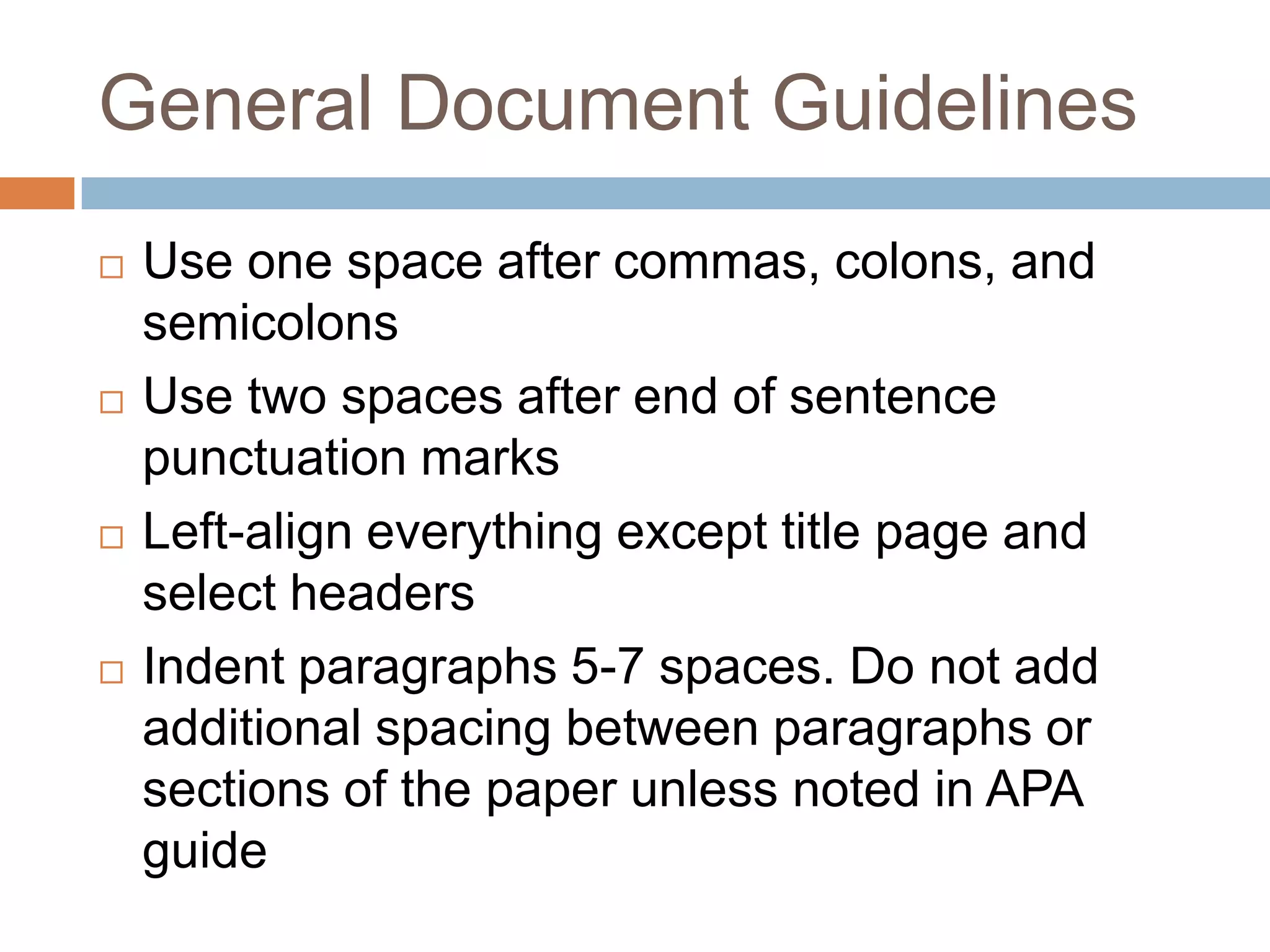
General Document GuidelinesFormat to have one inch margins on each sideUse 12pt Times New Roman FontDouble space the entire paper (incl. title, abstract, appendix, references, footnotes, tables)Spacing after punctuation: one space after commas, colons, and semicolons; two spaces after periodsOrder of pages: Title page, Abstract, Body, References, Footnotes, Tables, Figures, AppendicesLeft-align everything except title page and select headersIndent paragraphs 5-7 spaces. Do not add additional spacing between paragraphs
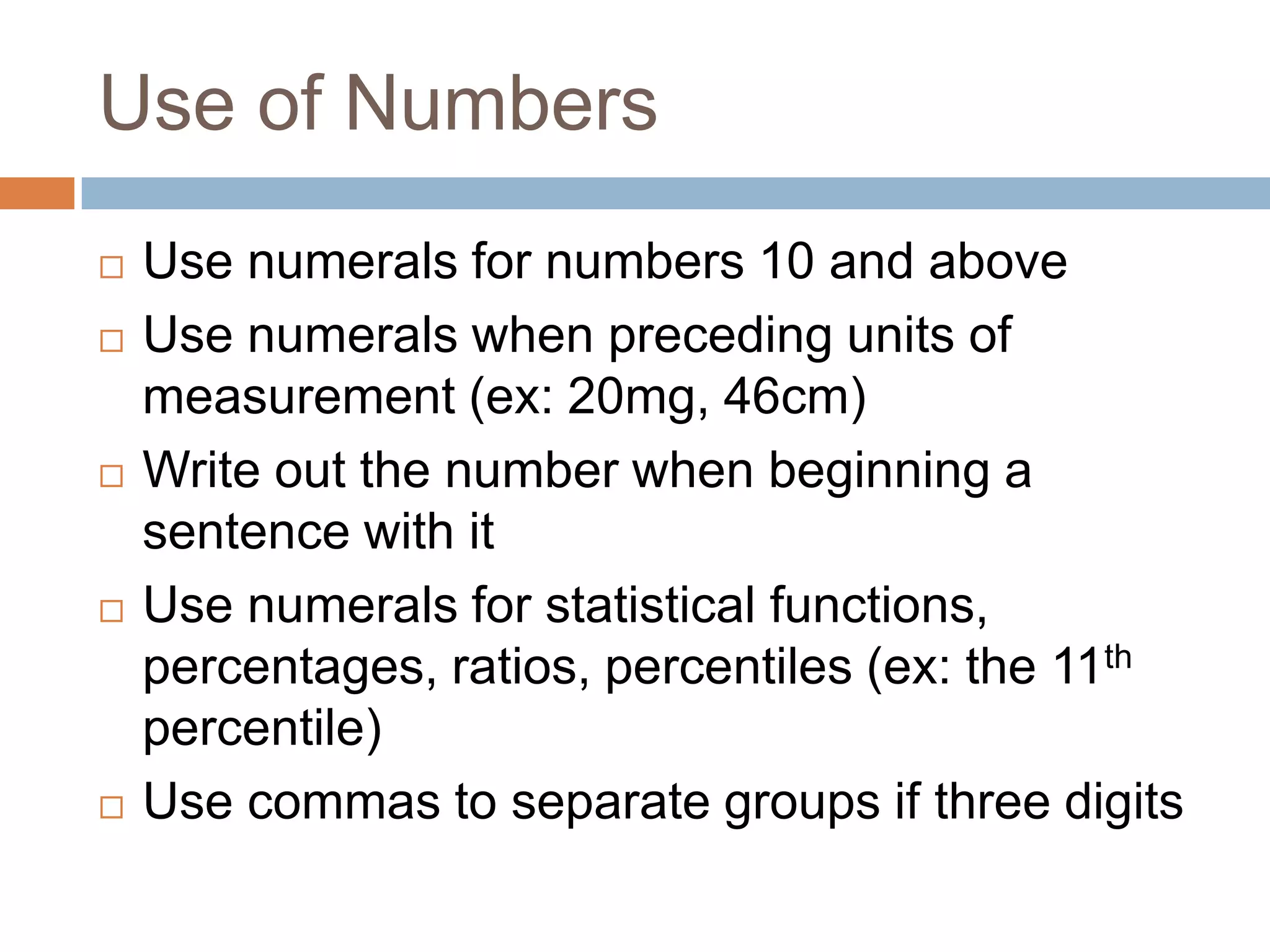
Use of NumbersUse numerals for numbers 10 and aboveUse numerals when preceding units of measurementEx: 20mg, 46cmWrite out the number when beginning a sentence with itExample: Twenty participants were randomly assigned…Use numerals for statistical functions, percentages, ratios, percentilesEx: the 11th percentileUse commas to separate groups if three digits
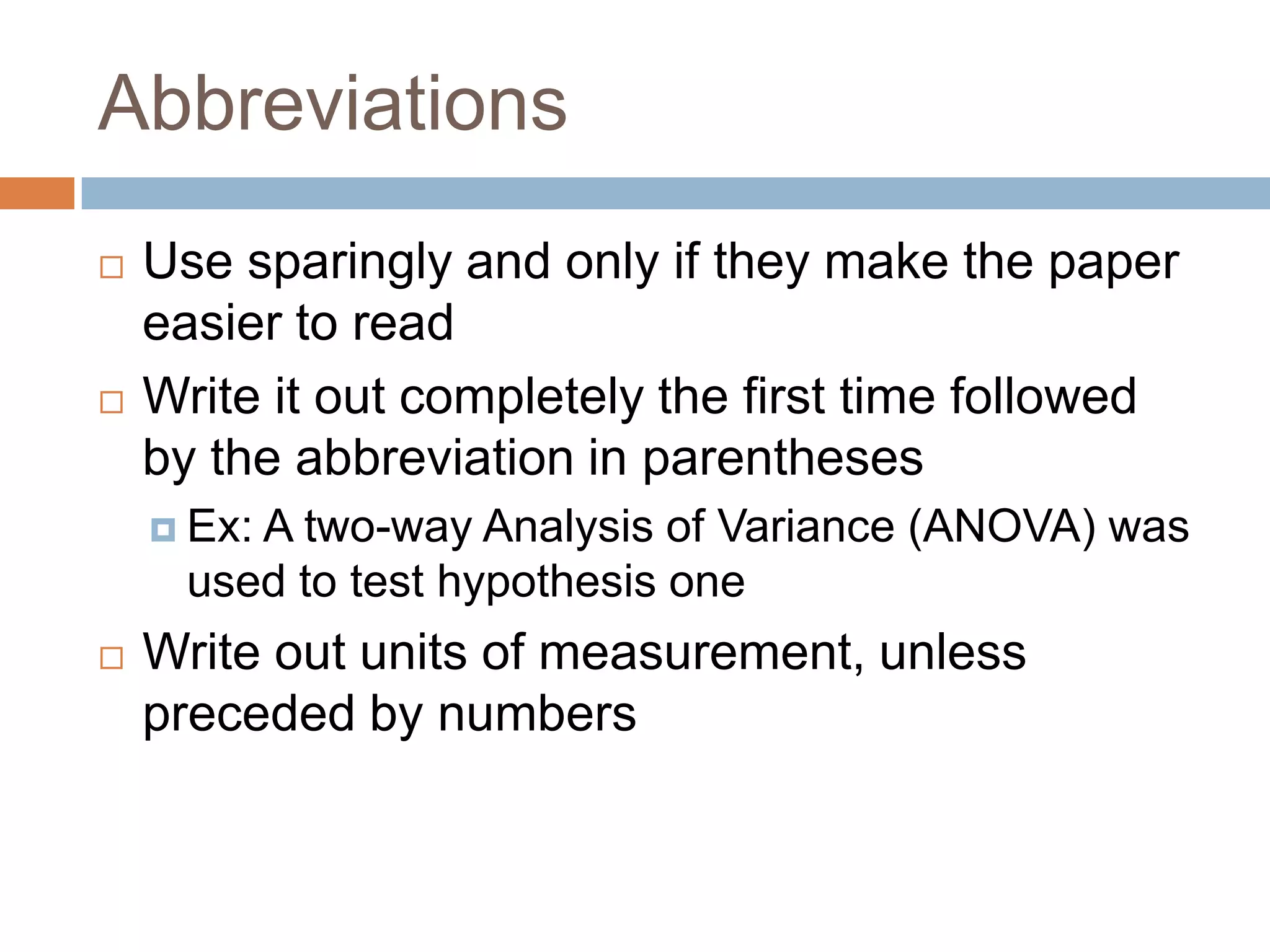
AbbreviationsUse sparingly and only if they make the paper easier to readWrite it out completely the first time followed by the abbreviation in parenthesesEx: A two-way Analysis of Variance (ANOVA) was used to test hypothesis oneWrite out units of measurement, unless preceded by numbers
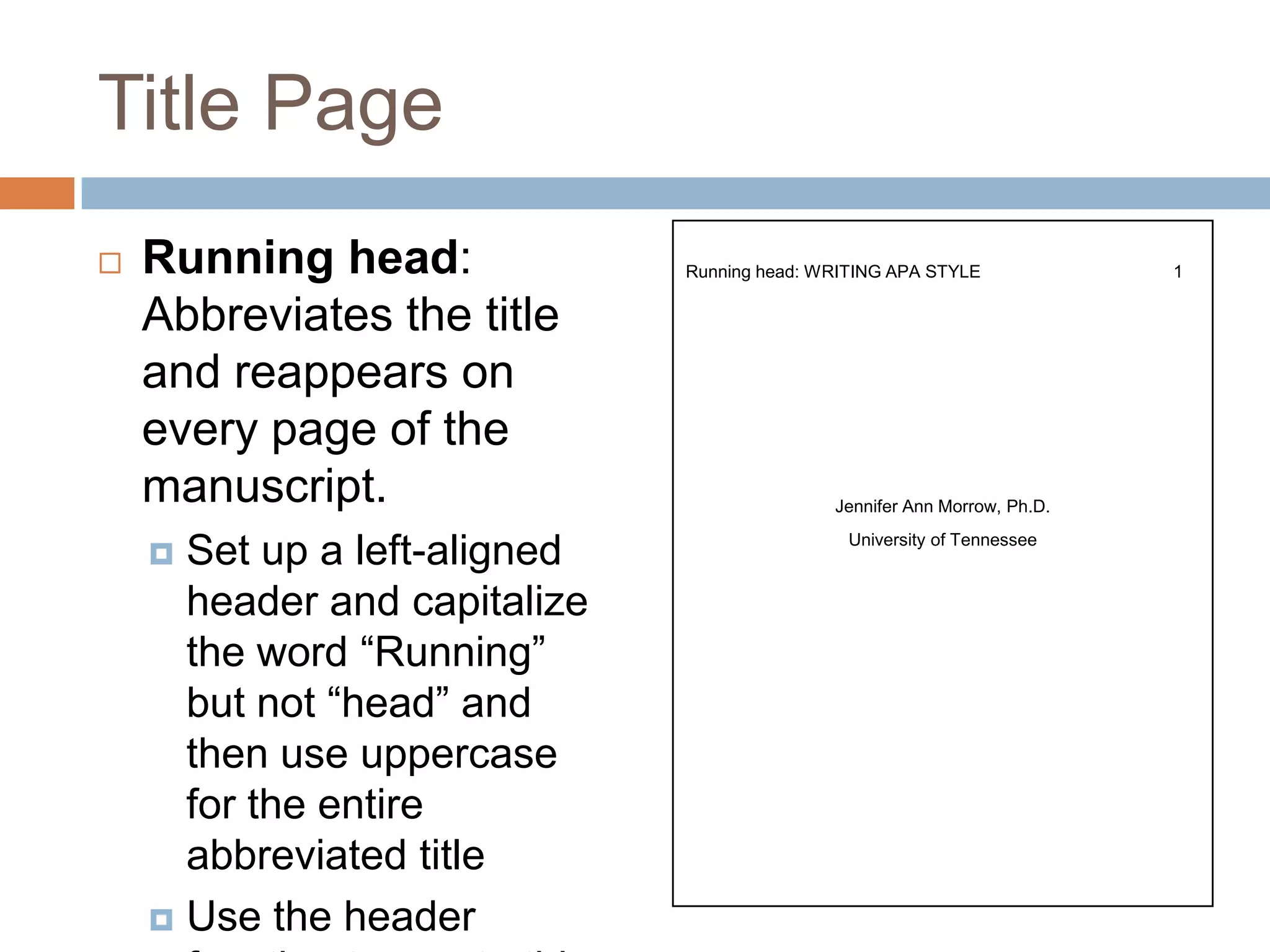
Title PageRunning head: Abbreviates the title and reappears on every page of the manuscriptSet up a left-aligned header and capitalize the word “Running” and “head” and the entire abbreviated title
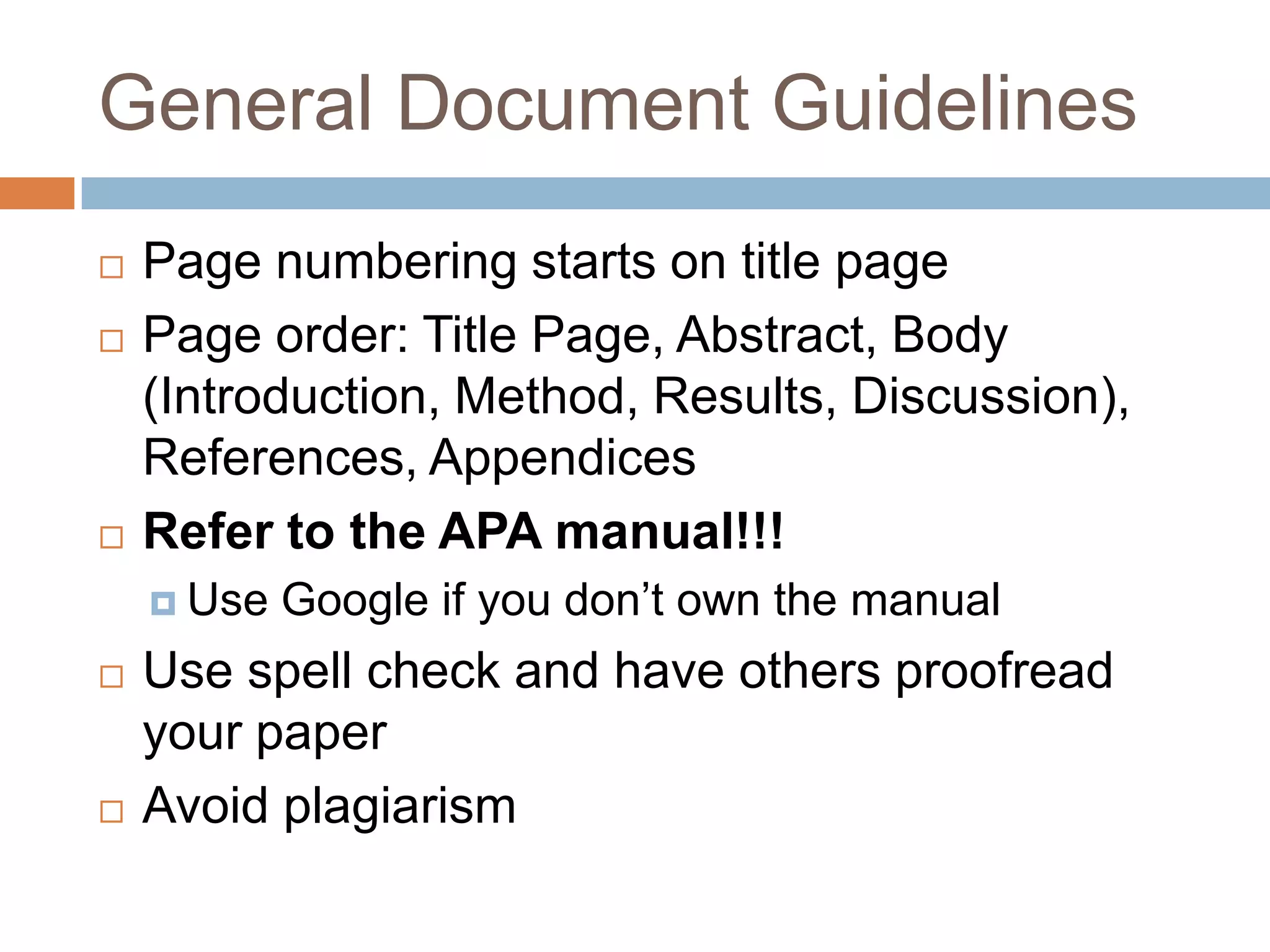
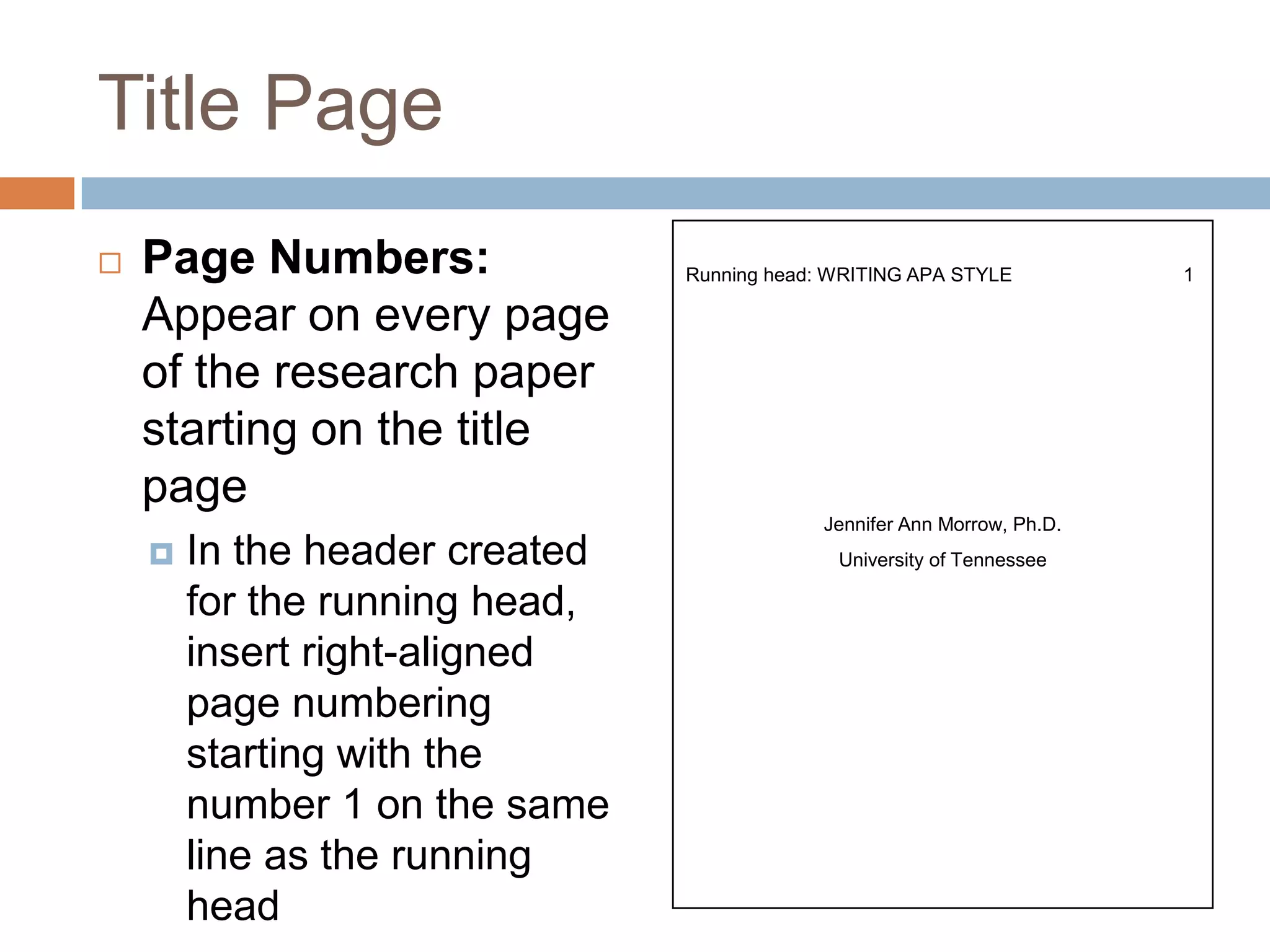
Title PagePage Numbers:Appears on every page of the research paper starting on the title pageIn the header created for the running head, insert right-aligned page numbering starting with the number 1 on the same line as the running head
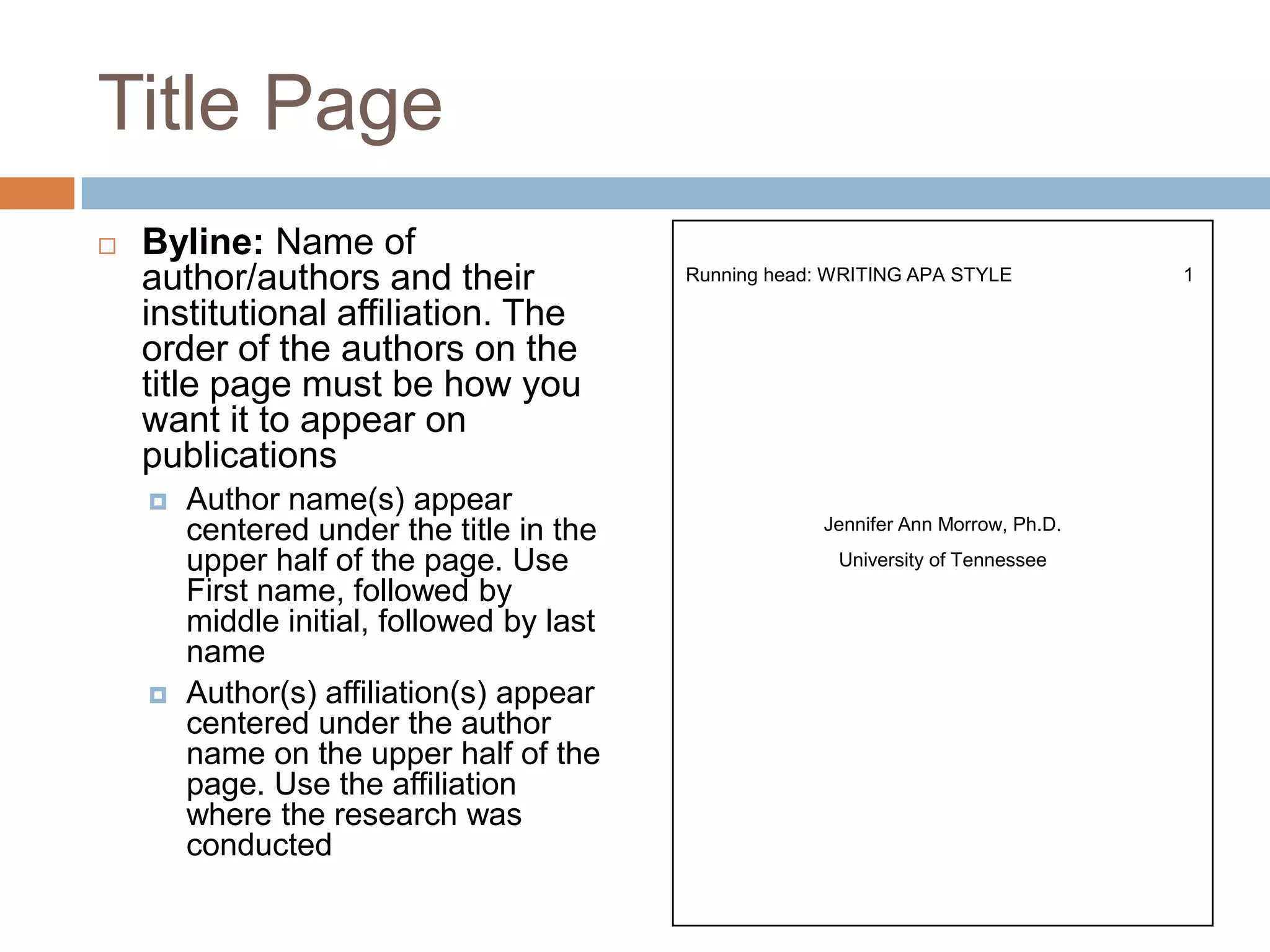
Title PageByline: Name of author/authors and their institutional affiliation. The order of the authors on the title page must be how you want it to appear on publicationsAuthor name(s) appear centered under the title in the upper half of the page. Use first name, followed by middle initial, followed by last nameAuthor(s) affiliation(s) appear centered under the author name on the upper half of the page. Use the affiliation where the research was conducted
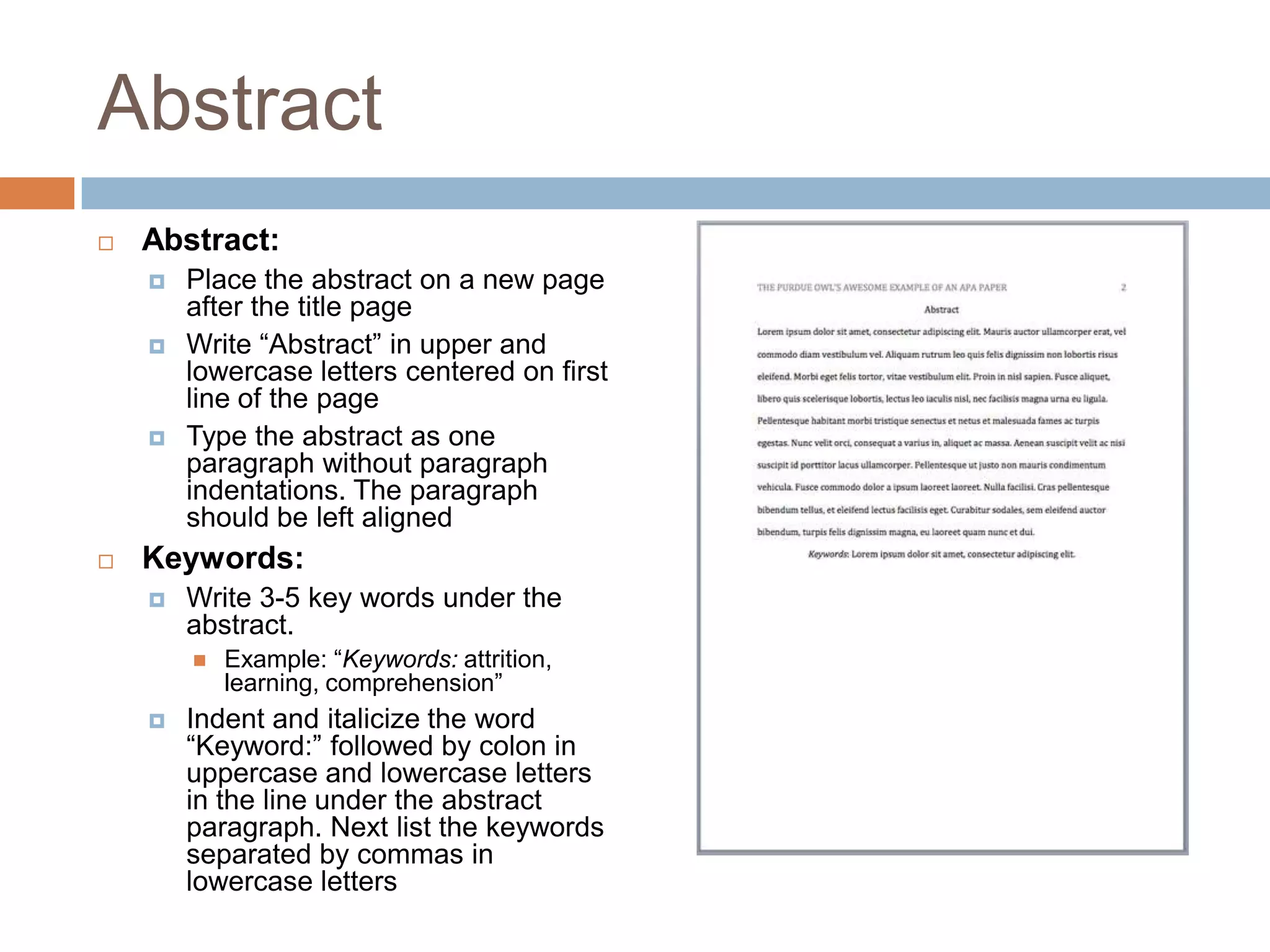
AbstractAbstract:Place the abstract on a new page after the title pageWrite “Abstract” in upper and lowercase letters centered on first line of the pageType the abstract as one paragraph without paragraph indentations. The paragraph should be left aligned. The Abstract should be 150-250 wordsKeywords:Write 3-5 key words under the abstractExample: “Keywords: attrition, learning, comprehension”Indent and italicize the word “Keyword:” followed by colon in uppercase and lowercase letters in the line under the abstract paragraph. Next list the keywords separated by commas in lowercase letters
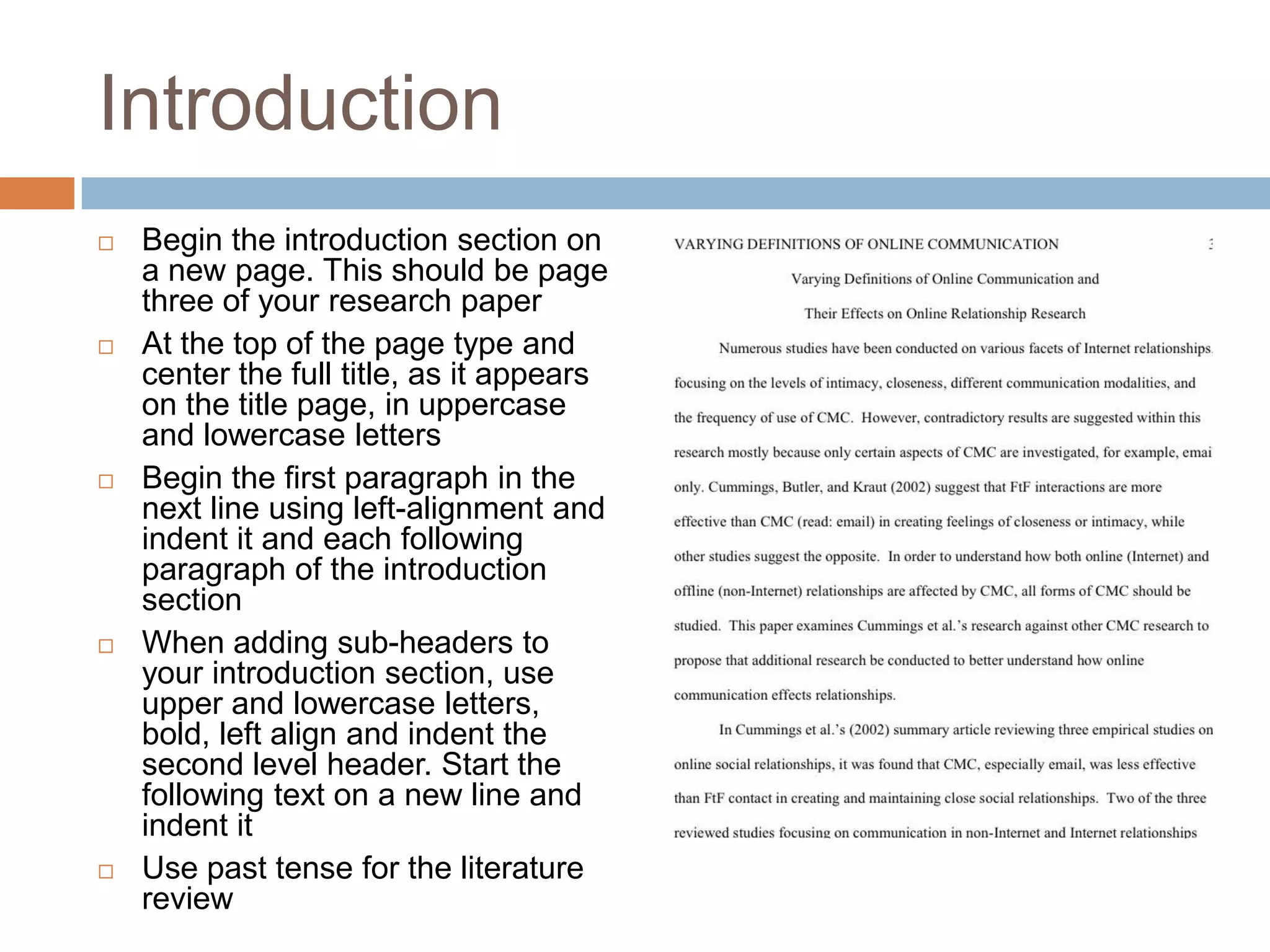
IntroductionBegin the introduction section on a new page. This should be page threeAt the top of the page type and center the full title, in uppercase and lowercase lettersBegin the first paragraph in the next line using left-alignment and indent it and each following paragraph of the introduction sectionWhen adding subheadings use upper and lowercase letters, bold, left align and indent for the second level header. Start the following text on a new line and indent itUse past tense for the literature review
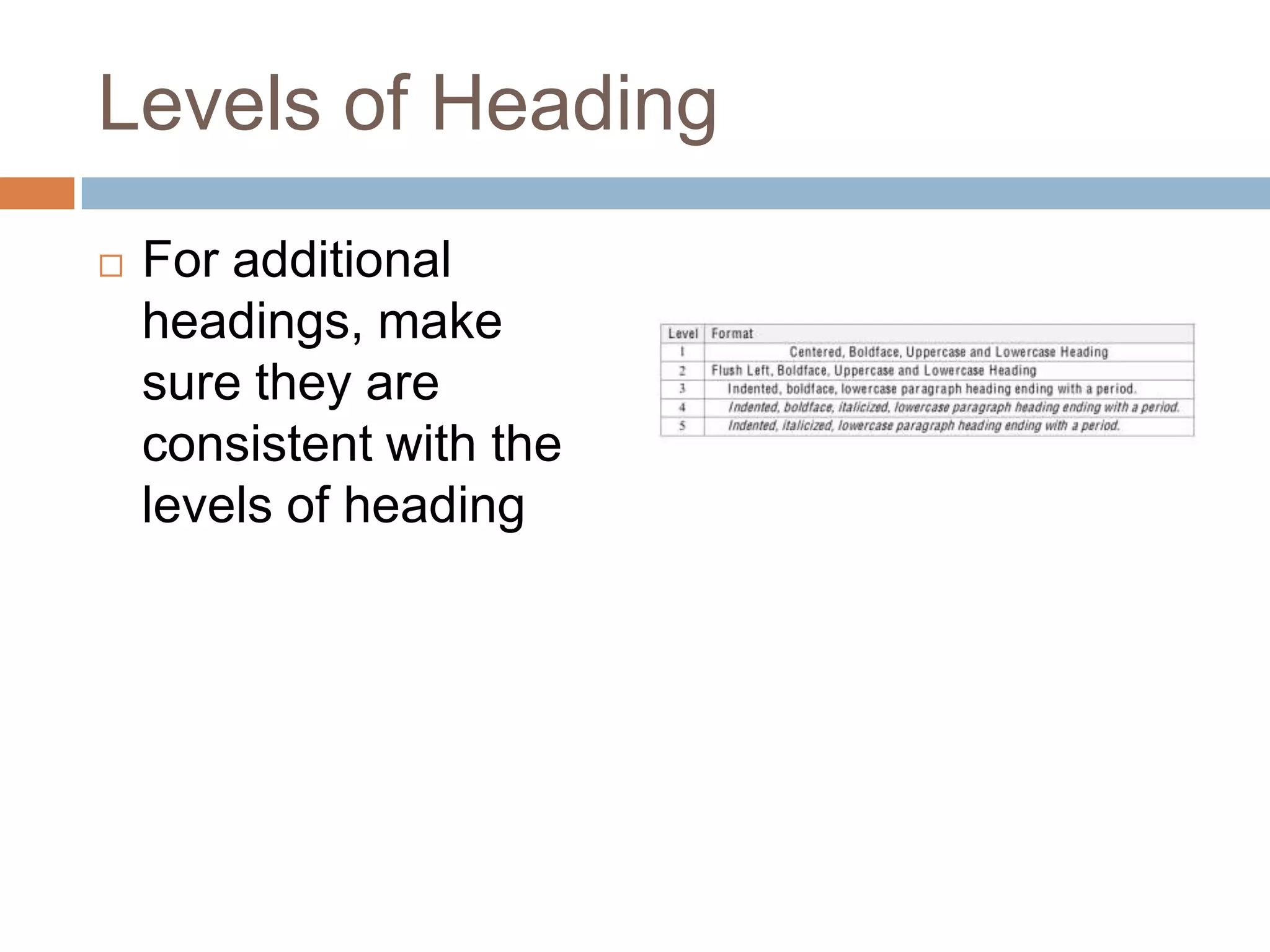
Levels of HeadingFor additional headings, make sure they are consistent with the levels of heading
Components of the Introduction Section1) Exploring the problemHere you draw the reader inSpecify problem leading into the study2) Discussing the previous literatureDiscuss relevant literature3) Deficiencies in the literatureWhat hasn’t been looked at?Leads into why you are doing your study4) Purpose of study and hypotheses/research questionsShould flow from the discussion of the literature
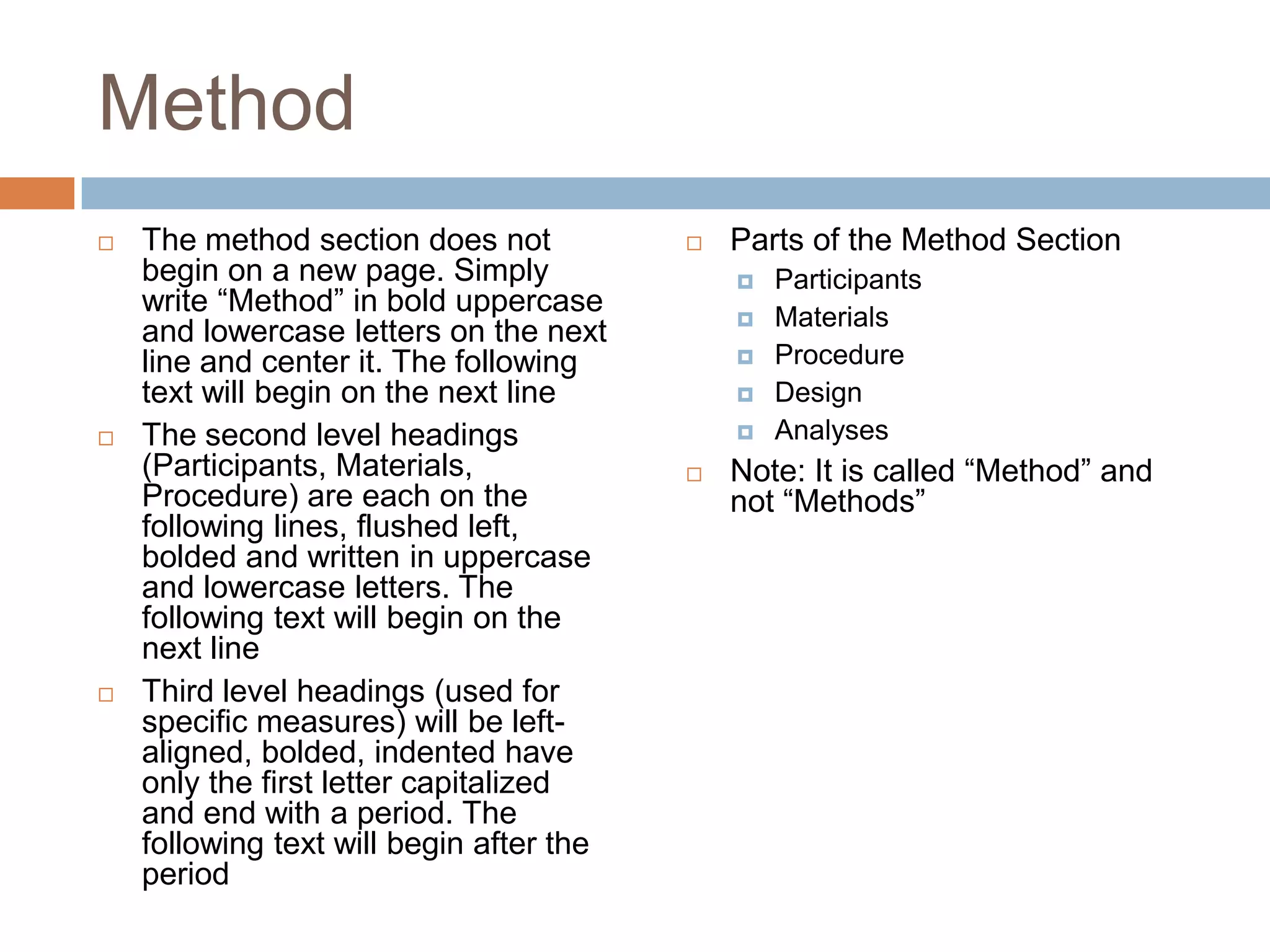
MethodThe method section does not begin on a new page. Simply write “Method” in bold uppercase and lowercase letters on the next line and center it. The following text will begin on the next lineThe second level headings (Participants, Measures, Design, Procedure, Proposed Analyses) are each on the following lines, flushed left, bolded and written in uppercase and lowercase letters. The following text will begin on the next lineThird level headings (used for specific measures) will be left-aligned, bolded, indented have only the first letter capitalized and end with a period. The following text will begin after the periodParts of the Method SectionParticipantsMeasuresAlso can be called: Materials, Instruments, or Apparatus depending on type of research projectProcedureDesignCan be combined with Participants or ProcedureAnalyses/Proposed AnalysesNote: It is called “Method” and not “Methods”
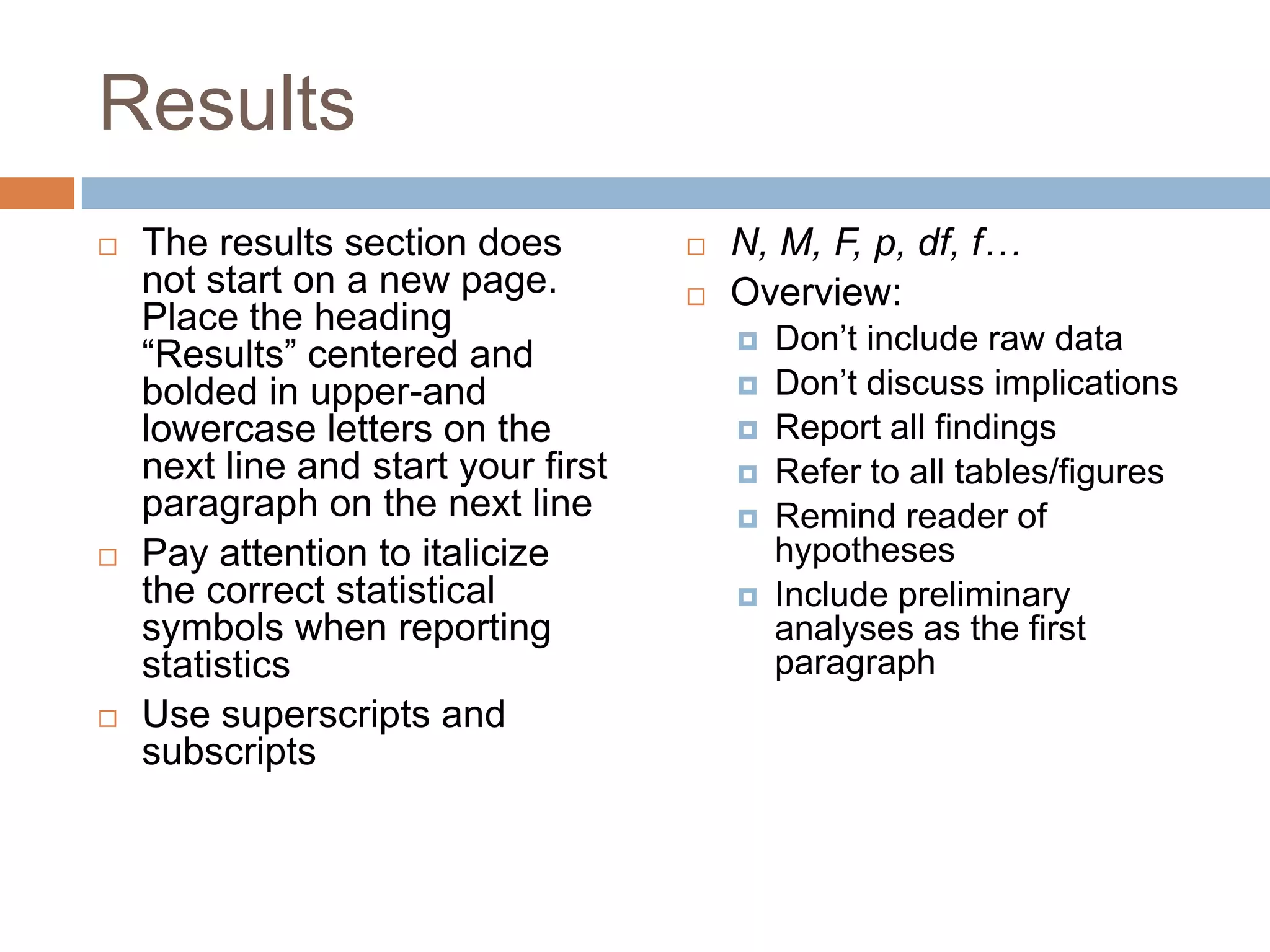
ResultsThe results section does not start on a new page. Place the heading “Results” centered and bolded in upper-and lowercase letters on the next line and start your first paragraph on the next lineRemember to italicize the correct statistical symbols when reporting statisticsUse superscripts and subscriptsItalicize: N, M, F, p, df,…Overview:Don’t include raw dataDon’t discuss implicationsReport all findings, those that are significant and those that are not significantInclude tablesRemind reader of hypothesesInclude preliminary analyses and dealing with assumptions as first paragraph
DiscussionThe discussion section does not start on a new page. Place the heading “Discussion” centered and bolded in upper-and lowercase letters on the next line and start your first paragraph on the next lineOverview:Gives meaning to the results State whether hypotheses were supported or not supportedAddress limitations, implications, and future researchRefer back to the literature
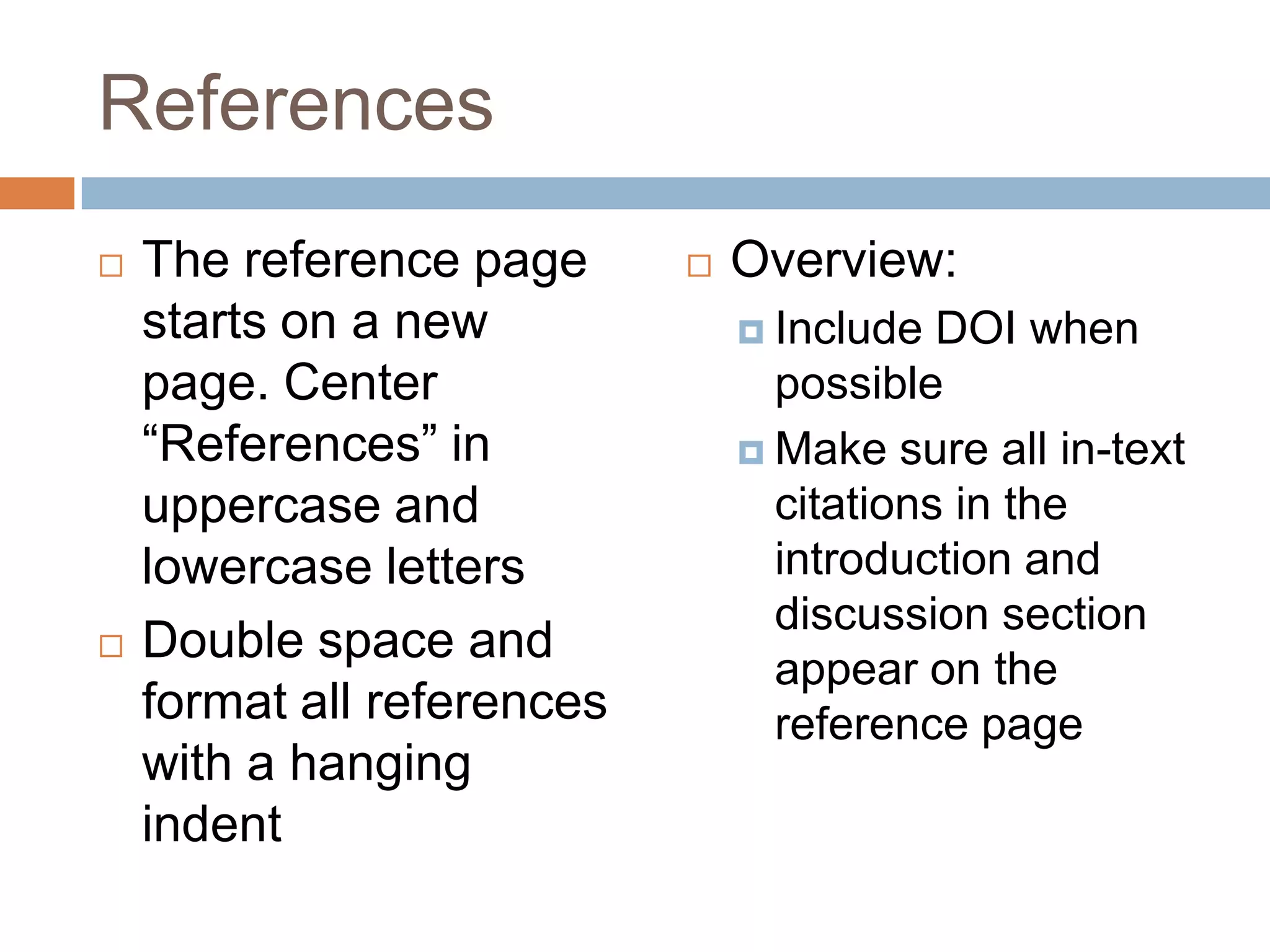
ReferencesThe reference page starts on a new page. Center “References” in uppercase and lowercase lettersDouble space and format all references with a hanging indentOverview:Include DOI when possible [http://www.crossref.org/SimpleTextQuery/]Make sure all in-text citations in the introduction and discussion section appear on the reference page
References – Journal ArticlesGeneral Form:Author, A. A., Author, B. B., & Author, C. C. (Year). Title of article. Title of Journal, xx, xxx-xxx.One AuthorWilliams, J. H. (2008). Employee engagement: Improving participation in safety. Professional Safety, 53(12), 40-45.
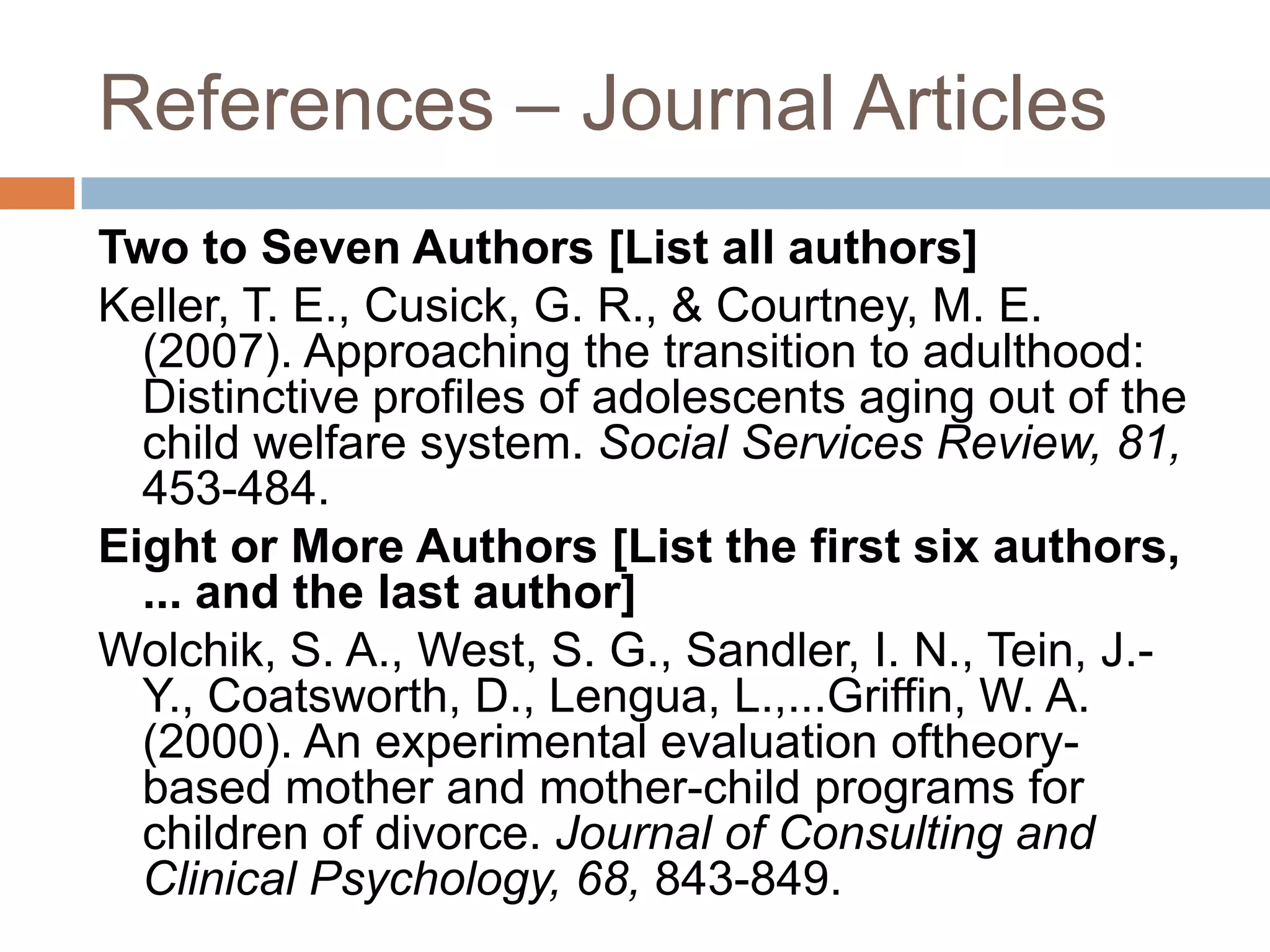
References – Journal ArticlesTwo to Seven Authors [List all authors]Keller, T. E., Cusick, G. R., & Courtney, M. E. (2007). Approaching the transition to adulthood: Distinctive profiles of adolescents aging out of the child welfare system. Social Services Review, 81, 453-484.Eight or More Authors [List the first six authors, ... and the last author]Wolchik, S. A., West, S. G., Sandler, I. N., Tein, J.-Y., Coatsworth, D.,Lengua, L.,...Griffin, W. A. (2000). An experimental evaluation of theory-based mother and mother-child programs for children of divorce. Journal of Consulting and Clinical Psychology, 68, 843-849.
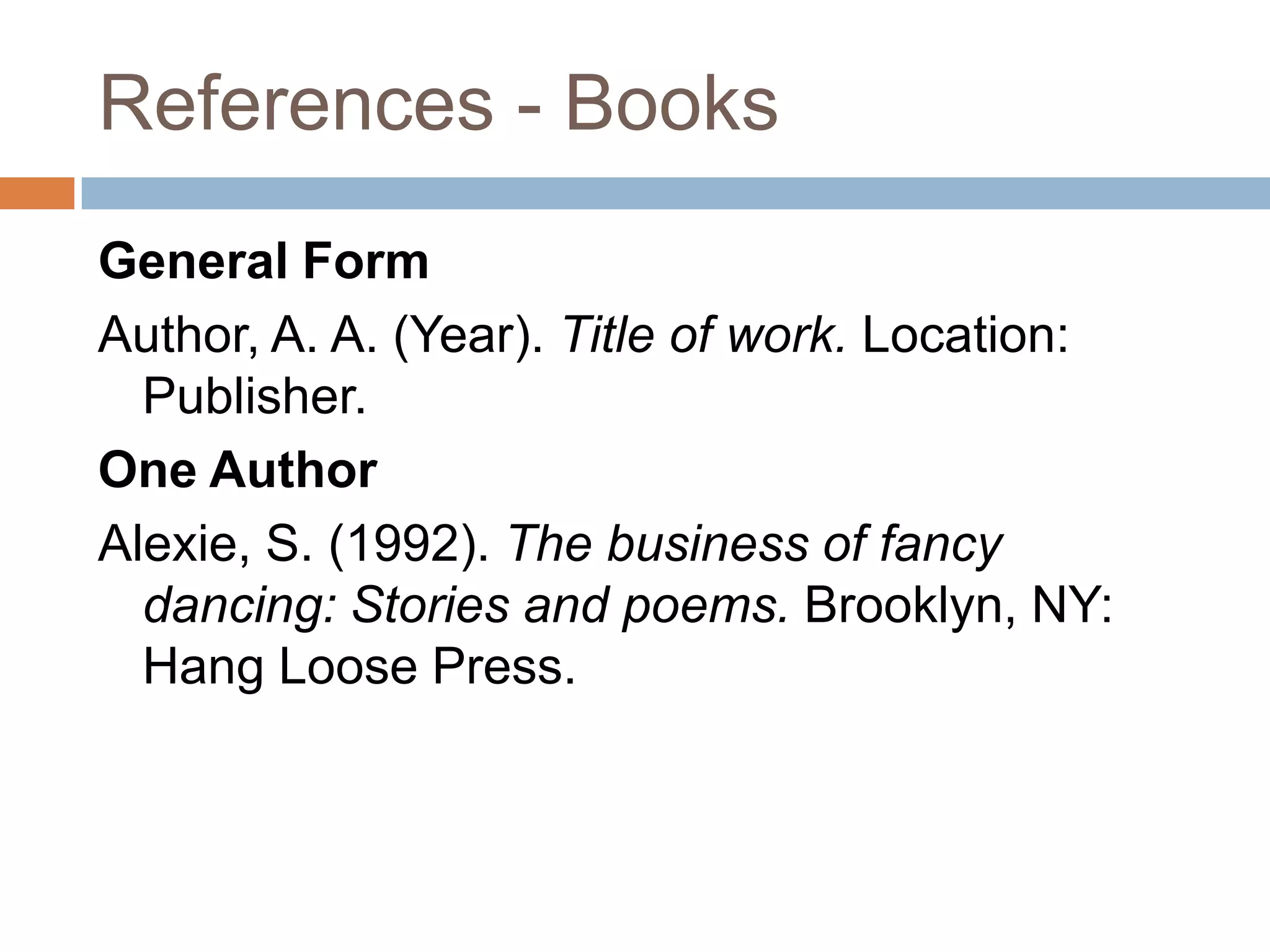
References - BooksGeneral FormAuthor, A. A. (Year). Title of work. Location: Publisher.One AuthorAlexie, S. (1992). The business of fancy dancing: Stories and poems. Brooklyn, NY: Hang Loose Press.
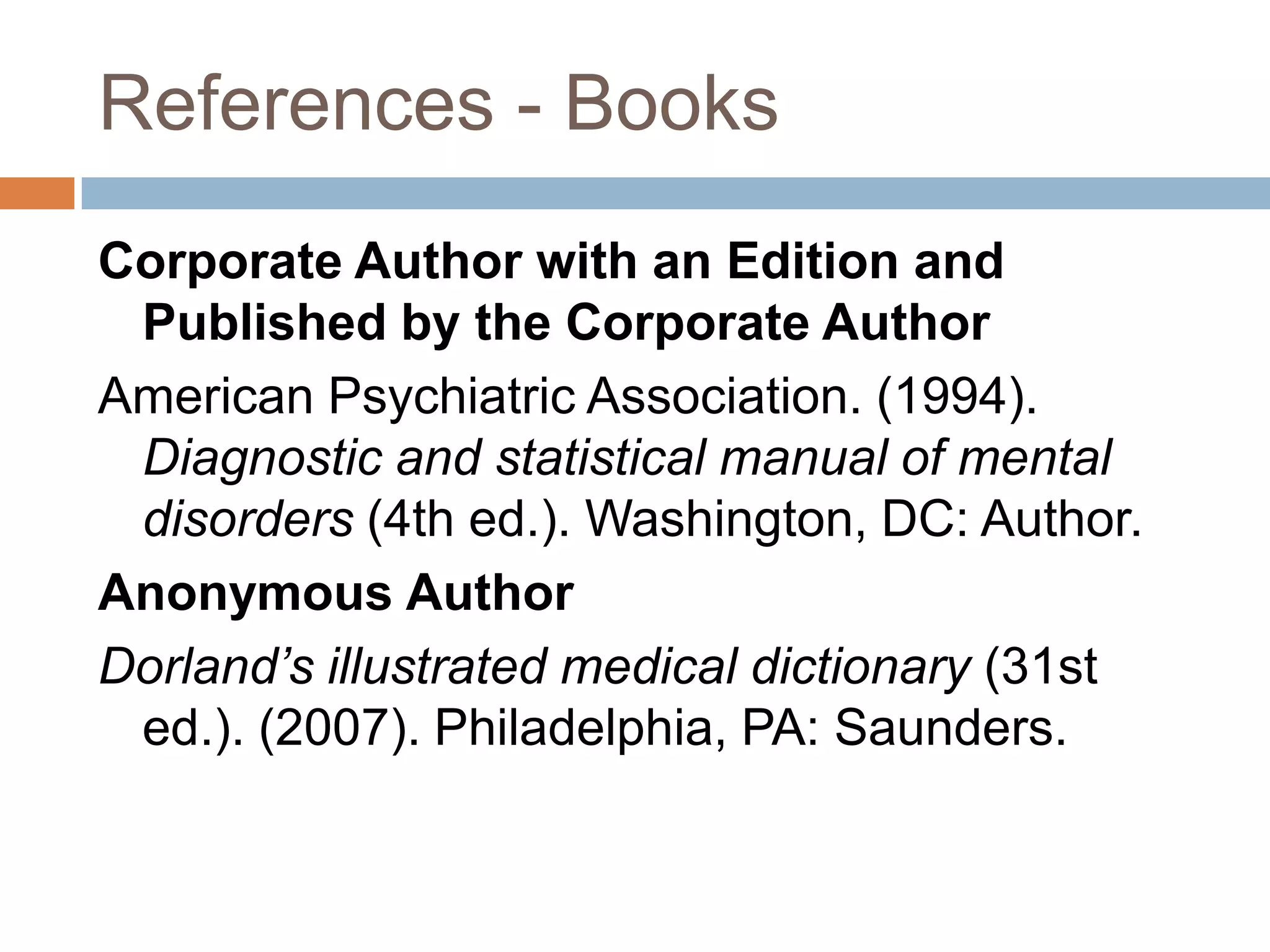
References - BooksCorporate Author with an Edition and Published by the Corporate AuthorAmerican Psychiatric Association. (1994). Diagnostic and statistical manual of mental disorders (4th ed.). Washington, DC: Author.Anonymous AuthorDorland’s illustrated medical dictionary (31st ed.). (2007). Philadelphia, PA: Saunders.
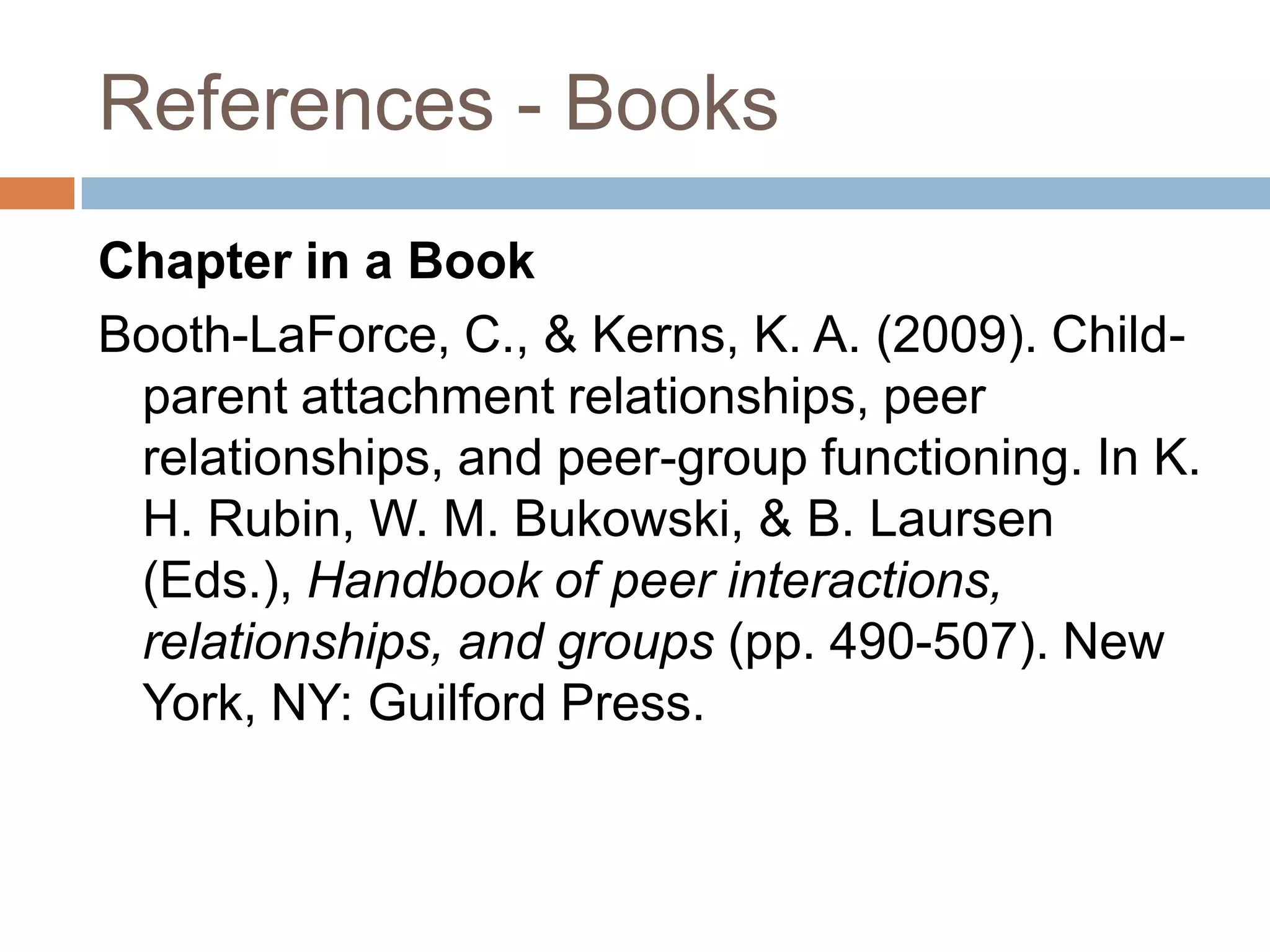
References - BooksChapter in a BookBooth-LaForce, C., & Kerns, K. A. (2009). Child-parent attachment relationships, peer relationships, and peer-group functioning. In K. H. Rubin, W. M. Bukowski, & B. Laursen (Eds.), Handbook of peer interactions, relationships, and groups (pp. 490-507). New York, NY: Guilford Press.
References – ERIC DocumentShyyan, V., Thurlow, M., & Liu, K. (2005). Student perceptions of instructional strategies: Voices of English language learners with disabilities. Minneapolis, MN: National Center on Educational Outcomes, University of Minnesota. Retrieved from the ERIC database (ED495903)
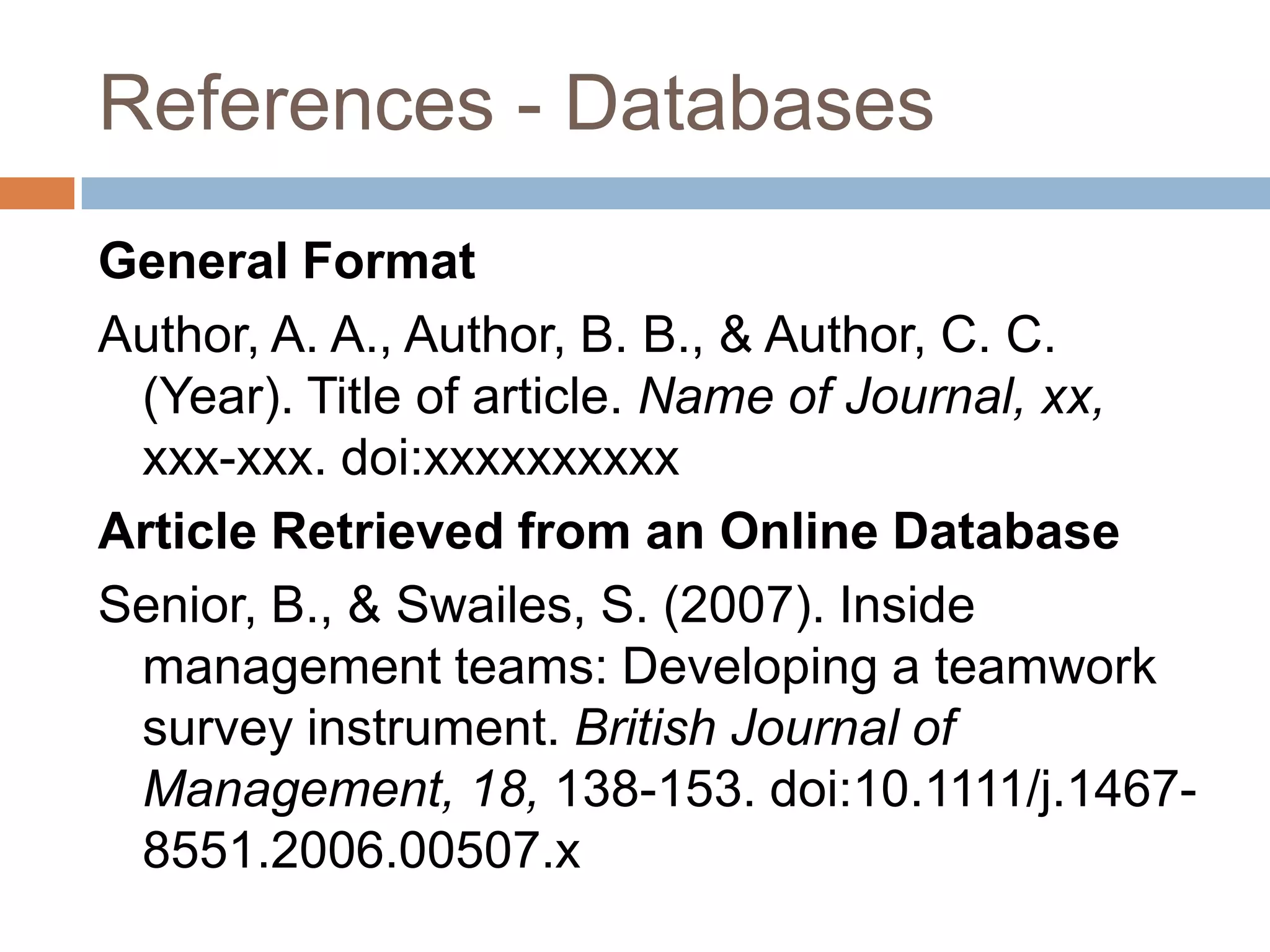
References - DatabasesGeneral Format Author, A. A., Author, B. B., & Author, C. C. (Year). Title of article. Name of Journal, xx, xxx-xxx. doi:xxxxxxxxxxArticle Retrieved from an Online DatabaseSenior, B., & Swailes, S. (2007). Inside management teams: Developing a teamwork survey instrument. British Journal of Management, 18, 138-153. doi:10.1111/j.1467-8551.2006.00507.x
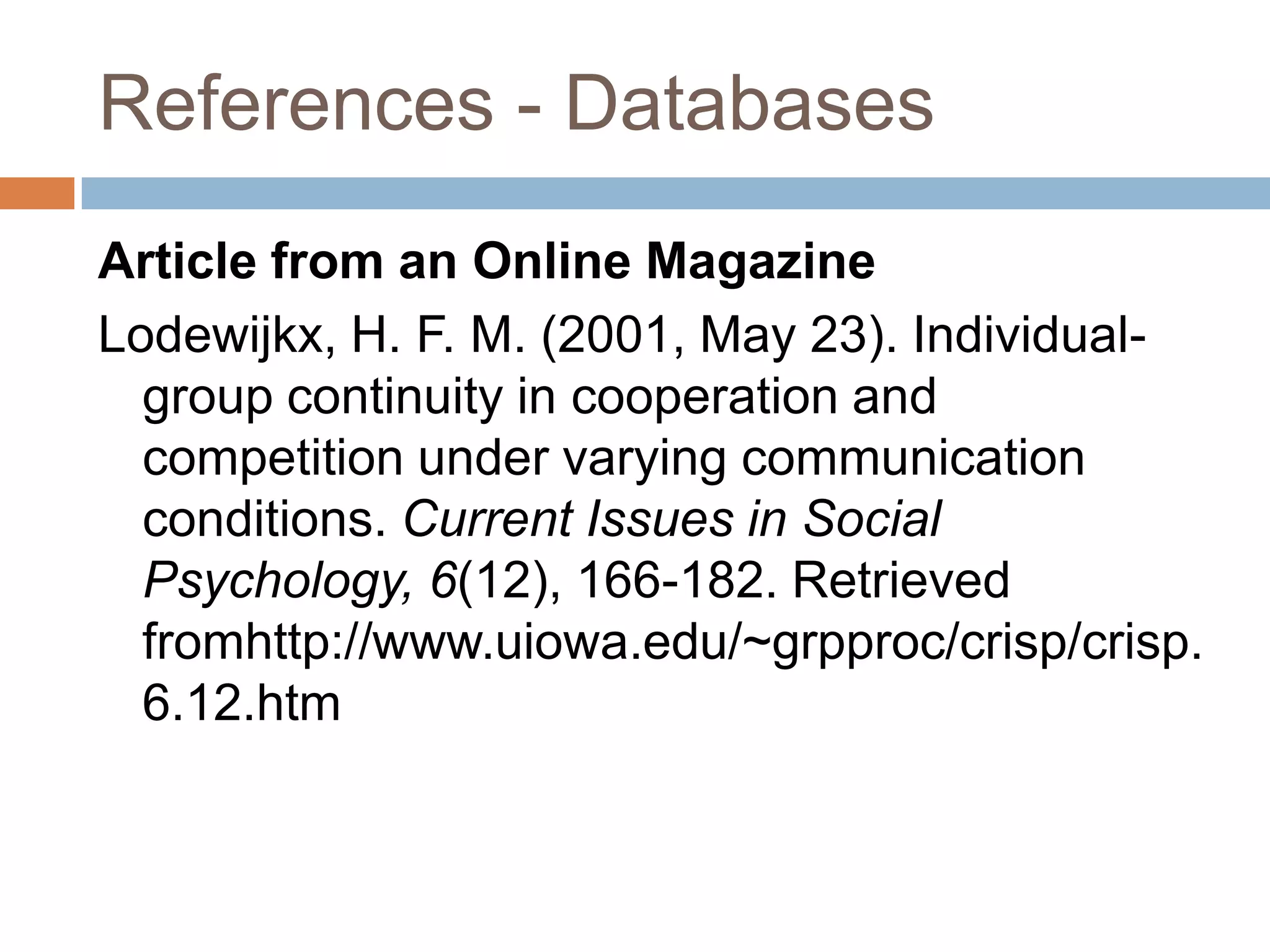
References - DatabasesArticle from an Online MagazineLodewijkx, H. F. M. (2001, May 23). Individual-group continuity in cooperation and competition under varying communication conditions. Current Issues in Social Psychology, 6(12), 166-182. Retrieved fromhttp://www.uiowa.edu/~grpproc/crisp/crisp.6.12.htm
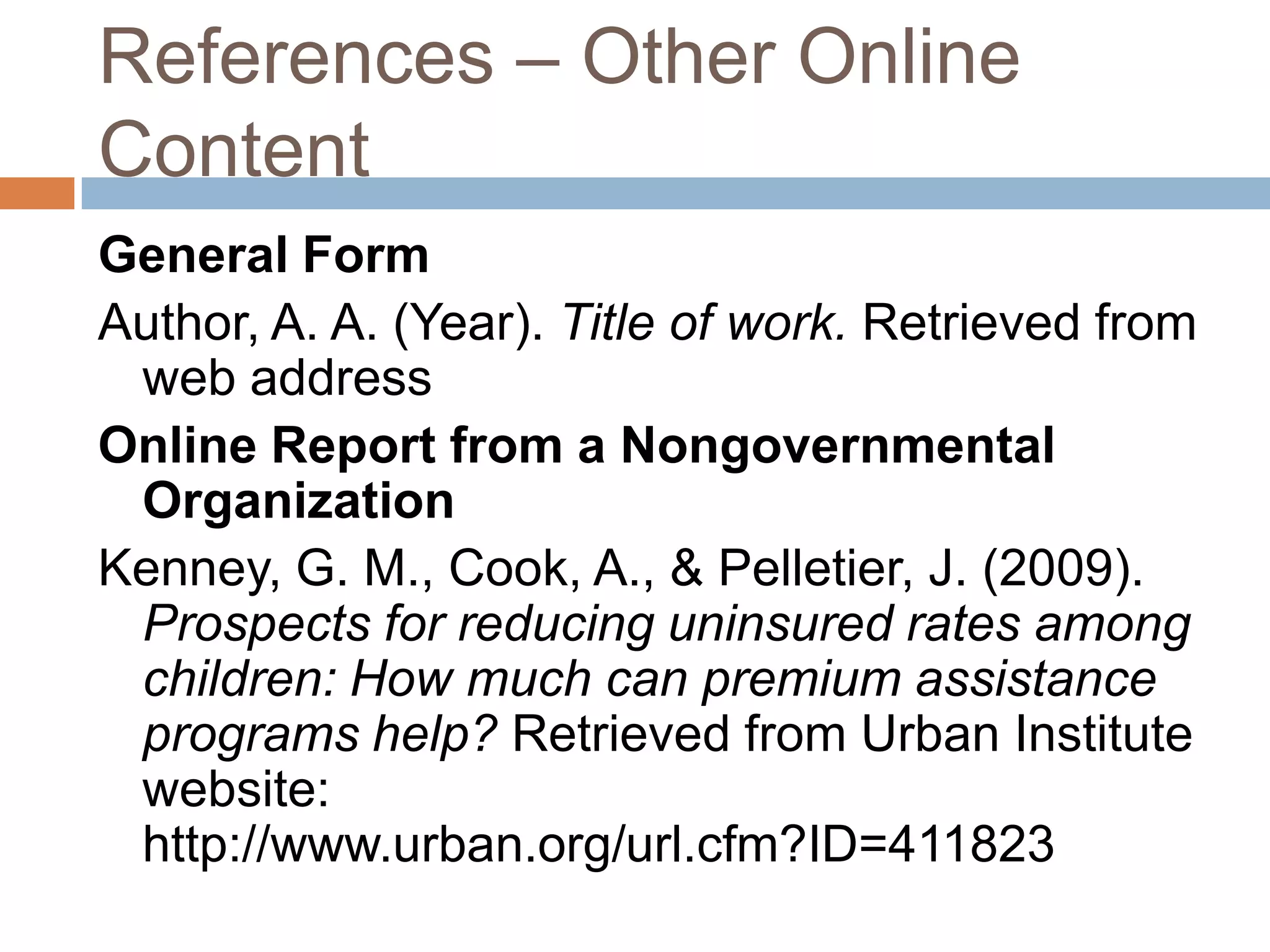
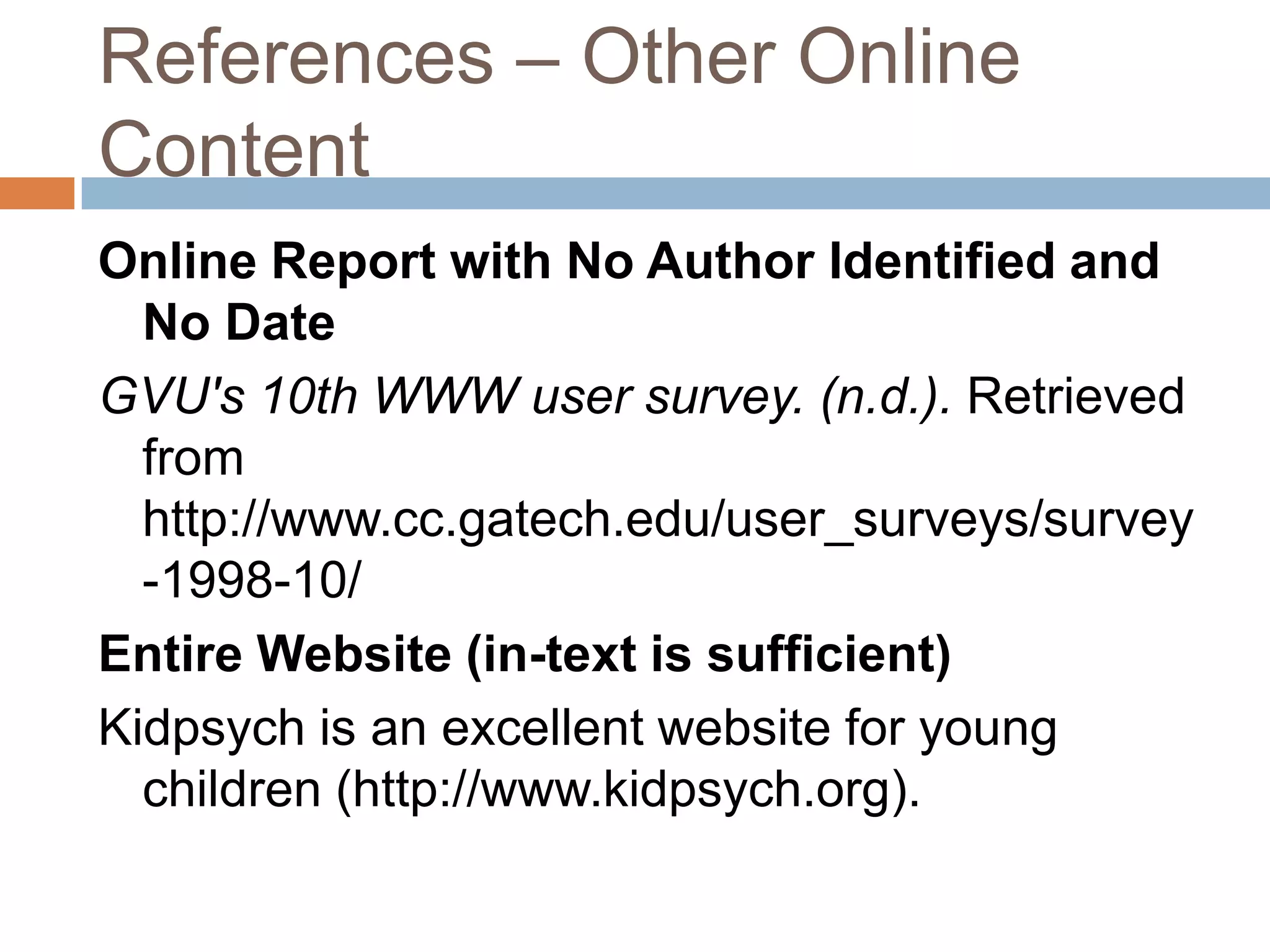
References – Other Online ContentGeneral FormAuthor, A. A. (Year). Title of work. Retrieved from web addressOnline Report from a Nongovernmental OrganizationKenney, G. M., Cook, A., & Pelletier, J. (2009). Prospects for reducing uninsured rates among children: How much can premium assistance programs help? Retrieved from Urban Institute website: http://www.urban.org/url.cfm?ID=411823
References – Other Online ContentOnline Report with No Author Identified and No DateGVU's 10th WWW user survey. (n.d.). Retrieved from http://www.cc.gatech.edu/user_surveys/survey-1998-10/Entire Website (in-text is sufficient)Kidpsych is an excellent website for young children (http://www.kidpsych.org).
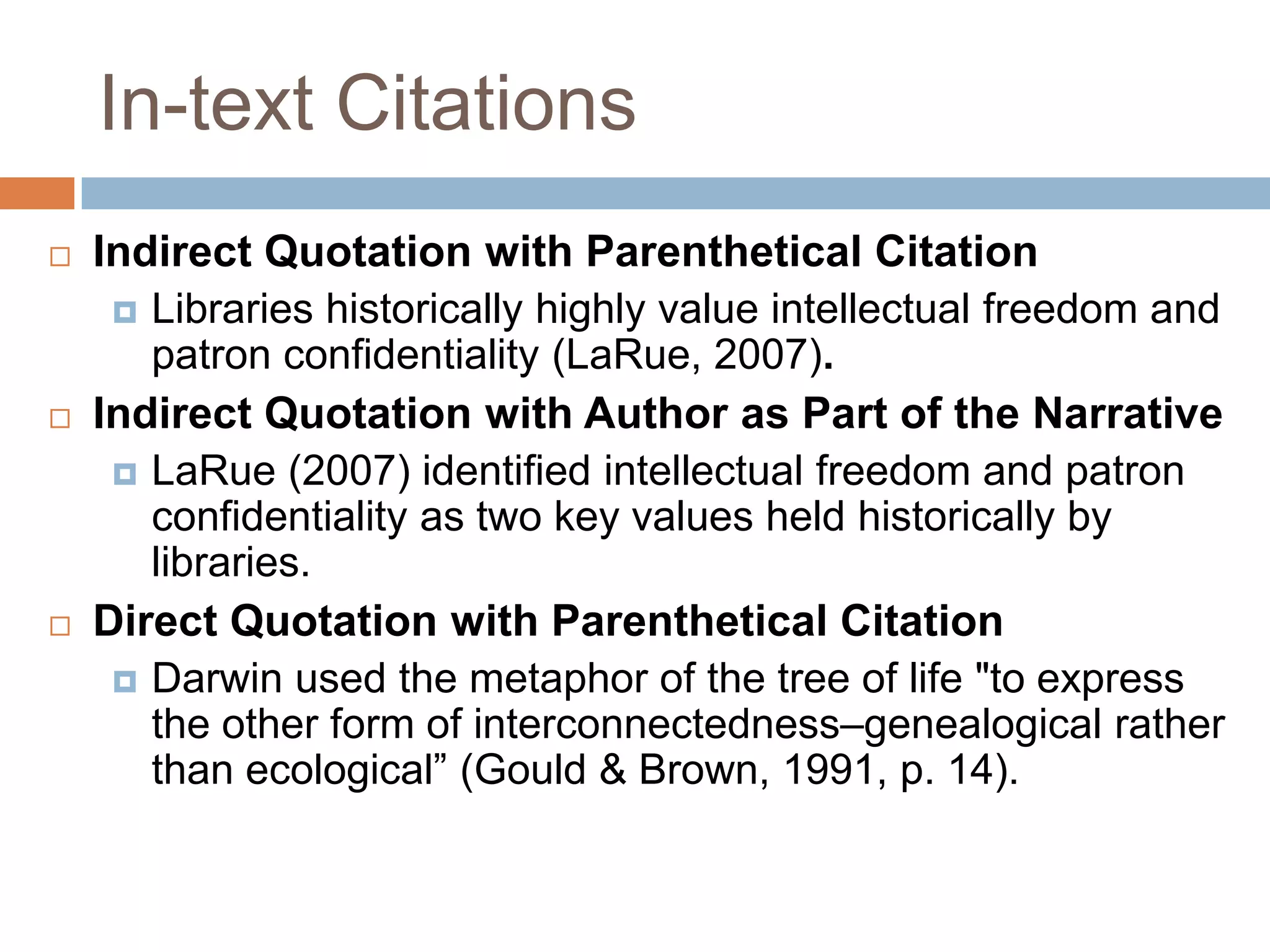
In-text CitationsIndirect Quotation with Parenthetical CitationLibraries historically highly value intellectual freedom and patron confidentiality (LaRue, 2007)Indirect Quotation with Author as Part of the NarrativeLaRue (2007) identified intellectual freedom and patron confidentiality as two key values held historically by librariesDirect Quotation with Parenthetical CitationDarwin used the metaphor of the tree of life "to express the other form of interconnectedness–genealogical rather than ecological” (Gould & Brown, 1991, p. 14)
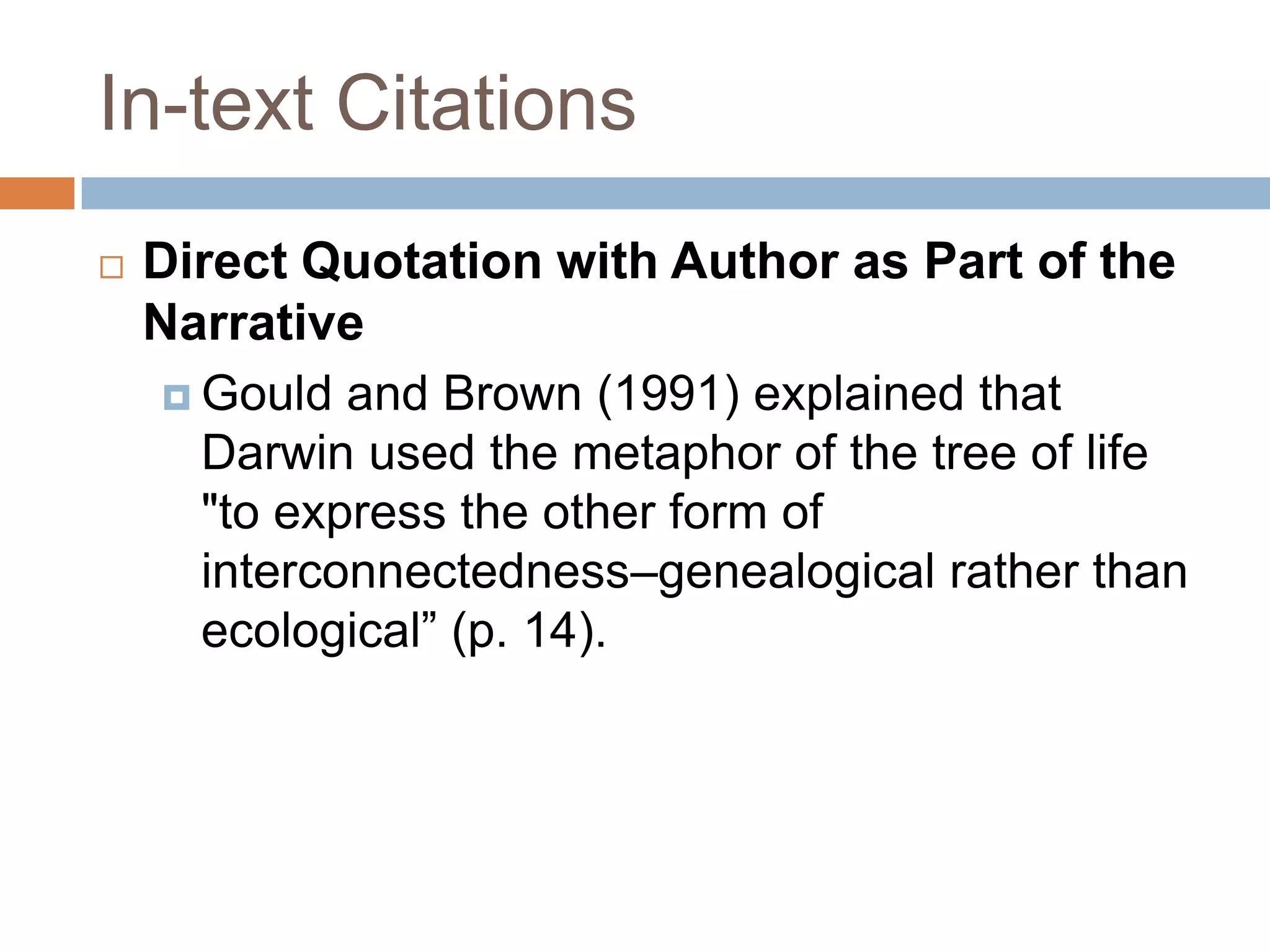
In-text CitationsDirect Quotation with Author as Part of the NarrativeGould and Brown (1991) explained that Darwin used the metaphor of the tree of life "to express the other form of interconnectedness–genealogical rather than ecological” (p. 14).
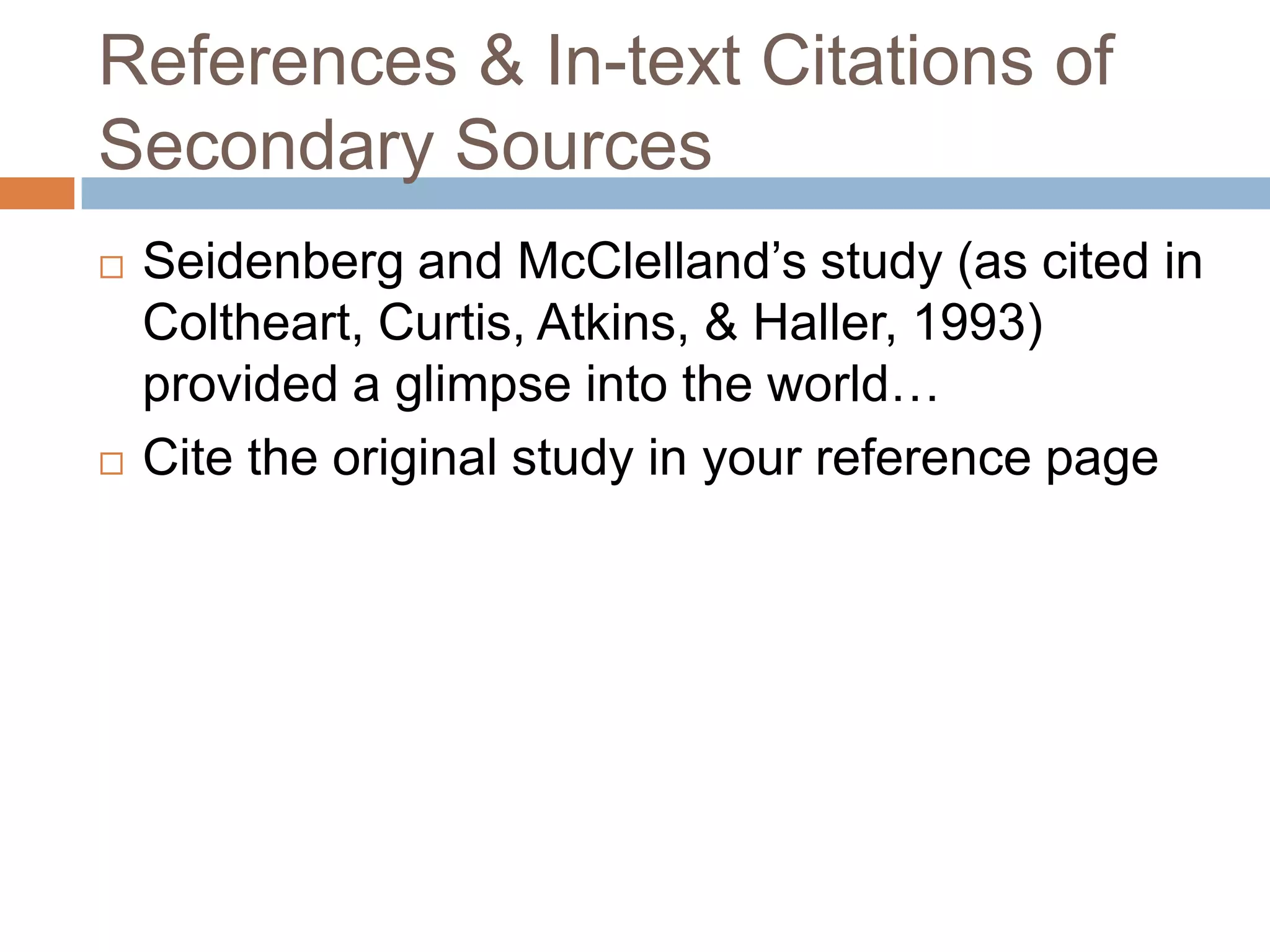
References & In-text Citations of Secondary SourcesSeidenberg and McClelland’s study (as cited in Coltheart, Curtis, Atkins, & Haller, 1993) provided a glimpse into the world…Cite the secondary source (the article that you actually read)in your reference pageEx: in the above example you would include Coltheart et al. in your references
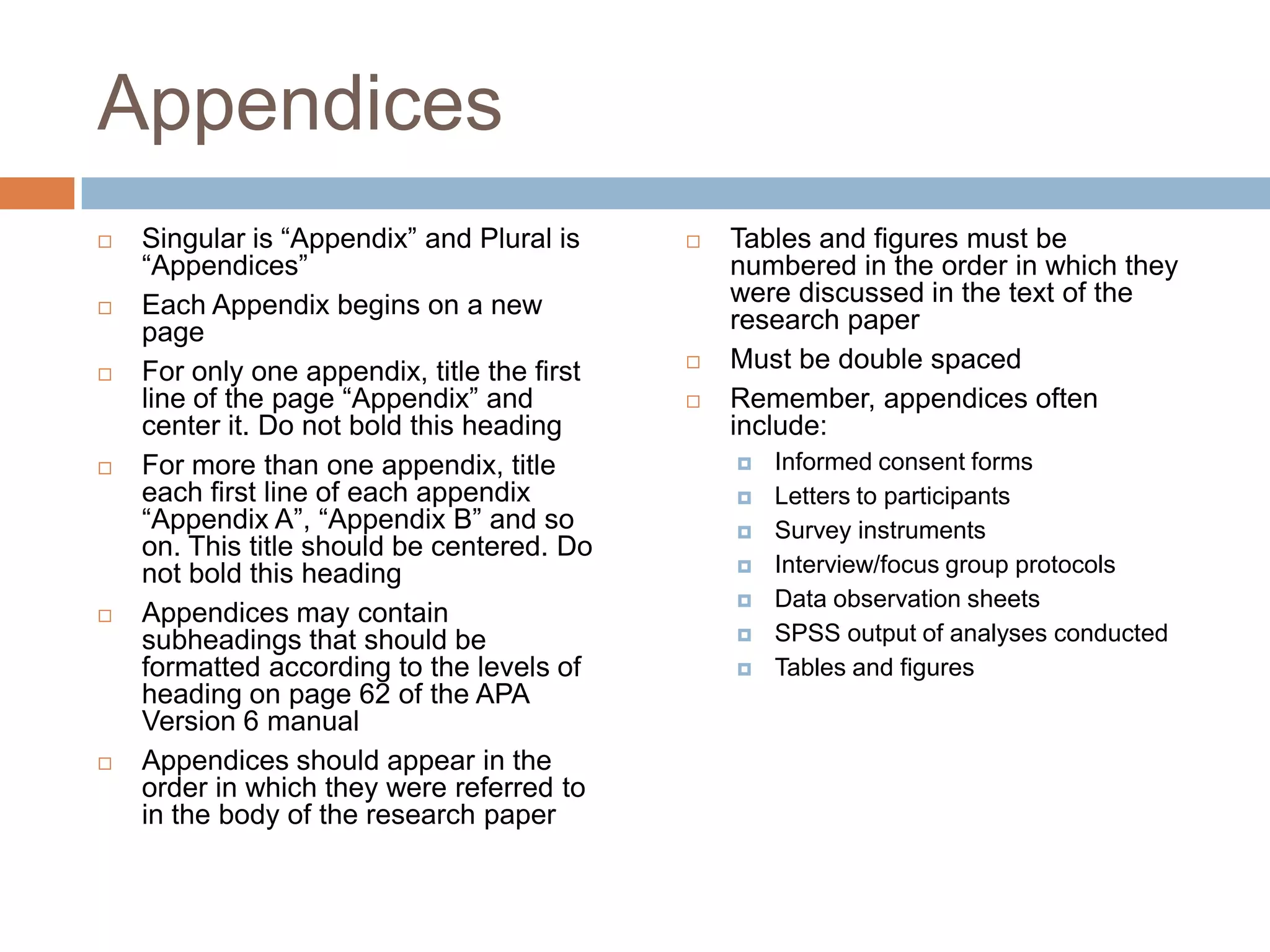
AppendicesSingular is “Appendix” and Plural is “Appendices”Each Appendix begins on a new pageFor only one appendix, title the first line of the page “Appendix” and center it. Do not bold this headingFor more than one appendix, title each first line of each appendix “Appendix A”, “Appendix B” and so on. This title should be centered. Do not bold this headingAppendices may contain subheadings that should be formatted according to the levels of heading on page 62 of the APA Version 6 manualAppendices should appear in the order in which they were referred to in the body of the research paperTables and figures must be numbered in the order in which they were discussed in the text of the research paperMust be double spacedRemember, appendices often include:Tables and figuresThese should appear before other appendicesInformed consent formsLetters to participantsSurvey instrumentsInterview/focus group protocolsData observation sheetsSPSS output of analyses conducted
Presentation Referenceshttp://owl.english.purdue.edu/owl/resource/560/01/http://www2.yk.psu.edu/learncenter/apa-july-09.pdfhttp://www.calstatela.edu/library/guides/3apa.pdfhttp://www.vanguard.edu/faculty/ddegelman/detail.aspx?doc_id=796APA Manual, Version 6, 2nd PrintingAPA Format Made Easy Presentation by Cady BlockAPA Format Presentation by Susanne Kaesbauer

APA Version 6 Quick Guide

  • 1.
    APA Format QuickReference6th EditionEDPY 582Jennifer Ann Morrow and Susanne KaesbauerThe University of Tennessee
  • 2.
    OverviewAPA is theofficial style of writing of the American Psychological Association (APA)Used to present findings and arguments in a coherent and concise mannerAPA is often used in social sciencesAPA dictates the structure of the writingEasier to write and readCritical thinkingRequired for professional publications
  • 3.
    General Document GuidelinesLimitthe use of the first person, instead use third personExamples: the researcher, they, the experimenterYou cannot prove a theory or hypothesisAvoid the words “proves” and “proof”Instead use “the results support/does not support the hypothesis” or “the results confirm/disconfirm the hypothesis”Avoid slang termsUse terms “participants” for humans and “subjects” for animals
  • 4.
    General Document GuidelinesFormatto have one inch margins on each sideUse 12pt Times New Roman FontDouble space the entire paper (incl. title, abstract, appendix, references, footnotes, tables)Spacing after punctuation: one space after commas, colons, and semicolons; two spaces after periodsOrder of pages: Title page, Abstract, Body, References, Footnotes, Tables, Figures, AppendicesLeft-align everything except title page and select headersIndent paragraphs 5-7 spaces. Do not add additional spacing between paragraphs
  • 5.
    Use of NumbersUsenumerals for numbers 10 and aboveUse numerals when preceding units of measurementEx: 20mg, 46cmWrite out the number when beginning a sentence with itExample: Twenty participants were randomly assigned…Use numerals for statistical functions, percentages, ratios, percentilesEx: the 11th percentileUse commas to separate groups if three digits
  • 6.
    AbbreviationsUse sparingly andonly if they make the paper easier to readWrite it out completely the first time followed by the abbreviation in parenthesesEx: A two-way Analysis of Variance (ANOVA) was used to test hypothesis oneWrite out units of measurement, unless preceded by numbers
  • 7.
    Title PageRunning head:Abbreviates the title and reappears on every page of the manuscriptSet up a left-aligned header and capitalize the word “Running” and “head” and the entire abbreviated title
  • 8.
    Title PagePage Numbers:Appearson every page of the research paper starting on the title pageIn the header created for the running head, insert right-aligned page numbering starting with the number 1 on the same line as the running head
  • 9.
    Title PageByline: Nameof author/authors and their institutional affiliation. The order of the authors on the title page must be how you want it to appear on publicationsAuthor name(s) appear centered under the title in the upper half of the page. Use first name, followed by middle initial, followed by last nameAuthor(s) affiliation(s) appear centered under the author name on the upper half of the page. Use the affiliation where the research was conducted
  • 10.
    AbstractAbstract:Place the abstracton a new page after the title pageWrite “Abstract” in upper and lowercase letters centered on first line of the pageType the abstract as one paragraph without paragraph indentations. The paragraph should be left aligned. The Abstract should be 150-250 wordsKeywords:Write 3-5 key words under the abstractExample: “Keywords: attrition, learning, comprehension”Indent and italicize the word “Keyword:” followed by colon in uppercase and lowercase letters in the line under the abstract paragraph. Next list the keywords separated by commas in lowercase letters
  • 11.
    IntroductionBegin the introductionsection on a new page. This should be page threeAt the top of the page type and center the full title, in uppercase and lowercase lettersBegin the first paragraph in the next line using left-alignment and indent it and each following paragraph of the introduction sectionWhen adding subheadings use upper and lowercase letters, bold, left align and indent for the second level header. Start the following text on a new line and indent itUse past tense for the literature review
  • 12.
    Levels of HeadingForadditional headings, make sure they are consistent with the levels of heading
  • 13.
    Components of theIntroduction Section1) Exploring the problemHere you draw the reader inSpecify problem leading into the study2) Discussing the previous literatureDiscuss relevant literature3) Deficiencies in the literatureWhat hasn’t been looked at?Leads into why you are doing your study4) Purpose of study and hypotheses/research questionsShould flow from the discussion of the literature
  • 14.
    MethodThe method sectiondoes not begin on a new page. Simply write “Method” in bold uppercase and lowercase letters on the next line and center it. The following text will begin on the next lineThe second level headings (Participants, Measures, Design, Procedure, Proposed Analyses) are each on the following lines, flushed left, bolded and written in uppercase and lowercase letters. The following text will begin on the next lineThird level headings (used for specific measures) will be left-aligned, bolded, indented have only the first letter capitalized and end with a period. The following text will begin after the periodParts of the Method SectionParticipantsMeasuresAlso can be called: Materials, Instruments, or Apparatus depending on type of research projectProcedureDesignCan be combined with Participants or ProcedureAnalyses/Proposed AnalysesNote: It is called “Method” and not “Methods”
  • 15.
    ResultsThe results sectiondoes not start on a new page. Place the heading “Results” centered and bolded in upper-and lowercase letters on the next line and start your first paragraph on the next lineRemember to italicize the correct statistical symbols when reporting statisticsUse superscripts and subscriptsItalicize: N, M, F, p, df,…Overview:Don’t include raw dataDon’t discuss implicationsReport all findings, those that are significant and those that are not significantInclude tablesRemind reader of hypothesesInclude preliminary analyses and dealing with assumptions as first paragraph
  • 16.
    DiscussionThe discussion sectiondoes not start on a new page. Place the heading “Discussion” centered and bolded in upper-and lowercase letters on the next line and start your first paragraph on the next lineOverview:Gives meaning to the results State whether hypotheses were supported or not supportedAddress limitations, implications, and future researchRefer back to the literature
  • 17.
    ReferencesThe reference pagestarts on a new page. Center “References” in uppercase and lowercase lettersDouble space and format all references with a hanging indentOverview:Include DOI when possible [http://www.crossref.org/SimpleTextQuery/]Make sure all in-text citations in the introduction and discussion section appear on the reference page
  • 18.
    References – JournalArticlesGeneral Form:Author, A. A., Author, B. B., & Author, C. C. (Year). Title of article. Title of Journal, xx, xxx-xxx.One AuthorWilliams, J. H. (2008). Employee engagement: Improving participation in safety. Professional Safety, 53(12), 40-45.
  • 19.
    References – JournalArticlesTwo to Seven Authors [List all authors]Keller, T. E., Cusick, G. R., & Courtney, M. E. (2007). Approaching the transition to adulthood: Distinctive profiles of adolescents aging out of the child welfare system. Social Services Review, 81, 453-484.Eight or More Authors [List the first six authors, ... and the last author]Wolchik, S. A., West, S. G., Sandler, I. N., Tein, J.-Y., Coatsworth, D.,Lengua, L.,...Griffin, W. A. (2000). An experimental evaluation of theory-based mother and mother-child programs for children of divorce. Journal of Consulting and Clinical Psychology, 68, 843-849.
  • 20.
    References - BooksGeneralFormAuthor, A. A. (Year). Title of work. Location: Publisher.One AuthorAlexie, S. (1992). The business of fancy dancing: Stories and poems. Brooklyn, NY: Hang Loose Press.
  • 21.
    References - BooksCorporateAuthor with an Edition and Published by the Corporate AuthorAmerican Psychiatric Association. (1994). Diagnostic and statistical manual of mental disorders (4th ed.). Washington, DC: Author.Anonymous AuthorDorland’s illustrated medical dictionary (31st ed.). (2007). Philadelphia, PA: Saunders.
  • 22.
    References - BooksChapterin a BookBooth-LaForce, C., & Kerns, K. A. (2009). Child-parent attachment relationships, peer relationships, and peer-group functioning. In K. H. Rubin, W. M. Bukowski, & B. Laursen (Eds.), Handbook of peer interactions, relationships, and groups (pp. 490-507). New York, NY: Guilford Press.
  • 23.
    References – ERICDocumentShyyan, V., Thurlow, M., & Liu, K. (2005). Student perceptions of instructional strategies: Voices of English language learners with disabilities. Minneapolis, MN: National Center on Educational Outcomes, University of Minnesota. Retrieved from the ERIC database (ED495903)
  • 24.
    References - DatabasesGeneralFormat Author, A. A., Author, B. B., & Author, C. C. (Year). Title of article. Name of Journal, xx, xxx-xxx. doi:xxxxxxxxxxArticle Retrieved from an Online DatabaseSenior, B., & Swailes, S. (2007). Inside management teams: Developing a teamwork survey instrument. British Journal of Management, 18, 138-153. doi:10.1111/j.1467-8551.2006.00507.x
  • 25.
    References - DatabasesArticlefrom an Online MagazineLodewijkx, H. F. M. (2001, May 23). Individual-group continuity in cooperation and competition under varying communication conditions. Current Issues in Social Psychology, 6(12), 166-182. Retrieved fromhttp://www.uiowa.edu/~grpproc/crisp/crisp.6.12.htm
  • 26.
    References – OtherOnline ContentGeneral FormAuthor, A. A. (Year). Title of work. Retrieved from web addressOnline Report from a Nongovernmental OrganizationKenney, G. M., Cook, A., & Pelletier, J. (2009). Prospects for reducing uninsured rates among children: How much can premium assistance programs help? Retrieved from Urban Institute website: http://www.urban.org/url.cfm?ID=411823
  • 27.
    References – OtherOnline ContentOnline Report with No Author Identified and No DateGVU's 10th WWW user survey. (n.d.). Retrieved from http://www.cc.gatech.edu/user_surveys/survey-1998-10/Entire Website (in-text is sufficient)Kidpsych is an excellent website for young children (http://www.kidpsych.org).
  • 28.
    In-text CitationsIndirect Quotationwith Parenthetical CitationLibraries historically highly value intellectual freedom and patron confidentiality (LaRue, 2007)Indirect Quotation with Author as Part of the NarrativeLaRue (2007) identified intellectual freedom and patron confidentiality as two key values held historically by librariesDirect Quotation with Parenthetical CitationDarwin used the metaphor of the tree of life "to express the other form of interconnectedness–genealogical rather than ecological” (Gould & Brown, 1991, p. 14)
  • 29.
    In-text CitationsDirect Quotationwith Author as Part of the NarrativeGould and Brown (1991) explained that Darwin used the metaphor of the tree of life "to express the other form of interconnectedness–genealogical rather than ecological” (p. 14).
  • 30.
    References & In-textCitations of Secondary SourcesSeidenberg and McClelland’s study (as cited in Coltheart, Curtis, Atkins, & Haller, 1993) provided a glimpse into the world…Cite the secondary source (the article that you actually read)in your reference pageEx: in the above example you would include Coltheart et al. in your references
  • 31.
    AppendicesSingular is “Appendix”and Plural is “Appendices”Each Appendix begins on a new pageFor only one appendix, title the first line of the page “Appendix” and center it. Do not bold this headingFor more than one appendix, title each first line of each appendix “Appendix A”, “Appendix B” and so on. This title should be centered. Do not bold this headingAppendices may contain subheadings that should be formatted according to the levels of heading on page 62 of the APA Version 6 manualAppendices should appear in the order in which they were referred to in the body of the research paperTables and figures must be numbered in the order in which they were discussed in the text of the research paperMust be double spacedRemember, appendices often include:Tables and figuresThese should appear before other appendicesInformed consent formsLetters to participantsSurvey instrumentsInterview/focus group protocolsData observation sheetsSPSS output of analyses conducted
  • 32.

Editor's Notes

  • #19 NOTE: The journal title and the volume number are in italics. Issue numbers are not required if the journal is continuously paged. If paged individually, the issue number is required and is in regular type in parentheses adjacent to the volume number.
  • #25 NOTE: Use the article’s DOI (Digital Object Identifier), the unique code givenby the publisher to a specific article.NOTE: Use the journal’s home page URL (or web address) if there is no DOI.This may require a web search to locate the journal’s home page. There is noperiod at the end of web address. Break a long URL before the punctuation.