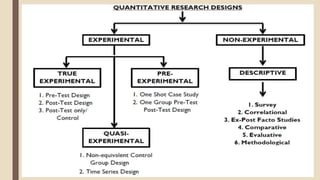
The document describes different types of quantitative research designs, including experimental, quasi-experimental, and non-experimental designs. Experimental designs allow researchers to control variables and identify cause-and-effect relationships. Quasi-experimental designs are similar but do not use random assignment. Non-experimental designs observe phenomena as they naturally occur without manipulation of variables. Specific non-experimental designs discussed include surveys, correlational studies, ex-post facto research, comparative studies, and evaluative research.
Experimental Research Design
■This allows the researcher to control the situation.
■ The researcher answers the question, “What causes
something to occur?”
■ This kind of research also allows the researcher to identify
cause and effect relationships between variables and to
distinguish placebo effects from treatment effects.
■ This research design supports the ability to limit alternative
explanations and to infer direct causal relationships in the
study; the approach provides the highest degree level of
evidence for single studies.
3.
A. Pre-Experimental Design
■A type of research apply to experimental design that
with least internal validity. One type of pre-
experiment, the simple group, pre-test-post-test
design, measures the group two times, before and
after the intervention.
■ Instead of comparing the pretest with the posttest
within one group, the posttest of the treated groups is
compared with that of an untreated group.
■ Measures the effect as the difference between groups
marks this as between-subjects design.
4.
B. Quasi-Experimental Design
■The researcher can collect more data, either by
scheduling more observations or finding more existing
measures.
■ This involves selecting groups, upon which a variable
is tested, without any random pre-selection
processes.
5.
■ Non-Equivalent ControlGroup
– This refers to the chance failure of random assignment to
equalize the conditions by converting a true experiment into
this kind of design, for purpose of analysis
■ InterruptedTime Series Design
– It employs multiple measures before and after the
experimental intervention. It differs from the single-group
pre-experiment that has only one pretest and one posttest.
Users of this design assume that the time threats such as
history or maturation appear as regular changes in the
measures prior to the intervention.
B. Quasi-Experimental Design
6.
C.True Experimental Design
■It employs multiple measures before and after the
experimental intervention.
■ It differs from the single-group pre-experiment that
has only one pretest and one posttest.
■ Users of this design assume that the time threats such
as history or maturation appear as regular changes in
the measures prior to the intervention.
7.
Non-Experimental Research Design
■In this kind of design, the researcher observes the
phenomena as they occur naturally and no external
variables are introduced.
■ In this research design, the variables are not deliberately
manipulated nor is the setting controlled.
■ Researchers collect data without making changes or
introducing treatments.
■ This may also called as DESCRIPTIVE RESEARCH DESIGN
because it is only one under non-experimental design.
8.
■ This design’smain purpose is to observe, describe and
document aspects of a situation as it naturally occurs and
sometimes to serve as a starting point for hypothesis
generation or theory development.The types are as follows:
■ A. SURVEY
– used to gather information from groups of people by
selecting and studying samples chosen from a population.
– useful when the objective of the study is to see general
picture of the population under investigation in terms of their
social and economic characteristics, opinions, and their
knowledge about the behavior towards a certain
phenomenon.
Non-Experimental Research Design
9.
■ B. CORRELATIONAL
–It is conducted by researchers whose aim would be to find
out the direction, associations and/or relationship between
different variables or groups of respondents under study.
Correlational Research has three types, these are:
A.1 Bivariate Correlational Studies – It obtains score from
two variables for each subject, and then uses them to
calculate a correlation coefficient. The term bivariate implies
that the two variables are correlated (variables are selected
because they are believed to be related).
Non-Experimental Research Design
10.
A.2 Prediction Studies– It uses correlation coefficient to
show how one variable (the predictor variable) predicts
another (the criterion variable).
A.3 Multiple Regression Prediction Studies – All variables in
the study can contribute to the over-all prediction in an
equation that adds together the predictive power of each
identified variable.
Non-Experimental Research Design
11.
■ C. EX-POSTFACTO or CAUSAL-COMPARATIVE.
– This kind of research derives conclusion from observations
and manifestations that already occurred in the past and
now compared to some dependent variables. It discusses
why and how a phenomenon occurs.
■ D. COMPARATIVE
– It involves comparing and contrasting two or more samples
of study subjects on one or more variables, often at a single
point of time.
– Compares two distinct groups on the basis of selected
attributes such as knowledge level, perceptions, and
attitudes, physical or psychological symptoms.
Non-Experimental Research Design
12.
■ E. NORMATIVE
–It describes the norm level of characteristics for a given
behavior.
■ F. EVALUATIVE
– It is a process used to determine what has happened during
a given activity or in an institution.
– The purpose of evaluation is to see if a given program is
working, an institution is successful according to the goals
set for it, or the original intent was successfully attained.
– In evaluation judgments can be in the forms of social utility,
desirability, or effectiveness of a process.
Non-Experimental Research Design
13.
■ E. METHODOLOGICAL
–In this approach, the implementation of a variety of
methodologies forms a critical part of achieving the goal
of developing a scale-matched approach, where data
from different disciplines can be integrated.
Non-Experimental Research Design