APA Editing: HowTo
AvoidCommon
Mistakes
For more information, please email
jeanine@statisticssolutions.com
Basics:
Grammar and
Style
 Active vs. Passive
APA prefers the use of active voice, which holds true for scholarly
writing as well. Passive voice occurs when the doer of an action is not
clear or present.
Examples:
(ACTIVE)The researcher conducted the study in a controlled
setting.
(PASSIVE)The study was conducted in a controlled setting.
Usually appears in Chapter 3 and when referring to your own study
and the steps you took.
Exceptions: can occur in Chapters 3 and 4 when the emphasis is placed
on recipient (aka your participants)
To fix passive sentences, include the doer of action in the sentence.
Need help with your dissertation? Call 727-442-4290
Basics:
Grammar and
Style
 Anthropomorphism
 The act of attributing characteristics to inanimate objects and ideas
 Examples:
 (CORRECT)The researcher found the following results.
 (INCORRECT)The study found the following results.
 (CORRECT) Smith (2004) discussed the turnover rates for correctional
officers.
 (INCORRECT)The article discussed the turnover rates for correctional
officers.
Need help with your dissertation? Call 727-442-4290
Basics:
Grammar and
Style
 Tense Use
 Generally, in the proposal stage, refer to your study in the present
and future tense (The research will find…The study is…)
 After the proposal is approved, change to past tense and continue
with results and conclusions presented in past tense (The researcher
found…The study was…)
 Always use past tense when referring to what other researchers did
or found, e.g., Smith (2000) stated, found, and confirmed, etc.
Need help with your dissertation? Call 727-442-4290
Basics:
Capitalization
 When to do it:
 Major words in titles and headings, including all words off our letters
of more
 Ex: Living WithYour Eyes Open
 Journal titles
 References to titles of sections within the same article or document
 Ex: In the Literature Review section…
 Proper nouns, adjectives and nouns used as proper nouns, and trade
names
 Nouns followed by numerals or letters
 Ex: Participant 1, Research Question 2
 Titles of tests, inventories, or questionnaires (NOT theories or
models)
 Ex. Minnesota Multifactor Personality Inventory, Multifactor
Leadership Questionnaire
Need help with your dissertation? Call 727-442-4290
Basics:
Capitalization
 When not to do it:
 In reference list titles of books or articles. Only capitalize the first
word, the first word after a colon or em dash, and proper nouns
 Reference Journal Example:
 Henderson, J. C., &Venkatraman, N. (1993). Strategic alignment:
Leveraging information technology for transforming organizations.
IBM System Journals, 32(1), 4–16. doi:10.1147/sj.382.0472
 Indented paragraph headings
 Names of laws, theories, models, statistical procedures, or
hypotheses
 Ex: cognitive behavior theory
 Shortened, inexact, or generic titles of test
Need help with your dissertation? Call 727-442-4290
Basics:
Abbreviations
 Abbreviations andAcronyms
 How often you use them:
 Over-use
 Determine whether the space saved by using abbreviations justifies the
necessity to understand the meaning
 Ex:The advantage of the LH was clear from the RT data, which reflected
high FP and FN rates for the RH.
 Under-use
 Abbreviations used three or less times within a paper should be spelled
out and not abbreviated
 Ex: Patients at several hospitals completed the MMPI-2
 Follow the Four or More rule
 On the first use of the acronym, it must be written out completely,
followed by the acronym in parentheses, such as the Centers for
Disease Control and Prevention (CDC)
 United States vs. U.S.
 Per APA, only use the abbreviation U.S. as an adjective (e.g., U.S. Navy),
and spell out United States when used as a noun.
Need help with your dissertation? Call 727-442-4290
Basics:APA
Numbers
 Number Use
 When to use numerals:
 Numbers 10 and higher
 Numbers that represent time, dates, ages, scores and points on a scale,
and exact sums of money (2-year-olds, 5 years, Item 1)
 Exception: use words for approximations of numbers of days, months, and
years (e.g., approximately three weeks; almost two days)
 Always use numerals in the abstract
 When to spell it out
 Any number that begins a sentence, title, or text headings
 Common fractions (one-third)
 Universally accepted usage
Need help with your dissertation? Call 727-442-4290
Citations and
References
One of the biggest issues!
Need help with your dissertation? Call 727-442-4290
Basics:
Citations and
Referencing
 Plagiarism vs. Paraphrasing
 All information that is not your own thought or idea must include a
citation.
 Using proper citations strengthens your credibility as a researcher
(this goes the other way, too, as poor referencing reduces your
credibility)
Need help with your dissertation? Call 727-442-4290
Basics:
Reference List
 Alphabetize reference list
 Cross-check with text
 All online sources MUST include retrieval information
 CrossRef database: hhtp://crossref.org
 DOI format (*change from APA 6)
 https://doi.org/xxxxxxxxxx
 Do not include “retrieved from” with DOI
Need help with your dissertation? Call 727-442-4290
Basics: In-Text
Citations
 Two main ways to reference an article within the text!
 Reference as the subject of the sentence
 Ex. Smith et al. (2012) found that…
 Reference at the end of sentence
 Ex. Researchers found that… (Smith et al., 2012).
 Any source cited in-text must also be found in full in the
references section!
Need help with your dissertation? Call 727-442-4290
APA 7th Edition
Writing and formatting rules
The Basics:
Heading
Levels
 Level 1: Centered, Boldface,Title Case Heading
 Text begins as a new paragraph.
 Level 2: Flush left, Boldface,Title Case Heading
 Text begins as a new paragraph.
 Level 3: Flush Left, Boldface Italic,Title Case Heading
 Text begins as a new paragraph.
 Level 4: Indented, BoldfaceTitle Case Heading EndingWith a
Period. Paragraph text continues on the same line and continues
as a regular paragraph.
 Level 5: Indented, Boldface Italic,Title Case Headings Ending
With a Period. Paragraph text continues on the same line and
continues as a regular paragraph.
WritingStyle
andGrammar,
and Bias-Free
Language
 “Singular they”
 Use if gender is unknown or irrelevant
 Use for a person who uses “they” as their personal pronouns
 “Person-first language”
 Ex: “man with epilepsy” rather than “an epileptic man”
 Ex: “people living in poverty” rather than “the poor”
 Be specific: Korean Americans vs. Asian Americans, cisgender men
vs. men
Tables and
Figures
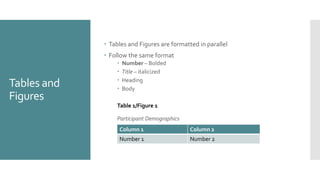
 Tables and Figures are formatted in parallel
 Follow the same format
 Number – Bolded
 Title – italicized
 Heading
 Body
Table 1/Figure 1
Participant Demographics
Column 1 Column 2
Number 1 Number 2
Tables and Figures
cont..
 Limit the use of boarders for
clarity
 Do not use vertical boarders
 Can be placed within the text of
the paper or within the appendix
section
In-Text
Citations and
Reference List
 In-Text Citations
 All sources with three or more authors use et al. beginning with
first use
 Exception: if two papers have first-listed authors with the same
name and author names are needed to differentiate
 References
 Include all authors up to 20 in reference list entry
 DOIs and URLs are both presented as hyperlinks for electronic
sources
 No use of “retrieved from”
 Exception: when a retrieval date is used
Some other
helpful tips
 Keep up with formatting from the very beginning!
 Keep a running list of references and check regularly against in-
text citations
 Citation managers (e.g., EndNote) can be very helpful, despite
some pitfalls
 Keep a copy of the APA 7 manual nearby – it’s a reference manual,
not something you need to memorize – it’s worth the investment
Question andAnswer
Additional
Support
Statistics Solutions is a full-service dissertation consulting
company providing graduate students timely, editorial
support for their dissertations and scholarly projects
For information about our services, receive a
complementary 30-min consultation available Mon-Fri 9-5
ET
Contact Jeanine Glase at jeanine@StatisticsSolutions.com
Phone: 877-437-8622

APA Editing.pptx

  • 1.
    APA Editing: HowTo AvoidCommon Mistakes Formore information, please email jeanine@statisticssolutions.com
  • 2.
    Basics: Grammar and Style  Activevs. Passive APA prefers the use of active voice, which holds true for scholarly writing as well. Passive voice occurs when the doer of an action is not clear or present. Examples: (ACTIVE)The researcher conducted the study in a controlled setting. (PASSIVE)The study was conducted in a controlled setting. Usually appears in Chapter 3 and when referring to your own study and the steps you took. Exceptions: can occur in Chapters 3 and 4 when the emphasis is placed on recipient (aka your participants) To fix passive sentences, include the doer of action in the sentence. Need help with your dissertation? Call 727-442-4290
  • 3.
    Basics: Grammar and Style  Anthropomorphism The act of attributing characteristics to inanimate objects and ideas  Examples:  (CORRECT)The researcher found the following results.  (INCORRECT)The study found the following results.  (CORRECT) Smith (2004) discussed the turnover rates for correctional officers.  (INCORRECT)The article discussed the turnover rates for correctional officers. Need help with your dissertation? Call 727-442-4290
  • 4.
    Basics: Grammar and Style  TenseUse  Generally, in the proposal stage, refer to your study in the present and future tense (The research will find…The study is…)  After the proposal is approved, change to past tense and continue with results and conclusions presented in past tense (The researcher found…The study was…)  Always use past tense when referring to what other researchers did or found, e.g., Smith (2000) stated, found, and confirmed, etc. Need help with your dissertation? Call 727-442-4290
  • 5.
    Basics: Capitalization  When todo it:  Major words in titles and headings, including all words off our letters of more  Ex: Living WithYour Eyes Open  Journal titles  References to titles of sections within the same article or document  Ex: In the Literature Review section…  Proper nouns, adjectives and nouns used as proper nouns, and trade names  Nouns followed by numerals or letters  Ex: Participant 1, Research Question 2  Titles of tests, inventories, or questionnaires (NOT theories or models)  Ex. Minnesota Multifactor Personality Inventory, Multifactor Leadership Questionnaire Need help with your dissertation? Call 727-442-4290
  • 6.
    Basics: Capitalization  When notto do it:  In reference list titles of books or articles. Only capitalize the first word, the first word after a colon or em dash, and proper nouns  Reference Journal Example:  Henderson, J. C., &Venkatraman, N. (1993). Strategic alignment: Leveraging information technology for transforming organizations. IBM System Journals, 32(1), 4–16. doi:10.1147/sj.382.0472  Indented paragraph headings  Names of laws, theories, models, statistical procedures, or hypotheses  Ex: cognitive behavior theory  Shortened, inexact, or generic titles of test Need help with your dissertation? Call 727-442-4290
  • 7.
    Basics: Abbreviations  Abbreviations andAcronyms How often you use them:  Over-use  Determine whether the space saved by using abbreviations justifies the necessity to understand the meaning  Ex:The advantage of the LH was clear from the RT data, which reflected high FP and FN rates for the RH.  Under-use  Abbreviations used three or less times within a paper should be spelled out and not abbreviated  Ex: Patients at several hospitals completed the MMPI-2  Follow the Four or More rule  On the first use of the acronym, it must be written out completely, followed by the acronym in parentheses, such as the Centers for Disease Control and Prevention (CDC)  United States vs. U.S.  Per APA, only use the abbreviation U.S. as an adjective (e.g., U.S. Navy), and spell out United States when used as a noun. Need help with your dissertation? Call 727-442-4290
  • 8.
    Basics:APA Numbers  Number Use When to use numerals:  Numbers 10 and higher  Numbers that represent time, dates, ages, scores and points on a scale, and exact sums of money (2-year-olds, 5 years, Item 1)  Exception: use words for approximations of numbers of days, months, and years (e.g., approximately three weeks; almost two days)  Always use numerals in the abstract  When to spell it out  Any number that begins a sentence, title, or text headings  Common fractions (one-third)  Universally accepted usage Need help with your dissertation? Call 727-442-4290
  • 9.
    Citations and References One ofthe biggest issues! Need help with your dissertation? Call 727-442-4290
  • 10.
    Basics: Citations and Referencing  Plagiarismvs. Paraphrasing  All information that is not your own thought or idea must include a citation.  Using proper citations strengthens your credibility as a researcher (this goes the other way, too, as poor referencing reduces your credibility) Need help with your dissertation? Call 727-442-4290
  • 11.
    Basics: Reference List  Alphabetizereference list  Cross-check with text  All online sources MUST include retrieval information  CrossRef database: hhtp://crossref.org  DOI format (*change from APA 6)  https://doi.org/xxxxxxxxxx  Do not include “retrieved from” with DOI Need help with your dissertation? Call 727-442-4290
  • 12.
    Basics: In-Text Citations  Twomain ways to reference an article within the text!  Reference as the subject of the sentence  Ex. Smith et al. (2012) found that…  Reference at the end of sentence  Ex. Researchers found that… (Smith et al., 2012).  Any source cited in-text must also be found in full in the references section! Need help with your dissertation? Call 727-442-4290
  • 13.
    APA 7th Edition Writingand formatting rules
  • 14.
    The Basics: Heading Levels  Level1: Centered, Boldface,Title Case Heading  Text begins as a new paragraph.  Level 2: Flush left, Boldface,Title Case Heading  Text begins as a new paragraph.  Level 3: Flush Left, Boldface Italic,Title Case Heading  Text begins as a new paragraph.  Level 4: Indented, BoldfaceTitle Case Heading EndingWith a Period. Paragraph text continues on the same line and continues as a regular paragraph.  Level 5: Indented, Boldface Italic,Title Case Headings Ending With a Period. Paragraph text continues on the same line and continues as a regular paragraph.
  • 15.
    WritingStyle andGrammar, and Bias-Free Language  “Singularthey”  Use if gender is unknown or irrelevant  Use for a person who uses “they” as their personal pronouns  “Person-first language”  Ex: “man with epilepsy” rather than “an epileptic man”  Ex: “people living in poverty” rather than “the poor”  Be specific: Korean Americans vs. Asian Americans, cisgender men vs. men
  • 16.
    Tables and Figures  Tablesand Figures are formatted in parallel  Follow the same format  Number – Bolded  Title – italicized  Heading  Body Table 1/Figure 1 Participant Demographics Column 1 Column 2 Number 1 Number 2
  • 17.
    Tables and Figures cont.. Limit the use of boarders for clarity  Do not use vertical boarders  Can be placed within the text of the paper or within the appendix section
  • 18.
    In-Text Citations and Reference List In-Text Citations  All sources with three or more authors use et al. beginning with first use  Exception: if two papers have first-listed authors with the same name and author names are needed to differentiate  References  Include all authors up to 20 in reference list entry  DOIs and URLs are both presented as hyperlinks for electronic sources  No use of “retrieved from”  Exception: when a retrieval date is used
  • 19.
    Some other helpful tips Keep up with formatting from the very beginning!  Keep a running list of references and check regularly against in- text citations  Citation managers (e.g., EndNote) can be very helpful, despite some pitfalls  Keep a copy of the APA 7 manual nearby – it’s a reference manual, not something you need to memorize – it’s worth the investment
  • 20.
  • 21.
    Additional Support Statistics Solutions isa full-service dissertation consulting company providing graduate students timely, editorial support for their dissertations and scholarly projects For information about our services, receive a complementary 30-min consultation available Mon-Fri 9-5 ET Contact Jeanine Glase at jeanine@StatisticsSolutions.com Phone: 877-437-8622