Psychological Statistics
TABULATION
MEANING
 Tabulation is the process of arranging the classified data in the form of a table
 A table is a systematic arrangement of classified data In rows and columns with appropriate headings
and sub-headings
COMPONENTS OF A STATISTICAL TABLE
 Table Number
 Each table should be numbered for the purpose of reference and identification
 Title
 It is a precise description of the content of the table
 It is prominently written in capital letters
 Captions
 These are the brief and self explanatory headings for columns
 These tell what the columns represent
 Stubs
 These are the designations of rows or row headings
 It constitutes the first column and explains what the rows are about
 Body of the Table
 It is the most vital part of the table
 It contains the classified data in different cells
 Head Note
 It explains the unit of measurement used in the body of the table
 Example, unit of measurement such as ‘Crores of Rupees’
 Foot note
 It is a qualifying statement which is to be written below the table explaining certain points related
to the data which have not been covered in title caption and stubs
 Source
 It is the source from which data have been taken
 It will help the potential reader to consult the original source they need
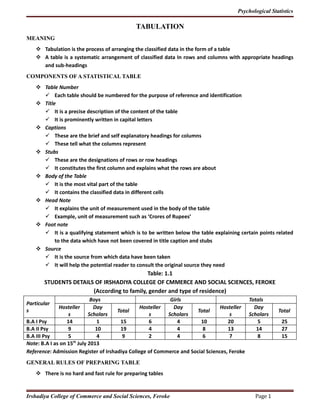
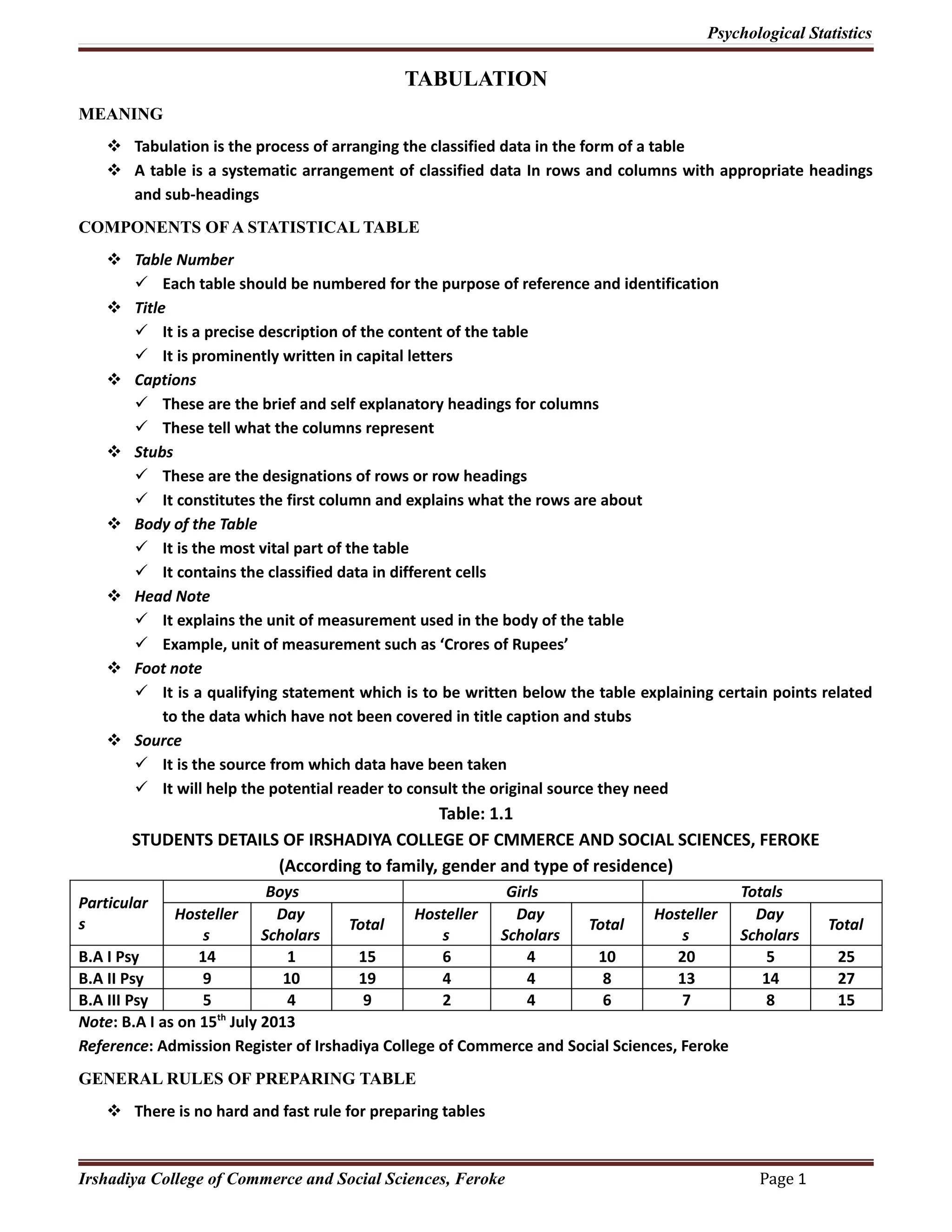
Table: 1.1
STUDENTS DETAILS OF IRSHADIYA COLLEGE OF CMMERCE AND SOCIAL SCIENCES, FEROKE
(According to family, gender and type of residence)
Particular
s
Boys Girls Totals
Hosteller
s
Day
Scholars
Total
Hosteller
s
Day
Scholars
Total
Hosteller
s
Day
Scholars
Total
B.A I Psy 14 1 15 6 4 10 20 5 25
B.A II Psy 9 10 19 4 4 8 13 14 27
B.A III Psy 5 4 9 2 4 6 7 8 15
Note: B.A I as on 15th
July 2013
Reference: Admission Register of Irshadiya College of Commerce and Social Sciences, Feroke
GENERAL RULES OF PREPARING TABLE
 There is no hard and fast rule for preparing tables
Irshadiya College of Commerce and Social Sciences, Feroke Page 1
Psychological Statistics
 Consider the person who is to use it (whether he is a literate/illiterate and has the technical knowledge
regarding the topic of the content or not)
 Further the object of the referring the data is to be kept in mind
 According to Prof: Bowley, “In collection and tabulation commonsense is the chief requisite and
experience is the chief teacher”
 The following points are to be borne in mind
 Rough table
 A rough sketch of the table is to be prepared and the sufficiency of spacing for rows and
columns is to be ascertained
 Order
 Captions and stubs should be in certain order such as alphabetical or chronological or traditional
or ascending
 The order should make the table easier to grasp
 Units of measurement
 Wherever possible the units of measurement should be given in stubs and captions
 Uniformity
 All the entries should be up to two decimals or three decimals or in thousands
 Loading
 Too many information should not be presented in a single table
 More tables can be used if necessary
 Important entries
 Any entry which needs prominence in the table should be given distinctly/in a box/in a circle
 Line of demarcation
 Thick line should be used for major divisions, row totals and column totals
 Thin lines should be used for sub divisions
 Others
 Dash (-) or N.A should be used to denote the absence of any information. ‘0’ should not be used
because it means that quantity is zero
 The expression ‘etc’ and ditto marks (“) should not be used. The details should be repeated
wherever necessary
 Abbreviations should not be used, especially in headings and sub headings
IMPORTANCE OF TABULATION
 Simplifies complex data
 Facilitates comparison
 Presents data in true perspective
 Figures can be worked out more easily
 Gives identity to the data
 Reveals pattern
Irshadiya College of Commerce and Social Sciences, Feroke Page 2

08 Tabulation

  • 1.
    Psychological Statistics TABULATION MEANING  Tabulationis the process of arranging the classified data in the form of a table  A table is a systematic arrangement of classified data In rows and columns with appropriate headings and sub-headings COMPONENTS OF A STATISTICAL TABLE  Table Number  Each table should be numbered for the purpose of reference and identification  Title  It is a precise description of the content of the table  It is prominently written in capital letters  Captions  These are the brief and self explanatory headings for columns  These tell what the columns represent  Stubs  These are the designations of rows or row headings  It constitutes the first column and explains what the rows are about  Body of the Table  It is the most vital part of the table  It contains the classified data in different cells  Head Note  It explains the unit of measurement used in the body of the table  Example, unit of measurement such as ‘Crores of Rupees’  Foot note  It is a qualifying statement which is to be written below the table explaining certain points related to the data which have not been covered in title caption and stubs  Source  It is the source from which data have been taken  It will help the potential reader to consult the original source they need Table: 1.1 STUDENTS DETAILS OF IRSHADIYA COLLEGE OF CMMERCE AND SOCIAL SCIENCES, FEROKE (According to family, gender and type of residence) Particular s Boys Girls Totals Hosteller s Day Scholars Total Hosteller s Day Scholars Total Hosteller s Day Scholars Total B.A I Psy 14 1 15 6 4 10 20 5 25 B.A II Psy 9 10 19 4 4 8 13 14 27 B.A III Psy 5 4 9 2 4 6 7 8 15 Note: B.A I as on 15th July 2013 Reference: Admission Register of Irshadiya College of Commerce and Social Sciences, Feroke GENERAL RULES OF PREPARING TABLE  There is no hard and fast rule for preparing tables Irshadiya College of Commerce and Social Sciences, Feroke Page 1
  • 2.
    Psychological Statistics  Considerthe person who is to use it (whether he is a literate/illiterate and has the technical knowledge regarding the topic of the content or not)  Further the object of the referring the data is to be kept in mind  According to Prof: Bowley, “In collection and tabulation commonsense is the chief requisite and experience is the chief teacher”  The following points are to be borne in mind  Rough table  A rough sketch of the table is to be prepared and the sufficiency of spacing for rows and columns is to be ascertained  Order  Captions and stubs should be in certain order such as alphabetical or chronological or traditional or ascending  The order should make the table easier to grasp  Units of measurement  Wherever possible the units of measurement should be given in stubs and captions  Uniformity  All the entries should be up to two decimals or three decimals or in thousands  Loading  Too many information should not be presented in a single table  More tables can be used if necessary  Important entries  Any entry which needs prominence in the table should be given distinctly/in a box/in a circle  Line of demarcation  Thick line should be used for major divisions, row totals and column totals  Thin lines should be used for sub divisions  Others  Dash (-) or N.A should be used to denote the absence of any information. ‘0’ should not be used because it means that quantity is zero  The expression ‘etc’ and ditto marks (“) should not be used. The details should be repeated wherever necessary  Abbreviations should not be used, especially in headings and sub headings IMPORTANCE OF TABULATION  Simplifies complex data  Facilitates comparison  Presents data in true perspective  Figures can be worked out more easily  Gives identity to the data  Reveals pattern Irshadiya College of Commerce and Social Sciences, Feroke Page 2