Introduction to  Game Theory Yale Braunstein Spring 2007
General approach Brief History of Game Theory  Payoff Matrix Types of Games  Basic Strategies Evolutionary Concepts Limitations and Problems
Brief History of Game Theory 1913 - E. Zermelo provides the first theorem of game theory; asserts that chess is strictly determined 1928 - John von Neumann proves the minimax theorem  1944 - John von Neumann & Oskar Morgenstern write  "Theory of Games and Economic Behavior” 1950-1953 - John Nash describes Nash equilibrium
Rationality Assumptions:  humans are rational beings humans always seek the best alternative in a set of possible choices Why assume rationality? narrow down the range of possibilities predictability
Utility Theory Utility Theory based on: rationality maximization of utility may not be a linear function of income or wealth It is a quantification of a person's preferences with respect to certain objects.
What is Game Theory?   Game theory is a study of how to mathematically determine the best strategy for given conditions in order to optimize the outcome
Game Theory Finding acceptable, if not optimal, strategies in conflict situations. Abstraction of real complex situation Game theory is highly mathematical Game theory assumes all human interactions can be understood and navigated by presumptions.
Why is game theory important? All intelligent beings make decisions all the time. AI needs to perform these tasks as a result. Helps us to analyze situations more rationally and formulate an acceptable alternative with respect to circumstance. Useful in modeling strategic decision-making Games against opponents Games against "nature„ Provides structured insight into the value of information
Types of Games Sequential  vs.  Simultaneous moves Single Play  vs.  Iterated  Zero  vs.  non-zero sum  Perfect  vs.  Imperfect information  Cooperative  vs.  conflict
Zero-Sum Games The sum of the payoffs remains constant during the course of the game. Two sides in conflict Being well informed always helps a player
Non-zero Sum Game The sum of payoffs is not constant during the course of game play. Players may co-operate or compete Being well informed may harm a player.
Games of Perfect Information The information concerning an opponent’s move is well known in advance. All sequential move games are of this type.
Imperfect Information Partial or no information concerning the opponent is given in advance to the player’s decision. Imperfect information may be diminished over time if the same game with the same opponent is to be repeated.
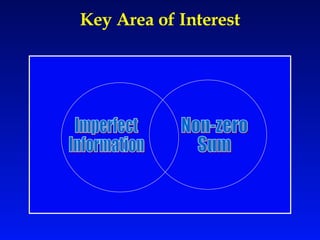
Key Area of Interest chance strategy Non-zero  Sum Imperfect  Information
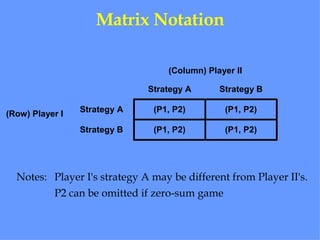
Matrix Notation Notes: Player I's strategy A may be different from Player II's. P2 can be omitted if zero-sum game
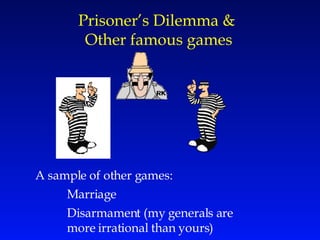
Prisoner’s Dilemma &  Other famous games A sample of other games: Marriage Disarmament (my generals are  more irrational than yours)
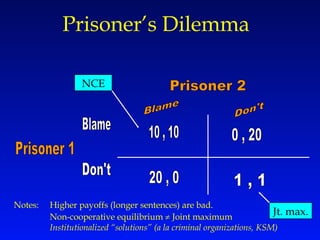
Prisoner’s Dilemma 10 , 10 Blame Don't Blame Don't 20 , 0 0 , 20 1 , 1 Prisoner 1 Prisoner 2 Notes:  Higher payoffs (longer sentences) are bad. Non-cooperative equilibrium    Joint maximum Institutionalized “solutions” (a la criminal organizations, KSM) NCE Jt. max.
Games of Conflict Two sides competing against each other Usually caused by complete lack of information about the opponent or the game Characteristic of zero-sum games
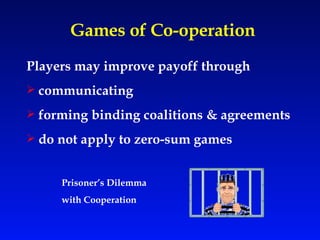
Games of Co-operation Players may improve payoff through communicating forming binding coalitions & agreements   do not apply to zero-sum games   Prisoner’s Dilemma  with Cooperation
Prisoner’s Dilemma with Iteration Infinite number of iterations Fear of retaliation Fixed number of iteration Domino effect
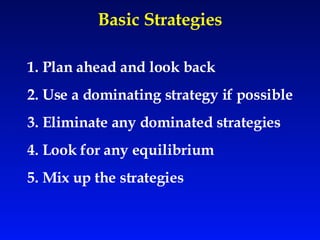
Basic Strategies 1. Plan ahead and look back  2. Use a dominating strategy if possible 3. Eliminate any dominated strategies 4. Look for any equilibrium 5. Mix up the strategies
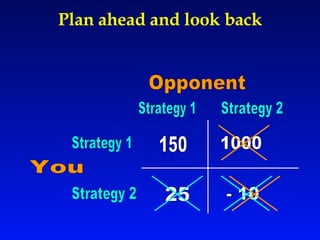
Plan ahead and look back Strategy 2 Strategy 1 150 1000 25 Strategy 1 Strategy 2 - 10 You Opponent
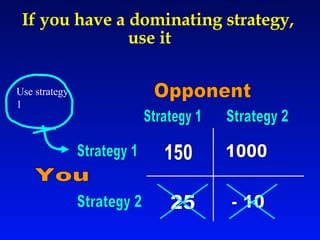
If you have a dominating strategy,  use it Strategy 2 Strategy 1 150 1000 25 Strategy 1 Strategy 2 - 10 You Opponent Use strategy 1
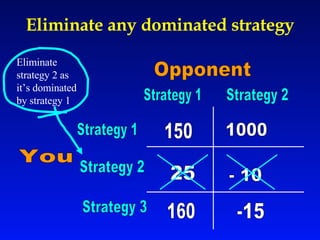
Eliminate any dominated strategy Strategy 2 Strategy 1 150 1000 25 Strategy 1 Strategy 2 - 10 You Opponent Strategy 3 -15 160 Eliminate strategy 2 as it’s dominated by strategy 1
Look for any equilibrium Dominating Equilibrium Minimax Equilibrium Nash Equilibrium
Maximin & Minimax Equilibrium Minimax - to minimize the maximum loss (defensive) Maximin - to maximize the minimum gain (offensive) Minimax = Maximin
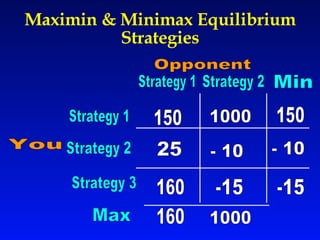
Maximin & Minimax Equilibrium Strategies Strategy 2 Strategy 1 150 1000 25 Strategy 1 Strategy 2 - 10 You Opponent Strategy 3 -15 160 Min 1000 150 - 10 -15 160 Max
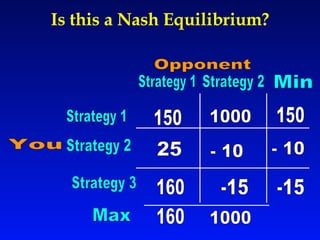
Definition: Nash Equilibrium “ If there is a set of strategies with the property that no player can benefit by changing her strategy while the other players keep their strategies unchanged, then that set of strategies and the corresponding payoffs constitute the Nash Equilibrium. “ Source: http://www.lebow.drexel.edu/economics/mccain/game/game.html
Is this a Nash Equilibrium? Strategy 2 Strategy 1 150 1000 25 Strategy 1 Strategy 2 - 10 You Opponent Strategy 3 -15 160 Min 1000 150 - 10 -15 160 Max
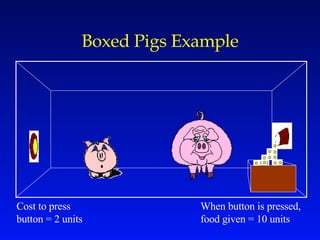
Cost to press button = 2 units When button is pressed, food given = 10 units Boxed Pigs Example
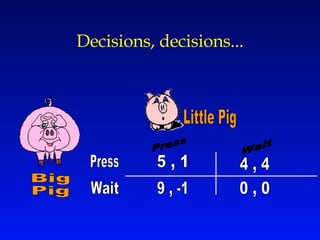
5 , 1 Press Wait Press Wait 9 , -1 4 , 4 0 , 0 Little Pig Big Pig Decisions, decisions...
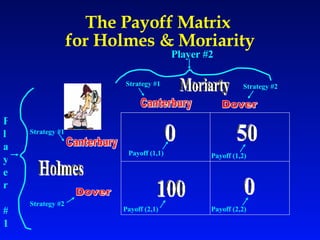
Time for "real-life" decision making Holmes & Moriarity in "The Final Problem" What would you do… If you were Holmes? If you were Moriarity? Possibly interesting digressions? Why was Moriarity so evil? What really happened? What do we mean by reality? What changed the reality?
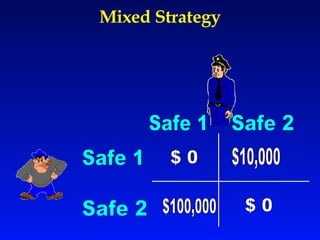
Mixed Strategy Safe 2 Safe 1 $ 0 $10,000 $100,000 Safe 1 Safe 2 $ 0
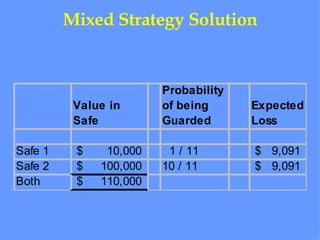
Mixed Strategy Solution
The Payoff Matrix  for Holmes & Moriarity Player #1 Player #2 Strategy #1 Strategy #2 Strategy #1 Strategy #2 Payoff (1,1) Payoff (1,2) Payoff (2,1) Payoff (2,2) Canterbury Canterbury Dover Dover 0 100 50 0 Holmes Moriarty
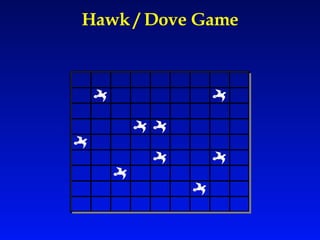
Evolutionary Game Theory Natural selection replaces rational behavior Survival of the fittest Why use evolution to determine a strategy?
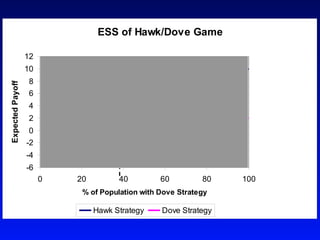
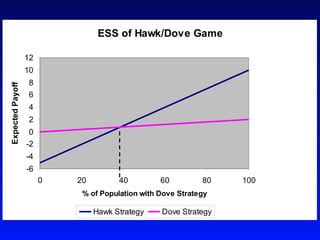
Hawk / Dove Game
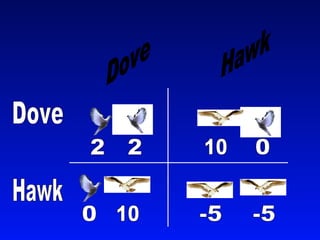
Evolutionary Stable Strategy Introduced by Maynard Smith and Price (1973) Strategy becomes stable throughout the population Mutations becoming ineffective
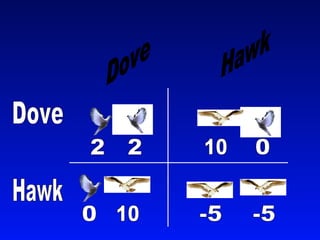
Hawk Dove Hawk Dove 2 2 10 0 10 0 -5 -5
 
Hawk Dove Hawk Dove 2 2 10 0 10 0 -5 -5
 
Where is game theory  currently used?  Ecology Networks Economics
Limitations & Problems Assumes players always maximize their outcomes Some outcomes are difficult to provide a utility for Not all of the payoffs can be quantified Not applicable to all problems
Summary What is game theory? Abstraction modeling multi-person interactions How is game theory applied? Payoff matrix contains each person’s utilities for various strategies  Who uses game theory? Economists, Ecologists, Network people,... How is this related to AI? Provides a method to simulate a thinking   agent
Sources Much more available on the web. These slides (with changes and additions) adapted from:  http://pages.cpsc.ucalgary.ca/~jacob/Courses/Winter2000/CPSC533/Pages/index.html Three interesting classics: John von Neumann & Oskar Morgenstern,  Theory of Games & Economic Behavior  (Princeton, 1944). John McDonald,  Strategy in Poker, Business & War  (Norton, 1950) Oskar Morgenstern, "The Theory of Games,"  Scientific American , May 1949; translated as "Theorie des Spiels,"  Die Amerikanische Rundschau , August 1949.

gt_2007

  • 1.
    Introduction to Game Theory Yale Braunstein Spring 2007
  • 2.
    General approach BriefHistory of Game Theory Payoff Matrix Types of Games Basic Strategies Evolutionary Concepts Limitations and Problems
  • 3.
    Brief History ofGame Theory 1913 - E. Zermelo provides the first theorem of game theory; asserts that chess is strictly determined 1928 - John von Neumann proves the minimax theorem 1944 - John von Neumann & Oskar Morgenstern write "Theory of Games and Economic Behavior” 1950-1953 - John Nash describes Nash equilibrium
  • 4.
    Rationality Assumptions: humans are rational beings humans always seek the best alternative in a set of possible choices Why assume rationality? narrow down the range of possibilities predictability
  • 5.
    Utility Theory UtilityTheory based on: rationality maximization of utility may not be a linear function of income or wealth It is a quantification of a person's preferences with respect to certain objects.
  • 6.
    What is GameTheory? Game theory is a study of how to mathematically determine the best strategy for given conditions in order to optimize the outcome
  • 7.
    Game Theory Findingacceptable, if not optimal, strategies in conflict situations. Abstraction of real complex situation Game theory is highly mathematical Game theory assumes all human interactions can be understood and navigated by presumptions.
  • 8.
    Why is gametheory important? All intelligent beings make decisions all the time. AI needs to perform these tasks as a result. Helps us to analyze situations more rationally and formulate an acceptable alternative with respect to circumstance. Useful in modeling strategic decision-making Games against opponents Games against "nature„ Provides structured insight into the value of information
  • 9.
    Types of GamesSequential vs. Simultaneous moves Single Play vs. Iterated Zero vs. non-zero sum Perfect vs. Imperfect information Cooperative vs. conflict
  • 10.
    Zero-Sum Games Thesum of the payoffs remains constant during the course of the game. Two sides in conflict Being well informed always helps a player
  • 11.
    Non-zero Sum GameThe sum of payoffs is not constant during the course of game play. Players may co-operate or compete Being well informed may harm a player.
  • 12.
    Games of PerfectInformation The information concerning an opponent’s move is well known in advance. All sequential move games are of this type.
  • 13.
    Imperfect Information Partialor no information concerning the opponent is given in advance to the player’s decision. Imperfect information may be diminished over time if the same game with the same opponent is to be repeated.
  • 14.
    Key Area ofInterest chance strategy Non-zero Sum Imperfect Information
  • 15.
    Matrix Notation Notes:Player I's strategy A may be different from Player II's. P2 can be omitted if zero-sum game
  • 16.
    Prisoner’s Dilemma & Other famous games A sample of other games: Marriage Disarmament (my generals are more irrational than yours)
  • 17.
    Prisoner’s Dilemma 10, 10 Blame Don't Blame Don't 20 , 0 0 , 20 1 , 1 Prisoner 1 Prisoner 2 Notes: Higher payoffs (longer sentences) are bad. Non-cooperative equilibrium  Joint maximum Institutionalized “solutions” (a la criminal organizations, KSM) NCE Jt. max.
  • 18.
    Games of ConflictTwo sides competing against each other Usually caused by complete lack of information about the opponent or the game Characteristic of zero-sum games
  • 19.
    Games of Co-operationPlayers may improve payoff through communicating forming binding coalitions & agreements do not apply to zero-sum games Prisoner’s Dilemma with Cooperation
  • 20.
    Prisoner’s Dilemma withIteration Infinite number of iterations Fear of retaliation Fixed number of iteration Domino effect
  • 21.
    Basic Strategies 1.Plan ahead and look back 2. Use a dominating strategy if possible 3. Eliminate any dominated strategies 4. Look for any equilibrium 5. Mix up the strategies
  • 22.
    Plan ahead andlook back Strategy 2 Strategy 1 150 1000 25 Strategy 1 Strategy 2 - 10 You Opponent
  • 23.
    If you havea dominating strategy, use it Strategy 2 Strategy 1 150 1000 25 Strategy 1 Strategy 2 - 10 You Opponent Use strategy 1
  • 24.
    Eliminate any dominatedstrategy Strategy 2 Strategy 1 150 1000 25 Strategy 1 Strategy 2 - 10 You Opponent Strategy 3 -15 160 Eliminate strategy 2 as it’s dominated by strategy 1
  • 25.
    Look for anyequilibrium Dominating Equilibrium Minimax Equilibrium Nash Equilibrium
  • 26.
    Maximin & MinimaxEquilibrium Minimax - to minimize the maximum loss (defensive) Maximin - to maximize the minimum gain (offensive) Minimax = Maximin
  • 27.
    Maximin & MinimaxEquilibrium Strategies Strategy 2 Strategy 1 150 1000 25 Strategy 1 Strategy 2 - 10 You Opponent Strategy 3 -15 160 Min 1000 150 - 10 -15 160 Max
  • 28.
    Definition: Nash Equilibrium“ If there is a set of strategies with the property that no player can benefit by changing her strategy while the other players keep their strategies unchanged, then that set of strategies and the corresponding payoffs constitute the Nash Equilibrium. “ Source: http://www.lebow.drexel.edu/economics/mccain/game/game.html
  • 29.
    Is this aNash Equilibrium? Strategy 2 Strategy 1 150 1000 25 Strategy 1 Strategy 2 - 10 You Opponent Strategy 3 -15 160 Min 1000 150 - 10 -15 160 Max
  • 30.
    Cost to pressbutton = 2 units When button is pressed, food given = 10 units Boxed Pigs Example
  • 31.
    5 , 1Press Wait Press Wait 9 , -1 4 , 4 0 , 0 Little Pig Big Pig Decisions, decisions...
  • 32.
    Time for "real-life"decision making Holmes & Moriarity in "The Final Problem" What would you do… If you were Holmes? If you were Moriarity? Possibly interesting digressions? Why was Moriarity so evil? What really happened? What do we mean by reality? What changed the reality?
  • 33.
    Mixed Strategy Safe2 Safe 1 $ 0 $10,000 $100,000 Safe 1 Safe 2 $ 0
  • 34.
  • 35.
    The Payoff Matrix for Holmes & Moriarity Player #1 Player #2 Strategy #1 Strategy #2 Strategy #1 Strategy #2 Payoff (1,1) Payoff (1,2) Payoff (2,1) Payoff (2,2) Canterbury Canterbury Dover Dover 0 100 50 0 Holmes Moriarty
  • 36.
    Evolutionary Game TheoryNatural selection replaces rational behavior Survival of the fittest Why use evolution to determine a strategy?
  • 37.
  • 38.
    Evolutionary Stable StrategyIntroduced by Maynard Smith and Price (1973) Strategy becomes stable throughout the population Mutations becoming ineffective
  • 39.
    Hawk Dove HawkDove 2 2 10 0 10 0 -5 -5
  • 40.
  • 41.
    Hawk Dove HawkDove 2 2 10 0 10 0 -5 -5
  • 42.
  • 43.
    Where is gametheory currently used? Ecology Networks Economics
  • 44.
    Limitations & ProblemsAssumes players always maximize their outcomes Some outcomes are difficult to provide a utility for Not all of the payoffs can be quantified Not applicable to all problems
  • 45.
    Summary What isgame theory? Abstraction modeling multi-person interactions How is game theory applied? Payoff matrix contains each person’s utilities for various strategies Who uses game theory? Economists, Ecologists, Network people,... How is this related to AI? Provides a method to simulate a thinking agent
  • 46.
    Sources Much moreavailable on the web. These slides (with changes and additions) adapted from: http://pages.cpsc.ucalgary.ca/~jacob/Courses/Winter2000/CPSC533/Pages/index.html Three interesting classics: John von Neumann & Oskar Morgenstern, Theory of Games & Economic Behavior (Princeton, 1944). John McDonald, Strategy in Poker, Business & War (Norton, 1950) Oskar Morgenstern, "The Theory of Games," Scientific American , May 1949; translated as "Theorie des Spiels," Die Amerikanische Rundschau , August 1949.