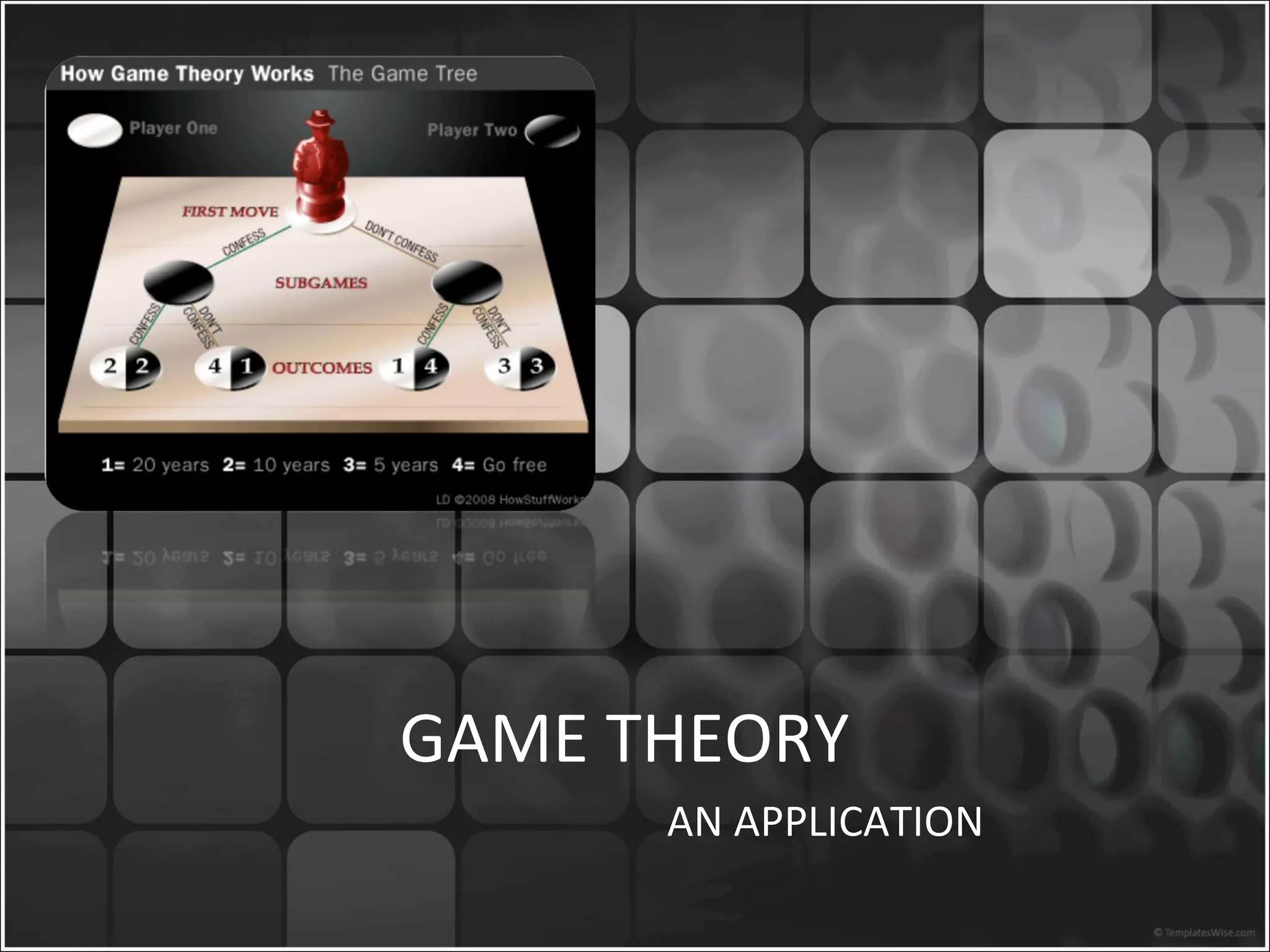
GAME THEORY AN APPLICATION
Game Theory A theory that attempts to mathematically capture behavior in strategic situations or games, in which an individual's success in making choices depends on the choices of others .
Game Theory – An Introduction Firstly presented by the legendary mathematician “John Von Neumann”. Attempt  to analyze competitions in which one individual does better at another ’ s expense ( zero sum games). Later developed by “John Nash”, the Nobel Prize winner and a professor at Princeton University.
DOMINANT FIRM GAME
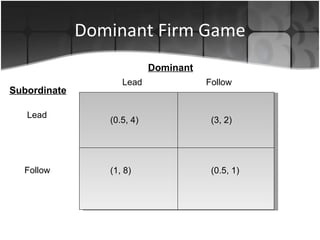
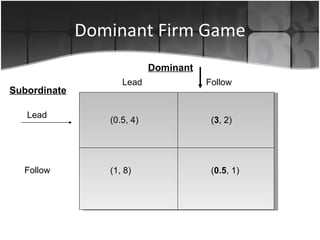
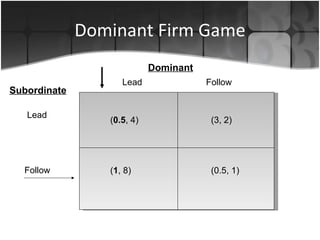
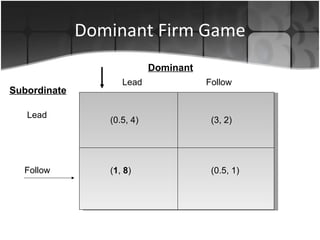
Dominant Firm Game Two firms, one large and one small. Either firm can announce an output level (lead) or else wait to see what the rival does and then produce an amount that does not saturate the market.
Dominant Firm Game Lead   Follow Dominant Subordinate Lead Follow (0.5, 4) (1, 8) (3, 2) (0.5, 1)
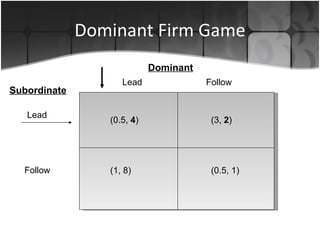
Dominant Firm Game Lead   Follow Dominant Subordinate Lead Follow (0.5,  4 ) (1, 8) (3,  2 ) (0.5, 1)
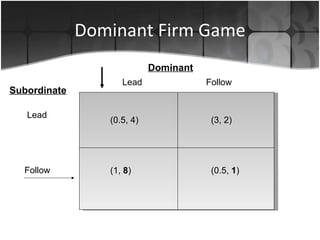
Dominant Firm Game Lead   Follow Dominant Subordinate Lead Follow (0.5, 4) (1,  8 ) (3, 2) (0.5,  1 )
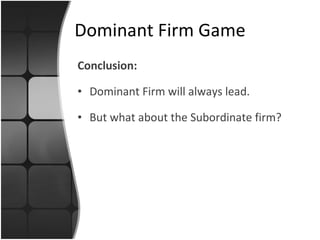
Conclusion: Dominant Firm will always lead. But what about the Subordinate firm? Dominant Firm Game
Dominant Firm Game Lead   Follow Dominant Subordinate Lead Follow (0.5, 4) (1, 8) ( 3 , 2) ( 0.5 , 1)
Dominant Firm Game Lead   Follow Dominant Subordinate Lead Follow ( 0.5 , 4) ( 1 , 8) (3, 2) (0.5, 1)
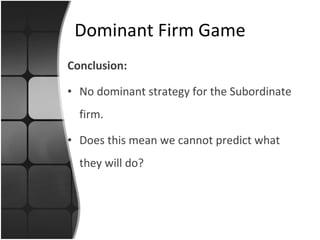
Conclusion: No dominant strategy for the Subordinate firm. Does this mean we cannot predict what they will do? Dominant Firm Game
Dominant Firm Game Lead   Follow Dominant Subordinate Lead Follow (0.5, 4) ( 1 ,  8 ) (3, 2) (0.5, 1)
Conclusion: Subordinate firm will always follow, because dominant firm will always lead. Dominant Firm Game
NASH EQUILIBRIUM
Nash Equilibrium A   solution concept  of a game involving two or more players  . If each player has chosen a strategy and no player can benefit by changing his or her strategy while the other players keep theirs unchanged, then the current set of strategy choices constitute a  Nash equilibrium .
CASE I: APPLICATION OF GAME THEORY IN TWO ADVERTISING AGENCIES
Advertising Agencies Two firms,  Mudra Communication Pvt. Ltd  and Waltz Entertainment Pvt. Ltd  must decide how much to spend on advertising. Each firm may adopt either a high (H) budget or a low (L) budget.
An Advertising Game Mudra makes the first move by choosing either H or L at the first decision “node.” Next, Waltz chooses either H or L, but the large oval surrounding Waltz’s two decision nodes indicates that Waltz does not know what choice Mudra made.
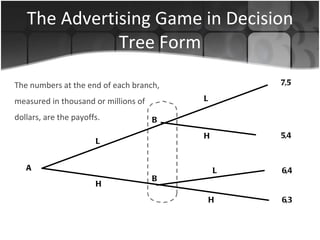
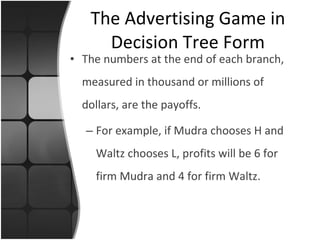
The Advertising Game in Decision Tree Form The numbers at the end of each branch, measured in thousand or millions of dollars, are the payoffs. 7,5 L L H L H H B B A 5,4 6,4 6,3
The numbers at the end of each branch, measured in thousand or millions of dollars, are the payoffs. For example, if Mudra chooses H and Waltz chooses L, profits will be 6 for firm Mudra and 4 for firm Waltz. The Advertising Game in Decision Tree Form
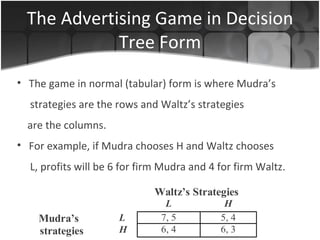
The Advertising Game in Decision Tree Form The game in normal (tabular) form is where Mudra’s strategies are the rows and Waltz’s strategies are the columns. For example, if Mudra chooses H and Waltz chooses L, profits will be 6 for firm Mudra and 4 for firm Waltz.
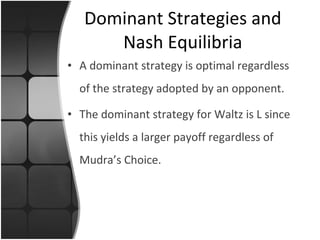
Dominant Strategies and Nash Equilibria A dominant strategy is optimal regardless of the strategy adopted by an opponent. The dominant strategy for Waltz is L since this yields a larger payoff regardless of Mudra’s Choice.
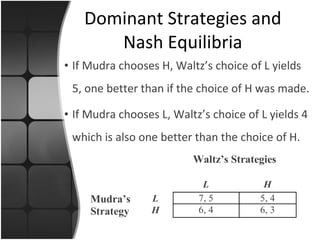
If Mudra chooses H, Waltz’s choice of L yields 5, one better than if the choice of H was made. If Mudra chooses L, Waltz’s choice of L yields 4 which is also one better than the choice of H. Dominant Strategies and Nash Equilibria
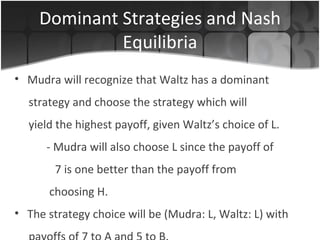
Dominant Strategies and Nash Equilibria Mudra will recognize that Waltz has a dominant  strategy and choose the strategy which will yield the highest payoff, given Waltz’s choice of L. - Mudra will also choose L since the payoff of    7 is one better than the payoff from   choosing H. The strategy choice will be (Mudra: L, Waltz: L) with payoffs of 7 to A and 5 to B.
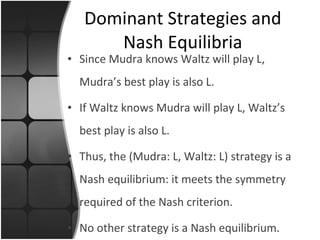
Since Mudra knows Waltz will play L, Mudra’s best play is also L. If Waltz knows Mudra will play L, Waltz’s best play is also L. Thus, the (Mudra: L, Waltz: L) strategy is a Nash equilibrium: it meets the symmetry required of the Nash criterion. No other strategy is a Nash equilibrium. Dominant Strategies and Nash Equilibria
CASE II: APPLICATION OF GAME THEORY IN TWO TELEVISION CHANNELS
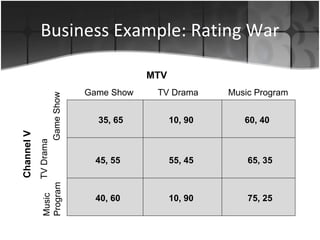
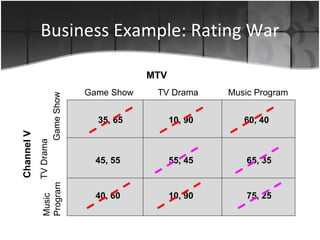
Business Example: Rating War 35, 65 10, 90 60, 40 45, 55 55, 45 65, 35 75, 25 10, 90 40, 60 MTV Channel V Game Show TV Drama Music Program Game Show TV Drama Music  Program
PRISONER ’S DILEMMA
Prisoner’s Dilemma The  prisoner's dilemma  is a fundamental problem in  game theory  that demonstrates why two people  or groups  might not cooperate even if it is in both their best interests to do so.
CASE III: TERRORISM
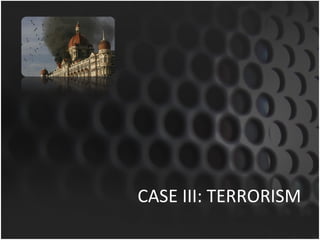
Case : Terrorism There is terrorism in Thailand. Two hotel buildings were set on fire. One in Chiang Mai and the other one in Phuket. There are 500 guests stuck in Chiang Mai hotel and 300 guests in Phuket hotel.  It is the responsibility of the chief of the Rescue Team stationed in Bangkok to send staff on the site(s) to save lives.
Unfortunately, the team has only one helicopter.  Since the 2 hotels are too far apart, we have to select only one mission: to rescue people in Chiang Mai OR in Phuket. However, there is the other Rescue Team who is our arch rival. It also owns only one helicopter as well. Case : Terrorism
Case : Terrorism Now the leader of the other team has to make the same decision as we do. We want to save as many lives as possible and they want to do the same. Since both the parties hate each other so they two cannot communicate.
PROBLEM: Should we send our team to Chiang Mai or Phuket? Case : Terrorism
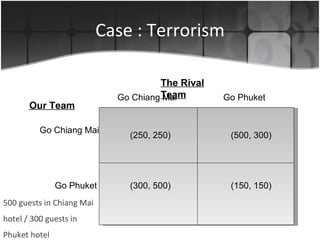
Case : Terrorism 500 guests in Chiang Mai hotel / 300 guests in Phuket hotel Go Chiang Mai   Go Phuket The Rival Team Our Team Go Chiang Mai Go Phuket (250, 250) (300, 500) (500, 300) (150, 150)
Scenario I:  Both teams go to Chiang Mai. Each team rescues 250 people. Scenario II:  Our team goes to Chiang Mai, our rival goes to Phuket. We rescue 500, they rescue 300. Case : Terrorism
Scenario III:  Our team goes to Phuket, our rival goes to Chiang Mai. We rescue 300, they rescue 500. Scenario IV:  Both the teams go to Phuket and rescue 150 per team. Case : Terrorism
Case : Terrorism The answer is…
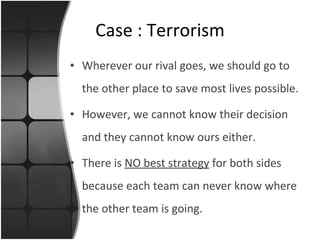
Wherever our rival goes, we should go to the other place to save most lives possible. However, we cannot know their decision and they cannot know ours either. There is  NO best strategy  for both sides because each team can never know where the other team is going. Case : Terrorism
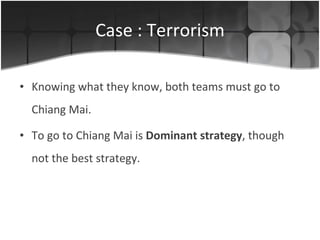
Case : Terrorism Knowing what they know, both teams must go to Chiang Mai. To go to Chiang Mai is  Dominant strategy , though not the best strategy.
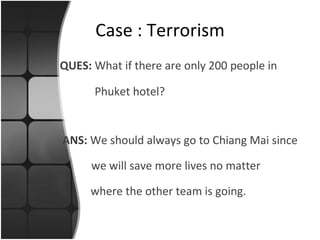
QUES:  What if there are only 200 people in   Phuket hotel? Case : Terrorism ANS:  We should always go to Chiang Mai since    we will save more lives no matter where the other team is going.
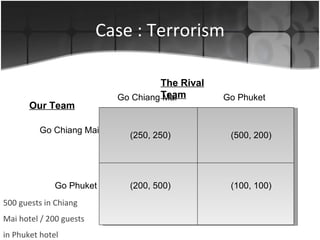
Case : Terrorism 500 guests in Chiang Mai hotel / 200 guests in Phuket hotel Go Chiang Mai   Go Phuket The Rival Team Our Team Go Chiang Mai Go Phuket (250, 250) (200, 500) (500, 200) (100, 100)
If there are only 200 people in Phuket Hotel. Then, to go to Chiang Mai is our  “Dominant Strategy” . It is also the best strategy possible. “ Dominant Strategy”  only exists in some situations. Case : Terrorism
Case : Terrorism Dominant Strategy is the rational  move  that  a player will make  no matter what the other side’s decision   is .   Sometimes Dominant Strategy is the best strategy in a situation, sometimes it is not. Anyway, a player will always use   Dominant Strategy  as his choice.
CONCLUSION Mimics most real-life situations well. Solving may not be efficient. Applications are in almost all fields. Big assumption: players being rational. Can you think of “irrational” game theory?
A PRESENTATION BY: Amritanshu Mehra (11DCP008) Kush Aggarwal (11DCP024) Ravi Gupta (11DCP038 )

Game theory

  • 1.
    GAME THEORY ANAPPLICATION
  • 2.
    Game Theory Atheory that attempts to mathematically capture behavior in strategic situations or games, in which an individual's success in making choices depends on the choices of others .
  • 3.
    Game Theory –An Introduction Firstly presented by the legendary mathematician “John Von Neumann”. Attempt to analyze competitions in which one individual does better at another ’ s expense ( zero sum games). Later developed by “John Nash”, the Nobel Prize winner and a professor at Princeton University.
  • 4.
  • 5.
    Dominant Firm GameTwo firms, one large and one small. Either firm can announce an output level (lead) or else wait to see what the rival does and then produce an amount that does not saturate the market.
  • 6.
    Dominant Firm GameLead Follow Dominant Subordinate Lead Follow (0.5, 4) (1, 8) (3, 2) (0.5, 1)
  • 7.
    Dominant Firm GameLead Follow Dominant Subordinate Lead Follow (0.5, 4 ) (1, 8) (3, 2 ) (0.5, 1)
  • 8.
    Dominant Firm GameLead Follow Dominant Subordinate Lead Follow (0.5, 4) (1, 8 ) (3, 2) (0.5, 1 )
  • 9.
    Conclusion: Dominant Firmwill always lead. But what about the Subordinate firm? Dominant Firm Game
  • 10.
    Dominant Firm GameLead Follow Dominant Subordinate Lead Follow (0.5, 4) (1, 8) ( 3 , 2) ( 0.5 , 1)
  • 11.
    Dominant Firm GameLead Follow Dominant Subordinate Lead Follow ( 0.5 , 4) ( 1 , 8) (3, 2) (0.5, 1)
  • 12.
    Conclusion: No dominantstrategy for the Subordinate firm. Does this mean we cannot predict what they will do? Dominant Firm Game
  • 13.
    Dominant Firm GameLead Follow Dominant Subordinate Lead Follow (0.5, 4) ( 1 , 8 ) (3, 2) (0.5, 1)
  • 14.
    Conclusion: Subordinate firmwill always follow, because dominant firm will always lead. Dominant Firm Game
  • 15.
  • 16.
    Nash Equilibrium A solution concept of a game involving two or more players . If each player has chosen a strategy and no player can benefit by changing his or her strategy while the other players keep theirs unchanged, then the current set of strategy choices constitute a Nash equilibrium .
  • 17.
    CASE I: APPLICATIONOF GAME THEORY IN TWO ADVERTISING AGENCIES
  • 18.
    Advertising Agencies Twofirms, Mudra Communication Pvt. Ltd and Waltz Entertainment Pvt. Ltd must decide how much to spend on advertising. Each firm may adopt either a high (H) budget or a low (L) budget.
  • 19.
    An Advertising GameMudra makes the first move by choosing either H or L at the first decision “node.” Next, Waltz chooses either H or L, but the large oval surrounding Waltz’s two decision nodes indicates that Waltz does not know what choice Mudra made.
  • 20.
    The Advertising Gamein Decision Tree Form The numbers at the end of each branch, measured in thousand or millions of dollars, are the payoffs. 7,5 L L H L H H B B A 5,4 6,4 6,3
  • 21.
    The numbers atthe end of each branch, measured in thousand or millions of dollars, are the payoffs. For example, if Mudra chooses H and Waltz chooses L, profits will be 6 for firm Mudra and 4 for firm Waltz. The Advertising Game in Decision Tree Form
  • 22.
    The Advertising Gamein Decision Tree Form The game in normal (tabular) form is where Mudra’s strategies are the rows and Waltz’s strategies are the columns. For example, if Mudra chooses H and Waltz chooses L, profits will be 6 for firm Mudra and 4 for firm Waltz.
  • 23.
    Dominant Strategies andNash Equilibria A dominant strategy is optimal regardless of the strategy adopted by an opponent. The dominant strategy for Waltz is L since this yields a larger payoff regardless of Mudra’s Choice.
  • 24.
    If Mudra choosesH, Waltz’s choice of L yields 5, one better than if the choice of H was made. If Mudra chooses L, Waltz’s choice of L yields 4 which is also one better than the choice of H. Dominant Strategies and Nash Equilibria
  • 25.
    Dominant Strategies andNash Equilibria Mudra will recognize that Waltz has a dominant strategy and choose the strategy which will yield the highest payoff, given Waltz’s choice of L. - Mudra will also choose L since the payoff of 7 is one better than the payoff from choosing H. The strategy choice will be (Mudra: L, Waltz: L) with payoffs of 7 to A and 5 to B.
  • 26.
    Since Mudra knowsWaltz will play L, Mudra’s best play is also L. If Waltz knows Mudra will play L, Waltz’s best play is also L. Thus, the (Mudra: L, Waltz: L) strategy is a Nash equilibrium: it meets the symmetry required of the Nash criterion. No other strategy is a Nash equilibrium. Dominant Strategies and Nash Equilibria
  • 27.
    CASE II: APPLICATIONOF GAME THEORY IN TWO TELEVISION CHANNELS
  • 28.
    Business Example: RatingWar 35, 65 10, 90 60, 40 45, 55 55, 45 65, 35 75, 25 10, 90 40, 60 MTV Channel V Game Show TV Drama Music Program Game Show TV Drama Music Program
  • 29.
    Business Example: RatingWar 35, 65 10, 90 60, 40 45, 55 55, 45 65, 35 75, 25 10, 90 40, 60 MTV Channel V Game Show TV Drama Music Program Game Show TV Drama Music Program
  • 30.
  • 31.
    Prisoner’s Dilemma The prisoner's dilemma is a fundamental problem in game theory that demonstrates why two people or groups might not cooperate even if it is in both their best interests to do so.
  • 32.
  • 33.
    Case : TerrorismThere is terrorism in Thailand. Two hotel buildings were set on fire. One in Chiang Mai and the other one in Phuket. There are 500 guests stuck in Chiang Mai hotel and 300 guests in Phuket hotel. It is the responsibility of the chief of the Rescue Team stationed in Bangkok to send staff on the site(s) to save lives.
  • 34.
    Unfortunately, the teamhas only one helicopter. Since the 2 hotels are too far apart, we have to select only one mission: to rescue people in Chiang Mai OR in Phuket. However, there is the other Rescue Team who is our arch rival. It also owns only one helicopter as well. Case : Terrorism
  • 35.
    Case : TerrorismNow the leader of the other team has to make the same decision as we do. We want to save as many lives as possible and they want to do the same. Since both the parties hate each other so they two cannot communicate.
  • 36.
    PROBLEM: Should wesend our team to Chiang Mai or Phuket? Case : Terrorism
  • 37.
    Case : Terrorism500 guests in Chiang Mai hotel / 300 guests in Phuket hotel Go Chiang Mai Go Phuket The Rival Team Our Team Go Chiang Mai Go Phuket (250, 250) (300, 500) (500, 300) (150, 150)
  • 38.
    Scenario I: Both teams go to Chiang Mai. Each team rescues 250 people. Scenario II: Our team goes to Chiang Mai, our rival goes to Phuket. We rescue 500, they rescue 300. Case : Terrorism
  • 39.
    Scenario III: Our team goes to Phuket, our rival goes to Chiang Mai. We rescue 300, they rescue 500. Scenario IV: Both the teams go to Phuket and rescue 150 per team. Case : Terrorism
  • 40.
    Case : TerrorismThe answer is…
  • 41.
    Wherever our rivalgoes, we should go to the other place to save most lives possible. However, we cannot know their decision and they cannot know ours either. There is NO best strategy for both sides because each team can never know where the other team is going. Case : Terrorism
  • 42.
    Case : TerrorismKnowing what they know, both teams must go to Chiang Mai. To go to Chiang Mai is Dominant strategy , though not the best strategy.
  • 43.
    QUES: Whatif there are only 200 people in Phuket hotel? Case : Terrorism ANS: We should always go to Chiang Mai since we will save more lives no matter where the other team is going.
  • 44.
    Case : Terrorism500 guests in Chiang Mai hotel / 200 guests in Phuket hotel Go Chiang Mai Go Phuket The Rival Team Our Team Go Chiang Mai Go Phuket (250, 250) (200, 500) (500, 200) (100, 100)
  • 45.
    If there areonly 200 people in Phuket Hotel. Then, to go to Chiang Mai is our “Dominant Strategy” . It is also the best strategy possible. “ Dominant Strategy” only exists in some situations. Case : Terrorism
  • 46.
    Case : TerrorismDominant Strategy is the rational move that a player will make no matter what the other side’s decision is . Sometimes Dominant Strategy is the best strategy in a situation, sometimes it is not. Anyway, a player will always use Dominant Strategy as his choice.
  • 47.
    CONCLUSION Mimics mostreal-life situations well. Solving may not be efficient. Applications are in almost all fields. Big assumption: players being rational. Can you think of “irrational” game theory?
  • 48.
    A PRESENTATION BY:Amritanshu Mehra (11DCP008) Kush Aggarwal (11DCP024) Ravi Gupta (11DCP038 )