Introduction to Game Theory
Prepared by César R. Sobrino
Universidad del Turabo
August 16, 2018
Prepared by César R. Sobrino Introduction to Game Theory
Outline
1 Description of a Game
Complete & Incomplete Information
Perfect & Imperfect Information
2 Simultaneous Decisions (Static Games)
Pure Strategies (One-shot game)
Dominant Strategy
Dominated Strategy
Mixed Strategies (One-shot game)
Repeated Games
3 Sequential Decisions (Dynamic Games)
Prepared by César R. Sobrino Introduction to Game Theory
Introduction
Game theory models strategic behavior by agents who
understand that their actions affect the actions of
other agents.
This scheme is useful to model interactions among
firms, countries, individuals, etc.
Useful to analyze the interactions in oligopolistic
markets.
Distinguishing feature of oligopoly is interdependence
of firms’ profits.
Arises when number of firms in market is small
enough that every firms’ price and output decisions
affect demand and marginal revenue conditions of
every other firm in market.
Prepared by César R. Sobrino Introduction to Game Theory
The Elements of a Game
A game consists of
A set of players.
A set of strategies for each player.
Set of rules such as: simultaneous, sequential, who
plays first, cooperation;
The payoffs to each player for every possible list of
strategy choices by the players.
A game can be represented by a matrix form or using
decision trees.
Solution(s): Nash Equilibrium: Neither player has
an incentive to change strategy, given the other
player’s choice
Prepared by César R. Sobrino Introduction to Game Theory
Complete and Incomplete Information
Complete information refers when each agent
knows the other agent’s payoffs and the rules of the
game. It is a central assumption of the Game Theory.
Incomplete information, also known as
asymmetric information, refers to the contrary,
where not all players know each other’s payoffs.
Prepared by César R. Sobrino Introduction to Game Theory
Perfect and Imperfect Information
The perfection of information is an important notion
in Game Theory when considering sequential and
simultaneous games.
Perfect information is when each player knows or
can see other player’s moves. A good example would
be chess, where each player sees the other player’s
pieces on the board.
Imperfect information is when decisions have to be
made simultaneously, and players need to balance all
possible outcomes when making a decision. A good
example is a card game where each player’s card are
hidden from the rest of the players.
Prepared by César R. Sobrino Introduction to Game Theory
Nash Equilibrium
Set of actions or decisions for which all managers are
choosing their best actions given the actions they
expect their rivals to choose
Strategic stability
No single firm can unilaterally make a different
decision & do better.
When a unique Nash Equilibrium set of decisions
exists.
Rivals can be expected to make the decisions leading
to the Nash Equilibrium.
With multiple Nash equilibria, no way to predict the
likely outcome.
Nash equilibria can occur without dominant or
dominated strategies.
Prepared by César R. Sobrino Introduction to Game Theory
Simultaneous Decisions
Occur when managers must make individual decisions
without knowing their rivals’ decisions.
For all firms in an oligopoly to be predicting correctly
each others’ decisions:
All firms must be choosing individually best actions
given the predicted actions of their rivals, which they
can then believe are correctly predicted.
Strategically astute managers look for mutually best
decisions.
Prepared by César R. Sobrino Introduction to Game Theory
Pure Strategies: Dominant Strategy
Always provide best outcome no matter what decisions
rivals make,
When one exists, the rational decision maker always
follows its dominant strategy,
Predict rivals will follow their dominant strategies, if
they exist.
Dominant strategy equilibrium.
Exists when when all decision makers have dominant
strategies.
Prepared by César R. Sobrino Introduction to Game Theory
Prisoner’s Dilemma
2 prisoners (Bill & Jane), suspected of burglary, are
taken into custody.
There is no enough evidence to convict them of that
crime, only to convict them on the charge of possession
of stolen goods.
Prisoners are on separate interrogation rooms, which
means that they cannot communicate (imperfect
information).
Both prisoners are offered the same deal and know the
consequences of each action (complete information)
Prisoners are completely aware that the other prisoner
has been offered the exact same deal (common
knowledge).
Prepared by César R. Sobrino Introduction to Game Theory
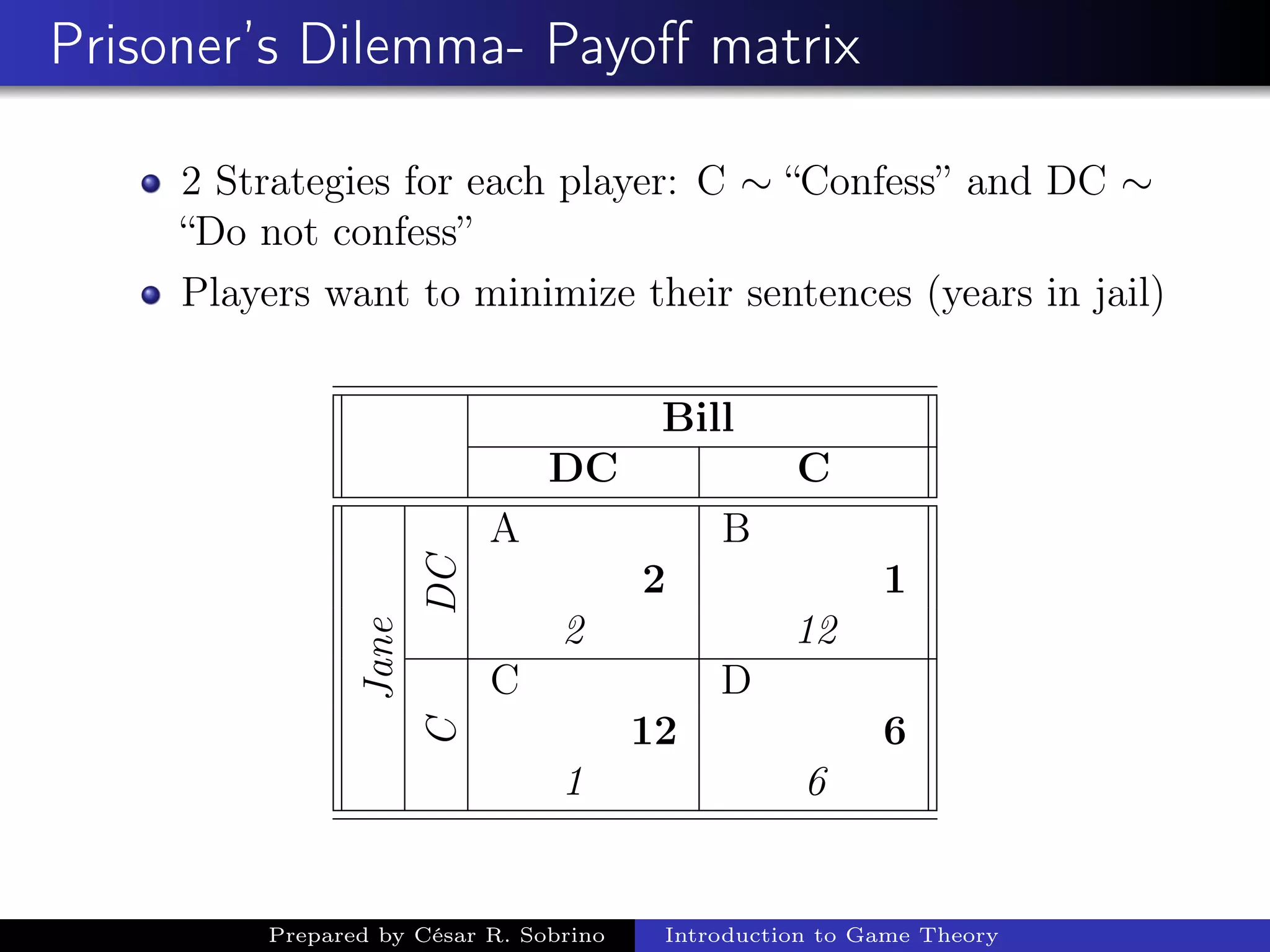
Prisoner’s Dilemma- Payoff matrix
2 Strategies for each player: C ∼ “Confess” and DC ∼
“Do not confess”
Players want to minimize their sentences (years in jail)
Bill
DC C
Jane
DC
A B
2 1
2 12
C
C D
12 6
1 6
Prepared by César R. Sobrino Introduction to Game Theory
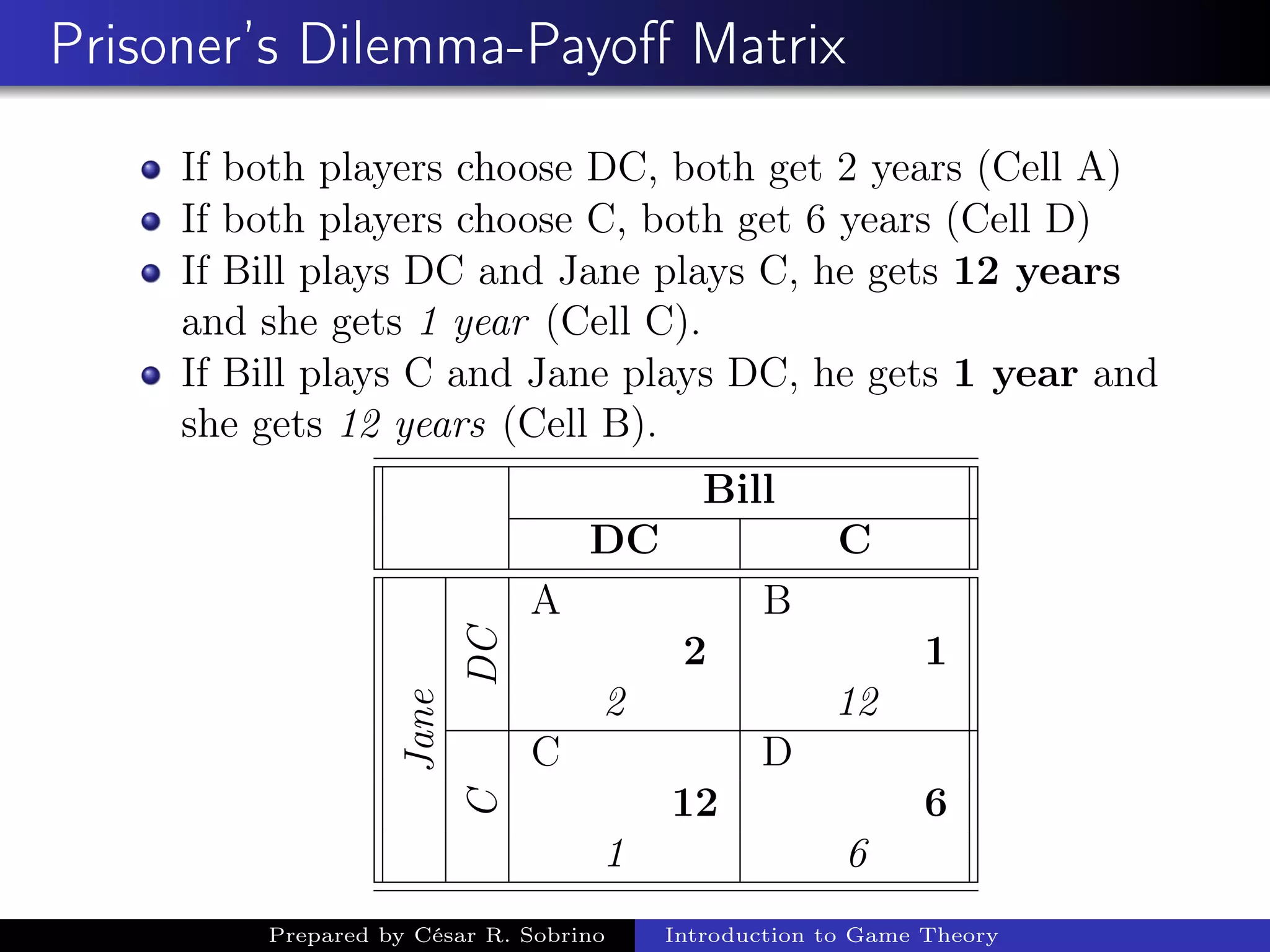
Prisoner’s Dilemma-Payoff Matrix
If both players choose DC, both get 2 years (Cell A)
If both players choose C, both get 6 years (Cell D)
If Bill plays DC and Jane plays C, he gets 12 years
and she gets 1 year (Cell C).
If Bill plays C and Jane plays DC, he gets 1 year and
she gets 12 years (Cell B).
Bill
DC C
Jane
DC
A B
2 1
2 12
C
C D
12 6
1 6
Prepared by César R. Sobrino Introduction to Game Theory
Prisoner’s Dilemma-Payoff Matrix: Bill’s payoffs
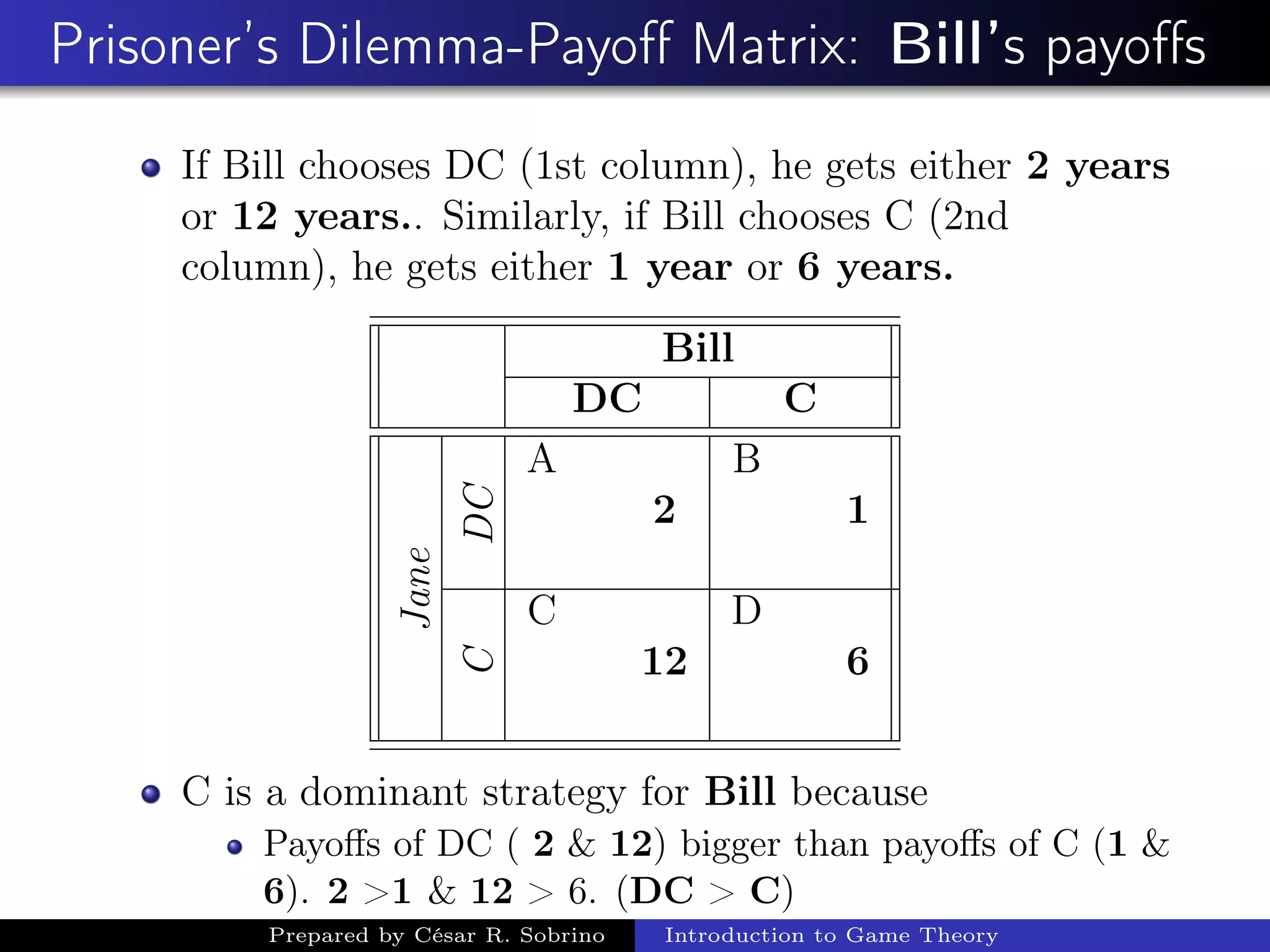
If Bill chooses DC (1st column), he gets either 2 years
or 12 years.. Similarly, if Bill chooses C (2nd
column), he gets either 1 year or 6 years.
Bill
DC CJane
DC A B
2 1
C
C D
12 6
C is a dominant strategy for Bill because
Payoffs of DC ( 2 & 12) bigger than payoffs of C (1 &
6). 2 >1 & 12 > 6. (DC > C)
Prepared by César R. Sobrino Introduction to Game Theory
Prisoner’s Dilemma-Payoff Matrix: Jane’s payoffs
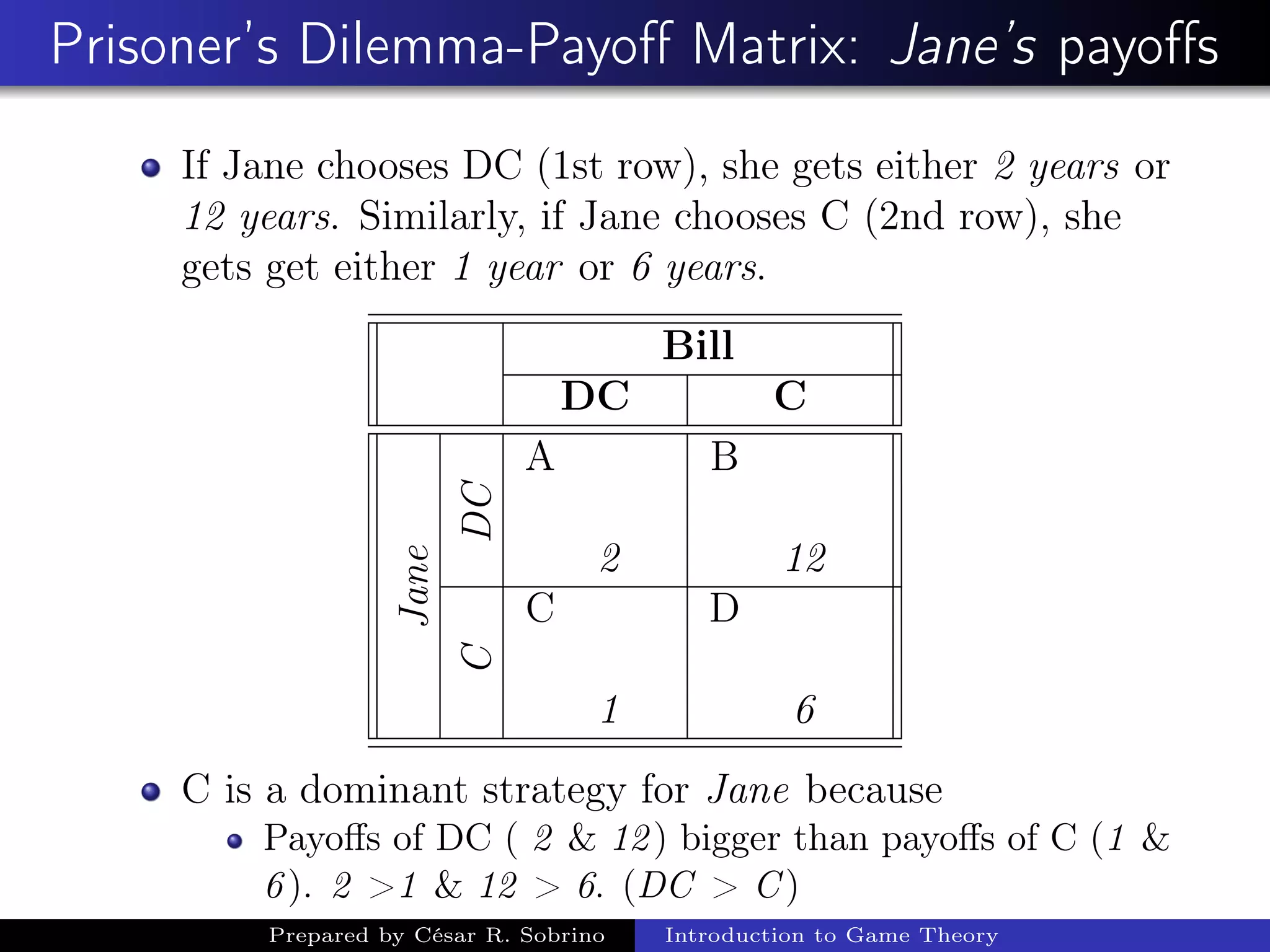
If Jane chooses DC (1st row), she gets either 2 years or
12 years. Similarly, if Jane chooses C (2nd row), she
gets get either 1 year or 6 years.
Bill
DC CJane
DC A B
2 12
C
C D
1 6
C is a dominant strategy for Jane because
Payoffs of DC ( 2 & 12) bigger than payoffs of C (1 &
6). 2 >1 & 12 > 6. (DC > C)
Prepared by César R. Sobrino Introduction to Game Theory
Prisoner’s Dilemma-Dominant Strategy
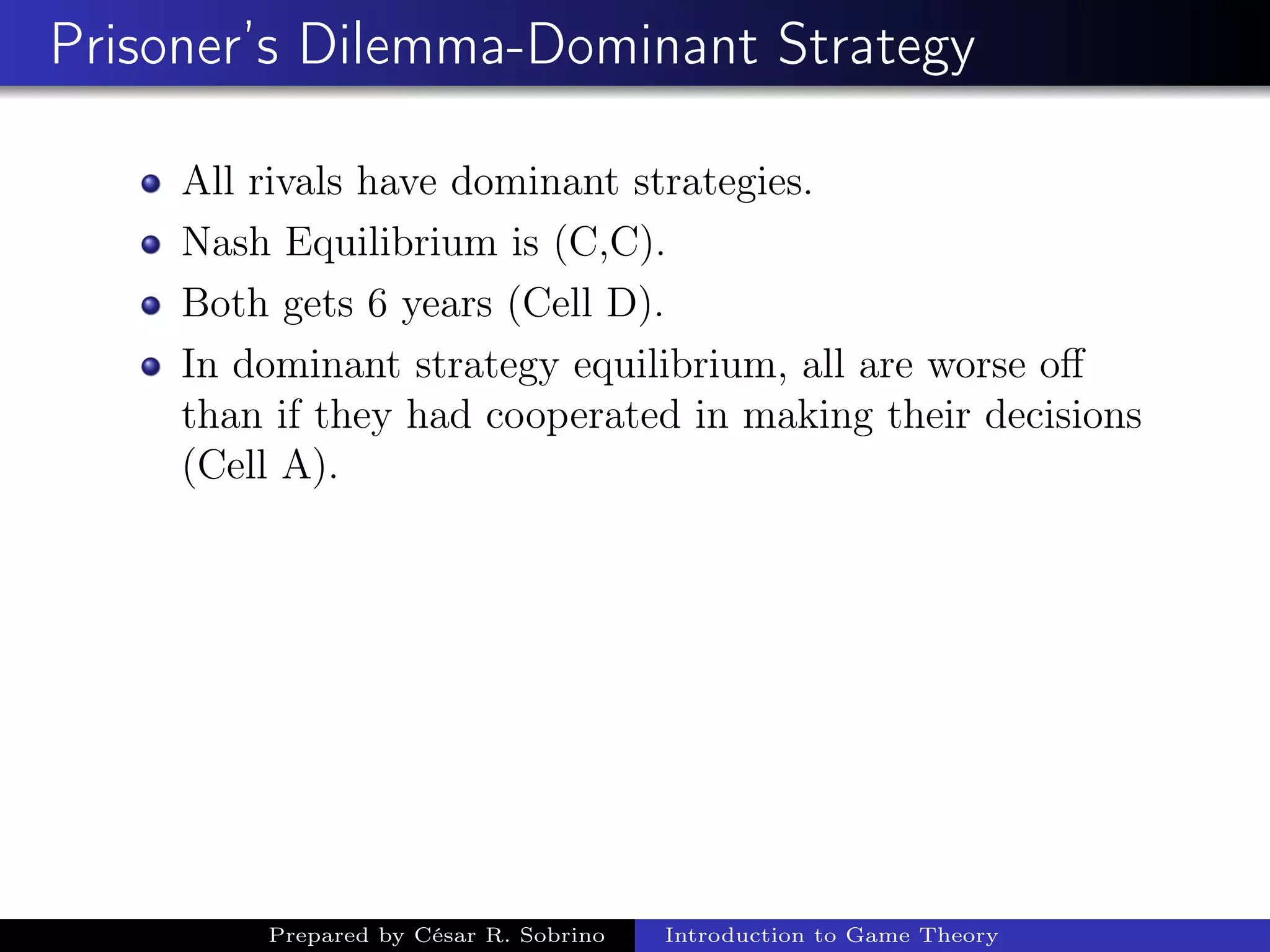
All rivals have dominant strategies.
Nash Equilibrium is (C,C).
Both gets 6 years (Cell D).
In dominant strategy equilibrium, all are worse off
than if they had cooperated in making their decisions
(Cell A).
Prepared by César R. Sobrino Introduction to Game Theory
Prisoner’s Dilemma- Best Response Analysis
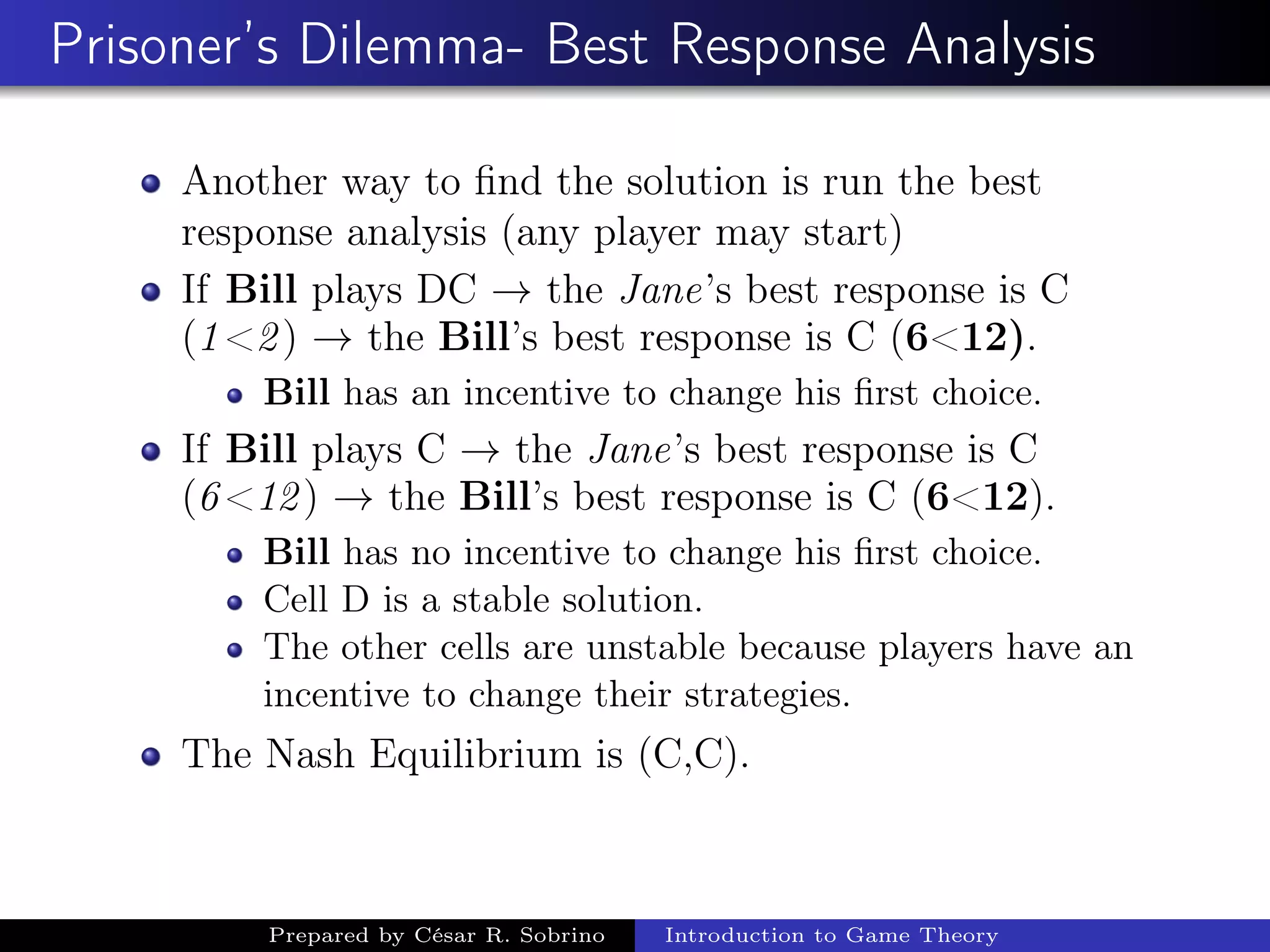
Another way to find the solution is run the best
response analysis (any player may start)
If Bill plays DC → the Jane’s best response is C
(1<2) → the Bill’s best response is C (6<12).
Bill has an incentive to change his first choice.
If Bill plays C → the Jane’s best response is C
(6<12) → the Bill’s best response is C (6<12).
Bill has no incentive to change his first choice.
Cell D is a stable solution.
The other cells are unstable because players have an
incentive to change their strategies.
The Nash Equilibrium is (C,C).
Prepared by César R. Sobrino Introduction to Game Theory
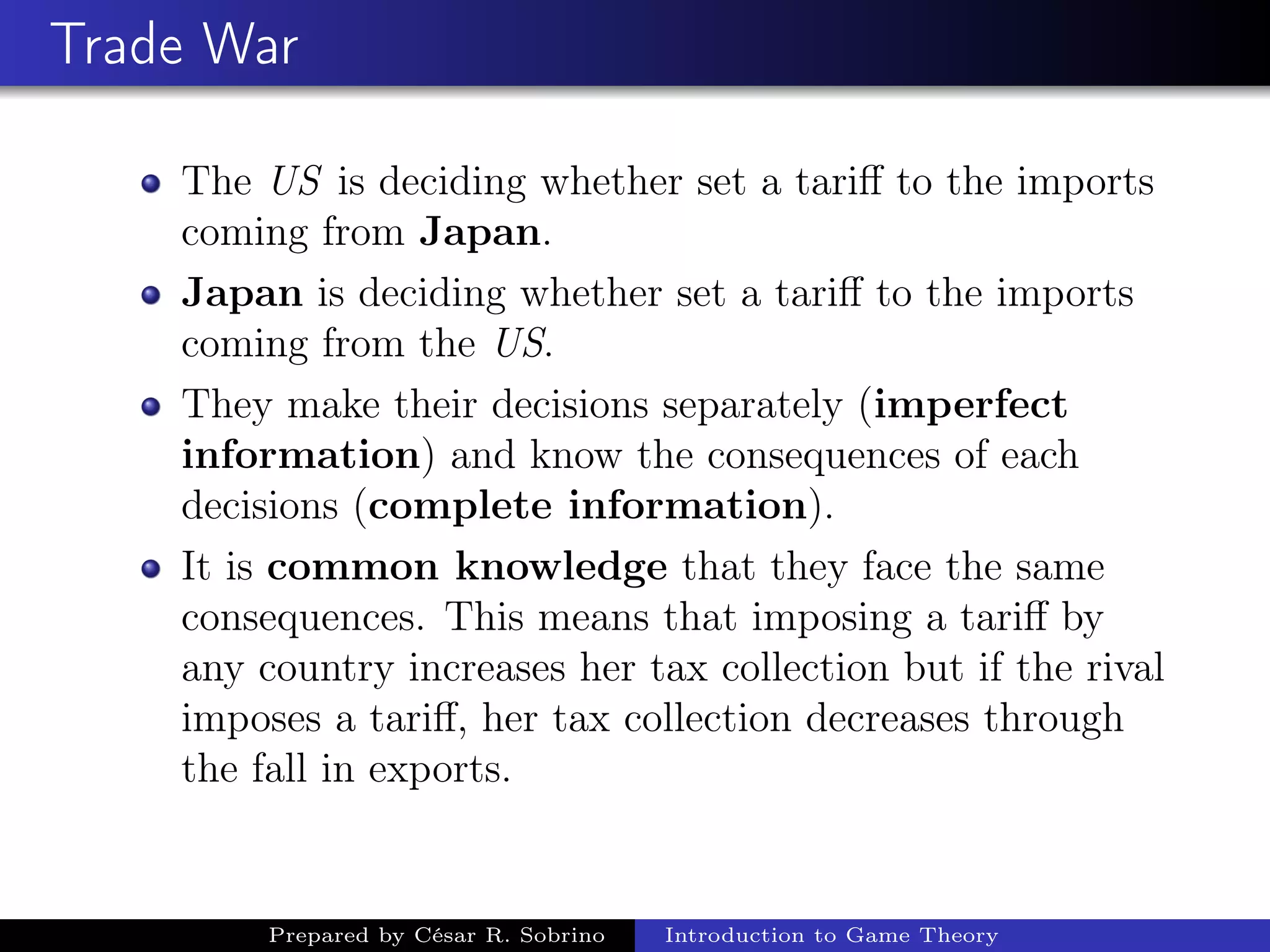
Trade War
The US is deciding whether set a tariff to the imports
coming from Japan.
Japan is deciding whether set a tariff to the imports
coming from the US.
They make their decisions separately (imperfect
information) and know the consequences of each
decisions (complete information).
It is common knowledge that they face the same
consequences. This means that imposing a tariff by
any country increases her tax collection but if the rival
imposes a tariff, her tax collection decreases through
the fall in exports.
Prepared by César R. Sobrino Introduction to Game Theory
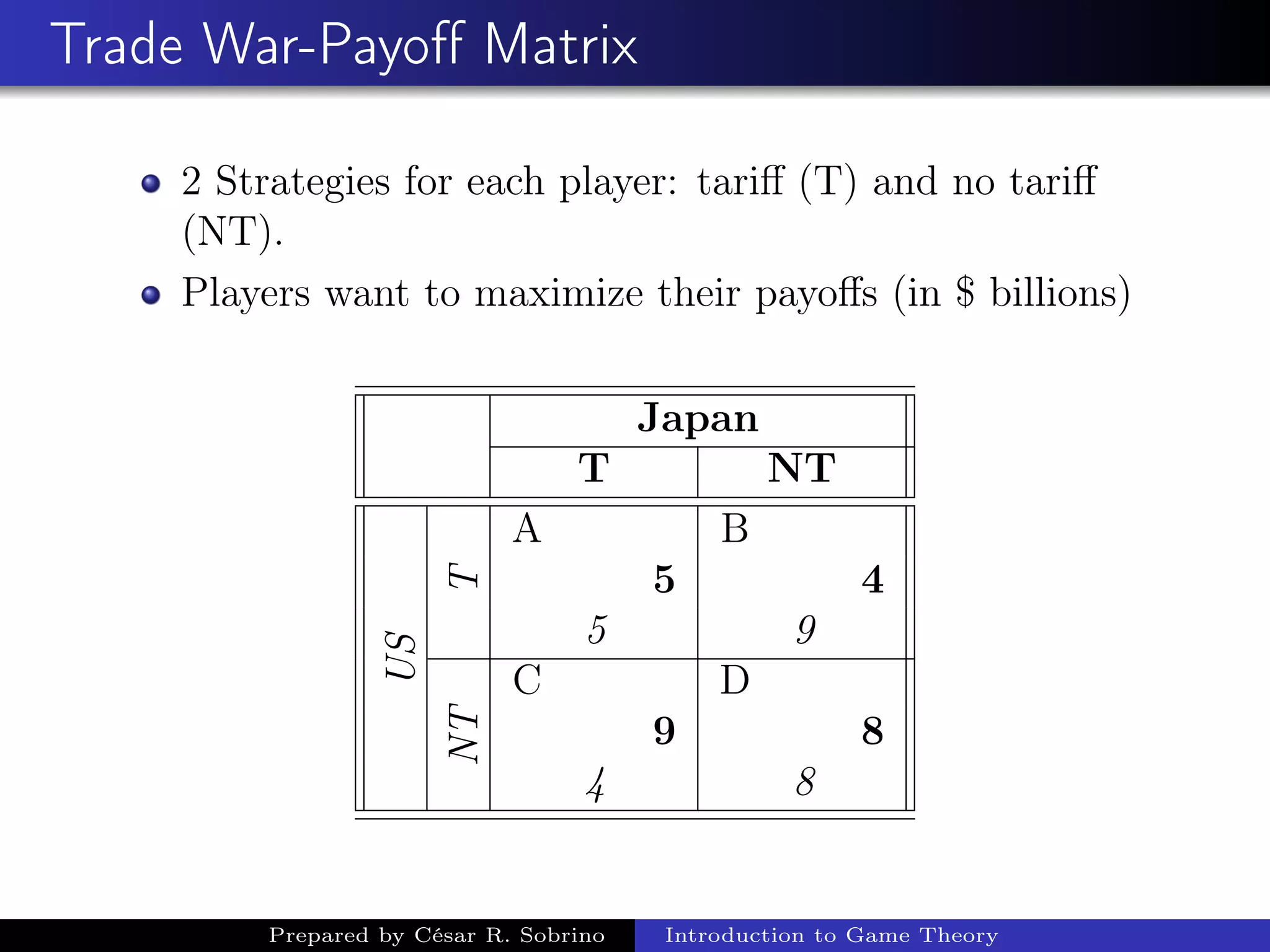
Trade War-Payoff Matrix
2 Strategies for each player: tariff (T) and no tariff
(NT).
Players want to maximize their payoffs (in $ billions)
Japan
T NT
US
T
A B
5 4
5 9
NT
C D
9 8
4 8
Prepared by César R. Sobrino Introduction to Game Theory
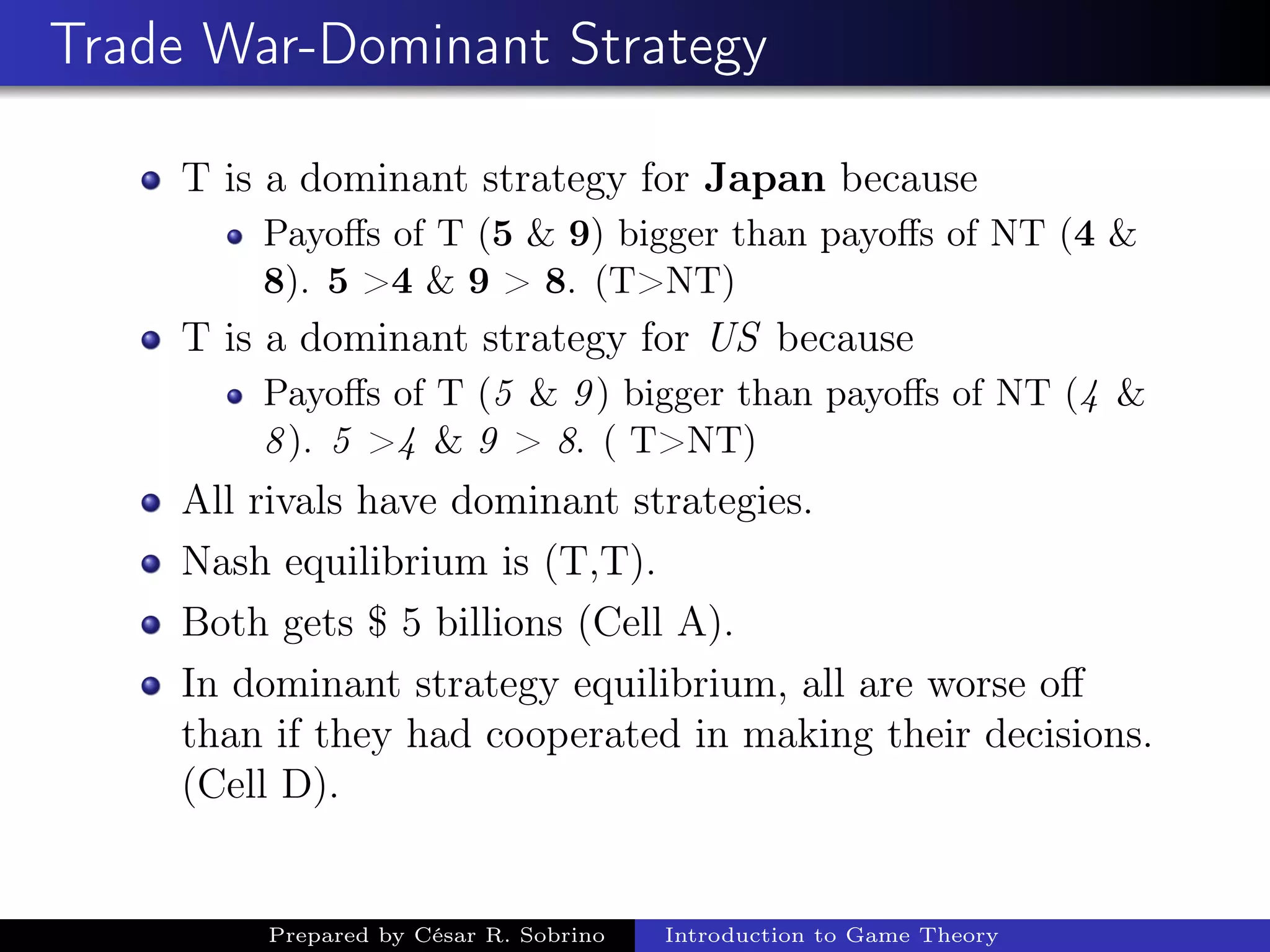
Trade War-Dominant Strategy
T is a dominant strategy for Japan because
Payoffs of T (5 & 9) bigger than payoffs of NT (4 &
8). 5 >4 & 9 > 8. (T>NT)
T is a dominant strategy for US because
Payoffs of T (5 & 9) bigger than payoffs of NT (4 &
8). 5 >4 & 9 > 8. ( T>NT)
All rivals have dominant strategies.
Nash equilibrium is (T,T).
Both gets $ 5 billions (Cell A).
In dominant strategy equilibrium, all are worse off
than if they had cooperated in making their decisions.
(Cell D).
Prepared by César R. Sobrino Introduction to Game Theory
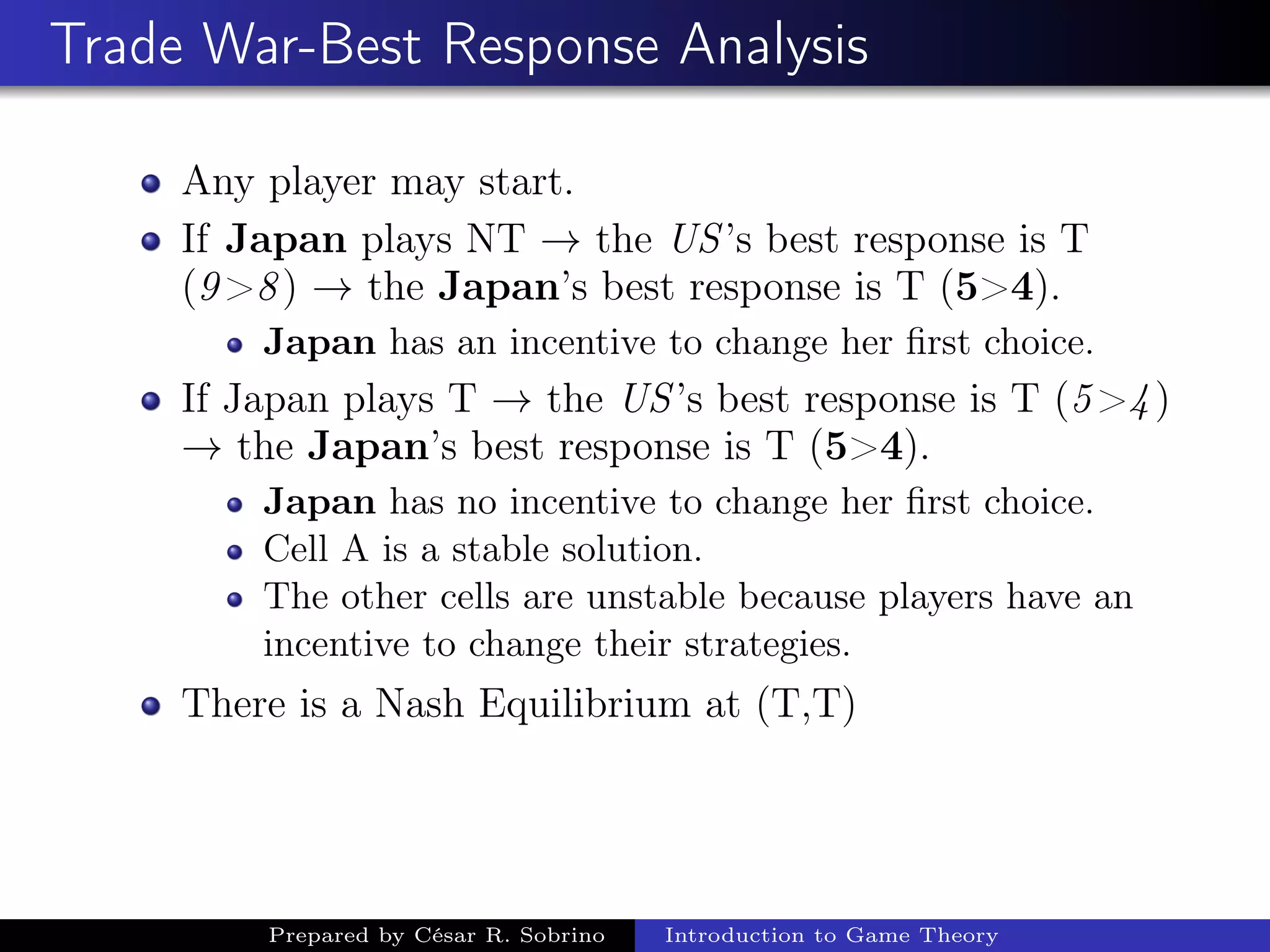
Trade War-Best Response Analysis
Any player may start.
If Japan plays NT → the US’s best response is T
(9>8) → the Japan’s best response is T (5>4).
Japan has an incentive to change her first choice.
If Japan plays T → the US’s best response is T (5>4)
→ the Japan’s best response is T (5>4).
Japan has no incentive to change her first choice.
Cell A is a stable solution.
The other cells are unstable because players have an
incentive to change their strategies.
There is a Nash Equilibrium at (T,T)
Prepared by César R. Sobrino Introduction to Game Theory
Multiple Equilibria
There are games that have more than one Nash
Equilibrium.
Hard to find a unique solution in simultaneous
decisions.
Sequential decisions is the best way to find a unique
outcome.
Prepared by César R. Sobrino Introduction to Game Theory
Battle of the sexes
It is a game of coordination.
This kind of game is where the payoffs of the players
are highest when they can coordinate their strategies.
Husband and wife like to spend time in either “Opera”
or “Fight”.
However, wife would rather to go to the “Opera” and
husband would rather to go to the “Fight”.
A key point is that they like to spend time together. It
is worthless to go alone to any of those meetings.
Payoffs are in utils (preference levels). The higher the
util, the better.
Prepared by César R. Sobrino Introduction to Game Theory
Battle of the sexes
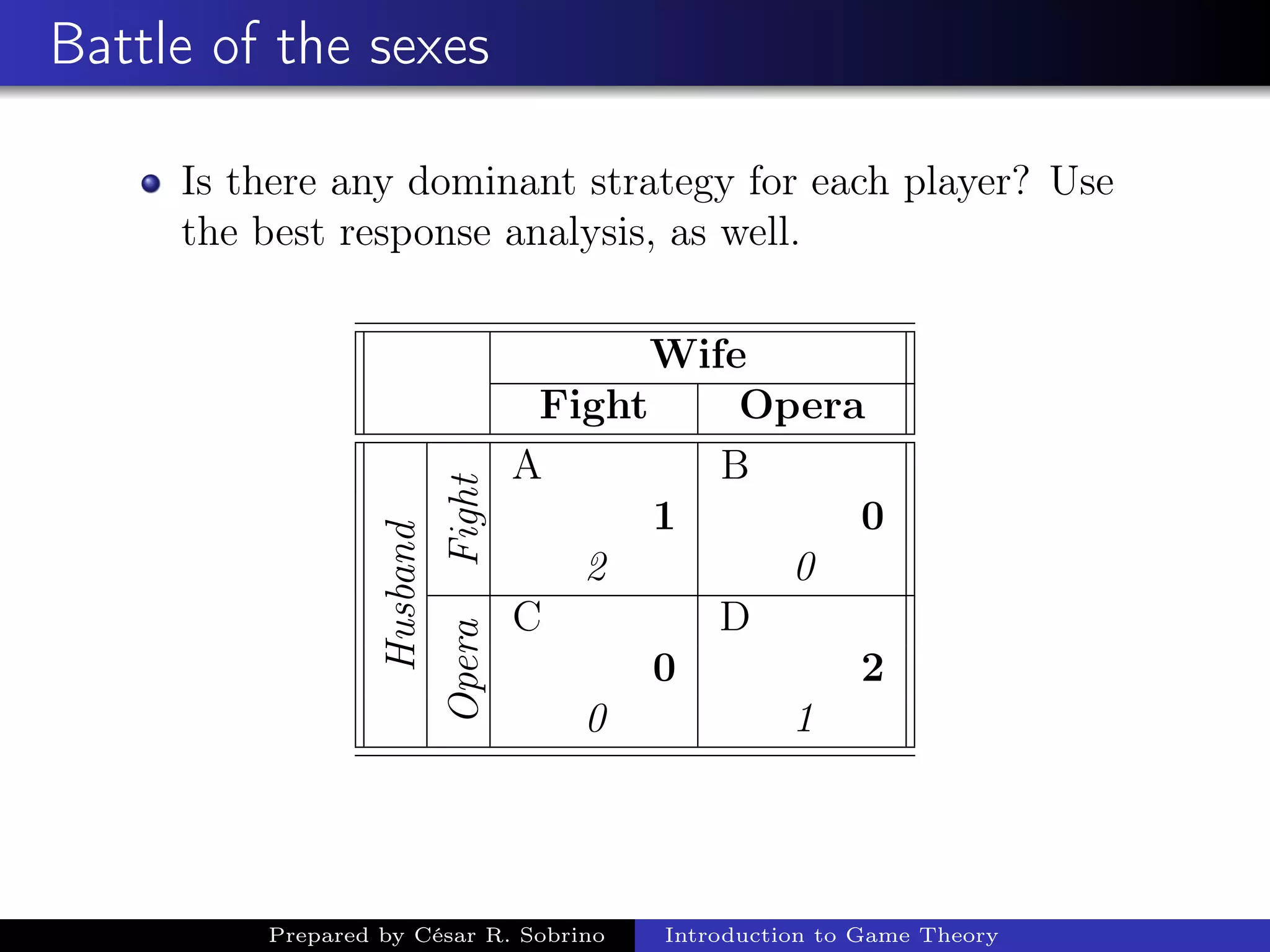
Is there any dominant strategy for each player? Use
the best response analysis, as well.
Wife
Fight OperaHusband
Fight A B
1 0
2 0
Opera
C D
0 2
0 1
Prepared by César R. Sobrino Introduction to Game Theory
Battle of the sexes-Dominant Strategy
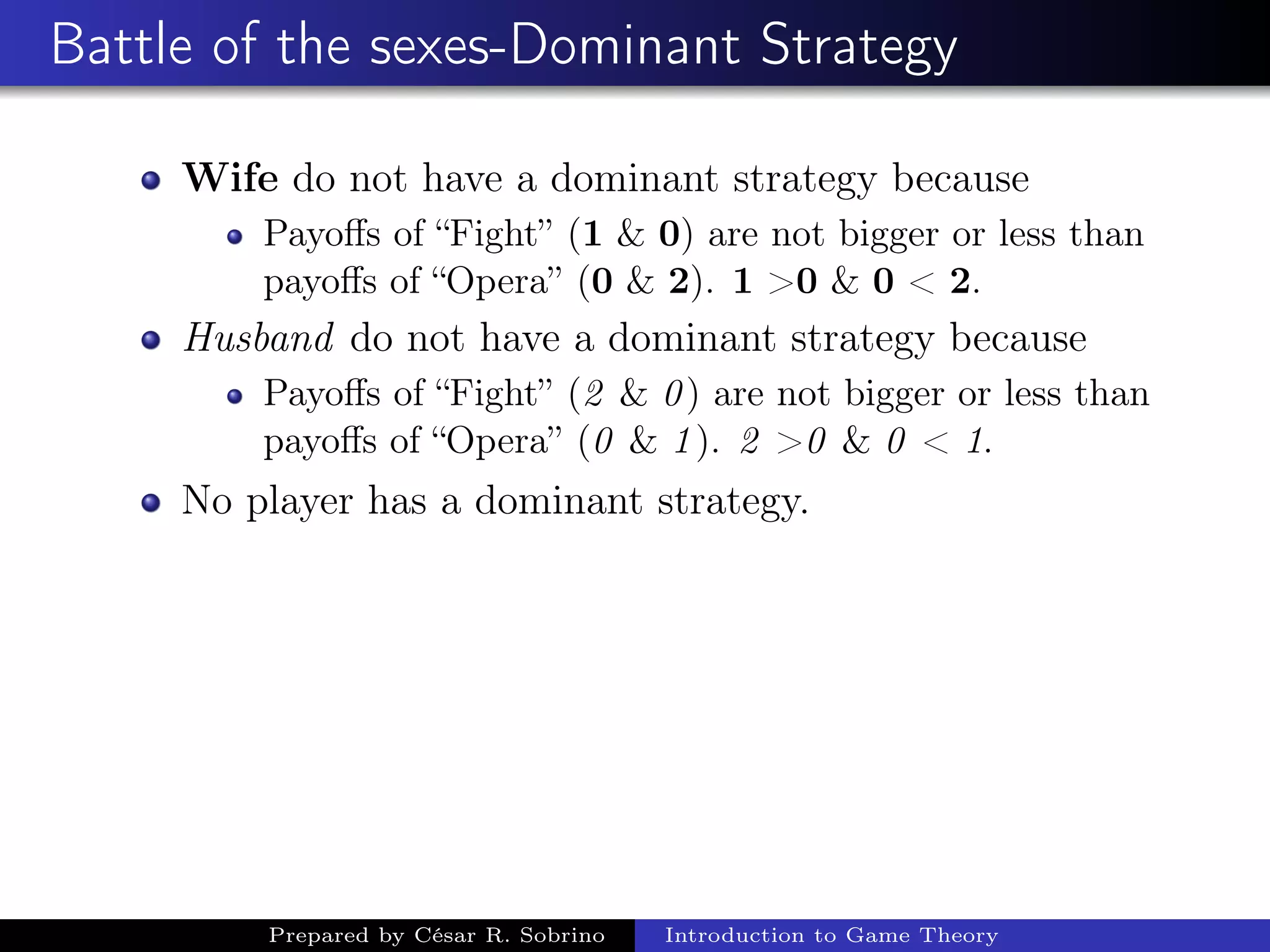
Wife do not have a dominant strategy because
Payoffs of “Fight” (1 & 0) are not bigger or less than
payoffs of “Opera” (0 & 2). 1 >0 & 0 < 2.
Husband do not have a dominant strategy because
Payoffs of “Fight” (2 & 0) are not bigger or less than
payoffs of “Opera” (0 & 1). 2 >0 & 0 < 1.
No player has a dominant strategy.
Prepared by César R. Sobrino Introduction to Game Theory
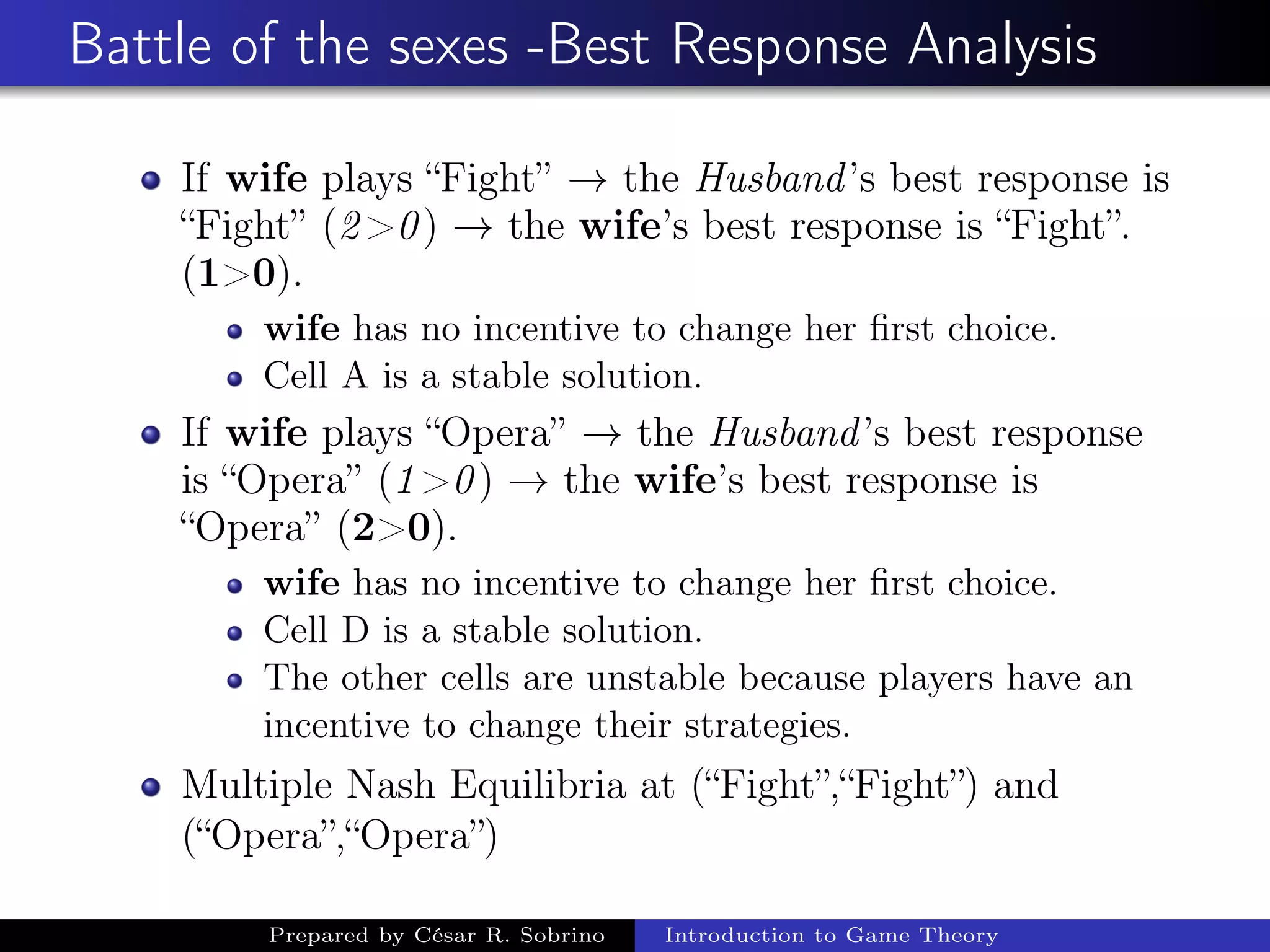
Battle of the sexes -Best Response Analysis
If wife plays “Fight” → the Husband’s best response is
“Fight” (2>0) → the wife’s best response is “Fight”.
(1>0).
wife has no incentive to change her first choice.
Cell A is a stable solution.
If wife plays “Opera” → the Husband’s best response
is “Opera” (1>0) → the wife’s best response is
“Opera” (2>0).
wife has no incentive to change her first choice.
Cell D is a stable solution.
The other cells are unstable because players have an
incentive to change their strategies.
Multiple Nash Equilibria at (“Fight”,“Fight”) and
(“Opera”,“Opera”)
Prepared by César R. Sobrino Introduction to Game Theory
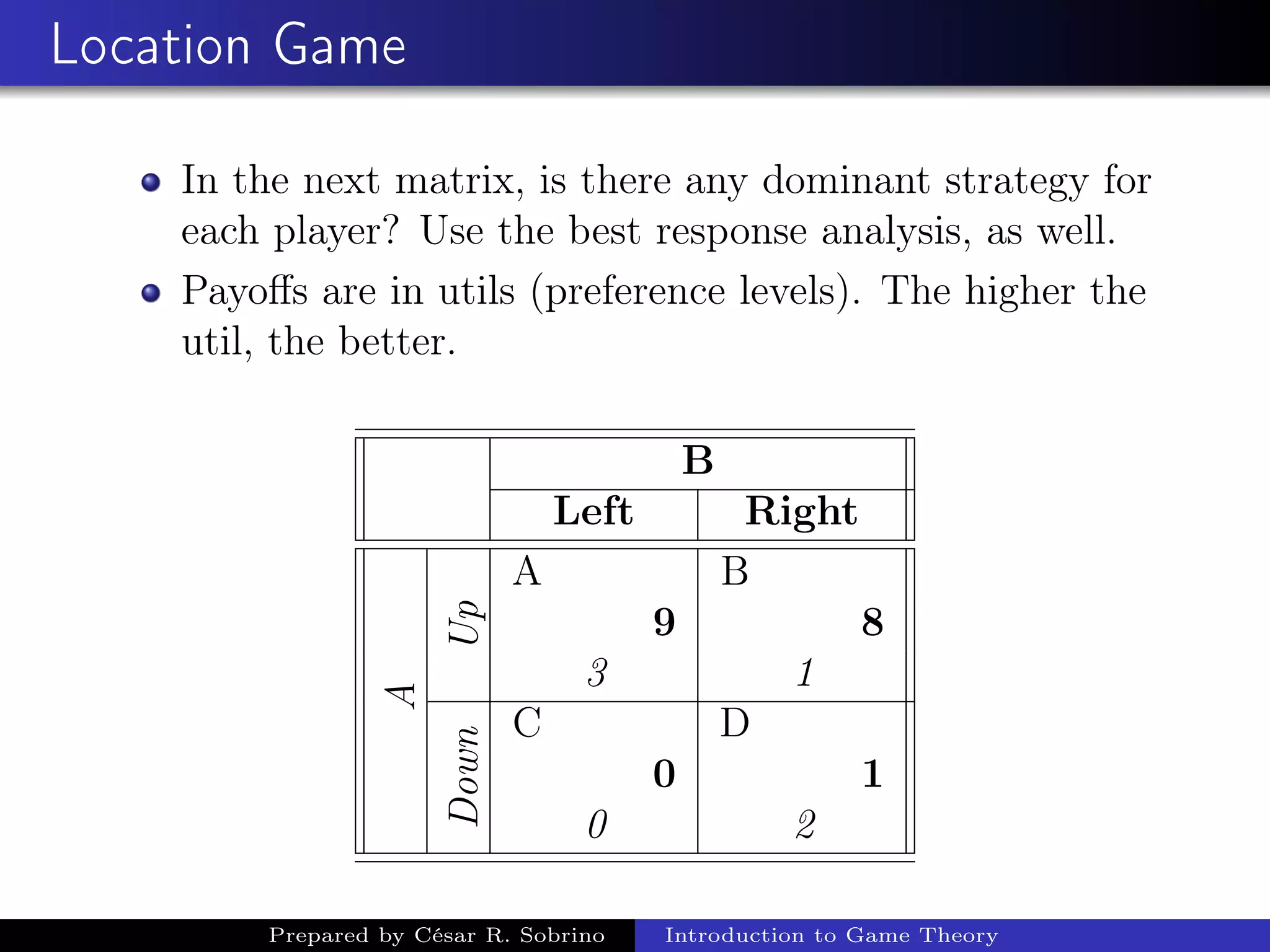
Location Game
In the next matrix, is there any dominant strategy for
each player? Use the best response analysis, as well.
Payoffs are in utils (preference levels). The higher the
util, the better.
B
Left Right
A
Up
A B
9 8
3 1
Down
C D
0 1
0 2
Prepared by César R. Sobrino Introduction to Game Theory
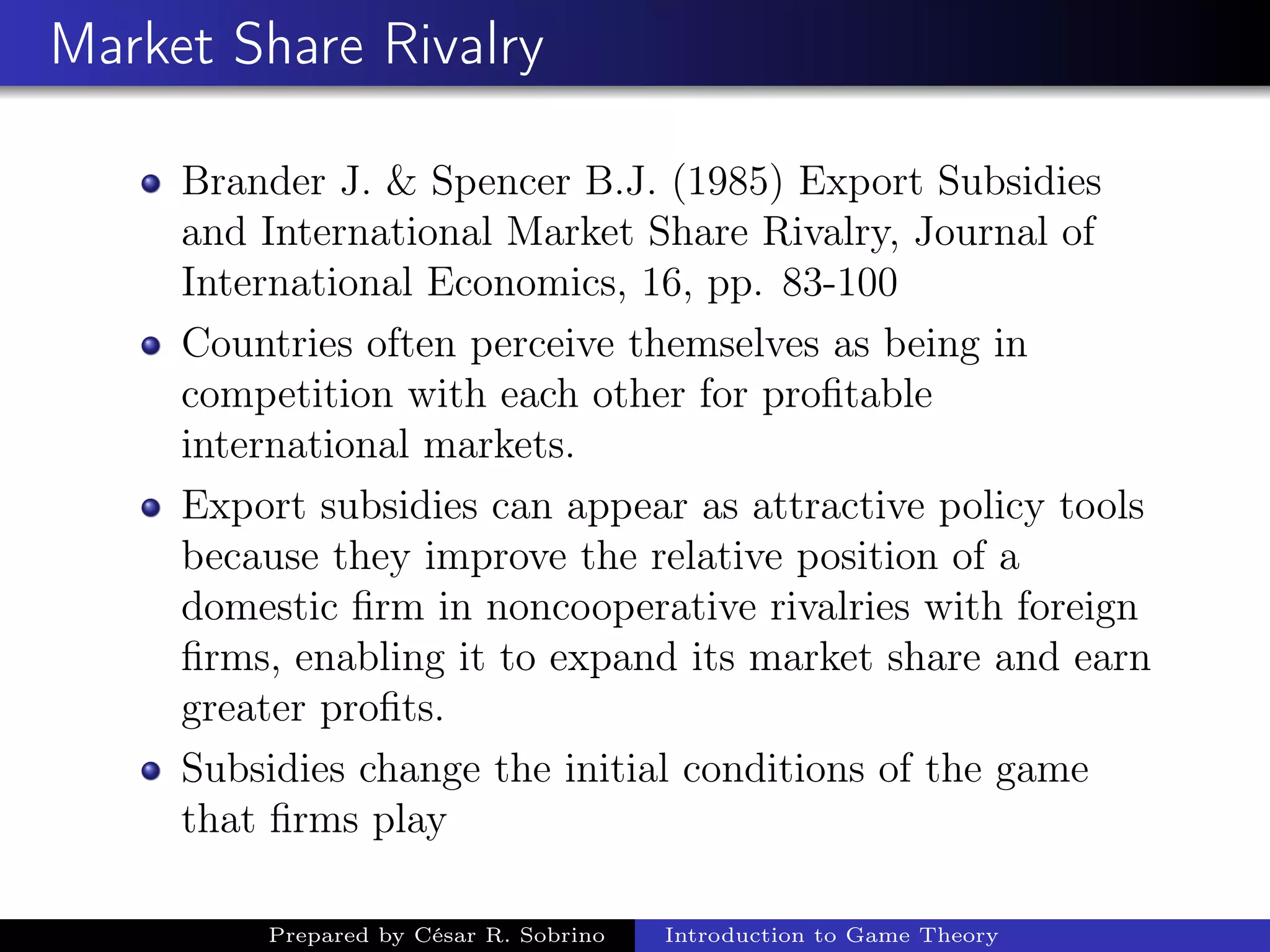
Market Share Rivalry
Brander J. & Spencer B.J. (1985) Export Subsidies
and International Market Share Rivalry, Journal of
International Economics, 16, pp. 83-100
Countries often perceive themselves as being in
competition with each other for profitable
international markets.
Export subsidies can appear as attractive policy tools
because they improve the relative position of a
domestic firm in noncooperative rivalries with foreign
firms, enabling it to expand its market share and earn
greater profits.
Subsidies change the initial conditions of the game
that firms play
Prepared by César R. Sobrino Introduction to Game Theory
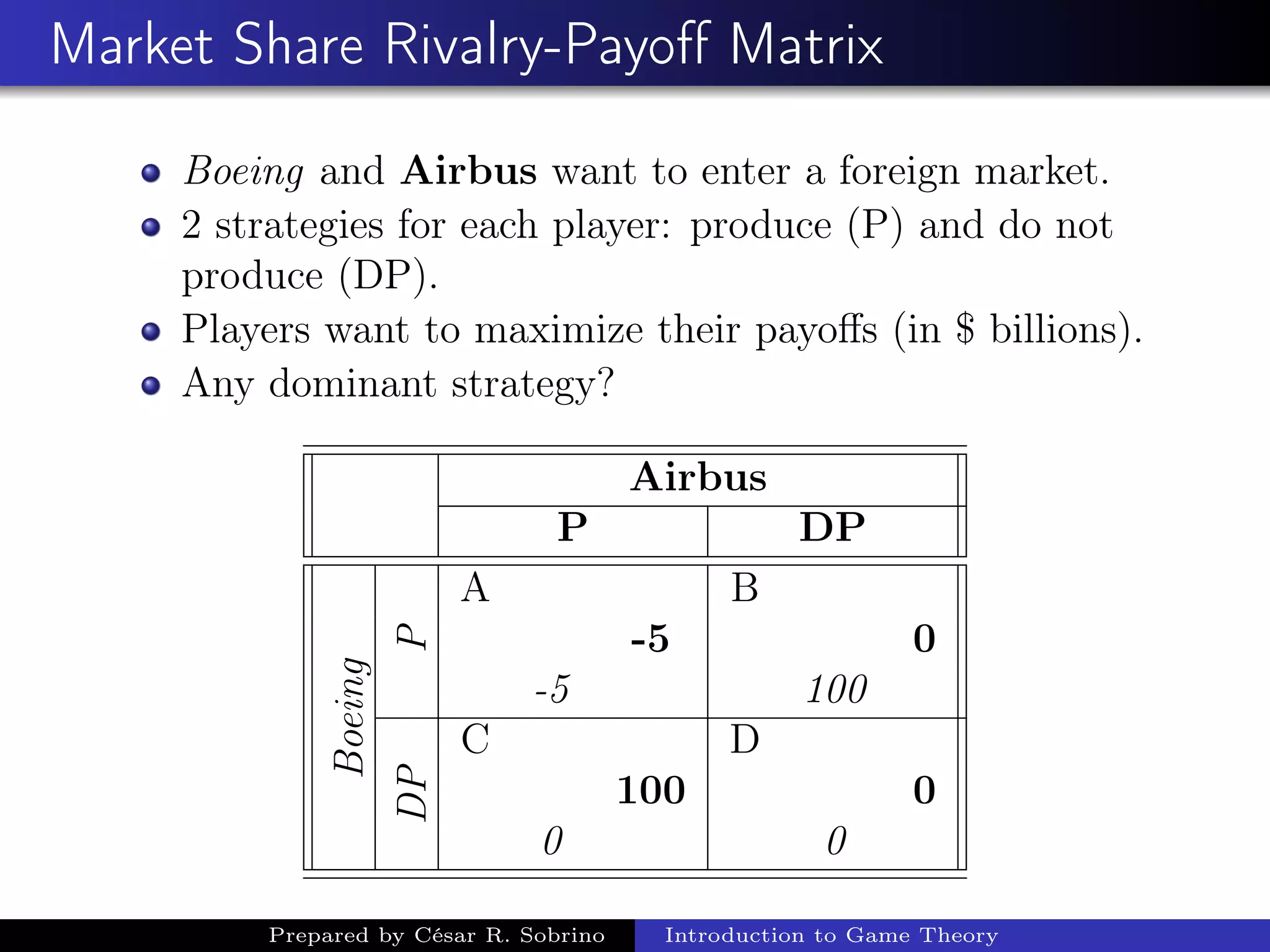
Market Share Rivalry-Payoff Matrix
Boeing and Airbus want to enter a foreign market.
2 strategies for each player: produce (P) and do not
produce (DP).
Players want to maximize their payoffs (in $ billions).
Any dominant strategy?
Airbus
P DP
Boeing
P
A B
-5 0
-5 100
DP
C D
100 0
0 0
Prepared by César R. Sobrino Introduction to Game Theory
Market Share Rivalry-Dominant Strategy
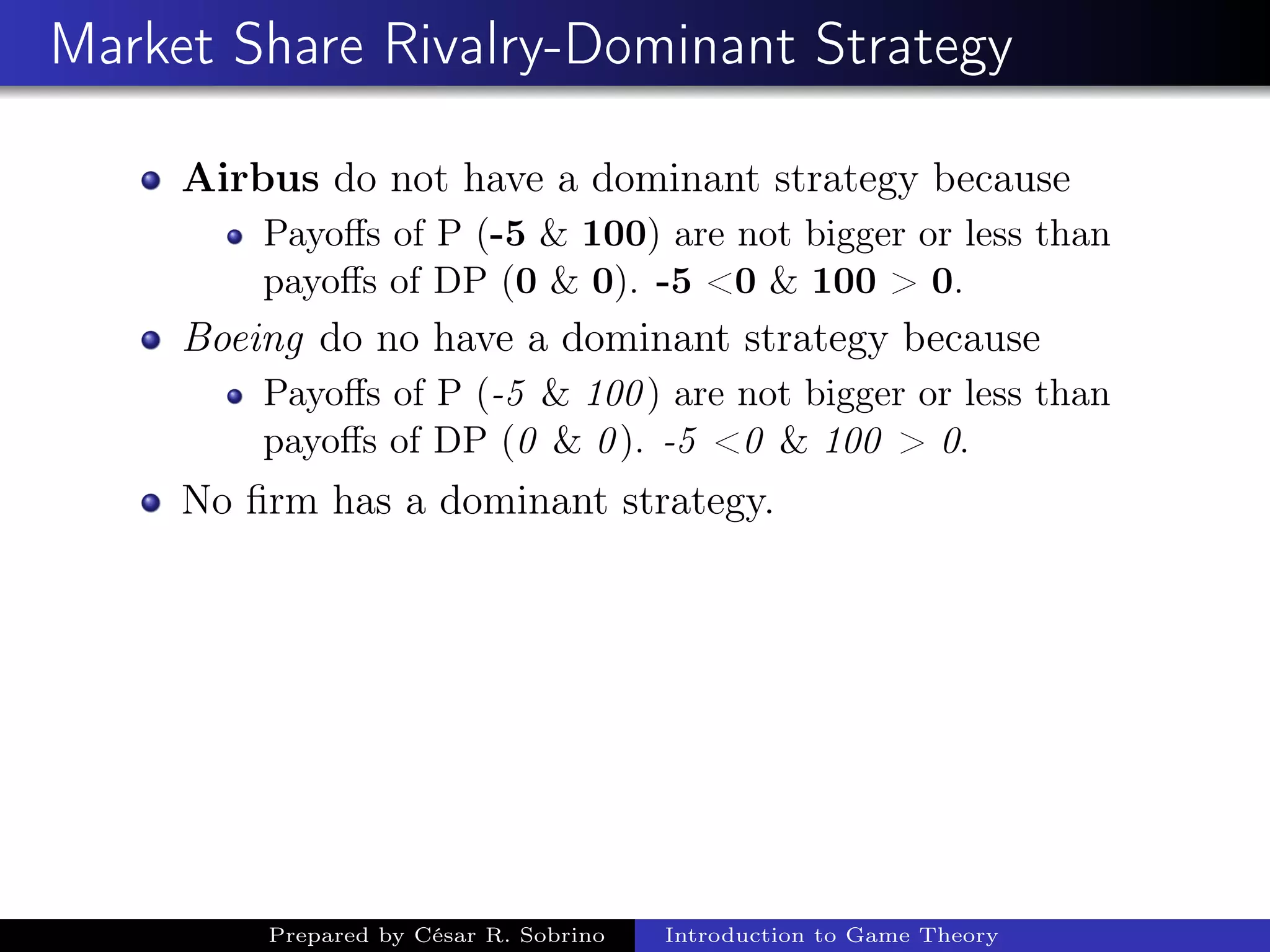
Airbus do not have a dominant strategy because
Payoffs of P (-5 & 100) are not bigger or less than
payoffs of DP (0 & 0). -5 <0 & 100 > 0.
Boeing do no have a dominant strategy because
Payoffs of P (-5 & 100) are not bigger or less than
payoffs of DP (0 & 0). -5 <0 & 100 > 0.
No firm has a dominant strategy.
Prepared by César R. Sobrino Introduction to Game Theory
Market Share Rivalry -Best Response Analysis
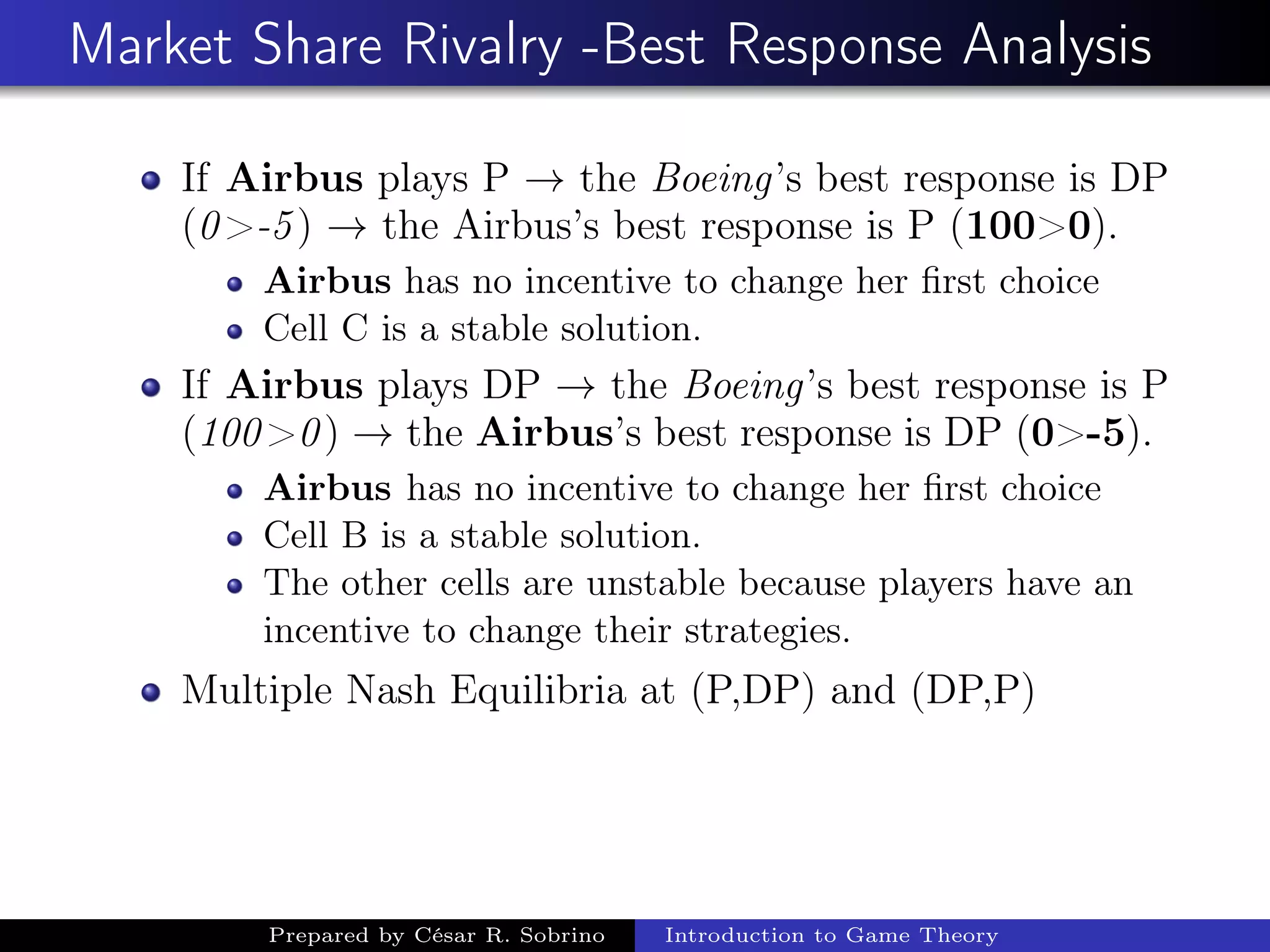
If Airbus plays P → the Boeing’s best response is DP
(0>-5) → the Airbus’s best response is P (100>0).
Airbus has no incentive to change her first choice
Cell C is a stable solution.
If Airbus plays DP → the Boeing’s best response is P
(100>0) → the Airbus’s best response is DP (0>-5).
Airbus has no incentive to change her first choice
Cell B is a stable solution.
The other cells are unstable because players have an
incentive to change their strategies.
Multiple Nash Equilibria at (P,DP) and (DP,P)
Prepared by César R. Sobrino Introduction to Game Theory
Market Share Rivalry-Payoff Matrix
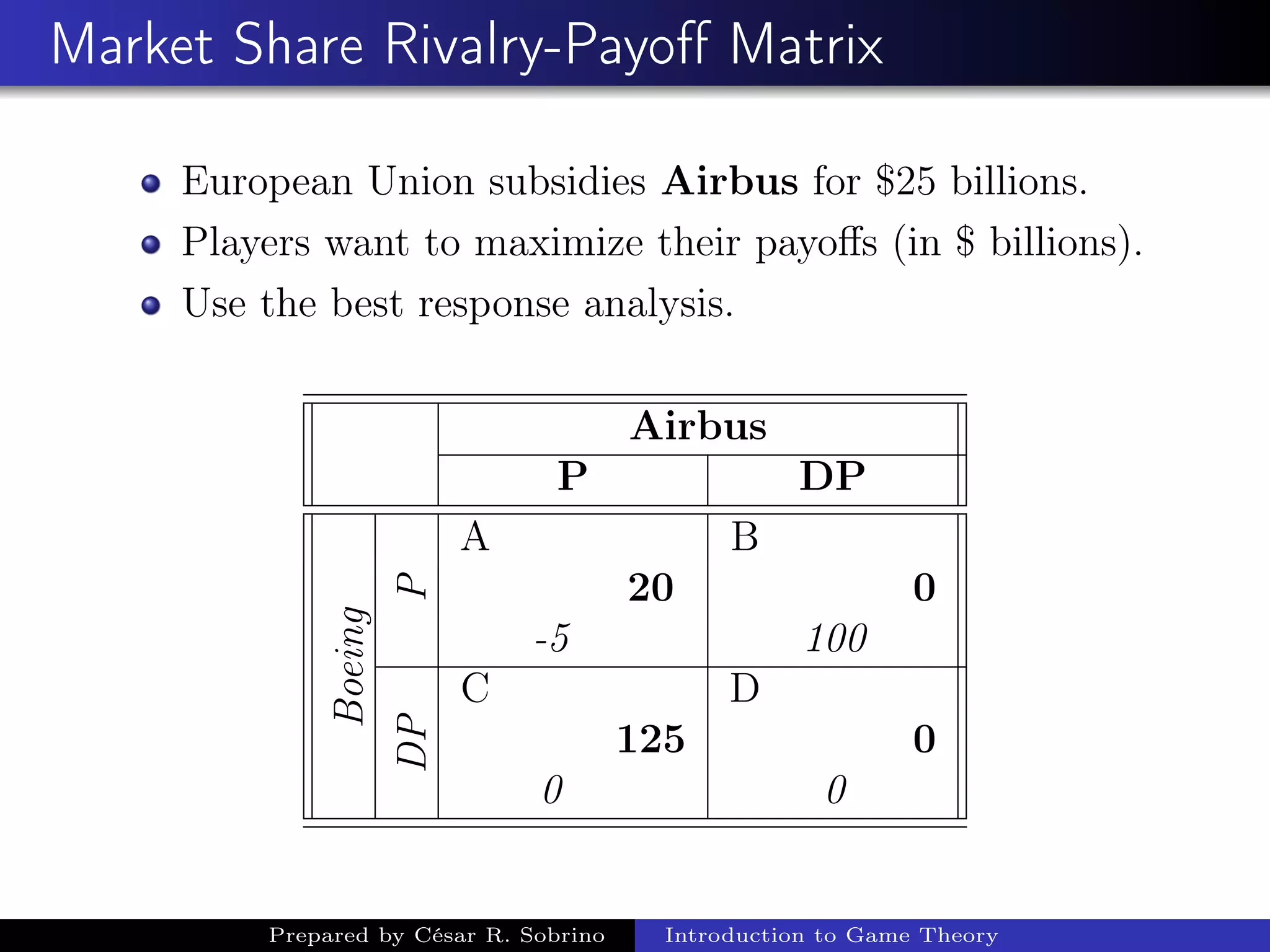
European Union subsidies Airbus for $25 billions.
Players want to maximize their payoffs (in $ billions).
Use the best response analysis.
Airbus
P DP
Boeing
P
A B
20 0
-5 100
DP
C D
125 0
0 0
Prepared by César R. Sobrino Introduction to Game Theory
Market Share Rivalry-Payoff Matrix
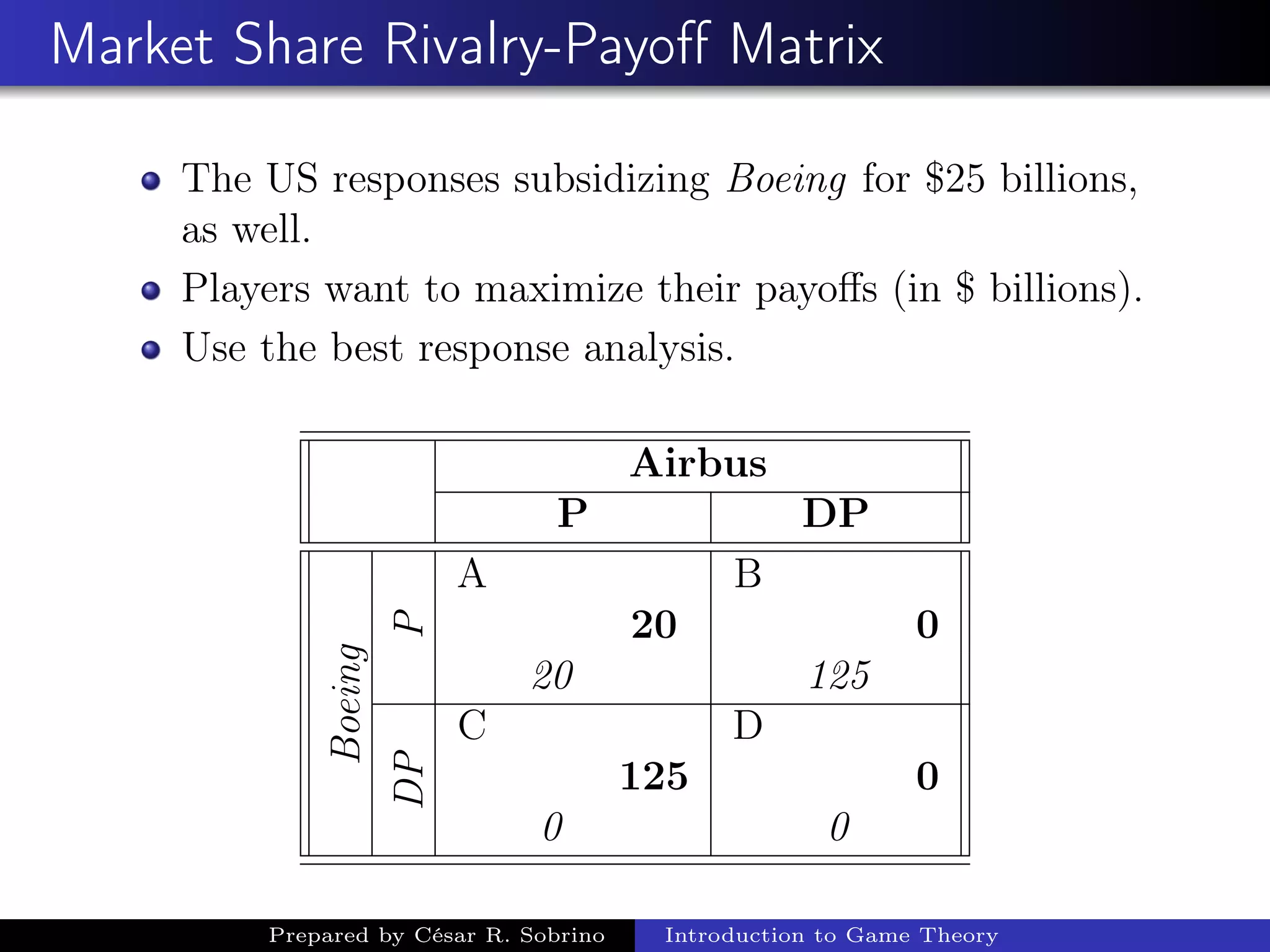
The US responses subsidizing Boeing for $25 billions,
as well.
Players want to maximize their payoffs (in $ billions).
Use the best response analysis.
Airbus
P DP
Boeing
P
A B
20 0
20 125
DP
C D
125 0
0 0
Prepared by César R. Sobrino Introduction to Game Theory
Pure Strategies: Dominated Strategy
Never the best strategy, so never would be chosen &
should be eliminated.
Successive elimination of dominated strategies should
continue until none remain.
Search for dominant strategies first, then dominated
strategies
When neither form of strategic dominance exists,
employ a different concept for making simultaneous
decisions.
Example:
2 players: Palace and Castle
They are deciding their price level for similar goods
(pizzas).
3 prices levels: high (H), medium (M), and, low (L).
Prepared by César R. Sobrino Introduction to Game Theory
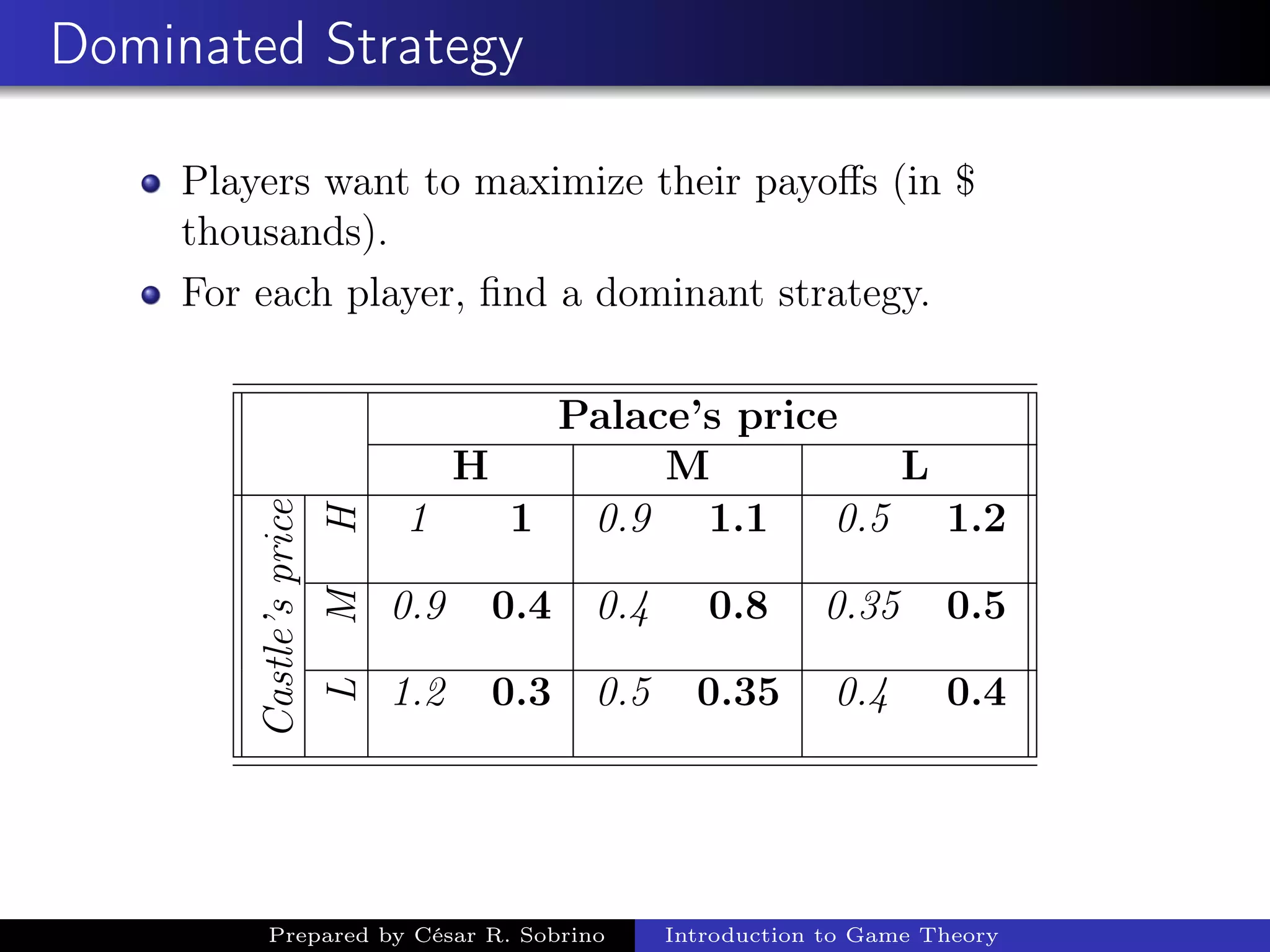
Dominated Strategy
Players want to maximize their payoffs (in $
thousands).
For each player, find a dominant strategy.
Palace’s price
H M L
Castle’sprice
H
1 1 0.9 1.1 0.5 1.2
M
0.9 0.4 0.4 0.8 0.35 0.5
L
1.2 0.3 0.5 0.35 0.4 0.4
Prepared by César R. Sobrino Introduction to Game Theory
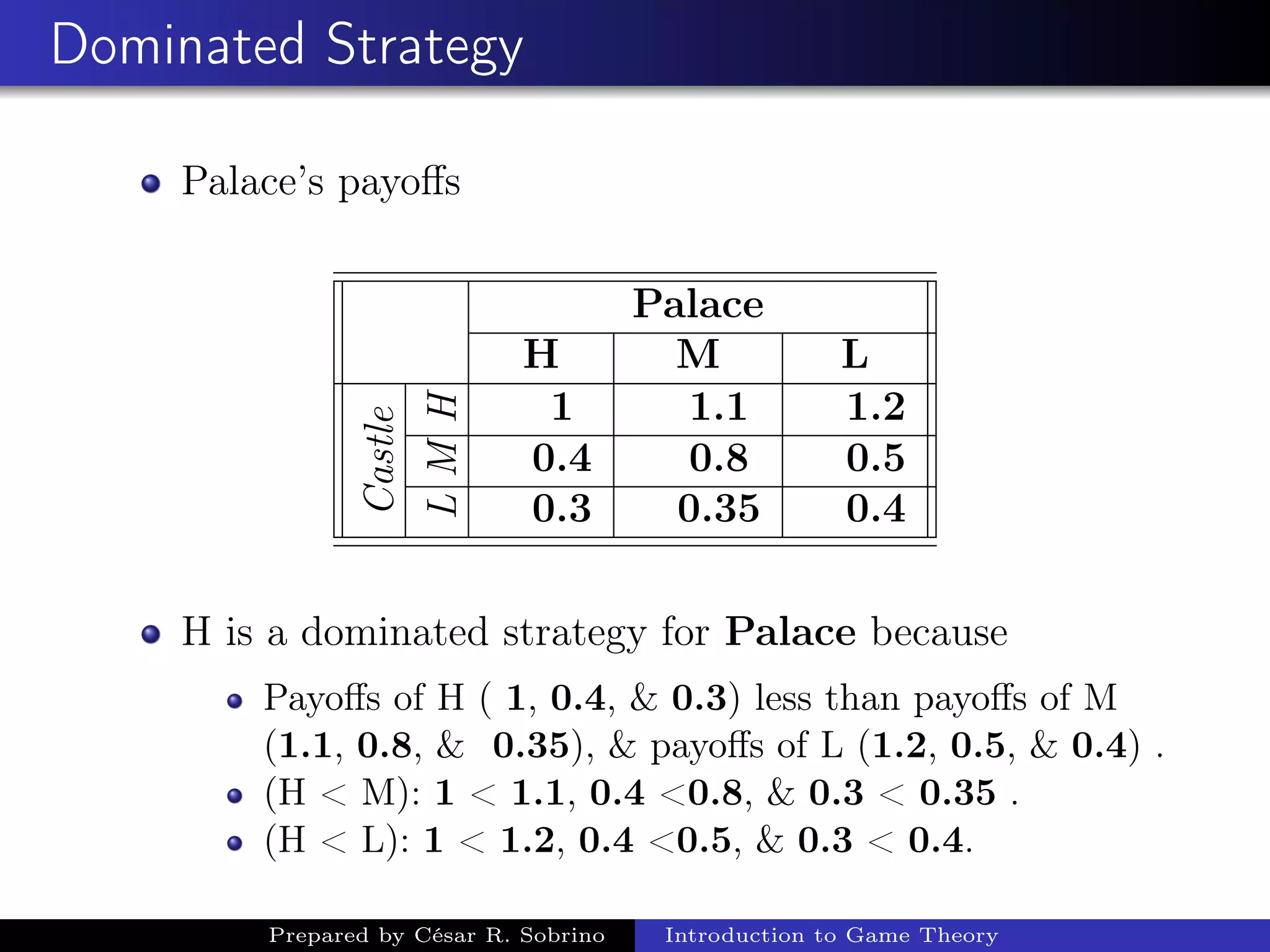
Dominated Strategy
Palace’s payoffs
Palace
H M L
Castle
H
1 1.1 1.2
M 0.4 0.8 0.5L
0.3 0.35 0.4
H is a dominated strategy for Palace because
Payoffs of H ( 1, 0.4, & 0.3) less than payoffs of M
(1.1, 0.8, & 0.35), & payoffs of L (1.2, 0.5, & 0.4) .
(H < M): 1 < 1.1, 0.4 <0.8, & 0.3 < 0.35 .
(H < L): 1 < 1.2, 0.4 <0.5, & 0.3 < 0.4.
Prepared by César R. Sobrino Introduction to Game Theory
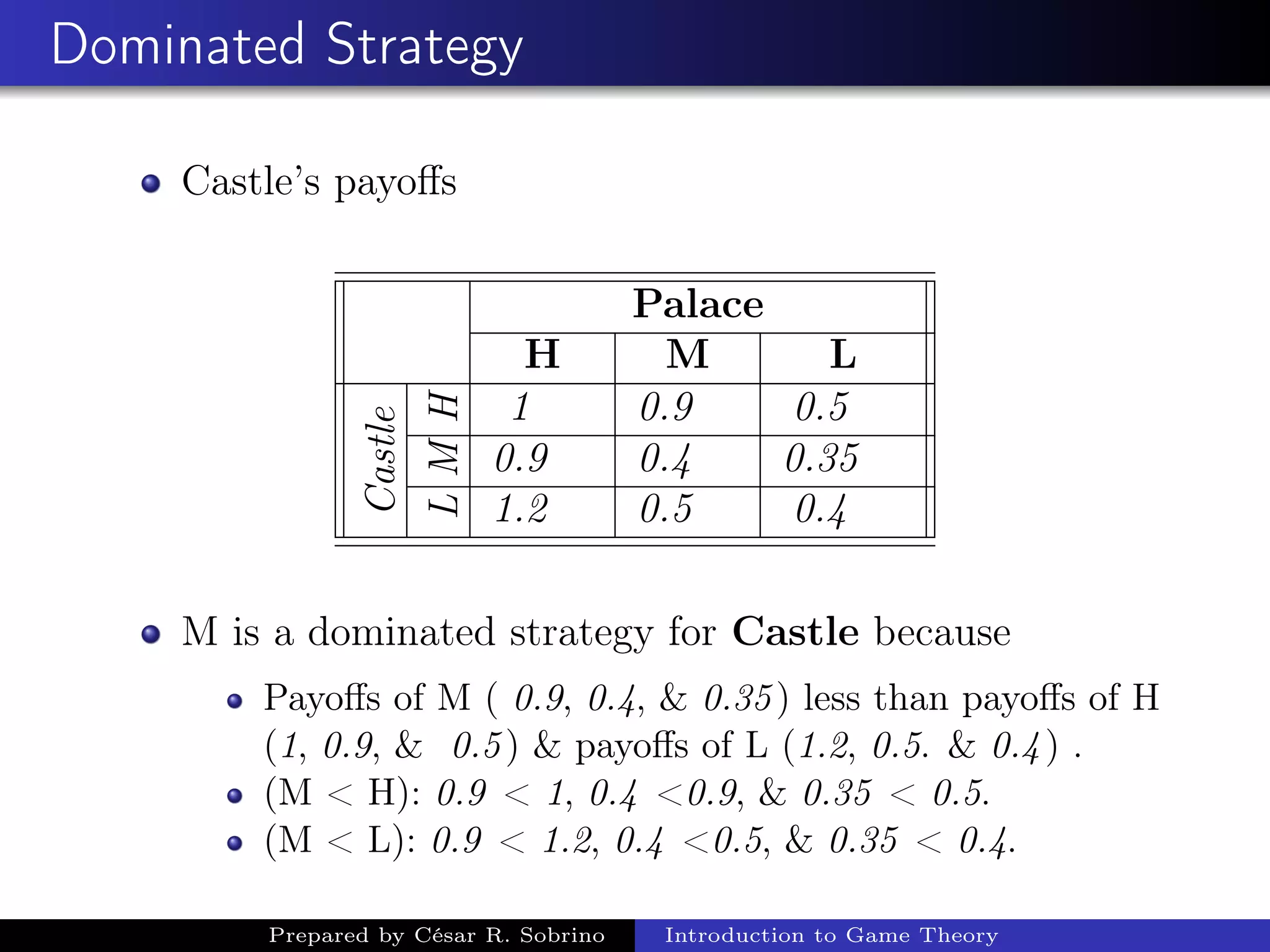
Dominated Strategy
Castle’s payoffs
Palace
H M L
Castle
H
1 0.9 0.5
M 0.9 0.4 0.35L
1.2 0.5 0.4
M is a dominated strategy for Castle because
Payoffs of M ( 0.9, 0.4, & 0.35) less than payoffs of H
(1, 0.9, & 0.5) & payoffs of L (1.2, 0.5. & 0.4) .
(M < H): 0.9 < 1, 0.4 <0.9, & 0.35 < 0.5.
(M < L): 0.9 < 1.2, 0.4 <0.5, & 0.35 < 0.4.
Prepared by César R. Sobrino Introduction to Game Theory
Dominated Strategy
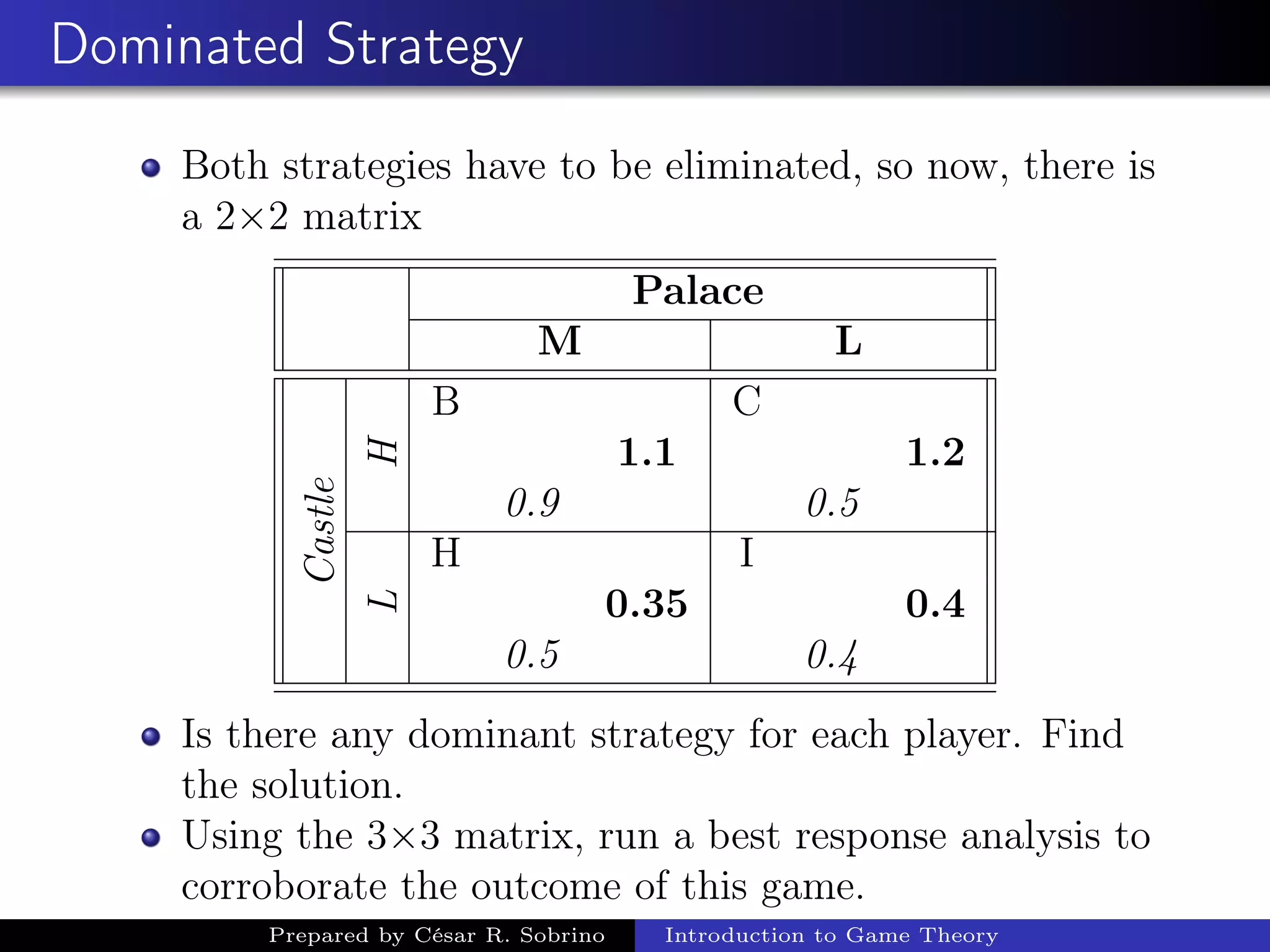
Both strategies have to be eliminated, so now, there is
a 2×2 matrix
Palace
M L
Castle
H B C
1.1 1.2
0.9 0.5
L
H I
0.35 0.4
0.5 0.4
Is there any dominant strategy for each player. Find
the solution.
Using the 3×3 matrix, run a best response analysis to
corroborate the outcome of this game.
Prepared by César R. Sobrino Introduction to Game Theory
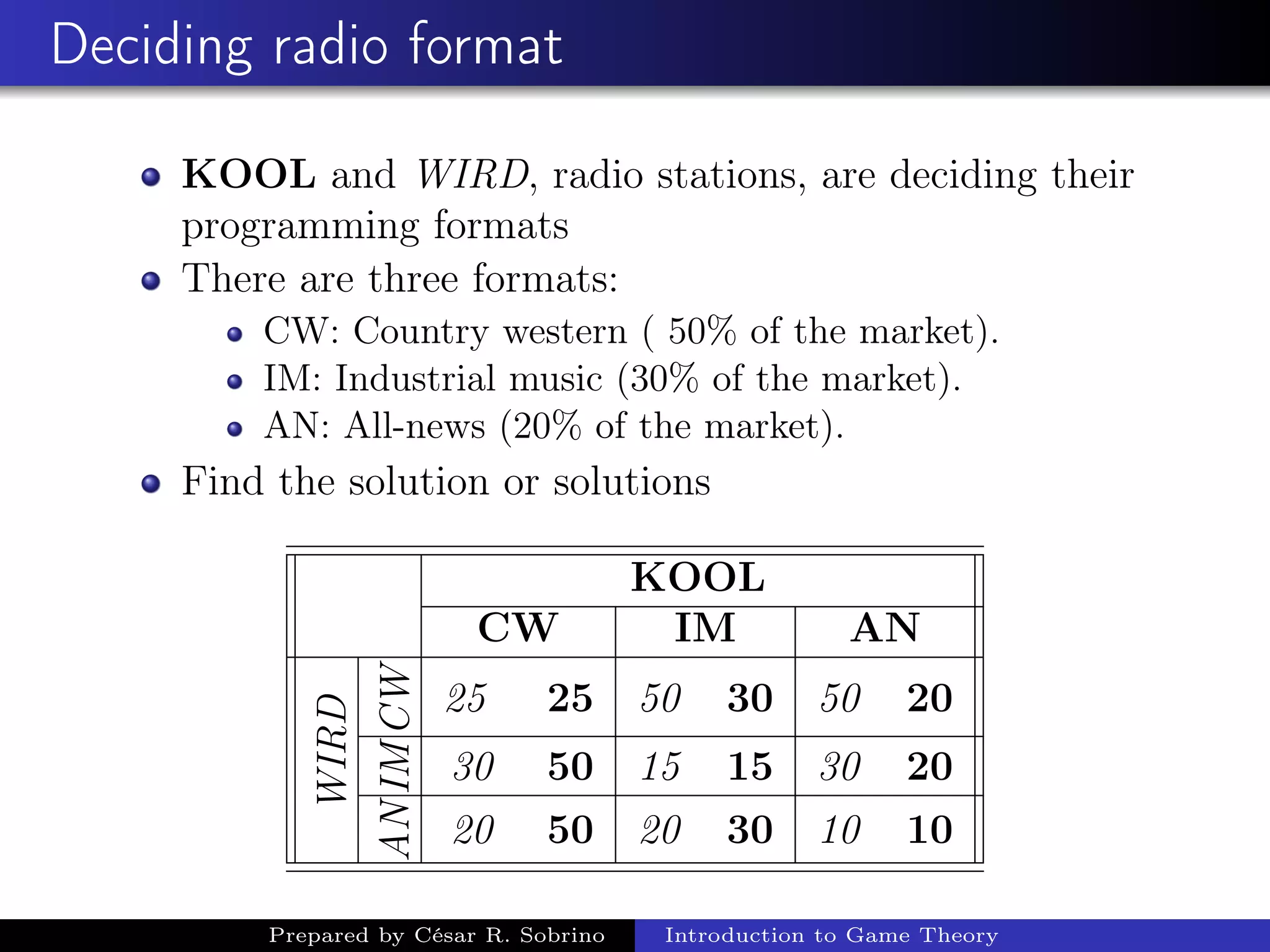
Deciding radio format
KOOL and WIRD, radio stations, are deciding their
programming formats
There are three formats:
CW: Country western ( 50% of the market).
IM: Industrial music (30% of the market).
AN: All-news (20% of the market).
Find the solution or solutions
KOOL
CW IM AN
WIRD
CW
25 25 50 30 50 20
IM
30 50 15 15 30 20
AN
20 50 20 30 10 10
Prepared by César R. Sobrino Introduction to Game Theory
Mixed Strategy
A mixed strategy is one in which a player plays his
available pure strategies with certain probabilities.
If each player in an n-player game has a finite number
of pure strategies, then there exists at least one
equilibrium in (possibly) mixed strategies.
If there are no pure strategy equilibria, there must be a
unique mixed strategy equilibrium.
You may analyze the Battle of sexes using probabilities
Prepared by César R. Sobrino Introduction to Game Theory
Employee Monitoring
Principal-Agent Problem (Moral Hazard)
Employees can work hard or shirk.
Salary: $100K unless caught shirking
Cost of effort: $50K
Managers can monitor or not.
Value of employee output: $200K
Profit if employee doesn’t work: $0
Cost of monitoring: $10K
Prepared by César R. Sobrino Introduction to Game Theory
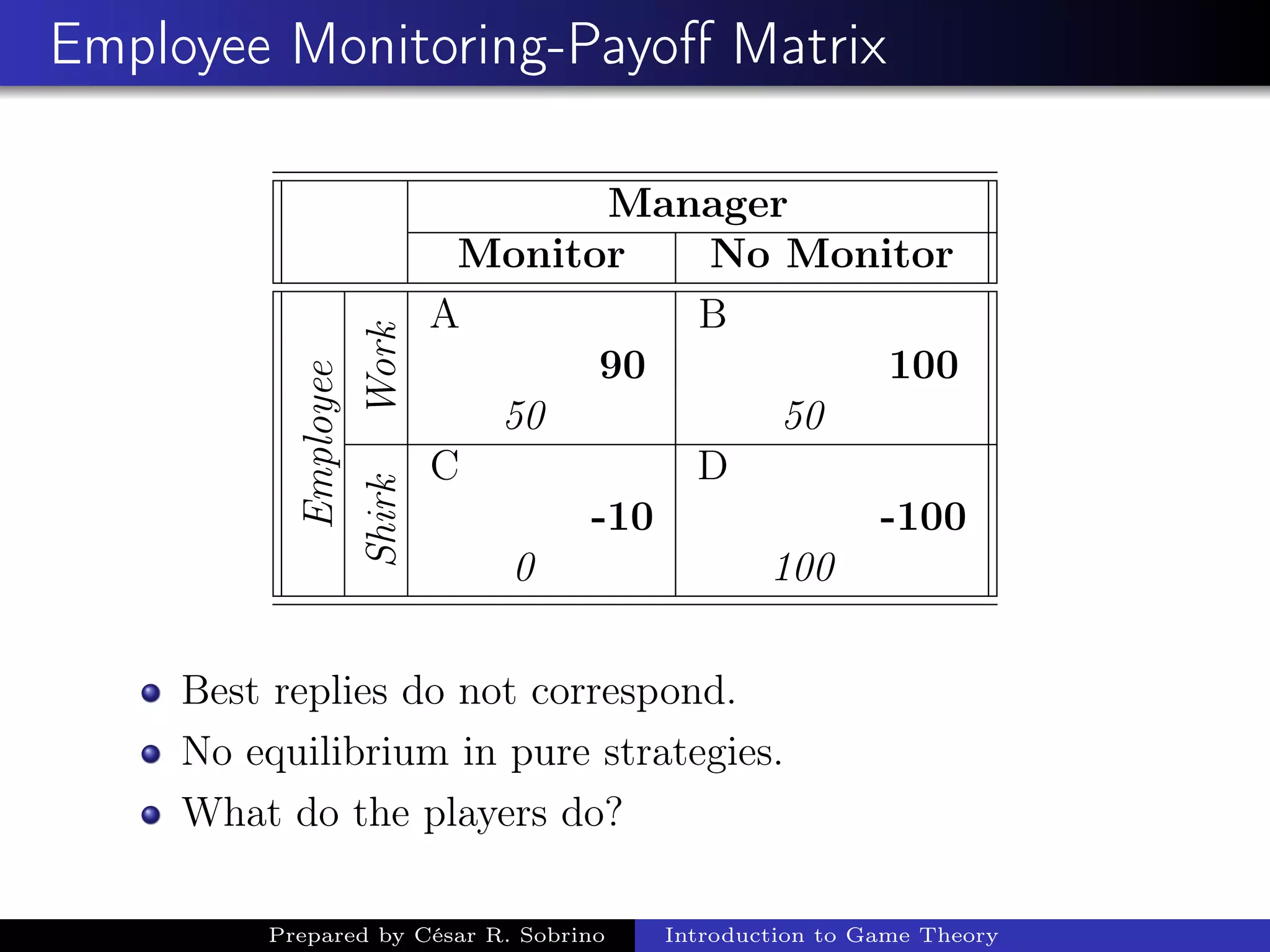
Employee Monitoring-Payoff Matrix
Manager
Monitor No Monitor
Employee
Work
A B
90 100
50 50
Shirk
C D
-10 -100
0 100
Best replies do not correspond.
No equilibrium in pure strategies.
What do the players do?
Prepared by César R. Sobrino Introduction to Game Theory
Skeeping Employees from Shirking
Suppose:
Employee chooses (work, shirk) with probabilities
(p,1 − p), respectively. p ∈]0, 1[.
Manager chooses (monitor, no monitor) with
probabilities (q,1 − q), respectively. q ∈]0, 1[
First, find employee’s expected payoff from each pure
strategy.
If employee works: receives 50
E(work)= 50 × q + 50 × (1 − q) = 50
If employee shirks: receives 0 or 100
E(shirk)=0 × q + 100 × (1 − q) = 100 − 100 × q
Prepared by César R. Sobrino Introduction to Game Theory
Skeeping Employees from Shirking
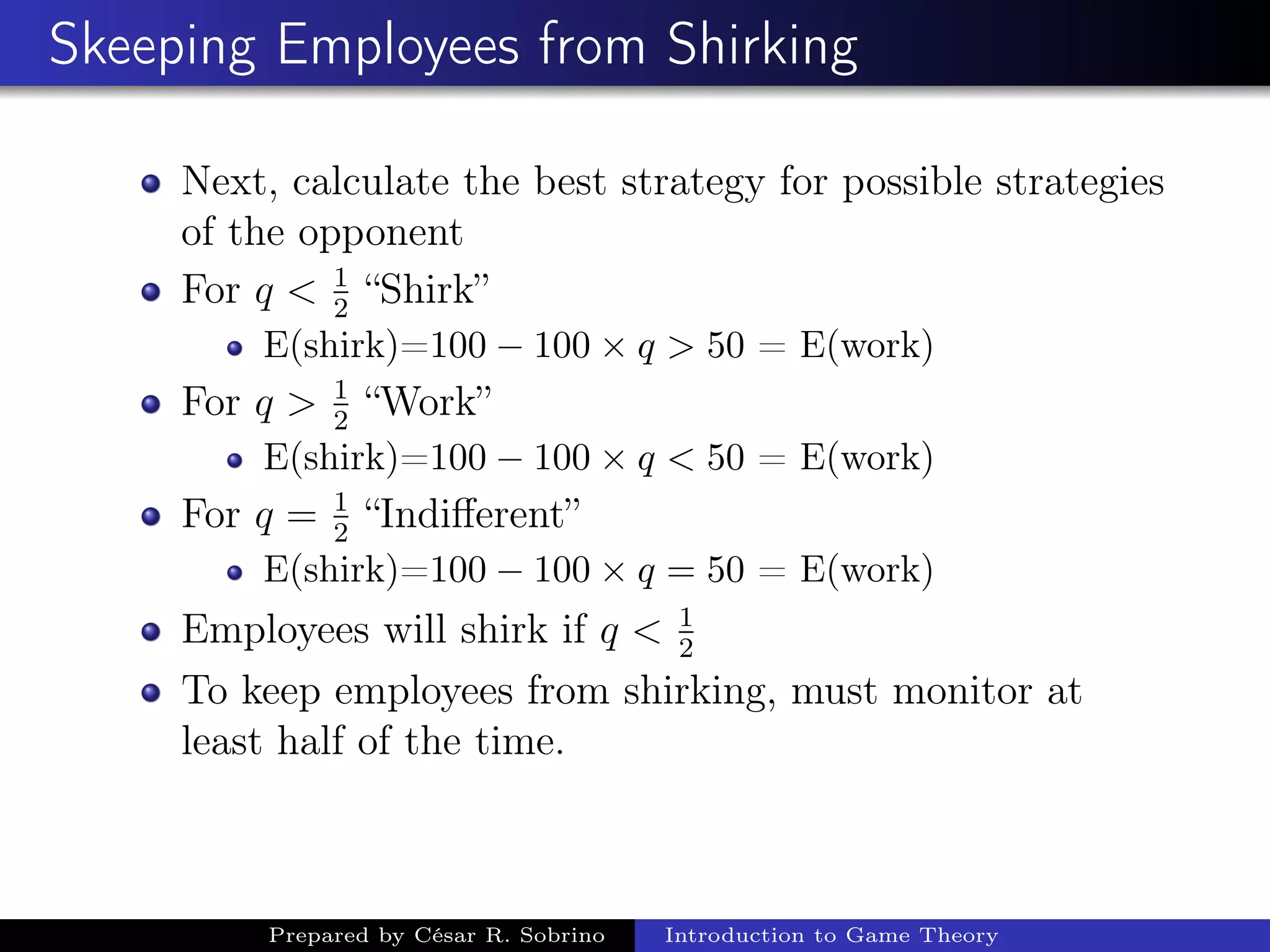
Next, calculate the best strategy for possible strategies
of the opponent
For q < 1
2
“Shirk”
E(shirk)=100 − 100 × q > 50 = E(work)
For q > 1
2
“Work”
E(shirk)=100 − 100 × q < 50 = E(work)
For q = 1
2
“Indifferent”
E(shirk)=100 − 100 × q = 50 = E(work)
Employees will shirk if q < 1
2
To keep employees from shirking, must monitor at
least half of the time.
Prepared by César R. Sobrino Introduction to Game Theory
Skeeping Employees from Shirking
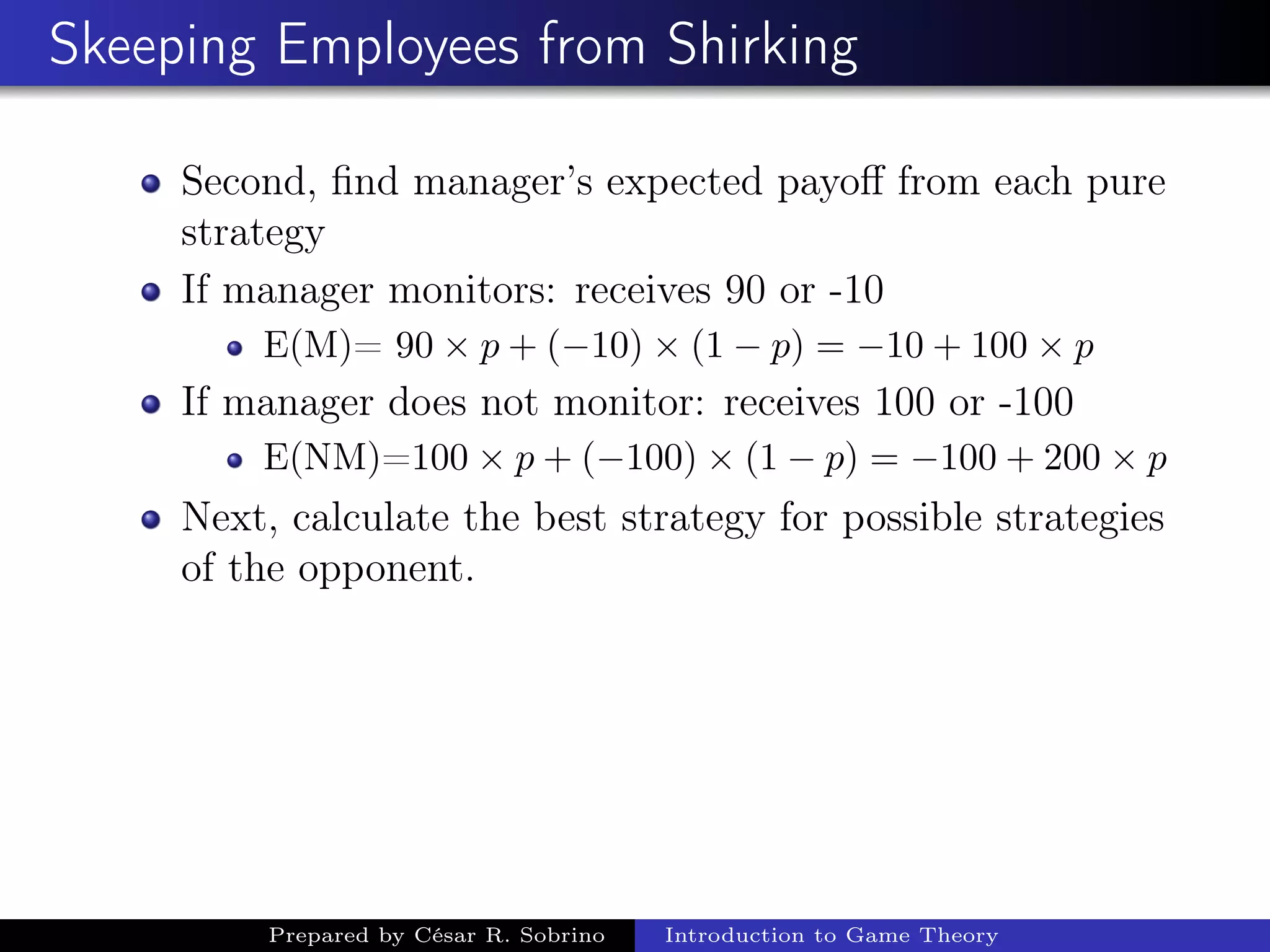
Second, find manager’s expected payoff from each pure
strategy
If manager monitors: receives 90 or -10
E(M)= 90 × p + (−10) × (1 − p) = −10 + 100 × p
If manager does not monitor: receives 100 or -100
E(NM)=100 × p + (−100) × (1 − p) = −100 + 200 × p
Next, calculate the best strategy for possible strategies
of the opponent.
Prepared by César R. Sobrino Introduction to Game Theory
Skeeping Employees from Shirking
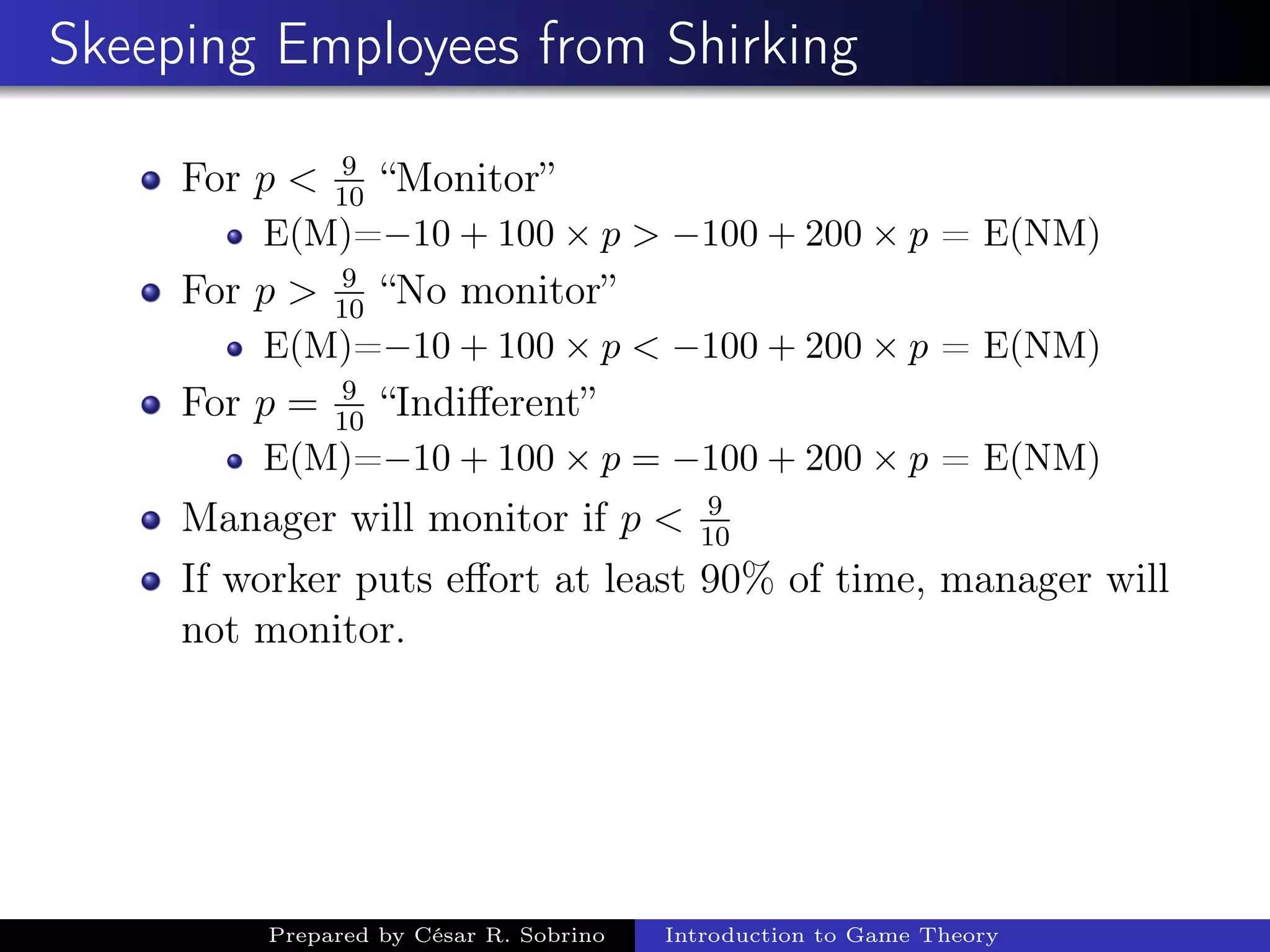
For p < 9
10
“Monitor”
E(M)=−10 + 100 × p > −100 + 200 × p = E(NM)
For p > 9
10
“No monitor”
E(M)=−10 + 100 × p < −100 + 200 × p = E(NM)
For p = 9
10
“Indifferent”
E(M)=−10 + 100 × p = −100 + 200 × p = E(NM)
Manager will monitor if p < 9
10
If worker puts effort at least 90% of time, manager will
not monitor.
Prepared by César R. Sobrino Introduction to Game Theory
Equilibrium Payoffs
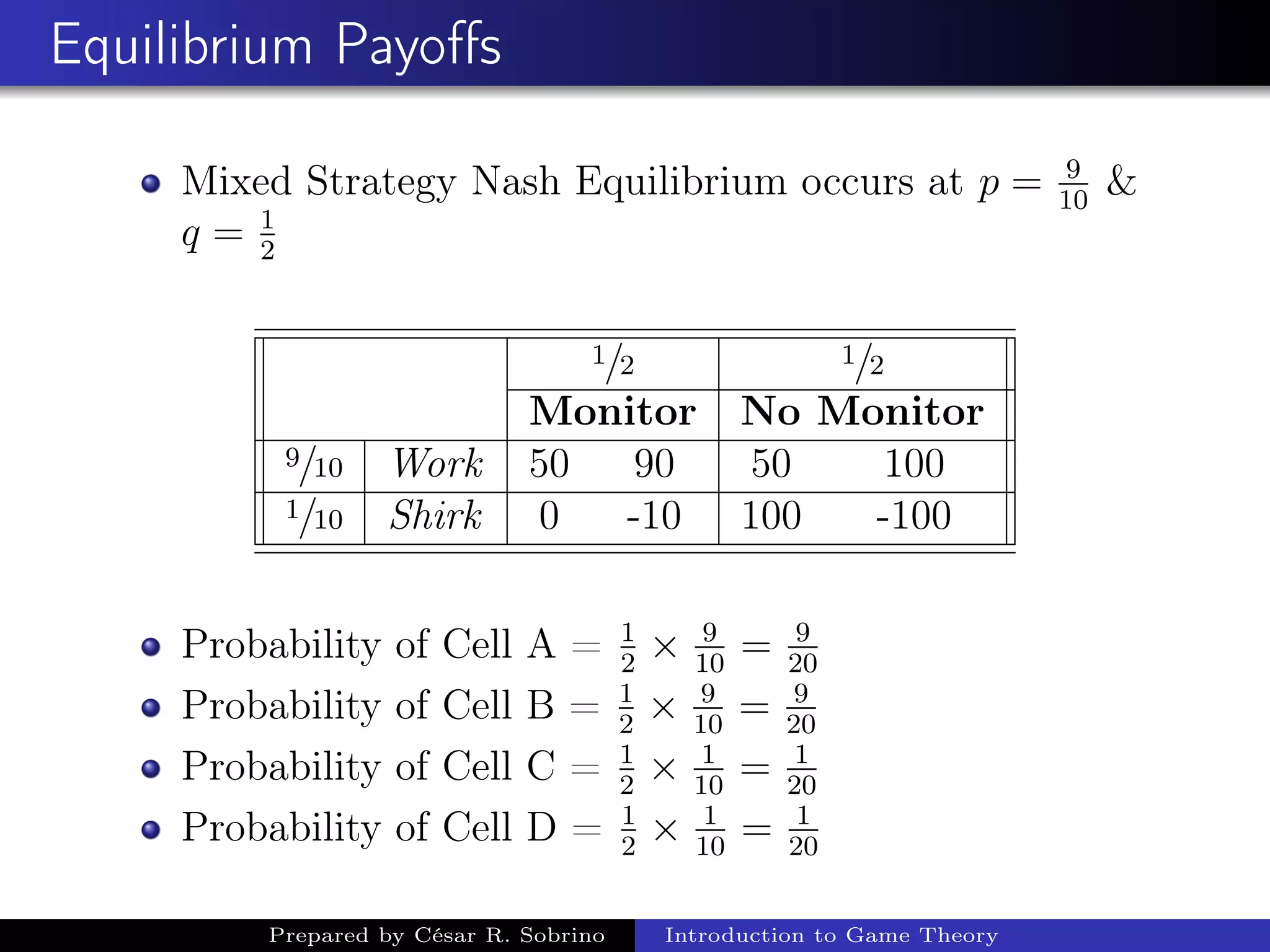
Mixed Strategy Nash Equilibrium occurs at p = 9
10
&
q = 1
2
1/2 1/2
Monitor No Monitor
9/10 Work 50 90 50 100
1/10 Shirk 0 -10 100 -100
Probability of Cell A = 1
2
× 9
10
= 9
20
Probability of Cell B = 1
2
× 9
10
= 9
20
Probability of Cell C = 1
2
× 1
10
= 1
20
Probability of Cell D = 1
2
× 1
10
= 1
20
Prepared by César R. Sobrino Introduction to Game Theory
Expected Nash Equilibrium Payoff
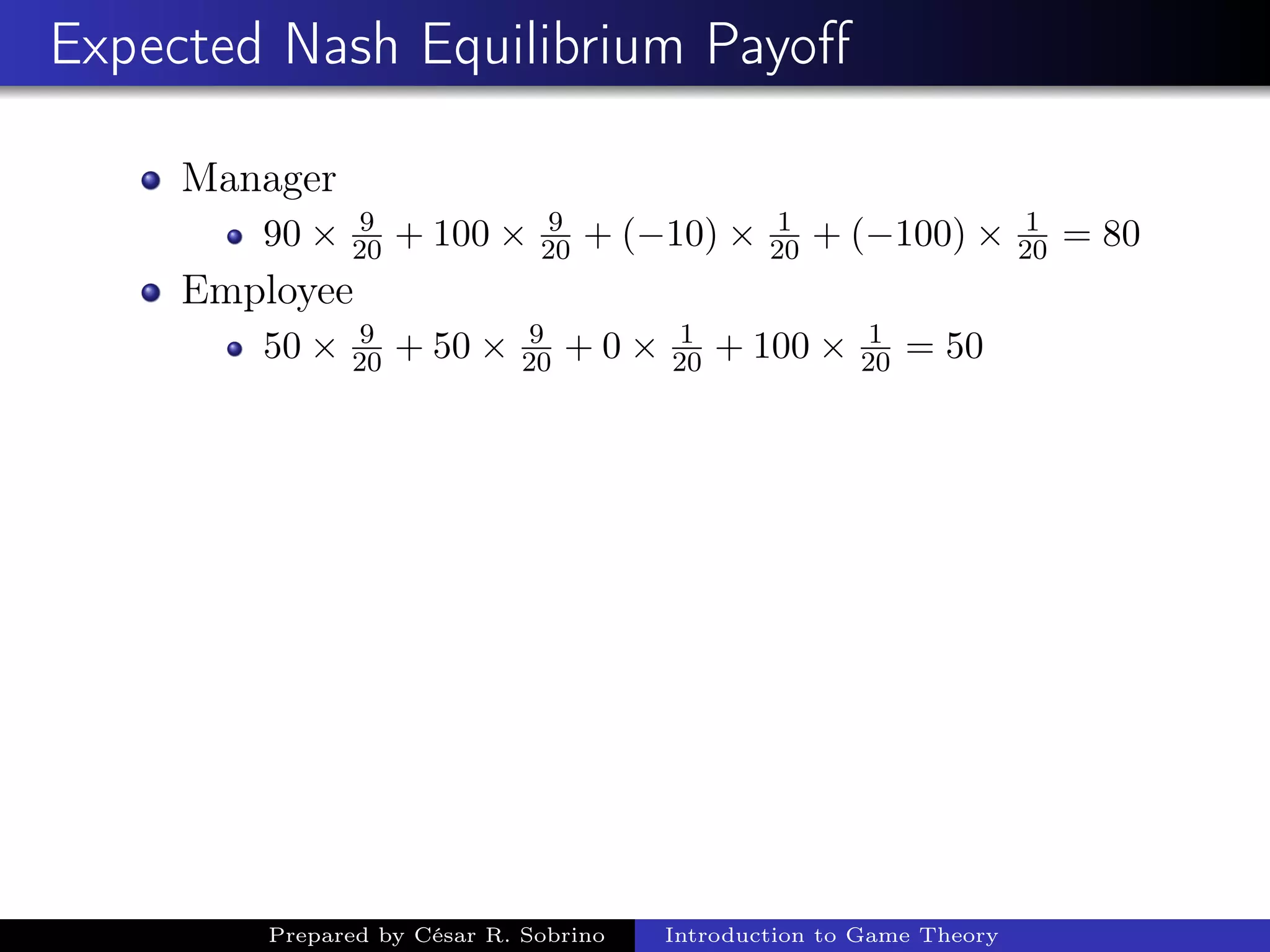
Manager
90 × 9
20 + 100 × 9
20 + (−10) × 1
20 + (−100) × 1
20 = 80
Employee
50 × 9
20 + 50 × 9
20 + 0 × 1
20 + 100 × 1
20 = 50
Prepared by César R. Sobrino Introduction to Game Theory
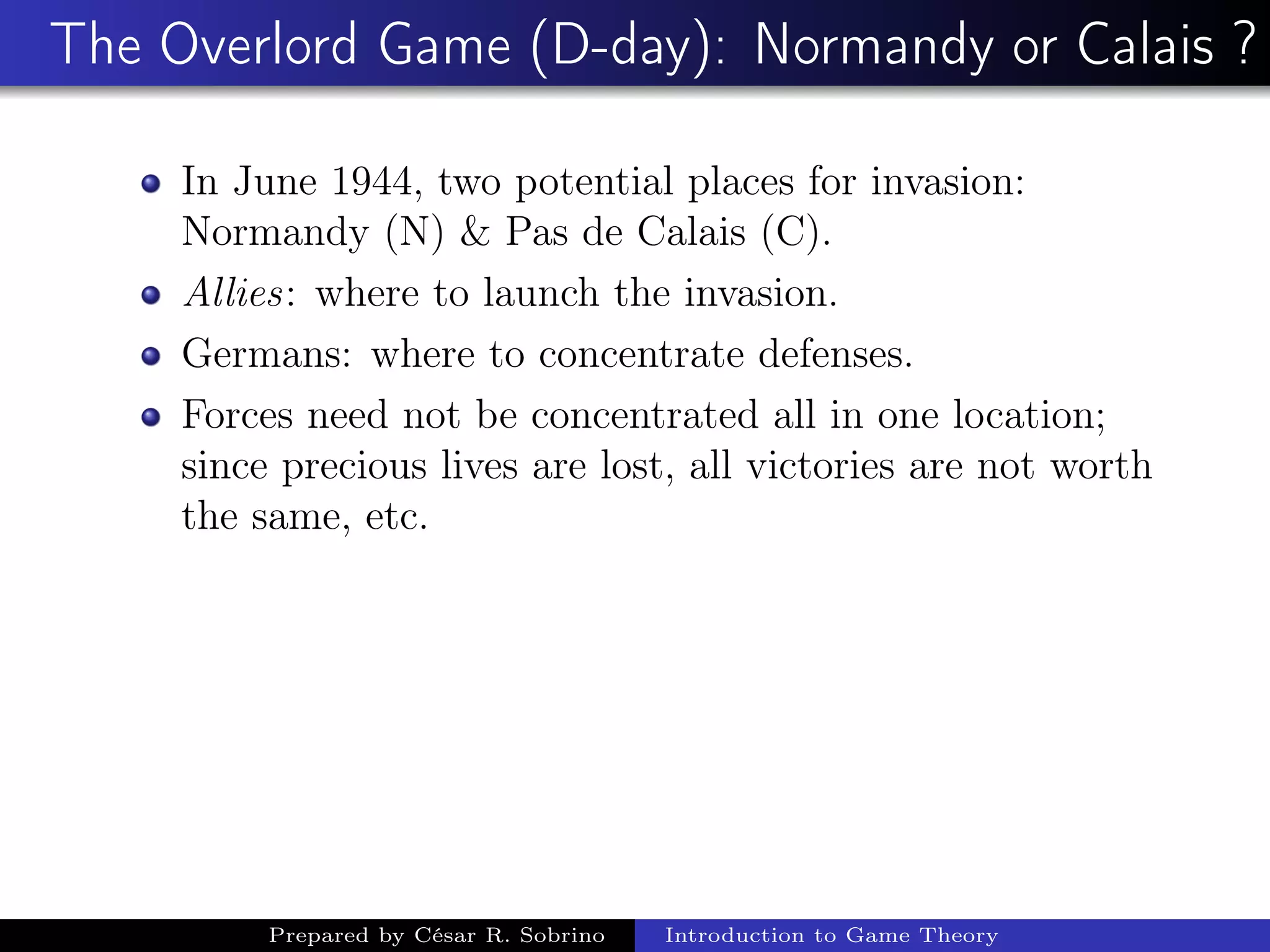
The Overlord Game (D-day): Normandy or Calais ?
In June 1944, two potential places for invasion:
Normandy (N) & Pas de Calais (C).
Allies: where to launch the invasion.
Germans: where to concentrate defenses.
Forces need not be concentrated all in one location;
since precious lives are lost, all victories are not worth
the same, etc.
Prepared by César R. Sobrino Introduction to Game Theory
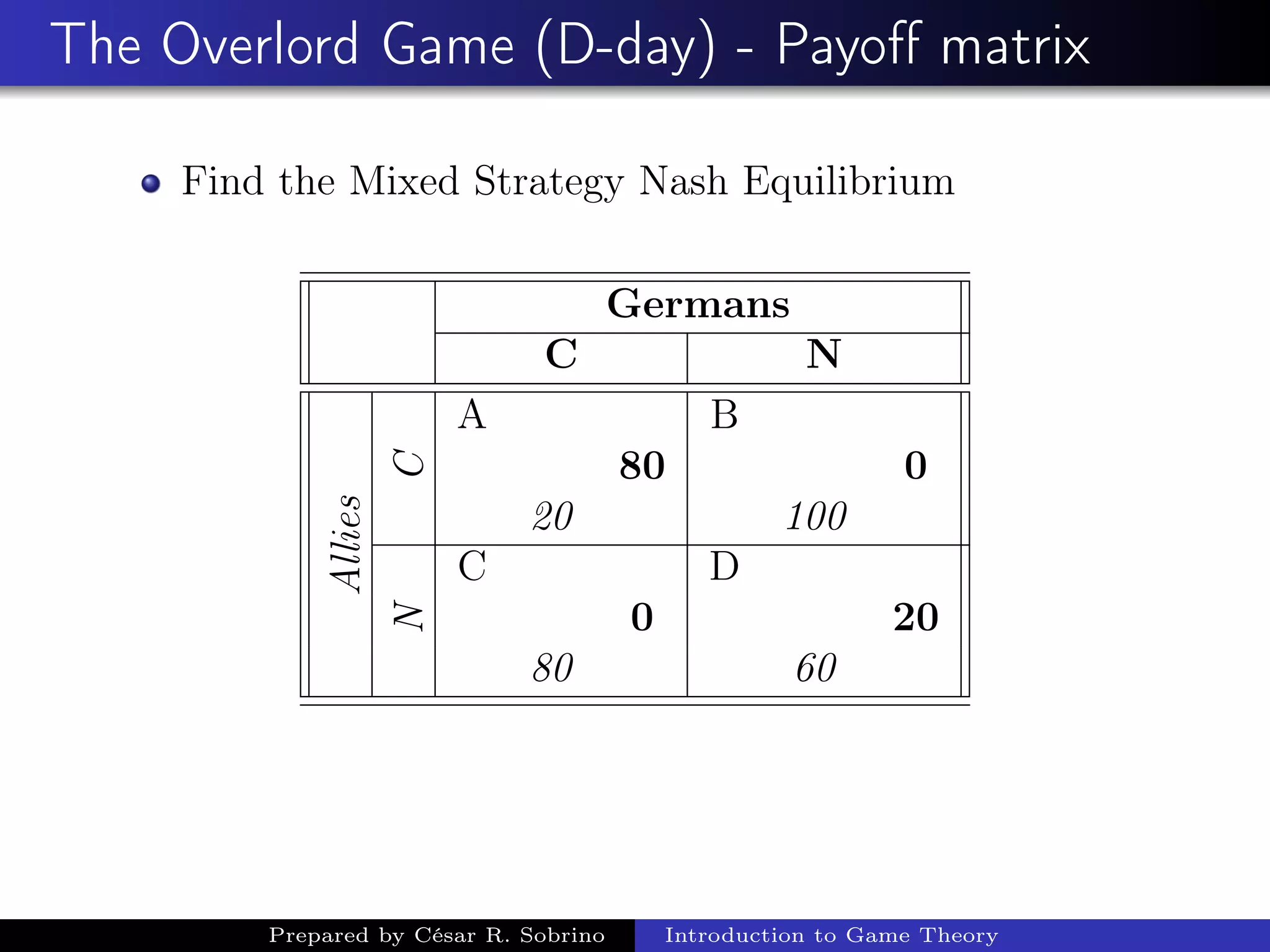
The Overlord Game (D-day) - Payoff matrix
Find the Mixed Strategy Nash Equilibrium
Germans
C NAllies
C A B
80 0
20 100
N
C D
0 20
80 60
Prepared by César R. Sobrino Introduction to Game Theory
The Cuban Missile Crisis (1962)
In October 1962, USSR attempted to install
medium-range and intermediate-range nuclear-armed
ballistic missiles in Cuba that were capable of hitting a
large portion of the US.
The US considered two strategies to avoid that
attempt:
A naval blockade (B), or “quarantine” to prevent
shipment of more missiles, possibly followed by
stronger action to induce the USSR to withdraw the
missiles already installed.
An air strike (A) to wipe out the missiles already
installed.
The alternatives of USSR were:
Withdrawal (W) of their missiles.
Maintenance (M) of their missiles.
Prepared by César R. Sobrino Introduction to Game Theory
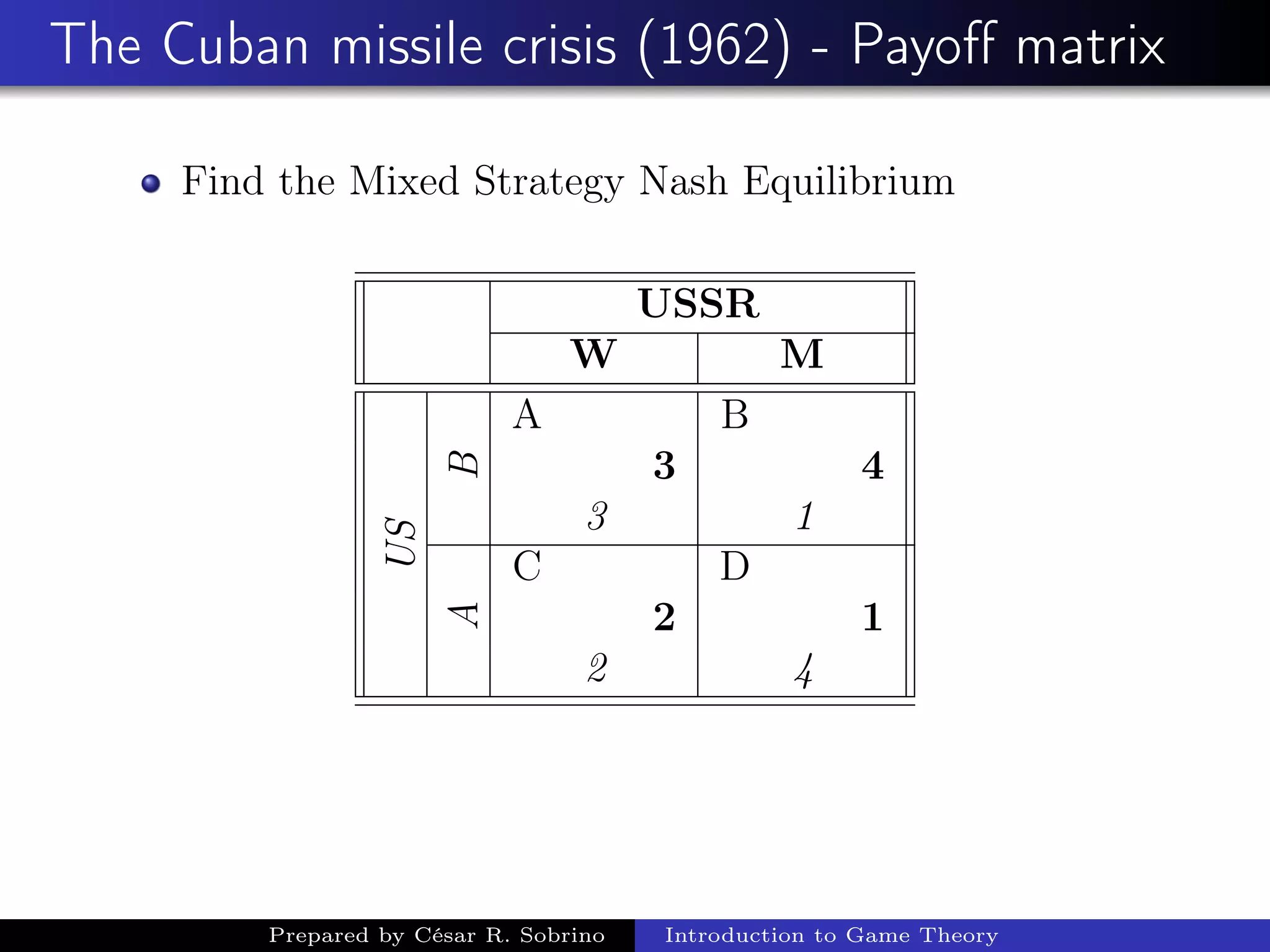
The Cuban missile crisis (1962) - Payoff matrix
Find the Mixed Strategy Nash Equilibrium
USSR
W M
US
B
A B
3 4
3 1
A
C D
2 1
2 4
Prepared by César R. Sobrino Introduction to Game Theory
Repeated Games: Strategies & Commitments
Three types: commitments, threats, and, promises.
Only credible strategic moves matter.
Players (managers) announce or demonstrate to rivals
that they will bind themselves to take a particular
action or make a specific decision.
No matter what action is taken by rivals.
Threats: Explicit or tacit “If you take action A, I will
take action B, which is undesirable or costly to you”.
Promises: “If you take action A, I will take action B,
which is desirable or rewarding to you”.
Prepared by César R. Sobrino Introduction to Game Theory
Repeated Games: Cooperation or Cheating
Cooperation occurs when oligopoly firms make
individual decisions that make every firm better off
than they would be in a (noncooperative) Nash
equilibrium.
Making noncooperative decisions
Does not imply that firms have made any agreement
to cooperate.
One-time prisoners’ dilemmas
Cooperation is not strategically stable (Cell A).
No future consequences from cheating, so both firms
expect the other to cheat.
Cheating is best response for each.
Prepared by César R. Sobrino Introduction to Game Theory
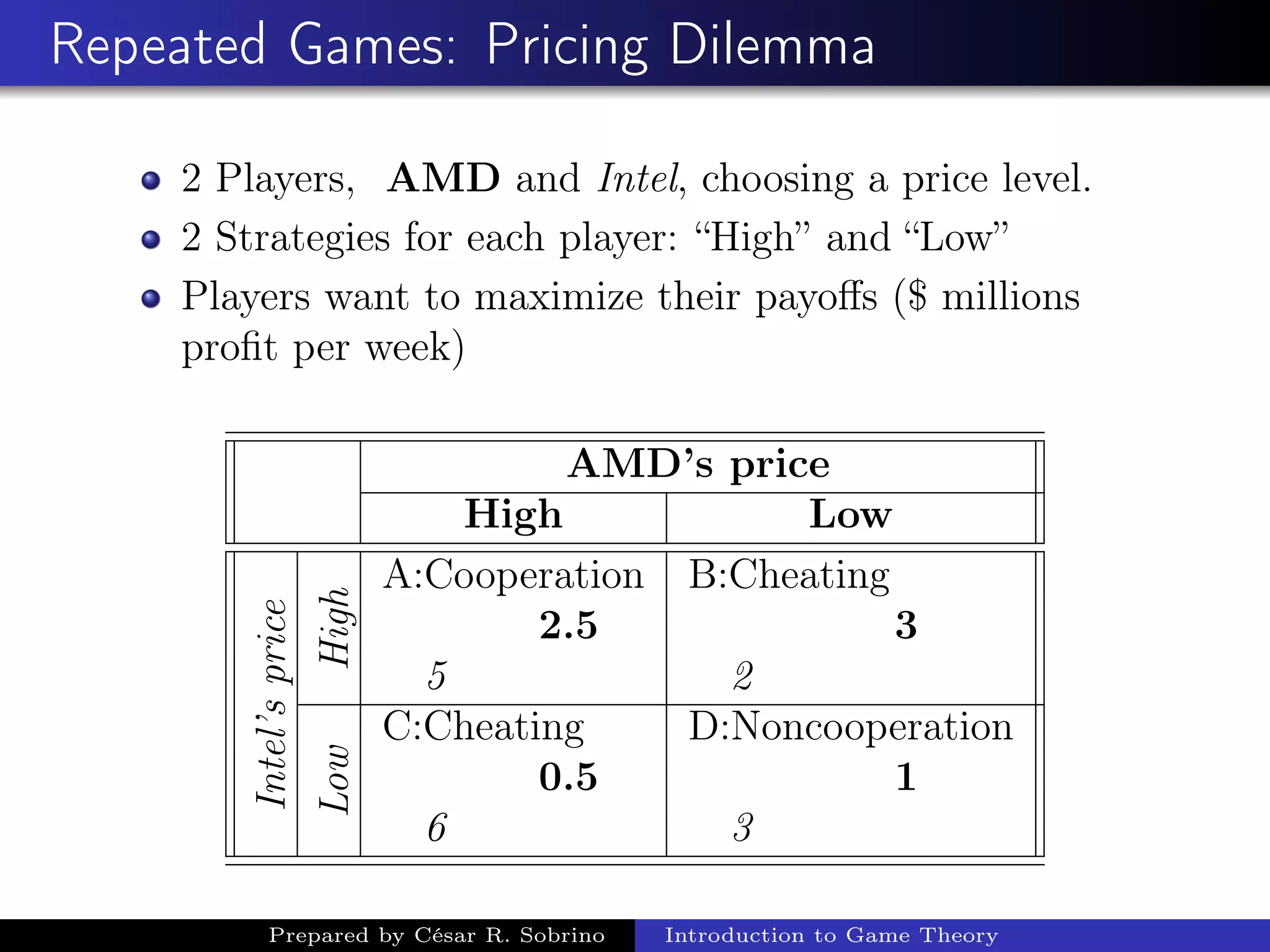
Repeated Games: Pricing Dilemma
2 Players, AMD and Intel, choosing a price level.
2 Strategies for each player: “High” and “Low”
Players want to maximize their payoffs ($ millions
profit per week)
AMD’s price
High Low
Intel’sprice
High
A:Cooperation B:Cheating
2.5 3
5 2
Low
C:Cheating D:Noncooperation
0.5 1
6 3
Prepared by César R. Sobrino Introduction to Game Theory
Repeated Games: Deciding to Cooperate
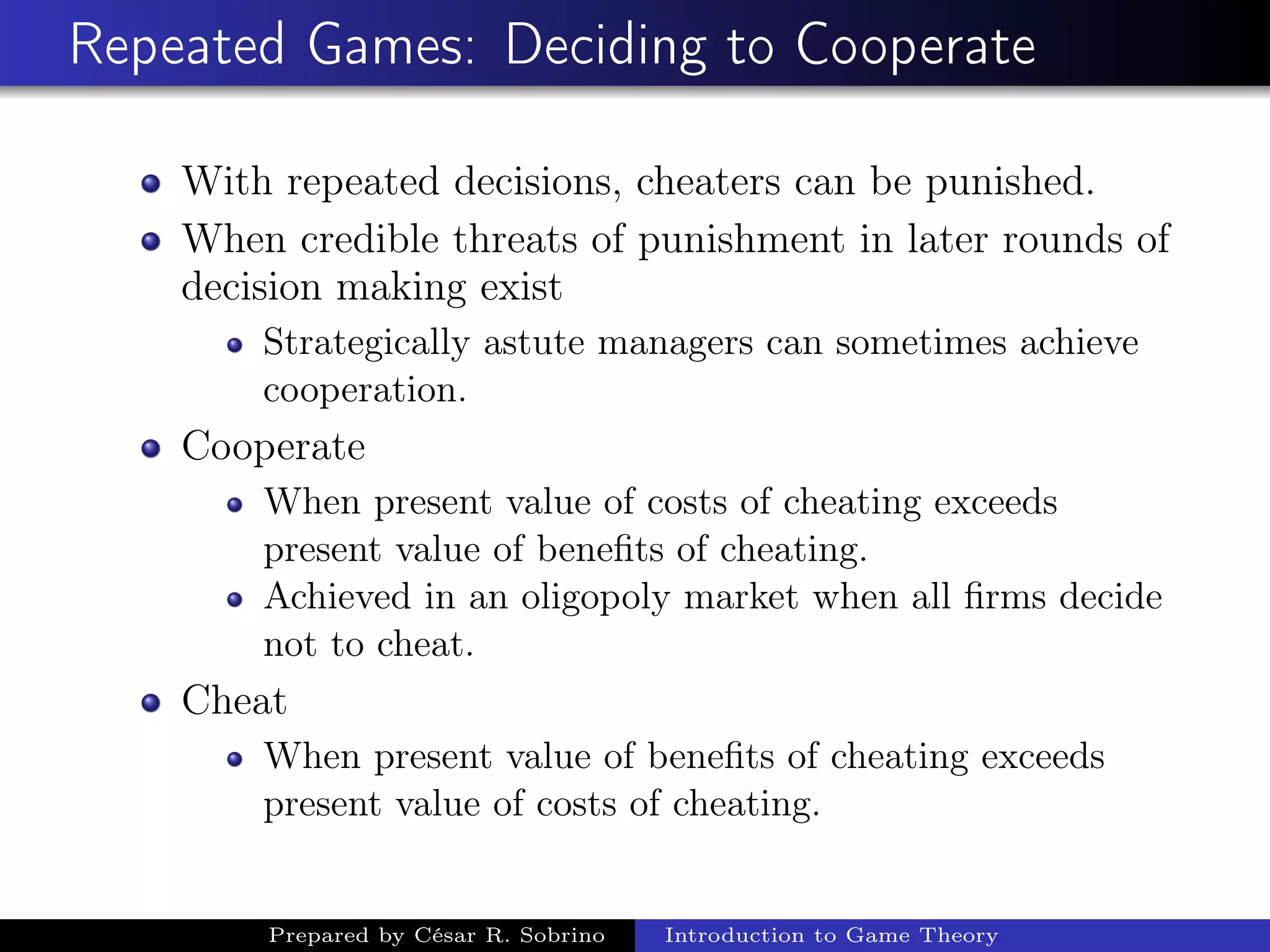
With repeated decisions, cheaters can be punished.
When credible threats of punishment in later rounds of
decision making exist
Strategically astute managers can sometimes achieve
cooperation.
Cooperate
When present value of costs of cheating exceeds
present value of benefits of cheating.
Achieved in an oligopoly market when all firms decide
not to cheat.
Cheat
When present value of benefits of cheating exceeds
present value of costs of cheating.
Prepared by César R. Sobrino Introduction to Game Theory
Repeated Games: Deciding to Cooperate
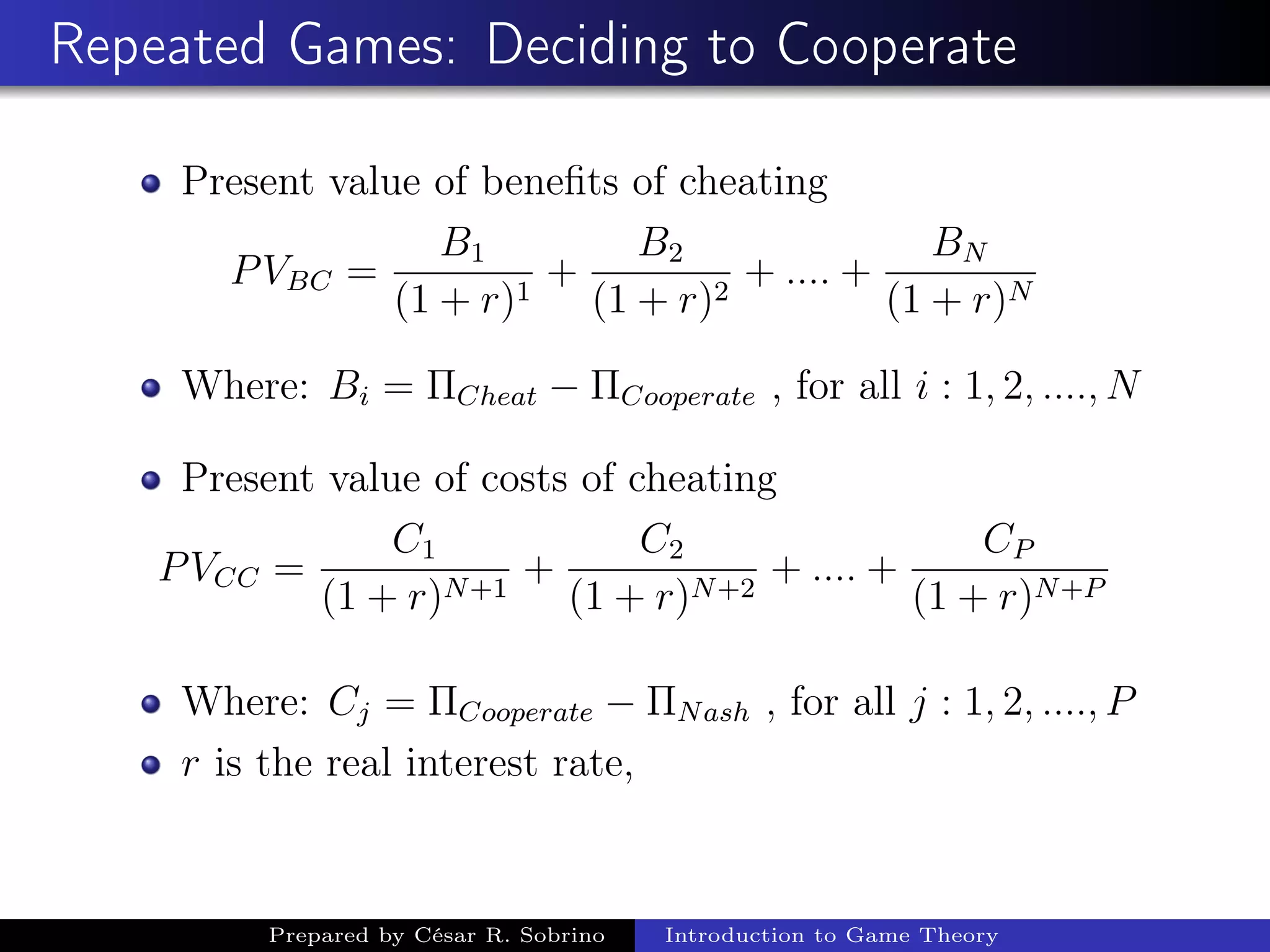
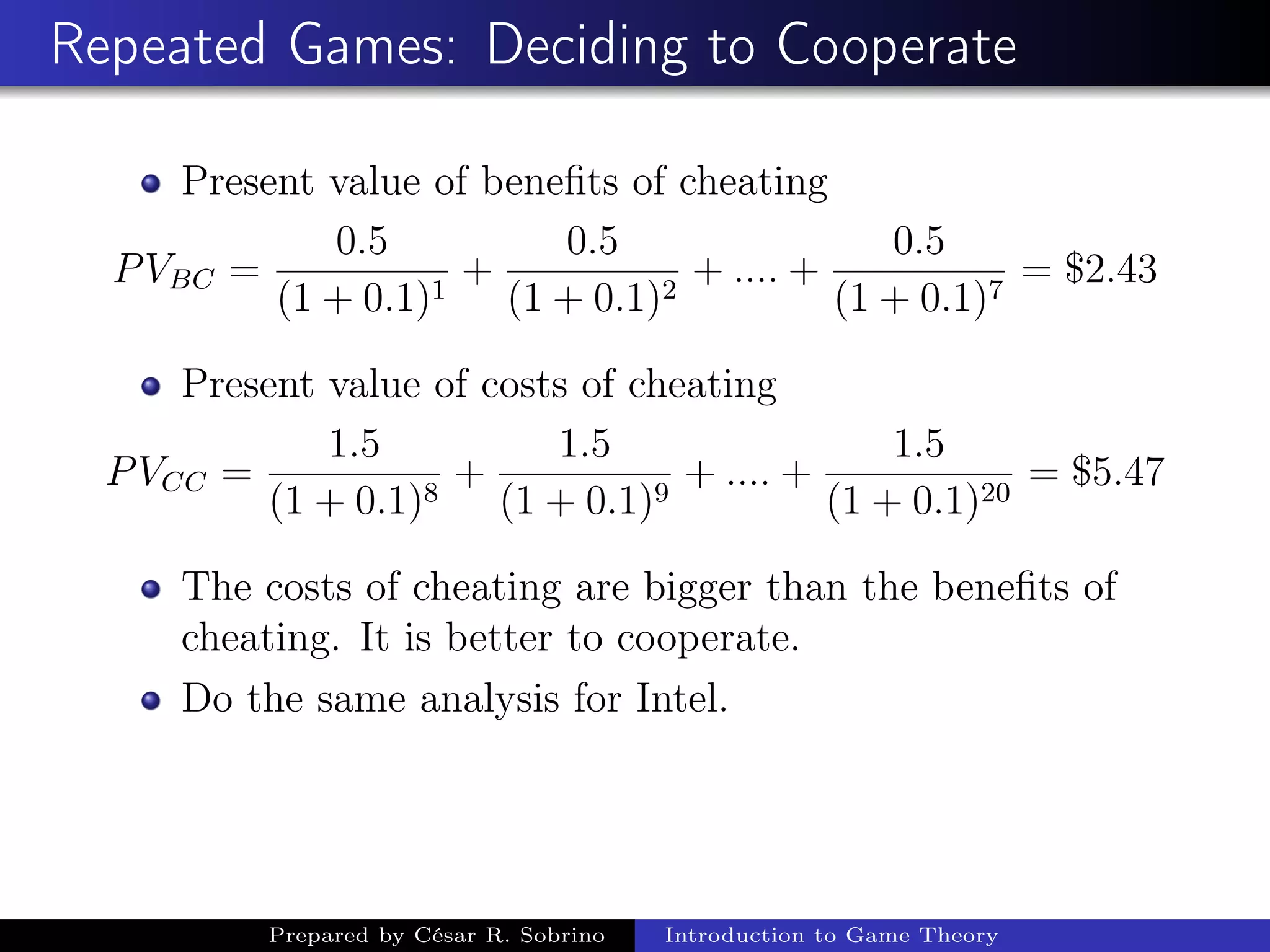
Present value of benefits of cheating
PVBC =
B1
(1 + r)1
+
B2
(1 + r)2
+ .... +
BN
(1 + r)N
Where: Bi = ΠCheat − ΠCooperate , for all i : 1, 2, ...., N
Present value of costs of cheating
PVCC =
C1
(1 + r)N+1
+
C2
(1 + r)N+2
+ .... +
CP
(1 + r)N+P
Where: Cj = ΠCooperate − ΠNash , for all j : 1, 2, ...., P
r is the real interest rate,
Prepared by César R. Sobrino Introduction to Game Theory
Repeated Games: Deciding to Cooperate
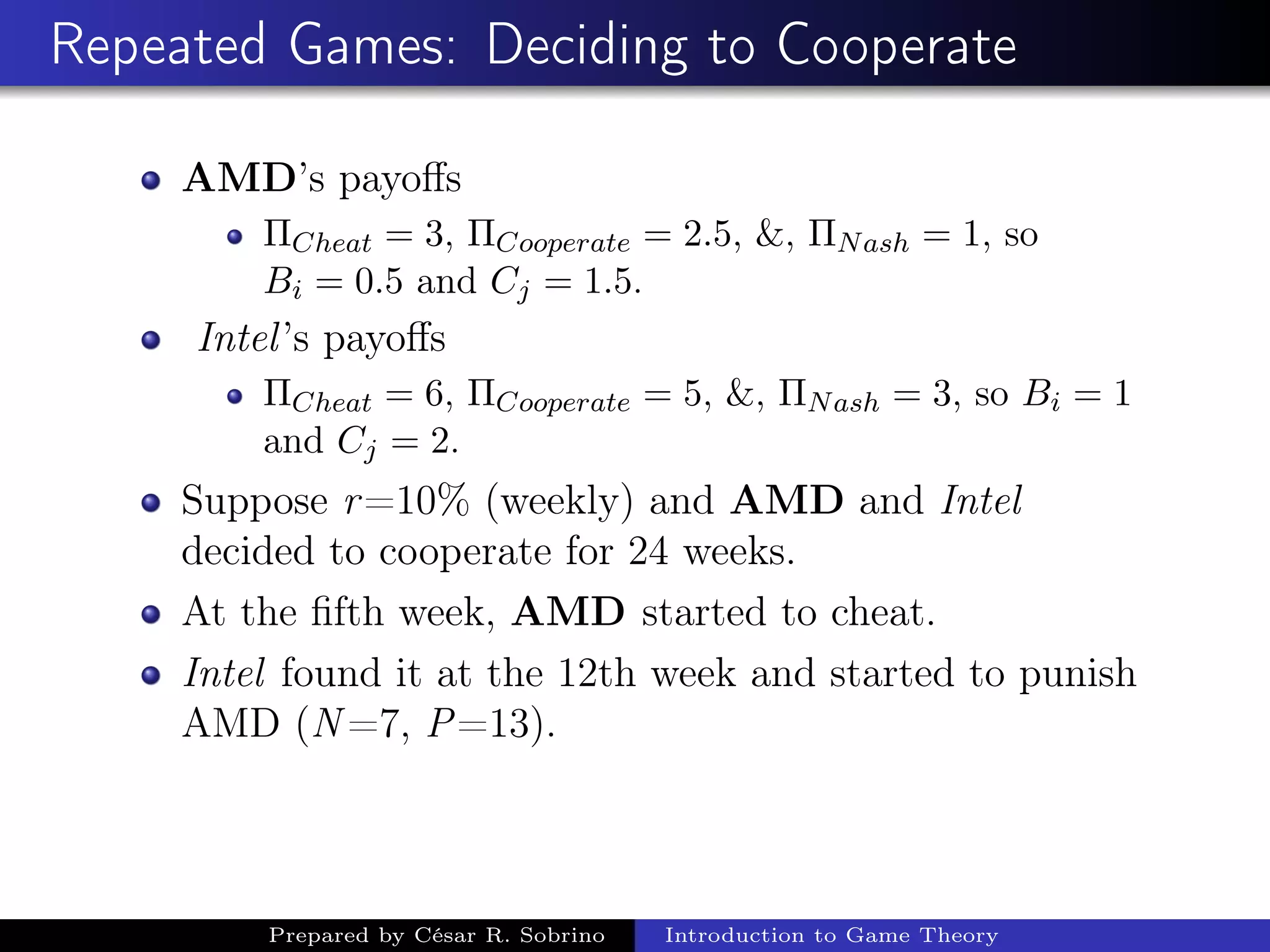
AMD’s payoffs
ΠCheat = 3, ΠCooperate = 2.5, &, ΠNash = 1, so
Bi = 0.5 and Cj = 1.5.
Intel’s payoffs
ΠCheat = 6, ΠCooperate = 5, &, ΠNash = 3, so Bi = 1
and Cj = 2.
Suppose r=10% (weekly) and AMD and Intel
decided to cooperate for 24 weeks.
At the fifth week, AMD started to cheat.
Intel found it at the 12th week and started to punish
AMD (N =7, P=13).
Prepared by César R. Sobrino Introduction to Game Theory
Repeated Games: Deciding to Cooperate
Present value of benefits of cheating
PVBC =
0.5
(1 + 0.1)1
+
0.5
(1 + 0.1)2
+ .... +
0.5
(1 + 0.1)7
= $2.43
Present value of costs of cheating
PVCC =
1.5
(1 + 0.1)8
+
1.5
(1 + 0.1)9
+ .... +
1.5
(1 + 0.1)20
= $5.47
The costs of cheating are bigger than the benefits of
cheating. It is better to cooperate.
Do the same analysis for Intel.
Prepared by César R. Sobrino Introduction to Game Theory
Repeated Games: Trigger Strategies
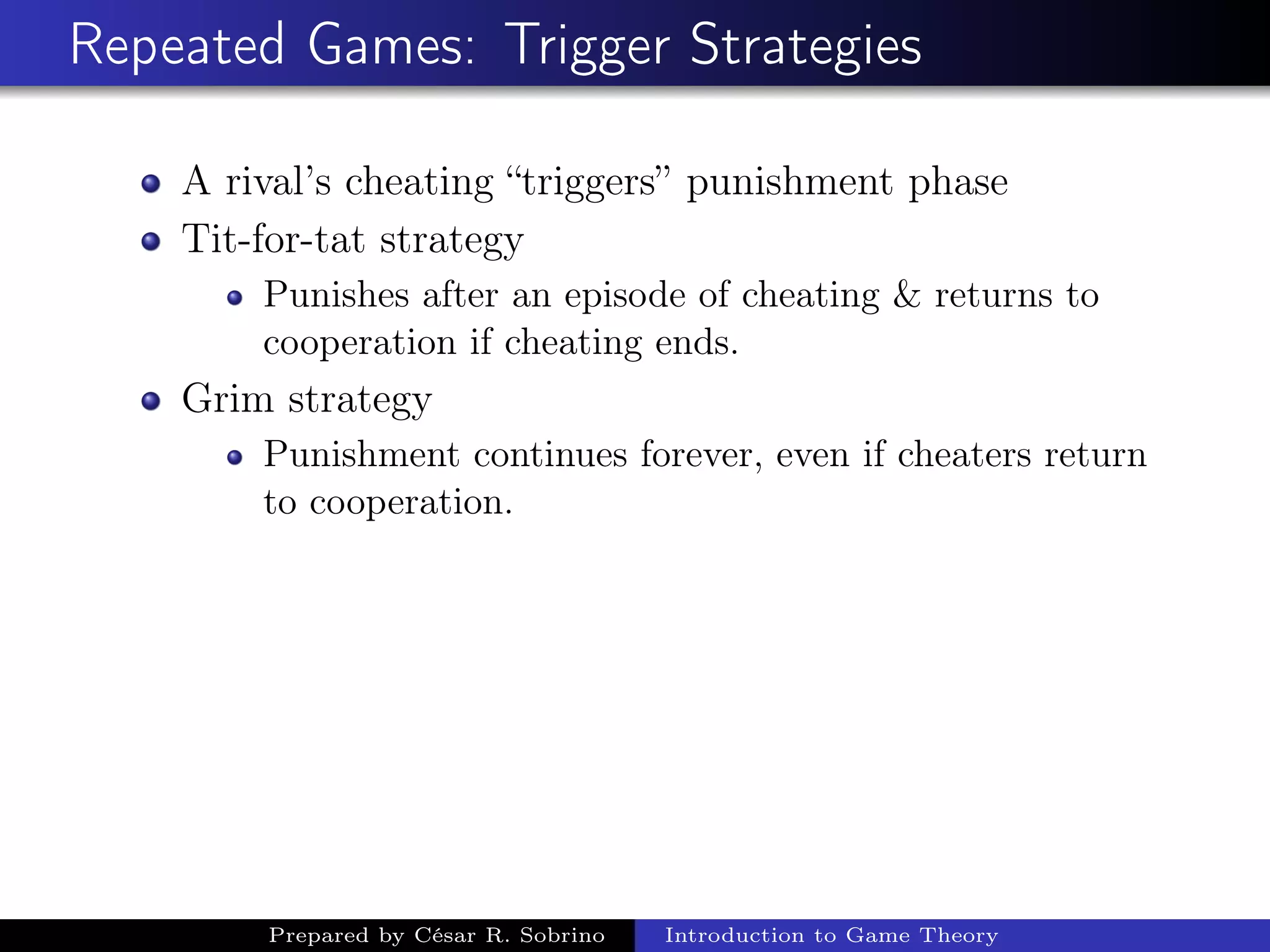
A rival’s cheating “triggers” punishment phase
Tit-for-tat strategy
Punishes after an episode of cheating & returns to
cooperation if cheating ends.
Grim strategy
Punishment continues forever, even if cheaters return
to cooperation.
Prepared by César R. Sobrino Introduction to Game Theory
Repeated Games: Facilitating Tactics
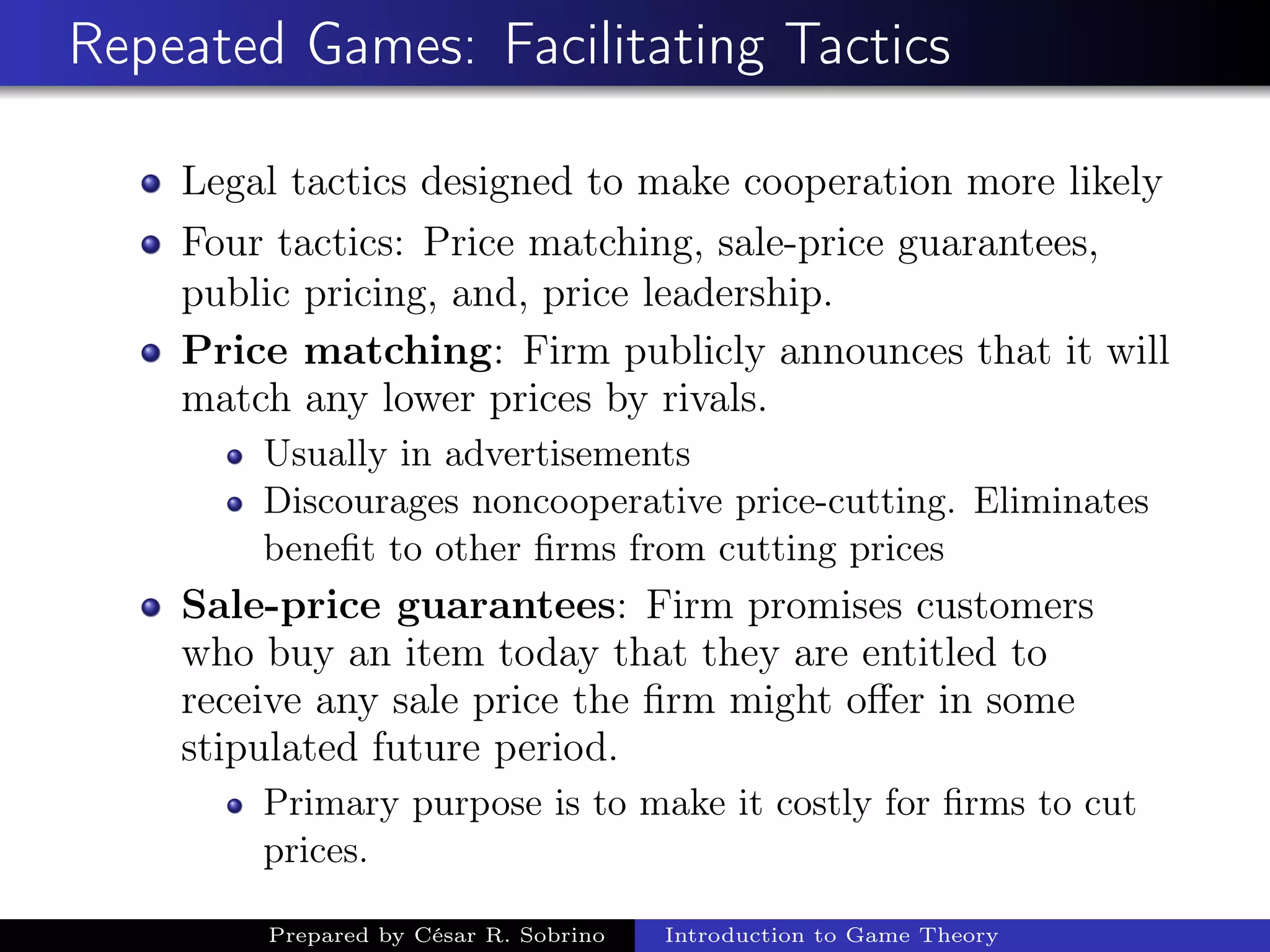
Legal tactics designed to make cooperation more likely
Four tactics: Price matching, sale-price guarantees,
public pricing, and, price leadership.
Price matching: Firm publicly announces that it will
match any lower prices by rivals.
Usually in advertisements
Discourages noncooperative price-cutting. Eliminates
benefit to other firms from cutting prices
Sale-price guarantees: Firm promises customers
who buy an item today that they are entitled to
receive any sale price the firm might offer in some
stipulated future period.
Primary purpose is to make it costly for firms to cut
prices.
Prepared by César R. Sobrino Introduction to Game Theory
Repeated Games: Facilitating Tactics
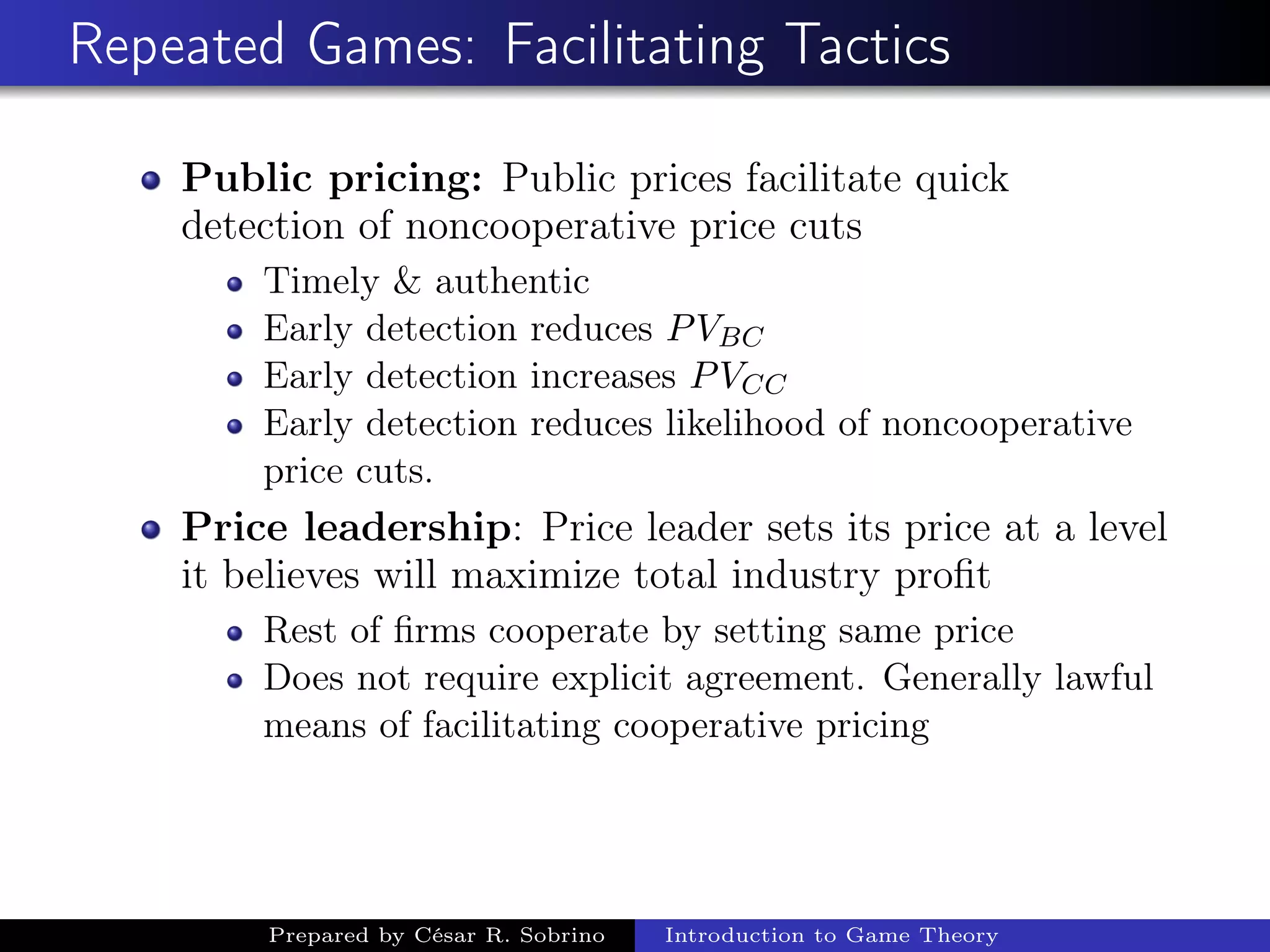
Public pricing: Public prices facilitate quick
detection of noncooperative price cuts
Timely & authentic
Early detection reduces PVBC
Early detection increases PVCC
Early detection reduces likelihood of noncooperative
price cuts.
Price leadership: Price leader sets its price at a level
it believes will maximize total industry profit
Rest of firms cooperate by setting same price
Does not require explicit agreement. Generally lawful
means of facilitating cooperative pricing
Prepared by César R. Sobrino Introduction to Game Theory
Cartels
Most extreme form of cooperative oligopoly.
Explicit collusive agreement to drive up prices by
restricting total market output
Illegal in US, Canada, Mexico, Germany, & European
Union.
Pricing schemes usually strategically unstable &
difficult to maintain
Strong incentive to cheat by lowering price
Prepared by César R. Sobrino Introduction to Game Theory
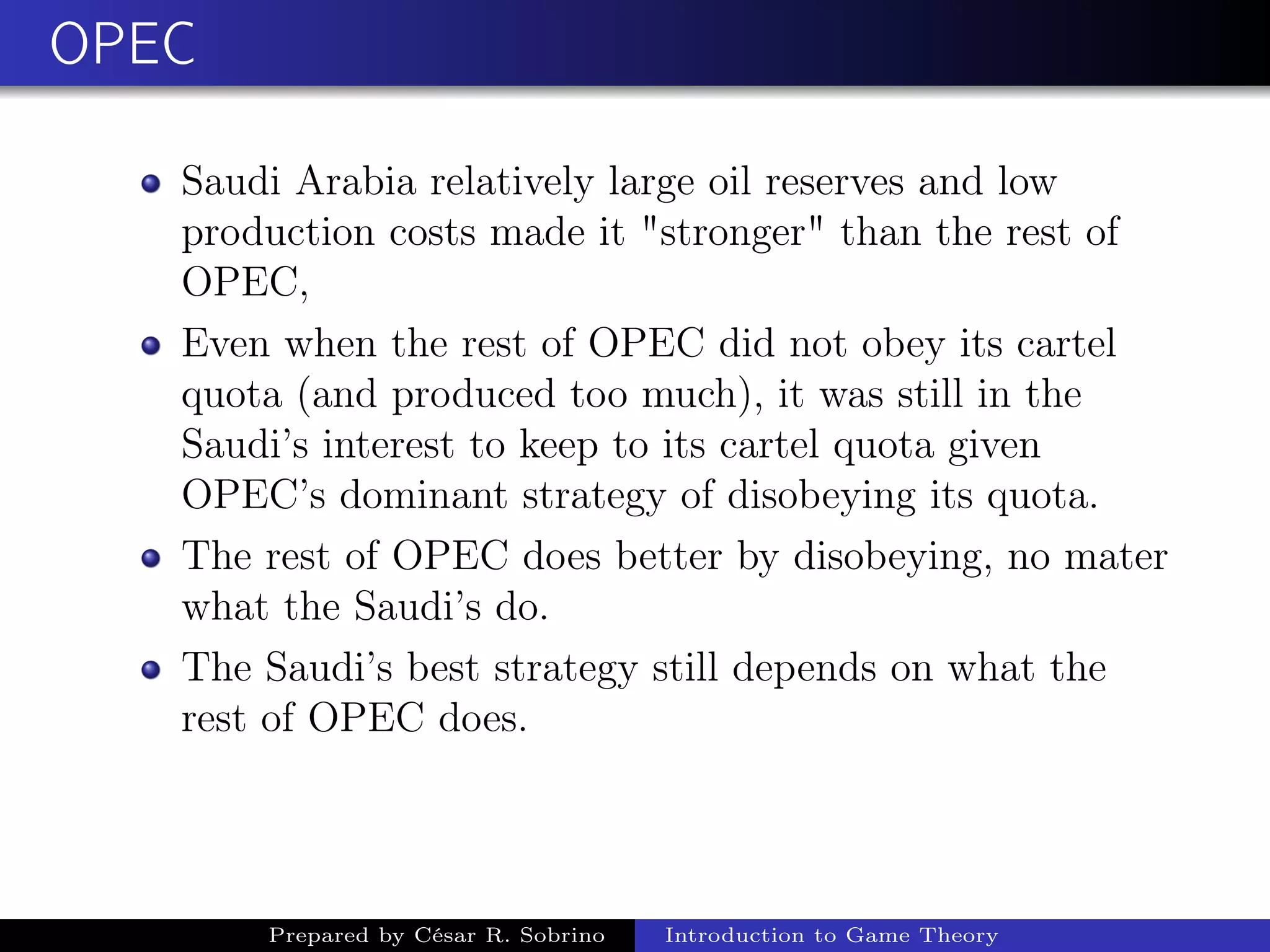
OPEC
Saudi Arabia relatively large oil reserves and low
production costs made it "stronger" than the rest of
OPEC,
Even when the rest of OPEC did not obey its cartel
quota (and produced too much), it was still in the
Saudi’s interest to keep to its cartel quota given
OPEC’s dominant strategy of disobeying its quota.
The rest of OPEC does better by disobeying, no mater
what the Saudi’s do.
The Saudi’s best strategy still depends on what the
rest of OPEC does.
Prepared by César R. Sobrino Introduction to Game Theory
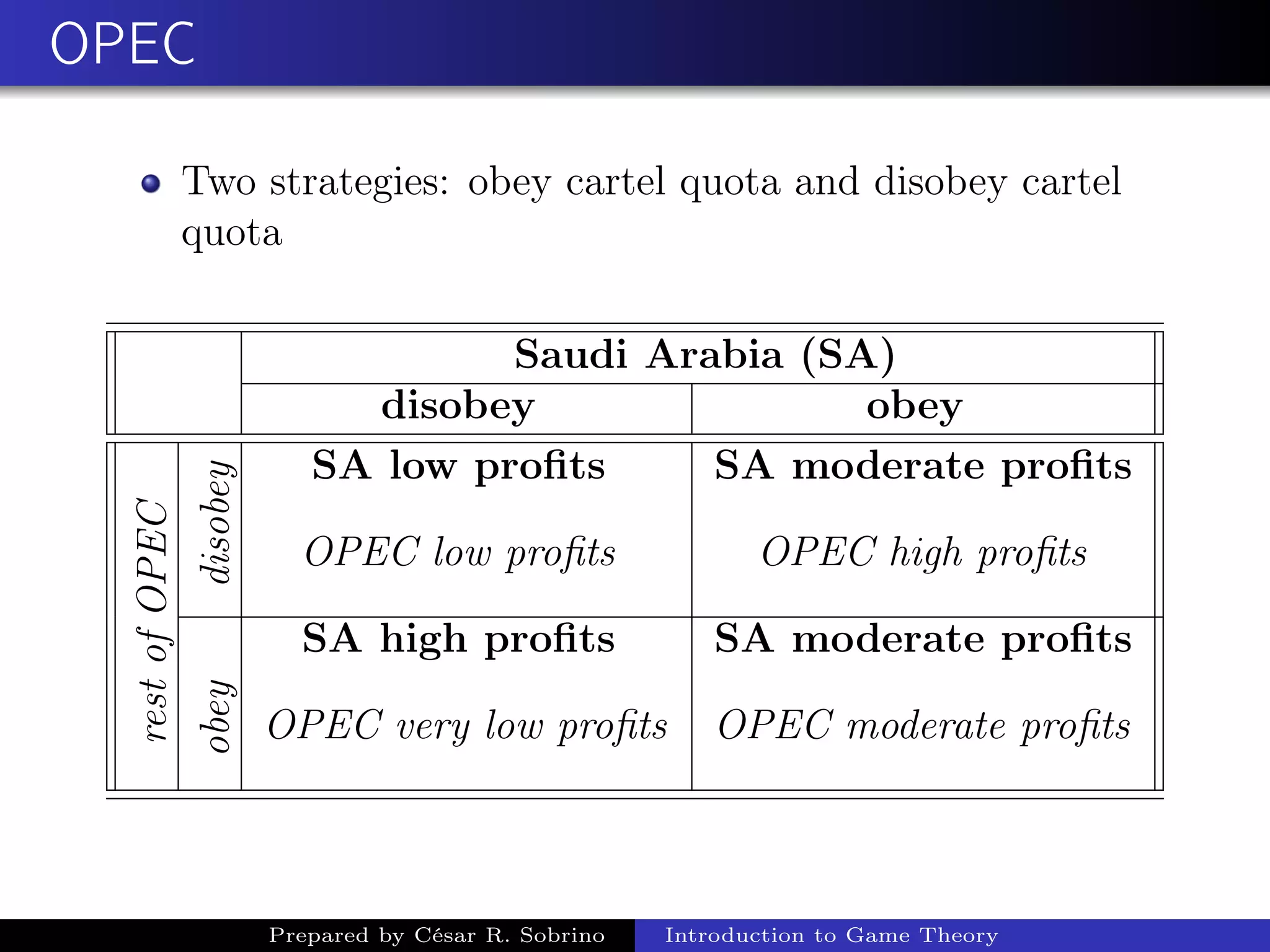
OPEC
Two strategies: obey cartel quota and disobey cartel
quota
Saudi Arabia (SA)
disobey obey
restofOPEC
disobey
SA low profits SA moderate profits
OPEC low profits OPEC high profits
obey
SA high profits SA moderate profits
OPEC very low profits OPEC moderate profits
Prepared by César R. Sobrino Introduction to Game Theory
Tacit Collusion
Far less extreme form of cooperation among oligopoly
firms
Cooperation occurs without any explicit agreement or
any other facilitating practices
Prepared by César R. Sobrino Introduction to Game Theory
Sequential Decisions
Sometimes a game has more than one Nash
Equilibrium and it is hard to say which is more likely
to occur.
When such a game is sequential, perhaps, one of the
Nash equilibria is more likely to occur than the other.
One firm makes its decision first, then a rival firm,
knowing the action of the first firm, makes its decision.
The best decision a manager makes today depends on
how rivals respond tomorrow.
Game tree: shows firms decisions as nodes with
branches extending from the nodes
One branch for each action that can be taken at the
node
Sequence of decisions proceeds from left to right until
final payoffs are reached
Prepared by César R. Sobrino Introduction to Game Theory
Sequential Decisions
Roll-back method (or backward induction)
Method of finding Nash solution by looking ahead to
future decisions to reason back to the current best
decision.
First-mover advantage
If letting rivals know what you are doing by going first
in a sequential decision increases your payoff.
Second-mover advantage
If reacting to a decision already made by a rival
increases your payoff.
Determine whether the order of decision making can
be confer an advantage
Apply roll-back method to game trees for each
possible sequence of decisions
Prepared by César R. Sobrino Introduction to Game Theory
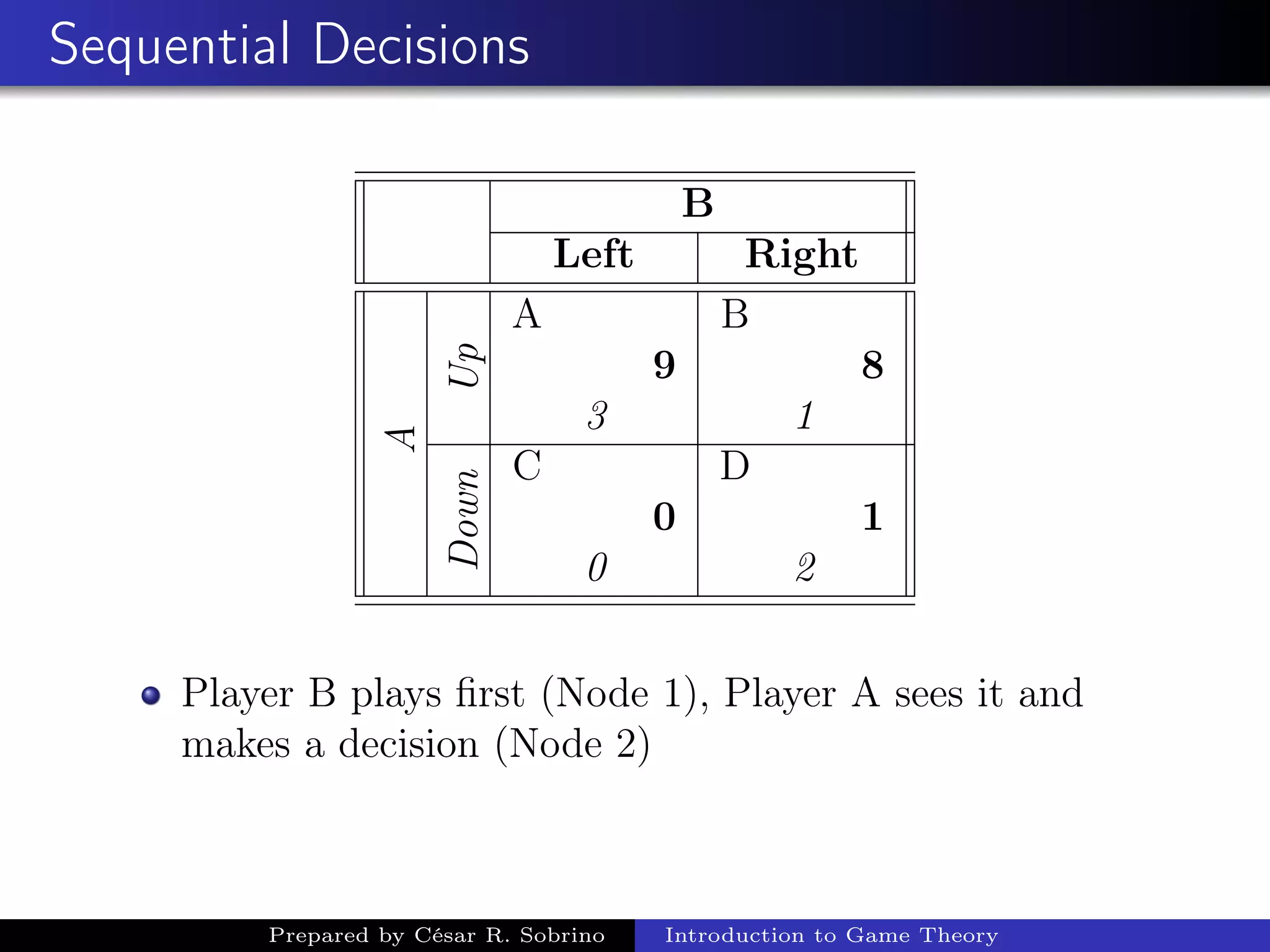
Sequential Decisions
B
Left Right
A
Up
A B
9 8
3 1
Down C D
0 1
0 2
Player B plays first (Node 1), Player A sees it and
makes a decision (Node 2)
Prepared by César R. Sobrino Introduction to Game Theory
Sequential Decisions
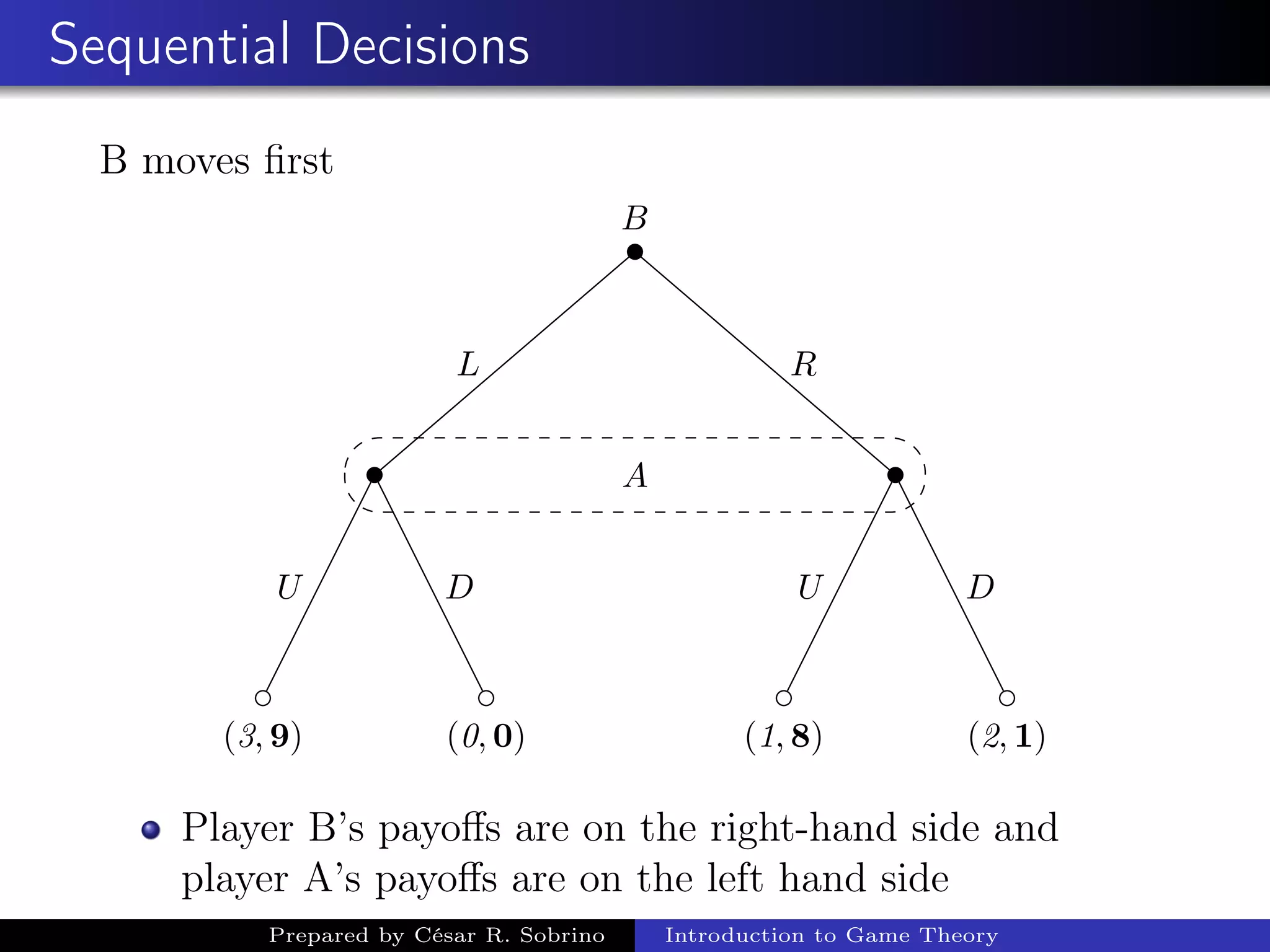
B moves first
B
(3, 9)
U
(0, 0)
D
L
(1, 8)
U
(2, 1)
D
R
A
Player B’s payoffs are on the right-hand side and
player A’s payoffs are on the left hand side
Prepared by César R. Sobrino Introduction to Game Theory
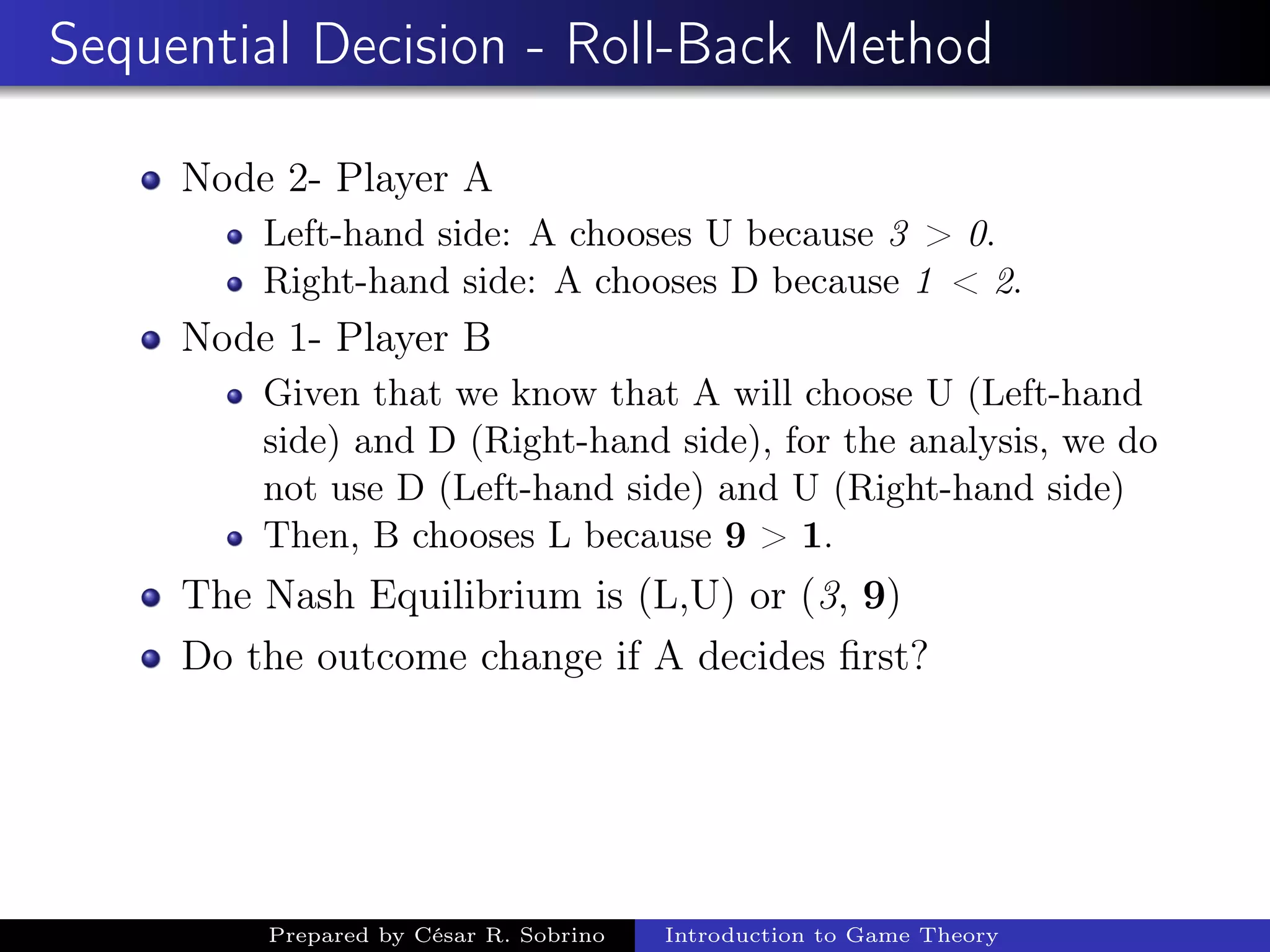
Sequential Decision - Roll-Back Method
Node 2- Player A
Left-hand side: A chooses U because 3 > 0.
Right-hand side: A chooses D because 1 < 2.
Node 1- Player B
Given that we know that A will choose U (Left-hand
side) and D (Right-hand side), for the analysis, we do
not use D (Left-hand side) and U (Right-hand side)
Then, B chooses L because 9 > 1.
The Nash Equilibrium is (L,U) or (3, 9)
Do the outcome change if A decides first?
Prepared by César R. Sobrino Introduction to Game Theory
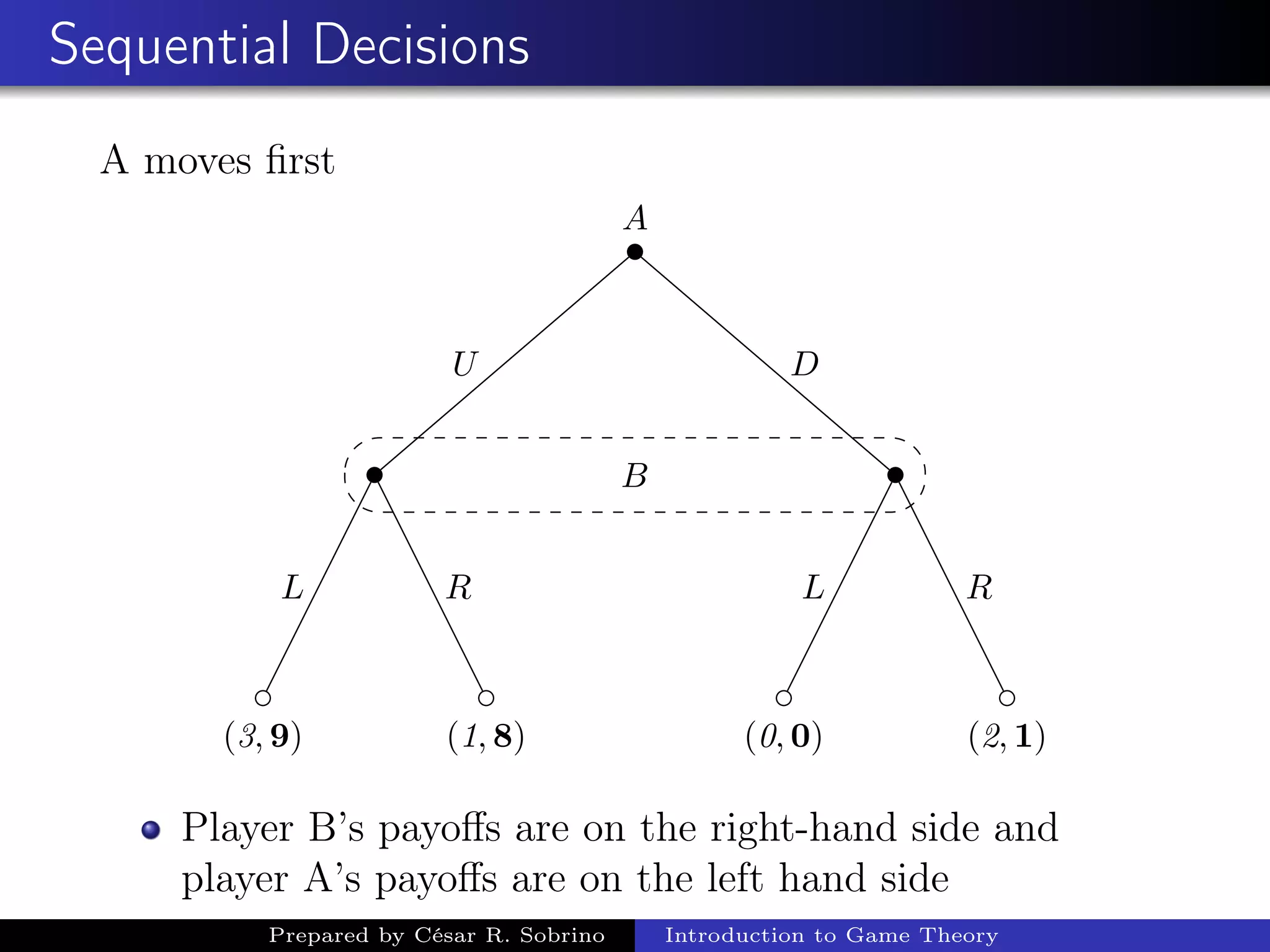
Sequential Decisions
A moves first
A
(3, 9)
L
(1, 8)
R
U
(0, 0)
L
(2, 1)
R
D
B
Player B’s payoffs are on the right-hand side and
player A’s payoffs are on the left hand side
Prepared by César R. Sobrino Introduction to Game Theory
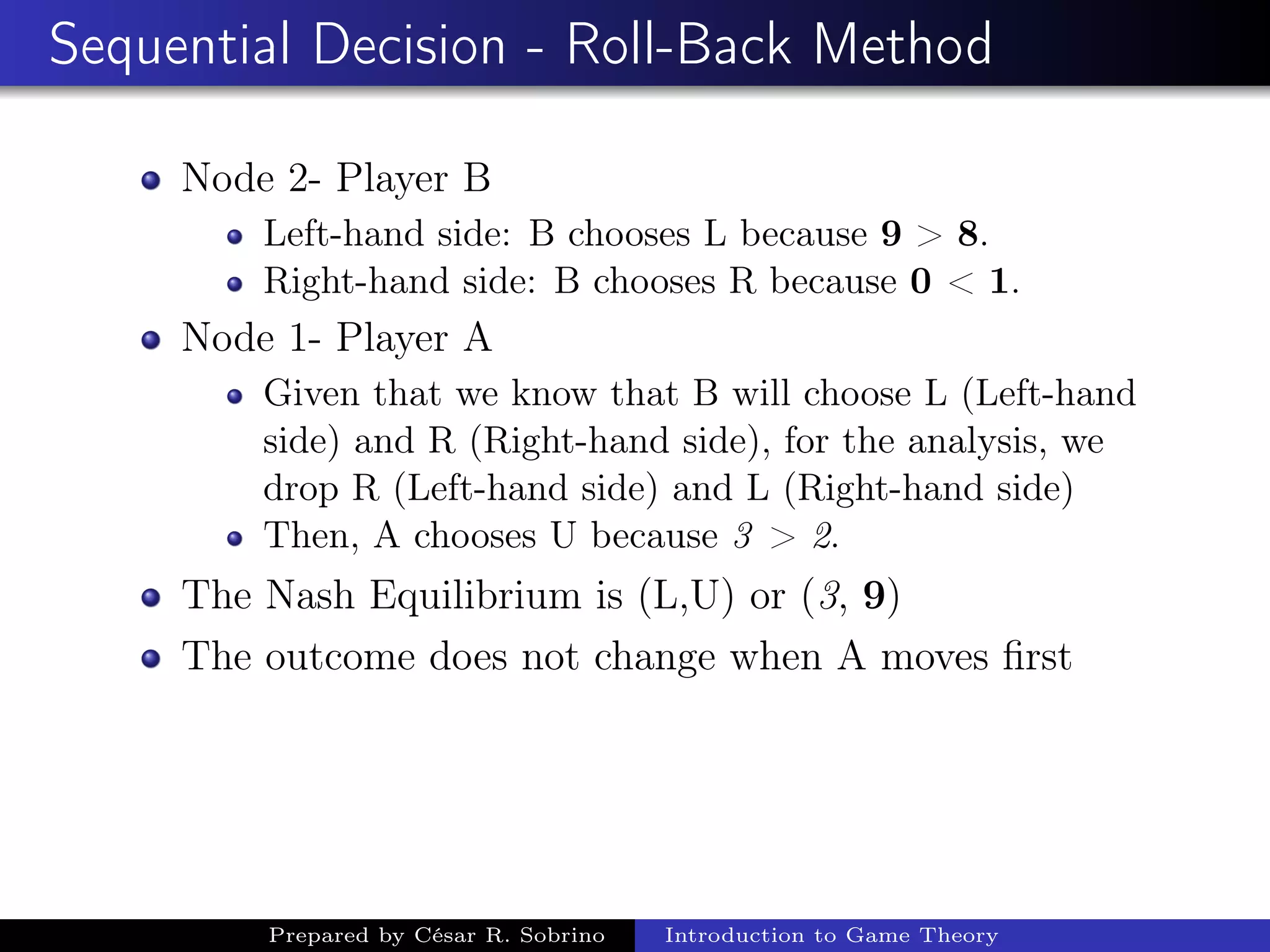
Sequential Decision - Roll-Back Method
Node 2- Player B
Left-hand side: B chooses L because 9 > 8.
Right-hand side: B chooses R because 0 < 1.
Node 1- Player A
Given that we know that B will choose L (Left-hand
side) and R (Right-hand side), for the analysis, we
drop R (Left-hand side) and L (Right-hand side)
Then, A chooses U because 3 > 2.
The Nash Equilibrium is (L,U) or (3, 9)
The outcome does not change when A moves first
Prepared by César R. Sobrino Introduction to Game Theory
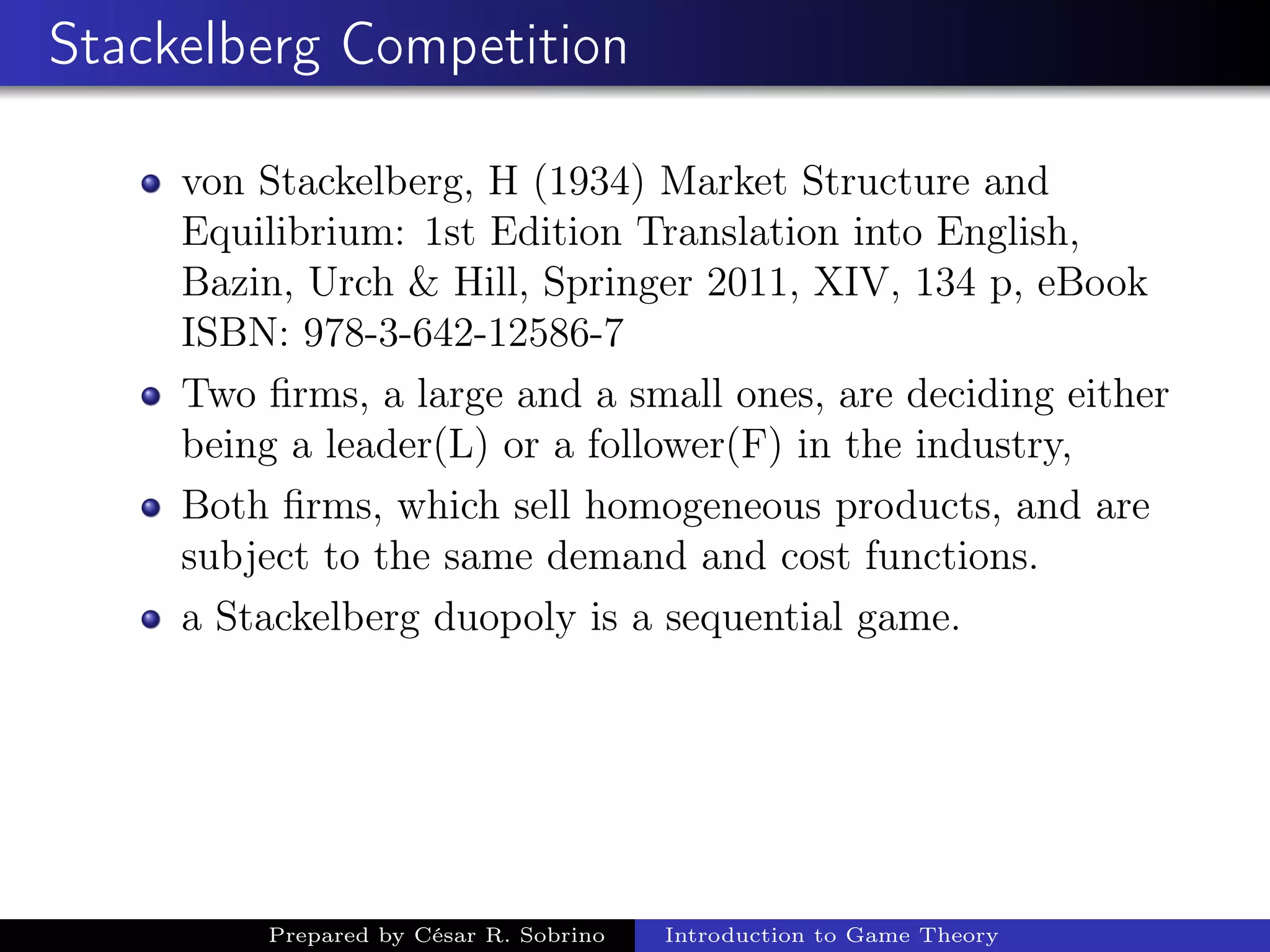
Stackelberg Competition
von Stackelberg, H (1934) Market Structure and
Equilibrium: 1st Edition Translation into English,
Bazin, Urch & Hill, Springer 2011, XIV, 134 p, eBook
ISBN: 978-3-642-12586-7
Two firms, a large and a small ones, are deciding either
being a leader(L) or a follower(F) in the industry,
Both firms, which sell homogeneous products, and are
subject to the same demand and cost functions.
a Stackelberg duopoly is a sequential game.
Prepared by César R. Sobrino Introduction to Game Theory
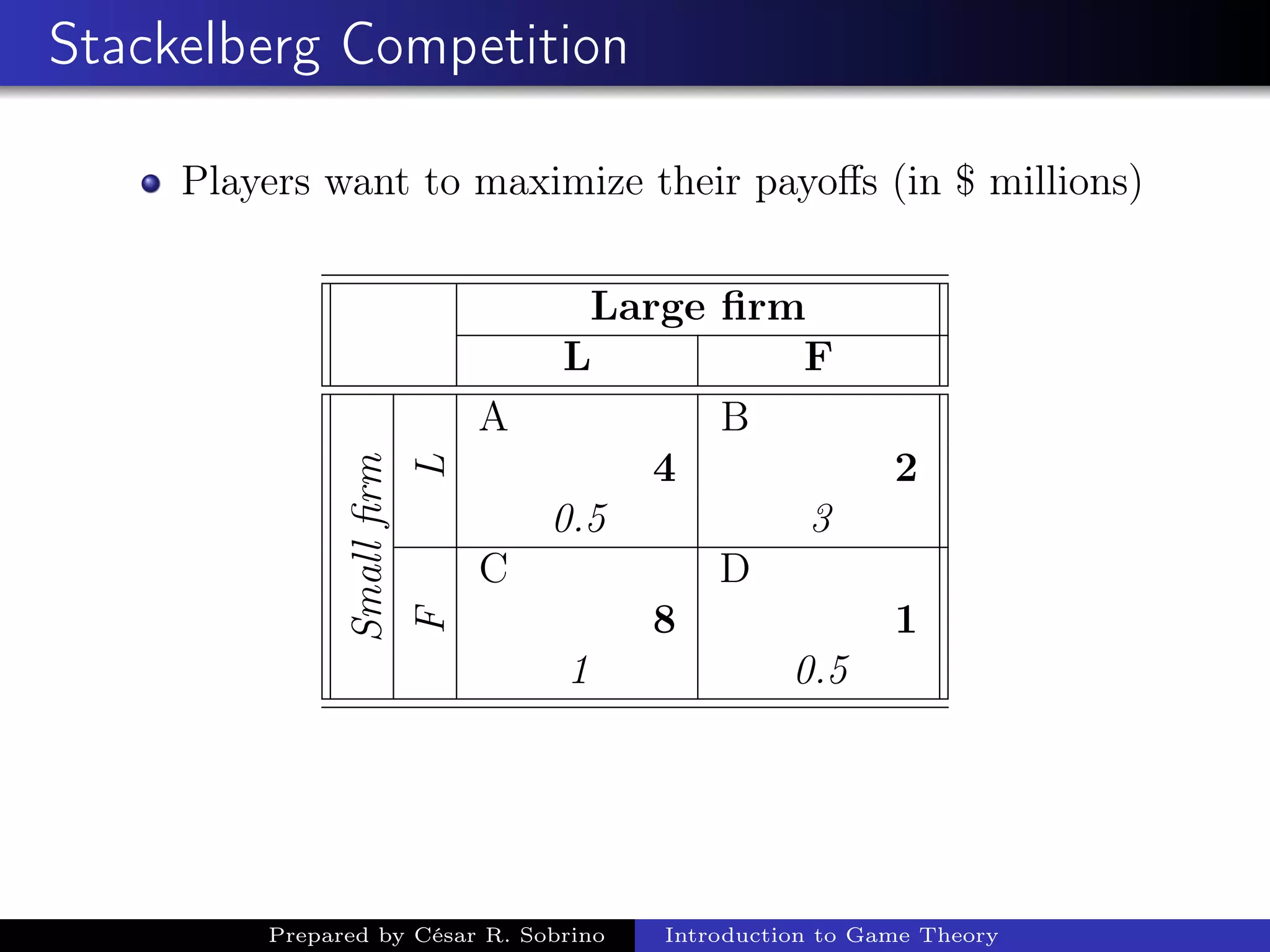
Stackelberg Competition
Players want to maximize their payoffs (in $ millions)
Large firm
L FSmallfirm
L A B
4 2
0.5 3
F
C D
8 1
1 0.5
Prepared by César R. Sobrino Introduction to Game Theory
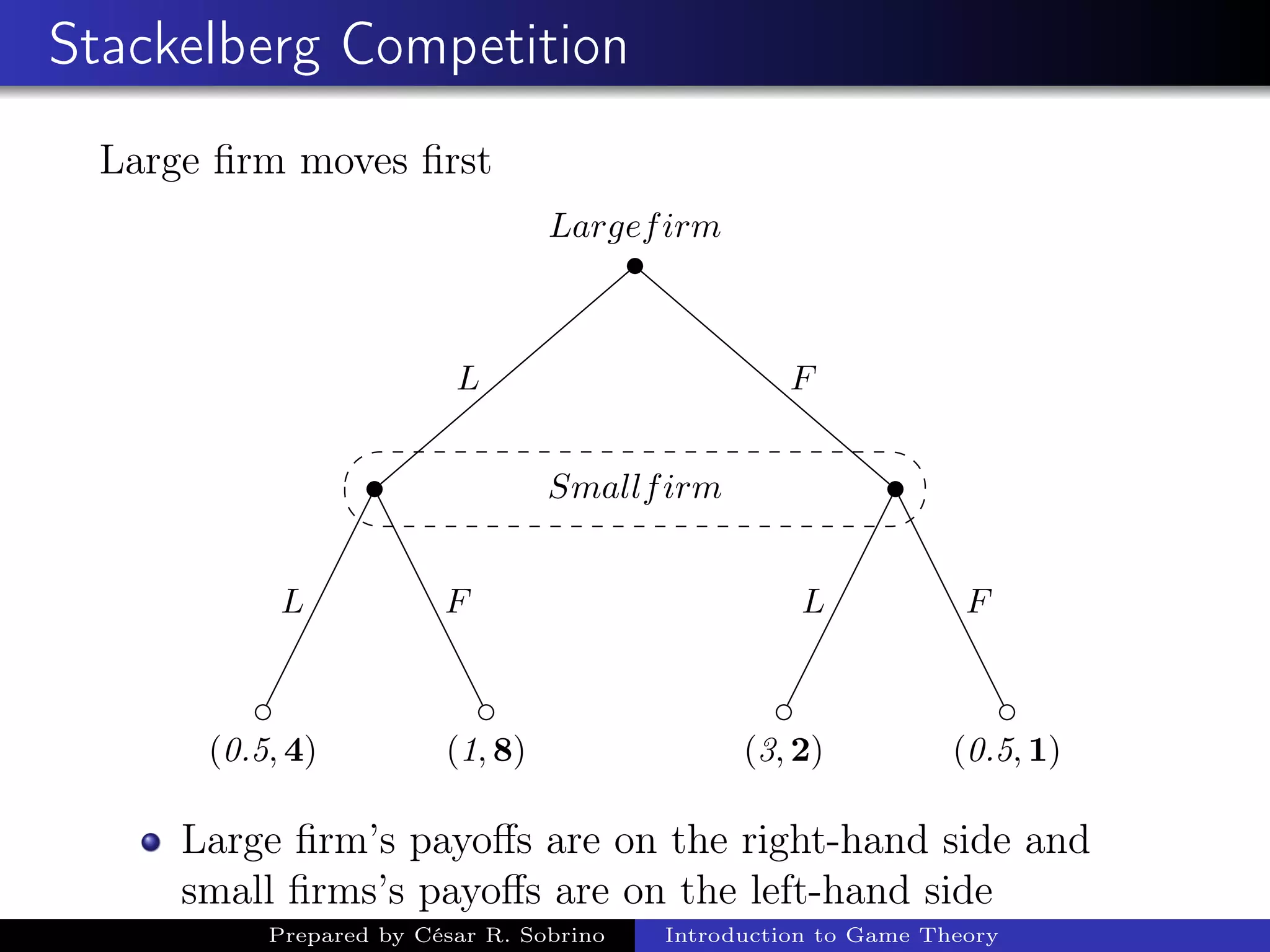
Stackelberg Competition
Large firm moves first
Largefirm
(0.5, 4)
L
(1, 8)
F
L
(3, 2)
L
(0.5, 1)
F
F
Smallfirm
Large firm’s payoffs are on the right-hand side and
small firms’s payoffs are on the left-hand side
Prepared by César R. Sobrino Introduction to Game Theory
Stackelberg Competition- Roll-Back Method
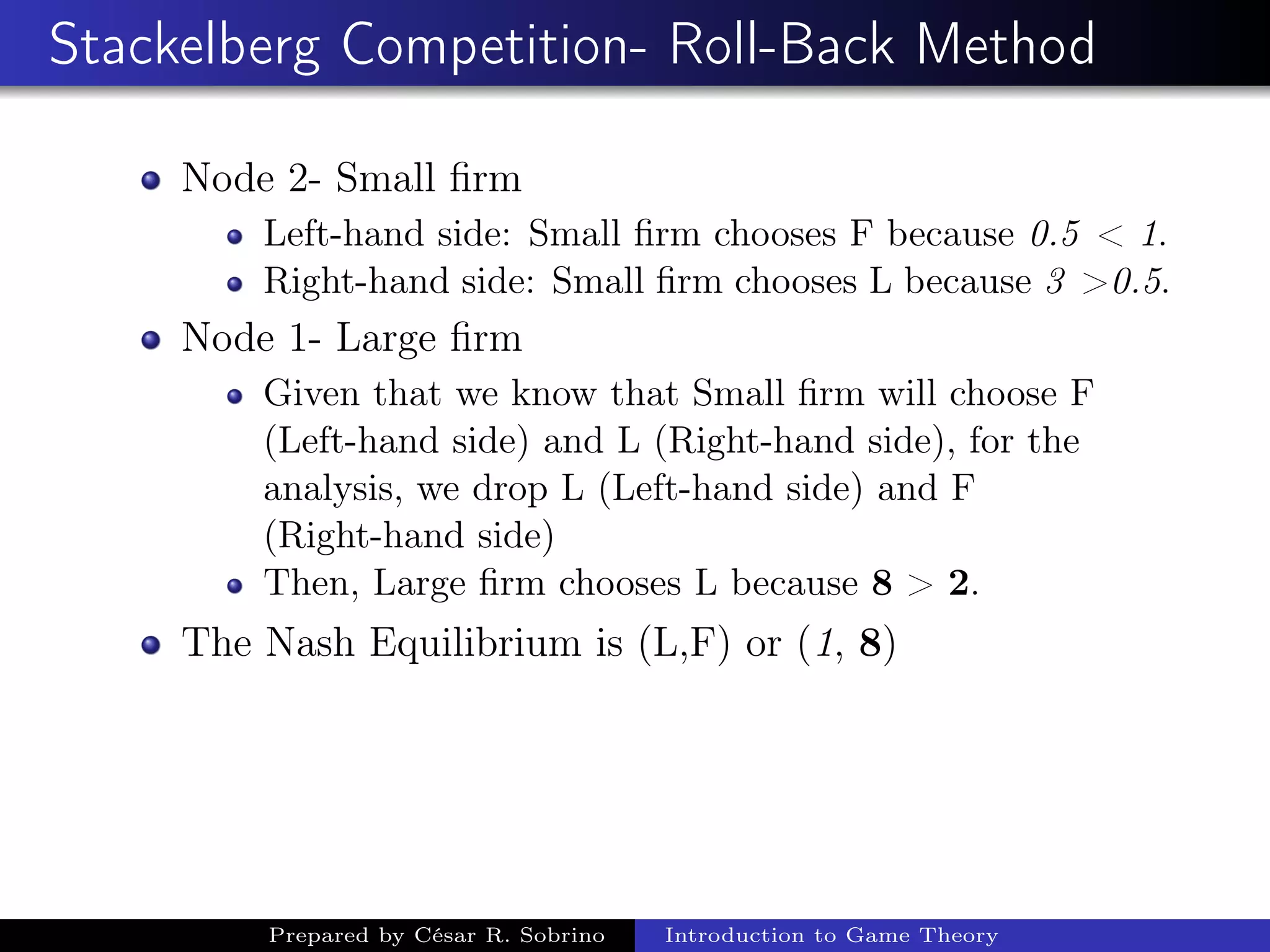
Node 2- Small firm
Left-hand side: Small firm chooses F because 0.5 < 1.
Right-hand side: Small firm chooses L because 3 >0.5.
Node 1- Large firm
Given that we know that Small firm will choose F
(Left-hand side) and L (Right-hand side), for the
analysis, we drop L (Left-hand side) and F
(Right-hand side)
Then, Large firm chooses L because 8 > 2.
The Nash Equilibrium is (L,F) or (1, 8)
Prepared by César R. Sobrino Introduction to Game Theory
Strategic Entry Deterrence
Ronnie’s Wraps is the only supplier of sandwich
food and makes a healthy profit.
It currently charges a high price and makes a profit of
six thousands per week.
Flash Salads is considering entering the same market.
Ronnie’s Wrap plays high price or low price.
Flash Salads plays enter to the market or stay out
Prepared by César R. Sobrino Introduction to Game Theory
Strategic Entry Deterrence
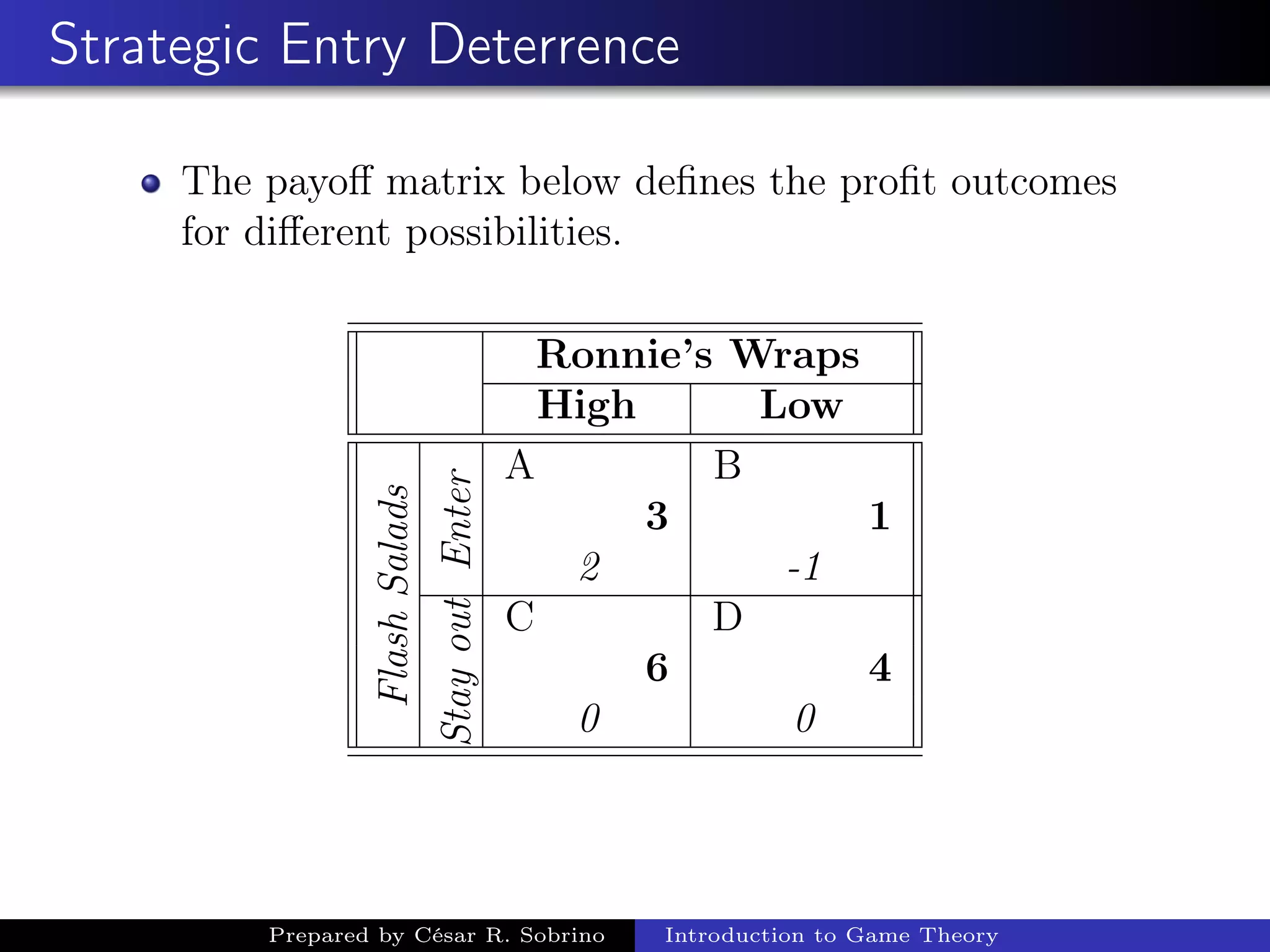
The payoff matrix below defines the profit outcomes
for different possibilities.
Ronnie’s Wraps
High LowFlashSalads
Enter A B
3 1
2 -1
Stayout
C D
6 4
0 0
Prepared by César R. Sobrino Introduction to Game Theory
Strategic Entry Deterrence
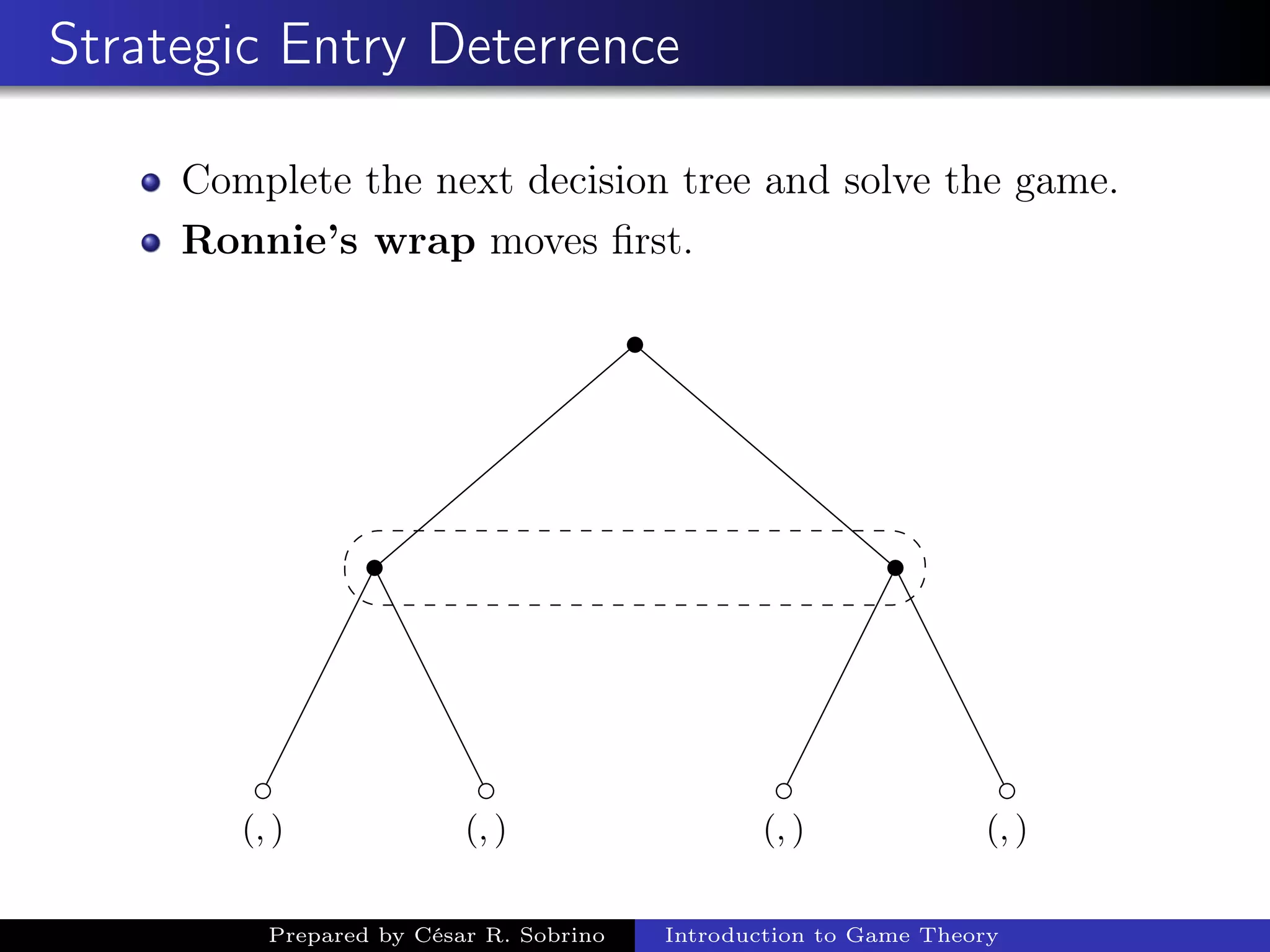
Complete the next decision tree and solve the game.
Ronnie’s wrap moves first.
(, ) (, ) (, ) (, )
Prepared by César R. Sobrino Introduction to Game Theory
References
Varian, Hal R. 2010. Intermediate microeconomics: a
modern approach. New York: W.W. Norton & Co.
Gibbons, R. (1992.). A Primer in Game Theory,
Prentice Hall
Prepared by César R. Sobrino Introduction to Game Theory

Introduction to Game Theory

  • 1.
    Introduction to GameTheory Prepared by César R. Sobrino Universidad del Turabo August 16, 2018 Prepared by César R. Sobrino Introduction to Game Theory
  • 2.
    Outline 1 Description ofa Game Complete & Incomplete Information Perfect & Imperfect Information 2 Simultaneous Decisions (Static Games) Pure Strategies (One-shot game) Dominant Strategy Dominated Strategy Mixed Strategies (One-shot game) Repeated Games 3 Sequential Decisions (Dynamic Games) Prepared by César R. Sobrino Introduction to Game Theory
  • 3.
    Introduction Game theory modelsstrategic behavior by agents who understand that their actions affect the actions of other agents. This scheme is useful to model interactions among firms, countries, individuals, etc. Useful to analyze the interactions in oligopolistic markets. Distinguishing feature of oligopoly is interdependence of firms’ profits. Arises when number of firms in market is small enough that every firms’ price and output decisions affect demand and marginal revenue conditions of every other firm in market. Prepared by César R. Sobrino Introduction to Game Theory
  • 4.
    The Elements ofa Game A game consists of A set of players. A set of strategies for each player. Set of rules such as: simultaneous, sequential, who plays first, cooperation; The payoffs to each player for every possible list of strategy choices by the players. A game can be represented by a matrix form or using decision trees. Solution(s): Nash Equilibrium: Neither player has an incentive to change strategy, given the other player’s choice Prepared by César R. Sobrino Introduction to Game Theory
  • 5.
    Complete and IncompleteInformation Complete information refers when each agent knows the other agent’s payoffs and the rules of the game. It is a central assumption of the Game Theory. Incomplete information, also known as asymmetric information, refers to the contrary, where not all players know each other’s payoffs. Prepared by César R. Sobrino Introduction to Game Theory
  • 6.
    Perfect and ImperfectInformation The perfection of information is an important notion in Game Theory when considering sequential and simultaneous games. Perfect information is when each player knows or can see other player’s moves. A good example would be chess, where each player sees the other player’s pieces on the board. Imperfect information is when decisions have to be made simultaneously, and players need to balance all possible outcomes when making a decision. A good example is a card game where each player’s card are hidden from the rest of the players. Prepared by César R. Sobrino Introduction to Game Theory
  • 7.
    Nash Equilibrium Set ofactions or decisions for which all managers are choosing their best actions given the actions they expect their rivals to choose Strategic stability No single firm can unilaterally make a different decision & do better. When a unique Nash Equilibrium set of decisions exists. Rivals can be expected to make the decisions leading to the Nash Equilibrium. With multiple Nash equilibria, no way to predict the likely outcome. Nash equilibria can occur without dominant or dominated strategies. Prepared by César R. Sobrino Introduction to Game Theory
  • 8.
    Simultaneous Decisions Occur whenmanagers must make individual decisions without knowing their rivals’ decisions. For all firms in an oligopoly to be predicting correctly each others’ decisions: All firms must be choosing individually best actions given the predicted actions of their rivals, which they can then believe are correctly predicted. Strategically astute managers look for mutually best decisions. Prepared by César R. Sobrino Introduction to Game Theory
  • 9.
    Pure Strategies: DominantStrategy Always provide best outcome no matter what decisions rivals make, When one exists, the rational decision maker always follows its dominant strategy, Predict rivals will follow their dominant strategies, if they exist. Dominant strategy equilibrium. Exists when when all decision makers have dominant strategies. Prepared by César R. Sobrino Introduction to Game Theory
  • 10.
    Prisoner’s Dilemma 2 prisoners(Bill & Jane), suspected of burglary, are taken into custody. There is no enough evidence to convict them of that crime, only to convict them on the charge of possession of stolen goods. Prisoners are on separate interrogation rooms, which means that they cannot communicate (imperfect information). Both prisoners are offered the same deal and know the consequences of each action (complete information) Prisoners are completely aware that the other prisoner has been offered the exact same deal (common knowledge). Prepared by César R. Sobrino Introduction to Game Theory
  • 11.
    Prisoner’s Dilemma- Payoffmatrix 2 Strategies for each player: C ∼ “Confess” and DC ∼ “Do not confess” Players want to minimize their sentences (years in jail) Bill DC C Jane DC A B 2 1 2 12 C C D 12 6 1 6 Prepared by César R. Sobrino Introduction to Game Theory
  • 12.
    Prisoner’s Dilemma-Payoff Matrix Ifboth players choose DC, both get 2 years (Cell A) If both players choose C, both get 6 years (Cell D) If Bill plays DC and Jane plays C, he gets 12 years and she gets 1 year (Cell C). If Bill plays C and Jane plays DC, he gets 1 year and she gets 12 years (Cell B). Bill DC C Jane DC A B 2 1 2 12 C C D 12 6 1 6 Prepared by César R. Sobrino Introduction to Game Theory
  • 13.
    Prisoner’s Dilemma-Payoff Matrix:Bill’s payoffs If Bill chooses DC (1st column), he gets either 2 years or 12 years.. Similarly, if Bill chooses C (2nd column), he gets either 1 year or 6 years. Bill DC CJane DC A B 2 1 C C D 12 6 C is a dominant strategy for Bill because Payoffs of DC ( 2 & 12) bigger than payoffs of C (1 & 6). 2 >1 & 12 > 6. (DC > C) Prepared by César R. Sobrino Introduction to Game Theory
  • 14.
    Prisoner’s Dilemma-Payoff Matrix:Jane’s payoffs If Jane chooses DC (1st row), she gets either 2 years or 12 years. Similarly, if Jane chooses C (2nd row), she gets get either 1 year or 6 years. Bill DC CJane DC A B 2 12 C C D 1 6 C is a dominant strategy for Jane because Payoffs of DC ( 2 & 12) bigger than payoffs of C (1 & 6). 2 >1 & 12 > 6. (DC > C) Prepared by César R. Sobrino Introduction to Game Theory
  • 15.
    Prisoner’s Dilemma-Dominant Strategy Allrivals have dominant strategies. Nash Equilibrium is (C,C). Both gets 6 years (Cell D). In dominant strategy equilibrium, all are worse off than if they had cooperated in making their decisions (Cell A). Prepared by César R. Sobrino Introduction to Game Theory
  • 16.
    Prisoner’s Dilemma- BestResponse Analysis Another way to find the solution is run the best response analysis (any player may start) If Bill plays DC → the Jane’s best response is C (1<2) → the Bill’s best response is C (6<12). Bill has an incentive to change his first choice. If Bill plays C → the Jane’s best response is C (6<12) → the Bill’s best response is C (6<12). Bill has no incentive to change his first choice. Cell D is a stable solution. The other cells are unstable because players have an incentive to change their strategies. The Nash Equilibrium is (C,C). Prepared by César R. Sobrino Introduction to Game Theory
  • 17.
    Trade War The USis deciding whether set a tariff to the imports coming from Japan. Japan is deciding whether set a tariff to the imports coming from the US. They make their decisions separately (imperfect information) and know the consequences of each decisions (complete information). It is common knowledge that they face the same consequences. This means that imposing a tariff by any country increases her tax collection but if the rival imposes a tariff, her tax collection decreases through the fall in exports. Prepared by César R. Sobrino Introduction to Game Theory
  • 18.
    Trade War-Payoff Matrix 2Strategies for each player: tariff (T) and no tariff (NT). Players want to maximize their payoffs (in $ billions) Japan T NT US T A B 5 4 5 9 NT C D 9 8 4 8 Prepared by César R. Sobrino Introduction to Game Theory
  • 19.
    Trade War-Dominant Strategy Tis a dominant strategy for Japan because Payoffs of T (5 & 9) bigger than payoffs of NT (4 & 8). 5 >4 & 9 > 8. (T>NT) T is a dominant strategy for US because Payoffs of T (5 & 9) bigger than payoffs of NT (4 & 8). 5 >4 & 9 > 8. ( T>NT) All rivals have dominant strategies. Nash equilibrium is (T,T). Both gets $ 5 billions (Cell A). In dominant strategy equilibrium, all are worse off than if they had cooperated in making their decisions. (Cell D). Prepared by César R. Sobrino Introduction to Game Theory
  • 20.
    Trade War-Best ResponseAnalysis Any player may start. If Japan plays NT → the US’s best response is T (9>8) → the Japan’s best response is T (5>4). Japan has an incentive to change her first choice. If Japan plays T → the US’s best response is T (5>4) → the Japan’s best response is T (5>4). Japan has no incentive to change her first choice. Cell A is a stable solution. The other cells are unstable because players have an incentive to change their strategies. There is a Nash Equilibrium at (T,T) Prepared by César R. Sobrino Introduction to Game Theory
  • 21.
    Multiple Equilibria There aregames that have more than one Nash Equilibrium. Hard to find a unique solution in simultaneous decisions. Sequential decisions is the best way to find a unique outcome. Prepared by César R. Sobrino Introduction to Game Theory
  • 22.
    Battle of thesexes It is a game of coordination. This kind of game is where the payoffs of the players are highest when they can coordinate their strategies. Husband and wife like to spend time in either “Opera” or “Fight”. However, wife would rather to go to the “Opera” and husband would rather to go to the “Fight”. A key point is that they like to spend time together. It is worthless to go alone to any of those meetings. Payoffs are in utils (preference levels). The higher the util, the better. Prepared by César R. Sobrino Introduction to Game Theory
  • 23.
    Battle of thesexes Is there any dominant strategy for each player? Use the best response analysis, as well. Wife Fight OperaHusband Fight A B 1 0 2 0 Opera C D 0 2 0 1 Prepared by César R. Sobrino Introduction to Game Theory
  • 24.
    Battle of thesexes-Dominant Strategy Wife do not have a dominant strategy because Payoffs of “Fight” (1 & 0) are not bigger or less than payoffs of “Opera” (0 & 2). 1 >0 & 0 < 2. Husband do not have a dominant strategy because Payoffs of “Fight” (2 & 0) are not bigger or less than payoffs of “Opera” (0 & 1). 2 >0 & 0 < 1. No player has a dominant strategy. Prepared by César R. Sobrino Introduction to Game Theory
  • 25.
    Battle of thesexes -Best Response Analysis If wife plays “Fight” → the Husband’s best response is “Fight” (2>0) → the wife’s best response is “Fight”. (1>0). wife has no incentive to change her first choice. Cell A is a stable solution. If wife plays “Opera” → the Husband’s best response is “Opera” (1>0) → the wife’s best response is “Opera” (2>0). wife has no incentive to change her first choice. Cell D is a stable solution. The other cells are unstable because players have an incentive to change their strategies. Multiple Nash Equilibria at (“Fight”,“Fight”) and (“Opera”,“Opera”) Prepared by César R. Sobrino Introduction to Game Theory
  • 26.
    Location Game In thenext matrix, is there any dominant strategy for each player? Use the best response analysis, as well. Payoffs are in utils (preference levels). The higher the util, the better. B Left Right A Up A B 9 8 3 1 Down C D 0 1 0 2 Prepared by César R. Sobrino Introduction to Game Theory
  • 27.
    Market Share Rivalry BranderJ. & Spencer B.J. (1985) Export Subsidies and International Market Share Rivalry, Journal of International Economics, 16, pp. 83-100 Countries often perceive themselves as being in competition with each other for profitable international markets. Export subsidies can appear as attractive policy tools because they improve the relative position of a domestic firm in noncooperative rivalries with foreign firms, enabling it to expand its market share and earn greater profits. Subsidies change the initial conditions of the game that firms play Prepared by César R. Sobrino Introduction to Game Theory
  • 28.
    Market Share Rivalry-PayoffMatrix Boeing and Airbus want to enter a foreign market. 2 strategies for each player: produce (P) and do not produce (DP). Players want to maximize their payoffs (in $ billions). Any dominant strategy? Airbus P DP Boeing P A B -5 0 -5 100 DP C D 100 0 0 0 Prepared by César R. Sobrino Introduction to Game Theory
  • 29.
    Market Share Rivalry-DominantStrategy Airbus do not have a dominant strategy because Payoffs of P (-5 & 100) are not bigger or less than payoffs of DP (0 & 0). -5 <0 & 100 > 0. Boeing do no have a dominant strategy because Payoffs of P (-5 & 100) are not bigger or less than payoffs of DP (0 & 0). -5 <0 & 100 > 0. No firm has a dominant strategy. Prepared by César R. Sobrino Introduction to Game Theory
  • 30.
    Market Share Rivalry-Best Response Analysis If Airbus plays P → the Boeing’s best response is DP (0>-5) → the Airbus’s best response is P (100>0). Airbus has no incentive to change her first choice Cell C is a stable solution. If Airbus plays DP → the Boeing’s best response is P (100>0) → the Airbus’s best response is DP (0>-5). Airbus has no incentive to change her first choice Cell B is a stable solution. The other cells are unstable because players have an incentive to change their strategies. Multiple Nash Equilibria at (P,DP) and (DP,P) Prepared by César R. Sobrino Introduction to Game Theory
  • 31.
    Market Share Rivalry-PayoffMatrix European Union subsidies Airbus for $25 billions. Players want to maximize their payoffs (in $ billions). Use the best response analysis. Airbus P DP Boeing P A B 20 0 -5 100 DP C D 125 0 0 0 Prepared by César R. Sobrino Introduction to Game Theory
  • 32.
    Market Share Rivalry-PayoffMatrix The US responses subsidizing Boeing for $25 billions, as well. Players want to maximize their payoffs (in $ billions). Use the best response analysis. Airbus P DP Boeing P A B 20 0 20 125 DP C D 125 0 0 0 Prepared by César R. Sobrino Introduction to Game Theory
  • 33.
    Pure Strategies: DominatedStrategy Never the best strategy, so never would be chosen & should be eliminated. Successive elimination of dominated strategies should continue until none remain. Search for dominant strategies first, then dominated strategies When neither form of strategic dominance exists, employ a different concept for making simultaneous decisions. Example: 2 players: Palace and Castle They are deciding their price level for similar goods (pizzas). 3 prices levels: high (H), medium (M), and, low (L). Prepared by César R. Sobrino Introduction to Game Theory
  • 34.
    Dominated Strategy Players wantto maximize their payoffs (in $ thousands). For each player, find a dominant strategy. Palace’s price H M L Castle’sprice H 1 1 0.9 1.1 0.5 1.2 M 0.9 0.4 0.4 0.8 0.35 0.5 L 1.2 0.3 0.5 0.35 0.4 0.4 Prepared by César R. Sobrino Introduction to Game Theory
  • 35.
    Dominated Strategy Palace’s payoffs Palace HM L Castle H 1 1.1 1.2 M 0.4 0.8 0.5L 0.3 0.35 0.4 H is a dominated strategy for Palace because Payoffs of H ( 1, 0.4, & 0.3) less than payoffs of M (1.1, 0.8, & 0.35), & payoffs of L (1.2, 0.5, & 0.4) . (H < M): 1 < 1.1, 0.4 <0.8, & 0.3 < 0.35 . (H < L): 1 < 1.2, 0.4 <0.5, & 0.3 < 0.4. Prepared by César R. Sobrino Introduction to Game Theory
  • 36.
    Dominated Strategy Castle’s payoffs Palace HM L Castle H 1 0.9 0.5 M 0.9 0.4 0.35L 1.2 0.5 0.4 M is a dominated strategy for Castle because Payoffs of M ( 0.9, 0.4, & 0.35) less than payoffs of H (1, 0.9, & 0.5) & payoffs of L (1.2, 0.5. & 0.4) . (M < H): 0.9 < 1, 0.4 <0.9, & 0.35 < 0.5. (M < L): 0.9 < 1.2, 0.4 <0.5, & 0.35 < 0.4. Prepared by César R. Sobrino Introduction to Game Theory
  • 37.
    Dominated Strategy Both strategieshave to be eliminated, so now, there is a 2×2 matrix Palace M L Castle H B C 1.1 1.2 0.9 0.5 L H I 0.35 0.4 0.5 0.4 Is there any dominant strategy for each player. Find the solution. Using the 3×3 matrix, run a best response analysis to corroborate the outcome of this game. Prepared by César R. Sobrino Introduction to Game Theory
  • 38.
    Deciding radio format KOOLand WIRD, radio stations, are deciding their programming formats There are three formats: CW: Country western ( 50% of the market). IM: Industrial music (30% of the market). AN: All-news (20% of the market). Find the solution or solutions KOOL CW IM AN WIRD CW 25 25 50 30 50 20 IM 30 50 15 15 30 20 AN 20 50 20 30 10 10 Prepared by César R. Sobrino Introduction to Game Theory
  • 39.
    Mixed Strategy A mixedstrategy is one in which a player plays his available pure strategies with certain probabilities. If each player in an n-player game has a finite number of pure strategies, then there exists at least one equilibrium in (possibly) mixed strategies. If there are no pure strategy equilibria, there must be a unique mixed strategy equilibrium. You may analyze the Battle of sexes using probabilities Prepared by César R. Sobrino Introduction to Game Theory
  • 40.
    Employee Monitoring Principal-Agent Problem(Moral Hazard) Employees can work hard or shirk. Salary: $100K unless caught shirking Cost of effort: $50K Managers can monitor or not. Value of employee output: $200K Profit if employee doesn’t work: $0 Cost of monitoring: $10K Prepared by César R. Sobrino Introduction to Game Theory
  • 41.
    Employee Monitoring-Payoff Matrix Manager MonitorNo Monitor Employee Work A B 90 100 50 50 Shirk C D -10 -100 0 100 Best replies do not correspond. No equilibrium in pure strategies. What do the players do? Prepared by César R. Sobrino Introduction to Game Theory
  • 42.
    Skeeping Employees fromShirking Suppose: Employee chooses (work, shirk) with probabilities (p,1 − p), respectively. p ∈]0, 1[. Manager chooses (monitor, no monitor) with probabilities (q,1 − q), respectively. q ∈]0, 1[ First, find employee’s expected payoff from each pure strategy. If employee works: receives 50 E(work)= 50 × q + 50 × (1 − q) = 50 If employee shirks: receives 0 or 100 E(shirk)=0 × q + 100 × (1 − q) = 100 − 100 × q Prepared by César R. Sobrino Introduction to Game Theory
  • 43.
    Skeeping Employees fromShirking Next, calculate the best strategy for possible strategies of the opponent For q < 1 2 “Shirk” E(shirk)=100 − 100 × q > 50 = E(work) For q > 1 2 “Work” E(shirk)=100 − 100 × q < 50 = E(work) For q = 1 2 “Indifferent” E(shirk)=100 − 100 × q = 50 = E(work) Employees will shirk if q < 1 2 To keep employees from shirking, must monitor at least half of the time. Prepared by César R. Sobrino Introduction to Game Theory
  • 44.
    Skeeping Employees fromShirking Second, find manager’s expected payoff from each pure strategy If manager monitors: receives 90 or -10 E(M)= 90 × p + (−10) × (1 − p) = −10 + 100 × p If manager does not monitor: receives 100 or -100 E(NM)=100 × p + (−100) × (1 − p) = −100 + 200 × p Next, calculate the best strategy for possible strategies of the opponent. Prepared by César R. Sobrino Introduction to Game Theory
  • 45.
    Skeeping Employees fromShirking For p < 9 10 “Monitor” E(M)=−10 + 100 × p > −100 + 200 × p = E(NM) For p > 9 10 “No monitor” E(M)=−10 + 100 × p < −100 + 200 × p = E(NM) For p = 9 10 “Indifferent” E(M)=−10 + 100 × p = −100 + 200 × p = E(NM) Manager will monitor if p < 9 10 If worker puts effort at least 90% of time, manager will not monitor. Prepared by César R. Sobrino Introduction to Game Theory
  • 46.
    Equilibrium Payoffs Mixed StrategyNash Equilibrium occurs at p = 9 10 & q = 1 2 1/2 1/2 Monitor No Monitor 9/10 Work 50 90 50 100 1/10 Shirk 0 -10 100 -100 Probability of Cell A = 1 2 × 9 10 = 9 20 Probability of Cell B = 1 2 × 9 10 = 9 20 Probability of Cell C = 1 2 × 1 10 = 1 20 Probability of Cell D = 1 2 × 1 10 = 1 20 Prepared by César R. Sobrino Introduction to Game Theory
  • 47.
    Expected Nash EquilibriumPayoff Manager 90 × 9 20 + 100 × 9 20 + (−10) × 1 20 + (−100) × 1 20 = 80 Employee 50 × 9 20 + 50 × 9 20 + 0 × 1 20 + 100 × 1 20 = 50 Prepared by César R. Sobrino Introduction to Game Theory
  • 48.
    The Overlord Game(D-day): Normandy or Calais ? In June 1944, two potential places for invasion: Normandy (N) & Pas de Calais (C). Allies: where to launch the invasion. Germans: where to concentrate defenses. Forces need not be concentrated all in one location; since precious lives are lost, all victories are not worth the same, etc. Prepared by César R. Sobrino Introduction to Game Theory
  • 49.
    The Overlord Game(D-day) - Payoff matrix Find the Mixed Strategy Nash Equilibrium Germans C NAllies C A B 80 0 20 100 N C D 0 20 80 60 Prepared by César R. Sobrino Introduction to Game Theory
  • 50.
    The Cuban MissileCrisis (1962) In October 1962, USSR attempted to install medium-range and intermediate-range nuclear-armed ballistic missiles in Cuba that were capable of hitting a large portion of the US. The US considered two strategies to avoid that attempt: A naval blockade (B), or “quarantine” to prevent shipment of more missiles, possibly followed by stronger action to induce the USSR to withdraw the missiles already installed. An air strike (A) to wipe out the missiles already installed. The alternatives of USSR were: Withdrawal (W) of their missiles. Maintenance (M) of their missiles. Prepared by César R. Sobrino Introduction to Game Theory
  • 51.
    The Cuban missilecrisis (1962) - Payoff matrix Find the Mixed Strategy Nash Equilibrium USSR W M US B A B 3 4 3 1 A C D 2 1 2 4 Prepared by César R. Sobrino Introduction to Game Theory
  • 52.
    Repeated Games: Strategies& Commitments Three types: commitments, threats, and, promises. Only credible strategic moves matter. Players (managers) announce or demonstrate to rivals that they will bind themselves to take a particular action or make a specific decision. No matter what action is taken by rivals. Threats: Explicit or tacit “If you take action A, I will take action B, which is undesirable or costly to you”. Promises: “If you take action A, I will take action B, which is desirable or rewarding to you”. Prepared by César R. Sobrino Introduction to Game Theory
  • 53.
    Repeated Games: Cooperationor Cheating Cooperation occurs when oligopoly firms make individual decisions that make every firm better off than they would be in a (noncooperative) Nash equilibrium. Making noncooperative decisions Does not imply that firms have made any agreement to cooperate. One-time prisoners’ dilemmas Cooperation is not strategically stable (Cell A). No future consequences from cheating, so both firms expect the other to cheat. Cheating is best response for each. Prepared by César R. Sobrino Introduction to Game Theory
  • 54.
    Repeated Games: PricingDilemma 2 Players, AMD and Intel, choosing a price level. 2 Strategies for each player: “High” and “Low” Players want to maximize their payoffs ($ millions profit per week) AMD’s price High Low Intel’sprice High A:Cooperation B:Cheating 2.5 3 5 2 Low C:Cheating D:Noncooperation 0.5 1 6 3 Prepared by César R. Sobrino Introduction to Game Theory
  • 55.
    Repeated Games: Decidingto Cooperate With repeated decisions, cheaters can be punished. When credible threats of punishment in later rounds of decision making exist Strategically astute managers can sometimes achieve cooperation. Cooperate When present value of costs of cheating exceeds present value of benefits of cheating. Achieved in an oligopoly market when all firms decide not to cheat. Cheat When present value of benefits of cheating exceeds present value of costs of cheating. Prepared by César R. Sobrino Introduction to Game Theory
  • 56.
    Repeated Games: Decidingto Cooperate Present value of benefits of cheating PVBC = B1 (1 + r)1 + B2 (1 + r)2 + .... + BN (1 + r)N Where: Bi = ΠCheat − ΠCooperate , for all i : 1, 2, ...., N Present value of costs of cheating PVCC = C1 (1 + r)N+1 + C2 (1 + r)N+2 + .... + CP (1 + r)N+P Where: Cj = ΠCooperate − ΠNash , for all j : 1, 2, ...., P r is the real interest rate, Prepared by César R. Sobrino Introduction to Game Theory
  • 57.
    Repeated Games: Decidingto Cooperate AMD’s payoffs ΠCheat = 3, ΠCooperate = 2.5, &, ΠNash = 1, so Bi = 0.5 and Cj = 1.5. Intel’s payoffs ΠCheat = 6, ΠCooperate = 5, &, ΠNash = 3, so Bi = 1 and Cj = 2. Suppose r=10% (weekly) and AMD and Intel decided to cooperate for 24 weeks. At the fifth week, AMD started to cheat. Intel found it at the 12th week and started to punish AMD (N =7, P=13). Prepared by César R. Sobrino Introduction to Game Theory
  • 58.
    Repeated Games: Decidingto Cooperate Present value of benefits of cheating PVBC = 0.5 (1 + 0.1)1 + 0.5 (1 + 0.1)2 + .... + 0.5 (1 + 0.1)7 = $2.43 Present value of costs of cheating PVCC = 1.5 (1 + 0.1)8 + 1.5 (1 + 0.1)9 + .... + 1.5 (1 + 0.1)20 = $5.47 The costs of cheating are bigger than the benefits of cheating. It is better to cooperate. Do the same analysis for Intel. Prepared by César R. Sobrino Introduction to Game Theory
  • 59.
    Repeated Games: TriggerStrategies A rival’s cheating “triggers” punishment phase Tit-for-tat strategy Punishes after an episode of cheating & returns to cooperation if cheating ends. Grim strategy Punishment continues forever, even if cheaters return to cooperation. Prepared by César R. Sobrino Introduction to Game Theory
  • 60.
    Repeated Games: FacilitatingTactics Legal tactics designed to make cooperation more likely Four tactics: Price matching, sale-price guarantees, public pricing, and, price leadership. Price matching: Firm publicly announces that it will match any lower prices by rivals. Usually in advertisements Discourages noncooperative price-cutting. Eliminates benefit to other firms from cutting prices Sale-price guarantees: Firm promises customers who buy an item today that they are entitled to receive any sale price the firm might offer in some stipulated future period. Primary purpose is to make it costly for firms to cut prices. Prepared by César R. Sobrino Introduction to Game Theory
  • 61.
    Repeated Games: FacilitatingTactics Public pricing: Public prices facilitate quick detection of noncooperative price cuts Timely & authentic Early detection reduces PVBC Early detection increases PVCC Early detection reduces likelihood of noncooperative price cuts. Price leadership: Price leader sets its price at a level it believes will maximize total industry profit Rest of firms cooperate by setting same price Does not require explicit agreement. Generally lawful means of facilitating cooperative pricing Prepared by César R. Sobrino Introduction to Game Theory
  • 62.
    Cartels Most extreme formof cooperative oligopoly. Explicit collusive agreement to drive up prices by restricting total market output Illegal in US, Canada, Mexico, Germany, & European Union. Pricing schemes usually strategically unstable & difficult to maintain Strong incentive to cheat by lowering price Prepared by César R. Sobrino Introduction to Game Theory
  • 63.
    OPEC Saudi Arabia relativelylarge oil reserves and low production costs made it "stronger" than the rest of OPEC, Even when the rest of OPEC did not obey its cartel quota (and produced too much), it was still in the Saudi’s interest to keep to its cartel quota given OPEC’s dominant strategy of disobeying its quota. The rest of OPEC does better by disobeying, no mater what the Saudi’s do. The Saudi’s best strategy still depends on what the rest of OPEC does. Prepared by César R. Sobrino Introduction to Game Theory
  • 64.
    OPEC Two strategies: obeycartel quota and disobey cartel quota Saudi Arabia (SA) disobey obey restofOPEC disobey SA low profits SA moderate profits OPEC low profits OPEC high profits obey SA high profits SA moderate profits OPEC very low profits OPEC moderate profits Prepared by César R. Sobrino Introduction to Game Theory
  • 65.
    Tacit Collusion Far lessextreme form of cooperation among oligopoly firms Cooperation occurs without any explicit agreement or any other facilitating practices Prepared by César R. Sobrino Introduction to Game Theory
  • 66.
    Sequential Decisions Sometimes agame has more than one Nash Equilibrium and it is hard to say which is more likely to occur. When such a game is sequential, perhaps, one of the Nash equilibria is more likely to occur than the other. One firm makes its decision first, then a rival firm, knowing the action of the first firm, makes its decision. The best decision a manager makes today depends on how rivals respond tomorrow. Game tree: shows firms decisions as nodes with branches extending from the nodes One branch for each action that can be taken at the node Sequence of decisions proceeds from left to right until final payoffs are reached Prepared by César R. Sobrino Introduction to Game Theory
  • 67.
    Sequential Decisions Roll-back method(or backward induction) Method of finding Nash solution by looking ahead to future decisions to reason back to the current best decision. First-mover advantage If letting rivals know what you are doing by going first in a sequential decision increases your payoff. Second-mover advantage If reacting to a decision already made by a rival increases your payoff. Determine whether the order of decision making can be confer an advantage Apply roll-back method to game trees for each possible sequence of decisions Prepared by César R. Sobrino Introduction to Game Theory
  • 68.
    Sequential Decisions B Left Right A Up AB 9 8 3 1 Down C D 0 1 0 2 Player B plays first (Node 1), Player A sees it and makes a decision (Node 2) Prepared by César R. Sobrino Introduction to Game Theory
  • 69.
    Sequential Decisions B movesfirst B (3, 9) U (0, 0) D L (1, 8) U (2, 1) D R A Player B’s payoffs are on the right-hand side and player A’s payoffs are on the left hand side Prepared by César R. Sobrino Introduction to Game Theory
  • 70.
    Sequential Decision -Roll-Back Method Node 2- Player A Left-hand side: A chooses U because 3 > 0. Right-hand side: A chooses D because 1 < 2. Node 1- Player B Given that we know that A will choose U (Left-hand side) and D (Right-hand side), for the analysis, we do not use D (Left-hand side) and U (Right-hand side) Then, B chooses L because 9 > 1. The Nash Equilibrium is (L,U) or (3, 9) Do the outcome change if A decides first? Prepared by César R. Sobrino Introduction to Game Theory
  • 71.
    Sequential Decisions A movesfirst A (3, 9) L (1, 8) R U (0, 0) L (2, 1) R D B Player B’s payoffs are on the right-hand side and player A’s payoffs are on the left hand side Prepared by César R. Sobrino Introduction to Game Theory
  • 72.
    Sequential Decision -Roll-Back Method Node 2- Player B Left-hand side: B chooses L because 9 > 8. Right-hand side: B chooses R because 0 < 1. Node 1- Player A Given that we know that B will choose L (Left-hand side) and R (Right-hand side), for the analysis, we drop R (Left-hand side) and L (Right-hand side) Then, A chooses U because 3 > 2. The Nash Equilibrium is (L,U) or (3, 9) The outcome does not change when A moves first Prepared by César R. Sobrino Introduction to Game Theory
  • 73.
    Stackelberg Competition von Stackelberg,H (1934) Market Structure and Equilibrium: 1st Edition Translation into English, Bazin, Urch & Hill, Springer 2011, XIV, 134 p, eBook ISBN: 978-3-642-12586-7 Two firms, a large and a small ones, are deciding either being a leader(L) or a follower(F) in the industry, Both firms, which sell homogeneous products, and are subject to the same demand and cost functions. a Stackelberg duopoly is a sequential game. Prepared by César R. Sobrino Introduction to Game Theory
  • 74.
    Stackelberg Competition Players wantto maximize their payoffs (in $ millions) Large firm L FSmallfirm L A B 4 2 0.5 3 F C D 8 1 1 0.5 Prepared by César R. Sobrino Introduction to Game Theory
  • 75.
    Stackelberg Competition Large firmmoves first Largefirm (0.5, 4) L (1, 8) F L (3, 2) L (0.5, 1) F F Smallfirm Large firm’s payoffs are on the right-hand side and small firms’s payoffs are on the left-hand side Prepared by César R. Sobrino Introduction to Game Theory
  • 76.
    Stackelberg Competition- Roll-BackMethod Node 2- Small firm Left-hand side: Small firm chooses F because 0.5 < 1. Right-hand side: Small firm chooses L because 3 >0.5. Node 1- Large firm Given that we know that Small firm will choose F (Left-hand side) and L (Right-hand side), for the analysis, we drop L (Left-hand side) and F (Right-hand side) Then, Large firm chooses L because 8 > 2. The Nash Equilibrium is (L,F) or (1, 8) Prepared by César R. Sobrino Introduction to Game Theory
  • 77.
    Strategic Entry Deterrence Ronnie’sWraps is the only supplier of sandwich food and makes a healthy profit. It currently charges a high price and makes a profit of six thousands per week. Flash Salads is considering entering the same market. Ronnie’s Wrap plays high price or low price. Flash Salads plays enter to the market or stay out Prepared by César R. Sobrino Introduction to Game Theory
  • 78.
    Strategic Entry Deterrence Thepayoff matrix below defines the profit outcomes for different possibilities. Ronnie’s Wraps High LowFlashSalads Enter A B 3 1 2 -1 Stayout C D 6 4 0 0 Prepared by César R. Sobrino Introduction to Game Theory
  • 79.
    Strategic Entry Deterrence Completethe next decision tree and solve the game. Ronnie’s wrap moves first. (, ) (, ) (, ) (, ) Prepared by César R. Sobrino Introduction to Game Theory
  • 80.
    References Varian, Hal R.2010. Intermediate microeconomics: a modern approach. New York: W.W. Norton & Co. Gibbons, R. (1992.). A Primer in Game Theory, Prentice Hall Prepared by César R. Sobrino Introduction to Game Theory