Prof. Siva Prasad Darla
Asst.Professor (S.G.), SMBS,
VIT University,
Vellore-632014, India.
www.vit.ac.in
Contact: sivaprasaddarla@vit.ac.in
Game Theory
Outline for Game Theory
 Introduction to Game Theory
 Two-person zero-sum game
 Maximin-Minimax Criterion
 Solution Methods
 Algebraic solution
 Graphical solution
Darla/SMBS/VIT
Introduction
• Partial or imperfect information about a problem
– Decisions under risk
– Decisions under uncertainty
• Decisions under uncertainty:
Several criteria exist in uncertainty situations.
Ex. Laplace criterion, Minimax criterion
• In decisions under uncertainty, competitive situations exist in
which two (or more) opponents are working in conflict, with each
opponent trying to gain at the expense of the other(s).
Decision maker is working against an intelligent opponent.
The theory governing these types of decision problems – theory of
games.
Ex. In a war, opposing armies represent intelligent opponents.
Launching advertisement campaigns for competing products.
Darla/SMBS/VIT
Two-player Zero-sum Game
Game theory is a mathematical theory that deals with the general
features of competitive situations. The basic elements are follows:
Player: intelligent opponents playing the game
Strategy: a simple action or a predetermined rule to possible
circumstance
Outcomes or Payoffs: a gain (positive or negative) for player
Payoff matrix for the player: player’s gain is resulted from each
combination of strategies for the two players.
Two-person zero-sum game: a game with two players, where a gain of
one player equals a loss to the other, so that the sum of their net
winnings is zero.
Games represent the ultimate case of lack of information in which
intelligent opponents are working in a conflicting environment.
Darla/SMBS/VIT
Example for Two-player Zero-sum Game
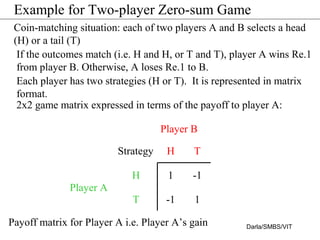
Coin-matching situation: each of two players A and B selects a head
(H) or a tail (T)
Each player has two strategies (H or T). It is represented in matrix
format.
If the outcomes match (i.e. H and H, or T and T), player A wins Re.1
from player B. Otherwise, A loses Re.1 to B.
Strategy H T
H 1 -1
T -1 1
Player B
Player A
2x2 game matrix expressed in terms of the payoff to player A:
Payoff matrix for Player A i.e. Player A’s gain Darla/SMBS/VIT
Objective of game theory
• A primary objective of game theory is the development of rational
criteria for selecting a strategy.
• Two key assumptions are:
1. Both players are rational
2. Both players choose their strategies solely to promote their own welfare
(no compassion for the opponent)
Darla/SMBS/VIT
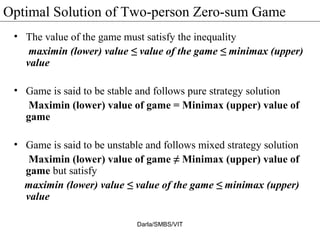
Optimal Solution of Two-person Zero-sum Game
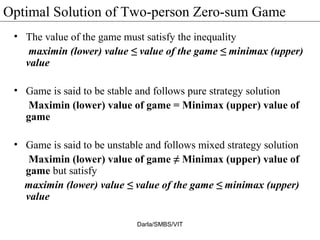
• The value of the game must satisfy the inequality
maximin (lower) value ≤ value of the game ≤ minimax (upper)
value
• Game is said to be stable and follows pure strategy solution
Maximin (lower) value of game = Minimax (upper) value of
game
• Game is said to be unstable and follows mixed strategy solution
Maximin (lower) value of game ≠ Minimax (upper) value of
game but satisfy
maximin (lower) value ≤ value of the game ≤ minimax (upper)
value
Darla/SMBS/VIT
Minimax-Maximin Criterion
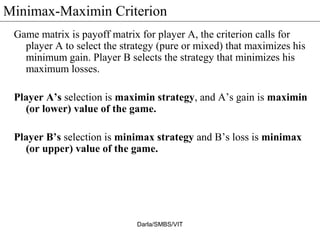
Game matrix is payoff matrix for player A, the criterion calls for
player A to select the strategy (pure or mixed) that maximizes his
minimum gain. Player B selects the strategy that minimizes his
maximum losses.
Player A’s selection is maximin strategy, and A’s gain is maximin
(or lower) value of the game.
Player B’s selection is minimax strategy and B’s loss is minimax
(or upper) value of the game.
Darla/SMBS/VIT
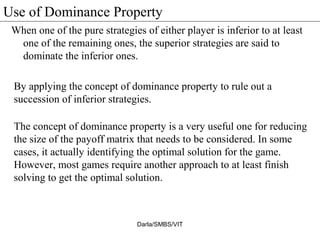
Use of Dominance Property
When one of the pure strategies of either player is inferior to at least
one of the remaining ones, the superior strategies are said to
dominate the inferior ones.
Darla/SMBS/VIT
By applying the concept of dominance property to rule out a
succession of inferior strategies.
The concept of dominance property is a very useful one for reducing
the size of the payoff matrix that needs to be considered. In some
cases, it actually identifying the optimal solution for the game.
However, most games require another approach to at least finish
solving to get the optimal solution.
Use of Dominance Property contd…
Strategy 1 2 3 4
1 -5 3 1 20
2 5 5 4 6
3 -4 -2 0 -5
Player B
Player A
Example problem
Darla/SMBS/VIT
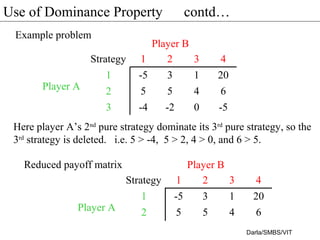
Here player A’s 2nd
pure strategy dominate its 3rd
pure strategy, so the
3rd
strategy is deleted. i.e. 5 > -4, 5 > 2, 4 > 0, and 6 > 5.
Strategy 1 2 3 4
1 -5 3 1 20
2 5 5 4 6
Player B
Player A
Reduced payoff matrix
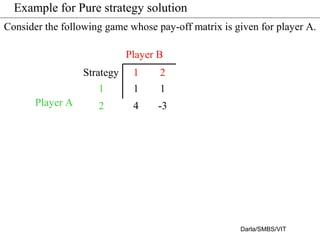
Example for Pure strategy solution
Consider the following game whose pay-off matrix is given for player A.
Strategy 1 2
1 1 1
2 4 -3
Player B
Player A
Darla/SMBS/VIT
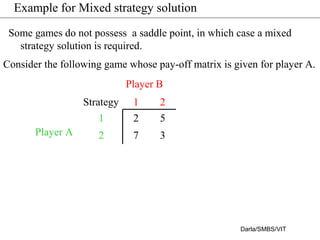
Example for Mixed strategy solution
Consider the following game whose pay-off matrix is given for player A.
Strategy 1 2
1 2 5
2 7 3
Player B
Player A
Darla/SMBS/VIT
Some games do not possess a saddle point, in which case a mixed
strategy solution is required.
Optimal Solution of Two-person Zero-sum Game
• The value of the game must satisfy the inequality
maximin (lower) value ≤ value of the game ≤ minimax (upper)
value
• Game is said to be stable and follows pure strategy solution
Maximin (lower) value of game = Minimax (upper) value of
game
• Game is said to be unstable and follows mixed strategy solution
Maximin (lower) value of game ≠ Minimax (upper) value of
game but satisfy
maximin (lower) value ≤ value of the game ≤ minimax (upper)
value
Darla/SMBS/VIT
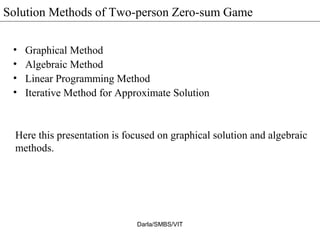
Solution Methods of Two-person Zero-sum Game
• Graphical Method
• Algebraic Method
• Linear Programming Method
• Iterative Method for Approximate Solution
Darla/SMBS/VIT
Here this presentation is focused on graphical solution and algebraic
methods.
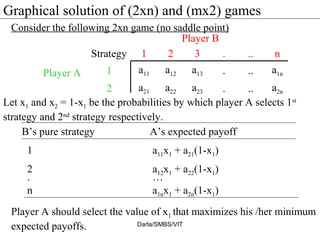
Graphical solution of (2xn) and (mx2) games
Strategy 1 2 3 . .. n
1 a11 a12 a13 . .. a1n
2 a21 a22 a23 . .. a2n
Player B
Player A
Consider the following 2xn game (no saddle point)
Let x1 and x2 = 1-x1 be the probabilities by which player A selects 1st
strategy and 2nd
strategy respectively.
B’s pure strategy A’s expected payoff
1 a11x1 + a21(1-x1)
2 a12x1 + a22(1-x1)
n a1nx1 + a2n(1-x1)
. …
Player A should select the value of x1 that maximizes his /her minimum
expected payoffs. Darla/SMBS/VIT
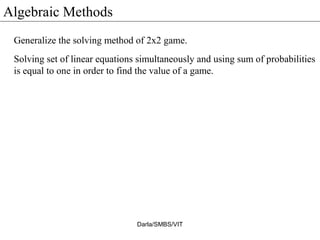
Algebraic Methods
Solving set of linear equations simultaneously and using sum of probabilities
is equal to one in order to find the value of a game.
Generalize the solving method of 2x2 game.
Darla/SMBS/VIT
Summery
 Two-player zero-sum games
 Pure strategy and mixed strategy optimal solutions
 Solution methods such as algebraic, dominance property and
graphical procedure
Darla/SMBS/VIT
thanK yoU
1. Operations Research: An Introduction, Hamdy A Taha, Prentice Hall
Reference

Game theory

  • 1.
    Prof. Siva PrasadDarla Asst.Professor (S.G.), SMBS, VIT University, Vellore-632014, India. www.vit.ac.in Contact: sivaprasaddarla@vit.ac.in Game Theory
  • 2.
    Outline for GameTheory  Introduction to Game Theory  Two-person zero-sum game  Maximin-Minimax Criterion  Solution Methods  Algebraic solution  Graphical solution Darla/SMBS/VIT
  • 3.
    Introduction • Partial orimperfect information about a problem – Decisions under risk – Decisions under uncertainty • Decisions under uncertainty: Several criteria exist in uncertainty situations. Ex. Laplace criterion, Minimax criterion • In decisions under uncertainty, competitive situations exist in which two (or more) opponents are working in conflict, with each opponent trying to gain at the expense of the other(s). Decision maker is working against an intelligent opponent. The theory governing these types of decision problems – theory of games. Ex. In a war, opposing armies represent intelligent opponents. Launching advertisement campaigns for competing products. Darla/SMBS/VIT
  • 4.
    Two-player Zero-sum Game Gametheory is a mathematical theory that deals with the general features of competitive situations. The basic elements are follows: Player: intelligent opponents playing the game Strategy: a simple action or a predetermined rule to possible circumstance Outcomes or Payoffs: a gain (positive or negative) for player Payoff matrix for the player: player’s gain is resulted from each combination of strategies for the two players. Two-person zero-sum game: a game with two players, where a gain of one player equals a loss to the other, so that the sum of their net winnings is zero. Games represent the ultimate case of lack of information in which intelligent opponents are working in a conflicting environment. Darla/SMBS/VIT
  • 5.
    Example for Two-playerZero-sum Game Coin-matching situation: each of two players A and B selects a head (H) or a tail (T) Each player has two strategies (H or T). It is represented in matrix format. If the outcomes match (i.e. H and H, or T and T), player A wins Re.1 from player B. Otherwise, A loses Re.1 to B. Strategy H T H 1 -1 T -1 1 Player B Player A 2x2 game matrix expressed in terms of the payoff to player A: Payoff matrix for Player A i.e. Player A’s gain Darla/SMBS/VIT
  • 6.
    Objective of gametheory • A primary objective of game theory is the development of rational criteria for selecting a strategy. • Two key assumptions are: 1. Both players are rational 2. Both players choose their strategies solely to promote their own welfare (no compassion for the opponent) Darla/SMBS/VIT
  • 7.
    Optimal Solution ofTwo-person Zero-sum Game • The value of the game must satisfy the inequality maximin (lower) value ≤ value of the game ≤ minimax (upper) value • Game is said to be stable and follows pure strategy solution Maximin (lower) value of game = Minimax (upper) value of game • Game is said to be unstable and follows mixed strategy solution Maximin (lower) value of game ≠ Minimax (upper) value of game but satisfy maximin (lower) value ≤ value of the game ≤ minimax (upper) value Darla/SMBS/VIT
  • 8.
    Minimax-Maximin Criterion Game matrixis payoff matrix for player A, the criterion calls for player A to select the strategy (pure or mixed) that maximizes his minimum gain. Player B selects the strategy that minimizes his maximum losses. Player A’s selection is maximin strategy, and A’s gain is maximin (or lower) value of the game. Player B’s selection is minimax strategy and B’s loss is minimax (or upper) value of the game. Darla/SMBS/VIT
  • 9.
    Use of DominanceProperty When one of the pure strategies of either player is inferior to at least one of the remaining ones, the superior strategies are said to dominate the inferior ones. Darla/SMBS/VIT By applying the concept of dominance property to rule out a succession of inferior strategies. The concept of dominance property is a very useful one for reducing the size of the payoff matrix that needs to be considered. In some cases, it actually identifying the optimal solution for the game. However, most games require another approach to at least finish solving to get the optimal solution.
  • 10.
    Use of DominanceProperty contd… Strategy 1 2 3 4 1 -5 3 1 20 2 5 5 4 6 3 -4 -2 0 -5 Player B Player A Example problem Darla/SMBS/VIT Here player A’s 2nd pure strategy dominate its 3rd pure strategy, so the 3rd strategy is deleted. i.e. 5 > -4, 5 > 2, 4 > 0, and 6 > 5. Strategy 1 2 3 4 1 -5 3 1 20 2 5 5 4 6 Player B Player A Reduced payoff matrix
  • 11.
    Example for Purestrategy solution Consider the following game whose pay-off matrix is given for player A. Strategy 1 2 1 1 1 2 4 -3 Player B Player A Darla/SMBS/VIT
  • 12.
    Example for Mixedstrategy solution Consider the following game whose pay-off matrix is given for player A. Strategy 1 2 1 2 5 2 7 3 Player B Player A Darla/SMBS/VIT Some games do not possess a saddle point, in which case a mixed strategy solution is required.
  • 13.
    Optimal Solution ofTwo-person Zero-sum Game • The value of the game must satisfy the inequality maximin (lower) value ≤ value of the game ≤ minimax (upper) value • Game is said to be stable and follows pure strategy solution Maximin (lower) value of game = Minimax (upper) value of game • Game is said to be unstable and follows mixed strategy solution Maximin (lower) value of game ≠ Minimax (upper) value of game but satisfy maximin (lower) value ≤ value of the game ≤ minimax (upper) value Darla/SMBS/VIT
  • 14.
    Solution Methods ofTwo-person Zero-sum Game • Graphical Method • Algebraic Method • Linear Programming Method • Iterative Method for Approximate Solution Darla/SMBS/VIT Here this presentation is focused on graphical solution and algebraic methods.
  • 15.
    Graphical solution of(2xn) and (mx2) games Strategy 1 2 3 . .. n 1 a11 a12 a13 . .. a1n 2 a21 a22 a23 . .. a2n Player B Player A Consider the following 2xn game (no saddle point) Let x1 and x2 = 1-x1 be the probabilities by which player A selects 1st strategy and 2nd strategy respectively. B’s pure strategy A’s expected payoff 1 a11x1 + a21(1-x1) 2 a12x1 + a22(1-x1) n a1nx1 + a2n(1-x1) . … Player A should select the value of x1 that maximizes his /her minimum expected payoffs. Darla/SMBS/VIT
  • 16.
    Algebraic Methods Solving setof linear equations simultaneously and using sum of probabilities is equal to one in order to find the value of a game. Generalize the solving method of 2x2 game. Darla/SMBS/VIT
  • 17.
    Summery  Two-player zero-sumgames  Pure strategy and mixed strategy optimal solutions  Solution methods such as algebraic, dominance property and graphical procedure Darla/SMBS/VIT thanK yoU 1. Operations Research: An Introduction, Hamdy A Taha, Prentice Hall Reference