Game Theory
TABLE OF CONTENTS
Definition of Game Theory
History, Brief Description and
Types
I
Information and Rationality
Pay off and Market Entry
III
Nash Equilibria
Types and Prisoner Dilemma
II
Bargaining
Bargaining Games and Nash
Bargaining
IV
Bidding and Values
V
Auctions
Game Theory - Study of strategically interdependent
decision-making, where several players must affect the
interest of other players in a game
 Why do competitors stay close to each other?
 More nuclear weapons in the Cold War or less ?
 Rock, Paper, Scissors, Which do you choose?
 Can some games be solved ? (Tic Tac Toe, Chess, Go)
What actually “The Game” is …
Interaction between players
 Game – Formal description of a strategic situation
 Player – agent to make decision
 Pay-off – utility and desirability of an outcome
 Strategy – possible plan or actions to follow
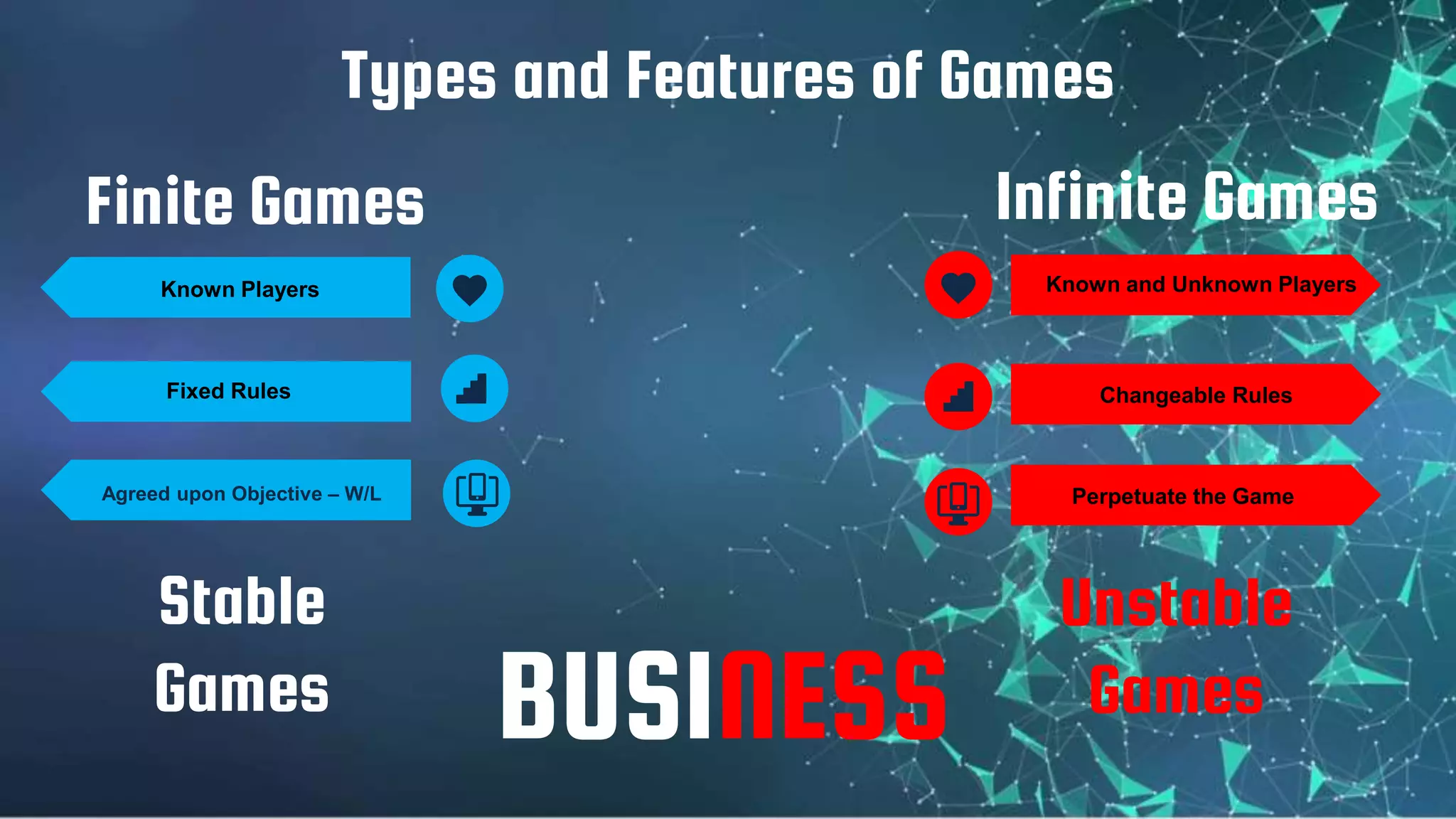
Agreed upon Objective – W/L
Known and Unknown Players
Changeable Rules
Perpetuate the Game
Types and Features of Games
Known Players
Fixed Rules
Finite Games Infinite Games
Stable
Games
Unstable
GamesBUSINESS
Complete information: firms know all strategies and profits.
Information and Rationality
Incomplete information
Private information
High transaction costs
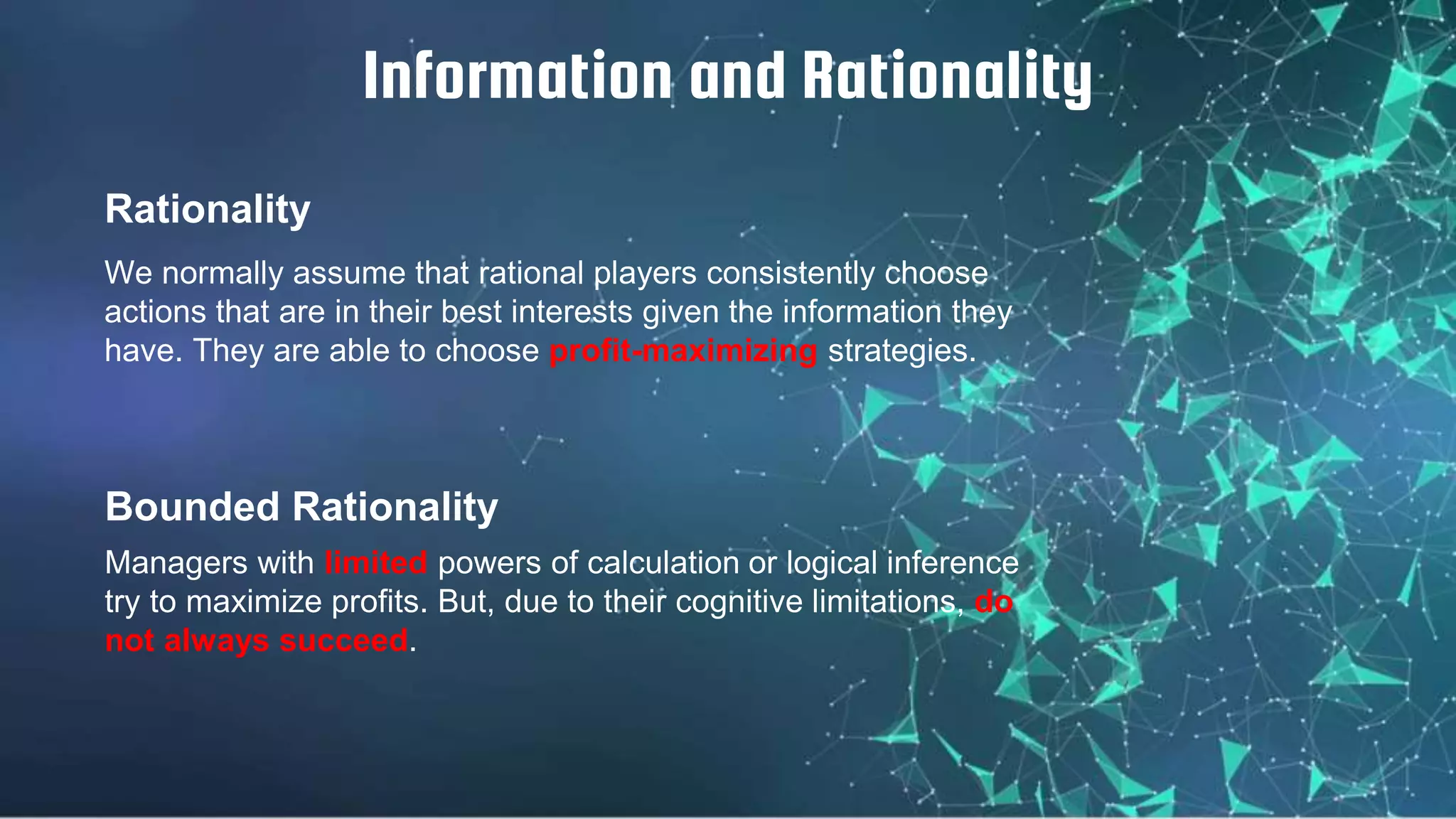
Rationality
We normally assume that rational players consistently choose
actions that are in their best interests given the information they
have. They are able to choose profit-maximizing strategies.
Information and Rationality
Bounded Rationality
Managers with limited powers of calculation or logical inference
try to maximize profits. But, due to their cognitive limitations, do
not always succeed.
Example
Information and Rationality
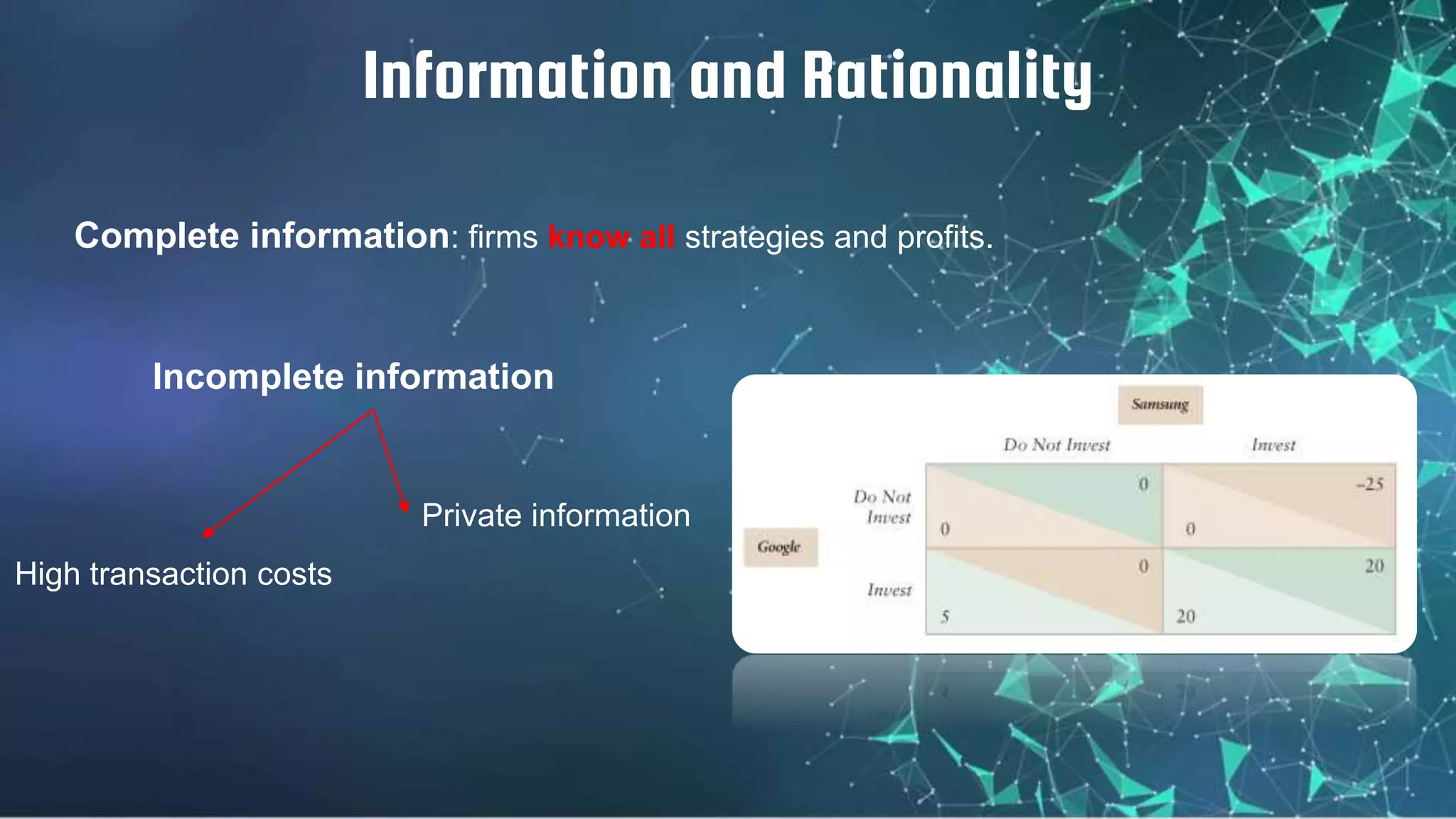
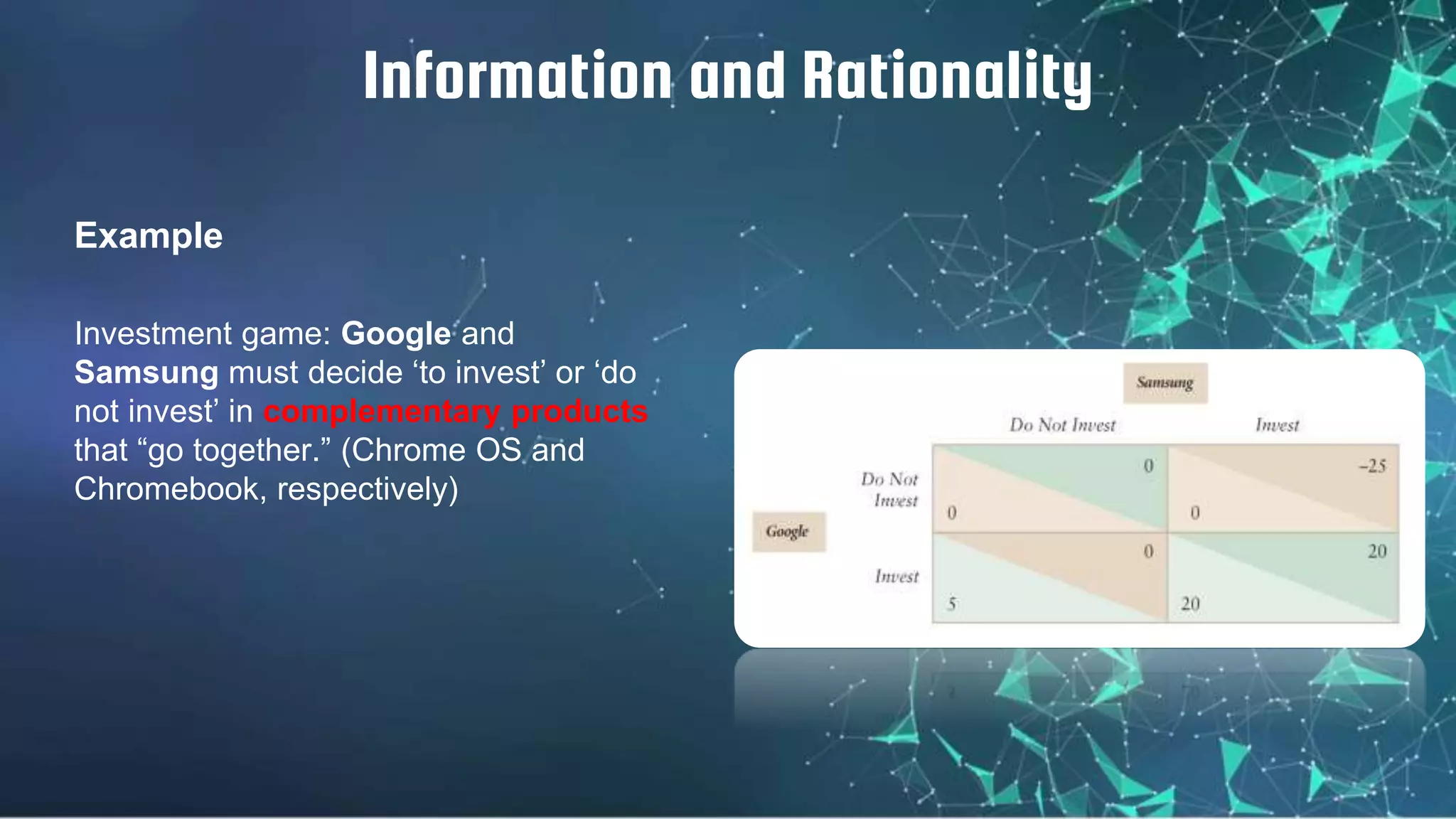
Investment game: Google and
Samsung must decide ‘to invest’ or ‘do
not invest’ in complementary products
that “go together.” (Chrome OS and
Chromebook, respectively)
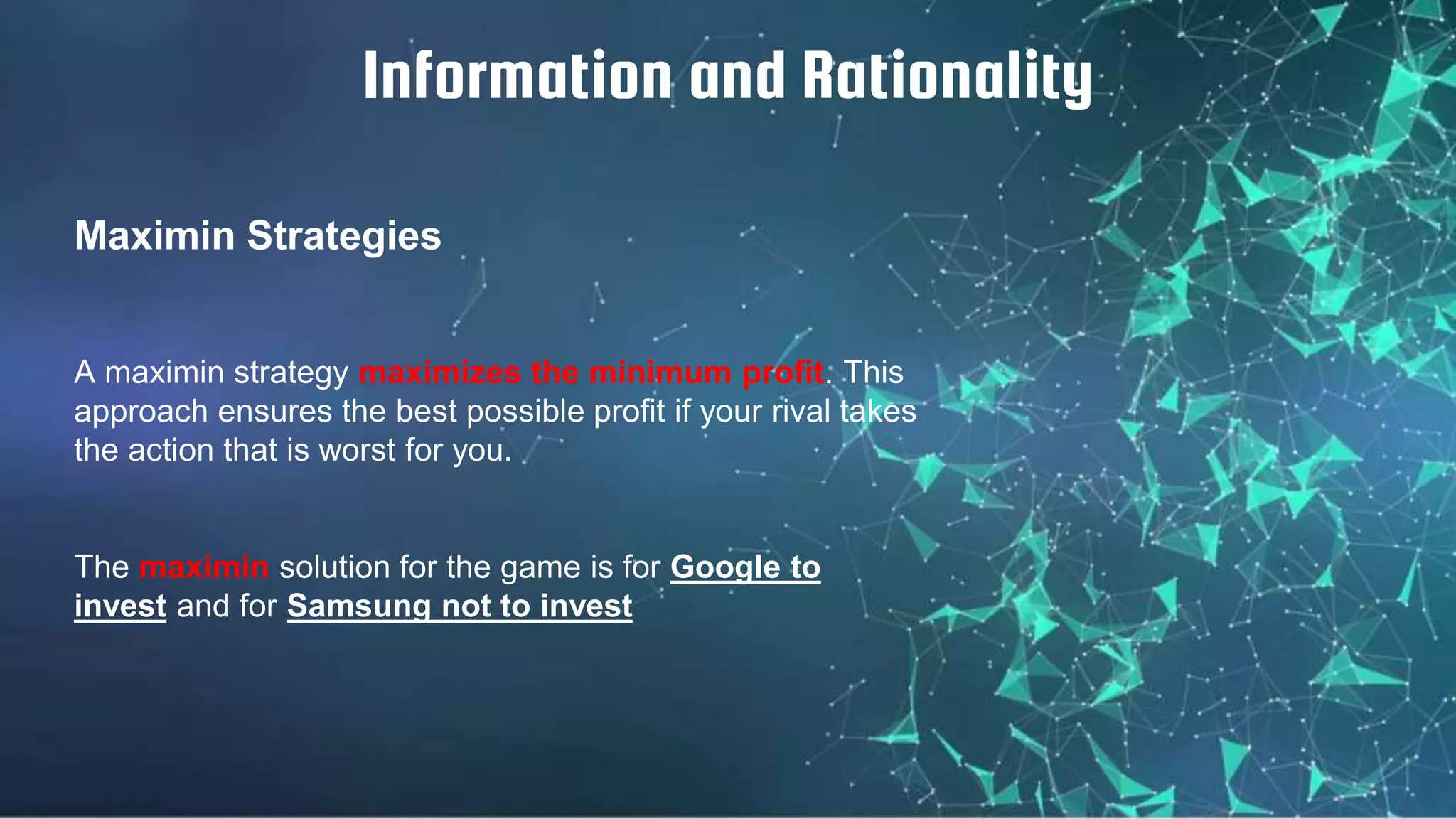
Maximin Strategies
Information and Rationality
A maximin strategy maximizes the minimum profit. This
approach ensures the best possible profit if your rival takes
the action that is worst for you.
The maximin solution for the game is for Google to
invest and for Samsung not to invest
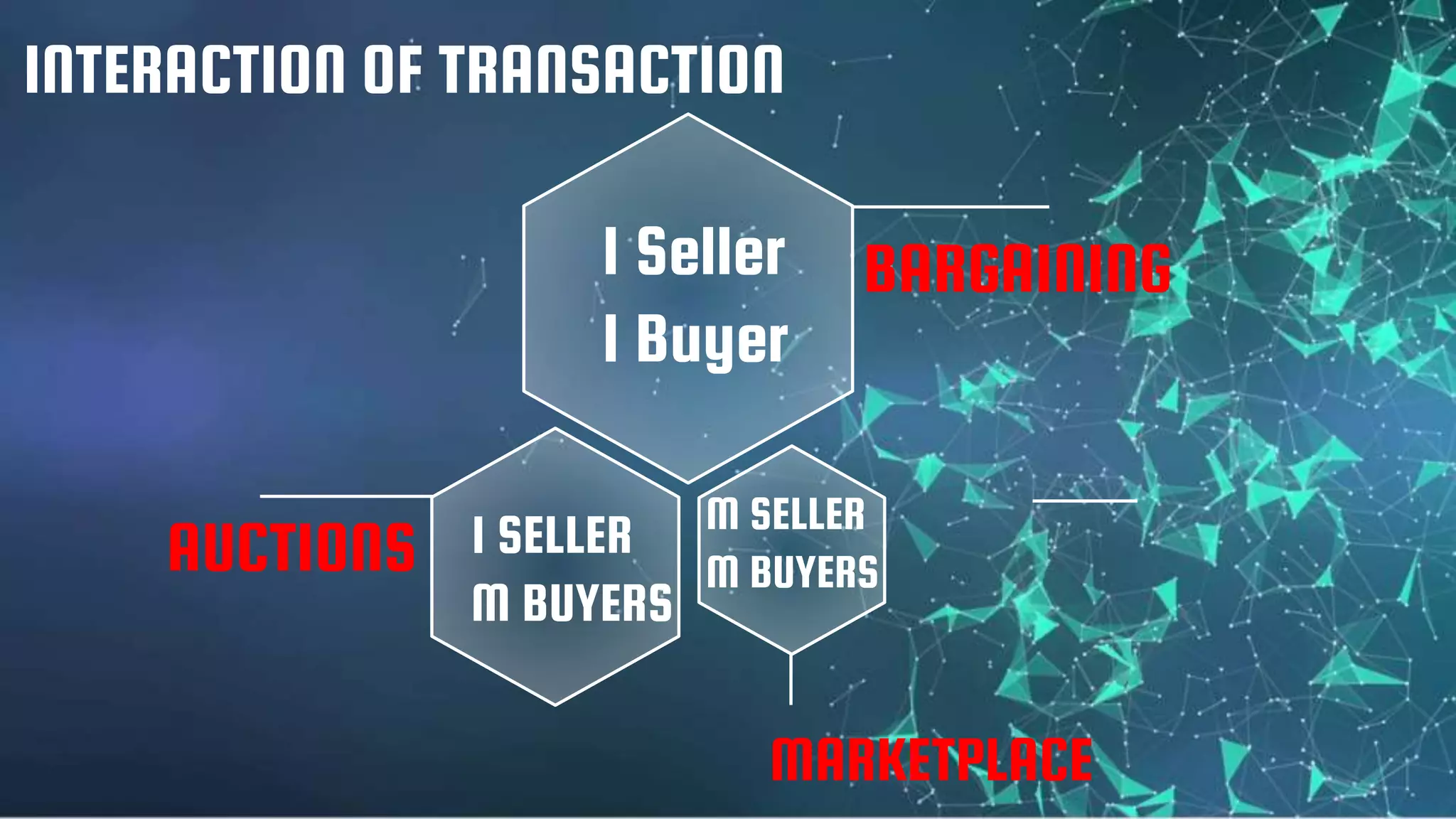
INTERACTION OF TRANSACTION
M SELLER
M BUYERS
1 SELLER
M BUYERS
1 Seller
1 Buyer
BARGAINING
AUCTIONS
MARKETPLACE
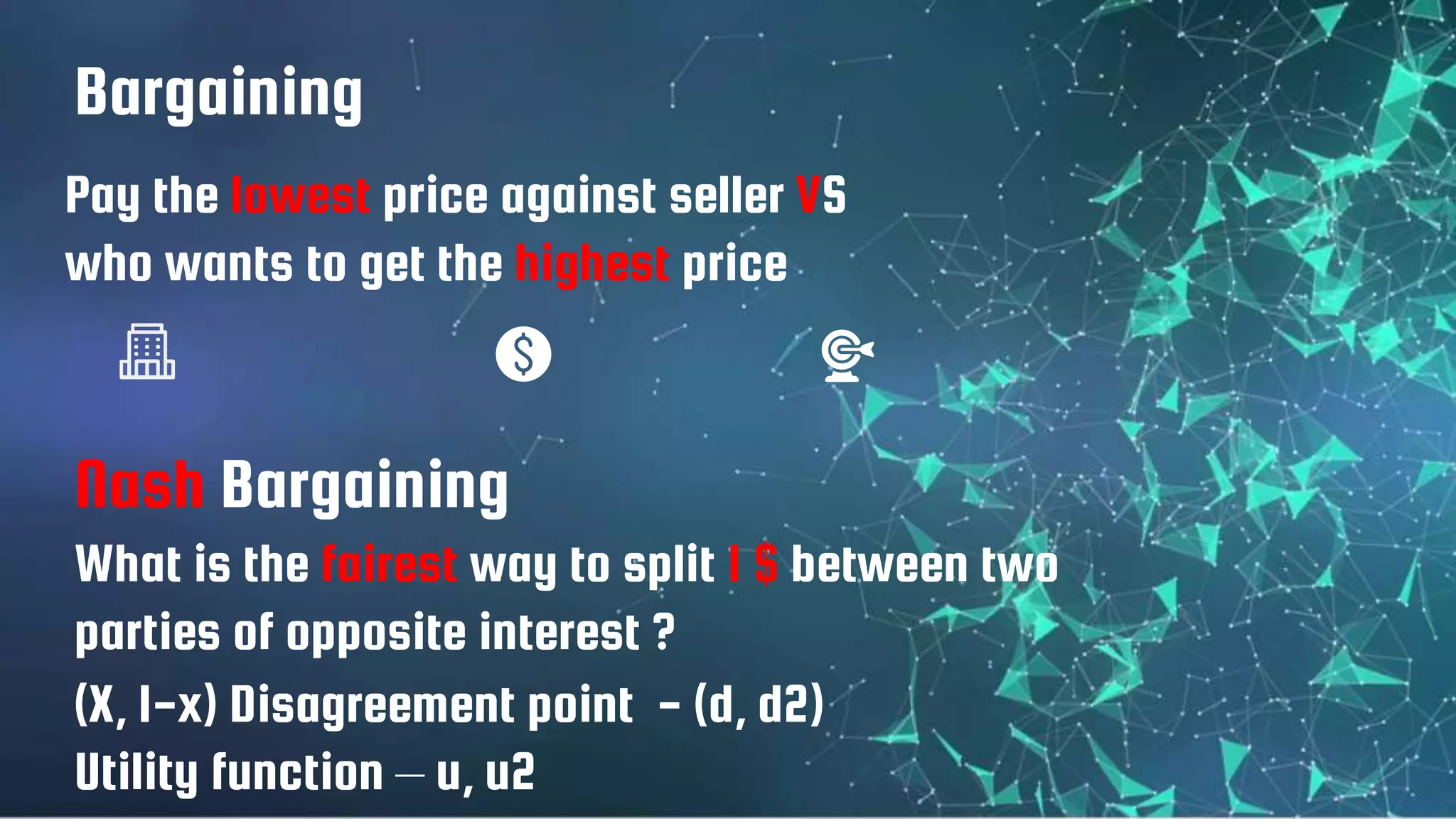
Bargaining
What is the fairest way to split 1 $ between two
parties of opposite interest ?
Pay the lowest price against seller VS
who wants to get the highest price
Nash Bargaining
(X, 1-x) Disagreement point - (d, d2)
Utility function – u, u2
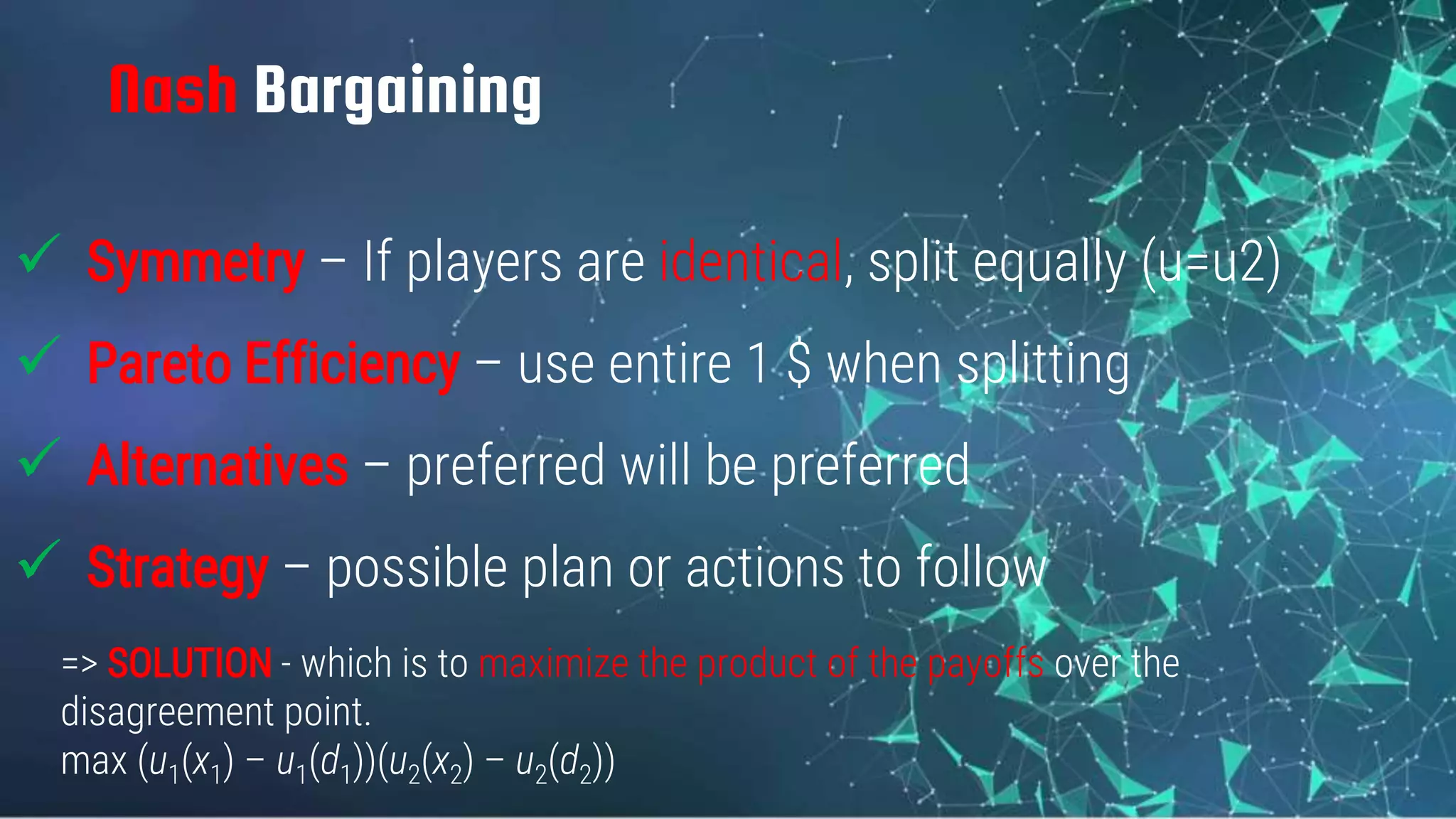
Nash Bargaining
 Symmetry – If players are identical, split equally (u=u2)
 Pareto Efficiency – use entire 1 $ when splitting
 Alternatives – preferred will be preferred
 Strategy – possible plan or actions to follow
=> SOLUTION - which is to maximize the product of the payoffs over the
disagreement point.
max (u1(x1) – u1(d1))(u2(x2) – u2(d2))
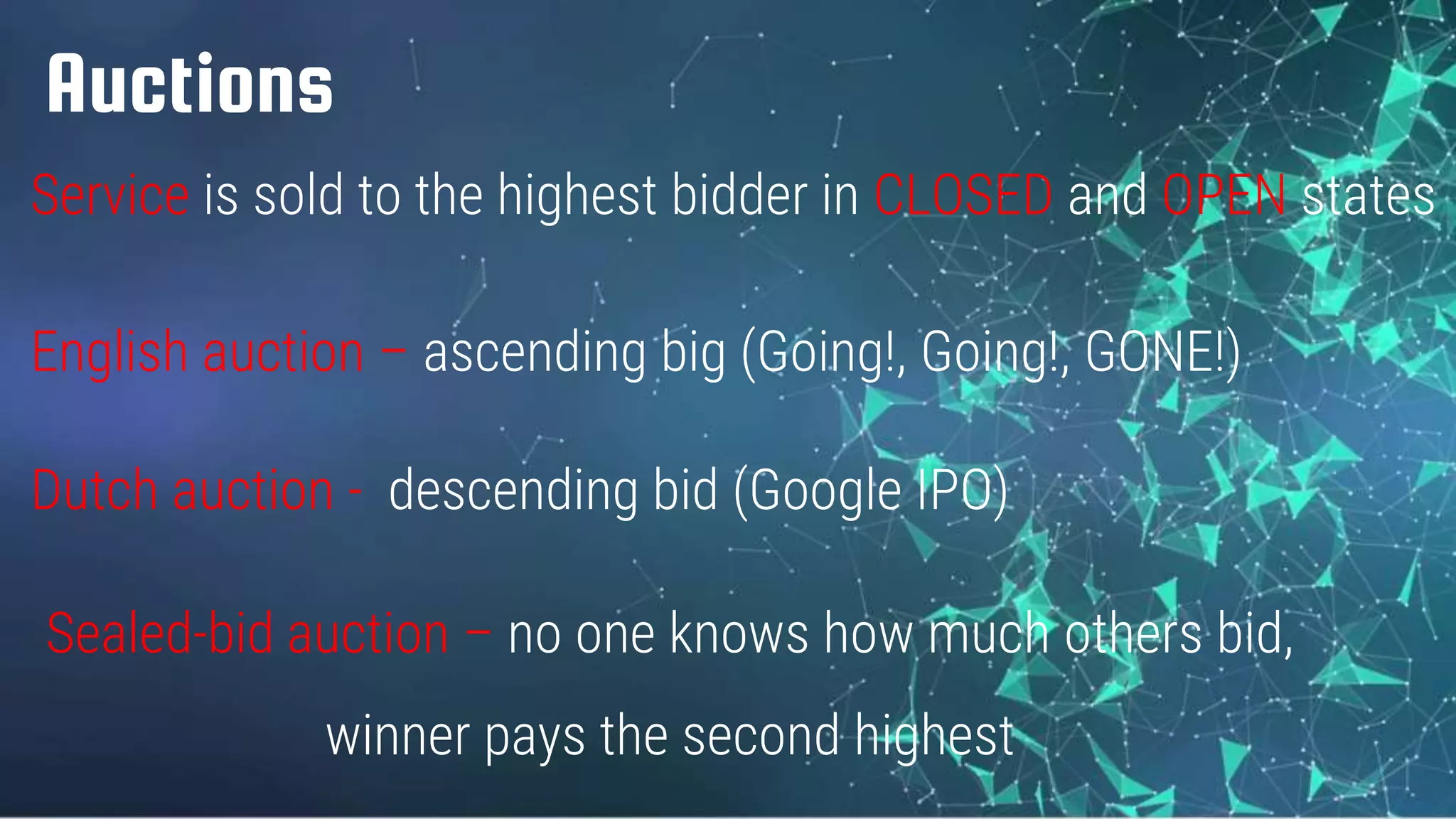
Auctions
Service is sold to the highest bidder in CLOSED and OPEN states
English auction – ascending big (Going!, Going!, GONE!)
Dutch auction - descending bid (Google IPO)
Sealed-bid auction – no one knows how much others bid,
winner pays the second highest
THE TEAM
TURAL SADIGOV TURAL AHMADOV
OPERATIONAL LEADER
CONTACTS:
+99450 996 88 91
ELVIN AGHAMMAD
TEAM LEADER
THE VISIONARY
PRODUCT WIZARD,
TECHLEAD
THANKS

Game theory in Economics

  • 1.
  • 2.
    TABLE OF CONTENTS Definitionof Game Theory History, Brief Description and Types I Information and Rationality Pay off and Market Entry III Nash Equilibria Types and Prisoner Dilemma II Bargaining Bargaining Games and Nash Bargaining IV Bidding and Values V Auctions
  • 3.
    Game Theory -Study of strategically interdependent decision-making, where several players must affect the interest of other players in a game  Why do competitors stay close to each other?  More nuclear weapons in the Cold War or less ?  Rock, Paper, Scissors, Which do you choose?  Can some games be solved ? (Tic Tac Toe, Chess, Go)
  • 4.
    What actually “TheGame” is … Interaction between players  Game – Formal description of a strategic situation  Player – agent to make decision  Pay-off – utility and desirability of an outcome  Strategy – possible plan or actions to follow
  • 5.
    Agreed upon Objective– W/L Known and Unknown Players Changeable Rules Perpetuate the Game Types and Features of Games Known Players Fixed Rules Finite Games Infinite Games Stable Games Unstable GamesBUSINESS
  • 6.
    Complete information: firmsknow all strategies and profits. Information and Rationality Incomplete information Private information High transaction costs
  • 7.
    Rationality We normally assumethat rational players consistently choose actions that are in their best interests given the information they have. They are able to choose profit-maximizing strategies. Information and Rationality Bounded Rationality Managers with limited powers of calculation or logical inference try to maximize profits. But, due to their cognitive limitations, do not always succeed.
  • 8.
    Example Information and Rationality Investmentgame: Google and Samsung must decide ‘to invest’ or ‘do not invest’ in complementary products that “go together.” (Chrome OS and Chromebook, respectively)
  • 9.
    Maximin Strategies Information andRationality A maximin strategy maximizes the minimum profit. This approach ensures the best possible profit if your rival takes the action that is worst for you. The maximin solution for the game is for Google to invest and for Samsung not to invest
  • 10.
    INTERACTION OF TRANSACTION MSELLER M BUYERS 1 SELLER M BUYERS 1 Seller 1 Buyer BARGAINING AUCTIONS MARKETPLACE
  • 11.
    Bargaining What is thefairest way to split 1 $ between two parties of opposite interest ? Pay the lowest price against seller VS who wants to get the highest price Nash Bargaining (X, 1-x) Disagreement point - (d, d2) Utility function – u, u2
  • 12.
    Nash Bargaining  Symmetry– If players are identical, split equally (u=u2)  Pareto Efficiency – use entire 1 $ when splitting  Alternatives – preferred will be preferred  Strategy – possible plan or actions to follow => SOLUTION - which is to maximize the product of the payoffs over the disagreement point. max (u1(x1) – u1(d1))(u2(x2) – u2(d2))
  • 13.
    Auctions Service is soldto the highest bidder in CLOSED and OPEN states English auction – ascending big (Going!, Going!, GONE!) Dutch auction - descending bid (Google IPO) Sealed-bid auction – no one knows how much others bid, winner pays the second highest
  • 14.
    THE TEAM TURAL SADIGOVTURAL AHMADOV OPERATIONAL LEADER CONTACTS: +99450 996 88 91 ELVIN AGHAMMAD TEAM LEADER THE VISIONARY PRODUCT WIZARD, TECHLEAD
  • 15.

Editor's Notes

  • #4 Interdependence means - what I do to affect your outcomes, what u do to affect mine History – 1940s Jon Nash, 1960 70 Politics and Econ
  • #6 Pit finite with finite Infinite vs infinite Let’s know the game to win – next…. Finite to infinite
  • #13 2. Solution without usin all is inefficient 3. Prefreed in small set or large set is preferred restaurant example
  • #14 Common and private values for ex : art )