
Introduction to Game Theory and its Applications in Computer Networks John C.S. Lui Dept. of Computer Science & Engineering The Chinese University of Hong Kong Daniel R. Figueiredo School of Computer and Communication Sciences  Swiss Federal Institute of Technology – Lausanne (EPFL) ACM SIGMETRICS / IFIP Performance June 2006
Tutorial Organization Two parts of 90 minutes 15 minutes coffee break in between First part: introduction to game theory definitions, important results, (simple) examples divided in two 45 minutes sessions (Daniel + John) Second part: game theory and networking game-theoretic formulation of networking problems 1 st  45 minute session (Daniel) routing games and congestion control games 2 nd  45 minute session (John) overlay games and wireless games
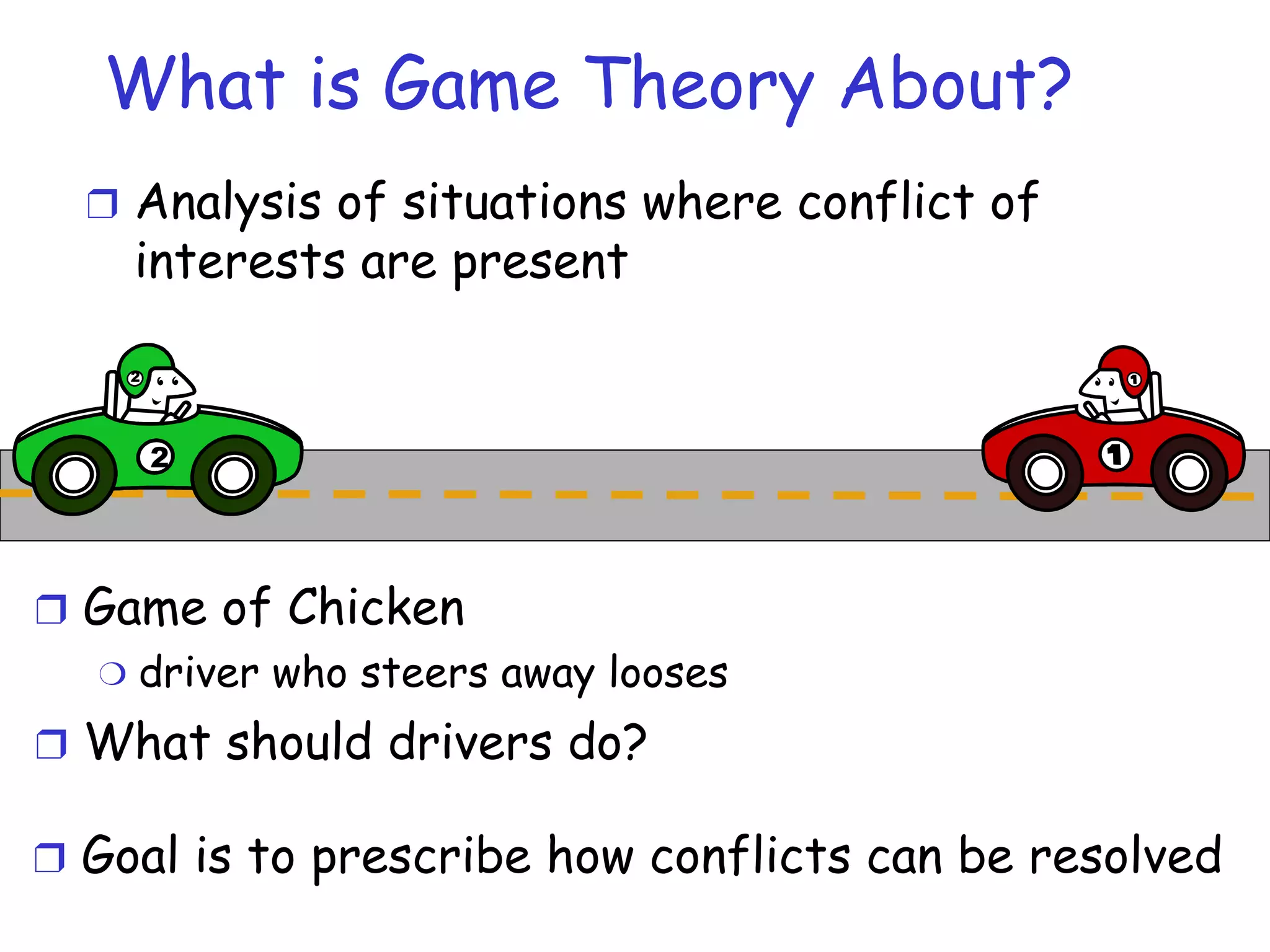
What is Game Theory About? Analysis of situations where conflict of interests are present Goal is to prescribe how conflicts can be resolved Game of Chicken driver who steers away looses What should drivers do? 2 2
Applications of Game Theory Theory developed mainly by mathematicians and economists contributions from biologists Widely applied in many disciplines from economics to philosophy, including computer science (Systems, Theory and AI) goal is often to understand some phenomena “ Recently” applied to computer networks Nagle, RFC 970, 1985 “ datagram networks as a multi-player game” paper in first volume of IEEE/ACM ToN (1993) wider interest starting around 2000
Limitations of Game Theory No unified solution to general conflict resolution Real-world conflicts are complex models can at best capture important aspects Players are (usually) considered rational determine what is best for them given that others are doing the same  No unique prescription not clear what players should do But it can provide intuitions, suggestions and partial prescriptions best mathematical tool we currently have
What is a Game? A Game consists of at least two players  a set of strategies for each player a preference relation over possible outcomes Player is general entity individual, company, nation, protocol, animal, etc Strategies actions which a player chooses to follow Outcome determined by mutual choice of strategies Preference relation modeled as utility (payoff) over set of outcomes
Classification of Games Many, many types of games three major categories Non-Cooperative (Competitive) Games individualized play, no bindings among players Repeated and Evolutionary Games dynamic scenario Cooperative Games play as a group, possible bindings
Matrix Game (Normal form) Simultaneous play players analyze the game and write their strategy on a paper Combination of strategies determines payoff Player 1 Player 2 Strategy set  for Player 1 Strategy set  for Player 2 Payoff to Player 1 Payoff to Player 2 Representation of a game (3, 4) (0, 0) B (3, -1) (-5, 1) B (-2, -1) (2, 2) A C A
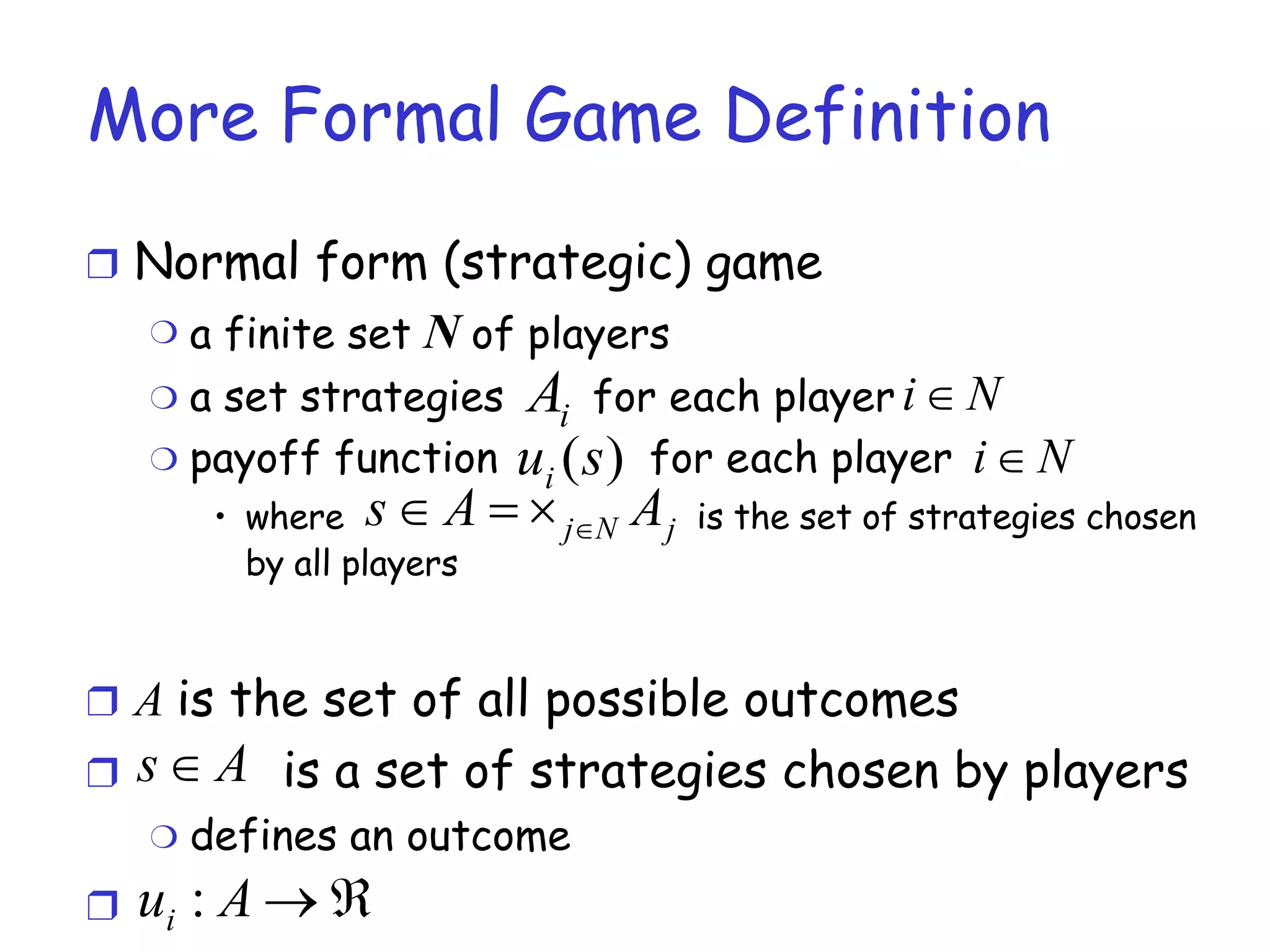
More Formal Game Definition Normal form (strategic) game a finite set  N  of players a set strategies  for each player  payoff function  for each player  where  is the set of strategies chosen by all players A  is the set of all possible outcomes is a set of strategies chosen by players defines an outcome
Two-person Zero-sum Games One of the first games studied most well understood type of game Players interest are strictly opposed what one player gains the other loses game matrix has single entry (gain to player 1) Intuitive solution concept players maximize gains unique solution
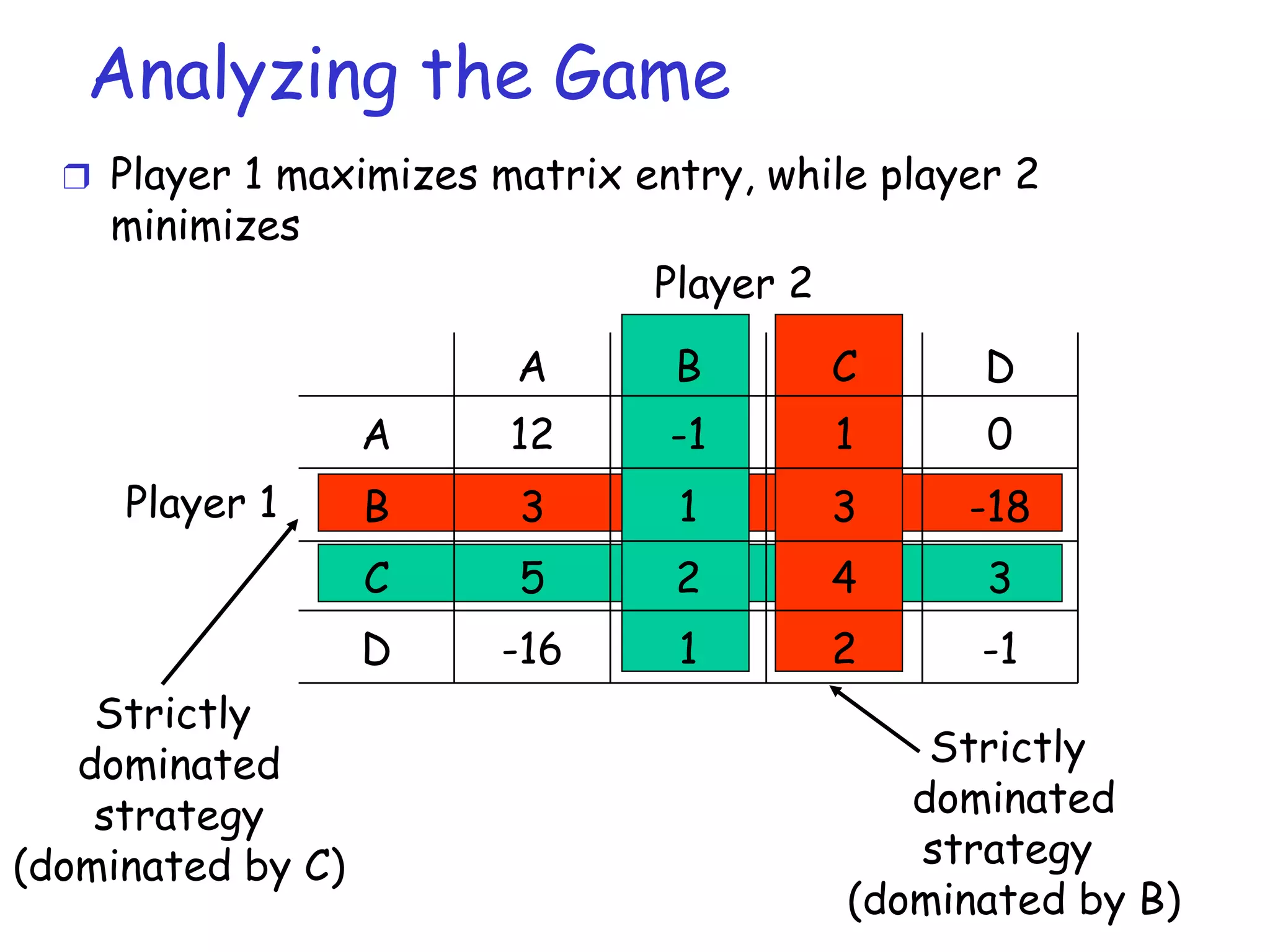
Analyzing the Game Player 1 maximizes matrix entry, while player 2 minimizes Player 1 Player 2 Strictly  dominated strategy (dominated by C) Strictly  dominated strategy  (dominated by B) -1 2 1 -16 D 3 4 2 5 C -18 3 1 3 B 0 1 -1 12 A D C B A
Dominance Strategy S  strictly dominates  a strategy T if every possible outcome when S is chosen is better than the corresponding outcome when T is chosen Dominance Principle rational players never choose strictly dominated strategies Idea:  Solve the game by eliminating strictly dominated strategies! iterated removal
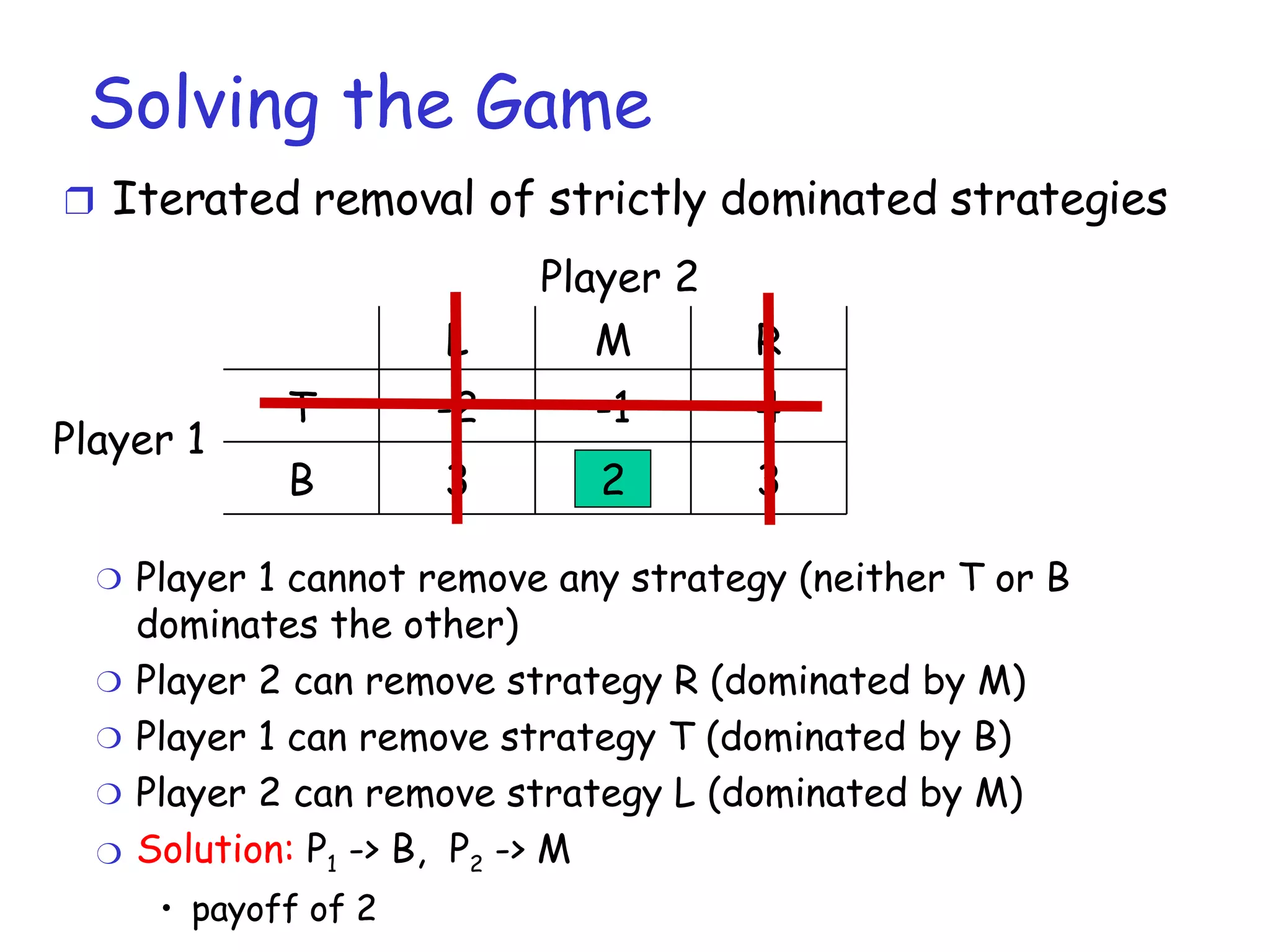
Solving the Game Player 1 Player 2 Iterated removal of strictly dominated strategies Player 1 cannot remove any strategy (neither T or B dominates the other) Player 2 can remove strategy R (dominated by M)  Player 1 can remove strategy T (dominated by B) Player 2 can remove strategy L (dominated by M) Solution:  P 1  -> B,  P 2  -> M payoff of 2 3 2 3 B 4 -1 -2 T R M L
Solving the Game Player 1 Player 2 Removal of strictly dominates strategies does not always work Consider the game Neither player has dominated strategies Requires another solution concept -1 0 -16 D 3 2 5 C 0 -1 12 A D B A
Analyzing the Game Player 1 Player 2 Outcome (C, B) seems “stable” saddle point of game -1 0 -16 D 3 2 5 C 0 -1 12 A D B A
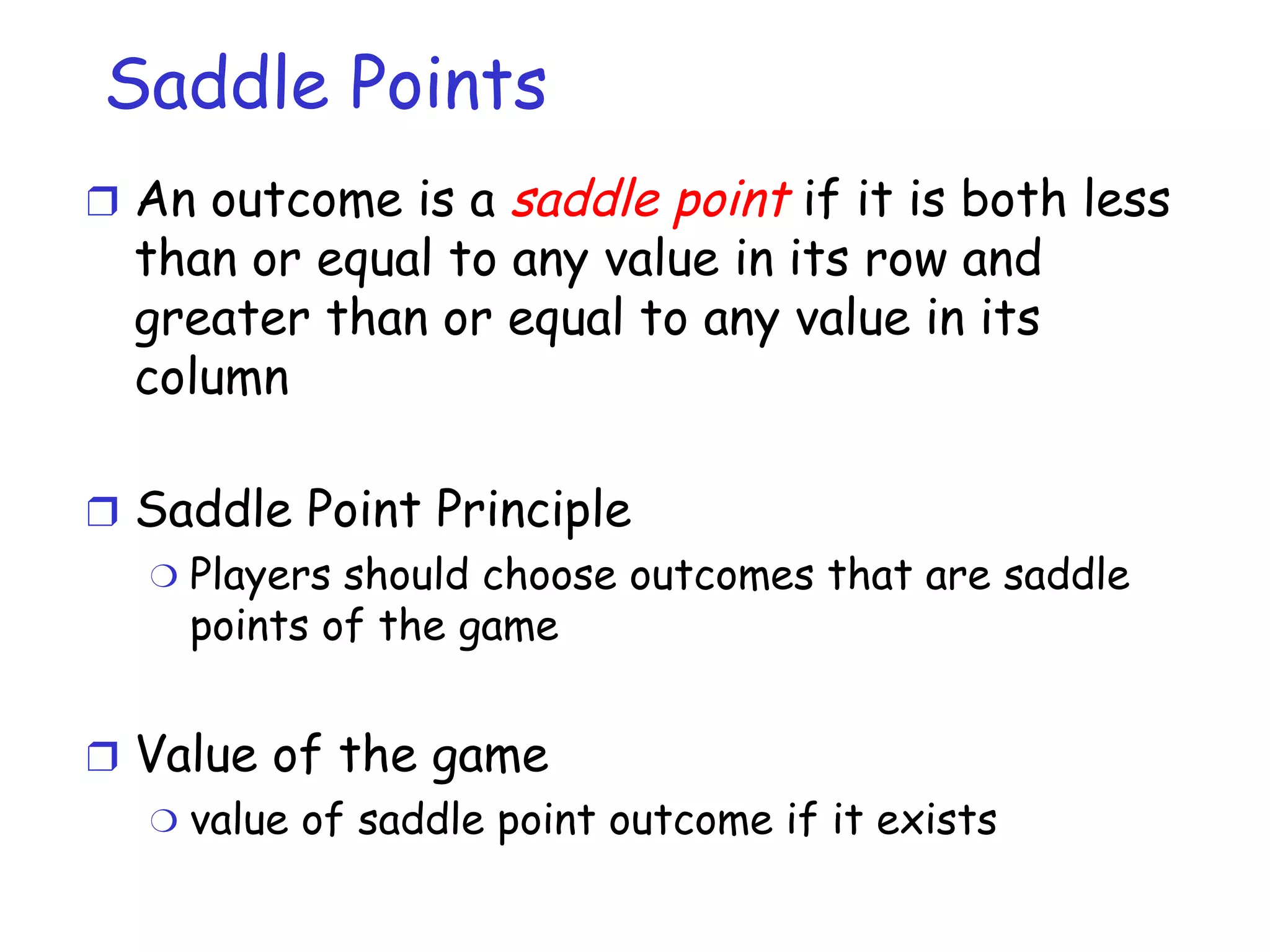
Saddle Points An outcome is a  saddle point  if it is both less than or equal to any value in its row and greater than or equal to any value in its column Saddle Point Principle Players should choose outcomes that are saddle points of the game Value of the game value of saddle point outcome if it exists
Why Play Saddle Points? If player 1 believes player 2 will play B player 1 should play best response to B (which is C) If player 2 believes player 1 will play C player 2 should play best response to C (which is B) Player 1 Player 2 -1 0 -16 D 3 2 5 C 0 -1 12 A D B A
Why Play Saddle Points? Why should player 1 believe player 2 will play B? playing B guarantees player 2  loses at most v  (which is 2) Why should player 2 believe player 1 will play C? playing C guarantees player 1  wins at least v  (which is 2) Player 1 Player 2 -1 0 -16 D 3 2 5 C 0 -1 12 A D B A Powerful arguments to play saddle point!
Solving the Game (min-max algorithm) choose minimum entry in each row choose the maximum among these this is maximin value Player 1 Player 2 choose maximum entry in each column choose the minimum among these this is the minimax value if minimax == maximin, then this is the saddle point of game -5 -4 8 0 D 3 1 5 7 C -1 0 2 -10 B 5 2 3 4 A D C B A -5 1 -10 2 5 2 8 7
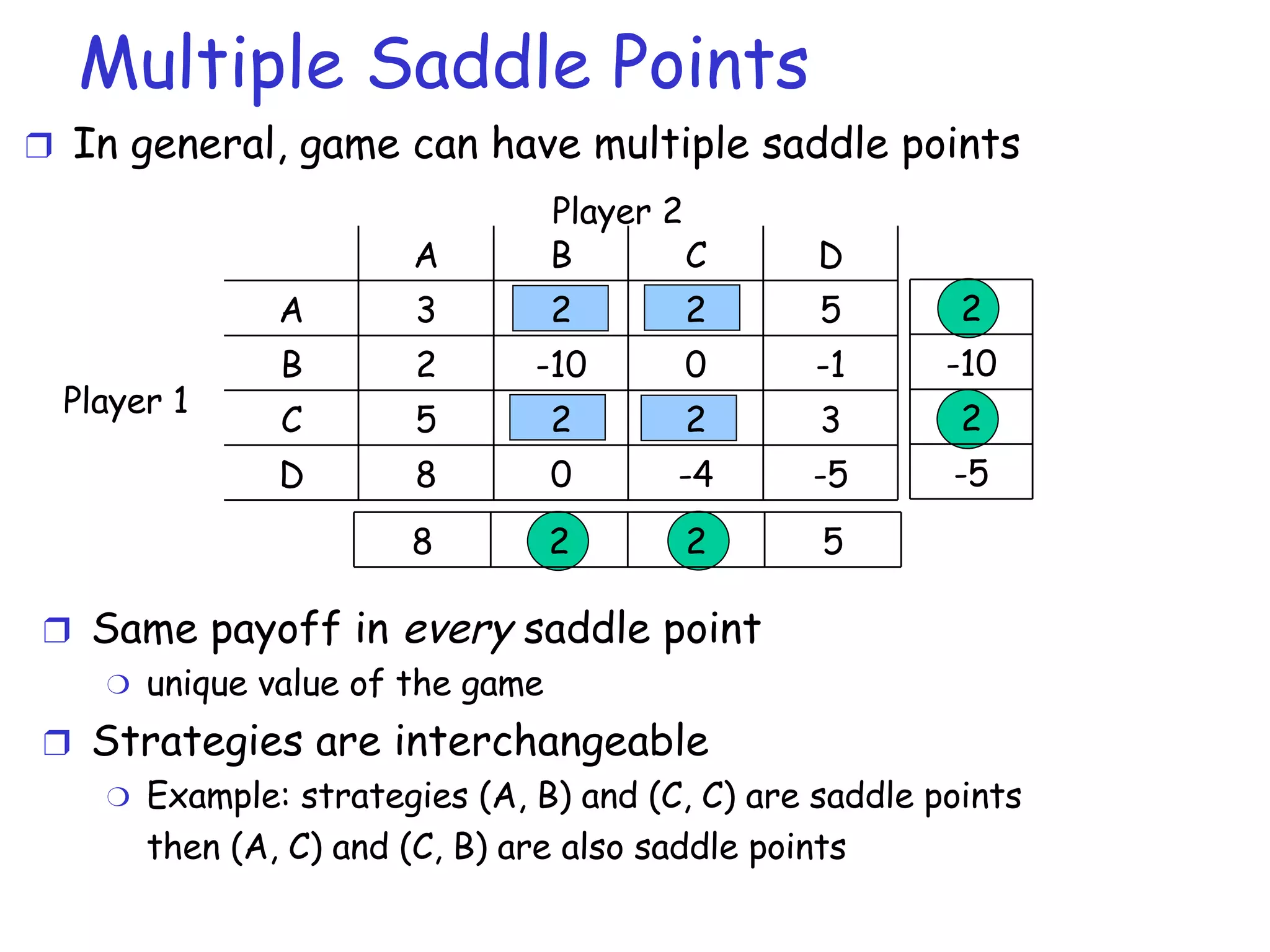
Multiple Saddle Points Player 1 Player 2 In general, game can have multiple saddle points Same payoff in  every  saddle point unique value of the game Strategies are interchangeable Example: strategies (A, B) and (C, C) are saddle points then (A, C) and (C, B) are also saddle points -5 -4 0 8 D 3 2 2 5 C -1 0 -10 2 B 5 2 2 3 A D C B A -5 2 -10 2 5 2 2 8
Games With no Saddle Points What should players do? resort to randomness to select strategies Player 1 Player 2 3 0 B 1 -5 B -1 2 A C A
Mixed Strategies Each player associates a probability distribution over its set of strategies players decide on which prob. distribution to use Payoffs are computed as expectations Player 1 Payoff to P1 when playing A = 1/3(4) + 2/3(0) = 4/3 Payoff to P1 when playing B = 1/3(-5) + 2/3(3) = 1/3 How should players choose prob. distribution? 3 0 D -5 B 4 A C 2/3 1/3
Mixed Strategies Idea:  use a prob. distribution that cannot be exploited by other player payoff should be equal independent of the choice of strategy of other player guarantees minimum gain (maximum loss) Player 1 Payoff to P1 when playing A = x(4) + (1-x)(0) = 4x Payoff to P1 when playing B = x(-5) + (1-x)(3) = 3 – 8x 4x = 3 – 8x, thus x = 1/4 How should Player 2 play? 3 0 D -5 B 4 A C (1-x) x
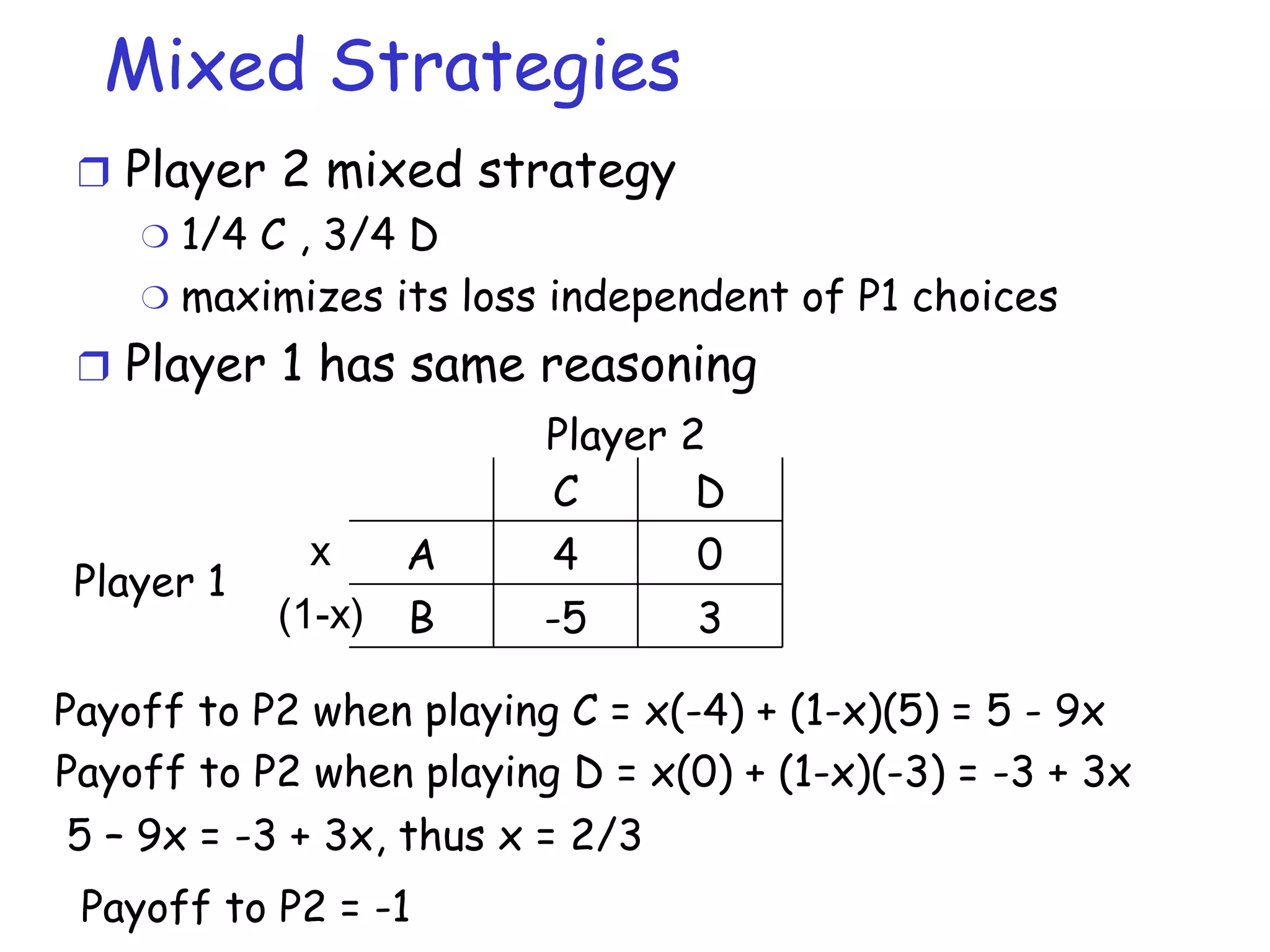
Mixed Strategies Player 2 mixed strategy 1/4 C , 3/4 D maximizes its loss independent of P1 choices Player 1 has same reasoning Player 1 Payoff to P2 when playing C = x(-4) + (1-x)(5) = 5 - 9x Payoff to P2 when playing D = x(0) + (1-x)(-3) = -3 + 3x 5 – 9x = -3 + 3x, thus x = 2/3 Player 2 Payoff to P2 = -1 3 0 D -5 B 4 A C (1-x) x
Minimax Theorem Every two-person zero-sum game has a solution in mixed (and sometimes pure) strategies solution payoff is the value of the game maximin = v = minimax v is unique multiple equilibrium in pure strategies possible but fully interchangeable Proved by John von Neumann in 1928! birth of game theory…
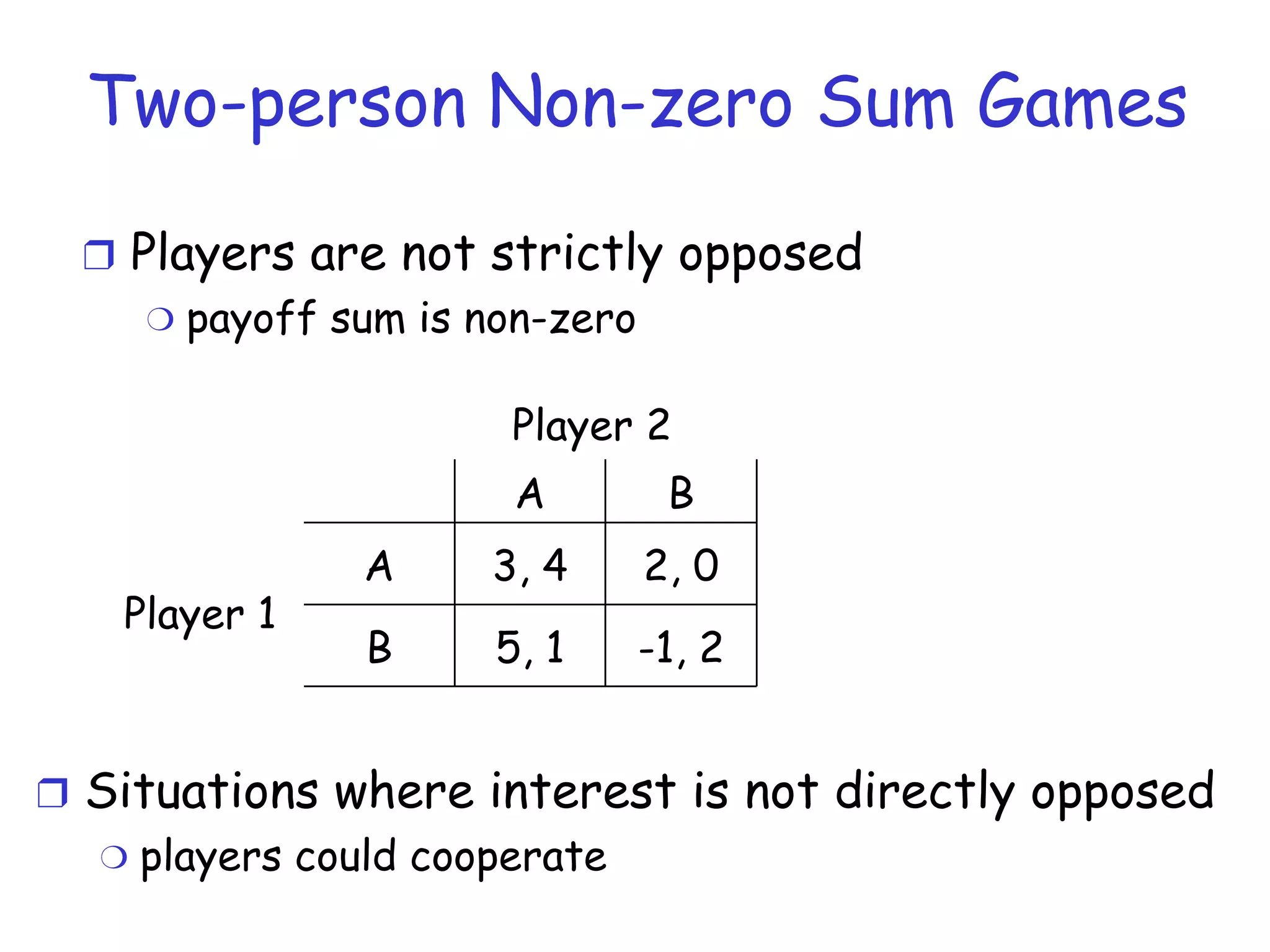
Two-person Non-zero Sum Games Players are not strictly opposed payoff sum is non-zero Player 1 Player 2 Situations where interest is not directly opposed players could cooperate -1, 2 2, 0 B 5, 1 B 3, 4 A A
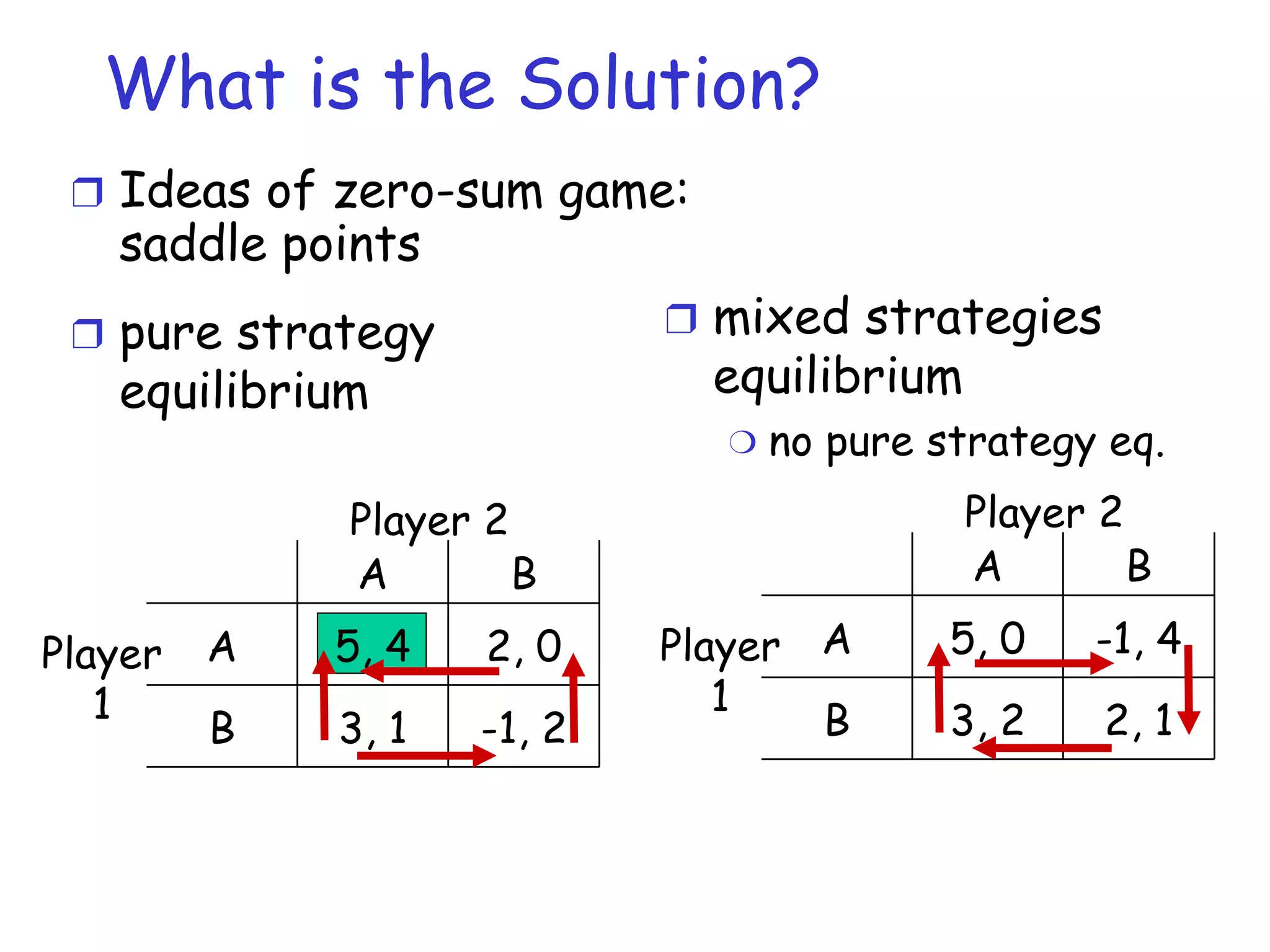
What is the Solution? Ideas of zero-sum game: saddle points pure strategy equilibrium mixed strategies equilibrium no pure strategy eq. Player 1 Player 2 Player 1 Player 2 2, 1 -1, 4 B 3, 2 B 5, 0 A A -1, 2 2, 0 B 3, 1 B 5, 4 A A
Multiple Solution Problem Games can have multiple equilibria not equivalent: payoff is different not interchangeable: playing an equilibrium strategy does not lead to equilibrium Player 1 Player 2 equilibria 2, 2 1, 1 B 0, 1 B 1, 4 A A
The Good News: Nash’s Theorem Every two person game has  at least one  equilibrium in either pure or mixed strategies Proved by Nash in 1950 using fixed point theorem generalized to N person game did not “invent” this equilibrium concept Def: An outcome o* of a game is a NEP (Nash equilibrium point) if no player can unilaterally change its strategy and increase its payoff Cor: any saddle point is also a NEP
The Prisoner’s Dilemma One of the most studied and used games proposed in 1950s Two suspects arrested for joint crime each suspect when interrogated separately, has option to confess or remain silent Suspect 1 Suspect 2 payoff is years in jail ( smaller is better ) single NEP better  outcome 5, 5 10, 1 C 1, 10 C 2, 2 S S
Pareto Optimal Prisoner’s dilemma: individual rationality Suspect 1 Suspect 2 Another type of solution: group rationality Pareto optimal Def: outcome o* is Pareto Optimal if no other outcome is better for  all  players Pareto Optimal 5, 5 10, 1 C 1, 10 C 2, 2 S S
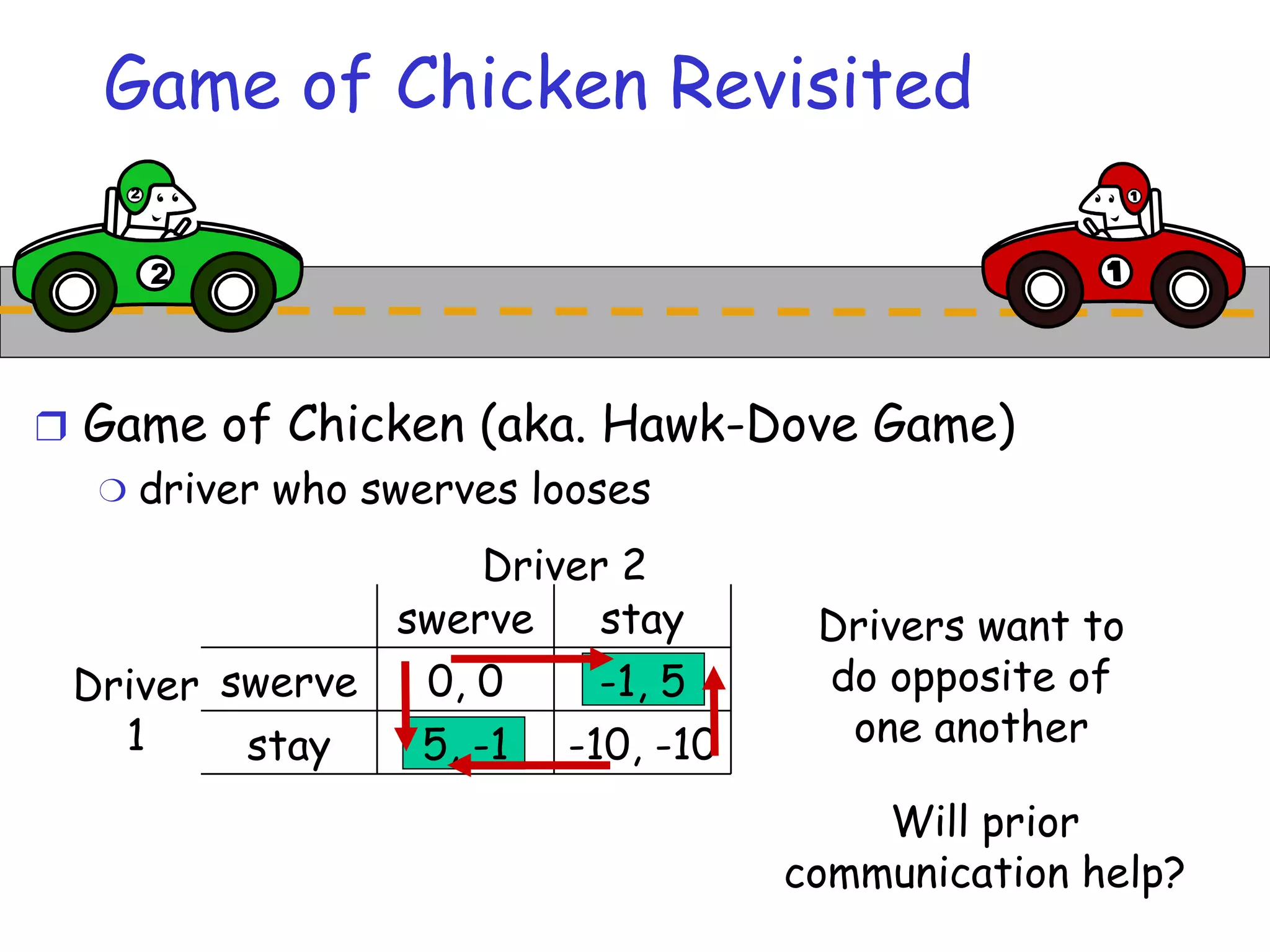
Game of Chicken Revisited Game of Chicken (aka. Hawk-Dove Game) driver who swerves looses Driver 1 Driver 2 Drivers want to do opposite of one another Will prior communication help? 2 2 -10, -10 -1, 5 stay 5, -1 stay 0, 0 swerve swerve
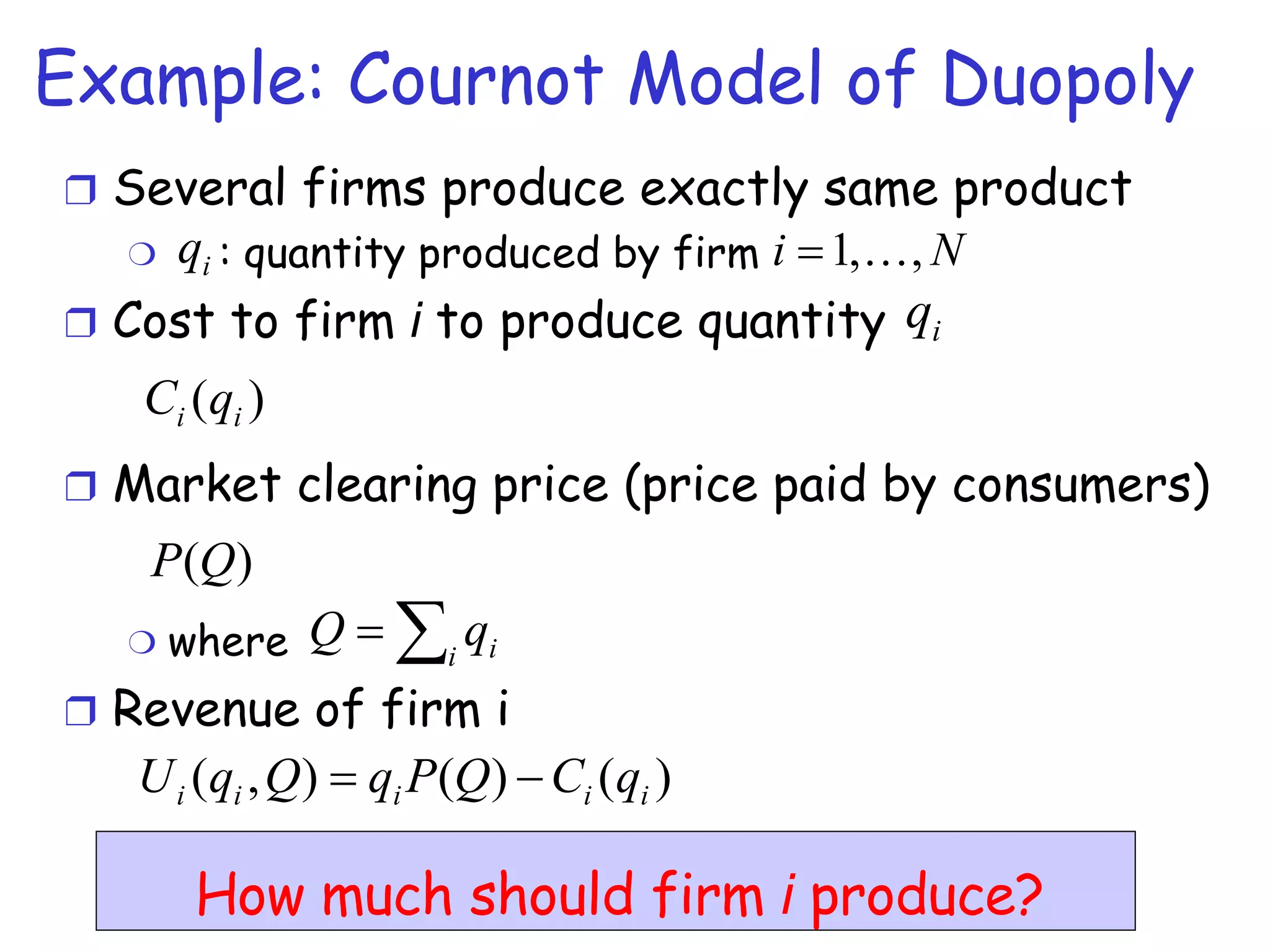
Example: Cournot Model of Duopoly Several firms produce exactly same product : quantity produced by firm  Cost to firm  i  to produce quantity Market clearing price (price paid by consumers) where  Revenue of firm i How much should firm  i  produce?
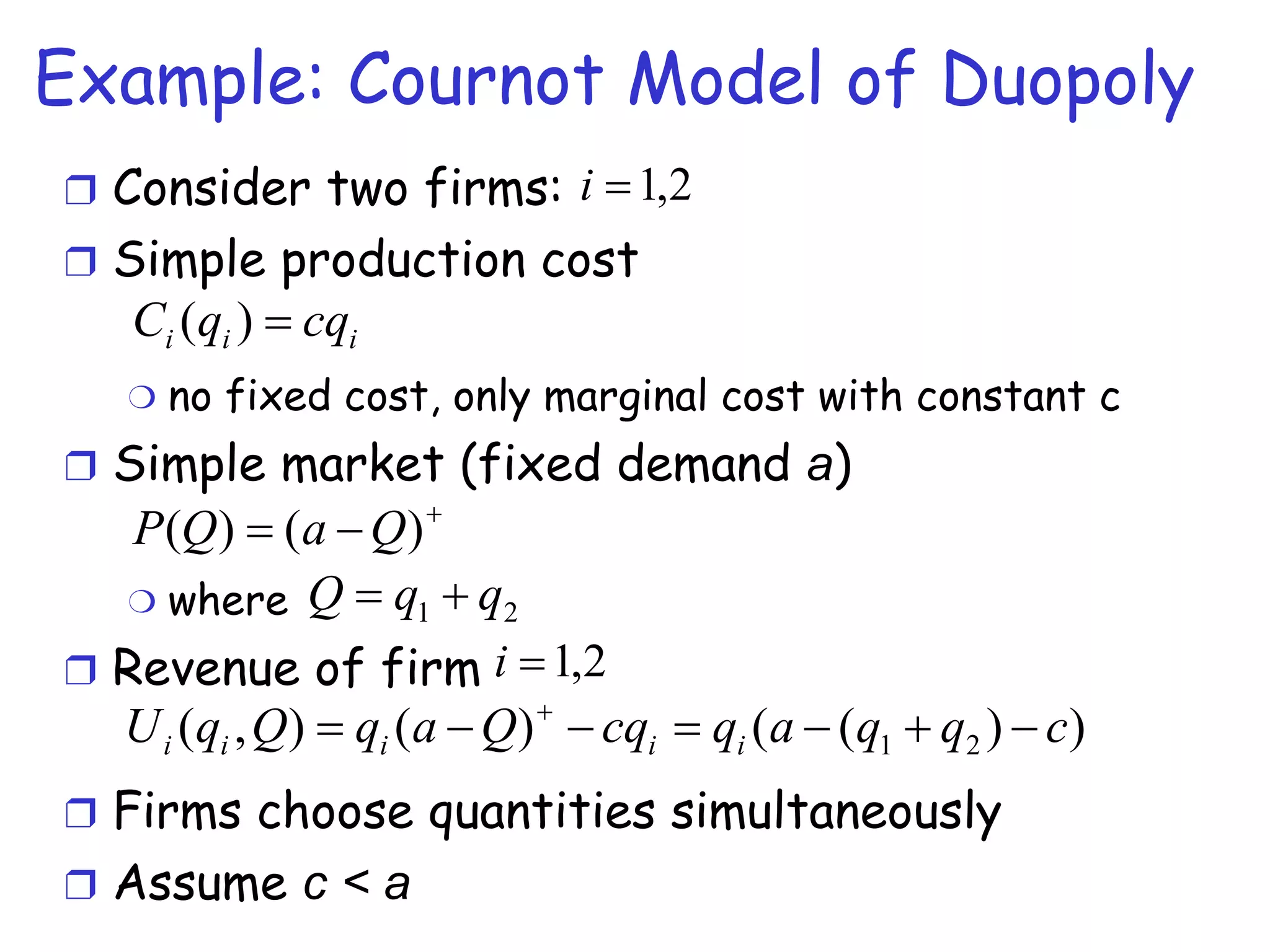
Example: Cournot Model of Duopoly Consider two firms:  Simple production cost no fixed cost, only marginal cost with constant c  Simple market (fixed demand  a ) where  Revenue of firm  Firms choose quantities simultaneously Assume  c < a
Example: Cournot Model of Duopoly Two player game: Firm 1 and Firm 2 Strategy space production quantity since  if  ,  What is the NEP? To find NEP, firm 1 solves To find NEP, firm 2 solves value chosen by firm 2 value chosen by firm 1
Example: Cournot Model of Duopoly Solution to maximization problem first order condition is necessary and sufficient Best response functions best strategy for player 1, given choice for player 2 At NEP, strategies  are best response to one another need to solve pair of equations using substitution… and and
Example: Cournot Model of Duopoly NEP is given by Total amount produced at NEP:  Price paid by consumers at NEP:  Consider a  monopoly  (no firm 2,  ) Equilibrium is given by Total amount produced:  Price paid by consumers:  less quantity produced higher price Competition can be good!
Example: Cournot Model of Duopoly Graphical approach: best response functions Plot best response for firm 1 Plot best response for firm 2 NEP : strategies are mutual best responses all intersections are NEPs
Game Trees (Extensive form) Sequential play players take turns in making choices previous choices can be available to players Game represented as a tree each non-leaf node represents a decision point for some player edges represent available choices Can be converted to matrix game (Normal form) “plan of action” must be chosen before hand
Game Trees Example Strategy set for Player 1: {L, R} Player 1 Player 2 Player 2 L L R R R L 3, 1 1, 2 -2, 1 0, -1 Strategy for Player 2: __, __ what to do when P1 plays L  what to do when P1 plays R  Strategy set for Player 2: {LL, LR, RL, RR} Payoff to Player 2 Payoff to Player 1
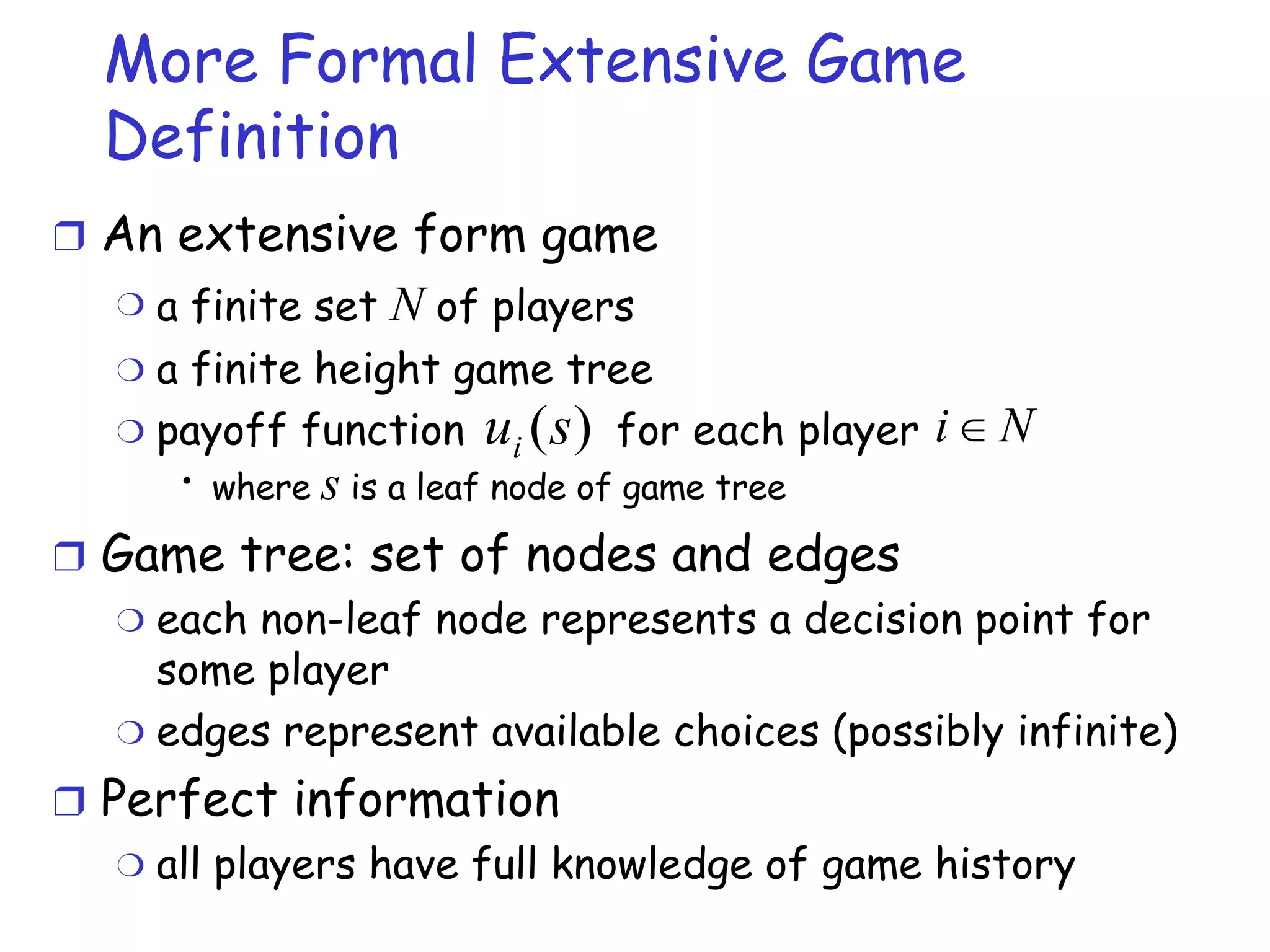
More Formal Extensive Game Definition An extensive form game a finite set  N  of players a finite height game tree payoff function  for each player where  s  is a leaf node of game tree  Game tree: set of nodes and edges each non-leaf node represents a decision point for some player edges represent available choices (possibly infinite) Perfect information all players have full knowledge of game history
Game Tree Example Microsoft and Mozilla are deciding on adopting new browser technology (.net or java) Microsoft moves first, then Mozilla makes its move Non-zero sum game what are the NEP? Microsoft Mozilla Mozilla .net .net java java java .net 3, 1 1, 0 0, 0 2, 2
Converting to Matrix Game Every game in extensive form can be converted into normal form exponential growth in number of strategies Microsoft Mozilla 0, 0 1, 0 java, .net 2, 2 3, 1 .net, java 2, 2 0, 0 java 1, 0 3, 1 .net java, java .net, .net .net .net java java java .net 3, 1 1, 0 0, 0 2, 2
NEP and Incredible Threats Microsoft Mozilla NEP incredible threat Play “java no matter what” is not credible for Mozilla if Microsoft plays .net then .net is better for Mozilla than java .net .net java java java .net 3, 1 1, 0 0, 0 2, 2 0, 0 1, 0 java, .net 2, 2 3, 1 .net, java 2, 2 0, 0 java 1, 0 3, 1 .net java, java .net, .net
Solving the Game (backward induction) Starting from terminal nodes move up game tree making best choice Best strategy for Mozilla: .net, java (follow Microsoft) Best strategy for Microsoft: .net Single NEP Microsoft -> .net,  Mozilla -> .net, java Equilibrium outcome .net java 3, 1 2, 2 .net .net java java java .net 3, 1 1, 0 0, 0 2, 2
Backward Induction on Game Trees Kuhn’s Thr:  Backward induction always leads to saddle point (on games with perfect information) game value at equilibrium is unique (for zero-sum games) In general, multiple NEPs are possible after backward induction cases with no strict preference over payoffs Effective mechanism to remove “bad” NEP incredible threats
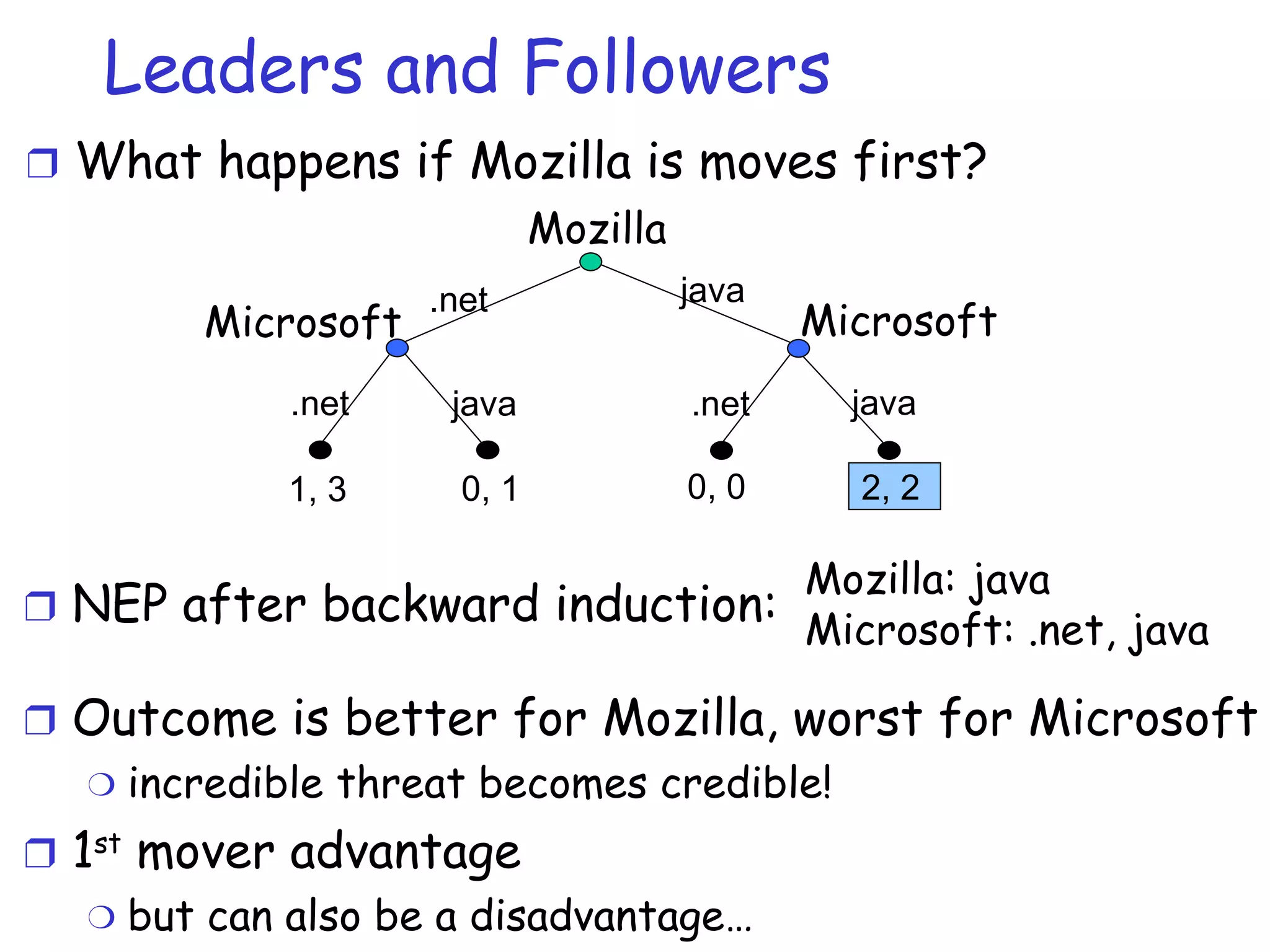
Leaders and Followers What happens if Mozilla is moves first? NEP after backward induction: Mozilla: java Microsoft: .net, java Outcome is better for Mozilla, worst for Microsoft incredible threat becomes credible! 1 st  mover advantage but can also be a disadvantage… Mozilla Microsoft Microsoft .net .net java java java .net 1, 3 0, 1 0, 0 2, 2
The Subgame Concept Def: a subgame is any subtree of the original game that also defines a proper game includes all descendents of non-leaf root node 3 subtrees full tree, left tree, right tree Microsoft Mozilla Mozilla .net .net java java java .net 3, 1 1, 0 0, 0 2, 2
Subgame Perfect Nash Equilibrium Def: a NEP is  subgame perfect  if its restriction to  every  subgame is also a NEP of the subgame Thr:  every extensive form game has at least one subgame perferct Nash equilibrium Kuhn’s theorem, based on backward induction Set of NEP that survive backward induction in games with perfect information
Subgame Perfect Nash Equilibrium (N, NN)  is not a NEP when restricted to the subgame starting at  J (J, JJ)  is not a NEP when restricted to the subgame starting at  N (N, NJ)  is a  subgame perfect  Nash equilibrium MS Mozilla J N Subgame Perfect NEP Not subgame Perfect NEP Microsoft Mozilla Mozilla .net .net java java java .net 3, 1 1, 0 0, 0 2, 2 0,0 1,0 JN 2,2 3,1 NJ 2,2 0,0 J 1,0 3,1 N JJ NN
Title

file1

  • 1.
    Introduction to GameTheory and its Applications in Computer Networks John C.S. Lui Dept. of Computer Science & Engineering The Chinese University of Hong Kong Daniel R. Figueiredo School of Computer and Communication Sciences Swiss Federal Institute of Technology – Lausanne (EPFL) ACM SIGMETRICS / IFIP Performance June 2006
  • 2.
    Tutorial Organization Twoparts of 90 minutes 15 minutes coffee break in between First part: introduction to game theory definitions, important results, (simple) examples divided in two 45 minutes sessions (Daniel + John) Second part: game theory and networking game-theoretic formulation of networking problems 1 st 45 minute session (Daniel) routing games and congestion control games 2 nd 45 minute session (John) overlay games and wireless games
  • 3.
    What is GameTheory About? Analysis of situations where conflict of interests are present Goal is to prescribe how conflicts can be resolved Game of Chicken driver who steers away looses What should drivers do? 2 2
  • 4.
    Applications of GameTheory Theory developed mainly by mathematicians and economists contributions from biologists Widely applied in many disciplines from economics to philosophy, including computer science (Systems, Theory and AI) goal is often to understand some phenomena “ Recently” applied to computer networks Nagle, RFC 970, 1985 “ datagram networks as a multi-player game” paper in first volume of IEEE/ACM ToN (1993) wider interest starting around 2000
  • 5.
    Limitations of GameTheory No unified solution to general conflict resolution Real-world conflicts are complex models can at best capture important aspects Players are (usually) considered rational determine what is best for them given that others are doing the same No unique prescription not clear what players should do But it can provide intuitions, suggestions and partial prescriptions best mathematical tool we currently have
  • 6.
    What is aGame? A Game consists of at least two players a set of strategies for each player a preference relation over possible outcomes Player is general entity individual, company, nation, protocol, animal, etc Strategies actions which a player chooses to follow Outcome determined by mutual choice of strategies Preference relation modeled as utility (payoff) over set of outcomes
  • 7.
    Classification of GamesMany, many types of games three major categories Non-Cooperative (Competitive) Games individualized play, no bindings among players Repeated and Evolutionary Games dynamic scenario Cooperative Games play as a group, possible bindings
  • 8.
    Matrix Game (Normalform) Simultaneous play players analyze the game and write their strategy on a paper Combination of strategies determines payoff Player 1 Player 2 Strategy set for Player 1 Strategy set for Player 2 Payoff to Player 1 Payoff to Player 2 Representation of a game (3, 4) (0, 0) B (3, -1) (-5, 1) B (-2, -1) (2, 2) A C A
  • 9.
    More Formal GameDefinition Normal form (strategic) game a finite set N of players a set strategies for each player payoff function for each player where is the set of strategies chosen by all players A is the set of all possible outcomes is a set of strategies chosen by players defines an outcome
  • 10.
    Two-person Zero-sum GamesOne of the first games studied most well understood type of game Players interest are strictly opposed what one player gains the other loses game matrix has single entry (gain to player 1) Intuitive solution concept players maximize gains unique solution
  • 11.
    Analyzing the GamePlayer 1 maximizes matrix entry, while player 2 minimizes Player 1 Player 2 Strictly dominated strategy (dominated by C) Strictly dominated strategy (dominated by B) -1 2 1 -16 D 3 4 2 5 C -18 3 1 3 B 0 1 -1 12 A D C B A
  • 12.
    Dominance Strategy S strictly dominates a strategy T if every possible outcome when S is chosen is better than the corresponding outcome when T is chosen Dominance Principle rational players never choose strictly dominated strategies Idea: Solve the game by eliminating strictly dominated strategies! iterated removal
  • 13.
    Solving the GamePlayer 1 Player 2 Iterated removal of strictly dominated strategies Player 1 cannot remove any strategy (neither T or B dominates the other) Player 2 can remove strategy R (dominated by M) Player 1 can remove strategy T (dominated by B) Player 2 can remove strategy L (dominated by M) Solution: P 1 -> B, P 2 -> M payoff of 2 3 2 3 B 4 -1 -2 T R M L
  • 14.
    Solving the GamePlayer 1 Player 2 Removal of strictly dominates strategies does not always work Consider the game Neither player has dominated strategies Requires another solution concept -1 0 -16 D 3 2 5 C 0 -1 12 A D B A
  • 15.
    Analyzing the GamePlayer 1 Player 2 Outcome (C, B) seems “stable” saddle point of game -1 0 -16 D 3 2 5 C 0 -1 12 A D B A
  • 16.
    Saddle Points Anoutcome is a saddle point if it is both less than or equal to any value in its row and greater than or equal to any value in its column Saddle Point Principle Players should choose outcomes that are saddle points of the game Value of the game value of saddle point outcome if it exists
  • 17.
    Why Play SaddlePoints? If player 1 believes player 2 will play B player 1 should play best response to B (which is C) If player 2 believes player 1 will play C player 2 should play best response to C (which is B) Player 1 Player 2 -1 0 -16 D 3 2 5 C 0 -1 12 A D B A
  • 18.
    Why Play SaddlePoints? Why should player 1 believe player 2 will play B? playing B guarantees player 2 loses at most v (which is 2) Why should player 2 believe player 1 will play C? playing C guarantees player 1 wins at least v (which is 2) Player 1 Player 2 -1 0 -16 D 3 2 5 C 0 -1 12 A D B A Powerful arguments to play saddle point!
  • 19.
    Solving the Game(min-max algorithm) choose minimum entry in each row choose the maximum among these this is maximin value Player 1 Player 2 choose maximum entry in each column choose the minimum among these this is the minimax value if minimax == maximin, then this is the saddle point of game -5 -4 8 0 D 3 1 5 7 C -1 0 2 -10 B 5 2 3 4 A D C B A -5 1 -10 2 5 2 8 7
  • 20.
    Multiple Saddle PointsPlayer 1 Player 2 In general, game can have multiple saddle points Same payoff in every saddle point unique value of the game Strategies are interchangeable Example: strategies (A, B) and (C, C) are saddle points then (A, C) and (C, B) are also saddle points -5 -4 0 8 D 3 2 2 5 C -1 0 -10 2 B 5 2 2 3 A D C B A -5 2 -10 2 5 2 2 8
  • 21.
    Games With noSaddle Points What should players do? resort to randomness to select strategies Player 1 Player 2 3 0 B 1 -5 B -1 2 A C A
  • 22.
    Mixed Strategies Eachplayer associates a probability distribution over its set of strategies players decide on which prob. distribution to use Payoffs are computed as expectations Player 1 Payoff to P1 when playing A = 1/3(4) + 2/3(0) = 4/3 Payoff to P1 when playing B = 1/3(-5) + 2/3(3) = 1/3 How should players choose prob. distribution? 3 0 D -5 B 4 A C 2/3 1/3
  • 23.
    Mixed Strategies Idea: use a prob. distribution that cannot be exploited by other player payoff should be equal independent of the choice of strategy of other player guarantees minimum gain (maximum loss) Player 1 Payoff to P1 when playing A = x(4) + (1-x)(0) = 4x Payoff to P1 when playing B = x(-5) + (1-x)(3) = 3 – 8x 4x = 3 – 8x, thus x = 1/4 How should Player 2 play? 3 0 D -5 B 4 A C (1-x) x
  • 24.
    Mixed Strategies Player2 mixed strategy 1/4 C , 3/4 D maximizes its loss independent of P1 choices Player 1 has same reasoning Player 1 Payoff to P2 when playing C = x(-4) + (1-x)(5) = 5 - 9x Payoff to P2 when playing D = x(0) + (1-x)(-3) = -3 + 3x 5 – 9x = -3 + 3x, thus x = 2/3 Player 2 Payoff to P2 = -1 3 0 D -5 B 4 A C (1-x) x
  • 25.
    Minimax Theorem Everytwo-person zero-sum game has a solution in mixed (and sometimes pure) strategies solution payoff is the value of the game maximin = v = minimax v is unique multiple equilibrium in pure strategies possible but fully interchangeable Proved by John von Neumann in 1928! birth of game theory…
  • 26.
    Two-person Non-zero SumGames Players are not strictly opposed payoff sum is non-zero Player 1 Player 2 Situations where interest is not directly opposed players could cooperate -1, 2 2, 0 B 5, 1 B 3, 4 A A
  • 27.
    What is theSolution? Ideas of zero-sum game: saddle points pure strategy equilibrium mixed strategies equilibrium no pure strategy eq. Player 1 Player 2 Player 1 Player 2 2, 1 -1, 4 B 3, 2 B 5, 0 A A -1, 2 2, 0 B 3, 1 B 5, 4 A A
  • 28.
    Multiple Solution ProblemGames can have multiple equilibria not equivalent: payoff is different not interchangeable: playing an equilibrium strategy does not lead to equilibrium Player 1 Player 2 equilibria 2, 2 1, 1 B 0, 1 B 1, 4 A A
  • 29.
    The Good News:Nash’s Theorem Every two person game has at least one equilibrium in either pure or mixed strategies Proved by Nash in 1950 using fixed point theorem generalized to N person game did not “invent” this equilibrium concept Def: An outcome o* of a game is a NEP (Nash equilibrium point) if no player can unilaterally change its strategy and increase its payoff Cor: any saddle point is also a NEP
  • 30.
    The Prisoner’s DilemmaOne of the most studied and used games proposed in 1950s Two suspects arrested for joint crime each suspect when interrogated separately, has option to confess or remain silent Suspect 1 Suspect 2 payoff is years in jail ( smaller is better ) single NEP better outcome 5, 5 10, 1 C 1, 10 C 2, 2 S S
  • 31.
    Pareto Optimal Prisoner’sdilemma: individual rationality Suspect 1 Suspect 2 Another type of solution: group rationality Pareto optimal Def: outcome o* is Pareto Optimal if no other outcome is better for all players Pareto Optimal 5, 5 10, 1 C 1, 10 C 2, 2 S S
  • 32.
    Game of ChickenRevisited Game of Chicken (aka. Hawk-Dove Game) driver who swerves looses Driver 1 Driver 2 Drivers want to do opposite of one another Will prior communication help? 2 2 -10, -10 -1, 5 stay 5, -1 stay 0, 0 swerve swerve
  • 33.
    Example: Cournot Modelof Duopoly Several firms produce exactly same product : quantity produced by firm Cost to firm i to produce quantity Market clearing price (price paid by consumers) where Revenue of firm i How much should firm i produce?
  • 34.
    Example: Cournot Modelof Duopoly Consider two firms: Simple production cost no fixed cost, only marginal cost with constant c Simple market (fixed demand a ) where Revenue of firm Firms choose quantities simultaneously Assume c < a
  • 35.
    Example: Cournot Modelof Duopoly Two player game: Firm 1 and Firm 2 Strategy space production quantity since if , What is the NEP? To find NEP, firm 1 solves To find NEP, firm 2 solves value chosen by firm 2 value chosen by firm 1
  • 36.
    Example: Cournot Modelof Duopoly Solution to maximization problem first order condition is necessary and sufficient Best response functions best strategy for player 1, given choice for player 2 At NEP, strategies are best response to one another need to solve pair of equations using substitution… and and
  • 37.
    Example: Cournot Modelof Duopoly NEP is given by Total amount produced at NEP: Price paid by consumers at NEP: Consider a monopoly (no firm 2, ) Equilibrium is given by Total amount produced: Price paid by consumers: less quantity produced higher price Competition can be good!
  • 38.
    Example: Cournot Modelof Duopoly Graphical approach: best response functions Plot best response for firm 1 Plot best response for firm 2 NEP : strategies are mutual best responses all intersections are NEPs
  • 39.
    Game Trees (Extensiveform) Sequential play players take turns in making choices previous choices can be available to players Game represented as a tree each non-leaf node represents a decision point for some player edges represent available choices Can be converted to matrix game (Normal form) “plan of action” must be chosen before hand
  • 40.
    Game Trees ExampleStrategy set for Player 1: {L, R} Player 1 Player 2 Player 2 L L R R R L 3, 1 1, 2 -2, 1 0, -1 Strategy for Player 2: __, __ what to do when P1 plays L what to do when P1 plays R Strategy set for Player 2: {LL, LR, RL, RR} Payoff to Player 2 Payoff to Player 1
  • 41.
    More Formal ExtensiveGame Definition An extensive form game a finite set N of players a finite height game tree payoff function for each player where s is a leaf node of game tree Game tree: set of nodes and edges each non-leaf node represents a decision point for some player edges represent available choices (possibly infinite) Perfect information all players have full knowledge of game history
  • 42.
    Game Tree ExampleMicrosoft and Mozilla are deciding on adopting new browser technology (.net or java) Microsoft moves first, then Mozilla makes its move Non-zero sum game what are the NEP? Microsoft Mozilla Mozilla .net .net java java java .net 3, 1 1, 0 0, 0 2, 2
  • 43.
    Converting to MatrixGame Every game in extensive form can be converted into normal form exponential growth in number of strategies Microsoft Mozilla 0, 0 1, 0 java, .net 2, 2 3, 1 .net, java 2, 2 0, 0 java 1, 0 3, 1 .net java, java .net, .net .net .net java java java .net 3, 1 1, 0 0, 0 2, 2
  • 44.
    NEP and IncredibleThreats Microsoft Mozilla NEP incredible threat Play “java no matter what” is not credible for Mozilla if Microsoft plays .net then .net is better for Mozilla than java .net .net java java java .net 3, 1 1, 0 0, 0 2, 2 0, 0 1, 0 java, .net 2, 2 3, 1 .net, java 2, 2 0, 0 java 1, 0 3, 1 .net java, java .net, .net
  • 45.
    Solving the Game(backward induction) Starting from terminal nodes move up game tree making best choice Best strategy for Mozilla: .net, java (follow Microsoft) Best strategy for Microsoft: .net Single NEP Microsoft -> .net, Mozilla -> .net, java Equilibrium outcome .net java 3, 1 2, 2 .net .net java java java .net 3, 1 1, 0 0, 0 2, 2
  • 46.
    Backward Induction onGame Trees Kuhn’s Thr: Backward induction always leads to saddle point (on games with perfect information) game value at equilibrium is unique (for zero-sum games) In general, multiple NEPs are possible after backward induction cases with no strict preference over payoffs Effective mechanism to remove “bad” NEP incredible threats
  • 47.
    Leaders and FollowersWhat happens if Mozilla is moves first? NEP after backward induction: Mozilla: java Microsoft: .net, java Outcome is better for Mozilla, worst for Microsoft incredible threat becomes credible! 1 st mover advantage but can also be a disadvantage… Mozilla Microsoft Microsoft .net .net java java java .net 1, 3 0, 1 0, 0 2, 2
  • 48.
    The Subgame ConceptDef: a subgame is any subtree of the original game that also defines a proper game includes all descendents of non-leaf root node 3 subtrees full tree, left tree, right tree Microsoft Mozilla Mozilla .net .net java java java .net 3, 1 1, 0 0, 0 2, 2
  • 49.
    Subgame Perfect NashEquilibrium Def: a NEP is subgame perfect if its restriction to every subgame is also a NEP of the subgame Thr: every extensive form game has at least one subgame perferct Nash equilibrium Kuhn’s theorem, based on backward induction Set of NEP that survive backward induction in games with perfect information
  • 50.
    Subgame Perfect NashEquilibrium (N, NN) is not a NEP when restricted to the subgame starting at J (J, JJ) is not a NEP when restricted to the subgame starting at N (N, NJ) is a subgame perfect Nash equilibrium MS Mozilla J N Subgame Perfect NEP Not subgame Perfect NEP Microsoft Mozilla Mozilla .net .net java java java .net 3, 1 1, 0 0, 0 2, 2 0,0 1,0 JN 2,2 3,1 NJ 2,2 0,0 J 1,0 3,1 N JJ NN
  • 51.