Downloaded 146 times


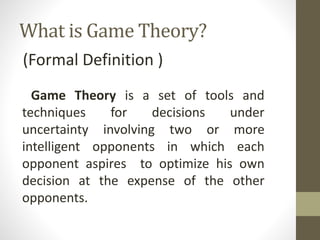
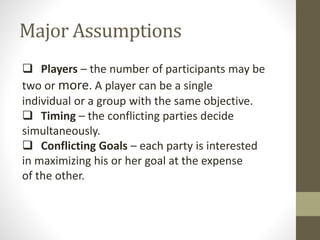
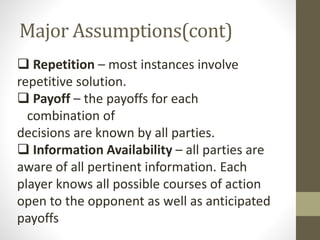
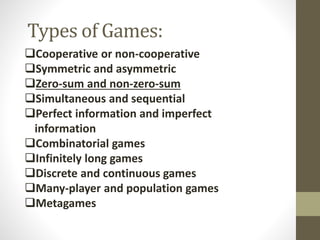

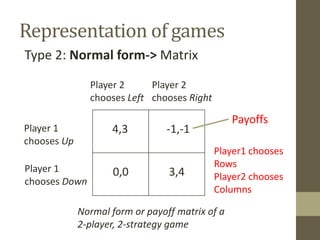


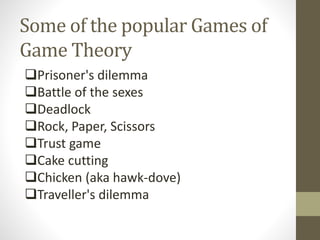


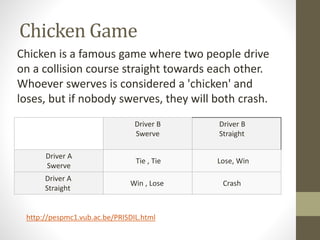
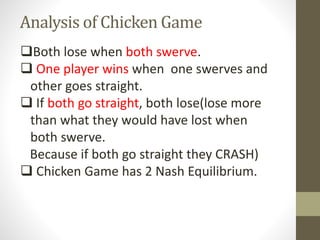
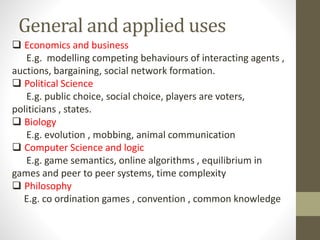


This document provides an overview of game theory, including: - Defining game theory as a way to study strategic decision-making involving multiple participants with conflicting goals. - The major assumptions of game theory include players having different objectives, making decisions simultaneously, and knowing potential payoffs. - Common types of games are cooperative/non-cooperative, zero-sum/non-zero-sum, and simultaneous/sequential games. - Popular examples used in game theory include the Prisoner's Dilemma and Chicken games, which demonstrate outcomes like Nash equilibrium. - Game theory has applications in economics, politics, biology, and other fields for modeling interactions and predicting outcomes.


![Game theory intro_and_questions_2009[1]](https://cdn.slidesharecdn.com/ss_thumbnails/gametheoryintroandquestions20091-140204051533-phpapp02-thumbnail.jpg?width=640&height=640&fit=bounds)


