
1
GAME THEORY
AN INTRODUCTION
Njdeh Tahmasian Savarani
Winter 2014
2
History
 Interdisciplinary (Economic and Mathematic)
approach to the study of human behavior
 Founded in the 1920s by John von Neumann
 1994 Nobel prize in Economics awarded to
three researchers
 “Games” are a metaphor for wide range of
human interactions
3
Applications
 Market:
 pricing of a new product when other firms have similar new
products
 deciding how to bid in an auction
 Networking:
 choosing a route on the Internet or through a transportation
networks
 Politic:
 Deciding whether to adopt an aggressive or a passive stance in
international relations
 Sport:
 choosing how to target a soccer penalty kick and choosing how
to defend against
 Choosing whether to use performance-enhancing drugs in a
professional sport
3
4
What is a (Mathematical) Game?
 Rules
 Outcomes and payoffs
 Uncertainty of the Outcome
 Decision making
 No cheating
4
5
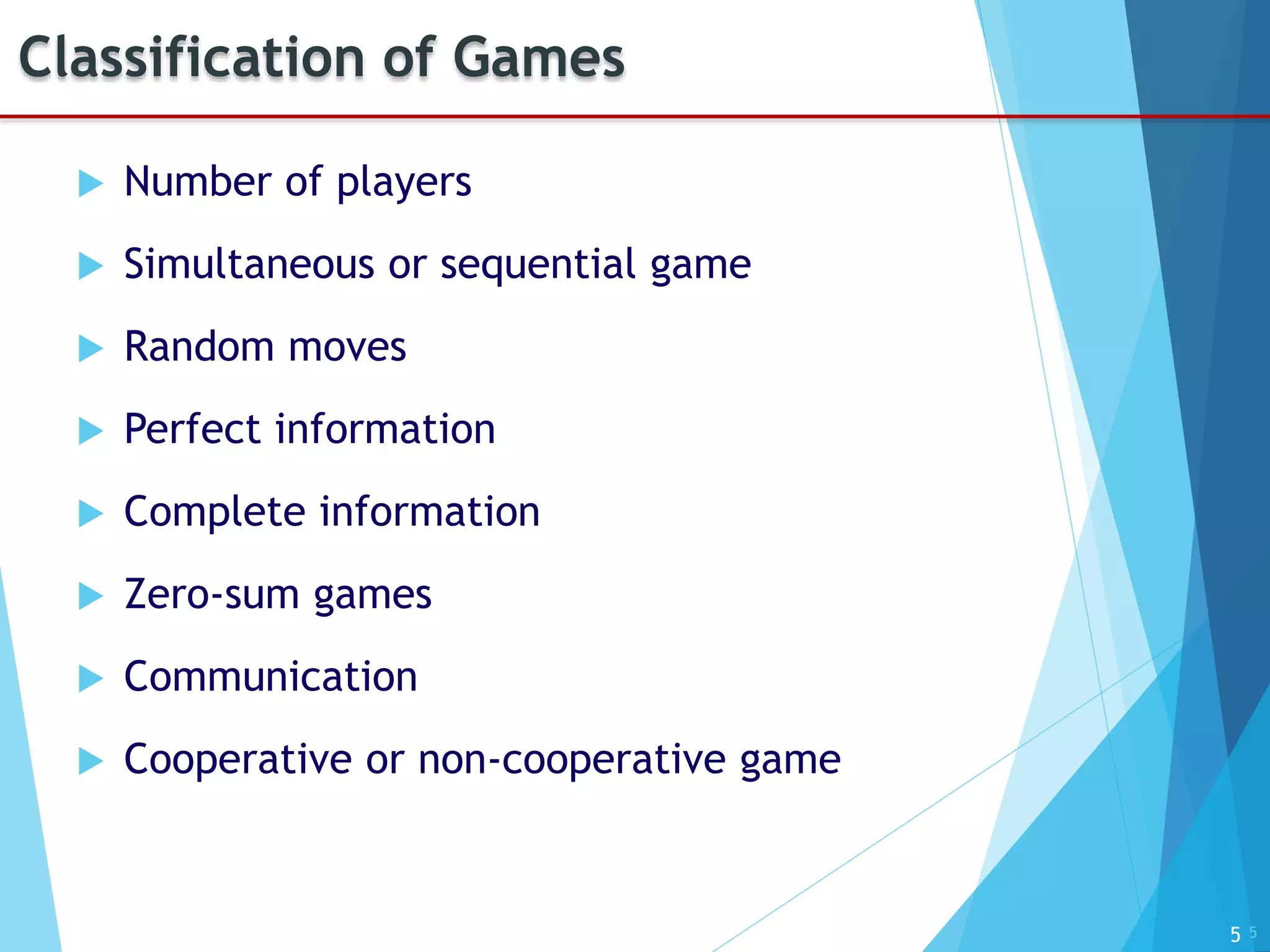
Classification of Games
 Number of players
 Simultaneous or sequential game
 Random moves
 Perfect information
 Complete information
 Zero-sum games
 Communication
 Cooperative or non-cooperative game
5
6
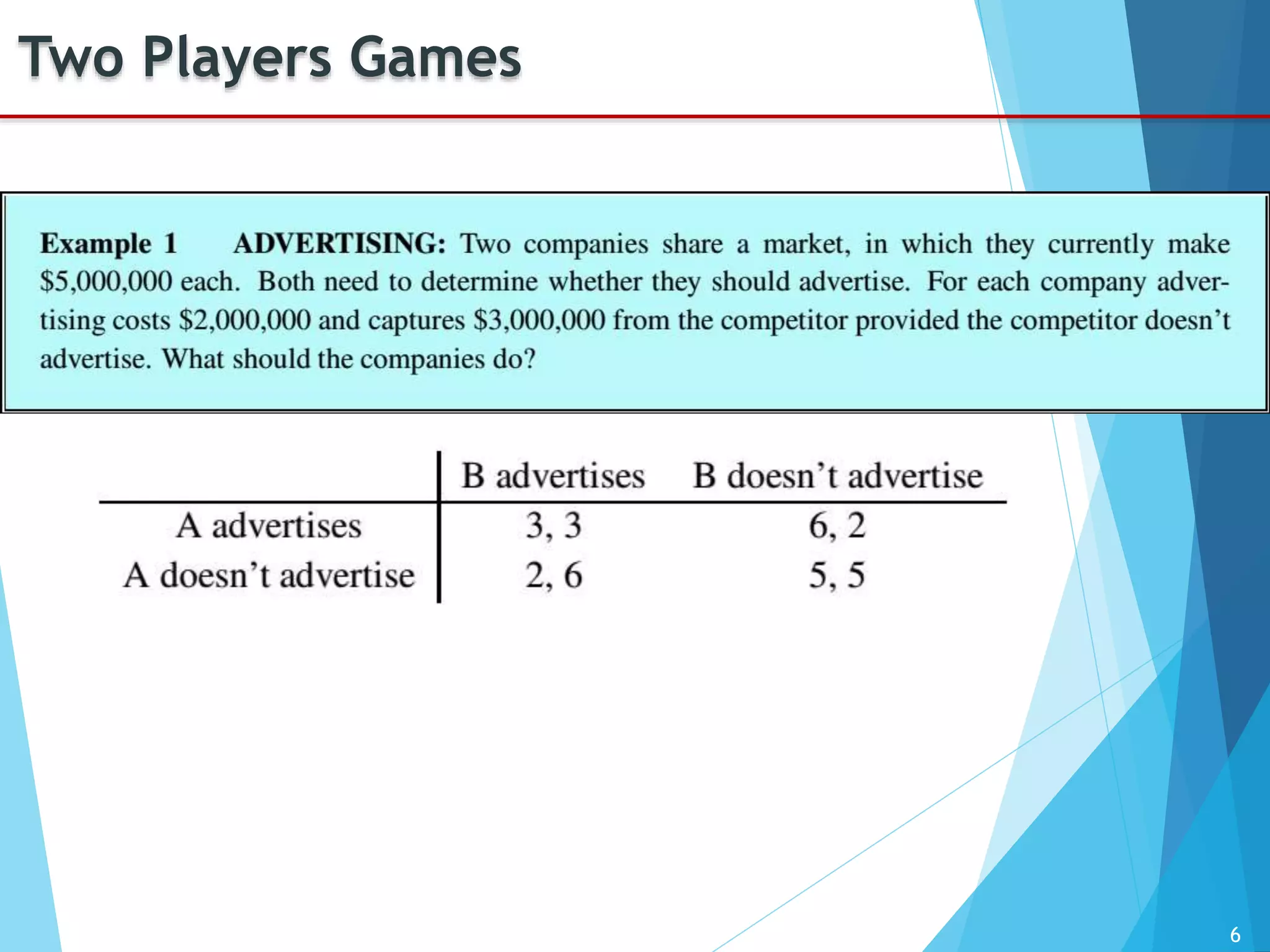
Two Players Games
7
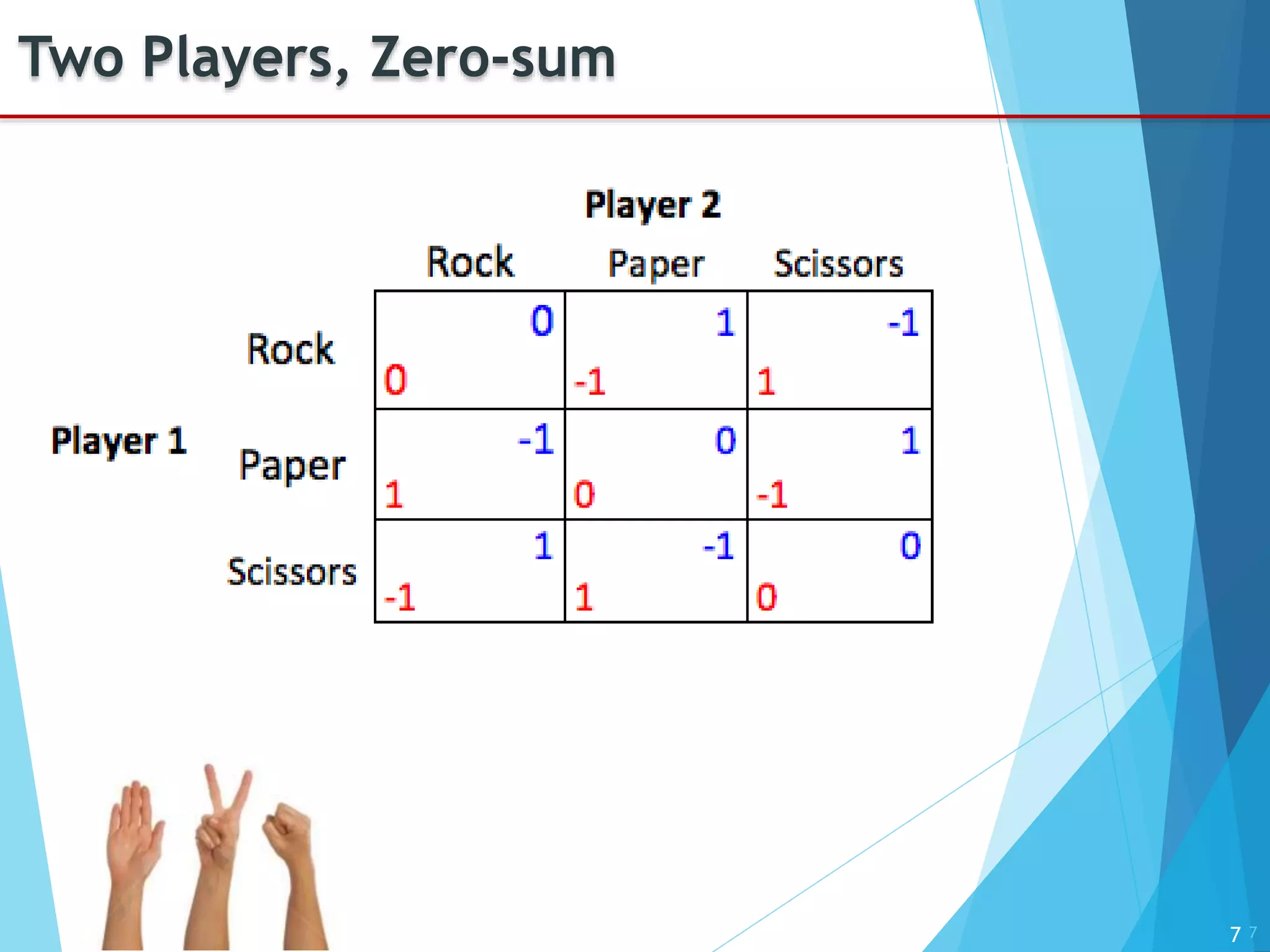
Two Players, Zero-sum
7
8
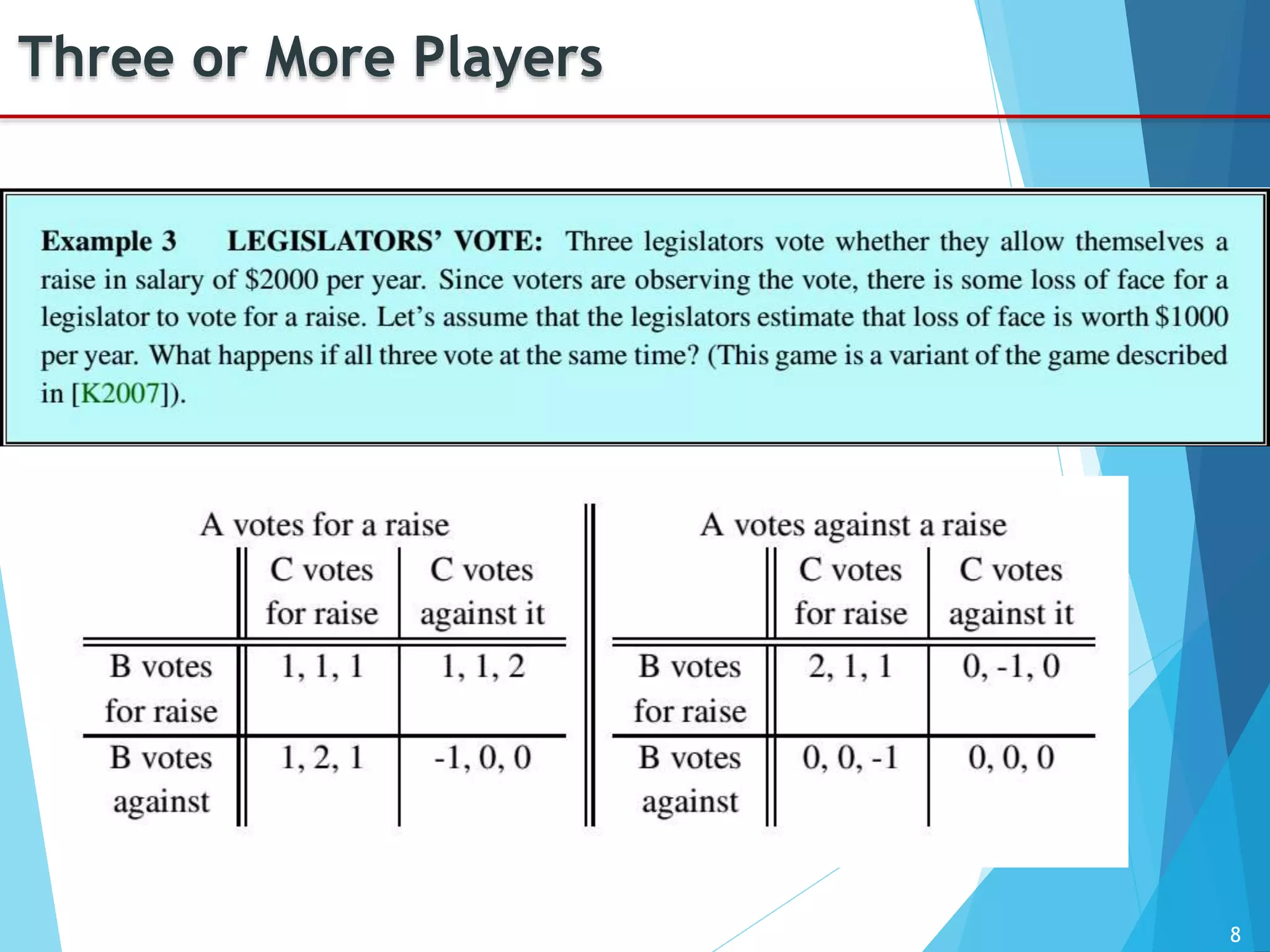
Three or More Players
9
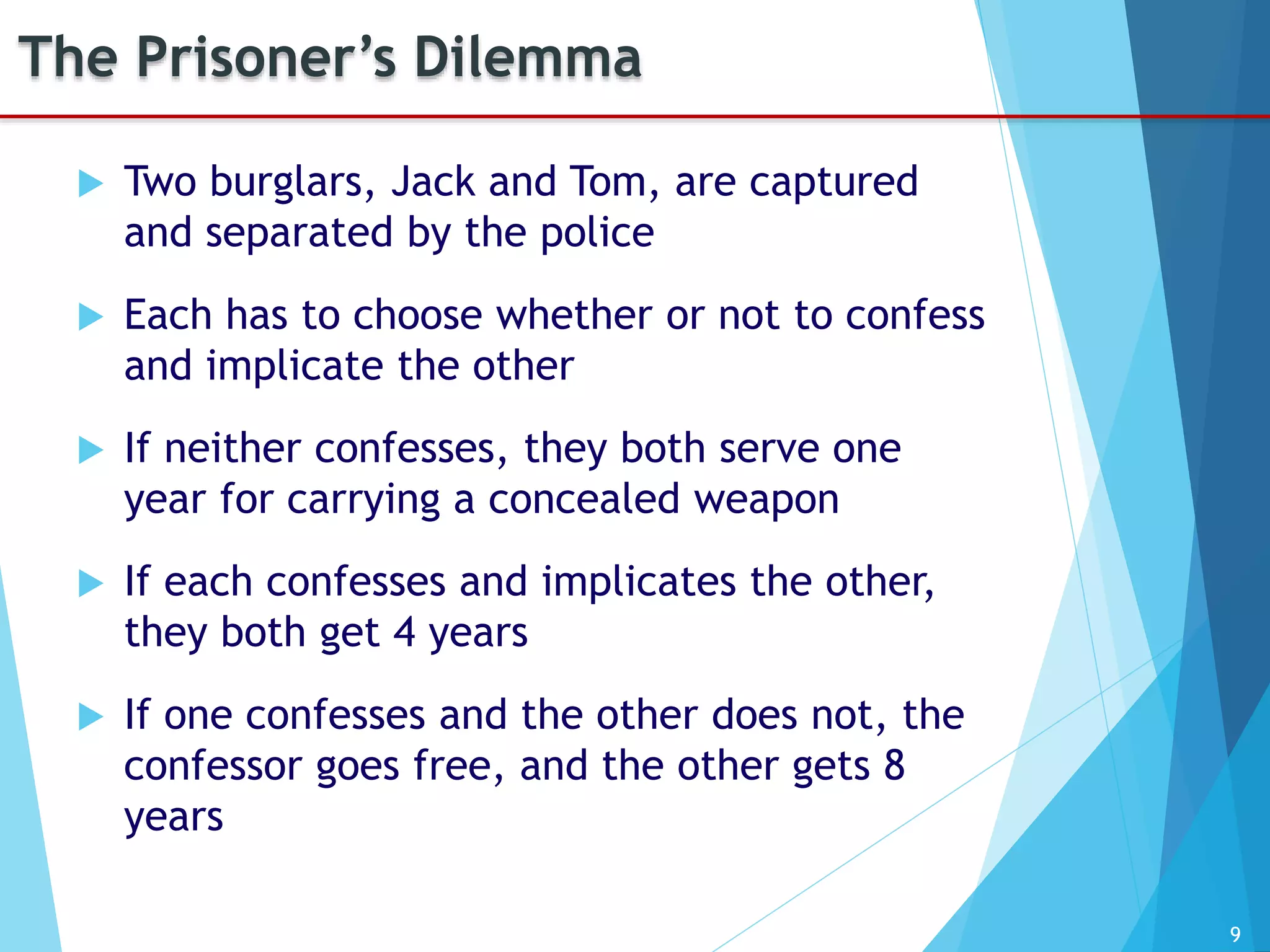
The Prisoner’s Dilemma
 Two burglars, Jack and Tom, are captured
and separated by the police
 Each has to choose whether or not to confess
and implicate the other
 If neither confesses, they both serve one
year for carrying a concealed weapon
 If each confesses and implicates the other,
they both get 4 years
 If one confesses and the other does not, the
confessor goes free, and the other gets 8
years
10
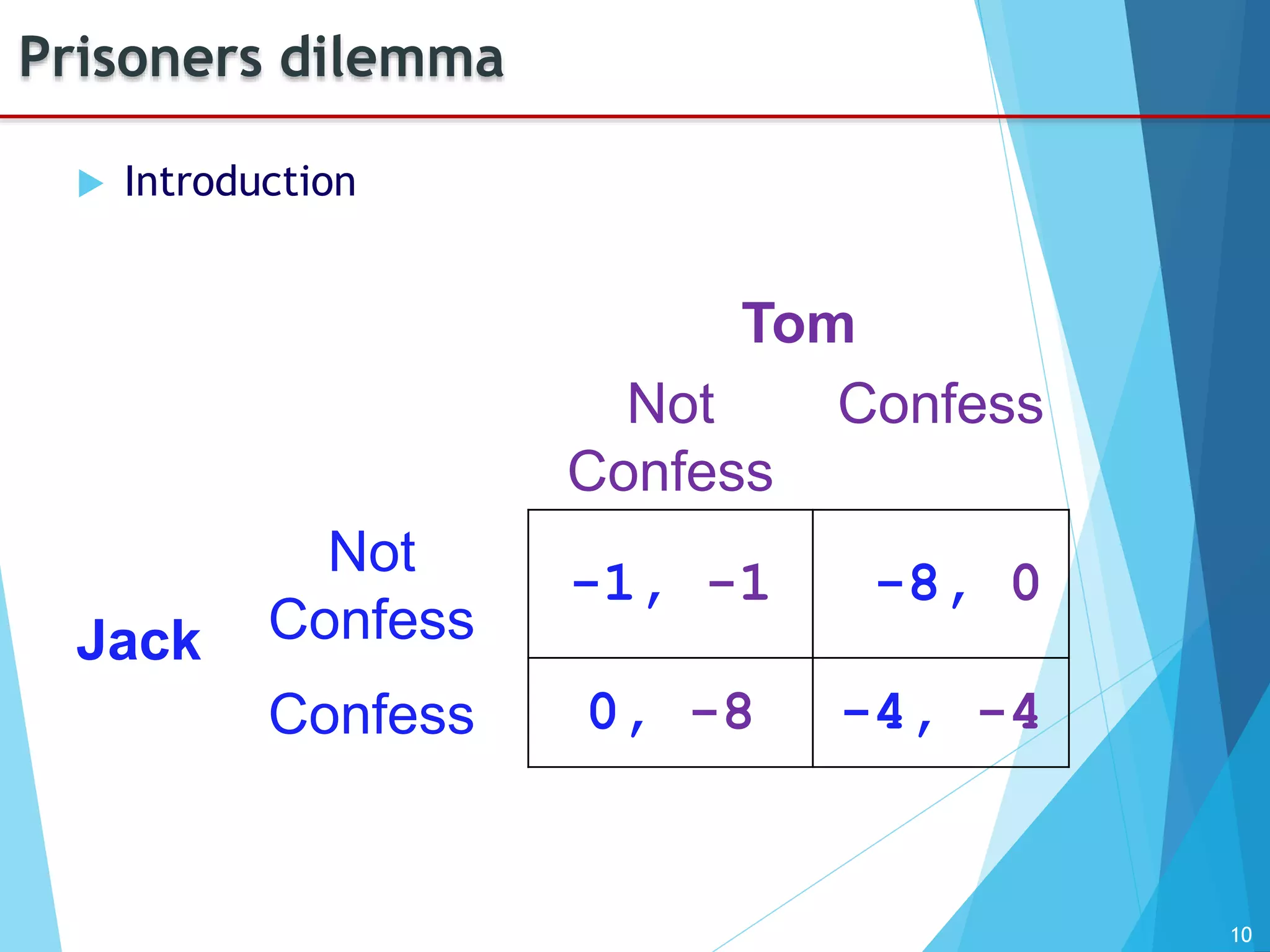
Prisoners dilemma
 Introduction
Tom
Not
Confess
Confess
Jack
Not
Confess
-1, -1 -8, 0
Confess 0, -8 -4, -4
11
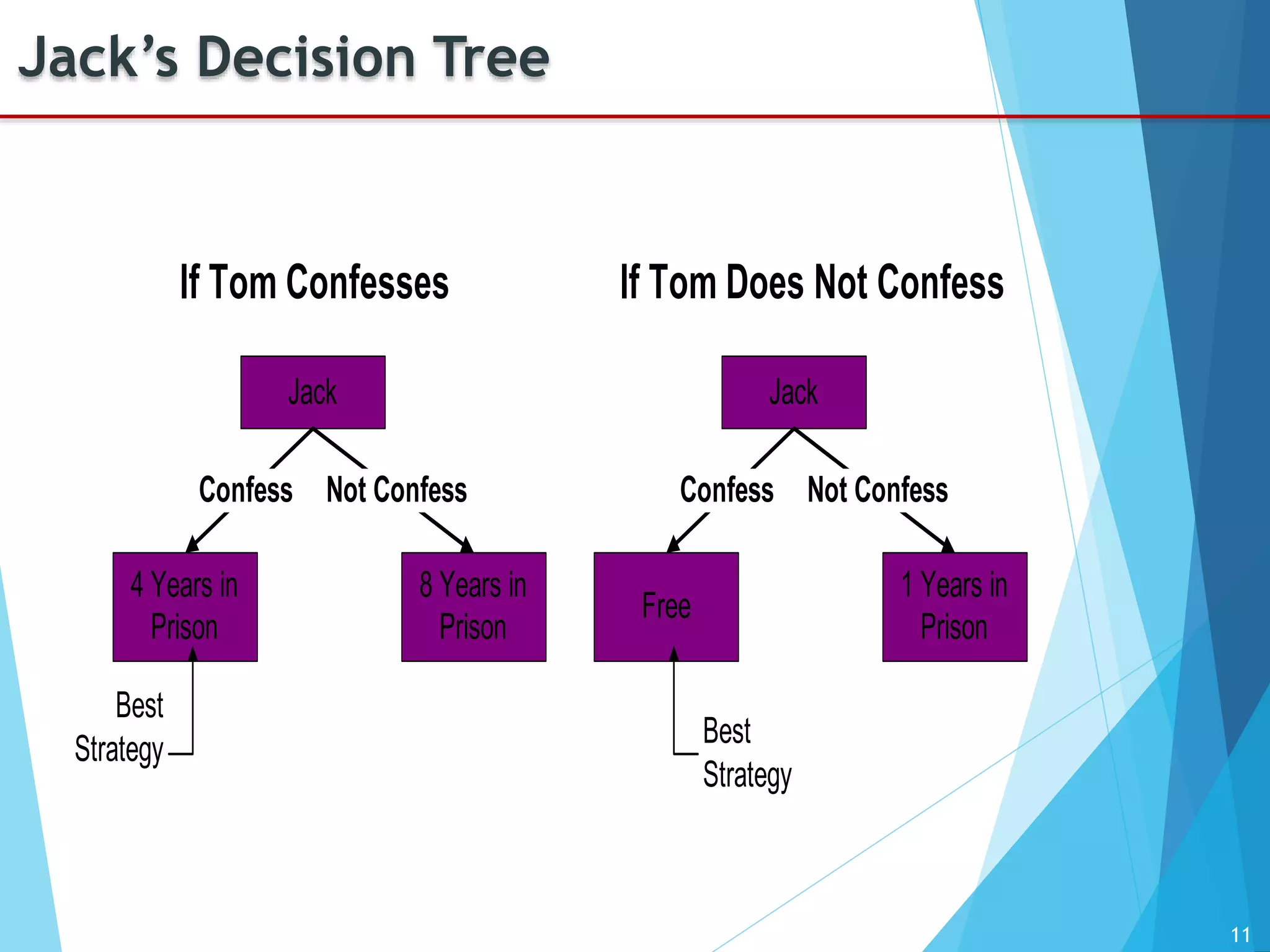
Jack’s Decision Tree
If Tom Does Not ConfessIf Tom Confesses
Jack
4 Years in
Prison
8 Years in
Prison
Free
1 Years in
Prison
Jack
Not ConfessConfess Confess Not Confess
Best
Strategy
Best
Strategy
12
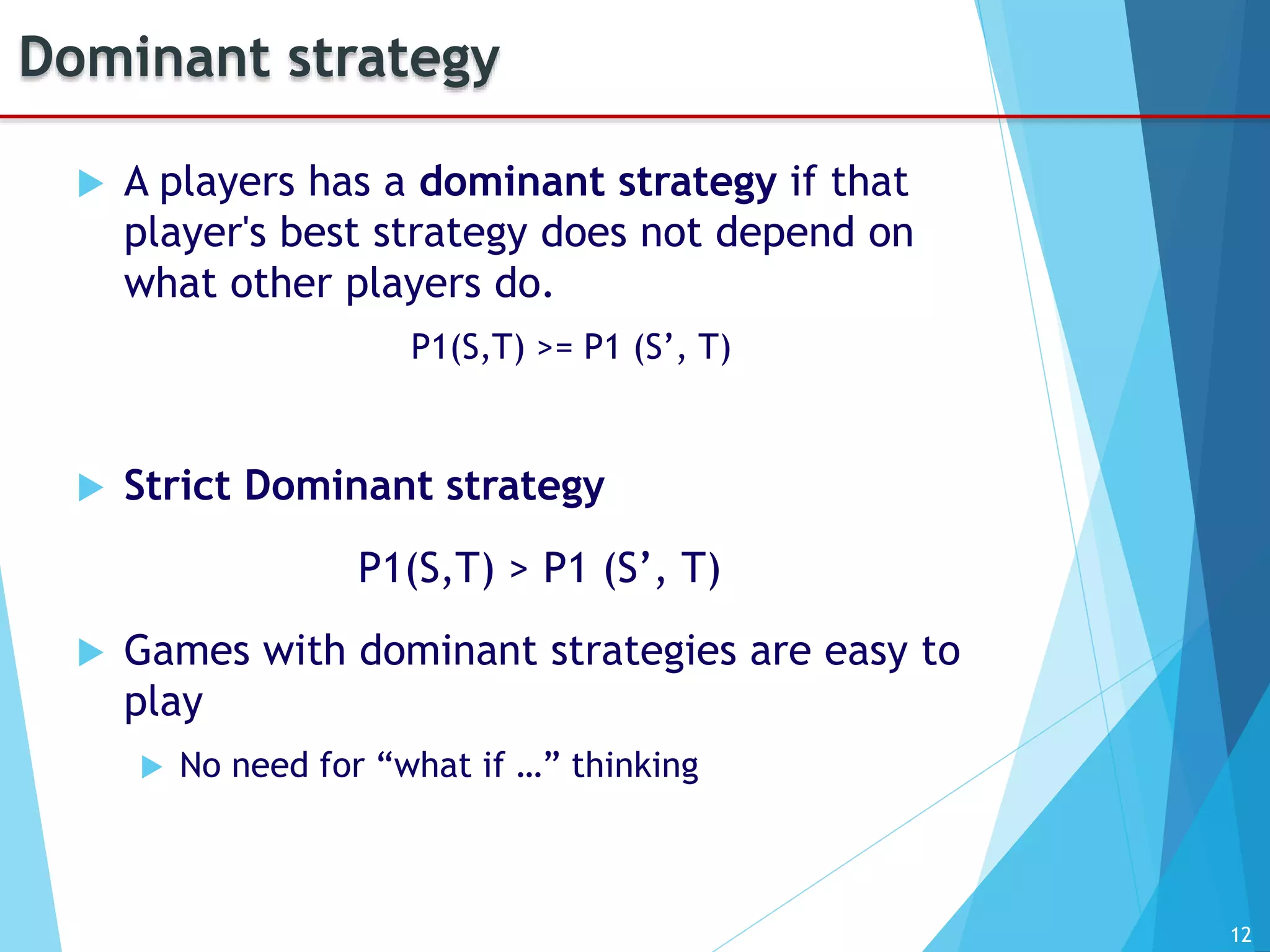
Dominant strategy
 A players has a dominant strategy if that
player's best strategy does not depend on
what other players do.
P1(S,T) >= P1 (S’, T)
 Strict Dominant strategy
P1(S,T) > P1 (S’, T)
 Games with dominant strategies are easy to
play
 No need for “what if …” thinking
13
Prisoner's Dilemma
 Strategies must be undertaken without the
full knowledge of what other players will do.
 Players adopt dominant strategies
 BUT they don't necessarily lead to the best
outcome.
14
Nash Equilibrium
 A Nash equilibrium is a situation in which
none of them have dominant Strategy and
each player makes his or her best response
 (S, T) is Nash equilibrium if S is the best strategy to
T and T is the best strategy to S
 John Nash shared the 1994 Nobel prize in
Economic for developing this idea!
15
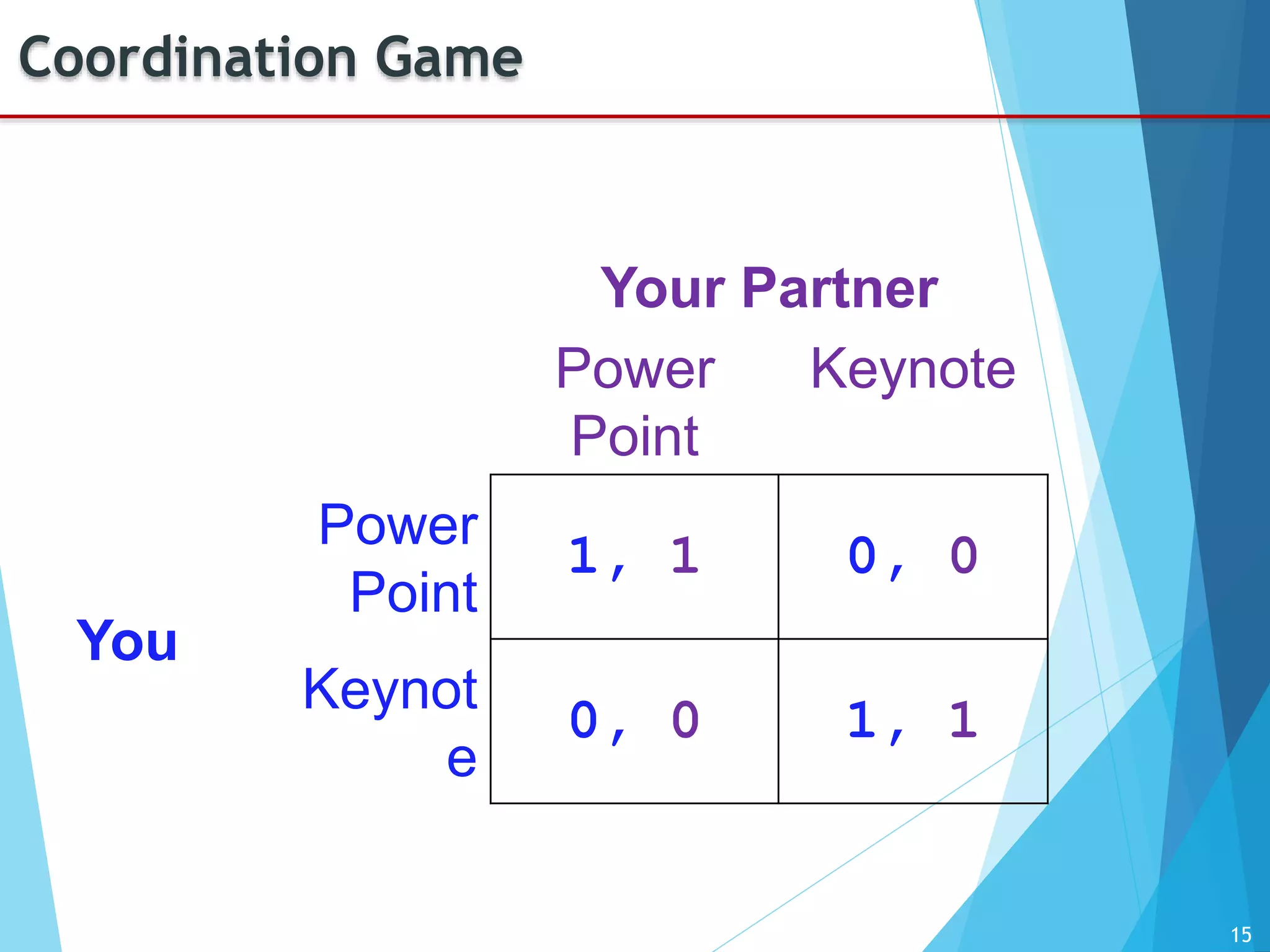
Coordination Game
Your Partner
Power
Point
Keynote
You
Power
Point
1, 1 0, 0
Keynot
e
0, 0 1, 1
16
Other samples of Coordination Game
 Using Metric units of measurement of English
Units
 Two people trying to find each other in a
crowded mall with two entrance
 …
 These games has more than one Nash
Equilibrium
17
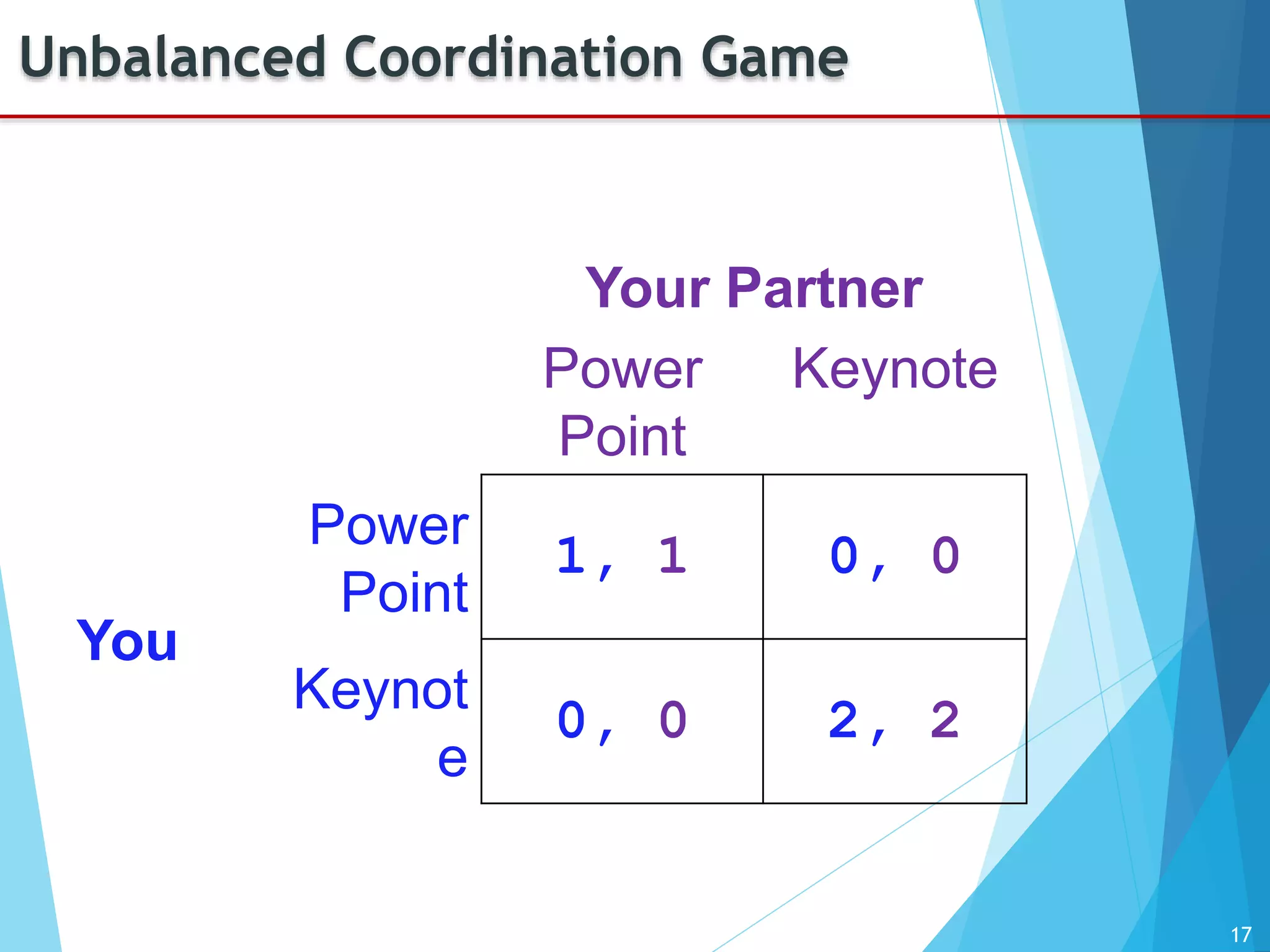
Unbalanced Coordination Game
Your Partner
Power
Point
Keynote
You
Power
Point
1, 1 0, 0
Keynot
e
0, 0 2, 2
18
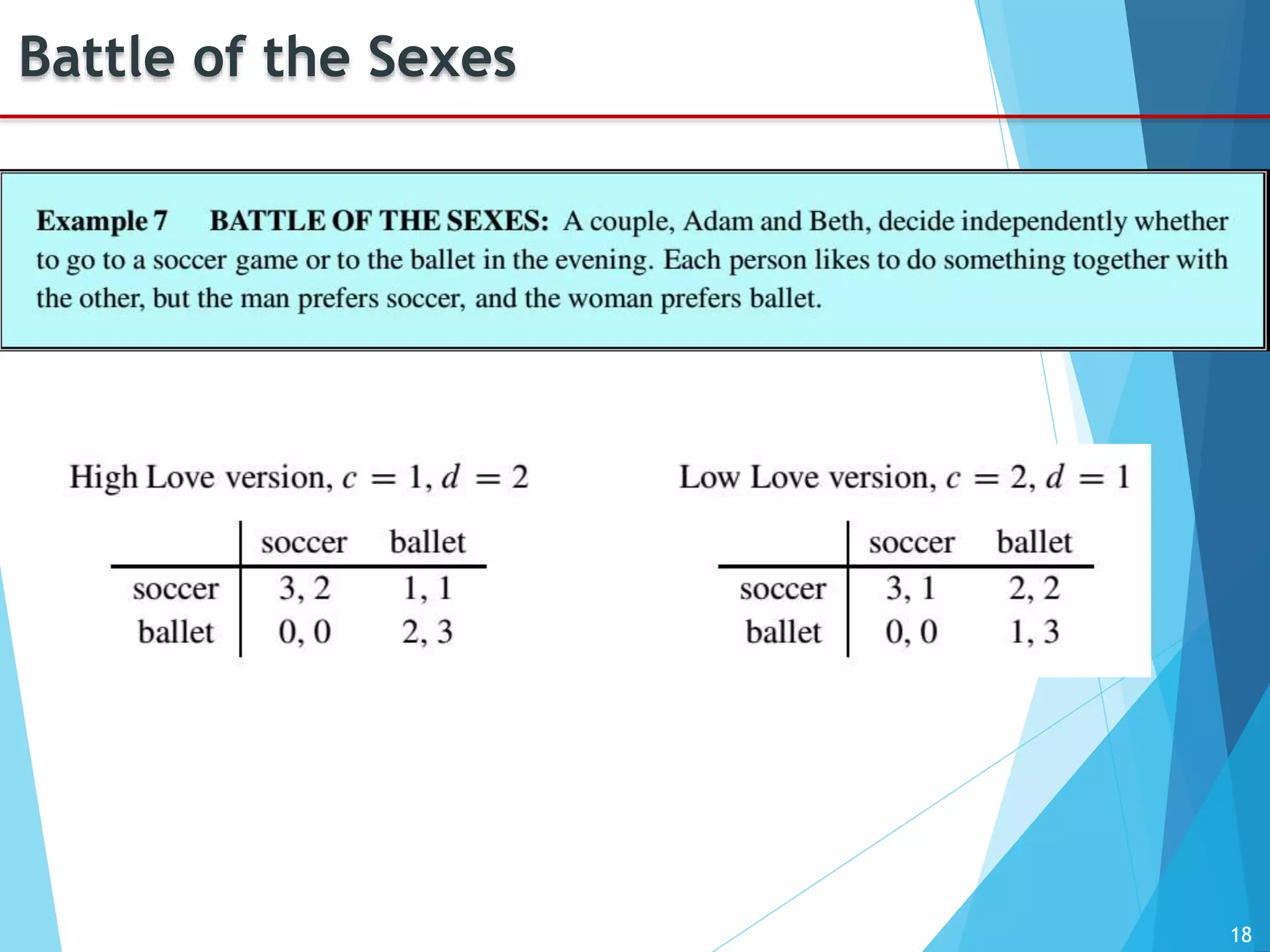
Battle of the Sexes
19
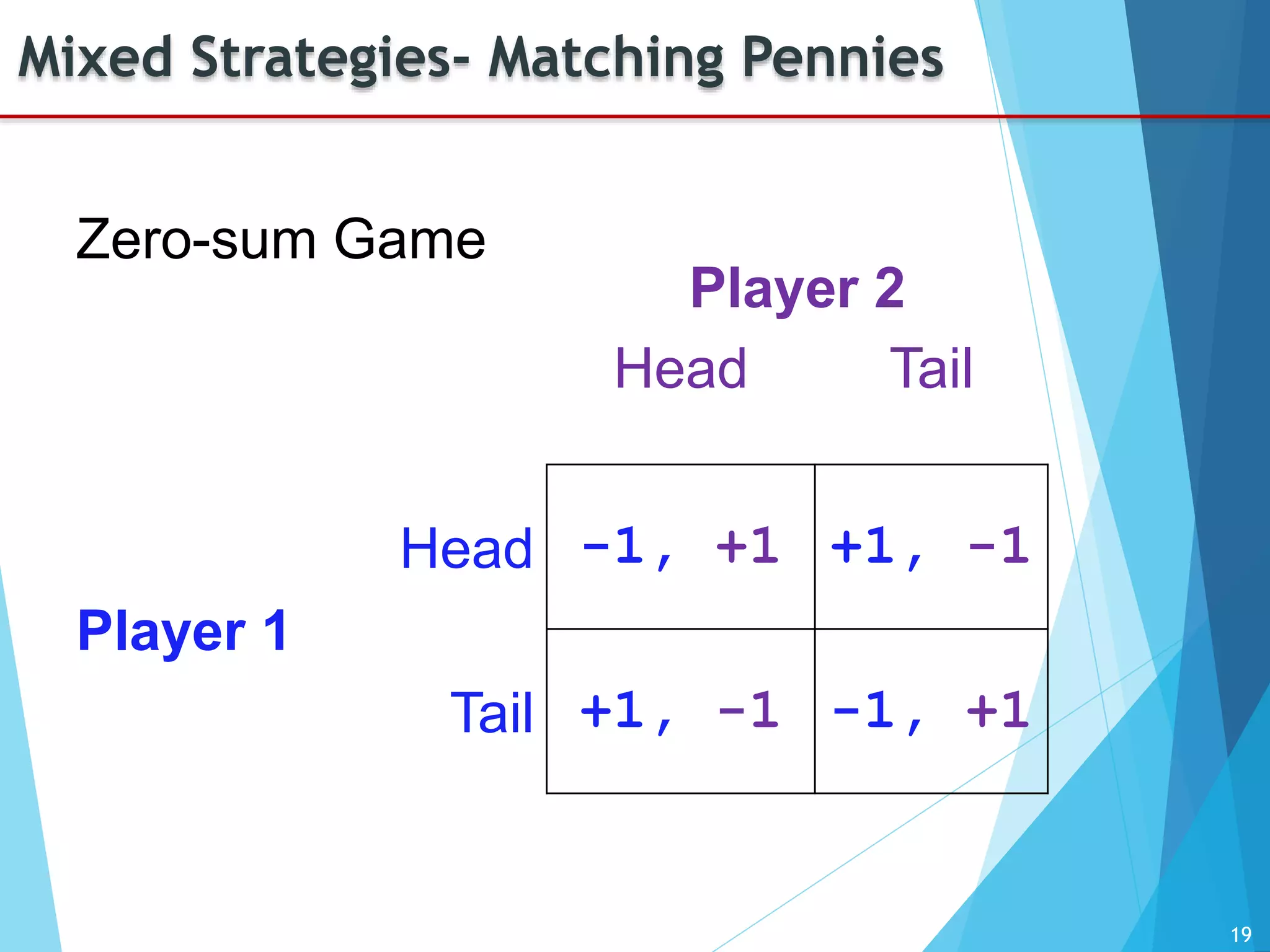
Mixed Strategies- Matching Pennies
Zero-sum Game
Player 2
Head Tail
Player 1
Head -1, +1 +1, -1
Tail +1, -1 -1, +1
20
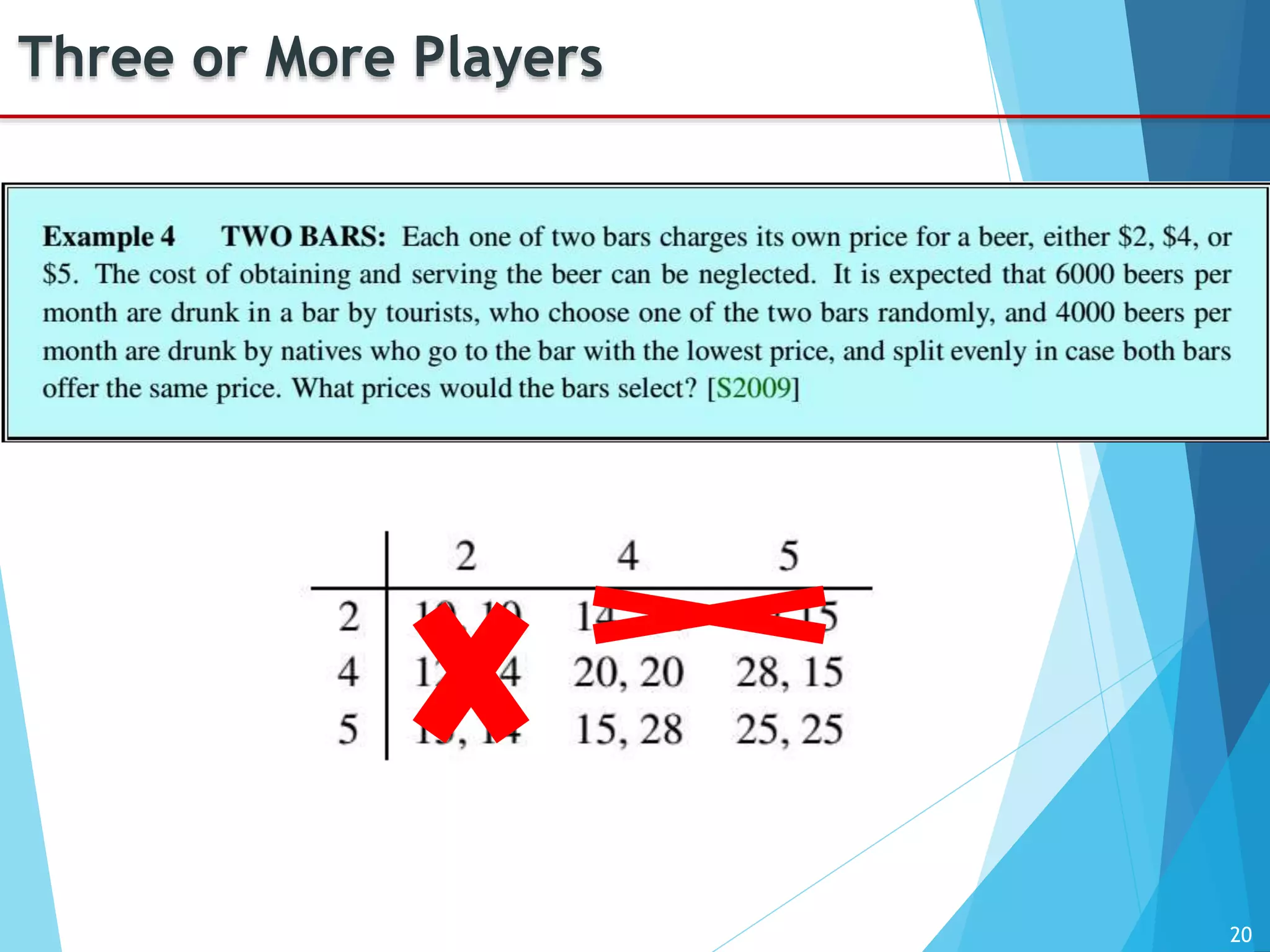
Three or More Players
21
22
References

Game Theory: An Intoduction

  • 1.
    1 GAME THEORY AN INTRODUCTION NjdehTahmasian Savarani Winter 2014
  • 2.
    2 History  Interdisciplinary (Economicand Mathematic) approach to the study of human behavior  Founded in the 1920s by John von Neumann  1994 Nobel prize in Economics awarded to three researchers  “Games” are a metaphor for wide range of human interactions
  • 3.
    3 Applications  Market:  pricingof a new product when other firms have similar new products  deciding how to bid in an auction  Networking:  choosing a route on the Internet or through a transportation networks  Politic:  Deciding whether to adopt an aggressive or a passive stance in international relations  Sport:  choosing how to target a soccer penalty kick and choosing how to defend against  Choosing whether to use performance-enhancing drugs in a professional sport 3
  • 4.
    4 What is a(Mathematical) Game?  Rules  Outcomes and payoffs  Uncertainty of the Outcome  Decision making  No cheating 4
  • 5.
    5 Classification of Games Number of players  Simultaneous or sequential game  Random moves  Perfect information  Complete information  Zero-sum games  Communication  Cooperative or non-cooperative game 5
  • 6.
  • 7.
  • 8.
  • 9.
    9 The Prisoner’s Dilemma Two burglars, Jack and Tom, are captured and separated by the police  Each has to choose whether or not to confess and implicate the other  If neither confesses, they both serve one year for carrying a concealed weapon  If each confesses and implicates the other, they both get 4 years  If one confesses and the other does not, the confessor goes free, and the other gets 8 years
  • 10.
  • 11.
    11 Jack’s Decision Tree IfTom Does Not ConfessIf Tom Confesses Jack 4 Years in Prison 8 Years in Prison Free 1 Years in Prison Jack Not ConfessConfess Confess Not Confess Best Strategy Best Strategy
  • 12.
    12 Dominant strategy  Aplayers has a dominant strategy if that player's best strategy does not depend on what other players do. P1(S,T) >= P1 (S’, T)  Strict Dominant strategy P1(S,T) > P1 (S’, T)  Games with dominant strategies are easy to play  No need for “what if …” thinking
  • 13.
    13 Prisoner's Dilemma  Strategiesmust be undertaken without the full knowledge of what other players will do.  Players adopt dominant strategies  BUT they don't necessarily lead to the best outcome.
  • 14.
    14 Nash Equilibrium  ANash equilibrium is a situation in which none of them have dominant Strategy and each player makes his or her best response  (S, T) is Nash equilibrium if S is the best strategy to T and T is the best strategy to S  John Nash shared the 1994 Nobel prize in Economic for developing this idea!
  • 15.
  • 16.
    16 Other samples ofCoordination Game  Using Metric units of measurement of English Units  Two people trying to find each other in a crowded mall with two entrance  …  These games has more than one Nash Equilibrium
  • 17.
    17 Unbalanced Coordination Game YourPartner Power Point Keynote You Power Point 1, 1 0, 0 Keynot e 0, 0 2, 2
  • 18.
  • 19.
    19 Mixed Strategies- MatchingPennies Zero-sum Game Player 2 Head Tail Player 1 Head -1, +1 +1, -1 Tail +1, -1 -1, +1
  • 20.
  • 21.
  • 22.