FreeBSD in the Enterprise   An Introduction for Linux Users Murray Stokely  [email_address]
FreeBSD in a nutshell Freely available Unix-like operating system Runs on x86, Alpha, Sparc64, IA-64, AMD64 architectures Over 10,000 software packages available Many commercial users Thousands of developers around the world contributing to it Used as an operating systems research platform So far, so Linux...
FreeBSD History BSD developed at University of California, Berkeley, as alterations to AT&T Unix Initial implementation of key Unix concepts, such as sockets, virtual memory, and TCP/IP 386BSD developed to implement BSD Unix on x86 architecture in early 1990s FreeBSD developed from 386BSD project (as did NetBSD) Now has 350+ active developers, and 1,000's of contributors
Places you’ll find FreeBSD Powering websites Yahoo! Sony Japan Netcraft NTT/Verio “ Grunt work” Disney Manex VFX NASA ISPs UUNet, Pair, Demon, EasyNet, …  Embedded Systems IBM Intel Nokia Checkpoint Juniper Networks Coyote Other operating systems Mac OS X Embedded
Enterprise Use FreeBSD is used by some of the largest banks in the world to process over 1.5 trillion US Dollars (12,300,000,000,000 RMB) of business to business transactions per year. Perl, Apache, X11, and other Open Source software also used in this application. FreeBSD Jails used for system security.
Factors that Help Stability Source availability for helping understand and fix problems that occur (having the source to the system helps you understand why your application does not do what you expect) Excellent performance Easy hardware upgrade paths The application is spread over many servers. Need more power in one part? Add more FreeBSD boxes. PC hardware sometimes is less than perfect, but at PC hardware prices, hot spares are practical.
Internet Infrastructure BSD has existed since the last 1970's and was the testbed and reference implementation for TCP/IP. The Internet Software Consortium (ISC) uses FreeBSD exclusively for f-root domain servers (in 21 cities now, usually with 3 servers per city). Modern FreeBSD is extremely refined and mature. FreeBSD consistently placed at the top of the "uptime" lists produced by Netcraft to measure the stability of the world's busiest websites.
Differences from Linux
FreeBSD Licensing Model FreeBSD distributed under "2 clause" BSD license Copyright © [year] [name] All rights reserved Redistribution in source and binary forms, with or without modification, are permitted, provided that the following conditions are met: 1. Redistribution of source code must retain the above copyright notice, this list of conditions,  and the disclaimer. 2. Redistributions in binary form must reproduce the above copyright notice, this list of  conditions, and the following disclaimer in the documentation and/or other materials  provided with the distribution. THIS SOFTWARE IS PROVIDED BY THE AUTHOR AND CONTRIBUTORS "AS IS", AND ANY  EXPRESS OR IMPLIED LIMITED WARANTIES...
FreeBSD Licensing Model Don't claim that you wrote the code Don't blame us if the code doesn't work Apart from that, do anything you want with the code
The GPL and BSD Licenses The GPL mandates that source code be disclosed The BSD License allows source code changes to be kept secret GPL is often categorised as "Copyleft", as distinct from "Copyright" BSD License is "Copycentre".  We actively encourage third parties to use the source code. Donating changes back is purely at the discretion of the party making the changes
Source Code Control The entire source code for FreeBSD  is stored in a CVS repository The logs, and individual changes for each file can be traced back to 1994. The source tree can be checked out at any state, or corresponding to any release CDs are available taking the history back a further 20 years
Source Code Control Changes to the FreeBSD tree are available in a number of ways (CVS, CVSup, CTM (e-mail), Web) It is possible to maintain a local mirror of the complete CVS tree You can 'tag' a local copy of the tree as buildable, and then selectively include changes from FreeBSD
Source Code Distribution FreeBSD Source Code Available on CD (freebsdmall.com, others) Can be downloaded from ftp.freebsd.org Changes to the source code Can be updated using CVS Can be updated using CVSup (faster CVS) Changes can be automatically e-mailed in, and integrated with your local source tree Can be browsed, with history, on the web, at http://www.freebsd.org/cgi/cvsweb.cgi
Development Organization Two layers of FreeBSD organization The committers, and everyone else Committers have write access to the source tree Everyone else submits patches or bug reports using FreeBSD's problem reporting system, and waits for a committer to commit the change Individuals who submit many patches (that work) are invited to become committers 9 committers form the elected "core team", for dispute resolution
Development Organization Source code 9 core team Thousands of contributors 300+ committers
FreeBSD is a complete OS FreeBSD consists of all the components needed for a complete operating system kernel compiler include files libraries user-land utilities Kernel and userland are kept synchronized, and can be built, from source, as a unit
FreeBSD Release Model FreeBSD releases maintained using CVS branches Head of the tree (-current) is now FreeBSD 6.0 When 4.0 came out, a branch was created for “4-STABLE” and minor releases up to 4.10 happened every 4 months. These minor releases (4.1, 4.2, etc) consist of bug fixes backported from -current, and new features in -current that have been extensively tested 5.0 process was a little different, and was not declared 5-STABLE until 5.3, due to the number of advanced new features and reimplementation of SMP introduced in FreeBSD 5.
FreeBSD Release Model March 2000, FreeBSD 4.0
FreeBSD Release Model FreeBSD-Current (will become 5.0) March 2000, FreeBSD 4.0 FreeBSD-Stable
FreeBSD Release Model FreeBSD-Current (will become 5.0) March 2000, FreeBSD 4.0 FreeBSD-Stable 4.2, November 2000 4.1.1, September 2000 (crypto) 4.1, July 2000 4.3, April 2001
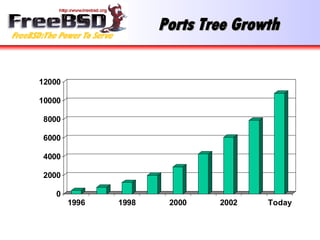
Third Party Packages FreeBSD has over 10,500 applications available as binary packages Linux has similar number of applications available in a number of different binary formats (RPM, Deb, and others, depending on the distribution). Packages are built from the “ports tree” of which more later FreeBSD and Linux roughly equal in this respect...
Ports Tree Growth
Linux Compatability FreeBSD runs 95%+ of Linux binary applications unchanged Oracle VMWare Netscape RealPlayer Flash NetBackup Quake III …
FreeBSD for Development The source code is a great reference Run standard development tools gcc gdb ddd (x)emacs make
FreeBSD on the Desktop GNOME KDE StarOffice Netscape WordPerfect VMWare GIMP XMMS CD recording MP3 ripping Gnutella / Napster Afterstep / Enlightenment / Sawfish / BlackBox / IceWM … A great server OS is a great desktop OS FreeBSD runs all the desktop apps you’re familiar with
FreeBSD Technologies
The Build System The Ports System System Configuration Linux Compatability Filesystem Research …  and more
The Build System
Building World The entire operating system, including all libraries and utilities can be built with a single command : “make world” The source code for the system is placed in /usr/src during installation. Much easier to secure a system if a bug is found in a key library like OpenSSL. More information in build(7) and Handbook.
Building Releases You can even build a complete release of FreeBSD, including FTP install directories, floppy images, and ISO images for CDROMs with one command. “ make release” is used by many large companies to produce special versions of FreeBSD with special patches or additional software installed by default. It is also the well documented way in which the release engineering team makes all official releases of FreeBSD.
Release Engineering “ make release” makes it much easier to deploy thousands of systems pre-configured for a specific environment. The release engineering team for FreeBSD publishes schedules, identifies QA issues that must be resolved before release, and publishes documents to help other people build FreeBSD based products. See release(7) and www.freebsd.org/releng
Linux Compatability
Running a FreeBSD binary Code like fd = open(“/etc/passwd”, O_RDONLY); Becomes syscall(5, ...) Kernel knows it’s a FreeBSD binary, uses freebsd_syscalls[] array freebsd_syscalls[5] = freebsd_open(…); File is opened
Running a Linux binary Code like fd = open(“/etc/passwd”, O_RDONLY); Becomes syscall(5, ...) Kernel knows it’s a Linux binary, uses linux_syscalls[] array linux_syscalls[5] = linux_open(…); File is opened All Linux file operations redirected to /compat/linux first
Running Linux binaries No slowdown; this is  not  emulation Efficiency of TCP/IP and VM system means some Linux apps run  faster SCO (ibcs2) compatibility handled in the same way
More Information http://www. freebsdchina .org http://www. freebsd .org http://www. freebsd .org/docs.html FreeBSD Handbook (Chinese translation available) Local User Groups, Mailing lists Visit our table in the hallway.
Questions?

FreeBSD - LinuxExpo

  • 1.
    FreeBSD in theEnterprise An Introduction for Linux Users Murray Stokely [email_address]
  • 2.
    FreeBSD in anutshell Freely available Unix-like operating system Runs on x86, Alpha, Sparc64, IA-64, AMD64 architectures Over 10,000 software packages available Many commercial users Thousands of developers around the world contributing to it Used as an operating systems research platform So far, so Linux...
  • 3.
    FreeBSD History BSDdeveloped at University of California, Berkeley, as alterations to AT&T Unix Initial implementation of key Unix concepts, such as sockets, virtual memory, and TCP/IP 386BSD developed to implement BSD Unix on x86 architecture in early 1990s FreeBSD developed from 386BSD project (as did NetBSD) Now has 350+ active developers, and 1,000's of contributors
  • 4.
    Places you’ll findFreeBSD Powering websites Yahoo! Sony Japan Netcraft NTT/Verio “ Grunt work” Disney Manex VFX NASA ISPs UUNet, Pair, Demon, EasyNet, … Embedded Systems IBM Intel Nokia Checkpoint Juniper Networks Coyote Other operating systems Mac OS X Embedded
  • 5.
    Enterprise Use FreeBSDis used by some of the largest banks in the world to process over 1.5 trillion US Dollars (12,300,000,000,000 RMB) of business to business transactions per year. Perl, Apache, X11, and other Open Source software also used in this application. FreeBSD Jails used for system security.
  • 6.
    Factors that HelpStability Source availability for helping understand and fix problems that occur (having the source to the system helps you understand why your application does not do what you expect) Excellent performance Easy hardware upgrade paths The application is spread over many servers. Need more power in one part? Add more FreeBSD boxes. PC hardware sometimes is less than perfect, but at PC hardware prices, hot spares are practical.
  • 7.
    Internet Infrastructure BSDhas existed since the last 1970's and was the testbed and reference implementation for TCP/IP. The Internet Software Consortium (ISC) uses FreeBSD exclusively for f-root domain servers (in 21 cities now, usually with 3 servers per city). Modern FreeBSD is extremely refined and mature. FreeBSD consistently placed at the top of the "uptime" lists produced by Netcraft to measure the stability of the world's busiest websites.
  • 8.
  • 9.
    FreeBSD Licensing ModelFreeBSD distributed under "2 clause" BSD license Copyright © [year] [name] All rights reserved Redistribution in source and binary forms, with or without modification, are permitted, provided that the following conditions are met: 1. Redistribution of source code must retain the above copyright notice, this list of conditions, and the disclaimer. 2. Redistributions in binary form must reproduce the above copyright notice, this list of conditions, and the following disclaimer in the documentation and/or other materials provided with the distribution. THIS SOFTWARE IS PROVIDED BY THE AUTHOR AND CONTRIBUTORS "AS IS", AND ANY EXPRESS OR IMPLIED LIMITED WARANTIES...
  • 10.
    FreeBSD Licensing ModelDon't claim that you wrote the code Don't blame us if the code doesn't work Apart from that, do anything you want with the code
  • 11.
    The GPL andBSD Licenses The GPL mandates that source code be disclosed The BSD License allows source code changes to be kept secret GPL is often categorised as "Copyleft", as distinct from "Copyright" BSD License is "Copycentre". We actively encourage third parties to use the source code. Donating changes back is purely at the discretion of the party making the changes
  • 12.
    Source Code ControlThe entire source code for FreeBSD is stored in a CVS repository The logs, and individual changes for each file can be traced back to 1994. The source tree can be checked out at any state, or corresponding to any release CDs are available taking the history back a further 20 years
  • 13.
    Source Code ControlChanges to the FreeBSD tree are available in a number of ways (CVS, CVSup, CTM (e-mail), Web) It is possible to maintain a local mirror of the complete CVS tree You can 'tag' a local copy of the tree as buildable, and then selectively include changes from FreeBSD
  • 14.
    Source Code DistributionFreeBSD Source Code Available on CD (freebsdmall.com, others) Can be downloaded from ftp.freebsd.org Changes to the source code Can be updated using CVS Can be updated using CVSup (faster CVS) Changes can be automatically e-mailed in, and integrated with your local source tree Can be browsed, with history, on the web, at http://www.freebsd.org/cgi/cvsweb.cgi
  • 15.
    Development Organization Twolayers of FreeBSD organization The committers, and everyone else Committers have write access to the source tree Everyone else submits patches or bug reports using FreeBSD's problem reporting system, and waits for a committer to commit the change Individuals who submit many patches (that work) are invited to become committers 9 committers form the elected "core team", for dispute resolution
  • 16.
    Development Organization Sourcecode 9 core team Thousands of contributors 300+ committers
  • 17.
    FreeBSD is acomplete OS FreeBSD consists of all the components needed for a complete operating system kernel compiler include files libraries user-land utilities Kernel and userland are kept synchronized, and can be built, from source, as a unit
  • 18.
    FreeBSD Release ModelFreeBSD releases maintained using CVS branches Head of the tree (-current) is now FreeBSD 6.0 When 4.0 came out, a branch was created for “4-STABLE” and minor releases up to 4.10 happened every 4 months. These minor releases (4.1, 4.2, etc) consist of bug fixes backported from -current, and new features in -current that have been extensively tested 5.0 process was a little different, and was not declared 5-STABLE until 5.3, due to the number of advanced new features and reimplementation of SMP introduced in FreeBSD 5.
  • 19.
    FreeBSD Release ModelMarch 2000, FreeBSD 4.0
  • 20.
    FreeBSD Release ModelFreeBSD-Current (will become 5.0) March 2000, FreeBSD 4.0 FreeBSD-Stable
  • 21.
    FreeBSD Release ModelFreeBSD-Current (will become 5.0) March 2000, FreeBSD 4.0 FreeBSD-Stable 4.2, November 2000 4.1.1, September 2000 (crypto) 4.1, July 2000 4.3, April 2001
  • 22.
    Third Party PackagesFreeBSD has over 10,500 applications available as binary packages Linux has similar number of applications available in a number of different binary formats (RPM, Deb, and others, depending on the distribution). Packages are built from the “ports tree” of which more later FreeBSD and Linux roughly equal in this respect...
  • 23.
  • 24.
    Linux Compatability FreeBSDruns 95%+ of Linux binary applications unchanged Oracle VMWare Netscape RealPlayer Flash NetBackup Quake III …
  • 25.
    FreeBSD for DevelopmentThe source code is a great reference Run standard development tools gcc gdb ddd (x)emacs make
  • 26.
    FreeBSD on theDesktop GNOME KDE StarOffice Netscape WordPerfect VMWare GIMP XMMS CD recording MP3 ripping Gnutella / Napster Afterstep / Enlightenment / Sawfish / BlackBox / IceWM … A great server OS is a great desktop OS FreeBSD runs all the desktop apps you’re familiar with
  • 27.
  • 28.
    The Build SystemThe Ports System System Configuration Linux Compatability Filesystem Research … and more
  • 29.
  • 30.
    Building World Theentire operating system, including all libraries and utilities can be built with a single command : “make world” The source code for the system is placed in /usr/src during installation. Much easier to secure a system if a bug is found in a key library like OpenSSL. More information in build(7) and Handbook.
  • 31.
    Building Releases Youcan even build a complete release of FreeBSD, including FTP install directories, floppy images, and ISO images for CDROMs with one command. “ make release” is used by many large companies to produce special versions of FreeBSD with special patches or additional software installed by default. It is also the well documented way in which the release engineering team makes all official releases of FreeBSD.
  • 32.
    Release Engineering “make release” makes it much easier to deploy thousands of systems pre-configured for a specific environment. The release engineering team for FreeBSD publishes schedules, identifies QA issues that must be resolved before release, and publishes documents to help other people build FreeBSD based products. See release(7) and www.freebsd.org/releng
  • 33.
  • 34.
    Running a FreeBSDbinary Code like fd = open(“/etc/passwd”, O_RDONLY); Becomes syscall(5, ...) Kernel knows it’s a FreeBSD binary, uses freebsd_syscalls[] array freebsd_syscalls[5] = freebsd_open(…); File is opened
  • 35.
    Running a Linuxbinary Code like fd = open(“/etc/passwd”, O_RDONLY); Becomes syscall(5, ...) Kernel knows it’s a Linux binary, uses linux_syscalls[] array linux_syscalls[5] = linux_open(…); File is opened All Linux file operations redirected to /compat/linux first
  • 36.
    Running Linux binariesNo slowdown; this is not emulation Efficiency of TCP/IP and VM system means some Linux apps run faster SCO (ibcs2) compatibility handled in the same way
  • 37.
    More Information http://www.freebsdchina .org http://www. freebsd .org http://www. freebsd .org/docs.html FreeBSD Handbook (Chinese translation available) Local User Groups, Mailing lists Visit our table in the hallway.
  • 38.