1
W
Systems Modeling - Game
Theory and Mechanism Design
Systems Integration and Testing
(INSE 6421)
2020
1
W
2
Overview
◆ Game Theory
◆ Standard Representations
◆ Solution Concepts
◆ Mixed Strategies
◆ Mechanism Design
2
W
Game Theory
◆ The science of studying and analyzing
rational behavior in interactive
situations
◆ A formal study of decision-making
where several systems must make
choices that potentially affect the
interest of the other systems
3
3
W
Game Theory
◆ The formal study of conflict and
cooperation among systems
◆ It provides a framework to formulate,
structure, and analyze strategic scenarios
◆ Strategic situation is a setting where the
outcome that effects you, are not only
dependent on your actions but on actions
of others
4
4
2
W
History
◆ 1944- John von Neumann and Oskar
Morgenstern
◆ Theory of Games and Economic Behavior
◆ 1950- John Nash
◆ Nash Equilibrium
◆ Awarded Nobel prize in 1994
◆ 1953- Lloyd Shapley
◆ The notions of the Core and Shapley Value
◆ Awarded Nobel prize in 2012
◆ 2007- Jean Tirole
◆ Awarded Nobel prize in 2014
5
5
W Classification
6
6
W
7
Example: TCP Backoff Game
◆ Should you send your packets using
correctly-implemented TCP which has a
“backoff” mechanism, or using a defective
implementation, which doesn’t?
◆ An example of a two-player game:
◆ Both players use a correct implementation: both
get 1 ms delay
◆ One correct, one defective: 4 ms for correct, 0 ms
for defective
◆ Both defective: both get a 3 ms delay.
7
W
Example: TCP Backoff Game
◆ Some relevant questions for further to discussion:
◆ Would all users behave the same?
◆ For what changes to the numbers would behavior be
the same?
◆ What effect would communication have?
◆ Is playing the game in a repeated way would make a
difference?
◆ Does it matter if I believe that my opponent is
rational?
8
8
3
W
Self-Interested Agents
◆ Each self-interested agent has a utility
function that:
◆ quantifies degree of preference across
alternatives
◆ explains the impact of uncertainty
◆ Decision-theoretic rationality: act to
maximize expected utility
9
9
W Game Components
◆ Players: who are the decision makers?
◆ People? Governments? Companies? Intelligent
Systems ...
◆ Actions: what can the players do?
◆ Enter a bid in an auction? Decide whether to end
a strike? Decide when to sell a stock? Decide how
to vote? Decide to cooperate?
◆ Payoffs: what motivates players?
◆ Do they care about some profit? Do they care
about other players?...
10
10
W
11
Overview
◆ ü Game Theory
◆ Standard Representations
◆ Solution Concepts
◆ Mixed Strategies
◆ Mechanism Design
11
W Two Standard Representations (1)
◆ Normal Form specifies:
◆ payoffs players get as a function of their
actions
◆ Players move simultaneously
◆ Normal form has two other names:
Matrix Form, and Strategic Form
12
12
4
W Two Standard Representations (2)
◆ Extensive Form Includes timing of
moves
◆ Players move sequentially, represented as
a tree
◆ Chess: white player moves, then black
player can see white’s move and react...
◆ Stackelberg game: the leader moves first
and then the followers move sequentially
◆ Keeps track of what each player knows
when she makes each decision
13
13
W
Normal Form Game
14
14
W
Normal Form Game
◆ Writing a 2-player game as a matrix:
◆ “Row” player is player 1;
◆ “Column” player is player 2
◆ Rows correspond to actions a1 ∈ A1
◆ Columns correspond to actions a2 ∈ A2
◆ Cells listing utility or payoff values for each
player: the row player first, then the column
15
15
W
Matrix Form
◆ TCP Backoff game
16
16
5
W
Matrix Form
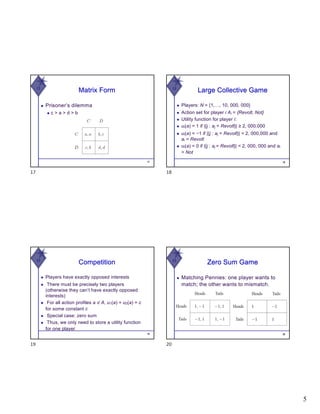
◆ Prisoner’s dilemma
◆ c > a > d > b
17
17
W
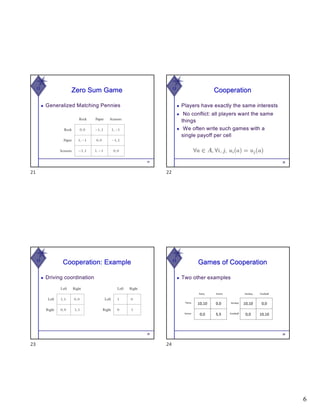
Large Collective Game
◆ Players: N = {1,…, 10, 000, 000}
◆ Action set for player i Ai = {Revolt, Not}
◆ Utility function for player i:
◆ ui(a) = 1 if |{j : aj = Revolt}| ≥ 2, 000,000
◆ ui(a) = −1 if |{j : aj = Revolt}| < 2, 000,000 and
ai = Revolt
◆ ui(a) = 0 if |{j : aj = Revolt}| < 2, 000, 000 and ai
= Not
18
18
W
Competition
◆ Players have exactly opposed interests
◆ There must be precisely two players
(otherwise they can’t have exactly opposed
interests)
◆ For all action profiles a ∈ A, u1(a) + u2(a) = c
for some constant c
◆ Special case: zero sum
◆ Thus, we only need to store a utility function
for one player
19
19
W
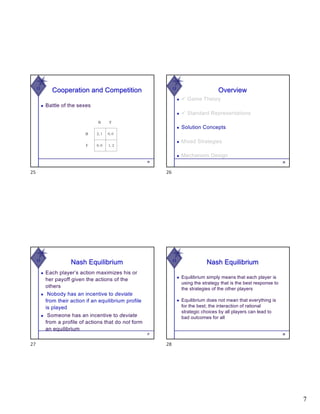
Zero Sum Game
◆ Matching Pennies: one player wants to
match; the other wants to mismatch.
20
20
6
W
Zero Sum Game
◆ Generalized Matching Pennies
21
21
W
Cooperation
◆ Players have exactly the same interests
◆ No conflict: all players want the same
things
◆ We often write such games with a
single payoff per cell
22
22
W
Cooperation: Example
◆ Driving coordination
23
23
W
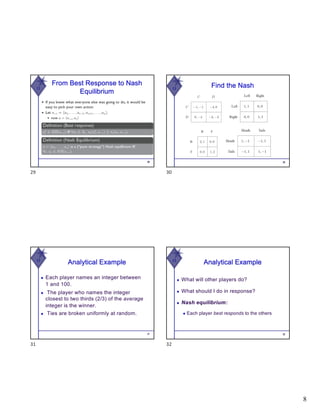
Games of Cooperation
◆ Two other examples
24
24
7
W
Cooperation and Competition
◆ Battle of the sexes
25
25
W
26
Overview
◆ ü Game Theory
◆ ü Standard Representations
◆ Solution Concepts
◆ Mixed Strategies
◆ Mechanism Design
26
W
Nash Equilibrium
◆ Each player’s action maximizes his or
her payoff given the actions of the
others
◆ Nobody has an incentive to deviate
from their action if an equilibrium profile
is played
◆ Someone has an incentive to deviate
from a profile of actions that do not form
an equilibrium
27
27
W
Nash Equilibrium
◆ Equilibrium simply means that each player is
using the strategy that is the best response to
the strategies of the other players
◆ Equilibrium does not mean that everything is
for the best; the interaction of rational
strategic choices by all players can lead to
bad outcomes for all
28
28
8
W
From Best Response to Nash
Equilibrium
29
29
W
Find the Nash
30
30
W
Analytical Example
◆ Each player names an integer between
1 and 100.
◆ The player who names the integer
closest to two thirds (2/3) of the average
integer is the winner.
◆ Ties are broken uniformly at random.
31
31
W
◆ What will other players do?
◆ What should I do in response?
◆ Nash equilibrium:
◆ Each player best responds to the others
32
Analytical Example
32
9
W Solving the Game
◆ Suppose a player believes the average play will be X
(including her own integer). That player’s optimal
strategy is to say the closest integer to 2/3X.
◆ X has to be less than 100, so the optimal strategy of any
player has to be no more than 67.
◆ If X is no more than 67, then the optimal strategy of any
player has to be no more than 2/3 * 67.
◆ If X is no more than 2/3* 67, then the optimal strategy of
any player has to be no more than (2/3)2*67.
◆ Iterating, the unique Nash equilibrium of this game is for
every player to announce 1!
33
33
W Observation: First Time
34
34
W
35
Observation: Second Time
35
W
Dominant Strategy
36
36
10
W
Dominant Strategy
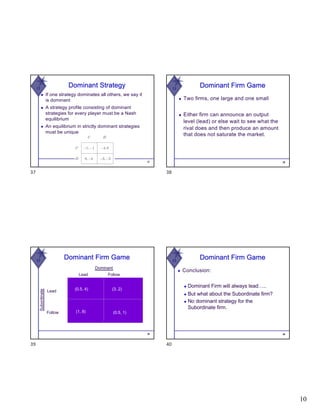
◆ If one strategy dominates all others, we say it
is dominant
◆ A strategy profile consisting of dominant
strategies for every player must be a Nash
equilibrium
◆ An equilibrium in strictly dominant strategies
must be unique
37
37
W
38
Dominant Firm Game
◆ Two firms, one large and one small
◆ Either firm can announce an output
level (lead) or else wait to see what the
rival does and then produce an amount
that does not saturate the market.
38
W
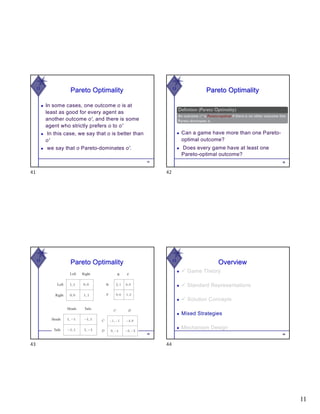
Dominant Firm Game
Lead Follow
Subordinate
Dominant
Lead
Follow
(0.5, 4)
(1, 8)
(3, 2)
(0.5, 1)
39
39
W
40
◆ Conclusion:
◆ Dominant Firm will always lead…..
◆ But what about the Subordinate firm?
◆ No dominant strategy for the
Subordinate firm.
Dominant Firm Game
40
11
W
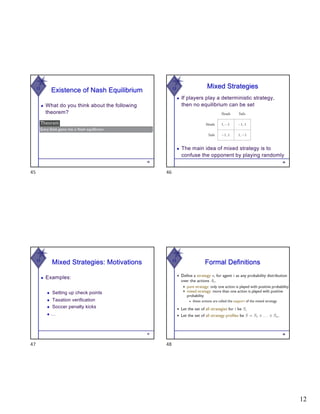
Pareto Optimality
◆ In some cases, one outcome o is at
least as good for every agent as
another outcome o′, and there is some
agent who strictly prefers o to o′
◆ In this case, we say that o is better than
o′
◆ we say that o Pareto-dominates o′.
41
41
W
Pareto Optimality
◆ Can a game have more than one Pareto-
optimal outcome?
◆ Does every game have at least one
Pareto-optimal outcome?
42
42
W
Pareto Optimality
43
43
W
44
Overview
◆ ü Game Theory
◆ ü Standard Representations
◆ ü Solution Concepts
◆ Mixed Strategies
◆ Mechanism Design
44
12
W
Existence of Nash Equilibrium
◆ What do you think about the following
theorem?
45
45
W Mixed Strategies
◆ If players play a deterministic strategy,
then no equilibrium can be set
46
◆ The main idea of mixed strategy is to
confuse the opponent by playing randomly
46
W
Mixed Strategies: Motivations
◆ Examples:
◆ Setting up check points
◆ Taxation verification
◆ Soccer penalty kicks
◆ …
47
47
W
Formal Definitions
48
48
13
W Formal Definitions
◆ Problem: How to represent the payoff if all the
players follow mixed strategy profile s ∈ S?
◆ We cannot read this number from the game
matrix anymore
◆ Solution: use the idea of expected utility from
decision theory:
49
49
W
50
Best Response and Nash
◆ Generalization from actions to strategies
50
W Examples
51
51
W
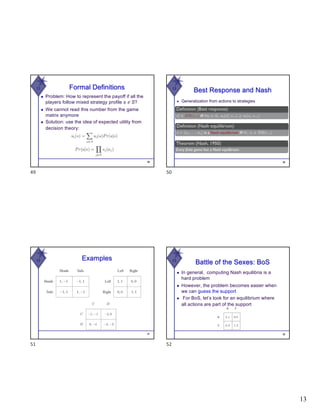
Battle of the Sexes: BoS
◆ In general, computing Nash equilibria is a
hard problem
◆ However, the problem becomes easier when
we can guess the support
◆ For BoS, let’s look for an equilibrium where
all actions are part of the support
52
52
14
W Indifference Observation
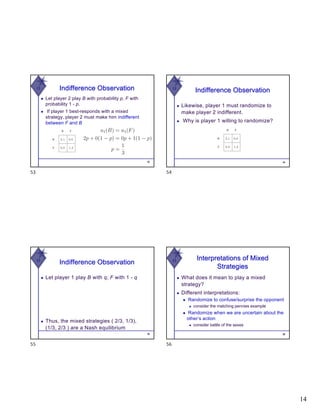
◆ Let player 2 play B with probability p, F with
probability 1 - p.
◆ If player 1 best-responds with a mixed
strategy, player 2 must make him indifferent
between F and B
53
53
W
Indifference Observation
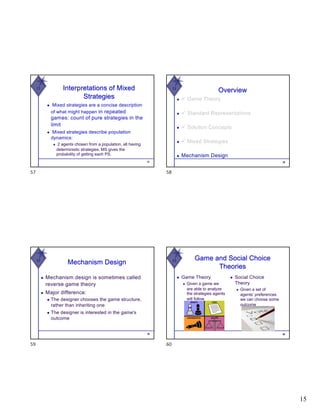
◆ Likewise, player 1 must randomize to
make player 2 indifferent.
◆ Why is player 1 willing to randomize?
54
54
W
Indifference Observation
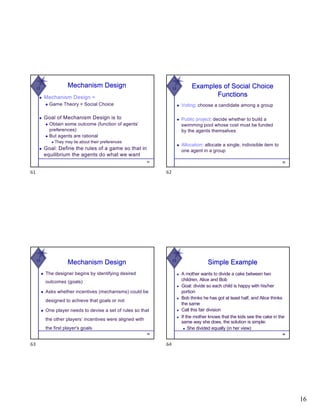
◆ Let player 1 play B with q, F with 1 - q
55
◆ Thus, the mixed strategies ( 2/3, 1/3),
(1/3, 2/3 ) are a Nash equilibrium
55
W Interpretations of Mixed
Strategies
◆ What does it mean to play a mixed
strategy?
◆ Different interpretations:
◆ Randomize to confuse/surprise the opponent
◆ consider the matching pennies example
◆ Randomize when we are uncertain about the
other’s action
◆ consider battle of the sexes
56
56
15
W
◆ Mixed strategies are a concise description
of what might happen in repeated
games: count of pure strategies in the
limit
◆ Mixed strategies describe population
dynamics:
◆ 2 agents chosen from a population, all having
deterministic strategies. MS gives the
probability of getting each PS.
57
Interpretations of Mixed
Strategies
57
W
58
Overview
◆ ü Game Theory
◆ ü Standard Representations
◆ ü Solution Concepts
◆ ü Mixed Strategies
◆ Mechanism Design
58
W
Mechanism Design
◆ Mechanism design is sometimes called
reverse game theory
◆ Major difference:
◆ The designer chooses the game structure,
rather than inheriting one
◆ The designer is interested in the game's
outcome
59
59
W
◆ Game Theory
◆ Given a game we
are able to analyze
the strategies agents
will follow
◆ Social Choice
Theory
◆ Given a set of
agents’ preferences
we can choose some
outcome
60
Game and Social Choice
Theories
60
16
W
◆ Mechanism Design =
◆ Game Theory + Social Choice
◆ Goal of Mechanism Design is to
◆ Obtain some outcome (function of agents’
preferences)
◆ But agents are rational
◆ They may lie about their preferences
◆ Goal: Define the rules of a game so that in
equilibrium the agents do what we want
61
Mechanism Design
61
W Examples of Social Choice
Functions
◆ Voting: choose a candidate among a group
◆ Public project: decide whether to build a
swimming pool whose cost must be funded
by the agents themselves
◆ Allocation: allocate a single, indivisible item to
one agent in a group
62
62
W
Mechanism Design
◆ The designer begins by identifying desired
outcomes (goals)
◆ Asks whether incentives (mechanisms) could be
designed to achieve that goals or not
◆ One player needs to devise a set of rules so that
the other players’ incentives were aligned with
the first player's goals
63
63
W
Simple Example
◆ A mother wants to divide a cake between two
children, Alice and Bob
◆ Goal: divide so each child is happy with his/her
portion
◆ Bob thinks he has got at least half, and Alice thinks
the same
◆ Call this fair division
◆ If the mother knows that the kids see the cake in the
same way she does, the solution is simple:
◆ She divided equally (in her view)
64
64
17
W
Simple Example
◆ But what if, say Bob sees the cake differently from
the mother?
◆ The mother thinks she has divided the cake equally
◆ But Bob thinks his piece is smaller than Alice’s
◆ Difficulty: The mother wants to achieve fair division
◆ But she does not have enough information to do
this on her own
◆ In effect, doesn’t know which division is fair
65
65
W
Simple Example
◆ Can the mother design a mechanism
(procedure) for which outcome will be
fair division? (even though she doesn’t
know what is fair herself)
◆ It is a very old problem and there is a
solution
66
66
W
Simple Example
◆ Have Bob divide the cake in two
◆ Have Alice choose one of the pieces
◆ Why does it work:
◆ Bob will divide so that pieces are equal in his eyes
◆ If one of pieces were bigger, then Alice would take that
one
◆ So whichever piece Alice takes, Bob will be happy with
the other
◆ And Alice will be happy with her choice because if she
thinks pieces are unequal, she can take the bigger one
67
67

Topic 2 (4 slides).pdf

  • 1.
    1 W Systems Modeling -Game Theory and Mechanism Design Systems Integration and Testing (INSE 6421) 2020 1 W 2 Overview ◆ Game Theory ◆ Standard Representations ◆ Solution Concepts ◆ Mixed Strategies ◆ Mechanism Design 2 W Game Theory ◆ The science of studying and analyzing rational behavior in interactive situations ◆ A formal study of decision-making where several systems must make choices that potentially affect the interest of the other systems 3 3 W Game Theory ◆ The formal study of conflict and cooperation among systems ◆ It provides a framework to formulate, structure, and analyze strategic scenarios ◆ Strategic situation is a setting where the outcome that effects you, are not only dependent on your actions but on actions of others 4 4
  • 2.
    2 W History ◆ 1944- Johnvon Neumann and Oskar Morgenstern ◆ Theory of Games and Economic Behavior ◆ 1950- John Nash ◆ Nash Equilibrium ◆ Awarded Nobel prize in 1994 ◆ 1953- Lloyd Shapley ◆ The notions of the Core and Shapley Value ◆ Awarded Nobel prize in 2012 ◆ 2007- Jean Tirole ◆ Awarded Nobel prize in 2014 5 5 W Classification 6 6 W 7 Example: TCP Backoff Game ◆ Should you send your packets using correctly-implemented TCP which has a “backoff” mechanism, or using a defective implementation, which doesn’t? ◆ An example of a two-player game: ◆ Both players use a correct implementation: both get 1 ms delay ◆ One correct, one defective: 4 ms for correct, 0 ms for defective ◆ Both defective: both get a 3 ms delay. 7 W Example: TCP Backoff Game ◆ Some relevant questions for further to discussion: ◆ Would all users behave the same? ◆ For what changes to the numbers would behavior be the same? ◆ What effect would communication have? ◆ Is playing the game in a repeated way would make a difference? ◆ Does it matter if I believe that my opponent is rational? 8 8
  • 3.
    3 W Self-Interested Agents ◆ Eachself-interested agent has a utility function that: ◆ quantifies degree of preference across alternatives ◆ explains the impact of uncertainty ◆ Decision-theoretic rationality: act to maximize expected utility 9 9 W Game Components ◆ Players: who are the decision makers? ◆ People? Governments? Companies? Intelligent Systems ... ◆ Actions: what can the players do? ◆ Enter a bid in an auction? Decide whether to end a strike? Decide when to sell a stock? Decide how to vote? Decide to cooperate? ◆ Payoffs: what motivates players? ◆ Do they care about some profit? Do they care about other players?... 10 10 W 11 Overview ◆ ü Game Theory ◆ Standard Representations ◆ Solution Concepts ◆ Mixed Strategies ◆ Mechanism Design 11 W Two Standard Representations (1) ◆ Normal Form specifies: ◆ payoffs players get as a function of their actions ◆ Players move simultaneously ◆ Normal form has two other names: Matrix Form, and Strategic Form 12 12
  • 4.
    4 W Two StandardRepresentations (2) ◆ Extensive Form Includes timing of moves ◆ Players move sequentially, represented as a tree ◆ Chess: white player moves, then black player can see white’s move and react... ◆ Stackelberg game: the leader moves first and then the followers move sequentially ◆ Keeps track of what each player knows when she makes each decision 13 13 W Normal Form Game 14 14 W Normal Form Game ◆ Writing a 2-player game as a matrix: ◆ “Row” player is player 1; ◆ “Column” player is player 2 ◆ Rows correspond to actions a1 ∈ A1 ◆ Columns correspond to actions a2 ∈ A2 ◆ Cells listing utility or payoff values for each player: the row player first, then the column 15 15 W Matrix Form ◆ TCP Backoff game 16 16
  • 5.
    5 W Matrix Form ◆ Prisoner’sdilemma ◆ c > a > d > b 17 17 W Large Collective Game ◆ Players: N = {1,…, 10, 000, 000} ◆ Action set for player i Ai = {Revolt, Not} ◆ Utility function for player i: ◆ ui(a) = 1 if |{j : aj = Revolt}| ≥ 2, 000,000 ◆ ui(a) = −1 if |{j : aj = Revolt}| < 2, 000,000 and ai = Revolt ◆ ui(a) = 0 if |{j : aj = Revolt}| < 2, 000, 000 and ai = Not 18 18 W Competition ◆ Players have exactly opposed interests ◆ There must be precisely two players (otherwise they can’t have exactly opposed interests) ◆ For all action profiles a ∈ A, u1(a) + u2(a) = c for some constant c ◆ Special case: zero sum ◆ Thus, we only need to store a utility function for one player 19 19 W Zero Sum Game ◆ Matching Pennies: one player wants to match; the other wants to mismatch. 20 20
  • 6.
    6 W Zero Sum Game ◆Generalized Matching Pennies 21 21 W Cooperation ◆ Players have exactly the same interests ◆ No conflict: all players want the same things ◆ We often write such games with a single payoff per cell 22 22 W Cooperation: Example ◆ Driving coordination 23 23 W Games of Cooperation ◆ Two other examples 24 24
  • 7.
    7 W Cooperation and Competition ◆Battle of the sexes 25 25 W 26 Overview ◆ ü Game Theory ◆ ü Standard Representations ◆ Solution Concepts ◆ Mixed Strategies ◆ Mechanism Design 26 W Nash Equilibrium ◆ Each player’s action maximizes his or her payoff given the actions of the others ◆ Nobody has an incentive to deviate from their action if an equilibrium profile is played ◆ Someone has an incentive to deviate from a profile of actions that do not form an equilibrium 27 27 W Nash Equilibrium ◆ Equilibrium simply means that each player is using the strategy that is the best response to the strategies of the other players ◆ Equilibrium does not mean that everything is for the best; the interaction of rational strategic choices by all players can lead to bad outcomes for all 28 28
  • 8.
    8 W From Best Responseto Nash Equilibrium 29 29 W Find the Nash 30 30 W Analytical Example ◆ Each player names an integer between 1 and 100. ◆ The player who names the integer closest to two thirds (2/3) of the average integer is the winner. ◆ Ties are broken uniformly at random. 31 31 W ◆ What will other players do? ◆ What should I do in response? ◆ Nash equilibrium: ◆ Each player best responds to the others 32 Analytical Example 32
  • 9.
    9 W Solving theGame ◆ Suppose a player believes the average play will be X (including her own integer). That player’s optimal strategy is to say the closest integer to 2/3X. ◆ X has to be less than 100, so the optimal strategy of any player has to be no more than 67. ◆ If X is no more than 67, then the optimal strategy of any player has to be no more than 2/3 * 67. ◆ If X is no more than 2/3* 67, then the optimal strategy of any player has to be no more than (2/3)2*67. ◆ Iterating, the unique Nash equilibrium of this game is for every player to announce 1! 33 33 W Observation: First Time 34 34 W 35 Observation: Second Time 35 W Dominant Strategy 36 36
  • 10.
    10 W Dominant Strategy ◆ Ifone strategy dominates all others, we say it is dominant ◆ A strategy profile consisting of dominant strategies for every player must be a Nash equilibrium ◆ An equilibrium in strictly dominant strategies must be unique 37 37 W 38 Dominant Firm Game ◆ Two firms, one large and one small ◆ Either firm can announce an output level (lead) or else wait to see what the rival does and then produce an amount that does not saturate the market. 38 W Dominant Firm Game Lead Follow Subordinate Dominant Lead Follow (0.5, 4) (1, 8) (3, 2) (0.5, 1) 39 39 W 40 ◆ Conclusion: ◆ Dominant Firm will always lead….. ◆ But what about the Subordinate firm? ◆ No dominant strategy for the Subordinate firm. Dominant Firm Game 40
  • 11.
    11 W Pareto Optimality ◆ Insome cases, one outcome o is at least as good for every agent as another outcome o′, and there is some agent who strictly prefers o to o′ ◆ In this case, we say that o is better than o′ ◆ we say that o Pareto-dominates o′. 41 41 W Pareto Optimality ◆ Can a game have more than one Pareto- optimal outcome? ◆ Does every game have at least one Pareto-optimal outcome? 42 42 W Pareto Optimality 43 43 W 44 Overview ◆ ü Game Theory ◆ ü Standard Representations ◆ ü Solution Concepts ◆ Mixed Strategies ◆ Mechanism Design 44
  • 12.
    12 W Existence of NashEquilibrium ◆ What do you think about the following theorem? 45 45 W Mixed Strategies ◆ If players play a deterministic strategy, then no equilibrium can be set 46 ◆ The main idea of mixed strategy is to confuse the opponent by playing randomly 46 W Mixed Strategies: Motivations ◆ Examples: ◆ Setting up check points ◆ Taxation verification ◆ Soccer penalty kicks ◆ … 47 47 W Formal Definitions 48 48
  • 13.
    13 W Formal Definitions ◆Problem: How to represent the payoff if all the players follow mixed strategy profile s ∈ S? ◆ We cannot read this number from the game matrix anymore ◆ Solution: use the idea of expected utility from decision theory: 49 49 W 50 Best Response and Nash ◆ Generalization from actions to strategies 50 W Examples 51 51 W Battle of the Sexes: BoS ◆ In general, computing Nash equilibria is a hard problem ◆ However, the problem becomes easier when we can guess the support ◆ For BoS, let’s look for an equilibrium where all actions are part of the support 52 52
  • 14.
    14 W Indifference Observation ◆Let player 2 play B with probability p, F with probability 1 - p. ◆ If player 1 best-responds with a mixed strategy, player 2 must make him indifferent between F and B 53 53 W Indifference Observation ◆ Likewise, player 1 must randomize to make player 2 indifferent. ◆ Why is player 1 willing to randomize? 54 54 W Indifference Observation ◆ Let player 1 play B with q, F with 1 - q 55 ◆ Thus, the mixed strategies ( 2/3, 1/3), (1/3, 2/3 ) are a Nash equilibrium 55 W Interpretations of Mixed Strategies ◆ What does it mean to play a mixed strategy? ◆ Different interpretations: ◆ Randomize to confuse/surprise the opponent ◆ consider the matching pennies example ◆ Randomize when we are uncertain about the other’s action ◆ consider battle of the sexes 56 56
  • 15.
    15 W ◆ Mixed strategiesare a concise description of what might happen in repeated games: count of pure strategies in the limit ◆ Mixed strategies describe population dynamics: ◆ 2 agents chosen from a population, all having deterministic strategies. MS gives the probability of getting each PS. 57 Interpretations of Mixed Strategies 57 W 58 Overview ◆ ü Game Theory ◆ ü Standard Representations ◆ ü Solution Concepts ◆ ü Mixed Strategies ◆ Mechanism Design 58 W Mechanism Design ◆ Mechanism design is sometimes called reverse game theory ◆ Major difference: ◆ The designer chooses the game structure, rather than inheriting one ◆ The designer is interested in the game's outcome 59 59 W ◆ Game Theory ◆ Given a game we are able to analyze the strategies agents will follow ◆ Social Choice Theory ◆ Given a set of agents’ preferences we can choose some outcome 60 Game and Social Choice Theories 60
  • 16.
    16 W ◆ Mechanism Design= ◆ Game Theory + Social Choice ◆ Goal of Mechanism Design is to ◆ Obtain some outcome (function of agents’ preferences) ◆ But agents are rational ◆ They may lie about their preferences ◆ Goal: Define the rules of a game so that in equilibrium the agents do what we want 61 Mechanism Design 61 W Examples of Social Choice Functions ◆ Voting: choose a candidate among a group ◆ Public project: decide whether to build a swimming pool whose cost must be funded by the agents themselves ◆ Allocation: allocate a single, indivisible item to one agent in a group 62 62 W Mechanism Design ◆ The designer begins by identifying desired outcomes (goals) ◆ Asks whether incentives (mechanisms) could be designed to achieve that goals or not ◆ One player needs to devise a set of rules so that the other players’ incentives were aligned with the first player's goals 63 63 W Simple Example ◆ A mother wants to divide a cake between two children, Alice and Bob ◆ Goal: divide so each child is happy with his/her portion ◆ Bob thinks he has got at least half, and Alice thinks the same ◆ Call this fair division ◆ If the mother knows that the kids see the cake in the same way she does, the solution is simple: ◆ She divided equally (in her view) 64 64
  • 17.
    17 W Simple Example ◆ Butwhat if, say Bob sees the cake differently from the mother? ◆ The mother thinks she has divided the cake equally ◆ But Bob thinks his piece is smaller than Alice’s ◆ Difficulty: The mother wants to achieve fair division ◆ But she does not have enough information to do this on her own ◆ In effect, doesn’t know which division is fair 65 65 W Simple Example ◆ Can the mother design a mechanism (procedure) for which outcome will be fair division? (even though she doesn’t know what is fair herself) ◆ It is a very old problem and there is a solution 66 66 W Simple Example ◆ Have Bob divide the cake in two ◆ Have Alice choose one of the pieces ◆ Why does it work: ◆ Bob will divide so that pieces are equal in his eyes ◆ If one of pieces were bigger, then Alice would take that one ◆ So whichever piece Alice takes, Bob will be happy with the other ◆ And Alice will be happy with her choice because if she thinks pieces are unequal, she can take the bigger one 67 67