Game Theory


              Abu Bashar
What is game theory?
 Game     theory is the study of how optimal
  strategies are formulated in conflict.
 It is concerned with the requirement of decision
  making in situations where two or more rational
  opponents are involved under conditions of
  competition     and     conflicting    interests in
  anticipation of certain outcomes over a period of
  time.
Cont’d….
 In a competitive environment the strategies taken by
  the opponent organizations or individuals can
  dramatically affect the outcome of a particular
  decision by an organization.
 In the automobile industry, for example, the
  strategies of competitors to introduce certain models
  with certain features can dramatically affect the
  profitability of other carmakers.
 So in order to make important decisions in business,
  it is necessary to consider what other organizations
  or individuals are doing or might do.
 Game theory is a way to consider the impact of the
  strategies of one, on the strategies and outcomes of
  the other.
What is a GAME???
 A GAME refers to a situation in which two or more
    players are competing.
   It involves the players (decision makers) who have
    different goals or objectives.
   They are in a situation in which there may be a
    number of possible outcomes with different values to
    them.
   Although they might have some control that would
    influence the outcome, they do not have complete
    control over others.
   Unions striking against the company management,
    players in a chess game, firm striving for larger share
    of market are a few illustrations that can be viewed as
GAME THEORY MODELS
 Models in the theory of games can be classified
  depending upon the following factors:
 Number of Players
 Total Pay Off and
 Strategy
Number of players
  It is the number of competitive decision makers,
   involved in the game.
  A game involving two players is referred to as a
   “Two-person game”.
  However if the number of players is more ( say
   n>2 ) then the game is called an n-person game.
Total Payoff
 It is the sum of gains and losses from the game that
  are available to the players.
 If in a game sum of the gains to one player is exactly
  equal to the sum of losses to another player, so that
  the sum of the gains and losses equals zero then the
  game is said to be a zero-sum game.
 There are also games in which the sum of the
  players’ gains and losses does not equal zero, and
  these games are denoted as non-zero-sum games.
Strategy
 The strategy for a player is the set of alternative
  courses of action that he will take for every payoff
  (outcome) that might arise.
 It is assumed that the players know the rules
  governing the choices in advance.
 The different outcomes resulting from the choices
  are also known to the players in advance and are
  expressed in terms of the numerical values ( e.g.
  money, market share percentage etc. )
Strategy Cont’d..
 Strategy may be of two types:
 (a) Pure strategy
 If the players select the same strategy each time, then
  it is referred as pure – strategy. In this case each player
  knows exactly what the opponent is going to do and the
  objective of the players is to maximize gains or to
  minimize losses.
 (b) Mixed Strategy
 When the players use a combination of strategies with
  some fixed probabilities and each player kept guessing
  as to which course of action is to be selected by the
  other player at a particular occasion then this is known
  as mixed strategy.
TWO PERSON ZERO SUM GAME
 A game which involves only two players, say player A
  and player B, and where the gains made by one
  equals the loss incurred by the other is called a two
  person zero sum game.
 For example,
 If two chess players agree that at the end of the game
  the loser would pay Rs 50 to the winner then it would
  mean that the sum of the gains and losses equals
  zero.
 So it is a two person – zero sum game.
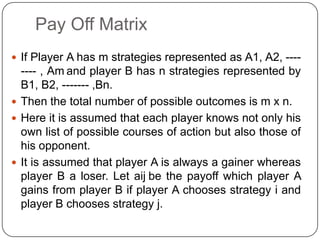
Pay Off Matrix
 If Player A has m strategies represented as A1, A2, ----
  ---- , Am and player B has n strategies represented by
  B1, B2, ------- ,Bn.
 Then the total number of possible outcomes is m x n.
 Here it is assumed that each player knows not only his
  own list of possible courses of action but also those of
  his opponent.
 It is assumed that player A is always a gainer whereas
  player B a loser. Let aij be the payoff which player A
  gains from player B if player A chooses strategy i and
  player B chooses strategy j.
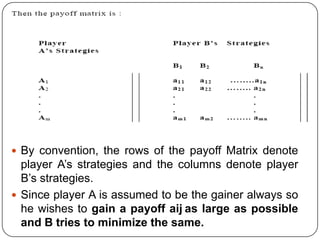
 By convention, the rows of the payoff Matrix denote
  player A’s strategies and the columns denote player
  B’s strategies.
 Since player A is assumed to be the gainer always so
  he wishes to gain a payoff aij as large as possible
  and B tries to minimize the same.
Now consider a simple game
 Suppose that there are two lighting fixture stores, X
  and Y. The respective market shares have been
  stable until now, but the situation then changes.
 The owner of store X has developed two distinct
  advertising strategies, one using radio spots and the
  other newspaper advertisements. Upon hearing this,
  the owner of store Y also proceeds to prepare radio
  and newspaper advertisements.
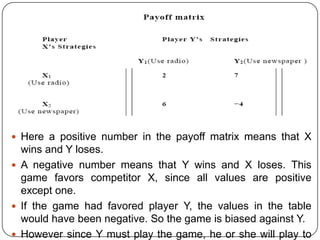
 Here a positive number in the payoff matrix means that X
  wins and Y loses.
 A negative number means that Y wins and X loses. This
  game favors competitor X, since all values are positive
  except one.
 If the game had favored player Y, the values in the table
  would have been negative. So the game is biased against Y.
 However since Y must play the game, he or she will play to
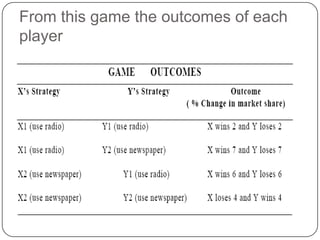
From this game the outcomes of each
player
ASSUMPTIONS OF THE GAME
 Each player has to choose from a finite number of
    possible strategies.
   The strategies for each player may or may not be the
    same.
   Player A always tries to maximize his gains and
    players B tries to minimize the losses.
   The decision by both the players is taken individually
    prior to the play without any communication between
    them.
   The decisions are made and announced
    simultaneously so that neither player has an
    advantage resulting from direct knowledge of the
    other player’s decision.
MINIMAX AND MAXIMIN
 PRINCIPLE
 The selection of an optimal strategy by each player
  without the knowledge of the competitor’s strategy is
  the basic problem in playing games.
 The objective of the study is to know how these
  players must select their respective strategies so that
  they could optimize their payoff.
 Such a decision making criterion is referred to as the
  minimax – maximin principle.
 For player A
 Minimum value in each row represents the least gain to
    him if he chooses that particular strategy.
   These are written in the matrix by row minima.
   He will then select the strategy that gives maximum gain
    among the row minimum values.
   This choice of player A is called the maximin criterion
    and the corresponding gain is called the maximin value
    of the game.
   Similarly, for player B
   who is assumed to be the loser, the maximum value in
    each column represents the maximum loss to him if he
    chooses his particular strategy.
   These are written as column maxima. He will select that
    strategy which gives minimum loss among the column
    maximum values. This choice of player B is called the
    minimax criterion, and the corresponding loss is the
Saddle Point
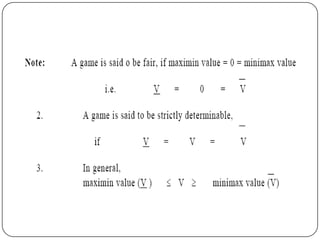
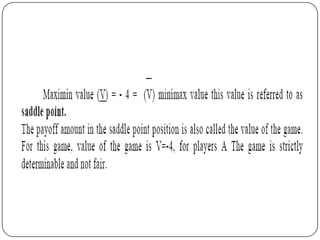
 If the maximin value equals the minimax value,
  then the game is said to have a saddle point and
  the corresponding strategies are called optimal
  strategies.
 The amount of payoff at an equilibrium point is
  known as the VALUE of the game. A game may
  have more than one saddle point or no saddle
  point.
Example of minimax – maximin principle
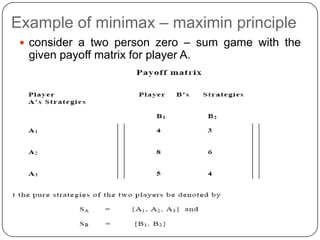
  consider a two person zero – sum game with the
  given payoff matrix for player A.
 Suppose that player A starts the game knowing that
    whatever strategy he adopts, B will select that particular
    counter strategy which will minimize the payoff to A.
   Thus if A selects the strategy A1 then B will select B2 as
    his corresponds to the minimum payoff to A
    corresponding to A1. Similarly, if A chooses the strategy
    A2, he may gain 8 or 6 depending upon the choice of B.
   If A chooses A2 then A can guarantee a gain of at least
    min {8,6} = 6 irrespective of the choice of B. Obviously A
    would prefer to maximize his minimum assured gains.
   In this example the selection of strategy A2 gives the
    maximum of the minimum gains to A.
   This gain is called as maximin value of the game and the
    corresponding strategy as maximum strategy.
RULES FOR DETERMINING A SADDLE
POINT
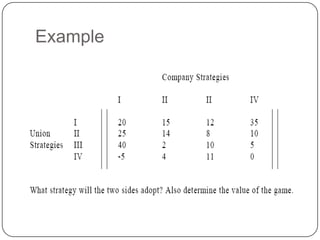
 STEP 1: Select the minimum element of each row of
  the payoff matrix and mark them as (O) . This is row
  minima of the respective row.
 STEP 2: Select the greatest element of each column
  of the payoff matrix and mark them as ( ) . This is
  column maxima of the respective column.
 STEP 3: If there appears an element in the payoff
  matrix marked with (O) and (         )both, then this
  element represents the value of the game and its
  position is a saddle point of the payoff matrix.
Example
Example
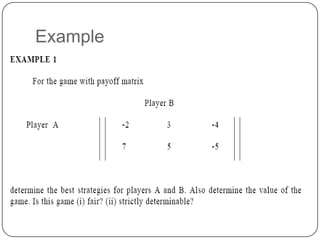
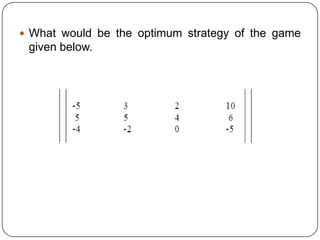
 What would be the optimum strategy of the game
 given below.
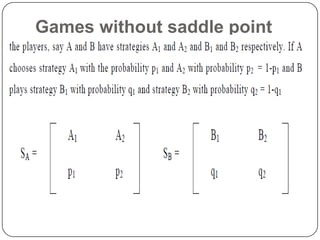
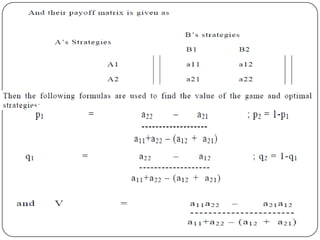
Games without saddle point
Example
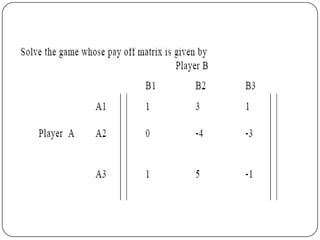
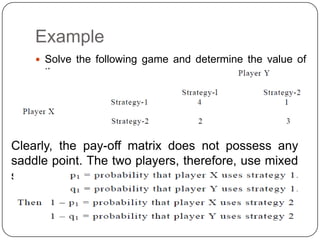
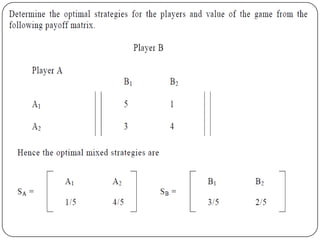
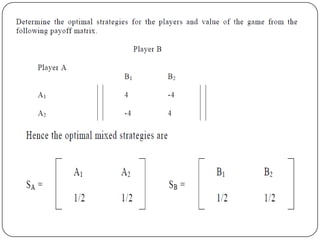
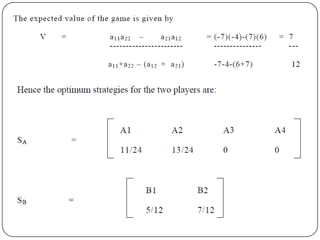
     Solve the following game and determine the value of
     the game:


Clearly, the pay-off matrix does not possess any
saddle point. The two players, therefore, use mixed
strategies. Let
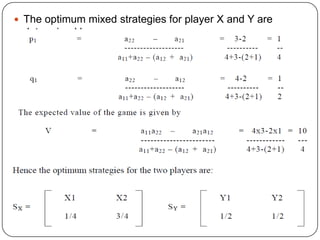
 The optimum mixed strategies for player X and Y are
 determined by
 But...
   Did you observe one thing
    that it was applicable to
    only 2 x 2 payoff
    matrices?
 So let us implement it to
other       matrices      using
dominance and study the
importance of DOMINANCE
PRINCIPLES OF DOMINANCE
 In a game, sometimes a strategy available to a player might
    be found to be preferable to some other strategy / strategies.
    Such a strategy is said to dominate the other one(s).
   The rules of dominance are used to reduce the size of the
    payoff matrix.
   These rules help in deleting certain rows and/or columns of
    the payoff matrix, which are of lower priority to at least one of
    the remaining rows, and/or columns in terms of payoffs to
    both the players.
   Rows / columns once deleted will never be used for
    determining the optimal strategy for both the players.
   This concept of domination is very usefully employed in
    simplifying the two – person zero sum games without saddle
    point.
   In general the following rules are used to reduce the size of
Cont’d……. The RULES
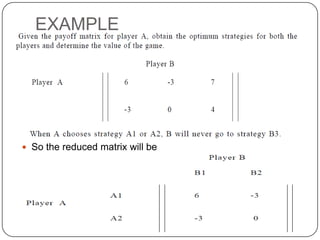
 Rule 1: If all the elements in a row ( say ith
  row ) of a pay off matrix are less than or
  equal to the corresponding elements of the
  other row ( say jth row ) then the player A will
  never choose the ith strategy then we say ith
  strategy is dominated by jth strategy and will
  delete the ith row.
 Rule 2: If all the elements in a column ( say
  rth column ) of a payoff matrix are greater
  than or equal to the corresponding elements
  of the other column ( say sth column ) then
  the player B will never choose the rth strategy
EXAMPLE


 So the reduced matrix will be
 Calculate Saddle point??
 If saddle point exist then we have value for the
  games….
 If not calculate?????????????
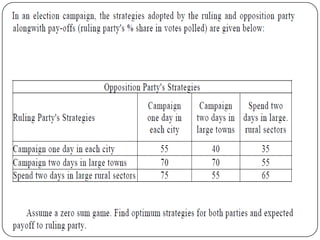
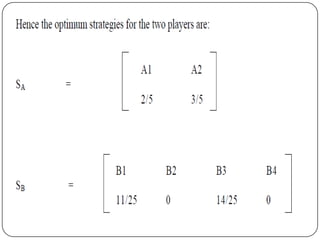
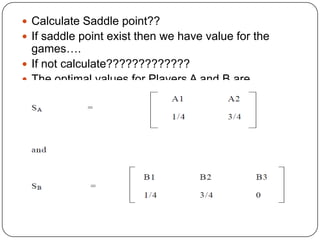
 The optimal values for Players A and B are
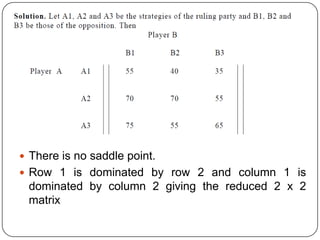
 There is no saddle point.
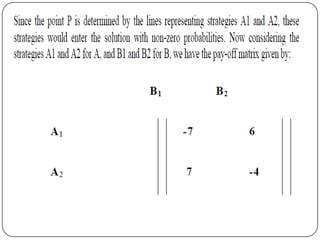
 Row 1 is dominated by row 2 and column 1 is
 dominated by column 2 giving the reduced 2 x 2
 matrix
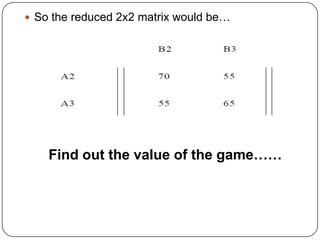
 So the reduced 2x2 matrix would be…


    Find out the value of the game……
GRAPHICAL
SOLUTION

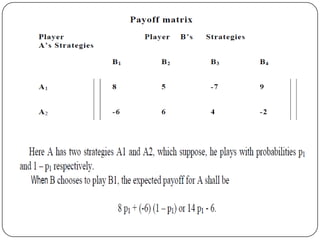
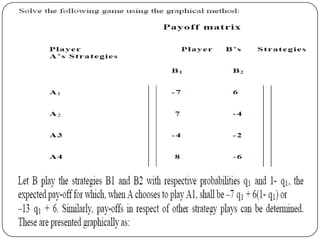
TO  solve the zero
sum games which do
not possess a saddle
point using
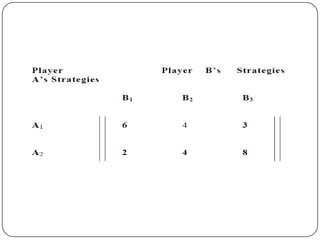
Solution of 2 x n and m x 2 Games
 consider the solution of games where either
  of the players has only two strategies
  available:
 When the player A, for example, has only 2
  strategies to choose from and the player B
  has n, the game shall be of the order 2 x n,
  whereas in case B has only two strategies
  available to him and A has m strategies, the
  game shall be a m x 2 game.
 The problem may originally be a 2 x n or a m
  x 2 game or a problem might have been
Graphical method Cont’d……..
 In either case, we can use graphical method to
  solve the problem.
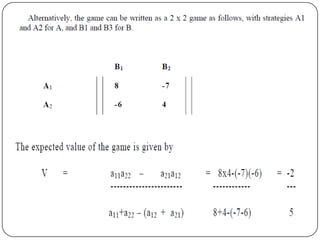
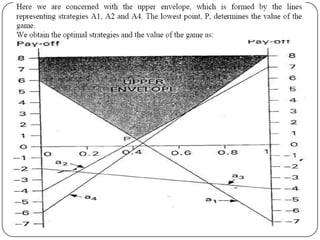
 By using the graphical approach, it is aimed to
  reduce a game to the order of 2 x 2 by identifying
  and eliminating the dominated strategies, and
  then solve it by the analytical method used for
  solving such games.
 The resultant solution is also the solution to the
  original problem.
 Although the game value and the optimal strategy
  can be read off from the graph, we generally
  adopt the analytical method (for 2 x 2 games) to
  get the answer.
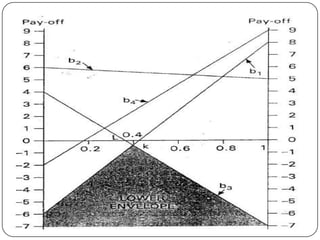
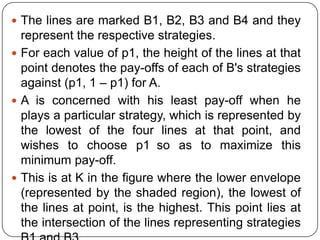
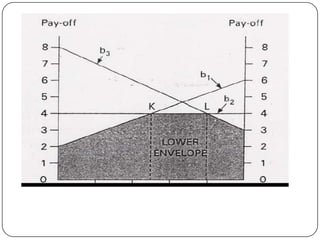
 The lines are marked B1, B2, B3 and B4 and they
  represent the respective strategies.
 For each value of p1, the height of the lines at that
  point denotes the pay-offs of each of B's strategies
  against (p1, 1 – p1) for A.
 A is concerned with his least pay-off when he
  plays a particular strategy, which is represented by
  the lowest of the four lines at that point, and
  wishes to choose p1 so as to maximize this
  minimum pay-off.
 This is at K in the figure where the lower envelope
  (represented by the shaded region), the lowest of
  the lines at point, is the highest. This point lies at
  the intersection of the lines representing strategies
Thank
you Very

Game theory

  • 1.
    Game Theory Abu Bashar
  • 2.
    What is gametheory?  Game theory is the study of how optimal strategies are formulated in conflict.  It is concerned with the requirement of decision making in situations where two or more rational opponents are involved under conditions of competition and conflicting interests in anticipation of certain outcomes over a period of time.
  • 3.
    Cont’d….  In acompetitive environment the strategies taken by the opponent organizations or individuals can dramatically affect the outcome of a particular decision by an organization.  In the automobile industry, for example, the strategies of competitors to introduce certain models with certain features can dramatically affect the profitability of other carmakers.  So in order to make important decisions in business, it is necessary to consider what other organizations or individuals are doing or might do.  Game theory is a way to consider the impact of the strategies of one, on the strategies and outcomes of the other.
  • 4.
    What is aGAME???  A GAME refers to a situation in which two or more players are competing.  It involves the players (decision makers) who have different goals or objectives.  They are in a situation in which there may be a number of possible outcomes with different values to them.  Although they might have some control that would influence the outcome, they do not have complete control over others.  Unions striking against the company management, players in a chess game, firm striving for larger share of market are a few illustrations that can be viewed as
  • 5.
    GAME THEORY MODELS Models in the theory of games can be classified depending upon the following factors:  Number of Players  Total Pay Off and  Strategy
  • 6.
    Number of players  It is the number of competitive decision makers, involved in the game.  A game involving two players is referred to as a “Two-person game”.  However if the number of players is more ( say n>2 ) then the game is called an n-person game.
  • 7.
    Total Payoff  Itis the sum of gains and losses from the game that are available to the players.  If in a game sum of the gains to one player is exactly equal to the sum of losses to another player, so that the sum of the gains and losses equals zero then the game is said to be a zero-sum game.  There are also games in which the sum of the players’ gains and losses does not equal zero, and these games are denoted as non-zero-sum games.
  • 8.
    Strategy  The strategyfor a player is the set of alternative courses of action that he will take for every payoff (outcome) that might arise.  It is assumed that the players know the rules governing the choices in advance.  The different outcomes resulting from the choices are also known to the players in advance and are expressed in terms of the numerical values ( e.g. money, market share percentage etc. )
  • 9.
    Strategy Cont’d..  Strategymay be of two types:  (a) Pure strategy  If the players select the same strategy each time, then it is referred as pure – strategy. In this case each player knows exactly what the opponent is going to do and the objective of the players is to maximize gains or to minimize losses.  (b) Mixed Strategy  When the players use a combination of strategies with some fixed probabilities and each player kept guessing as to which course of action is to be selected by the other player at a particular occasion then this is known as mixed strategy.
  • 10.
    TWO PERSON ZEROSUM GAME  A game which involves only two players, say player A and player B, and where the gains made by one equals the loss incurred by the other is called a two person zero sum game.  For example,  If two chess players agree that at the end of the game the loser would pay Rs 50 to the winner then it would mean that the sum of the gains and losses equals zero.  So it is a two person – zero sum game.
  • 11.
    Pay Off Matrix If Player A has m strategies represented as A1, A2, ---- ---- , Am and player B has n strategies represented by B1, B2, ------- ,Bn.  Then the total number of possible outcomes is m x n.  Here it is assumed that each player knows not only his own list of possible courses of action but also those of his opponent.  It is assumed that player A is always a gainer whereas player B a loser. Let aij be the payoff which player A gains from player B if player A chooses strategy i and player B chooses strategy j.
  • 12.
     By convention,the rows of the payoff Matrix denote player A’s strategies and the columns denote player B’s strategies.  Since player A is assumed to be the gainer always so he wishes to gain a payoff aij as large as possible and B tries to minimize the same.
  • 13.
    Now consider asimple game  Suppose that there are two lighting fixture stores, X and Y. The respective market shares have been stable until now, but the situation then changes.  The owner of store X has developed two distinct advertising strategies, one using radio spots and the other newspaper advertisements. Upon hearing this, the owner of store Y also proceeds to prepare radio and newspaper advertisements.
  • 14.
     Here apositive number in the payoff matrix means that X wins and Y loses.  A negative number means that Y wins and X loses. This game favors competitor X, since all values are positive except one.  If the game had favored player Y, the values in the table would have been negative. So the game is biased against Y.  However since Y must play the game, he or she will play to
  • 15.
    From this gamethe outcomes of each player
  • 16.
    ASSUMPTIONS OF THEGAME  Each player has to choose from a finite number of possible strategies.  The strategies for each player may or may not be the same.  Player A always tries to maximize his gains and players B tries to minimize the losses.  The decision by both the players is taken individually prior to the play without any communication between them.  The decisions are made and announced simultaneously so that neither player has an advantage resulting from direct knowledge of the other player’s decision.
  • 17.
    MINIMAX AND MAXIMIN PRINCIPLE  The selection of an optimal strategy by each player without the knowledge of the competitor’s strategy is the basic problem in playing games.  The objective of the study is to know how these players must select their respective strategies so that they could optimize their payoff.  Such a decision making criterion is referred to as the minimax – maximin principle.
  • 18.
     For playerA  Minimum value in each row represents the least gain to him if he chooses that particular strategy.  These are written in the matrix by row minima.  He will then select the strategy that gives maximum gain among the row minimum values.  This choice of player A is called the maximin criterion and the corresponding gain is called the maximin value of the game.  Similarly, for player B  who is assumed to be the loser, the maximum value in each column represents the maximum loss to him if he chooses his particular strategy.  These are written as column maxima. He will select that strategy which gives minimum loss among the column maximum values. This choice of player B is called the minimax criterion, and the corresponding loss is the
  • 19.
    Saddle Point  Ifthe maximin value equals the minimax value, then the game is said to have a saddle point and the corresponding strategies are called optimal strategies.  The amount of payoff at an equilibrium point is known as the VALUE of the game. A game may have more than one saddle point or no saddle point.
  • 20.
    Example of minimax– maximin principle  consider a two person zero – sum game with the given payoff matrix for player A.
  • 21.
     Suppose thatplayer A starts the game knowing that whatever strategy he adopts, B will select that particular counter strategy which will minimize the payoff to A.  Thus if A selects the strategy A1 then B will select B2 as his corresponds to the minimum payoff to A corresponding to A1. Similarly, if A chooses the strategy A2, he may gain 8 or 6 depending upon the choice of B.  If A chooses A2 then A can guarantee a gain of at least min {8,6} = 6 irrespective of the choice of B. Obviously A would prefer to maximize his minimum assured gains.  In this example the selection of strategy A2 gives the maximum of the minimum gains to A.  This gain is called as maximin value of the game and the corresponding strategy as maximum strategy.
  • 22.
    RULES FOR DETERMININGA SADDLE POINT  STEP 1: Select the minimum element of each row of the payoff matrix and mark them as (O) . This is row minima of the respective row.  STEP 2: Select the greatest element of each column of the payoff matrix and mark them as ( ) . This is column maxima of the respective column.  STEP 3: If there appears an element in the payoff matrix marked with (O) and ( )both, then this element represents the value of the game and its position is a saddle point of the payoff matrix.
  • 24.
  • 26.
  • 27.
     What wouldbe the optimum strategy of the game given below.
  • 29.
  • 31.
    Example  Solve the following game and determine the value of the game: Clearly, the pay-off matrix does not possess any saddle point. The two players, therefore, use mixed strategies. Let
  • 32.
     The optimummixed strategies for player X and Y are determined by
  • 35.
     But... Did you observe one thing that it was applicable to only 2 x 2 payoff matrices? So let us implement it to other matrices using dominance and study the importance of DOMINANCE
  • 36.
    PRINCIPLES OF DOMINANCE In a game, sometimes a strategy available to a player might be found to be preferable to some other strategy / strategies.  Such a strategy is said to dominate the other one(s).  The rules of dominance are used to reduce the size of the payoff matrix.  These rules help in deleting certain rows and/or columns of the payoff matrix, which are of lower priority to at least one of the remaining rows, and/or columns in terms of payoffs to both the players.  Rows / columns once deleted will never be used for determining the optimal strategy for both the players.  This concept of domination is very usefully employed in simplifying the two – person zero sum games without saddle point.  In general the following rules are used to reduce the size of
  • 37.
    Cont’d……. The RULES Rule 1: If all the elements in a row ( say ith row ) of a pay off matrix are less than or equal to the corresponding elements of the other row ( say jth row ) then the player A will never choose the ith strategy then we say ith strategy is dominated by jth strategy and will delete the ith row.  Rule 2: If all the elements in a column ( say rth column ) of a payoff matrix are greater than or equal to the corresponding elements of the other column ( say sth column ) then the player B will never choose the rth strategy
  • 38.
    EXAMPLE  So thereduced matrix will be
  • 39.
     Calculate Saddlepoint??  If saddle point exist then we have value for the games….  If not calculate?????????????  The optimal values for Players A and B are
  • 41.
     There isno saddle point.  Row 1 is dominated by row 2 and column 1 is dominated by column 2 giving the reduced 2 x 2 matrix
  • 42.
     So thereduced 2x2 matrix would be… Find out the value of the game……
  • 43.
    GRAPHICAL SOLUTION TO solvethe zero sum games which do not possess a saddle point using
  • 44.
    Solution of 2x n and m x 2 Games  consider the solution of games where either of the players has only two strategies available:  When the player A, for example, has only 2 strategies to choose from and the player B has n, the game shall be of the order 2 x n, whereas in case B has only two strategies available to him and A has m strategies, the game shall be a m x 2 game.  The problem may originally be a 2 x n or a m x 2 game or a problem might have been
  • 45.
    Graphical method Cont’d…….. In either case, we can use graphical method to solve the problem.  By using the graphical approach, it is aimed to reduce a game to the order of 2 x 2 by identifying and eliminating the dominated strategies, and then solve it by the analytical method used for solving such games.  The resultant solution is also the solution to the original problem.  Although the game value and the optimal strategy can be read off from the graph, we generally adopt the analytical method (for 2 x 2 games) to get the answer.
  • 48.
     The linesare marked B1, B2, B3 and B4 and they represent the respective strategies.  For each value of p1, the height of the lines at that point denotes the pay-offs of each of B's strategies against (p1, 1 – p1) for A.  A is concerned with his least pay-off when he plays a particular strategy, which is represented by the lowest of the four lines at that point, and wishes to choose p1 so as to maximize this minimum pay-off.  This is at K in the figure where the lower envelope (represented by the shaded region), the lowest of the lines at point, is the highest. This point lies at the intersection of the lines representing strategies
  • 57.