Introduction to
Game Theory
General approach
 Brief History of Game Theory
 Payoff Matrix
 Types of Games
 Basic Strategies
 Evolutionary Concepts
 Limitations and Problems
Brief History of Game Theory
 1913 - E. Zermelo provides the first theorem of
game theory; asserts that chess is strictly
determined
 1928 - John von Neumann proves the minimax
theorem
 1944 - John von Neumann & Oskar
Morgenstern write "Theory of Games and
Economic Behavior”
 1950-1953 - John Nash describes Nash
equilibrium
Rationality
Assumptions:
 humans are rational beings
 humans always seek the best alternative
in a set of possible choices
Why assume rationality?
 narrow down the range of possibilities
 predictability
Utility Theory
Utility Theory based on:
 rationality
 maximization of utility
 may not be a linear function of income or
wealth
It is a quantification of a person's preferences
with respect to certain objects.
What is Game Theory?
Game theory is a study of how to
mathematically determine the best strategy for
given conditions in order to optimize the
outcome
Game Theory
 Finding acceptable, if not optimal,
strategies in conflict situations.
 Abstraction of real complex situation
 Game theory is highly mathematical
 Game theory assumes all human
interactions can be understood and
navigated by presumptions.
Why is game theory important?
 All intelligent beings make decisions all the time.
 AII needs to perform these tasks as a result.
 Helps us to analyze situations more rationally and
formulate an acceptable alternative with respect to
circumstance.
 Useful in modeling strategic decision-making
 Games against opponents
 Games against "nature„
 Provides structured insight into the value of
information
Types of Games
Sequential vs. Simultaneous moves
Single Play vs. Iterated
Zero vs. non-zero sum
Perfect vs. Imperfect information
Cooperative vs. conflict
Zero-Sum Games
 The sum of the payoffs remains constant
during the course of the game.
 Two sides in conflict
 Being well informed always helps a
player
Non-zero Sum Game
 The sum of payoffs is not constant during the
course of game play.
 Players may co-operate or compete
 Being well informed may harm a player.
Games of Perfect Information
 The information concerning an opponent’s
move is well known in advance.
 All sequential move games are of this type.
Imperfect Information
 Partial or no information concerning the
opponent is given in advance to the player’s
decision.
 Imperfect information may be diminished
over time if the same game with the same
opponent is to be repeated.
Key Area of Interest
 chance
 strategy
Matrix Notation
(Column) Player II
Strategy A Strategy B
(Row) Player I
Strategy A (P1, P2) (P1, P2)
Strategy B (P1, P2) (P1, P2)
Notes: Player I's strategy A may be different from Player II's.
P2 can be omitted if zero-sum game
Prisoner’s Dilemma &
Other famous games
A sample of other games:
Marriage
Disarmament (my generals are
more irrational than yours)
Prisoner’s Dilemma
Notes: Higher payoffs (longer sentences) are bad.
Non-cooperative equilibrium  Joint maximum
Institutionalized “solutions” (a la criminal organizations, KSM)
NCE
Jt. max.
Games of Conflict
 Two sides competing against each other
 Usually caused by complete lack of
information about the opponent or the game
 Characteristic of zero-sum games
Games of Co-operation
Players may improve payoff through
 communicating
 forming binding coalitions & agreements
 do not apply to zero-sum games
Prisoner’s Dilemma
with Cooperation
Prisoner’s Dilemma with Iteration
 Infinite number of iterations
 Fear of retaliation
 Fixed number of iteration
 Domino effect
Basic Strategies
1. Plan ahead and look back
2. Use a dominating strategy if possible
3. Eliminate any dominated strategies
4. Look for any equilibrium
5. Mix up the strategies
Plan ahead and look back
If you have a dominating strategy,
use it
Use
strategy 1
Eliminate any dominated
strategy
Eliminate
strategy 2 as
it’s dominated
by strategy 1
Look for any equilibrium
Dominating Equilibrium
Minimax Equilibrium
Nash Equilibrium
Maximin & Minimax Equilibrium
 Minimax - to minimize the maximum loss
(defensive)
 Maximin - to maximize the minimum gain
(offensive)
 Minimax = Maximin
Maximin & Minimax
Equilibrium Strategies
Definition: Nash Equilibrium
“If there is a set of strategies with the property
that no player can benefit by changing her
strategy while the other players keep their
strategies unchanged, then that set of
strategies and the corresponding payoffs
constitute the Nash Equilibrium. “
Source: http://www.lebow.drexel.edu/economics/mccain/game/game.html
Is this a Nash Equilibrium?
Cost to press
button = 2 units
When button is pressed,
food given = 10 units
Boxed Pigs Example
Decisions, decisions...
Time for "real-life" decision making
 Holmes & Moriarity in "The Final Problem"
 What would you do…
 If you were Holmes?
 If you were Moriarity?
 Possibly interesting digressions?
 Why was Moriarity so evil?
 What really happened?
–What do we mean by reality?
–What changed the reality?
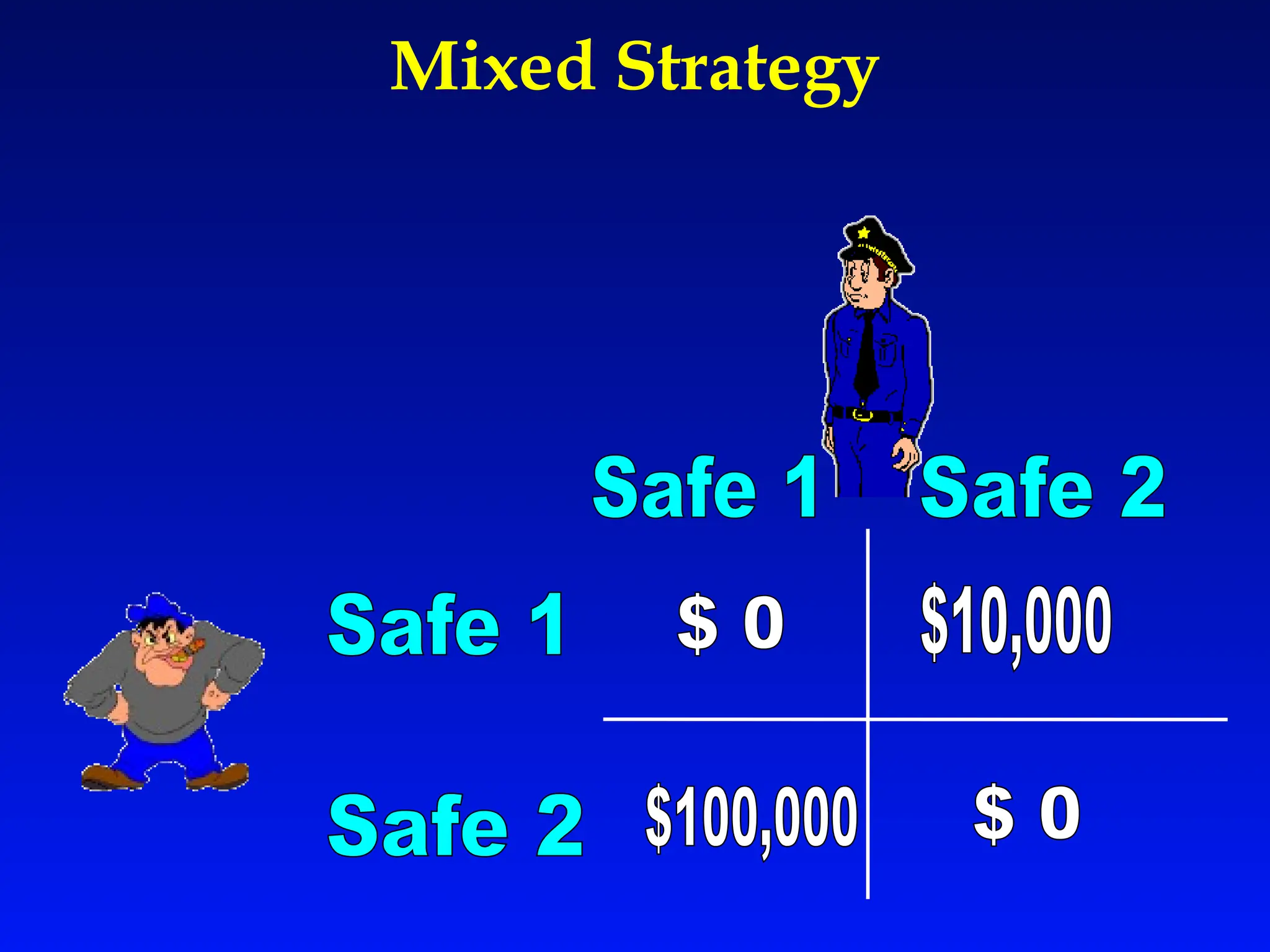
Mixed Strategy
Mixed Strategy Solution
Value in
Safe
Probability
of being
Guarded
Expected
Loss
Safe 1 10,000
$ 1 / 11 9,091
$
Safe 2 100,000
$ 10 / 11 9,091
$
Both 110,000
$
The Payoff Matrix
for Holmes & Moriarity
P
l
a
y
e
r
#
1
Player #2
Strategy #1 Strategy #2
Strategy #1
Strategy #2
Payoff (1,1) Payoff (1,2)
Payoff (2,1) Payoff (2,2)
Where is game theory
currently used?
–Ecology
–Networks
–Economics
Limitations & Problems
 Assumes players always maximize their
outcomes
 Some outcomes are difficult to provide a
utility for
 Not all of the payoffs can be quantified
 Not applicable to all problems
Summary
 What is game theory?
 Abstraction modeling multi-person interactions
 How is game theory applied?
 Payoff matrix contains each person’s utilities for
various strategies
 Who uses game theory?
 Economists, Ecologists, Network people,...
 How is this related to AI?
 Provides a method to simulate a thinking agent
Sources
 Much more available on the web.
 These slides (with changes and additions) adapted
from:
http://pages.cpsc.ucalgary.ca/~jacob/Courses/Winter2000/CPSC533/Pages/i
ndex.html
 Three interesting classics:
 John von Neumann & Oskar Morgenstern, Theory of
Games & Economic Behavior (Princeton, 1944).
 John McDonald, Strategy in Poker, Business & War
(Norton, 1950)
 Oskar Morgenstern, "The Theory of Games," Scientific
American, May 1949; translated as "Theorie des Spiels,"
Die Amerikanische Rundschau, August 1949.

Introduction to Game Theory for engineering.ppt

  • 1.
  • 2.
    General approach  BriefHistory of Game Theory  Payoff Matrix  Types of Games  Basic Strategies  Evolutionary Concepts  Limitations and Problems
  • 3.
    Brief History ofGame Theory  1913 - E. Zermelo provides the first theorem of game theory; asserts that chess is strictly determined  1928 - John von Neumann proves the minimax theorem  1944 - John von Neumann & Oskar Morgenstern write "Theory of Games and Economic Behavior”  1950-1953 - John Nash describes Nash equilibrium
  • 4.
    Rationality Assumptions:  humans arerational beings  humans always seek the best alternative in a set of possible choices Why assume rationality?  narrow down the range of possibilities  predictability
  • 5.
    Utility Theory Utility Theorybased on:  rationality  maximization of utility  may not be a linear function of income or wealth It is a quantification of a person's preferences with respect to certain objects.
  • 6.
    What is GameTheory? Game theory is a study of how to mathematically determine the best strategy for given conditions in order to optimize the outcome
  • 7.
    Game Theory  Findingacceptable, if not optimal, strategies in conflict situations.  Abstraction of real complex situation  Game theory is highly mathematical  Game theory assumes all human interactions can be understood and navigated by presumptions.
  • 8.
    Why is gametheory important?  All intelligent beings make decisions all the time.  AII needs to perform these tasks as a result.  Helps us to analyze situations more rationally and formulate an acceptable alternative with respect to circumstance.  Useful in modeling strategic decision-making  Games against opponents  Games against "nature„  Provides structured insight into the value of information
  • 9.
    Types of Games Sequentialvs. Simultaneous moves Single Play vs. Iterated Zero vs. non-zero sum Perfect vs. Imperfect information Cooperative vs. conflict
  • 10.
    Zero-Sum Games  Thesum of the payoffs remains constant during the course of the game.  Two sides in conflict  Being well informed always helps a player
  • 11.
    Non-zero Sum Game The sum of payoffs is not constant during the course of game play.  Players may co-operate or compete  Being well informed may harm a player.
  • 12.
    Games of PerfectInformation  The information concerning an opponent’s move is well known in advance.  All sequential move games are of this type.
  • 13.
    Imperfect Information  Partialor no information concerning the opponent is given in advance to the player’s decision.  Imperfect information may be diminished over time if the same game with the same opponent is to be repeated.
  • 14.
    Key Area ofInterest  chance  strategy
  • 15.
    Matrix Notation (Column) PlayerII Strategy A Strategy B (Row) Player I Strategy A (P1, P2) (P1, P2) Strategy B (P1, P2) (P1, P2) Notes: Player I's strategy A may be different from Player II's. P2 can be omitted if zero-sum game
  • 16.
    Prisoner’s Dilemma & Otherfamous games A sample of other games: Marriage Disarmament (my generals are more irrational than yours)
  • 17.
    Prisoner’s Dilemma Notes: Higherpayoffs (longer sentences) are bad. Non-cooperative equilibrium  Joint maximum Institutionalized “solutions” (a la criminal organizations, KSM) NCE Jt. max.
  • 18.
    Games of Conflict Two sides competing against each other  Usually caused by complete lack of information about the opponent or the game  Characteristic of zero-sum games
  • 19.
    Games of Co-operation Playersmay improve payoff through  communicating  forming binding coalitions & agreements  do not apply to zero-sum games Prisoner’s Dilemma with Cooperation
  • 20.
    Prisoner’s Dilemma withIteration  Infinite number of iterations  Fear of retaliation  Fixed number of iteration  Domino effect
  • 21.
    Basic Strategies 1. Planahead and look back 2. Use a dominating strategy if possible 3. Eliminate any dominated strategies 4. Look for any equilibrium 5. Mix up the strategies
  • 22.
    Plan ahead andlook back
  • 23.
    If you havea dominating strategy, use it Use strategy 1
  • 24.
    Eliminate any dominated strategy Eliminate strategy2 as it’s dominated by strategy 1
  • 25.
    Look for anyequilibrium Dominating Equilibrium Minimax Equilibrium Nash Equilibrium
  • 26.
    Maximin & MinimaxEquilibrium  Minimax - to minimize the maximum loss (defensive)  Maximin - to maximize the minimum gain (offensive)  Minimax = Maximin
  • 27.
  • 28.
    Definition: Nash Equilibrium “Ifthere is a set of strategies with the property that no player can benefit by changing her strategy while the other players keep their strategies unchanged, then that set of strategies and the corresponding payoffs constitute the Nash Equilibrium. “ Source: http://www.lebow.drexel.edu/economics/mccain/game/game.html
  • 29.
    Is this aNash Equilibrium?
  • 30.
    Cost to press button= 2 units When button is pressed, food given = 10 units Boxed Pigs Example
  • 31.
  • 32.
    Time for "real-life"decision making  Holmes & Moriarity in "The Final Problem"  What would you do…  If you were Holmes?  If you were Moriarity?  Possibly interesting digressions?  Why was Moriarity so evil?  What really happened? –What do we mean by reality? –What changed the reality?
  • 33.
  • 34.
    Mixed Strategy Solution Valuein Safe Probability of being Guarded Expected Loss Safe 1 10,000 $ 1 / 11 9,091 $ Safe 2 100,000 $ 10 / 11 9,091 $ Both 110,000 $
  • 35.
    The Payoff Matrix forHolmes & Moriarity P l a y e r # 1 Player #2 Strategy #1 Strategy #2 Strategy #1 Strategy #2 Payoff (1,1) Payoff (1,2) Payoff (2,1) Payoff (2,2)
  • 36.
    Where is gametheory currently used? –Ecology –Networks –Economics
  • 37.
    Limitations & Problems Assumes players always maximize their outcomes  Some outcomes are difficult to provide a utility for  Not all of the payoffs can be quantified  Not applicable to all problems
  • 38.
    Summary  What isgame theory?  Abstraction modeling multi-person interactions  How is game theory applied?  Payoff matrix contains each person’s utilities for various strategies  Who uses game theory?  Economists, Ecologists, Network people,...  How is this related to AI?  Provides a method to simulate a thinking agent
  • 39.
    Sources  Much moreavailable on the web.  These slides (with changes and additions) adapted from: http://pages.cpsc.ucalgary.ca/~jacob/Courses/Winter2000/CPSC533/Pages/i ndex.html  Three interesting classics:  John von Neumann & Oskar Morgenstern, Theory of Games & Economic Behavior (Princeton, 1944).  John McDonald, Strategy in Poker, Business & War (Norton, 1950)  Oskar Morgenstern, "The Theory of Games," Scientific American, May 1949; translated as "Theorie des Spiels," Die Amerikanische Rundschau, August 1949.

Editor's Notes

  • #3 http://william-king.www.drexel.edu/top/class/histf.html
  • #4 Based on the assumption that human beings are absolutely rational in their economic choices. Specifically, the assumption is that each person maximizes her or his rewards -- profits, incomes, or subjective benefits -- in the circumstances that she or he faces. This hypothesis serves a double purpose in the study of the allocation of resources. First, it narrows the range of possibilities somewhat. Absolutely rational behavior is more predictable than irrational behavior. Second, it provides a criterion for evaluation of the efficiency of an economic system. If the system leads to a reduction in the rewards coming to some people, without producing more than compensating rewards to others (costs greater than benefits, broadly) then something is wrong. Pollution, the overexploitation of fisheries, and inadequate resources committed to research can all be examples of this. Source:http://www.lebow.drexel.edu/economics/mccain/game/game.html
  • #5 Few people would risk a sure gain of $1,000,000 for an even chance of gaining $10,000,000, for example. In fact, many decisions people make, such as buying insurance policies, playing lottery games, and gambling in a casino, indicate that they are not maximizing their average profits. Game theory does not attempt to indicate what a player's goal should be; instead, it shows the player how to attain his goal, whatever it may be. Von Neumann and Morgenstern understood this distinction, and so to accommodate all players, whatever their goals, they constructed a theory of utility. They began by listing certain axioms that they felt all "rational" decision makers would follow (for example, if a person likes tea better than milk, and milk better than coffee, then that person should like tea better than coffee). They then proved that for such rational decision makers it was possible to define a utility function that would reflect an individual's preferences; basically, a utility function assigns to each of a player's alternatives a number that conveys the relative attractiveness of that alternative. Maximizing someone's utility automatically determines his most preferred option. In recent years, however, some doubt has been raised about whether people actually behave in accordance with these rational rules. Source: http://search.britannica.com/bcom/eb/article/5/0,5716,117275+6,00.html Values assigned to alternatives is based on the relative attractiveness to an individual.
  • #6 game theory focuses on how groups of people interact. Game theory focuses on how “players” in economic “games” behave when, to reach their goals, they have to predict how their opponents will react to their moves. CONCLUSION: As a conclusion Game theory is the study of competitive interaction; it analyzes possible outcomes in situations where people are trying to score points off each other, whether in bridge, politics of war. You do this by trying to anticipate the reaction of your competitor to your next move and then factoring that reaction into your actual decision. It teaches people to think several moves ahead. From now on , Whoever it was who said it doesn’t matter if you win or lose but how you play the game, missed the point. It matters very much. According to game theory, it’s how you play the game that usually determines whether you win or lose. Source:http://www.ug.bcc.bilkent.edu.tr/~zyilmaz/proposal.html
  • #7 It is highly mathematical in order to emulated human value judgement (mental rules, fuzzy input of good or bad) ex. Chess play
  • #8 WHY GAME THEORY IS IMPORTANT? Game theory is both easy and excruciatingly difficult. People use it all the time, average people, in their daily lives. It comes into play in mundane deals like buying a car, where a certain skill in haggling is required. The buyer’s offer is usually formulated on the basis of what he or she presumes the seller will take. The seller is guided by a presumption about how high the buyer will go. The outcome of this negotiation could be totally positive (if the deal satisfies both parties), totally negative (if it falls through), or positive for one party and less so for the other (depending on how much is paid.) It is used to describe any relationship and interaction, economic, social or political. And it’s useful in creating strategies for negotiators. It can help you win, and that is why companies and governments hire game theorists to write strategies against other players in whatever game they’re in. Mathematics and statistics are the tools they use. For example, during the Cold War the Pentagon became interested in game theory to help develop its nuclear strategy, and with some success. You don’t make a move in chess without first trying to figure out how your opponent will react to it. Game theory assumes that all-human interactions, personal, institutional, economic, can be understood and navigated by presumptions similar to those of the chess player. Source:http://www.ug.bcc.bilkent.edu.tr/~zyilmaz/proposal.html
  • #10  In zero-sum games it never helps a player to give an adversary information, and it never harms a player to learn an opponent's strategy in advance. These rules do not necessarily hold true for nonzero-sum games, however. Source: http://search.britannica.com/bcom/eb/article/5/0,5716,117275+6,00.html
  • #11 Nonzero-sum game includes all games which are not constant-sum. In non-zero-sum game, the sum of the payoffs are not the same for all outcomes. Nonzero-sum games are mixed motive games. The interests of the players are neither strictly coincident nor strictly opposed. They generate intrapersonal and interpersonal conflicts. They are not always completely soluble but they provide insights into important areas of interdependent choice. In these games, one player's losses do not always equal another player's gains. Some nonzero-sum games are positive sum and some are negative sum: Negative sum games are competitive, but nobody really wins, rather, everybody loses. For example, a war or a strike. Positive sum games are cooperative, all players have one goal that they contribute together as in an educational game. For example, school newspapers or plays, building blocks, or a science exhibit. One major example of a two-person nonzero-sum game is the prisoner's dilemma. It is a non cooperative game because the players can not communicate their intentions. (See topic 'Automata & Games Theory') Source: http://artsci-ccwin.concordia.ca/edtech/ETEC606/conceptprinciples.html A player may want his opponent to be well-informed. In a labour-management dispute, for example, if the labour union is prepared for a strike, it behooves it to inform management and thereby possibly achieve its goal without a long, costly conflict. In this example, management is not harmed by the advance information (it, too, benefits by avoiding the costly strike), but in other nonzero-sum games a player can be at a disadvantage if he knows his opponent's strategy. A blackmailer, for example, benefits only if he informs his victim that he will harm the victim unless his terms are met. If he does not give this information to the intended victim, the blackmailer can still do damage but he has no reason to. Thus, knowledge of the blackmailer's strategy works to the victim's disadvantage. Source: http://search.britannica.com/bcom/eb/article/5/0,5716,117275+6,00.html
  • #12 A class of Game in which players move alternately and each player is completely informed of previous moves. Finite, Zero-Sum, two-player Games with perfect information (including checkers and chess) have a Saddle Point, and therefore one or more optimal strategies. However, the optimal strategy may be so difficult to compute as to be effectively impossible to determine (as in the game of Chess). Source:http://mathworld.wolfram.com/PerfectInformation.html
  • #20 It might seem that the paradox inherent in the prisoners' dilemma could be resolved if the game were played repeatedly. Players would learn that they do best when both act unselfishly and cooperate; if one player failed to cooperate in one game, the other player could retaliate by not cooperating in the next game and both would lose until they began to cooperate again. When the game is repeated a fixed number of times, however, this argument fails. According to the argument, when the two shopkeepers described above set up their stores at a 10-day county fair, each should maintain a high price, knowing that if he does not, his competitor will retaliate the next day. On the 10th day, however, each shopkeeper realizes that his competitor can no longer retaliate (the fair will be closed so there is no next day); therefore each shopkeeper should lower his price on the last day. But if each shopkeeper knows that his rival will lower the price on the 10th day, he has no incentive to maintain the high price on the ninth day. Continuing this reasoning, one concludes that "rational" shopkeepers will have a price war every day. It is only when the game is played repeatedly and neither player knows when the sequence will end that the cooperative strategy succeeds. Source:http://search.britannica.com/bcom/eb/article/5/0,5716,117275+6,00.html Lead to ESS.
  • #21 1. Each player need to figure out the other player’s future responses and use them in calculating his/her best move. In AI sense, this involves the evaluation of all possible outcomes for all possible actions. (Charlie Brown Story) 2. Dominating strategy: A dominating strategy occurs if there exists a action whose associated outcome is always favorable regardless what action the other player makes. Ex. Football game again 3. Dominated strategy: A dominated strategy occurs if there exists an action whose associated outcome is always not in favor of the player regardless what action the other player makes. Ex. Football game again.  Give a example where dominating strategy doesn’t always associates with a dominated strategy.
  • #28 a unique outcome that satisfied conditions: (1) the solution must be independent of the choice of utility function (if a player prefers x to y and one function assigns x a utility of 10 and y a utility of 1 while a second function assigns them the values 20 and 2, the solution should not change); (2) it must be impossible for both players to simultaneously do better than the Nash solution (a condition known as Pareto optimality); (3) the solution must be independent of irrelevant alternatives (if unattractive options are added to or dropped from the list of alternatives, the Nash solution should not change); and (4) the solution must be symmetrical (if the players reverse their roles, the solution remains the same except that the payoffs are reversed). Source: http://search.britannica.com/bcom/eb/article/5/0,5716,117275+6,00.html