Porcupine: A Highly Available Cluster-based Mail Service Yasushi Saito Brian Bershad Hank Levy University of Washington  Department of Computer Science and Engineering, Seattle,  WA http://porcupine.cs.washington.edu/
Why Email? Mail is important Real demand Mail is hard Write intensive Low locality Mail is easy Well-defined API Large parallelism Weak consistency
Goals Use commodity hardware to build a large,  scalable mail service Three facets of scalability ... Performance : Linear increase with cluster size  Manageability : React to changes automatically Availability : Survive failures gracefully
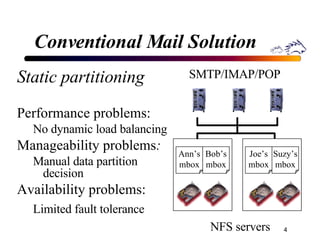
Conventional Mail Solution Static partitioning Performance problems: No dynamic load balancing Manageability problems : Manual data partition decision Availability problems: Limited fault tolerance   SMTP/IMAP/POP Bob’s mbox Ann’s mbox Joe’s mbox Suzy’s mbox NFS servers
Presentation Outline Overview Porcupine Architecture Key concepts and techniques Basic operations and data structures Advantages Challenges and solutions Conclusion
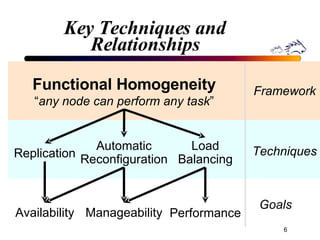
Key Techniques and Relationships Functional Homogeneity “ any node can perform any task ” Automatic Reconfiguration Load Balancing Replication Manageability Performance Availability Framework Techniques Goals
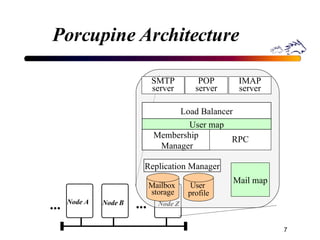
Porcupine Architecture Node A ... Node B Node Z ... Mail map Mailbox  storage User  profile Replication Manager SMTP server POP server IMAP server Membership Manager RPC Load Balancer User map
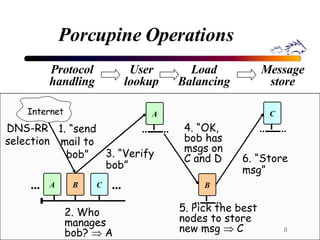
Porcupine Operations A B ... A 1. “send mail to bob” 2. Who manages bob?    A 3. “Verify bob” 5. Pick the best nodes to store new msg    C DNS-RR selection 4. “OK, bob has msgs on C and D 6. “Store msg” B C Protocol handling User lookup Load Balancing Message store ... C Internet
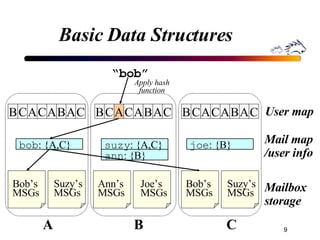
Basic Data Structures “ bob” bob : {A,C} ann : {B} suzy : {A,C} joe : {B} Apply hash function User map Mail map /user info Mailbox storage A B C Bob’s MSGs Suzy’s MSGs Bob’s MSGs Joe’s MSGs Ann’s MSGs Suzy’s MSGs B C A C A B A C B C A C A B A C B C A C A B A C
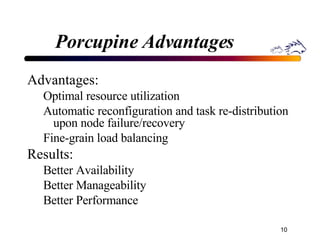
Porcupine Advantages Advantages: Optimal resource utilization Automatic reconfiguration and task re-distribution upon node failure/recovery Fine-grain load balancing Results: Better Availability Better Manageability Better Performance
Presentation Outline Overview Porcupine Architecture Challenges and solutions Scaling performance Handling failures and recoveries: Automatic soft-state reconstruction Hard-state replication Load balancing Conclusion
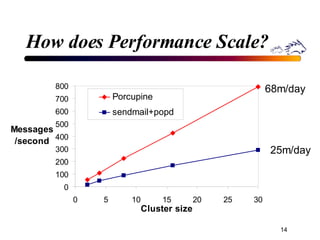
Performance Goals Scale performance linearly with cluster size Strategy: Avoid creating hot spots Partition data uniformly among nodes Fine-grain data partition
Measurement Environment 30 node cluster of not-quite-all-identical PCs 100Mb/s Ethernet + 1Gb/s hubs Linux 2.2.7 42,000 lines of C++ code Synthetic load  Compare to sendmail+popd
How does Performance Scale? 68m/day 25m/day
Availability Goals: Maintain function after failures React quickly to changes regardless of cluster size Graceful performance degradation / improvement Strategy:  Two complementary mechanisms Hard state:  email messages, user profile      Optimistic fine-grain replication Soft state : user map, mail map      Reconstruction after membership change
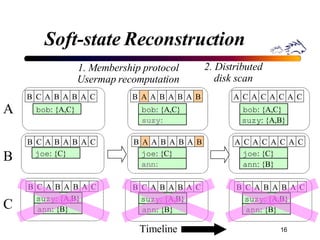
Soft-state Reconstruction bob : {A,C} joe : {C} B A A B A B A B bob : {A,C} joe : {C} B A A B A B A B A C A C A C A C bob : {A,C} joe : {C} A C A C A C A C suzy : {A,B} ann : {B} 1. Membership protocol Usermap recomputation 2. Distributed disk scan suzy : ann : Timeline A B ann : {B} suzy : {A,B} C ann : {B} suzy : {A,B} ann : {B} suzy : {A,B} B C A B A B A C B C A B A B A C B C A B A B A C B C A B A B A C B C A B A B A C
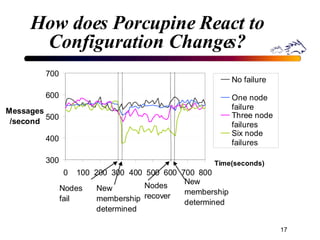
How does Porcupine React to Configuration Changes?
Hard-state Replication Goals: Keep serving hard state after failures Handle unusual failure modes  Strategy: Exploit Internet semantics Optimistic, eventually consistent replication Per-message, per-user-profile replication Efficient during normal operation Small window of inconsistency
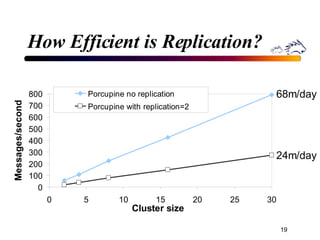
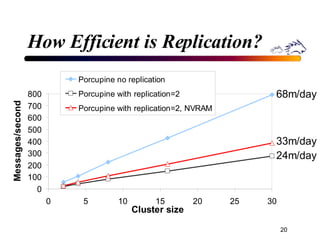
How Efficient is Replication? 68m/day 24m/day
How Efficient is Replication? 68m/day 24m/day 33m/day
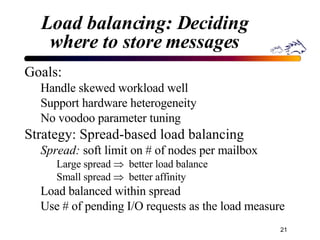
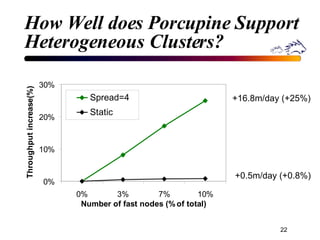
Load balancing: Deciding where to store messages Goals: Handle skewed workload well Support hardware heterogeneity No voodoo parameter tuning Strategy: Spread-based load balancing Spread:  soft limit on # of nodes per mailbox Large spread     better load balance Small spread     better affinity Load balanced within spread Use # of pending I/O requests as the load measure
How Well does Porcupine Support Heterogeneous Clusters?  +16.8m/day (+25%) +0.5m/day (+0.8%)
Conclusions Fast, available, and manageable clusters can be built for write-intensive service Key ideas can be extended beyond mail Functional homogeneity Automatic reconfiguration Replication Load balancing
Ongoing Work More efficient membership protocol Extending Porcupine beyond mail: Usenet, BBS, Calendar, etc  More generic replication mechanism

saito_porcupine

  • 1.
    Porcupine: A HighlyAvailable Cluster-based Mail Service Yasushi Saito Brian Bershad Hank Levy University of Washington Department of Computer Science and Engineering, Seattle, WA http://porcupine.cs.washington.edu/
  • 2.
    Why Email? Mailis important Real demand Mail is hard Write intensive Low locality Mail is easy Well-defined API Large parallelism Weak consistency
  • 3.
    Goals Use commodityhardware to build a large, scalable mail service Three facets of scalability ... Performance : Linear increase with cluster size Manageability : React to changes automatically Availability : Survive failures gracefully
  • 4.
    Conventional Mail SolutionStatic partitioning Performance problems: No dynamic load balancing Manageability problems : Manual data partition decision Availability problems: Limited fault tolerance SMTP/IMAP/POP Bob’s mbox Ann’s mbox Joe’s mbox Suzy’s mbox NFS servers
  • 5.
    Presentation Outline OverviewPorcupine Architecture Key concepts and techniques Basic operations and data structures Advantages Challenges and solutions Conclusion
  • 6.
    Key Techniques andRelationships Functional Homogeneity “ any node can perform any task ” Automatic Reconfiguration Load Balancing Replication Manageability Performance Availability Framework Techniques Goals
  • 7.
    Porcupine Architecture NodeA ... Node B Node Z ... Mail map Mailbox storage User profile Replication Manager SMTP server POP server IMAP server Membership Manager RPC Load Balancer User map
  • 8.
    Porcupine Operations AB ... A 1. “send mail to bob” 2. Who manages bob?  A 3. “Verify bob” 5. Pick the best nodes to store new msg  C DNS-RR selection 4. “OK, bob has msgs on C and D 6. “Store msg” B C Protocol handling User lookup Load Balancing Message store ... C Internet
  • 9.
    Basic Data Structures“ bob” bob : {A,C} ann : {B} suzy : {A,C} joe : {B} Apply hash function User map Mail map /user info Mailbox storage A B C Bob’s MSGs Suzy’s MSGs Bob’s MSGs Joe’s MSGs Ann’s MSGs Suzy’s MSGs B C A C A B A C B C A C A B A C B C A C A B A C
  • 10.
    Porcupine Advantages Advantages:Optimal resource utilization Automatic reconfiguration and task re-distribution upon node failure/recovery Fine-grain load balancing Results: Better Availability Better Manageability Better Performance
  • 11.
    Presentation Outline OverviewPorcupine Architecture Challenges and solutions Scaling performance Handling failures and recoveries: Automatic soft-state reconstruction Hard-state replication Load balancing Conclusion
  • 12.
    Performance Goals Scaleperformance linearly with cluster size Strategy: Avoid creating hot spots Partition data uniformly among nodes Fine-grain data partition
  • 13.
    Measurement Environment 30node cluster of not-quite-all-identical PCs 100Mb/s Ethernet + 1Gb/s hubs Linux 2.2.7 42,000 lines of C++ code Synthetic load Compare to sendmail+popd
  • 14.
    How does PerformanceScale? 68m/day 25m/day
  • 15.
    Availability Goals: Maintainfunction after failures React quickly to changes regardless of cluster size Graceful performance degradation / improvement Strategy: Two complementary mechanisms Hard state: email messages, user profile  Optimistic fine-grain replication Soft state : user map, mail map  Reconstruction after membership change
  • 16.
    Soft-state Reconstruction bob: {A,C} joe : {C} B A A B A B A B bob : {A,C} joe : {C} B A A B A B A B A C A C A C A C bob : {A,C} joe : {C} A C A C A C A C suzy : {A,B} ann : {B} 1. Membership protocol Usermap recomputation 2. Distributed disk scan suzy : ann : Timeline A B ann : {B} suzy : {A,B} C ann : {B} suzy : {A,B} ann : {B} suzy : {A,B} B C A B A B A C B C A B A B A C B C A B A B A C B C A B A B A C B C A B A B A C
  • 17.
    How does PorcupineReact to Configuration Changes?
  • 18.
    Hard-state Replication Goals:Keep serving hard state after failures Handle unusual failure modes Strategy: Exploit Internet semantics Optimistic, eventually consistent replication Per-message, per-user-profile replication Efficient during normal operation Small window of inconsistency
  • 19.
    How Efficient isReplication? 68m/day 24m/day
  • 20.
    How Efficient isReplication? 68m/day 24m/day 33m/day
  • 21.
    Load balancing: Decidingwhere to store messages Goals: Handle skewed workload well Support hardware heterogeneity No voodoo parameter tuning Strategy: Spread-based load balancing Spread: soft limit on # of nodes per mailbox Large spread  better load balance Small spread  better affinity Load balanced within spread Use # of pending I/O requests as the load measure
  • 22.
    How Well doesPorcupine Support Heterogeneous Clusters? +16.8m/day (+25%) +0.5m/day (+0.8%)
  • 23.
    Conclusions Fast, available,and manageable clusters can be built for write-intensive service Key ideas can be extended beyond mail Functional homogeneity Automatic reconfiguration Replication Load balancing
  • 24.
    Ongoing Work Moreefficient membership protocol Extending Porcupine beyond mail: Usenet, BBS, Calendar, etc More generic replication mechanism

Editor's Notes