Windows vs FreeBSD vs Linux Or: Why Deploying Linux in your Environment is Suicide
Don’t Believe Anything I Say "Do not believe in anything simply because you have heard it. Do not believe in anything simply because it is spoken and rumored by many. Do not believe in anything simply because it is found written in your religious books. Do not believe in anything merely on the authority of your teachers and elders. Do not believe in traditions because they have been handed down for many generations. But after observation and analysis, when you find that anything agrees with reason and is conducive to the good and benefit of one and all, then accept it and live up to it.” - Buddha Daytime - Security consultant “ Beltway bandit” in Linthicum MD Night - Founder of the Shmoo Group, Capital Area Wireless Network, periodic author
For Your Safety and The Safety of Those Around You Linux Zealots Windows / BSD / Others This talk  may  be not much more than flamebait You may be reminded of a /. Discussion This talk is meant to be interactive
Lets Talk about Security For the feds, “Information Assurance” Tactical Coding Error vs Design Flaw Script kiddie vs Dedicated Attacker Host Hardening vs Long term operational security
Long term Operational Security Often overlooked aspect of “security” We are not an end in and of ourselves. Further, an IDS does not operational security make Any idiot can be trained to secure a host Look at all the security books on the shelf Running a long term secure enterprise is the tough thing
Enter Rant Mode
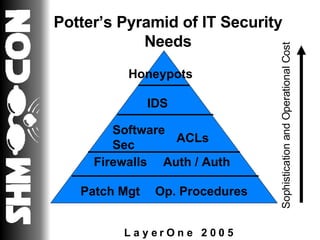
Potter’s Pyramid of IT Security Needs IDS Patch Mgt Op. Procedures Firewalls Auth / Auth ACLs Software Sec Honeypots Sophistication and Operational Cost
Why Does the Development Method Matter? You can certainly do belly button contemplation to say why it does or does not matter Structured process is the only way to build a secure and scalable system  Or Having many eyeballs and lack of clear direction means the best and most useful stuff is what will get integrated, not all the fluff. There is no right answer… Process driven code can suck horribly There are often not “many eyes” looking at security Corp View OSS View
But really, is there a difference? Beyond what the zealots say, and what the media says…  Is there a real difference? Assessing this difference is a real PIA with lots of red herrings Methods of determining difference Examine the development processes Examine the history of security in the architecture Vulnerability statistics? Examine the future directions of security Ideally get statistics from enterprises on how they spend their security budgets and why I’m not Burton or IDG… So I just asked friends…
Let’s talk about Vulnerability Statistics Vulnerability stats are (generally) an artifact of tactical coding errors, not bigger problems “ In the last year we cut the number of patches we released from 35 to 12” Well, if you’re rolling up many vuln fixes to one patch, it doesn’t count Further, the impact from the vulns may vary  as well Not just an MS problem… MDKSA-2004-037 Whose code was the vuln in? Kernel?  Integrated Application?  Third Party?
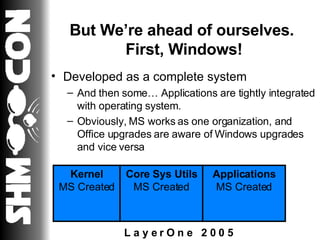
But We’re ahead of ourselves.  First, Windows! Developed as a complete system And then some… Applications are tightly integrated with operating system. Obviously, MS works as one organization, and Office upgrades are aware of Windows upgrades and vice versa Kernel MS Created Core Sys Utils MS Created Applications MS Created
Windows Release Methodologies Publicized well in advance Much of it is marketing spam, but there is obviously a HUGE developer network that seeds new technology info well in advance of release MS has a habit of once they’ve dominated a market, they stop dealing with the market IE is a prime example This has a negative impact on security MS will only integrate as much security as the market demands.  The OSS world will continue to integrate security b/c it’s the right thing to do
Windows Security Roadmap Many long term security initiatives Internal code security programs Security is woven through their entire development process Tho with the recent announcement of Land II, they may not quite be there yet Security functionality roadmap Including a full MLS compliant OS by 09 Definitely aware of Security Operations
FreeBSD FreeBSD is designed and developed as a complete end to end system Kernel to userland system utilities Structured development process Core team, and accountability for all parts of the core OS Beyond userland system utilities, thirdparty software is packaged by the FBSD team Either in binary or source packaging (or both) Kernel FBSD Created Core Sys Utils FBSD Created Applications FBSD packaged
FreeBSD Release Methodologies For Core system, there is a FreeBSD Release Engineering team. For Third party software, there is also a team dedicated to “produce a high quality package set suitable for official FreeBSD release media.” More info at http://www.freebsd.org/releng/
FreeBSD Security Roadmap FreeBSD provides EOL info WELL in advance of EOL occurring to give operators a heads up. Many integrated security features Securelevels are a great feature Expanded ACL control, jails (!chroot) While not a Roadmap ala Microsoft, still a great start.
Linux It’s Bazaar, right? Linus et al control the kernel Community creates the rest with some loose coordination Distros use Duct Tape as a “value add” to put everything together While they’re all “Linux” they’re basically different OS’s Aren’t they?  Kernel Linus Created Core Sys Utils Community Created / Distro Pkg Applications Community Created / Distro Pkg
A Choice Slashdot Quote First, why do I give a shit about the bloat of the graphical envinron vs the bloat of the kernel?  It’s all part of the OS as far as I care Second, stop with this GNU/Linux vs Linux crap
Linux Kernel Release Methodologies Whenever they feel like it Whenever they feel like iterating the third digit Changes with each major release 2.0 was different than 2.2 than 2.4 than 2.6 Not necessarily done in conjunction with distros Distros released at the same time will often use different kernels Frankly, it’s all at Linus’ and his deputy’s control
Distro Release Methodologies Even tho they’re all “Linux”, they’re like their own OS So there… Some are very slow evolutions and rely on uber admins Debian is the ultimate example Others attempt to have structure and make things easier on the user The Old ReadHet, Ubuntu, etc… However, since they’re really only responsible for the packaging and glue code, they’re at the whim of the community for features, especially security A distro will not, for instance, write their own firewall code
Linux Security Roadmap Not much out there for “Linux” There’s barely a kernel roadmap… RedHat released a security roadmap 2 years ago that basically amounted to “Integrate SELinux into RH distro” Really, that’s about all I found… Others have insight? Lots of add-on things (GRSec, etc…)
And now, Patching Patching is a core Security function, and releasing patches should be a core vendor function MS used to release patches whenever it “made sense” Now they’ve gone to monthly roll-up patches Concerns about losing resolution (aka: making 0day attacks a problem) have not materialized Certainly simplifies ongoing Ops Regression testing / QA can be scheduled in advance and patch deployment times are reduced
Patching on the *NIXs FreeBSD Kernel Patches direct from FBSD developers Linux Kernel Patches can be applied from kernel.org code Patches can be applied from distro code Which is right? Third party patches (network stack, KDE, etc) Patches direct from developer Patches from distro Core system utils in FBSD come from FBSD developers Again, which is right? *NIX patches easier to understand, easy to mass deploy More difficult to determine if it’s needed
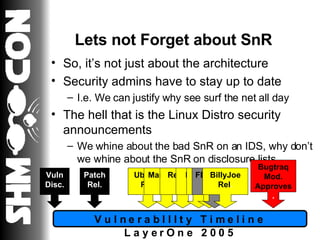
Lets not Forget about SnR So, it’s not just about the architecture Security admins have to stay up to date I.e. We can justify why see surf the net all day The hell that is the Linux Distro security announcements We whine about the bad SnR on an IDS, why don’t we whine about the SnR on disclosure lists V u l n e r a b I l I t y  T i m e l i n e   Vuln Disc. Patch Rel. Ubuntu Rel . Mandrake Rel . Red Hat Rel . Debian Rel . OpenLin Rel . FBSD Rel . Bugtraq Mod. Approves . BillyJoe Rel .
The Future Linux continues to survive by brute force and a worldwide network of zealots The Linux zealots make Apple users look tame MS will continue to push the bounds of security beyond what the stereotypical OSS operating system can do Especially from an operational security perspective The BSD’s will continue to be the leaders in the OSS movement wrt operational security
Questions?  Answers?

BPotter-L1-05

  • 1.
    Windows vs FreeBSDvs Linux Or: Why Deploying Linux in your Environment is Suicide
  • 2.
    Don’t Believe AnythingI Say "Do not believe in anything simply because you have heard it. Do not believe in anything simply because it is spoken and rumored by many. Do not believe in anything simply because it is found written in your religious books. Do not believe in anything merely on the authority of your teachers and elders. Do not believe in traditions because they have been handed down for many generations. But after observation and analysis, when you find that anything agrees with reason and is conducive to the good and benefit of one and all, then accept it and live up to it.” - Buddha Daytime - Security consultant “ Beltway bandit” in Linthicum MD Night - Founder of the Shmoo Group, Capital Area Wireless Network, periodic author
  • 3.
    For Your Safetyand The Safety of Those Around You Linux Zealots Windows / BSD / Others This talk may be not much more than flamebait You may be reminded of a /. Discussion This talk is meant to be interactive
  • 4.
    Lets Talk aboutSecurity For the feds, “Information Assurance” Tactical Coding Error vs Design Flaw Script kiddie vs Dedicated Attacker Host Hardening vs Long term operational security
  • 5.
    Long term OperationalSecurity Often overlooked aspect of “security” We are not an end in and of ourselves. Further, an IDS does not operational security make Any idiot can be trained to secure a host Look at all the security books on the shelf Running a long term secure enterprise is the tough thing
  • 6.
  • 7.
    Potter’s Pyramid ofIT Security Needs IDS Patch Mgt Op. Procedures Firewalls Auth / Auth ACLs Software Sec Honeypots Sophistication and Operational Cost
  • 8.
    Why Does theDevelopment Method Matter? You can certainly do belly button contemplation to say why it does or does not matter Structured process is the only way to build a secure and scalable system Or Having many eyeballs and lack of clear direction means the best and most useful stuff is what will get integrated, not all the fluff. There is no right answer… Process driven code can suck horribly There are often not “many eyes” looking at security Corp View OSS View
  • 9.
    But really, isthere a difference? Beyond what the zealots say, and what the media says… Is there a real difference? Assessing this difference is a real PIA with lots of red herrings Methods of determining difference Examine the development processes Examine the history of security in the architecture Vulnerability statistics? Examine the future directions of security Ideally get statistics from enterprises on how they spend their security budgets and why I’m not Burton or IDG… So I just asked friends…
  • 10.
    Let’s talk aboutVulnerability Statistics Vulnerability stats are (generally) an artifact of tactical coding errors, not bigger problems “ In the last year we cut the number of patches we released from 35 to 12” Well, if you’re rolling up many vuln fixes to one patch, it doesn’t count Further, the impact from the vulns may vary as well Not just an MS problem… MDKSA-2004-037 Whose code was the vuln in? Kernel? Integrated Application? Third Party?
  • 11.
    But We’re aheadof ourselves. First, Windows! Developed as a complete system And then some… Applications are tightly integrated with operating system. Obviously, MS works as one organization, and Office upgrades are aware of Windows upgrades and vice versa Kernel MS Created Core Sys Utils MS Created Applications MS Created
  • 12.
    Windows Release MethodologiesPublicized well in advance Much of it is marketing spam, but there is obviously a HUGE developer network that seeds new technology info well in advance of release MS has a habit of once they’ve dominated a market, they stop dealing with the market IE is a prime example This has a negative impact on security MS will only integrate as much security as the market demands. The OSS world will continue to integrate security b/c it’s the right thing to do
  • 13.
    Windows Security RoadmapMany long term security initiatives Internal code security programs Security is woven through their entire development process Tho with the recent announcement of Land II, they may not quite be there yet Security functionality roadmap Including a full MLS compliant OS by 09 Definitely aware of Security Operations
  • 14.
    FreeBSD FreeBSD isdesigned and developed as a complete end to end system Kernel to userland system utilities Structured development process Core team, and accountability for all parts of the core OS Beyond userland system utilities, thirdparty software is packaged by the FBSD team Either in binary or source packaging (or both) Kernel FBSD Created Core Sys Utils FBSD Created Applications FBSD packaged
  • 15.
    FreeBSD Release MethodologiesFor Core system, there is a FreeBSD Release Engineering team. For Third party software, there is also a team dedicated to “produce a high quality package set suitable for official FreeBSD release media.” More info at http://www.freebsd.org/releng/
  • 16.
    FreeBSD Security RoadmapFreeBSD provides EOL info WELL in advance of EOL occurring to give operators a heads up. Many integrated security features Securelevels are a great feature Expanded ACL control, jails (!chroot) While not a Roadmap ala Microsoft, still a great start.
  • 17.
    Linux It’s Bazaar,right? Linus et al control the kernel Community creates the rest with some loose coordination Distros use Duct Tape as a “value add” to put everything together While they’re all “Linux” they’re basically different OS’s Aren’t they? Kernel Linus Created Core Sys Utils Community Created / Distro Pkg Applications Community Created / Distro Pkg
  • 18.
    A Choice SlashdotQuote First, why do I give a shit about the bloat of the graphical envinron vs the bloat of the kernel? It’s all part of the OS as far as I care Second, stop with this GNU/Linux vs Linux crap
  • 19.
    Linux Kernel ReleaseMethodologies Whenever they feel like it Whenever they feel like iterating the third digit Changes with each major release 2.0 was different than 2.2 than 2.4 than 2.6 Not necessarily done in conjunction with distros Distros released at the same time will often use different kernels Frankly, it’s all at Linus’ and his deputy’s control
  • 20.
    Distro Release MethodologiesEven tho they’re all “Linux”, they’re like their own OS So there… Some are very slow evolutions and rely on uber admins Debian is the ultimate example Others attempt to have structure and make things easier on the user The Old ReadHet, Ubuntu, etc… However, since they’re really only responsible for the packaging and glue code, they’re at the whim of the community for features, especially security A distro will not, for instance, write their own firewall code
  • 21.
    Linux Security RoadmapNot much out there for “Linux” There’s barely a kernel roadmap… RedHat released a security roadmap 2 years ago that basically amounted to “Integrate SELinux into RH distro” Really, that’s about all I found… Others have insight? Lots of add-on things (GRSec, etc…)
  • 22.
    And now, PatchingPatching is a core Security function, and releasing patches should be a core vendor function MS used to release patches whenever it “made sense” Now they’ve gone to monthly roll-up patches Concerns about losing resolution (aka: making 0day attacks a problem) have not materialized Certainly simplifies ongoing Ops Regression testing / QA can be scheduled in advance and patch deployment times are reduced
  • 23.
    Patching on the*NIXs FreeBSD Kernel Patches direct from FBSD developers Linux Kernel Patches can be applied from kernel.org code Patches can be applied from distro code Which is right? Third party patches (network stack, KDE, etc) Patches direct from developer Patches from distro Core system utils in FBSD come from FBSD developers Again, which is right? *NIX patches easier to understand, easy to mass deploy More difficult to determine if it’s needed
  • 24.
    Lets not Forgetabout SnR So, it’s not just about the architecture Security admins have to stay up to date I.e. We can justify why see surf the net all day The hell that is the Linux Distro security announcements We whine about the bad SnR on an IDS, why don’t we whine about the SnR on disclosure lists V u l n e r a b I l I t y T i m e l i n e Vuln Disc. Patch Rel. Ubuntu Rel . Mandrake Rel . Red Hat Rel . Debian Rel . OpenLin Rel . FBSD Rel . Bugtraq Mod. Approves . BillyJoe Rel .
  • 25.
    The Future Linuxcontinues to survive by brute force and a worldwide network of zealots The Linux zealots make Apple users look tame MS will continue to push the bounds of security beyond what the stereotypical OSS operating system can do Especially from an operational security perspective The BSD’s will continue to be the leaders in the OSS movement wrt operational security
  • 26.