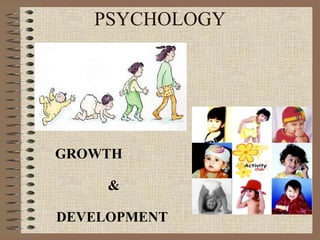
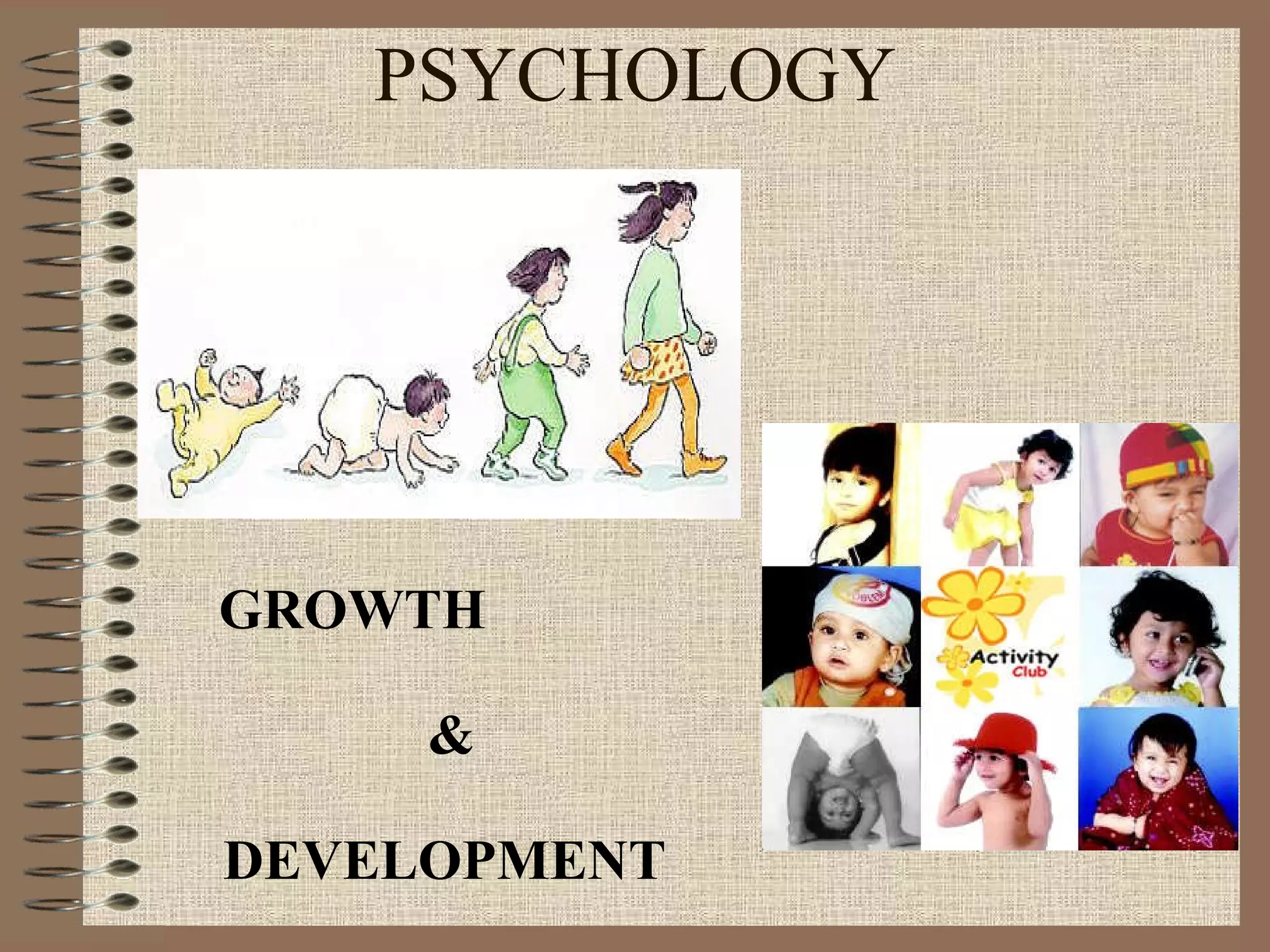
PSYCHOLOGY GROWTH  &  DEVELOPMENT
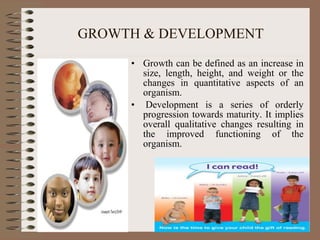
GROWTH & DEVELOPMENT Growth can be defined as an increase in size, length, height, and weight or the changes in quantitative aspects of an organism.    Development is a series of orderly progression towards maturity. It implies overall qualitative changes resulting in the improved functioning of the organism.
GROWTH VS DEVELOPMENT quantitative changes in size, weight number etc. one of the parts of development. changes that take place in particular aspects of the body & behaviour  continue throughout life but stops with the attainment of maturity changes may be measured  quantitative & observable  may or may not bring about development . qualitative  changes in the quality  overall changes in the individual. Growth is one of its parts describes the changes in the organism as a whole. continuous process- from womb to tomb changes are qualitative in nature & cannot be measured- can be assessed  possible without growth
PRINCIPLES OF DEVELOPMENT There are seven principles of development that have been put forth from the scientific knowledge gained from observing children.
PRINCIPLES OF DEVELOPMENT PRINCIPLE OF CONTINUOUS DEVELOPMENT   PRINCIPLE OF ORDERLY DEVELOPMENT   PRINCIPLE OF SEQUENTIAL DEVELOPMENT   PRINCIPLE OF UNIQUE DEVELOPMENT PRINCIPLE OF INTER-RELATED DEVELOPMENT   PRINCIPLE OF INTERACTION OF HEREDITY & ENVIROMENT   PRINCIPLE OF INTERACTION OF MATURATION & LEARNING
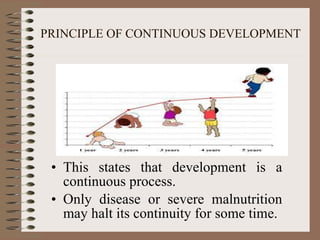
PRINCIPLE OF CONTINUOUS DEVELOPMENT This states that development is a continuous process.  Only disease or severe malnutrition may halt its continuity for some time.
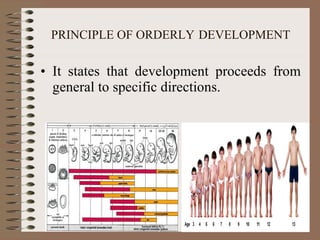
PRINCIPLE OF ORDERLY   DEVELOPMENT It states that development proceeds from general to specific directions.
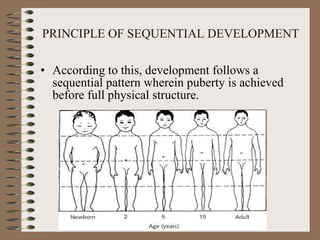
PRINCIPLE OF SEQUENTIAL DEVELOPMENT According to this, development follows a sequential pattern wherein puberty is achieved before full physical structure.
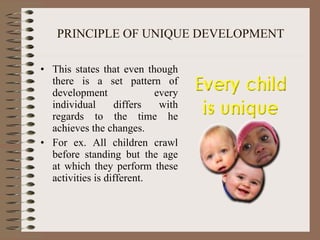
PRINCIPLE OF UNIQUE DEVELOPMENT This states that even though there is a set pattern of development every individual differs with regards to the time he achieves the changes.  For ex. All children crawl before standing but the age at which they perform these activities is different.
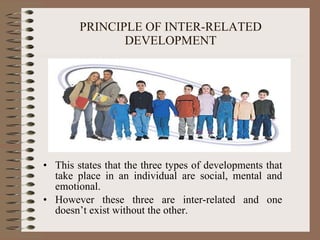
PRINCIPLE OF INTER-RELATED DEVELOPMENT This states that the three types of developments that take place in an individual are social, mental and emotional. However these three are inter-related and one doesn’t exist without the other.
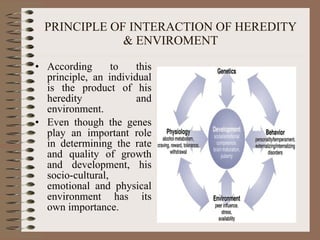
PRINCIPLE OF INTERACTION OF HEREDITY & ENVIROMENT According to this principle, an individual is the product of his heredity and environment. Even though the genes play an important role in determining the rate and quality of growth and development, his socio-cultural, emotional and physical environment has its own importance.
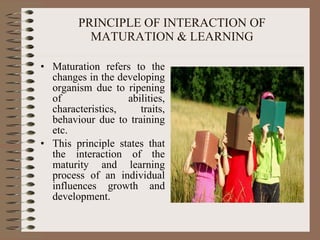
PRINCIPLE OF INTERACTION OF MATURATION & LEARNING Maturation refers to the changes in the developing organism due to ripening of abilities, characteristics, traits, behaviour due to training etc.  This principle states that the interaction of the maturity and learning process of an individual influences growth and development.
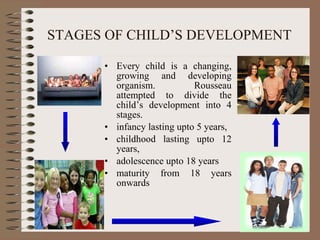
STAGES OF CHILD’S DEVELOPMENT Every child is a changing, growing and developing organism. Rousseau attempted to divide the child’s development into 4 stages.  infancy lasting upto 5 years, childhood lasting upto 12 years, adolescence upto 18 years maturity from 18 years onwards

Growth n development with principles

  • 1.
    PSYCHOLOGY GROWTH & DEVELOPMENT
  • 2.
    GROWTH & DEVELOPMENTGrowth can be defined as an increase in size, length, height, and weight or the changes in quantitative aspects of an organism.   Development is a series of orderly progression towards maturity. It implies overall qualitative changes resulting in the improved functioning of the organism.
  • 3.
    GROWTH VS DEVELOPMENTquantitative changes in size, weight number etc. one of the parts of development. changes that take place in particular aspects of the body & behaviour continue throughout life but stops with the attainment of maturity changes may be measured quantitative & observable may or may not bring about development . qualitative changes in the quality overall changes in the individual. Growth is one of its parts describes the changes in the organism as a whole. continuous process- from womb to tomb changes are qualitative in nature & cannot be measured- can be assessed possible without growth
  • 4.
    PRINCIPLES OF DEVELOPMENTThere are seven principles of development that have been put forth from the scientific knowledge gained from observing children.
  • 5.
    PRINCIPLES OF DEVELOPMENTPRINCIPLE OF CONTINUOUS DEVELOPMENT PRINCIPLE OF ORDERLY DEVELOPMENT PRINCIPLE OF SEQUENTIAL DEVELOPMENT PRINCIPLE OF UNIQUE DEVELOPMENT PRINCIPLE OF INTER-RELATED DEVELOPMENT PRINCIPLE OF INTERACTION OF HEREDITY & ENVIROMENT PRINCIPLE OF INTERACTION OF MATURATION & LEARNING
  • 6.
    PRINCIPLE OF CONTINUOUSDEVELOPMENT This states that development is a continuous process. Only disease or severe malnutrition may halt its continuity for some time.
  • 7.
    PRINCIPLE OF ORDERLY DEVELOPMENT It states that development proceeds from general to specific directions.
  • 8.
    PRINCIPLE OF SEQUENTIALDEVELOPMENT According to this, development follows a sequential pattern wherein puberty is achieved before full physical structure.
  • 9.
    PRINCIPLE OF UNIQUEDEVELOPMENT This states that even though there is a set pattern of development every individual differs with regards to the time he achieves the changes. For ex. All children crawl before standing but the age at which they perform these activities is different.
  • 10.
    PRINCIPLE OF INTER-RELATEDDEVELOPMENT This states that the three types of developments that take place in an individual are social, mental and emotional. However these three are inter-related and one doesn’t exist without the other.
  • 11.
    PRINCIPLE OF INTERACTIONOF HEREDITY & ENVIROMENT According to this principle, an individual is the product of his heredity and environment. Even though the genes play an important role in determining the rate and quality of growth and development, his socio-cultural, emotional and physical environment has its own importance.
  • 12.
    PRINCIPLE OF INTERACTIONOF MATURATION & LEARNING Maturation refers to the changes in the developing organism due to ripening of abilities, characteristics, traits, behaviour due to training etc. This principle states that the interaction of the maturity and learning process of an individual influences growth and development.
  • 13.
    STAGES OF CHILD’SDEVELOPMENT Every child is a changing, growing and developing organism. Rousseau attempted to divide the child’s development into 4 stages.  infancy lasting upto 5 years, childhood lasting upto 12 years, adolescence upto 18 years maturity from 18 years onwards