









GROWTH AND
DEVELOPMENT
1
OBJECTIVES
 Define growth and development.
 Identify the importance of growth and development.
 Mention the principles of growth and development.
 List factors affecting growth and development.
 Mention types of growth and development.
 Identify the stages of development.
2
Definition of growth and development
 Growth and development generally refers to the process by which a fertilized
ovum eventually attains adult status
 Growth:-
 is the increase in size of the body as a whole hence a quantitative change
in a child body.
 Its measured in terms of kilograms ,pounds, meters etc.
3
4
Growth pattern
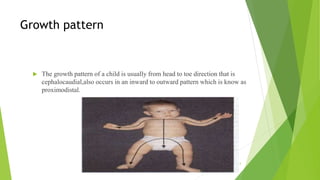
 The growth pattern of a child is usually from head to toe direction that is
cephalocaudial,also occurs in an inward to outward pattern which is know as
proximodistal.
5
Conti.:
 Development:-
 This refers to a progressive increase in skill and capacity to function
 It usually a qualitative change in the child's development.
6
Importance of growth and development
assessment
 Helps in formulating plan care program as the child keeps developing
 Helps in knowing of what to expect of a particular child at a given stage of
development
 Simple and time efficient mechanism to ensure adequate surveillance of
developmental progress
 Early detection of deviation in child’s pattern of development
7
Principles of growth and development
 Every child grows and develop in their own unique ways
 Growth and development is a continuous process throughout the life span of an
individual .
 There are usually increased periods of development in the early childhood and
adolescents but decrease rate of G/D in the middle childhood
 Growth and development proceed in a regular related direction that is
cephalocaudiol and proximodistal and from general to specific.
 Each stage of growth and development is affected by the preceding types of
development
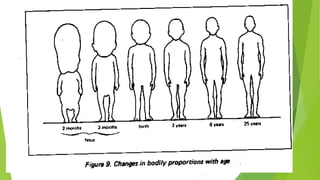
 Not all body parts grow at the same rate
8
Factors affecting growth and
development
 factors are either
 Environmental
 Hereditary
 Environmental factors include
 Pre-natal environment
 Posta natal environment
9
Prenatal environment
 This are the factors related to the mother during pregnancy and also related to the
fetus
- Nutritional deficiencies
- Diabetic mother
- Exposure to radiation
- Infection with German measles
- Smoking
- Use of drugs
- Mal-position in uterus
- Faulty placental implantation
10
Postnatal environment
 It can either be external environment or the internal environment
- External environment:
- socio-economic status of the family
- child’s nutrition
- climate and season
- child’s ordinal position in the family
- Number of siblings in the family
- Family structure that is single parent the extended family
11
Conti.:
-Internal environment
-intelligence
-hormonal
-emotions
12
Types of growth and development
 Types of growth includes:-
 Physiological growth this involves the vital signs
 Physical growth that is increase in weight ,height ,size etc.
 Types of development includes :-
 Motor development
 Cognitive development
 Emotional development
 Social development
13
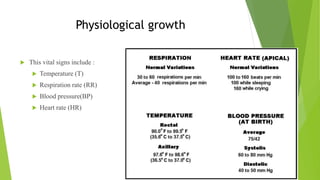
Physiological growth
 This vital signs include :
 Temperature (T)
 Respiration rate (RR)
 Blood pressure(BP)
 Heart rate (HR)
14
Physical growth
- Weight = 2.700 – 4 kg
- Weight loss 5% -10% by 3-4 days after birth
- Weight gain by 10th days of life
- Gain ¾ kg by the end of the 1st month
They loose 5 % to 10 % of weight by 3-4 days after birth as result of :
-Withdrawal of hormones from mother.
-Loss of excessive extra cellular fluid.
-Passage of meconium (feces) and urine.
-Limited food intake.
15
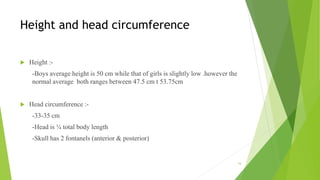
Height and head circumference
 Height :-
-Boys average height is 50 cm while that of girls is slightly low .however the
normal average both ranges between 47.5 cm t 53.75cm
 Head circumference :-
-33-35 cm
-Head is ¼ total body length
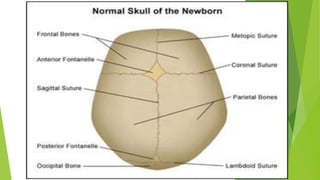
-Skull has 2 fontanels (anterior & posterior)
16
17
 motor development
 Gross motor development
 Fine motor development
Usually the newborn's movement are random, diffuse and uncoordinated.
Reflexes carry out bodily functions and responds to external stimuli.
 Cognitive development usually involves the increase in the complexity of the
child's psychology that’s in terms of thinking ,understanding and perceiving.
 Emotional development the newborn expresses their emotion just through cry
for hunger, pain or discomfort sensation .
 Social development is the way I which the newborn /child is able to interact
with those around them starting from the caregivers 18
Stages of growth and development
 Prenatal
- Embryonic (conception- 8 w)
- Fetal stage (8-40 or 42 w)
 Infancy
-Neonate is from Birth to end of 1 month
-Infancy is from 1 month to end of 1 year
 Early Childhood
-Toddler starts from the age of 1 year up to 3 years
-Preschool is from the age of 3 years to 6 years 19
Cont.:
 Middle Childhood
-School age from age of 6 years to 12 years
 Late Childhood
-Adolescent from age of 13 years to approximately 18 years
20
Infancy
• Are the children whose age range from 0 days up to 1 year of age.
• 0days to 28days/ 1 month those are neonates while starting from 1 month up to
12 months /1 year are the infants
21
Neonate
 All the senses are developed that’s Touch,Vision,Hearing,Taste and Smell
 Under gross motor development the newborn's movement are random, diffuse
and uncoordinated. Reflexes carry out bodily functions and responses to
external stimuli.
 Fine motor development that are developed are holding hands in fist and while
crying they draw arms and legs to the body.
 The newborn infant expresses his emotion just through cry for hunger, pain or
discomfort sensation
 However the cognitive development in a neonate is hard to be noticed
22
Infancy
 This is a period which start at the 28days/1 month up to 12 months /1 year.
 Growth during this period is very rapid .
Physical growth
 The infant gains ¾ kg /month from birth up to 4 months , ½ kg/month from 5
months to 8 months and ¼ kg /month from 9 to 12 months. Usually the infants
doubles the weight by age of 4 to 5 months and triple it by age of 10 to 12 months
.
 The infants height increases about 3 cm/month during the 1st 3 months of age,
then it increases to 2 cm /month at age of 4-6 months, then at 7 – 12 months, it
increases by 1 ½ cm per month
23
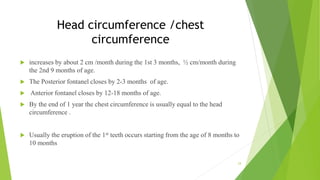
Head circumference /chest
circumference
 increases by about 2 cm /month during the 1st 3 months, ½ cm/month during
the 2nd 9 months of age.
 The Posterior fontanel closes by 2-3 months of age.
 Anterior fontanel closes by 12-18 months of age.
 By the end of 1 year the chest circumference is usually equal to the head
circumference .
 Usually the eruption of the 1st teeth occurs starting from the age of 8 months to
10 months
24
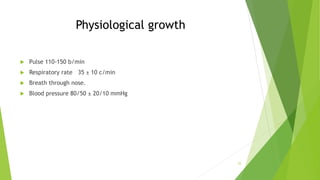
Physiological growth
 Pulse 110-150 b/min
 Respiratory rate 35 ± 10 c/min
 Breath through nose.
 Blood pressure 80/50 ± 20/10 mmHg
25
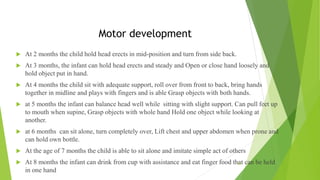
Motor development
 At 2 months the child hold head erects in mid-position and turn from side back.
 At 3 months, the infant can hold head erects and steady and Open or close hand loosely and
hold object put in hand.
 At 4 months the child sit with adequate support, roll over from front to back, bring hands
together in midline and plays with fingers and is able Grasp objects with both hands.
 at 5 months the infant can balance head well while sitting with slight support. Can pull feet up
to mouth when supine, Grasp objects with whole hand Hold one object while looking at
another.
 at 6 months can sit alone, turn completely over, Lift chest and upper abdomen when prone and
can hold own bottle.
 At the age of 7 months the child is able to sit alone and imitate simple act of others
 At 8 months the infant can drink from cup with assistance and eat finger food that can be held
in one hand
26
Cont.:
 At the age of 9 months the infant can rise to sitting position alone ,crawl and
hold one bottle with good hand mouth coordination.
27
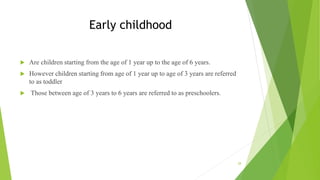
Early childhood
 Are children starting from the age of 1 year up to the age of 6 years.
 However children starting from age of 1 year up to age of 3 years are referred
to as toddler
 Those between age of 3 years to 6 years are referred to as preschoolers.
28
Toddler
 During this stage growth slows considerably
Physical growth
 average weight gain is 1.8 to 2.7 kg/year.
 height increases to about 10 to 12.5cm/year.
 The head increases 10 cm only from the age of 1 year to adult age.
 The chest circumference continues to increase in size and exceeds head
circumference.
 By 2 years of age, the toddler has 16 temporary teeth. And 20 teeth by age of
2½ years
29
Conti.:
Physiological growth
 Pulse rate 80–130 beats/min (average 110/min).
 Respiration rate: 20–30C/min.
 Daytime control of bladder and bowel control by 24–30 months.
Fine motor development
 By age of 1 yr. the toddler is able to transfer objects from one hand to the other
 At 2 yrs. Toddler is able to hold a crayon and use it for drawing and is also
able to build a tower of 5-6 block .
 At age of 3 yrs. Is able to copy some of the diagrams from a bool e.g. a circle
or a cross line
30
Conti.:
Gross motor development
 creeps upstairs, assume standing position without falling and able to go up and
down stairs alone with two feet on each step and is also able to jump with both
feet and from chair or step
 Hold a cup with all fingers grasped around it transferring it from hand to hand
at will hence able to drink well from a small glass held in one hand .
 Are able to remove own cloths
31
Emotional development
 Temper tantrums
 Stranger anxiety
 Sibling rivalry
 Thumb sucking
 Toilet Training
32
Cognitive development
 within 2 years the toddler uses their senses and motor development to
different self from objects.
 The toddler from 2 to 3 years will be in the pre-conceptual phase of cognitive
development (2-4 years) and still egocentric and can not take the point of
view of other people
33
Social development
 Imitates what the parents are doing
 Usually they are very social but still egocentric
 Notice sex differences and know own sex that is they start to associate
themselves with other whose are of the same sex .
 The development of autonomy during this period is centered around toddlers
increasing abilities to control their bodies, themselves and their environment.
34
preschool
 Are the children between the age of 3 years to 6 years
Physical development
 Growth is relatively slow
 Gain approximately 1.8 kg/year
 They double birth length by 4-5 years of age
Physiological growth
 Pulse: 80–120 beat/min.
 Respiration: 20–30C/min.
 Blood Pressure: 100/67+24/25.
35
Fine motor and cognitive development
 able to give reasons for his belief and actions, but not true cause-effect relationship.
 copy a circle and a cross – build using small blocks
 use scissors, color within the borders
 write some letters and draw a person with body parts
 Buttoning clothing
 Holding a pencil
 Building with small blocks
 Using scissors
 Playing a board game
 Have child draw picture of themselves
36
Emotional development
 Fears the dark
 Tends to be impatient and selfish
 Expresses aggression through physical and verbal behaviors.
 Shows signs of jealousy of siblings.
Social development
 Egocentric
 Tolerates short separation
 Less dependent on parents
 May have dreams & night-mares
 Attachment to opposite sex parent
 More cooperative in play
 Develop a sense of initiative
37
Middle childhood
 This are children starting from the age of 6 years up to the age of 12 years
 Are usually the school age children and their growth and development is characterized with gradual
growth
Physical growth
 Usually gain the weight of about 3.8kg/yr.
 The child gains a height of about 5cm /yr.
 Permanent teeth erupt during this stage.
Physiological growth
 Pulse rate range is 90+15 beats/min (75 to 105).
 Respiration rate range is 21+3C/min (18–24).
 Blood Pressure is 100/60+16/10
38
Fine motor development
 Writing skills improve e.g. Prints word and learn cursive writing
 During this stage of development the child may be able to use musical
instruments ,sewing, and also typing using a computer
 is when the fine motor development is refined
 are able to ride a bicycle, runs Jumps, climbs and hops.
 Uses both hands independently and also handles eating utensils skillfully and
also have improved eye-hand coordination
 is involved in most physical activities that's is participate in organized sports
 motor coordination continues to improve
39
cognitive development
 At 7-11 years, the child now is in the concrete operational stage of cognitive
development. That is ,they are able to function on a higher level in his
mental ability.
 Greater ability to concentrate and participate in self-initiating quiet activities
that challenge cognitive skills, such as reading, playing computer and board
games.
40
Emotional development
 Fears injury to body and fear of dark.
 Jealous of siblings ,especially 6–8 years old children.
 They are always curious about everything.
 Have short bursts of anger by age of 10 years but able to control anger by 12
years.
41
Social development
 Continues to be egocentric.
 Wants other children to play with him.
 Insists on being first in every thing
 Becomes peer oriented.
 Improves relationship with siblings.
 Has greater self–control, confident, sincere.
 Respects parents and their role.
 Joints group (formal and informal).
 Engage in tasks in the real world.
42
Late childhood
 Ranges between the age of 13 years to 18 years of age
 They can also be referred to as adolescents .
 Adolescence is a transmission period from childhood to adulthood and its usually
based on the childhood experiences and accomplishments.
 It begins with the appearance of secondary sex characteristics and ends when somatic
growth is completed and the individual is psychological mature.
43
Physical growth
 Growth spurt begins earlier in girls than in males
 usually Males gains 7 to 30kg, while female gains 7 to 25kg.
 By the age of 13 years they triples there birth length whereby males gains 10 to 30cm
in height.
 Females gains less height than males as they gain 5 to 20cm.
 Growth in height ceases at age of 16 or 17 years in females and 18 to 20 years in
males.
Physiological growth
Pulse rate Reaches adult value 60–80 beats/min.
Respiration rate range between 16–20C/minute.
44
Emotional development
 This period is usually accompanied by changes in emotional control.
 There exhibition of alternating and recurrent episodes of disturbed behavior
with periods of quite one.
 They may become hostile or ready to fight, complain or resist every thing.
 Mood swings especially in early adolescents
Cognitive development
 generally through formal operational thinking, adolescent can deal with a
problem.
Social development
 they are able to know who they are in relation to family and society, that is,
they develop a sense of identity
 They look for close relationships that is they show interest in opposite sex
45
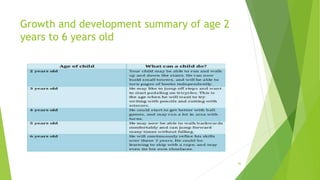
Growth and development summary of age 2
years to 6 years old
46

Growth and development presentation

  • 1.
  • 2.
    OBJECTIVES  Define growthand development.  Identify the importance of growth and development.  Mention the principles of growth and development.  List factors affecting growth and development.  Mention types of growth and development.  Identify the stages of development. 2
  • 3.
    Definition of growthand development  Growth and development generally refers to the process by which a fertilized ovum eventually attains adult status  Growth:-  is the increase in size of the body as a whole hence a quantitative change in a child body.  Its measured in terms of kilograms ,pounds, meters etc. 3
  • 4.
  • 5.
    Growth pattern  Thegrowth pattern of a child is usually from head to toe direction that is cephalocaudial,also occurs in an inward to outward pattern which is know as proximodistal. 5
  • 6.
    Conti.:  Development:-  Thisrefers to a progressive increase in skill and capacity to function  It usually a qualitative change in the child's development. 6
  • 7.
    Importance of growthand development assessment  Helps in formulating plan care program as the child keeps developing  Helps in knowing of what to expect of a particular child at a given stage of development  Simple and time efficient mechanism to ensure adequate surveillance of developmental progress  Early detection of deviation in child’s pattern of development 7
  • 8.
    Principles of growthand development  Every child grows and develop in their own unique ways  Growth and development is a continuous process throughout the life span of an individual .  There are usually increased periods of development in the early childhood and adolescents but decrease rate of G/D in the middle childhood  Growth and development proceed in a regular related direction that is cephalocaudiol and proximodistal and from general to specific.  Each stage of growth and development is affected by the preceding types of development  Not all body parts grow at the same rate 8
  • 9.
    Factors affecting growthand development  factors are either  Environmental  Hereditary  Environmental factors include  Pre-natal environment  Posta natal environment 9
  • 10.
    Prenatal environment  Thisare the factors related to the mother during pregnancy and also related to the fetus - Nutritional deficiencies - Diabetic mother - Exposure to radiation - Infection with German measles - Smoking - Use of drugs - Mal-position in uterus - Faulty placental implantation 10
  • 11.
    Postnatal environment  Itcan either be external environment or the internal environment - External environment: - socio-economic status of the family - child’s nutrition - climate and season - child’s ordinal position in the family - Number of siblings in the family - Family structure that is single parent the extended family 11
  • 12.
  • 13.
    Types of growthand development  Types of growth includes:-  Physiological growth this involves the vital signs  Physical growth that is increase in weight ,height ,size etc.  Types of development includes :-  Motor development  Cognitive development  Emotional development  Social development 13
  • 14.
    Physiological growth  Thisvital signs include :  Temperature (T)  Respiration rate (RR)  Blood pressure(BP)  Heart rate (HR) 14
  • 15.
    Physical growth - Weight= 2.700 – 4 kg - Weight loss 5% -10% by 3-4 days after birth - Weight gain by 10th days of life - Gain ¾ kg by the end of the 1st month They loose 5 % to 10 % of weight by 3-4 days after birth as result of : -Withdrawal of hormones from mother. -Loss of excessive extra cellular fluid. -Passage of meconium (feces) and urine. -Limited food intake. 15
  • 16.
    Height and headcircumference  Height :- -Boys average height is 50 cm while that of girls is slightly low .however the normal average both ranges between 47.5 cm t 53.75cm  Head circumference :- -33-35 cm -Head is ¼ total body length -Skull has 2 fontanels (anterior & posterior) 16
  • 17.
  • 18.
     motor development Gross motor development  Fine motor development Usually the newborn's movement are random, diffuse and uncoordinated. Reflexes carry out bodily functions and responds to external stimuli.  Cognitive development usually involves the increase in the complexity of the child's psychology that’s in terms of thinking ,understanding and perceiving.  Emotional development the newborn expresses their emotion just through cry for hunger, pain or discomfort sensation .  Social development is the way I which the newborn /child is able to interact with those around them starting from the caregivers 18
  • 19.
    Stages of growthand development  Prenatal - Embryonic (conception- 8 w) - Fetal stage (8-40 or 42 w)  Infancy -Neonate is from Birth to end of 1 month -Infancy is from 1 month to end of 1 year  Early Childhood -Toddler starts from the age of 1 year up to 3 years -Preschool is from the age of 3 years to 6 years 19
  • 20.
    Cont.:  Middle Childhood -Schoolage from age of 6 years to 12 years  Late Childhood -Adolescent from age of 13 years to approximately 18 years 20
  • 21.
    Infancy • Are thechildren whose age range from 0 days up to 1 year of age. • 0days to 28days/ 1 month those are neonates while starting from 1 month up to 12 months /1 year are the infants 21
  • 22.
    Neonate  All thesenses are developed that’s Touch,Vision,Hearing,Taste and Smell  Under gross motor development the newborn's movement are random, diffuse and uncoordinated. Reflexes carry out bodily functions and responses to external stimuli.  Fine motor development that are developed are holding hands in fist and while crying they draw arms and legs to the body.  The newborn infant expresses his emotion just through cry for hunger, pain or discomfort sensation  However the cognitive development in a neonate is hard to be noticed 22
  • 23.
    Infancy  This isa period which start at the 28days/1 month up to 12 months /1 year.  Growth during this period is very rapid . Physical growth  The infant gains ¾ kg /month from birth up to 4 months , ½ kg/month from 5 months to 8 months and ¼ kg /month from 9 to 12 months. Usually the infants doubles the weight by age of 4 to 5 months and triple it by age of 10 to 12 months .  The infants height increases about 3 cm/month during the 1st 3 months of age, then it increases to 2 cm /month at age of 4-6 months, then at 7 – 12 months, it increases by 1 ½ cm per month 23
  • 24.
    Head circumference /chest circumference increases by about 2 cm /month during the 1st 3 months, ½ cm/month during the 2nd 9 months of age.  The Posterior fontanel closes by 2-3 months of age.  Anterior fontanel closes by 12-18 months of age.  By the end of 1 year the chest circumference is usually equal to the head circumference .  Usually the eruption of the 1st teeth occurs starting from the age of 8 months to 10 months 24
  • 25.
    Physiological growth  Pulse110-150 b/min  Respiratory rate 35 ± 10 c/min  Breath through nose.  Blood pressure 80/50 ± 20/10 mmHg 25
  • 26.
    Motor development  At2 months the child hold head erects in mid-position and turn from side back.  At 3 months, the infant can hold head erects and steady and Open or close hand loosely and hold object put in hand.  At 4 months the child sit with adequate support, roll over from front to back, bring hands together in midline and plays with fingers and is able Grasp objects with both hands.  at 5 months the infant can balance head well while sitting with slight support. Can pull feet up to mouth when supine, Grasp objects with whole hand Hold one object while looking at another.  at 6 months can sit alone, turn completely over, Lift chest and upper abdomen when prone and can hold own bottle.  At the age of 7 months the child is able to sit alone and imitate simple act of others  At 8 months the infant can drink from cup with assistance and eat finger food that can be held in one hand 26
  • 27.
    Cont.:  At theage of 9 months the infant can rise to sitting position alone ,crawl and hold one bottle with good hand mouth coordination. 27
  • 28.
    Early childhood  Arechildren starting from the age of 1 year up to the age of 6 years.  However children starting from age of 1 year up to age of 3 years are referred to as toddler  Those between age of 3 years to 6 years are referred to as preschoolers. 28
  • 29.
    Toddler  During thisstage growth slows considerably Physical growth  average weight gain is 1.8 to 2.7 kg/year.  height increases to about 10 to 12.5cm/year.  The head increases 10 cm only from the age of 1 year to adult age.  The chest circumference continues to increase in size and exceeds head circumference.  By 2 years of age, the toddler has 16 temporary teeth. And 20 teeth by age of 2½ years 29
  • 30.
    Conti.: Physiological growth  Pulserate 80–130 beats/min (average 110/min).  Respiration rate: 20–30C/min.  Daytime control of bladder and bowel control by 24–30 months. Fine motor development  By age of 1 yr. the toddler is able to transfer objects from one hand to the other  At 2 yrs. Toddler is able to hold a crayon and use it for drawing and is also able to build a tower of 5-6 block .  At age of 3 yrs. Is able to copy some of the diagrams from a bool e.g. a circle or a cross line 30
  • 31.
    Conti.: Gross motor development creeps upstairs, assume standing position without falling and able to go up and down stairs alone with two feet on each step and is also able to jump with both feet and from chair or step  Hold a cup with all fingers grasped around it transferring it from hand to hand at will hence able to drink well from a small glass held in one hand .  Are able to remove own cloths 31
  • 32.
    Emotional development  Tempertantrums  Stranger anxiety  Sibling rivalry  Thumb sucking  Toilet Training 32
  • 33.
    Cognitive development  within2 years the toddler uses their senses and motor development to different self from objects.  The toddler from 2 to 3 years will be in the pre-conceptual phase of cognitive development (2-4 years) and still egocentric and can not take the point of view of other people 33
  • 34.
    Social development  Imitateswhat the parents are doing  Usually they are very social but still egocentric  Notice sex differences and know own sex that is they start to associate themselves with other whose are of the same sex .  The development of autonomy during this period is centered around toddlers increasing abilities to control their bodies, themselves and their environment. 34
  • 35.
    preschool  Are thechildren between the age of 3 years to 6 years Physical development  Growth is relatively slow  Gain approximately 1.8 kg/year  They double birth length by 4-5 years of age Physiological growth  Pulse: 80–120 beat/min.  Respiration: 20–30C/min.  Blood Pressure: 100/67+24/25. 35
  • 36.
    Fine motor andcognitive development  able to give reasons for his belief and actions, but not true cause-effect relationship.  copy a circle and a cross – build using small blocks  use scissors, color within the borders  write some letters and draw a person with body parts  Buttoning clothing  Holding a pencil  Building with small blocks  Using scissors  Playing a board game  Have child draw picture of themselves 36
  • 37.
    Emotional development  Fearsthe dark  Tends to be impatient and selfish  Expresses aggression through physical and verbal behaviors.  Shows signs of jealousy of siblings. Social development  Egocentric  Tolerates short separation  Less dependent on parents  May have dreams & night-mares  Attachment to opposite sex parent  More cooperative in play  Develop a sense of initiative 37
  • 38.
    Middle childhood  Thisare children starting from the age of 6 years up to the age of 12 years  Are usually the school age children and their growth and development is characterized with gradual growth Physical growth  Usually gain the weight of about 3.8kg/yr.  The child gains a height of about 5cm /yr.  Permanent teeth erupt during this stage. Physiological growth  Pulse rate range is 90+15 beats/min (75 to 105).  Respiration rate range is 21+3C/min (18–24).  Blood Pressure is 100/60+16/10 38
  • 39.
    Fine motor development Writing skills improve e.g. Prints word and learn cursive writing  During this stage of development the child may be able to use musical instruments ,sewing, and also typing using a computer  is when the fine motor development is refined  are able to ride a bicycle, runs Jumps, climbs and hops.  Uses both hands independently and also handles eating utensils skillfully and also have improved eye-hand coordination  is involved in most physical activities that's is participate in organized sports  motor coordination continues to improve 39
  • 40.
    cognitive development  At7-11 years, the child now is in the concrete operational stage of cognitive development. That is ,they are able to function on a higher level in his mental ability.  Greater ability to concentrate and participate in self-initiating quiet activities that challenge cognitive skills, such as reading, playing computer and board games. 40
  • 41.
    Emotional development  Fearsinjury to body and fear of dark.  Jealous of siblings ,especially 6–8 years old children.  They are always curious about everything.  Have short bursts of anger by age of 10 years but able to control anger by 12 years. 41
  • 42.
    Social development  Continuesto be egocentric.  Wants other children to play with him.  Insists on being first in every thing  Becomes peer oriented.  Improves relationship with siblings.  Has greater self–control, confident, sincere.  Respects parents and their role.  Joints group (formal and informal).  Engage in tasks in the real world. 42
  • 43.
    Late childhood  Rangesbetween the age of 13 years to 18 years of age  They can also be referred to as adolescents .  Adolescence is a transmission period from childhood to adulthood and its usually based on the childhood experiences and accomplishments.  It begins with the appearance of secondary sex characteristics and ends when somatic growth is completed and the individual is psychological mature. 43
  • 44.
    Physical growth  Growthspurt begins earlier in girls than in males  usually Males gains 7 to 30kg, while female gains 7 to 25kg.  By the age of 13 years they triples there birth length whereby males gains 10 to 30cm in height.  Females gains less height than males as they gain 5 to 20cm.  Growth in height ceases at age of 16 or 17 years in females and 18 to 20 years in males. Physiological growth Pulse rate Reaches adult value 60–80 beats/min. Respiration rate range between 16–20C/minute. 44
  • 45.
    Emotional development  Thisperiod is usually accompanied by changes in emotional control.  There exhibition of alternating and recurrent episodes of disturbed behavior with periods of quite one.  They may become hostile or ready to fight, complain or resist every thing.  Mood swings especially in early adolescents Cognitive development  generally through formal operational thinking, adolescent can deal with a problem. Social development  they are able to know who they are in relation to family and society, that is, they develop a sense of identity  They look for close relationships that is they show interest in opposite sex 45
  • 46.
    Growth and developmentsummary of age 2 years to 6 years old 46

Editor's Notes

  • #15 Vital signs - Temperature (36.3 to37.2C ). - Pulse ( 120 to 160 b/min ). - Respiration ( 35 to 50C/min) .
  • #18 Diamond in shape/The junction of the sagittal, corneal and frontal sutures forms it/Between 2 frontal & 2 parietal bones/3-4 cm in length and 2-3 cm width /It closes at 12-18 months of age Triangular/Located between occipital & 2 parietal bones / Closes by the end of the 1st month of age