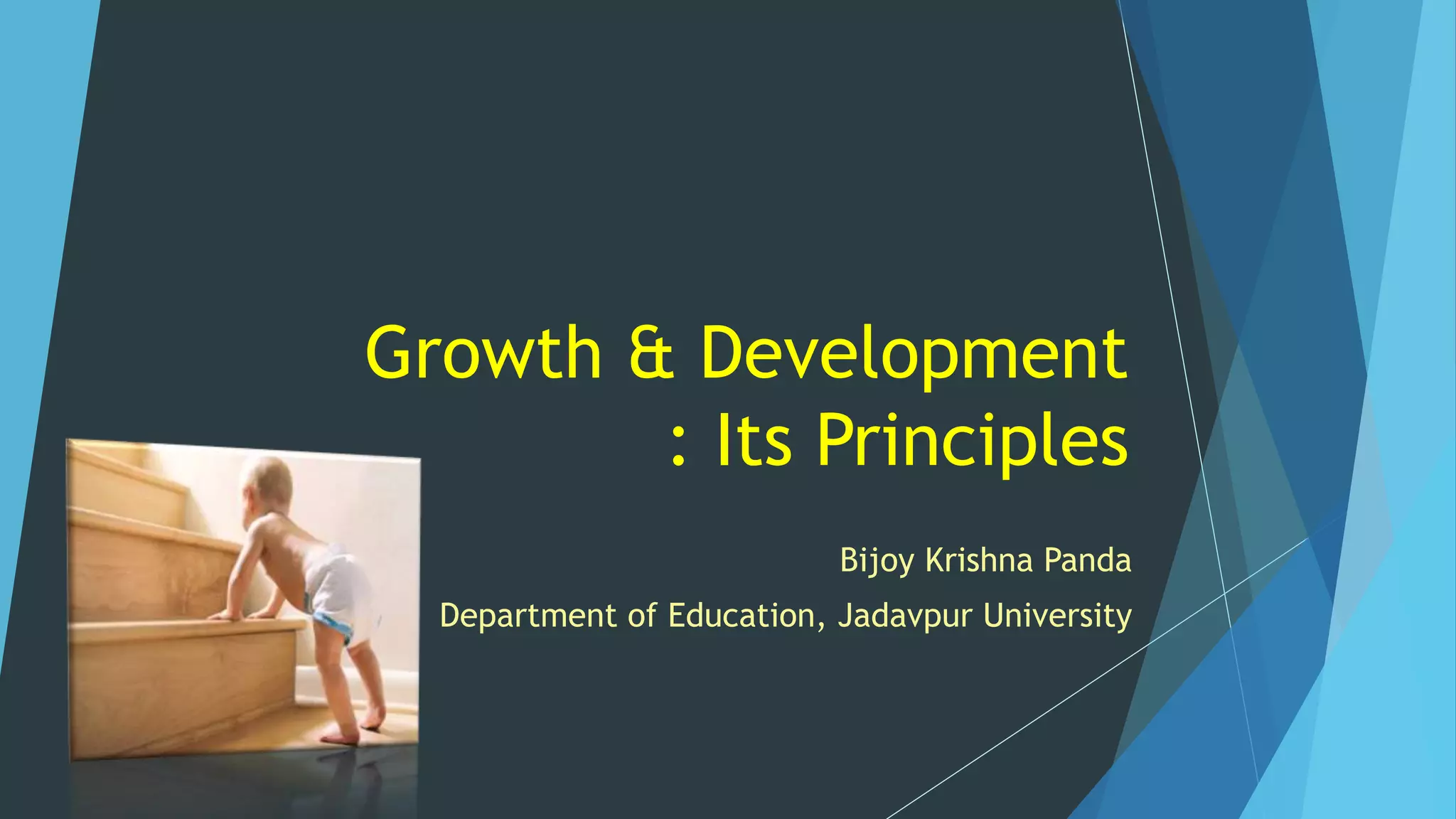
Growth & Development
: Its Principles
Bijoy Krishna Panda
Department of Education, Jadavpur University
What is ‘Principle’ ?
 A fundamental, primary or general law or truth from which
others are derived.
What is ‘Growth’ ?
 Growth refers to an increase in some quantity over time.
 The quantity can be physical.
What is ‘Development’ ?
 Development is systematic and orderly change, organisms
experience as they live and either gain or loose abilities.
Change is the inevitable law or phenomena of human being
Are Growth & Development two similar process?
 Growth is quantitative change, but development is both qualitative
quantitative and functional change.
 Growth is initial matter where development comes afterward as a
result of growth and maturity. So the sequence may be arranged like :
Growth >> Maturity >> Development
 Growth only creates the ability in the individual but development
helps in make use of that ability.
 Human body ceases to grow after attaining maximum maturity
level, but development continues till the end of life.
Principles of Growth & Development
 Continuity
 Development is Cephalocaudle
 Development is Proximodistal
 Locomotion
 Generality to Specificity
 Depend on Maturation & Learning
 Growth is a personal matter
Continuity
 From conception to death (Womb to Tomb)
 Leads child to be an adult in respect of body size,
functioning, behaviour.
 Adulthood changes to old age.
 Then comes the death which ends the life cycle.
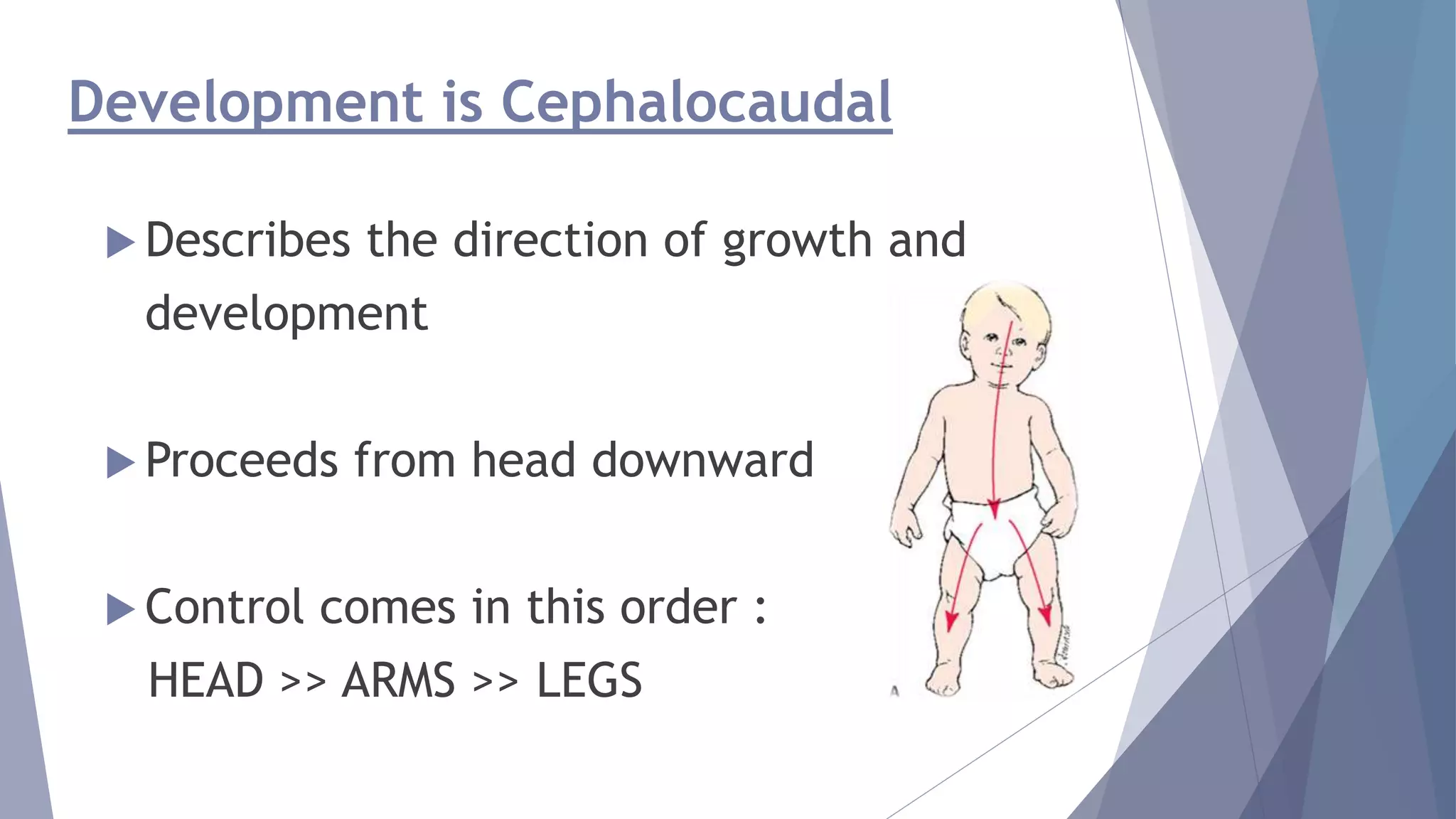
Development is Cephalocaudal
 Describes the direction of growth and
development
 Proceeds from head downward
 Control comes in this order :
HEAD >> ARMS >> LEGS
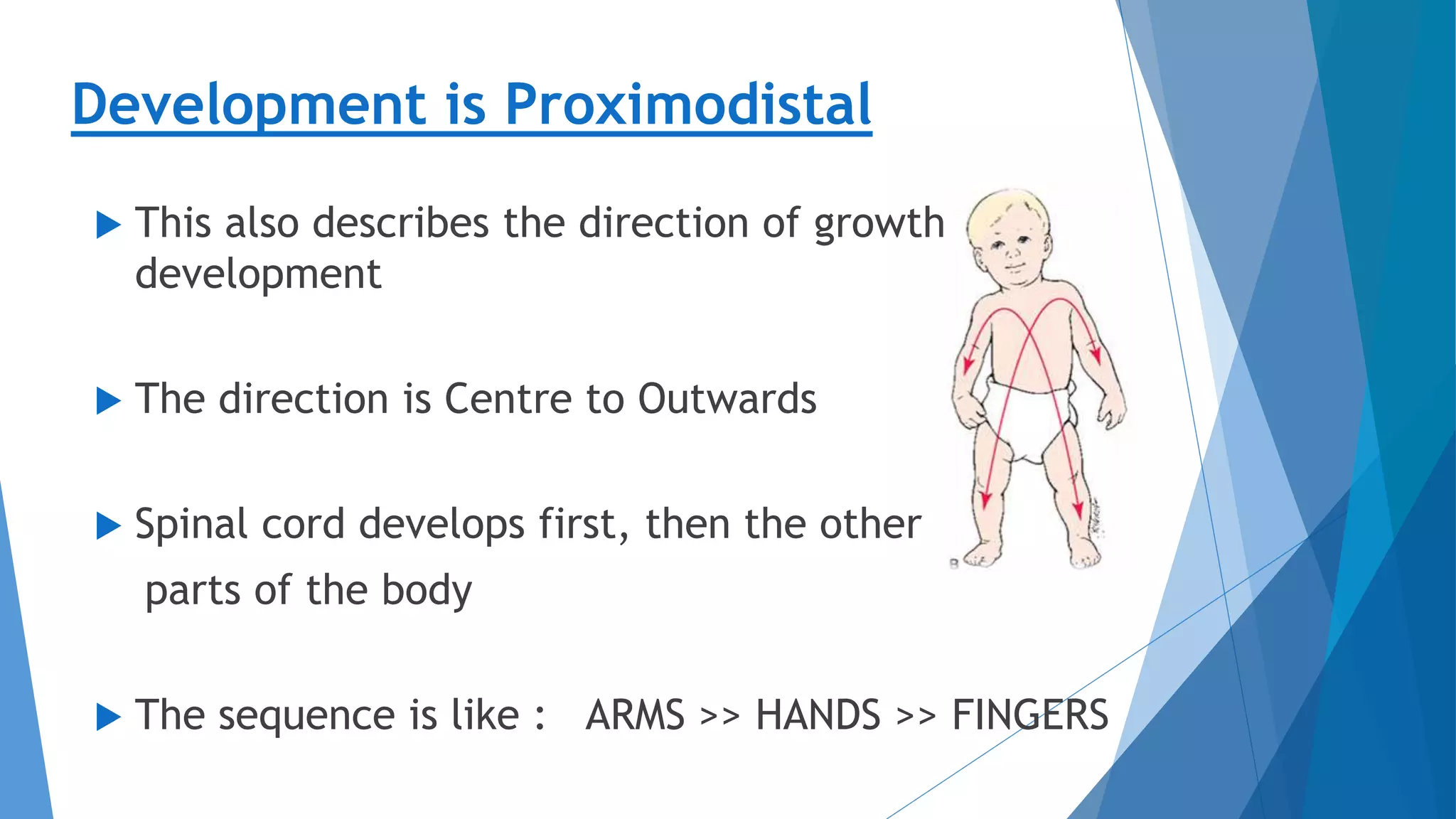
Development is Proximodistal
 This also describes the direction of growth &
development
 The direction is Centre to Outwards
 Spinal cord develops first, then the other
parts of the body
 The sequence is like : ARMS >> HANDS >> FINGERS
Locomotion
 It is related to the movement of the body.
 Every species follows a similar pattern.
 Each one has to pass through the stages accordingly.
 This is like : CREEPING >> CRAWLING >> STANDING >>
WALKING >> RUNNING
Generality to Specificity
 DEVELOPMENT PROCEEDS FROM GENERAL TO SPECIFIC.
 GROWTH OCCURS TO LARGE MUSCLE MOVEMENTS TO
SMALLER MUSCLE MOVEMENTS.
 THIS RESEMBLES WITH THE WHOLE AND PART. WE FIRST SEE
THE WHOLE THEN COMES THE PARTS.
 INFANT GRASPS THE OBJECT WITH HIS WHOLE HAND BEFORE
USING THUMB OR FOREFINGER.
Depends on Maturation & Learning
 MATURATION STANDS FOR BIOLOGICAL GROWTH &
DEVELOPMENT.
 THESE OCCURS IN SEQUENCE.
 PREPARES THE CHILD TO ACCEPT NEW SKILLS AND
PROGRESS ON IT.
 LIKE, A SIX MONTH OLD CHILD CANNOT USE LANGUAGE
AS THE INFANT’S BRAIN HAS NOT YET ATTAINED THAT
MATURITY LABEL TO TALK.
Growth & Development are personal matter
 RATE AND AMOUNT OF GROWTH IS NOT SAME FOR ALL.
 THIS IS CAUSED BY BOTH HEREDITY AND ENVIRONMENT.
 THERE IS NO TWO INDIVIDUAL WHOSE DEVELOPMENT RATE IS
SAME.
 THERE IS NO VALIDITY IN COMPARING ONE CHILD’S
PROGRESS WITH OR AGAINST ANOTHER CHILD.
Educational Implications
 The education process or the learning process should be continuous and
life long
 Learners should be introduced to basic concepts preceding elaborated
information.
 Subject matters should be presented in step by step.
 General ideas should be developed in the learners in order to make them
think specifically.
 The knowledge of concrete objects will be helpful to draw abstract ideas.
 Law of readiness must be considered while framing subject topic and
curriculum.
 Diversified learning strategies, course of study and developmental task
should be provided to learners in order to keep pace with their
individualistic developmental context.
Thank You

Principles of growth & development bijoy krishna panda

  • 1.
    Growth & Development :Its Principles Bijoy Krishna Panda Department of Education, Jadavpur University
  • 2.
    What is ‘Principle’?  A fundamental, primary or general law or truth from which others are derived. What is ‘Growth’ ?  Growth refers to an increase in some quantity over time.  The quantity can be physical. What is ‘Development’ ?  Development is systematic and orderly change, organisms experience as they live and either gain or loose abilities. Change is the inevitable law or phenomena of human being
  • 3.
    Are Growth &Development two similar process?  Growth is quantitative change, but development is both qualitative quantitative and functional change.  Growth is initial matter where development comes afterward as a result of growth and maturity. So the sequence may be arranged like : Growth >> Maturity >> Development  Growth only creates the ability in the individual but development helps in make use of that ability.  Human body ceases to grow after attaining maximum maturity level, but development continues till the end of life.
  • 4.
    Principles of Growth& Development  Continuity  Development is Cephalocaudle  Development is Proximodistal  Locomotion  Generality to Specificity  Depend on Maturation & Learning  Growth is a personal matter
  • 5.
    Continuity  From conceptionto death (Womb to Tomb)  Leads child to be an adult in respect of body size, functioning, behaviour.  Adulthood changes to old age.  Then comes the death which ends the life cycle.
  • 6.
    Development is Cephalocaudal Describes the direction of growth and development  Proceeds from head downward  Control comes in this order : HEAD >> ARMS >> LEGS
  • 7.
    Development is Proximodistal This also describes the direction of growth & development  The direction is Centre to Outwards  Spinal cord develops first, then the other parts of the body  The sequence is like : ARMS >> HANDS >> FINGERS
  • 8.
    Locomotion  It isrelated to the movement of the body.  Every species follows a similar pattern.  Each one has to pass through the stages accordingly.  This is like : CREEPING >> CRAWLING >> STANDING >> WALKING >> RUNNING
  • 9.
    Generality to Specificity DEVELOPMENT PROCEEDS FROM GENERAL TO SPECIFIC.  GROWTH OCCURS TO LARGE MUSCLE MOVEMENTS TO SMALLER MUSCLE MOVEMENTS.  THIS RESEMBLES WITH THE WHOLE AND PART. WE FIRST SEE THE WHOLE THEN COMES THE PARTS.  INFANT GRASPS THE OBJECT WITH HIS WHOLE HAND BEFORE USING THUMB OR FOREFINGER.
  • 10.
    Depends on Maturation& Learning  MATURATION STANDS FOR BIOLOGICAL GROWTH & DEVELOPMENT.  THESE OCCURS IN SEQUENCE.  PREPARES THE CHILD TO ACCEPT NEW SKILLS AND PROGRESS ON IT.  LIKE, A SIX MONTH OLD CHILD CANNOT USE LANGUAGE AS THE INFANT’S BRAIN HAS NOT YET ATTAINED THAT MATURITY LABEL TO TALK.
  • 11.
    Growth & Developmentare personal matter  RATE AND AMOUNT OF GROWTH IS NOT SAME FOR ALL.  THIS IS CAUSED BY BOTH HEREDITY AND ENVIRONMENT.  THERE IS NO TWO INDIVIDUAL WHOSE DEVELOPMENT RATE IS SAME.  THERE IS NO VALIDITY IN COMPARING ONE CHILD’S PROGRESS WITH OR AGAINST ANOTHER CHILD.
  • 12.
    Educational Implications  Theeducation process or the learning process should be continuous and life long  Learners should be introduced to basic concepts preceding elaborated information.  Subject matters should be presented in step by step.  General ideas should be developed in the learners in order to make them think specifically.  The knowledge of concrete objects will be helpful to draw abstract ideas.  Law of readiness must be considered while framing subject topic and curriculum.  Diversified learning strategies, course of study and developmental task should be provided to learners in order to keep pace with their individualistic developmental context.
  • 13.