AWARENESS ON CONSUMER RIGHTS

(UNFAIR TRADE PRACTICES & ADULTERATION OF
FOOD)
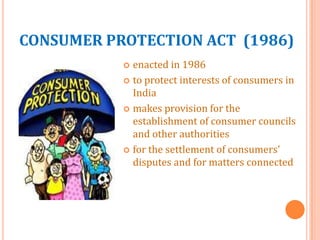
CONSUMER PROTECTION ACT (1986)
enacted in 1986
 to protect interests of consumers in
India
 makes provision for the
establishment of consumer councils
and other authorities
 for the settlement of consumers'
disputes and for matters connected

OBJECTIVES OF CENTRAL COUNCIL
To promote and protect the rights of the consumers
such as:a) - the right to be protected
against the marketing of goods and services
which are hazardous to life and property
b) - the right to be informed
about the quality, quantity, potency, purity,
standard and price of goods or services, as
the case may be so as to protect the
consumer against unfair trade practices
c) - the right to be assured
access to a variety of goods and services at
competitive prices
OBJECTIVES OF CENTRAL COUNCIL
d) - the right to be heard and to be
assured
that consumer's interests will
receive due consideration at
appropriate forums
e) - the right to seek redressal
against unfair trade practices or
restrictive trade practices or
unscrupulous exploitation of
consumers
f) - the right to consumer education
OBJECTIVES OF STATE COUNCIL
The objectives of every State Council
shall be
 to promote and protect within the
State the rights of the consumers
laid down in clauses (a) to (f) in
central council objectives
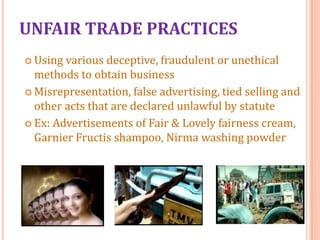
UNFAIR TRADE PRACTICES
 Using

various deceptive, fraudulent or unethical
methods to obtain business
 Misrepresentation, false advertising, tied selling and
other acts that are declared unlawful by statute
 Ex: Advertisements of Fair & Lovely fairness cream,
Garnier Fructis shampoo, Nirma washing powder
ADULTERATION OF FOOD
(RIGHT TO INFORMATION)
Adulteration of food consists of
 substituting it wholly or in part
by a cheaper or inferior
substance or
 removing any of its constituents,
wholly or in part, which affects
the nature or quality of the food
adversely
TYPES OF ADULTERANTS
INTENTIONAL ADULTERANTS
EX: sand, marble chips, stones, water, etc
 INCIDENTAL ADULTERANTS
Ex: pesticide residues, droppings of rodents, larvae in
foods etc
 METALLIC ADULTERANTS
Ex: arsenic from pesticides, lead from water effluents
from chemical industries, tin from cans etc

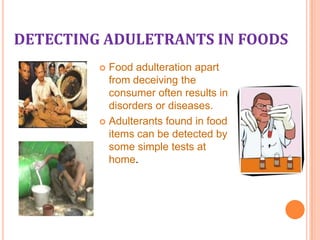
DETECTING ADULETRANTS IN FOODS
Food adulteration apart
from deceiving the
consumer often results in
disorders or diseases.
 Adulterants found in food
items can be detected by
some simple tests at
home.

NOW LET US KNOW ABOUT ADULTERANTS
AND THEIR DETECTION IN SOME COMMON
FOOD ITEMS………..
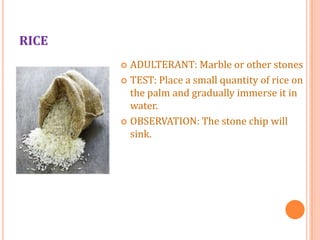
RICE
ADULTERANT: Marble or other stones
 TEST: Place a small quantity of rice on
the palm and gradually immerse it in
water.
 OBSERVATION: The stone chip will
sink.

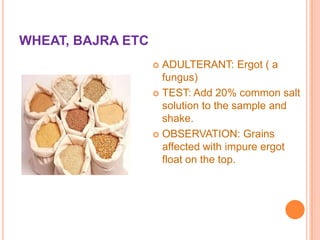
WHEAT, BAJRA ETC
ADULTERANT: Ergot ( a
fungus)
 TEST: Add 20% common salt
solution to the sample and
shake.
 OBSERVATION: Grains
affected with impure ergot
float on the top.

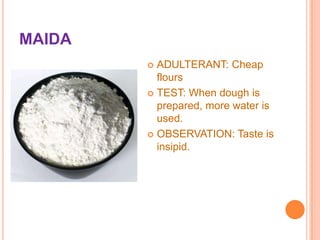
MAIDA
ADULTERANT: Cheap
flours
 TEST: When dough is
prepared, more water is
used.
 OBSERVATION: Taste is
insipid.

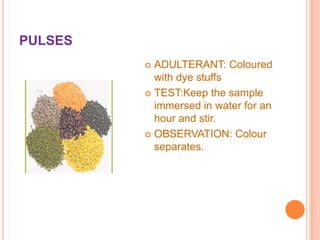
PULSES
ADULTERANT: Coloured
with dye stuffs
 TEST:Keep the sample
immersed in water for an
hour and stir.
 OBSERVATION: Colour
separates.

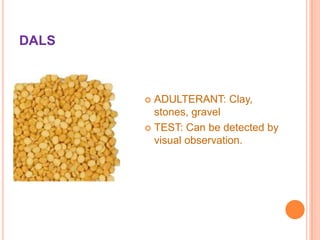
DALS

ADULTERANT: Clay,
stones, gravel
 TEST: Can be detected by
visual observation.

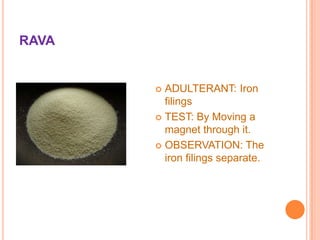
RAVA

ADULTERANT: Iron
filings
 TEST: By Moving a
magnet through it.
 OBSERVATION: The
iron filings separate.

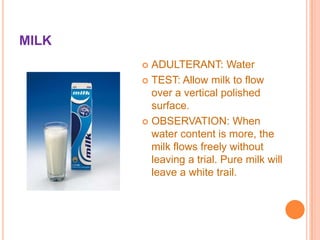
MILK
ADULTERANT: Water
 TEST: Allow milk to flow
over a vertical polished
surface.
 OBSERVATION: When
water content is more, the
milk flows freely without
leaving a trial. Pure milk will
leave a white trail.

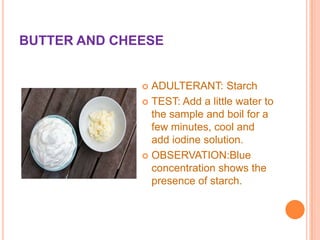
BUTTER AND CHEESE

ADULTERANT: Starch
 TEST: Add a little water to
the sample and boil for a
few minutes, cool and
add iodine solution.
 OBSERVATION:Blue
concentration shows the
presence of starch.

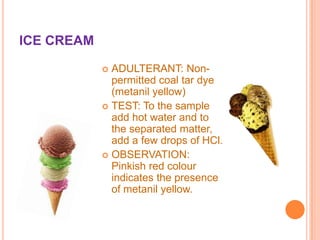
ICE CREAM
ADULTERANT: Nonpermitted coal tar dye
(metanil yellow)
 TEST: To the sample
add hot water and to
the separated matter,
add a few drops of HCl.
 OBSERVATION:
Pinkish red colour
indicates the presence
of metanil yellow.

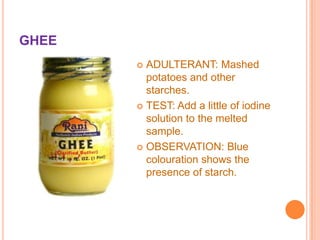
GHEE
ADULTERANT: Mashed
potatoes and other
starches.
 TEST: Add a little of iodine
solution to the melted
sample.
 OBSERVATION: Blue
colouration shows the
presence of starch.

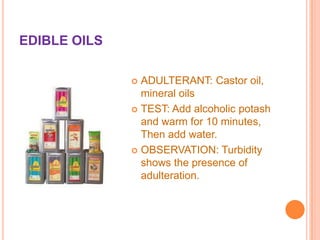
EDIBLE OILS
ADULTERANT: Castor oil,
mineral oils
 TEST: Add alcoholic potash
and warm for 10 minutes,
Then add water.
 OBSERVATION: Turbidity
shows the presence of
adulteration.

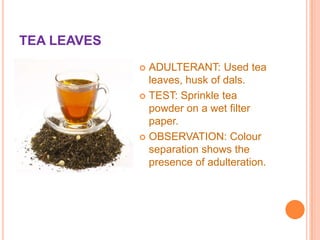
TEA LEAVES
ADULTERANT: Used tea
leaves, husk of dals.
 TEST: Sprinkle tea
powder on a wet filter
paper.
 OBSERVATION: Colour
separation shows the
presence of adulteration.

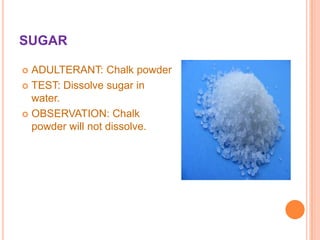
SUGAR
ADULTERANT: Chalk powder
 TEST: Dissolve sugar in
water.
 OBSERVATION: Chalk
powder will not dissolve.

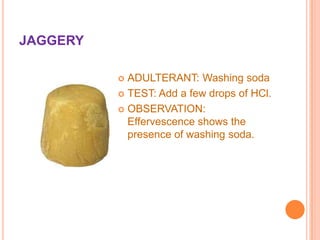
JAGGERY
ADULTERANT: Washing soda
 TEST: Add a few drops of HCl.
 OBSERVATION:
Effervescence shows the
presence of washing soda.

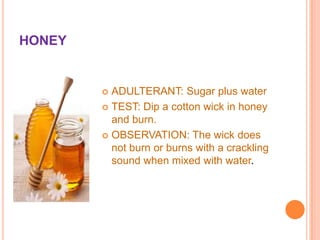
HONEY

ADULTERANT: Sugar plus water
 TEST: Dip a cotton wick in honey
and burn.
 OBSERVATION: The wick does
not burn or burns with a crackling
sound when mixed with water.

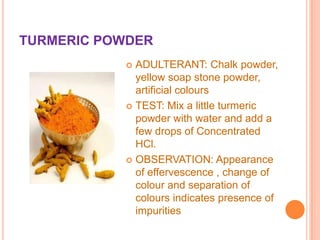
TURMERIC POWDER
ADULTERANT: Chalk powder,
yellow soap stone powder,
artificial colours
 TEST: Mix a little turmeric
powder with water and add a
few drops of Concentrated
HCl.
 OBSERVATION: Appearance
of effervescence , change of
colour and separation of
colours indicates presence of
impurities

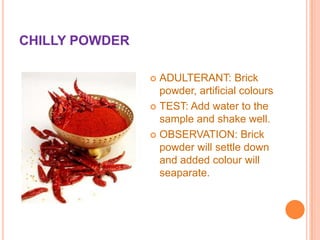
CHILLY POWDER
ADULTERANT: Brick
powder, artificial colours
 TEST: Add water to the
sample and shake well.
 OBSERVATION: Brick
powder will settle down
and added colour will
seaparate.

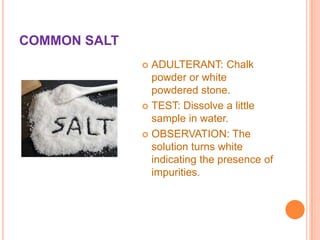
COMMON SALT
ADULTERANT: Chalk
powder or white
powdered stone.
 TEST: Dissolve a little
sample in water.
 OBSERVATION: The
solution turns white
indicating the presence of
impurities.

GRIEVANCE & REDRESSAL


1.
2.
3.

4.

Whenever any adulteration in food is confirmed,
complaints may be lodged at
Municipal Council – Municipal Health Officer
Town Panchayat – Medical Officer – PHC
District Level – Dy. Director of Health Services
State Level – Director of Public Health &
Preventive Medicine
SO BE INFORMED & BE AWARE!!
Eat pure!!
Be happy!!!!

THANK YOU!

Awareness on consumer rights

  • 1.
    AWARENESS ON CONSUMERRIGHTS (UNFAIR TRADE PRACTICES & ADULTERATION OF FOOD)
  • 2.
    CONSUMER PROTECTION ACT(1986) enacted in 1986  to protect interests of consumers in India  makes provision for the establishment of consumer councils and other authorities  for the settlement of consumers' disputes and for matters connected 
  • 3.
    OBJECTIVES OF CENTRALCOUNCIL To promote and protect the rights of the consumers such as:a) - the right to be protected against the marketing of goods and services which are hazardous to life and property b) - the right to be informed about the quality, quantity, potency, purity, standard and price of goods or services, as the case may be so as to protect the consumer against unfair trade practices c) - the right to be assured access to a variety of goods and services at competitive prices
  • 4.
    OBJECTIVES OF CENTRALCOUNCIL d) - the right to be heard and to be assured that consumer's interests will receive due consideration at appropriate forums e) - the right to seek redressal against unfair trade practices or restrictive trade practices or unscrupulous exploitation of consumers f) - the right to consumer education
  • 5.
    OBJECTIVES OF STATECOUNCIL The objectives of every State Council shall be  to promote and protect within the State the rights of the consumers laid down in clauses (a) to (f) in central council objectives
  • 6.
    UNFAIR TRADE PRACTICES Using various deceptive, fraudulent or unethical methods to obtain business  Misrepresentation, false advertising, tied selling and other acts that are declared unlawful by statute  Ex: Advertisements of Fair & Lovely fairness cream, Garnier Fructis shampoo, Nirma washing powder
  • 7.
    ADULTERATION OF FOOD (RIGHTTO INFORMATION) Adulteration of food consists of  substituting it wholly or in part by a cheaper or inferior substance or  removing any of its constituents, wholly or in part, which affects the nature or quality of the food adversely
  • 8.
    TYPES OF ADULTERANTS INTENTIONALADULTERANTS EX: sand, marble chips, stones, water, etc  INCIDENTAL ADULTERANTS Ex: pesticide residues, droppings of rodents, larvae in foods etc  METALLIC ADULTERANTS Ex: arsenic from pesticides, lead from water effluents from chemical industries, tin from cans etc 
  • 9.
    DETECTING ADULETRANTS INFOODS Food adulteration apart from deceiving the consumer often results in disorders or diseases.  Adulterants found in food items can be detected by some simple tests at home. 
  • 10.
    NOW LET USKNOW ABOUT ADULTERANTS AND THEIR DETECTION IN SOME COMMON FOOD ITEMS………..
  • 11.
    RICE ADULTERANT: Marble orother stones  TEST: Place a small quantity of rice on the palm and gradually immerse it in water.  OBSERVATION: The stone chip will sink. 
  • 12.
    WHEAT, BAJRA ETC ADULTERANT:Ergot ( a fungus)  TEST: Add 20% common salt solution to the sample and shake.  OBSERVATION: Grains affected with impure ergot float on the top. 
  • 13.
    MAIDA ADULTERANT: Cheap flours  TEST:When dough is prepared, more water is used.  OBSERVATION: Taste is insipid. 
  • 14.
    PULSES ADULTERANT: Coloured with dyestuffs  TEST:Keep the sample immersed in water for an hour and stir.  OBSERVATION: Colour separates. 
  • 15.
    DALS ADULTERANT: Clay, stones, gravel TEST: Can be detected by visual observation. 
  • 16.
    RAVA ADULTERANT: Iron filings  TEST:By Moving a magnet through it.  OBSERVATION: The iron filings separate. 
  • 17.
    MILK ADULTERANT: Water  TEST:Allow milk to flow over a vertical polished surface.  OBSERVATION: When water content is more, the milk flows freely without leaving a trial. Pure milk will leave a white trail. 
  • 18.
    BUTTER AND CHEESE ADULTERANT:Starch  TEST: Add a little water to the sample and boil for a few minutes, cool and add iodine solution.  OBSERVATION:Blue concentration shows the presence of starch. 
  • 19.
    ICE CREAM ADULTERANT: Nonpermittedcoal tar dye (metanil yellow)  TEST: To the sample add hot water and to the separated matter, add a few drops of HCl.  OBSERVATION: Pinkish red colour indicates the presence of metanil yellow. 
  • 20.
    GHEE ADULTERANT: Mashed potatoes andother starches.  TEST: Add a little of iodine solution to the melted sample.  OBSERVATION: Blue colouration shows the presence of starch. 
  • 21.
    EDIBLE OILS ADULTERANT: Castoroil, mineral oils  TEST: Add alcoholic potash and warm for 10 minutes, Then add water.  OBSERVATION: Turbidity shows the presence of adulteration. 
  • 22.
    TEA LEAVES ADULTERANT: Usedtea leaves, husk of dals.  TEST: Sprinkle tea powder on a wet filter paper.  OBSERVATION: Colour separation shows the presence of adulteration. 
  • 23.
    SUGAR ADULTERANT: Chalk powder TEST: Dissolve sugar in water.  OBSERVATION: Chalk powder will not dissolve. 
  • 24.
    JAGGERY ADULTERANT: Washing soda TEST: Add a few drops of HCl.  OBSERVATION: Effervescence shows the presence of washing soda. 
  • 25.
    HONEY ADULTERANT: Sugar pluswater  TEST: Dip a cotton wick in honey and burn.  OBSERVATION: The wick does not burn or burns with a crackling sound when mixed with water. 
  • 26.
    TURMERIC POWDER ADULTERANT: Chalkpowder, yellow soap stone powder, artificial colours  TEST: Mix a little turmeric powder with water and add a few drops of Concentrated HCl.  OBSERVATION: Appearance of effervescence , change of colour and separation of colours indicates presence of impurities 
  • 27.
    CHILLY POWDER ADULTERANT: Brick powder,artificial colours  TEST: Add water to the sample and shake well.  OBSERVATION: Brick powder will settle down and added colour will seaparate. 
  • 28.
    COMMON SALT ADULTERANT: Chalk powderor white powdered stone.  TEST: Dissolve a little sample in water.  OBSERVATION: The solution turns white indicating the presence of impurities. 
  • 29.
    GRIEVANCE & REDRESSAL  1. 2. 3. 4. Wheneverany adulteration in food is confirmed, complaints may be lodged at Municipal Council – Municipal Health Officer Town Panchayat – Medical Officer – PHC District Level – Dy. Director of Health Services State Level – Director of Public Health & Preventive Medicine
  • 30.
    SO BE INFORMED& BE AWARE!!
  • 31.