HEALTH EVALUATION 2 HEALTH CARE SYSTEMS
AIMS OF HEALTH AGENCIES Increase in life expectancy. Reduction in mortality rate. Decrease in population growth. Improvement in nutritional status. Provision of basic sanitation and literacy.
FEATURES OF HEALTH AGENCIES Should be able to cure and prevent the spread of any disease. The system and its activities should be acceptable to the people in the community. Should allow the community members to participate in its activities. The treatment should be low in cost or atleast affordable by all the members of the community
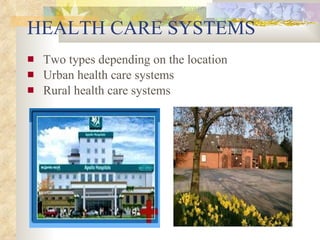
HEALTH CARE SYSTEMS Two types depending on the location Urban health care systems  Rural health care systems
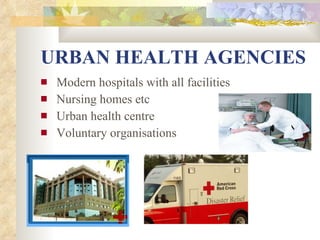
URBAN   HEALTH AGENCIES Modern hospitals with all facilities Nursing homes etc Urban health centre Voluntary organisations
RURAL HEALTH AGENCIES Village health guides Local dayees Anganwadi workers Rural hospitals Primary health centres Community health centres
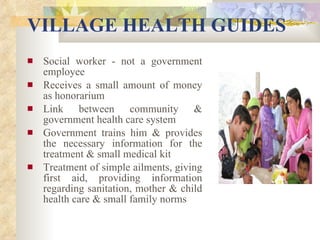
VILLAGE HEALTH GUIDES Social worker - not a government employee Receives a small amount of money as honorarium Link between community & government health care system      Government trains him & provides the necessary information for the treatment & small medical kit Treatment of simple ailments, giving first aid, providing information regarding sanitation, mother & child health care & small family norms
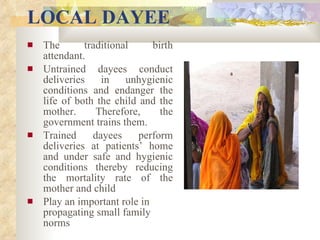
LOCAL DAYEE The traditional birth attendant. Untrained dayees conduct deliveries in unhygienic conditions and endanger the life of both the child and the mother. Therefore, the government trains them. Trained dayees perform deliveries at patients’ home and under safe and hygienic conditions thereby reducing the mortality rate of the mother and child Play an important role in propagating small family norms
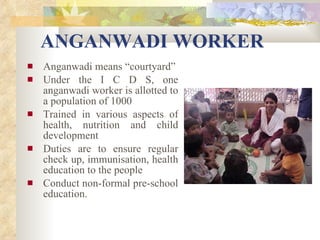
ANGANWADI WORKER Anganwadi means “courtyard” Under the I C D S, one anganwadi worker is allotted to a population of 1000 Trained in various aspects of health, nutrition and child development Duties are to ensure regular check up, immunisation, health education to the people Conduct non-formal pre-school education.
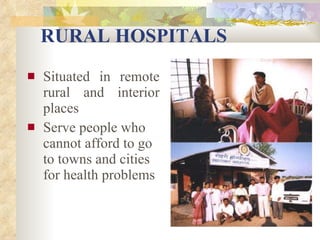
RURAL HOSPITALS Situated in remote rural and interior places Serve people who cannot afford to go to towns and cities for health problems
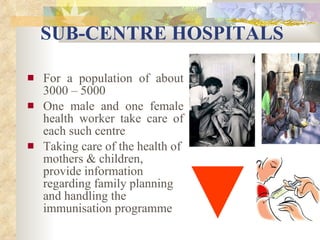
SUB-CENTRE HOSPITALS For a population of about 3000 – 5000 One male and one female health worker take care of each such centre Taking care of the health of mothers & children, provide information regarding family planning and handling the immunisation programme
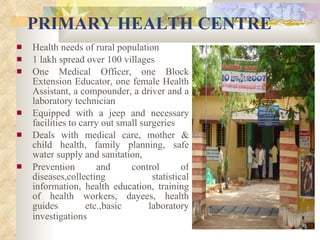
PRIMARY HEALTH CENTRE Health needs of rural population      1 lakh spread over 100 villages One Medical Officer, one Block Extension Educator, one female Health Assistant, a compounder, a driver and a laboratory technician Equipped with a jeep and necessary facilities to carry out small surgeries Deals with medical care, mother & child health, family planning, safe water supply and sanitation,  Prevention and control of diseases,collecting statistical information, health education, training of health workers, dayees, health guides etc.,basic laboratory investigations
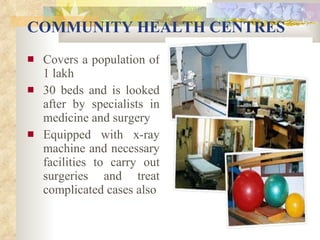
COMMUNITY HEALTH CENTRES Covers a population of 1 lakh 30 beds and is looked after by specialists in medicine and surgery Equipped with x-ray machine and necessary facilities to carry out surgeries and treat complicated cases also

4. health care systems

  • 1.
    HEALTH EVALUATION 2HEALTH CARE SYSTEMS
  • 2.
    AIMS OF HEALTHAGENCIES Increase in life expectancy. Reduction in mortality rate. Decrease in population growth. Improvement in nutritional status. Provision of basic sanitation and literacy.
  • 3.
    FEATURES OF HEALTHAGENCIES Should be able to cure and prevent the spread of any disease. The system and its activities should be acceptable to the people in the community. Should allow the community members to participate in its activities. The treatment should be low in cost or atleast affordable by all the members of the community
  • 4.
    HEALTH CARE SYSTEMSTwo types depending on the location Urban health care systems Rural health care systems
  • 5.
    URBAN HEALTH AGENCIES Modern hospitals with all facilities Nursing homes etc Urban health centre Voluntary organisations
  • 6.
    RURAL HEALTH AGENCIESVillage health guides Local dayees Anganwadi workers Rural hospitals Primary health centres Community health centres
  • 7.
    VILLAGE HEALTH GUIDESSocial worker - not a government employee Receives a small amount of money as honorarium Link between community & government health care system     Government trains him & provides the necessary information for the treatment & small medical kit Treatment of simple ailments, giving first aid, providing information regarding sanitation, mother & child health care & small family norms
  • 8.
    LOCAL DAYEE Thetraditional birth attendant. Untrained dayees conduct deliveries in unhygienic conditions and endanger the life of both the child and the mother. Therefore, the government trains them. Trained dayees perform deliveries at patients’ home and under safe and hygienic conditions thereby reducing the mortality rate of the mother and child Play an important role in propagating small family norms
  • 9.
    ANGANWADI WORKER Anganwadimeans “courtyard” Under the I C D S, one anganwadi worker is allotted to a population of 1000 Trained in various aspects of health, nutrition and child development Duties are to ensure regular check up, immunisation, health education to the people Conduct non-formal pre-school education.
  • 10.
    RURAL HOSPITALS Situatedin remote rural and interior places Serve people who cannot afford to go to towns and cities for health problems
  • 11.
    SUB-CENTRE HOSPITALS Fora population of about 3000 – 5000 One male and one female health worker take care of each such centre Taking care of the health of mothers & children, provide information regarding family planning and handling the immunisation programme
  • 12.
    PRIMARY HEALTH CENTREHealth needs of rural population     1 lakh spread over 100 villages One Medical Officer, one Block Extension Educator, one female Health Assistant, a compounder, a driver and a laboratory technician Equipped with a jeep and necessary facilities to carry out small surgeries Deals with medical care, mother & child health, family planning, safe water supply and sanitation, Prevention and control of diseases,collecting statistical information, health education, training of health workers, dayees, health guides etc.,basic laboratory investigations
  • 13.
    COMMUNITY HEALTH CENTRESCovers a population of 1 lakh 30 beds and is looked after by specialists in medicine and surgery Equipped with x-ray machine and necessary facilities to carry out surgeries and treat complicated cases also