B.ED FIRST YEAR
PAPER-I
FACTORS INFLUENCING GROWTH &
DEVELOPMENT
Dr. Sunita Arora
PRINCIPAL
Institute of Teacher’s Education
FEW OTHER FACTORS INFLUENCE G&D
 Economic and social status of family
 Parental and family care received by the child
 The quality of neighbourhood and surrounding
environment.
 The quality of the schooling received by the child.
 The quality of peer group relationships and
company of the child
 The quality of educational and vocational facilities
and opportunities available to the children.
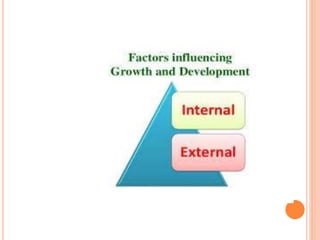
INTERNAL FACTORS:
 Factors which lie within the individual are
designated as internal factors:
 Heredity Factors
 Biological Factors
 Intelligence
 Emotional Factors
 Social factors
HEREDITY FACTORS
 These factors play their role at the time of
conception of the child in the womb of the mother.
 This contribution is the real starting point and base
of all growth and development.
 The weight, height, colour of eyes, colour of the
skin, hair texture, characteristics are just decided by
these hereditary influences.
BIOLOGICAL FACTORS
 The nervous system which he inherits along with
him at any stage of his growth and development,
affects his further growth and development in
cognitive dimension.
 The chemistry of the body is governed by endocrine
and ductless glands, which secrete their own
chemicals known as hormones.
 In case, there is over activity or under activity on
the parts of these glands ,it may lead to serious
abnormality.
INTELLIGENCE
 Intelligence affects the social behaviour, moral
judgement and emotional make up of an individual.
 In this way, physical, social, emotional, moral and
language development of the child is greatly
influenced by the level of his intelligence.
 We can’t expect problem solving behaviour,
creative, imaginative and inventive venture from a
child having sub-normal intelligence.
EMOTIONAL FACTORS
 Emotional factors like emotional adjustability and
maturity play a big role in influencing one’s growth
and development.
 The children who are found to be overwhelmed with
negative emotions like fear, anger, jealousy etc. Are
adversely affected in terms of their normal physical,
mental, social, moral and language development.
SOCIAL FACTOR
 One’s socialization helps him in achieving
adjustment and advancement in other aspects of
his growth and development.
 He may learn from his environment more on
account of his social nature and it may help for his
proper growth and development.
EXTERNAL FACTORS
 Environment available in the womb of the mother
 The physical and mental health of the mother
during pregnancy.
 Single or multiple children getting nourishment in
the womb.
 The quality and quantity of nutrition received by the
embryo within the womb of the mother.
 Protection from harmful radiation
 Normal or abnormal delivery
 Damage or accident to the child in the womb.
ENVIRONMENT AVAILABLE AFTER BIRTH
 Accidents and incidents of life may change the
entire development of the individual.
 The quality of physical environment , medical care
and nourishment available to him may influence
growth and development.
 The quality of the facilities and opportunities
provided by the social and cultural forces may
influence the entire course of his development.
Thank you

Factors influencing growth & development

  • 1.
    B.ED FIRST YEAR PAPER-I FACTORSINFLUENCING GROWTH & DEVELOPMENT Dr. Sunita Arora PRINCIPAL Institute of Teacher’s Education
  • 2.
    FEW OTHER FACTORSINFLUENCE G&D  Economic and social status of family  Parental and family care received by the child  The quality of neighbourhood and surrounding environment.  The quality of the schooling received by the child.  The quality of peer group relationships and company of the child  The quality of educational and vocational facilities and opportunities available to the children.
  • 4.
    INTERNAL FACTORS:  Factorswhich lie within the individual are designated as internal factors:  Heredity Factors  Biological Factors  Intelligence  Emotional Factors  Social factors
  • 5.
    HEREDITY FACTORS  Thesefactors play their role at the time of conception of the child in the womb of the mother.  This contribution is the real starting point and base of all growth and development.  The weight, height, colour of eyes, colour of the skin, hair texture, characteristics are just decided by these hereditary influences.
  • 6.
    BIOLOGICAL FACTORS  Thenervous system which he inherits along with him at any stage of his growth and development, affects his further growth and development in cognitive dimension.  The chemistry of the body is governed by endocrine and ductless glands, which secrete their own chemicals known as hormones.  In case, there is over activity or under activity on the parts of these glands ,it may lead to serious abnormality.
  • 7.
    INTELLIGENCE  Intelligence affectsthe social behaviour, moral judgement and emotional make up of an individual.  In this way, physical, social, emotional, moral and language development of the child is greatly influenced by the level of his intelligence.  We can’t expect problem solving behaviour, creative, imaginative and inventive venture from a child having sub-normal intelligence.
  • 8.
    EMOTIONAL FACTORS  Emotionalfactors like emotional adjustability and maturity play a big role in influencing one’s growth and development.  The children who are found to be overwhelmed with negative emotions like fear, anger, jealousy etc. Are adversely affected in terms of their normal physical, mental, social, moral and language development.
  • 9.
    SOCIAL FACTOR  One’ssocialization helps him in achieving adjustment and advancement in other aspects of his growth and development.  He may learn from his environment more on account of his social nature and it may help for his proper growth and development.
  • 10.
    EXTERNAL FACTORS  Environmentavailable in the womb of the mother  The physical and mental health of the mother during pregnancy.  Single or multiple children getting nourishment in the womb.  The quality and quantity of nutrition received by the embryo within the womb of the mother.  Protection from harmful radiation  Normal or abnormal delivery  Damage or accident to the child in the womb.
  • 11.
    ENVIRONMENT AVAILABLE AFTERBIRTH  Accidents and incidents of life may change the entire development of the individual.  The quality of physical environment , medical care and nourishment available to him may influence growth and development.  The quality of the facilities and opportunities provided by the social and cultural forces may influence the entire course of his development.
  • 12.