Growth and Development
By:
Chaitra H V
Assistant Professor
Al Mohammed B.ed College,
Shivamogga.
Growth
• The term growth is used in purely physical
sense.
• It is the process of physical maturation
resulting an increase in size of the body and
various organs.
• It generally refers to an increase in size,
length, height and weight.
• It is quantitative changes of the body.
• Growth can be defined as an increase in size,
length, height, and weight or the changes in
quantitative aspects of an organism.
• According to HURLOCK Growth is change in
size, in proportion, disappearance of old
features and acquisition of new ones.
• According to Crow and Crow (1962) Growth
refers to structural and physiological changes.
• Finally Growth describes the changes which
take place in particular aspects of the body
and behaviour of an organism.
• Growth does not continue throughout life. It
stops when maturity has been attained.
• The changes produced by growth are the
subject of measurement. They may be
quantified.
Development
• Development implies overall changes in shape,
form or structure resulting in improved working
or functioning.
• It indicates the changes in the quality or
character rather than in quantitative aspects.
• Development is a series of orderly progression
towards maturity.
• It implies overall qualitative changes resulting in
the improved functioning of the organism.
• It is the process of functional and physiological
maturation of the individual.
• It refers to overall changes in the individual
• According to Hurlock(1959) Development means a
progressive series of changes that occur in an orderly
predictable pattern as a result of maturation and
experience.
• According to J.E. Anderson(1950) Development is
concerned with growth as well as those changes in
behavior which results from environmental situations.
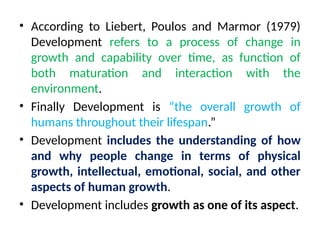
• According to Liebert, Poulos and Marmor (1979)
Development refers to a process of change in
growth and capability over time, as function of
both maturation and interaction with the
environment.
• Finally Development is “the overall growth of
humans throughout their lifespan.”
• Development includes the understanding of how
and why people change in terms of physical
growth, intellectual, emotional, social, and other
aspects of human growth.
• Development includes growth as one of its aspect.
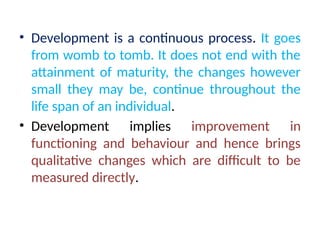
• Development is a continuous process. It goes
from womb to tomb. It does not end with the
attainment of maturity, the changes however
small they may be, continue throughout the
life span of an individual.
• Development implies improvement in
functioning and behaviour and hence brings
qualitative changes which are difficult to be
measured directly.
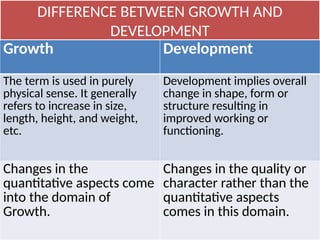
DIFFERENCE BETWEEN GROWTH AND
DEVELOPMENT
Growth Development
The term is used in purely
physical sense. It generally
refers to increase in size,
length, height, and weight,
etc.
Development implies overall
change in shape, form or
structure resulting in
improved working or
functioning.
Changes in the
quantitative aspects come
into the domain of
Growth.
Changes in the quality or
character rather than the
quantitative aspects
comes in this domain.
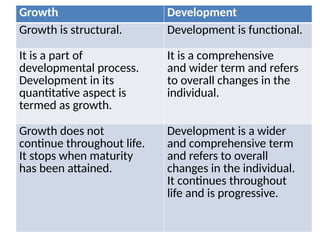
Growth Development
Growth is structural. Development is functional.
It is a part of
developmental process.
Development in its
quantitative aspect is
termed as growth.
It is a comprehensive
and wider term and refers
to overall changes in the
individual.
Growth does not
continue throughout life.
It stops when maturity
has been attained.
Development is a wider
and comprehensive term
and refers to overall
changes in the individual.
It continues throughout
life and is progressive.
Growth Development
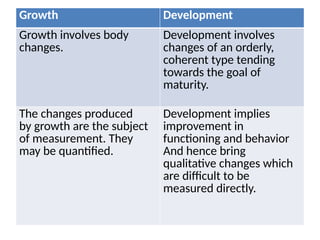
Growth involves body
changes.
Development involves
changes of an orderly,
coherent type tending
towards the goal of
maturity.
The changes produced
by growth are the subject
of measurement. They
may be quantified.
Development implies
improvement in
functioning and behavior
And hence bring
qualitative changes which
are difficult to be
measured directly.
Growth Development
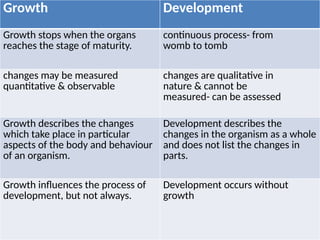
Growth stops when the organs
reaches the stage of maturity.
continuous process- from
womb to tomb
changes may be measured
quantitative & observable
changes are qualitative in
nature & cannot be
measured- can be assessed
Growth describes the changes
which take place in particular
aspects of the body and behaviour
of an organism.
Development describes the
changes in the organism as a whole
and does not list the changes in
parts.
Growth influences the process of
development, but not always.
Development occurs without
growth
Principles of Development
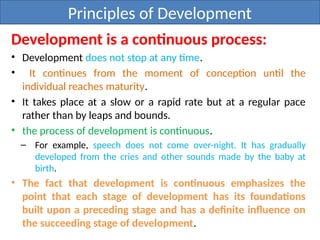
Development is a continuous process:
• Development does not stop at any time.
• It continues from the moment of conception until the
individual reaches maturity.
• It takes place at a slow or a rapid rate but at a regular pace
rather than by leaps and bounds.
• the process of development is continuous.
– For example, speech does not come over-night. It has gradually
developed from the cries and other sounds made by the baby at
birth.
• The fact that development is continuous emphasizes the
point that each stage of development has its foundations
built upon a preceding stage and has a definite influence on
the succeeding stage of development.
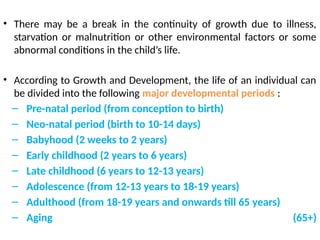
• There may be a break in the continuity of growth due to illness,
starvation or malnutrition or other environmental factors or some
abnormal conditions in the child’s life.
• According to Growth and Development, the life of an individual can
be divided into the following major developmental periods :
– Pre-natal period (from conception to birth)
– Neo-natal period (birth to 10-14 days)
– Babyhood (2 weeks to 2 years)
– Early childhood (2 years to 6 years)
– Late childhood (6 years to 12-13 years)
– Adolescence (from 12-13 years to 18-19 years)
– Adulthood (from 18-19 years and onwards till 65 years)
– Aging (65+)
• Development follows a pattern :
– Development occurs in orderly manner and follows a
certain sequences which, in general is the same for most
children.
– Each stage of development leads to the next. For instance,
all children first learn to sit up without support before they
stand. Similarly, they learn to draw a circle before
attempting to draw a square.
• The rate and speed of development may vary in
individual cases, but the sequence of the pattern is the
same. A child from a disadvantaged home and a child
from an affluent home, both follow the same pattern
of development, although the latter may develop at a
faster rate due to the facilities available at home.
• One of the sequential patterns of development relate
to the two directions in which development
proceeds.
– Firstly, development proceeds from the upper portions
of the body toward the lower portions. This is referred to
as “head to toe” sequence. This means that improvements
in the structure and function in a child’s body come first in
the head region, then in the trunk and last in the leg
region.
– Secondly, development proceeds from the centre line of
the body outward towards the distance or peripheral
parts referred to as “near to far” sequence. The head and
the trunk are fairly well developed before the rudimentary
limb buds appear, gradually the arm buds lengthen and
then develop into hands and fingers.
• Development proceeds from general
to specific responses:
– It makes from a generalized to localized behaviour.
– In studying the development pattern of children, it is
observed that general activity always precedes
specific activity.
– The early responses of the baby are very general in
nature which is gradually replaced with specific ones.
• For Example: The earliest emotional responses
of the new born are generally diffused
excitement and this slowly gives way to specific
emotional patterns of anger, joy, fear, etc.
– Babies wave their arms in general, random
movements before they are capable of such specific
responses as reaching for an object held before
them.
– Similarly, in early stages of language development
the child may use a particular word for any type of
animal/ eatable. Gradually, as his / her vocabulary
increases, he/she will learn to use correct specific
words.
• Thus, uncoordinated movements/ responses are
gradually replaced by specific ones.
• Development involves change:
– Development involves a progressive series of
changes.
– The human being is never static. From the moment of
conception to the time of death, the person is
undergoing changes.
– Nature shapes development most clearly through
genetic programming that may determine whole
sequences of later development.
• It refers to a progressive series of orderly
coherent changes.
• Development implies both quantitative and
qualitative changes.
• Development is a product of interaction of
the heredity and environment:
Child at any stage of his growth and development is a joint
products of both heredity and environment.
• But it is not possible to indicate exactly in what proportion
heredity and environment contribute to the development
of an individual.
• The two work hand in hand from the very conceptions. The
environment bears upon the new organism from the
beginning.
• Among, the environmental factors like nutrition, climate,
the conditions in the home, the type of social organization
in which individual move and live, the roles they have to
play and other.
Principle of uniqueness:
• Development is individualized process.
Although the pattern of development is
similar for all children, they follow the
pattern at their own rate.
• These individual differences arise
because each child is controlled by a
unique combination of hereditary
endowment and environmental factors.
• Every child follows a developmental timetable
that is characteristically unique for each child.
All children therefore do not reach the same
point of development at the same age.
• Individual differences are caused by the both
hereditary and environmental conditions.
• The child’s physical development, for
example, depends partly on the hereditary
potential and partly on the environmental
factors such as diet, general health, climate
etc.
• Development is also affected by the genetic factors.
A child should be provided with opportunities for experiences and
learning. These include:
(a) A stimulating environment where the child can explore. The
environment must include materials which arouse curiosity and
facilitate learning and
(b) encouragement and guidance from parents and teachers.
• Each child is a unique individual. No two children can be expected
to behave or develop in an identical manner although they are of
the same age.
• For example, in the same class, a child who comes from a deprived
environment cannot be expected to do as well in studies as a child
of the same ability whose parents put high value on education and
encourage the child to study.
• The Principle of Interaction of
Maturation and Learning:
• Maturation refers to changes in a developed
organism due to the unfolding ripening of
abilities, characteristics, traits and potentialities
present at birth.
• Learning denotes the changes in behaviour due to
training and or experiences.
• Maturation is the inner growth process
unaffected by training. Another factor that causes
growth is ‘learning’.
• Learning implies exercise and experience on the part
of an individual.
• Learning may result from practice, which in due
course of time may bring about a change in the
individual’s behaviour.
• Maturation and learning are closely related and one
influences the other. This means that traits
potentially present will not develop to their
maximum without effort or learning. Thus, learning
have a great influence on growth and development,
maturation provides the raw material for learning
and determines to a large extent the more general
patterns of the individual’s behaviour.
• Development is often predictable:
• Development psychologists have observed that each
developmental phase has certain common traits and
characteristics. We have seen that the rate of development
for each child is fairly constant.
• The consequence is that it is possible for us to predict at an
early age the range within which the mature development of
the child is likely to fall. But all types of development,
particularly mental development, cannot be predicted with
the same degree of accuracy.
• It is more easily predictable for children whose mental
development falls within the normal range rather than for
those whose mental development shows marked deviation
from the average.
• Most traits are correlated in development:
Generally, it is seen that the child whose
intellectual development is above average is
so in health, size, sociability and special
aptitudes.
• Principle of Individual Difference:
– Every organism is a distinct creation in itself.
– Development in various dimensions is unique and
specific.
• Principle of Spiral versus Linear Advancement:
– The child doesn’t proceed straight on the path of
development with a constant or steady pace.
– Actually he makes advancement, during a
particular period but takes rest in the next
following period to consolidate his development.
In advancing further, therefore, he turns back and
then makes forward again like a spiral.
Educational implications for Principles of
Development
• The school must provide a rich, appropriate
environment.
• School must take note of the natural differences
in the interests of the boys and girls and provide
co-curricular activities that cater to their maturity
level and interests.
• Children should not be admitted to the first
grade in school before the age group of six or an
equal mental age.
• Elementary school need not merely be a drill or
practice school; reasoning, imagining.
Appreciating and generalizing must go along
with sensing, memorizing and perceiving.
Hence teacher should provide all kinds of
experiences to their learners in primary schools.
• Principles like proceeding from general to
specific responses and the principle of
integration helps us to plan the learning
processes and arrange suitable learning
experiences so as to achieve maximum gains in
terms of growth and development.
• The principle of interrelation and interdependent
directs us to strive from the very beginning for all
round harmonious growth and development of the
personalities of our children and cautions us not to
encourage the development of a particular aspect
at the cost of another.
• The principle and knowledge of individual
differences reminds us to understand the wide
differences that surface at all periods of growth
and development among children. Each child
should be helped along the developmental process
within the sphere of his own strengths and
limitations.
Factors influencing on development
Factors influencing development
Right from conception, the beginning of life in a
mother’s womb, the growth and development of
human beings influenced by variety of factors
categorized as
• Heredity and
• Environment
A variety of internal factors influence the growth
and development of human beings. These
factors include :
1. Heredity factors
2. Biological or Constitutional factors
3. Intelligence
4. Emotional factors
Heredity factors
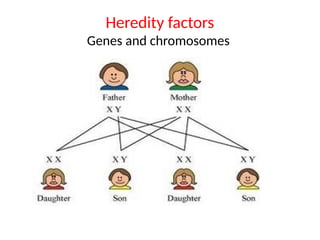
Genes and chromosomes
• Heredity factors play their part at the time of
conception in the mother’s womb.
– A person’s height,
– weight and structure of the body,
– color of hair and eye,
– intelligence,
– aptitudes and instinct
are all decided by these hereditary influences.
Biological Factors
• A child’s constitutional make-up, somatic
structure, physique and body chemistry
influences his growth and development
throughout his life.
– Physical structure
– Nervous system
– Endocrine glands - Hypo activity & Hyperactivity
Intelligence
• Intelligence is the ability to learn about, learn
from, understand, adjust,
• interact with the environment and
• take right decision at right time.
• It affects the social behavior, moral judgment
and emotional growth.
• Control over his emotions
• Social adjustment
Emotional factors
• The expression of feelings about self, others, and
things describe emotional development.
• Emotional and social development are often
described and grouped together because they are
closely interrelated growth patterns.
• Fear
• Anger
• Jealousy
is adversely affected on development.
External factors influencing development
• 1. Environment in the womb of the mother
• 2. Environment available after birth.
Environment in the womb of the mother
• The physical and mental health of the mother
during pregnancy.
• Single or multiple children getting nourished in
the womb.
• The quality and quantity of nutrition received by
the mother during pregnancy.
• Harmful radiations or rays etc.
• Normal or abnormal delivery.
• Any damage or accident to the baby in the womb.
Environment available after birth.
• Accidents and incidents in life.
• The quality of physical environment, medical
care and nourishment after delivery.
• The quality of the facilities and opportunities
provided by the social and cultural forces.
• Parental and family care received by a child.
• Economic and social status of the parents and
the family.
• The quality of the neighborhood and surrounding
environment.
• The quality of the schooling received by a child.
• He quality of peer group relationships.
• The quality of treatment made available with
regard caste, religion, nationality.
• The quality of educational and vocational facility
and opportunity available.
• The quality of the government, laws and
organizations of the society to which child belongs.
• The quality of the power and status enjoyed by the
country to which a child belongs.
psychology growth and development presentation

  • 1.
    Growth and Development By: ChaitraH V Assistant Professor Al Mohammed B.ed College, Shivamogga.
  • 2.
    Growth • The termgrowth is used in purely physical sense. • It is the process of physical maturation resulting an increase in size of the body and various organs. • It generally refers to an increase in size, length, height and weight. • It is quantitative changes of the body.
  • 3.
    • Growth canbe defined as an increase in size, length, height, and weight or the changes in quantitative aspects of an organism. • According to HURLOCK Growth is change in size, in proportion, disappearance of old features and acquisition of new ones. • According to Crow and Crow (1962) Growth refers to structural and physiological changes.
  • 4.
    • Finally Growthdescribes the changes which take place in particular aspects of the body and behaviour of an organism. • Growth does not continue throughout life. It stops when maturity has been attained. • The changes produced by growth are the subject of measurement. They may be quantified.
  • 5.
    Development • Development impliesoverall changes in shape, form or structure resulting in improved working or functioning. • It indicates the changes in the quality or character rather than in quantitative aspects. • Development is a series of orderly progression towards maturity. • It implies overall qualitative changes resulting in the improved functioning of the organism.
  • 6.
    • It isthe process of functional and physiological maturation of the individual. • It refers to overall changes in the individual • According to Hurlock(1959) Development means a progressive series of changes that occur in an orderly predictable pattern as a result of maturation and experience. • According to J.E. Anderson(1950) Development is concerned with growth as well as those changes in behavior which results from environmental situations.
  • 7.
    • According toLiebert, Poulos and Marmor (1979) Development refers to a process of change in growth and capability over time, as function of both maturation and interaction with the environment. • Finally Development is “the overall growth of humans throughout their lifespan.” • Development includes the understanding of how and why people change in terms of physical growth, intellectual, emotional, social, and other aspects of human growth. • Development includes growth as one of its aspect.
  • 8.
    • Development isa continuous process. It goes from womb to tomb. It does not end with the attainment of maturity, the changes however small they may be, continue throughout the life span of an individual. • Development implies improvement in functioning and behaviour and hence brings qualitative changes which are difficult to be measured directly.
  • 9.
    DIFFERENCE BETWEEN GROWTHAND DEVELOPMENT Growth Development The term is used in purely physical sense. It generally refers to increase in size, length, height, and weight, etc. Development implies overall change in shape, form or structure resulting in improved working or functioning. Changes in the quantitative aspects come into the domain of Growth. Changes in the quality or character rather than the quantitative aspects comes in this domain.
  • 10.
    Growth Development Growth isstructural. Development is functional. It is a part of developmental process. Development in its quantitative aspect is termed as growth. It is a comprehensive and wider term and refers to overall changes in the individual. Growth does not continue throughout life. It stops when maturity has been attained. Development is a wider and comprehensive term and refers to overall changes in the individual. It continues throughout life and is progressive.
  • 11.
    Growth Development Growth involvesbody changes. Development involves changes of an orderly, coherent type tending towards the goal of maturity. The changes produced by growth are the subject of measurement. They may be quantified. Development implies improvement in functioning and behavior And hence bring qualitative changes which are difficult to be measured directly.
  • 12.
    Growth Development Growth stopswhen the organs reaches the stage of maturity. continuous process- from womb to tomb changes may be measured quantitative & observable changes are qualitative in nature & cannot be measured- can be assessed Growth describes the changes which take place in particular aspects of the body and behaviour of an organism. Development describes the changes in the organism as a whole and does not list the changes in parts. Growth influences the process of development, but not always. Development occurs without growth
  • 13.
    Principles of Development Developmentis a continuous process: • Development does not stop at any time. • It continues from the moment of conception until the individual reaches maturity. • It takes place at a slow or a rapid rate but at a regular pace rather than by leaps and bounds. • the process of development is continuous. – For example, speech does not come over-night. It has gradually developed from the cries and other sounds made by the baby at birth. • The fact that development is continuous emphasizes the point that each stage of development has its foundations built upon a preceding stage and has a definite influence on the succeeding stage of development.
  • 14.
    • There maybe a break in the continuity of growth due to illness, starvation or malnutrition or other environmental factors or some abnormal conditions in the child’s life. • According to Growth and Development, the life of an individual can be divided into the following major developmental periods : – Pre-natal period (from conception to birth) – Neo-natal period (birth to 10-14 days) – Babyhood (2 weeks to 2 years) – Early childhood (2 years to 6 years) – Late childhood (6 years to 12-13 years) – Adolescence (from 12-13 years to 18-19 years) – Adulthood (from 18-19 years and onwards till 65 years) – Aging (65+)
  • 15.
    • Development followsa pattern : – Development occurs in orderly manner and follows a certain sequences which, in general is the same for most children. – Each stage of development leads to the next. For instance, all children first learn to sit up without support before they stand. Similarly, they learn to draw a circle before attempting to draw a square. • The rate and speed of development may vary in individual cases, but the sequence of the pattern is the same. A child from a disadvantaged home and a child from an affluent home, both follow the same pattern of development, although the latter may develop at a faster rate due to the facilities available at home.
  • 16.
    • One ofthe sequential patterns of development relate to the two directions in which development proceeds. – Firstly, development proceeds from the upper portions of the body toward the lower portions. This is referred to as “head to toe” sequence. This means that improvements in the structure and function in a child’s body come first in the head region, then in the trunk and last in the leg region. – Secondly, development proceeds from the centre line of the body outward towards the distance or peripheral parts referred to as “near to far” sequence. The head and the trunk are fairly well developed before the rudimentary limb buds appear, gradually the arm buds lengthen and then develop into hands and fingers.
  • 17.
    • Development proceedsfrom general to specific responses: – It makes from a generalized to localized behaviour. – In studying the development pattern of children, it is observed that general activity always precedes specific activity. – The early responses of the baby are very general in nature which is gradually replaced with specific ones. • For Example: The earliest emotional responses of the new born are generally diffused excitement and this slowly gives way to specific emotional patterns of anger, joy, fear, etc.
  • 18.
    – Babies wavetheir arms in general, random movements before they are capable of such specific responses as reaching for an object held before them. – Similarly, in early stages of language development the child may use a particular word for any type of animal/ eatable. Gradually, as his / her vocabulary increases, he/she will learn to use correct specific words. • Thus, uncoordinated movements/ responses are gradually replaced by specific ones.
  • 19.
    • Development involveschange: – Development involves a progressive series of changes. – The human being is never static. From the moment of conception to the time of death, the person is undergoing changes. – Nature shapes development most clearly through genetic programming that may determine whole sequences of later development. • It refers to a progressive series of orderly coherent changes. • Development implies both quantitative and qualitative changes.
  • 20.
    • Development isa product of interaction of the heredity and environment: Child at any stage of his growth and development is a joint products of both heredity and environment. • But it is not possible to indicate exactly in what proportion heredity and environment contribute to the development of an individual. • The two work hand in hand from the very conceptions. The environment bears upon the new organism from the beginning. • Among, the environmental factors like nutrition, climate, the conditions in the home, the type of social organization in which individual move and live, the roles they have to play and other.
  • 21.
    Principle of uniqueness: •Development is individualized process. Although the pattern of development is similar for all children, they follow the pattern at their own rate. • These individual differences arise because each child is controlled by a unique combination of hereditary endowment and environmental factors.
  • 22.
    • Every childfollows a developmental timetable that is characteristically unique for each child. All children therefore do not reach the same point of development at the same age. • Individual differences are caused by the both hereditary and environmental conditions. • The child’s physical development, for example, depends partly on the hereditary potential and partly on the environmental factors such as diet, general health, climate etc.
  • 23.
    • Development isalso affected by the genetic factors. A child should be provided with opportunities for experiences and learning. These include: (a) A stimulating environment where the child can explore. The environment must include materials which arouse curiosity and facilitate learning and (b) encouragement and guidance from parents and teachers. • Each child is a unique individual. No two children can be expected to behave or develop in an identical manner although they are of the same age. • For example, in the same class, a child who comes from a deprived environment cannot be expected to do as well in studies as a child of the same ability whose parents put high value on education and encourage the child to study.
  • 24.
    • The Principleof Interaction of Maturation and Learning: • Maturation refers to changes in a developed organism due to the unfolding ripening of abilities, characteristics, traits and potentialities present at birth. • Learning denotes the changes in behaviour due to training and or experiences. • Maturation is the inner growth process unaffected by training. Another factor that causes growth is ‘learning’.
  • 25.
    • Learning impliesexercise and experience on the part of an individual. • Learning may result from practice, which in due course of time may bring about a change in the individual’s behaviour. • Maturation and learning are closely related and one influences the other. This means that traits potentially present will not develop to their maximum without effort or learning. Thus, learning have a great influence on growth and development, maturation provides the raw material for learning and determines to a large extent the more general patterns of the individual’s behaviour.
  • 26.
    • Development isoften predictable: • Development psychologists have observed that each developmental phase has certain common traits and characteristics. We have seen that the rate of development for each child is fairly constant. • The consequence is that it is possible for us to predict at an early age the range within which the mature development of the child is likely to fall. But all types of development, particularly mental development, cannot be predicted with the same degree of accuracy. • It is more easily predictable for children whose mental development falls within the normal range rather than for those whose mental development shows marked deviation from the average.
  • 27.
    • Most traitsare correlated in development: Generally, it is seen that the child whose intellectual development is above average is so in health, size, sociability and special aptitudes. • Principle of Individual Difference: – Every organism is a distinct creation in itself. – Development in various dimensions is unique and specific.
  • 28.
    • Principle ofSpiral versus Linear Advancement: – The child doesn’t proceed straight on the path of development with a constant or steady pace. – Actually he makes advancement, during a particular period but takes rest in the next following period to consolidate his development. In advancing further, therefore, he turns back and then makes forward again like a spiral.
  • 29.
    Educational implications forPrinciples of Development • The school must provide a rich, appropriate environment. • School must take note of the natural differences in the interests of the boys and girls and provide co-curricular activities that cater to their maturity level and interests. • Children should not be admitted to the first grade in school before the age group of six or an equal mental age.
  • 30.
    • Elementary schoolneed not merely be a drill or practice school; reasoning, imagining. Appreciating and generalizing must go along with sensing, memorizing and perceiving. Hence teacher should provide all kinds of experiences to their learners in primary schools. • Principles like proceeding from general to specific responses and the principle of integration helps us to plan the learning processes and arrange suitable learning experiences so as to achieve maximum gains in terms of growth and development.
  • 31.
    • The principleof interrelation and interdependent directs us to strive from the very beginning for all round harmonious growth and development of the personalities of our children and cautions us not to encourage the development of a particular aspect at the cost of another. • The principle and knowledge of individual differences reminds us to understand the wide differences that surface at all periods of growth and development among children. Each child should be helped along the developmental process within the sphere of his own strengths and limitations.
  • 32.
  • 33.
    Factors influencing development Rightfrom conception, the beginning of life in a mother’s womb, the growth and development of human beings influenced by variety of factors categorized as • Heredity and • Environment
  • 34.
    A variety ofinternal factors influence the growth and development of human beings. These factors include : 1. Heredity factors 2. Biological or Constitutional factors 3. Intelligence 4. Emotional factors
  • 35.
  • 36.
    • Heredity factorsplay their part at the time of conception in the mother’s womb. – A person’s height, – weight and structure of the body, – color of hair and eye, – intelligence, – aptitudes and instinct are all decided by these hereditary influences.
  • 37.
    Biological Factors • Achild’s constitutional make-up, somatic structure, physique and body chemistry influences his growth and development throughout his life. – Physical structure – Nervous system – Endocrine glands - Hypo activity & Hyperactivity
  • 38.
    Intelligence • Intelligence isthe ability to learn about, learn from, understand, adjust, • interact with the environment and • take right decision at right time. • It affects the social behavior, moral judgment and emotional growth. • Control over his emotions • Social adjustment
  • 39.
    Emotional factors • Theexpression of feelings about self, others, and things describe emotional development. • Emotional and social development are often described and grouped together because they are closely interrelated growth patterns. • Fear • Anger • Jealousy is adversely affected on development.
  • 40.
    External factors influencingdevelopment • 1. Environment in the womb of the mother • 2. Environment available after birth.
  • 41.
    Environment in thewomb of the mother • The physical and mental health of the mother during pregnancy. • Single or multiple children getting nourished in the womb. • The quality and quantity of nutrition received by the mother during pregnancy. • Harmful radiations or rays etc. • Normal or abnormal delivery. • Any damage or accident to the baby in the womb.
  • 42.
    Environment available afterbirth. • Accidents and incidents in life. • The quality of physical environment, medical care and nourishment after delivery. • The quality of the facilities and opportunities provided by the social and cultural forces. • Parental and family care received by a child. • Economic and social status of the parents and the family.
  • 43.
    • The qualityof the neighborhood and surrounding environment. • The quality of the schooling received by a child. • He quality of peer group relationships. • The quality of treatment made available with regard caste, religion, nationality. • The quality of educational and vocational facility and opportunity available. • The quality of the government, laws and organizations of the society to which child belongs. • The quality of the power and status enjoyed by the country to which a child belongs.