PSYCHOLOGY MENTAL DEVELOPMENT
MENTAL DEVELOPMENT In the educational process, improving the skill of remembering and coming out of the forgetting problem and adjusting to various conditions is called as  mental development .
THEORIES OF MENTAL DEVELOPMENT There are three theories of remembering and forgetting.  They are:        Theory of Decay or Disease,       Theory of Interference, Theory of Trace Change.
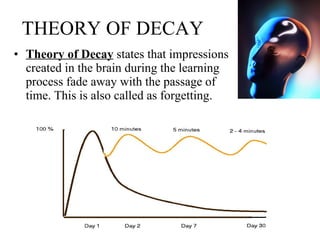
THEORY OF DECAY Theory of Decay  states that impressions created in the brain during the learning process fade away with the passage of time. This is also called as forgetting.
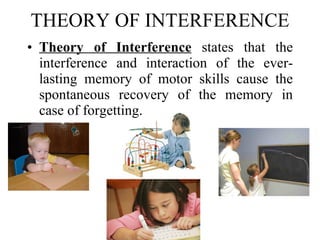
THEORY OF INTERFERENCE Theory of Interference  states that the interference and interaction of the ever-lasting memory of motor skills cause the spontaneous recovery of the memory in case of forgetting.
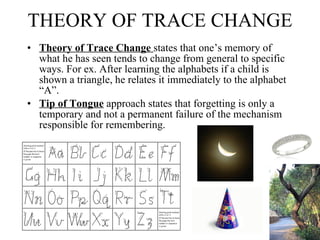
THEORY OF TRACE CHANGE Theory of Trace Change  states that one’s memory of what he has seen tends to change from general to specific ways. For ex. After learning the alphabets if a child is shown a triangle, he relates it immediately to the alphabet “A”.   Tip of Tongue  approach states that forgetting is only a temporary and not a permanent failure of the mechanism responsible for remembering.
METHODS TO MEASURE MEMORY Psychologists generally describe three methods to measure memory.  They are : Recall Recognisation Re-learning
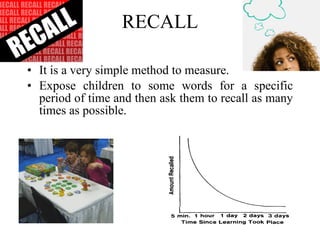
RECALL It is a very simple method to measure.  Expose children to some words for a specific period of time and then ask them to recall as many times as possible.
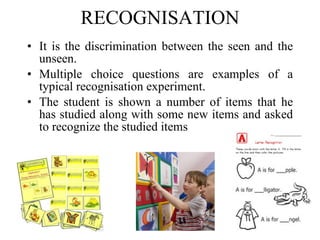
RECOGNISATION It is the discrimination between the seen and the unseen. Multiple choice questions are examples of a typical recognisation experiment. The student is shown a number of items that he has studied along with some new items and asked to recognize the studied items
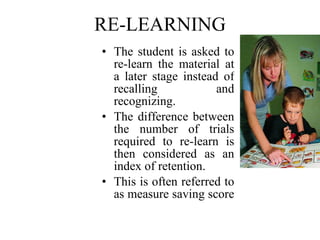
RE-LEARNING The student is asked to re-learn the material at a later stage instead of recalling and recognizing. The difference between the number of trials required to re-learn is then considered as an index of retention. This is often referred to as measure saving score
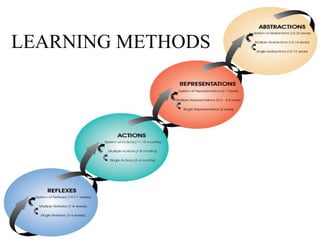
LEARNING METHODS
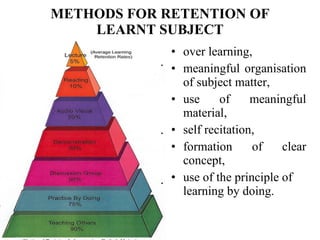
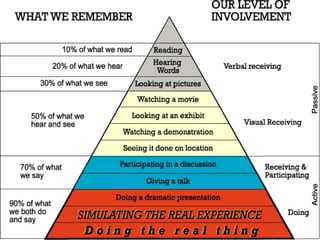
METHODS FOR RETENTION OF LEARNT SUBJECT over learning, meaningful organisation of subject matter, use of meaningful material, self recitation, formation of clear concept, use of the principle of learning by doing.
 
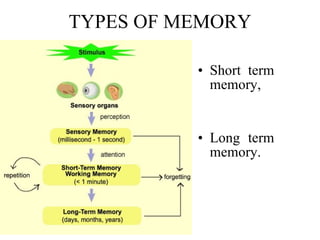
TYPES OF MEMORY Short term memory, Long term memory.
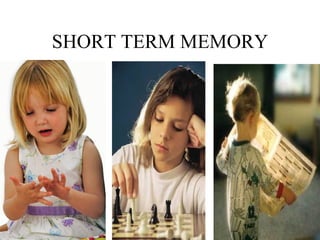
SHORT TERM MEMORY
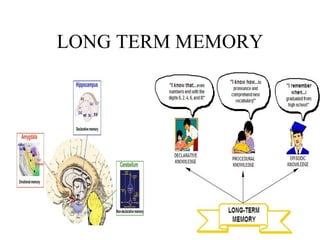
LONG TERM MEMORY

6.mental development

  • 1.
  • 2.
    MENTAL DEVELOPMENT Inthe educational process, improving the skill of remembering and coming out of the forgetting problem and adjusting to various conditions is called as mental development .
  • 3.
    THEORIES OF MENTALDEVELOPMENT There are three theories of remembering and forgetting. They are:       Theory of Decay or Disease,      Theory of Interference, Theory of Trace Change.
  • 4.
    THEORY OF DECAYTheory of Decay states that impressions created in the brain during the learning process fade away with the passage of time. This is also called as forgetting.
  • 5.
    THEORY OF INTERFERENCETheory of Interference states that the interference and interaction of the ever-lasting memory of motor skills cause the spontaneous recovery of the memory in case of forgetting.
  • 6.
    THEORY OF TRACECHANGE Theory of Trace Change states that one’s memory of what he has seen tends to change from general to specific ways. For ex. After learning the alphabets if a child is shown a triangle, he relates it immediately to the alphabet “A”. Tip of Tongue approach states that forgetting is only a temporary and not a permanent failure of the mechanism responsible for remembering.
  • 7.
    METHODS TO MEASUREMEMORY Psychologists generally describe three methods to measure memory. They are : Recall Recognisation Re-learning
  • 8.
    RECALL It isa very simple method to measure. Expose children to some words for a specific period of time and then ask them to recall as many times as possible.
  • 9.
    RECOGNISATION It isthe discrimination between the seen and the unseen. Multiple choice questions are examples of a typical recognisation experiment. The student is shown a number of items that he has studied along with some new items and asked to recognize the studied items
  • 10.
    RE-LEARNING The studentis asked to re-learn the material at a later stage instead of recalling and recognizing. The difference between the number of trials required to re-learn is then considered as an index of retention. This is often referred to as measure saving score
  • 11.
  • 12.
    METHODS FOR RETENTIONOF LEARNT SUBJECT over learning, meaningful organisation of subject matter, use of meaningful material, self recitation, formation of clear concept, use of the principle of learning by doing.
  • 13.
  • 14.
    TYPES OF MEMORYShort term memory, Long term memory.
  • 15.
  • 16.