



Growth &
Development
Joyce Buck, PhD(c), MSN, RN-C, CNE
Joy A. Shepard, PhD, RN-C, CNE
1
Objectives
• Describe principles, patterns, and rates of growth and development
• Describe major developmental theories
• Plan for the nursing management of children with learning and
intellectual disabilities
• Describe the nursing role in prevention and treatment of child abuse
and neglect
• Summarize major nutritional concepts pertaining to the growth and
development of children
• Describe nursing interventions for children who are overweight or
obese
• Plan care for the child with an inherited biochemical abnormality
2
Nursing Diagnoses
• Delayed Growth & Development
• Readiness for Enhanced Parenting
• Readiness for Enhanced Family Processes
• Compromised Family Coping
• Dysfunctional Family Processes
• Caregiver Role Strain
• Risk for Impaired Parenting
• Risk for Injury
• Imbalanced Nutrition: More than body requirements
• Imbalanced Nutrition: Less than body requirements
• Sedentary Lifestyle 3
4
Principles of Growth & Development
Growth
• WEIGHT- most sensitive
• Birth weight: 2X by 6 mos
• 3x by 1 yr
• 4X by 2 yrs
• LENGTH/ HEIGHT
•  1.5 cm/ mo 1st 6 mos
•  1 cm/ mo. 7-12 mos
• Ave.  in ht. during 1st yr is 50%
• Approx. ½ of adult ht. at 2 yrs 5
Development
• DEVELOPMENT- in the skills or capacity to function
• How to Measure:
• By simply observing a child doing specific task
• By noting parent’s description of the child’s progress
• By comparing child’s performance to developmental milestones
• By a Developmental Screening Tool
• Developmental Screening tools include the domains of:
• Cognition
• Fine & Gross Motor Skills
• Speech & Language
• Social-Emotional Development 6
Maturation
• MATURATION - synonymous with development, also known as READINESS
• COGNITIVE DEVELOPMENT- is the ability to learn (to change behavior) and
understand from experience, to acquire and retain knowledge, to respond to a
new situation and to solve problems
• Basis of Intellectual Disability
• IQ= mental age X 100
chronological age
• 0-20 profound intellectual disability (infant)
• 20-35 severe (0-2 yo)
• 35-50 moderate (2-7 yo) trainable
• 50-70 mild (7-12 yo) educable
• 70-90 borderline
• 90-110 normal (average IQ)
•  130 gifted
7
Basic Divisions of Life
• 1st Stage- Prenatal (from
conception to birth)
• 2nd Stage- Infancy
• Neonatal: 1st 28 days of life
• Infancy: Birth to 12 months
3rd Stage- Early Childhood
• Toddler: 1-3 yrs
• Preschool: 3-6 yrs
• 4th Stage- Middle
Childhood
• School age: 6-12 yrs
• 5th Stage- Late Childhood
• Adolescent: 12-18 yrs (or 21)
8
Principles of Growth &
Development
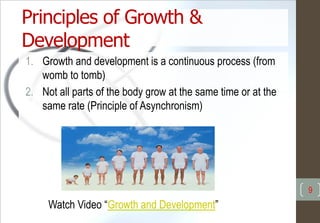
1. Growth and development is a continuous process (from
womb to tomb)
2. Not all parts of the body grow at the same time or at the
same rate (Principle of Asynchronism)
9
Watch Video “Growth and Development”
Patterns of Growth &
Development
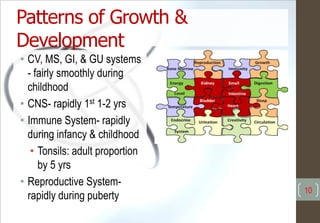
• CV, MS, GI, & GU systems
- fairly smoothly during
childhood
• CNS- rapidly 1st 1-2 yrs
• Immune System- rapidly
during infancy & childhood
• Tonsils: adult proportion
by 5 yrs
• Reproductive System-
rapidly during puberty
10
Rates of Growth & Development
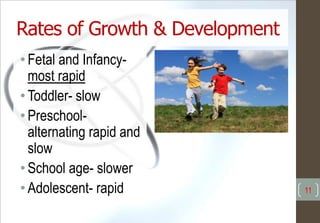
• Fetal and Infancy-
most rapid
• Toddler- slow
• Preschool-
alternating rapid and
slow
• School age- slower
• Adolescent- rapid 11
Each Child is Unique
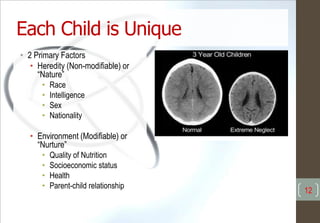
• 2 Primary Factors
• Heredity (Non-modifiable) or
“Nature”
• Race
• Intelligence
• Sex
• Nationality
• Environment (Modifiable) or
“Nurture”
• Quality of Nutrition
• Socioeconomic status
• Health
• Parent-child relationship
12
Directional Trends
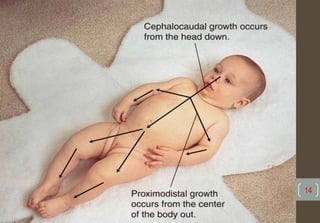
• Cephalocaudal: “ head to tail”. It occurs along body’s long
axis in which control over head, mouth and eye movements
and precedes control over upper body torso and legs.
• Proximodistal: from center of the body to extremities (e.g.
baby uses whole arm in crawling then hand pincers)
• Symmetrical: each side of the body develops in the same
direction at same time and rate
• Mass-Specific (Differentiation): the child learns from simple
operations before complex functions or move from a broad
general pattern of behavior to a more refined pattern (e.g.,
crying precedes speech)
13
14
Gross Motor vs. Fine Motor Ability
• Motor skills – carried out when the brain, nervous system,
and muscles work together
• Gross motor – larger movement child makes with arms,
legs, feet, or entire body
• Examples: rolling over, sitting, crawling, running, and jumping
• Fine motor – smaller, more skilled movements
• Small muscles of fingers, toes, lips & tongue
• Examples: picking things up between finger and thumb,
wriggling toes in the sand, using lips and tongue to taste and
feel objects
• Gross motor skills precede fine motor skills
15
Infant Primitive Reflexes
• Infant primitive reflexes must be lost first before
development can proceed (e.g., spitting/extrusion reflex must be
overcome before infant can be fed with solid foods; tonic neck reflex
must be diminished before the infant can turn over)
• REFLEXES- involuntary reactions to specific forms of
stimulation
• Importance:
• Survival (e.g., feeding reflexes: rooting, sucking, swallowing;
protective reflexes: blink, gag, cough, Moro)
• Reflects how well CNS is functioning
• Forms the basis for later, more sophisticated behavior
16
Sequential & Secular Trends
• SEQUENTIAL TRENDS- involves a predictable sequence
of growth and development to which the child normally
passes
a) Locomotion
b) Language and social skills
• SECULAR TRENDS-refers to the worldwide trend of
maturing earlier and growing larger as compared to
previous generations
17
Behavior & Play
• BEHAVIOR- most
comprehensive
indicator of
developmental status
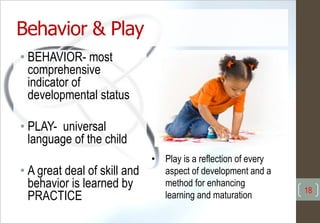
• PLAY- universal
language of the child
• A great deal of skill and
behavior is learned by
PRACTICE
18
• Play is a reflection of every
aspect of development and a
method for enhancing
learning and maturation
Play in Infancy
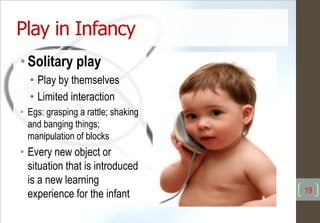
• Solitary play
• Play by themselves
• Limited interaction
• Egs: grasping a rattle; shaking
and banging things;
manipulation of blocks
• Every new object or
situation that is introduced
is a new learning
experience for the infant 19
Play in Toddlerhood
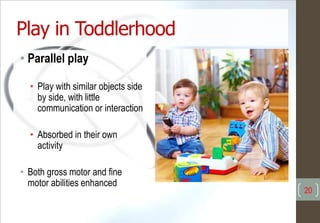
• Parallel play
• Play with similar objects side
by side, with little
communication or interaction
• Absorbed in their own
activity
• Both gross motor and fine
motor abilities enhanced
20
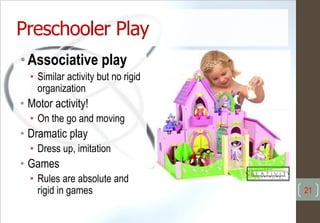
Preschooler Play
•Associative play
• Similar activity but no rigid
organization
• Motor activity!
• On the go and moving
• Dramatic play
• Dress up, imitation
• Games
• Rules are absolute and
rigid in games 21
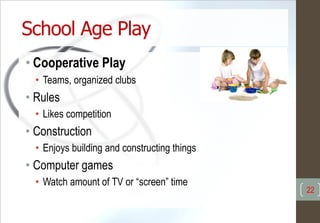
School Age Play
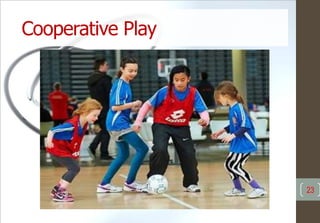
• Cooperative Play
• Teams, organized clubs
• Rules
• Likes competition
• Construction
• Enjoys building and constructing things
• Computer games
• Watch amount of TV or “screen” time
22
Cooperative Play
23
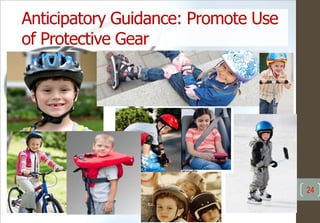
Anticipatory Guidance: Promote Use
of Protective Gear
24
25
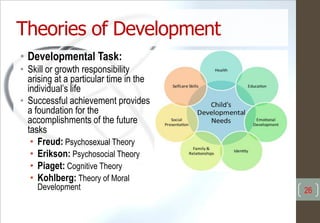
Theories of Development
• Developmental Task:
• Skill or growth responsibility
arising at a particular time in the
individual’s life
• Successful achievement provides
a foundation for the
accomplishments of the future
tasks
• Freud: Psychosexual Theory
• Erikson: Psychosocial Theory
• Piaget: Cognitive Theory
• Kohlberg: Theory of Moral
Development 26
Psychosexual Theory/
Psychoanalytic Theory
• Sigmund Freud (1856-1939): Austrian neurologist, founder of
psychoanalysis
• 3 parts of personality:
• 1) Id: basic sexual energy
present at birth
2) Ego: realistic part of person;
develops around 4-5 months
3) Superego: moral/ ethical system; develops
at 3-6 years
27
Psychosexual Theory Cont’d….
• 1. ORAL- (Birth-12 mos) Infant
• Mouth- site of gratification
• Activity: biting, sucking, crying (for enjoyment and release
of tension)
• Offer pacifier when NPO
28
Psychosexual Theory Cont’d….
• 2. ANAL-(1-3 yrs) Toddler
• Anus- site of gratification where elimination takes place
• Principles in Toilet Training:
• “Holding on”- child wins, becomes stubborn or antisocial
• “Letting go”- mother wins, child becomes obedient, kind,
perfectionist, obsessive-compulsive
29
Psychosexual Theory Cont’d….
• 3. PHALLIC-(3-6 yrs) Preschool
• Genitalia- site of gratification
•  knowledge on 2 sexes , exhibitionism is normal
• Accept child fondling his/her genitalia as normal area of
exploration
• Answer child’s questions directly
• SUPEREGO is a necessary part of socialization; includes
internalization of values, ideas and moral standards of
parents and society; development of CONSCIENCE 30
Preschooler cont’d: Gender
Role Identity
• Becomes aware of their similarity to parent of the
same sex
• Usually like to be like the same sex parent
• Reinforced by the parent
• Girls—cooking with mom; Boys—working with dad in the
shop
• Not absolute—many identify with both parents 31
Psychosexual Theory Cont’d….
• 4. LATENT-(6-12 yrs) School Age
• Period of suppression, no obvious development
• Help child achieve positive experiences so that he/she will
become ready to face the conflicts of adolescence
• 5. GENITAL- ( 12yrs) Adolescent
• Focused on sexuality
• Developing sexual maturity; learning how to establish a
satisfactory relationship with opposite sex 32
Psychosocial Theory
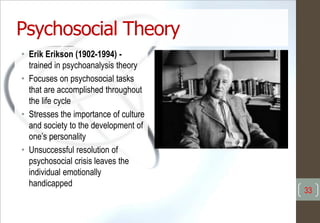
• Erik Erikson (1902-1994) -
trained in psychoanalysis theory
• Focuses on psychosocial tasks
that are accomplished throughout
the life cycle
• Stresses the importance of culture
and society to the development of
one’s personality
• Unsuccessful resolution of
psychosocial crisis leaves the
individual emotionally
handicapped
33
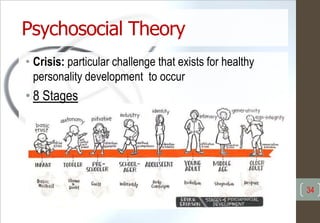
Psychosocial Theory
• Crisis: particular challenge that exists for healthy
personality development to occur
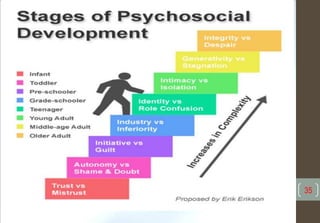
• 8 Stages
34
35
Psychosocial Theory Cont’d….
• 1. Trust vs Mistrust (Birth to 1 year) *Feeding
Developed by:
• Satisfying needs at all times: feed upon demand
(because stomach capacity is low and baby easily gets
hungry)
• Giving an experience that will add to security (e.g. touch,
hugs and kisses, eye-to-eye contact, soft music)
• Parental caring must be consistent and adequate
36
Psychosocial Theory Cont’d….
• 2. Autonomy vs Shame and Doubt (1-3 yrs)
Toddler *Toilet Training
• If everything is planned or done for the child, autonomy is
not developed
• Developed by:
• Giving opportunity for decision-making, offering choices,
rather than judgement
• Setting limits is the parents’ moral obligation
37
Psychosocial Theory Cont’d….
• 3. Initiative vs Guilt (3-6 yrs) Preschool *Doing basic things
• Views play as work and takes it seriously; if failed the child feels
• Guilt: anger turned inward
Developed by:
• Giving opportunity to explore new places and events
• Provide activities that can enhance imagination, creativity and
fine motor skills e.g. modeling clay, finger painting
• If child fails, don’t say “It’s just a game”; instead encourage
child to accept defeat and to do his/her best next time
38
Psychosocial Theory Cont’d….
• 4. Industry vs Inferiority (6-12 yrs) School age *School
• Learns how to do things well
• Developed by:
• Giving opportunity on short assignments and projects
39
Psychosocial Theory Cont’d….
• 5. Identity vs Role Confusion (12-18 yrs) Adolescent
*Peers
• Learns who he/she is, what kind of person will he/she
become by adjusting to new body image
• Emancipation from parents: liberation/freedom
• Peers become more important
• Experiment with new roles
40
Psychosocial Theory Cont’d….
• 6. Intimacy vs Isolation (19-40 yrs) Young Adult *Love
• Looking for lifetime partners, career-focused
• 7. Generativity vs Stagnation (40-65 yrs) Middle Adult
*Parenting
• 8. Ego Integrity vs Despair (65 yrs) Late Adult
*Reflection
41
Cognitive Theory
• Jean Piaget (1896-
1980)- Swiss Psychologist
• Defines cognitive acts as
ways in which the mind
organizes & adapts to its
environment
• SCHEMA- individual’s
framework of thought
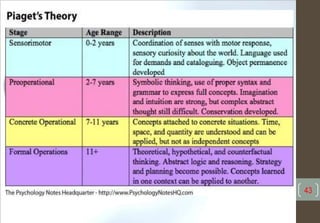
• 4 Stages of Cognitive
Development
42
43
Stages of Cognitive
Development: Sensorimotor
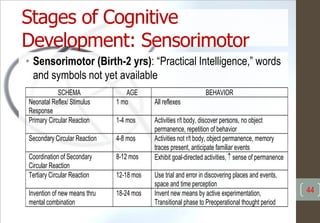
• Sensorimotor (Birth-2 yrs): “Practical Intelligence,” words
and symbols not yet available
44
A.
SCHEMA AGE BEHAVIOR
Neonatal Reflex/ Stimulus
Response
1 mo All reflexes
Primary Circular Reaction 1-4 mos Activities r/t body, discover persons, no object
permanence, repetition of behavior
Secondary Circular Reaction 4-8 mos Activities not r/t body, object permanence, memory
traces present, anticipate familiar events
Coordination of Secondary
Circular Reaction
8-12 mos Exhibit goal-directed activities,  sense of permanence
Tertiary Circular Reaction 12-18 mos Use trial and error in discovering places and events,
space and time perception
Invention of new means thru
mental combination
18-24 mos Invent new means by active experimentation,
Transitional phase to Preoperational thought period
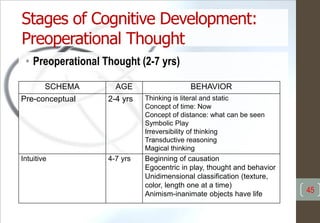
Stages of Cognitive Development:
Preoperational Thought
• Preoperational Thought (2-7 yrs)
45
SCHEMA AGE BEHAVIOR
Pre-conceptual 2-4 yrs Thinking is literal and static
Concept of time: Now
Concept of distance: what can be seen
Symbolic Play
Irreversibility of thinking
Transductive reasoning
Magical thinking
Intuitive 4-7 yrs Beginning of causation
Egocentric in play, thought and behavior
Unidimensional classification (texture,
color, length one at a time)
Animism-inanimate objects have life
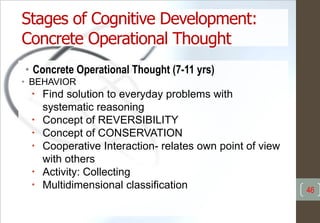
Stages of Cognitive Development:
Concrete Operational Thought
• Concrete Operational Thought (7-11 yrs)
• BEHAVIOR
• Find solution to everyday problems with
systematic reasoning
• Concept of REVERSIBILITY
• Concept of CONSERVATION
• Cooperative Interaction- relates own point of view
with others
• Activity: Collecting
• Multidimensional classification 46
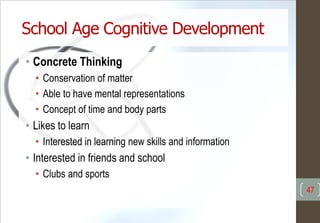
School Age Cognitive Development
• Concrete Thinking
• Conservation of matter
• Able to have mental representations
• Concept of time and body parts
• Likes to learn
• Interested in learning new skills and information
• Interested in friends and school
• Clubs and sports
47
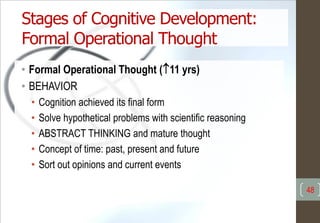
Stages of Cognitive Development:
Formal Operational Thought
• Formal Operational Thought (11 yrs)
• BEHAVIOR
• Cognition achieved its final form
• Solve hypothetical problems with scientific reasoning
• ABSTRACT THINKING and mature thought
• Concept of time: past, present and future
• Sort out opinions and current events
48
Formal Operational
Thought cont’d…
• Capacity for fully mature intellectual thought
• No longer depends on concrete experiences as basis of thought
• Capable of abstract thinking
• Likes independence and autonomy
• Establishing own identity and values
• Experimentation and risky behaviors
• Peer relationships are VERY important
• Keen awareness of body image (often comparing themselves
with peers)
• Idealistic: ripe for health teaching 49
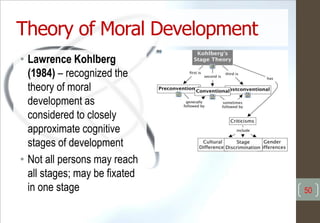
Theory of Moral Development
• Lawrence Kohlberg
(1984) – recognized the
theory of moral
development as
considered to closely
approximate cognitive
stages of development
• Not all persons may reach
all stages; may be fixated
in one stage 50
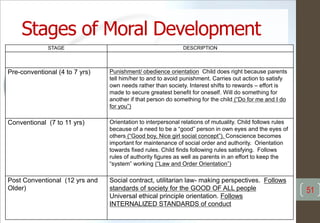
Stages of Moral Development
STAGE DESCRIPTION
Pre-conventional (4 to 7 yrs) Punishment/ obedience orientation Child does right because parents
tell him/her to and to avoid punishment. Carries out action to satisfy
own needs rather than society. Interest shifts to rewards – effort is
made to secure greatest benefit for oneself. Will do something for
another if that person do something for the child (“Do for me and I do
for you”)
Conventional (7 to 11 yrs) Orientation to interpersonal relations of mutuality. Child follows rules
because of a need to be a “good” person in own eyes and the eyes of
others (“Good boy, Nice girl social concept”). Conscience becomes
important for maintenance of social order and authority. Orientation
towards fixed rules. Child finds following rules satisfying. Follows
rules of authority figures as well as parents in an effort to keep the
“system” working (“Law and Order Orientation”)
Post Conventional (12 yrs and
Older)
Social contract, utilitarian law- making perspectives. Follows
standards of society for the GOOD OF ALL people
Universal ethical principle orientation. Follows
INTERNALIZED STANDARDS of conduct
51
52
53
Learning & Intellectual Disabilities
Learning & Intellectual
Disabilities (pp. 933-939)
• Learning disability: normal intelligence, but has difficulty
learning in a typical manner
• Brain cannot receive or process information in the normal
manner
• 5-10% school-age children
• Affects many parts of a child's life: school, daily routines,
family life, and sometimes even friendships and play
• Common types: dyslexia, dyscalculia, dysgraphia, dyspraxia
54
Learning & Intellectual
Disabilities Cont’d…
• Intellectual disability (NOT “mental retardation”)
• Limitation in intellectual functioning, adaptive behavior
• Differences in conceptual, social, and adaptive skills, before
age 18 yrs
• IQ below 70 to 75
• Adaptive functioning deficits in at least two areas (e.g.,
communication, self-care, social/ interpersonal skills,
academic skills, or work)
• Etiology: prenatal development of CNS, postnatal changes or
external forces leading to CNS damage 55
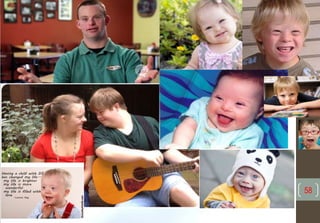
Down Syndrome (p. 885)
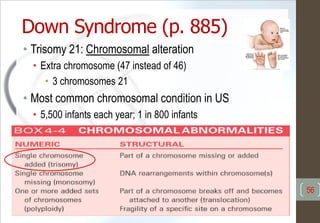
• Trisomy 21: Chromosomal alteration
• Extra chromosome (47 instead of 46)
• 3 chromosomes 21
• Most common chromosomal condition in US
• 5,500 infants each year; 1 in 800 infants
56
Down Syndrome, cont’d
• Syndrome: umbrella term with characteristic features
and anomalies of several organs
• Hypotonia, single palmar crease, almond-shaped eyes that slant
up, protruding tongue, short neck, low-set ears, wide, short neck,
epicanthal eye folds
• IQ in mildly-to-moderately low range; developmental delays (e.g.,
slower to speak than other children)
• At risk for: congenital heart defects, hearing loss, otitis media,
obstructive sleep apnea, strabismus, Hirschsprung disease,
thyroid disease, leukemia, Alzheimer’s disease, congenital
cataracts, diabetes 57
58
Nursing Management for
Children with Disability
• Developmental approach rather than a
chronological one
• Assess the child for developmental milestones
• Assess the child for adaptive functioning (ability to
effectively interact with society on all levels and care for
one's self)
• Assess functioning and coping of ALL family members
• Facilitate early intervention 59
Nursing Management for
Children with Disability, cont’d…
• Partner with the family and multidisciplinary team
• Open communication
• Parents are an ESSENTIAL part of “the team”
• Observe how the family is managing (parents are often
stretched to the limit)
• Collaboration is a MUST – need well-coordinated, seamless
plan of care
• Goal: accessible, continuous, comprehensive,
family-centered, coordinated, compassionate,
and culturally effective care 60
Nurse’s Role with Families of
Children with Disabilities
• Assessment
• Strengths and focus on abilities (not disabilities)
• Support
• Accept reactions and encourage expression of feelings
• Identification of resources
• Discuss realistic Goal Setting
• “Child First” language
• A child with Down syndrome, NOT a Down syndrome
child
61
62
Child Maltreatment
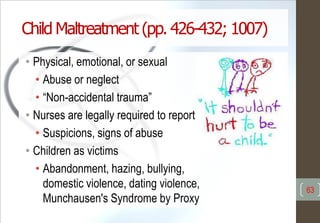
Child Maltreatment (pp. 426-432; 1007)
• Physical, emotional, or sexual
• Abuse or neglect
• “Non-accidental trauma”
• Nurses are legally required to report
• Suspicions, signs of abuse
• Children as victims
• Abandonment, hazing, bullying,
domestic violence, dating violence,
Munchausen's Syndrome by Proxy
63
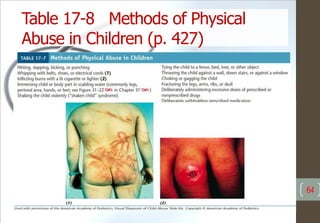
Table 17-8 Methods of Physical
Abuse in Children (p. 427)
64
Munchausen Syndrome by
Proxy (pp. 432)
• Fabrication of signs and symptoms of a health condition in a child;
potentially deadly form of child abuse
• Occurs most often in parent-child relationships; mothers most often
perpetrator; victim usually under 6 yrs
• Unexplained, recurrent, or extremely rare conditions; illness unresponsive
to treatment; symptoms change frequently; history and clinical findings
inconsistent; symptoms occur in presence of same caretaker, disappear
when child is separated from caretaker
• Diagnosis: difficult because perpetrator is expert at faking illness; must
carefully review health records, talk with friends or family
• Mandatory reporting to Child Protective Services & law enforcement; child
placed in safe environment 65
Munchausen Syndrome by
Proxy
• Most commonly reported signs & symptoms:
• CNS dysfunction
• Apnea
• Vomiting
• Diarrhea
• Seizures
• Fever
• Signs of bleeding (urine or stool)
• Rashes 66
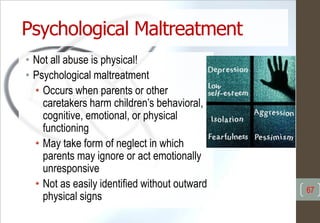
Psychological Maltreatment
• Not all abuse is physical!
• Psychological maltreatment
• Occurs when parents or other
caretakers harm children’s behavioral,
cognitive, emotional, or physical
functioning
• May take form of neglect in which
parents may ignore or act emotionally
unresponsive
• Not as easily identified without outward
physical signs
67
What are Consequences of
Psychological Maltreatment?
• Some children survive and grow into
psychologically healthy adults
• Others suffer long-term damage
• Low self-esteem, depression, suicide
• Lying
• Misbehavior
• Underachievement in school
• Criminal behavior
68
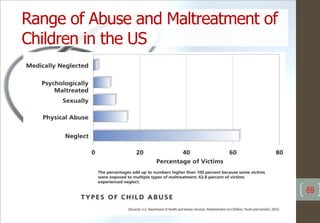
Range of Abuse and Maltreatment of
Children in the US
69
Risk Factors Common in Families with
Child Victims of Violence
• Poverty
• History of mental illness, domestic violence, incarceration, or
substance abuse in the home
• Family stresses (e.g., single-parent households, high levels of
marital discord)
• Inadequate child care or supervision
• Inadequate family social support
• Gang membership in family or neighborhood
• High exposure to media violence
• Children with chronic illnesses and special health care needs
• Child hyperactivity or other developmental behavior disorders
70
True or False?
•Child abuse can occur in any home
or child care setting
71
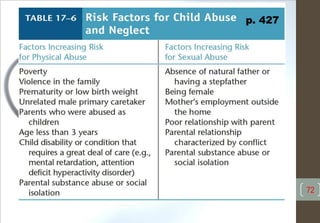
Table17-6 RiskFactorsforChildAbuseandNeglect
72
p. 427
Nursing Interventions & Goals
• Assess the family for ineffective coping and the potential for
abuse
• Make appropriate referrals to support services such as
mental health counseling, social services, and respite
• Work with family to:
• Understand present and future risks
• Change social and physical environment
• To achieve goals:
• Educate families, connecting them with resources
• Plan measurable behavior changes 73
Suspect...
Dramatic changes or shifts in behavior
without logical explanation warrant inquiry
74
75
Nutrition
76
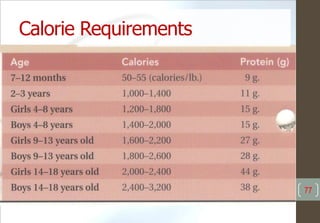
Calorie Requirements
77
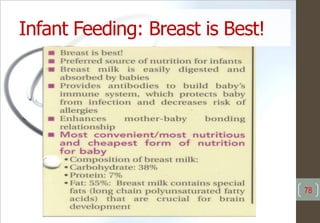
Infant Feeding: Breast is Best!
78
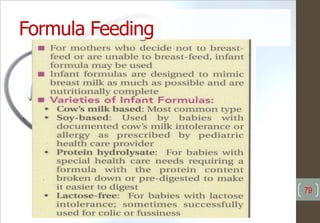
Formula Feeding
79
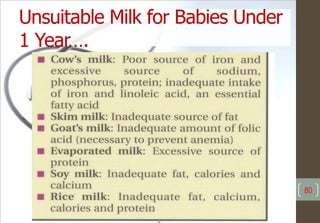
Unsuitable Milk for Babies Under
1 Year….
80
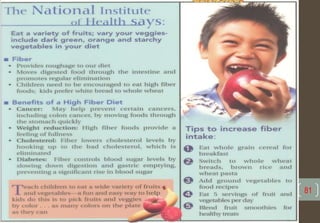
81
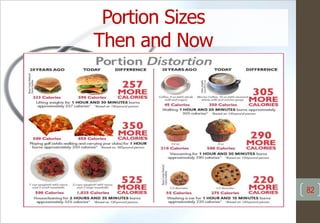
Portion Sizes
Then and Now
82
83
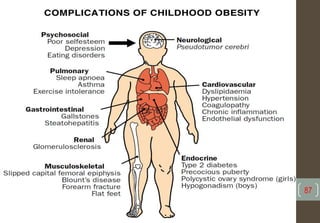
Childhood Obesity
84
Childhood Obesity Epidemic
(pp. 325-326; 328-329)
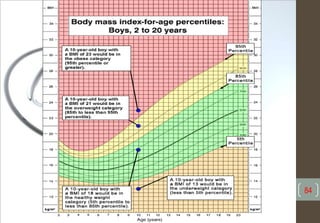
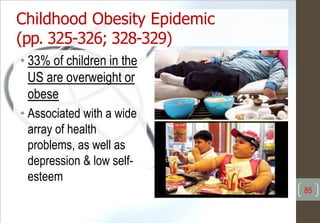
• 33% of children in the
US are overweight or
obese
• Associated with a wide
array of health
problems, as well as
depression & low self-
esteem
85
Childhood Obesity Epidemic,
cont’d
•Helps bring on during childhood many of the
chronic diseases of middle age and old age:
• Type II Diabetes, CVA, cardiovascular disease,
hypertension, dyslipidemia, gallbladder disease,
osteoarthritis, respiratory problems
(e.g. obstructive sleep apnea)
86
87
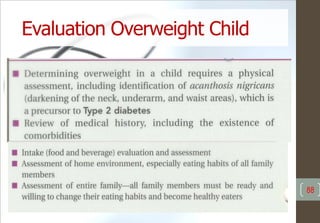
Evaluation Overweight Child
88
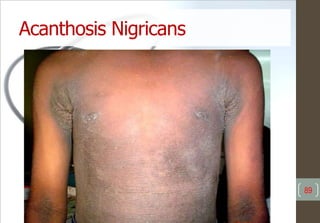
Acanthosis Nigricans
89
Early Intervention: Healthy Food
Choices, Active Lifestyle
• Early diagnosis with
interdisciplinary monitoring
and appropriate interventions
along with healthy food
choices beginning in
childhood and an active
lifestyle are the keys to better
health and a longer life
• See Nursing Care Plan:
The Child Who is
Overweight, pp. 328-329
90
91
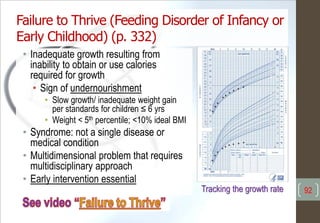
Failure to Thrive
• Inadequate growth resulting from
inability to obtain or use calories
required for growth
• Sign of undernourishment
• Slow growth/ inadequate weight gain
per standards for children ≤ 6 yrs
• Weight < 5th percentile; <10% ideal BMI
• Syndrome: not a single disease or
medical condition
• Multidimensional problem that requires
multidisciplinary approach
• Early intervention essential
Failure to Thrive (Feeding Disorder of Infancy or
Early Childhood) (p. 332)
Tracking the growth rate 92
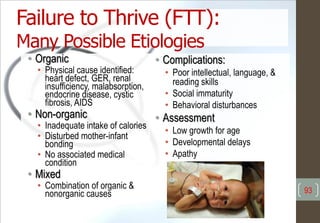
• Organic
• Physical cause identified:
heart defect, GER, renal
insufficiency, malabsorption,
endocrine disease, cystic
fibrosis, AIDS
• Non-organic
• Inadequate intake of calories
• Disturbed mother-infant
bonding
• No associated medical
condition
• Mixed
• Combination of organic &
nonorganic causes
• Complications:
• Poor intellectual, language, &
reading skills
• Social immaturity
• Behavioral disturbances
• Assessment
• Low growth for age
• Developmental delays
• Apathy
Failure to Thrive (FTT):
Many Possible Etiologies
93
FTT: Collaborative Care
• Multidisciplinary team approach: provide adequate caloric &
nutritional intake; promote normal G & D; assist parents
• Thorough history & physical
• Accurate daily weights, I & O
• Monitoring of height / weight / HC
• Observation of infant / caretaker interaction
• Calorie count to determine actual calories consumed
• Meals & snacks: pleasant, regularly scheduled (e.g., every 3
hrs), not rushed, established routine, distractions minimized
• Grazing in between meals/ snack times should be eliminated
• Referral: Community resources
94
•Complete a comprehensive health history
•Perform a physical examination
•Educate regarding nutrition, feeding
techniques, feeding cues
•Offer support for caregivers and families
•Report abuse or neglect
FTT: Nursing Care
95
96
Inborn Errors of Metabolism
(pp. 969-972)
• Large class of genetic diseases involving disorders of
metabolism
• Body cannot properly turn food into energy
• Caused by defects in specific proteins (enzymes) that help
break down (metabolize) parts of food
• Manifestations usually occur within days or weeks of birth
• Untreated: irreversible organ damage, life-threatening
problems, coma, death
• North Carolina Newborn Metabolic Screening:
phenylketonuria, galactosemia, maple syrup urine disease
(among other conditions) 97
Phenyketonuria (p. 970)
• Autosomal recessive inheritance pattern
• Missing an enzyme (phenylalanine hydroxylase), which is
needed to properly break down phenylalanine
• Untreated: irreversible brain damage, severe intellectual
disability
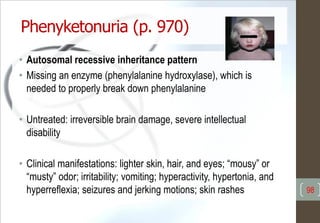
• Clinical manifestations: lighter skin, hair, and eyes; “mousy” or
“musty” odor; irritability; vomiting; hyperactivity, hypertonia, and
hyperreflexia; seizures and jerking motions; skin rashes 98
Phenyketonuria, cont’d
• Treatment: special formula (Lofenalac); low
phenylalanine-diet (avoid high protein foods, such
as milk, dairy products, meat, fish, chicken, eggs,
beans, and nuts; aspartame)
• Nursing: support & educate parents; confer with
nutritionist
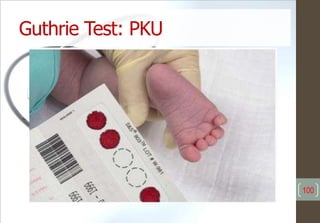
• All states require PKU newborn screening
99
Guthrie Test: PKU
100
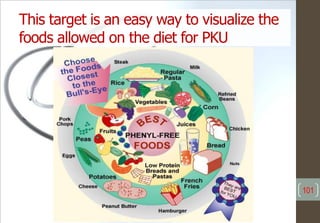
This target is an easy way to visualize the
foods allowed on the diet for PKU
101
PKU Diet
• Phenylalanine-free medical formula (Phenyl-Free)*
• Contains protein, vitamins, minerals & energy with no
phenylalanine
• Fruits, vegetables, bread, pasta, & cereals (carefully
measured amounts)
• Special low-protein breads & pastas
• * Registered trademark of Mead Johnson Co.
102
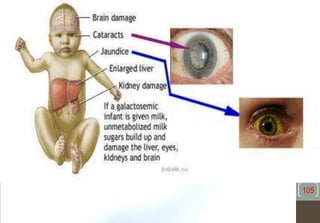
Galactosemia (pp. 970-971)
• Autosomal recessive inheritance pattern
• Unable to use (metabolize) the simple sugar
galactose
• Untreated: irreversible damage to eyes, liver,
kidney, and brain
• Clinical manifestations: poor feeding, poor weight
gain, jaundice, vomiting, irritability, lethargy,
seizures, coma, death 103
Galactosemia cont’d
• Treatment: lactose-free formula (e.g., soy formula,
Nutramigen), galactose-free diet
• Avoid all milk, breastmilk, milk-containing products
(including dry milk), and other foods that contain
galactose for life
• Nursing management: support & educate parents;
confer with nutritionist
• All states require galactosemia newborn screening 104
105
MapleSyrupUrineDisease(MSUD)(pp.971-972)
• Autosomal recessive inheritance pattern
• Cannot break down the amino acids leucine, isoleucine, &
valine
• Untreated: cerebral edema, progressive neurologic
impairment, death
• Clinical manifestations: poor appetite, feeding difficulties,
lethargy, vomiting, urine that smells like maple syrup,
ketoacidosis, seizures, coma, death
106
MSUD
• Treatment: specially-designed formulas, low-protein foods,
daily urine testing for ketones; removal of amino acids &
their metabolites from the tissues & body fluids, may require
dialysis; liver transplant
• Nursing management: support & educate parents; confer
with nutritionist
• Most states require MUSD newborn screening
107

Growth &amp; development nurs 3340 spring 2017

  • 1.
    Growth & Development Joyce Buck,PhD(c), MSN, RN-C, CNE Joy A. Shepard, PhD, RN-C, CNE 1
  • 2.
    Objectives • Describe principles,patterns, and rates of growth and development • Describe major developmental theories • Plan for the nursing management of children with learning and intellectual disabilities • Describe the nursing role in prevention and treatment of child abuse and neglect • Summarize major nutritional concepts pertaining to the growth and development of children • Describe nursing interventions for children who are overweight or obese • Plan care for the child with an inherited biochemical abnormality 2
  • 3.
    Nursing Diagnoses • DelayedGrowth & Development • Readiness for Enhanced Parenting • Readiness for Enhanced Family Processes • Compromised Family Coping • Dysfunctional Family Processes • Caregiver Role Strain • Risk for Impaired Parenting • Risk for Injury • Imbalanced Nutrition: More than body requirements • Imbalanced Nutrition: Less than body requirements • Sedentary Lifestyle 3
  • 4.
  • 5.
    Growth • WEIGHT- mostsensitive • Birth weight: 2X by 6 mos • 3x by 1 yr • 4X by 2 yrs • LENGTH/ HEIGHT •  1.5 cm/ mo 1st 6 mos •  1 cm/ mo. 7-12 mos • Ave.  in ht. during 1st yr is 50% • Approx. ½ of adult ht. at 2 yrs 5
  • 6.
    Development • DEVELOPMENT- inthe skills or capacity to function • How to Measure: • By simply observing a child doing specific task • By noting parent’s description of the child’s progress • By comparing child’s performance to developmental milestones • By a Developmental Screening Tool • Developmental Screening tools include the domains of: • Cognition • Fine & Gross Motor Skills • Speech & Language • Social-Emotional Development 6
  • 7.
    Maturation • MATURATION -synonymous with development, also known as READINESS • COGNITIVE DEVELOPMENT- is the ability to learn (to change behavior) and understand from experience, to acquire and retain knowledge, to respond to a new situation and to solve problems • Basis of Intellectual Disability • IQ= mental age X 100 chronological age • 0-20 profound intellectual disability (infant) • 20-35 severe (0-2 yo) • 35-50 moderate (2-7 yo) trainable • 50-70 mild (7-12 yo) educable • 70-90 borderline • 90-110 normal (average IQ) •  130 gifted 7
  • 8.
    Basic Divisions ofLife • 1st Stage- Prenatal (from conception to birth) • 2nd Stage- Infancy • Neonatal: 1st 28 days of life • Infancy: Birth to 12 months 3rd Stage- Early Childhood • Toddler: 1-3 yrs • Preschool: 3-6 yrs • 4th Stage- Middle Childhood • School age: 6-12 yrs • 5th Stage- Late Childhood • Adolescent: 12-18 yrs (or 21) 8
  • 9.
    Principles of Growth& Development 1. Growth and development is a continuous process (from womb to tomb) 2. Not all parts of the body grow at the same time or at the same rate (Principle of Asynchronism) 9 Watch Video “Growth and Development”
  • 10.
    Patterns of Growth& Development • CV, MS, GI, & GU systems - fairly smoothly during childhood • CNS- rapidly 1st 1-2 yrs • Immune System- rapidly during infancy & childhood • Tonsils: adult proportion by 5 yrs • Reproductive System- rapidly during puberty 10
  • 11.
    Rates of Growth& Development • Fetal and Infancy- most rapid • Toddler- slow • Preschool- alternating rapid and slow • School age- slower • Adolescent- rapid 11
  • 12.
    Each Child isUnique • 2 Primary Factors • Heredity (Non-modifiable) or “Nature” • Race • Intelligence • Sex • Nationality • Environment (Modifiable) or “Nurture” • Quality of Nutrition • Socioeconomic status • Health • Parent-child relationship 12
  • 13.
    Directional Trends • Cephalocaudal:“ head to tail”. It occurs along body’s long axis in which control over head, mouth and eye movements and precedes control over upper body torso and legs. • Proximodistal: from center of the body to extremities (e.g. baby uses whole arm in crawling then hand pincers) • Symmetrical: each side of the body develops in the same direction at same time and rate • Mass-Specific (Differentiation): the child learns from simple operations before complex functions or move from a broad general pattern of behavior to a more refined pattern (e.g., crying precedes speech) 13
  • 14.
  • 15.
    Gross Motor vs.Fine Motor Ability • Motor skills – carried out when the brain, nervous system, and muscles work together • Gross motor – larger movement child makes with arms, legs, feet, or entire body • Examples: rolling over, sitting, crawling, running, and jumping • Fine motor – smaller, more skilled movements • Small muscles of fingers, toes, lips & tongue • Examples: picking things up between finger and thumb, wriggling toes in the sand, using lips and tongue to taste and feel objects • Gross motor skills precede fine motor skills 15
  • 16.
    Infant Primitive Reflexes •Infant primitive reflexes must be lost first before development can proceed (e.g., spitting/extrusion reflex must be overcome before infant can be fed with solid foods; tonic neck reflex must be diminished before the infant can turn over) • REFLEXES- involuntary reactions to specific forms of stimulation • Importance: • Survival (e.g., feeding reflexes: rooting, sucking, swallowing; protective reflexes: blink, gag, cough, Moro) • Reflects how well CNS is functioning • Forms the basis for later, more sophisticated behavior 16
  • 17.
    Sequential & SecularTrends • SEQUENTIAL TRENDS- involves a predictable sequence of growth and development to which the child normally passes a) Locomotion b) Language and social skills • SECULAR TRENDS-refers to the worldwide trend of maturing earlier and growing larger as compared to previous generations 17
  • 18.
    Behavior & Play •BEHAVIOR- most comprehensive indicator of developmental status • PLAY- universal language of the child • A great deal of skill and behavior is learned by PRACTICE 18 • Play is a reflection of every aspect of development and a method for enhancing learning and maturation
  • 19.
    Play in Infancy •Solitary play • Play by themselves • Limited interaction • Egs: grasping a rattle; shaking and banging things; manipulation of blocks • Every new object or situation that is introduced is a new learning experience for the infant 19
  • 20.
    Play in Toddlerhood •Parallel play • Play with similar objects side by side, with little communication or interaction • Absorbed in their own activity • Both gross motor and fine motor abilities enhanced 20
  • 21.
    Preschooler Play •Associative play •Similar activity but no rigid organization • Motor activity! • On the go and moving • Dramatic play • Dress up, imitation • Games • Rules are absolute and rigid in games 21
  • 22.
    School Age Play •Cooperative Play • Teams, organized clubs • Rules • Likes competition • Construction • Enjoys building and constructing things • Computer games • Watch amount of TV or “screen” time 22
  • 23.
  • 24.
    Anticipatory Guidance: PromoteUse of Protective Gear 24
  • 25.
  • 26.
    Theories of Development •Developmental Task: • Skill or growth responsibility arising at a particular time in the individual’s life • Successful achievement provides a foundation for the accomplishments of the future tasks • Freud: Psychosexual Theory • Erikson: Psychosocial Theory • Piaget: Cognitive Theory • Kohlberg: Theory of Moral Development 26
  • 27.
    Psychosexual Theory/ Psychoanalytic Theory •Sigmund Freud (1856-1939): Austrian neurologist, founder of psychoanalysis • 3 parts of personality: • 1) Id: basic sexual energy present at birth 2) Ego: realistic part of person; develops around 4-5 months 3) Superego: moral/ ethical system; develops at 3-6 years 27
  • 28.
    Psychosexual Theory Cont’d…. •1. ORAL- (Birth-12 mos) Infant • Mouth- site of gratification • Activity: biting, sucking, crying (for enjoyment and release of tension) • Offer pacifier when NPO 28
  • 29.
    Psychosexual Theory Cont’d…. •2. ANAL-(1-3 yrs) Toddler • Anus- site of gratification where elimination takes place • Principles in Toilet Training: • “Holding on”- child wins, becomes stubborn or antisocial • “Letting go”- mother wins, child becomes obedient, kind, perfectionist, obsessive-compulsive 29
  • 30.
    Psychosexual Theory Cont’d…. •3. PHALLIC-(3-6 yrs) Preschool • Genitalia- site of gratification •  knowledge on 2 sexes , exhibitionism is normal • Accept child fondling his/her genitalia as normal area of exploration • Answer child’s questions directly • SUPEREGO is a necessary part of socialization; includes internalization of values, ideas and moral standards of parents and society; development of CONSCIENCE 30
  • 31.
    Preschooler cont’d: Gender RoleIdentity • Becomes aware of their similarity to parent of the same sex • Usually like to be like the same sex parent • Reinforced by the parent • Girls—cooking with mom; Boys—working with dad in the shop • Not absolute—many identify with both parents 31
  • 32.
    Psychosexual Theory Cont’d…. •4. LATENT-(6-12 yrs) School Age • Period of suppression, no obvious development • Help child achieve positive experiences so that he/she will become ready to face the conflicts of adolescence • 5. GENITAL- ( 12yrs) Adolescent • Focused on sexuality • Developing sexual maturity; learning how to establish a satisfactory relationship with opposite sex 32
  • 33.
    Psychosocial Theory • ErikErikson (1902-1994) - trained in psychoanalysis theory • Focuses on psychosocial tasks that are accomplished throughout the life cycle • Stresses the importance of culture and society to the development of one’s personality • Unsuccessful resolution of psychosocial crisis leaves the individual emotionally handicapped 33
  • 34.
    Psychosocial Theory • Crisis:particular challenge that exists for healthy personality development to occur • 8 Stages 34
  • 35.
  • 36.
    Psychosocial Theory Cont’d…. •1. Trust vs Mistrust (Birth to 1 year) *Feeding Developed by: • Satisfying needs at all times: feed upon demand (because stomach capacity is low and baby easily gets hungry) • Giving an experience that will add to security (e.g. touch, hugs and kisses, eye-to-eye contact, soft music) • Parental caring must be consistent and adequate 36
  • 37.
    Psychosocial Theory Cont’d…. •2. Autonomy vs Shame and Doubt (1-3 yrs) Toddler *Toilet Training • If everything is planned or done for the child, autonomy is not developed • Developed by: • Giving opportunity for decision-making, offering choices, rather than judgement • Setting limits is the parents’ moral obligation 37
  • 38.
    Psychosocial Theory Cont’d…. •3. Initiative vs Guilt (3-6 yrs) Preschool *Doing basic things • Views play as work and takes it seriously; if failed the child feels • Guilt: anger turned inward Developed by: • Giving opportunity to explore new places and events • Provide activities that can enhance imagination, creativity and fine motor skills e.g. modeling clay, finger painting • If child fails, don’t say “It’s just a game”; instead encourage child to accept defeat and to do his/her best next time 38
  • 39.
    Psychosocial Theory Cont’d…. •4. Industry vs Inferiority (6-12 yrs) School age *School • Learns how to do things well • Developed by: • Giving opportunity on short assignments and projects 39
  • 40.
    Psychosocial Theory Cont’d…. •5. Identity vs Role Confusion (12-18 yrs) Adolescent *Peers • Learns who he/she is, what kind of person will he/she become by adjusting to new body image • Emancipation from parents: liberation/freedom • Peers become more important • Experiment with new roles 40
  • 41.
    Psychosocial Theory Cont’d…. •6. Intimacy vs Isolation (19-40 yrs) Young Adult *Love • Looking for lifetime partners, career-focused • 7. Generativity vs Stagnation (40-65 yrs) Middle Adult *Parenting • 8. Ego Integrity vs Despair (65 yrs) Late Adult *Reflection 41
  • 42.
    Cognitive Theory • JeanPiaget (1896- 1980)- Swiss Psychologist • Defines cognitive acts as ways in which the mind organizes & adapts to its environment • SCHEMA- individual’s framework of thought • 4 Stages of Cognitive Development 42
  • 43.
  • 44.
    Stages of Cognitive Development:Sensorimotor • Sensorimotor (Birth-2 yrs): “Practical Intelligence,” words and symbols not yet available 44 A. SCHEMA AGE BEHAVIOR Neonatal Reflex/ Stimulus Response 1 mo All reflexes Primary Circular Reaction 1-4 mos Activities r/t body, discover persons, no object permanence, repetition of behavior Secondary Circular Reaction 4-8 mos Activities not r/t body, object permanence, memory traces present, anticipate familiar events Coordination of Secondary Circular Reaction 8-12 mos Exhibit goal-directed activities,  sense of permanence Tertiary Circular Reaction 12-18 mos Use trial and error in discovering places and events, space and time perception Invention of new means thru mental combination 18-24 mos Invent new means by active experimentation, Transitional phase to Preoperational thought period
  • 45.
    Stages of CognitiveDevelopment: Preoperational Thought • Preoperational Thought (2-7 yrs) 45 SCHEMA AGE BEHAVIOR Pre-conceptual 2-4 yrs Thinking is literal and static Concept of time: Now Concept of distance: what can be seen Symbolic Play Irreversibility of thinking Transductive reasoning Magical thinking Intuitive 4-7 yrs Beginning of causation Egocentric in play, thought and behavior Unidimensional classification (texture, color, length one at a time) Animism-inanimate objects have life
  • 46.
    Stages of CognitiveDevelopment: Concrete Operational Thought • Concrete Operational Thought (7-11 yrs) • BEHAVIOR • Find solution to everyday problems with systematic reasoning • Concept of REVERSIBILITY • Concept of CONSERVATION • Cooperative Interaction- relates own point of view with others • Activity: Collecting • Multidimensional classification 46
  • 47.
    School Age CognitiveDevelopment • Concrete Thinking • Conservation of matter • Able to have mental representations • Concept of time and body parts • Likes to learn • Interested in learning new skills and information • Interested in friends and school • Clubs and sports 47
  • 48.
    Stages of CognitiveDevelopment: Formal Operational Thought • Formal Operational Thought (11 yrs) • BEHAVIOR • Cognition achieved its final form • Solve hypothetical problems with scientific reasoning • ABSTRACT THINKING and mature thought • Concept of time: past, present and future • Sort out opinions and current events 48
  • 49.
    Formal Operational Thought cont’d… •Capacity for fully mature intellectual thought • No longer depends on concrete experiences as basis of thought • Capable of abstract thinking • Likes independence and autonomy • Establishing own identity and values • Experimentation and risky behaviors • Peer relationships are VERY important • Keen awareness of body image (often comparing themselves with peers) • Idealistic: ripe for health teaching 49
  • 50.
    Theory of MoralDevelopment • Lawrence Kohlberg (1984) – recognized the theory of moral development as considered to closely approximate cognitive stages of development • Not all persons may reach all stages; may be fixated in one stage 50
  • 51.
    Stages of MoralDevelopment STAGE DESCRIPTION Pre-conventional (4 to 7 yrs) Punishment/ obedience orientation Child does right because parents tell him/her to and to avoid punishment. Carries out action to satisfy own needs rather than society. Interest shifts to rewards – effort is made to secure greatest benefit for oneself. Will do something for another if that person do something for the child (“Do for me and I do for you”) Conventional (7 to 11 yrs) Orientation to interpersonal relations of mutuality. Child follows rules because of a need to be a “good” person in own eyes and the eyes of others (“Good boy, Nice girl social concept”). Conscience becomes important for maintenance of social order and authority. Orientation towards fixed rules. Child finds following rules satisfying. Follows rules of authority figures as well as parents in an effort to keep the “system” working (“Law and Order Orientation”) Post Conventional (12 yrs and Older) Social contract, utilitarian law- making perspectives. Follows standards of society for the GOOD OF ALL people Universal ethical principle orientation. Follows INTERNALIZED STANDARDS of conduct 51
  • 52.
  • 53.
  • 54.
    Learning & Intellectual Disabilities(pp. 933-939) • Learning disability: normal intelligence, but has difficulty learning in a typical manner • Brain cannot receive or process information in the normal manner • 5-10% school-age children • Affects many parts of a child's life: school, daily routines, family life, and sometimes even friendships and play • Common types: dyslexia, dyscalculia, dysgraphia, dyspraxia 54
  • 55.
    Learning & Intellectual DisabilitiesCont’d… • Intellectual disability (NOT “mental retardation”) • Limitation in intellectual functioning, adaptive behavior • Differences in conceptual, social, and adaptive skills, before age 18 yrs • IQ below 70 to 75 • Adaptive functioning deficits in at least two areas (e.g., communication, self-care, social/ interpersonal skills, academic skills, or work) • Etiology: prenatal development of CNS, postnatal changes or external forces leading to CNS damage 55
  • 56.
    Down Syndrome (p.885) • Trisomy 21: Chromosomal alteration • Extra chromosome (47 instead of 46) • 3 chromosomes 21 • Most common chromosomal condition in US • 5,500 infants each year; 1 in 800 infants 56
  • 57.
    Down Syndrome, cont’d •Syndrome: umbrella term with characteristic features and anomalies of several organs • Hypotonia, single palmar crease, almond-shaped eyes that slant up, protruding tongue, short neck, low-set ears, wide, short neck, epicanthal eye folds • IQ in mildly-to-moderately low range; developmental delays (e.g., slower to speak than other children) • At risk for: congenital heart defects, hearing loss, otitis media, obstructive sleep apnea, strabismus, Hirschsprung disease, thyroid disease, leukemia, Alzheimer’s disease, congenital cataracts, diabetes 57
  • 58.
  • 59.
    Nursing Management for Childrenwith Disability • Developmental approach rather than a chronological one • Assess the child for developmental milestones • Assess the child for adaptive functioning (ability to effectively interact with society on all levels and care for one's self) • Assess functioning and coping of ALL family members • Facilitate early intervention 59
  • 60.
    Nursing Management for Childrenwith Disability, cont’d… • Partner with the family and multidisciplinary team • Open communication • Parents are an ESSENTIAL part of “the team” • Observe how the family is managing (parents are often stretched to the limit) • Collaboration is a MUST – need well-coordinated, seamless plan of care • Goal: accessible, continuous, comprehensive, family-centered, coordinated, compassionate, and culturally effective care 60
  • 61.
    Nurse’s Role withFamilies of Children with Disabilities • Assessment • Strengths and focus on abilities (not disabilities) • Support • Accept reactions and encourage expression of feelings • Identification of resources • Discuss realistic Goal Setting • “Child First” language • A child with Down syndrome, NOT a Down syndrome child 61
  • 62.
  • 63.
    Child Maltreatment (pp.426-432; 1007) • Physical, emotional, or sexual • Abuse or neglect • “Non-accidental trauma” • Nurses are legally required to report • Suspicions, signs of abuse • Children as victims • Abandonment, hazing, bullying, domestic violence, dating violence, Munchausen's Syndrome by Proxy 63
  • 64.
    Table 17-8 Methodsof Physical Abuse in Children (p. 427) 64
  • 65.
    Munchausen Syndrome by Proxy(pp. 432) • Fabrication of signs and symptoms of a health condition in a child; potentially deadly form of child abuse • Occurs most often in parent-child relationships; mothers most often perpetrator; victim usually under 6 yrs • Unexplained, recurrent, or extremely rare conditions; illness unresponsive to treatment; symptoms change frequently; history and clinical findings inconsistent; symptoms occur in presence of same caretaker, disappear when child is separated from caretaker • Diagnosis: difficult because perpetrator is expert at faking illness; must carefully review health records, talk with friends or family • Mandatory reporting to Child Protective Services & law enforcement; child placed in safe environment 65
  • 66.
    Munchausen Syndrome by Proxy •Most commonly reported signs & symptoms: • CNS dysfunction • Apnea • Vomiting • Diarrhea • Seizures • Fever • Signs of bleeding (urine or stool) • Rashes 66
  • 67.
    Psychological Maltreatment • Notall abuse is physical! • Psychological maltreatment • Occurs when parents or other caretakers harm children’s behavioral, cognitive, emotional, or physical functioning • May take form of neglect in which parents may ignore or act emotionally unresponsive • Not as easily identified without outward physical signs 67
  • 68.
    What are Consequencesof Psychological Maltreatment? • Some children survive and grow into psychologically healthy adults • Others suffer long-term damage • Low self-esteem, depression, suicide • Lying • Misbehavior • Underachievement in school • Criminal behavior 68
  • 69.
    Range of Abuseand Maltreatment of Children in the US 69
  • 70.
    Risk Factors Commonin Families with Child Victims of Violence • Poverty • History of mental illness, domestic violence, incarceration, or substance abuse in the home • Family stresses (e.g., single-parent households, high levels of marital discord) • Inadequate child care or supervision • Inadequate family social support • Gang membership in family or neighborhood • High exposure to media violence • Children with chronic illnesses and special health care needs • Child hyperactivity or other developmental behavior disorders 70
  • 71.
    True or False? •Childabuse can occur in any home or child care setting 71
  • 72.
  • 73.
    Nursing Interventions &Goals • Assess the family for ineffective coping and the potential for abuse • Make appropriate referrals to support services such as mental health counseling, social services, and respite • Work with family to: • Understand present and future risks • Change social and physical environment • To achieve goals: • Educate families, connecting them with resources • Plan measurable behavior changes 73
  • 74.
    Suspect... Dramatic changes orshifts in behavior without logical explanation warrant inquiry 74
  • 75.
  • 76.
  • 77.
  • 78.
  • 79.
  • 80.
    Unsuitable Milk forBabies Under 1 Year…. 80
  • 81.
  • 82.
  • 83.
  • 84.
  • 85.
    Childhood Obesity Epidemic (pp.325-326; 328-329) • 33% of children in the US are overweight or obese • Associated with a wide array of health problems, as well as depression & low self- esteem 85
  • 86.
    Childhood Obesity Epidemic, cont’d •Helpsbring on during childhood many of the chronic diseases of middle age and old age: • Type II Diabetes, CVA, cardiovascular disease, hypertension, dyslipidemia, gallbladder disease, osteoarthritis, respiratory problems (e.g. obstructive sleep apnea) 86
  • 87.
  • 88.
  • 89.
  • 90.
    Early Intervention: HealthyFood Choices, Active Lifestyle • Early diagnosis with interdisciplinary monitoring and appropriate interventions along with healthy food choices beginning in childhood and an active lifestyle are the keys to better health and a longer life • See Nursing Care Plan: The Child Who is Overweight, pp. 328-329 90
  • 91.
  • 92.
    • Inadequate growthresulting from inability to obtain or use calories required for growth • Sign of undernourishment • Slow growth/ inadequate weight gain per standards for children ≤ 6 yrs • Weight < 5th percentile; <10% ideal BMI • Syndrome: not a single disease or medical condition • Multidimensional problem that requires multidisciplinary approach • Early intervention essential Failure to Thrive (Feeding Disorder of Infancy or Early Childhood) (p. 332) Tracking the growth rate 92
  • 93.
    • Organic • Physicalcause identified: heart defect, GER, renal insufficiency, malabsorption, endocrine disease, cystic fibrosis, AIDS • Non-organic • Inadequate intake of calories • Disturbed mother-infant bonding • No associated medical condition • Mixed • Combination of organic & nonorganic causes • Complications: • Poor intellectual, language, & reading skills • Social immaturity • Behavioral disturbances • Assessment • Low growth for age • Developmental delays • Apathy Failure to Thrive (FTT): Many Possible Etiologies 93
  • 94.
    FTT: Collaborative Care •Multidisciplinary team approach: provide adequate caloric & nutritional intake; promote normal G & D; assist parents • Thorough history & physical • Accurate daily weights, I & O • Monitoring of height / weight / HC • Observation of infant / caretaker interaction • Calorie count to determine actual calories consumed • Meals & snacks: pleasant, regularly scheduled (e.g., every 3 hrs), not rushed, established routine, distractions minimized • Grazing in between meals/ snack times should be eliminated • Referral: Community resources 94
  • 95.
    •Complete a comprehensivehealth history •Perform a physical examination •Educate regarding nutrition, feeding techniques, feeding cues •Offer support for caregivers and families •Report abuse or neglect FTT: Nursing Care 95
  • 96.
  • 97.
    Inborn Errors ofMetabolism (pp. 969-972) • Large class of genetic diseases involving disorders of metabolism • Body cannot properly turn food into energy • Caused by defects in specific proteins (enzymes) that help break down (metabolize) parts of food • Manifestations usually occur within days or weeks of birth • Untreated: irreversible organ damage, life-threatening problems, coma, death • North Carolina Newborn Metabolic Screening: phenylketonuria, galactosemia, maple syrup urine disease (among other conditions) 97
  • 98.
    Phenyketonuria (p. 970) •Autosomal recessive inheritance pattern • Missing an enzyme (phenylalanine hydroxylase), which is needed to properly break down phenylalanine • Untreated: irreversible brain damage, severe intellectual disability • Clinical manifestations: lighter skin, hair, and eyes; “mousy” or “musty” odor; irritability; vomiting; hyperactivity, hypertonia, and hyperreflexia; seizures and jerking motions; skin rashes 98
  • 99.
    Phenyketonuria, cont’d • Treatment:special formula (Lofenalac); low phenylalanine-diet (avoid high protein foods, such as milk, dairy products, meat, fish, chicken, eggs, beans, and nuts; aspartame) • Nursing: support & educate parents; confer with nutritionist • All states require PKU newborn screening 99
  • 100.
  • 101.
    This target isan easy way to visualize the foods allowed on the diet for PKU 101
  • 102.
    PKU Diet • Phenylalanine-freemedical formula (Phenyl-Free)* • Contains protein, vitamins, minerals & energy with no phenylalanine • Fruits, vegetables, bread, pasta, & cereals (carefully measured amounts) • Special low-protein breads & pastas • * Registered trademark of Mead Johnson Co. 102
  • 103.
    Galactosemia (pp. 970-971) •Autosomal recessive inheritance pattern • Unable to use (metabolize) the simple sugar galactose • Untreated: irreversible damage to eyes, liver, kidney, and brain • Clinical manifestations: poor feeding, poor weight gain, jaundice, vomiting, irritability, lethargy, seizures, coma, death 103
  • 104.
    Galactosemia cont’d • Treatment:lactose-free formula (e.g., soy formula, Nutramigen), galactose-free diet • Avoid all milk, breastmilk, milk-containing products (including dry milk), and other foods that contain galactose for life • Nursing management: support & educate parents; confer with nutritionist • All states require galactosemia newborn screening 104
  • 105.
  • 106.
    MapleSyrupUrineDisease(MSUD)(pp.971-972) • Autosomal recessiveinheritance pattern • Cannot break down the amino acids leucine, isoleucine, & valine • Untreated: cerebral edema, progressive neurologic impairment, death • Clinical manifestations: poor appetite, feeding difficulties, lethargy, vomiting, urine that smells like maple syrup, ketoacidosis, seizures, coma, death 106
  • 107.
    MSUD • Treatment: specially-designedformulas, low-protein foods, daily urine testing for ketones; removal of amino acids & their metabolites from the tissues & body fluids, may require dialysis; liver transplant • Nursing management: support & educate parents; confer with nutritionist • Most states require MUSD newborn screening 107