Child
Development
Foundation Apprenticeship
Children and Young People
Development
In this section we will look at –
• What is meant by the development of children and young people?
• The progression of development of children and young people?
• Ways that Development is individual to each child and young person
Throughout this unit we will be looking at the principles and
perspectives of child development as well as the influences and
circumstance that can effect the development of children and young
people
What is Development?
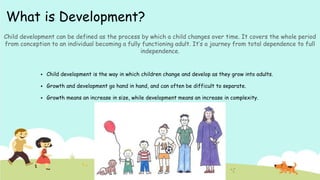
 Child development is the way in which children change and develop as they grow into adults.
 Growth and development go hand in hand, and can often be difficult to separate.
 Growth means an increase in size, while development means an increase in complexity.
Child development can be defined as the process by which a child changes over time. It covers the whole period
from conception to an individual becoming a fully functioning adult. It’s a journey from total dependence to full
independence.
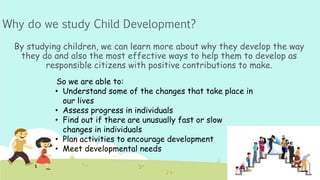
Why do we study Child Development?
By studying children, we can learn more about why they develop the way
they do and also the most effective ways to help them to develop as
responsible citizens with positive contributions to make.
So we are able to:
• Understand some of the changes that take place in
our lives
• Assess progress in individuals
• Find out if there are unusually fast or slow
changes in individuals
• Plan activities to encourage development
• Meet developmental needs
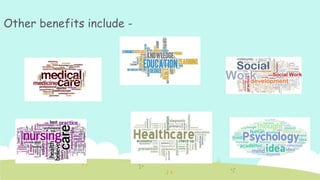
Other benefits include -
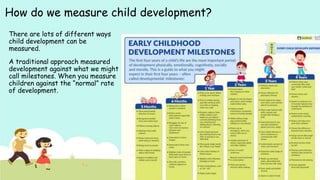
How do we measure child development?
There are lots of different ways
child development can be
measured.
A traditional approach measured
development against what we might
call milestones. When you measure
children against the “normal” rate
of development.
What are the pros and cons of using this
method to measure development?
Children may do things at an earlier
or later stage than their
Peers. Measurement against norms
can result in anxiety for
Parents or carers or even result in
the labelling of a child
With additional support needs.
Measuring a child’s
development against a set of
stages or milestones is
useful in providing a
framework that can be
studied easily.
The stages of development we will look at in this unit are:
• Infancy – 0-3 years
• Pre-school – 3-5 years
• Early childhood – 5-8 years
• Childhood – 8-12 years
• Adolescence – 13-18 years
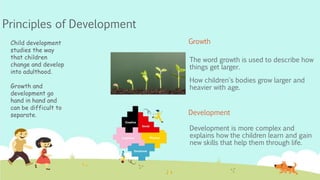
Principles of Development
Growth
The word growth is used to describe how
things get larger.
How children's bodies grow larger and
heavier with age.
Development
Development is more complex and
explains how the children learn and gain
new skills that help them through life.
Child development
studies the way
that children
change and develop
into adulthood.
Growth and
development go
hand in hand and
can be difficult to
separate.
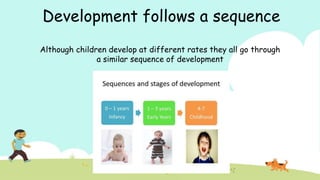
Development follows a sequence
Although children develop at different rates they all go through
a similar sequence of development
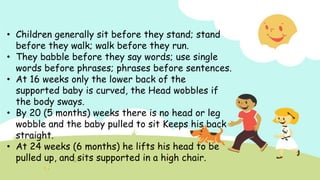
• Children generally sit before they stand; stand
before they walk; walk before they run.
• They babble before they say words; use single
words before phrases; phrases before sentences.
• At 16 weeks only the lower back of the
supported baby is curved, the Head wobbles if
the body sways.
• By 20 (5 months) weeks there is no head or leg
wobble and the baby pulled to sit Keeps his back
straight.
• At 24 weeks (6 months) he lifts his head to be
pulled up, and sits supported in a high chair.
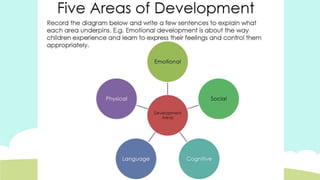
Physical Development
Physical development is the development of the body. This includes changes in body size and shape
and the development of sex characteristics at puberty.
Children will grow and develop motor skills. These
require co-ordination between the brain and
muscles, and require practice for the child to
become confident at using them.
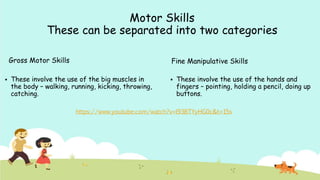
Motor Skills
These can be separated into two categories
Gross Motor Skills
 These involve the use of the big muscles in
the body – walking, running, kicking, throwing,
catching.
Fine Manipulative Skills
 These involve the use of the hands and
fingers – pointing, holding a pencil, doing up
buttons.
https://www.youtube.com/watch?v=l93BTYyHG0c&t=15s
Decide whether these are Gross Motor Skills or Fine Manipulative Skills:
Turning a Handle
Holding a pencil
Climbing a tree
Skipping with a rope
Fastening a zip
Running a race
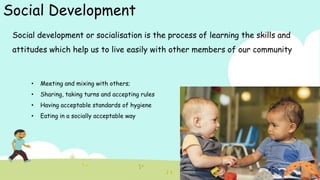
Social Development
Social development or socialisation is the process of learning the skills and
attitudes which help us to live easily with other members of our community
• Meeting and mixing with others;
• Sharing, taking turns and accepting rules
• Having acceptable standards of hygiene
• Eating in a socially acceptable way
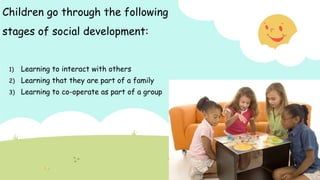
Children go through the following
stages of social development:
1) Learning to interact with others
2) Learning that they are part of a family
3) Learning to co-operate as part of a group
Think about the social skills, such as meeting and mixing with others, sharing
and turn taking, accepting rules, good levels of hygiene, eating an caring for
yourself.
Note down the part you think your family played in developing them.
Emotional Development
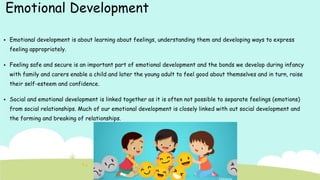
 Emotional development is about learning about feelings, understanding them and developing ways to express
feeling appropriately.
 Feeling safe and secure is an important part of emotional development and the bonds we develop during infancy
with family and carers enable a child and later the young adult to feel good about themselves and in turn, raise
their self-esteem and confidence.
 Social and emotional development is linked together as it is often not possible to separate feelings (emotions)
from social relationships. Much of our emotional development is closely linked with out social development and
the forming and breaking of relationships.
Cognitive Development
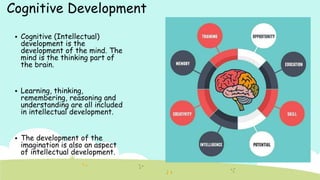
 Cognitive (Intellectual)
development is the
development of the mind. The
mind is the thinking part of
the brain.
 Learning, thinking,
remembering, reasoning and
understanding are all included
in intellectual development.
 The development of the
imagination is also an aspect
of intellectual development.
https://www.youtube.com/watch?v=kY5z0zMU23k
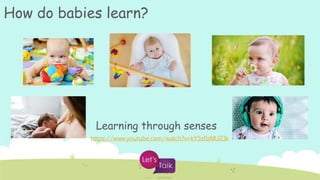
Learning through senses
How do babies learn?
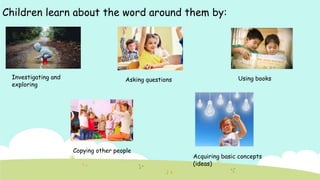
Children learn about the word around them by:
Investigating and
exploring
Asking questions Using books
Acquiring basic concepts
(ideas)
Copying other people
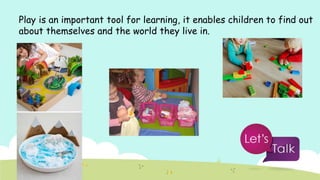
Play is an important tool for learning, it enables children to find out
about themselves and the world they live in.
Language Development
Communication involves sending and receiving messages.
These messages can be sent by our faces, bodies and voices.
- This is known as non verbal communication.
We can also communicate with the words we use.
- This is known as verbal communication.
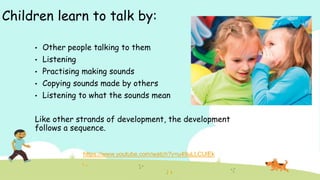
Children learn to talk by:
• Other people talking to them
• Listening
• Practising making sounds
• Copying sounds made by others
• Listening to what the sounds mean
Like other strands of development, the development
follows a sequence.
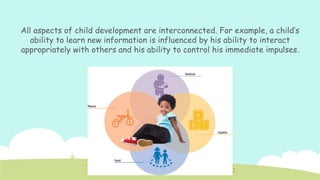
All aspects of child development are interconnected. For example, a child’s
ability to learn new information is influenced by his ability to interact
appropriately with others and his ability to control his immediate impulses.

Development Overview

  • 1.
  • 2.
    Development In this sectionwe will look at – • What is meant by the development of children and young people? • The progression of development of children and young people? • Ways that Development is individual to each child and young person Throughout this unit we will be looking at the principles and perspectives of child development as well as the influences and circumstance that can effect the development of children and young people
  • 3.
    What is Development? Child development is the way in which children change and develop as they grow into adults.  Growth and development go hand in hand, and can often be difficult to separate.  Growth means an increase in size, while development means an increase in complexity. Child development can be defined as the process by which a child changes over time. It covers the whole period from conception to an individual becoming a fully functioning adult. It’s a journey from total dependence to full independence.
  • 4.
    Why do westudy Child Development? By studying children, we can learn more about why they develop the way they do and also the most effective ways to help them to develop as responsible citizens with positive contributions to make. So we are able to: • Understand some of the changes that take place in our lives • Assess progress in individuals • Find out if there are unusually fast or slow changes in individuals • Plan activities to encourage development • Meet developmental needs
  • 5.
  • 6.
    How do wemeasure child development? There are lots of different ways child development can be measured. A traditional approach measured development against what we might call milestones. When you measure children against the “normal” rate of development.
  • 7.
    What are thepros and cons of using this method to measure development?
  • 8.
    Children may dothings at an earlier or later stage than their Peers. Measurement against norms can result in anxiety for Parents or carers or even result in the labelling of a child With additional support needs. Measuring a child’s development against a set of stages or milestones is useful in providing a framework that can be studied easily.
  • 9.
    The stages ofdevelopment we will look at in this unit are: • Infancy – 0-3 years • Pre-school – 3-5 years • Early childhood – 5-8 years • Childhood – 8-12 years • Adolescence – 13-18 years
  • 10.
    Principles of Development Growth Theword growth is used to describe how things get larger. How children's bodies grow larger and heavier with age. Development Development is more complex and explains how the children learn and gain new skills that help them through life. Child development studies the way that children change and develop into adulthood. Growth and development go hand in hand and can be difficult to separate.
  • 11.
    Development follows asequence Although children develop at different rates they all go through a similar sequence of development
  • 12.
    • Children generallysit before they stand; stand before they walk; walk before they run. • They babble before they say words; use single words before phrases; phrases before sentences. • At 16 weeks only the lower back of the supported baby is curved, the Head wobbles if the body sways. • By 20 (5 months) weeks there is no head or leg wobble and the baby pulled to sit Keeps his back straight. • At 24 weeks (6 months) he lifts his head to be pulled up, and sits supported in a high chair.
  • 14.
    Physical Development Physical developmentis the development of the body. This includes changes in body size and shape and the development of sex characteristics at puberty. Children will grow and develop motor skills. These require co-ordination between the brain and muscles, and require practice for the child to become confident at using them.
  • 15.
    Motor Skills These canbe separated into two categories Gross Motor Skills  These involve the use of the big muscles in the body – walking, running, kicking, throwing, catching. Fine Manipulative Skills  These involve the use of the hands and fingers – pointing, holding a pencil, doing up buttons. https://www.youtube.com/watch?v=l93BTYyHG0c&t=15s
  • 16.
    Decide whether theseare Gross Motor Skills or Fine Manipulative Skills: Turning a Handle Holding a pencil Climbing a tree Skipping with a rope Fastening a zip Running a race
  • 17.
    Social Development Social developmentor socialisation is the process of learning the skills and attitudes which help us to live easily with other members of our community • Meeting and mixing with others; • Sharing, taking turns and accepting rules • Having acceptable standards of hygiene • Eating in a socially acceptable way
  • 18.
    Children go throughthe following stages of social development: 1) Learning to interact with others 2) Learning that they are part of a family 3) Learning to co-operate as part of a group
  • 19.
    Think about thesocial skills, such as meeting and mixing with others, sharing and turn taking, accepting rules, good levels of hygiene, eating an caring for yourself. Note down the part you think your family played in developing them.
  • 20.
    Emotional Development  Emotionaldevelopment is about learning about feelings, understanding them and developing ways to express feeling appropriately.  Feeling safe and secure is an important part of emotional development and the bonds we develop during infancy with family and carers enable a child and later the young adult to feel good about themselves and in turn, raise their self-esteem and confidence.  Social and emotional development is linked together as it is often not possible to separate feelings (emotions) from social relationships. Much of our emotional development is closely linked with out social development and the forming and breaking of relationships.
  • 21.
    Cognitive Development  Cognitive(Intellectual) development is the development of the mind. The mind is the thinking part of the brain.  Learning, thinking, remembering, reasoning and understanding are all included in intellectual development.  The development of the imagination is also an aspect of intellectual development.
  • 22.
  • 23.
    Children learn aboutthe word around them by: Investigating and exploring Asking questions Using books Acquiring basic concepts (ideas) Copying other people
  • 24.
    Play is animportant tool for learning, it enables children to find out about themselves and the world they live in.
  • 25.
    Language Development Communication involvessending and receiving messages. These messages can be sent by our faces, bodies and voices. - This is known as non verbal communication. We can also communicate with the words we use. - This is known as verbal communication.
  • 26.
    Children learn totalk by: • Other people talking to them • Listening • Practising making sounds • Copying sounds made by others • Listening to what the sounds mean Like other strands of development, the development follows a sequence.
  • 27.
    All aspects ofchild development are interconnected. For example, a child’s ability to learn new information is influenced by his ability to interact appropriately with others and his ability to control his immediate impulses.