SEMINAR ON CURRENT PRINCIPLES,
PRACTICES & TRENDS IN PAEDIATRIC
NURSING
PRESENTED BY,
MONISHA R PILLAI
2ND YR MSc NURSING
INE , MUM-8
AIMS
At the end of the presentation, the group will be able to understand
the concept of paediatrics, current principles, practices & trends in
paediatric nursing .
Objectives
• At the end of the presentation, the learner will be able to
1.Conceptualize paediatric nursing.
2.Understand the current practices in paediatric nursing.
2.Discuss the current principles in paediatric nursing.
3. Explain the current trends in paediatric nursing.
4. Describe the role of paediatric nurse .
Pediatrics
• Paediatrics is the speciality of
medical science concerned with
physical, mental & social health of
children from conception to young
adulthood in health & illness.
• Paediatrics – derived from Greek word
pedia -child
iatrike- treatment
ics-branch of science
Introduction.
• The children are the miniature of adult.
• Health is a complete state of well being not merely absence of disease or
infirmity.
• The child health also an essential aspects which supposed to be taken care by
the adult.
• It is every child citizen’s right to utilize the health care programmes for their
betterment of the health.
• Child health nursing is undergoing tremendous advancements just like
paediatric medicine and surgery.
• The current trends in the practice are based on researches that have taken place
in the field of paediatric nursing.
Pediatric nursing
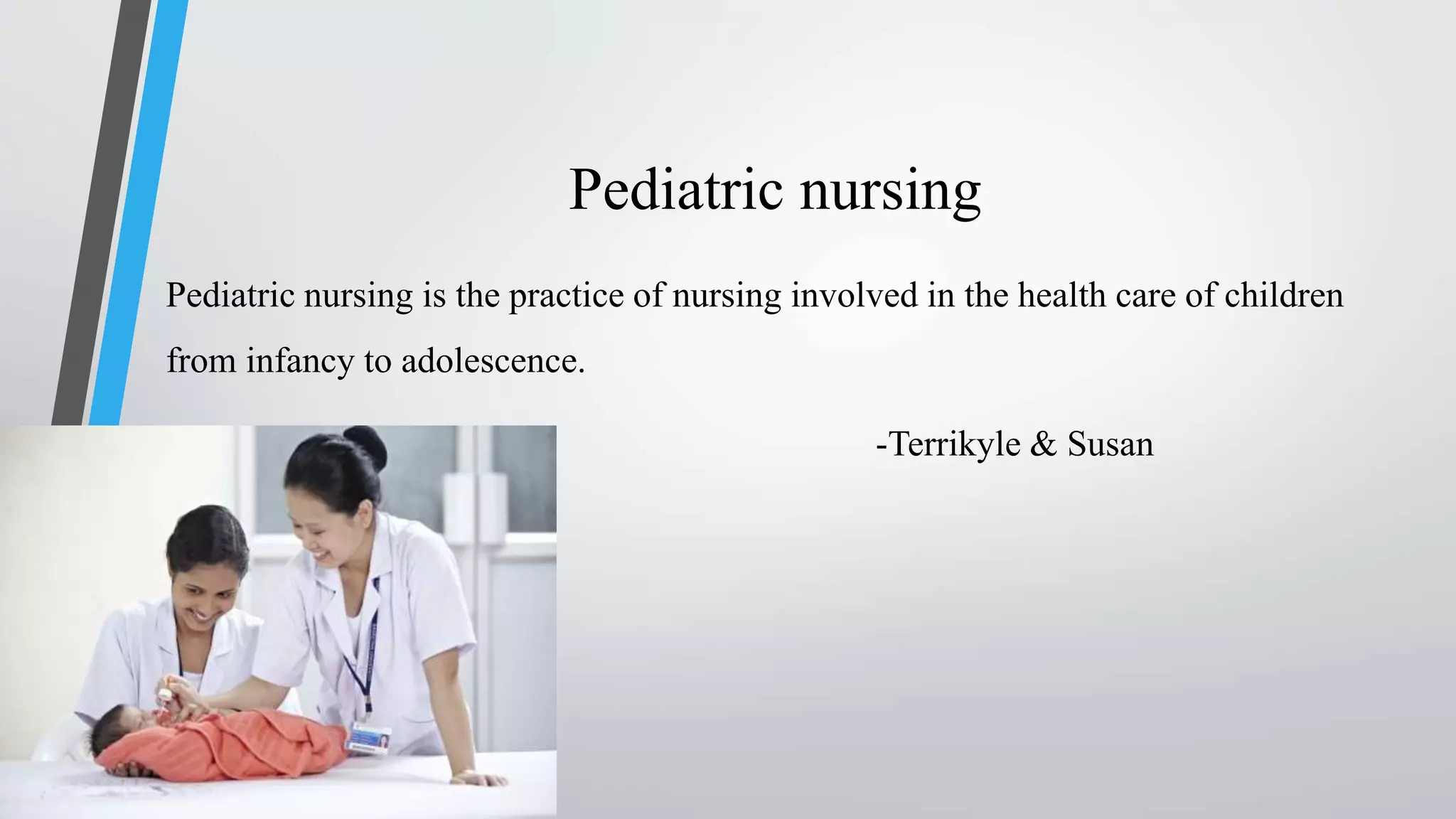
Pediatric nursing is the practice of nursing involved in the health care of children
from infancy to adolescence.
-Terrikyle & Susan
Contd…
Pediatric nursing is the specialized area of nursing practice concerning the care
of children during wellness and illness. It includes preventive, promotive,
curative and rehabilitative care of children. It emphasizes on all round
development of body, mind and spirit of the growing individual.
PRINCIPLES OF PEDIATRIC NURSING
1. Family is the basic unit of SOCIETY
Contd……….
2. Each child within a family needs love
and security to develop feelings of trust
and self esteem.
Contd…..
3.Each child is a unique individual
who has needs based on his/her family
background, level of growth and
development and degree of illness.
Contd…..
4.The pediatric nurse seeks to
promote, maintain and restore
health in both the children and
their parents.
Contd…
5.Each ill child should be under the
accountable care of one professional
nurse.
Contd…..
6.The family and the child should be included
along with the health and nursing teams in
planning for therapeutic and nursing
interventions and for implementing and
evaluating the plan of care.
Contd….
7.Within a safe environment, the child
who has an acute of chronic illness
needs expert physical care, emotional
support, play that allows for expression
of feelings and school, if the school
age child is well enough to promote
the continued growth.
Contd….
8. Parents who have a trusting
relationship with nurses feel welcome
whenever they visit and participate in the
care of their ill child at home.
Contd….
9. The family members and their
child, who are under great stress
when a child is terminally ill or
dying, should be supported
emotionally so that the child can
die with dignity and with a feeling
of being loved.
Contd….
10. Hospitalization of children is so
common today that there is a tendency to
forget its importance as a break in the
unity of the family.
Current Practice
• It involves
1. Educational requirements
2. Research and roles
3. Critical thinking & nursing process
4. Documentation
5. Confidentiality & informed consent.
Educational requirements
• Update the knowledge.
• Accountability – important.
• Responsibility to community.
Research & roles
a. Research:
- Evidence – based practice
b. Roles:
-Health Promotion & anticipatory guidance.
-Advocating
-Holistic attitude
-Ethical decision making
Critical thinking &
Nursing Process
• Critical thinking: sysytemic, expanded
way of thinking
• Nursing process
Documentation
• Data collection
• Assessment findings
• Patient care needs
• Interventions
• Specific time ( legally important)
• Discharge needs
• Law-” if something was not charted –
not done”
Confidentiality &
Informed Consent
• HIPPA ( Health Insurance Portability &
Accountability Act) regulations.
• Should not share information
• Patient records- carefully monitored
• Should not give private information –
telephone callers.
HIPPA
• The Health Insurance Portability and Accountability Act of
1996 (HIPAA or the Kennedy–Kassebaum Act[1][2]) is a United States Act of
Congress enacted by the 104th United States Congress and signed into law by
President Bill Clinton on August 21, 1996.[3] It modernized the flow of
healthcare information, stipulates how personally identifiable
information maintained by the healthcare and healthcare insurance industries
should be protected from fraud and theft, and addressed some limitations
on healthcare insurance coverage.[4] It generally prohibits healthcare providers
and healthcare businesses, called covered entities, from disclosing protected
information to anyone other than a patient and the patient's authorized
representatives without their consent.
Example:
• According to HIPAA, patients
have a right to their medical
records within 30 days of a
request; failure to provide
them is a HIPAA violation. Losing
a device or record that exposes
patient records to unauthorized
actors is also a HIPAA violation
THE COMMON TRENDS ARE AS FOLLOWING:
1.FAMILY CENTRED CARE (FCC)
a.ENABLING .
b.EMPOWERMENT
2.HIGH TECHNOLOGY CARE (HTC) .
3. EVIDENCE-BASED PRACTICE (EBP).
4.. ATRAUMATIC CARE.
5. COST CONTAINMENT (CC).
6.PREVENTION AND HEALTH PROMOTION.
Family centered care
Family centred care
• It is based on the philosophy that quality care can be provided in an
environment that support family integrity and promote psychological and
physiological health of the family.
• It assumes that if the family gain adequate information and support it is
capable of making health care decisions (Mc Kay and Philips, 1984).
• FCC provides a holistic approach than simply providing medical and nursing
care.
• Parents know best about their child's needs, more aware of their child's
behaviour and habits. They stay as the most important people for children.
Enabling( opportunities)
• In the process of enabling, all the family members are helped by the
professionals to create opportunities and means to utilize their present abilities,
competence and acquire new skills that are necessary to provide care to their
ailing children. For example, the family members may be capable of comforting
a crying child.
Empowering( Interaction)
Empowering helps to foster the strengths of family members to cope up and
withstand stress related to sick ness of their children.
In FCC, the nurse need to move farther from describing what is upsetting to
families to describing interventions that are helpful and providing the same to
recipients of care.
High technology care
HIGH TECHNOLOGY CARE
1.Advancement in the medical field has created the care of children too
technologically versatile.
2.The nurse also needs to be technologically competent enough to meet
the nursing care needs of children.
Contd….
3.The advancement in the diagnostic technology has made detection
of many disorders even in the foetal period.
4.Laboratory methods to assess foetal maturity and health of the
foetus in the womb, wide use of ultra sound in diagnosis and
aggressive technology in the care of premature and sick babies have
created many ethical dilemma even in nursing practice/ Nurse need
to be alert to these advances.
Evidence based practice
EVIDENCE-BASED PRACTICE
• In evidence-based practice (EBP), nurses need to make decisions
on the best available evidences.
• EBP in nursing provides a systematic approach to enable nurses to
effectively use the best solutions related to nursing prac tice.
• Hence, nurses need to search the literature to analyse evidences
using biostatistics rules to identify generalisabilty of findings.
Primary nursing
Contd…..
• The system of primary nursing provides extreme commit ment to
patient accountability. 24-hour responsibility and accountability by
one nurse for the care of a small group of patients is possible with
primary nursing.
• Primary nurse is the bedside nurse with few duties delegated to
other nurses. When primary nurse is not working, an associate
primary nurse will maintain continuity of care.
• This system provides better client satisfaction and they have the
privilege to get all necessary information from one person.
Case management
Contd….
• It is considered as an extension of primary nursing.
• It is usually used in outpatient setting by assigning a case manager
to a patient or a group of patients.
• It utilizes time line or critical path or practice guidelines.
• Case management system utilizes set guidelines that are prepared.
Many forms or models of guidelines are used such as critical path,
care maps and standardised care plan.
Child-oriented environment
• A child friendly environment should be provided to a child who is
admitted to hospital.
• Child should be admitted to a children's ward.
• The outlay of the ward should be one of child friendly with
adequate safety precautions. Education and facilities for play
should be provided.
• Liberal visiting hours and permitting parents to be with children
when hospitalised also promotes child-oriented environment in a
hospital.
• Children’s ward should be equipped with skilled staff .
Atraumatic care
Contd….
• Provision of therapeutic care in settings by personnel and with
interventions that eliminates or minimizes the psychological and
physical distress experienced by children & their families in the
health care system.
• Therapeutic care:
-Prevention
-Diagnosis
-Treatment
-Palliation.
Contd…
• Suggested intervention:
-Parent-child relationship
-Prepare the child before any procedure
-Control pain
-Child privacy
-Play
-Minimizes loss of control
-Respect cultural & religious differences
Cost- containment
Contd….
• It is a management technique utilized to reduce the cost of
hospitalization.
• Multidisciplinary approach
• Enabling & empowerment.
Nursing process application
Ethics in Paediatric nursing
• In nursing practice
-Non-beneficence – do not harm
-Beneficence – do good
-Justice
-Respect for autonomy
-Truth telling
Related to research
• 1. Informed consent
-Legal age -18yrs
2. Conceptual issues
e.g. reusing life saving care for religious practices.
3. Benefience
4.Truth telling
5.Confidentiality
6. Conflicts of interest.
Rights of the child
Other trends
• KMC
• Rooming in concept
• Child-to-child program
• Focus on prevention
• Whole child
Changing trends in paediatric nursing
Sr No Shift from Focus on
1 Disease centered care Child centered care
2 That of discouraging the families on neglect of the
female child.
Taking special care of the female child as she is the
future mother. Immunization of all girls for tetanus and
rubella before marriage.
3 Starting care for the woman after she becomes
pregnant.
Health education on planned parenthood and guarding
the maternal health before conception.
4 Special care during last trimester and the post natal
period to the child born with congenital anomalies
and hereditary disorders.
Early identification and family counseling y based on
biochemical screening and chromosomal studies to
prevent congenital anomalies and hereditary disorders
in children.
5 Only caring for child after birth of child. Guarding the health of child from day of conception.
6 Only care to the sick children in hospital. The participation in prevention of illness, health
promotion activities.
Sr.no Shift from Focus on
7 Caring of the physical condition of child in isolation. Comprehensive care of child in relation to his home and the community
in which he lives and providing emotional support to the family.
8 Not allowing the parents to be with the child in the hospital
and rigid visiting hours.
Ensuring the children must have one parent s. stay with them in the
hospital and participate in care. Flexible visiting hours in children
wards.
9 One of illness oriented. One that is health oriented.
10 Only cleanliness and treatment oriented. Warmth and love oriented. Providing tactile stimulation to the infants.
11 Only curative and rehabilitative to the children in hospitals. Health promotion activities by ensuring environmental stimulation and
intelligent manipulation of the environment. Adequate play activities.
Services related to fertility, sex education and counseling.
12 The concept of pediatrics as infant feeding and care of a few
diseases of children.
The comprehensive care of child in its totality from conception to
maturity within the framework of his family and community.
13 Adapting indifferent attitude to child neglect and abuse by
family and society.
Safeguarding and protection of children's rights by health providing
cultural practices
Conclusion
• Thus remarkable changes have occurred in the field of paediatric nursing in
recent years due to changing needs of society, medical & technological
advances, political interest and changing trends within the nursing
profession.
Bibliography
• 1.Assuma Beevi. T.M., Textbook of Paediatric Nursing, Elseiver Publication,
2009, Pg. No.8-17
• 2. Parul Datta, Textbook of Paediatric Nursing, Jaypee Publication, 4th
Edition, Pg. No.
• 3.Wong’s, Essential’s of Paediatric Nursing, Elseiver Publication, 2nd Edition,
Pg. no.1-3
• 4. Marlow R Dorothy, Redding A Barbara, “Text Book of Pediatric Nursing”
6 the edition; Saunders Elsevier, Philadelphia (2002), page no: 19 – 22
Assignment
• Explain current principles of paediatric nursing.
• Explain changing trends of paediatric nursing
• Role of paediatric nurse.
Research article
The Impact of an mHealth Voice Message Service (mMitra) on Infant
Care Knowledge, and Practices Among Low-Income Women in India:
Findings from a Pseudo-Randomized Controlled Trial
• Objectives mHealth interventions for MNCH have been shown to improve
uptake of antenatal and neonatal services in low- and middle-income countries
(LMICs). However, little systematic analysis is available about their impact on
infant health outcomes, such as reducing low birth weight or malnutrition
among children under the age of five. The objective of this study is to determine
if an age- and stage-based mobile phone voice messaging i initiative for women,
during pregnancy and up to 1 year after delivery, can reduce low birth weight
and child malnutrition and improve women’s infant care knowledge and
practices.
• Methods :They conducted a pseudo-randomized controlled trial among pregnant
women from urban slums and low-income areas in Mumbai, India.
Contd….
• This study provides robust evidence that tailored mobile voice
messages can significantly improve infant care practices and maternal
knowledge that can positively impact infant child health. Furthermore,
this is the first prospective study of a voice-based mHealth
intervention to demonstrate a positive impact on infant birth weight, a
health outcome of public health importance in many LMICs.
Contd…
• Murthy N, Chandrasekharan S, Prakash MP, Kaonga NN, Peter J, Ganju A,
Mechael PN. The impact of an mHealth voice message service (mMitra) on
infant care knowledge, and practices among low-income women in India:
findings from a Pseudo-Randomized controlled trial. Maternal and child
health journal. 2019 Dec;23(12):1658-69.
Presentation on Current principles , practices trends in pediatric nursing..pptx

Presentation on Current principles , practices trends in pediatric nursing..pptx

  • 1.
    SEMINAR ON CURRENTPRINCIPLES, PRACTICES & TRENDS IN PAEDIATRIC NURSING PRESENTED BY, MONISHA R PILLAI 2ND YR MSc NURSING INE , MUM-8
  • 2.
    AIMS At the endof the presentation, the group will be able to understand the concept of paediatrics, current principles, practices & trends in paediatric nursing .
  • 3.
    Objectives • At theend of the presentation, the learner will be able to 1.Conceptualize paediatric nursing. 2.Understand the current practices in paediatric nursing. 2.Discuss the current principles in paediatric nursing. 3. Explain the current trends in paediatric nursing. 4. Describe the role of paediatric nurse .
  • 4.
    Pediatrics • Paediatrics isthe speciality of medical science concerned with physical, mental & social health of children from conception to young adulthood in health & illness.
  • 5.
    • Paediatrics –derived from Greek word pedia -child iatrike- treatment ics-branch of science
  • 6.
    Introduction. • The childrenare the miniature of adult. • Health is a complete state of well being not merely absence of disease or infirmity. • The child health also an essential aspects which supposed to be taken care by the adult. • It is every child citizen’s right to utilize the health care programmes for their betterment of the health. • Child health nursing is undergoing tremendous advancements just like paediatric medicine and surgery. • The current trends in the practice are based on researches that have taken place in the field of paediatric nursing.
  • 7.
    Pediatric nursing Pediatric nursingis the practice of nursing involved in the health care of children from infancy to adolescence. -Terrikyle & Susan
  • 8.
    Contd… Pediatric nursing isthe specialized area of nursing practice concerning the care of children during wellness and illness. It includes preventive, promotive, curative and rehabilitative care of children. It emphasizes on all round development of body, mind and spirit of the growing individual.
  • 9.
    PRINCIPLES OF PEDIATRICNURSING 1. Family is the basic unit of SOCIETY
  • 10.
    Contd………. 2. Each childwithin a family needs love and security to develop feelings of trust and self esteem.
  • 11.
    Contd….. 3.Each child isa unique individual who has needs based on his/her family background, level of growth and development and degree of illness.
  • 12.
    Contd….. 4.The pediatric nurseseeks to promote, maintain and restore health in both the children and their parents.
  • 13.
    Contd… 5.Each ill childshould be under the accountable care of one professional nurse.
  • 14.
    Contd….. 6.The family andthe child should be included along with the health and nursing teams in planning for therapeutic and nursing interventions and for implementing and evaluating the plan of care.
  • 15.
    Contd…. 7.Within a safeenvironment, the child who has an acute of chronic illness needs expert physical care, emotional support, play that allows for expression of feelings and school, if the school age child is well enough to promote the continued growth.
  • 16.
    Contd…. 8. Parents whohave a trusting relationship with nurses feel welcome whenever they visit and participate in the care of their ill child at home.
  • 17.
    Contd…. 9. The familymembers and their child, who are under great stress when a child is terminally ill or dying, should be supported emotionally so that the child can die with dignity and with a feeling of being loved.
  • 18.
    Contd…. 10. Hospitalization ofchildren is so common today that there is a tendency to forget its importance as a break in the unity of the family.
  • 19.
    Current Practice • Itinvolves 1. Educational requirements 2. Research and roles 3. Critical thinking & nursing process 4. Documentation 5. Confidentiality & informed consent.
  • 20.
    Educational requirements • Updatethe knowledge. • Accountability – important. • Responsibility to community.
  • 21.
    Research & roles a.Research: - Evidence – based practice b. Roles: -Health Promotion & anticipatory guidance. -Advocating -Holistic attitude -Ethical decision making
  • 22.
    Critical thinking & NursingProcess • Critical thinking: sysytemic, expanded way of thinking • Nursing process
  • 23.
    Documentation • Data collection •Assessment findings • Patient care needs • Interventions • Specific time ( legally important) • Discharge needs • Law-” if something was not charted – not done”
  • 24.
    Confidentiality & Informed Consent •HIPPA ( Health Insurance Portability & Accountability Act) regulations. • Should not share information • Patient records- carefully monitored • Should not give private information – telephone callers.
  • 25.
    HIPPA • The HealthInsurance Portability and Accountability Act of 1996 (HIPAA or the Kennedy–Kassebaum Act[1][2]) is a United States Act of Congress enacted by the 104th United States Congress and signed into law by President Bill Clinton on August 21, 1996.[3] It modernized the flow of healthcare information, stipulates how personally identifiable information maintained by the healthcare and healthcare insurance industries should be protected from fraud and theft, and addressed some limitations on healthcare insurance coverage.[4] It generally prohibits healthcare providers and healthcare businesses, called covered entities, from disclosing protected information to anyone other than a patient and the patient's authorized representatives without their consent.
  • 26.
    Example: • According toHIPAA, patients have a right to their medical records within 30 days of a request; failure to provide them is a HIPAA violation. Losing a device or record that exposes patient records to unauthorized actors is also a HIPAA violation
  • 27.
    THE COMMON TRENDSARE AS FOLLOWING: 1.FAMILY CENTRED CARE (FCC) a.ENABLING . b.EMPOWERMENT 2.HIGH TECHNOLOGY CARE (HTC) . 3. EVIDENCE-BASED PRACTICE (EBP). 4.. ATRAUMATIC CARE. 5. COST CONTAINMENT (CC). 6.PREVENTION AND HEALTH PROMOTION.
  • 28.
  • 29.
    Family centred care •It is based on the philosophy that quality care can be provided in an environment that support family integrity and promote psychological and physiological health of the family. • It assumes that if the family gain adequate information and support it is capable of making health care decisions (Mc Kay and Philips, 1984). • FCC provides a holistic approach than simply providing medical and nursing care. • Parents know best about their child's needs, more aware of their child's behaviour and habits. They stay as the most important people for children.
  • 30.
    Enabling( opportunities) • Inthe process of enabling, all the family members are helped by the professionals to create opportunities and means to utilize their present abilities, competence and acquire new skills that are necessary to provide care to their ailing children. For example, the family members may be capable of comforting a crying child.
  • 31.
    Empowering( Interaction) Empowering helpsto foster the strengths of family members to cope up and withstand stress related to sick ness of their children. In FCC, the nurse need to move farther from describing what is upsetting to families to describing interventions that are helpful and providing the same to recipients of care.
  • 32.
  • 33.
    HIGH TECHNOLOGY CARE 1.Advancementin the medical field has created the care of children too technologically versatile. 2.The nurse also needs to be technologically competent enough to meet the nursing care needs of children.
  • 34.
    Contd…. 3.The advancement inthe diagnostic technology has made detection of many disorders even in the foetal period. 4.Laboratory methods to assess foetal maturity and health of the foetus in the womb, wide use of ultra sound in diagnosis and aggressive technology in the care of premature and sick babies have created many ethical dilemma even in nursing practice/ Nurse need to be alert to these advances.
  • 35.
  • 36.
    EVIDENCE-BASED PRACTICE • Inevidence-based practice (EBP), nurses need to make decisions on the best available evidences. • EBP in nursing provides a systematic approach to enable nurses to effectively use the best solutions related to nursing prac tice. • Hence, nurses need to search the literature to analyse evidences using biostatistics rules to identify generalisabilty of findings.
  • 37.
  • 38.
    Contd….. • The systemof primary nursing provides extreme commit ment to patient accountability. 24-hour responsibility and accountability by one nurse for the care of a small group of patients is possible with primary nursing. • Primary nurse is the bedside nurse with few duties delegated to other nurses. When primary nurse is not working, an associate primary nurse will maintain continuity of care. • This system provides better client satisfaction and they have the privilege to get all necessary information from one person.
  • 39.
  • 40.
    Contd…. • It isconsidered as an extension of primary nursing. • It is usually used in outpatient setting by assigning a case manager to a patient or a group of patients. • It utilizes time line or critical path or practice guidelines. • Case management system utilizes set guidelines that are prepared. Many forms or models of guidelines are used such as critical path, care maps and standardised care plan.
  • 41.
    Child-oriented environment • Achild friendly environment should be provided to a child who is admitted to hospital. • Child should be admitted to a children's ward. • The outlay of the ward should be one of child friendly with adequate safety precautions. Education and facilities for play should be provided. • Liberal visiting hours and permitting parents to be with children when hospitalised also promotes child-oriented environment in a hospital. • Children’s ward should be equipped with skilled staff .
  • 42.
  • 43.
    Contd…. • Provision oftherapeutic care in settings by personnel and with interventions that eliminates or minimizes the psychological and physical distress experienced by children & their families in the health care system. • Therapeutic care: -Prevention -Diagnosis -Treatment -Palliation.
  • 44.
    Contd… • Suggested intervention: -Parent-childrelationship -Prepare the child before any procedure -Control pain -Child privacy -Play -Minimizes loss of control -Respect cultural & religious differences
  • 45.
  • 46.
    Contd…. • It isa management technique utilized to reduce the cost of hospitalization. • Multidisciplinary approach • Enabling & empowerment.
  • 47.
  • 48.
  • 49.
    Ethics in Paediatricnursing • In nursing practice -Non-beneficence – do not harm -Beneficence – do good -Justice -Respect for autonomy -Truth telling
  • 50.
    Related to research •1. Informed consent -Legal age -18yrs 2. Conceptual issues e.g. reusing life saving care for religious practices. 3. Benefience 4.Truth telling 5.Confidentiality 6. Conflicts of interest.
  • 51.
  • 52.
    Other trends • KMC •Rooming in concept • Child-to-child program • Focus on prevention • Whole child
  • 54.
    Changing trends inpaediatric nursing Sr No Shift from Focus on 1 Disease centered care Child centered care 2 That of discouraging the families on neglect of the female child. Taking special care of the female child as she is the future mother. Immunization of all girls for tetanus and rubella before marriage. 3 Starting care for the woman after she becomes pregnant. Health education on planned parenthood and guarding the maternal health before conception. 4 Special care during last trimester and the post natal period to the child born with congenital anomalies and hereditary disorders. Early identification and family counseling y based on biochemical screening and chromosomal studies to prevent congenital anomalies and hereditary disorders in children. 5 Only caring for child after birth of child. Guarding the health of child from day of conception. 6 Only care to the sick children in hospital. The participation in prevention of illness, health promotion activities.
  • 55.
    Sr.no Shift fromFocus on 7 Caring of the physical condition of child in isolation. Comprehensive care of child in relation to his home and the community in which he lives and providing emotional support to the family. 8 Not allowing the parents to be with the child in the hospital and rigid visiting hours. Ensuring the children must have one parent s. stay with them in the hospital and participate in care. Flexible visiting hours in children wards. 9 One of illness oriented. One that is health oriented. 10 Only cleanliness and treatment oriented. Warmth and love oriented. Providing tactile stimulation to the infants. 11 Only curative and rehabilitative to the children in hospitals. Health promotion activities by ensuring environmental stimulation and intelligent manipulation of the environment. Adequate play activities. Services related to fertility, sex education and counseling. 12 The concept of pediatrics as infant feeding and care of a few diseases of children. The comprehensive care of child in its totality from conception to maturity within the framework of his family and community. 13 Adapting indifferent attitude to child neglect and abuse by family and society. Safeguarding and protection of children's rights by health providing cultural practices
  • 56.
    Conclusion • Thus remarkablechanges have occurred in the field of paediatric nursing in recent years due to changing needs of society, medical & technological advances, political interest and changing trends within the nursing profession.
  • 57.
    Bibliography • 1.Assuma Beevi.T.M., Textbook of Paediatric Nursing, Elseiver Publication, 2009, Pg. No.8-17 • 2. Parul Datta, Textbook of Paediatric Nursing, Jaypee Publication, 4th Edition, Pg. No. • 3.Wong’s, Essential’s of Paediatric Nursing, Elseiver Publication, 2nd Edition, Pg. no.1-3 • 4. Marlow R Dorothy, Redding A Barbara, “Text Book of Pediatric Nursing” 6 the edition; Saunders Elsevier, Philadelphia (2002), page no: 19 – 22
  • 58.
    Assignment • Explain currentprinciples of paediatric nursing. • Explain changing trends of paediatric nursing • Role of paediatric nurse.
  • 59.
  • 60.
    The Impact ofan mHealth Voice Message Service (mMitra) on Infant Care Knowledge, and Practices Among Low-Income Women in India: Findings from a Pseudo-Randomized Controlled Trial • Objectives mHealth interventions for MNCH have been shown to improve uptake of antenatal and neonatal services in low- and middle-income countries (LMICs). However, little systematic analysis is available about their impact on infant health outcomes, such as reducing low birth weight or malnutrition among children under the age of five. The objective of this study is to determine if an age- and stage-based mobile phone voice messaging i initiative for women, during pregnancy and up to 1 year after delivery, can reduce low birth weight and child malnutrition and improve women’s infant care knowledge and practices. • Methods :They conducted a pseudo-randomized controlled trial among pregnant women from urban slums and low-income areas in Mumbai, India.
  • 61.
    Contd…. • This studyprovides robust evidence that tailored mobile voice messages can significantly improve infant care practices and maternal knowledge that can positively impact infant child health. Furthermore, this is the first prospective study of a voice-based mHealth intervention to demonstrate a positive impact on infant birth weight, a health outcome of public health importance in many LMICs.
  • 62.
    Contd… • Murthy N,Chandrasekharan S, Prakash MP, Kaonga NN, Peter J, Ganju A, Mechael PN. The impact of an mHealth voice message service (mMitra) on infant care knowledge, and practices among low-income women in India: findings from a Pseudo-Randomized controlled trial. Maternal and child health journal. 2019 Dec;23(12):1658-69.