CLINICAL TEACHING
METHODS
Submitted by:
Ms. ARUSHI NEGI
M.Sc. Nursing Ist Year
SUBMITTED TO :
Ms. ANJALI KAUSHIK
TUTOR, RCON, JH
CONTENT
• INTRODUCTION
• DEFINITION
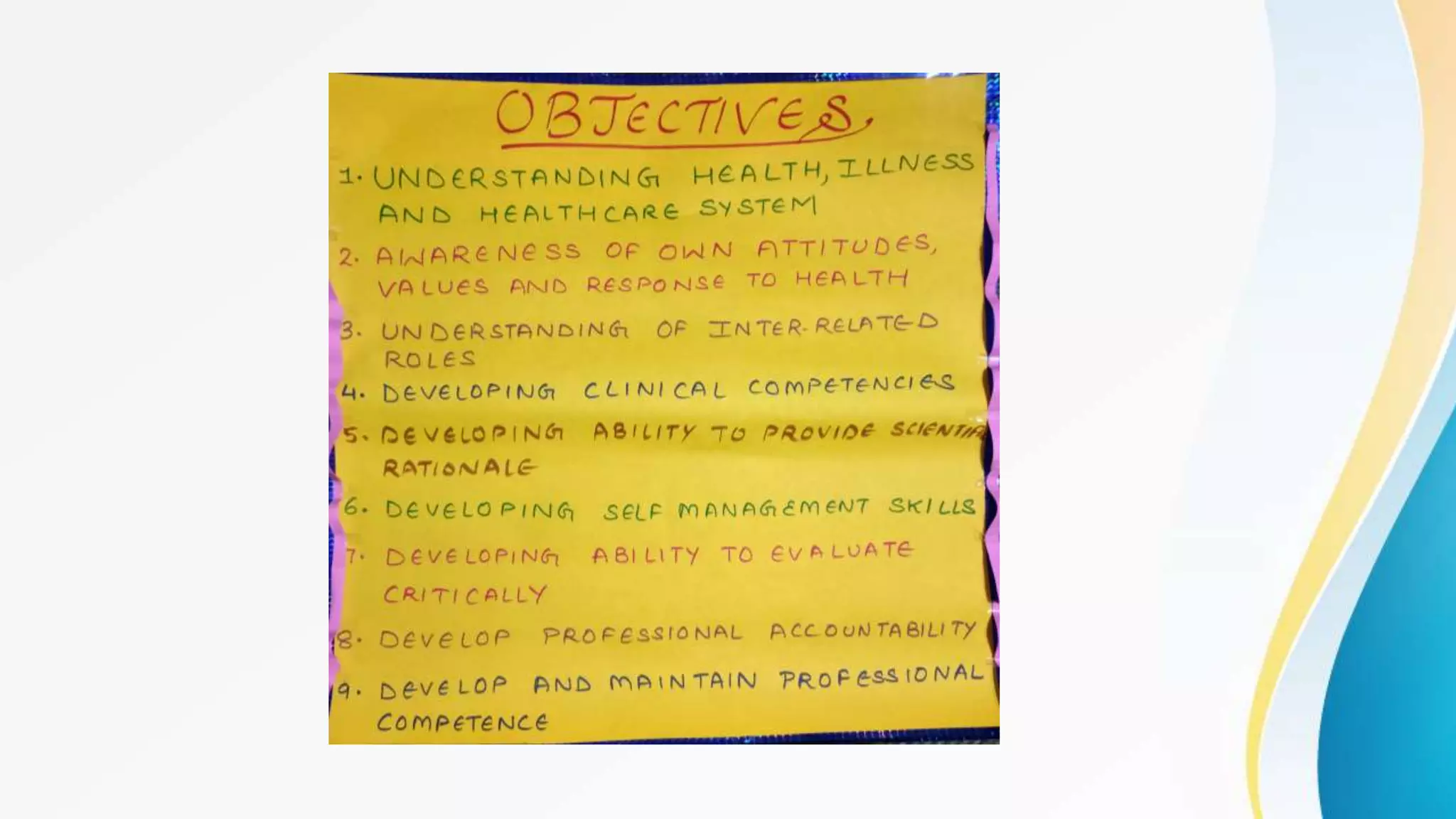
• OBJECTIVES
• GUIDELINES FOR SELECTION
• CLINICAL TEACHING METHODS
• NURSING CLINIC
• BEDSIDE CLINIC
• NURSING ROUNDS
• NURSING ASSIGNMENT
• NURSING CARE CONFERENCE
• MORNING AND EVENING
REPORTS
• INDIVIDUAL CONFERENCE
• GROUP CONFERENCE
• PROCESS RECORDING
• FIELD TRIP
• LABORATORY METHOD
• NURSING CARE PLAN
• SEMINAR
• CASE ANALYSIS METHOD
• CASE INCIDENT METHOD
• ROLE PLAYING
• SYMPOSIUM
• WORKSHOP
• PANEL DISCUSSION
• RESEARCH
• SUMMARY AND CONCLUSION
INTRODUCTION
• In nursing, competency of a nurse is recognized mainly
by the demonstration of clinical skills.
• Developing clinical skills demands more effort from the
side of teachers and students .
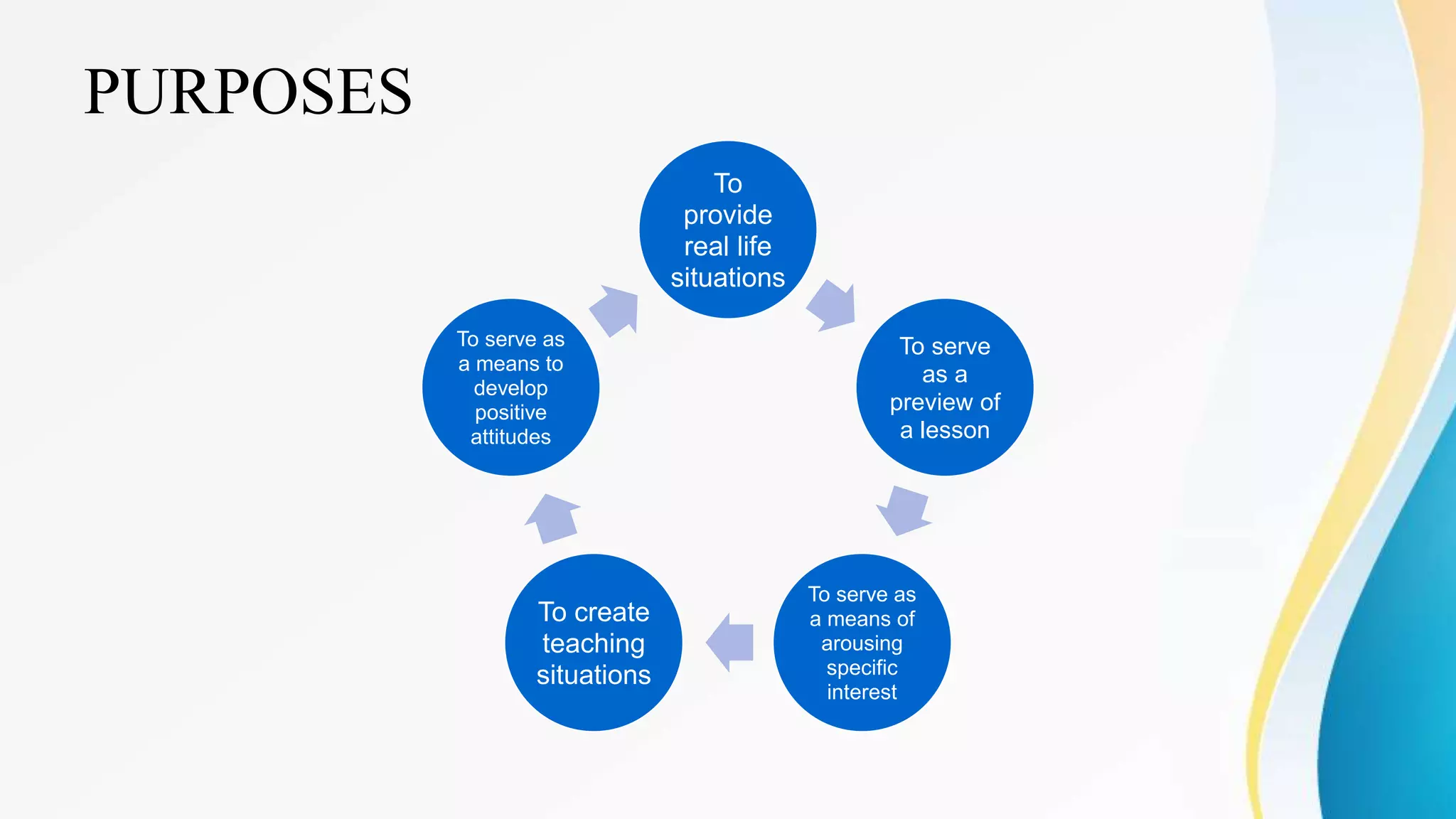
• Clinical area is a gold mine of learning opportunities and
experiences.
DEFINITION
• Clinical teaching involves planning, organizing,
teaching, supervising and evaluating students direct
experiences in patient care
• It provides students with an opportunity to make
application of theoretical knowledge to provide
improved patient-centered nursing care.
WHAT COULD BE THE
OBJECTIVES ?
WHAT ARE THE VARIOUS
GUIDELINES FOR
SELECTION OF TEACHING
METHOD?
CLINICAL TEACHING METHODS
Nursing clinics
Bedside clinic.
Nursing rounds.
Nursing assignments.
Nursing care conferences.
Morning and afternoon reports.
Individual conference.
Group conference
Process recording
Field visit
Laboratory method
Nursing care plan
Seminar
Case analysis method
Case incident method
Role playing
Symposium
Workshop
Panel discussion
NURSING CLINIC
• The nursing clinic utilizes the presence of a selected
patient as its focus for group discussion.
• It affords a direct experience in the discussion of
principles and practices of nursing care relative to a
given patient.
• Students have the opportunity to sharpen their
observation and interviewing skills .
PURPOSE
Apply theory
into actual
practice by
inter-viewing
and studying
patient
Apply
knowledge and
experience to
the situation.
Understand
certain
types of
apparatus.
Improve
the nursing
care.
PRE PLANNING THE CLINIC
• Determining the purpose of the clinic
• Selecting patient for nursing care.
• Securing the patient's consent.
• Selecting the setting to be used, i.e. conference room.
• Providing advance preparation of the student
LEVELS OF DISCUSSION
1.
Introduction.
2. Patient
centered
discussion.
3. Post-clinic
evaluation
discussion.
BEDSIDE CLINIC
• Bedside clinic is an organized clinical instruction in the
presence of the patient.
• This is a teacher centered method for a small group of students
and can be conducted by a nurse educator, doctor.
• The name of the patient, other details and the venue should be
informed to students prior so that they can study the case sheet
of the patient and actively participate in the bedside clinic.
• The usual duration is 30 to 45 minutes and student have to
gather around the patient in an informal way in order to avoid
tension to him.
PURPOSE
To provide
learning on how
to collect
information about
the patient.
To improve the
student's ability to
solve nursing
problems.
It helps student to
do nursing
observation in
organized
systematic way.
To be able to
recognize
opportunities for
health teaching in
the hospital.
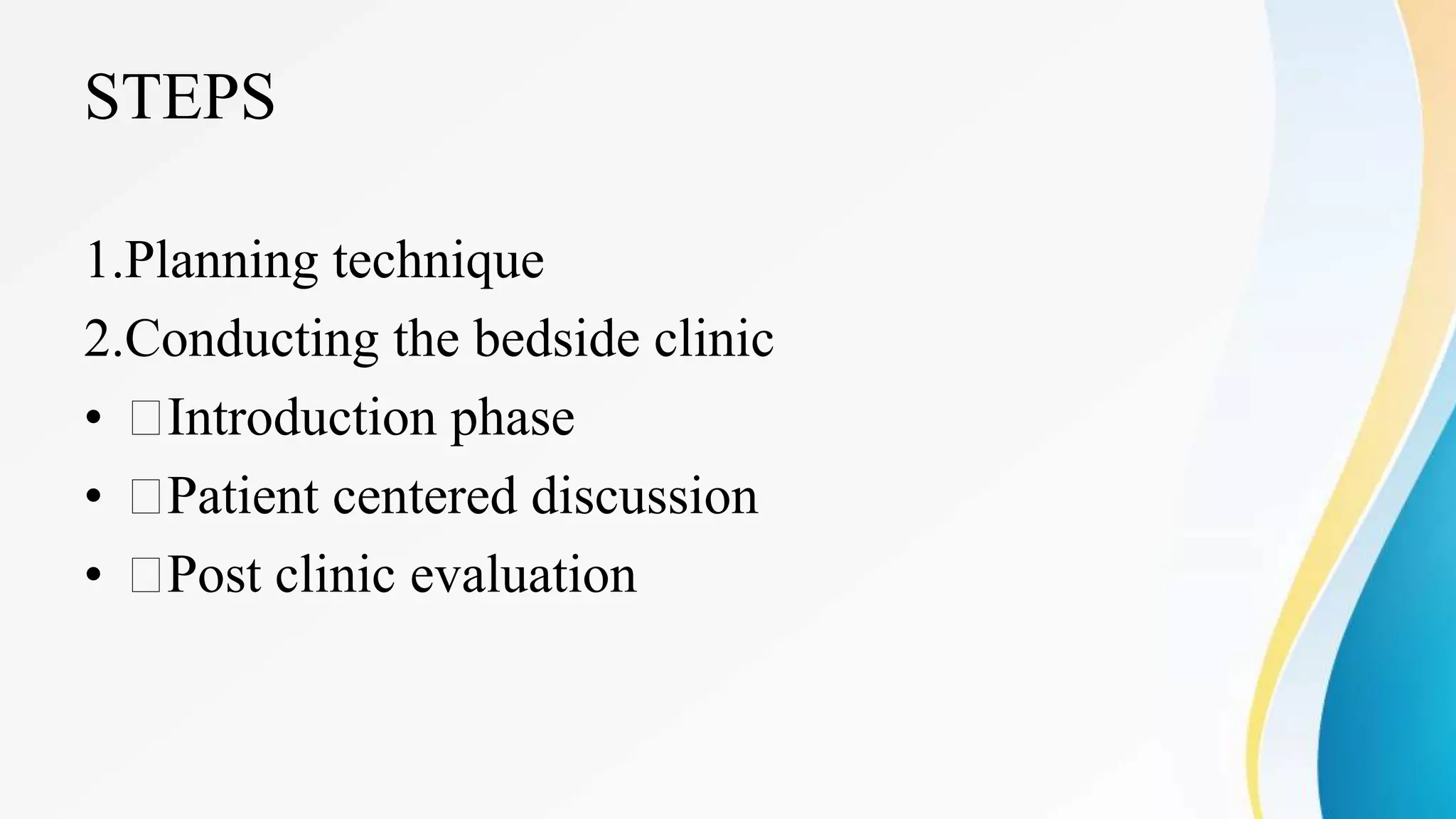
STEPS
1.Planning technique
2.Conducting the bedside clinic
• Introduction phase
• Patient centered discussion
• Post clinic evaluation
ADVANTAGES
1. Bedside teaching puts the student in an
active area, students have to come prepared.
2. Covers a limited group of students.
3. Permits evaluation of degree to which
educational objectives have been attained.
4. Develops qualities of observation and
decision taking
5. Permits comparison between reality and
theory.
6. Enables students to develop self-
confidence.
NURSING ROUNDS
• In nursing rounds, the nursing teacher or head nurse who
knows the details of the patient briefs the nursing care.
• The staff nurse or the nursing student who has been taking
care of the patient for a few days are allowed to contribute
and have to answer the questions of the group.
• The group then discuss the nursing care aspects in brief .
• One staff nurse records all the instructions and suggestions in
the nursing rounds register maintained in the ward.
• Then the group move towards the next patient.
PURPOSES
Demonstrate
aspects
important in
nursing care.
Clarify
terminology
studied.
Compare
patient's
reaction to
disease and
study the
disease
conditions.
Demonstrate
effects of
drugs, i.e.
indication,
actions and
reactions of
drugs.
Illustrate
skillful
nursing care.
ADVANTAGES
• Make classroom discussions more real and thus improve
learning experiences
• Response of the patient is more natural.
• Students can select patients with specific problems and
plan proper nursing care
NURSING ASSIGNMENT
• Assignments play a major role in the teaching-learning
process. It is a self-study which supplements classroom
teaching.
• The success and effectiveness of assignment depends
upon the amount of independent work done by the
students .
• Clinical Assignment is that part of learning experience
where the students are assigned with patients and
student’s provide care to them.
•WHAT ARE THE VARIOUS
OBJECTIVES OF NURSING
ASSIGNMENT ?
METHODS
• PATIENT METHOD
In the patient method of assignment a nurse is expected to
give complete nursing care to one .
• FUNCTIONAL METHOD
A nurses is assigned to specific functions in the ward such
as giving medications or treatment to all patients
• TEAM METHOD
In this method a group of patient are looked after by a
group of hospital staff and students (nursing team).
GUIDELINES
Mere dictation of questions or problems is not an assignment.
The teacher has to suggest along with it the book to be
consulted and the references to be studied.
The assignments should preferably raise out of the activities,
need and interests of the students.
It must motivate, remove doubts or misunderstandings and
level insight.
ADVANTAGES
Patient method
• The nurse gets job satisfaction.
• Interpersonal relationship is good
• The maximum learning takes place.
Functional method
• More work is turned out in less given period of time.
• Skill is developed when the work is done repeatedly.
Team method
• Team spirit is created in the team
• Attitude of cooperation and co-ordination is learnt.
DISADVANTAGES
Patient method
• More nurses are required.
• Economic loss to an agency or to country
Functional method
• Patient does not get any security
• Individual needs are not considered.
Team method
• It there is no cooperation within the team members, the
work will not be done properly and patient will suffer.
NURSING CARE CONFERENCE
• It has all the characteristics of the bedside clinic except the
presence of the patient.
• When the teacher as well as the students are well
acquainted with the patient's features this is the preferred
method.
• The nursing care conference consists of a group discussion
using problem-solving techniques to determine ways of
providing care for patients to whom students are assigned as
a part of their clinical nursing experience.
PHASES
It has three phases.
1.
Opening
phase
2.
Working
phase
3.
Closing
phase
The task here is to
delegate
responsibility to one
or more of the staff
to act on the
problems.
The task here is to
make a commitment
to work on a
problem relating to
a particular patient.
The task of the working
phase is to arrive at a
consensus on problem
identification and
solution.
ADVANTAGES
1.Helps to collect the information in creative way.
2.It fortifies the thinking of students, thereby the creativity and
judgement capacity will be increased.
3.It provides free opportunity to think.
4.Each member will be actively participating.
DISADVANTAGES
1. It will be of little use if the students do not accustom to such
situation.
2. There are chances of using these conference hours for
classroom teaching.
MORNING AND EVENING REPORTS
• A report summarizes the services of the nurse and or the
agency. Reports may be in the form of an analysis of
some aspect of service. These reports can be either oral
or written.
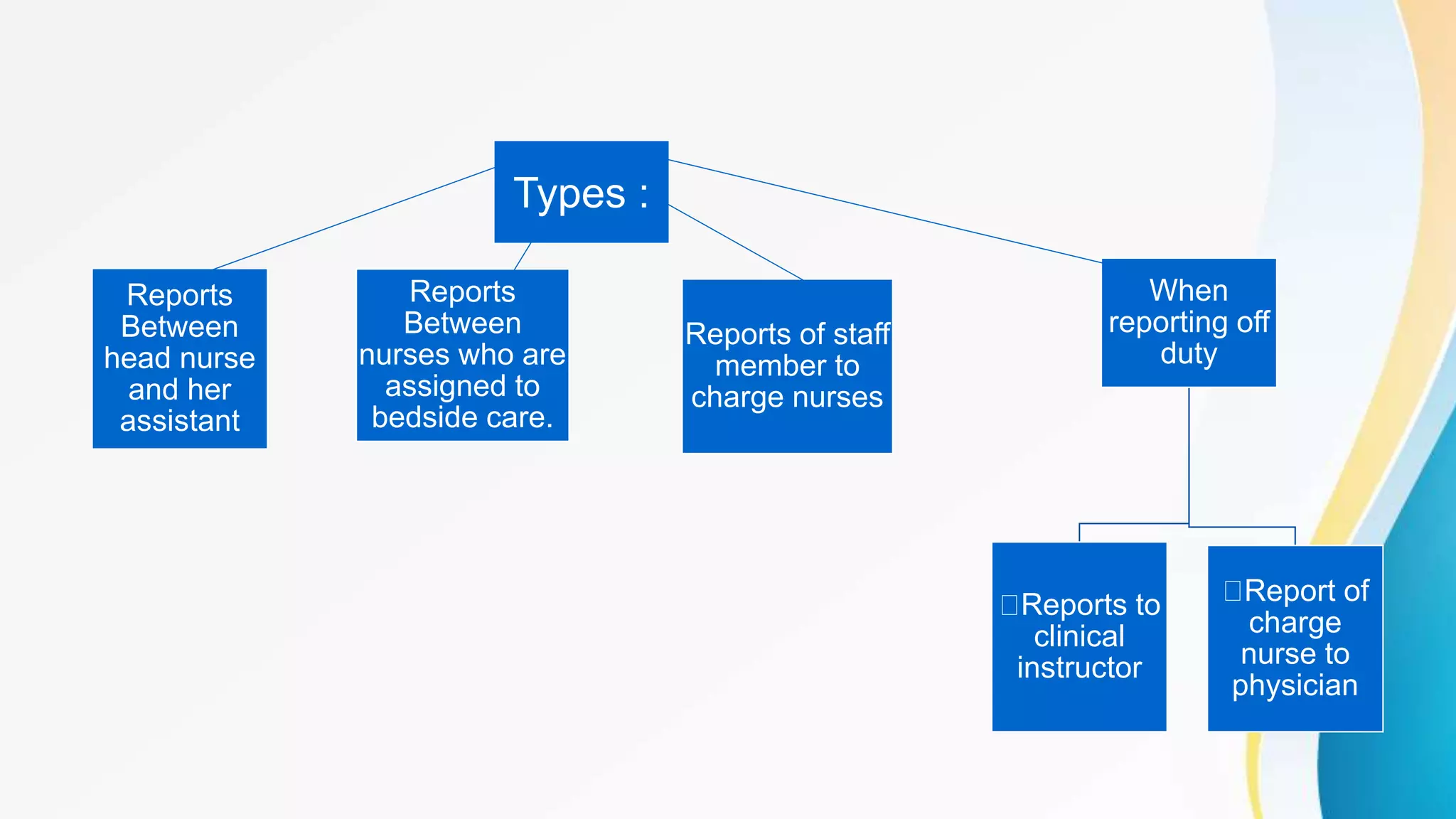
Types :
Reports
Between
head nurse
and her
assistant
Reports
Between
nurses who are
assigned to
bedside care.
Reports of staff
member to
charge nurses
When
reporting off
duty
Reports to
clinical
instructor
Report of
charge
nurse to
physician
INDIVIDUAL CONFERENCE
Individual conference provides an opportunity for the
students to know about his achievements and to express the
difficulties or problems he is facing, in relation to the
acquisition of clinical skills.
After the conference, a brief record of the conference should
be maintained by recording the nature of the problem, events
led to the conference, student's attitude towards the problem
and the kind of help rendered by the teacher.
PURPOSES
To guide in teaching
To acquire more knowledge.
To discover the interests, needs and the problems of the
individual student
To help the student to help herself/himself
PRINCIPLES
1.Establishment of a definite purpose and specific issues
to be covered.
2.Knowledge of the student
3.Provide privacy
4.Provide sufficient time
5.Establish good rapport.
6.Good listening
7.Positive effect.
8.Recording of data.
USE OF THE INDIVIDUAL CONFERENCE
IN NURSING COURSES
1. It can be used
to clarify class
material.
2. It helps in
supplement
instructions.
3. It can also help
to explain
answers to
questions of
individuals.
4. It can be used
as a means of
assisting the
individual who is
having difficulties
in keeping up with
the classroom
situation
GROUP CONFERENCE
• In group conference, a subject of common interest is
taken .It can be unplanned or planned.
Unplanned conference
Emphasis is given to solve the problem of immediate
concern.
Planned conference
Systematic and predetermined
Prior intimation to the student is a must and the time and
place should not be changed.
PROCESS RECORDING
• The process record as "a verbatum account of a visit for
purpose of bringing out the interplay between the nurse
and the patient in relation to the objectives of the visit
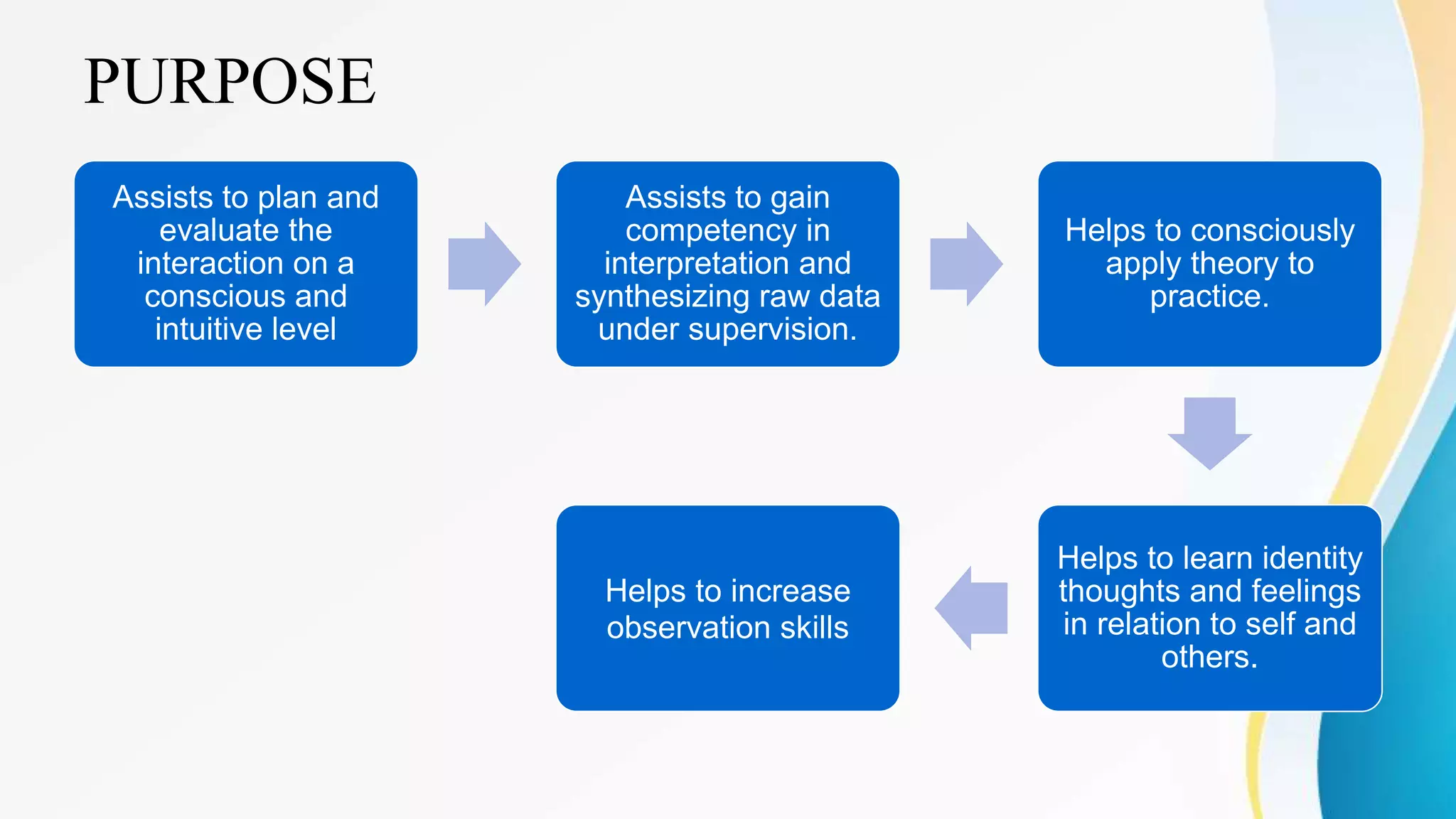
PURPOSE
Assists to plan and
evaluate the
interaction on a
conscious and
intuitive level
Assists to gain
competency in
interpretation and
synthesizing raw data
under supervision.
Helps to consciously
apply theory to
practice.
Helps to learn identity
thoughts and feelings
in relation to self and
others.
Helps to increase
observation skills
PHASES IN PROCESS RECORDING
• Preparing the student for process recording.
• Recording nurse-patient interaction
• Evaluating the interactions by nurse teacher and the
student
FIELD-TRIP/VISIT
• A field-trip is a visit especially planned for its possible
contribution to the objectives of the curriculum, course,
project, lesson or other unit of instructions.
PURPOSES
To
provide
real life
situations
To serve
as a
preview of
a lesson
To serve as
a means of
arousing
specific
interest
To create
teaching
situations
To serve as
a means to
develop
positive
attitudes
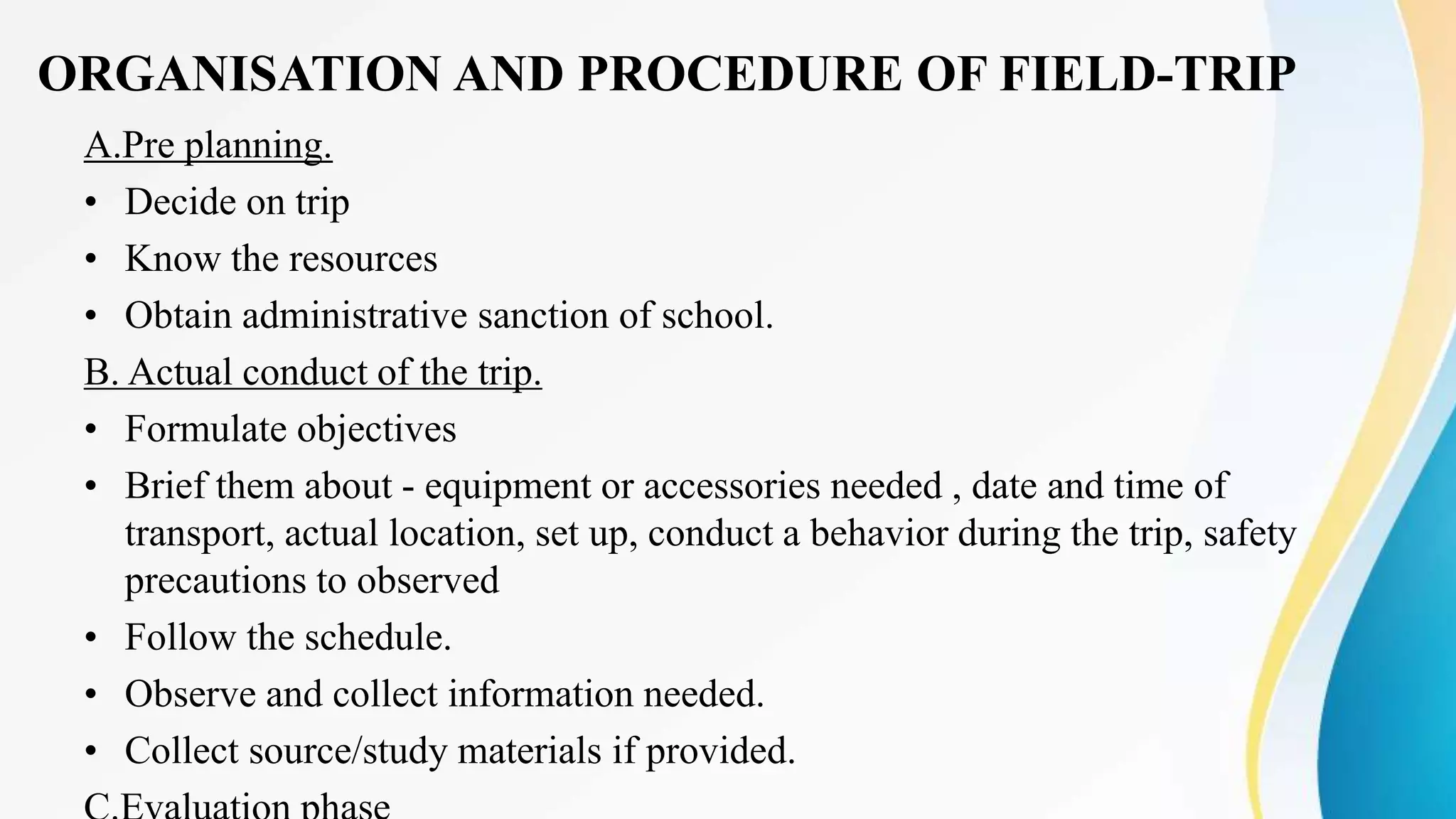
ORGANISATION AND PROCEDURE OF FIELD-TRIP
A.Pre planning.
• Decide on trip
• Know the resources
• Obtain administrative sanction of school.
B. Actual conduct of the trip.
• Formulate objectives
• Brief them about - equipment or accessories needed , date and time of
transport, actual location, set up, conduct a behavior during the trip, safety
precautions to observed
• Follow the schedule.
• Observe and collect information needed.
• Collect source/study materials if provided.
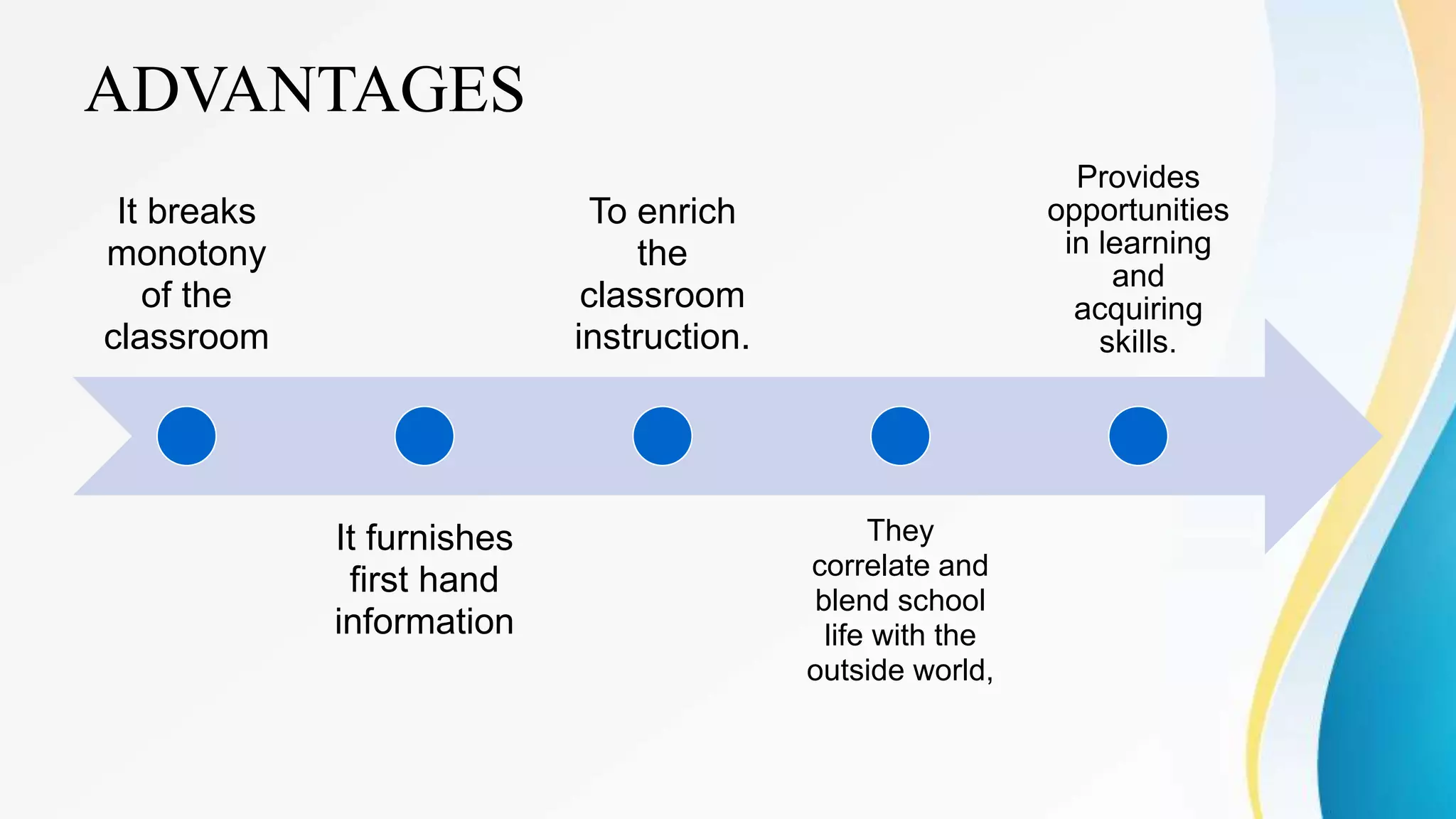
ADVANTAGES
It breaks
monotony
of the
classroom
It furnishes
first hand
information
To enrich
the
classroom
instruction.
They
correlate and
blend school
life with the
outside world,
Provides
opportunities
in learning
and
acquiring
skills.
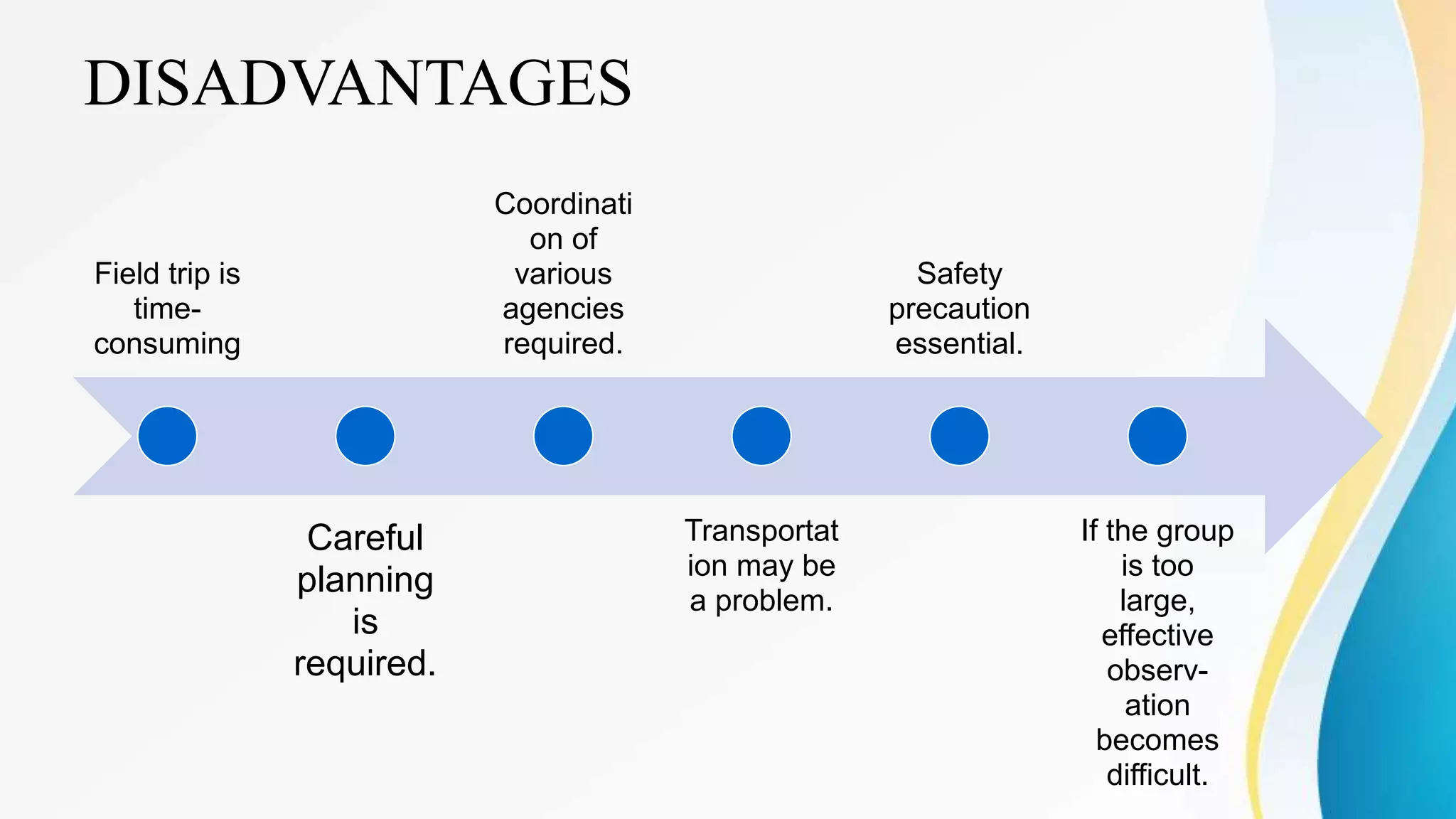
DISADVANTAGES
Field trip is
time-
consuming
Careful
planning
is
required.
Coordinati
on of
various
agencies
required.
Transportat
ion may be
a problem.
Safety
precaution
essential.
If the group
is too
large,
effective
observ-
ation
becomes
difficult.
LABORATORY METHOD
• Laboratory method of teaching utilized a problem
solving approach to learning that offers students
opportunities for supervised ,individualized, and direct
experiences in the testing and application of previous
learned theories.
PURPOSES :
• To provide first hand experience
• To provide experiences with actual situation
• To make student to become skillful in manipulation
apparatus,
TECHNIQUES :
• Introductory steps / Preparation
• Work Period
• Culminating activities/ Evaluation
ADVANTAGES:
It helps student
to master the
subject.
It helps in
participation of
student
Information gained
by them turns out
to be of
permanent kind.
DISADVANTAGES :
Limited
applicability.
Shortage of
resources.
Method is
considered to
be
expensive.
NURSING CARE PLAN
• Rendering nursing care through nursing care plan help
the students develop basic nursing skills like assessing
the patients' condition, formulating nursing diagnosis,
prioritizing patients, needs, planning care, implementing
the care with rationale and evaluating the care.
• With no compromise on reliability, nursing care plan can
be implemented in all clinical settings.
OBJECTIVES
• Promote evidence-based nursing care
• Support holistic care which involves the whole person
including physical, psychological, social and spiritual in
relation to management and prevention of the disease.
• Identify and distinguish goals and expected outcome.
• Review communication and documentation of the care
plan.
• Measure nursing care.
•WHAT ARE THE VARIOUS
COMPONENTS OF NURSING
CARE PLAN ?
SEMINAR
• The term seminar refers to a small group of graduate
students engaged in original research under the guidance
of a knowledgeable professor.
• It involves a discussion of the problem using a small
group of students and a teacher who is expert in the field
of study.
• The objective in the seminar is to give students the
opportunity to participate in methods of scientific
analysis and research procedure.
ADVANTAGES
• Role of student is active
• Teaches scientific analysis and
techniques of research
• Group tries to solve problems
• Student develop skills by participation
• Student develops more critical point
of view
DISADVANTAGES
• Time consuming.
• If subject knowledge is poor,
unnecessary discussion arises.
CASE ANALYSIS METHOD
• This method of teaching refers to group analysis of a
case history for the purpose of developing skill in
reflective thinking by defining problems to be solved,
discussing relevant data and various sides of the issues,
and verifying facts to make judgments.
CASE INCIDENT METHOD
• This method is emerging as a promising means of
inquiry that can be used effectively in undergraduate
curricula to help students develop skill in reflective
thinking leading to decision-making.
ROLE PLAYING
• Role-playing involves the acting out of roles related to
problems involving human relations.
• In total group is involved in the analysis of behaviors
portrayed in the role-playing situation for the purpose of
increasing their insights into similar problems and
under-standing ways of dealing with them.
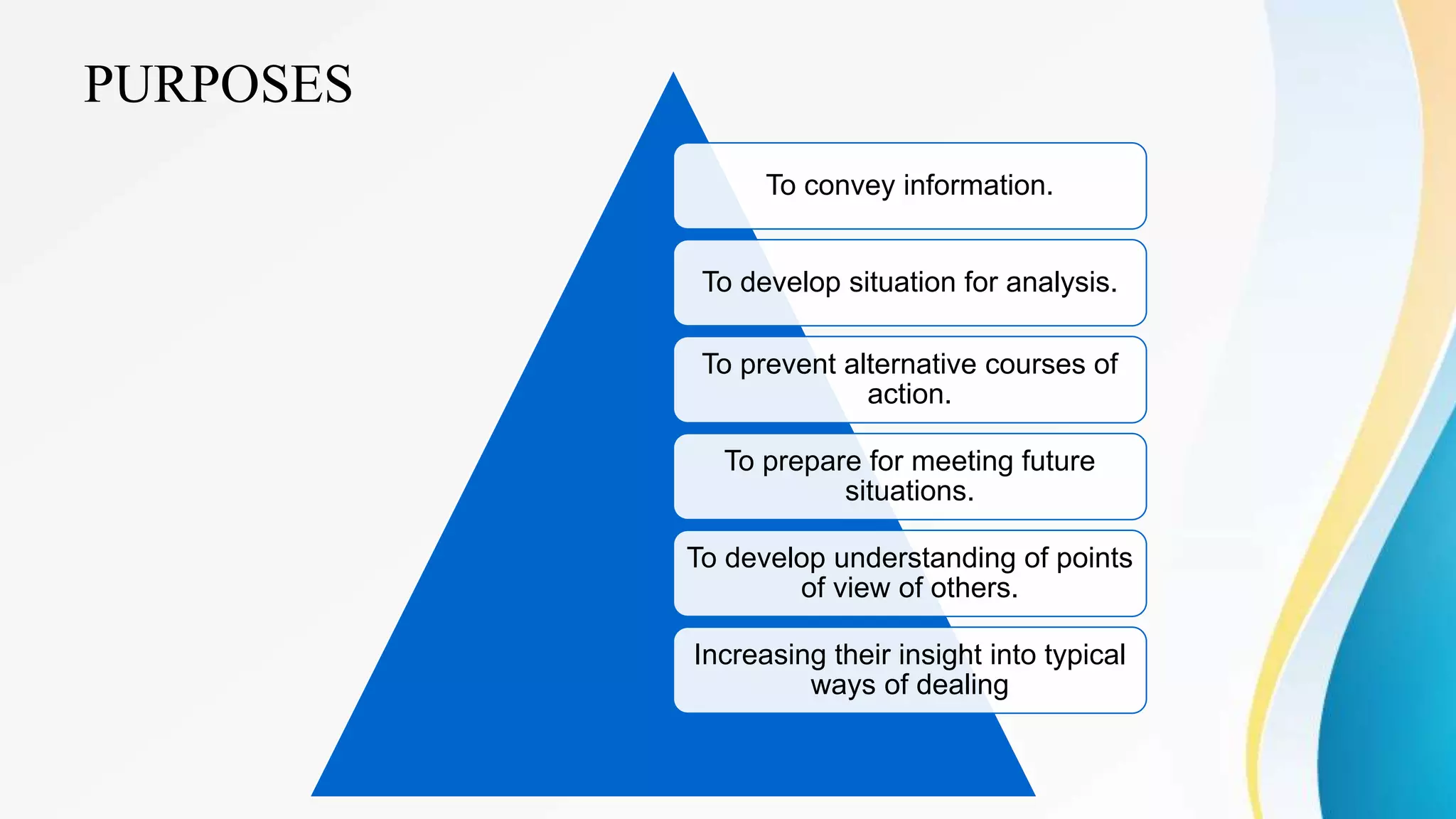
PURPOSES
To convey information.
To develop situation for analysis.
To prevent alternative courses of
action.
To prepare for meeting future
situations.
To develop understanding of points
of view of others.
Increasing their insight into typical
ways of dealing
SYMPOSIUM
• The symposium is a type of discussion, in which two or
more speakers, talk from ten to twenty minutes, develop
individual approaches or solutions to a problem or
present aspects of a policy, process or program.
• The speeches are followed by questions or comments
from the audience, as in the panel forum.
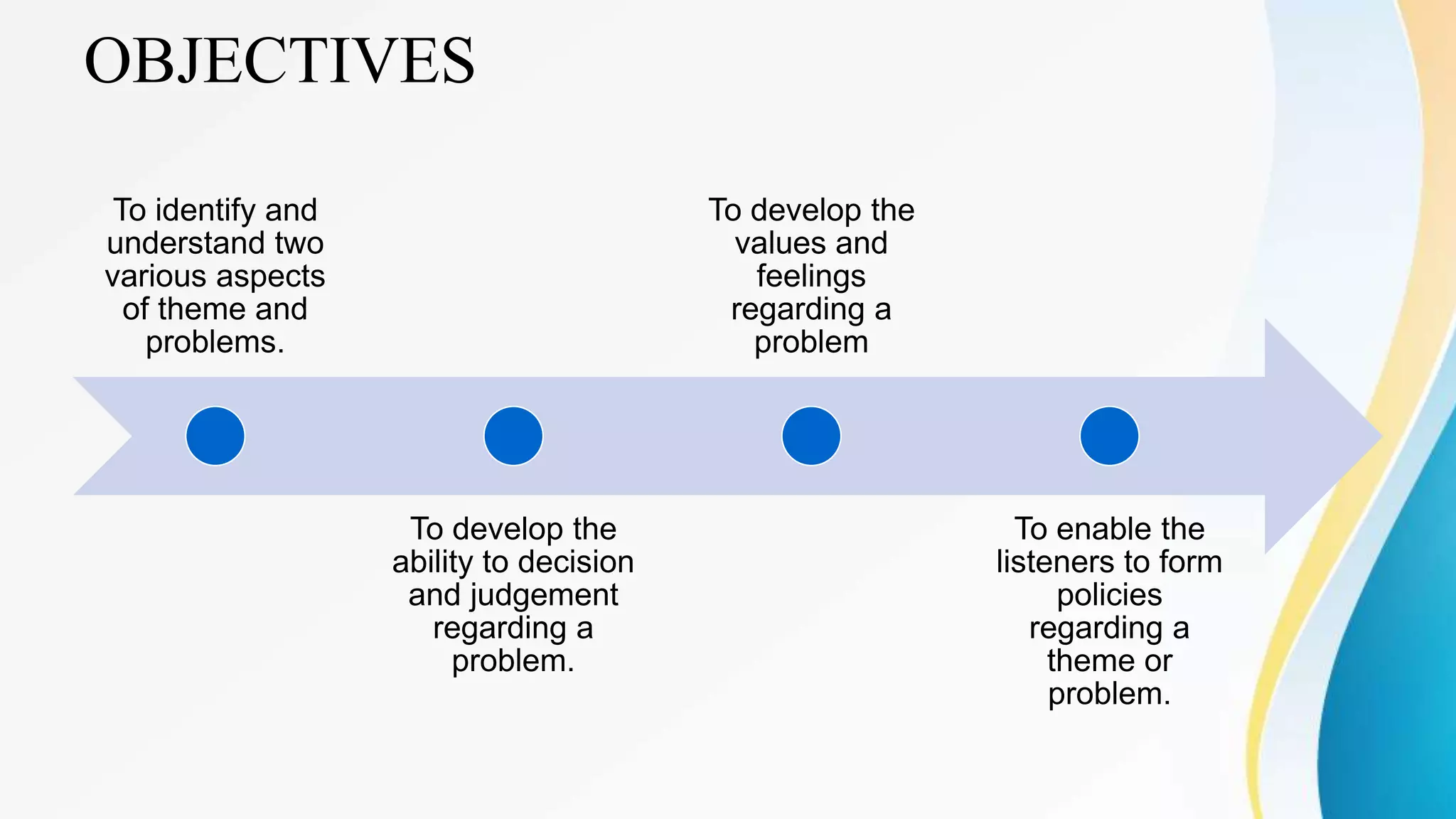
OBJECTIVES
To identify and
understand two
various aspects
of theme and
problems.
To develop the
ability to decision
and judgement
regarding a
problem.
To develop the
values and
feelings
regarding a
problem
To enable the
listeners to form
policies
regarding a
theme or
problem.
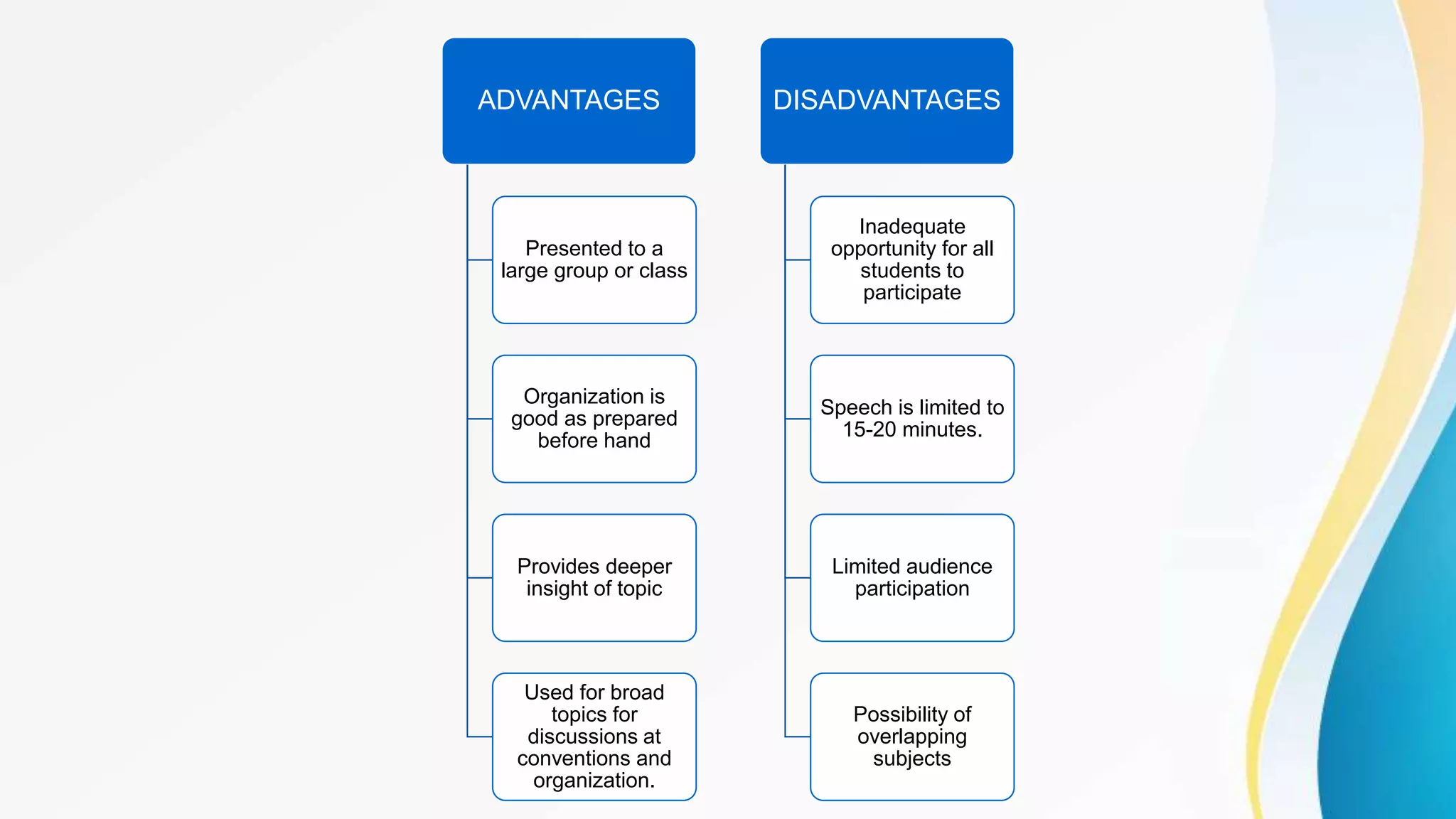
ADVANTAGES
Presented to a
large group or class
Organization is
good as prepared
before hand
Provides deeper
insight of topic
Used for broad
topics for
discussions at
conventions and
organization.
DISADVANTAGES
Inadequate
opportunity for all
students to
participate
Speech is limited to
15-20 minutes.
Limited audience
participation
Possibility of
overlapping
subjects
WORKSHOP
• Workshop is defined as assembled group of 10 to 25
persons who share a common interest or problem.
• They meet together to improve their individual and skill
of a subject through intensive study, research, practice
and discussion.
OBJECTIVES
A)Cognitive objectives:
• To solve the problems of teaching profession.
• To provide the philosophical and sociological
background for instructional and teaching situation.
B)Psycho motor objectives:
• To develop the proficiency for planning and organizing
teaching and instructional activities.
• To develop the skills to perform a task independently
• Used to realize higher cognitive and psycho motor
objectives
• Technique can be used in developing understanding
• Used to develop and improve professional efficiency.
ADVANTAGES
• The in-service teachers do not take interest to understand
and use the new practices in their classrooms
• The workshops can not be organized for large group so
that large number of persons are trained.
• The effectiveness of a workshop technique depends on the
follow up program.
DISADVANTAGES
PANEL DISCUSSION
• The discussion technique of learning is based on the
modern theory of organization.
• The assumption of this theory is that every member of
the organization has the capacity to initiate and solve the
problem and brings certain attitude and values to the
organization.
OBJECTIVES
• To provide information and new facts.
• To analyze the current problem from different angle.
• To identify the values.
TYPES
• Public panel discussion - This type of panel discussions
are organized for the common men problems.
• Educational panel discussion
• Encourages social learning.
• The higher cognitive objectives achieved.
• Develop the ability of logical thinking
• Develops right approach towards the
problem.
ADVANTAGES
• Deviate from theme at time of discussion
• No opportunities to participate others in
discussion.
• Here is possibility to split the group into two
sub groups
DIS -
ADVANTAGES
RESEARCH
Effectiveness of the clinical teaching associate model in
clinical nursing education
• By Cheraghi Rozita , Jasemi Madineh , Namadi Farideh from
Department of Medical Surgical Nursing, Urmia University of
Medical Sciences, Urmia, Iran
• Published online on : 1-Aug-2019
• Objectives: This study aimed to evaluate the effects of the
Clinical Teaching Associate (CTA) model on clinical skills and
satisfaction with clinical education among nursing students.
Sample :
• This two-group posttest-only trial was conducted on 120
nursing students recruited through the census method from
Tabriz Faculty of Nursing and Midwifery, Tabriz, Iran.
Method :
• Participants were randomly allocated to a control group to
receive clinical education through routine teaching method and
an intervention group to receive clinical education through the
CTA model.
Results:
• The mean score of overall clinical skills in the intervention
group was significantly greater than that of the control group
Clinical teaching of university-degree nursing
students: are the nurses in practice in Uganda ready?
Published on : 04 January 2021 in BMC Nursing volume 20,
Article number: 4 (2021)
By Drasiku Amos , Gross Janet L., Jones Casey & Nyoni
Champion N.
Objective :A university in Uganda established a bachelor’s degree
in Nursing program and was expecting to use nurses in practice at a
teaching hospital for the clinical teaching of university-degree
nursing students.
This study reports on the perceptions of the nurses in practice
regarding their readiness for the clinical teaching of undergraduate
nursing students.
• Sample : A qualitative descriptive research study was
conducted among 33 conveniently sampled nurses from Arua
Regional Referral Hospital (ARRH)
• Method : Five focus group discussions and three informant
interviews were used to generate the data. Data were
transcribed verbatim and analysed using an inductive approach
through thematic analysis.
Results:
• The nurses in practice perceived themselves as ready for
clinical teaching of undergraduate nursing students. Three
themes emerged namely; “Willingness to teach undergraduate
students” “Perceived attributes of undergraduate students”, and
“The clinical practice environment”.
SUMMARY
• Through this assignment we learned about various
clinical learning approaches such as Nursing clinics,
Bedside clinic, Nursing rounds, Nursing assignments,
Nursing care conferences, Morning and afternoon
reports, Individual conference, Group conference,
Process recording, Field visit, Laboratory method
,Nursing care plan, Seminar ,Case analysis method ,Case
incident method ,Role playing ,Symposium, Workshop
,Panel discussion.
CONCLUSION
• Teaching is the act of communicating in variety of ways
with the individual or group or both at the actual point of
the learners experiences so that he/she can reach his/her
unique potential.
• Clinical teaching involves planning, organizing,
teaching, supervising and evaluating students direct
experiences in patient care and provides students with an
opportunity to make application of theoretical
knowledge to provide improved patient-centered nursing
care.
BIBLIOGRAPHY
• Basavanthappa BT, Nursing Education, 2nd Edition,2009,
Jaypee brothers medical publishers, pg no- 520-579.
• Sankaranarayanan B. , Sindhu B. , Learning and teaching
nursing, 4th edition ,2012, jaypee brothers medical publishers,
pg no -93-136.
• https://www.nmsjournal.com/article.asp?issn=2322-
1488;year=2019;volume=8;issue=3;spage=132;epage=136;aula
st=Cheraghi
• https://bmcnurs.biomedcentral.com/articles/10.1186/s12912-
020-00528-5

Ppt on clinical teaching methods

  • 1.
    CLINICAL TEACHING METHODS Submitted by: Ms.ARUSHI NEGI M.Sc. Nursing Ist Year SUBMITTED TO : Ms. ANJALI KAUSHIK TUTOR, RCON, JH
  • 2.
    CONTENT • INTRODUCTION • DEFINITION •OBJECTIVES • GUIDELINES FOR SELECTION • CLINICAL TEACHING METHODS • NURSING CLINIC • BEDSIDE CLINIC • NURSING ROUNDS • NURSING ASSIGNMENT • NURSING CARE CONFERENCE • MORNING AND EVENING REPORTS • INDIVIDUAL CONFERENCE • GROUP CONFERENCE • PROCESS RECORDING • FIELD TRIP • LABORATORY METHOD • NURSING CARE PLAN • SEMINAR • CASE ANALYSIS METHOD • CASE INCIDENT METHOD • ROLE PLAYING • SYMPOSIUM • WORKSHOP • PANEL DISCUSSION • RESEARCH • SUMMARY AND CONCLUSION
  • 3.
    INTRODUCTION • In nursing,competency of a nurse is recognized mainly by the demonstration of clinical skills. • Developing clinical skills demands more effort from the side of teachers and students . • Clinical area is a gold mine of learning opportunities and experiences.
  • 4.
    DEFINITION • Clinical teachinginvolves planning, organizing, teaching, supervising and evaluating students direct experiences in patient care • It provides students with an opportunity to make application of theoretical knowledge to provide improved patient-centered nursing care.
  • 5.
    WHAT COULD BETHE OBJECTIVES ?
  • 7.
    WHAT ARE THEVARIOUS GUIDELINES FOR SELECTION OF TEACHING METHOD?
  • 9.
    CLINICAL TEACHING METHODS Nursingclinics Bedside clinic. Nursing rounds. Nursing assignments. Nursing care conferences. Morning and afternoon reports. Individual conference. Group conference Process recording Field visit Laboratory method Nursing care plan Seminar Case analysis method Case incident method Role playing Symposium Workshop Panel discussion
  • 10.
    NURSING CLINIC • Thenursing clinic utilizes the presence of a selected patient as its focus for group discussion. • It affords a direct experience in the discussion of principles and practices of nursing care relative to a given patient. • Students have the opportunity to sharpen their observation and interviewing skills .
  • 11.
    PURPOSE Apply theory into actual practiceby inter-viewing and studying patient Apply knowledge and experience to the situation. Understand certain types of apparatus. Improve the nursing care.
  • 12.
    PRE PLANNING THECLINIC • Determining the purpose of the clinic • Selecting patient for nursing care. • Securing the patient's consent. • Selecting the setting to be used, i.e. conference room. • Providing advance preparation of the student
  • 13.
    LEVELS OF DISCUSSION 1. Introduction. 2.Patient centered discussion. 3. Post-clinic evaluation discussion.
  • 14.
    BEDSIDE CLINIC • Bedsideclinic is an organized clinical instruction in the presence of the patient. • This is a teacher centered method for a small group of students and can be conducted by a nurse educator, doctor. • The name of the patient, other details and the venue should be informed to students prior so that they can study the case sheet of the patient and actively participate in the bedside clinic. • The usual duration is 30 to 45 minutes and student have to gather around the patient in an informal way in order to avoid tension to him.
  • 15.
    PURPOSE To provide learning onhow to collect information about the patient. To improve the student's ability to solve nursing problems. It helps student to do nursing observation in organized systematic way. To be able to recognize opportunities for health teaching in the hospital.
  • 16.
    STEPS 1.Planning technique 2.Conducting thebedside clinic • Introduction phase • Patient centered discussion • Post clinic evaluation
  • 17.
    ADVANTAGES 1. Bedside teachingputs the student in an active area, students have to come prepared. 2. Covers a limited group of students. 3. Permits evaluation of degree to which educational objectives have been attained. 4. Develops qualities of observation and decision taking 5. Permits comparison between reality and theory. 6. Enables students to develop self- confidence.
  • 18.
    NURSING ROUNDS • Innursing rounds, the nursing teacher or head nurse who knows the details of the patient briefs the nursing care. • The staff nurse or the nursing student who has been taking care of the patient for a few days are allowed to contribute and have to answer the questions of the group. • The group then discuss the nursing care aspects in brief . • One staff nurse records all the instructions and suggestions in the nursing rounds register maintained in the ward. • Then the group move towards the next patient.
  • 19.
    PURPOSES Demonstrate aspects important in nursing care. Clarify terminology studied. Compare patient's reactionto disease and study the disease conditions. Demonstrate effects of drugs, i.e. indication, actions and reactions of drugs. Illustrate skillful nursing care.
  • 20.
    ADVANTAGES • Make classroomdiscussions more real and thus improve learning experiences • Response of the patient is more natural. • Students can select patients with specific problems and plan proper nursing care
  • 21.
    NURSING ASSIGNMENT • Assignmentsplay a major role in the teaching-learning process. It is a self-study which supplements classroom teaching. • The success and effectiveness of assignment depends upon the amount of independent work done by the students . • Clinical Assignment is that part of learning experience where the students are assigned with patients and student’s provide care to them.
  • 22.
    •WHAT ARE THEVARIOUS OBJECTIVES OF NURSING ASSIGNMENT ?
  • 24.
    METHODS • PATIENT METHOD Inthe patient method of assignment a nurse is expected to give complete nursing care to one . • FUNCTIONAL METHOD A nurses is assigned to specific functions in the ward such as giving medications or treatment to all patients • TEAM METHOD In this method a group of patient are looked after by a group of hospital staff and students (nursing team).
  • 25.
    GUIDELINES Mere dictation ofquestions or problems is not an assignment. The teacher has to suggest along with it the book to be consulted and the references to be studied. The assignments should preferably raise out of the activities, need and interests of the students. It must motivate, remove doubts or misunderstandings and level insight.
  • 26.
    ADVANTAGES Patient method • Thenurse gets job satisfaction. • Interpersonal relationship is good • The maximum learning takes place. Functional method • More work is turned out in less given period of time. • Skill is developed when the work is done repeatedly. Team method • Team spirit is created in the team • Attitude of cooperation and co-ordination is learnt.
  • 27.
    DISADVANTAGES Patient method • Morenurses are required. • Economic loss to an agency or to country Functional method • Patient does not get any security • Individual needs are not considered. Team method • It there is no cooperation within the team members, the work will not be done properly and patient will suffer.
  • 28.
    NURSING CARE CONFERENCE •It has all the characteristics of the bedside clinic except the presence of the patient. • When the teacher as well as the students are well acquainted with the patient's features this is the preferred method. • The nursing care conference consists of a group discussion using problem-solving techniques to determine ways of providing care for patients to whom students are assigned as a part of their clinical nursing experience.
  • 29.
    PHASES It has threephases. 1. Opening phase 2. Working phase 3. Closing phase The task here is to delegate responsibility to one or more of the staff to act on the problems. The task here is to make a commitment to work on a problem relating to a particular patient. The task of the working phase is to arrive at a consensus on problem identification and solution.
  • 30.
    ADVANTAGES 1.Helps to collectthe information in creative way. 2.It fortifies the thinking of students, thereby the creativity and judgement capacity will be increased. 3.It provides free opportunity to think. 4.Each member will be actively participating. DISADVANTAGES 1. It will be of little use if the students do not accustom to such situation. 2. There are chances of using these conference hours for classroom teaching.
  • 31.
    MORNING AND EVENINGREPORTS • A report summarizes the services of the nurse and or the agency. Reports may be in the form of an analysis of some aspect of service. These reports can be either oral or written.
  • 32.
    Types : Reports Between head nurse andher assistant Reports Between nurses who are assigned to bedside care. Reports of staff member to charge nurses When reporting off duty Reports to clinical instructor Report of charge nurse to physician
  • 33.
    INDIVIDUAL CONFERENCE Individual conferenceprovides an opportunity for the students to know about his achievements and to express the difficulties or problems he is facing, in relation to the acquisition of clinical skills. After the conference, a brief record of the conference should be maintained by recording the nature of the problem, events led to the conference, student's attitude towards the problem and the kind of help rendered by the teacher.
  • 34.
    PURPOSES To guide inteaching To acquire more knowledge. To discover the interests, needs and the problems of the individual student To help the student to help herself/himself
  • 35.
    PRINCIPLES 1.Establishment of adefinite purpose and specific issues to be covered. 2.Knowledge of the student 3.Provide privacy 4.Provide sufficient time 5.Establish good rapport. 6.Good listening 7.Positive effect. 8.Recording of data.
  • 36.
    USE OF THEINDIVIDUAL CONFERENCE IN NURSING COURSES 1. It can be used to clarify class material. 2. It helps in supplement instructions. 3. It can also help to explain answers to questions of individuals. 4. It can be used as a means of assisting the individual who is having difficulties in keeping up with the classroom situation
  • 37.
    GROUP CONFERENCE • Ingroup conference, a subject of common interest is taken .It can be unplanned or planned. Unplanned conference Emphasis is given to solve the problem of immediate concern. Planned conference Systematic and predetermined Prior intimation to the student is a must and the time and place should not be changed.
  • 38.
    PROCESS RECORDING • Theprocess record as "a verbatum account of a visit for purpose of bringing out the interplay between the nurse and the patient in relation to the objectives of the visit
  • 39.
    PURPOSE Assists to planand evaluate the interaction on a conscious and intuitive level Assists to gain competency in interpretation and synthesizing raw data under supervision. Helps to consciously apply theory to practice. Helps to learn identity thoughts and feelings in relation to self and others. Helps to increase observation skills
  • 40.
    PHASES IN PROCESSRECORDING • Preparing the student for process recording. • Recording nurse-patient interaction • Evaluating the interactions by nurse teacher and the student
  • 41.
    FIELD-TRIP/VISIT • A field-tripis a visit especially planned for its possible contribution to the objectives of the curriculum, course, project, lesson or other unit of instructions.
  • 42.
    PURPOSES To provide real life situations To serve asa preview of a lesson To serve as a means of arousing specific interest To create teaching situations To serve as a means to develop positive attitudes
  • 43.
    ORGANISATION AND PROCEDUREOF FIELD-TRIP A.Pre planning. • Decide on trip • Know the resources • Obtain administrative sanction of school. B. Actual conduct of the trip. • Formulate objectives • Brief them about - equipment or accessories needed , date and time of transport, actual location, set up, conduct a behavior during the trip, safety precautions to observed • Follow the schedule. • Observe and collect information needed. • Collect source/study materials if provided.
  • 44.
    ADVANTAGES It breaks monotony of the classroom Itfurnishes first hand information To enrich the classroom instruction. They correlate and blend school life with the outside world, Provides opportunities in learning and acquiring skills.
  • 45.
    DISADVANTAGES Field trip is time- consuming Careful planning is required. Coordinati onof various agencies required. Transportat ion may be a problem. Safety precaution essential. If the group is too large, effective observ- ation becomes difficult.
  • 46.
    LABORATORY METHOD • Laboratorymethod of teaching utilized a problem solving approach to learning that offers students opportunities for supervised ,individualized, and direct experiences in the testing and application of previous learned theories.
  • 47.
    PURPOSES : • Toprovide first hand experience • To provide experiences with actual situation • To make student to become skillful in manipulation apparatus, TECHNIQUES : • Introductory steps / Preparation • Work Period • Culminating activities/ Evaluation
  • 48.
    ADVANTAGES: It helps student tomaster the subject. It helps in participation of student Information gained by them turns out to be of permanent kind. DISADVANTAGES : Limited applicability. Shortage of resources. Method is considered to be expensive.
  • 49.
    NURSING CARE PLAN •Rendering nursing care through nursing care plan help the students develop basic nursing skills like assessing the patients' condition, formulating nursing diagnosis, prioritizing patients, needs, planning care, implementing the care with rationale and evaluating the care. • With no compromise on reliability, nursing care plan can be implemented in all clinical settings.
  • 50.
    OBJECTIVES • Promote evidence-basednursing care • Support holistic care which involves the whole person including physical, psychological, social and spiritual in relation to management and prevention of the disease. • Identify and distinguish goals and expected outcome. • Review communication and documentation of the care plan. • Measure nursing care.
  • 51.
    •WHAT ARE THEVARIOUS COMPONENTS OF NURSING CARE PLAN ?
  • 53.
    SEMINAR • The termseminar refers to a small group of graduate students engaged in original research under the guidance of a knowledgeable professor. • It involves a discussion of the problem using a small group of students and a teacher who is expert in the field of study. • The objective in the seminar is to give students the opportunity to participate in methods of scientific analysis and research procedure.
  • 54.
    ADVANTAGES • Role ofstudent is active • Teaches scientific analysis and techniques of research • Group tries to solve problems • Student develop skills by participation • Student develops more critical point of view DISADVANTAGES • Time consuming. • If subject knowledge is poor, unnecessary discussion arises.
  • 55.
    CASE ANALYSIS METHOD •This method of teaching refers to group analysis of a case history for the purpose of developing skill in reflective thinking by defining problems to be solved, discussing relevant data and various sides of the issues, and verifying facts to make judgments.
  • 56.
    CASE INCIDENT METHOD •This method is emerging as a promising means of inquiry that can be used effectively in undergraduate curricula to help students develop skill in reflective thinking leading to decision-making.
  • 57.
    ROLE PLAYING • Role-playinginvolves the acting out of roles related to problems involving human relations. • In total group is involved in the analysis of behaviors portrayed in the role-playing situation for the purpose of increasing their insights into similar problems and under-standing ways of dealing with them.
  • 58.
    PURPOSES To convey information. Todevelop situation for analysis. To prevent alternative courses of action. To prepare for meeting future situations. To develop understanding of points of view of others. Increasing their insight into typical ways of dealing
  • 59.
    SYMPOSIUM • The symposiumis a type of discussion, in which two or more speakers, talk from ten to twenty minutes, develop individual approaches or solutions to a problem or present aspects of a policy, process or program. • The speeches are followed by questions or comments from the audience, as in the panel forum.
  • 60.
    OBJECTIVES To identify and understandtwo various aspects of theme and problems. To develop the ability to decision and judgement regarding a problem. To develop the values and feelings regarding a problem To enable the listeners to form policies regarding a theme or problem.
  • 61.
    ADVANTAGES Presented to a largegroup or class Organization is good as prepared before hand Provides deeper insight of topic Used for broad topics for discussions at conventions and organization. DISADVANTAGES Inadequate opportunity for all students to participate Speech is limited to 15-20 minutes. Limited audience participation Possibility of overlapping subjects
  • 62.
    WORKSHOP • Workshop isdefined as assembled group of 10 to 25 persons who share a common interest or problem. • They meet together to improve their individual and skill of a subject through intensive study, research, practice and discussion.
  • 63.
    OBJECTIVES A)Cognitive objectives: • Tosolve the problems of teaching profession. • To provide the philosophical and sociological background for instructional and teaching situation. B)Psycho motor objectives: • To develop the proficiency for planning and organizing teaching and instructional activities. • To develop the skills to perform a task independently
  • 64.
    • Used torealize higher cognitive and psycho motor objectives • Technique can be used in developing understanding • Used to develop and improve professional efficiency. ADVANTAGES • The in-service teachers do not take interest to understand and use the new practices in their classrooms • The workshops can not be organized for large group so that large number of persons are trained. • The effectiveness of a workshop technique depends on the follow up program. DISADVANTAGES
  • 65.
    PANEL DISCUSSION • Thediscussion technique of learning is based on the modern theory of organization. • The assumption of this theory is that every member of the organization has the capacity to initiate and solve the problem and brings certain attitude and values to the organization.
  • 66.
    OBJECTIVES • To provideinformation and new facts. • To analyze the current problem from different angle. • To identify the values. TYPES • Public panel discussion - This type of panel discussions are organized for the common men problems. • Educational panel discussion
  • 67.
    • Encourages sociallearning. • The higher cognitive objectives achieved. • Develop the ability of logical thinking • Develops right approach towards the problem. ADVANTAGES • Deviate from theme at time of discussion • No opportunities to participate others in discussion. • Here is possibility to split the group into two sub groups DIS - ADVANTAGES
  • 68.
    RESEARCH Effectiveness of theclinical teaching associate model in clinical nursing education • By Cheraghi Rozita , Jasemi Madineh , Namadi Farideh from Department of Medical Surgical Nursing, Urmia University of Medical Sciences, Urmia, Iran • Published online on : 1-Aug-2019 • Objectives: This study aimed to evaluate the effects of the Clinical Teaching Associate (CTA) model on clinical skills and satisfaction with clinical education among nursing students.
  • 69.
    Sample : • Thistwo-group posttest-only trial was conducted on 120 nursing students recruited through the census method from Tabriz Faculty of Nursing and Midwifery, Tabriz, Iran. Method : • Participants were randomly allocated to a control group to receive clinical education through routine teaching method and an intervention group to receive clinical education through the CTA model. Results: • The mean score of overall clinical skills in the intervention group was significantly greater than that of the control group
  • 70.
    Clinical teaching ofuniversity-degree nursing students: are the nurses in practice in Uganda ready? Published on : 04 January 2021 in BMC Nursing volume 20, Article number: 4 (2021) By Drasiku Amos , Gross Janet L., Jones Casey & Nyoni Champion N. Objective :A university in Uganda established a bachelor’s degree in Nursing program and was expecting to use nurses in practice at a teaching hospital for the clinical teaching of university-degree nursing students. This study reports on the perceptions of the nurses in practice regarding their readiness for the clinical teaching of undergraduate nursing students.
  • 71.
    • Sample :A qualitative descriptive research study was conducted among 33 conveniently sampled nurses from Arua Regional Referral Hospital (ARRH) • Method : Five focus group discussions and three informant interviews were used to generate the data. Data were transcribed verbatim and analysed using an inductive approach through thematic analysis. Results: • The nurses in practice perceived themselves as ready for clinical teaching of undergraduate nursing students. Three themes emerged namely; “Willingness to teach undergraduate students” “Perceived attributes of undergraduate students”, and “The clinical practice environment”.
  • 72.
    SUMMARY • Through thisassignment we learned about various clinical learning approaches such as Nursing clinics, Bedside clinic, Nursing rounds, Nursing assignments, Nursing care conferences, Morning and afternoon reports, Individual conference, Group conference, Process recording, Field visit, Laboratory method ,Nursing care plan, Seminar ,Case analysis method ,Case incident method ,Role playing ,Symposium, Workshop ,Panel discussion.
  • 73.
    CONCLUSION • Teaching isthe act of communicating in variety of ways with the individual or group or both at the actual point of the learners experiences so that he/she can reach his/her unique potential. • Clinical teaching involves planning, organizing, teaching, supervising and evaluating students direct experiences in patient care and provides students with an opportunity to make application of theoretical knowledge to provide improved patient-centered nursing care.
  • 74.
    BIBLIOGRAPHY • Basavanthappa BT,Nursing Education, 2nd Edition,2009, Jaypee brothers medical publishers, pg no- 520-579. • Sankaranarayanan B. , Sindhu B. , Learning and teaching nursing, 4th edition ,2012, jaypee brothers medical publishers, pg no -93-136. • https://www.nmsjournal.com/article.asp?issn=2322- 1488;year=2019;volume=8;issue=3;spage=132;epage=136;aula st=Cheraghi • https://bmcnurs.biomedcentral.com/articles/10.1186/s12912- 020-00528-5