Health Promotion of
The Infant and Toddler
Joy A. Shepard, PhD, RN-C, CNE
Joyce Buck, PhD(c), MSN, RN-C, CNE
1
Objectives
• Recognize major developmental milestones
• Describe the role of play
• Describe and plan nursing interventions to meet nutritional
needs
• Identify major health concerns
• Apply communication skills according to the child’s
developmental level
• Use anticipatory guidance to promote positive parenting, child
safety, and prevent injury
2
Nursing Diagnoses
• Readiness for Enhanced Knowledge
• Readiness for Enhanced Parenting
• Readiness for Enhanced Immunization Status
• Readiness for Enhanced Family Coping
• Deficient Knowledge
• Ineffective Family Therapeutic Regimen Management
• Ineffective Infant Feeding Pattern
• Risk for Aspiration
• Risk for Electrolyte Imbalance
• Risk for Infection
• Risk for Injury
• Risk for Falls
• Risk for Delayed Development
• Risk for Sudden Infant Death Syndrome
• Risk for Poisoning
3
Review: Developmental Age Groups
(pp. 68 [new]; 81-82 [old], Ball & Bindler)
•Neonate: First 28 days of life
•Infancy: Birth to 1 year
•Toddler: 1 to 3 years
•Preschooler: 3 to 6 years
•School-ager: 6 to 12 years
•Adolescent: 12 to 18 years
Normal Infant Reflexes
(pp. 541-544, Lowdermilk text)
5
Protective Reflexes
•Blink
•Sneezing
•Coughing
•Do not outgrow
6
Sucking Reflex
(p. 541, Lowdermilk)
•Essential for normal life
•Sucks on anything placed in
mouth
•Well-coordinated with
swallowing by 32 – 34 weeks
of gestation
•Disappears by 1 year
7
Rooting Reflex
(p. 541, Lowdermilk)
8
• Lightly stroke cheek, infant
turns towards stimuli, then
opens mouth
• Response helps infant find
nipple for feeding
• Reflex stronger when infant
hungry
• Disappears @ 3-4 months
Palmar Grasp Reflex
(p. 541, Lowdermilk)
•Occurs when infant’s palm
is touched near base of
fingers
•Hand closes in tight fist
•Disappears by 3-4
months
9
Plantar Grasp Reflex
(p. 541, Lowdermilk)
•Similar to the palmar grasp
reflex
•Infant’s tendency to curl toes
downward over finger when
sole of foot is touched
•Disappears by 8 months
10
Tonic Neck Reflex
(p. 541, Lowdermilk)
• “Fencer’s position”
• Posture assumed by infants in a
supine position when head is
turned to one side
• The extremities on the same side
extend
• Flexion occurs on the opposite
side
• Disappears by 3-4 months
11
Moro and Startle
(p. 542, Lowdermilk)
• In response to sudden
movement or loud noise
• Arms and legs extend and the
fingers fan outward, with the
thumb and forefinger forming a
C-shape
• Most significant reflex
• Disappears by 6 months
12
Stepping (Walking) Reflex
(p. 542, Lowdermilk)
•Newborns tend when held
upright to take steps in
response to feet touching a
hard surface
•Lift one foot and then the
other
•Disappears by 3-4 weeks
13
Babinski Reflex
(p. 543, Lowdermilk)
Baby's toes fan with dorsiflexion of big toe
**Disappears by 1 year**
14
Positive vs Negative Babinski Reflex
15
Question
•Which infant reflex can help the new mother learn to
breast-feed?
• A. Tonic neck
• B. Rooting
• C. Palmar grasp
• D. Moro
16
Infant
(Chapter 7, Ball & Bindler)
17
Infancy (Chapter 7, Ball & Bindler)
• Infancy:
• Age birth to 1 year
• Includes neonatal period (birth to 28 days)
• Dramatic growth and change
• Body systems immature
• Risks r/t immature body systems:
• More at risk for respiratory infection or aspiration (immature respiratory system
tiny, collapsible airways)
• More at risk for infection (immature immune system)
• More at risk for fluid and electrolyte imbalances (immature renal system; cannot
concentrate urine efficiently)
18
Infancy
• Vital Signs:
• HR & respirations ↓; BP ↑(as infant gets older)
• Growth and Development:
• Best indication good health: steadily increasing growth
• Measured by: height, weight, head circumference, and weight-for-length (BMI)
• Plot anthropometric data on growth chart to see if growth pattern conforms to
normal growth curves
• ~As the child grows, the growth rate slows~ 19
Anthropometric Measurements
20
Infancy: Weight
• Weight:
• 1st 6 months—5 – 7 oz
(140-200 g)/ week
• 6-12 monthsslows
• 6 months—doubles birth weight
• 12 months—triples birth weight
21
Infancy: Height
• Height:
• 1st 6 months1.5 cm per month
• 6-12 months1 cm per month
• At 12 monthslength increased
by 50% (about 1 foot)
22
Infancy: Head Growth
• Head Growth:
• When the baby is born, head slightly larger than chest
• 1st 6 months1.5 cm per month
• 6-12 months1 cm per month
• 12 months—head circumference = chest circumference
• Fontanels accommodate rapidly growing brain:
• 2-3 months: posterior fontanel closes
• 12-18 months: anterior fontanel closes
23
Measurement of Head
Circumference
• Measuring tape that cannot be
stretched
• Securely and snugly wrap tape
around widest possible
circumference of head
• Position tape just above
eyebrows, above the ears, and
around the biggest part of the
back of the head (occiput)
• Read measurement to nearest
0.1 cm 24
Infancy: Body Systems
• Neurologic System:
• Brain growth very rapid during 1st yr of life: brain doubles in weight
• Brain growth depends on nutrition
• Without proper nutrition: developmental problems
• Rapid growth: increased number of synapses, myelination
• Cephalocaudal pattern
• Primitive reflexes replaced by purposeful movement
25
Infancy: Body Systems
• Immune System:
• Immature immune systems: Risk for Infection
• Newborn with very little own immunity; passive immunity if breastfed
• Breastfeeding decreases: ear, respiratory tract, GI, and urinary tract
infections; diarrhea; sepsis
• First year of life: infant develops own immunity
• Immunizations: health promotion & disease prevention
26
Infancy: Motor Development
• Weight gain and muscle growth: increased control of reflexes,
increasingly coordinated movement
• Risk for Injury
• Anticipatory guidance:
prevent accidents
• Milestones: screen for
motor development problems
• Expected MilestonesFine (purposeful use of hands and fingers)
and Gross Motor: refer to chart
27
Infancy: Cognitive Development
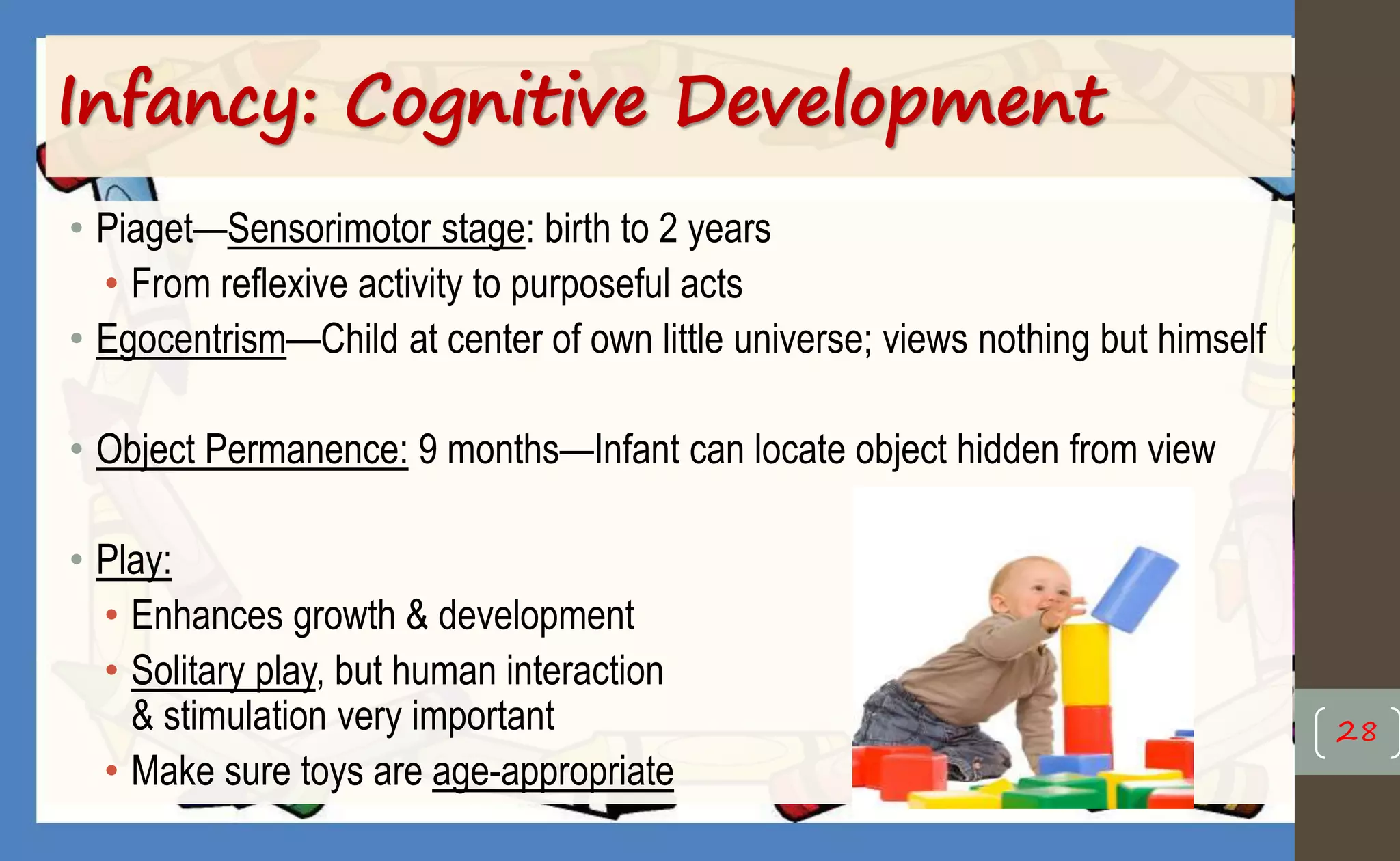
• Piaget—Sensorimotor stage: birth to 2 years
• From reflexive activity to purposeful acts
• Egocentrism—Child at center of own little universe; views nothing but himself
• Object Permanence: 9 months—Infant can locate object hidden from view
• Play:
• Enhances growth & development
• Solitary play, but human interaction
& stimulation very important
• Make sure toys are age-appropriate
28
Infancy: Language
• Cries—first attempt at communication
• Distinguish normal from abnormal
• High-pitched—usually neurological problem
• Hearing and understanding (receptive speech) come before
expressive speech
• Language Developmental Milestones: refer to chart
29
30
Infancy: Vision
• Acuity: 20/100 to 20/400 at birth. Focus on objects 8”-12" from face
at birth (en face position)
• Colors: High-contrast, primary colors
• 6 months of age—able to distinguish pastel colors
• Vision milestones: refer to chart
• Can assess “PERRL” but NOT “PERRLA” – Accommodation
(except with accommodative toys)
31
Nystagmus & Strabismus
(pp. 447 [new]; 484; 490 [old], Ball & Bindler)
• Young infants lack eye coordination
• Transient nystagmus or strabismus
normal variant until 4 months
• Alignment of eye important due to
correlation with brain development
• Nystagmus: involuntary rapid eye
movements
• Treatment: eyeglasses, surgery of eye
muscles
• Strabismus: misaligned eyes
• Treatment: Surgical correction,
optometric vision training
• Untreated: can lead to amblyopia (lazy
eye) (p. 447 [new]; 519 [old]) 32
Normal: Reflections of light are symmetrical
Infancy: Hearing
•Acute at birth; Mandatory
newborn hearing screening
•Hearing milestones: refer to
chart
33
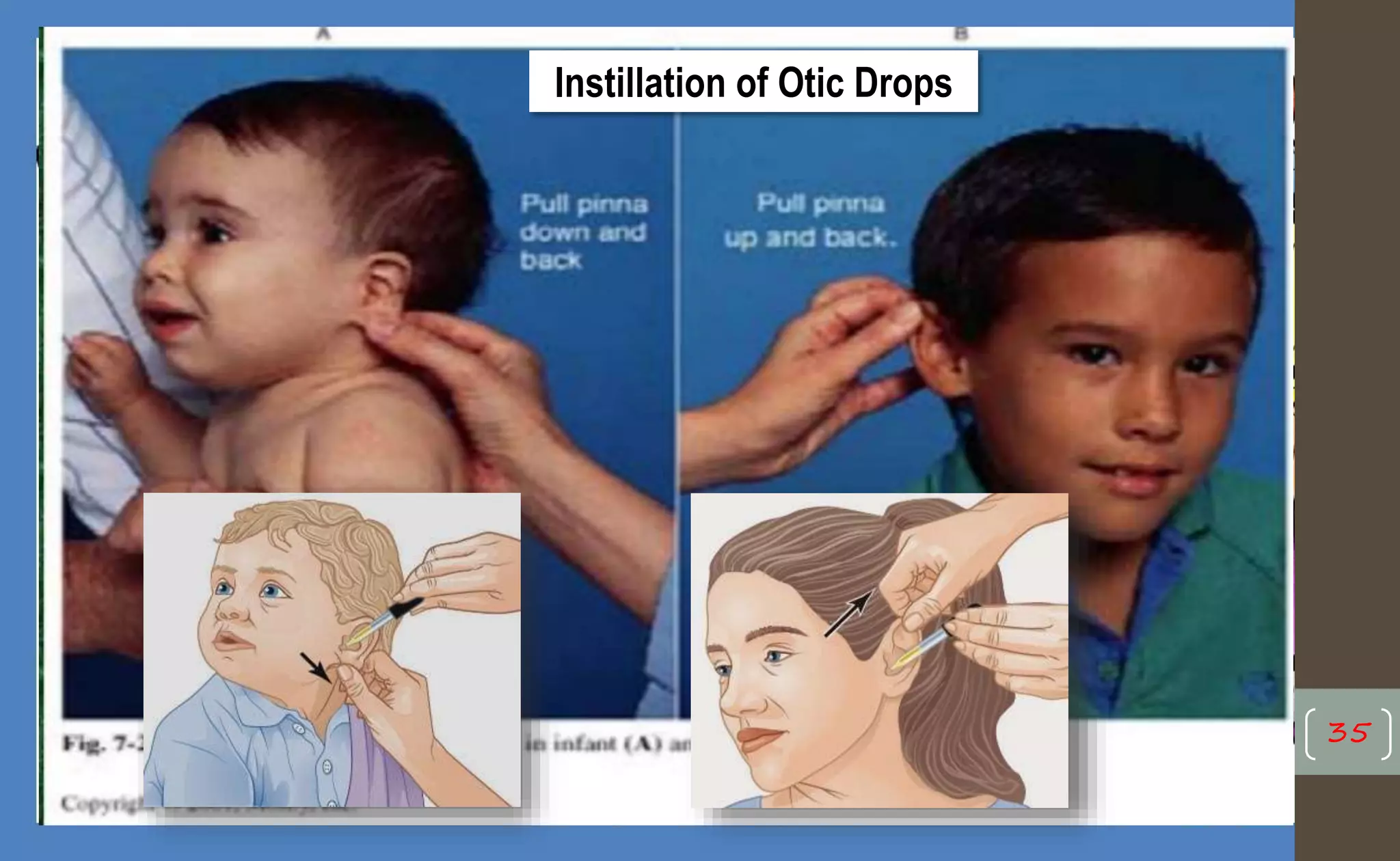
Ear Exam
Pinna is pulled down and back to straighten ear canal in
children under 3 years.
34
35
Instillation of Otic Drops
Infancy: Psychosocial
• Erikson—Trust vs Mistrust
• Foundation of personality; establish sense of trust
• Related to feeding cycle
• Freud—Oral stage:
• Oral stimulation: source of pleasure and satisfaction
• Parent-Infant Attachment:
• One of most important features of psychosocial development
• Critical for normal development and survival; infant is active participant
• Stranger Anxiety: 6-7 mos; Infant cries, clings to parents, turns away from strangers
• Separation Anxiety: 15-18 mos; inconsolable crying, distress, when parents are not
present
• Anticipatory guidance: health promotion, injury prevention 36
Stranger Anxiety! (Peaks 6-12 mos)
37
Review Question
•The pediatric RN would expect a 10-month-old infant
to respond to the staff upon admission to the
hospital in which manner?
A. Outward hostility
B. Frequent negativism
C. Occasional jealousy
D. Fear of strangers
38
Infancy: Sleep
(pp. 159-160 [new];180 [old], Ball & Bindler)
• Newborn to 3 mos: 10 – 16 hours/ day
• Most infants begin to sleep for longer periods during the nights as they get
older
• Sleep patterns will be alternating the first year of life—sleep a lot at first, then
not sleeping as much
• Safe to Sleep Campaign—Helps prevent sudden infant death syndrome
(SIDS)
• Sudden, unexplained death of an infant younger than 1 yr old
• Fourth leading cause of death in infants < 12 mos
• “Safe to Sleep" campaign has reduced SIDS rate by 50%
http://www.nichd.nih.gov/health/topics/sids/Pages/default.aspx 39
See Risk Factors for SIDS (Box 20-3), p. 483 [new]; 529 [old]
40
Safe Sleep Environment
(pp. 483-485 [new]; 528-529 [old], Ball & Bindler)
• Place infant on back to sleep, for naps and
at night
• Place infant on firm sleep surface (e.g.,
safety approved crib mattress with fitted
sheet)
• In parent’s room in a separate crib/ cradle/
bassinet (NOT sharing same sleeping
surface)
• NO soft surfaces (e.g., pillow, quilt,
sheepskin, or a waterbed)
• Keep soft objects out of infant’s sleep area
• No pillows or “fluffy” items in the crib (“Bare
is Best”) 41
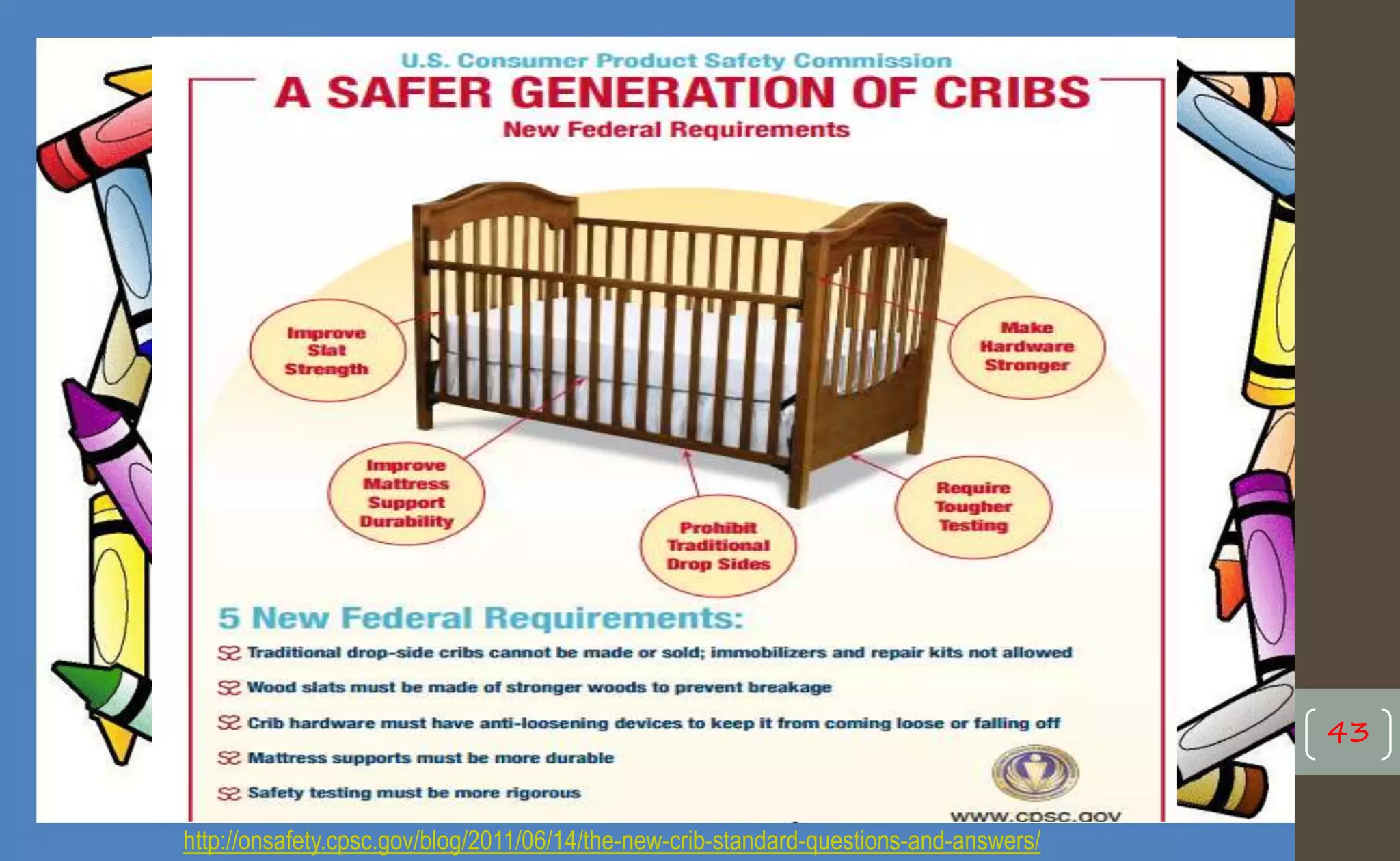
Crib Safety
• Distances between slats ≤ 2-3/8 inches wide
• No drop side rails
• Minimal gap (less than 2 fingerbreadths) between crib mattress and
interior of the crib
• Lead-free paint, no decorative enhancements, no elevated
cornerposts, child-proof latches
• Position crib at least 3 inches away from drapes, ribbons, blind
cords, and decorative wall hangings
• http://www.thebabydepartment.com/nursery/crib-safety-
standards.aspx 42
43
http://onsafety.cpsc.gov/blog/2011/06/14/the-new-crib-standard-questions-and-answers/
Apparent Life-Threatening Event (ALTE) (former term)
Brief Resolved Unexplained Event (BRUE) (recommended term)
(pp. 481-482 [new]; 527-528 [old], Ball & Bindler)
• Event that is frightening to the observer
• Infant younger than 1 yr
• Sudden, brief, less than 1 minute
• At least one of the following:
• Tone: Marked hypo- or hypertonia
• Respirations: Absent (apnea), decreased, or irregular
• Altered level of responsiveness
• Color: Cyanosis, pallor, or erythema
• Syndrome with a broad range of possible underlying causes
• Prematurity, GERD, pertussis, lower respiratory tract infections, sepsis, seizure, urinary tract
infection, child abuse/ Munchausen Syndrome by Proxy, miscellaneous
• Tx: thorough history of the event and careful physical examination, diagnostics, in-hospital
observation (to determine and then treat underlying cause); home cardiorespiratory monitor
44
See Home Care Instructions for the Infant Requiring a Cardiorespiratory Monitor (p. 482 [new], 528 [old])
45
Nutrition
• Utmost importance for growth
and development
• Breast milk or commercially
prepared formulas: foundation of
nutrition throughout infancy
• Calorie needs: 95-110
kcal/kg/day
• Fluid needs: 100 ml/kg/day
• Output: At least 6 wet
diapers/day
46
Breastfeeding
(pp. 601-624, Lowdermilk)
• Breastfeeding
• Very important for infant health
• Recommended over formula
• Easier to digest, natural antibodies, less expensive
• Breastfed infants
• Gain less weight than bottle-fed infants
• Less chance: otitis media, obesity, NEC, type II DM, & cardiovascular
disease
• Contraindicated: Galactosemia; mother substance abuser,
taking certain prescribed drugs, has untreated active TB, or is
infected with human immunodeficiency virus (HIV)
47
48
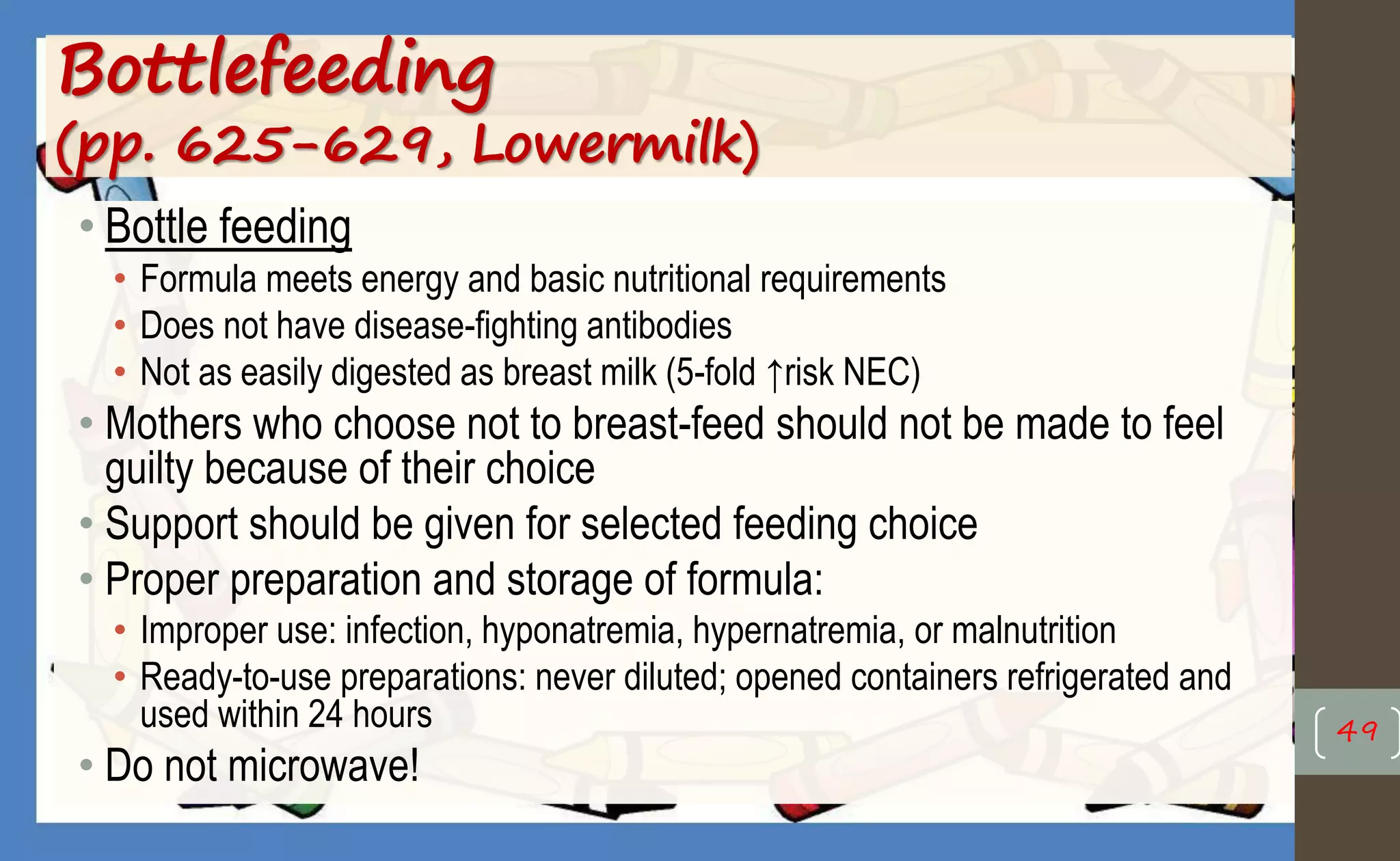
Bottlefeeding
(pp. 625-629, Lowermilk)
• Bottle feeding
• Formula meets energy and basic nutritional requirements
• Does not have disease-fighting antibodies
• Not as easily digested as breast milk (5-fold ↑risk NEC)
• Mothers who choose not to breast-feed should not be made to feel
guilty because of their choice
• Support should be given for selected feeding choice
• Proper preparation and storage of formula:
• Improper use: infection, hyponatremia, hypernatremia, or malnutrition
• Ready-to-use preparations: never diluted; opened containers refrigerated and
used within 24 hours
• Do not microwave!
49
50
Abnormal Growth Patterns 2°
Nutritional Issues
Adding cereal to the formula increases caloric
value and can result in infantile obesity
51
Non-Organic Failure to Thrive - Lengthisusually
preservedinthesechildren,unlessseveredeprivation
Weaning and Solid Food Introduction
(Table 14-1, p. 284 [new], 317 [old])
• Weaning (6 to 12 months):
• NOT during stress; gradual: replacing one feeding at a time
• Solid Foods (4 to 6 months):
• Ready: can sit, extrusion reflex gone, can reach for objects and bring to mouth, can indicate
desire or refusal for food, and is able to safely move food to back of mouth and swallow
• Solids should be introduced one at a time in small amounts; wait at least 3 to 4 days before
introducing a new food; feed only from a spoon
• New recommendations: introduce peanut butter and other potential allergens at 4 to 6
months
• Any food, with the exception of honey and cow’s milk, can be introduced @ 4 to 6 months as long
as this is done one at a time to see if there is any reaction to each food
• It should be the right texture; make sure it is pureed
• Include ample amounts of fruits and vegetables
• Salt, sugar, and spices should not be added
• Food Allergies
• Abdominal pain, diarrhea, nasal congestion, wheezing, cough, vomiting, and rashes
52
53
54
Keep your sense of humor and enjoy watching
him make some tasty discoveries!
Caution
• Cow’s milk—not recommended until 12 months of age
• Inadequate iron & linoleic acid; excessive sodium, phosphorus, & protein
• May cause kidney problems, digestive problems (GI bleeds), dehydration,
iron-deficiency, and allergies
• Avoid honey until at least 1 yr of age
• Infants cannot detoxify clostridium botulinum spores sometimes present in
honey – can lead to infant botulism
• AVOID hard & small food items: hot dogs, chunks of meat or cheese, hard
candy, raw vegetables or fruit chunks, whole grapes, raisins, seeds, nuts,
popcorn, peanut butter, chewing gum, lollipops, and marshmallows -
choking hazard 55
Risk for Aspiration
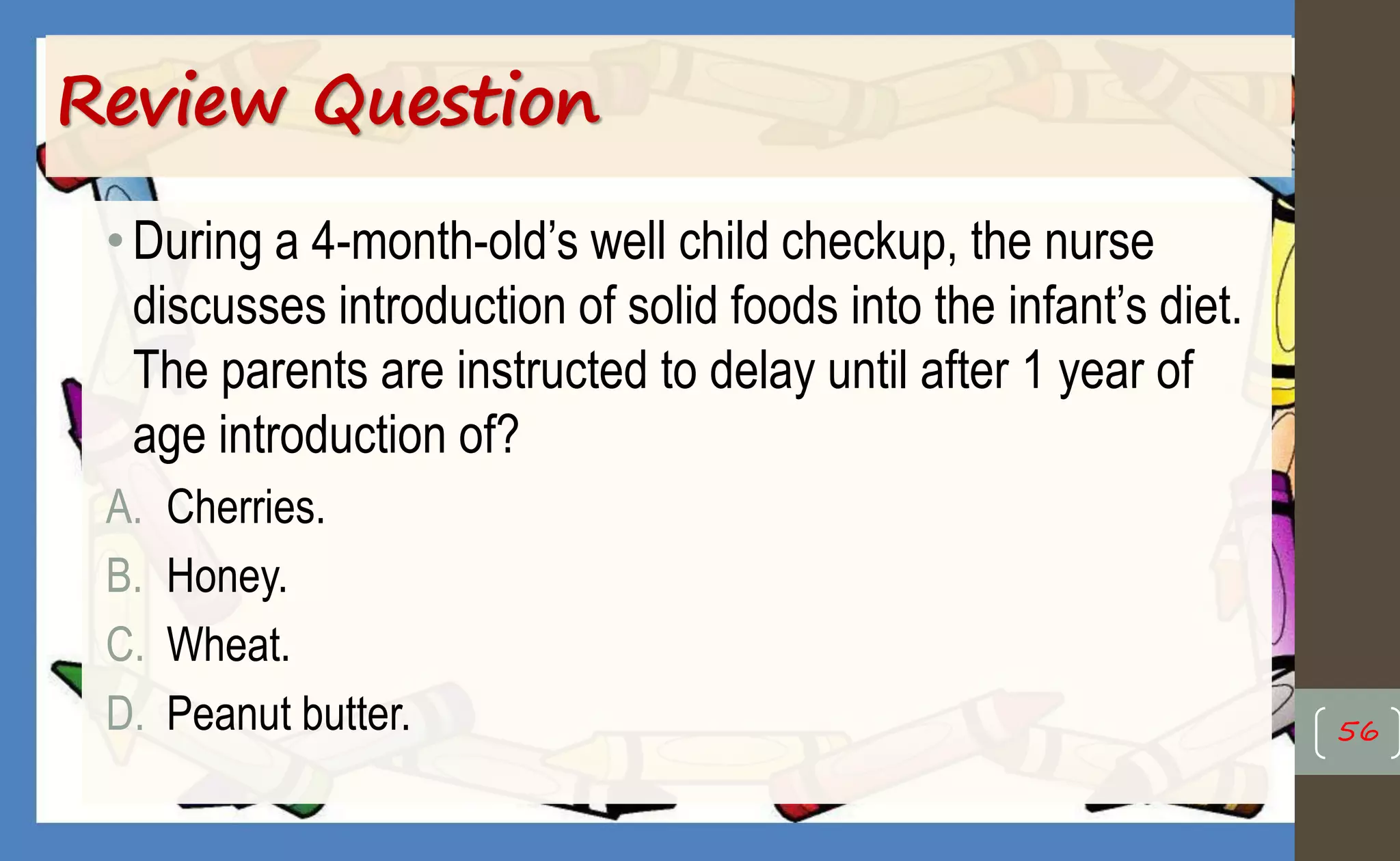
Review Question
•During a 4-month-old’s well child checkup, the nurse
discusses introduction of solid foods into the infant’s diet.
The parents are instructed to delay until after 1 year of
age introduction of?
A. Cherries.
B. Honey.
C. Wheat.
D. Peanut butter. 56
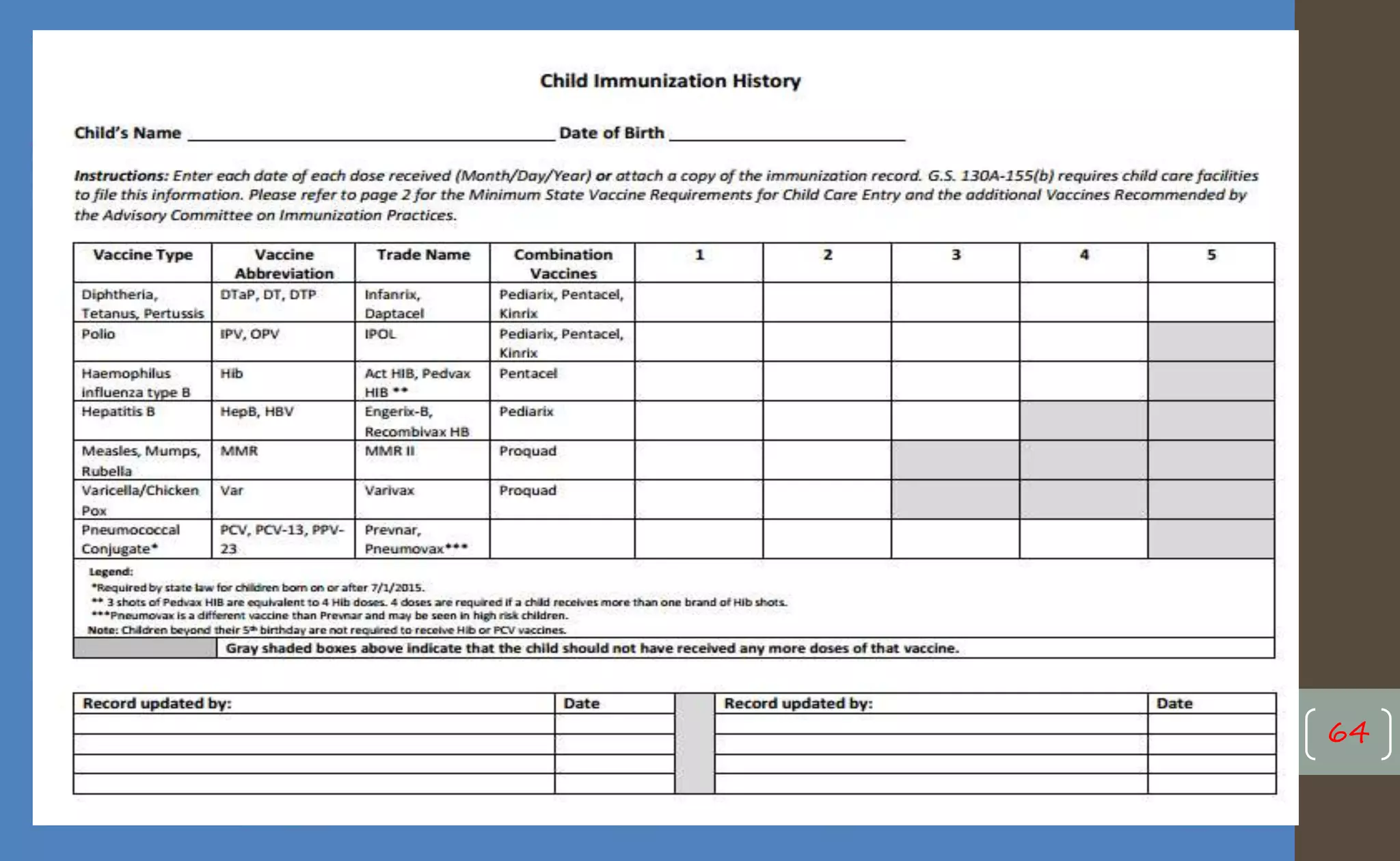
Immunizations
• Check CDC National Immunization Program site for up-to-date information:
• http://www.cdc.gov/vaccines/parents/index.html
• Informed consent
• Document: vaccine name, date of administration, expiration date, manufacturer & lot
number, administration site (anatomical), route, VIS publication date, name/ initial
• Contraindications: severe allergic reaction (anaphylaxis), immunodeficiency, known
allergy to a vaccine component, encephalopathy
• Common side effects: redness or soreness at the site and a mild, low-grade fever
• Give liquid acetaminophen (Tylenol) or ibuprofen—do not give aspirin to a pediatric
patient under age 18 during episodes of fever-causing or viral illnesses (risk of Reye
Syndrome)
57
58
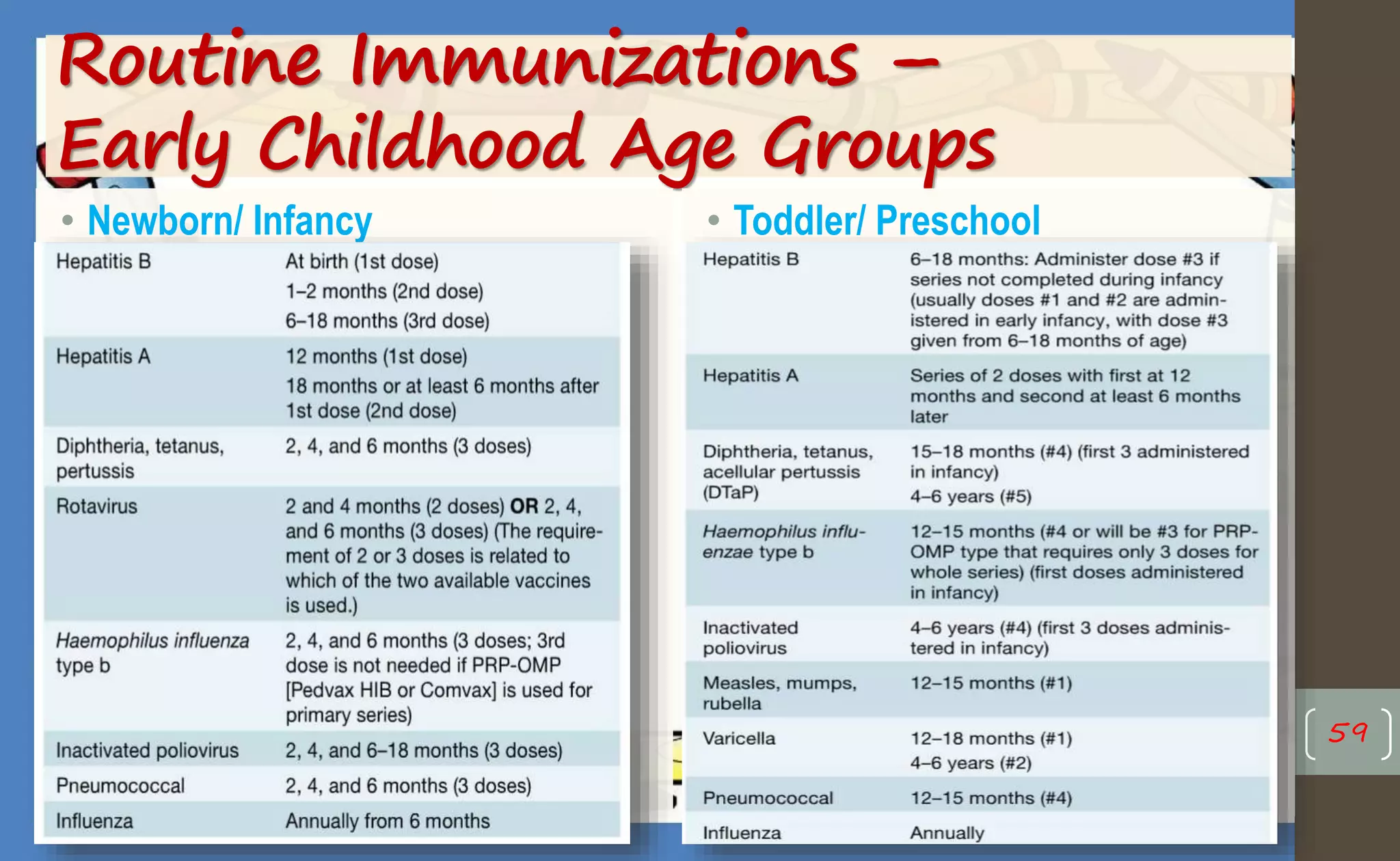
Routine Immunizations –
Early Childhood Age Groups
• Newborn/ Infancy • Toddler/ Preschool
59
61
Immunizations –> Substantially reduced child mortality and morbidity
62
Review Question
• Which of the following sets of injections is typically given
at the 4-month checkup?
•A. DTaP, Hib, RV, IPV, PCV, and Hep B
•B. DTaP, RV, IPV, PCV, and Hep B
•C. DTaP, Hib, RV, IPV, and PCV
•D. DTaP, MMR, PVC, varicella, and Hep A
63
64
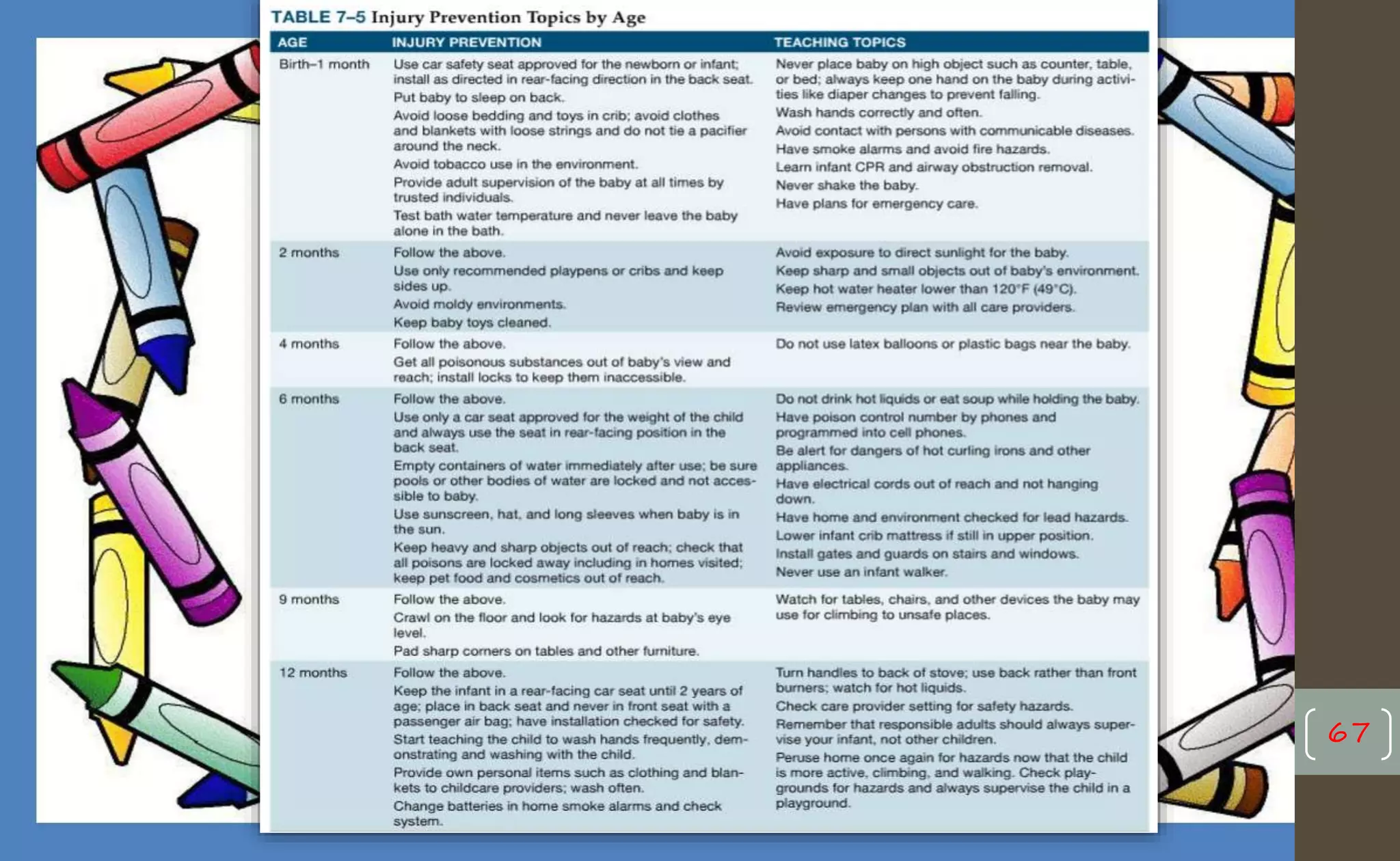
Safety
(REVIEW pp. 162-163 [new], 182-185 [old], Ball & Bindler)
• Accidental injury: The fifth leading cause of death during infancy
• Common causes: Suffocation and aspiration of small objects, motor vehicle crashes,
drowning, fire/ burns, poisoning, and falls (p. 7)
• Prevent asphyxiation—asphyxiation (suffocation) occurs when air cannot get into
or out of the lungs and oxygen supplies are depleted
• Choking: major concern in infancy and toddlerhood
• Keep small objects out of reach
• Cut food into small pieces; don’t let them have hard candy
• Substances or objects aspirated into airway
• Partial or complete obstruction of the lungs
• Strangulation: constriction of the neck; also blockage of nose & mouth by airtight
material
• All plastic bags or covers kept out of the infant’s reach
• NO latex balloons
65
Safety Cont’d….
• Burn safety—Temperature settings on hot water heaters <
120 F. Test bath water with back of wrist. Turn cooking
handles toward the back of the stove. Cover outlets
• Prevent falls by restraining straps in high chairs. Never leave
baby unattended on a changing table or other high surface, not
even for a second. Infants begin to roll over by themselves as
early as 2 months of age. Fence all stairways
66
67
Toddler
(Chapter 8, Ball & Bindler)
68
Toddler: 12-36 mos (1-3 yrs)
• Struggle for autonomy: develops sense of self separate from parent
• Growth slacks off: growth spurts and lags (step-like growth curve)
• Anthropometric Measurements:
• Toddler's height: increased 50% since birth
• ~3 inches per year
• Toddler's weight:
• Triples birth weight by age 1
• ~5 pounds per year
• Quadruples birth weight by age 2
• Head circumference: at 12 mos, head = chest
• 24 months: chest greater than the head
• American Academy of Pediatrics: plot ≤ 2 yrs (anterior fontanel closed)
• Microcephaly, macrocephaly
• CDC Birth to 36 mos growth chart: Head circumference-for-age
69
Toddler: Vital Signs & Physical
Characteristics
• HR: 80-120
• Respirations: 20-30
• BP: 88/45 (BP estimate: systolic 80 + [ 2x age]; diastolic 2/3s systolic)
• Affected by fever, dehydration, respiratory illnesses and drugs
• Measure BP at every provider’s office visit
• Physical Characteristics:
• Brain growing rapidly (good nutrition essential): 80% adult size by 2 yrs
• Whole milk (3.5%) until age 2, then 2% milk (need fat for brain development)
• Nervous system: continues to myelinate; fine motor control is refining
• Muscle tissue replacing adipose tissue (baby fat) present during infancy
• Gaining physical strength and ability
• Motor Development
• Gross Motor: refer to chart
• Fine Motor: refer to chart
70
Review Question
• A mother of a 15-month-old brings her son to the clinic. While
doing a nursing assessment, the mother makes the following
comments. Which comment merits further investigation by the
nurse?
A. “My son cries sometimes when I leave him at his
grandparent’s house.”
B. “My son always takes his blanket with him.”
C. “My son is not crawling yet.”
D. “My son likes to eat mashed potatoes.” 71
Toddler: Play & Language
• Parallel Play:
• Gross Motor:
• Ride-on toys; push and pull toys
• Fine Motor:
• Crayons--with supervision
• Tasks: fine & gross motor development
• Language (refer to chart): ability
developing rapidly
• RECEPTIVE SPEECH before
EXPRESSIVE SPEECH
• Tantrums (pp. 172-173 [new],193-194 [old]) 72
Review Question
•Which of the following play activities would be
appropriate for the toddler?
•A. Musical mobile above bed
•B. Rattle
•C. Jigsaw puzzle
•D. Wagon
73
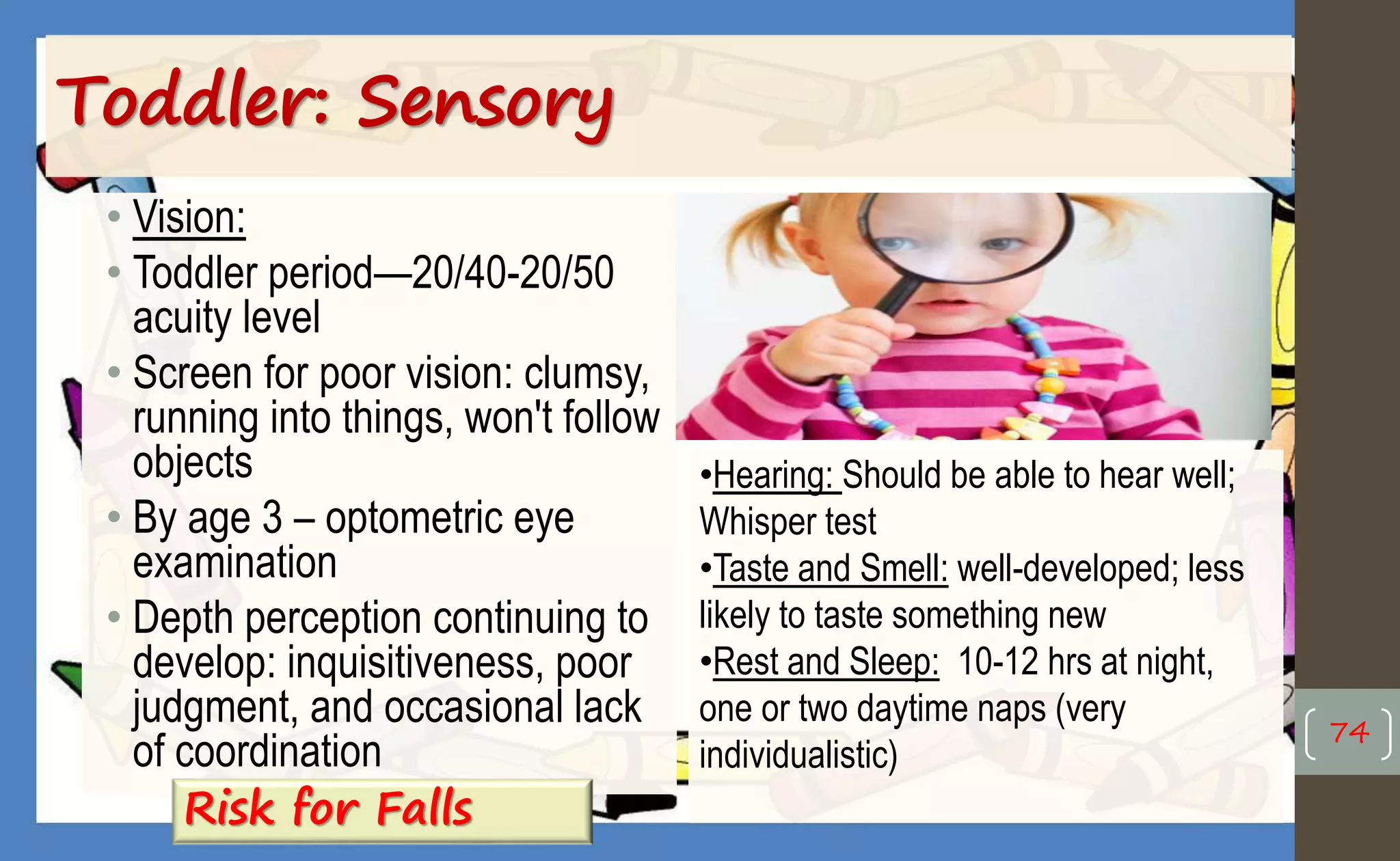
• Vision:
• Toddler period—20/40-20/50
acuity level
• Screen for poor vision: clumsy,
running into things, won't follow
objects
• By age 3 – optometric eye
examination
• Depth perception continuing to
develop: inquisitiveness, poor
judgment, and occasional lack
of coordination
Toddler: Sensory
74
•Hearing: Should be able to hear well;
Whisper test
•Taste and Smell: well-developed; less
likely to taste something new
•Rest and Sleep: 10-12 hrs at night,
one or two daytime naps (very
individualistic)
Risk for Falls
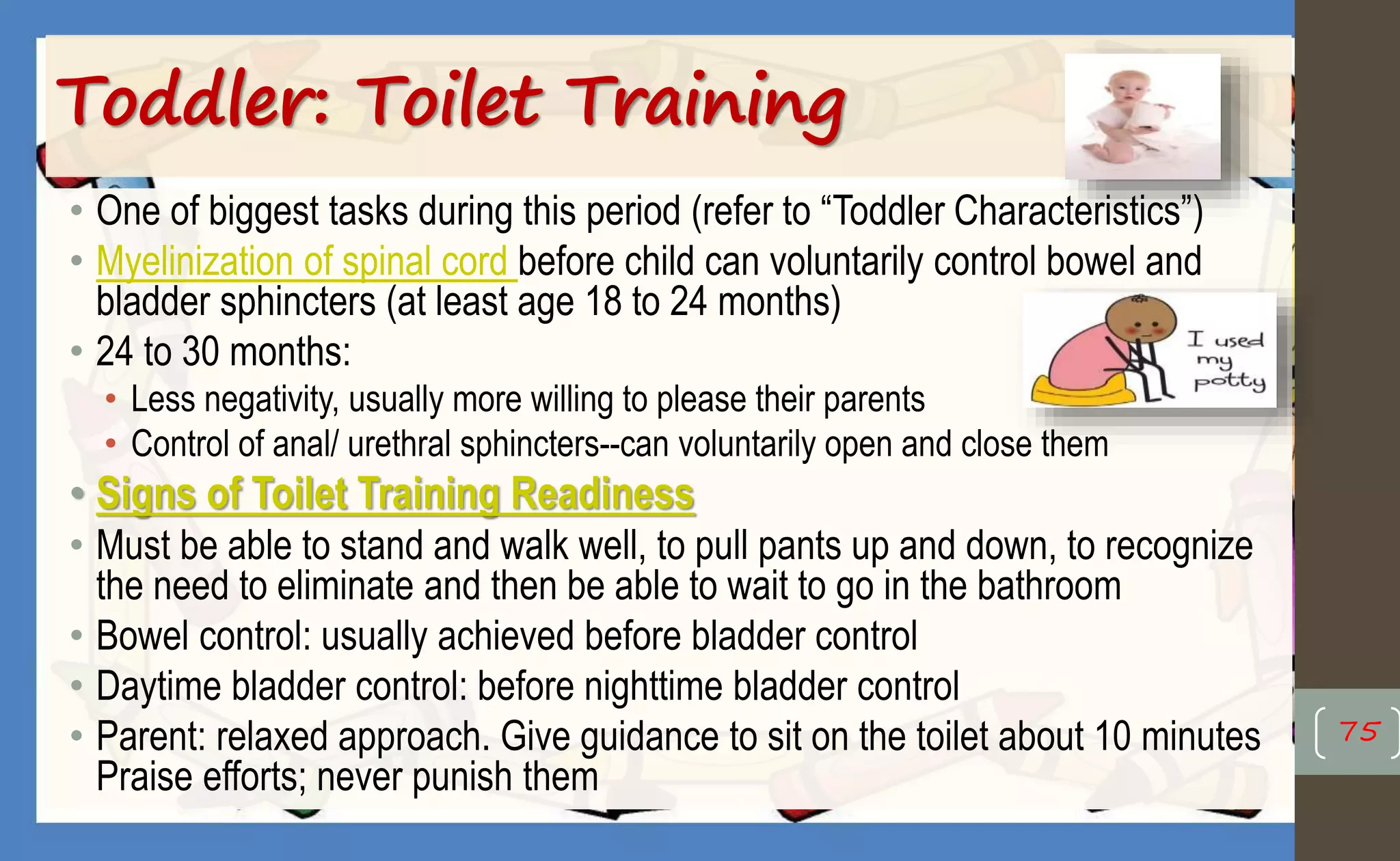
Toddler: Toilet Training
• One of biggest tasks during this period (refer to “Toddler Characteristics”)
• Myelinization of spinal cord before child can voluntarily control bowel and
bladder sphincters (at least age 18 to 24 months)
• 24 to 30 months:
• Less negativity, usually more willing to please their parents
• Control of anal/ urethral sphincters--can voluntarily open and close them
• Signs of Toilet Training Readiness
• Must be able to stand and walk well, to pull pants up and down, to recognize
the need to eliminate and then be able to wait to go in the bathroom
• Bowel control: usually achieved before bladder control
• Daytime bladder control: before nighttime bladder control
• Parent: relaxed approach. Give guidance to sit on the toilet about 10 minutes
Praise efforts; never punish them
75
Signs of Toilet Training Readiness
76
Toddler: Psychosocial Development
• Erickson: Autonomy vs shame and doubt
• Autonomy--wanting to be in control. Conflict. Give them choices that are
appropriate
• Freud: Anal stage. Best example is toilet training; as their sphincters
become mature, they can assert control, autonomy over the bowel
• Moral development: Don’t know “right from wrong”
• No formed conscience: avoids punishment by controlling his or her behavior
• Right and wrong are determined by the consequences of actions
• Negativism: refer to "Toddler Characteristics”
• Temper tantrums--refer to "Toddler Characteristics;” p. 172 [new], 193 [old]
• Ritualism: refer to "Toddler Characteristics" 77
Toddler
• Separation anxiety (15-18 mos):
• Peaks in the toddler period
• Stressful: Inform child honestly and clearly about a separation
shortly before it occurs
• Parallel Play:
• Plays alongside, but not with, other children
• Egocentric, shamelessly aggressive
• Lacks cognitive/ social skills for interacting or playing well with
others
78
Toddler
• Discipline:
• Role modeling (guiding behavior), ignoring, and/ or time out (placing
the child in a nonstimulating environment)
• Key ingredients: consistency, loving, immediate, realistic and age-
appropriate
• See Families Want to Know: Positive Discipline (p. 172 [new], 193 [old])
• Sibling rivalry:
• Make older child feel important, involved in care of younger sibling
• Safety is concern
• Constant supervision: Child < 3-1/2 yrs should never be left alone with infant 79
80
Toddler: Discipline
81
Medina, J.J. (2014). Brain rules for baby. Pear Press: Seattle, WA.
Toddler Sensorimotor Phase, 1-2 yrs
(pp. 69-72 [new], 82-83 [old], Ball & Bindler)
• Learning by physical trial and error; imitate older children and adults
• Using all senses to explore environment; starting to think before
acting
• Rudimentary awareness of cause/ effect
• Rudimentary awareness of spatial relationships
• Object permanence--well established by toddler age
• Domestic mimicry--a toddler at this stage is often seen imitating the
parent of the same sex, performing household tasks
82
Toddler Preoperational Phase, 2-4 yrs
(p. 72 [new], 83 [old], Ball & Bindler)
• ↑Understanding time and space
• ↑Use of language
• Mental trial and error rather than physical
• Problem solving based on what they see or hear
• Egocentrism: views everything in relation to self; unable to consider another's point of
view
• Transductive reasoning: reasoning from one particular fact or case to another similar
fact or case; unrealistic understanding cause-and-effect
• Magical thinking: feels extremely powerful; believes thoughts or wishes cause events to
happen
• Animism: believes that inert objects such as stuffed animals are alive and have wills of
their own
• Centration: ability to consider only one aspect of a situation at a time
• Irreversibility: cannot see a process in reverse order
83
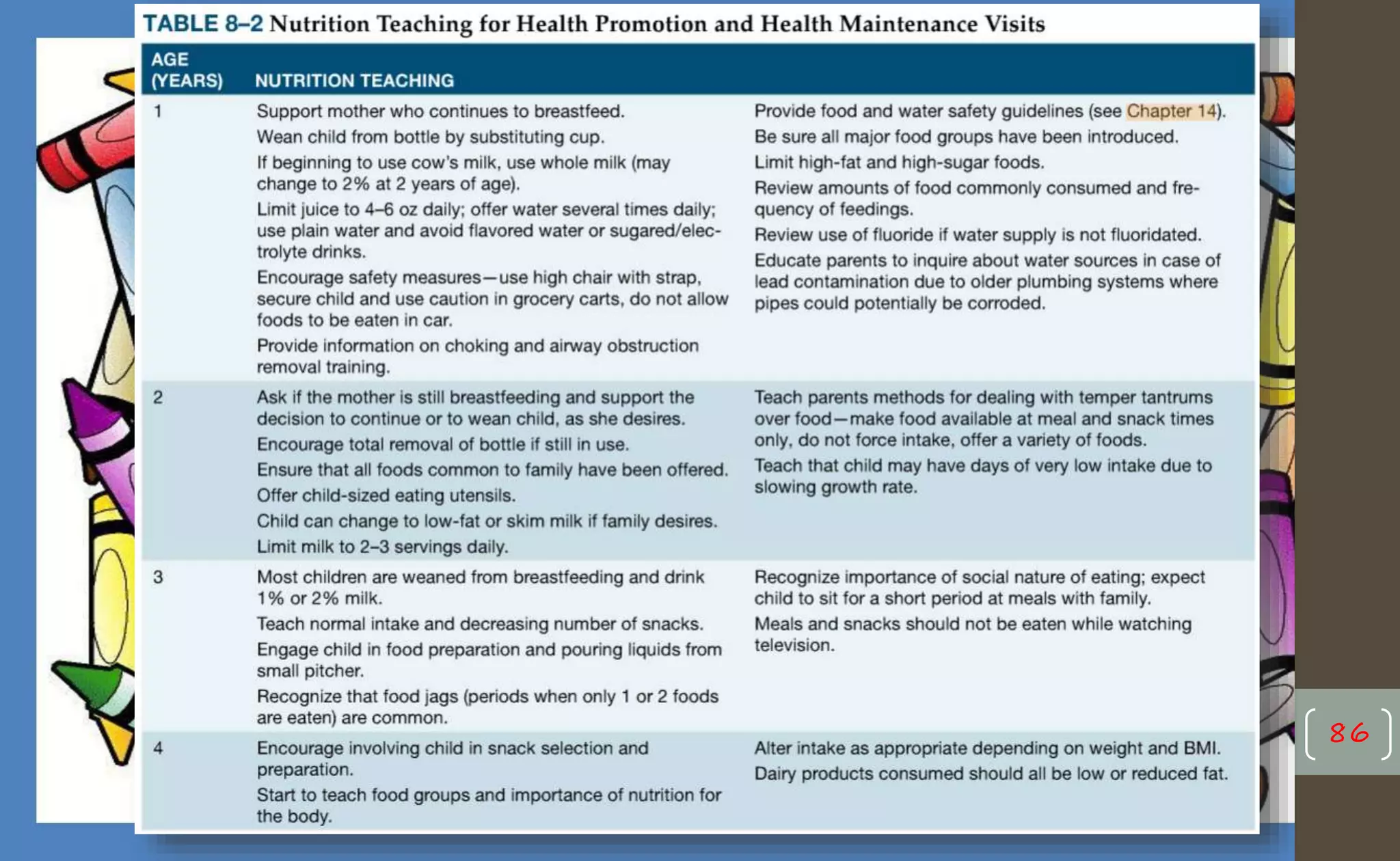
Toddler: Nutrition (p. 266 [new], 316 [old])
• Rate of growth/ appetite slows: "Physiologic Anorexia"
• Calorie requirements: 1300 calories/day (~ 100 kcal/ kg/ day)
• Prone to anemia
• Well-balanced meals. Small/ more frequent feedings. Allow healthy, nutritious
choices
• Avoid junk foods, non-nutrient foods, concentrated sweets, fats, fast foods
• Food jags: fixate on one food and want that food for an extended period of
time; usually passes with time
• Environment: sitting at table with family, minimal distractions (NO TV)
• Rest period before meal time to help increase appetite
• Do not give snacks to the child before meals
84
Toddler: Nutrition
• 2-3 servings milk group daily
• After 2 yrs, low-fat (2%) milk
• Milk intake: limit to 2 - 3 cups/day; can lead
to deficiencies (especially iron-deficiency
anemia)
• Limit juice: 4-6 ounces/ day
• If the toddler is overweight (85%-95% BMI)
or obese (>95% BMI), don't restrict calories.
Instead, promote a healthy diet and
encourage regular physical activity. Cut
down on portion sizes, and don't offer too
much milk, juice, or high-calorie snacks
85
86
87
Infant/ Toddler Dental Care
(pp. 116, 171-172 [new]; 133; 316 [old], Ball & Bindler)
• Deciduous teeth:
• Age 6-10 months: Eruption of first teeth
• 12 months: 6-8 teeth
• No teeth eruption by 12 months - think endocrine disorder
• Teething: cool liquids, cold teething rings, gentle gum massage
• Dental hygiene—use a soft washcloth
• Nonfluoridated toothpaste for children under age 2 (sodium fluoride is a potent
poison)
• Ages 2-5 yrs: pea-sized amount of fluoridated toothpaste per day, don’t allow to
swallow (must be carefully supervised)
• Fluoride drops (0.25 mg) recommended > 6 mos (with unfluoridated water)
• Dental fluorosis white spotted, yellow or brown stained and sometimes crumbly
teeth
88
Deciduous Teeth Timeline
(p. 118 [new], 133 [old])
89
The first teeth begin to break through the gums at about 6 months of age. Usually, the
first two teeth to erupt are the two bottom central incisors (the two bottom front teeth).
Next, the top four front teeth emerge. After that, other teeth slowly begin to fill in,
usually in pairs -- one each side of the upper or lower jaw -- until all 20 teeth (10 in the
upper jaw and 10 in the lower jaw) have come in by the time the child is 33 months old.
Infant/ Toddler Dental Care
• 33 months old: complete set of 20 baby teeth (deciduous teeth)
• Healthy teeth:
• Diet: low in sweets (especially sticky sweets), high in nutritious foods
• Enough dietary calcium
• Taking care of teeth by brushing:
• By parent or parent-supervised, after each meal and at bedtime
• Soft bristle nylon brush or washcloth
• Flossing
• Prevent bottle caries (early childhood caries) or middle ear infections (otitis media):
• Wean from the bottle at one year
• Don’t allow the bottle (or sippy/ tippy cup!) in bed
• Bottle of juice or formula should never go to bed with the infant
• First dental visit 6 months after first primary tooth erupts, or no later than 1 yr
of age; once or twice yearly afterwards
90
Early Childhood Caries
(“Baby Bottle Caries”) (p. 171 [new], 192 [old])
• One or more decayed, missing, or filled teeth
in children ages 71 months or younger
• 28% of young children
• Complications: abscess formation; need for
multiple teeth extractions
• Referrals: periodontics, orthodontics, oral surgery
• Painful, can hinder speech, delay development
• 19% experience interference with play, 32%
with school, 50% with sleeping, and 86% with
eating
• Tx: extraction of teeth under general anesthesia
(“Total Mouth Rehabilitation”)
• Prevention: Good oral hygiene practices;
avoid sweets; do NOT take bottle, sippy/
tippy cups to bed
91
Infant/Toddler: Car Safety
(p. 162, 176 [new]; 183, 197 [old])
• Car: Door locks
• Safety seats: http://www.buckleupnc.org/occupant-
restraint-laws/child-passenger-safety-law-summary/
• Children < 5 yrs, < 40 lbs restrained
in back seat (preferably center)
• Rear-facing child restraints for
children for a MINIMUM of 2 yrs &
reaches the highest weight/ height
allowed in the car seat
• When children outgrow rear-facing
seats: forward-facing car seats with
5-point harnesses until they reach
the upper weight or height limit of the
seat
92
Forward-facing (FF)
“toddler” / “combination”
seats are used only in the
forward-facing direction
and never for a child who
weighs less than 20 lbs or
is less than 2 yrs of age.
FF car seats generally fit a
child who weighs 20-40 lbs
or more and up to 40” tall.
Infant in Rear-Facing Only Car Seat
93
Infant seats can ONLY be used rear-facing
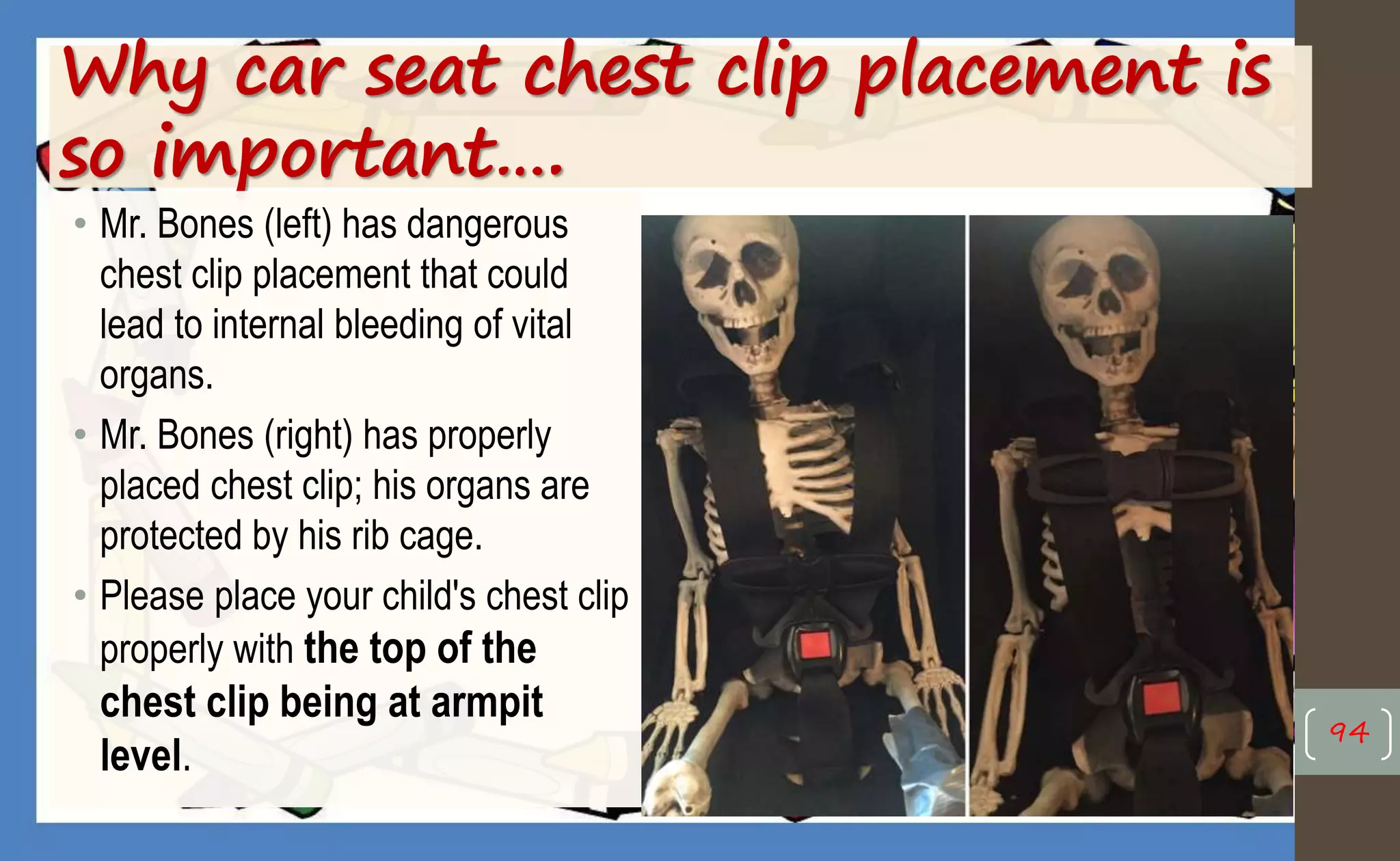
Why car seat chest clip placement is
so important….
• Mr. Bones (left) has dangerous
chest clip placement that could
lead to internal bleeding of vital
organs.
• Mr. Bones (right) has properly
placed chest clip; his organs are
protected by his rib cage.
• Please place your child's chest clip
properly with the top of the
chest clip being at armpit
level.
94
Or more precisely, in the middle of the sternum. The retainer clip is designed to keep the
straps parallel over the torso in a crash. Too low and the child could be ejected from the
seat in a crash; too high and the child could suffer a neck injury. Line it up with the top of
the child’s armpits, and it’ll be just right every time!
95
Make sure the harness is snug and
the clip is at axillary level and not
across the infant’s neck or abdomen.
Toddler Safety
(pp. 175-176 [new]; 196-197 [old], Ball & Bindler)
• Fire and burns:
• No dangling cords from irons or
other small appliances
• Keep away from open fires and
heaters
• Electrical outlet covers
• Turn handles in on top of stove
• Water heaters 120 or less
• Preventing falls:
• Stairway gate
• Locks on doors and windows;
guards over screened windows
96
Toddler Safety
(pp. 175-176 [new]; 196-197 [old], Ball & Bindler)
• Water safety:
• NEVER leave a child alone in water (can drown in 1” of water)
• Preventing poisoning:
• Locks on cabinets; child-resistant containers;
• “Mr. Yuk” stickers, Poison Control Center number by every telephone
(800-222-1222)
• Firearm safety:
• Keeping guns locked up and unloaded
97
98
Toddler: Poisons
(pp. 175, 395-400 [new]; 433-436; 437-438 [old], Ball & Bindler)
• Poisoning – Ingestion of or exposure to toxic substances
• Children < 6 yrs more at risk due to developmental level
• Toddlers lack cognitive ability to know what is dangerous; caretakers need
to be on guard
• Most poisonings occur in the child’s home or homes of relatives or friends
• Most is oral ingestion: medications, household chemicals, cosmetics,
plants, and heavy metals
• Common toxic substances ingested by children include acetaminophen,
ibuprofen, aspirin, iron, hydrocarbons, corrosives, and/or lead
• Grandma’s purse: One pill can kill
99
Toddler: Poisons
• Primary prevention is key: Avoiding Childhood Poisoning (p. 398 [new]; 436 [old])
• Keep medicines, vitamins and household products out of sight and
reach—locked is better than high
• NO syrup of Ipecac; call Poison Control Center (800-222-1222) or 911
• Decontamination strategies (Emergency Department): reverse toxicity by
giving an antidote (e.g., N-acetylcysteine, glucagon, naloxone); gastric
lavage (with life-threatening ingestions and within 60 minutes of ingestion;
must protect patient’s airway); gastric decontamination with activated
charcoal (1 g/ kg; often requires placement of NG tube); whole bowel
irrigation (prevents further absorption of sustained-release medications) 100
See “Clinical Manifestations: Commonly Ingested Toxic Agents,” p. 396 (new); 435 (old)
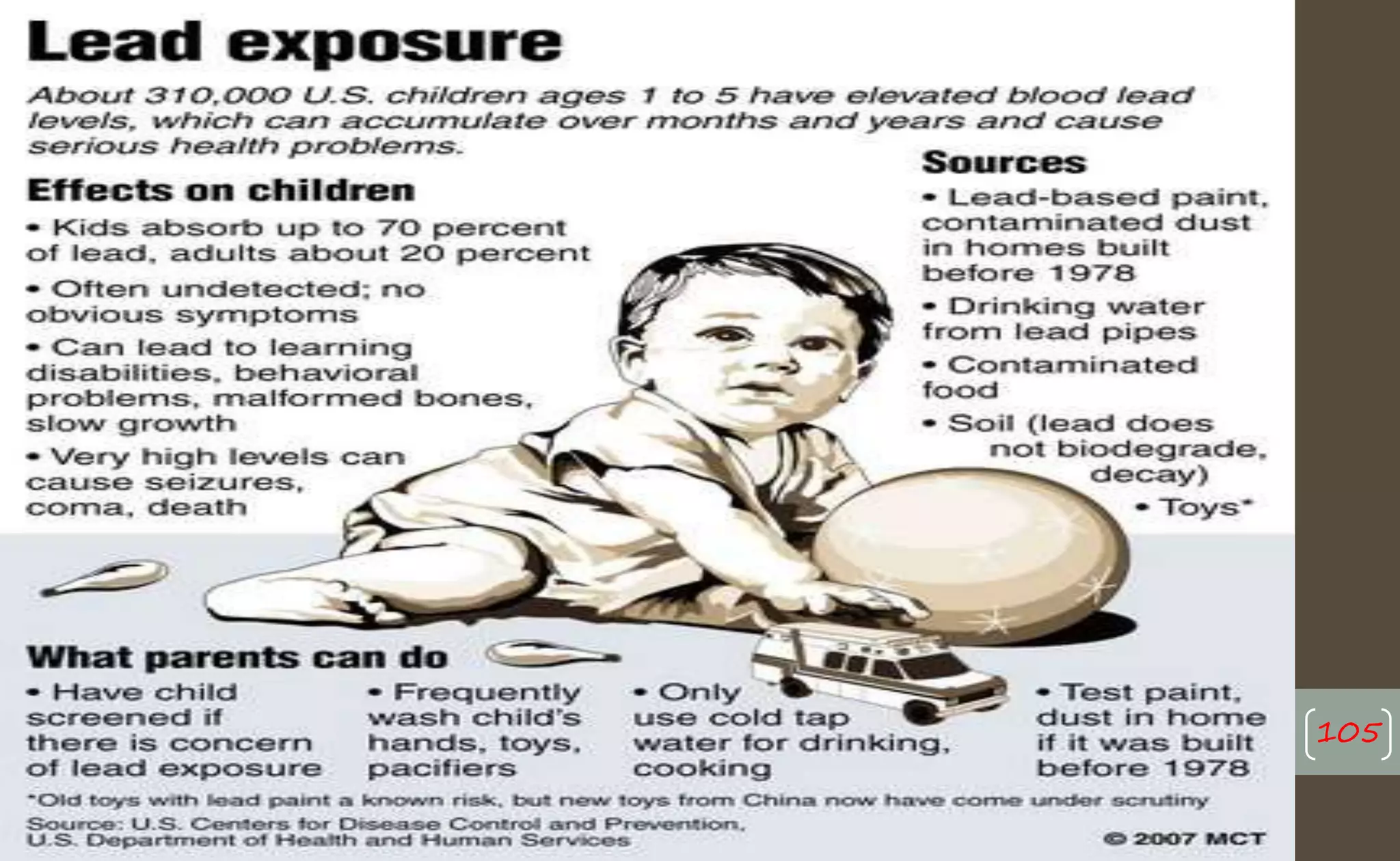
Lead Poisoning
(pp. 399-400 [new]; 437-438 [old], Ball & Bindler)
• Ingestion, inhalation, or absorption through skin
• Primary source: deteriorating lead-based paint (structures built before 1978;
old toys/ from China, jewelry, and furniture coated with lead paint)
• Most harmful to children under the age of 6
• Lead affects every system of the body, ESPECIALLY the rapidly developing brain
and nervous system (causes irreversible CNS damage)
• Lead stored in the bones/ teeth; very difficult to remove from body (lead lines on
bones; blue-black gum lines)
• S/S: learning disabilities, developmental delays, decreased IQ scores, behavioral
problems (e.g., attention deficit hyperactivity disorder [ADHD], oppositional/conduct
disorders, & delinquency), seizures, hearing loss, malformed bones, slowed body
growth, loss of appetite, digestive issues, and kidney damage
• Anemia: lead interferes with the production of hemoglobin (↓ H & H) 101
102
Potential Sources of Lead
•Because the harm from lead
is irreversible, primary
prevention efforts that identify
and reduce or eliminate lead
hazards in children’s
environments before they are
exposed are critical
•Name sources of lead and
how these can be avoided 103
Lead Poisoning
(pp. 399-400 [new]; 437-438 [old], Ball & Bindler)
• Screening: 12 & 24 mos, or between 3-6 yrs
• Chelation therapy:
• Binds with lead, removes it from the blood (through urine and stool)
• Oral/ IV; dose/type depends on blood lead level (BLL)
• Edetate Calcium Disodium (CaNa2EDTA), dimercaprol (BAL), 2,3
Dimercaptosuccinic Acid (DMSA), penicillamine
• Many repeated doses required
• Long-term follow-up essential
• Remove lead hazards in child’s environment 104
105
106

Health promotion of the infant &amp; toddler fall 2017

  • 1.
    Health Promotion of TheInfant and Toddler Joy A. Shepard, PhD, RN-C, CNE Joyce Buck, PhD(c), MSN, RN-C, CNE 1
  • 2.
    Objectives • Recognize majordevelopmental milestones • Describe the role of play • Describe and plan nursing interventions to meet nutritional needs • Identify major health concerns • Apply communication skills according to the child’s developmental level • Use anticipatory guidance to promote positive parenting, child safety, and prevent injury 2
  • 3.
    Nursing Diagnoses • Readinessfor Enhanced Knowledge • Readiness for Enhanced Parenting • Readiness for Enhanced Immunization Status • Readiness for Enhanced Family Coping • Deficient Knowledge • Ineffective Family Therapeutic Regimen Management • Ineffective Infant Feeding Pattern • Risk for Aspiration • Risk for Electrolyte Imbalance • Risk for Infection • Risk for Injury • Risk for Falls • Risk for Delayed Development • Risk for Sudden Infant Death Syndrome • Risk for Poisoning 3
  • 4.
    Review: Developmental AgeGroups (pp. 68 [new]; 81-82 [old], Ball & Bindler) •Neonate: First 28 days of life •Infancy: Birth to 1 year •Toddler: 1 to 3 years •Preschooler: 3 to 6 years •School-ager: 6 to 12 years •Adolescent: 12 to 18 years
  • 5.
    Normal Infant Reflexes (pp.541-544, Lowdermilk text) 5
  • 6.
  • 7.
    Sucking Reflex (p. 541,Lowdermilk) •Essential for normal life •Sucks on anything placed in mouth •Well-coordinated with swallowing by 32 – 34 weeks of gestation •Disappears by 1 year 7
  • 8.
    Rooting Reflex (p. 541,Lowdermilk) 8 • Lightly stroke cheek, infant turns towards stimuli, then opens mouth • Response helps infant find nipple for feeding • Reflex stronger when infant hungry • Disappears @ 3-4 months
  • 9.
    Palmar Grasp Reflex (p.541, Lowdermilk) •Occurs when infant’s palm is touched near base of fingers •Hand closes in tight fist •Disappears by 3-4 months 9
  • 10.
    Plantar Grasp Reflex (p.541, Lowdermilk) •Similar to the palmar grasp reflex •Infant’s tendency to curl toes downward over finger when sole of foot is touched •Disappears by 8 months 10
  • 11.
    Tonic Neck Reflex (p.541, Lowdermilk) • “Fencer’s position” • Posture assumed by infants in a supine position when head is turned to one side • The extremities on the same side extend • Flexion occurs on the opposite side • Disappears by 3-4 months 11
  • 12.
    Moro and Startle (p.542, Lowdermilk) • In response to sudden movement or loud noise • Arms and legs extend and the fingers fan outward, with the thumb and forefinger forming a C-shape • Most significant reflex • Disappears by 6 months 12
  • 13.
    Stepping (Walking) Reflex (p.542, Lowdermilk) •Newborns tend when held upright to take steps in response to feet touching a hard surface •Lift one foot and then the other •Disappears by 3-4 weeks 13
  • 14.
    Babinski Reflex (p. 543,Lowdermilk) Baby's toes fan with dorsiflexion of big toe **Disappears by 1 year** 14
  • 15.
    Positive vs NegativeBabinski Reflex 15
  • 16.
    Question •Which infant reflexcan help the new mother learn to breast-feed? • A. Tonic neck • B. Rooting • C. Palmar grasp • D. Moro 16
  • 17.
  • 18.
    Infancy (Chapter 7,Ball & Bindler) • Infancy: • Age birth to 1 year • Includes neonatal period (birth to 28 days) • Dramatic growth and change • Body systems immature • Risks r/t immature body systems: • More at risk for respiratory infection or aspiration (immature respiratory system tiny, collapsible airways) • More at risk for infection (immature immune system) • More at risk for fluid and electrolyte imbalances (immature renal system; cannot concentrate urine efficiently) 18
  • 19.
    Infancy • Vital Signs: •HR & respirations ↓; BP ↑(as infant gets older) • Growth and Development: • Best indication good health: steadily increasing growth • Measured by: height, weight, head circumference, and weight-for-length (BMI) • Plot anthropometric data on growth chart to see if growth pattern conforms to normal growth curves • ~As the child grows, the growth rate slows~ 19
  • 20.
  • 21.
    Infancy: Weight • Weight: •1st 6 months—5 – 7 oz (140-200 g)/ week • 6-12 monthsslows • 6 months—doubles birth weight • 12 months—triples birth weight 21
  • 22.
    Infancy: Height • Height: •1st 6 months1.5 cm per month • 6-12 months1 cm per month • At 12 monthslength increased by 50% (about 1 foot) 22
  • 23.
    Infancy: Head Growth •Head Growth: • When the baby is born, head slightly larger than chest • 1st 6 months1.5 cm per month • 6-12 months1 cm per month • 12 months—head circumference = chest circumference • Fontanels accommodate rapidly growing brain: • 2-3 months: posterior fontanel closes • 12-18 months: anterior fontanel closes 23
  • 24.
    Measurement of Head Circumference •Measuring tape that cannot be stretched • Securely and snugly wrap tape around widest possible circumference of head • Position tape just above eyebrows, above the ears, and around the biggest part of the back of the head (occiput) • Read measurement to nearest 0.1 cm 24
  • 25.
    Infancy: Body Systems •Neurologic System: • Brain growth very rapid during 1st yr of life: brain doubles in weight • Brain growth depends on nutrition • Without proper nutrition: developmental problems • Rapid growth: increased number of synapses, myelination • Cephalocaudal pattern • Primitive reflexes replaced by purposeful movement 25
  • 26.
    Infancy: Body Systems •Immune System: • Immature immune systems: Risk for Infection • Newborn with very little own immunity; passive immunity if breastfed • Breastfeeding decreases: ear, respiratory tract, GI, and urinary tract infections; diarrhea; sepsis • First year of life: infant develops own immunity • Immunizations: health promotion & disease prevention 26
  • 27.
    Infancy: Motor Development •Weight gain and muscle growth: increased control of reflexes, increasingly coordinated movement • Risk for Injury • Anticipatory guidance: prevent accidents • Milestones: screen for motor development problems • Expected MilestonesFine (purposeful use of hands and fingers) and Gross Motor: refer to chart 27
  • 28.
    Infancy: Cognitive Development •Piaget—Sensorimotor stage: birth to 2 years • From reflexive activity to purposeful acts • Egocentrism—Child at center of own little universe; views nothing but himself • Object Permanence: 9 months—Infant can locate object hidden from view • Play: • Enhances growth & development • Solitary play, but human interaction & stimulation very important • Make sure toys are age-appropriate 28
  • 29.
    Infancy: Language • Cries—firstattempt at communication • Distinguish normal from abnormal • High-pitched—usually neurological problem • Hearing and understanding (receptive speech) come before expressive speech • Language Developmental Milestones: refer to chart 29
  • 30.
  • 31.
    Infancy: Vision • Acuity:20/100 to 20/400 at birth. Focus on objects 8”-12" from face at birth (en face position) • Colors: High-contrast, primary colors • 6 months of age—able to distinguish pastel colors • Vision milestones: refer to chart • Can assess “PERRL” but NOT “PERRLA” – Accommodation (except with accommodative toys) 31
  • 32.
    Nystagmus & Strabismus (pp.447 [new]; 484; 490 [old], Ball & Bindler) • Young infants lack eye coordination • Transient nystagmus or strabismus normal variant until 4 months • Alignment of eye important due to correlation with brain development • Nystagmus: involuntary rapid eye movements • Treatment: eyeglasses, surgery of eye muscles • Strabismus: misaligned eyes • Treatment: Surgical correction, optometric vision training • Untreated: can lead to amblyopia (lazy eye) (p. 447 [new]; 519 [old]) 32 Normal: Reflections of light are symmetrical
  • 33.
    Infancy: Hearing •Acute atbirth; Mandatory newborn hearing screening •Hearing milestones: refer to chart 33
  • 34.
    Ear Exam Pinna ispulled down and back to straighten ear canal in children under 3 years. 34
  • 35.
  • 36.
    Infancy: Psychosocial • Erikson—Trustvs Mistrust • Foundation of personality; establish sense of trust • Related to feeding cycle • Freud—Oral stage: • Oral stimulation: source of pleasure and satisfaction • Parent-Infant Attachment: • One of most important features of psychosocial development • Critical for normal development and survival; infant is active participant • Stranger Anxiety: 6-7 mos; Infant cries, clings to parents, turns away from strangers • Separation Anxiety: 15-18 mos; inconsolable crying, distress, when parents are not present • Anticipatory guidance: health promotion, injury prevention 36
  • 37.
  • 38.
    Review Question •The pediatricRN would expect a 10-month-old infant to respond to the staff upon admission to the hospital in which manner? A. Outward hostility B. Frequent negativism C. Occasional jealousy D. Fear of strangers 38
  • 39.
    Infancy: Sleep (pp. 159-160[new];180 [old], Ball & Bindler) • Newborn to 3 mos: 10 – 16 hours/ day • Most infants begin to sleep for longer periods during the nights as they get older • Sleep patterns will be alternating the first year of life—sleep a lot at first, then not sleeping as much • Safe to Sleep Campaign—Helps prevent sudden infant death syndrome (SIDS) • Sudden, unexplained death of an infant younger than 1 yr old • Fourth leading cause of death in infants < 12 mos • “Safe to Sleep" campaign has reduced SIDS rate by 50% http://www.nichd.nih.gov/health/topics/sids/Pages/default.aspx 39 See Risk Factors for SIDS (Box 20-3), p. 483 [new]; 529 [old]
  • 40.
  • 41.
    Safe Sleep Environment (pp.483-485 [new]; 528-529 [old], Ball & Bindler) • Place infant on back to sleep, for naps and at night • Place infant on firm sleep surface (e.g., safety approved crib mattress with fitted sheet) • In parent’s room in a separate crib/ cradle/ bassinet (NOT sharing same sleeping surface) • NO soft surfaces (e.g., pillow, quilt, sheepskin, or a waterbed) • Keep soft objects out of infant’s sleep area • No pillows or “fluffy” items in the crib (“Bare is Best”) 41
  • 42.
    Crib Safety • Distancesbetween slats ≤ 2-3/8 inches wide • No drop side rails • Minimal gap (less than 2 fingerbreadths) between crib mattress and interior of the crib • Lead-free paint, no decorative enhancements, no elevated cornerposts, child-proof latches • Position crib at least 3 inches away from drapes, ribbons, blind cords, and decorative wall hangings • http://www.thebabydepartment.com/nursery/crib-safety- standards.aspx 42
  • 43.
  • 44.
    Apparent Life-Threatening Event(ALTE) (former term) Brief Resolved Unexplained Event (BRUE) (recommended term) (pp. 481-482 [new]; 527-528 [old], Ball & Bindler) • Event that is frightening to the observer • Infant younger than 1 yr • Sudden, brief, less than 1 minute • At least one of the following: • Tone: Marked hypo- or hypertonia • Respirations: Absent (apnea), decreased, or irregular • Altered level of responsiveness • Color: Cyanosis, pallor, or erythema • Syndrome with a broad range of possible underlying causes • Prematurity, GERD, pertussis, lower respiratory tract infections, sepsis, seizure, urinary tract infection, child abuse/ Munchausen Syndrome by Proxy, miscellaneous • Tx: thorough history of the event and careful physical examination, diagnostics, in-hospital observation (to determine and then treat underlying cause); home cardiorespiratory monitor 44 See Home Care Instructions for the Infant Requiring a Cardiorespiratory Monitor (p. 482 [new], 528 [old])
  • 45.
  • 46.
    Nutrition • Utmost importancefor growth and development • Breast milk or commercially prepared formulas: foundation of nutrition throughout infancy • Calorie needs: 95-110 kcal/kg/day • Fluid needs: 100 ml/kg/day • Output: At least 6 wet diapers/day 46
  • 47.
    Breastfeeding (pp. 601-624, Lowdermilk) •Breastfeeding • Very important for infant health • Recommended over formula • Easier to digest, natural antibodies, less expensive • Breastfed infants • Gain less weight than bottle-fed infants • Less chance: otitis media, obesity, NEC, type II DM, & cardiovascular disease • Contraindicated: Galactosemia; mother substance abuser, taking certain prescribed drugs, has untreated active TB, or is infected with human immunodeficiency virus (HIV) 47
  • 48.
  • 49.
    Bottlefeeding (pp. 625-629, Lowermilk) •Bottle feeding • Formula meets energy and basic nutritional requirements • Does not have disease-fighting antibodies • Not as easily digested as breast milk (5-fold ↑risk NEC) • Mothers who choose not to breast-feed should not be made to feel guilty because of their choice • Support should be given for selected feeding choice • Proper preparation and storage of formula: • Improper use: infection, hyponatremia, hypernatremia, or malnutrition • Ready-to-use preparations: never diluted; opened containers refrigerated and used within 24 hours • Do not microwave! 49
  • 50.
  • 51.
    Abnormal Growth Patterns2° Nutritional Issues Adding cereal to the formula increases caloric value and can result in infantile obesity 51 Non-Organic Failure to Thrive - Lengthisusually preservedinthesechildren,unlessseveredeprivation
  • 52.
    Weaning and SolidFood Introduction (Table 14-1, p. 284 [new], 317 [old]) • Weaning (6 to 12 months): • NOT during stress; gradual: replacing one feeding at a time • Solid Foods (4 to 6 months): • Ready: can sit, extrusion reflex gone, can reach for objects and bring to mouth, can indicate desire or refusal for food, and is able to safely move food to back of mouth and swallow • Solids should be introduced one at a time in small amounts; wait at least 3 to 4 days before introducing a new food; feed only from a spoon • New recommendations: introduce peanut butter and other potential allergens at 4 to 6 months • Any food, with the exception of honey and cow’s milk, can be introduced @ 4 to 6 months as long as this is done one at a time to see if there is any reaction to each food • It should be the right texture; make sure it is pureed • Include ample amounts of fruits and vegetables • Salt, sugar, and spices should not be added • Food Allergies • Abdominal pain, diarrhea, nasal congestion, wheezing, cough, vomiting, and rashes 52
  • 53.
  • 54.
    54 Keep your senseof humor and enjoy watching him make some tasty discoveries!
  • 55.
    Caution • Cow’s milk—notrecommended until 12 months of age • Inadequate iron & linoleic acid; excessive sodium, phosphorus, & protein • May cause kidney problems, digestive problems (GI bleeds), dehydration, iron-deficiency, and allergies • Avoid honey until at least 1 yr of age • Infants cannot detoxify clostridium botulinum spores sometimes present in honey – can lead to infant botulism • AVOID hard & small food items: hot dogs, chunks of meat or cheese, hard candy, raw vegetables or fruit chunks, whole grapes, raisins, seeds, nuts, popcorn, peanut butter, chewing gum, lollipops, and marshmallows - choking hazard 55 Risk for Aspiration
  • 56.
    Review Question •During a4-month-old’s well child checkup, the nurse discusses introduction of solid foods into the infant’s diet. The parents are instructed to delay until after 1 year of age introduction of? A. Cherries. B. Honey. C. Wheat. D. Peanut butter. 56
  • 57.
    Immunizations • Check CDCNational Immunization Program site for up-to-date information: • http://www.cdc.gov/vaccines/parents/index.html • Informed consent • Document: vaccine name, date of administration, expiration date, manufacturer & lot number, administration site (anatomical), route, VIS publication date, name/ initial • Contraindications: severe allergic reaction (anaphylaxis), immunodeficiency, known allergy to a vaccine component, encephalopathy • Common side effects: redness or soreness at the site and a mild, low-grade fever • Give liquid acetaminophen (Tylenol) or ibuprofen—do not give aspirin to a pediatric patient under age 18 during episodes of fever-causing or viral illnesses (risk of Reye Syndrome) 57
  • 58.
  • 59.
    Routine Immunizations – EarlyChildhood Age Groups • Newborn/ Infancy • Toddler/ Preschool 59
  • 61.
    61 Immunizations –> Substantiallyreduced child mortality and morbidity
  • 62.
  • 63.
    Review Question • Whichof the following sets of injections is typically given at the 4-month checkup? •A. DTaP, Hib, RV, IPV, PCV, and Hep B •B. DTaP, RV, IPV, PCV, and Hep B •C. DTaP, Hib, RV, IPV, and PCV •D. DTaP, MMR, PVC, varicella, and Hep A 63
  • 64.
  • 65.
    Safety (REVIEW pp. 162-163[new], 182-185 [old], Ball & Bindler) • Accidental injury: The fifth leading cause of death during infancy • Common causes: Suffocation and aspiration of small objects, motor vehicle crashes, drowning, fire/ burns, poisoning, and falls (p. 7) • Prevent asphyxiation—asphyxiation (suffocation) occurs when air cannot get into or out of the lungs and oxygen supplies are depleted • Choking: major concern in infancy and toddlerhood • Keep small objects out of reach • Cut food into small pieces; don’t let them have hard candy • Substances or objects aspirated into airway • Partial or complete obstruction of the lungs • Strangulation: constriction of the neck; also blockage of nose & mouth by airtight material • All plastic bags or covers kept out of the infant’s reach • NO latex balloons 65
  • 66.
    Safety Cont’d…. • Burnsafety—Temperature settings on hot water heaters < 120 F. Test bath water with back of wrist. Turn cooking handles toward the back of the stove. Cover outlets • Prevent falls by restraining straps in high chairs. Never leave baby unattended on a changing table or other high surface, not even for a second. Infants begin to roll over by themselves as early as 2 months of age. Fence all stairways 66
  • 67.
  • 68.
  • 69.
    Toddler: 12-36 mos(1-3 yrs) • Struggle for autonomy: develops sense of self separate from parent • Growth slacks off: growth spurts and lags (step-like growth curve) • Anthropometric Measurements: • Toddler's height: increased 50% since birth • ~3 inches per year • Toddler's weight: • Triples birth weight by age 1 • ~5 pounds per year • Quadruples birth weight by age 2 • Head circumference: at 12 mos, head = chest • 24 months: chest greater than the head • American Academy of Pediatrics: plot ≤ 2 yrs (anterior fontanel closed) • Microcephaly, macrocephaly • CDC Birth to 36 mos growth chart: Head circumference-for-age 69
  • 70.
    Toddler: Vital Signs& Physical Characteristics • HR: 80-120 • Respirations: 20-30 • BP: 88/45 (BP estimate: systolic 80 + [ 2x age]; diastolic 2/3s systolic) • Affected by fever, dehydration, respiratory illnesses and drugs • Measure BP at every provider’s office visit • Physical Characteristics: • Brain growing rapidly (good nutrition essential): 80% adult size by 2 yrs • Whole milk (3.5%) until age 2, then 2% milk (need fat for brain development) • Nervous system: continues to myelinate; fine motor control is refining • Muscle tissue replacing adipose tissue (baby fat) present during infancy • Gaining physical strength and ability • Motor Development • Gross Motor: refer to chart • Fine Motor: refer to chart 70
  • 71.
    Review Question • Amother of a 15-month-old brings her son to the clinic. While doing a nursing assessment, the mother makes the following comments. Which comment merits further investigation by the nurse? A. “My son cries sometimes when I leave him at his grandparent’s house.” B. “My son always takes his blanket with him.” C. “My son is not crawling yet.” D. “My son likes to eat mashed potatoes.” 71
  • 72.
    Toddler: Play &Language • Parallel Play: • Gross Motor: • Ride-on toys; push and pull toys • Fine Motor: • Crayons--with supervision • Tasks: fine & gross motor development • Language (refer to chart): ability developing rapidly • RECEPTIVE SPEECH before EXPRESSIVE SPEECH • Tantrums (pp. 172-173 [new],193-194 [old]) 72
  • 73.
    Review Question •Which ofthe following play activities would be appropriate for the toddler? •A. Musical mobile above bed •B. Rattle •C. Jigsaw puzzle •D. Wagon 73
  • 74.
    • Vision: • Toddlerperiod—20/40-20/50 acuity level • Screen for poor vision: clumsy, running into things, won't follow objects • By age 3 – optometric eye examination • Depth perception continuing to develop: inquisitiveness, poor judgment, and occasional lack of coordination Toddler: Sensory 74 •Hearing: Should be able to hear well; Whisper test •Taste and Smell: well-developed; less likely to taste something new •Rest and Sleep: 10-12 hrs at night, one or two daytime naps (very individualistic) Risk for Falls
  • 75.
    Toddler: Toilet Training •One of biggest tasks during this period (refer to “Toddler Characteristics”) • Myelinization of spinal cord before child can voluntarily control bowel and bladder sphincters (at least age 18 to 24 months) • 24 to 30 months: • Less negativity, usually more willing to please their parents • Control of anal/ urethral sphincters--can voluntarily open and close them • Signs of Toilet Training Readiness • Must be able to stand and walk well, to pull pants up and down, to recognize the need to eliminate and then be able to wait to go in the bathroom • Bowel control: usually achieved before bladder control • Daytime bladder control: before nighttime bladder control • Parent: relaxed approach. Give guidance to sit on the toilet about 10 minutes Praise efforts; never punish them 75
  • 76.
    Signs of ToiletTraining Readiness 76
  • 77.
    Toddler: Psychosocial Development •Erickson: Autonomy vs shame and doubt • Autonomy--wanting to be in control. Conflict. Give them choices that are appropriate • Freud: Anal stage. Best example is toilet training; as their sphincters become mature, they can assert control, autonomy over the bowel • Moral development: Don’t know “right from wrong” • No formed conscience: avoids punishment by controlling his or her behavior • Right and wrong are determined by the consequences of actions • Negativism: refer to "Toddler Characteristics” • Temper tantrums--refer to "Toddler Characteristics;” p. 172 [new], 193 [old] • Ritualism: refer to "Toddler Characteristics" 77
  • 78.
    Toddler • Separation anxiety(15-18 mos): • Peaks in the toddler period • Stressful: Inform child honestly and clearly about a separation shortly before it occurs • Parallel Play: • Plays alongside, but not with, other children • Egocentric, shamelessly aggressive • Lacks cognitive/ social skills for interacting or playing well with others 78
  • 79.
    Toddler • Discipline: • Rolemodeling (guiding behavior), ignoring, and/ or time out (placing the child in a nonstimulating environment) • Key ingredients: consistency, loving, immediate, realistic and age- appropriate • See Families Want to Know: Positive Discipline (p. 172 [new], 193 [old]) • Sibling rivalry: • Make older child feel important, involved in care of younger sibling • Safety is concern • Constant supervision: Child < 3-1/2 yrs should never be left alone with infant 79
  • 80.
  • 81.
    Toddler: Discipline 81 Medina, J.J.(2014). Brain rules for baby. Pear Press: Seattle, WA.
  • 82.
    Toddler Sensorimotor Phase,1-2 yrs (pp. 69-72 [new], 82-83 [old], Ball & Bindler) • Learning by physical trial and error; imitate older children and adults • Using all senses to explore environment; starting to think before acting • Rudimentary awareness of cause/ effect • Rudimentary awareness of spatial relationships • Object permanence--well established by toddler age • Domestic mimicry--a toddler at this stage is often seen imitating the parent of the same sex, performing household tasks 82
  • 83.
    Toddler Preoperational Phase,2-4 yrs (p. 72 [new], 83 [old], Ball & Bindler) • ↑Understanding time and space • ↑Use of language • Mental trial and error rather than physical • Problem solving based on what they see or hear • Egocentrism: views everything in relation to self; unable to consider another's point of view • Transductive reasoning: reasoning from one particular fact or case to another similar fact or case; unrealistic understanding cause-and-effect • Magical thinking: feels extremely powerful; believes thoughts or wishes cause events to happen • Animism: believes that inert objects such as stuffed animals are alive and have wills of their own • Centration: ability to consider only one aspect of a situation at a time • Irreversibility: cannot see a process in reverse order 83
  • 84.
    Toddler: Nutrition (p.266 [new], 316 [old]) • Rate of growth/ appetite slows: "Physiologic Anorexia" • Calorie requirements: 1300 calories/day (~ 100 kcal/ kg/ day) • Prone to anemia • Well-balanced meals. Small/ more frequent feedings. Allow healthy, nutritious choices • Avoid junk foods, non-nutrient foods, concentrated sweets, fats, fast foods • Food jags: fixate on one food and want that food for an extended period of time; usually passes with time • Environment: sitting at table with family, minimal distractions (NO TV) • Rest period before meal time to help increase appetite • Do not give snacks to the child before meals 84
  • 85.
    Toddler: Nutrition • 2-3servings milk group daily • After 2 yrs, low-fat (2%) milk • Milk intake: limit to 2 - 3 cups/day; can lead to deficiencies (especially iron-deficiency anemia) • Limit juice: 4-6 ounces/ day • If the toddler is overweight (85%-95% BMI) or obese (>95% BMI), don't restrict calories. Instead, promote a healthy diet and encourage regular physical activity. Cut down on portion sizes, and don't offer too much milk, juice, or high-calorie snacks 85
  • 86.
  • 87.
  • 88.
    Infant/ Toddler DentalCare (pp. 116, 171-172 [new]; 133; 316 [old], Ball & Bindler) • Deciduous teeth: • Age 6-10 months: Eruption of first teeth • 12 months: 6-8 teeth • No teeth eruption by 12 months - think endocrine disorder • Teething: cool liquids, cold teething rings, gentle gum massage • Dental hygiene—use a soft washcloth • Nonfluoridated toothpaste for children under age 2 (sodium fluoride is a potent poison) • Ages 2-5 yrs: pea-sized amount of fluoridated toothpaste per day, don’t allow to swallow (must be carefully supervised) • Fluoride drops (0.25 mg) recommended > 6 mos (with unfluoridated water) • Dental fluorosis white spotted, yellow or brown stained and sometimes crumbly teeth 88
  • 89.
    Deciduous Teeth Timeline (p.118 [new], 133 [old]) 89 The first teeth begin to break through the gums at about 6 months of age. Usually, the first two teeth to erupt are the two bottom central incisors (the two bottom front teeth). Next, the top four front teeth emerge. After that, other teeth slowly begin to fill in, usually in pairs -- one each side of the upper or lower jaw -- until all 20 teeth (10 in the upper jaw and 10 in the lower jaw) have come in by the time the child is 33 months old.
  • 90.
    Infant/ Toddler DentalCare • 33 months old: complete set of 20 baby teeth (deciduous teeth) • Healthy teeth: • Diet: low in sweets (especially sticky sweets), high in nutritious foods • Enough dietary calcium • Taking care of teeth by brushing: • By parent or parent-supervised, after each meal and at bedtime • Soft bristle nylon brush or washcloth • Flossing • Prevent bottle caries (early childhood caries) or middle ear infections (otitis media): • Wean from the bottle at one year • Don’t allow the bottle (or sippy/ tippy cup!) in bed • Bottle of juice or formula should never go to bed with the infant • First dental visit 6 months after first primary tooth erupts, or no later than 1 yr of age; once or twice yearly afterwards 90
  • 91.
    Early Childhood Caries (“BabyBottle Caries”) (p. 171 [new], 192 [old]) • One or more decayed, missing, or filled teeth in children ages 71 months or younger • 28% of young children • Complications: abscess formation; need for multiple teeth extractions • Referrals: periodontics, orthodontics, oral surgery • Painful, can hinder speech, delay development • 19% experience interference with play, 32% with school, 50% with sleeping, and 86% with eating • Tx: extraction of teeth under general anesthesia (“Total Mouth Rehabilitation”) • Prevention: Good oral hygiene practices; avoid sweets; do NOT take bottle, sippy/ tippy cups to bed 91
  • 92.
    Infant/Toddler: Car Safety (p.162, 176 [new]; 183, 197 [old]) • Car: Door locks • Safety seats: http://www.buckleupnc.org/occupant- restraint-laws/child-passenger-safety-law-summary/ • Children < 5 yrs, < 40 lbs restrained in back seat (preferably center) • Rear-facing child restraints for children for a MINIMUM of 2 yrs & reaches the highest weight/ height allowed in the car seat • When children outgrow rear-facing seats: forward-facing car seats with 5-point harnesses until they reach the upper weight or height limit of the seat 92 Forward-facing (FF) “toddler” / “combination” seats are used only in the forward-facing direction and never for a child who weighs less than 20 lbs or is less than 2 yrs of age. FF car seats generally fit a child who weighs 20-40 lbs or more and up to 40” tall.
  • 93.
    Infant in Rear-FacingOnly Car Seat 93 Infant seats can ONLY be used rear-facing
  • 94.
    Why car seatchest clip placement is so important…. • Mr. Bones (left) has dangerous chest clip placement that could lead to internal bleeding of vital organs. • Mr. Bones (right) has properly placed chest clip; his organs are protected by his rib cage. • Please place your child's chest clip properly with the top of the chest clip being at armpit level. 94
  • 95.
    Or more precisely,in the middle of the sternum. The retainer clip is designed to keep the straps parallel over the torso in a crash. Too low and the child could be ejected from the seat in a crash; too high and the child could suffer a neck injury. Line it up with the top of the child’s armpits, and it’ll be just right every time! 95 Make sure the harness is snug and the clip is at axillary level and not across the infant’s neck or abdomen.
  • 96.
    Toddler Safety (pp. 175-176[new]; 196-197 [old], Ball & Bindler) • Fire and burns: • No dangling cords from irons or other small appliances • Keep away from open fires and heaters • Electrical outlet covers • Turn handles in on top of stove • Water heaters 120 or less • Preventing falls: • Stairway gate • Locks on doors and windows; guards over screened windows 96
  • 97.
    Toddler Safety (pp. 175-176[new]; 196-197 [old], Ball & Bindler) • Water safety: • NEVER leave a child alone in water (can drown in 1” of water) • Preventing poisoning: • Locks on cabinets; child-resistant containers; • “Mr. Yuk” stickers, Poison Control Center number by every telephone (800-222-1222) • Firearm safety: • Keeping guns locked up and unloaded 97
  • 98.
  • 99.
    Toddler: Poisons (pp. 175,395-400 [new]; 433-436; 437-438 [old], Ball & Bindler) • Poisoning – Ingestion of or exposure to toxic substances • Children < 6 yrs more at risk due to developmental level • Toddlers lack cognitive ability to know what is dangerous; caretakers need to be on guard • Most poisonings occur in the child’s home or homes of relatives or friends • Most is oral ingestion: medications, household chemicals, cosmetics, plants, and heavy metals • Common toxic substances ingested by children include acetaminophen, ibuprofen, aspirin, iron, hydrocarbons, corrosives, and/or lead • Grandma’s purse: One pill can kill 99
  • 100.
    Toddler: Poisons • Primaryprevention is key: Avoiding Childhood Poisoning (p. 398 [new]; 436 [old]) • Keep medicines, vitamins and household products out of sight and reach—locked is better than high • NO syrup of Ipecac; call Poison Control Center (800-222-1222) or 911 • Decontamination strategies (Emergency Department): reverse toxicity by giving an antidote (e.g., N-acetylcysteine, glucagon, naloxone); gastric lavage (with life-threatening ingestions and within 60 minutes of ingestion; must protect patient’s airway); gastric decontamination with activated charcoal (1 g/ kg; often requires placement of NG tube); whole bowel irrigation (prevents further absorption of sustained-release medications) 100 See “Clinical Manifestations: Commonly Ingested Toxic Agents,” p. 396 (new); 435 (old)
  • 101.
    Lead Poisoning (pp. 399-400[new]; 437-438 [old], Ball & Bindler) • Ingestion, inhalation, or absorption through skin • Primary source: deteriorating lead-based paint (structures built before 1978; old toys/ from China, jewelry, and furniture coated with lead paint) • Most harmful to children under the age of 6 • Lead affects every system of the body, ESPECIALLY the rapidly developing brain and nervous system (causes irreversible CNS damage) • Lead stored in the bones/ teeth; very difficult to remove from body (lead lines on bones; blue-black gum lines) • S/S: learning disabilities, developmental delays, decreased IQ scores, behavioral problems (e.g., attention deficit hyperactivity disorder [ADHD], oppositional/conduct disorders, & delinquency), seizures, hearing loss, malformed bones, slowed body growth, loss of appetite, digestive issues, and kidney damage • Anemia: lead interferes with the production of hemoglobin (↓ H & H) 101
  • 102.
  • 103.
    Potential Sources ofLead •Because the harm from lead is irreversible, primary prevention efforts that identify and reduce or eliminate lead hazards in children’s environments before they are exposed are critical •Name sources of lead and how these can be avoided 103
  • 104.
    Lead Poisoning (pp. 399-400[new]; 437-438 [old], Ball & Bindler) • Screening: 12 & 24 mos, or between 3-6 yrs • Chelation therapy: • Binds with lead, removes it from the blood (through urine and stool) • Oral/ IV; dose/type depends on blood lead level (BLL) • Edetate Calcium Disodium (CaNa2EDTA), dimercaprol (BAL), 2,3 Dimercaptosuccinic Acid (DMSA), penicillamine • Many repeated doses required • Long-term follow-up essential • Remove lead hazards in child’s environment 104
  • 105.
  • 106.