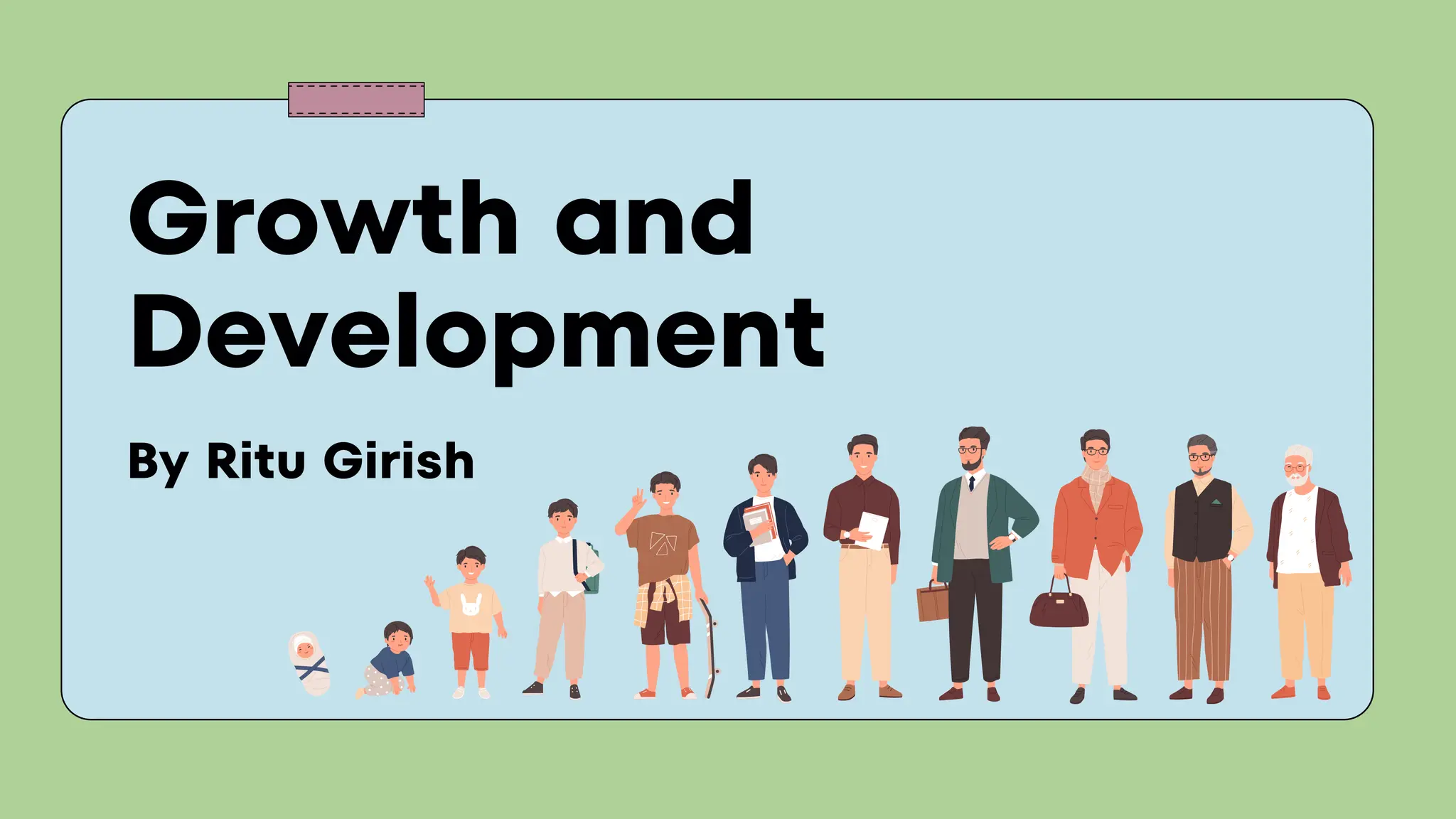
Growth and
Development
By Ritu Girish
What is Development?
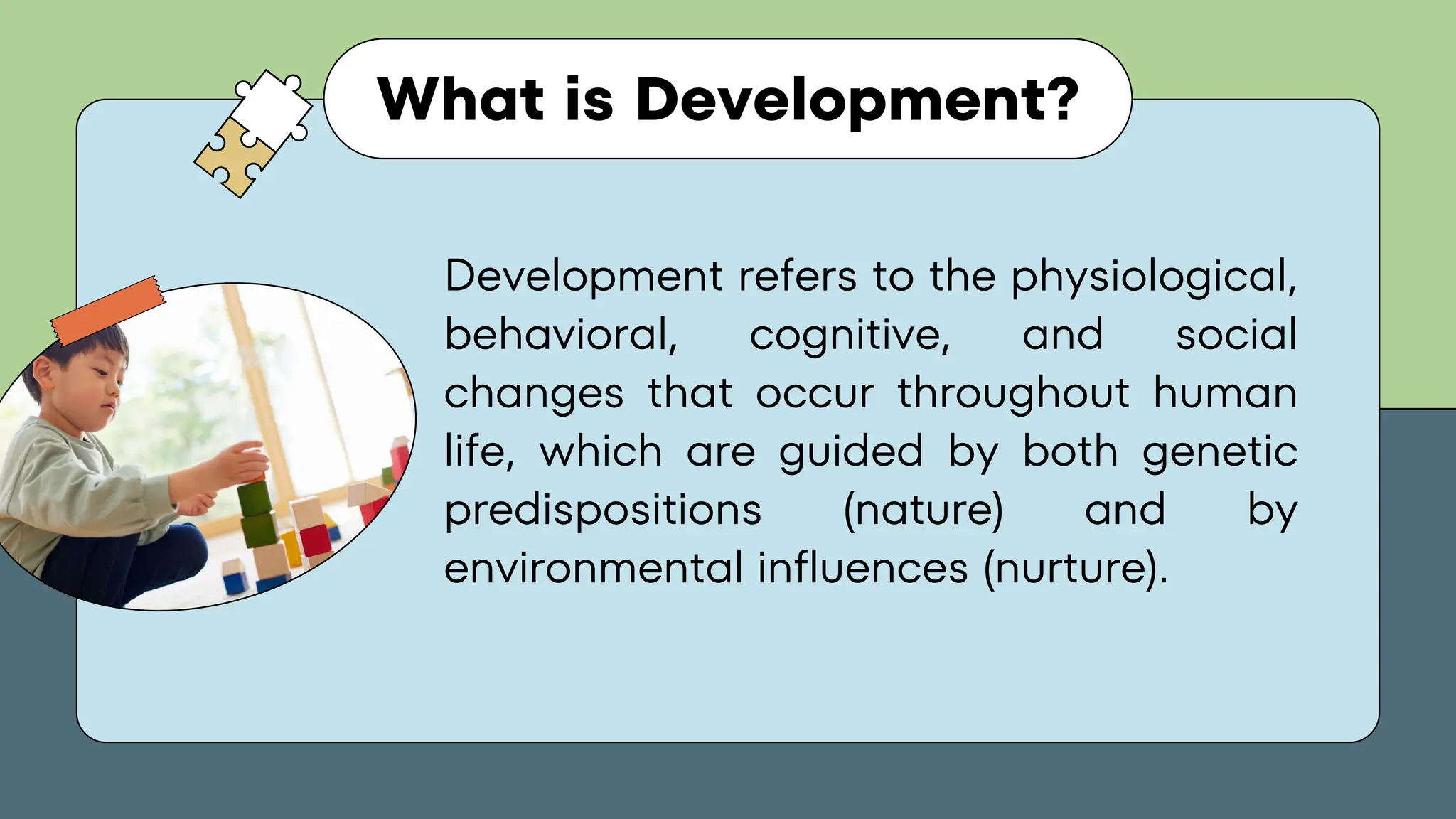
Development refers to the physiological,
behavioral, cognitive, and social
changes that occur throughout human
life, which are guided by both genetic
predispositions (nature) and by
environmental influences (nurture).
Growth vs Development
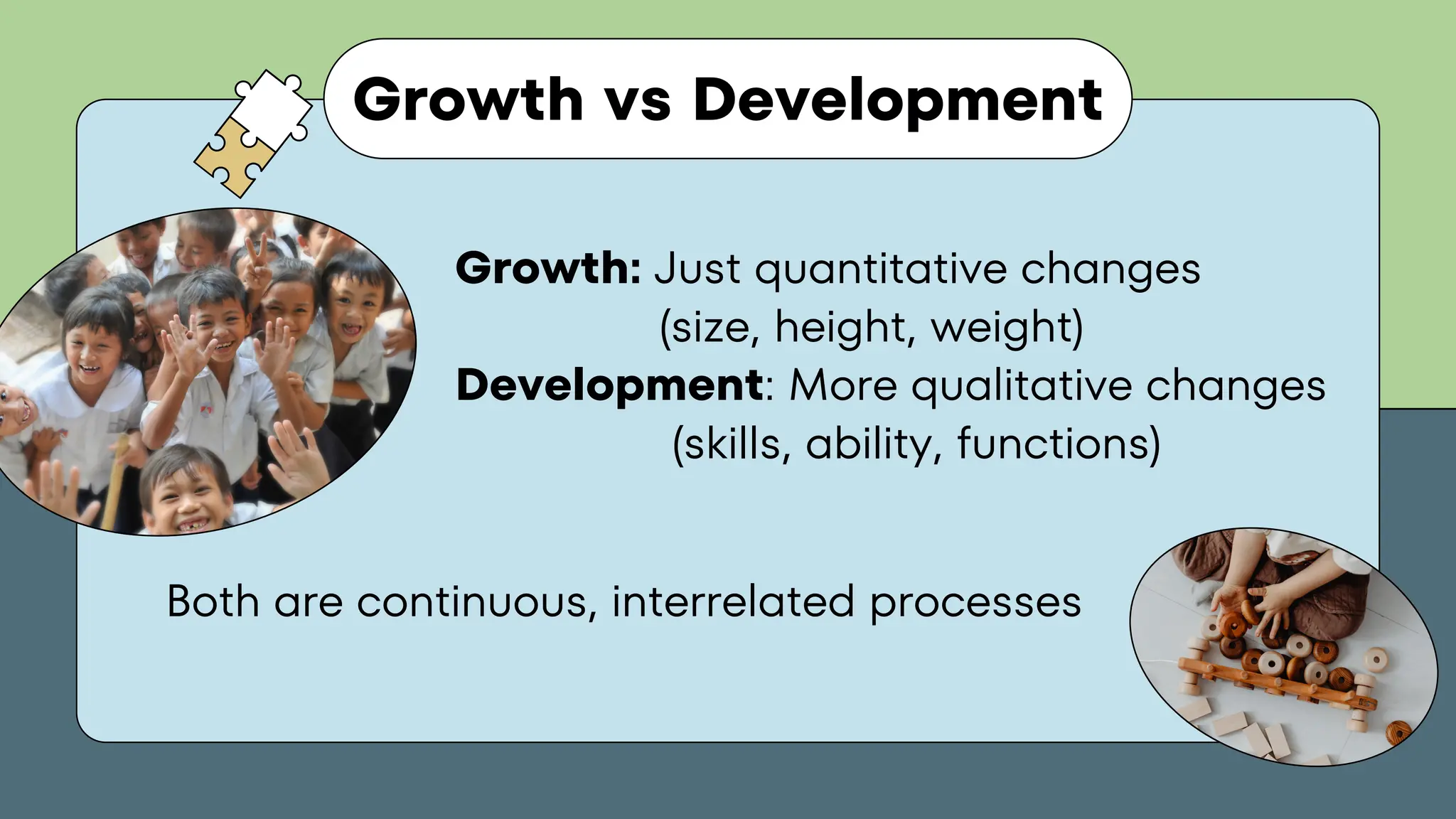
Growth: Just quantitative changes
(size, height, weight)
Development: More qualitative changes
(skills, ability, functions)
Both are continuous, interrelated processes
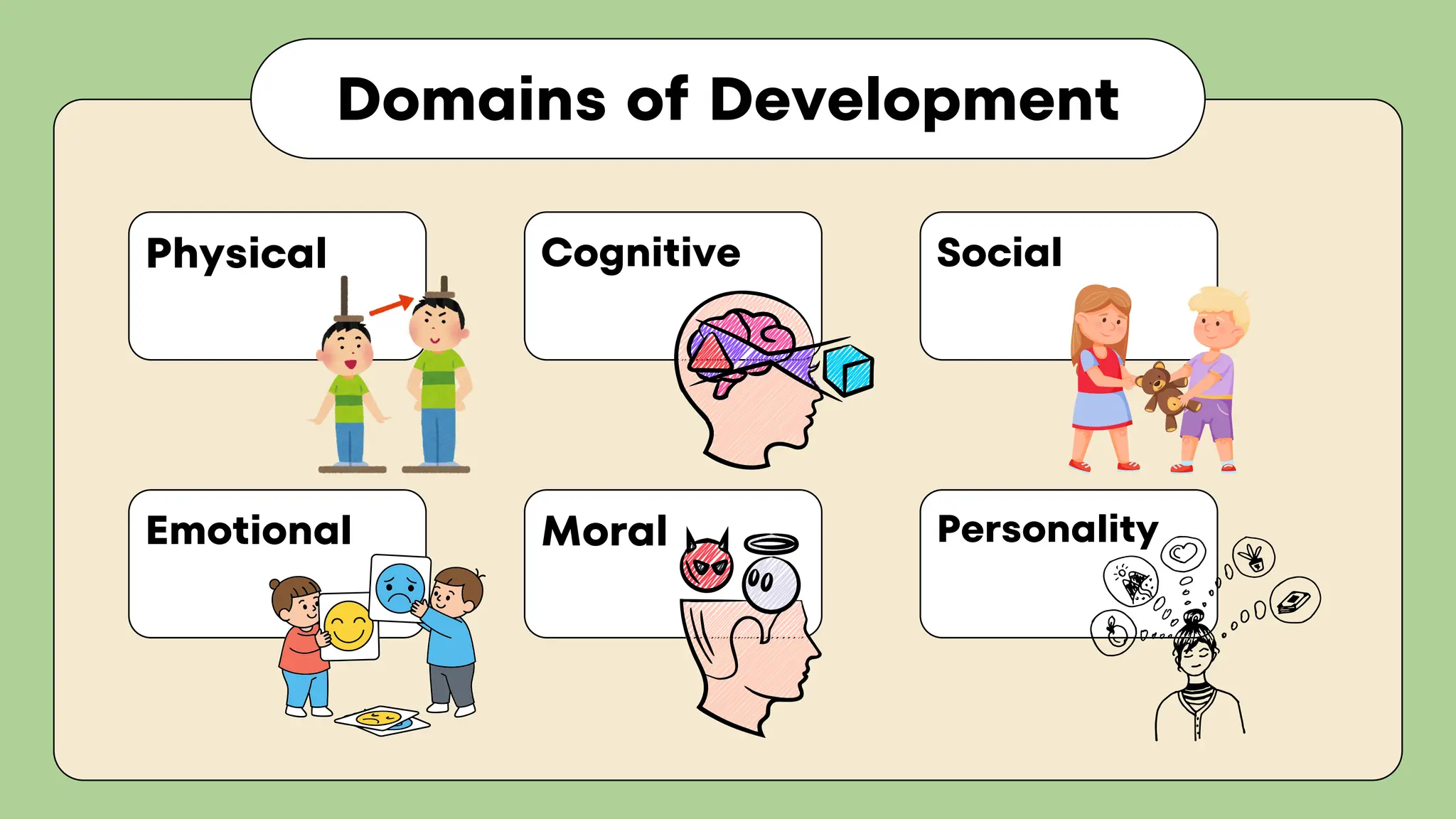
Domains of Development
Emotional
Social
Moral Personality
Physical Cognitive
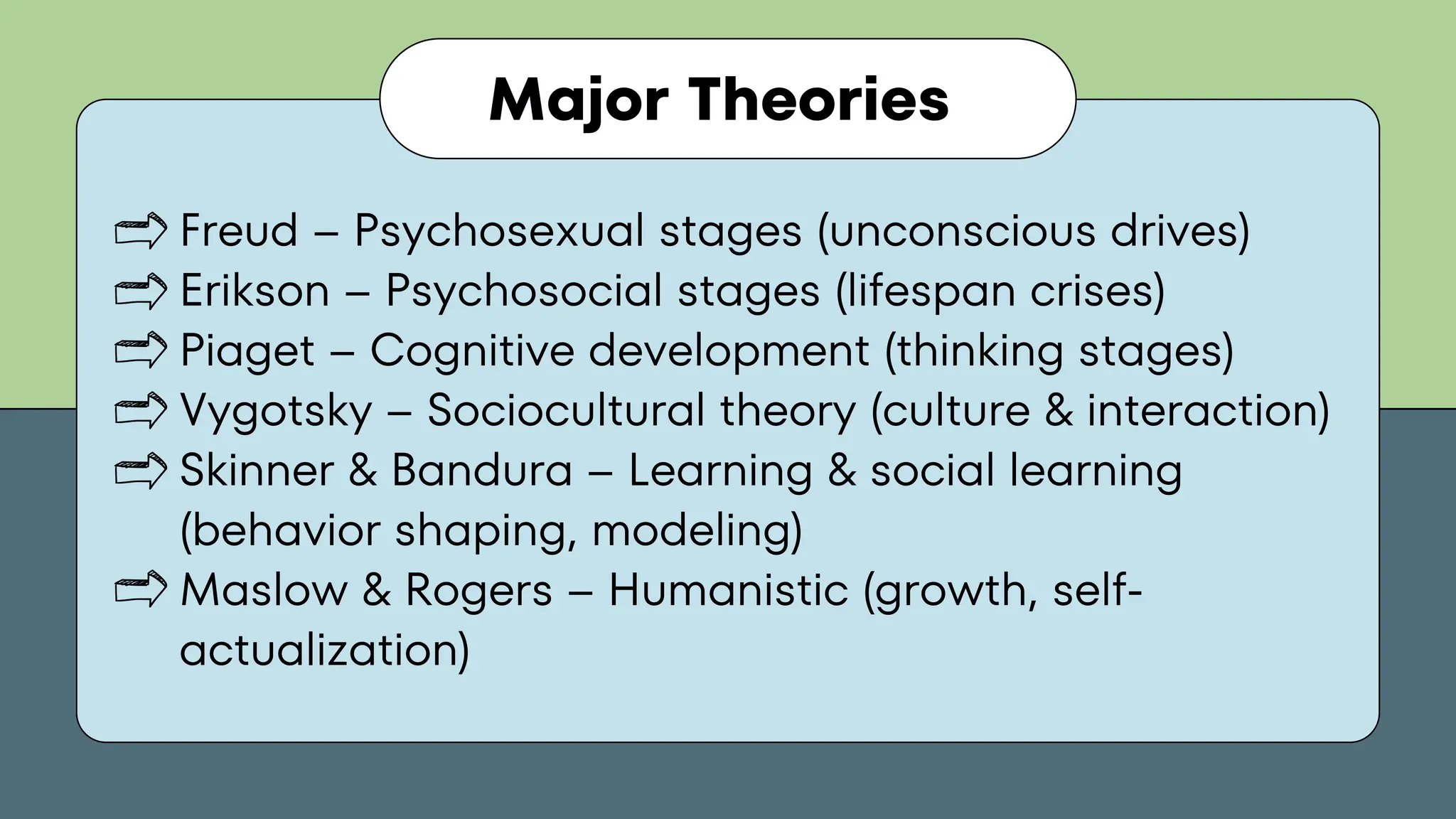
Major Theories
Freud – Psychosexual stages (unconscious drives)
Erikson – Psychosocial stages (lifespan crises)
Piaget – Cognitive development (thinking stages)
Vygotsky – Sociocultural theory (culture & interaction)
Skinner & Bandura – Learning & social learning
(behavior shaping, modeling)
Maslow & Rogers – Humanistic (growth, self-
actualization)
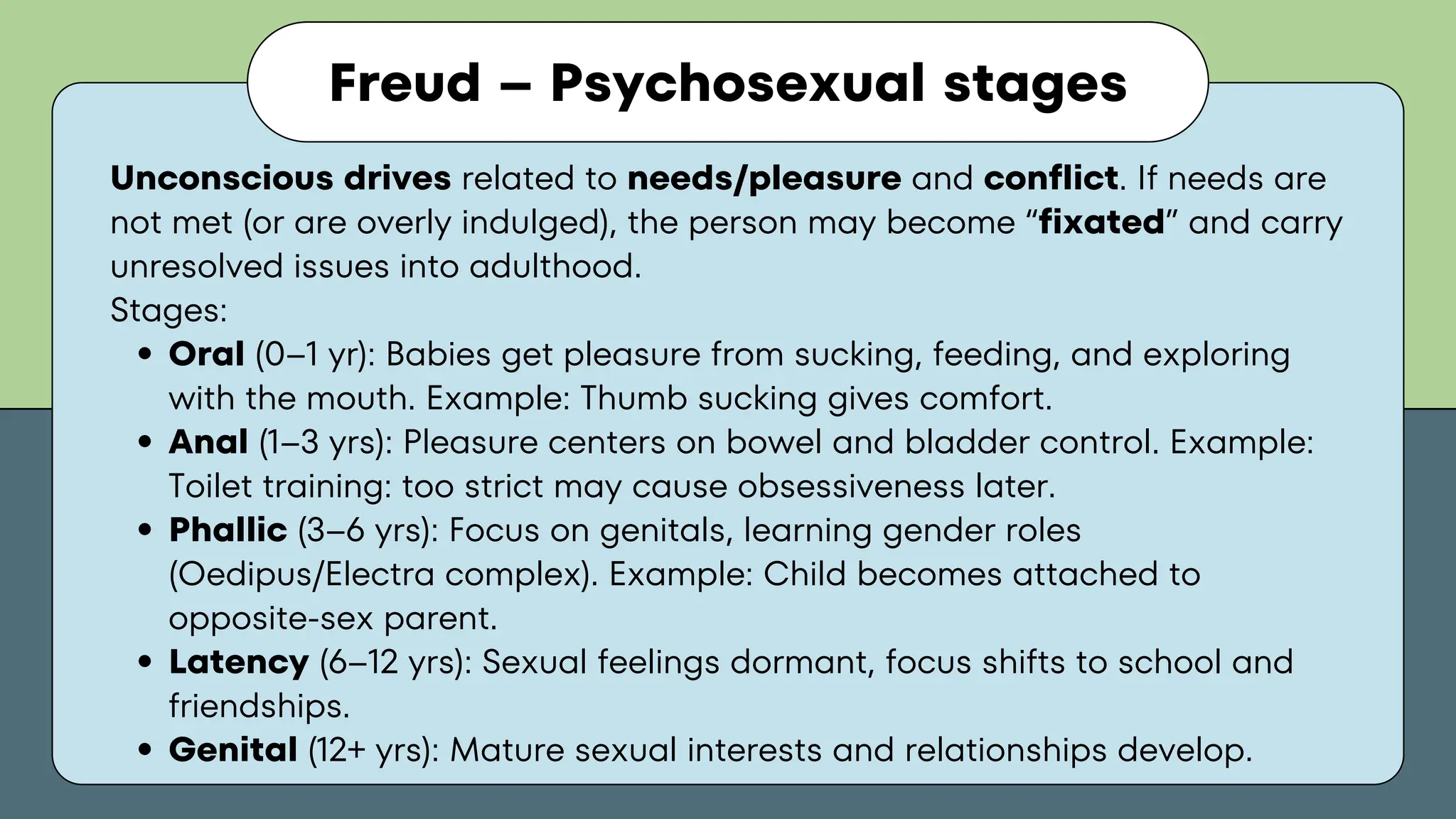
Freud – Psychosexual stages
Unconscious drives related to needs/pleasure and conflict. If needs are
not met (or are overly indulged), the person may become “fixated” and carry
unresolved issues into adulthood.
Stages:
Oral (0–1 yr): Babies get pleasure from sucking, feeding, and exploring
with the mouth. Example: Thumb sucking gives comfort.
Anal (1–3 yrs): Pleasure centers on bowel and bladder control. Example:
Toilet training: too strict may cause obsessiveness later.
Phallic (3–6 yrs): Focus on genitals, learning gender roles
(Oedipus/Electra complex). Example: Child becomes attached to
opposite-sex parent.
Latency (6–12 yrs): Sexual feelings dormant, focus shifts to school and
friendships.
Genital (12+ yrs): Mature sexual interests and relationships develop.
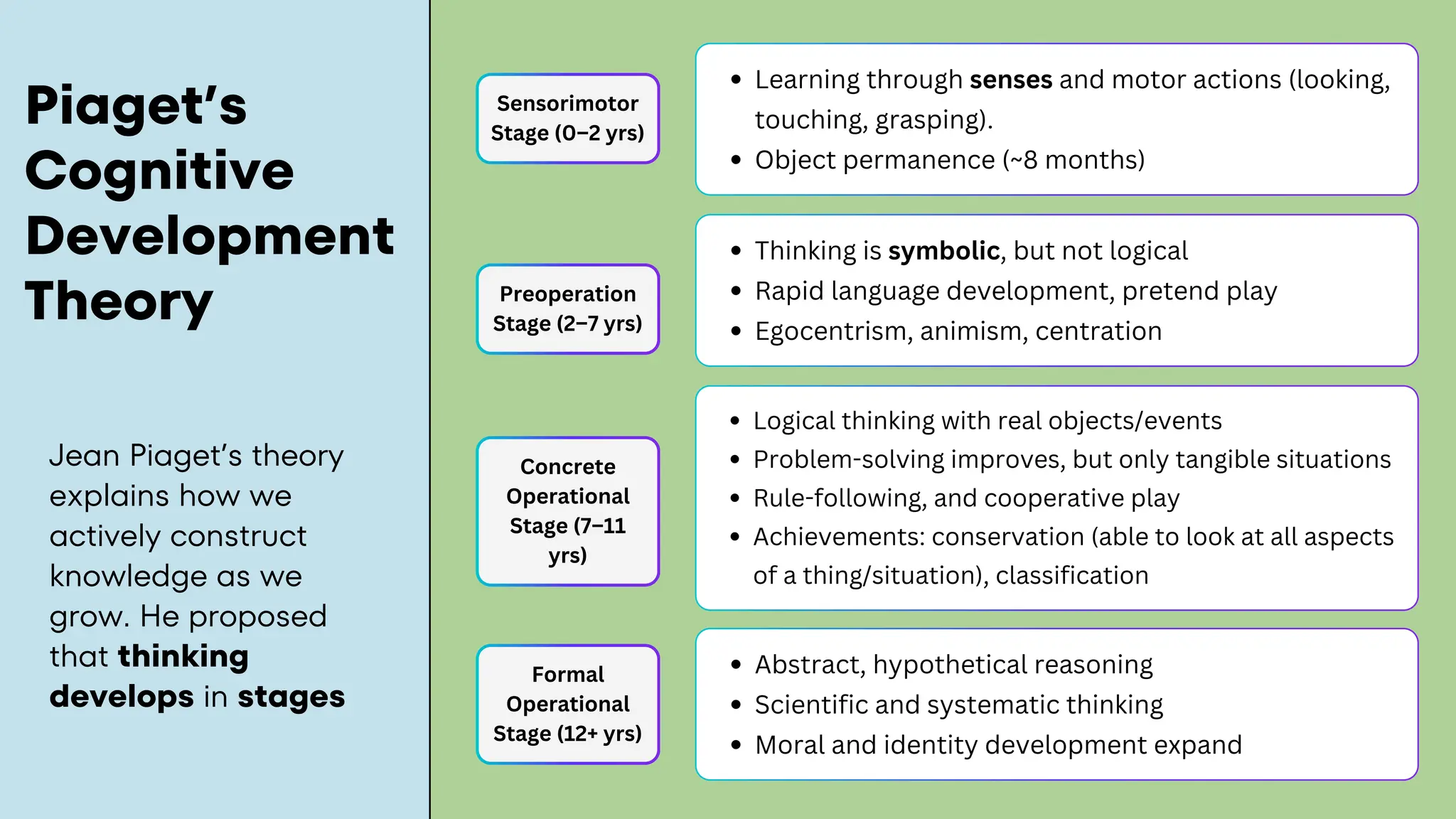
Piaget’s
Cognitive
Development
Theory
Jean Piaget’s theory
explains how we
actively construct
knowledge as we
grow. He proposed
that thinking
develops in stages
Learning through senses and motor actions (looking,
touching, grasping).
Object permanence (~8 months)
Thinking is symbolic, but not logical
Rapid language development, pretend play
Egocentrism, animism, centration
Sensorimotor
Stage (0–2 yrs)
Preoperation
Stage (2–7 yrs)
Formal
Operational
Stage (12+ yrs)
Concrete
Operational
Stage (7–11
yrs)
Logical thinking with real objects/events
Problem-solving improves, but only tangible situations
Rule-following, and cooperative play
Achievements: conservation (able to look at all aspects
of a thing/situation), classification
Abstract, hypothetical reasoning
Scientific and systematic thinking
Moral and identity development expand
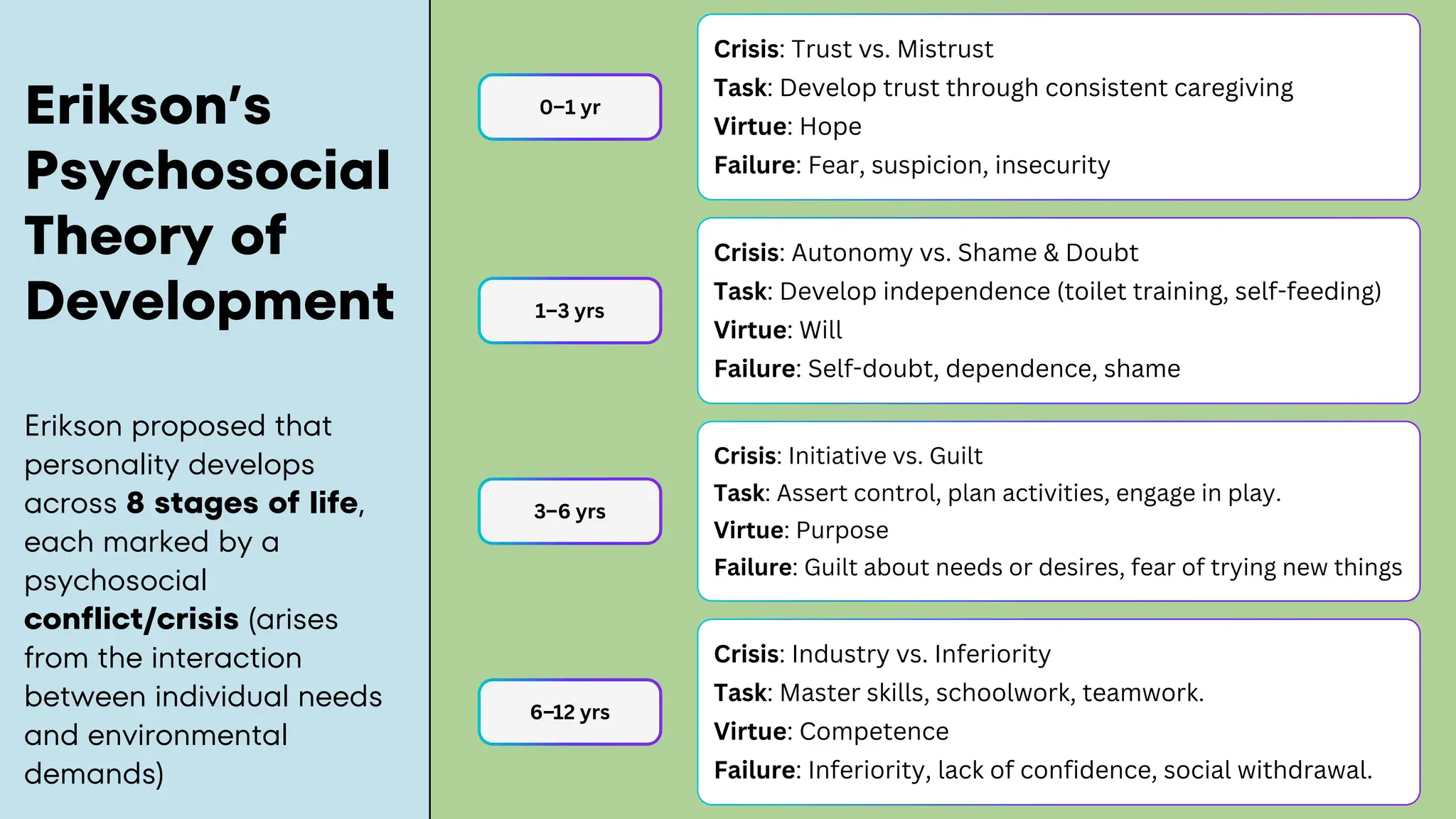
Crisis: Trust vs. Mistrust
Task: Develop trust through consistent caregiving
Virtue: Hope
Failure: Fear, suspicion, insecurity
Crisis: Autonomy vs. Shame & Doubt
Task: Develop independence (toilet training, self-feeding)
Virtue: Will
Failure: Self-doubt, dependence, shame
0–1 yr
1–3 yrs
Erikson’s
Psychosocial
Theory of
Development
Erikson proposed that
personality develops
across 8 stages of life,
each marked by a
psychosocial
conflict/crisis (arises
from the interaction
between individual needs
and environmental
demands)
6–12 yrs
3–6 yrs
Crisis: Initiative vs. Guilt
Task: Assert control, plan activities, engage in play.
Virtue: Purpose
Failure: Guilt about needs or desires, fear of trying new things
Crisis: Industry vs. Inferiority
Task: Master skills, schoolwork, teamwork.
Virtue: Competence
Failure: Inferiority, lack of confidence, social withdrawal.
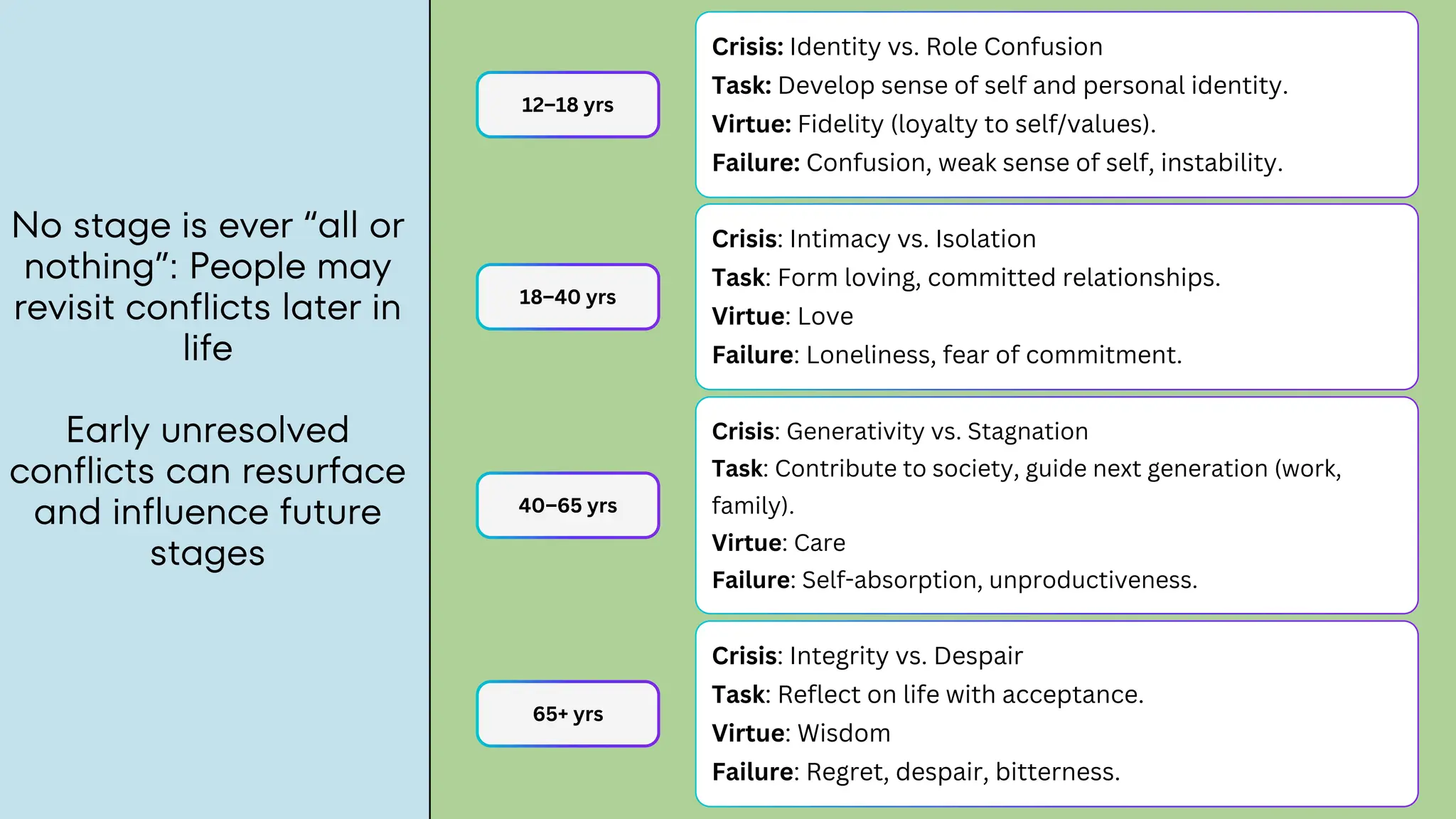
Crisis: Identity vs. Role Confusion
Task: Develop sense of self and personal identity.
Virtue: Fidelity (loyalty to self/values).
Failure: Confusion, weak sense of self, instability.
Crisis: Intimacy vs. Isolation
Task: Form loving, committed relationships.
Virtue: Love
Failure: Loneliness, fear of commitment.
12–18 yrs
18–40 yrs
No stage is ever “all or
nothing”: People may
revisit conflicts later in
life
Early unresolved
conflicts can resurface
and influence future
stages
65+ yrs
40–65 yrs
Crisis: Generativity vs. Stagnation
Task: Contribute to society, guide next generation (work,
family).
Virtue: Care
Failure: Self-absorption, unproductiveness.
Crisis: Integrity vs. Despair
Task: Reflect on life with acceptance.
Virtue: Wisdom
Failure: Regret, despair, bitterness.
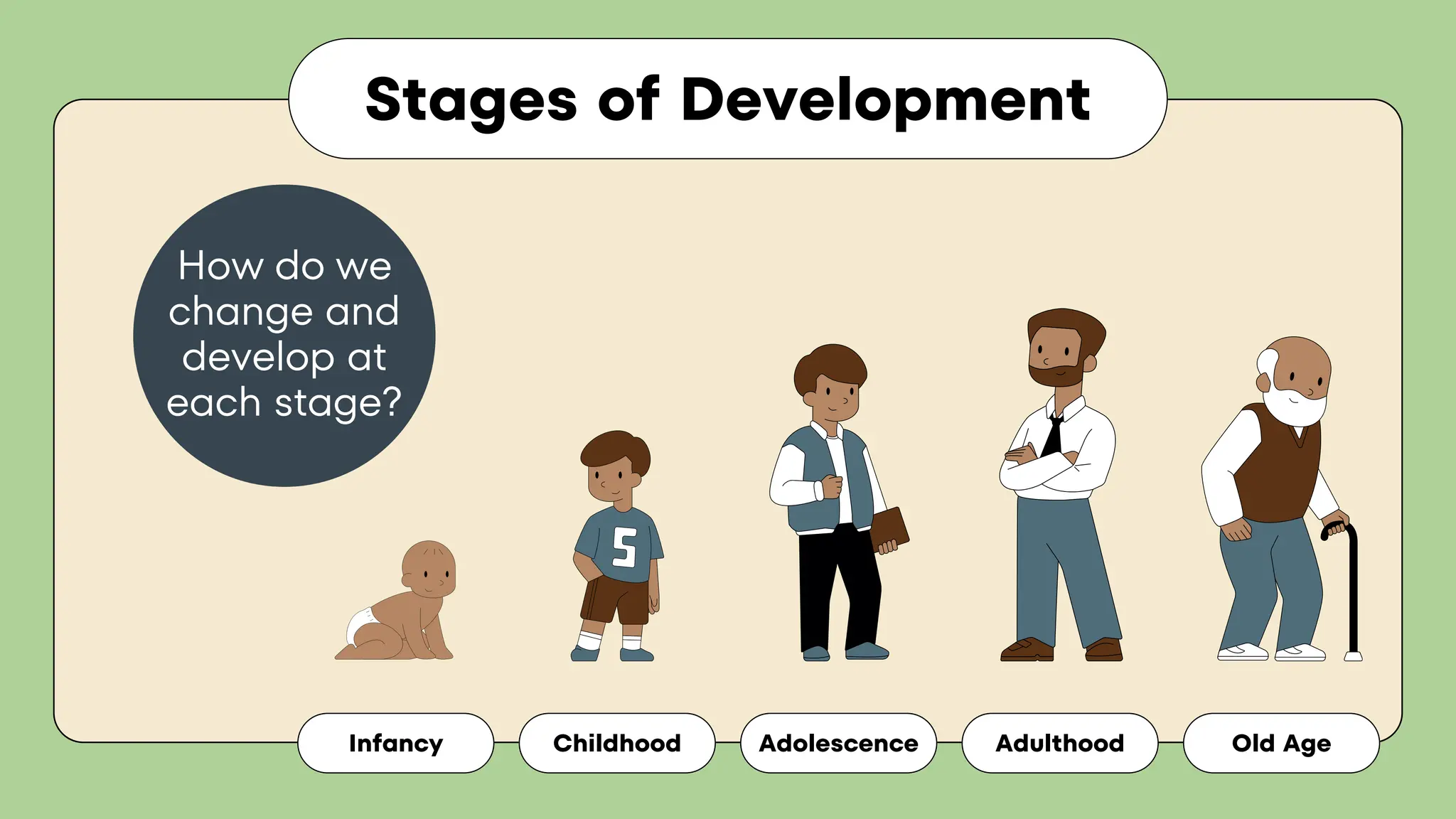
Infancy Childhood Adolescence Adulthood Old Age
Stages of Development
How do we
change and
develop at
each stage?
Infancy
(0-2 years)
Infancy
(0-2 years)
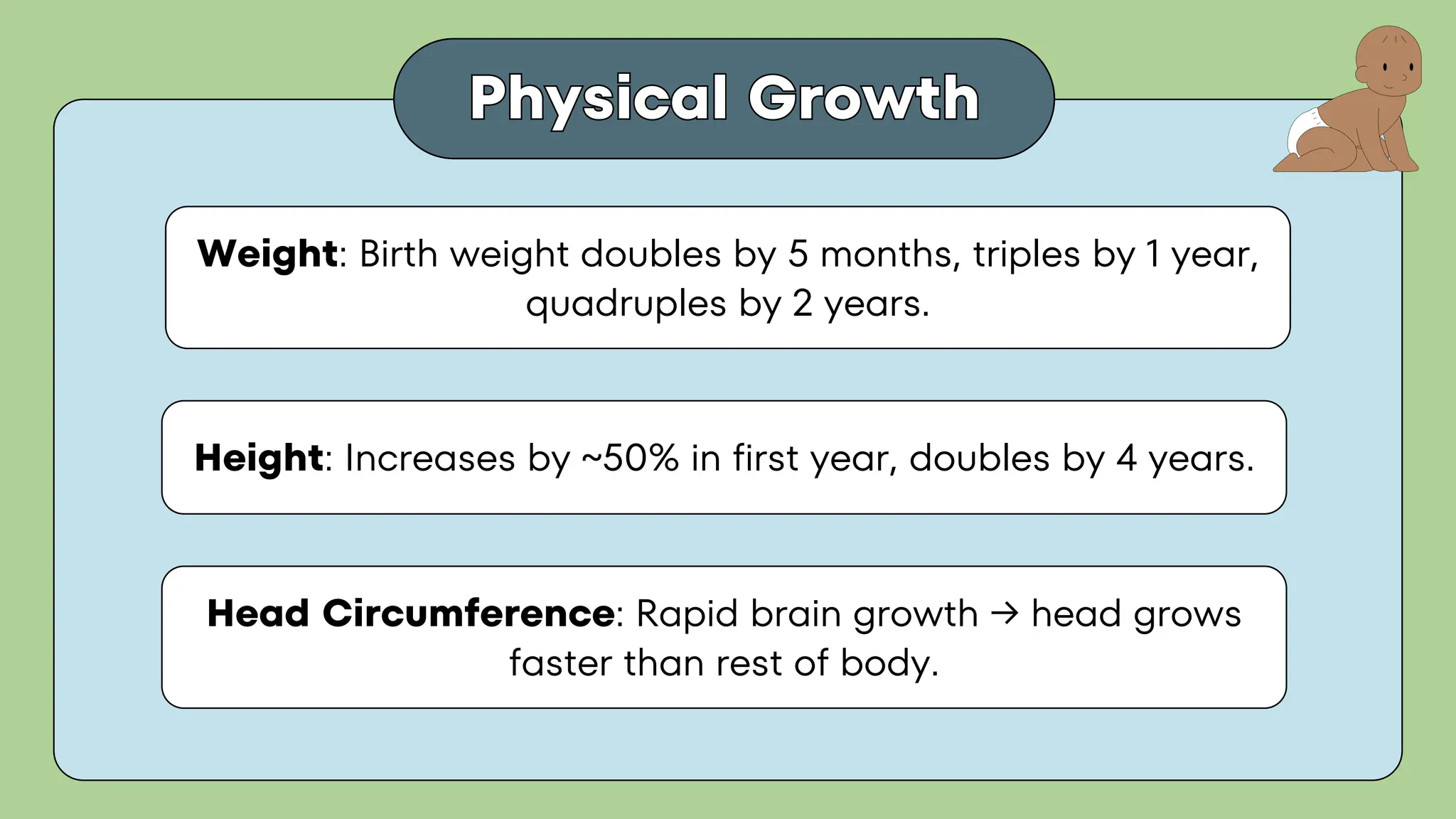
Physical Growth
Physical Growth
Weight: Birth weight doubles by 5 months, triples by 1 year,
quadruples by 2 years.
Height: Increases by ~50% in first year, doubles by 4 years.
Head Circumference: Rapid brain growth → head grows
faster than rest of body.
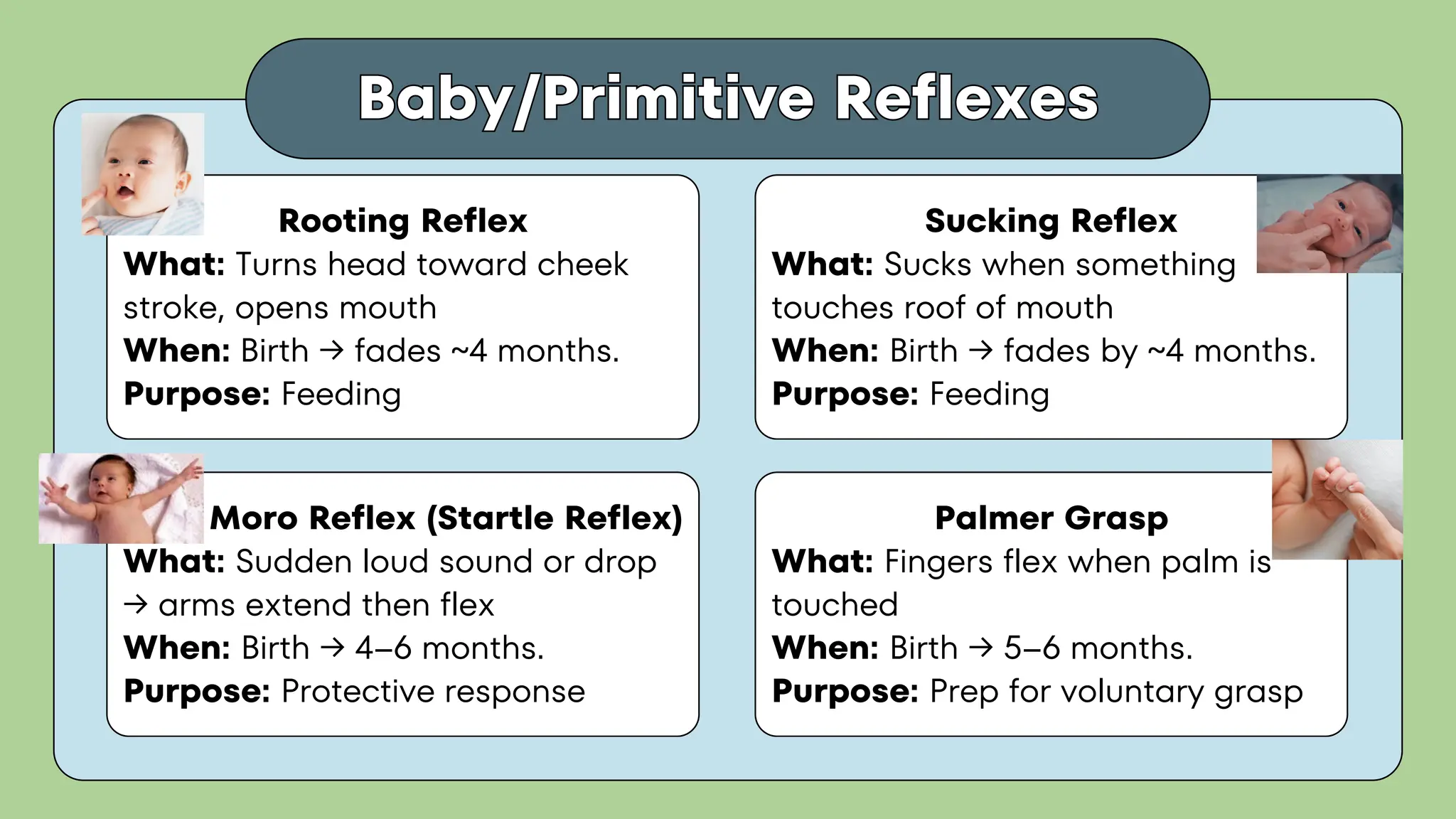
Baby/Primitive Reflexes
Rooting Reflex
What: Turns head toward cheek
stroke, opens mouth
When: Birth → fades ~4 months.
Purpose: Feeding
Sucking Reflex
What: Sucks when something
touches roof of mouth
When: Birth → fades by ~4 months.
Purpose: Feeding
Moro Reflex (Startle Reflex)
What: Sudden loud sound or drop
→ arms extend then flex
When: Birth → 4–6 months.
Purpose: Protective response
Palmer Grasp
What: Fingers flex when palm is
touched
When: Birth → 5–6 months.
Purpose: Prep for voluntary grasp
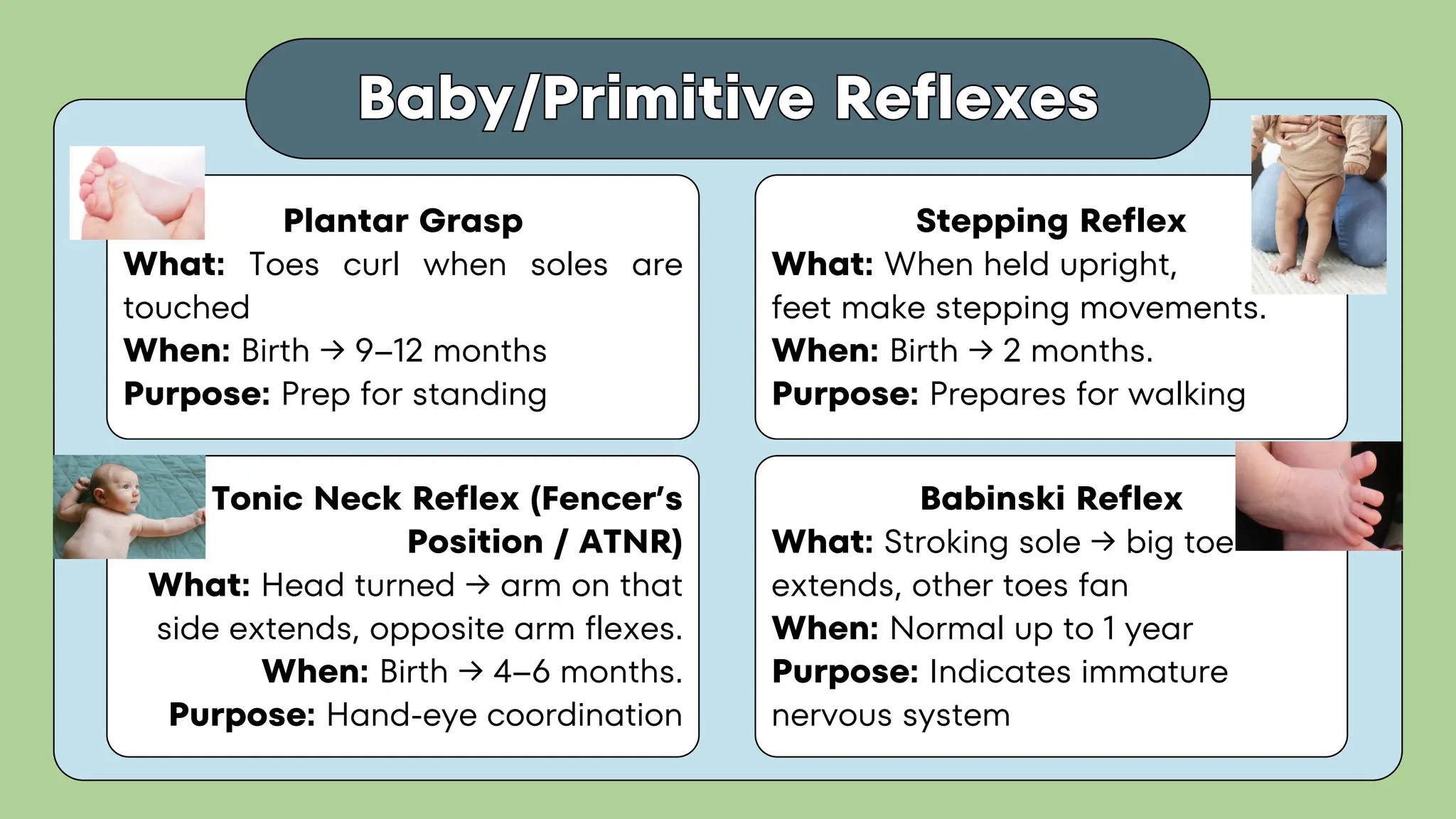
Baby/Primitive Reflexes
Plantar Grasp
What: Toes curl when soles are
touched
When: Birth → 9–12 months
Purpose: Prep for standing
Babinski Reflex
What: Stroking sole → big toe
extends, other toes fan
When: Normal up to 1 year
Purpose: Indicates immature
nervous system
Tonic Neck Reflex (Fencer’s
Position / ATNR)
What: Head turned → arm on that
side extends, opposite arm flexes.
When: Birth → 4–6 months.
Purpose: Hand-eye coordination
Stepping Reflex
What: When held upright,
feet make stepping movements.
When: Birth → 2 months.
Purpose: Prepares for walking
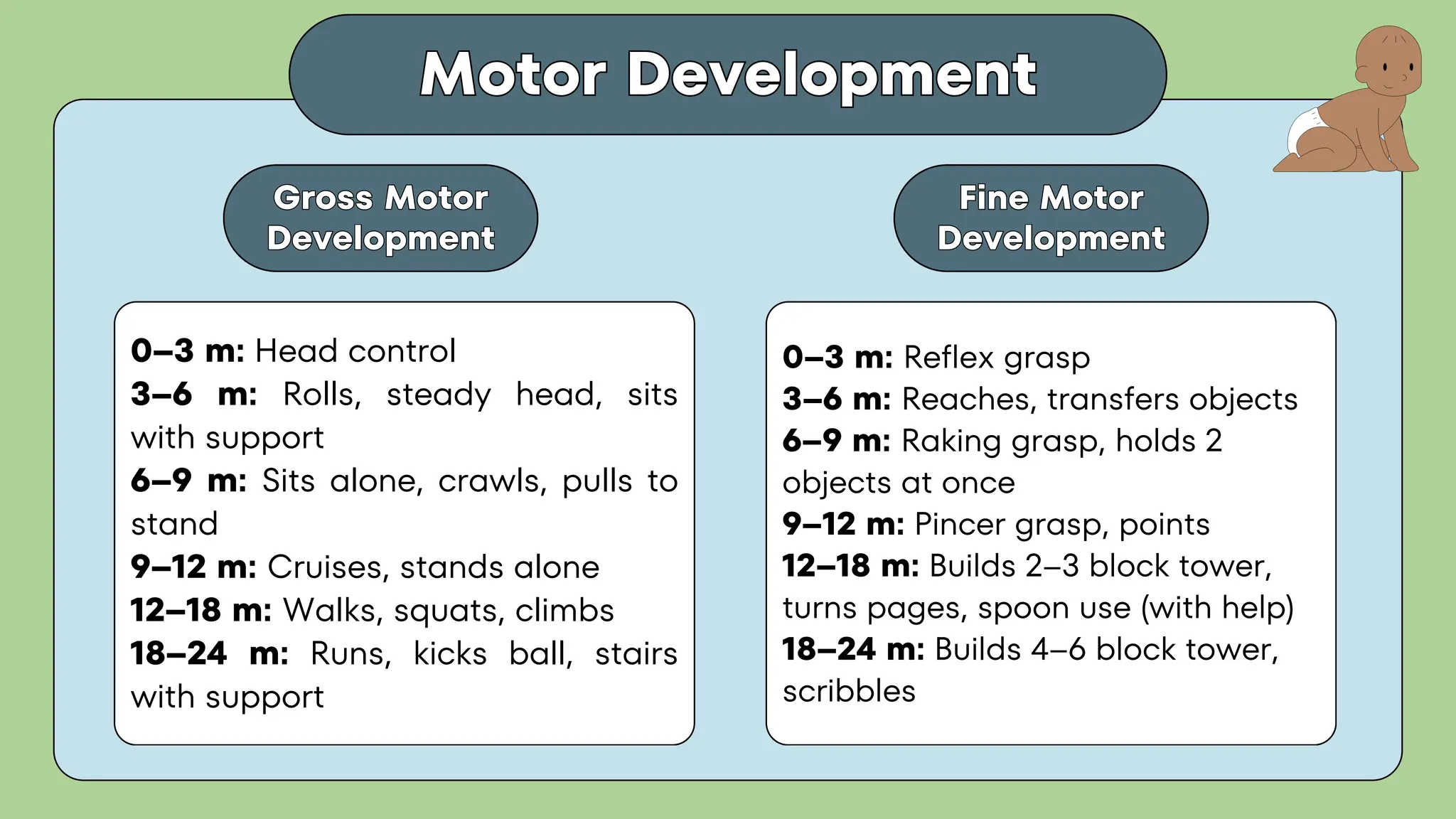
Motor Development
Motor Development
0–3 m: Head control
3–6 m: Rolls, steady head, sits
with support
6–9 m: Sits alone, crawls, pulls to
stand
9–12 m: Cruises, stands alone
12–18 m: Walks, squats, climbs
18–24 m: Runs, kicks ball, stairs
with support
Gross Motor
Development
Gross Motor
Development
Fine Motor
Development
Fine Motor
Development
0–3 m: Reflex grasp
3–6 m: Reaches, transfers objects
6–9 m: Raking grasp, holds 2
objects at once
9–12 m: Pincer grasp, points
12–18 m: Builds 2–3 block tower,
turns pages, spoon use (with help)
18–24 m: Builds 4–6 block tower,
scribbles
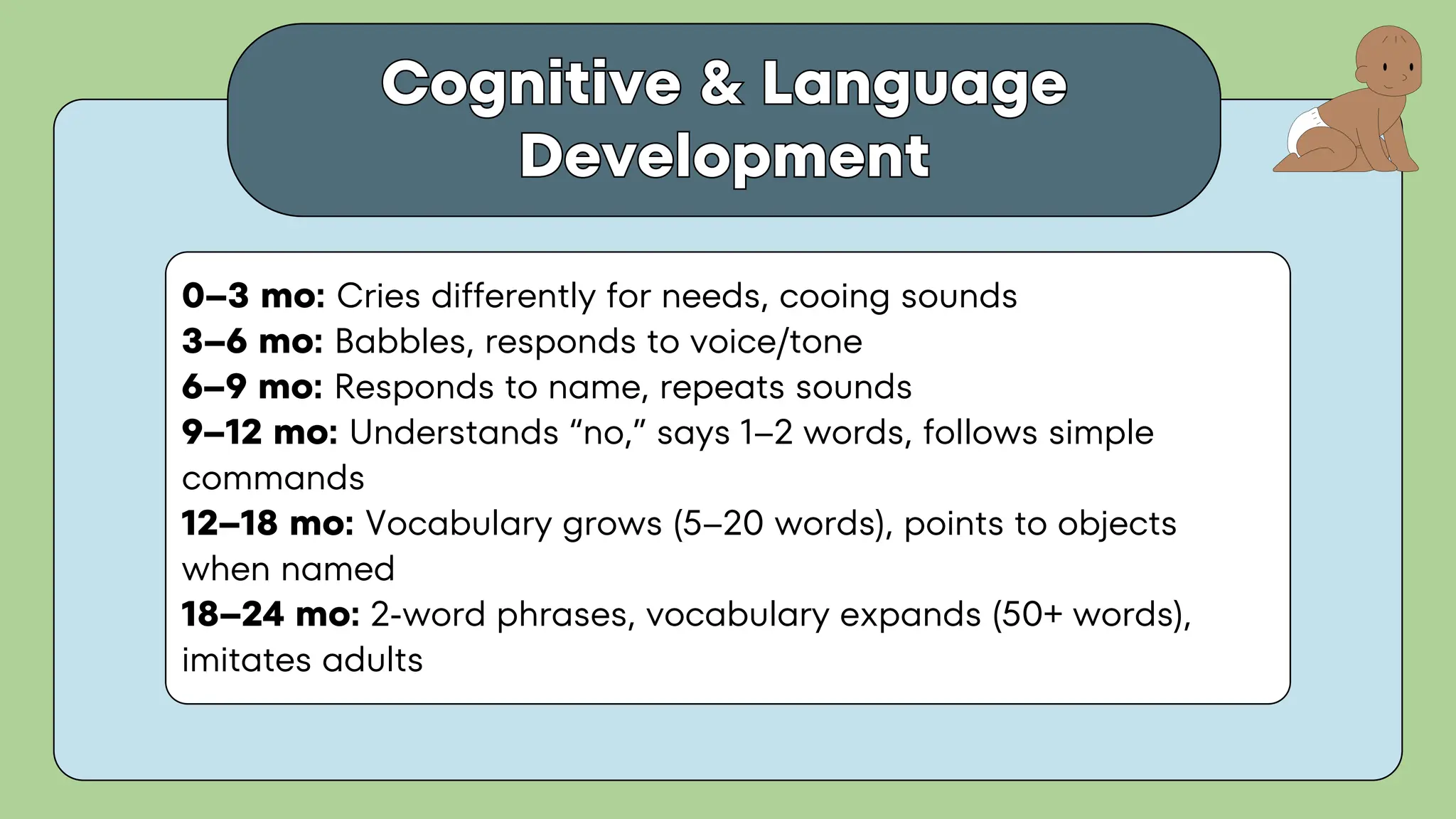
Cognitive & Language
Development
Cognitive & Language
Development
0–3 mo: Cries differently for needs, cooing sounds
3–6 mo: Babbles, responds to voice/tone
6–9 mo: Responds to name, repeats sounds
9–12 mo: Understands “no,” says 1–2 words, follows simple
commands
12–18 mo: Vocabulary grows (5–20 words), points to objects
when named
18–24 mo: 2-word phrases, vocabulary expands (50+ words),
imitates adults
Social & Emotional
Development
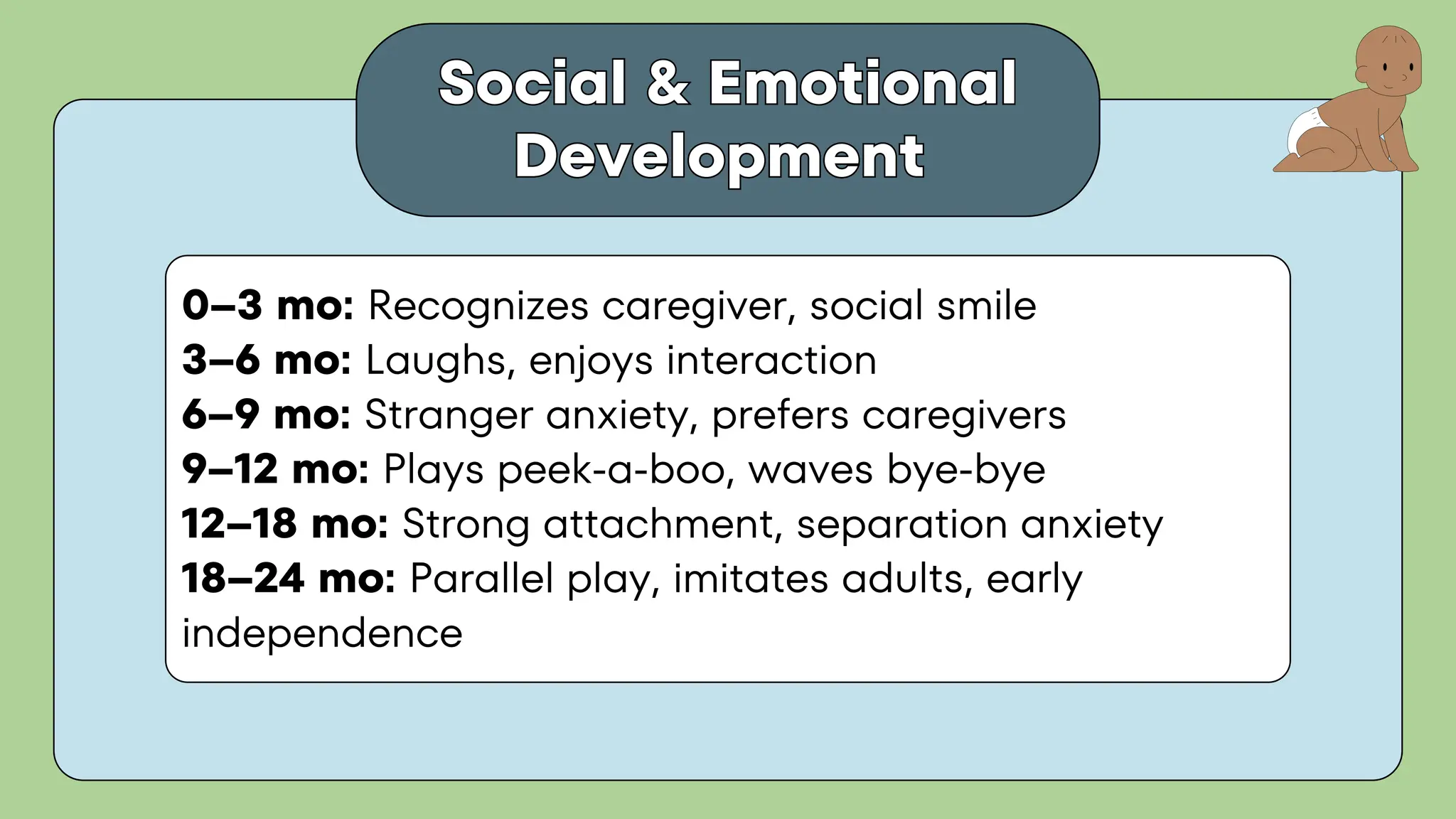
Social & Emotional
Development
0–3 mo: Recognizes caregiver, social smile
3–6 mo: Laughs, enjoys interaction
6–9 mo: Stranger anxiety, prefers caregivers
9–12 mo: Plays peek-a-boo, waves bye-bye
12–18 mo: Strong attachment, separation anxiety
18–24 mo: Parallel play, imitates adults, early
independence
Attachment
Phases (Bowlby)
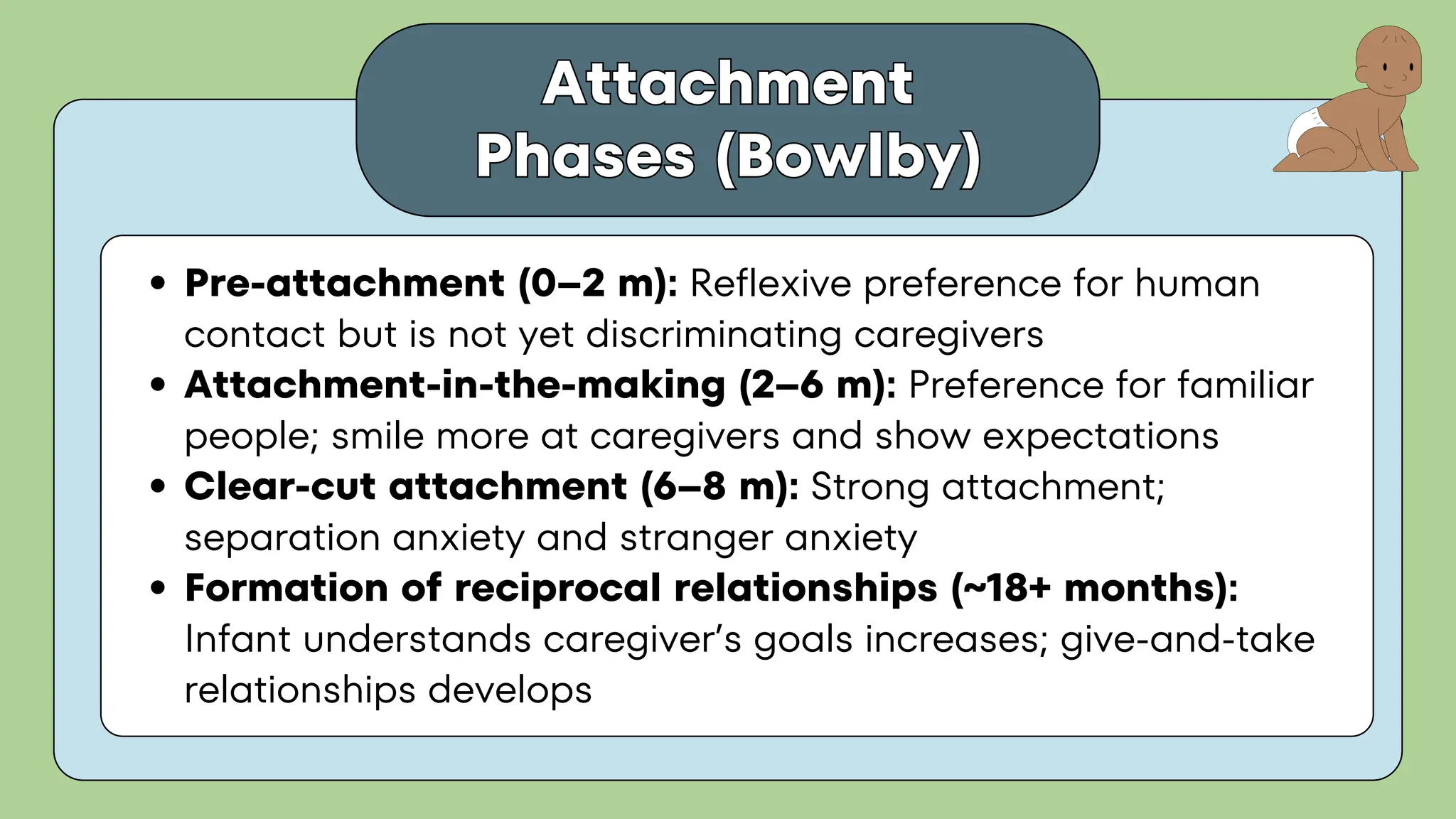
Attachment
Phases (Bowlby)
Pre-attachment (0–2 m): Reflexive preference for human
contact but is not yet discriminating caregivers
Attachment-in-the-making (2–6 m): Preference for familiar
people; smile more at caregivers and show expectations
Clear-cut attachment (6–8 m): Strong attachment;
separation anxiety and stranger anxiety
Formation of reciprocal relationships (~18+ months):
Infant understands caregiver’s goals increases; give-and-take
relationships develops
Open kahoot.it on
chrome/safari
https://play.kahoot.it/v2/?quizId=f16ad9c6-bb21-
4ef4-9577-3488d1798451&hostId=2e59ee93-08ed-
4673-94d4-78c5a8e18591
Early childhood
(2-6 yrs)
Middle Childhood
(6-12 yrs)
Early childhood
(2-6 yrs)
Middle Childhood
(6-12 yrs)
Childhood
Childhood
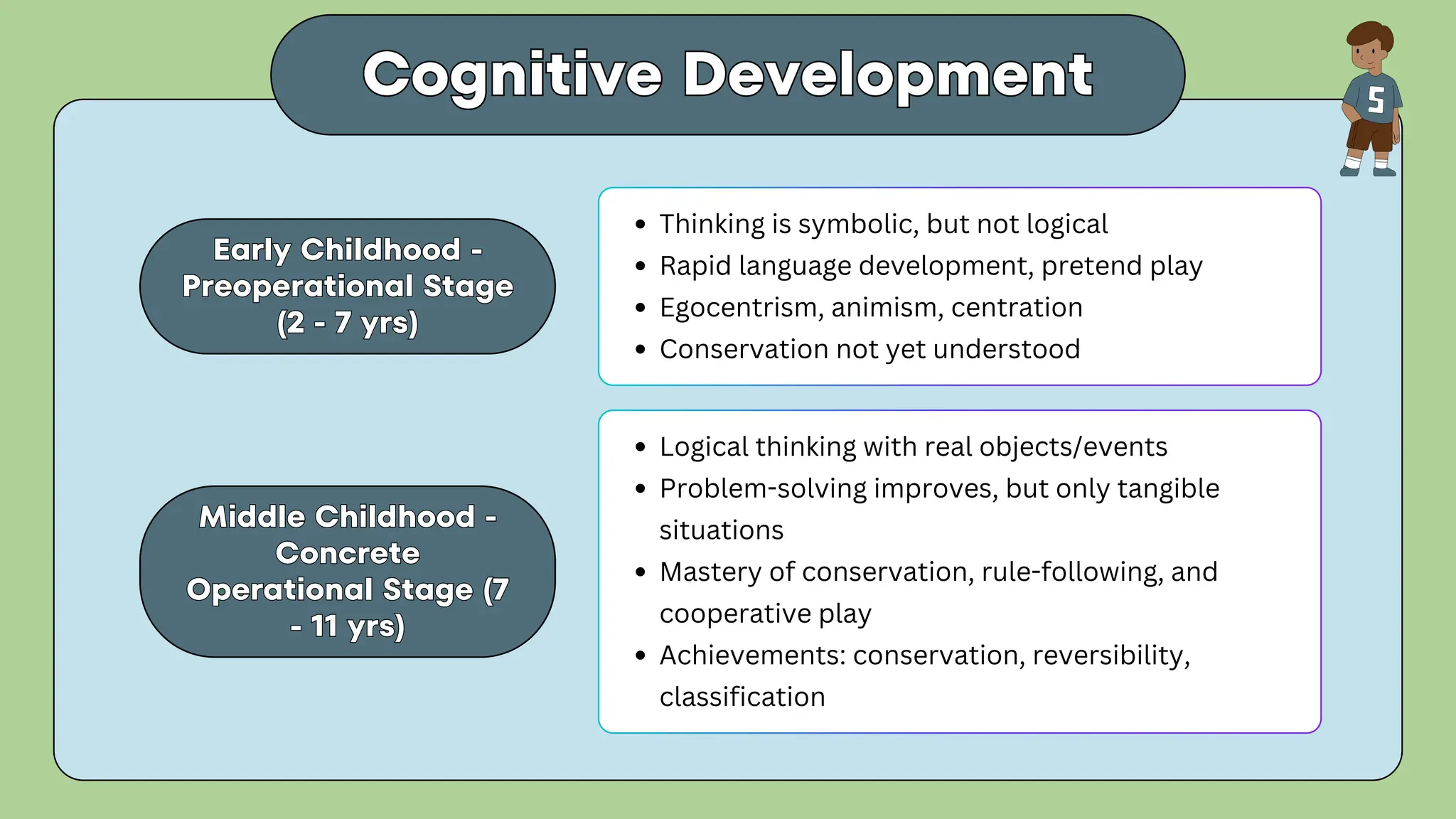
Cognitive Development
Middle Childhood -
Concrete
Operational Stage (7
- 11 yrs)
Middle Childhood -
Concrete
Operational Stage (7
- 11 yrs)
Thinking is symbolic, but not logical
Rapid language development, pretend play
Egocentrism, animism, centration
Conservation not yet understood
Logical thinking with real objects/events
Problem-solving improves, but only tangible
situations
Mastery of conservation, rule-following, and
cooperative play
Achievements: conservation, reversibility,
classification
Early Childhood -
Preoperational Stage
(2 - 7 yrs)
Early Childhood -
Preoperational Stage
(2 - 7 yrs)
Psychosocial
Development (Erikson)
Psychosocial
Development (Erikson)
Middle Childhood
(6 - 12 yrs)
Middle Childhood
(6 - 12 yrs)
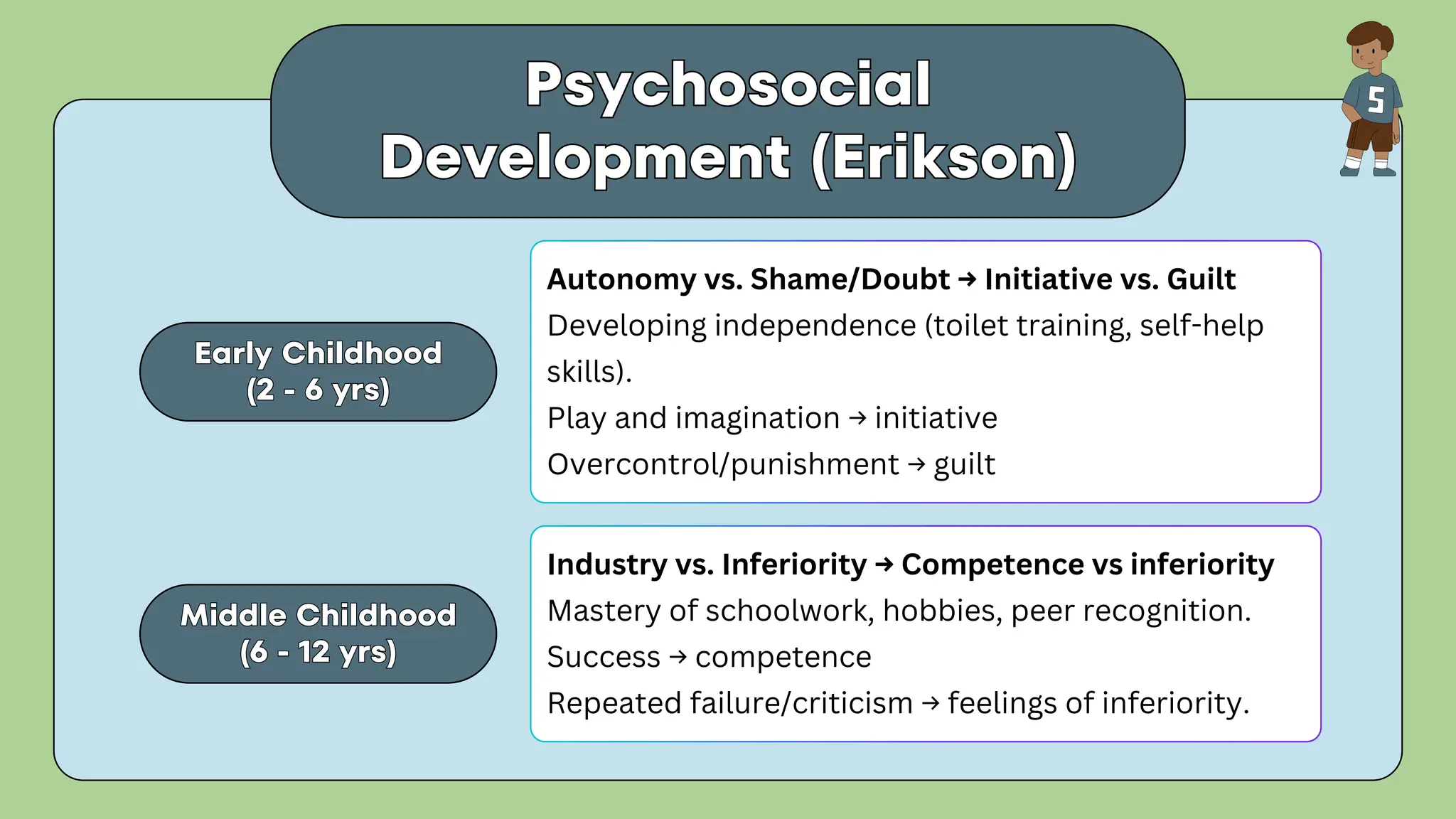
Autonomy vs. Shame/Doubt → Initiative vs. Guilt
Developing independence (toilet training, self-help
skills).
Play and imagination → initiative
Overcontrol/punishment → guilt
Industry vs. Inferiority → Competence vs inferiority
Mastery of schoolwork, hobbies, peer recognition.
Success → competence
Repeated failure/criticism → feelings of inferiority.
Early Childhood
(2 - 6 yrs)
Early Childhood
(2 - 6 yrs)
Social-Emotional
Development
Social-Emotional
Development
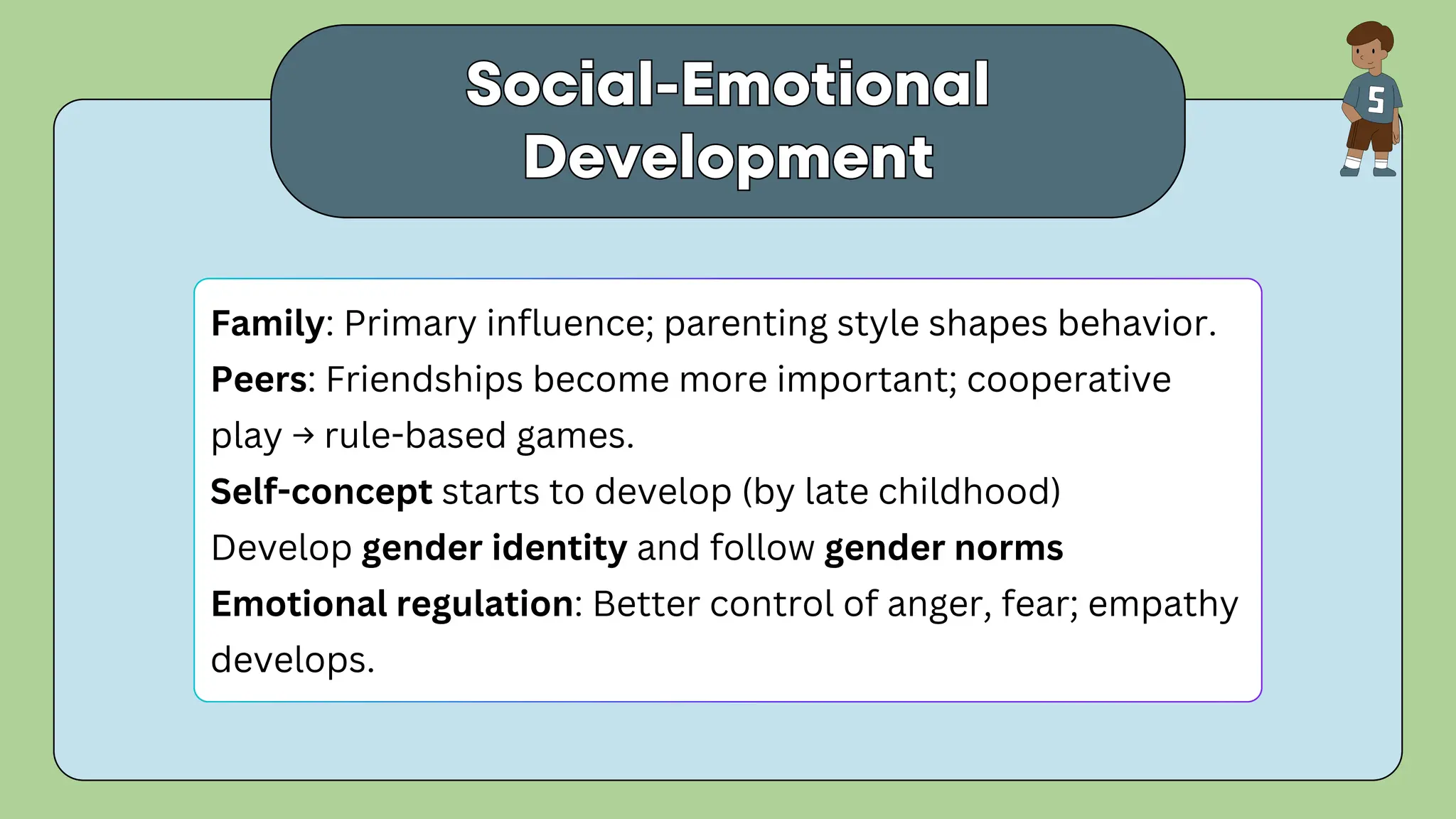
Family: Primary influence; parenting style shapes behavior.
Peers: Friendships become more important; cooperative
play → rule-based games.
Self-concept starts to develop (by late childhood)
Develop gender identity and follow gender norms
Emotional regulation: Better control of anger, fear; empathy
develops.
Moral Development
(Kohlberg)
Moral Development
(Kohlberg)
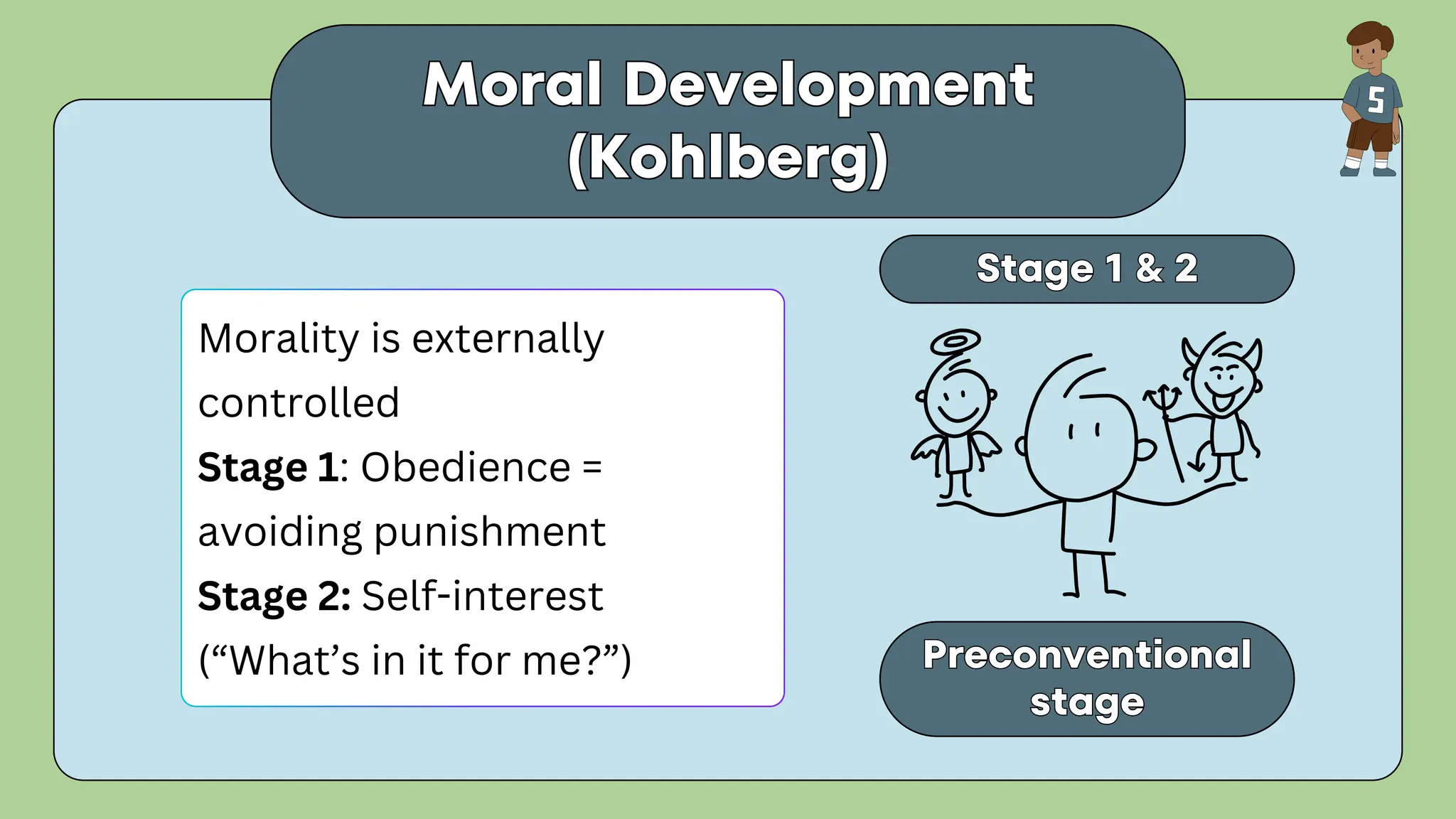
Morality is externally
controlled
Stage 1: Obedience =
avoiding punishment
Stage 2: Self-interest
(“What’s in it for me?”)
Stage 1 & 2
Stage 1 & 2
Preconventional
stage
Preconventional
stage
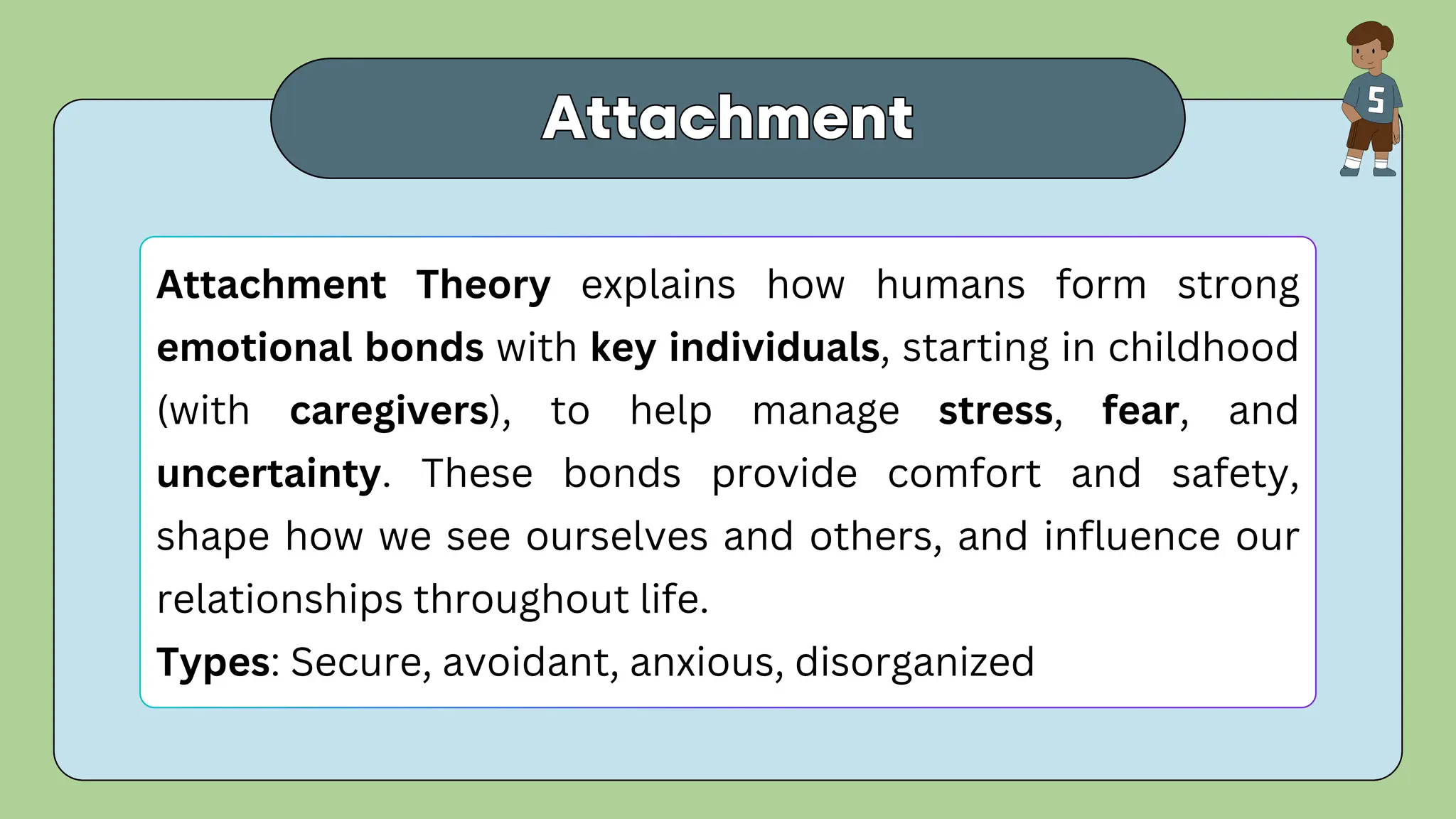
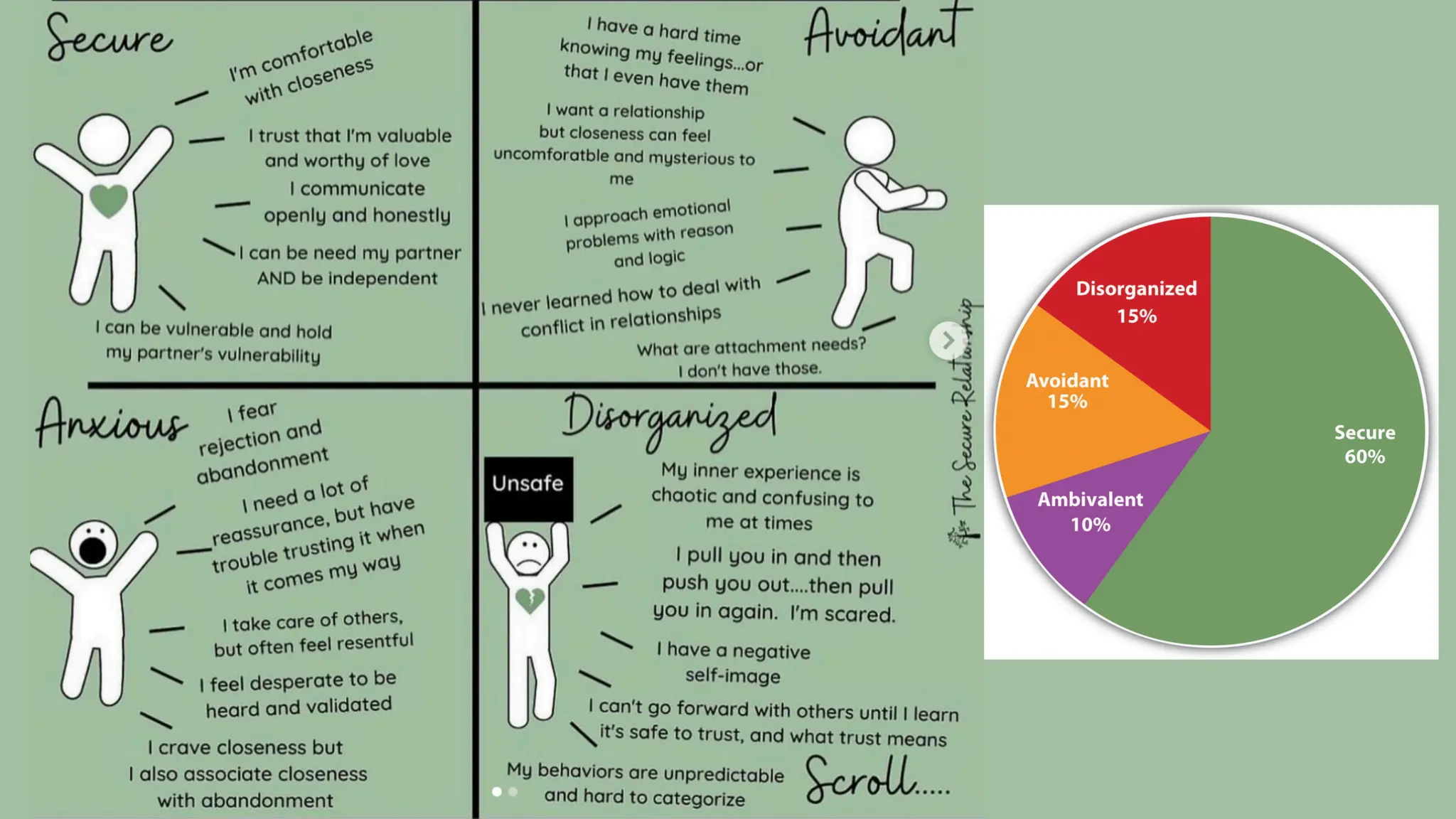
Attachment Theory explains how humans form strong
emotional bonds with key individuals, starting in childhood
(with caregivers), to help manage stress, fear, and
uncertainty. These bonds provide comfort and safety,
shape how we see ourselves and others, and influence our
relationships throughout life.
Types: Secure, avoidant, anxious, disorganized
Attachment
Attachment
Adolescence
12 - 18 years
Adolescence
12 - 18 years
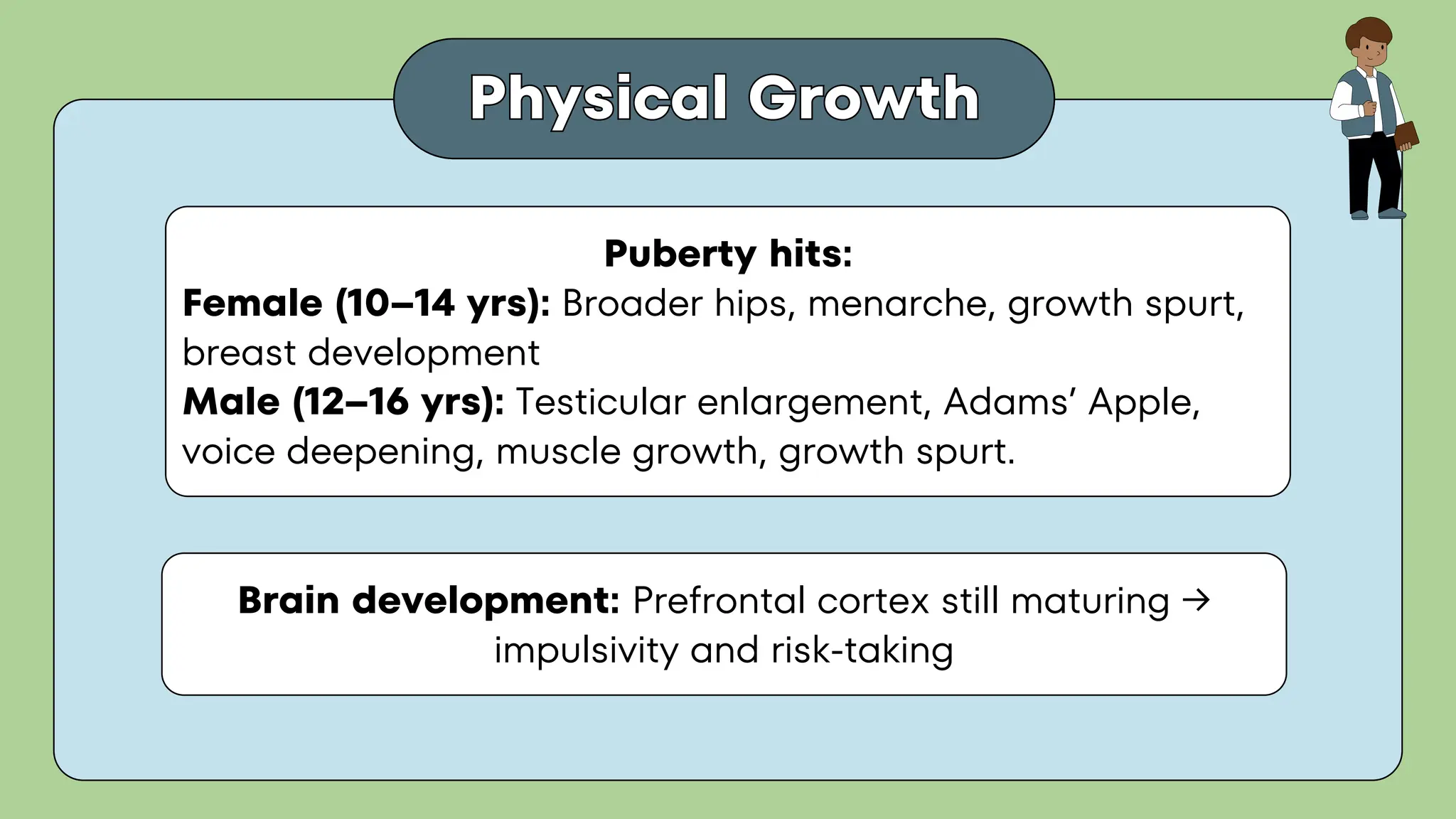
Physical Growth
Physical Growth
Puberty hits:
Female (10–14 yrs): Broader hips, menarche, growth spurt,
breast development
Male (12–16 yrs): Testicular enlargement, Adams’ Apple,
voice deepening, muscle growth, growth spurt.
Brain development: Prefrontal cortex still maturing →
impulsivity and risk-taking
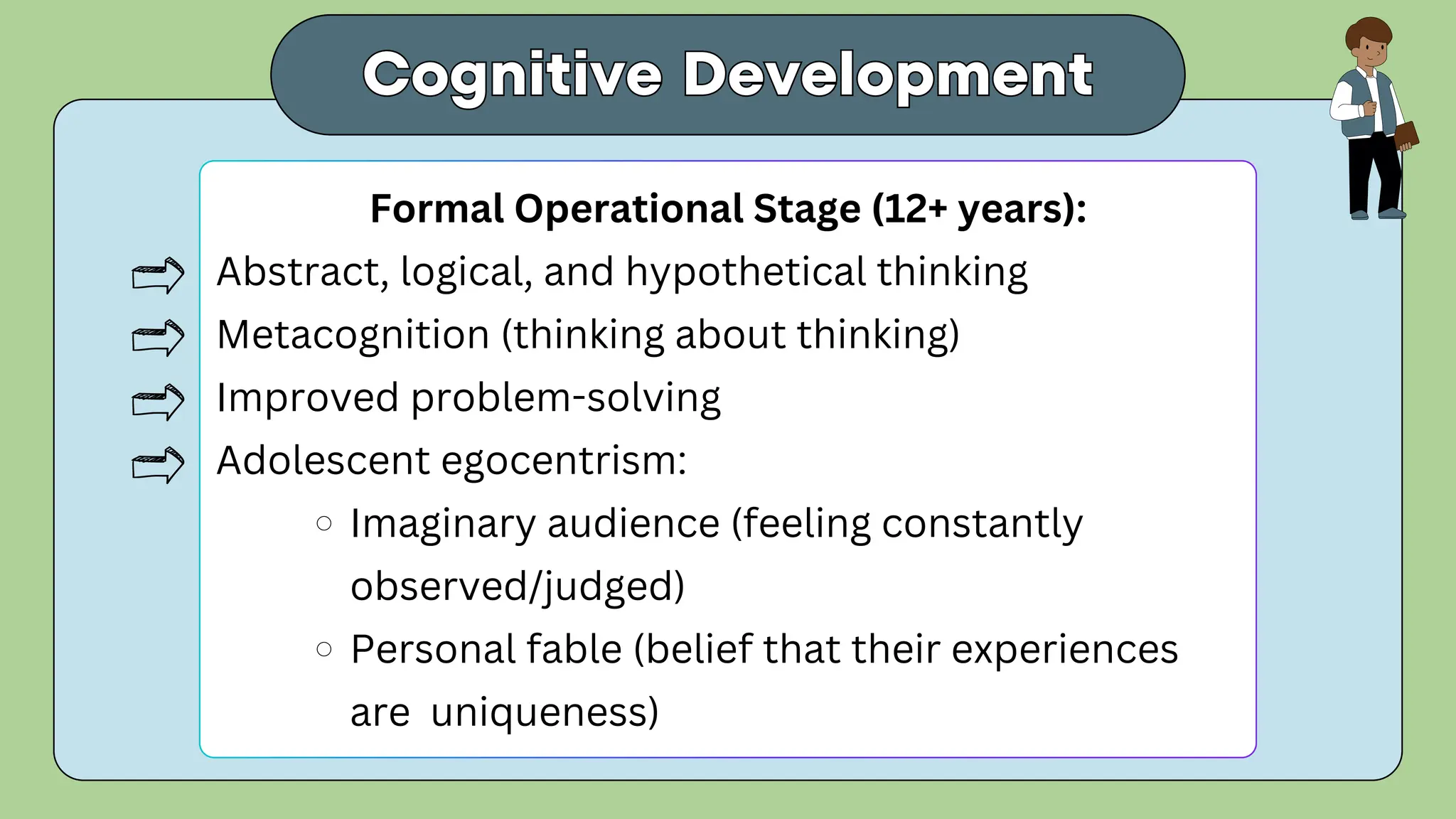
Cognitive Development
Formal Operational Stage (12+ years):
Abstract, logical, and hypothetical thinking
Metacognition (thinking about thinking)
Improved problem-solving
Adolescent egocentrism:
Imaginary audience (feeling constantly
observed/judged)
Personal fable (belief that their experiences
are uniqueness)
Psychosocial
Development (Erikson)
Psychosocial
Development (Erikson)
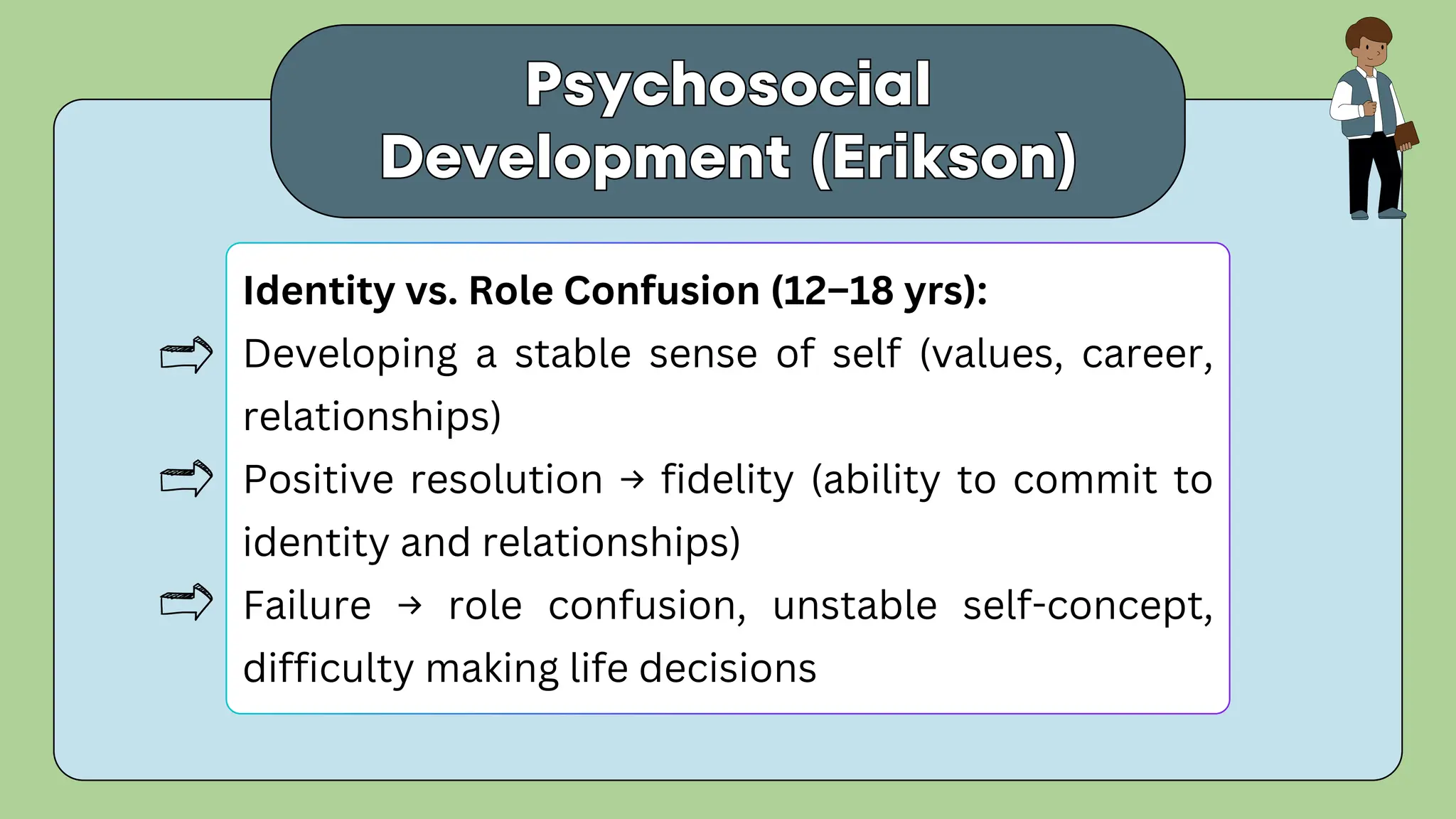
Identity vs. Role Confusion (12–18 yrs):
Developing a stable sense of self (values, career,
relationships)
Positive resolution → fidelity (ability to commit to
identity and relationships)
Failure → role confusion, unstable self-concept,
difficulty making life decisions
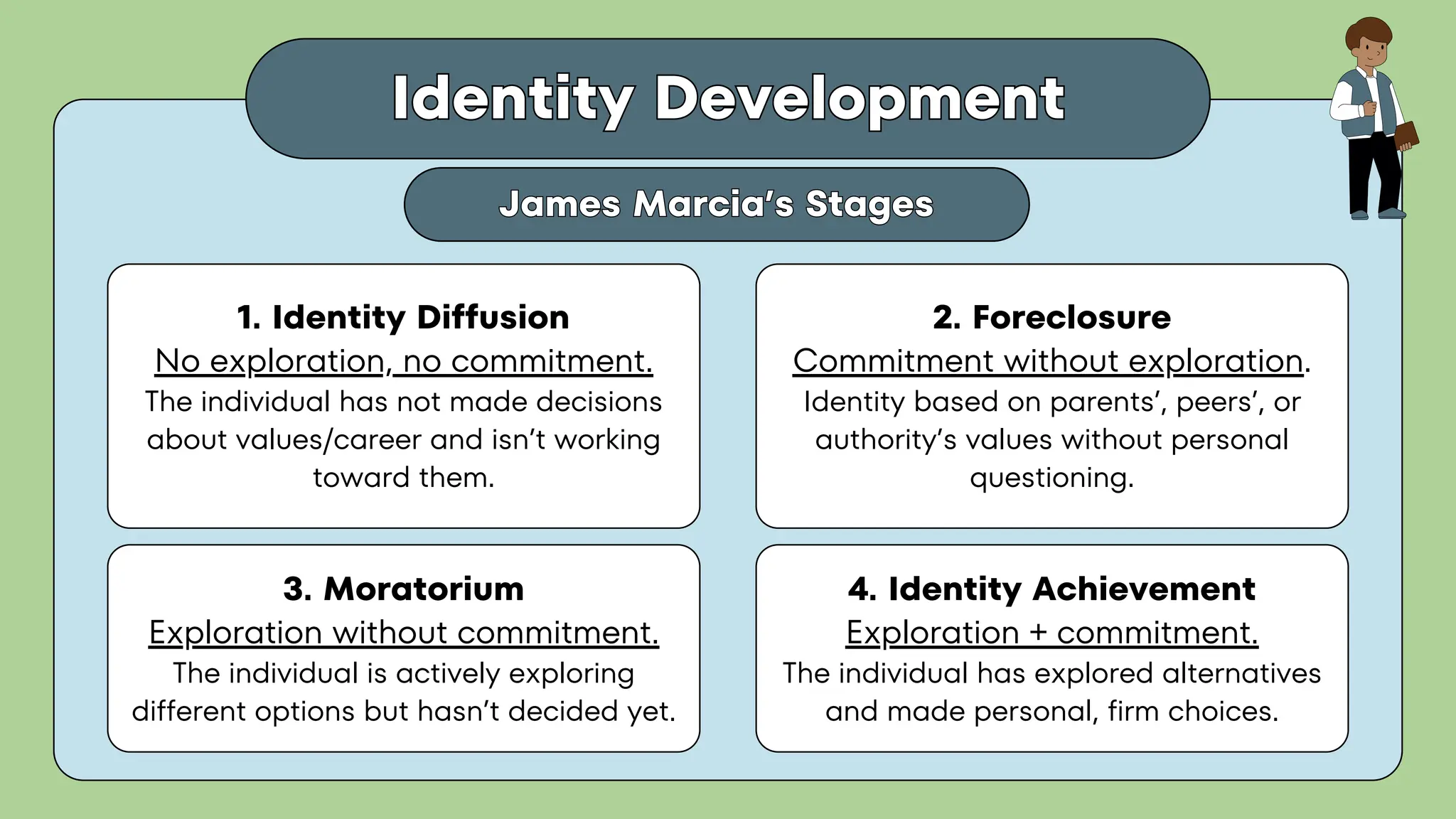
Identity Development
1. Identity Diffusion
No exploration, no commitment.
The individual has not made decisions
about values/career and isn’t working
toward them.
4. Identity Achievement
Exploration + commitment.
The individual has explored alternatives
and made personal, firm choices.
3. Moratorium
Exploration without commitment.
The individual is actively exploring
different options but hasn’t decided yet.
2. Foreclosure
Commitment without exploration.
Identity based on parents’, peers’, or
authority’s values without personal
questioning.
James Marcia’s Stages
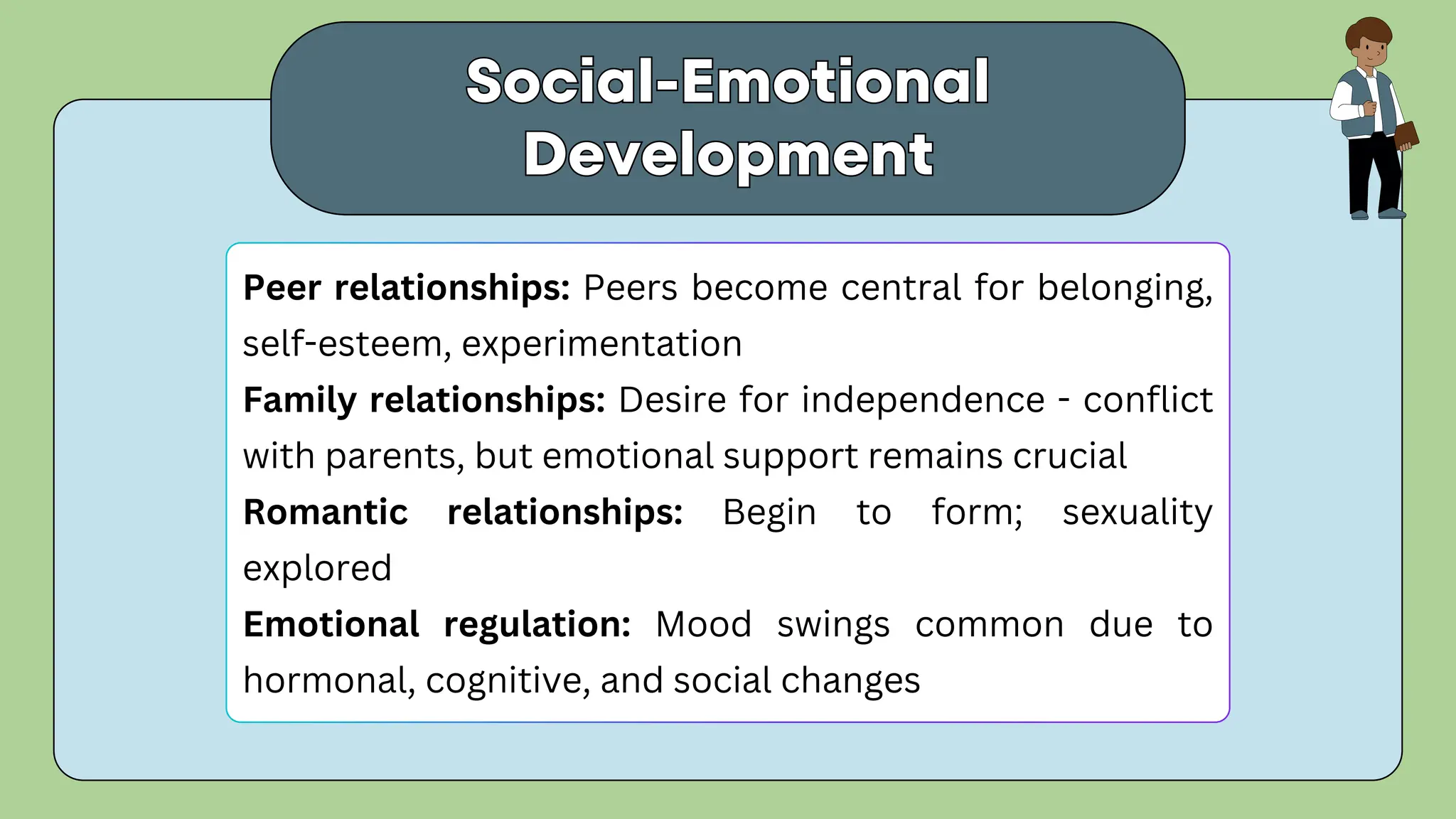
Peer relationships: Peers become central for belonging,
self-esteem, experimentation
Family relationships: Desire for independence - conflict
with parents, but emotional support remains crucial
Romantic relationships: Begin to form; sexuality
explored
Emotional regulation: Mood swings common due to
hormonal, cognitive, and social changes
Social-Emotional
Development
Social-Emotional
Development
Moral Development
(Kohlberg)
Moral Development
(Kohlberg)
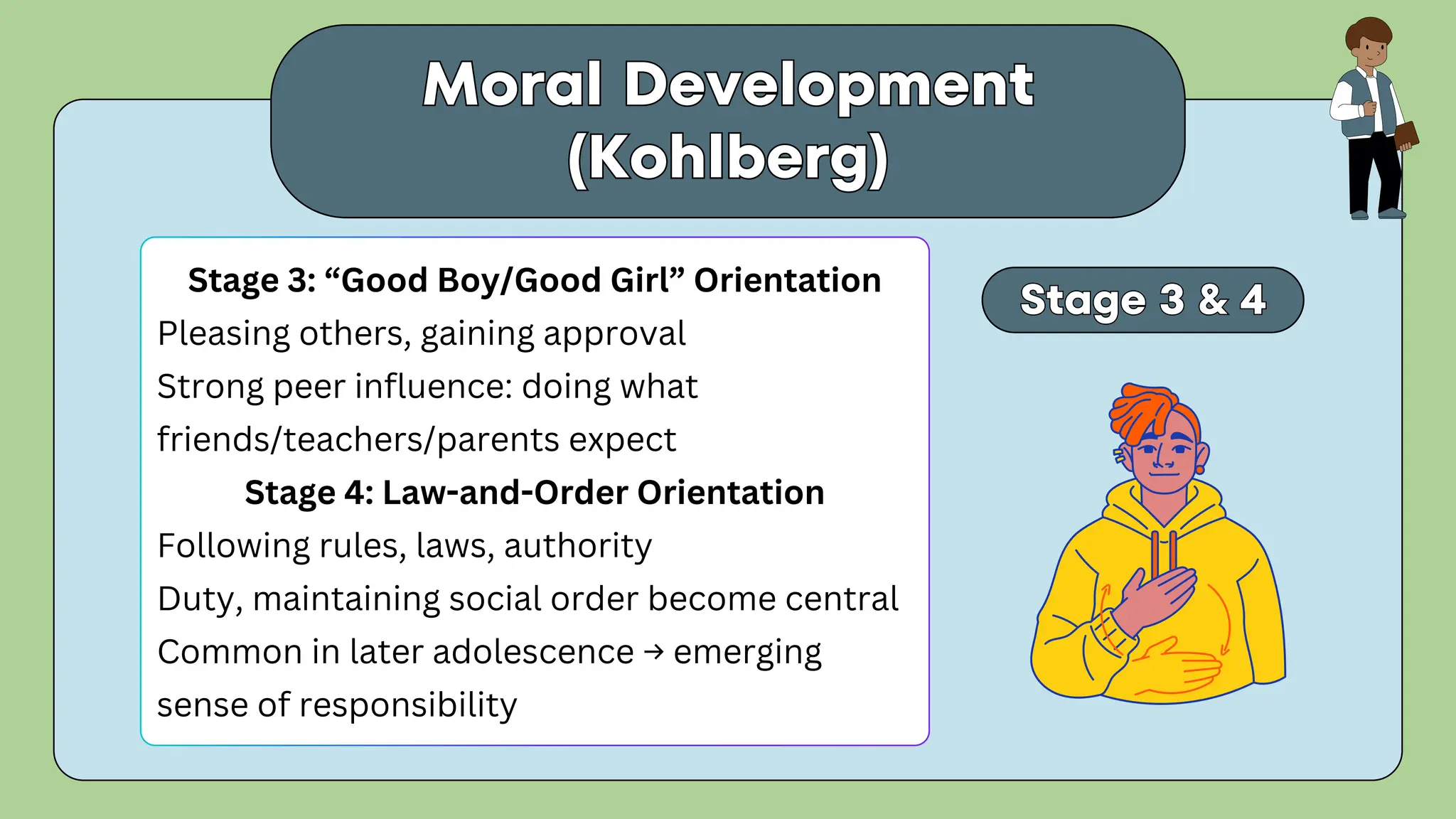
Stage 3: “Good Boy/Good Girl” Orientation
Pleasing others, gaining approval
Strong peer influence: doing what
friends/teachers/parents expect
Stage 4: Law-and-Order Orientation
Following rules, laws, authority
Duty, maintaining social order become central
Common in later adolescence → emerging
sense of responsibility
Stage 3 & 4
Stage 3 & 4
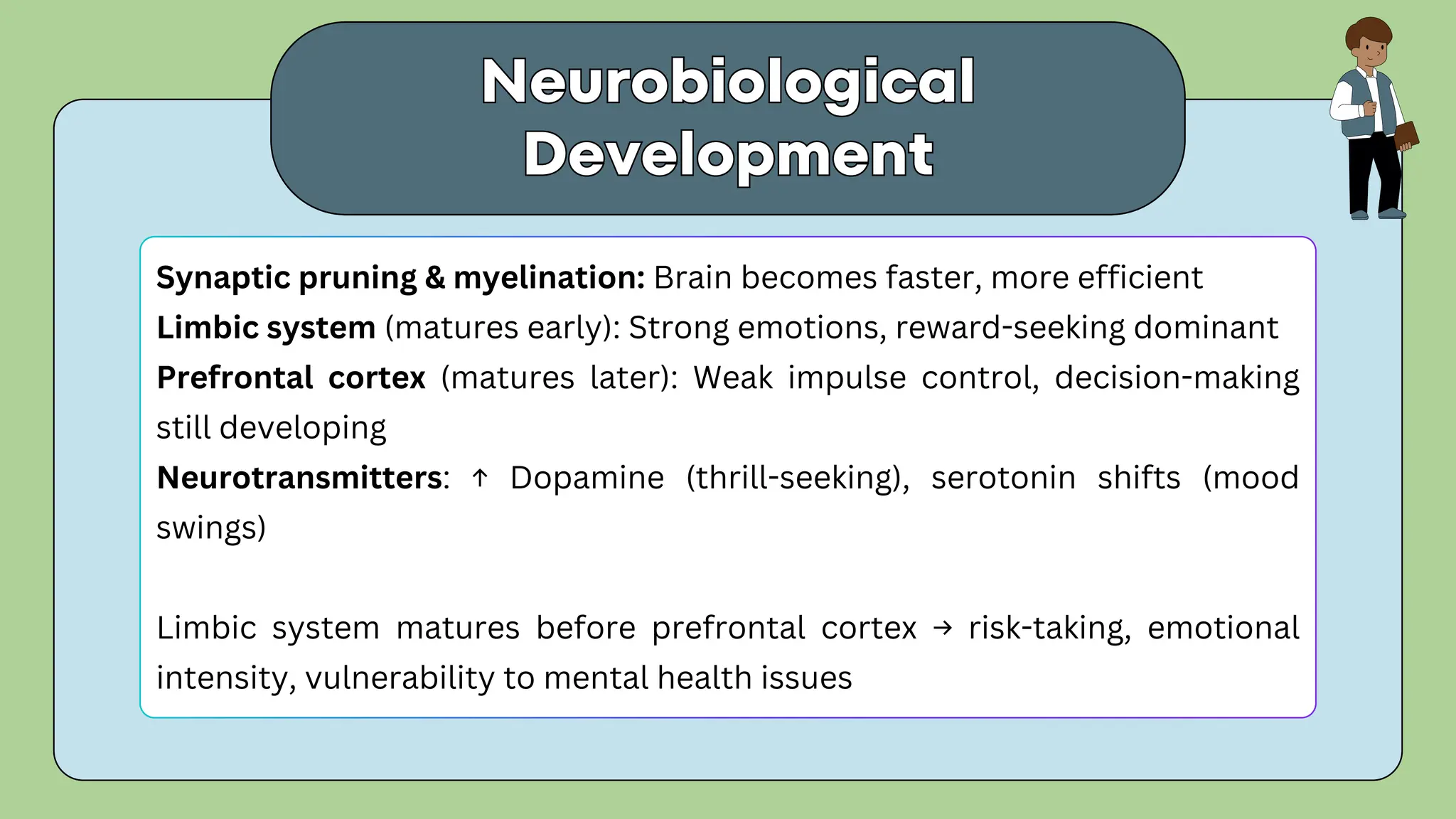
Synaptic pruning & myelination: Brain becomes faster, more efficient
Limbic system (matures early): Strong emotions, reward-seeking dominant
Prefrontal cortex (matures later): Weak impulse control, decision-making
still developing
Neurotransmitters: ↑ Dopamine (thrill-seeking), serotonin shifts (mood
swings)
Limbic system matures before prefrontal cortex → risk-taking, emotional
intensity, vulnerability to mental health issues
Neurobiological
Development
Neurobiological
Development
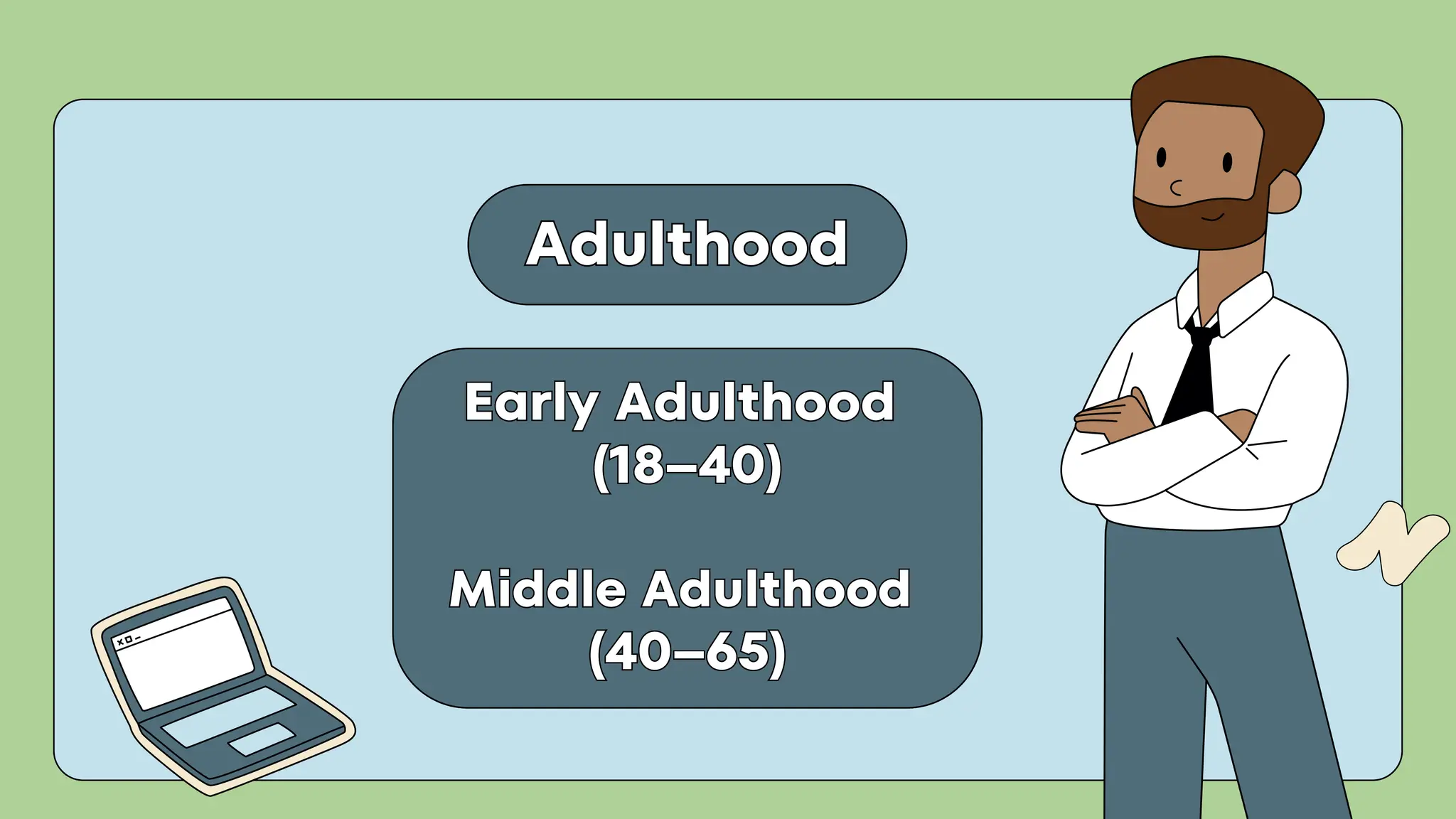
Early Adulthood
(18–40)
Middle Adulthood
(40–65)
Early Adulthood
(18–40)
Middle Adulthood
(40–65)
Adulthood
Adulthood
Physical Growth
Physical Growth
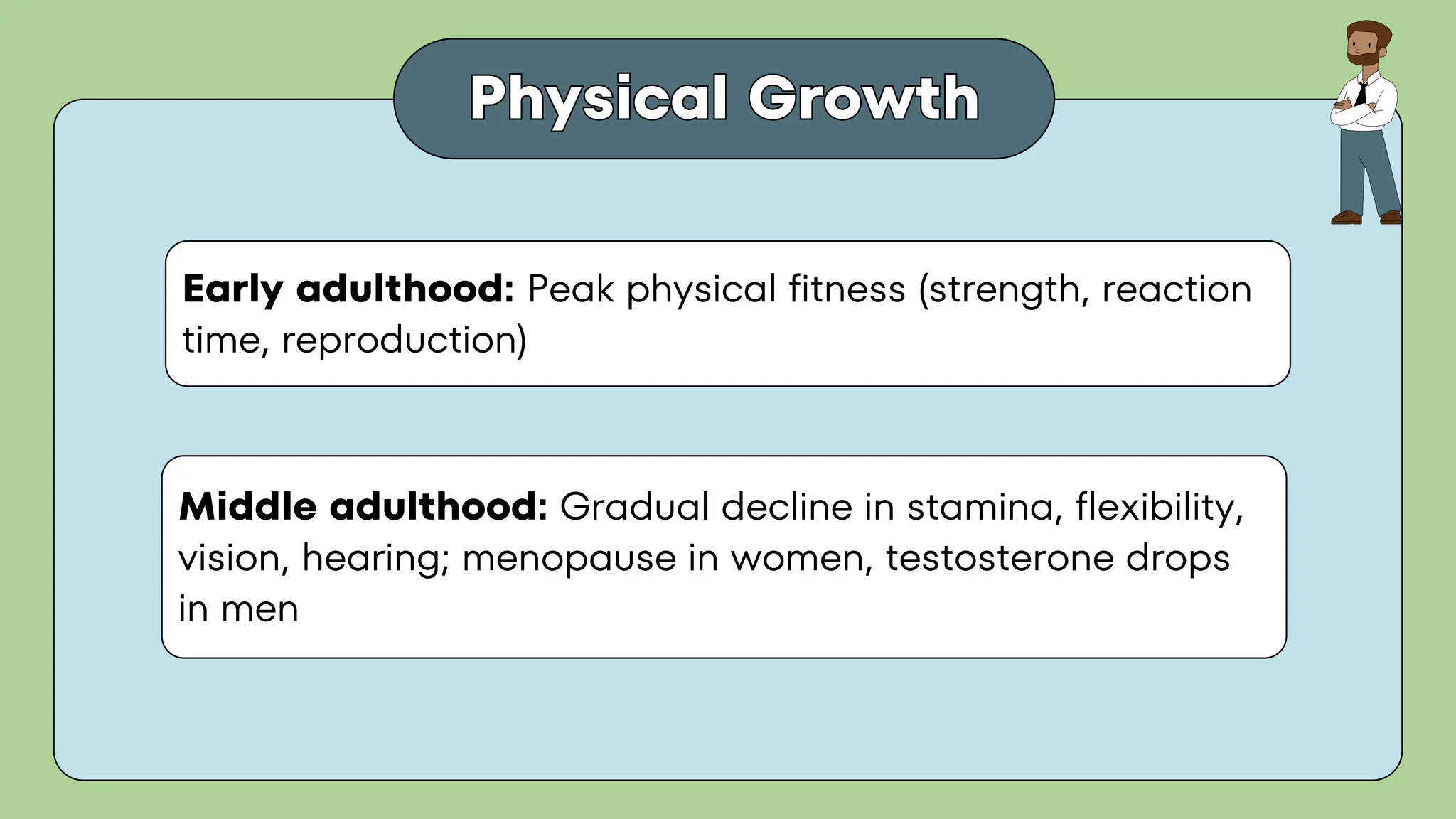
Early adulthood: Peak physical fitness (strength, reaction
time, reproduction)
Middle adulthood: Gradual decline in stamina, flexibility,
vision, hearing; menopause in women, testosterone drops
in men
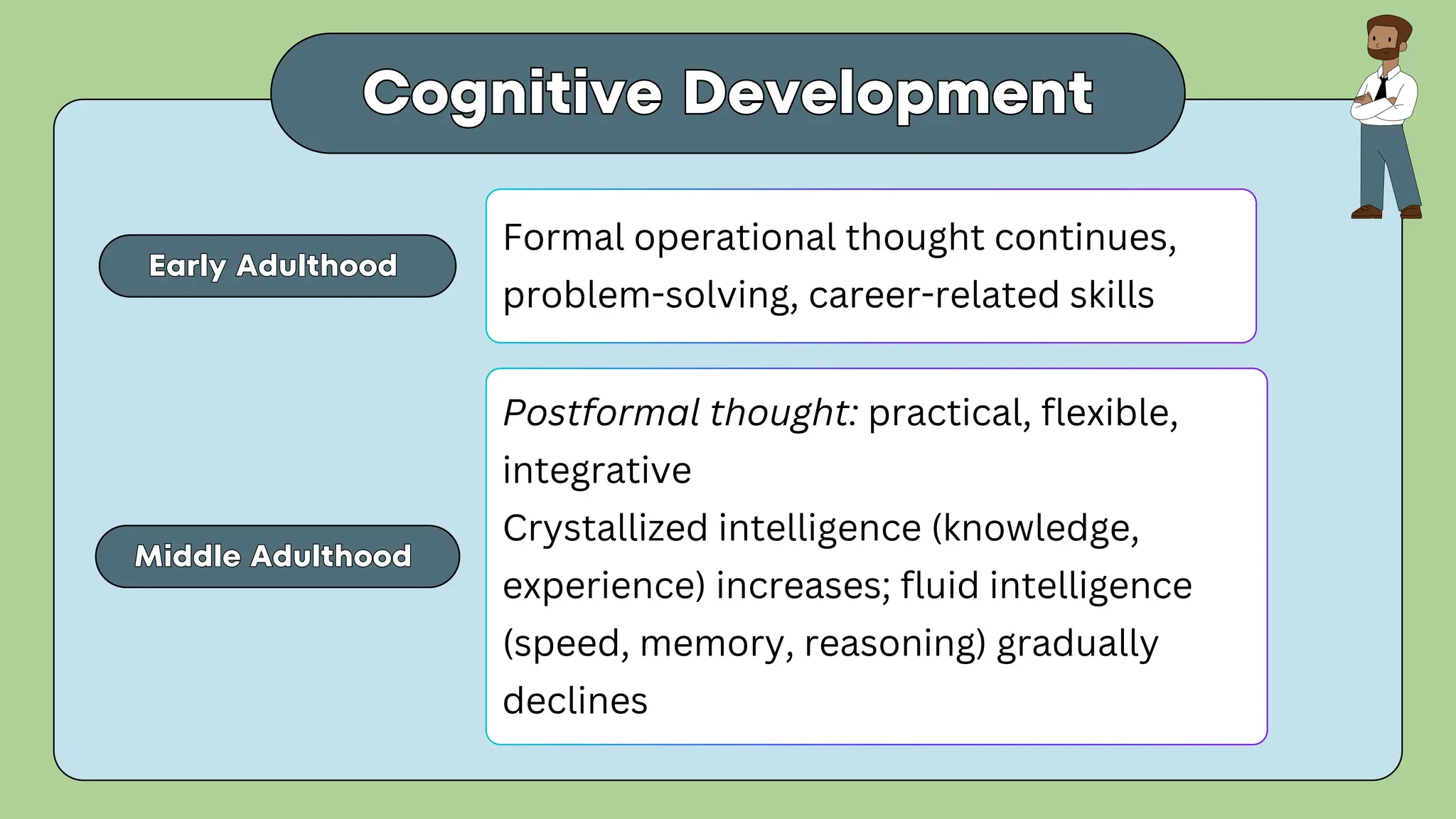
Cognitive Development
Formal operational thought continues,
problem-solving, career-related skills
Postformal thought: practical, flexible,
integrative
Crystallized intelligence (knowledge,
experience) increases; fluid intelligence
(speed, memory, reasoning) gradually
declines
Early Adulthood
Early Adulthood
Middle Adulthood
Middle Adulthood
Psychosocial
Development (Erikson)
Psychosocial
Development (Erikson)
Middle Adulthood
Middle Adulthood
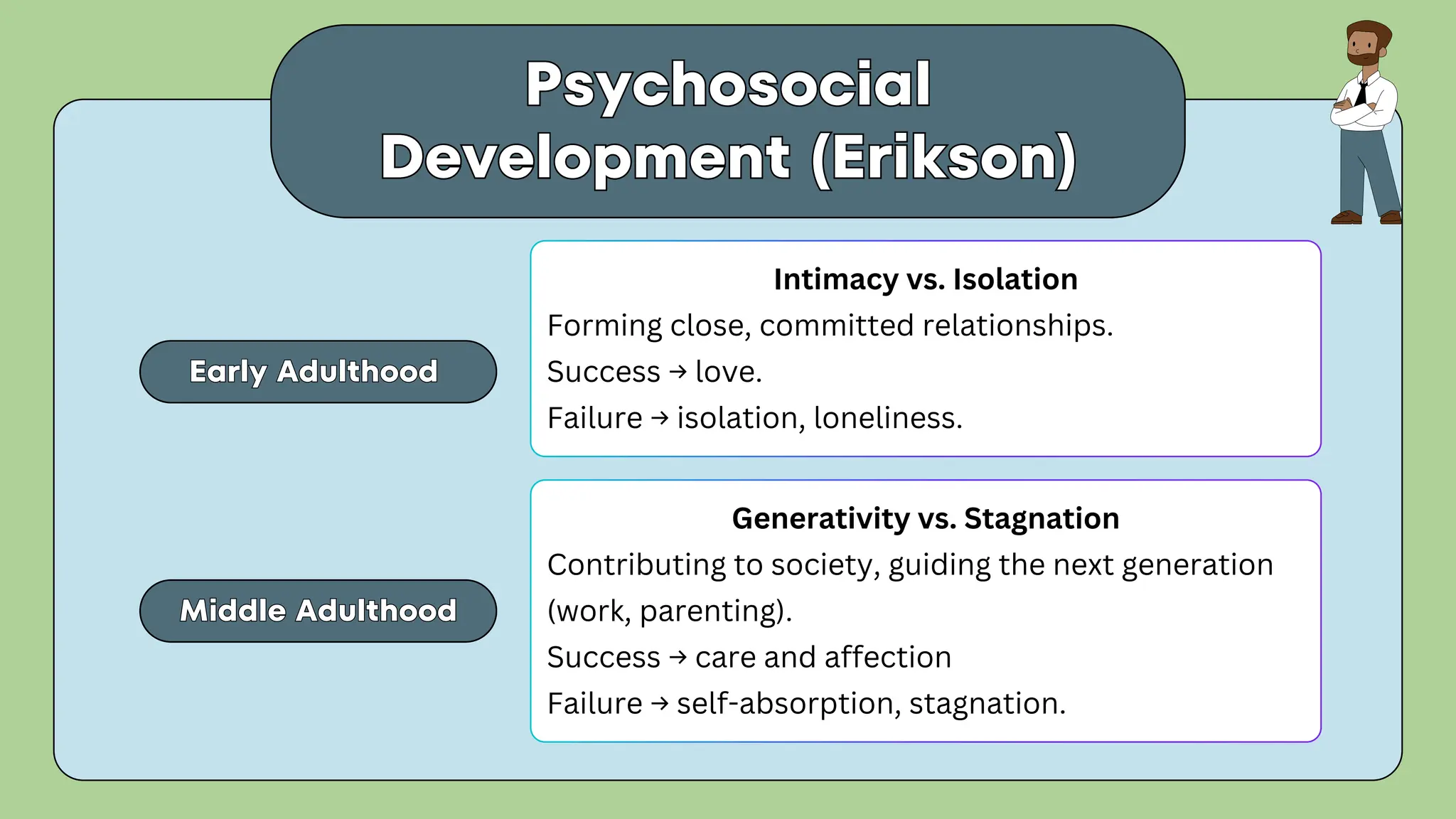
Intimacy vs. Isolation
Forming close, committed relationships.
Success → love.
Failure → isolation, loneliness.
Generativity vs. Stagnation
Contributing to society, guiding the next generation
(work, parenting).
Success → care and affection
Failure → self-absorption, stagnation.
Early Adulthood
Early Adulthood
Moral Development
(Kohlberg)
Moral Development
(Kohlberg)
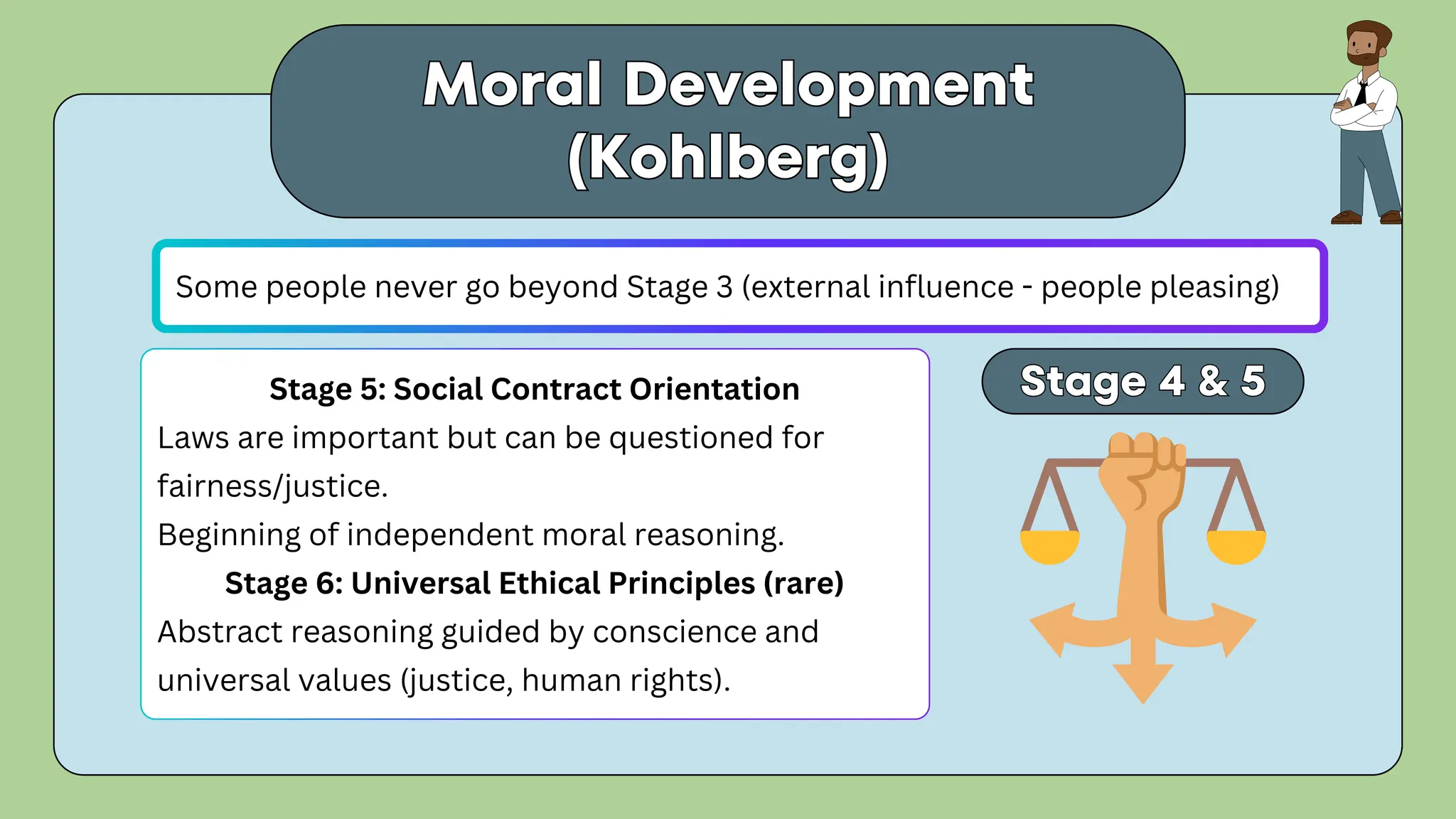
Stage 5: Social Contract Orientation
Laws are important but can be questioned for
fairness/justice.
Beginning of independent moral reasoning.
Stage 6: Universal Ethical Principles (rare)
Abstract reasoning guided by conscience and
universal values (justice, human rights).
Stage 4 & 5
Stage 4 & 5
Some people never go beyond Stage 3 (external influence - people pleasing)
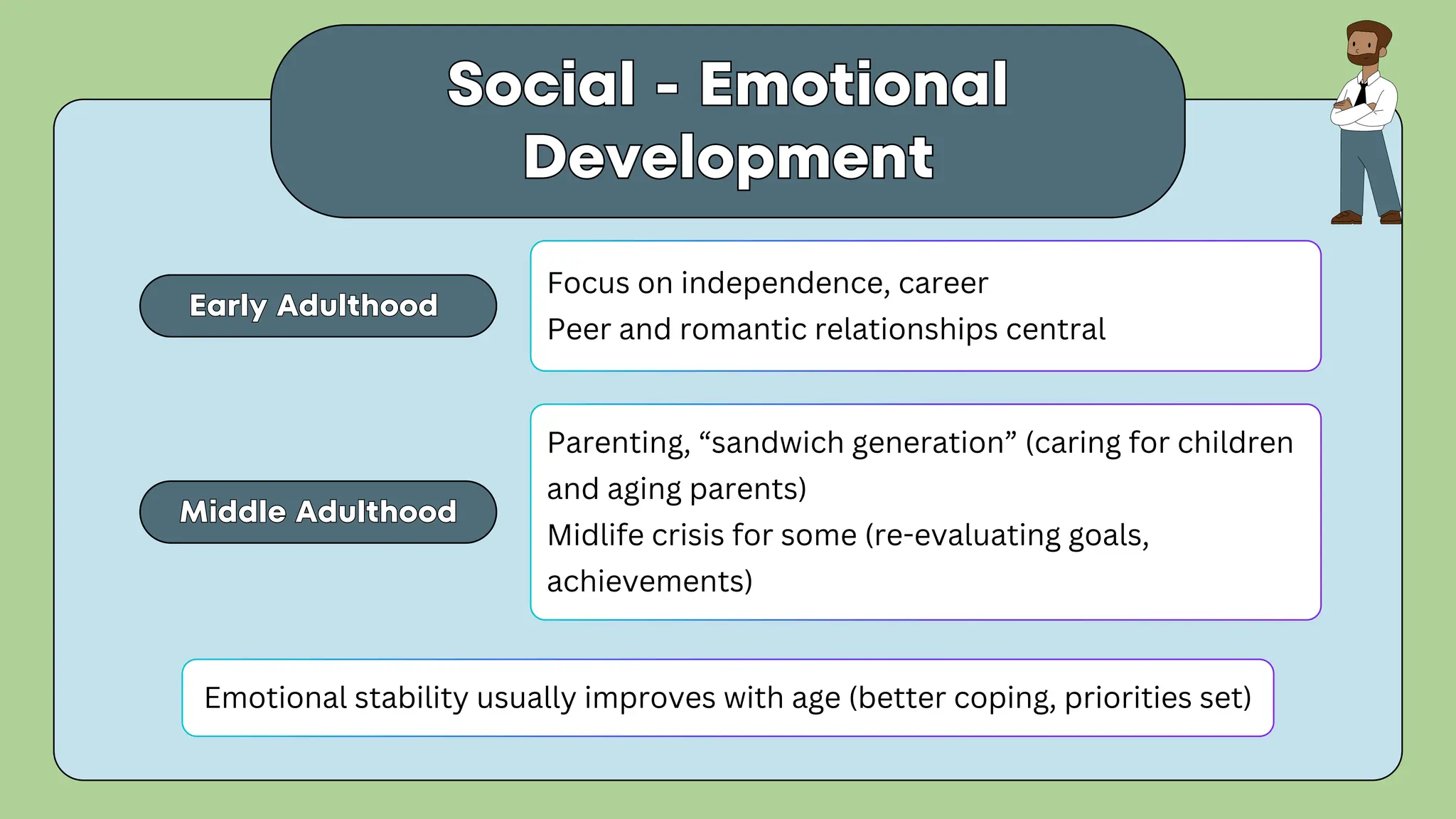
Social - Emotional
Development
Social - Emotional
Development
Middle Adulthood
Middle Adulthood
Focus on independence, career
Peer and romantic relationships central
Parenting, “sandwich generation” (caring for children
and aging parents)
Midlife crisis for some (re-evaluating goals,
achievements)
Early Adulthood
Early Adulthood
Emotional stability usually improves with age (better coping, priorities set)
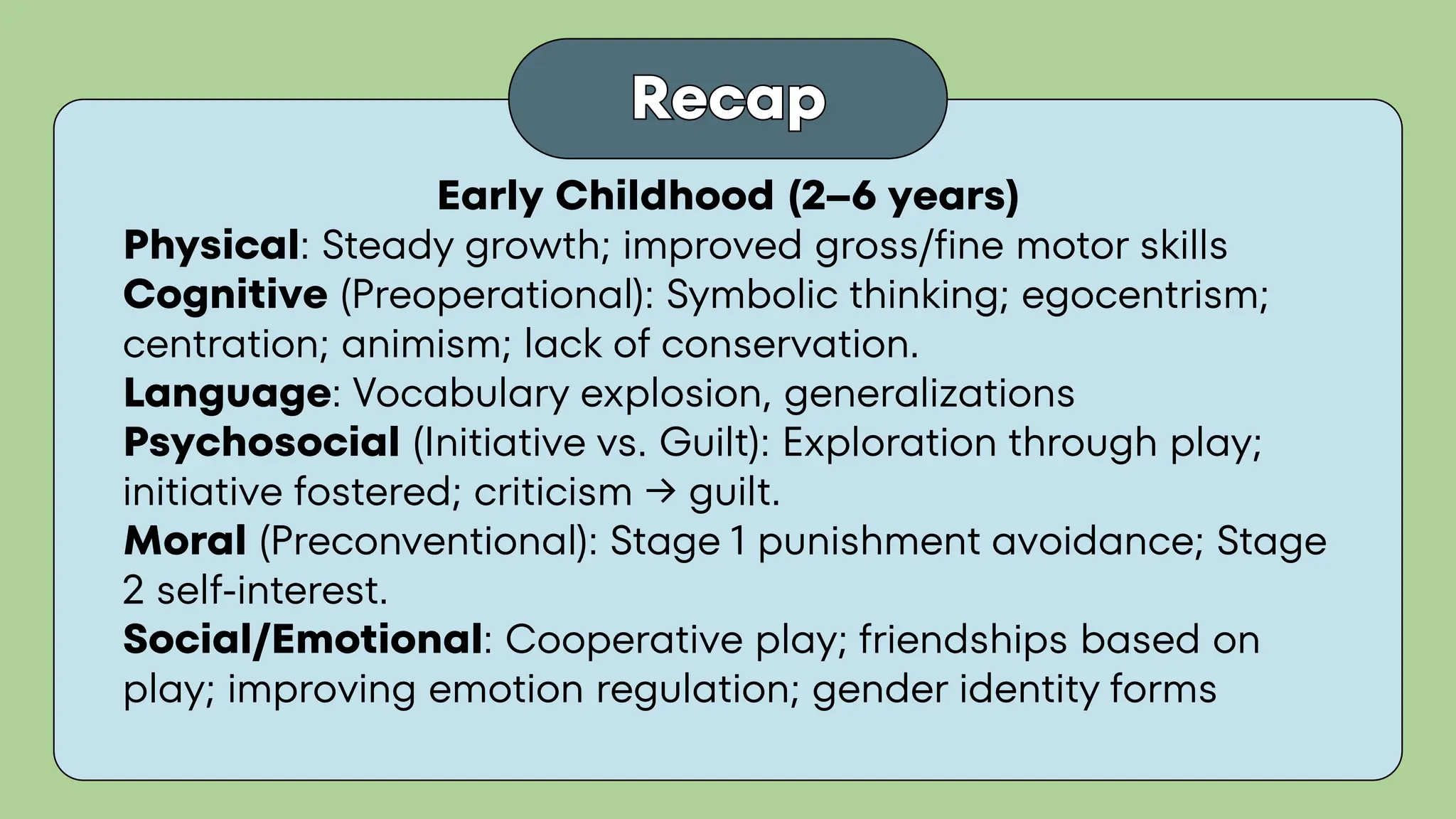
Recap
Recap
Early Childhood (2–6 years)
Physical: Steady growth; improved gross/fine motor skills
Cognitive (Preoperational): Symbolic thinking; egocentrism;
centration; animism; lack of conservation.
Language: Vocabulary explosion, generalizations
Psychosocial (Initiative vs. Guilt): Exploration through play;
initiative fostered; criticism → guilt.
Moral (Preconventional): Stage 1 punishment avoidance; Stage
2 self-interest.
Social/Emotional: Cooperative play; friendships based on
play; improving emotion regulation; gender identity forms
Recap
Recap
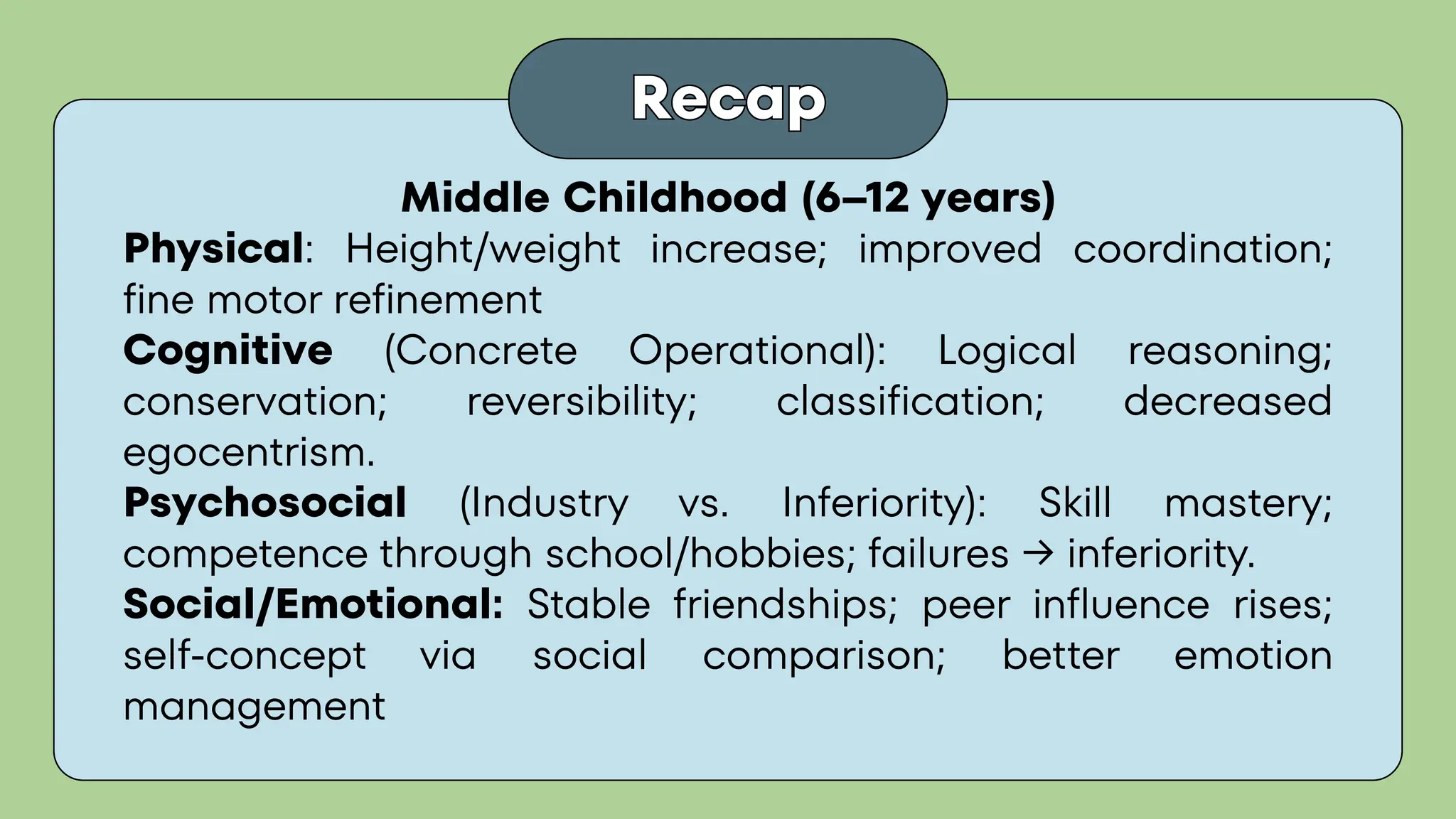
Middle Childhood (6–12 years)
Physical: Height/weight increase; improved coordination;
fine motor refinement
Cognitive (Concrete Operational): Logical reasoning;
conservation; reversibility; classification; decreased
egocentrism.
Psychosocial (Industry vs. Inferiority): Skill mastery;
competence through school/hobbies; failures → inferiority.
Social/Emotional: Stable friendships; peer influence rises;
self-concept via social comparison; better emotion
management
Recap
Recap
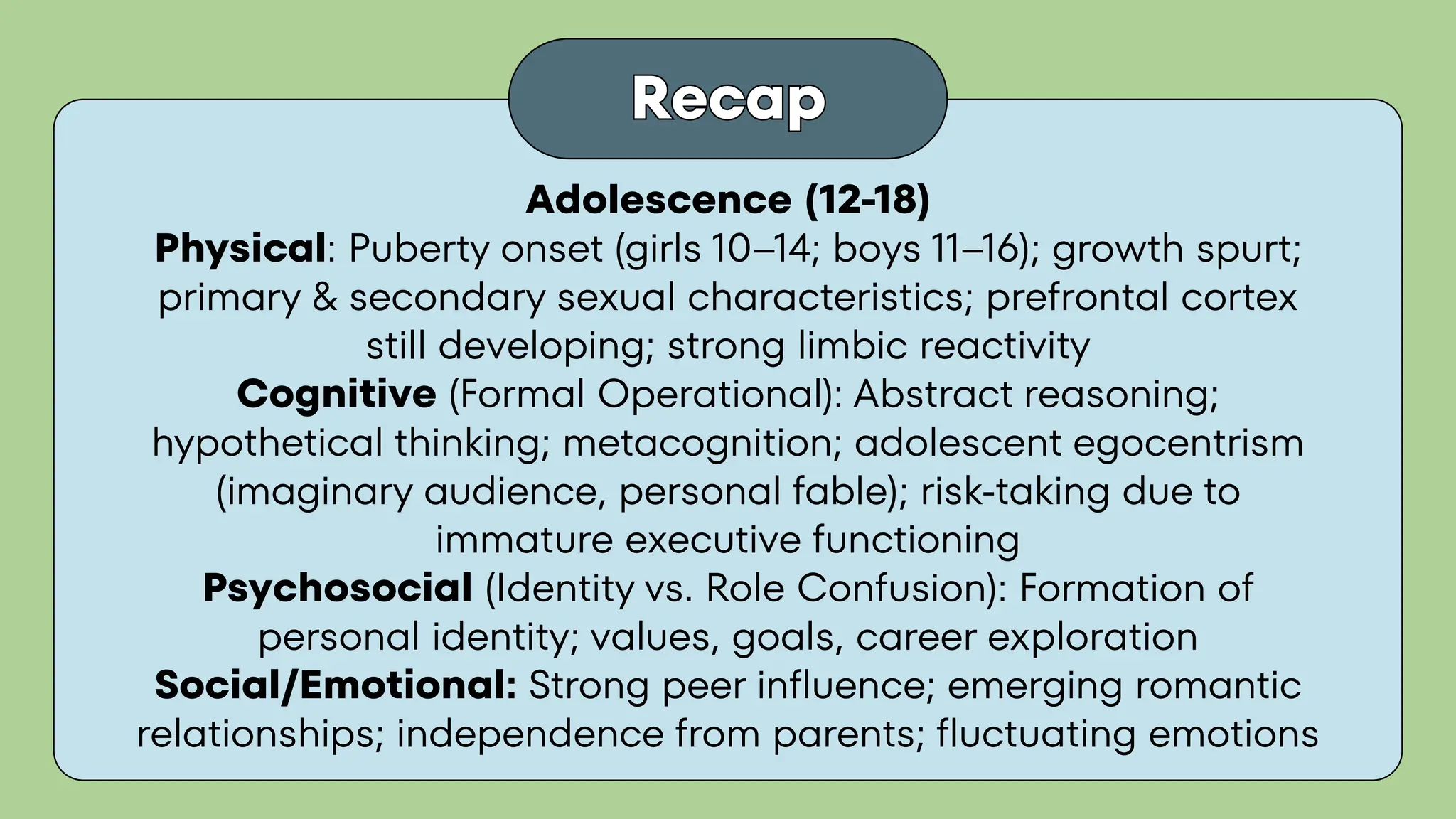
Adolescence (12-18)
Physical: Puberty onset (girls 10–14; boys 11–16); growth spurt;
primary & secondary sexual characteristics; prefrontal cortex
still developing; strong limbic reactivity
Cognitive (Formal Operational): Abstract reasoning;
hypothetical thinking; metacognition; adolescent egocentrism
(imaginary audience, personal fable); risk-taking due to
immature executive functioning
Psychosocial (Identity vs. Role Confusion): Formation of
personal identity; values, goals, career exploration
Social/Emotional: Strong peer influence; emerging romantic
relationships; independence from parents; fluctuating emotions
Recap
Recap
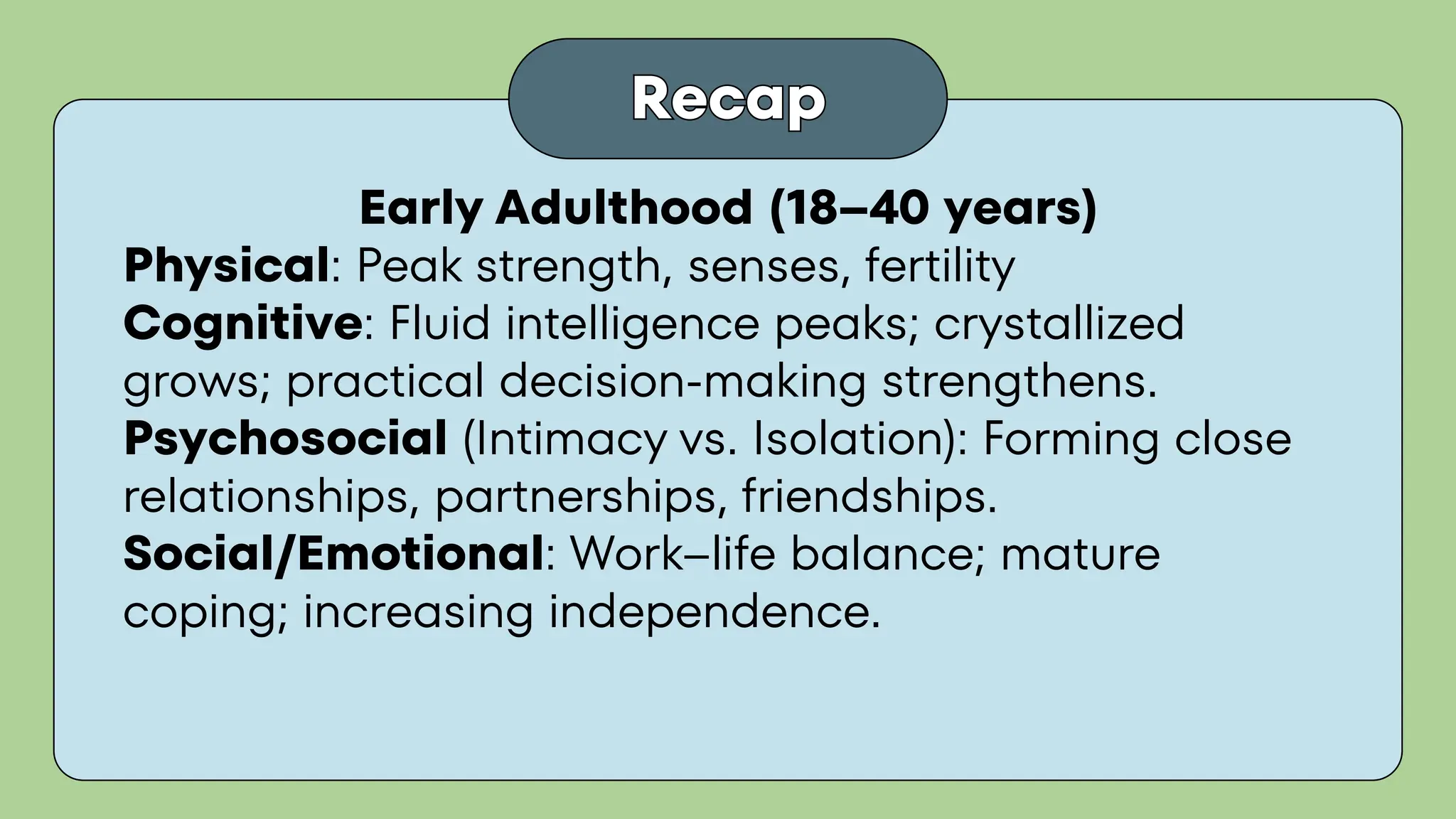
Early Adulthood (18–40 years)
Physical: Peak strength, senses, fertility
Cognitive: Fluid intelligence peaks; crystallized
grows; practical decision-making strengthens.
Psychosocial (Intimacy vs. Isolation): Forming close
relationships, partnerships, friendships.
Social/Emotional: Work–life balance; mature
coping; increasing independence.
Recap
Recap
Middle Adulthood (40–65 years)
Physical: Decline in stamina/senses; slower metabolism;
higher chronic illness risk; menopause.
Cognitive: Strong crystallized intelligence; slight
reduction in fluid reasoning; accumulated expertise.
Psychosocial (Generativity vs. Stagnation): Contribution
to family/community/work; mentoring; legacy-building.
Social/Emotional: Managing relationships with
adolescents/adult children and aging parents; reflective
stage
Old Age
65+ years
Old Age
65+ years
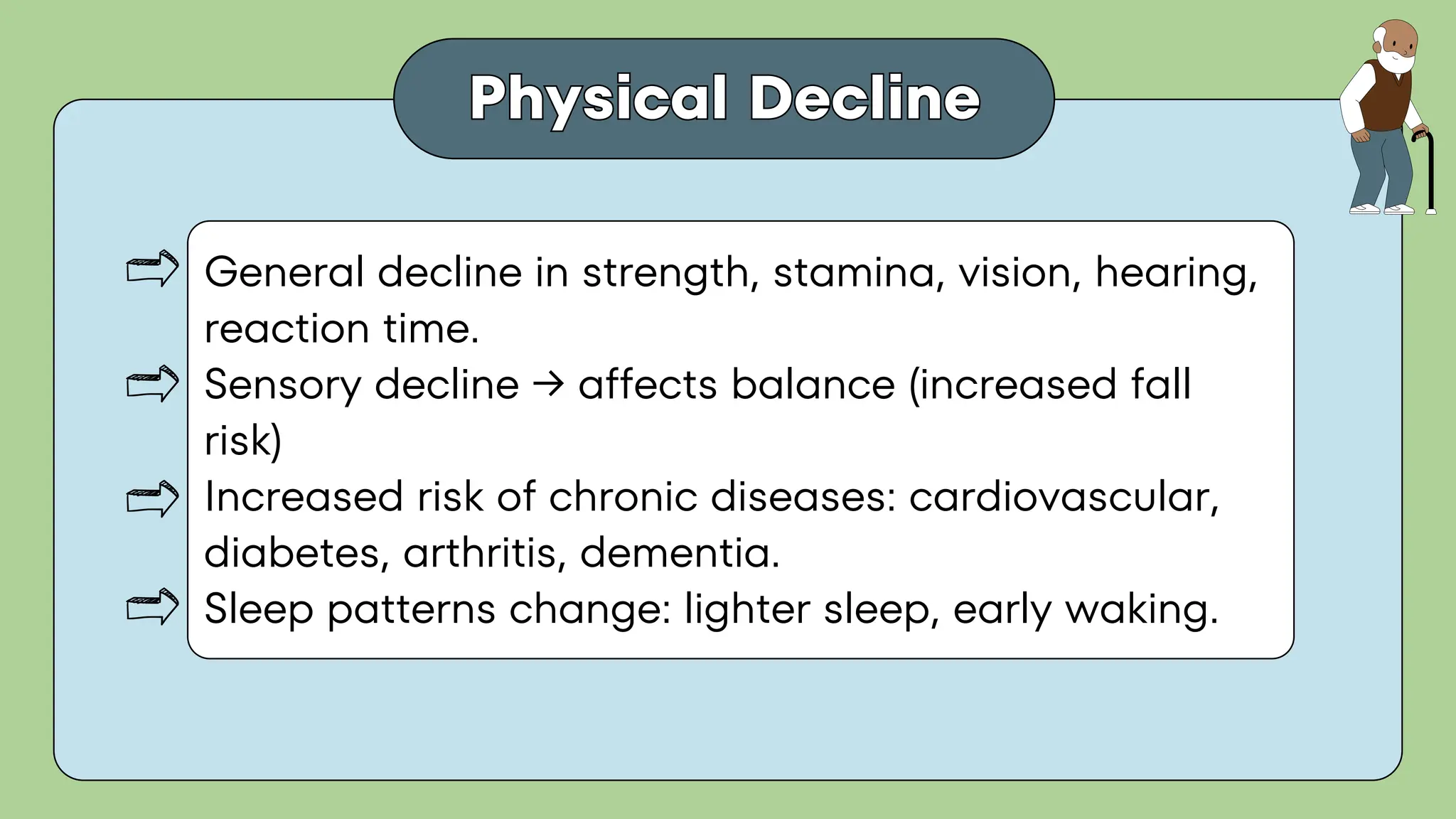
Physical Decline
Physical Decline
General decline in strength, stamina, vision, hearing,
reaction time.
Sensory decline → affects balance (increased fall
risk)
Increased risk of chronic diseases: cardiovascular,
diabetes, arthritis, dementia.
Sleep patterns change: lighter sleep, early waking.
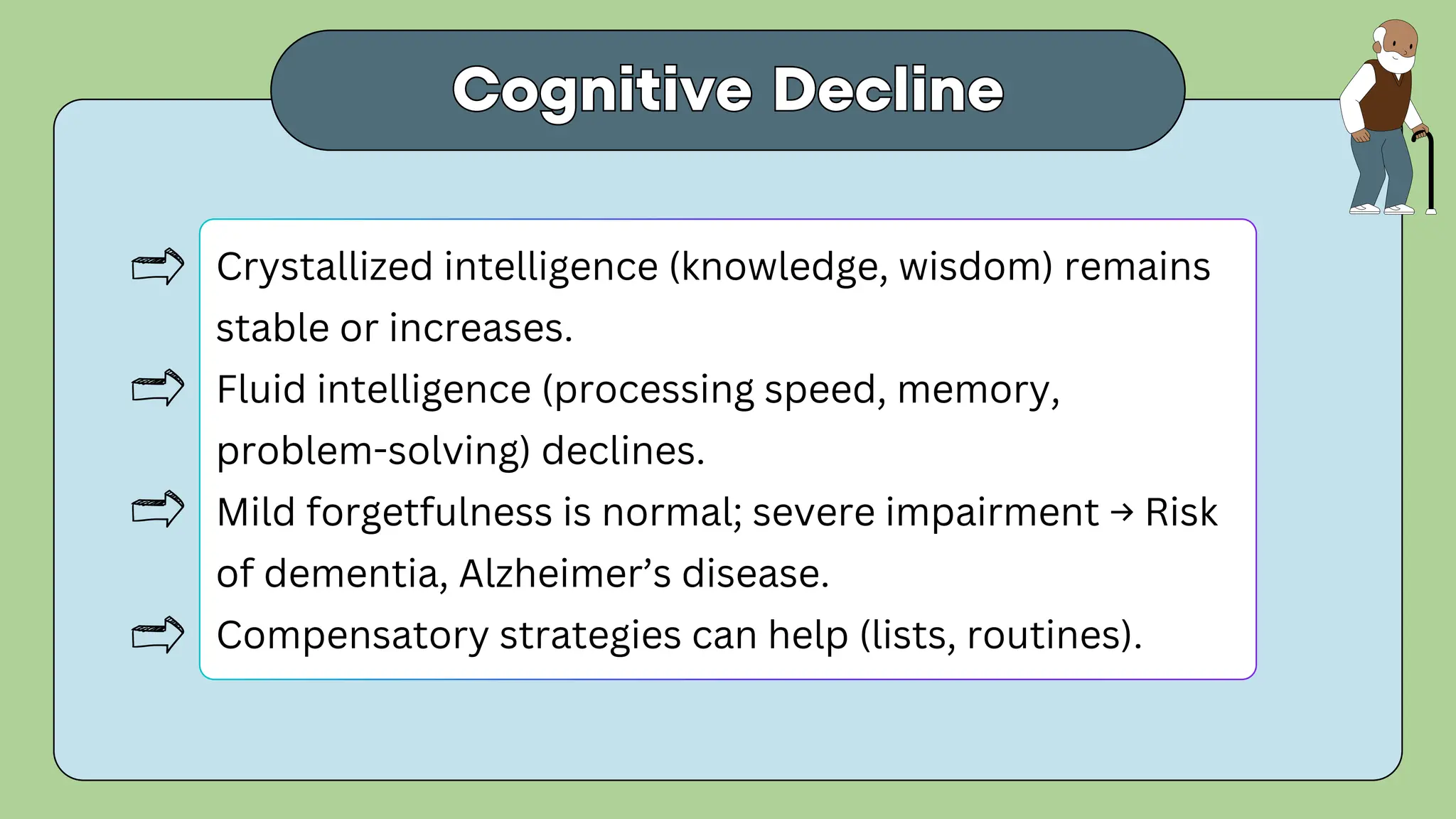
Cognitive Decline
Cognitive Decline
Crystallized intelligence (knowledge, wisdom) remains
stable or increases.
Fluid intelligence (processing speed, memory,
problem-solving) declines.
Mild forgetfulness is normal; severe impairment → Risk
of dementia, Alzheimer’s disease.
Compensatory strategies can help (lists, routines).
Psychosocial
Development (Erikson)
Psychosocial
Development (Erikson)
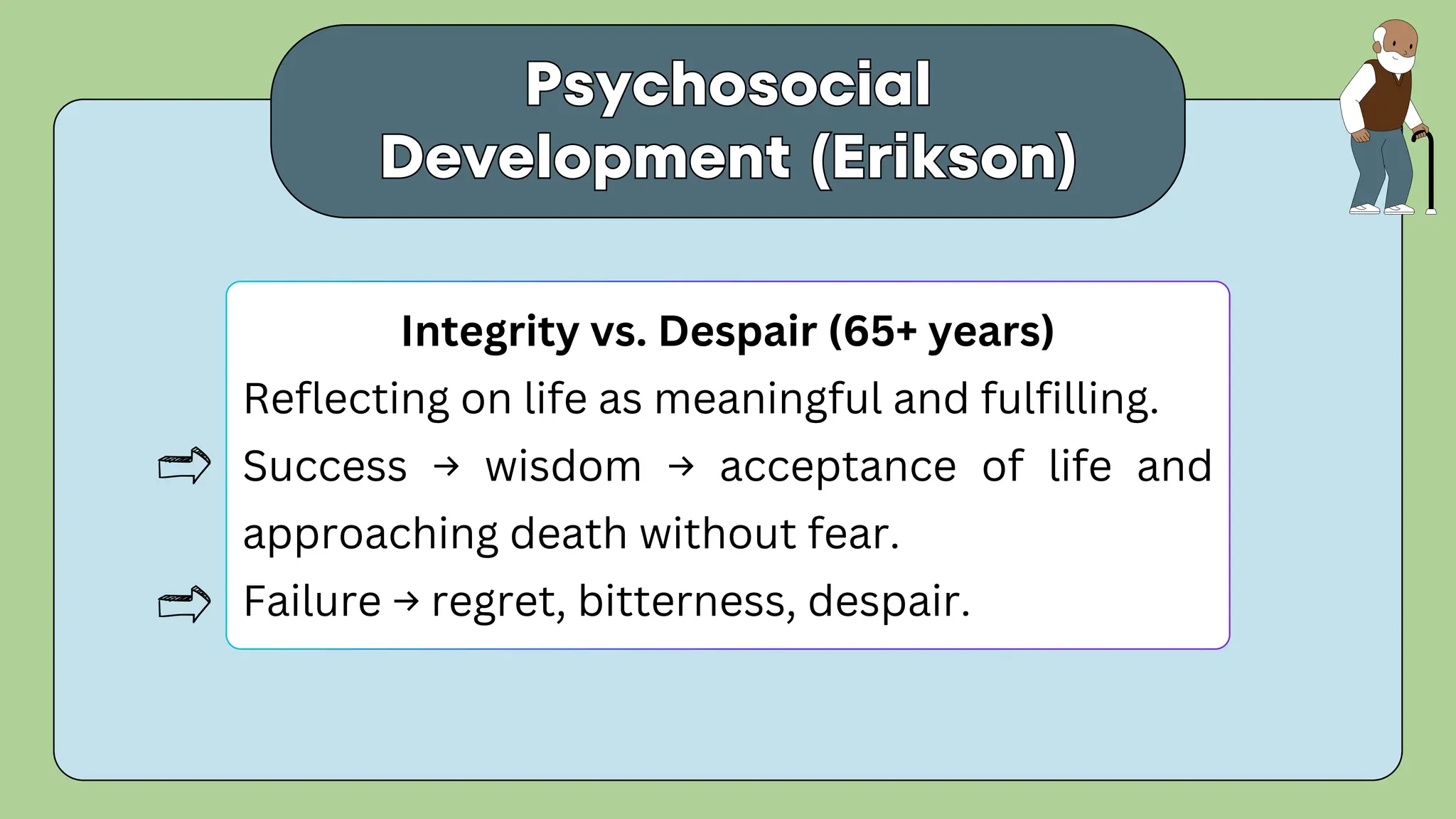
Integrity vs. Despair (65+ years)
Reflecting on life as meaningful and fulfilling.
Success → wisdom → acceptance of life and
approaching death without fear.
Failure → regret, bitterness, despair.
Social - Emotional
Development
Social - Emotional
Development
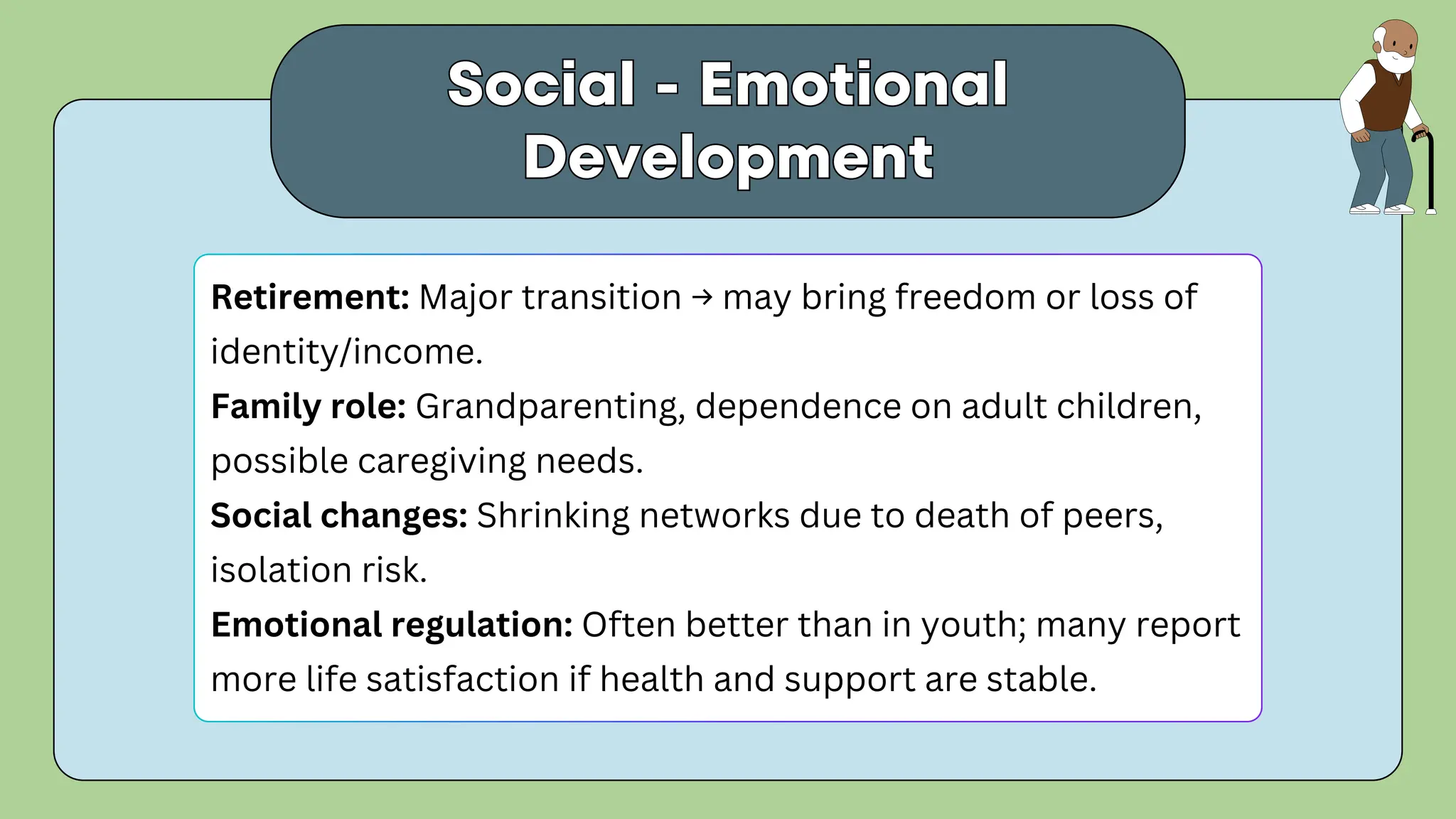
Retirement: Major transition → may bring freedom or loss of
identity/income.
Family role: Grandparenting, dependence on adult children,
possible caregiving needs.
Social changes: Shrinking networks due to death of peers,
isolation risk.
Emotional regulation: Often better than in youth; many report
more life satisfaction if health and support are stable.
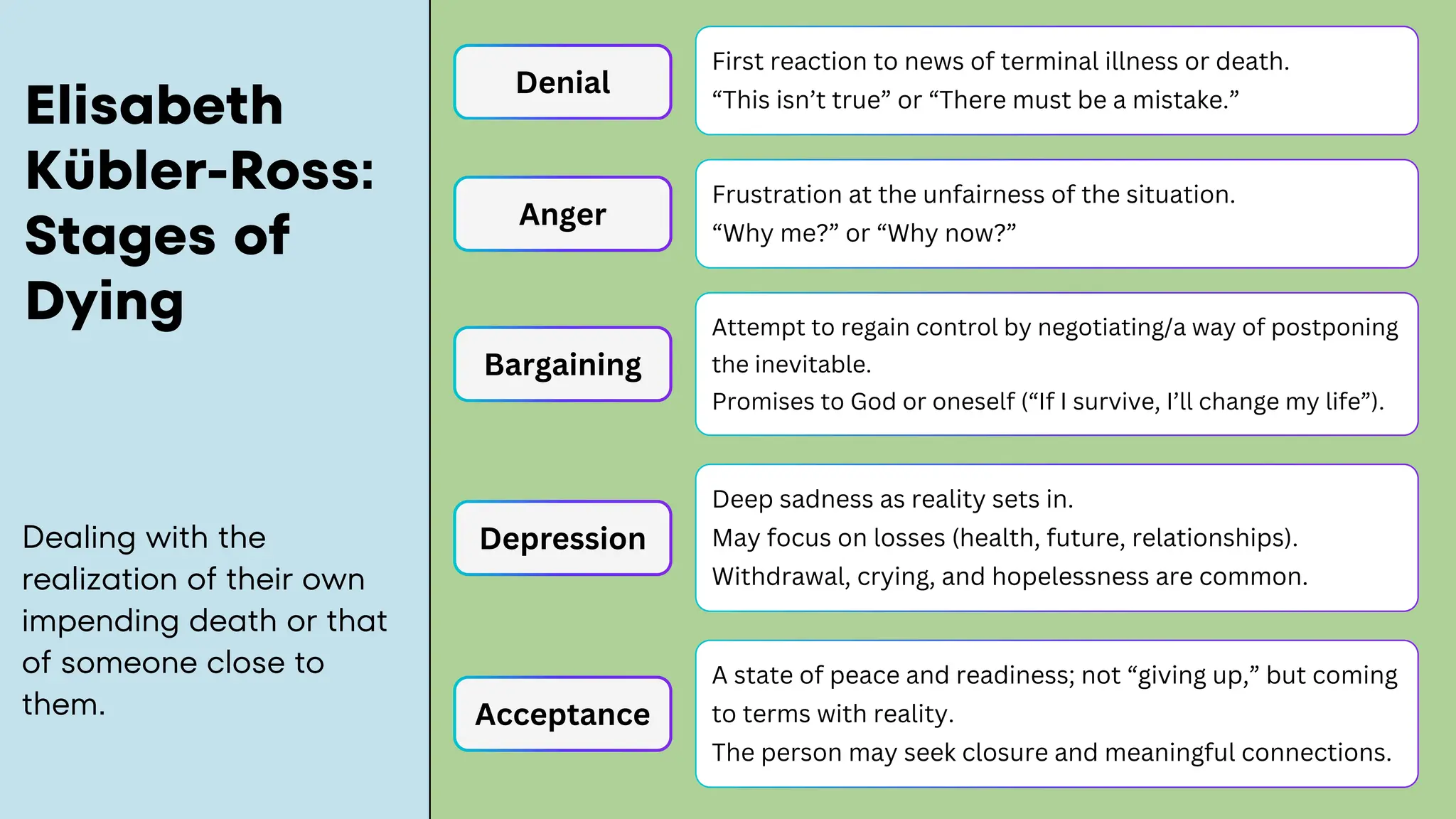
First reaction to news of terminal illness or death.
“This isn’t true” or “There must be a mistake.”
Frustration at the unfairness of the situation.
“Why me?” or “Why now?”
Denial
Anger
Elisabeth
Kübler-Ross:
Stages of
Dying
Dealing with the
realization of their own
impending death or that
of someone close to
them. Acceptance
Bargaining
Attempt to regain control by negotiating/a way of postponing
the inevitable.
Promises to God or oneself (“If I survive, I’ll change my life”).
Deep sadness as reality sets in.
May focus on losses (health, future, relationships).
Withdrawal, crying, and hopelessness are common.
Depression
A state of peace and readiness; not “giving up,” but coming
to terms with reality.
The person may seek closure and meaningful connections.

Growth and Development - Psychology Lecture Slides

  • 1.
  • 2.
    What is Development? Developmentrefers to the physiological, behavioral, cognitive, and social changes that occur throughout human life, which are guided by both genetic predispositions (nature) and by environmental influences (nurture).
  • 3.
    Growth vs Development Growth:Just quantitative changes (size, height, weight) Development: More qualitative changes (skills, ability, functions) Both are continuous, interrelated processes
  • 4.
    Domains of Development Emotional Social MoralPersonality Physical Cognitive
  • 5.
    Major Theories Freud –Psychosexual stages (unconscious drives) Erikson – Psychosocial stages (lifespan crises) Piaget – Cognitive development (thinking stages) Vygotsky – Sociocultural theory (culture & interaction) Skinner & Bandura – Learning & social learning (behavior shaping, modeling) Maslow & Rogers – Humanistic (growth, self- actualization)
  • 6.
    Freud – Psychosexualstages Unconscious drives related to needs/pleasure and conflict. If needs are not met (or are overly indulged), the person may become “fixated” and carry unresolved issues into adulthood. Stages: Oral (0–1 yr): Babies get pleasure from sucking, feeding, and exploring with the mouth. Example: Thumb sucking gives comfort. Anal (1–3 yrs): Pleasure centers on bowel and bladder control. Example: Toilet training: too strict may cause obsessiveness later. Phallic (3–6 yrs): Focus on genitals, learning gender roles (Oedipus/Electra complex). Example: Child becomes attached to opposite-sex parent. Latency (6–12 yrs): Sexual feelings dormant, focus shifts to school and friendships. Genital (12+ yrs): Mature sexual interests and relationships develop.
  • 7.
    Piaget’s Cognitive Development Theory Jean Piaget’s theory explainshow we actively construct knowledge as we grow. He proposed that thinking develops in stages Learning through senses and motor actions (looking, touching, grasping). Object permanence (~8 months) Thinking is symbolic, but not logical Rapid language development, pretend play Egocentrism, animism, centration Sensorimotor Stage (0–2 yrs) Preoperation Stage (2–7 yrs) Formal Operational Stage (12+ yrs) Concrete Operational Stage (7–11 yrs) Logical thinking with real objects/events Problem-solving improves, but only tangible situations Rule-following, and cooperative play Achievements: conservation (able to look at all aspects of a thing/situation), classification Abstract, hypothetical reasoning Scientific and systematic thinking Moral and identity development expand
  • 8.
    Crisis: Trust vs.Mistrust Task: Develop trust through consistent caregiving Virtue: Hope Failure: Fear, suspicion, insecurity Crisis: Autonomy vs. Shame & Doubt Task: Develop independence (toilet training, self-feeding) Virtue: Will Failure: Self-doubt, dependence, shame 0–1 yr 1–3 yrs Erikson’s Psychosocial Theory of Development Erikson proposed that personality develops across 8 stages of life, each marked by a psychosocial conflict/crisis (arises from the interaction between individual needs and environmental demands) 6–12 yrs 3–6 yrs Crisis: Initiative vs. Guilt Task: Assert control, plan activities, engage in play. Virtue: Purpose Failure: Guilt about needs or desires, fear of trying new things Crisis: Industry vs. Inferiority Task: Master skills, schoolwork, teamwork. Virtue: Competence Failure: Inferiority, lack of confidence, social withdrawal.
  • 9.
    Crisis: Identity vs.Role Confusion Task: Develop sense of self and personal identity. Virtue: Fidelity (loyalty to self/values). Failure: Confusion, weak sense of self, instability. Crisis: Intimacy vs. Isolation Task: Form loving, committed relationships. Virtue: Love Failure: Loneliness, fear of commitment. 12–18 yrs 18–40 yrs No stage is ever “all or nothing”: People may revisit conflicts later in life Early unresolved conflicts can resurface and influence future stages 65+ yrs 40–65 yrs Crisis: Generativity vs. Stagnation Task: Contribute to society, guide next generation (work, family). Virtue: Care Failure: Self-absorption, unproductiveness. Crisis: Integrity vs. Despair Task: Reflect on life with acceptance. Virtue: Wisdom Failure: Regret, despair, bitterness.
  • 10.
    Infancy Childhood AdolescenceAdulthood Old Age Stages of Development How do we change and develop at each stage?
  • 11.
  • 12.
    Physical Growth Physical Growth Weight:Birth weight doubles by 5 months, triples by 1 year, quadruples by 2 years. Height: Increases by ~50% in first year, doubles by 4 years. Head Circumference: Rapid brain growth → head grows faster than rest of body.
  • 13.
    Baby/Primitive Reflexes Baby/Primitive Reflexes RootingReflex What: Turns head toward cheek stroke, opens mouth When: Birth → fades ~4 months. Purpose: Feeding Sucking Reflex What: Sucks when something touches roof of mouth When: Birth → fades by ~4 months. Purpose: Feeding Moro Reflex (Startle Reflex) What: Sudden loud sound or drop → arms extend then flex When: Birth → 4–6 months. Purpose: Protective response Palmer Grasp What: Fingers flex when palm is touched When: Birth → 5–6 months. Purpose: Prep for voluntary grasp
  • 14.
    Baby/Primitive Reflexes Baby/Primitive Reflexes PlantarGrasp What: Toes curl when soles are touched When: Birth → 9–12 months Purpose: Prep for standing Babinski Reflex What: Stroking sole → big toe extends, other toes fan When: Normal up to 1 year Purpose: Indicates immature nervous system Tonic Neck Reflex (Fencer’s Position / ATNR) What: Head turned → arm on that side extends, opposite arm flexes. When: Birth → 4–6 months. Purpose: Hand-eye coordination Stepping Reflex What: When held upright, feet make stepping movements. When: Birth → 2 months. Purpose: Prepares for walking
  • 15.
    Motor Development Motor Development 0–3m: Head control 3–6 m: Rolls, steady head, sits with support 6–9 m: Sits alone, crawls, pulls to stand 9–12 m: Cruises, stands alone 12–18 m: Walks, squats, climbs 18–24 m: Runs, kicks ball, stairs with support Gross Motor Development Gross Motor Development Fine Motor Development Fine Motor Development 0–3 m: Reflex grasp 3–6 m: Reaches, transfers objects 6–9 m: Raking grasp, holds 2 objects at once 9–12 m: Pincer grasp, points 12–18 m: Builds 2–3 block tower, turns pages, spoon use (with help) 18–24 m: Builds 4–6 block tower, scribbles
  • 16.
    Cognitive & Language Development Cognitive& Language Development 0–3 mo: Cries differently for needs, cooing sounds 3–6 mo: Babbles, responds to voice/tone 6–9 mo: Responds to name, repeats sounds 9–12 mo: Understands “no,” says 1–2 words, follows simple commands 12–18 mo: Vocabulary grows (5–20 words), points to objects when named 18–24 mo: 2-word phrases, vocabulary expands (50+ words), imitates adults
  • 17.
    Social & Emotional Development Social& Emotional Development 0–3 mo: Recognizes caregiver, social smile 3–6 mo: Laughs, enjoys interaction 6–9 mo: Stranger anxiety, prefers caregivers 9–12 mo: Plays peek-a-boo, waves bye-bye 12–18 mo: Strong attachment, separation anxiety 18–24 mo: Parallel play, imitates adults, early independence
  • 18.
    Attachment Phases (Bowlby) Attachment Phases (Bowlby) Pre-attachment(0–2 m): Reflexive preference for human contact but is not yet discriminating caregivers Attachment-in-the-making (2–6 m): Preference for familiar people; smile more at caregivers and show expectations Clear-cut attachment (6–8 m): Strong attachment; separation anxiety and stranger anxiety Formation of reciprocal relationships (~18+ months): Infant understands caregiver’s goals increases; give-and-take relationships develops
  • 19.
  • 20.
    Early childhood (2-6 yrs) MiddleChildhood (6-12 yrs) Early childhood (2-6 yrs) Middle Childhood (6-12 yrs) Childhood Childhood
  • 21.
    Cognitive Development Cognitive Development MiddleChildhood - Concrete Operational Stage (7 - 11 yrs) Middle Childhood - Concrete Operational Stage (7 - 11 yrs) Thinking is symbolic, but not logical Rapid language development, pretend play Egocentrism, animism, centration Conservation not yet understood Logical thinking with real objects/events Problem-solving improves, but only tangible situations Mastery of conservation, rule-following, and cooperative play Achievements: conservation, reversibility, classification Early Childhood - Preoperational Stage (2 - 7 yrs) Early Childhood - Preoperational Stage (2 - 7 yrs)
  • 22.
    Psychosocial Development (Erikson) Psychosocial Development (Erikson) MiddleChildhood (6 - 12 yrs) Middle Childhood (6 - 12 yrs) Autonomy vs. Shame/Doubt → Initiative vs. Guilt Developing independence (toilet training, self-help skills). Play and imagination → initiative Overcontrol/punishment → guilt Industry vs. Inferiority → Competence vs inferiority Mastery of schoolwork, hobbies, peer recognition. Success → competence Repeated failure/criticism → feelings of inferiority. Early Childhood (2 - 6 yrs) Early Childhood (2 - 6 yrs)
  • 23.
    Social-Emotional Development Social-Emotional Development Family: Primary influence;parenting style shapes behavior. Peers: Friendships become more important; cooperative play → rule-based games. Self-concept starts to develop (by late childhood) Develop gender identity and follow gender norms Emotional regulation: Better control of anger, fear; empathy develops.
  • 24.
    Moral Development (Kohlberg) Moral Development (Kohlberg) Moralityis externally controlled Stage 1: Obedience = avoiding punishment Stage 2: Self-interest (“What’s in it for me?”) Stage 1 & 2 Stage 1 & 2 Preconventional stage Preconventional stage
  • 25.
    Attachment Theory explainshow humans form strong emotional bonds with key individuals, starting in childhood (with caregivers), to help manage stress, fear, and uncertainty. These bonds provide comfort and safety, shape how we see ourselves and others, and influence our relationships throughout life. Types: Secure, avoidant, anxious, disorganized Attachment Attachment
  • 27.
    Adolescence 12 - 18years Adolescence 12 - 18 years
  • 28.
    Physical Growth Physical Growth Pubertyhits: Female (10–14 yrs): Broader hips, menarche, growth spurt, breast development Male (12–16 yrs): Testicular enlargement, Adams’ Apple, voice deepening, muscle growth, growth spurt. Brain development: Prefrontal cortex still maturing → impulsivity and risk-taking
  • 29.
    Cognitive Development Cognitive Development FormalOperational Stage (12+ years): Abstract, logical, and hypothetical thinking Metacognition (thinking about thinking) Improved problem-solving Adolescent egocentrism: Imaginary audience (feeling constantly observed/judged) Personal fable (belief that their experiences are uniqueness)
  • 30.
    Psychosocial Development (Erikson) Psychosocial Development (Erikson) Identityvs. Role Confusion (12–18 yrs): Developing a stable sense of self (values, career, relationships) Positive resolution → fidelity (ability to commit to identity and relationships) Failure → role confusion, unstable self-concept, difficulty making life decisions
  • 31.
    Identity Development Identity Development 1.Identity Diffusion No exploration, no commitment. The individual has not made decisions about values/career and isn’t working toward them. 4. Identity Achievement Exploration + commitment. The individual has explored alternatives and made personal, firm choices. 3. Moratorium Exploration without commitment. The individual is actively exploring different options but hasn’t decided yet. 2. Foreclosure Commitment without exploration. Identity based on parents’, peers’, or authority’s values without personal questioning. James Marcia’s Stages James Marcia’s Stages
  • 32.
    Peer relationships: Peersbecome central for belonging, self-esteem, experimentation Family relationships: Desire for independence - conflict with parents, but emotional support remains crucial Romantic relationships: Begin to form; sexuality explored Emotional regulation: Mood swings common due to hormonal, cognitive, and social changes Social-Emotional Development Social-Emotional Development
  • 33.
    Moral Development (Kohlberg) Moral Development (Kohlberg) Stage3: “Good Boy/Good Girl” Orientation Pleasing others, gaining approval Strong peer influence: doing what friends/teachers/parents expect Stage 4: Law-and-Order Orientation Following rules, laws, authority Duty, maintaining social order become central Common in later adolescence → emerging sense of responsibility Stage 3 & 4 Stage 3 & 4
  • 34.
    Synaptic pruning &myelination: Brain becomes faster, more efficient Limbic system (matures early): Strong emotions, reward-seeking dominant Prefrontal cortex (matures later): Weak impulse control, decision-making still developing Neurotransmitters: ↑ Dopamine (thrill-seeking), serotonin shifts (mood swings) Limbic system matures before prefrontal cortex → risk-taking, emotional intensity, vulnerability to mental health issues Neurobiological Development Neurobiological Development
  • 35.
    Early Adulthood (18–40) Middle Adulthood (40–65) EarlyAdulthood (18–40) Middle Adulthood (40–65) Adulthood Adulthood
  • 36.
    Physical Growth Physical Growth Earlyadulthood: Peak physical fitness (strength, reaction time, reproduction) Middle adulthood: Gradual decline in stamina, flexibility, vision, hearing; menopause in women, testosterone drops in men
  • 37.
    Cognitive Development Cognitive Development Formaloperational thought continues, problem-solving, career-related skills Postformal thought: practical, flexible, integrative Crystallized intelligence (knowledge, experience) increases; fluid intelligence (speed, memory, reasoning) gradually declines Early Adulthood Early Adulthood Middle Adulthood Middle Adulthood
  • 38.
    Psychosocial Development (Erikson) Psychosocial Development (Erikson) MiddleAdulthood Middle Adulthood Intimacy vs. Isolation Forming close, committed relationships. Success → love. Failure → isolation, loneliness. Generativity vs. Stagnation Contributing to society, guiding the next generation (work, parenting). Success → care and affection Failure → self-absorption, stagnation. Early Adulthood Early Adulthood
  • 39.
    Moral Development (Kohlberg) Moral Development (Kohlberg) Stage5: Social Contract Orientation Laws are important but can be questioned for fairness/justice. Beginning of independent moral reasoning. Stage 6: Universal Ethical Principles (rare) Abstract reasoning guided by conscience and universal values (justice, human rights). Stage 4 & 5 Stage 4 & 5 Some people never go beyond Stage 3 (external influence - people pleasing)
  • 40.
    Social - Emotional Development Social- Emotional Development Middle Adulthood Middle Adulthood Focus on independence, career Peer and romantic relationships central Parenting, “sandwich generation” (caring for children and aging parents) Midlife crisis for some (re-evaluating goals, achievements) Early Adulthood Early Adulthood Emotional stability usually improves with age (better coping, priorities set)
  • 41.
    Recap Recap Early Childhood (2–6years) Physical: Steady growth; improved gross/fine motor skills Cognitive (Preoperational): Symbolic thinking; egocentrism; centration; animism; lack of conservation. Language: Vocabulary explosion, generalizations Psychosocial (Initiative vs. Guilt): Exploration through play; initiative fostered; criticism → guilt. Moral (Preconventional): Stage 1 punishment avoidance; Stage 2 self-interest. Social/Emotional: Cooperative play; friendships based on play; improving emotion regulation; gender identity forms
  • 42.
    Recap Recap Middle Childhood (6–12years) Physical: Height/weight increase; improved coordination; fine motor refinement Cognitive (Concrete Operational): Logical reasoning; conservation; reversibility; classification; decreased egocentrism. Psychosocial (Industry vs. Inferiority): Skill mastery; competence through school/hobbies; failures → inferiority. Social/Emotional: Stable friendships; peer influence rises; self-concept via social comparison; better emotion management
  • 43.
    Recap Recap Adolescence (12-18) Physical: Pubertyonset (girls 10–14; boys 11–16); growth spurt; primary & secondary sexual characteristics; prefrontal cortex still developing; strong limbic reactivity Cognitive (Formal Operational): Abstract reasoning; hypothetical thinking; metacognition; adolescent egocentrism (imaginary audience, personal fable); risk-taking due to immature executive functioning Psychosocial (Identity vs. Role Confusion): Formation of personal identity; values, goals, career exploration Social/Emotional: Strong peer influence; emerging romantic relationships; independence from parents; fluctuating emotions
  • 44.
    Recap Recap Early Adulthood (18–40years) Physical: Peak strength, senses, fertility Cognitive: Fluid intelligence peaks; crystallized grows; practical decision-making strengthens. Psychosocial (Intimacy vs. Isolation): Forming close relationships, partnerships, friendships. Social/Emotional: Work–life balance; mature coping; increasing independence.
  • 45.
    Recap Recap Middle Adulthood (40–65years) Physical: Decline in stamina/senses; slower metabolism; higher chronic illness risk; menopause. Cognitive: Strong crystallized intelligence; slight reduction in fluid reasoning; accumulated expertise. Psychosocial (Generativity vs. Stagnation): Contribution to family/community/work; mentoring; legacy-building. Social/Emotional: Managing relationships with adolescents/adult children and aging parents; reflective stage
  • 46.
    Old Age 65+ years OldAge 65+ years
  • 47.
    Physical Decline Physical Decline Generaldecline in strength, stamina, vision, hearing, reaction time. Sensory decline → affects balance (increased fall risk) Increased risk of chronic diseases: cardiovascular, diabetes, arthritis, dementia. Sleep patterns change: lighter sleep, early waking.
  • 48.
    Cognitive Decline Cognitive Decline Crystallizedintelligence (knowledge, wisdom) remains stable or increases. Fluid intelligence (processing speed, memory, problem-solving) declines. Mild forgetfulness is normal; severe impairment → Risk of dementia, Alzheimer’s disease. Compensatory strategies can help (lists, routines).
  • 49.
    Psychosocial Development (Erikson) Psychosocial Development (Erikson) Integrityvs. Despair (65+ years) Reflecting on life as meaningful and fulfilling. Success → wisdom → acceptance of life and approaching death without fear. Failure → regret, bitterness, despair.
  • 50.
    Social - Emotional Development Social- Emotional Development Retirement: Major transition → may bring freedom or loss of identity/income. Family role: Grandparenting, dependence on adult children, possible caregiving needs. Social changes: Shrinking networks due to death of peers, isolation risk. Emotional regulation: Often better than in youth; many report more life satisfaction if health and support are stable.
  • 51.
    First reaction tonews of terminal illness or death. “This isn’t true” or “There must be a mistake.” Frustration at the unfairness of the situation. “Why me?” or “Why now?” Denial Anger Elisabeth Kübler-Ross: Stages of Dying Dealing with the realization of their own impending death or that of someone close to them. Acceptance Bargaining Attempt to regain control by negotiating/a way of postponing the inevitable. Promises to God or oneself (“If I survive, I’ll change my life”). Deep sadness as reality sets in. May focus on losses (health, future, relationships). Withdrawal, crying, and hopelessness are common. Depression A state of peace and readiness; not “giving up,” but coming to terms with reality. The person may seek closure and meaningful connections.