


There are three main types
of day care :
A.
B.
C.
 The

centre may be a
; the common are
;a
; or a
facility that is part of larger
education institution, such as
university .
 Centre day care usually serves more
than twelve children.
A

second type of care family day
care , is provided in
by experienced parents
(who in some states must be
licensed to give care)
A
particularly for infants and
toddlers
Of

all types daycare is
.
Type of parent created child
care that usually involves a
for each other’s children on as
needed basis.




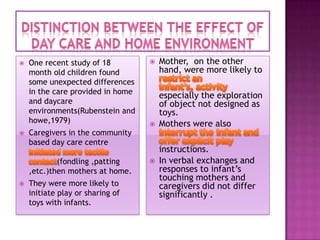
One recent study of 18
month old children found
some unexpected differences
in the care provided in home
and daycare
environments(Rubenstein and
howe,1979)
Caregivers in the community
based day care centre
(fondling ,patting
,etc.)then mothers at home.



They were more likely to
initiate play or sharing of
toys with infants.







Mother, on the other
hand, were more likely to
especially the exploration
of object not designed as
toys.
Mothers were also
instructions.
In verbal exchanges and
responses to infant’s
touching mothers and
caregivers did not differ
significantly .
 Study

points out numerous differences
between

 The

developmental effects of day care
have been more
that have the environments themselves.
 A body research shows that children in
do at least well
,
, as those
raised at home .
seems to enhance
emotional development too , and may
even improve relationships with parents.
 Children

language development can be
greatly affected by day care ,according
to one of the few studies comparing
the care at different levels of quality.
 The quality and amount
seemed even more
important for social development than
the children’s family background.
 Children from
or stressful home
environments have
 Children

develop best when they

have
,when they are care by
the adults who teach them and
accept them and when they have
between
on their own. (K.A. CLARKESTEWAT,1987)
The effect of day care on cognitive development
is somewhat complicated .
 For most children the day care experienced has
neither beneficial nor adverse effects on
intelligence , as measured by standardized test.
However,
 For children thought to be at
intellectually –mainly children of poor or poor
educated parents-day care may prevent the
children after the age of 18 months
 In one study

 Day

care enhance social development .
 Many studies show that day care children ,
especially at underage 18 months. Just as
parent anticipate ,they play at higher
developmental level than home-care
children.
 The differences, though, tends to disappear
when children who know each other play at
home.
 Day care
 They

,but they

 Aggressiveness

impulsivity, egocentrism, and less
tolerance for frustration, failure and
interruption are characteristics that
are more
 Decreased

cooperation with adults
and later with the education system
is also more likely outcome for day
care than home care children.
 Pre-school

.It
the personality of
young children.
 Pre-school education makes the child
autonomous in his functioning and help him
choose activities in environment.
 The most important contribution of preschool may well be the feeling children get
there ;that pre-school is
, that learning is
, and that they are
in a
school setting.
The Montessori curriculum school by
, teach the
and
Italian children.
 The curriculum is
based on the
natural abilities. It focuses on
motor, sensory, and language education.
 Pre-schoolers learn from their own
experiences, with the guidance, support and
help of skilled teachers.

 Children

from
in
socioeconomic backgrounds often
enter school with

 Since

the 1960’s large scale programs
have been developed to help such
disadvantaged children
for the experiences they have missed
and prepare them for schools.
 The

best know compensatory pre-school
program in the United States is Project Head
Start.
 It was a developed in 1965 as major
in the federal government’s war against in
 Its

is to improve the lives of children of
low-income families by providing health
care, intellectual enrichment, and a
supportive environment.
A

kindergarten (from
literally
) is a preschool
educational institution for children.
 It is a place which
children for
formal schooling.
 Many kids spend a
in kindergarten
schools. There are two views:
 One group
and the other group
the kids is
enough to take the full day studies.
are necessary and
important activities during early
childhood years that helps to

 They

by playing
with water, sand and mud .They acquire
new skills and learn when to use them.
 Play can be of different types. Some
different types of play are as follows :
reflects the extent of which the
child interacts with other children in play.
 The sequence of development of social play
are generally as follows:

-children play with their
toys alone, but at the school they play
independently w/o reference to what any
of the other children doing.
-They play within sight and
 children
earshot of another child, perhaps playing with
a similar toy but in their own way.
 In the early phases of peer interaction children
seem to be more engrossed in objects that each
other.
 The next type called
in which
two or three children begin to participate in
cooperative play they share playthings, organize
games, make friends.
children’s growing
capacity to accept and responds to ideas or
actions that not originally their own.
- According to Piaget(1951) and
Smilansky (1968),children’s in cognitive
development in early childhood lets them
progress from
(repetitive) play
(like rolling a ball) to
(like
building a block tower)
(like
hopscotch and marbles).
 These more complex forms of play, in turn, foster
further cognition development.
Involves imaginary situations.
It is also called as
,
or
.
 Emerges during the 2nd yr. of life when sensori
motor play is on the wane . It increases during the
next 3-4 year , and then declines as children
become more interested in playing game w/
formal rules .
 Fantasying

is rarely the time
it was one believed to be.
 By means of fantasy children can
The

is that Piaget.

Piaget sees children as assimilating new
experiences into a cognitive framework.
 Early

fantasy often involves a substitutional
(
) in which one object or
situation is used to stand for another. The

 Later

action will substitute for the object
and
may follow the reenactment of single events which involves
the
acting of a group of
children.
 In final stage of fantasy neither objects
, actions, nor the dramatic acting out
scenes are needed.
 It

is a
imagination
 At this stage anything is possible. There is
no restraints.
 Several sex differences have been observed
in the pattern of fantasies reported by
children.
 Generally
and incorporate a
greater number of objects ,judging, at
least from their own reports
 The fantasies described by girls, on the
other hand, are
and more often concerned with human
relations.
Types of day care

Types of day care

  • 2.
    There are threemain types of day care : A. B. C.
  • 3.
     The centre maybe a ; the common are ;a ; or a facility that is part of larger education institution, such as university .  Centre day care usually serves more than twelve children.
  • 4.
    A second type ofcare family day care , is provided in by experienced parents (who in some states must be licensed to give care) A particularly for infants and toddlers
  • 5.
    Of all types daycareis . Type of parent created child care that usually involves a for each other’s children on as needed basis.
  • 6.
      One recent studyof 18 month old children found some unexpected differences in the care provided in home and daycare environments(Rubenstein and howe,1979) Caregivers in the community based day care centre (fondling ,patting ,etc.)then mothers at home.  They were more likely to initiate play or sharing of toys with infants.    Mother, on the other hand, were more likely to especially the exploration of object not designed as toys. Mothers were also instructions. In verbal exchanges and responses to infant’s touching mothers and caregivers did not differ significantly .
  • 7.
     Study points outnumerous differences between  The developmental effects of day care have been more that have the environments themselves.  A body research shows that children in do at least well , , as those raised at home . seems to enhance emotional development too , and may even improve relationships with parents.
  • 8.
     Children language developmentcan be greatly affected by day care ,according to one of the few studies comparing the care at different levels of quality.  The quality and amount seemed even more important for social development than the children’s family background.  Children from or stressful home environments have
  • 9.
     Children develop bestwhen they have ,when they are care by the adults who teach them and accept them and when they have between on their own. (K.A. CLARKESTEWAT,1987)
  • 10.
    The effect ofday care on cognitive development is somewhat complicated .  For most children the day care experienced has neither beneficial nor adverse effects on intelligence , as measured by standardized test. However,  For children thought to be at intellectually –mainly children of poor or poor educated parents-day care may prevent the children after the age of 18 months  In one study 
  • 11.
     Day care enhancesocial development .  Many studies show that day care children , especially at underage 18 months. Just as parent anticipate ,they play at higher developmental level than home-care children.  The differences, though, tends to disappear when children who know each other play at home.  Day care
  • 12.
     They ,but they Aggressiveness impulsivity, egocentrism, and less tolerance for frustration, failure and interruption are characteristics that are more  Decreased cooperation with adults and later with the education system is also more likely outcome for day care than home care children.
  • 13.
     Pre-school .It the personalityof young children.  Pre-school education makes the child autonomous in his functioning and help him choose activities in environment.  The most important contribution of preschool may well be the feeling children get there ;that pre-school is , that learning is , and that they are in a school setting.
  • 14.
    The Montessori curriculumschool by , teach the and Italian children.  The curriculum is based on the natural abilities. It focuses on motor, sensory, and language education.  Pre-schoolers learn from their own experiences, with the guidance, support and help of skilled teachers. 
  • 15.
     Children from in socioeconomic backgroundsoften enter school with  Since the 1960’s large scale programs have been developed to help such disadvantaged children for the experiences they have missed and prepare them for schools.
  • 16.
     The best knowcompensatory pre-school program in the United States is Project Head Start.  It was a developed in 1965 as major in the federal government’s war against in  Its is to improve the lives of children of low-income families by providing health care, intellectual enrichment, and a supportive environment.
  • 17.
    A kindergarten (from literally ) isa preschool educational institution for children.  It is a place which children for formal schooling.  Many kids spend a in kindergarten schools. There are two views:  One group and the other group the kids is enough to take the full day studies.
  • 18.
    are necessary and importantactivities during early childhood years that helps to  They by playing with water, sand and mud .They acquire new skills and learn when to use them.  Play can be of different types. Some different types of play are as follows :
  • 19.
    reflects the extentof which the child interacts with other children in play.  The sequence of development of social play are generally as follows: -children play with their toys alone, but at the school they play independently w/o reference to what any of the other children doing.
  • 20.
    -They play withinsight and  children earshot of another child, perhaps playing with a similar toy but in their own way.  In the early phases of peer interaction children seem to be more engrossed in objects that each other.  The next type called in which two or three children begin to participate in cooperative play they share playthings, organize games, make friends. children’s growing capacity to accept and responds to ideas or actions that not originally their own.
  • 21.
    - According toPiaget(1951) and Smilansky (1968),children’s in cognitive development in early childhood lets them progress from (repetitive) play (like rolling a ball) to (like building a block tower) (like hopscotch and marbles).  These more complex forms of play, in turn, foster further cognition development. Involves imaginary situations. It is also called as , or .  Emerges during the 2nd yr. of life when sensori motor play is on the wane . It increases during the next 3-4 year , and then declines as children become more interested in playing game w/ formal rules .
  • 22.
     Fantasying is rarelythe time it was one believed to be.  By means of fantasy children can The is that Piaget. Piaget sees children as assimilating new experiences into a cognitive framework.
  • 23.
     Early fantasy ofteninvolves a substitutional ( ) in which one object or situation is used to stand for another. The  Later action will substitute for the object and may follow the reenactment of single events which involves the acting of a group of children.  In final stage of fantasy neither objects , actions, nor the dramatic acting out scenes are needed.
  • 24.
     It is a imagination At this stage anything is possible. There is no restraints.  Several sex differences have been observed in the pattern of fantasies reported by children.  Generally and incorporate a greater number of objects ,judging, at least from their own reports  The fantasies described by girls, on the other hand, are and more often concerned with human relations.