This document discusses several key challenges in services marketing. It identifies intangibility, inseparability, and heterogeneity as inherent characteristics of services that make them difficult to standardize and control quality. Other challenges include managing customer expectations, defining and measuring quality, designing effective customer organizations, and positioning services in the marketplace against competitors. Overall, the document outlines the complex nature of services and highlights areas services marketers must address, such as customization, training employees, and emphasizing quality to overcome issues related to intangibility and heterogeneity.

This section discusses various challenges in services marketing including inseparability, heterogeneity, intangibility, non-ownership, and perishability.
Focuses on customer misbehaviour's impact on frontline employees, highlighting that 70% of female retail workers face harassment.
Analyzes the difficulty in measuring productivity in the service sector, citing issues with intangible outputs and measurement problems.
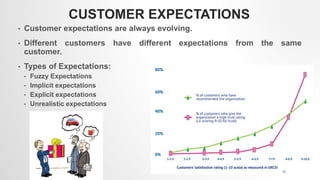
Explores the evolution of customer expectations, categorizing them into fuzzy, implicit, explicit, and unrealistic types.
Describes five perspectives on measuring quality as per Garvin, emphasizing various definitions from transcendent to value-based.
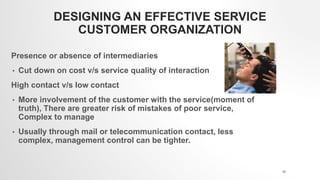
Discusses critical design factors in service delivery, including service duration, complexity, and risk management.
Examines strategic marketing aspects like service positioning, competitive advantage, market targeting, and effective communication.
Highlights operational strategies for marketing efficiency including quality control, automation, and security issues in the service sector.
INSEPERABILIT
Y
MARKETING CHALLENGES
Physicalconnection of the service provider to the service
Involvement of the customer in the production process
Involvement of other customers in the production process
POSSIBLE MARKETING SOLUTIONS
Emphasis on selecting and training public contact personnel
Consumer Management
Use of multisite locations
2
3.
HETEROGENEITY
MARKETING CHALLENGES
Lackof ability to control service quality before it reaches the consumer.
Most errors are one-time events and cannot be foreseen nor corrected ahead
of time
Consistency of service varies from firm to firm, among employees of the firm
and also while interacting with the same service provider on day-to-day basis
Service standardization and quality control are difficult to achieve and
maintain since each employee is a different personality
POSSIBLE MARKETING SOLUTIONS
Customization
Standardization
3
4.
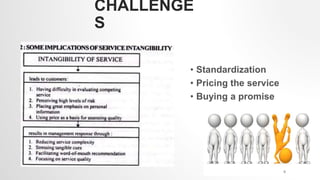
INTANGIBILITY
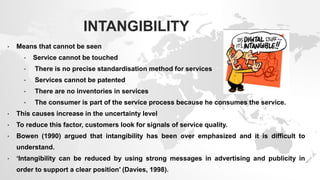
• Means thatcannot be seen
• Service cannot be touched
• There is no precise standardisation method for services
• Services cannot be patented
• There are no inventories in services
• The consumer is part of the service process because he consumes the service.
• This causes increase in the uncertainty level
• To reduce this factor, customers look for signals of service quality.
• Bowen (1990) argued that intangibility has been over emphasized and it is difficult to
understand.
• ‘Intangibility can be reduced by using strong messages in advertising and publicity in
order to support a clear position’ (Davies, 1998).
5.
EXAMPLES
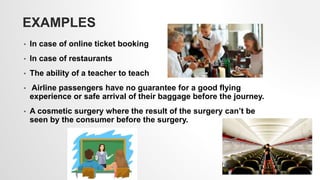
• In caseof online ticket booking
• In case of restaurants
• The ability of a teacher to teach
• Airline passengers have no guarantee for a good flying
experience or safe arrival of their baggage before the journey.
• A cosmetic surgery where the result of the surgery can’t be
seen by the consumer before the surgery.
5
NON OWNERSHIP
• Youcannot own or store a service like you can a product
• Services are used or hired for a period of time
• Customer pays only to secure access to or use of the service
EXAMPLES
• Aeroplane ticket
• Hotel room
• Banking services
7
8.
CHALLENGES
• Non ownershipcan sometimes
make it difficult for a customer to
assess and appreciate the
advantages of purchasing the
service.
• The marketer therefore needs to
pay particular attention in
emphasizing benefits of non-
ownership
8
9.
PERISHABILITY
• Once aservice has occurred it cannot be repeated in exactly
the same way
• You cannot put service in the warehouse, or store in your
inventory
EXAMPLES
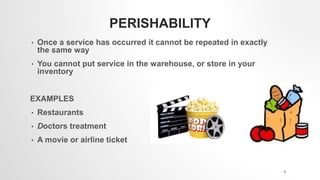
• Restaurants
• Doctors treatment
• A movie or airline ticket
9
10.
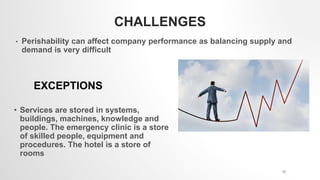
CHALLENGES
• Perishability canaffect company performance as balancing supply and
demand is very difficult
EXCEPTIONS
• Services are stored in systems,
buildings, machines, knowledge and
people. The emergency clinic is a store
of skilled people, equipment and
procedures. The hotel is a store of
rooms
10
11.
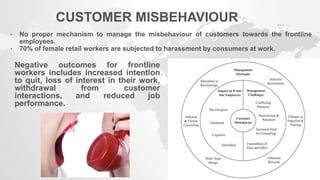
• No propermechanism to manage the misbehaviour of customers towards the frontline
employees.
• 70% of female retail workers are subjected to harassment by consumers at work.
Negative outcomes for frontline
workers includes increased intention
to quit, loss of interest in their work,
withdrawal from customer
interactions, and reduced job
performance.
CUSTOMER MISBEHAVIOUR
12.
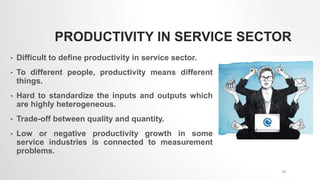
PRODUCTIVITY IN SERVICESECTOR
• Difficult to define productivity in service sector.
• To different people, productivity means different
things.
• Hard to standardize the inputs and outputs which
are highly heterogeneous.
• Trade-off between quality and quantity.
• Low or negative productivity growth in some
service industries is connected to measurement
problems.
12
13.
PROBLEMS IN MEASURING
PRODUCTIVITY
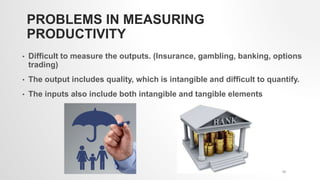
•Difficult to measure the outputs. (Insurance, gambling, banking, options
trading)
• The output includes quality, which is intangible and difficult to quantify.
• The inputs also include both intangible and tangible elements
13
14.
CUSTOMER EXPECTATIONS
• Customerexpectations are always evolving.
• Different customers have different expectations from the same
customer.
• Types of Expectations:
• Fuzzy Expectations
• Implicit expectations
• Explicit expectations
• Unrealistic expectations
14
15.
DEFINING AND MEASURINGQUALITY
Garvin identifies five perspectives
• Transcendent view: Innate excellence, a mark of
uncompromising standards and high achievement.
• Product based approach: Quality as a precise and measurable
variable
• User based definition: Quality lies in the eyes of the beholder
• Manufacturing based approach: Conformance to internal
specifications driven by productivity and cost containment.
• Value based definition: Defines quality in terms of value and
price
15
16.
DESIGNING AN EFFECTIVESERVICE
CUSTOMER ORGANIZATION
Presence or absence of intermediaries
• Cut down on cost v/s service quality of interaction
High contact v/s low contact
• More involvement of the customer with the service(moment of
truth), There are greater risk of mistakes of poor service,
Complex to manage
• Usually through mail or telecommunication contact, less
complex, management control can be tighter.
16
17.
Duration of servicedelivery process:
• More duration – more value has to be generated and cost will be high due to
internal monitoring and communicating those values to customers.
Level of complexity:
• High complexity – assist the user every stage – high cost –train the personnel,
risk of going wrong is high.
Degree of risk:
Service managers should identify the consequences of the service failure for their
customers.
Failure may range from personal inconvenience to monetary loss.
17
18.
STRATEGIC CHALLENGES IN
SERVICESMARKETING
Positioning a service in marketplace
Competitive advantage
• Value for money
• People are the key
• Convenience
• Quality and speed
• Differentiation in meaningful ways
18
19.
TO SELECT THETARGET MARKET
• Identifying the market segments with better opportunities
• Relating firm’s ability to match competing offerings rather than looking only
for sales and profit potential.
• To judge the current and prospective customers how do they see value
generated by the provider.
• Redesigning the existing services: Easy or complex?
• Believing in expert definition of expert’s perception to reality and customers
perception to reality is way to different.
• Concept of copy positioning. : E.g. Marlboro man
• Coping up with changes of the perception and expectation of the target
market. E.g. Nokia
19
20.
HIT LIST
Competitive Pricing-- Indigo Airlines
Communication – Internal and External
Using Social Media – Lens kart
Technology – Ola (security)
20
21.
Quality Control –BPO (cut calls), KFC mouse incident
Efficient Automation ( No Human interaction). E.g. Health care.
Security Issues E.g. banking sector.
21