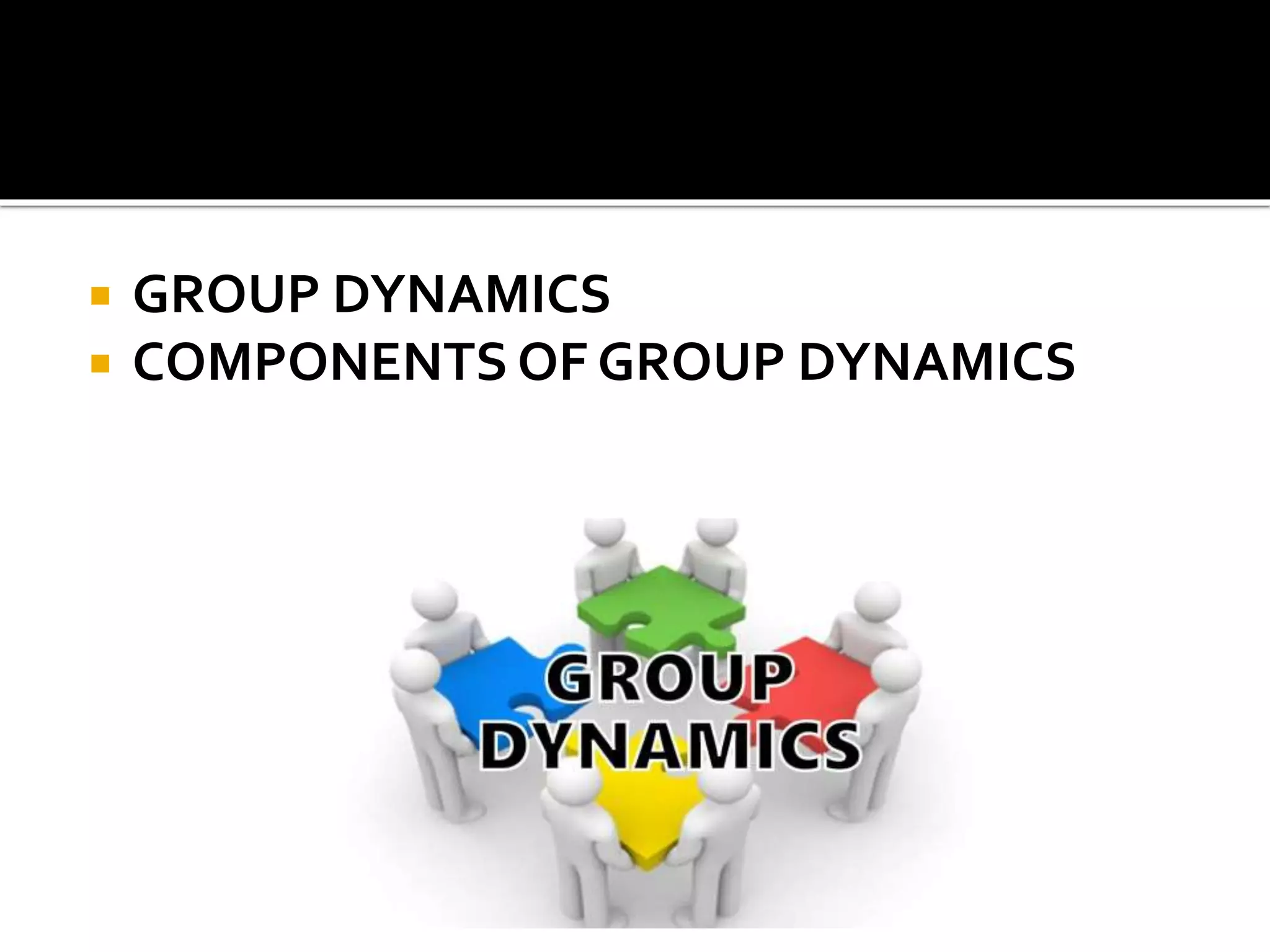
 GROUP DYNAMICS
 COMPONENTS OF GROUP DYNAMICS
 A group can be defined as several individuals who
come together to accomplish a particular task or goal.
 Group dynamics refers to the attitudinal and
behavioral characteristics of a group.
 Group dynamics concern how groups form, their
structure and process, and how they function.
 Group dynamics are relevant in both formal and
informal groups of all types.
 In an organizational setting, groups are a very
common organizational entity and the study of
groups and group dynamics is an important area of
study in organizational behavior.
 Group dynamics is a system of behaviors and psychological
processes occurring within a social group (intragroup dynamics),
or between social groups (intergroup dynamics).
 The study of group dynamics can be useful in understanding
decision-making behaviour, tracking the spread of diseases in
society, creating effective therapy techniques, and following the
emergence and popularity of new ideas and technologies.
 Group dynamics are at the core of understanding racism, sexism,
and other forms of social prejudice and discrimination.These
applications of the field are studied
in psychology, sociology, anthropology, political
science, epidemiology, education, social work, business,
and communication studies.
 The three main factors affecting a team's cohesion (working
together well) are: environmental, personal and leadership.
 Group dynamics is a set of behavioural and
psychological processes that occur within a
social group or between groups. It refers to
the "nature of groups, the laws of their
development, and their interrelations with
individuals, other groups, and larger
institutions" (Cartwright and Zander, 1968).
1.The group can influence the thinking of its
members.The members are always influenced
by the interactions of other members in the
group.
2. A group with a good leader performs better as
compared to a group with weak leader.
3.The group can give the effect of synergy, that is,
if the group consists of positive thinkers then its
output is more than the double every time.
4. Group dynamism can give job satisfaction to the
members.
5.The group can also bring team spirit among the
members.
6. Even the attitude, perceptions, and ideas of members
depend on group dynamism. For example, the
negative thinkers can be converted to positive
thinkers with the help of the facilitator.
7. If the group works as a cohesive group, the
cooperation and convergence can result in maximiza-
tion of productivity.
8. Lastly, group dynamism can reduce the labour unrest
and labour turnover due to emotional attachment
among the group members.
A)COMMUNICATION PROCESSES AND
INTERACTION PATTERNS
WHY PEOPLE COMMUNICATE:
1. Understanding other people
2. Finding out where they stand in relation to
other people
3. Persuading others
4. Gaining or maintaining power
5. Defending themselves
6. Provoking a reaction from others
7. Making an impression on others
8. Gaining and maintaining relationships
9. Presenting a unified image to the group
INTERACTION PATTERNS:
1. Maypole – leader to member & member to leader
2. Round Robin – members take turns
3. Hot Seat – extended back and forth exchange between
leader and a member
4. Free Floating – all members take responsibility for
communicating
 Patterns of Interaction are influenced by:
1. Cues and Reinforcers
2. Emotional Bonds
3. Subgroups
4. Size and Physical Arrangements
5. Power and Status
B)INTERPERSONAL ATTRACTION AND COHESION
 The result of all forces acting on members to remain in a
group is called cohesion
 Four interacting sets of variables determine a member’s
attraction to a group:
1. Need for affiliation, recognition, and security
2. The resources and prestige available through
participation
3. Expectations of the beneficial and detrimental
consequences of the group
4. Comparison of the group with other group experiences.
C)SOCIAL INTEGRATION AND INFLUENCE
 How members fit together and are accepted in a group.
 Groups are not able to function effectively unless there is
a fairly high level of social integration among members
 Social Control Mechanisms – the processes by which the
group-as-a-whole gains sufficient compliance and
conformity from its members to enable it to function in an
orderly manner.
 “Social order and stability are prerequisites for the
formation and maintenance of a cohesive group.”
Norms – shared expectations and beliefs about
appropriate ways to act in a social situation such as a
group.
 Increase predictability, stability, and security
 result from what is valued, preferred, and accepted
behavior
 Roles – shared expectations about the functions of
individuals in the group
 Status – an evaluation and ranking of each member’s
position in the group relative to all other members
D)POWER AND CONTROL
 Order is necessary for functioning of a social unit
such as group.As noted earlier ,group develop
norms to regulate member.A system of control
and power is inevitably developed to enforce
compliance.
 Formal group such as commercial organizations
or formal associations develop written rule,
while other groups follow a informal approach.
E)GROUP CULTURE
 The culture of a group is defined by the values ,beliefs ,customs
,traditions ,and preferred ways of doing business that are
implicitly understood and shared by all group members.
 Some groups would tend to be formal and some are informal in its
culture.
 Eg.,a group formed to achieve a specific task in a commercial or
governmental organization are formal
 A group formed to work with children or women by an NGO
would be more informal.The culture of a group is also a
determined , in part , by sponsoring organization , the
community, and the largest society, as groups take on some of the
dominant values and traits of these larger social systems.
Group dynamics

Group dynamics

  • 2.
     GROUP DYNAMICS COMPONENTS OF GROUP DYNAMICS
  • 3.
     A groupcan be defined as several individuals who come together to accomplish a particular task or goal.  Group dynamics refers to the attitudinal and behavioral characteristics of a group.  Group dynamics concern how groups form, their structure and process, and how they function.  Group dynamics are relevant in both formal and informal groups of all types.  In an organizational setting, groups are a very common organizational entity and the study of groups and group dynamics is an important area of study in organizational behavior.
  • 4.
     Group dynamicsis a system of behaviors and psychological processes occurring within a social group (intragroup dynamics), or between social groups (intergroup dynamics).  The study of group dynamics can be useful in understanding decision-making behaviour, tracking the spread of diseases in society, creating effective therapy techniques, and following the emergence and popularity of new ideas and technologies.  Group dynamics are at the core of understanding racism, sexism, and other forms of social prejudice and discrimination.These applications of the field are studied in psychology, sociology, anthropology, political science, epidemiology, education, social work, business, and communication studies.  The three main factors affecting a team's cohesion (working together well) are: environmental, personal and leadership.
  • 5.
     Group dynamicsis a set of behavioural and psychological processes that occur within a social group or between groups. It refers to the "nature of groups, the laws of their development, and their interrelations with individuals, other groups, and larger institutions" (Cartwright and Zander, 1968).
  • 6.
    1.The group caninfluence the thinking of its members.The members are always influenced by the interactions of other members in the group. 2. A group with a good leader performs better as compared to a group with weak leader. 3.The group can give the effect of synergy, that is, if the group consists of positive thinkers then its output is more than the double every time. 4. Group dynamism can give job satisfaction to the members.
  • 7.
    5.The group canalso bring team spirit among the members. 6. Even the attitude, perceptions, and ideas of members depend on group dynamism. For example, the negative thinkers can be converted to positive thinkers with the help of the facilitator. 7. If the group works as a cohesive group, the cooperation and convergence can result in maximiza- tion of productivity. 8. Lastly, group dynamism can reduce the labour unrest and labour turnover due to emotional attachment among the group members.
  • 8.
    A)COMMUNICATION PROCESSES AND INTERACTIONPATTERNS WHY PEOPLE COMMUNICATE: 1. Understanding other people 2. Finding out where they stand in relation to other people 3. Persuading others 4. Gaining or maintaining power 5. Defending themselves 6. Provoking a reaction from others 7. Making an impression on others 8. Gaining and maintaining relationships 9. Presenting a unified image to the group
  • 9.
    INTERACTION PATTERNS: 1. Maypole– leader to member & member to leader 2. Round Robin – members take turns 3. Hot Seat – extended back and forth exchange between leader and a member 4. Free Floating – all members take responsibility for communicating  Patterns of Interaction are influenced by: 1. Cues and Reinforcers 2. Emotional Bonds 3. Subgroups 4. Size and Physical Arrangements 5. Power and Status
  • 10.
    B)INTERPERSONAL ATTRACTION ANDCOHESION  The result of all forces acting on members to remain in a group is called cohesion  Four interacting sets of variables determine a member’s attraction to a group: 1. Need for affiliation, recognition, and security 2. The resources and prestige available through participation 3. Expectations of the beneficial and detrimental consequences of the group 4. Comparison of the group with other group experiences.
  • 11.
    C)SOCIAL INTEGRATION ANDINFLUENCE  How members fit together and are accepted in a group.  Groups are not able to function effectively unless there is a fairly high level of social integration among members  Social Control Mechanisms – the processes by which the group-as-a-whole gains sufficient compliance and conformity from its members to enable it to function in an orderly manner.  “Social order and stability are prerequisites for the formation and maintenance of a cohesive group.”
  • 12.
    Norms – sharedexpectations and beliefs about appropriate ways to act in a social situation such as a group.  Increase predictability, stability, and security  result from what is valued, preferred, and accepted behavior  Roles – shared expectations about the functions of individuals in the group  Status – an evaluation and ranking of each member’s position in the group relative to all other members
  • 13.
    D)POWER AND CONTROL Order is necessary for functioning of a social unit such as group.As noted earlier ,group develop norms to regulate member.A system of control and power is inevitably developed to enforce compliance.  Formal group such as commercial organizations or formal associations develop written rule, while other groups follow a informal approach.
  • 14.
    E)GROUP CULTURE  Theculture of a group is defined by the values ,beliefs ,customs ,traditions ,and preferred ways of doing business that are implicitly understood and shared by all group members.  Some groups would tend to be formal and some are informal in its culture.  Eg.,a group formed to achieve a specific task in a commercial or governmental organization are formal  A group formed to work with children or women by an NGO would be more informal.The culture of a group is also a determined , in part , by sponsoring organization , the community, and the largest society, as groups take on some of the dominant values and traits of these larger social systems.