A Presentation on
*Group
*Bargaining Behaviour
*Inter-group Relations

BY:
Rachna Kralia (23)
Ruhi Beri (24)
Group

Two or more individuals,
interacting and interdependent,
who have come together to
achieve particular objectives.
Formal Groups
A designated work group defined by
the organization’s structure.
Command Group
A group composed of the individuals
who report directly to a given
manager.
Task Group
Those working together to completes
a job task.
Informal Groups
A group that is neither formally structured
nor organizationally determined; appears
in response to the need for social contract.
Interest Group
Those working together to complete a job
task.
Friendship Group
Those brought together because they
share one or more common
characteristics.
Stages of Group Development

The five distinct stages groups go
through:
Forming,
Storming,
 Norming,
 Performing,
 Adjourning.
Stages of Group Development
Stage I: Forming
The first stage in group development,
characterized by much uncertainty about
the group’s purpose, structure, and
leadership.
Stage II: Storming
The second stage in group development,
characterized by intragroup conflict.
Stage III: Norming
The third stage in group development,
characterized by close relationships and
cohesiveness.
Stages of Group Development
Stage IV: Performing
The fourth stage in group
development, when the group is
fully functional.
Stage V: Adjourning
The fifth stage in group
development for temporary
groups, characterized by
concern with wrapping up
activities rather than task
performance.
Group Properties

Roles
Norms
 Status
 Cohesiveness
Size
Group Properties
Role
A set of expected behavior patterns
attributed to someone occupying a
given position in a special unit.

Norms
Acceptable standards of behavior
within a group that are shared by the
group’s members
Group Properties
Status
A socially defined position or rank
given to groups or group members by
others.

Cohesiveness
Degree to which group members are
attracted to each other and are
motivated to stay in the group
Group Properties


Size: The research leads to two
conclusions

1.

Groups with an odd number of
members tend to be preferable to
those with an even number.
Groups made up of five to seven
numbers do a pretty good job of
exercising the best elements of
both small and large groups.

2.
Reasons for joining groups

Security
Status
Self-esteem
Affiliation
Power
Goal Achievement
Bargaining

It means negotiating the terms and
conditions of a transaction to create
an agreement between two parties.
It has generally two approaches:
Distributive Bargaining
Integrative Bargaining
Distributive Bargaining
It is defined as negotiations that seeks
to divide up a fixed amount of
resources, a win lose situation.
Each party bargains aggressively and
treats the other as an opponent who
must be defeated.
It tends to build animosities and
deeper divisions when people have to
work together on an ongoing process
Distributive Bargaining
Behaviour
STRATEGIES:
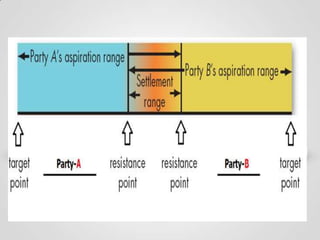
1. To push for a settlement close to
the seller’s (unknown) resistance
point, thereby yielding the largest
part of the settlement range for
the buyer.
2. To convince the seller to change
his resistance point by influencing
the seller’s beliefs about the value
of the unit and thereby increase
the bargaining range.
Distributive Bargaining
Behaviour
STRATEGIES:
3. If a negative settlement range
exists, to convince the seller to
reduce his resistance point to
create a positive settlement zone
or to change her own resistance
point to create an overlap
4. To convince the seller to believe
that this settlement is the best
that is possible
Integrative Bargaining
It means negotiation that seeks one or
more settlements than create win- win
situation.
In most circumstances, integrative
bargaining is preferable to distributive
bargaining.
Integrative bargaining builds long
term relationships and facilitates
working together in the future.
Integrative Bargaining
Behaviour
STRATEGIES:
1. Manage emotions, clarify
perceptions, and communicate
clearly to develop a complete and
shared understanding of the
situation.
2. Frame each of the issues as shared
or joint problems to foster
cooperation in order to find joint
solutions
Integrative Bargaining
Behaviour
STRATEGIES:
3. Focus on both dealcrafting and
interpersonal processes
4. Use objective criteria to decide
which options are best to
maximize joint gain
Intergroup relations

It refers to both individual
interactions involving members from
different groups and the collective
behaviour of groups in interaction
with other groups, at either the intra‐
or inter‐organizational level
Some important terms

Ingroup
The social group to which an individual
perceives herself or himself as belonging
(“us”).
Outgroup
Any group other than the one to which
individuals perceive themselves as
belonging (“them”).
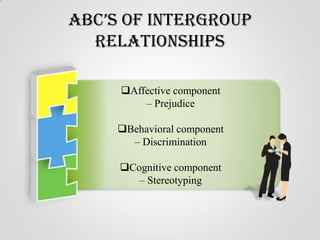
ABC’s oF IntErGroup
Relationships
Affective component
– Prejudice
Behavioral component
– Discrimination
Cognitive component
– Stereotyping
Cont’D
Prejudice
- A negative feeling toward someone
based
solely on his/her group membership
Discrimination
– Unequal treatment based on group
membership
Stereotype
– Beliefs that associate groups with
traits
Theories of Intergroup
Relations
Authoritarian Personality Theory
The authoritarian personality can be
described in terms of 3 components
1. Authoritarian submission
A high degree of submission to authorities
who are perceived to be established and
legitimate in the society in which one
lives.
2. Authoritarian aggression
A general aggressiveness, directed against
various persons, that is perceived to be
sanctioned by established authorities.
Theories of Intergroup
Relations
Authoritarian Personality Theory
3. Conventionalism
A high degree of adherence to the
social conventions that are perceived to
be endorsed by society and its
established authorities.
 Results in:
 Scape-goating
A response to frustration whereby the
individual displaces aggression onto a
socially disapproved outgroup.
Theories of Intergroup
Relations
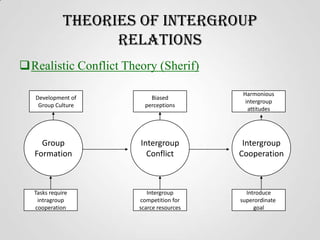
Realistic Conflict Theory (Sherif)
Development of
Group Culture

Biased
perceptions

Harmonious
intergroup
attitudes

Group
Formation

Intergroup
Conflict

Intergroup
Cooperation

Tasks require
intragroup
cooperation

Intergroup
competition for
scarce resources

Introduce
superordinate
goal
Theories of Intergroup
Relations
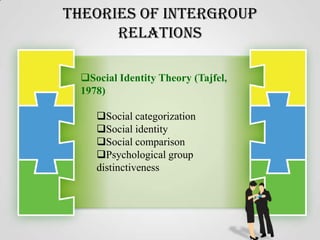
Social Identity Theory (Tajfel,
1978)
Social categorization
Social identity
Social comparison
Psychological group
distinctiveness
Social Identity Theory

Social categorization
The cognitive tendency to divide the social
world into categories (i.e., social groups).
This categorical differentiation has the
effect of sharpening the distinctions
between the categories and blurs the
differences within them.
Social Identity Theory
Social identity
That part of the individual’s
self-concept which derives
from knowledge of his or her
membership in a social group,
together with the value and
emotional significance
associated to that membership.
Social Identity Theory

Social comparison
The process through which
characteristics of the ingroup are
compared to those of the
outgroup.
Social Identity Theory
Psychological Group
Distinctiveness
The state desired by individuals in
which the ingroup has an identity
that is perceived by the group
members as being both distinct
and positive vis-à-vis relevant
comparison groups.
Reducing Prejudice
Prejudice can be reduced using the
following:
The Contact Hypothesis
Common Ingroup Identity Model
Dissociation Model
Reducing Prejudice
Contact Hypothesis (Allport, 1954)
Under favorable conditions, regular
interaction between members of different
groups reduces prejudice. (Negative
stereotypes arise because groups don’t
have enough contact with each other)
Contact only works…
– Among people of equal status
– When positive
– When outgroup members are
perceived as typical of their group
Reducing Prejudice
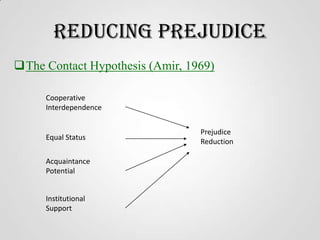
The Contact Hypothesis (Amir, 1969)
Cooperative
Interdependence

Equal Status
Acquaintance
Potential
Institutional
Support

Prejudice
Reduction
Reducing Prejudice
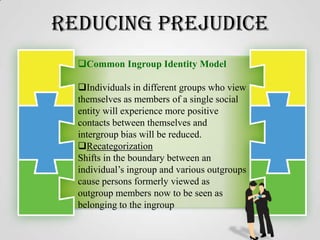
Common Ingroup Identity Model
Individuals in different groups who view
themselves as members of a single social
entity will experience more positive
contacts between themselves and
intergroup bias will be reduced.
Recategorization
Shifts in the boundary between an
individual’s ingroup and various outgroups
cause persons formerly viewed as
outgroup members now to be seen as
belonging to the ingroup
Reducing Prejudice

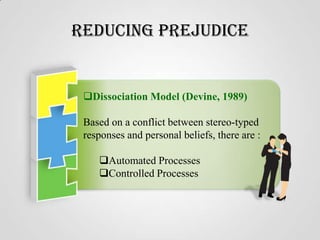
Dissociation Model (Devine, 1989)
Based on a conflict between stereo-typed
responses and personal beliefs, there are :
Automated Processes
Controlled Processes
Reducing Prejudice
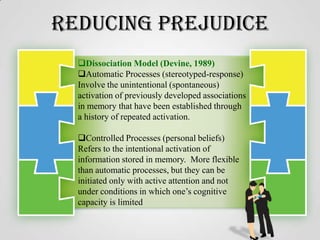
Dissociation Model (Devine, 1989)
Automatic Processes (stereotyped-response)
Involve the unintentional (spontaneous)
activation of previously developed associations
in memory that have been established through
a history of repeated activation.

Controlled Processes (personal beliefs)
Refers to the intentional activation of
information stored in memory. More flexible
than automatic processes, but they can be
initiated only with active attention and not
under conditions in which one’s cognitive
capacity is limited
Thank You 

Group, bargaining behaviour & intergroup relations

  • 1.
    A Presentation on *Group *BargainingBehaviour *Inter-group Relations BY: Rachna Kralia (23) Ruhi Beri (24)
  • 2.
    Group Two or moreindividuals, interacting and interdependent, who have come together to achieve particular objectives.
  • 3.
    Formal Groups A designatedwork group defined by the organization’s structure. Command Group A group composed of the individuals who report directly to a given manager. Task Group Those working together to completes a job task.
  • 4.
    Informal Groups A groupthat is neither formally structured nor organizationally determined; appears in response to the need for social contract. Interest Group Those working together to complete a job task. Friendship Group Those brought together because they share one or more common characteristics.
  • 5.
    Stages of GroupDevelopment The five distinct stages groups go through: Forming, Storming,  Norming,  Performing,  Adjourning.
  • 6.
    Stages of GroupDevelopment Stage I: Forming The first stage in group development, characterized by much uncertainty about the group’s purpose, structure, and leadership. Stage II: Storming The second stage in group development, characterized by intragroup conflict. Stage III: Norming The third stage in group development, characterized by close relationships and cohesiveness.
  • 7.
    Stages of GroupDevelopment Stage IV: Performing The fourth stage in group development, when the group is fully functional. Stage V: Adjourning The fifth stage in group development for temporary groups, characterized by concern with wrapping up activities rather than task performance.
  • 8.
  • 9.
    Group Properties Role A setof expected behavior patterns attributed to someone occupying a given position in a special unit. Norms Acceptable standards of behavior within a group that are shared by the group’s members
  • 10.
    Group Properties Status A sociallydefined position or rank given to groups or group members by others. Cohesiveness Degree to which group members are attracted to each other and are motivated to stay in the group
  • 11.
    Group Properties  Size: Theresearch leads to two conclusions 1. Groups with an odd number of members tend to be preferable to those with an even number. Groups made up of five to seven numbers do a pretty good job of exercising the best elements of both small and large groups. 2.
  • 12.
    Reasons for joininggroups Security Status Self-esteem Affiliation Power Goal Achievement
  • 13.
    Bargaining It means negotiatingthe terms and conditions of a transaction to create an agreement between two parties. It has generally two approaches: Distributive Bargaining Integrative Bargaining
  • 14.
    Distributive Bargaining It isdefined as negotiations that seeks to divide up a fixed amount of resources, a win lose situation. Each party bargains aggressively and treats the other as an opponent who must be defeated. It tends to build animosities and deeper divisions when people have to work together on an ongoing process
  • 16.
    Distributive Bargaining Behaviour STRATEGIES: 1. Topush for a settlement close to the seller’s (unknown) resistance point, thereby yielding the largest part of the settlement range for the buyer. 2. To convince the seller to change his resistance point by influencing the seller’s beliefs about the value of the unit and thereby increase the bargaining range.
  • 17.
    Distributive Bargaining Behaviour STRATEGIES: 3. Ifa negative settlement range exists, to convince the seller to reduce his resistance point to create a positive settlement zone or to change her own resistance point to create an overlap 4. To convince the seller to believe that this settlement is the best that is possible
  • 18.
    Integrative Bargaining It meansnegotiation that seeks one or more settlements than create win- win situation. In most circumstances, integrative bargaining is preferable to distributive bargaining. Integrative bargaining builds long term relationships and facilitates working together in the future.
  • 19.
    Integrative Bargaining Behaviour STRATEGIES: 1. Manageemotions, clarify perceptions, and communicate clearly to develop a complete and shared understanding of the situation. 2. Frame each of the issues as shared or joint problems to foster cooperation in order to find joint solutions
  • 20.
    Integrative Bargaining Behaviour STRATEGIES: 3. Focuson both dealcrafting and interpersonal processes 4. Use objective criteria to decide which options are best to maximize joint gain
  • 21.
    Intergroup relations It refersto both individual interactions involving members from different groups and the collective behaviour of groups in interaction with other groups, at either the intra‐ or inter‐organizational level
  • 22.
    Some important terms Ingroup Thesocial group to which an individual perceives herself or himself as belonging (“us”). Outgroup Any group other than the one to which individuals perceive themselves as belonging (“them”).
  • 23.
    ABC’s oF IntErGroup Relationships Affectivecomponent – Prejudice Behavioral component – Discrimination Cognitive component – Stereotyping
  • 24.
    Cont’D Prejudice - A negativefeeling toward someone based solely on his/her group membership Discrimination – Unequal treatment based on group membership Stereotype – Beliefs that associate groups with traits
  • 25.
    Theories of Intergroup Relations AuthoritarianPersonality Theory The authoritarian personality can be described in terms of 3 components 1. Authoritarian submission A high degree of submission to authorities who are perceived to be established and legitimate in the society in which one lives. 2. Authoritarian aggression A general aggressiveness, directed against various persons, that is perceived to be sanctioned by established authorities.
  • 26.
    Theories of Intergroup Relations AuthoritarianPersonality Theory 3. Conventionalism A high degree of adherence to the social conventions that are perceived to be endorsed by society and its established authorities.  Results in:  Scape-goating A response to frustration whereby the individual displaces aggression onto a socially disapproved outgroup.
  • 27.
    Theories of Intergroup Relations RealisticConflict Theory (Sherif) Development of Group Culture Biased perceptions Harmonious intergroup attitudes Group Formation Intergroup Conflict Intergroup Cooperation Tasks require intragroup cooperation Intergroup competition for scarce resources Introduce superordinate goal
  • 28.
    Theories of Intergroup Relations SocialIdentity Theory (Tajfel, 1978) Social categorization Social identity Social comparison Psychological group distinctiveness
  • 29.
    Social Identity Theory Socialcategorization The cognitive tendency to divide the social world into categories (i.e., social groups). This categorical differentiation has the effect of sharpening the distinctions between the categories and blurs the differences within them.
  • 30.
    Social Identity Theory Socialidentity That part of the individual’s self-concept which derives from knowledge of his or her membership in a social group, together with the value and emotional significance associated to that membership.
  • 31.
    Social Identity Theory Socialcomparison The process through which characteristics of the ingroup are compared to those of the outgroup.
  • 32.
    Social Identity Theory PsychologicalGroup Distinctiveness The state desired by individuals in which the ingroup has an identity that is perceived by the group members as being both distinct and positive vis-à-vis relevant comparison groups.
  • 33.
    Reducing Prejudice Prejudice canbe reduced using the following: The Contact Hypothesis Common Ingroup Identity Model Dissociation Model
  • 34.
    Reducing Prejudice Contact Hypothesis(Allport, 1954) Under favorable conditions, regular interaction between members of different groups reduces prejudice. (Negative stereotypes arise because groups don’t have enough contact with each other) Contact only works… – Among people of equal status – When positive – When outgroup members are perceived as typical of their group
  • 35.
    Reducing Prejudice The ContactHypothesis (Amir, 1969) Cooperative Interdependence Equal Status Acquaintance Potential Institutional Support Prejudice Reduction
  • 36.
    Reducing Prejudice Common IngroupIdentity Model Individuals in different groups who view themselves as members of a single social entity will experience more positive contacts between themselves and intergroup bias will be reduced. Recategorization Shifts in the boundary between an individual’s ingroup and various outgroups cause persons formerly viewed as outgroup members now to be seen as belonging to the ingroup
  • 37.
    Reducing Prejudice Dissociation Model(Devine, 1989) Based on a conflict between stereo-typed responses and personal beliefs, there are : Automated Processes Controlled Processes
  • 38.
    Reducing Prejudice Dissociation Model(Devine, 1989) Automatic Processes (stereotyped-response) Involve the unintentional (spontaneous) activation of previously developed associations in memory that have been established through a history of repeated activation. Controlled Processes (personal beliefs) Refers to the intentional activation of information stored in memory. More flexible than automatic processes, but they can be initiated only with active attention and not under conditions in which one’s cognitive capacity is limited
  • 39.