Group Dynamics
   zenith
By group
           D.K.D. Madhubhashini
           K. Sujeevakanthan
           K.P.W.A.S.B Kaduwela
           H.M. Madhumathi K.Haluwana
           K.D.D.U.S.B. Amarathunga
           Aroshi S. Tennekoon
           A.M.S.B. Abeysekara
           U.P. Wijewardane

                             on 14th January 2012
What is a “Group”?

       Two or more people who share a common definition and
evaluation of themselves and behave in accordance with such a
definition.
(Vaughan & Hogg, 2002, p. 200)
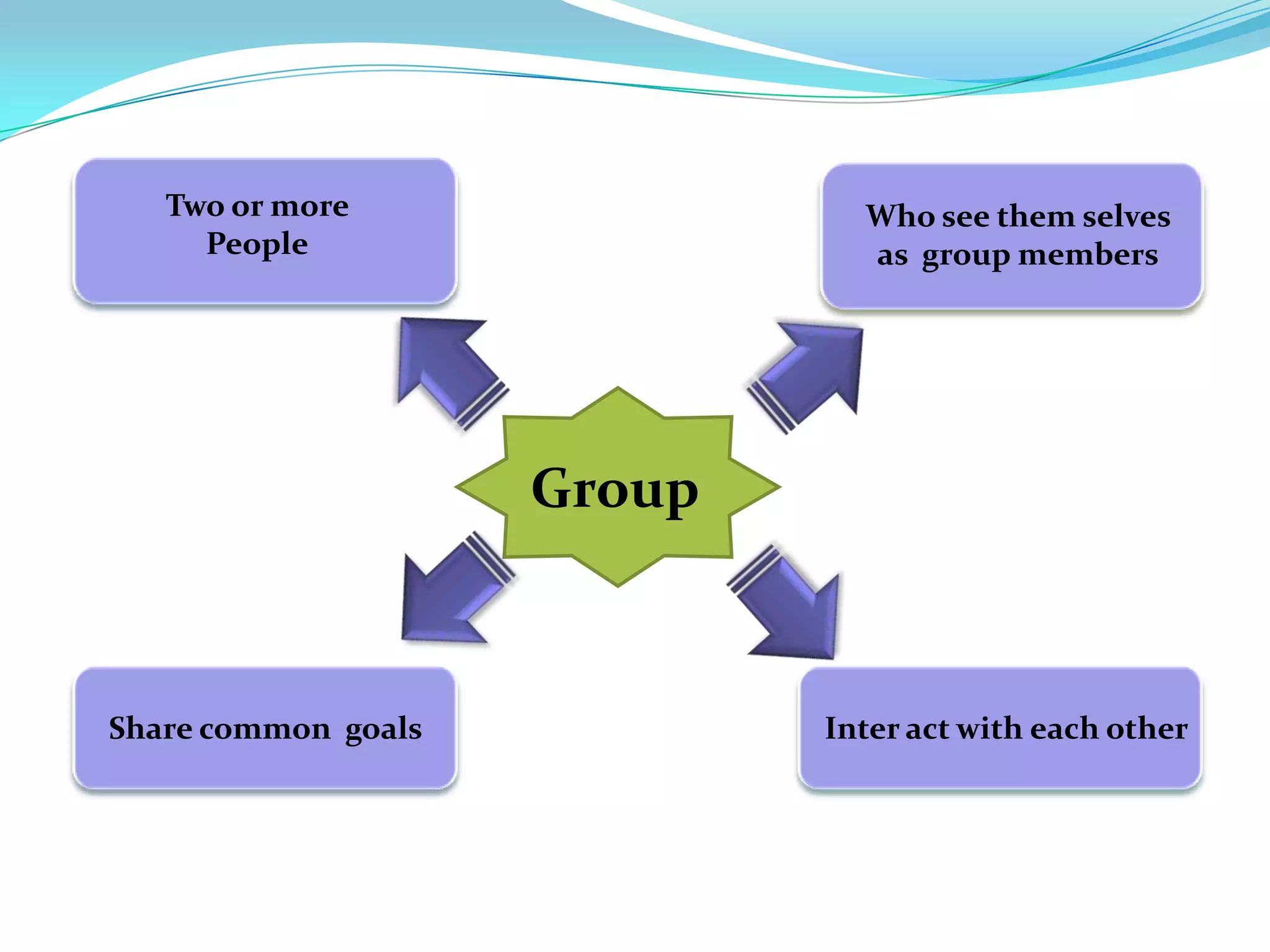
Two or more                 Who see them selves
     People                    as group members


                     Group


Share common goals           Inter act with each other
Groups Vs Teams

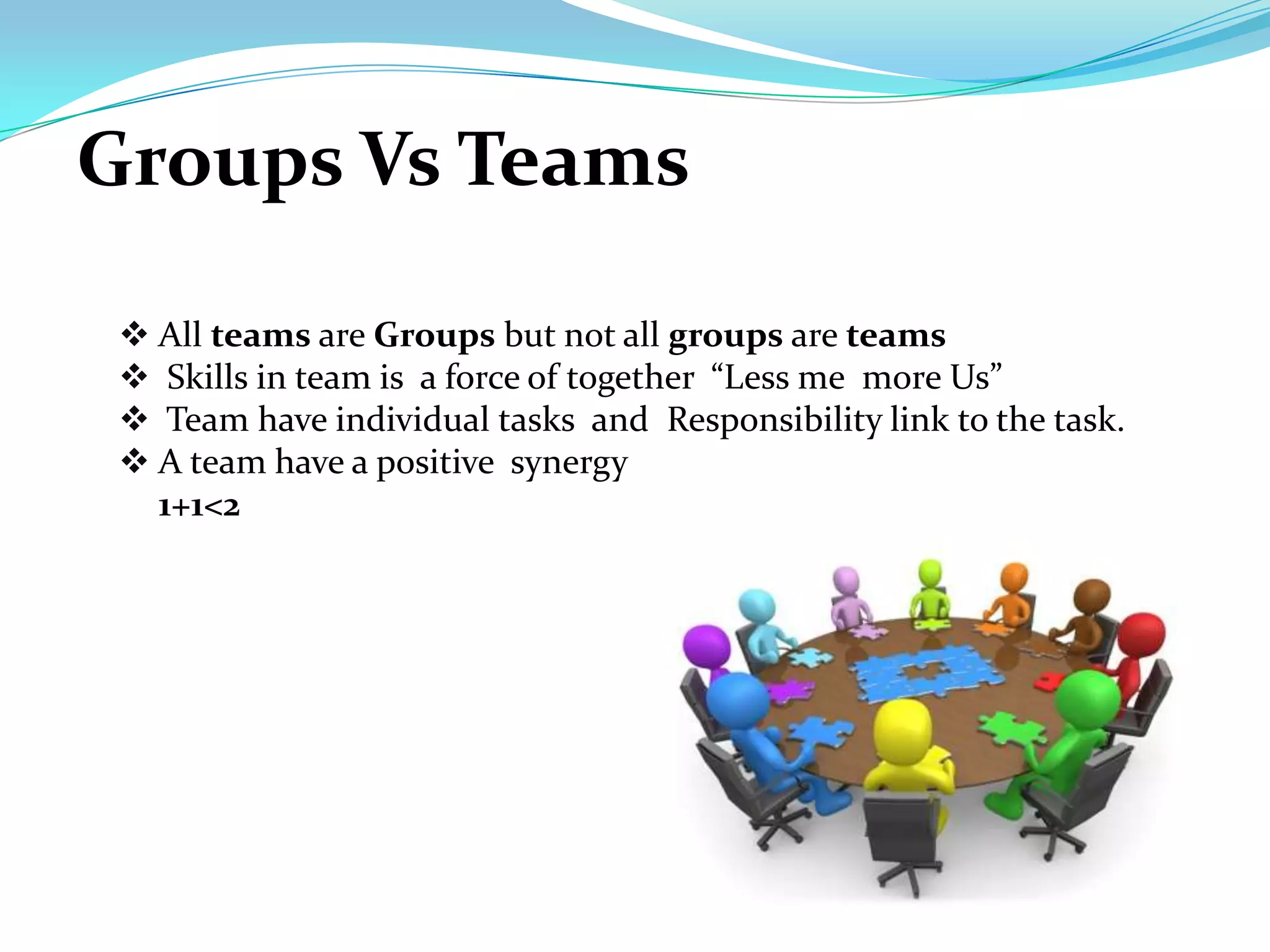
  All teams are Groups but not all groups are teams
  Skills in team is a force of together “Less me more Us”
  Team have individual tasks and Responsibility link to the task.
  A team have a positive synergy
   1+1<2
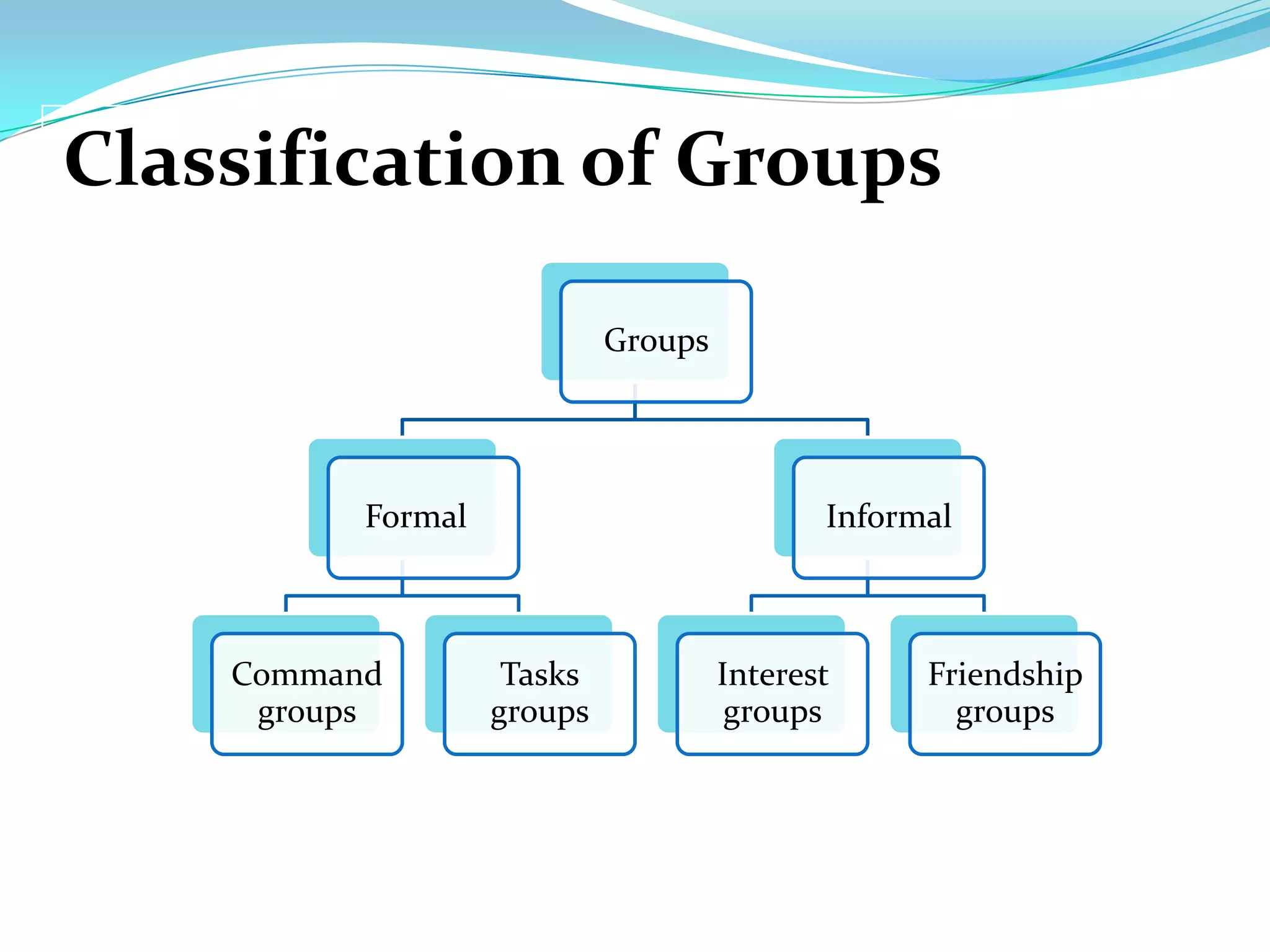
Classification of Groups

                            Groups


          Formal                            Informal


    Command         Tasks            Interest     Friendship
     groups        groups             groups        groups
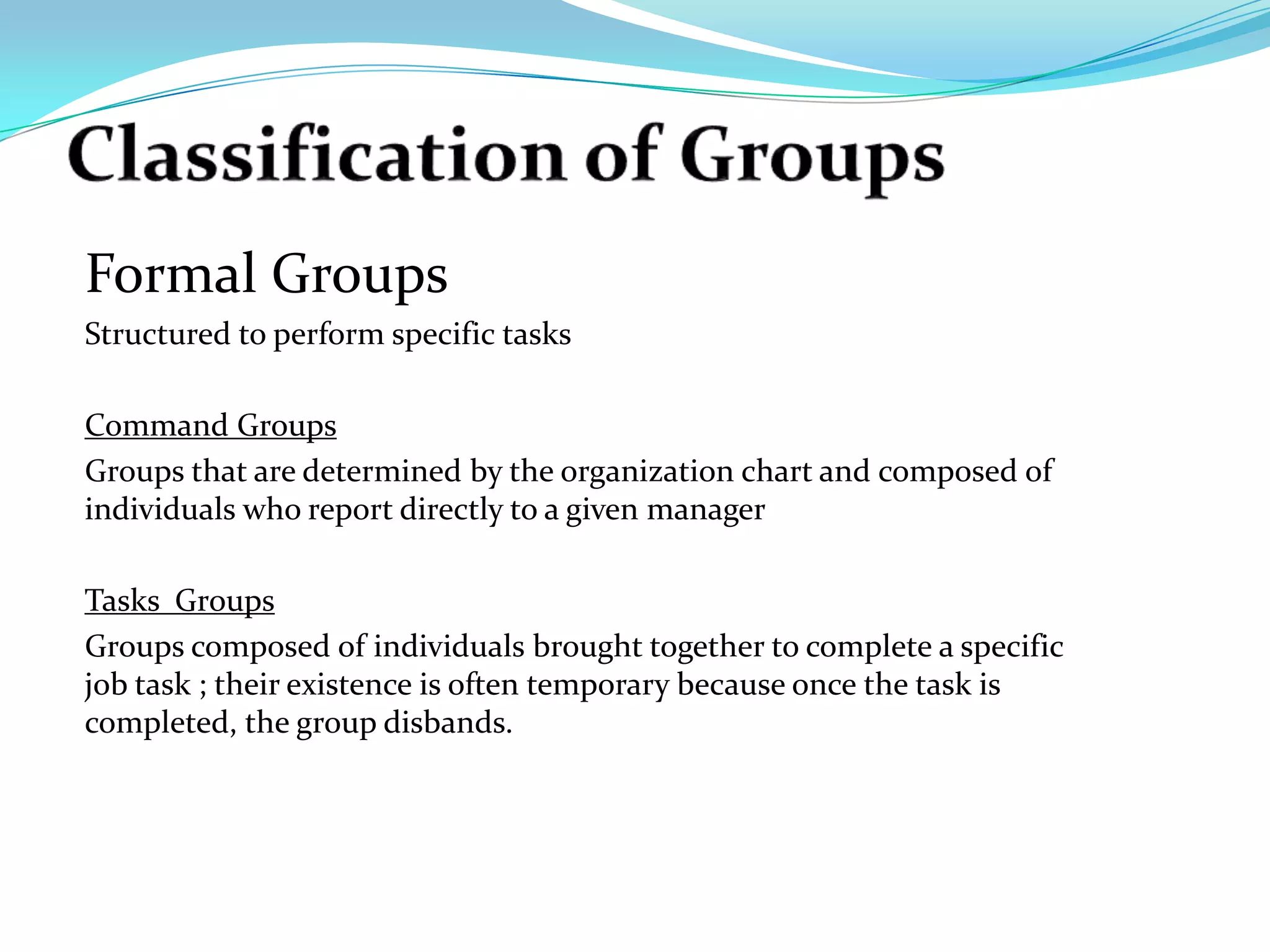
Formal Groups
Structured to perform specific tasks

Command Groups
Groups that are determined by the organization chart and composed of
individuals who report directly to a given manager

Tasks Groups
Groups composed of individuals brought together to complete a specific
job task ; their existence is often temporary because once the task is
completed, the group disbands.
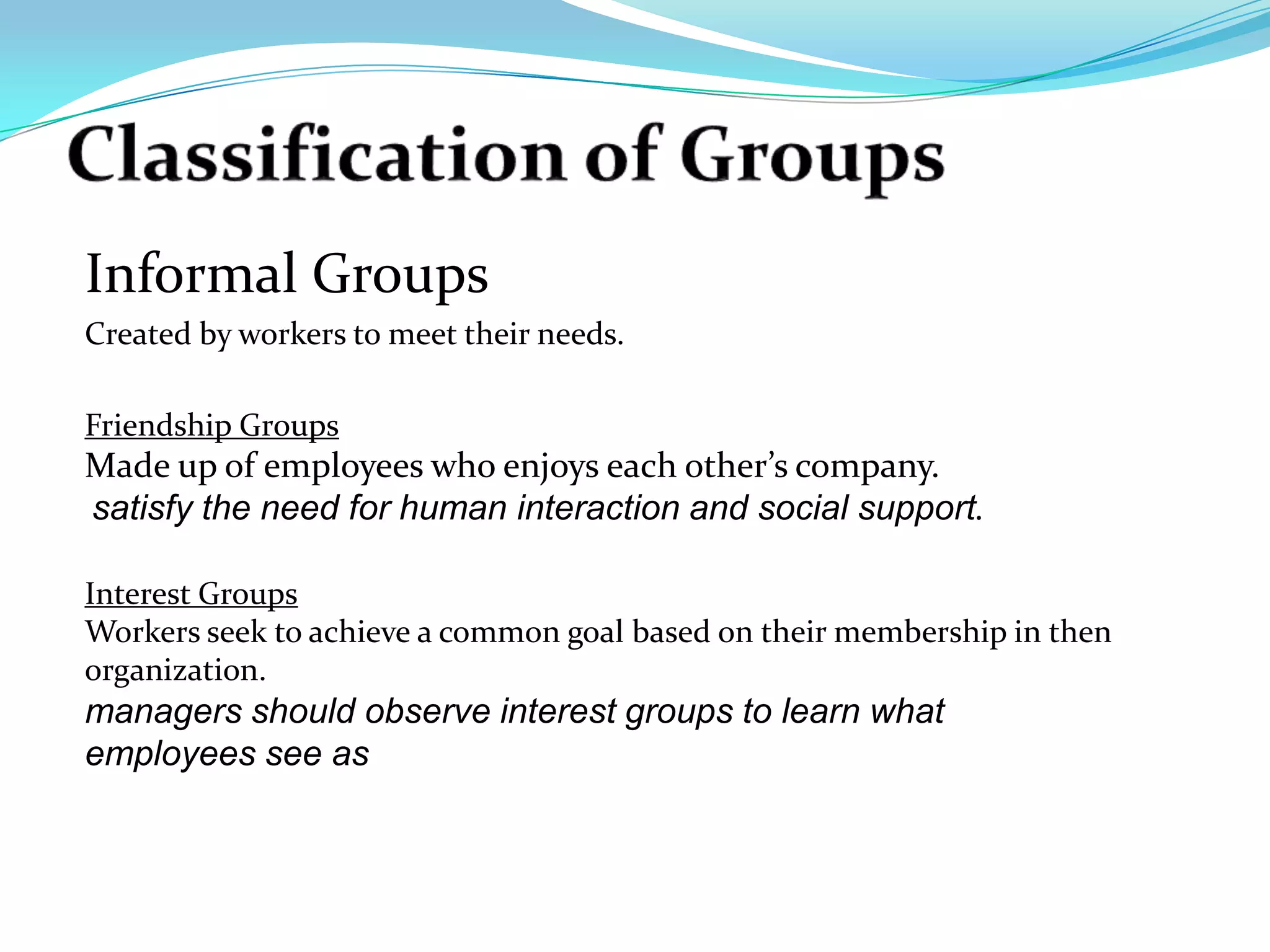
Informal Groups
Created by workers to meet their needs.

Friendship Groups
Made up of employees who enjoys each other’s company.
satisfy the need for human interaction and social support.

Interest Groups
Workers seek to achieve a common goal based on their membership in then
organization.
managers should observe interest groups to learn what
employees see as
Reasons for Joining Groups
Security
Status
Self –Esteem
Affiliation
Power
Goal Achievement
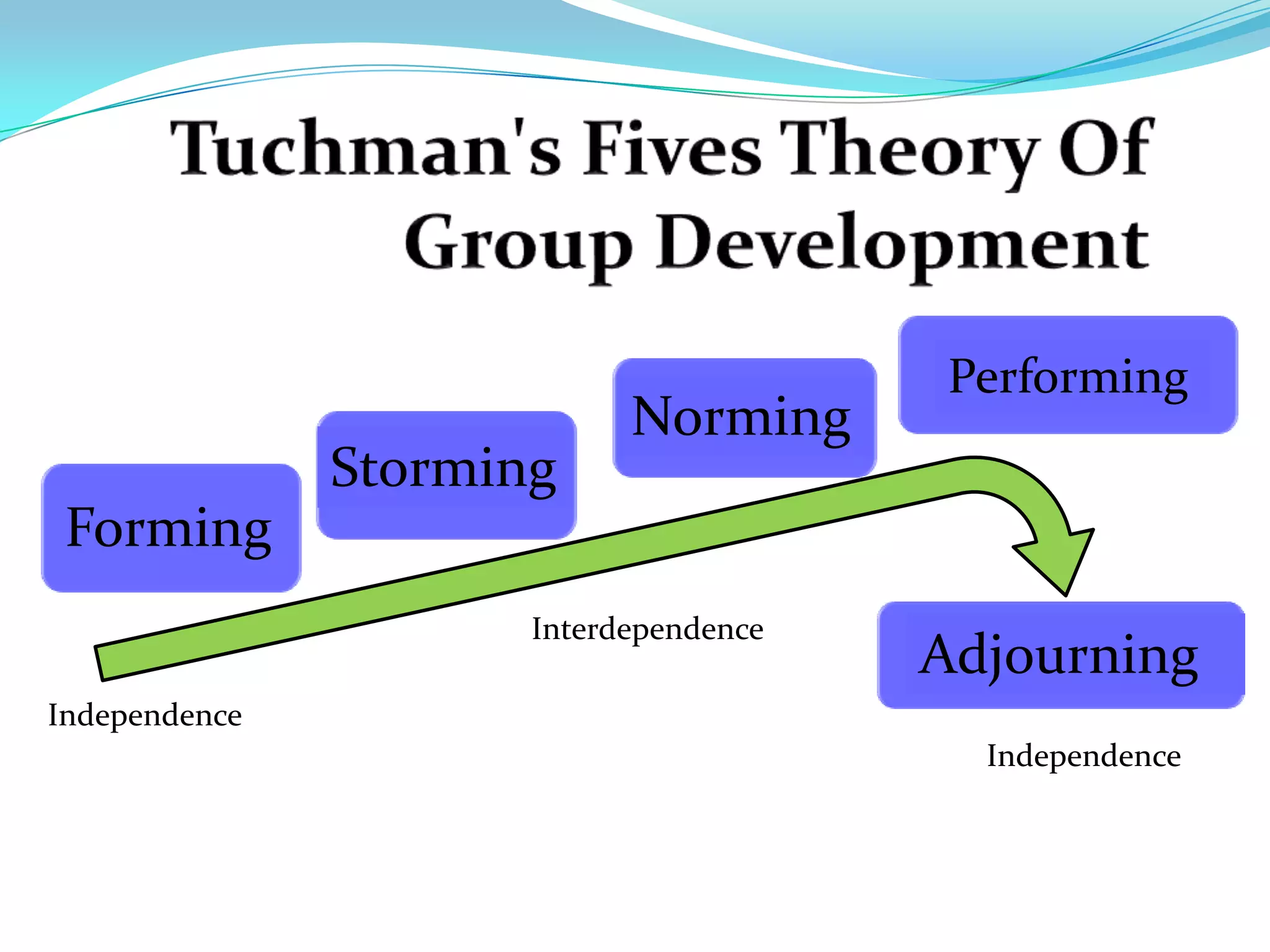
Performing
                            Norming
               Storming
Forming
 Forming
                      Interdependence
                                        Adjourning
Independence
                                          Independence
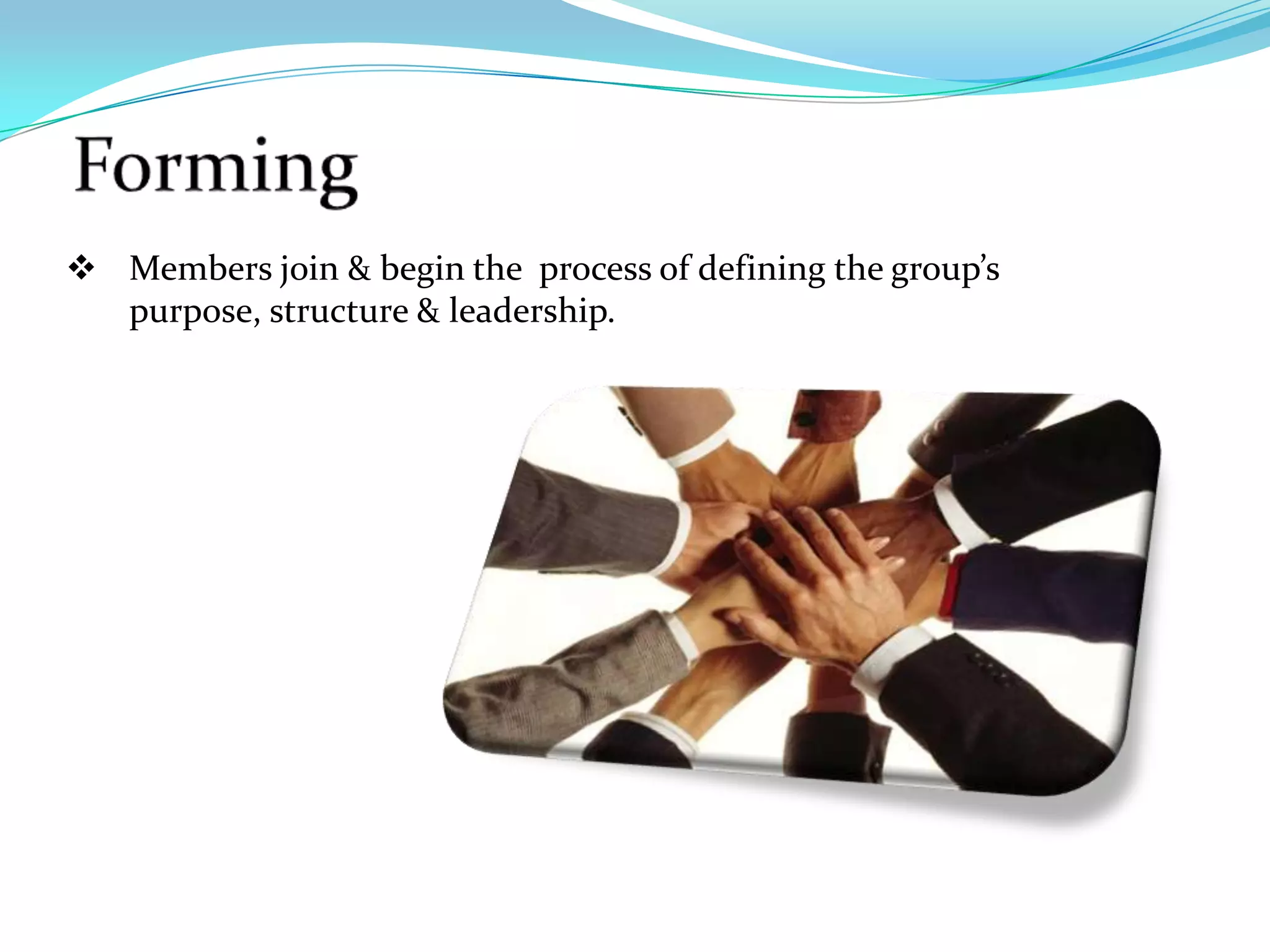
 Members join & begin the process of defining the group’s
  purpose, structure & leadership.
Storming
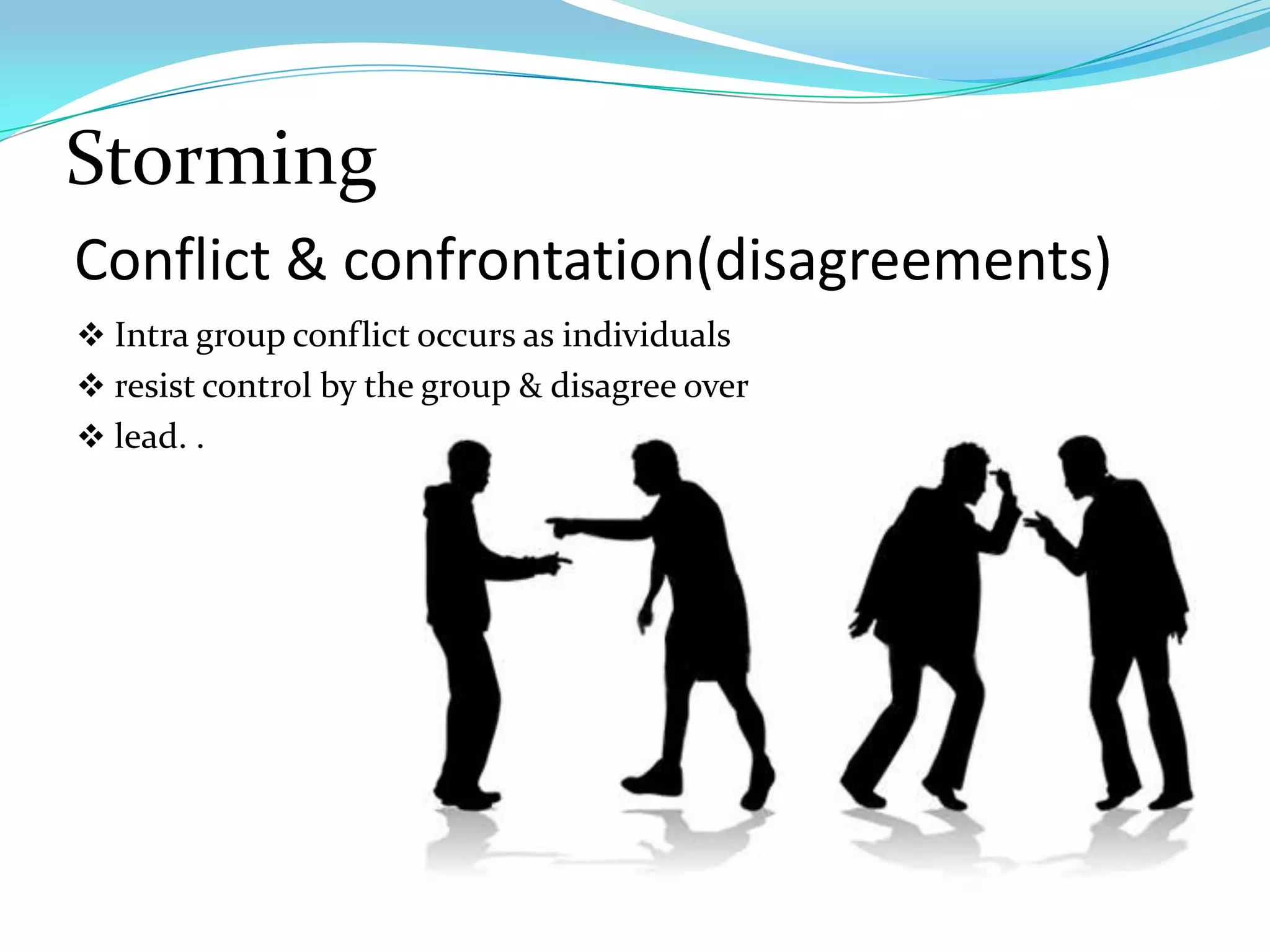
Conflict & confrontation(disagreements)
 Intra group conflict occurs as individuals
 resist control by the group & disagree over
 lead. .
Norming
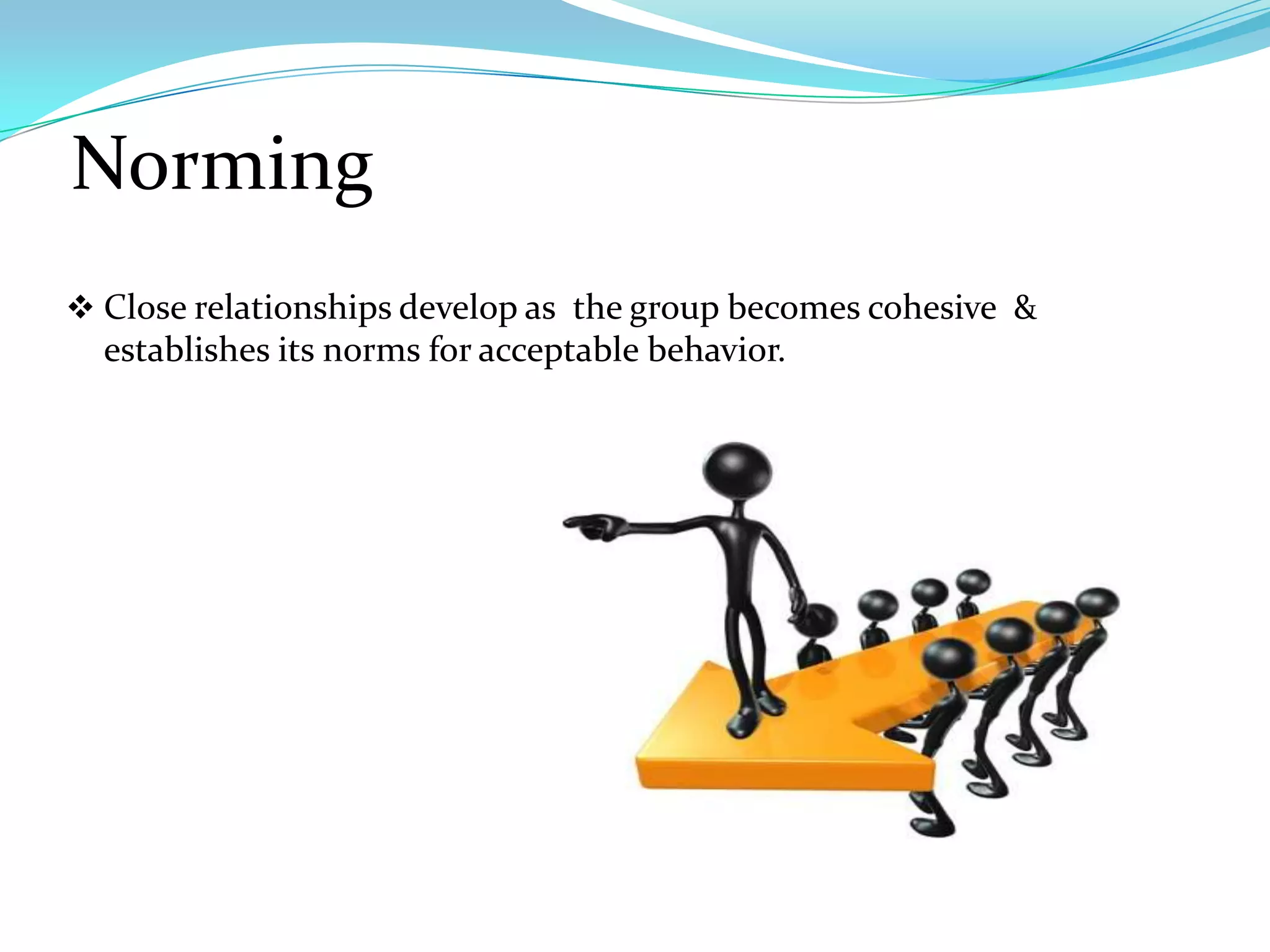
 Close relationships develop as the group becomes cohesive &
  establishes its norms for acceptable behavior.
Performing
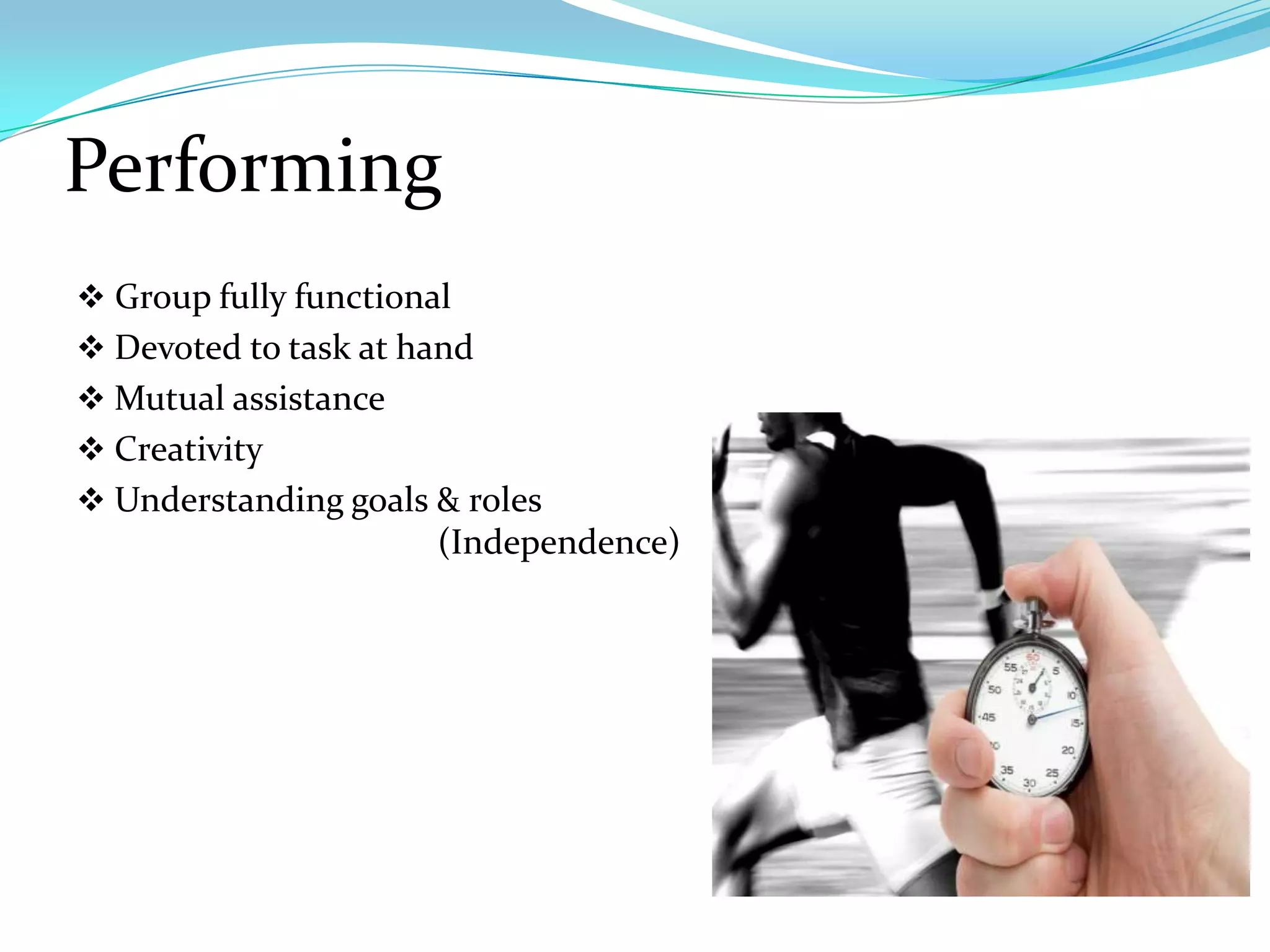
 Group fully functional
 Devoted to task at hand
 Mutual assistance
 Creativity
 Understanding goals & roles
                       (Independence)
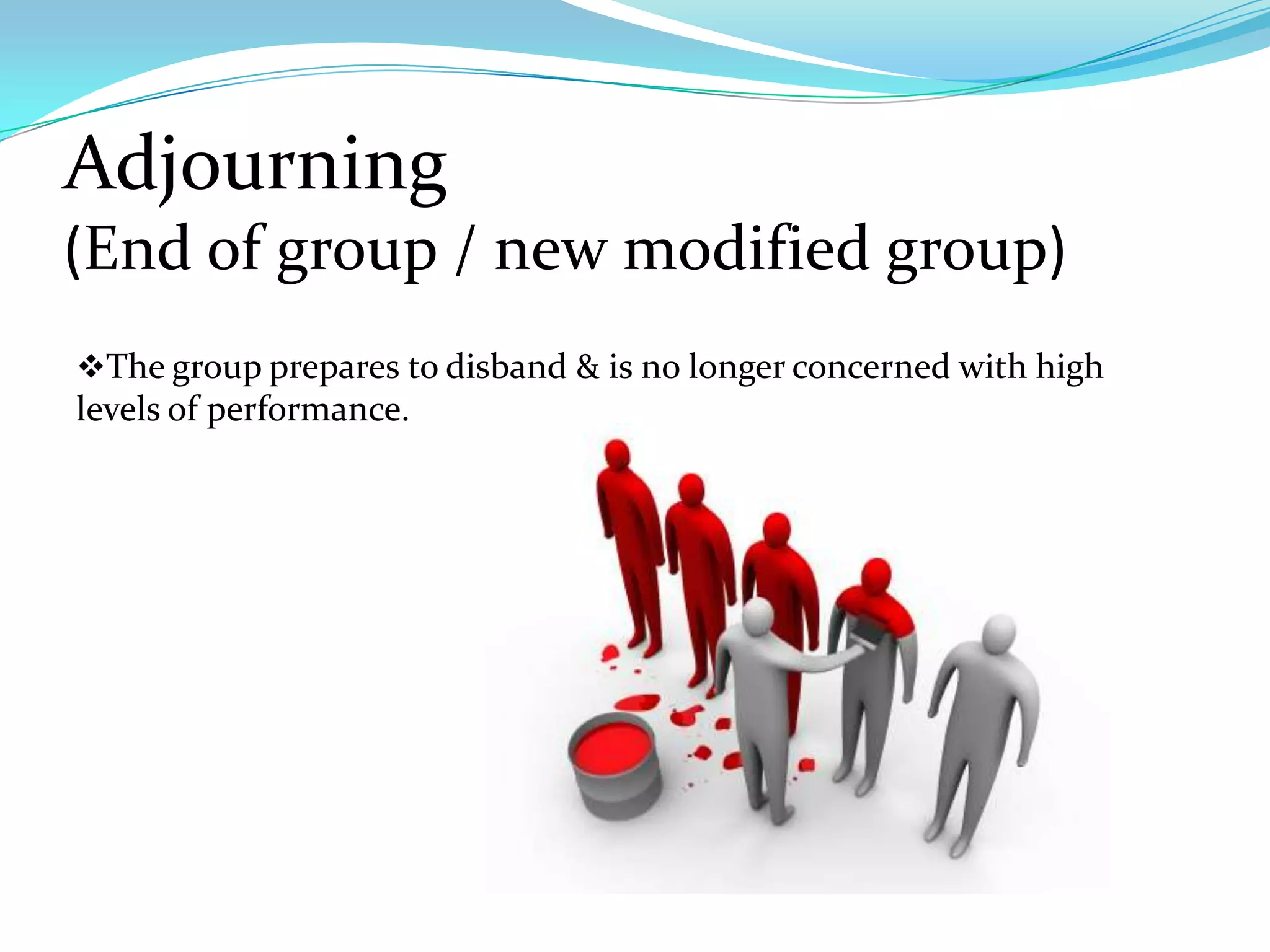
Adjourning
(End of group / new modified group)
The group prepares to disband & is no longer concerned with high
levels of performance.
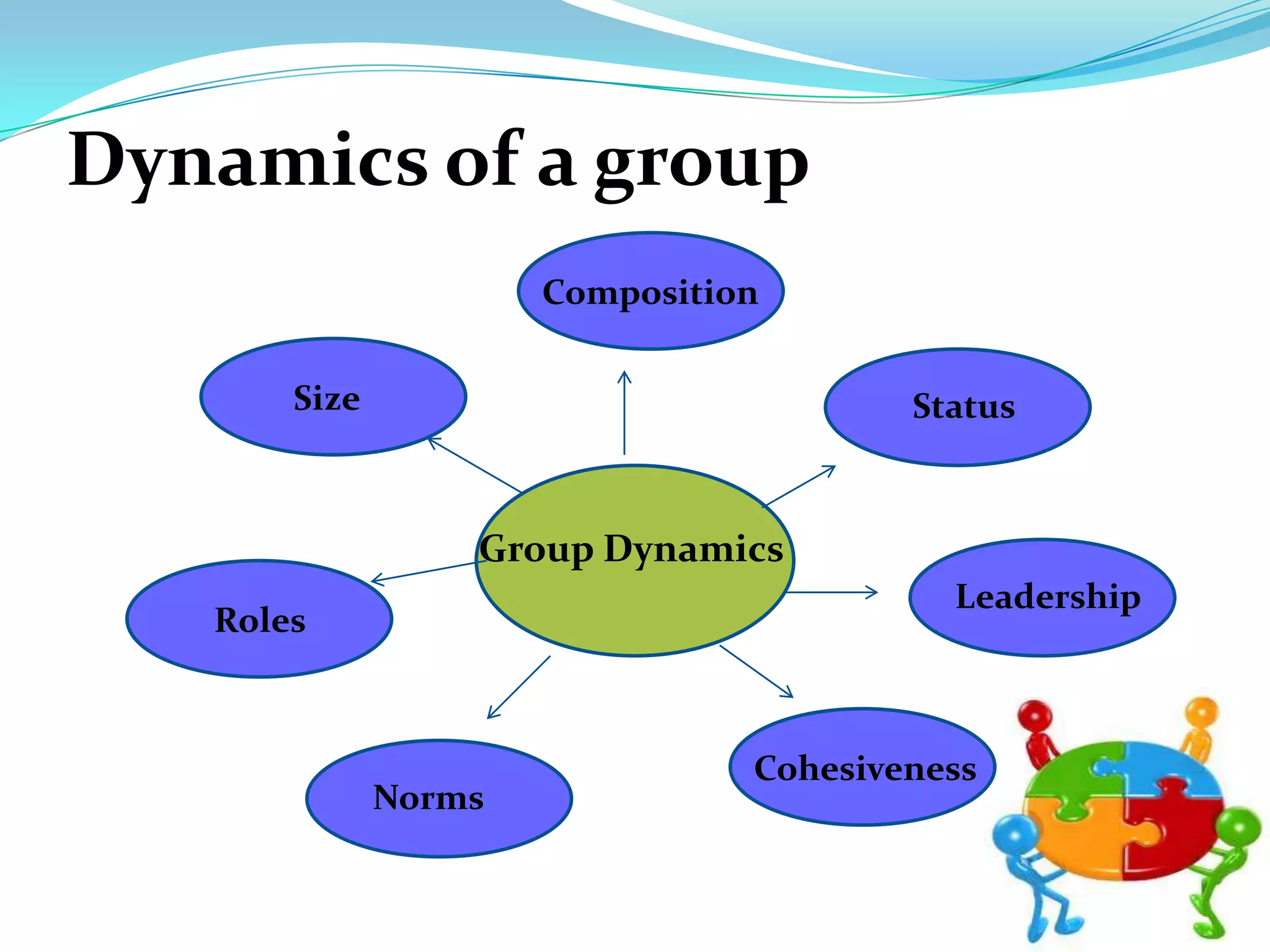
Dynamics of a group
                      Composition

       Size                             Status


                  Group Dynamics
                                          Leadership
   Roles


                                Cohesiveness
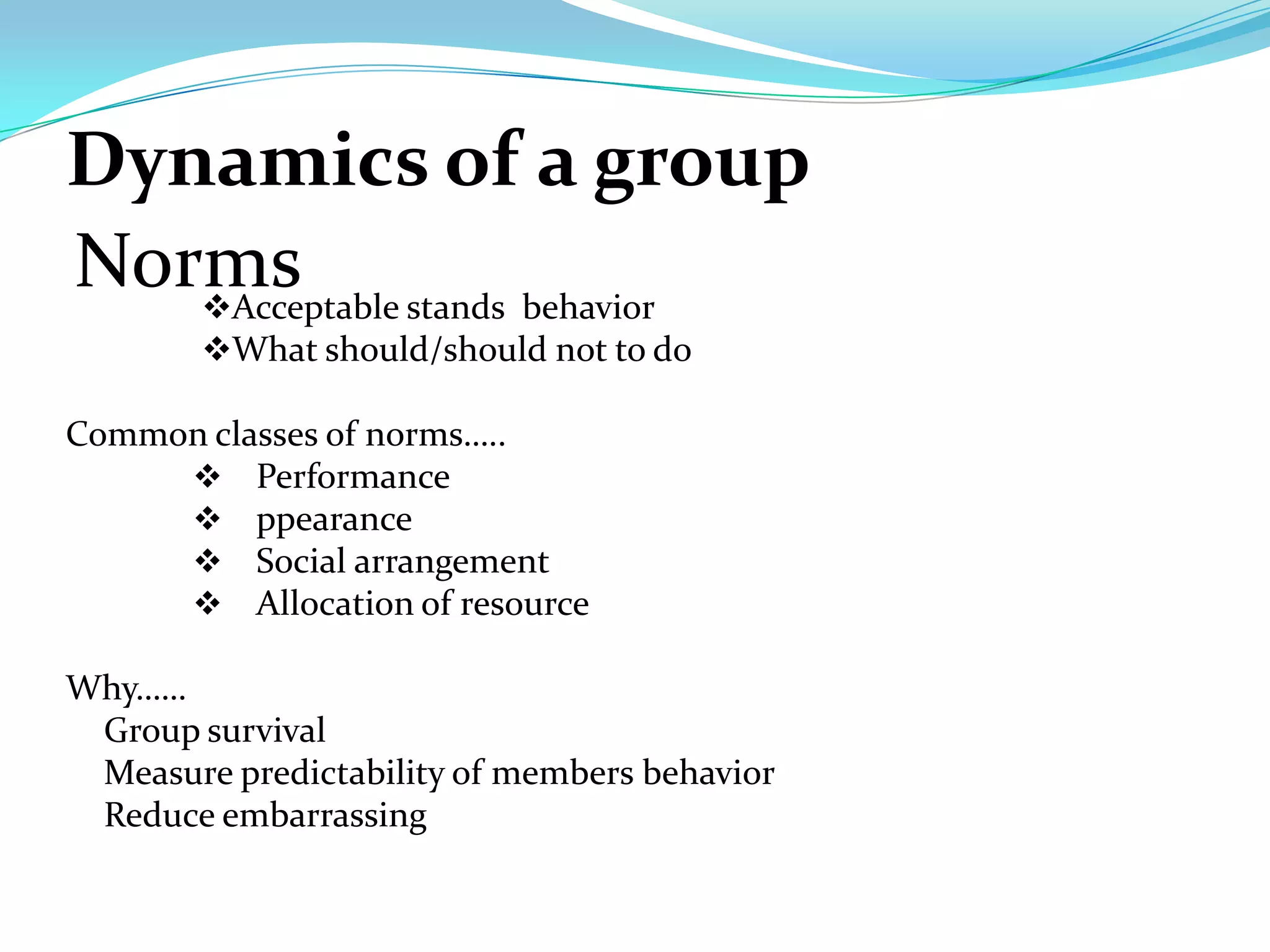
              Norms
Dynamics of a group
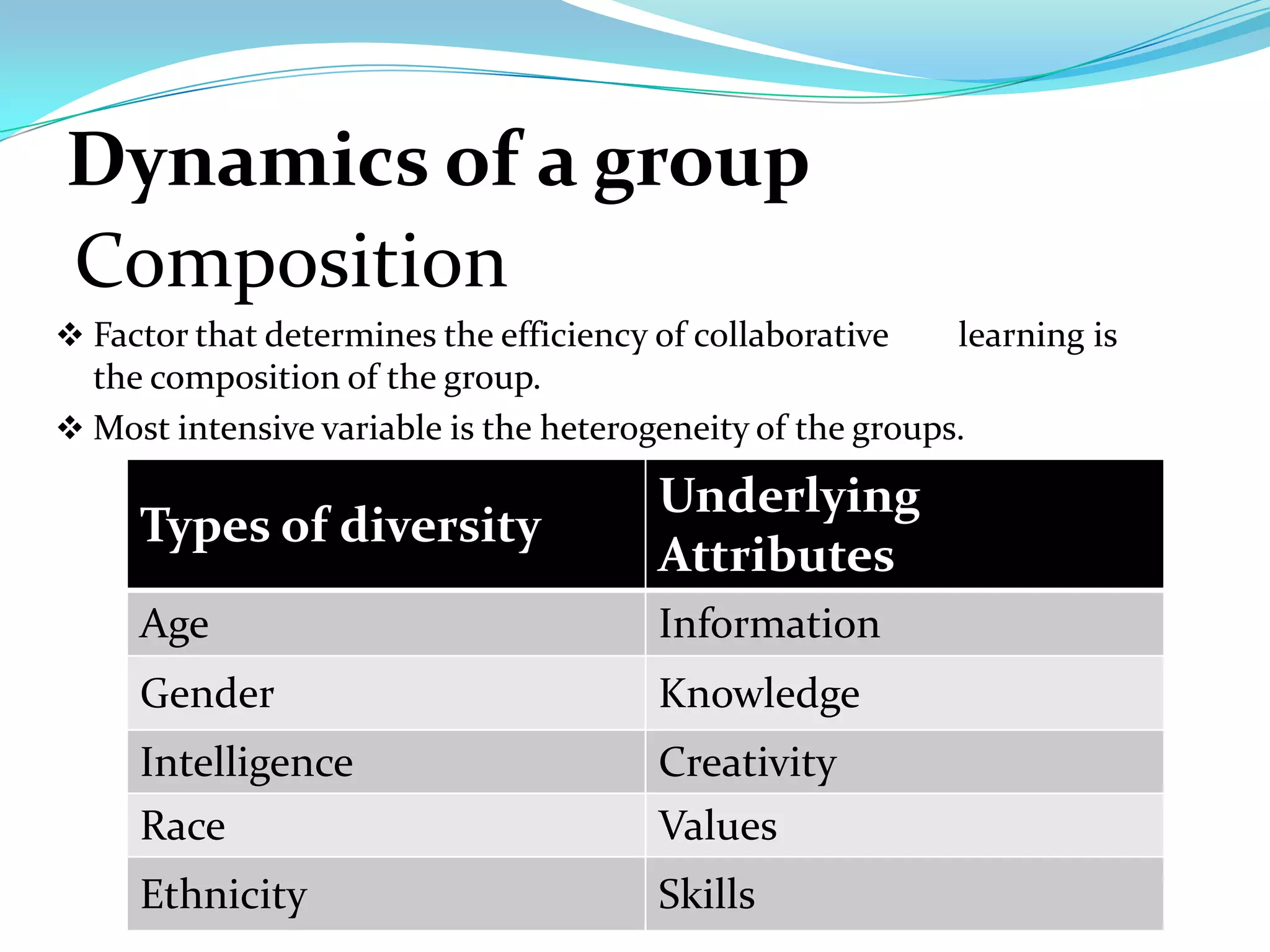
Composition
 Factor that determines the efficiency of collaborative    learning is
  the composition of the group.
 Most intensive variable is the heterogeneity of the groups.

                                        Underlying
     Types of diversity
                                        Attributes
     Age                                Information
     Gender                             Knowledge
     Intelligence                       Creativity
     Race                               Values
     Ethnicity                          Skills
Dynamics of a group
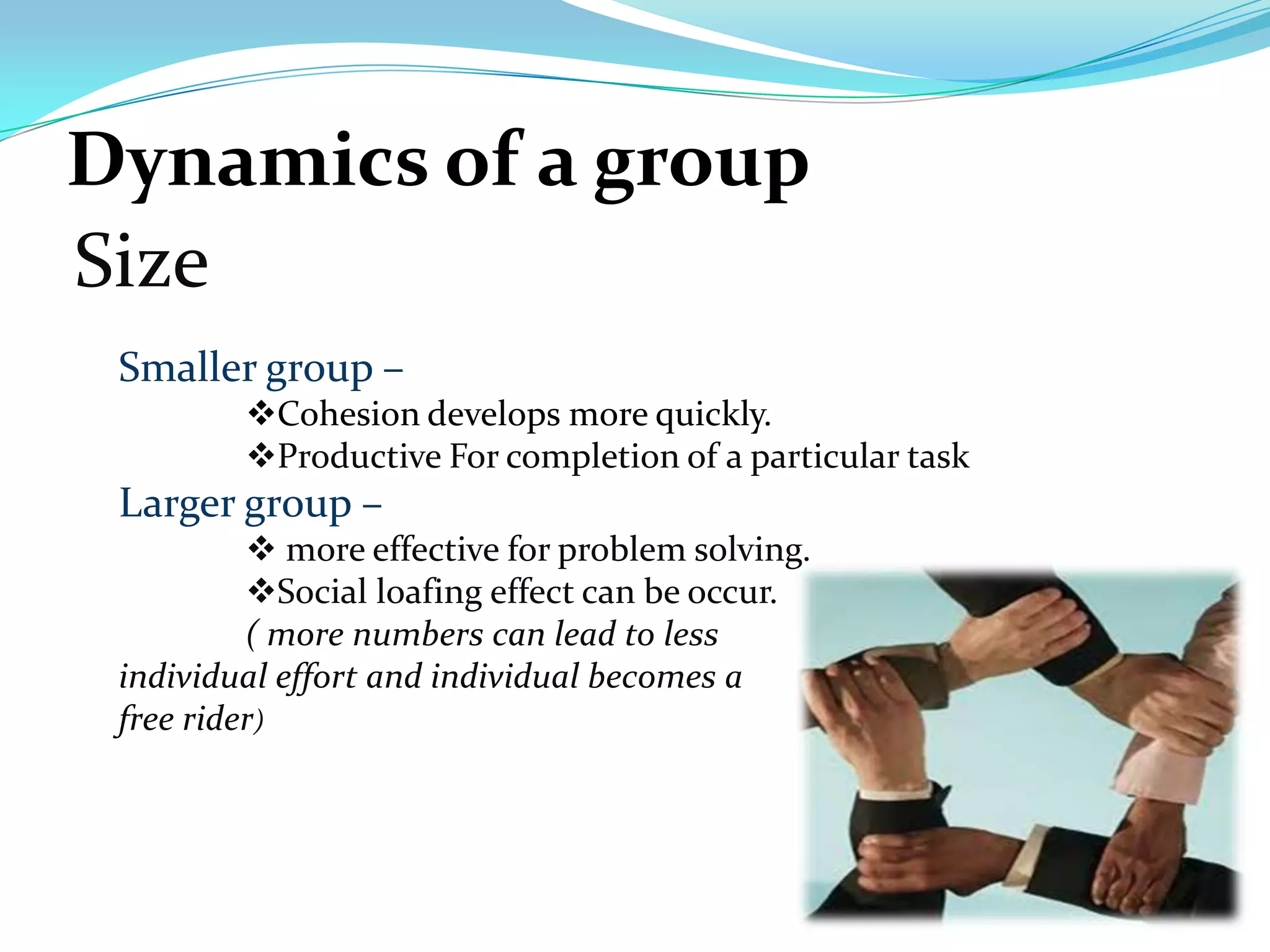
Size
 Smaller group –
         Cohesion develops more quickly.
         Productive For completion of a particular task
 Larger group –
           more effective for problem solving.
          Social loafing effect can be occur.
          ( more numbers can lead to less
 individual effort and individual becomes a
 free rider)
Dynamics of a group
Roles
         Group roles are largely determined by a combination of a
person’s personality and his or her experience with group settings
Assigned roles- chairmen , secretary , manager, treasurer

Emergent roles- confidant , group joker ,
                 gossiper , mentor
Dynamics of a group
Norms stands behavior
   Acceptable
        What should/should not to do

Common classes of norms…..
      Performance
      ppearance
      Social arrangement
      Allocation of resource

Why……
 Group survival
 Measure predictability of members behavior
 Reduce embarrassing
Dynamics of a group
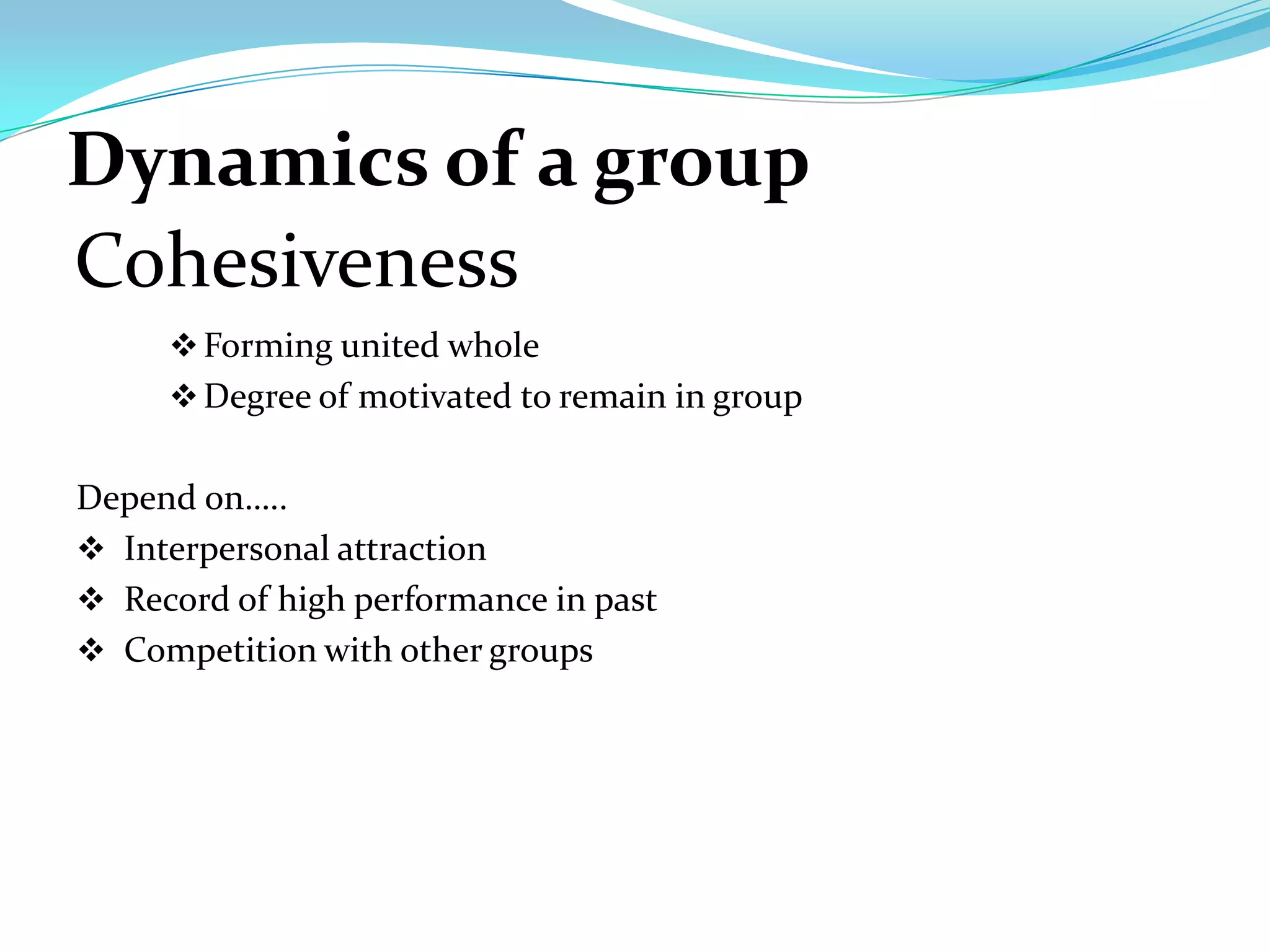
Cohesiveness
      Forming united whole
      Degree of motivated to remain in group


Depend on…..
 Interpersonal attraction
 Record of high performance in past
 Competition with other groups
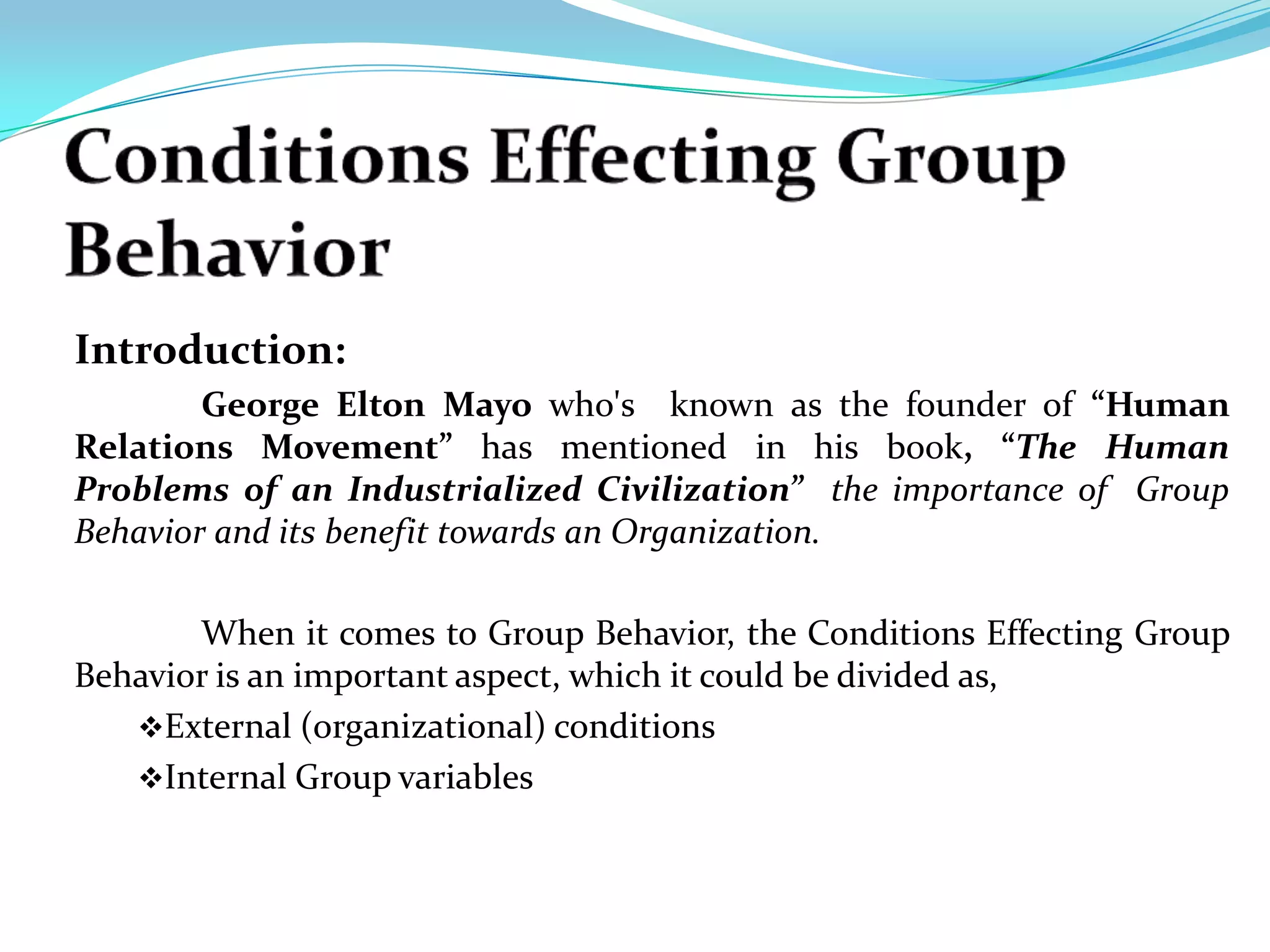
Introduction:
        George Elton Mayo who's known as the founder of “Human
Relations Movement” has mentioned in his book, “The Human
Problems of an Industrialized Civilization” the importance of Group
Behavior and its benefit towards an Organization.

       When it comes to Group Behavior, the Conditions Effecting Group
Behavior is an important aspect, which it could be divided as,
   External (organizational) conditions
   Internal Group variables
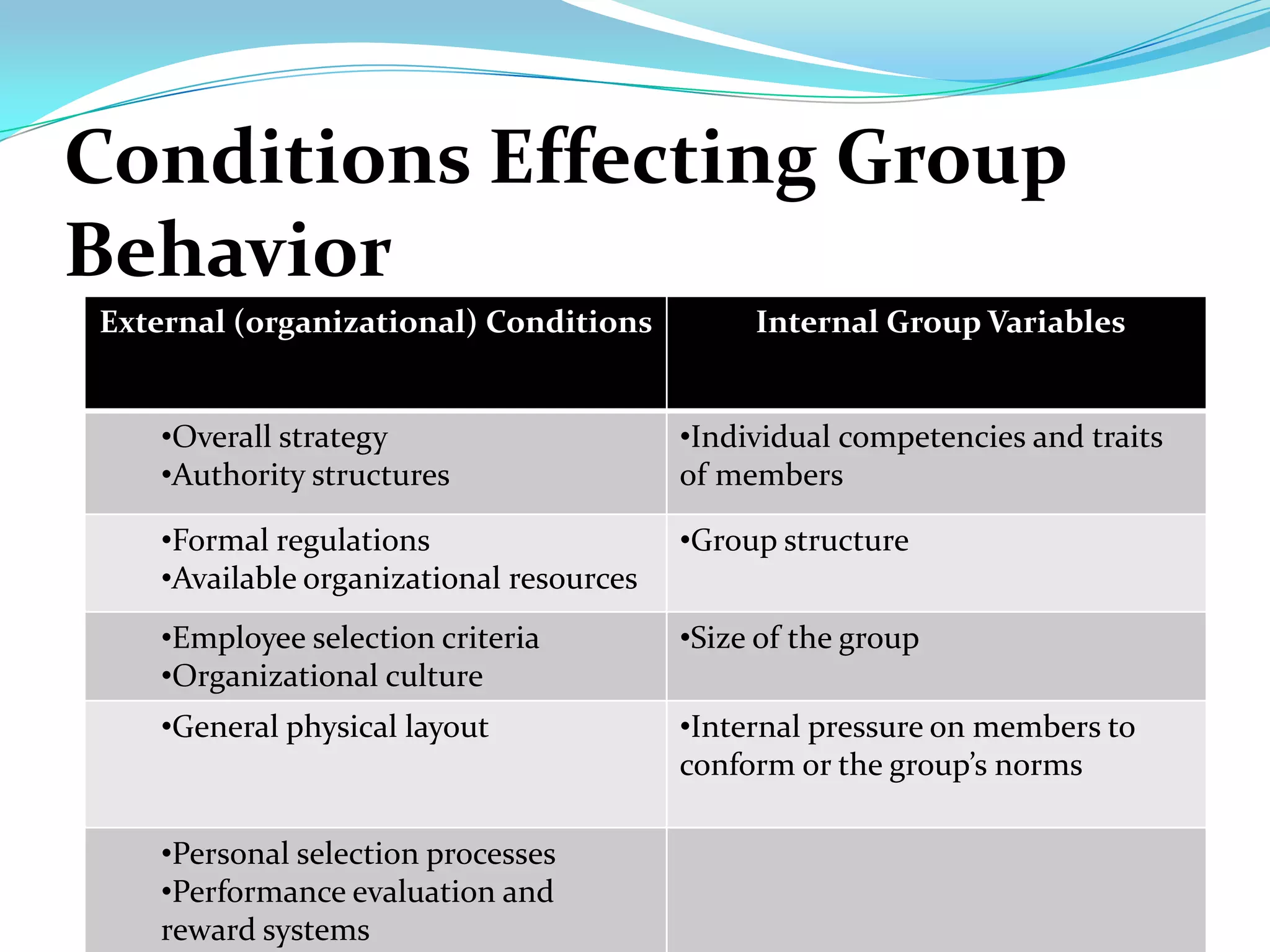
Conditions Effecting Group
Behavior
External (organizational) Conditions           Internal Group Variables


    •Overall strategy                     •Individual competencies and traits
    •Authority structures                 of members

    •Formal regulations                   •Group structure
    •Available organizational resources
    •Employee selection criteria          •Size of the group
    •Organizational culture
    •General physical layout              •Internal pressure on members to
                                          conform or the group’s norms

    •Personal selection processes
    •Performance evaluation and
    reward systems
Group decision
 In this path
  Introduction about group decision process….
  Method of decision making……
  Advantages of group decision making……
  Disadvantages of group decision making……
Group decision


 A complex process………………………….
 Require opinions from others…………
 On the process of decision making there are several
  methods….

   A. Authoritarian Style
          like a dictatorship
         Decision rest in the hand of the power full person…..
B. Brainstorming
     Excellent method
     Get the decision on consensus


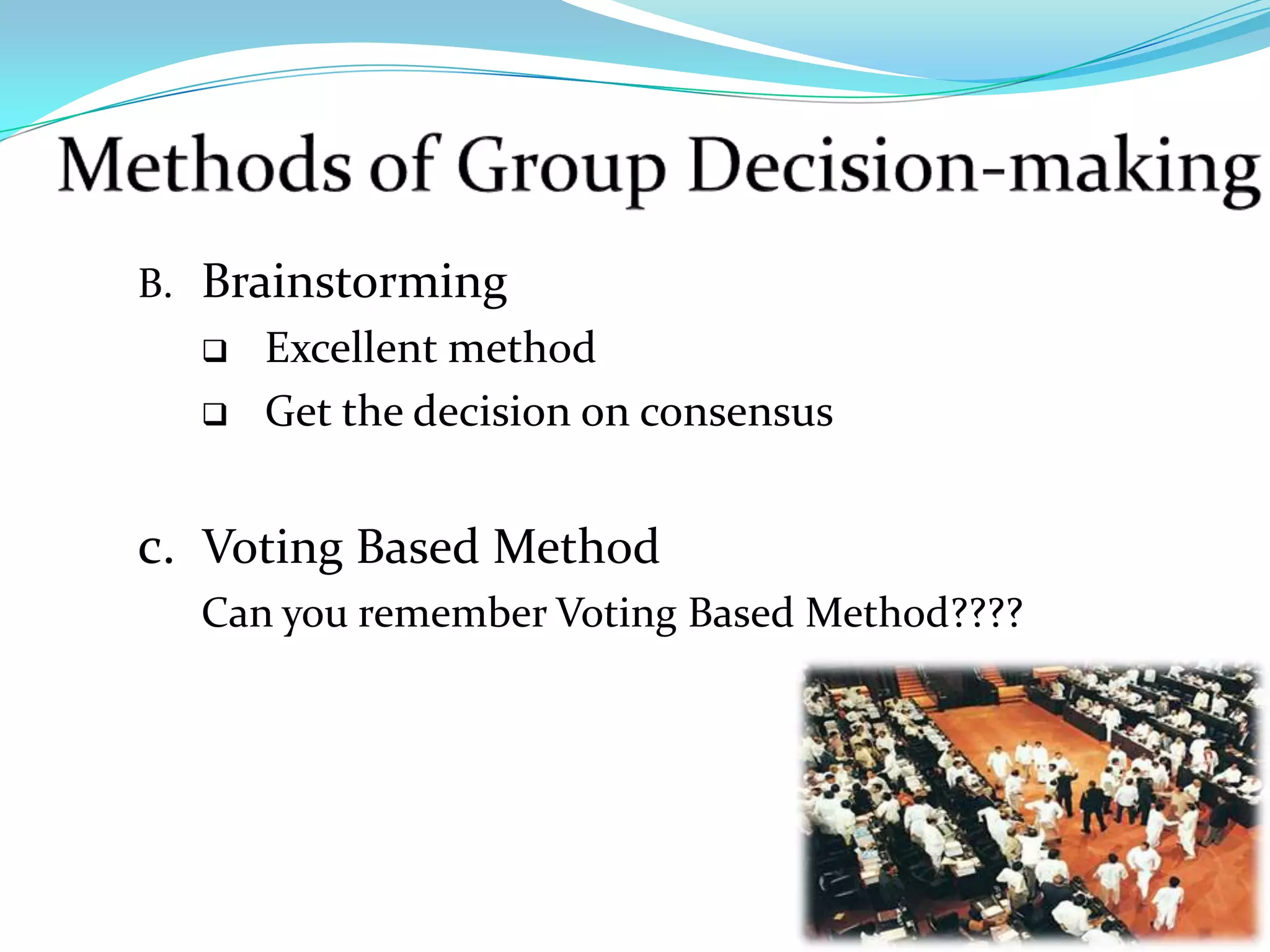
c. Voting Based Method
  Can you remember Voting Based Method????
 Generate more complete information and knowledge...
 Generate more diverse alternatives…..
 Increases acceptance of a solution……
 Increases legitimacy of decision….


 Time consuming…….
 Minority domination…..
 Pressure to conform……
Summary
 What is a group
 Difference between a group and a team
 Types of groups
 Reasons of joining groups
 Tuchman’s five theory of group development
 Dynamics of groups
 Conditions effecting group behavior
 Group decisions
Thank you!

Group Dynamics

  • 1.
    Group Dynamics zenith By group D.K.D. Madhubhashini K. Sujeevakanthan K.P.W.A.S.B Kaduwela H.M. Madhumathi K.Haluwana K.D.D.U.S.B. Amarathunga Aroshi S. Tennekoon A.M.S.B. Abeysekara U.P. Wijewardane on 14th January 2012
  • 2.
    What is a“Group”? Two or more people who share a common definition and evaluation of themselves and behave in accordance with such a definition. (Vaughan & Hogg, 2002, p. 200)
  • 3.
    Two or more Who see them selves People as group members Group Share common goals Inter act with each other
  • 4.
    Groups Vs Teams  All teams are Groups but not all groups are teams  Skills in team is a force of together “Less me more Us”  Team have individual tasks and Responsibility link to the task.  A team have a positive synergy 1+1<2
  • 5.
    Classification of Groups Groups Formal Informal Command Tasks Interest Friendship groups groups groups groups
  • 6.
    Formal Groups Structured toperform specific tasks Command Groups Groups that are determined by the organization chart and composed of individuals who report directly to a given manager Tasks Groups Groups composed of individuals brought together to complete a specific job task ; their existence is often temporary because once the task is completed, the group disbands.
  • 7.
    Informal Groups Created byworkers to meet their needs. Friendship Groups Made up of employees who enjoys each other’s company. satisfy the need for human interaction and social support. Interest Groups Workers seek to achieve a common goal based on their membership in then organization. managers should observe interest groups to learn what employees see as
  • 8.
    Reasons for JoiningGroups Security Status Self –Esteem Affiliation Power Goal Achievement
  • 9.
    Performing Norming Storming Forming Forming Interdependence Adjourning Independence Independence
  • 10.
     Members join& begin the process of defining the group’s purpose, structure & leadership.
  • 11.
    Storming Conflict & confrontation(disagreements) Intra group conflict occurs as individuals  resist control by the group & disagree over  lead. .
  • 12.
    Norming  Close relationshipsdevelop as the group becomes cohesive & establishes its norms for acceptable behavior.
  • 13.
    Performing  Group fullyfunctional  Devoted to task at hand  Mutual assistance  Creativity  Understanding goals & roles (Independence)
  • 14.
    Adjourning (End of group/ new modified group) The group prepares to disband & is no longer concerned with high levels of performance.
  • 15.
    Dynamics of agroup Composition Size Status Group Dynamics Leadership Roles Cohesiveness Norms
  • 16.
    Dynamics of agroup Composition  Factor that determines the efficiency of collaborative learning is the composition of the group.  Most intensive variable is the heterogeneity of the groups. Underlying Types of diversity Attributes Age Information Gender Knowledge Intelligence Creativity Race Values Ethnicity Skills
  • 17.
    Dynamics of agroup Size Smaller group – Cohesion develops more quickly. Productive For completion of a particular task Larger group –  more effective for problem solving. Social loafing effect can be occur. ( more numbers can lead to less individual effort and individual becomes a free rider)
  • 18.
    Dynamics of agroup Roles Group roles are largely determined by a combination of a person’s personality and his or her experience with group settings Assigned roles- chairmen , secretary , manager, treasurer Emergent roles- confidant , group joker , gossiper , mentor
  • 19.
    Dynamics of agroup Norms stands behavior Acceptable What should/should not to do Common classes of norms…..  Performance  ppearance  Social arrangement  Allocation of resource Why…… Group survival Measure predictability of members behavior Reduce embarrassing
  • 20.
    Dynamics of agroup Cohesiveness  Forming united whole  Degree of motivated to remain in group Depend on…..  Interpersonal attraction  Record of high performance in past  Competition with other groups
  • 21.
    Introduction: George Elton Mayo who's known as the founder of “Human Relations Movement” has mentioned in his book, “The Human Problems of an Industrialized Civilization” the importance of Group Behavior and its benefit towards an Organization. When it comes to Group Behavior, the Conditions Effecting Group Behavior is an important aspect, which it could be divided as, External (organizational) conditions Internal Group variables
  • 22.
    Conditions Effecting Group Behavior External(organizational) Conditions Internal Group Variables •Overall strategy •Individual competencies and traits •Authority structures of members •Formal regulations •Group structure •Available organizational resources •Employee selection criteria •Size of the group •Organizational culture •General physical layout •Internal pressure on members to conform or the group’s norms •Personal selection processes •Performance evaluation and reward systems
  • 23.
    Group decision Inthis path  Introduction about group decision process….  Method of decision making……  Advantages of group decision making……  Disadvantages of group decision making……
  • 24.
    Group decision  Acomplex process………………………….  Require opinions from others…………  On the process of decision making there are several methods…. A. Authoritarian Style  like a dictatorship  Decision rest in the hand of the power full person…..
  • 25.
    B. Brainstorming  Excellent method  Get the decision on consensus c. Voting Based Method Can you remember Voting Based Method????
  • 26.
     Generate morecomplete information and knowledge...  Generate more diverse alternatives…..  Increases acceptance of a solution……  Increases legitimacy of decision….  Time consuming…….  Minority domination…..  Pressure to conform……
  • 27.
    Summary  What isa group  Difference between a group and a team  Types of groups  Reasons of joining groups  Tuchman’s five theory of group development  Dynamics of groups  Conditions effecting group behavior  Group decisions
  • 28.