


By: JerylWyn S. Espejo, RMT
GROUP 
A collection of two or more interacting 
individuals who maintain stable 
patterns of relationships, share 
common goals and perceive 
themselves as being a group.
Theories of Group Formation
Propinquity 
 Individuals affiliate with one another because of 
spatial or geographical proximity 
 Drawback: it is not analytical and does not begin to 
explain some of the complexities of group formation 
and the modern development of globalization and 
electronic online networking and telecommunicating 
that gives new meaning to spatial or geographic 
proximity.
Interaction 
 A classic theory of George Homans based on the 
activities, interactions, and sentiments. 
 This theory lends a great deal to the 
understanding of group formation and process. 
 Persons in a group interact with one another not 
just in the physical propinguity sense or 
increasingky electronically, but also to 
accomplish many group goals through 
cooperation and problem solving.
Balance Theory 
 Theodore Newcomb 
 Persons are attracted to one another in the 
basis of similar attitudes toward commonly 
relevant objects and goals. 
 Both propinquity and interaction play a role 
in balance theory
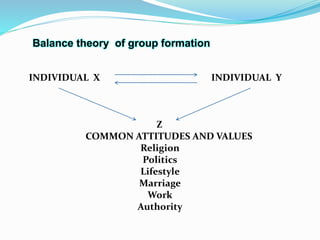
Balance theory of group formation 
INDIVIDUAL X INDIVIDUAL Y 
Z 
COMMON ATTITUDES AND VALUES 
Religion 
Politics 
Lifestyle 
Marriage 
Work 
Authority
Exchange Theory 
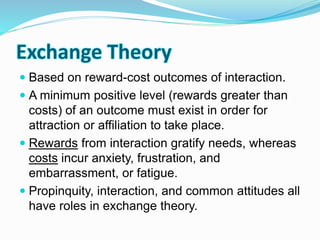
 Based on reward-cost outcomes of interaction. 
 A minimum positive level (rewards greater than 
costs) of an outcome must exist in order for 
attraction or affiliation to take place. 
 Rewards from interaction gratify needs, whereas 
costs incur anxiety, frustration, and 
embarrassment, or fatigue. 
 Propinquity, interaction, and common attitudes all 
have roles in exchange theory.
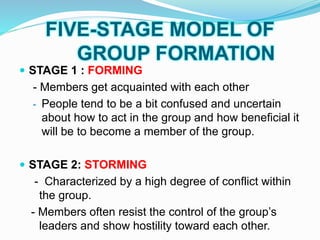
FIVE-STAGE MODEL OF 
GROUP FORMATION 
 STAGE 1 : FORMING 
- Members get acquainted with each other 
- People tend to be a bit confused and uncertain 
about how to act in the group and how beneficial it 
will be to become a member of the group. 
 STAGE 2: STORMING 
- Characterized by a high degree of conflict within 
the group. 
- Members often resist the control of the group’s 
leaders and show hostility toward each other.
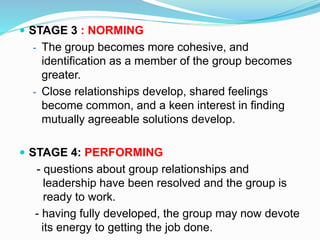
 STAGE 3 : NORMING 
- The group becomes more cohesive, and 
identification as a member of the group becomes 
greater. 
- Close relationships develop, shared feelings 
become common, and a keen interest in finding 
mutually agreeable solutions develop. 
 STAGE 4: PERFORMING 
- questions about group relationships and 
leadership have been resolved and the group is 
ready to work. 
- having fully developed, the group may now devote 
its energy to getting the job done.
 STAGE 5: ADJOURNING 
- Groups may cease to exist because they have met 
their goals and are no longer needed, in which case 
the end is abrupt.
THE PUNCTUATED-EQUILIBRIUM MODEL 
 Groups go through two stages marked by the mid-point 
of the group’s time together. 
The first half is a period of equilibrium, in which 
the group makes plans, but accomplishes little. 
The second half, group members make 
changes that lead them to accomplish the group’s 
task as the deadline approaches.
CHARACTERISTICS OF GROUPS 
 Social Interaction 
 Verbal 
 Non-verbal 
 Stability 
 there must be some stable relationships that 
keep group members together and functioning as a 
unit. 
 Common Interests or Goals 
 Recognition as Being a Group 
 people who recognize each other as a member 
of their group and can distinguish these individuals 
from non members
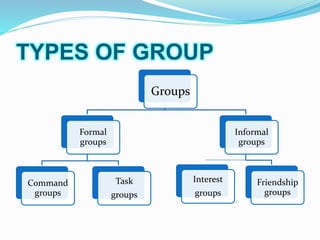
TYPES OF GROUP 
Groups 
Formal 
groups 
Command 
groups 
Task 
groups 
Informal 
groups 
Friendship 
groups 
Interest 
groups
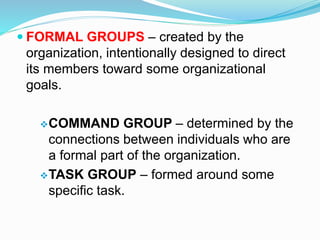
 FORMAL GROUPS – created by the 
organization, intentionally designed to direct 
its members toward some organizational 
goals. 
COMMAND GROUP – determined by the 
connections between individuals who are 
a formal part of the organization. 
TASK GROUP – formed around some 
specific task.
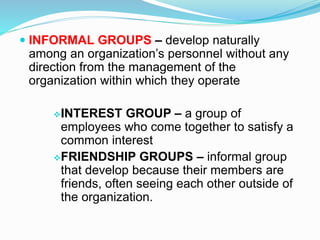
 INFORMAL GROUPS – develop naturally 
among an organization’s personnel without any 
direction from the management of the 
organization within which they operate 
INTEREST GROUP – a group of 
employees who come together to satisfy a 
common interest 
FRIENDSHIP GROUPS – informal group 
that develop because their members are 
friends, often seeing each other outside of 
the organization.
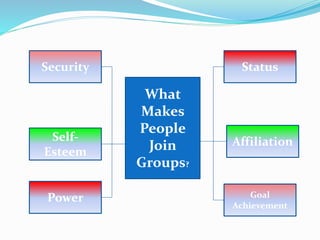
What 
Makes 
People 
Join 
Groups? 
Security 
Status 
Affiliation 
Power Goal 
Achievement 
Self- 
Esteem
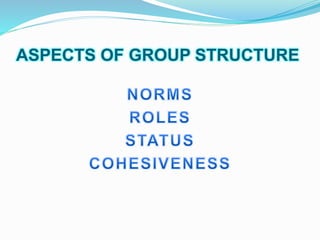
ASPECTS OF GROUP STRUCTURE
NORMS: A Group’s Unspoken Rules 
 Generally agreed upon informal rules that guide 
group member’s behavior. 
 Regulate the behavior of groups in important 
ways, such as by : 
 fostering workers’ honesty and loyalty to 
the company. 
Establishing appropriate way to dress 
Dictating when it is acceptable to be late 
for or absent from work
PRESCRIPTIVE NORM- dictate the 
behavior s that should be performed. 
PROSCRIPTIVE NORM- dictate 
specific behaviors that should be 
avoided.
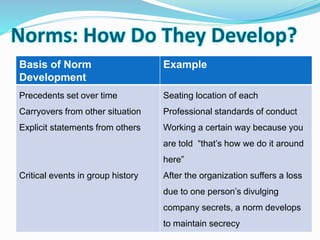
Norms: How Do They Develop? 
Basis of Norm 
Development 
Example 
Precedents set over time 
Carryovers from other situation 
Explicit statements from others 
Critical events in group history 
Seating location of each 
Professional standards of conduct 
Working a certain way because you 
are told “that’s how we do it around 
here” 
After the organization suffers a loss 
due to one person’s divulging 
company secrets, a norm develops 
to maintain secrecy
ROLES : The Hats We Wear 
 The typical behavior behavior that characterizes 
a person in a specific social context 
 Role incumbent – person holding a particular role 
 Role expectation – behavior expected of that 
person 
 Role ambiguity – confusion arising from not 
knowing what one is expected to do as the 
holder of the role. 
 Role differentiation – various group members 
come to play different roles in the social 
structure.
STATUS: The Prestige of Group 
Membership 
 The relative prestige, social position, or rank 
given to groups or individuals by others. 
NATURE: 
 Formal status – attempts to differentiate 
between the degrees of formal authority given 
employees by an organization. 
Status symbols – objects reflecting the 
position of an individual within an 
organization’s hierarchy.
Ways where status symbols can help 
goups: 
remind organizational members of their 
roles 
 provide assurance of the various 
rewards available to those who perform at 
a superior level. 
 provide a sense of identification by 
reminding members of the group’s values
 Informal Status - the prestige accorded 
individuals with certain characteristics that are 
not formally recognized by the organization. 
 e.g. employees who are older or more 
experienced, employees who have certain 
special skills
COHESIVENESS: Getting the 
Team Spirit 
 The strength of group members’ 
desires to remain a part of the group. 
Refers to a we-feeling, esprit de 
corps, a sense of belonging to a 
group.
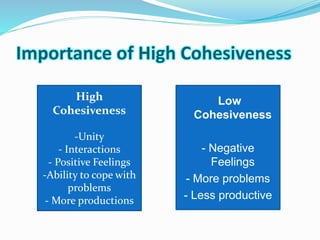
Importance of High Cohesiveness 
High 
Cohesiveness 
-Unity 
- Interactions 
- Positive Feelings 
-Ability to cope with 
problems 
- More productions 
Low 
Cohesiveness 
- Negative 
Feelings 
- More problems 
- Less productive
Groups with High Cohesiveness Gets Better 
Results!
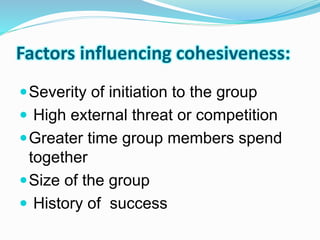
Factors influencing cohesiveness: 
Severity of initiation to the group 
 High external threat or competition 
Greater time group members spend 
together 
Size of the group 
 History of success
Highly cohesive groups also can be 
problematic. 
e.g. if a highly cohesive group’s goals 
are contrary to the organization’s goals, 
that group is in a position to inflict a great 
deal of harm to an organization, working 
against its interest.
Group and Group Dynamics

Group and Group Dynamics

  • 1.
    By: JerylWyn S.Espejo, RMT
  • 2.
    GROUP A collectionof two or more interacting individuals who maintain stable patterns of relationships, share common goals and perceive themselves as being a group.
  • 3.
  • 4.
    Propinquity  Individualsaffiliate with one another because of spatial or geographical proximity  Drawback: it is not analytical and does not begin to explain some of the complexities of group formation and the modern development of globalization and electronic online networking and telecommunicating that gives new meaning to spatial or geographic proximity.
  • 5.
    Interaction  Aclassic theory of George Homans based on the activities, interactions, and sentiments.  This theory lends a great deal to the understanding of group formation and process.  Persons in a group interact with one another not just in the physical propinguity sense or increasingky electronically, but also to accomplish many group goals through cooperation and problem solving.
  • 6.
    Balance Theory Theodore Newcomb  Persons are attracted to one another in the basis of similar attitudes toward commonly relevant objects and goals.  Both propinquity and interaction play a role in balance theory
  • 7.
    Balance theory ofgroup formation INDIVIDUAL X INDIVIDUAL Y Z COMMON ATTITUDES AND VALUES Religion Politics Lifestyle Marriage Work Authority
  • 8.
    Exchange Theory Based on reward-cost outcomes of interaction.  A minimum positive level (rewards greater than costs) of an outcome must exist in order for attraction or affiliation to take place.  Rewards from interaction gratify needs, whereas costs incur anxiety, frustration, and embarrassment, or fatigue.  Propinquity, interaction, and common attitudes all have roles in exchange theory.
  • 9.
    FIVE-STAGE MODEL OF GROUP FORMATION  STAGE 1 : FORMING - Members get acquainted with each other - People tend to be a bit confused and uncertain about how to act in the group and how beneficial it will be to become a member of the group.  STAGE 2: STORMING - Characterized by a high degree of conflict within the group. - Members often resist the control of the group’s leaders and show hostility toward each other.
  • 10.
     STAGE 3: NORMING - The group becomes more cohesive, and identification as a member of the group becomes greater. - Close relationships develop, shared feelings become common, and a keen interest in finding mutually agreeable solutions develop.  STAGE 4: PERFORMING - questions about group relationships and leadership have been resolved and the group is ready to work. - having fully developed, the group may now devote its energy to getting the job done.
  • 11.
     STAGE 5:ADJOURNING - Groups may cease to exist because they have met their goals and are no longer needed, in which case the end is abrupt.
  • 12.
    THE PUNCTUATED-EQUILIBRIUM MODEL  Groups go through two stages marked by the mid-point of the group’s time together. The first half is a period of equilibrium, in which the group makes plans, but accomplishes little. The second half, group members make changes that lead them to accomplish the group’s task as the deadline approaches.
  • 13.
    CHARACTERISTICS OF GROUPS  Social Interaction  Verbal  Non-verbal  Stability  there must be some stable relationships that keep group members together and functioning as a unit.  Common Interests or Goals  Recognition as Being a Group  people who recognize each other as a member of their group and can distinguish these individuals from non members
  • 14.
    TYPES OF GROUP Groups Formal groups Command groups Task groups Informal groups Friendship groups Interest groups
  • 15.
     FORMAL GROUPS– created by the organization, intentionally designed to direct its members toward some organizational goals. COMMAND GROUP – determined by the connections between individuals who are a formal part of the organization. TASK GROUP – formed around some specific task.
  • 16.
     INFORMAL GROUPS– develop naturally among an organization’s personnel without any direction from the management of the organization within which they operate INTEREST GROUP – a group of employees who come together to satisfy a common interest FRIENDSHIP GROUPS – informal group that develop because their members are friends, often seeing each other outside of the organization.
  • 17.
    What Makes People Join Groups? Security Status Affiliation Power Goal Achievement Self- Esteem
  • 18.
  • 19.
    NORMS: A Group’sUnspoken Rules  Generally agreed upon informal rules that guide group member’s behavior.  Regulate the behavior of groups in important ways, such as by :  fostering workers’ honesty and loyalty to the company. Establishing appropriate way to dress Dictating when it is acceptable to be late for or absent from work
  • 20.
    PRESCRIPTIVE NORM- dictatethe behavior s that should be performed. PROSCRIPTIVE NORM- dictate specific behaviors that should be avoided.
  • 21.
    Norms: How DoThey Develop? Basis of Norm Development Example Precedents set over time Carryovers from other situation Explicit statements from others Critical events in group history Seating location of each Professional standards of conduct Working a certain way because you are told “that’s how we do it around here” After the organization suffers a loss due to one person’s divulging company secrets, a norm develops to maintain secrecy
  • 22.
    ROLES : TheHats We Wear  The typical behavior behavior that characterizes a person in a specific social context  Role incumbent – person holding a particular role  Role expectation – behavior expected of that person  Role ambiguity – confusion arising from not knowing what one is expected to do as the holder of the role.  Role differentiation – various group members come to play different roles in the social structure.
  • 23.
    STATUS: The Prestigeof Group Membership  The relative prestige, social position, or rank given to groups or individuals by others. NATURE:  Formal status – attempts to differentiate between the degrees of formal authority given employees by an organization. Status symbols – objects reflecting the position of an individual within an organization’s hierarchy.
  • 24.
    Ways where statussymbols can help goups: remind organizational members of their roles  provide assurance of the various rewards available to those who perform at a superior level.  provide a sense of identification by reminding members of the group’s values
  • 25.
     Informal Status- the prestige accorded individuals with certain characteristics that are not formally recognized by the organization.  e.g. employees who are older or more experienced, employees who have certain special skills
  • 26.
    COHESIVENESS: Getting the Team Spirit  The strength of group members’ desires to remain a part of the group. Refers to a we-feeling, esprit de corps, a sense of belonging to a group.
  • 27.
    Importance of HighCohesiveness High Cohesiveness -Unity - Interactions - Positive Feelings -Ability to cope with problems - More productions Low Cohesiveness - Negative Feelings - More problems - Less productive
  • 28.
    Groups with HighCohesiveness Gets Better Results!
  • 29.
    Factors influencing cohesiveness: Severity of initiation to the group  High external threat or competition Greater time group members spend together Size of the group  History of success
  • 30.
    Highly cohesive groupsalso can be problematic. e.g. if a highly cohesive group’s goals are contrary to the organization’s goals, that group is in a position to inflict a great deal of harm to an organization, working against its interest.

Editor's Notes

  • #5 The most basic theory explaining affiliation. The interesting word means simply that individuals… > The theory would predict that students sitting to one another in class, for example, are more likely to form into a group than are students sitting at opposite ends of the room.
  • #6  The major element is interaction. These three elements are directly related to one another. The more activities persons share, the more numerous will be their interactions and the stronger will be their sentiments (how much the other person are liked or disliked); the more interactions among persons, the more will be their shared activities and sentiments; and the more sentiments persons have for one another, the more will be their shared activities and interactions.
  • #7 One of the more comprehensive is Theodore Newcomb’s classic balance theory of group formation.
  • #8 Individual X will interact and form a relationship/group with individual Y because common attitudes and values (Z). Once this relationship is formed, the participants strive to maintain a symmetrical balance between the attraction and the common attitudes. If an imbalance occurs, an attempt is made to restore the balance. If balance cannot be restored, the relationship dissolves.
  • #9 Another theoretical approach to group formation from social psychology is exchange theory.
  • #10 FORMING  marked by uncertainty and even confusion. Group members are not sure about the purpose, structure, task, or leadership of the group.  once individuals come to think of themselves as members of a group, the forming stage is complete. STORMING  characterized by conflict and confrontation.  If these conflicts are not resolved and group members withdraw, the group may disband. However, as conflicts are resolved and the group’s leadership is accepted, the storming stage is complete.
  • #11 NORMING:  members begin to settle into cooperation and collaboration. They have a “we” feeling with high cohesion, group identity, and camaraderie. the stage is complete when the members of the group accept a common set of expectations that constitutes an acceptable way of doing things. PERFORMING:  this is the stage where the group is fully functioning and devoted to effectively accomplishing the tasks agreed on in the norming stage  the group’s good relations and acceptance of the leadership helps the group perform well.
  • #12 Recognizing that not all groups last forever.. The final stage is known as adjourning. e.g. such as ad hoc group created to raise money for a charity project) Other groups may adjourn gradually as the group disintegrates, either because members leave or because the norms that have developed are no longer effective for project teams or task forces with a specific objective, once the objective is accomplished, the group will disband or have a new composition, and the stages will start over again.
  • #13 Not all scientists agree that groups develop in the order identified in the five-stage model. In fact, it has been argued that although there may not be a universal sequence of stages, there are some remarkable consistencies in the ways groups form and change. These patterns are described in the punctuated-equilibrium model Phase 1 – groups define their task, setting a mission that is unlikely to change until the 2nd half of the group’s life. - even if the members have new ideas, these are generally not acted upon - at the midpoint of their lives groups experience a sort of “midlife crisis” – a time when they recognize that they are going to have to change the way they operate if they are going to meet their goals. Phase 2 - groups drop old ways of thinking and adopt new perspectives. - groups then carry out these missions i=until they reach the end of phase 2
  • #14 Members must have some influence on one another. interaction between parties may be either…. VERBAL OR NON-VERBAL Verbal = such as sharing strategies for a corporate takeover Non-verbal = such as exchanging smiles in the hallway Parties must have some impact on one another to be considered as a group. To be a group, a greater level of stability would be required A collection of individuals that constantly changes e.g. people inside an office waiting room at any given time cannot be thought of as a group. Members with common interests help each other achieve a mutual goal (a sewing shop with common interest in sewing and the common goal of making money) members of a corporate finance committee know who is in their group and who is not. ---- shoppers in a check out line probably don’t think of each other as member of a group. Although they stand physically close to each other, they have little in common shared interest.
  • #16 The most basic way of identifying types of groups is to distinguish between formal groups and informal groups. Command group: i.e. those who legitimately can give orders to others determined by the organization’s rules regarding who reports to whom, and usually consist of a supervisor and his or her subordinates. Task group: unlike command groups, a task group may be composed of individuals with some special interest or expertise in a specific area regardless of their positions in the organizational heirarchy.
  • #17 one key factor in the formation of informal groups is a common interest shared by its members --- called an interest group the common goal sought by members of an interest group may unite workers at many different organizational levels. the key factor is that membership in an interest group is voluntary. Friendship groups extend beyond the workplace because they provide opportunities for satisfying the social needs of workers that are so important to their well-being. Informal work groups are an important part of life in organizations. Although they develop without direct encouragement fro management, friendships often originate out of formal organizational contact. ----- friendship can bind people together, helping them cooperate with each other, having beneficial effects on organizational functioning.
  • #18 People are social animals; they have a basic need to affiliate with others. Groups provide good opportunities for friendships to develop – hence, for social needs to be fulfilled people have a basic desire for their self esteem to be fulfilled. Group memberships can be a very effective way for nurturing self –esteem. For example, if a group to which one belongs is successful, the self-esteem of all members may be boosted.
  • #20 * Norms differ from organizational rules in that they are not formal and written.
  • #21 For example, groups may develop prescriptive norms to follow their leader or to help a group member who needs assistance. They may also develop poscriptive norms to avoid absences or to refrain from telling each other’s secrets to the boss.
  • #23 Various parts played by group members. The person holding the office of the president of the United States ( the role incumbent) has certain role expectations simply because he or she currently has that post. Role expectation: When a new president takes office, that person assumes the role and has the same formal powers as the previous president. Role ambiguity: typically experienced by new members of the organizations who have not had much of a chance to “learn the ropes”, and often results in job dissatisfaction, a lack of commitment to the organization, and an interest in leaving the job. Role differentiation: different people perform different functions in an organization.
  • #24 Clearly, one potential reward of group membership is the status associated with being in that group. Even within social groups, different members are accorded different levels of prestige. Group members get high status or low status in the group based on their authority and performance. Nature: Within most organizations status may be recognized as formal and informal in nature This is typically accomplished through the use of Status symbols: some common examples of status symbols include job titles, perquisites, or perks (e.g. a reserved parking space); the opportunity to do desireable and highly regarded work (e.g. serving on important committees); and a luxurious working conditions (e.g. a large, private office that is lavishly decorated)
  • #25 thereby reducing uncertainty and providing stability to the social order. E.g. maybe one day I’ll have a reserved parking spot. E.g. a gang’s jacket may remind its wearer of his expected loyalty and boldness
  • #26 employees who are older or more experienced may be perceived as higher in status by their coworkers. employees who have certain special skills also may be regarded as having higher status than others. in some organizations, the lower value placed on the work of women and members of minority groups by some individuals also can be considered an example of informal status in operation. > One of the best-established findings in the study of group dynamics is that higher-status people tend to be more influential than lower-status people.
  • #27 Esprit de corps – feeling of loyalty, enthusiasm, and devotion to a group among people who are members of the group.
  • #30 Severity of initiation to the group: Research has shown that the greater the difficulty people overcome to become the member of a group, the more the cohesive the group will be. High external threat or competition : When groups face a “common enemy,” they tend to draw together. Such cohesion not only makes workers feel safer and better protected, but also aids them by encouraging them to work closely together and to coordinate their efforts toward the common enemy. Greater time group members spend together: limited interaction cannot help but interfere with opportunities to develop bonds between group members. Size of the group: cohesiveness tends to be greater in smaller groups. Generally speaking, groups that are too large make it difficult for members to interact and, therefore, for cohesiveness to reach a high level. History of success: groups with history o success tend to be highly cohesive. It is often said that “everyone loves a winner,” and the success of a group tends to help unite its members as they rally around their success. For this reason, employees tend to be loyal to successful companies.  Cohesive groups tend to work together quite well, are sometimes exceptionally productive, and have low levels of voluntary turnover.
  • #31 e.g. Highly cohesive group members who conspire to sabotage their employers are a good example.  With this in mind, it’s important to recognize that when it comes to performance group cohesiveness is a double-edged sword: its effects can be both helpful and harmful.