Name:
BADM Dept.
 The word entrepreneurship originates from
the French word entrependre, which means
“to undertake”.
 Entrepreneurship is the key to innovation,
productivity and effective competition.
 When a person realizes his ability or capacity
and makes its practical use and establishes
new business unit this activity is known as
entrepreneurship.
Concept of Entrepreneurship :
Entrepreneurship is an innovative function. It is a
leadership rather than an ownership. The
process of innovation may be in the form of
 Introduction of a New Product
 Use of a New Method of production
 Opening of a New Market
 The conquest of New Source of supplying
Raw Materials
-
Joseph A. Schumpeter.
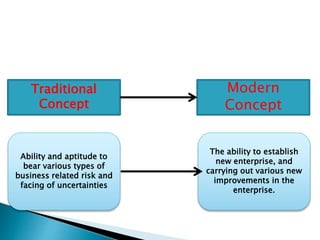
Traditional
Concept
Modern
Concept
Ability and aptitude to
bear various types of
business related risk and
facing of uncertainties
The ability to establish
new enterprise, and
carrying out various new
improvements in the
enterprise.
 Risk refers to the variability of outcomes (or
returns).
 Entrepreneurs are “risk-taker”- people who
don’t fear anything in business.
 Entrepreneurship involve taking of risks and
making the necessary investments under
conditions of uncertainty.
 Entrepreneurship is ability to connect and
coordinate the productive resources to
organize a venture and enterprise.
 It is bringing together the factors of
production and to organize them.
 Entrepreneur makes decisions about resource
allocations.
 Entrepreneurship is the process of bringing
together creative and innovative ideas and
actions with the management & leadership
skills to mobilize the appropriate people,
money and operating resources to create
wealth in the process.
 Entrepreneurs can translate their ideas into
action with management and leadership
skills.
 Innovation is the specific function of
entrepreneurship.
 It is the means by which the entrepreneur
either create new wealth- producing
resources or endows existing resources with
enhanced potential for creating wealth.
 Joseph Schumpeter revived the concept of
entrepreneurship as an innovative function.
 The person who are motivated with the need
for high achievement have a high level of
entrepreneurial activities.
 They have a desire to be successful in
competitive situations.
 Entrepreneurship is actively searching for
opportunities to do new things or to do
existing things in new ways for a profitable
business.
 Potential entrepreneurs are always looking for
unique opportunities to fill needs and wants.
 Entrepreneurs are economic agents who
transform demand into supply and they
transform resources into useful goods &
services, that lead to creation of wealth and
industrial growth.
 This is a modern concept of
entrepreneurship.
 The entrepreneur becomes the change agent
who transforms the resources into useful
goods and services, often creating the
circumstances that lead to industrial growth.
 This is also a modern concept.
 Through entrepreneurship, new products,
services, transactions, approaches, resources,
technologies and market are created that
contribute some value to a community or
marketplace.
 Value can be created- When resources are
transformed into output such as products &
services.
 Entrepreneurship education is a fast growing
area in Colleges & Universities.
 Most universities in the countries did
research on entrepreneurship, followed by
training courses.
 Due to fully developed subject, many
entrepreneurial schools have been opened.
 The definition of entrepreneurship may be
classified in-
 Establishment of new enterprises based
 Function based
 Combination based
 Decision making based
 Innovation based
 According to Prof. Musselman & Jackson,
“entrepreneurship is the inventing and risking of
time, money and effort to start a business.
 According to Prof. Udai Pareek And Manohar
Nadkarni, “Entrepreneurship refers to the general
trend of setting up new enterprises in a society.”
 These definitions not specified, which functions
and activities are to be performed for
establishing new enterprises for starting new
business and making them successful.
 According to Joseph A. Schumpeter,
“Entrepreneurship is an innovative function, it
is an leadership rather than an ownership.”
 It reveals various opportunities and abilities
like forecasting of economic opportunities
and ability to organize various sources and
techniques of production.
 Many scholars elaborate entrepreneurship as
the combination of functions and activities,
and organization.
 According to H. W. Johnson,
“Entrepreneurship is a composite of three
basic elements- inventions, innovation and
adaptions.
 According to Lamb, “ Entrepreneurship is that
form of social decision making performed by
economic innovations.”
 This definition focus on social responsibilities
and role of business.
 This definition does not lay emphasis on
doing innovations directly in the society.
 According to Prof. Rao and Mehta,
“Entrepreneurship can be described as creative and
innovative response to the environment.”
 Entrepreneurship is an activity of linking the
business with the society and environment.
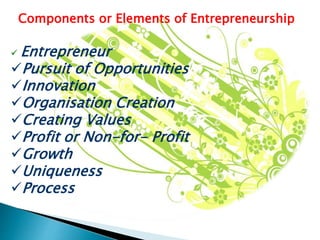
Components or Elements of Entrepreneurship
 Entrepreneur
Pursuit of Opportunities
Innovation
Organisation Creation
Creating Values
Profit or Non-for- Profit
Growth
Uniqueness
Process
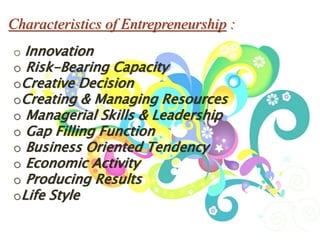
Characteristics of Entrepreneurship :
o Innovation
o Risk-Bearing Capacity
oCreative Decision
oCreating & Managing Resources
o Managerial Skills & Leadership
o Gap Filling Function
o Business Oriented Tendency
o Economic Activity
o Producing Results
oLife Style
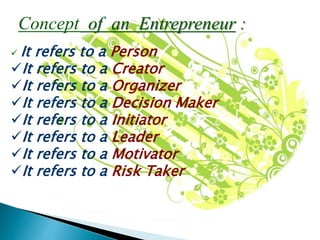
Concept of an Entrepreneur :
 It refers to a Person
It refers to a Creator
It refers to a Organizer
It refers to a Decision Maker
It refers to a Initiator
It refers to a Leader
It refers to a Motivator
It refers to a Risk Taker
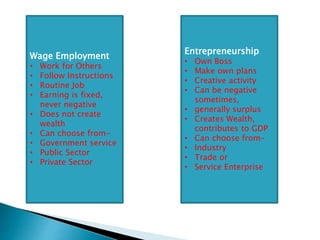
Wage Employment
• Work for Others
• Follow Instructions
• Routine Job
• Earning is fixed,
never negative
• Does not create
wealth
• Can choose from-
• Government service
• Public Sector
• Private Sector
Entrepreneurship
• Own Boss
• Make own plans
• Creative activity
• Can be negative
sometimes,
• generally surplus
• Creates Wealth,
contributes to GDP
• Can choose from-
• Industry
• Trade or
• Service Enterprise
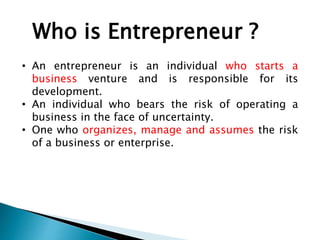
Who is Entrepreneur ?
• An entrepreneur is an individual who starts a
business venture and is responsible for its
development.
• An individual who bears the risk of operating a
business in the face of uncertainty.
• One who organizes, manage and assumes the risk
of a business or enterprise.
 Mental Ability – Entrepreneur must have creative thinking and
must be able to analyze problems and situations. He should be
able to anticipate changes.
 Business Secrecy – He should guard his business secrets from his
competitors.
 Clear Objectives – He must have clear objectives as to the exact
nature of business or the nature of goods to be produced.
 Human Relations – He must maintain good relation with his
customers, employees, etc. To maintain good relationship he
should have emotional stability, personal relations, tactfulness
and consideration.
 Communication Ability – He should have good communication
skills means both the sender and the receiver should understand
each others message.
 Technical Knowledge – He should have sufficient technical
knowledge.
Importance of Entrepreneurship:
 Reduces Poverty Level
 Increases Employment
 Fulfills the Demand of people
 Helps to develop Economic Condition of a country
o Lack of visible concept
o Lack of market knowledge
o Lack of technical skill
o Lack of seed capital
o Lack of business knowledge
o Lack of motivation
o Time pressure & distractions
o Legal constraints & regulations
o Monopoly & protectionism
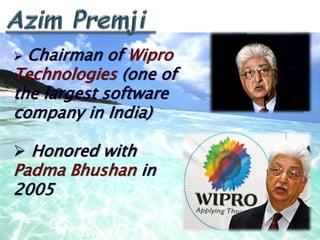
 Chairman of Wipro
Technologies (one of
the largest software
company in India)
 Honored with
Padma Bhushan in
2005
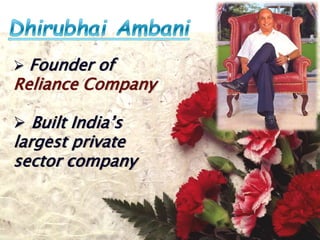
 Founder of
Reliance Company
 Built India’s
largest private
sector company
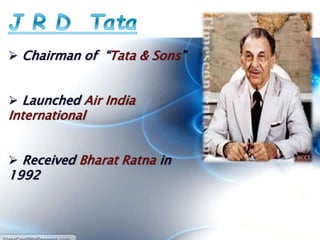
 Chairman of “Tata & Sons”
 Launched Air India
International
 Received Bharat Ratna in
1992
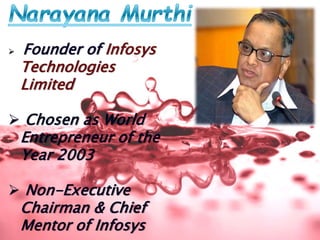
 Founder of Infosys
Technologies
Limited
 Chosen as World
Entrepreneur of the
Year 2003
 Non-Executive
Chairman & Chief
Mentor of Infosys
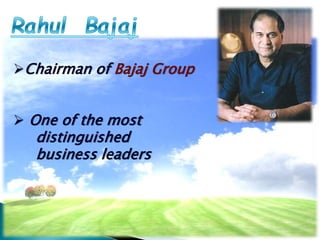
Chairman of Bajaj Group
 One of the most
distinguished
business leaders
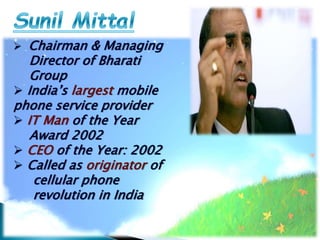
 Chairman & Managing
Director of Bharati
Group
 India’s largest mobile
phone service provider
 IT Man of the Year
Award 2002
 CEO of the Year: 2002
 Called as originator of
cellular phone
revolution in India
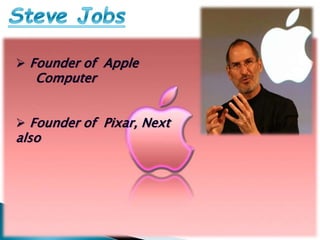
 Founder of Apple
Computer
 Founder of Pixar, Next
also
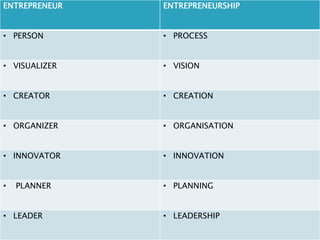
ENTREPRENEUR ENTREPRENEURSHIP
• PERSON • PROCESS
• VISUALIZER • VISION
• CREATOR • CREATION
• ORGANIZER • ORGANISATION
• INNOVATOR • INNOVATION
• PLANNER • PLANNING
• LEADER • LEADERSHIP
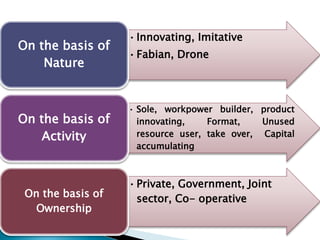
TYPES of
ENTREPRENEURSHIP
•Innovating, Imitative
•Fabian, Drone
On the basis of
Nature
• Sole, workpower builder, product
innovating, Format, Unused
resource user, take over, Capital
accumulating
On the basis of
Activity
•Private, Government, Joint
sector, Co- operativeOn the basis of
Ownership
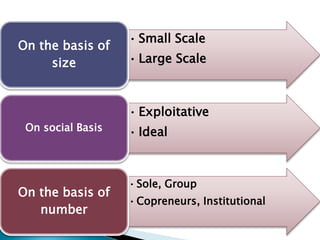
• Small Scale
• Large Scale
On the basis of
size
• Exploitative
• IdealOn social Basis
•Sole, Group
•Copreneurs, Institutional
On the basis of
number
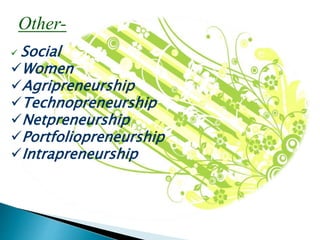
Other-
 Social
Women
Agripreneurship
Technopreneurship
Netpreneurship
Portfoliopreneurship
Intrapreneurship
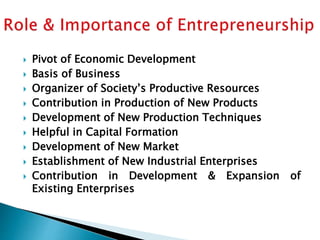
 Pivot of Economic Development
 Basis of Business
 Organizer of Society’s Productive Resources
 Contribution in Production of New Products
 Development of New Production Techniques
 Helpful in Capital Formation
 Development of New Market
 Establishment of New Industrial Enterprises
 Contribution in Development & Expansion of
Existing Enterprises
 Help in bringing changes in Social Framework
 Contribution in the formation of Industrial Climate
 Contribution to generate Employment
Opportunities
 Contribution to raise the Standard of Living
 Help in removing Regional Disparities
 Encouragement to Investigation & Research
Entrepreneurship

Entrepreneurship

  • 1.
  • 2.
     The wordentrepreneurship originates from the French word entrependre, which means “to undertake”.  Entrepreneurship is the key to innovation, productivity and effective competition.  When a person realizes his ability or capacity and makes its practical use and establishes new business unit this activity is known as entrepreneurship.
  • 3.
    Concept of Entrepreneurship: Entrepreneurship is an innovative function. It is a leadership rather than an ownership. The process of innovation may be in the form of  Introduction of a New Product  Use of a New Method of production  Opening of a New Market  The conquest of New Source of supplying Raw Materials - Joseph A. Schumpeter.
  • 4.
    Traditional Concept Modern Concept Ability and aptitudeto bear various types of business related risk and facing of uncertainties The ability to establish new enterprise, and carrying out various new improvements in the enterprise.
  • 5.
     Risk refersto the variability of outcomes (or returns).  Entrepreneurs are “risk-taker”- people who don’t fear anything in business.  Entrepreneurship involve taking of risks and making the necessary investments under conditions of uncertainty.
  • 6.
     Entrepreneurship isability to connect and coordinate the productive resources to organize a venture and enterprise.  It is bringing together the factors of production and to organize them.  Entrepreneur makes decisions about resource allocations.
  • 7.
     Entrepreneurship isthe process of bringing together creative and innovative ideas and actions with the management & leadership skills to mobilize the appropriate people, money and operating resources to create wealth in the process.  Entrepreneurs can translate their ideas into action with management and leadership skills.
  • 8.
     Innovation isthe specific function of entrepreneurship.  It is the means by which the entrepreneur either create new wealth- producing resources or endows existing resources with enhanced potential for creating wealth.  Joseph Schumpeter revived the concept of entrepreneurship as an innovative function.
  • 9.
     The personwho are motivated with the need for high achievement have a high level of entrepreneurial activities.  They have a desire to be successful in competitive situations.
  • 10.
     Entrepreneurship isactively searching for opportunities to do new things or to do existing things in new ways for a profitable business.  Potential entrepreneurs are always looking for unique opportunities to fill needs and wants.
  • 11.
     Entrepreneurs areeconomic agents who transform demand into supply and they transform resources into useful goods & services, that lead to creation of wealth and industrial growth.
  • 12.
     This isa modern concept of entrepreneurship.  The entrepreneur becomes the change agent who transforms the resources into useful goods and services, often creating the circumstances that lead to industrial growth.
  • 13.
     This isalso a modern concept.  Through entrepreneurship, new products, services, transactions, approaches, resources, technologies and market are created that contribute some value to a community or marketplace.  Value can be created- When resources are transformed into output such as products & services.
  • 14.
     Entrepreneurship educationis a fast growing area in Colleges & Universities.  Most universities in the countries did research on entrepreneurship, followed by training courses.  Due to fully developed subject, many entrepreneurial schools have been opened.
  • 15.
     The definitionof entrepreneurship may be classified in-  Establishment of new enterprises based  Function based  Combination based  Decision making based  Innovation based
  • 16.
     According toProf. Musselman & Jackson, “entrepreneurship is the inventing and risking of time, money and effort to start a business.  According to Prof. Udai Pareek And Manohar Nadkarni, “Entrepreneurship refers to the general trend of setting up new enterprises in a society.”  These definitions not specified, which functions and activities are to be performed for establishing new enterprises for starting new business and making them successful.
  • 17.
     According toJoseph A. Schumpeter, “Entrepreneurship is an innovative function, it is an leadership rather than an ownership.”  It reveals various opportunities and abilities like forecasting of economic opportunities and ability to organize various sources and techniques of production.
  • 18.
     Many scholarselaborate entrepreneurship as the combination of functions and activities, and organization.  According to H. W. Johnson, “Entrepreneurship is a composite of three basic elements- inventions, innovation and adaptions.
  • 19.
     According toLamb, “ Entrepreneurship is that form of social decision making performed by economic innovations.”  This definition focus on social responsibilities and role of business.  This definition does not lay emphasis on doing innovations directly in the society.
  • 20.
     According toProf. Rao and Mehta, “Entrepreneurship can be described as creative and innovative response to the environment.”  Entrepreneurship is an activity of linking the business with the society and environment.
  • 21.
    Components or Elementsof Entrepreneurship  Entrepreneur Pursuit of Opportunities Innovation Organisation Creation Creating Values Profit or Non-for- Profit Growth Uniqueness Process
  • 22.
    Characteristics of Entrepreneurship: o Innovation o Risk-Bearing Capacity oCreative Decision oCreating & Managing Resources o Managerial Skills & Leadership o Gap Filling Function o Business Oriented Tendency o Economic Activity o Producing Results oLife Style
  • 23.
    Concept of anEntrepreneur :  It refers to a Person It refers to a Creator It refers to a Organizer It refers to a Decision Maker It refers to a Initiator It refers to a Leader It refers to a Motivator It refers to a Risk Taker
  • 24.
    Wage Employment • Workfor Others • Follow Instructions • Routine Job • Earning is fixed, never negative • Does not create wealth • Can choose from- • Government service • Public Sector • Private Sector Entrepreneurship • Own Boss • Make own plans • Creative activity • Can be negative sometimes, • generally surplus • Creates Wealth, contributes to GDP • Can choose from- • Industry • Trade or • Service Enterprise
  • 25.
    Who is Entrepreneur? • An entrepreneur is an individual who starts a business venture and is responsible for its development. • An individual who bears the risk of operating a business in the face of uncertainty. • One who organizes, manage and assumes the risk of a business or enterprise.
  • 26.
     Mental Ability– Entrepreneur must have creative thinking and must be able to analyze problems and situations. He should be able to anticipate changes.  Business Secrecy – He should guard his business secrets from his competitors.  Clear Objectives – He must have clear objectives as to the exact nature of business or the nature of goods to be produced.  Human Relations – He must maintain good relation with his customers, employees, etc. To maintain good relationship he should have emotional stability, personal relations, tactfulness and consideration.  Communication Ability – He should have good communication skills means both the sender and the receiver should understand each others message.  Technical Knowledge – He should have sufficient technical knowledge.
  • 27.
    Importance of Entrepreneurship: Reduces Poverty Level  Increases Employment  Fulfills the Demand of people  Helps to develop Economic Condition of a country
  • 28.
    o Lack ofvisible concept o Lack of market knowledge o Lack of technical skill o Lack of seed capital o Lack of business knowledge o Lack of motivation o Time pressure & distractions o Legal constraints & regulations o Monopoly & protectionism
  • 30.
     Chairman ofWipro Technologies (one of the largest software company in India)  Honored with Padma Bhushan in 2005
  • 31.
     Founder of RelianceCompany  Built India’s largest private sector company
  • 32.
     Chairman of“Tata & Sons”  Launched Air India International  Received Bharat Ratna in 1992
  • 33.
     Founder ofInfosys Technologies Limited  Chosen as World Entrepreneur of the Year 2003  Non-Executive Chairman & Chief Mentor of Infosys
  • 34.
    Chairman of BajajGroup  One of the most distinguished business leaders
  • 35.
     Chairman &Managing Director of Bharati Group  India’s largest mobile phone service provider  IT Man of the Year Award 2002  CEO of the Year: 2002  Called as originator of cellular phone revolution in India
  • 36.
     Founder ofApple Computer  Founder of Pixar, Next also
  • 38.
    ENTREPRENEUR ENTREPRENEURSHIP • PERSON• PROCESS • VISUALIZER • VISION • CREATOR • CREATION • ORGANIZER • ORGANISATION • INNOVATOR • INNOVATION • PLANNER • PLANNING • LEADER • LEADERSHIP
  • 39.
  • 40.
    •Innovating, Imitative •Fabian, Drone Onthe basis of Nature • Sole, workpower builder, product innovating, Format, Unused resource user, take over, Capital accumulating On the basis of Activity •Private, Government, Joint sector, Co- operativeOn the basis of Ownership
  • 41.
    • Small Scale •Large Scale On the basis of size • Exploitative • IdealOn social Basis •Sole, Group •Copreneurs, Institutional On the basis of number
  • 42.
  • 43.
     Pivot ofEconomic Development  Basis of Business  Organizer of Society’s Productive Resources  Contribution in Production of New Products  Development of New Production Techniques  Helpful in Capital Formation  Development of New Market  Establishment of New Industrial Enterprises  Contribution in Development & Expansion of Existing Enterprises
  • 44.
     Help inbringing changes in Social Framework  Contribution in the formation of Industrial Climate  Contribution to generate Employment Opportunities  Contribution to raise the Standard of Living  Help in removing Regional Disparities  Encouragement to Investigation & Research