GRAPHING RATIONAL FUNCTIONS
INTERVENTION MATERIAL
IN
GENERAL MATHEMATICS
FIRST SEMESTER
SY 2016-2017
Prepared by:
KRISTEL ANN G. ALDAY
Teacher III
GRAPHING RATIONAL FUNCTIONS
Warm Up
Graph the function
𝑓 𝑥 = − 𝑥 + 3 2
+ 4
GRAPHING RATIONAL FUNCTIONS
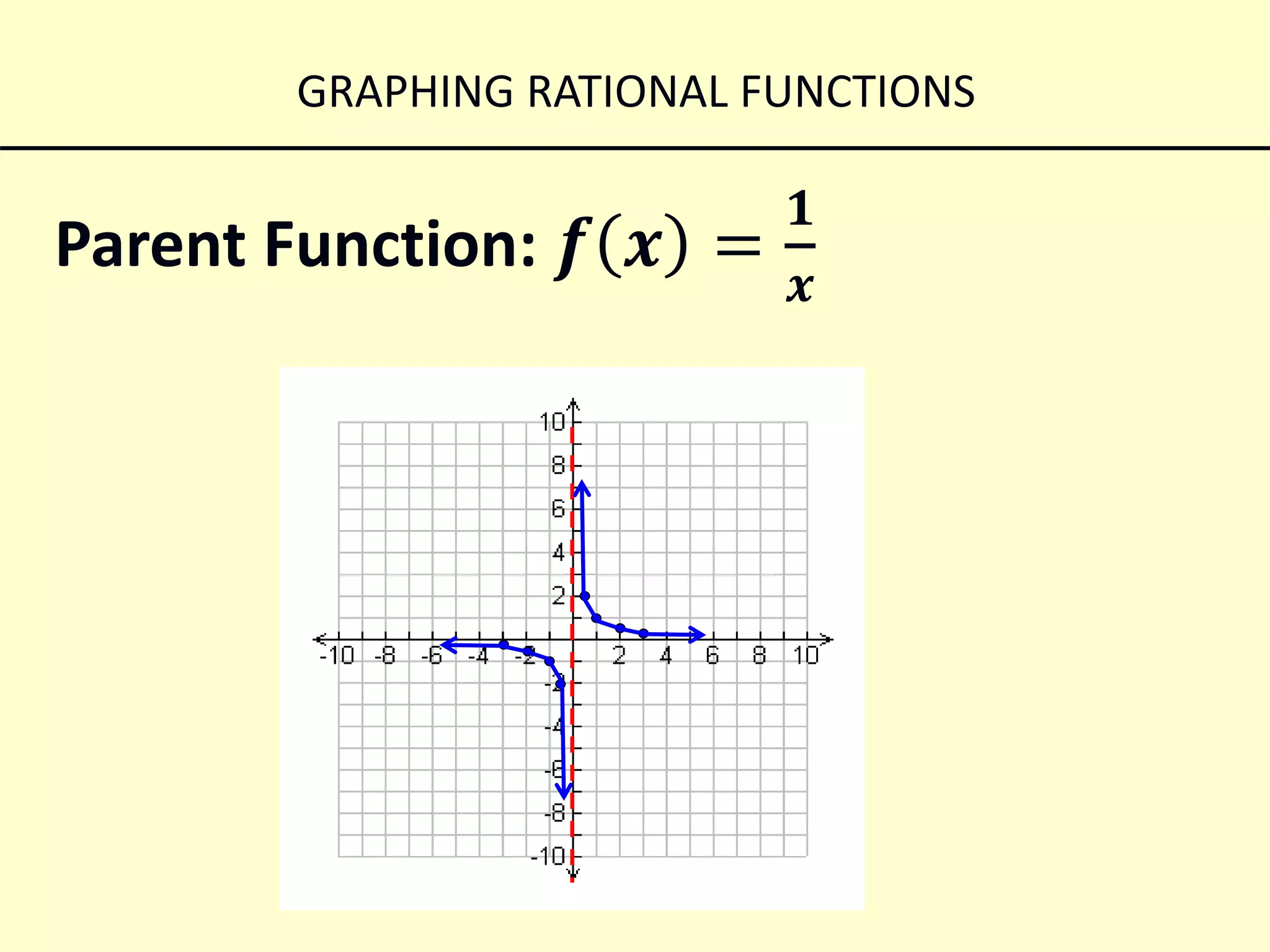
Parent Function: 𝒇 𝒙 =
𝟏
𝒙
GRAPHING RATIONAL FUNCTIONS
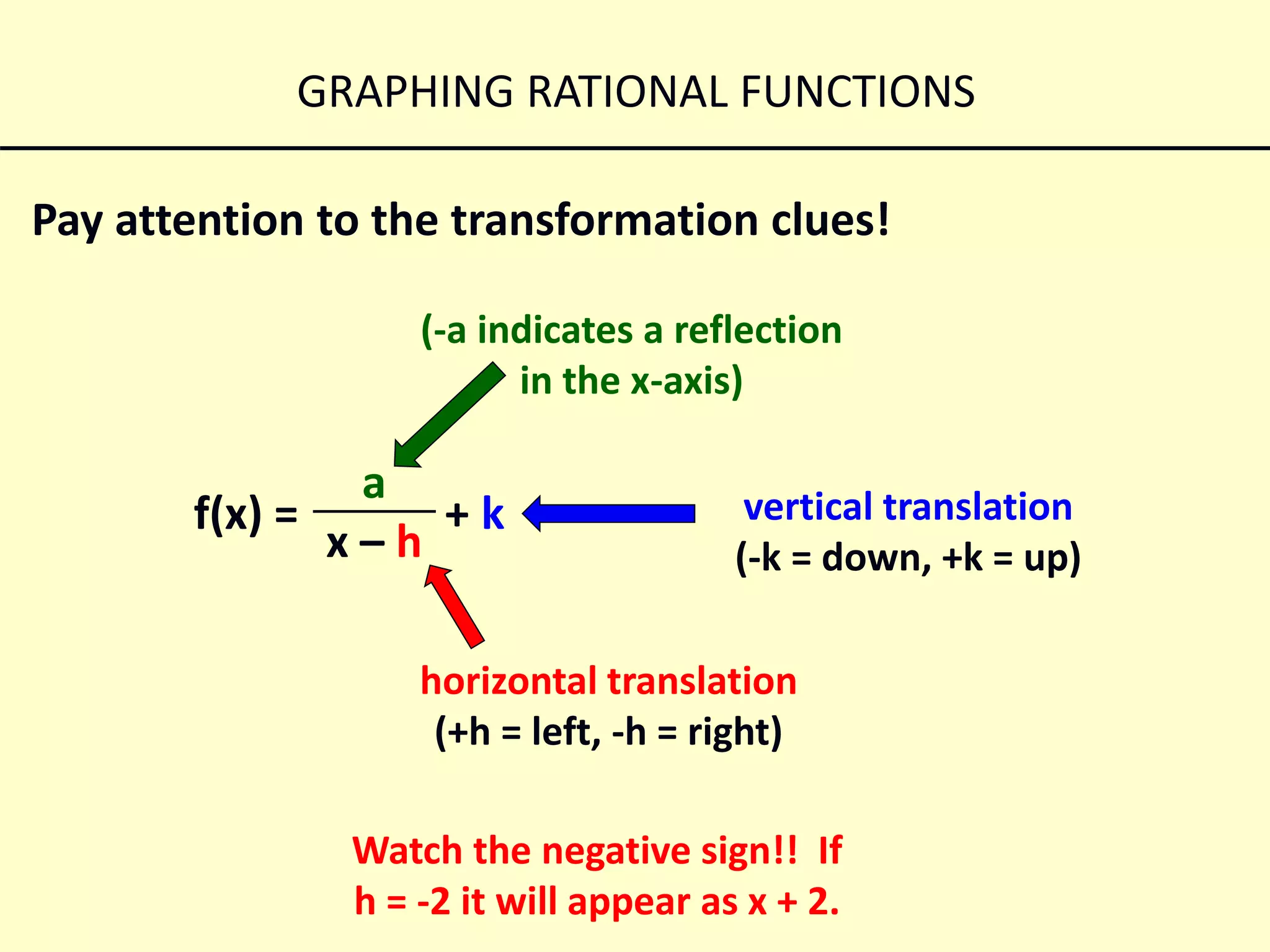
f(x) = + k
a
x – h
(-a indicates a reflection
in the x-axis)
vertical translation
(-k = down, +k = up)
horizontal translation
(+h = left, -h = right)
Pay attention to the transformation clues!
Watch the negative sign!! If
h = -2 it will appear as x + 2.
GRAPHING RATIONAL FUNCTIONS
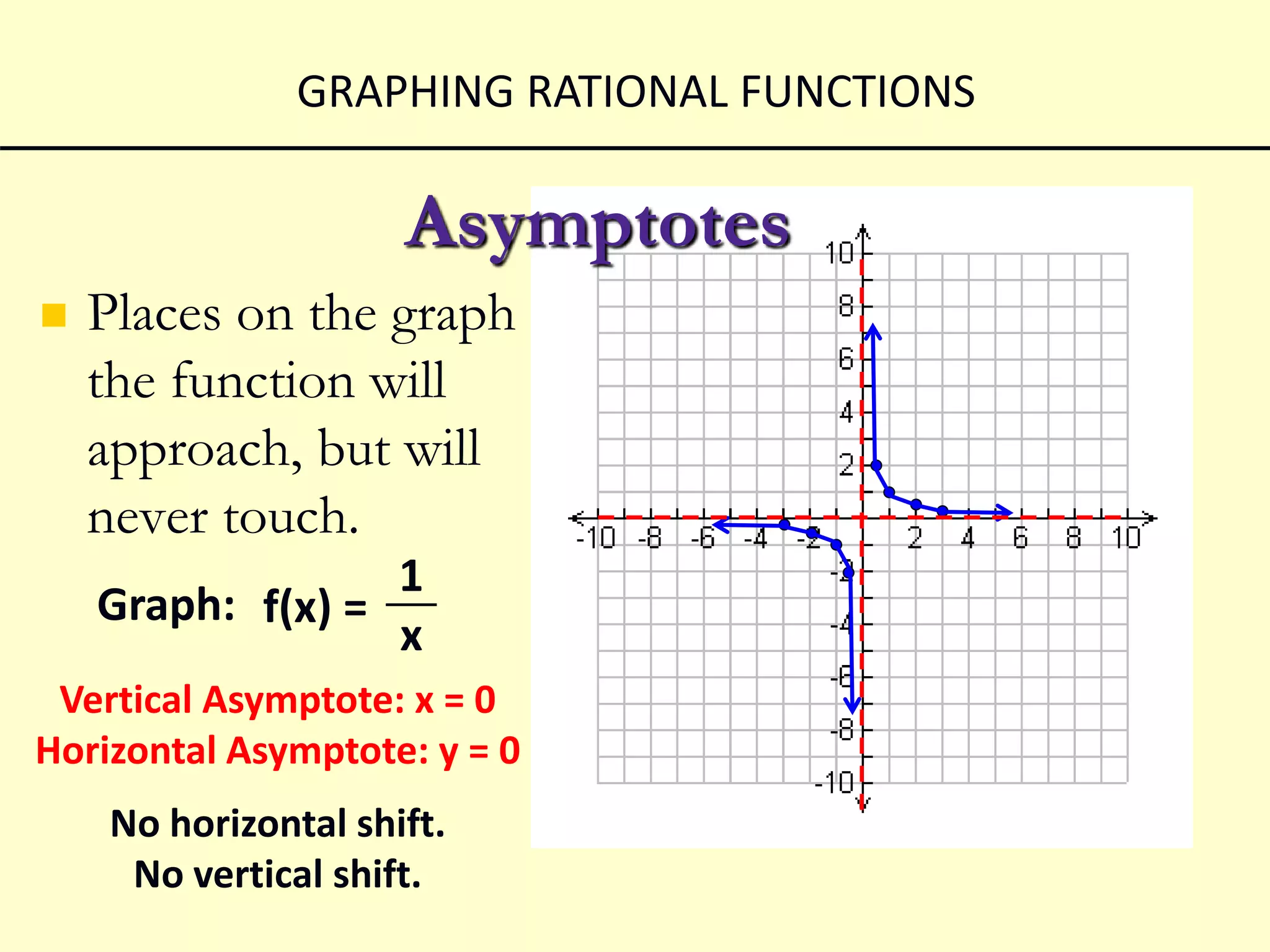
Vertical Asymptote: x = 0
Horizontal Asymptote: y = 0
f(x) =
1
x
Graph:
No horizontal shift.
No vertical shift.
Asymptotes
 Places on the graph
the function will
approach, but will
never touch.
GRAPHING RATIONAL FUNCTIONS
W𝐡𝐚𝐭 𝐝𝐨𝐞𝐬 𝒇 𝒙 = −
𝟏
𝒙
look like?
GRAPHING RATIONAL FUNCTIONS
Graph: f(x) =
1
x + 4
Vertical Asymptote: x = -4
x + 4 indicates a
shift 4 units left
Horizontal Asymptote: y = 0
No vertical shift
GRAPHING RATIONAL FUNCTIONS
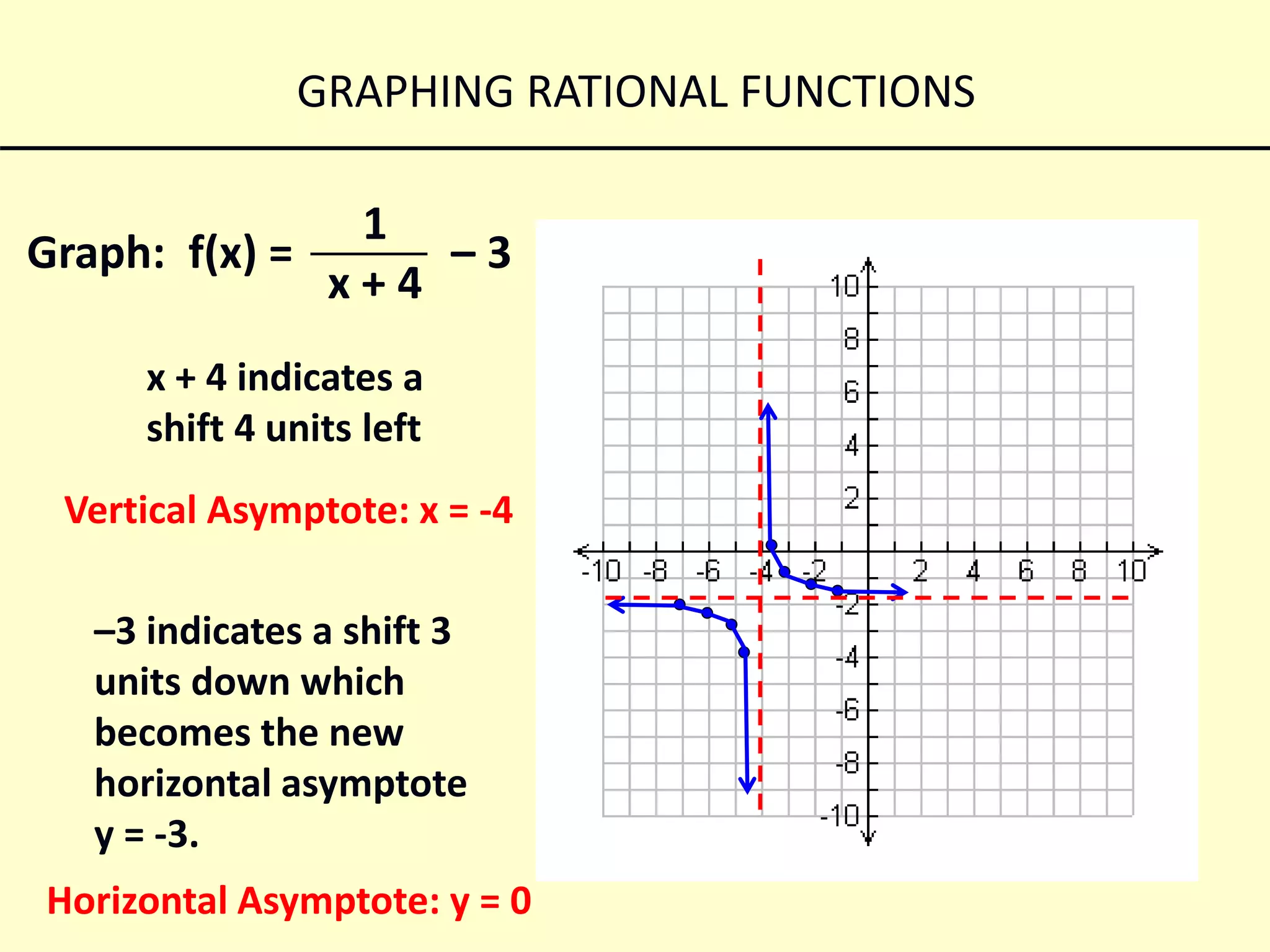
Graph: f(x) = – 3
1
x + 4
x + 4 indicates a
shift 4 units left
–3 indicates a shift 3
units down which
becomes the new
horizontal asymptote
y = -3.
Vertical Asymptote: x = -4
Horizontal Asymptote: y = 0
GRAPHING RATIONAL FUNCTIONS
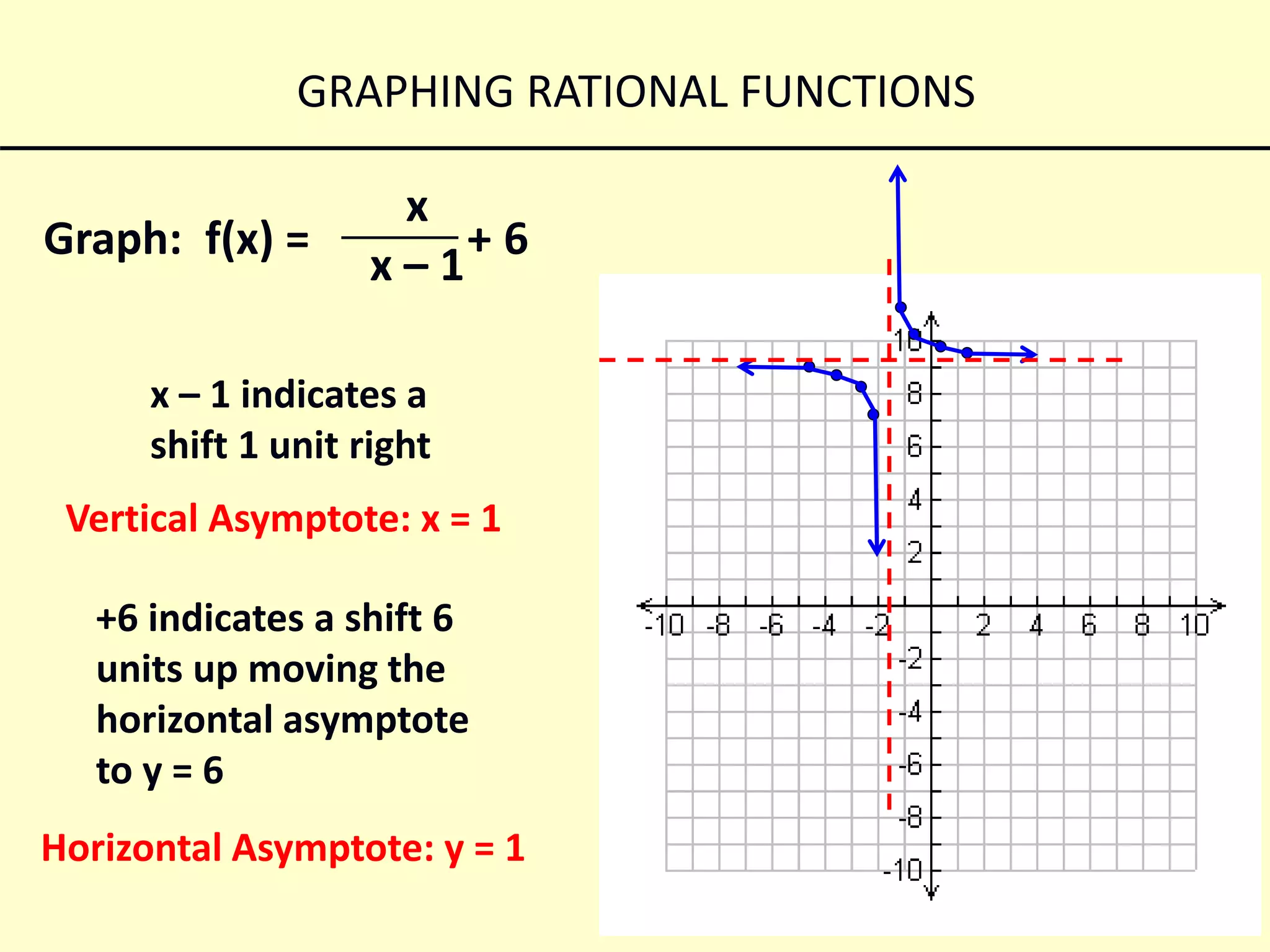
Graph: f(x) = + 6
x
x – 1
x – 1 indicates a
shift 1 unit right
+6 indicates a shift 6
units up moving the
horizontal asymptote
to y = 6
Vertical Asymptote: x = 1
Horizontal Asymptote: y = 1
GRAPHING RATIONAL FUNCTIONS
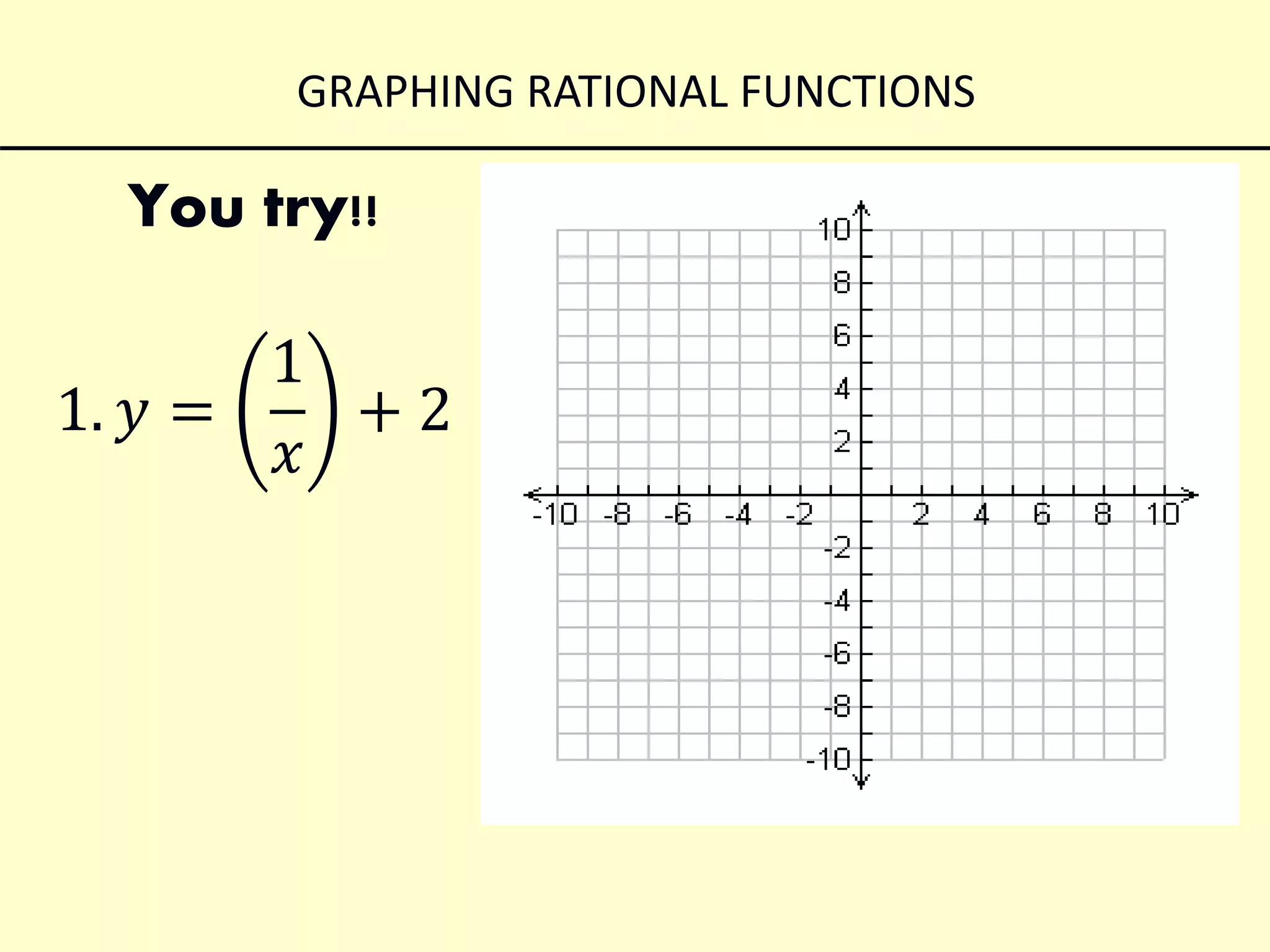
You try!!
1. 𝑦 =
1
𝑥
+ 2
GRAPHING RATIONAL FUNCTIONS
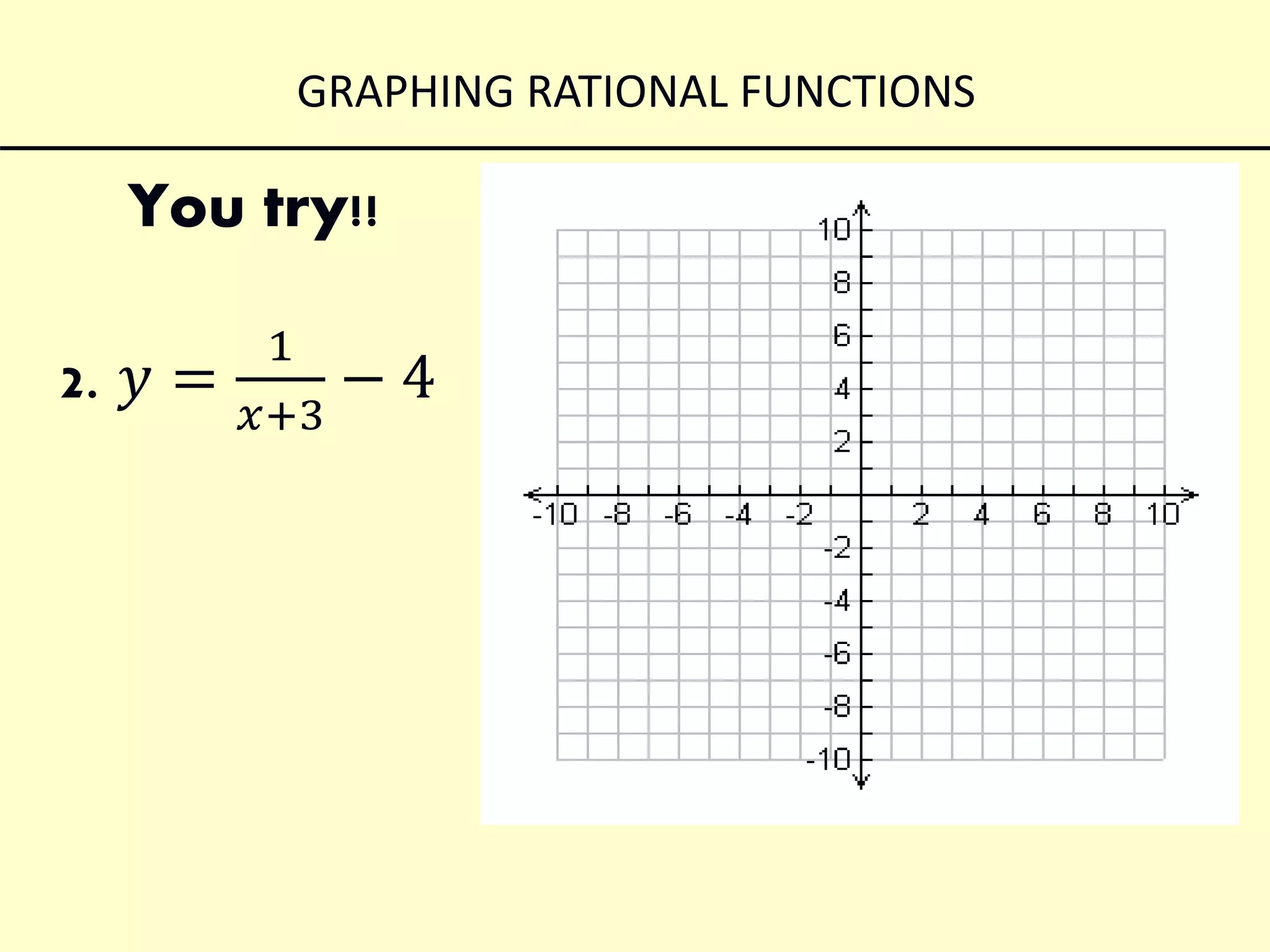
You try!!
2. 𝑦 =
1
𝑥+3
− 4
GRAPHING RATIONAL FUNCTIONS
How do we find asymptotes
based on an equation only?
GRAPHING RATIONAL FUNCTIONS
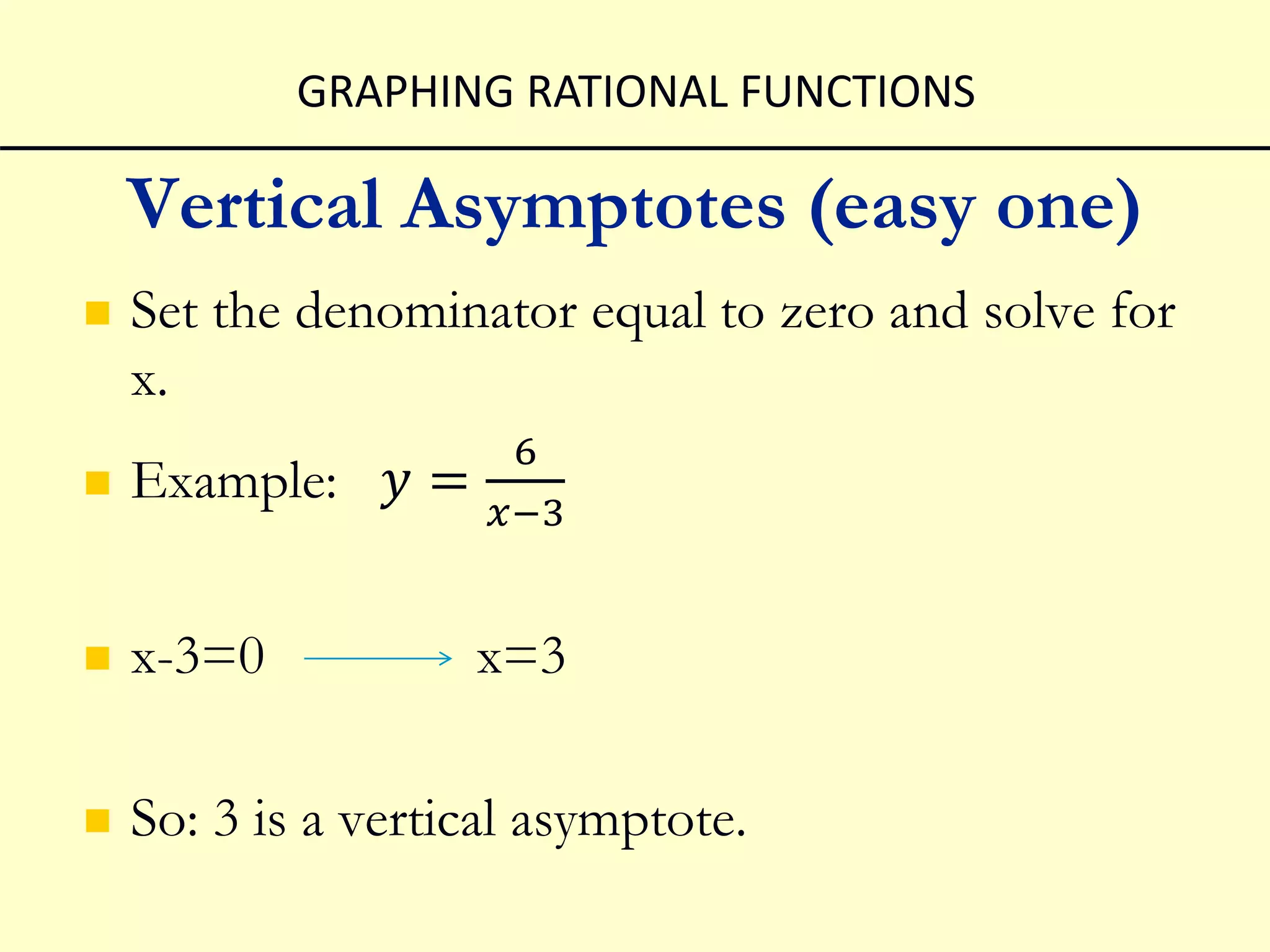
Vertical Asymptotes (easy one)
 Set the denominator equal to zero and solve for
x.
 Example: 𝑦 =
6
𝑥−3
 x-3=0 x=3
 So: 3 is a vertical asymptote.
GRAPHING RATIONAL FUNCTIONS
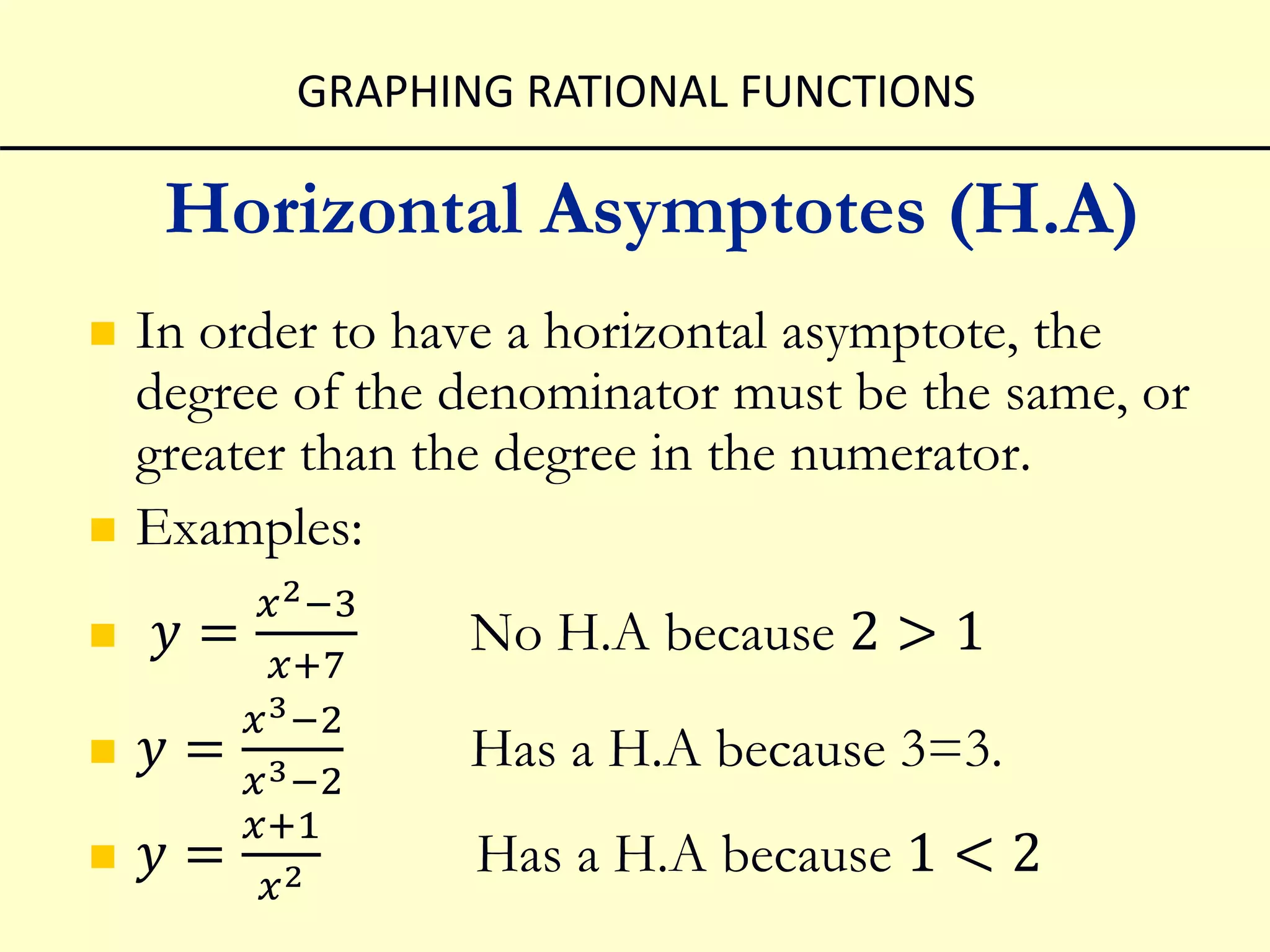
Horizontal Asymptotes (H.A)
 In order to have a horizontal asymptote, the
degree of the denominator must be the same, or
greater than the degree in the numerator.
 Examples:
 𝑦 =
𝑥2−3
𝑥+7
No H.A because 2 > 1
 𝑦 =
𝑥3−2
𝑥3−2
Has a H.A because 3=3.
 𝑦 =
𝑥+1
𝑥2 Has a H.A because 1 < 2
GRAPHING RATIONAL FUNCTIONS
3 cases
to consider in determining
Horizontal Asymptote of the
graph of a Rational Function
GRAPHING RATIONAL FUNCTIONS
If the degree of the denominator
is GREATER than the
numerator.
 The Asymptote is y=0 ( the x-axis)
GRAPHING RATIONAL FUNCTIONS
If the degree of the denominator
and numerator are the same:
 Divide the leading coefficient of the numerator
by the leading coefficient of the denominator in
order to find the horizontal asymptote.
 Example: 𝑦 =
6𝑥3
3𝑥3−2
 Asymptote is 6/3 =2.
GRAPHING RATIONAL FUNCTIONS
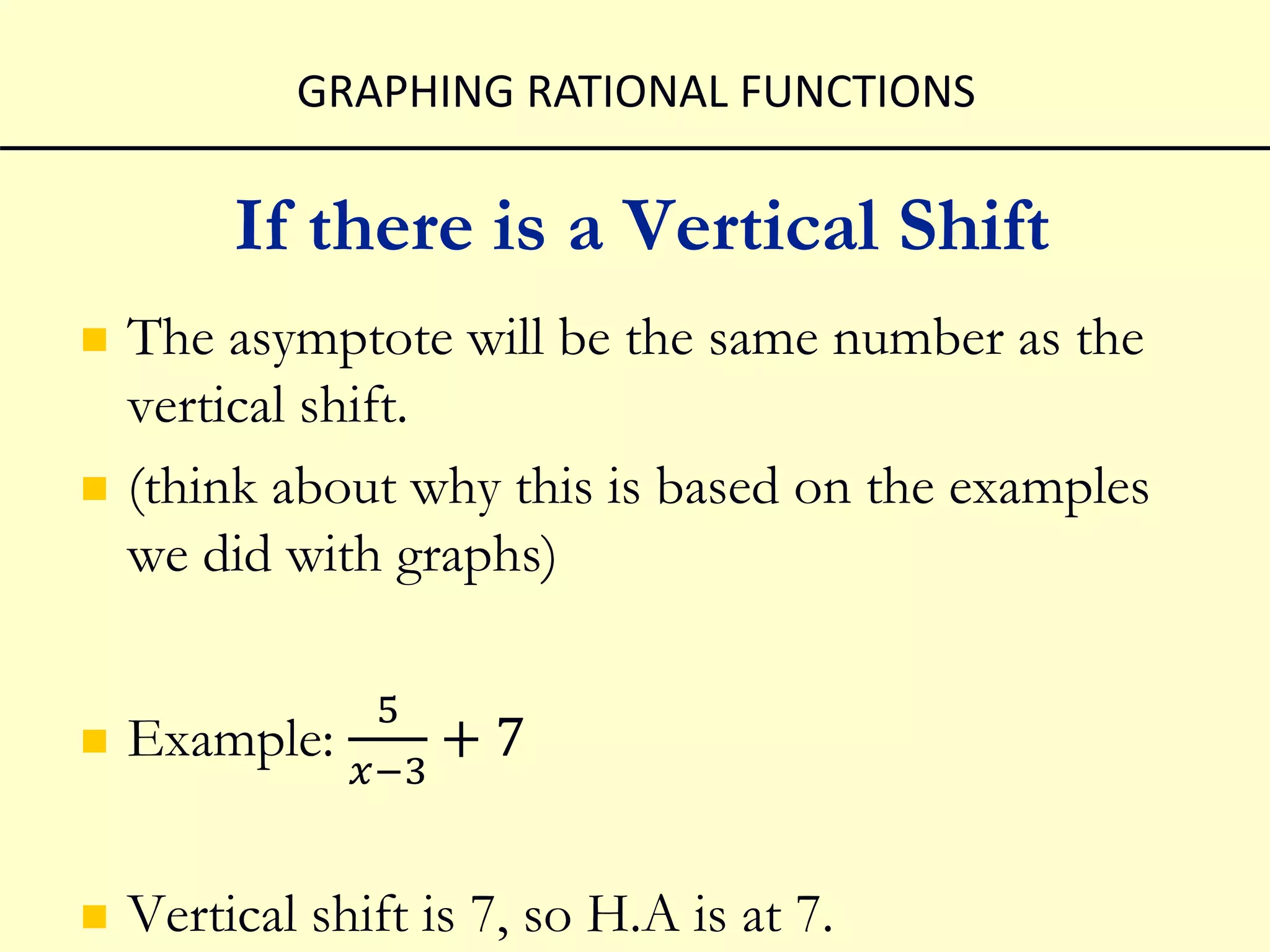
If there is a Vertical Shift
 The asymptote will be the same number as the
vertical shift.
 (think about why this is based on the examples
we did with graphs)
 Example:
5
𝑥−3
+ 7
 Vertical shift is 7, so H.A is at 7.

Graphing rational functions

  • 1.
    GRAPHING RATIONAL FUNCTIONS INTERVENTIONMATERIAL IN GENERAL MATHEMATICS FIRST SEMESTER SY 2016-2017 Prepared by: KRISTEL ANN G. ALDAY Teacher III
  • 2.
    GRAPHING RATIONAL FUNCTIONS WarmUp Graph the function 𝑓 𝑥 = − 𝑥 + 3 2 + 4
  • 3.
    GRAPHING RATIONAL FUNCTIONS ParentFunction: 𝒇 𝒙 = 𝟏 𝒙
  • 4.
    GRAPHING RATIONAL FUNCTIONS f(x)= + k a x – h (-a indicates a reflection in the x-axis) vertical translation (-k = down, +k = up) horizontal translation (+h = left, -h = right) Pay attention to the transformation clues! Watch the negative sign!! If h = -2 it will appear as x + 2.
  • 5.
    GRAPHING RATIONAL FUNCTIONS VerticalAsymptote: x = 0 Horizontal Asymptote: y = 0 f(x) = 1 x Graph: No horizontal shift. No vertical shift. Asymptotes  Places on the graph the function will approach, but will never touch.
  • 6.
    GRAPHING RATIONAL FUNCTIONS W𝐡𝐚𝐭𝐝𝐨𝐞𝐬 𝒇 𝒙 = − 𝟏 𝒙 look like?
  • 7.
    GRAPHING RATIONAL FUNCTIONS Graph:f(x) = 1 x + 4 Vertical Asymptote: x = -4 x + 4 indicates a shift 4 units left Horizontal Asymptote: y = 0 No vertical shift
  • 8.
    GRAPHING RATIONAL FUNCTIONS Graph:f(x) = – 3 1 x + 4 x + 4 indicates a shift 4 units left –3 indicates a shift 3 units down which becomes the new horizontal asymptote y = -3. Vertical Asymptote: x = -4 Horizontal Asymptote: y = 0
  • 9.
    GRAPHING RATIONAL FUNCTIONS Graph:f(x) = + 6 x x – 1 x – 1 indicates a shift 1 unit right +6 indicates a shift 6 units up moving the horizontal asymptote to y = 6 Vertical Asymptote: x = 1 Horizontal Asymptote: y = 1
  • 10.
    GRAPHING RATIONAL FUNCTIONS Youtry!! 1. 𝑦 = 1 𝑥 + 2
  • 11.
    GRAPHING RATIONAL FUNCTIONS Youtry!! 2. 𝑦 = 1 𝑥+3 − 4
  • 12.
    GRAPHING RATIONAL FUNCTIONS Howdo we find asymptotes based on an equation only?
  • 13.
    GRAPHING RATIONAL FUNCTIONS VerticalAsymptotes (easy one)  Set the denominator equal to zero and solve for x.  Example: 𝑦 = 6 𝑥−3  x-3=0 x=3  So: 3 is a vertical asymptote.
  • 14.
    GRAPHING RATIONAL FUNCTIONS HorizontalAsymptotes (H.A)  In order to have a horizontal asymptote, the degree of the denominator must be the same, or greater than the degree in the numerator.  Examples:  𝑦 = 𝑥2−3 𝑥+7 No H.A because 2 > 1  𝑦 = 𝑥3−2 𝑥3−2 Has a H.A because 3=3.  𝑦 = 𝑥+1 𝑥2 Has a H.A because 1 < 2
  • 15.
    GRAPHING RATIONAL FUNCTIONS 3cases to consider in determining Horizontal Asymptote of the graph of a Rational Function
  • 16.
    GRAPHING RATIONAL FUNCTIONS Ifthe degree of the denominator is GREATER than the numerator.  The Asymptote is y=0 ( the x-axis)
  • 17.
    GRAPHING RATIONAL FUNCTIONS Ifthe degree of the denominator and numerator are the same:  Divide the leading coefficient of the numerator by the leading coefficient of the denominator in order to find the horizontal asymptote.  Example: 𝑦 = 6𝑥3 3𝑥3−2  Asymptote is 6/3 =2.
  • 18.
    GRAPHING RATIONAL FUNCTIONS Ifthere is a Vertical Shift  The asymptote will be the same number as the vertical shift.  (think about why this is based on the examples we did with graphs)  Example: 5 𝑥−3 + 7  Vertical shift is 7, so H.A is at 7.