RATIONAL FUNCTIONS AND
THEIR GRAPHS
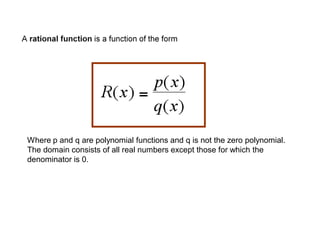
Where p and q are polynomial functions and q is not the zero polynomial.
The domain consists of all real numbers except those for which the
denominator is 0.
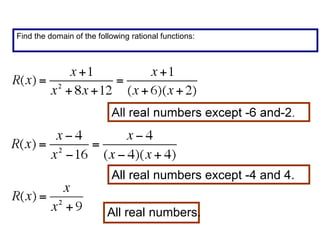
Find the domain of the following rational functions:
All real numbers except -4 and 4.
All real numbers.
Finding Asymptotes
VERTICAL
ASYMPTOTES
( )
4
3
5
2
2
2
−
−
+
+
=
x
x
x
x
x
R
Let’s set the bottom = 0 and
factor and solve to find where
the vertical asymptote(s) should
be.
( )( ) 0
1
4 =
+
− x
x
So there are vertical
asymptotes at x = 4 and x = -1.
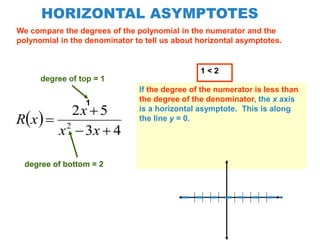
If the degree of the numerator is less than
the degree of the denominator, the x axis
is a horizontal asymptote. This is along
the line y = 0.
We compare the degrees of the polynomial in the numerator and the
polynomial in the denominator to tell us about horizontal asymptotes.
( )
4
3
5
2
2
+
−
+
=
x
x
x
x
R
degree of bottom = 2
HORIZONTAL ASYMPTOTES
1
1 < 2
degree of bottom = 2
HORIZONTAL ASYMPTOTES
degree of top = 2
The leading coefficient is the
number in front of the highest
powered x term.
1
2
=
( )
4
3
5
4
2
2
2
+
−
+
+
=
x
x
x
x
x
R
1
2
=
y
( )
4
3
5
3
2
2
2
3
+
−
+
−
+
=
x
x
x
x
x
x
R
If the degree of the numerator is greater
than the degree of the denominator, then
there is not a horizontal asymptote, but an
oblique one. The equation is found by
doing long division and the quotient is the
equation of the oblique asymptote ignoring
the remainder.
OBLIQUE ASYMPTOTES - Slanted
degree of top = 3
5
3
2 2
3
+
−
+ x
x
x
4
3
2
−
− x
x
remainder
a
5+
+
x
Oblique asymptote at y = x
+ 5
SUMMARY OF HOW TO FIND ASYMPTOTES
To determine horizontal or oblique asymptotes, compare the degrees of the
numerator and denominator.
1. If the degree of the top < the bottom, horizontal asymptote along the x
axis (y = 0)
2. If the degree of the top = bottom, horizontal asymptote at y = leading
coefficient of top over leading coefficient of bottom
3. If the degree of the top > the bottom, oblique asymptote found by long
division.
STRATEGY FOR GRAPHING A RATIONAL FUNCTION
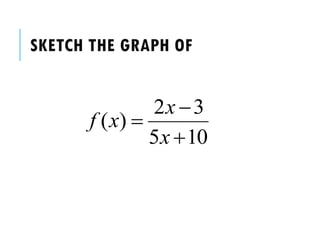
SKETCH THE GRAPH OF
10
5
3
2
)
(
+
−
=
x
x
x
f
10
5
3
2
)
(
+
−
=
x
x
x
f
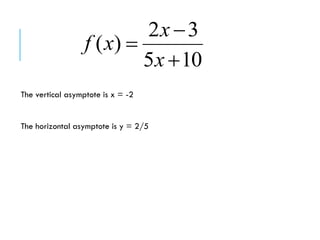
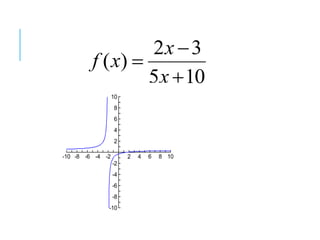
The vertical asymptote is x = -2
The horizontal asymptote is y = 2/5
10
5
3
2
)
(
+
−
=
x
x
x
f
-10 -8 -6 -4 -2 2 4 6 8 10
-10
-8
-6
-4
-2
2
4
6
8
10
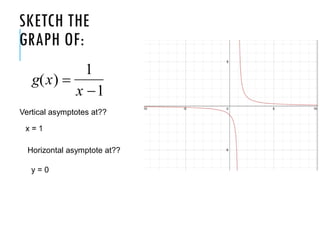
SKETCH THE
GRAPH OF:
g(x) =
1
x −1
Vertical asymptotes at??
Horizontal asymptote at??
y = 0
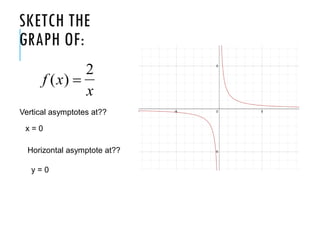
f (x) =
2
x
Vertical asymptotes at??
x = 0
Horizontal asymptote at??
y = 0
h(x) =
−4
x
Vertical asymptotes at??
x = 0
y = 0
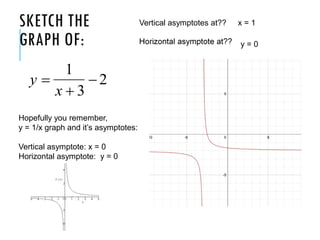
SKETCH THE
GRAPH OF:
y =
1
x + 3
−2
Vertical asymptotes at?? x = 1
y = 0
Hopefully you remember,
y = 1/x graph and it’s asymptotes:
Vertical asymptote: x = 0
Horizontal asymptote: y = 0
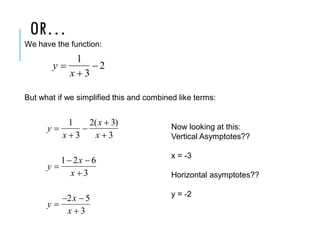
We have the function:

y =
1
x + 3
−2
But what if we simplified this and combined like terms:
y =
1
x + 3
−
2(x + 3)
x + 3
y =
1− 2x − 6
x + 3
y =
−2x − 5
x + 3
Now looking at this:
Vertical Asymptotes??
x = -3
Horizontal asymptotes??
y = -2
SKETCH THE
GRAPH OF:
h(x) =
x2
+ 3x
x
x = 0
h(x) =
x(x + 3)
x
FIND THE ASYMPTOTES OF EACH
FUNCTION:
y =
x2
+ 3x − 4
x

y =
x2
+ 3x −28
x3
−11x2
+28x

y =
x2
x
+
3x
x
−
4
x

y = x + 3−
4
x
Vertical Asymptote:
x = 0
y =
(x + 7)(x − 4)
x(x − 7)(x − 4)
Hole at x = 4
Vertical Asymptote:
x = 0 and x = 7
Horizontal Asymptote:
y = 0
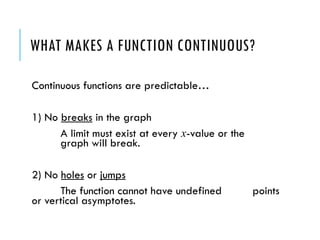
WHAT MAKES A FUNCTION CONTINUOUS?
Continuous functions are predictable…
1) No breaks in the graph
A limit must exist at every x-value or the
graph will break.
2) No holes or jumps
The function cannot have undefined points
or vertical asymptotes.
Key Point:
Continuous functions can be
drawn with a single,
unbroken pencil stroke.
CONTINUITY OF POLYNOMIAL AND RATIONAL
FUNCTIONS
DISCONTINUITY
Discontinuity: a point at
which a function is not
continuous
DISCONTINUITY
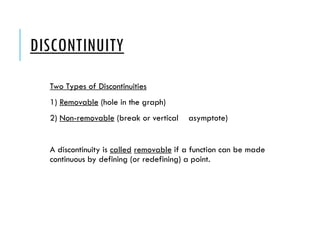
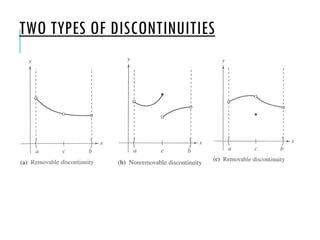
Two Types of Discontinuities
1) Removable (hole in the graph)
2) Non-removable (break or vertical asymptote)
A discontinuity is called removable if a function can be made
continuous by defining (or redefining) a point.
DISCONTINUITY
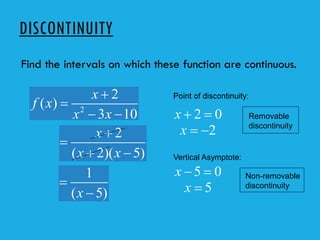
2
2
( )
3 10
x
f x
x x
+
=
− −
Find the intervals on which these function are continuous.
2
( 2)( 5)
x
x x
+
=
+ −
1
( 5)
x
=
−
2 0
x + =
2
x = −
Vertical Asymptote:
5 0
x − =
5
x =
Removable
discontinuity
Non-removable
discontinuity
DISCONTINUITY
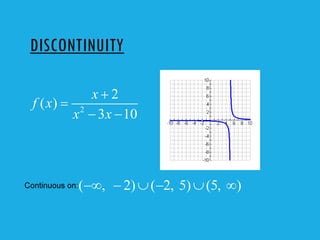
2
2
( )
3 10
x
f x
x x
+
=
− −
( , 2) ( 2, 5) (5, )
− −  −  
DISCONTINUITY
2
2 , 2
( )
4 1, 2
x x
f x
x x x
− 

= 
− + 

2
lim( 2 )
x
x
−
→
−
2
2
lim( 4 1)
x
x x
+
→
− +
(2)
f
4
= −
3
= −
4
= −
( , 2] (2, )
−  
Continuous on:
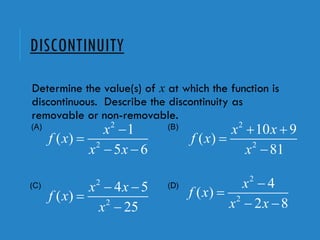
Determine the value(s) of x at which the function is
discontinuous. Describe the discontinuity as
removable or non-removable.
2
2
1
( )
5 6
x
f x
x x
−
=
− −
2
2
4 5
( )
25
x x
f x
x
− −
=
−
2
2
10 9
( )
81
x x
f x
x
+ +
=
−
2
2
4
( )
2 8
x
f x
x x
−
=
− −
(A) (B)
(C)
DISCONTINUITY
2
2
1
( )
5 6
x
f x
x x
−
=
− −
(A)
( 1)( 1)
( 6)( 1)
x x
x x
− +
=
− +
1
x = −
6
x = Non-removable discontinuity
DISCONTINUITY
(B)
9
x = −
9
x =
Removable discontinuity
( 9)( 1)
( 9)( 9)
x x
x x
+ +
=
+ −
2
2
10 9
( )
81
x x
f x
x
+ +
=
−
DISCONTINUITY
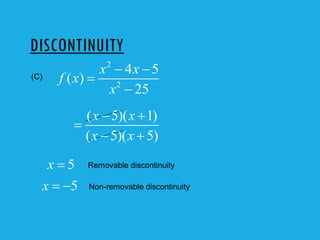
(C)
5
x =
5
x = − Non-removable discontinuity
( 5)( 1)
( 5)( 5)
x x
x x
− +
=
− +
2
2
4 5
( )
25
x x
f x
x
− −
=
−
DISCONTINUITY
(D)
2
x = −
4
x =
Removable discontinuity
( 2)( 2)
( 4)( 2)
x x
x x
− +
=
− +
2
2
4
( )
2 8
x
f x
x x
−
=
− −
CONCLUSION
Continuous functions have no breaks, no holes, and no jumps.
If you can evaluate any limit on the function using only the substitution
method, then the function is continuous.

Rational Functions and their graphs.....

  • 1.
  • 2.
    Where p andq are polynomial functions and q is not the zero polynomial. The domain consists of all real numbers except those for which the denominator is 0.
  • 3.
    Find the domainof the following rational functions: All real numbers except -4 and 4. All real numbers.
  • 4.
    Finding Asymptotes VERTICAL ASYMPTOTES ( ) 4 3 5 2 2 2 − − + + = x x x x x R Let’sset the bottom = 0 and factor and solve to find where the vertical asymptote(s) should be. ( )( ) 0 1 4 = + − x x So there are vertical asymptotes at x = 4 and x = -1.
  • 5.
    If the degreeof the numerator is less than the degree of the denominator, the x axis is a horizontal asymptote. This is along the line y = 0. We compare the degrees of the polynomial in the numerator and the polynomial in the denominator to tell us about horizontal asymptotes. ( ) 4 3 5 2 2 + − + = x x x x R degree of bottom = 2 HORIZONTAL ASYMPTOTES 1 1 < 2
  • 6.
    degree of bottom= 2 HORIZONTAL ASYMPTOTES degree of top = 2 The leading coefficient is the number in front of the highest powered x term. 1 2 = ( ) 4 3 5 4 2 2 2 + − + + = x x x x x R 1 2 = y
  • 7.
    ( ) 4 3 5 3 2 2 2 3 + − + − + = x x x x x x R If thedegree of the numerator is greater than the degree of the denominator, then there is not a horizontal asymptote, but an oblique one. The equation is found by doing long division and the quotient is the equation of the oblique asymptote ignoring the remainder. OBLIQUE ASYMPTOTES - Slanted degree of top = 3 5 3 2 2 3 + − + x x x 4 3 2 − − x x remainder a 5+ + x Oblique asymptote at y = x + 5
  • 8.
    SUMMARY OF HOWTO FIND ASYMPTOTES To determine horizontal or oblique asymptotes, compare the degrees of the numerator and denominator. 1. If the degree of the top < the bottom, horizontal asymptote along the x axis (y = 0) 2. If the degree of the top = bottom, horizontal asymptote at y = leading coefficient of top over leading coefficient of bottom 3. If the degree of the top > the bottom, oblique asymptote found by long division.
  • 9.
    STRATEGY FOR GRAPHINGA RATIONAL FUNCTION
  • 10.
    SKETCH THE GRAPHOF 10 5 3 2 ) ( + − = x x x f
  • 11.
    10 5 3 2 ) ( + − = x x x f The vertical asymptoteis x = -2 The horizontal asymptote is y = 2/5
  • 12.
    10 5 3 2 ) ( + − = x x x f -10 -8 -6-4 -2 2 4 6 8 10 -10 -8 -6 -4 -2 2 4 6 8 10
  • 13.
    SKETCH THE GRAPH OF: g(x)= 1 x −1 Vertical asymptotes at?? Horizontal asymptote at?? y = 0
  • 14.
    f (x) = 2 x Verticalasymptotes at?? x = 0 Horizontal asymptote at?? y = 0
  • 15.
  • 16.
    SKETCH THE GRAPH OF: y= 1 x + 3 −2 Vertical asymptotes at?? x = 1 y = 0 Hopefully you remember, y = 1/x graph and it’s asymptotes: Vertical asymptote: x = 0 Horizontal asymptote: y = 0
  • 17.
    We have thefunction:  y = 1 x + 3 −2 But what if we simplified this and combined like terms: y = 1 x + 3 − 2(x + 3) x + 3 y = 1− 2x − 6 x + 3 y = −2x − 5 x + 3 Now looking at this: Vertical Asymptotes?? x = -3 Horizontal asymptotes?? y = -2
  • 18.
    SKETCH THE GRAPH OF: h(x)= x2 + 3x x x = 0 h(x) = x(x + 3) x
  • 19.
    FIND THE ASYMPTOTESOF EACH FUNCTION: y = x2 + 3x − 4 x  y = x2 + 3x −28 x3 −11x2 +28x  y = x2 x + 3x x − 4 x  y = x + 3− 4 x Vertical Asymptote: x = 0 y = (x + 7)(x − 4) x(x − 7)(x − 4) Hole at x = 4 Vertical Asymptote: x = 0 and x = 7 Horizontal Asymptote: y = 0
  • 20.
    WHAT MAKES AFUNCTION CONTINUOUS? Continuous functions are predictable… 1) No breaks in the graph A limit must exist at every x-value or the graph will break. 2) No holes or jumps The function cannot have undefined points or vertical asymptotes.
  • 21.
    Key Point: Continuous functionscan be drawn with a single, unbroken pencil stroke.
  • 22.
    CONTINUITY OF POLYNOMIALAND RATIONAL FUNCTIONS
  • 23.
    DISCONTINUITY Discontinuity: a pointat which a function is not continuous
  • 24.
    DISCONTINUITY Two Types ofDiscontinuities 1) Removable (hole in the graph) 2) Non-removable (break or vertical asymptote) A discontinuity is called removable if a function can be made continuous by defining (or redefining) a point.
  • 26.
    DISCONTINUITY 2 2 ( ) 3 10 x fx x x + = − − Find the intervals on which these function are continuous. 2 ( 2)( 5) x x x + = + − 1 ( 5) x = − 2 0 x + = 2 x = − Vertical Asymptote: 5 0 x − = 5 x = Removable discontinuity Non-removable discontinuity
  • 27.
    DISCONTINUITY 2 2 ( ) 3 10 x fx x x + = − − ( , 2) ( 2, 5) (5, ) − −  −  
  • 28.
    DISCONTINUITY 2 2 , 2 () 4 1, 2 x x f x x x x −   =  − +   2 lim( 2 ) x x − → − 2 2 lim( 4 1) x x x + → − + (2) f 4 = − 3 = − 4 = − ( , 2] (2, ) −   Continuous on:
  • 29.
    Determine the value(s)of x at which the function is discontinuous. Describe the discontinuity as removable or non-removable. 2 2 1 ( ) 5 6 x f x x x − = − − 2 2 4 5 ( ) 25 x x f x x − − = − 2 2 10 9 ( ) 81 x x f x x + + = − 2 2 4 ( ) 2 8 x f x x x − = − − (A) (B) (C)
  • 30.
    DISCONTINUITY 2 2 1 ( ) 5 6 x fx x x − = − − (A) ( 1)( 1) ( 6)( 1) x x x x − + = − + 1 x = − 6 x = Non-removable discontinuity
  • 31.
    DISCONTINUITY (B) 9 x = − 9 x= Removable discontinuity ( 9)( 1) ( 9)( 9) x x x x + + = + − 2 2 10 9 ( ) 81 x x f x x + + = −
  • 32.
    DISCONTINUITY (C) 5 x = 5 x =− Non-removable discontinuity ( 5)( 1) ( 5)( 5) x x x x − + = − + 2 2 4 5 ( ) 25 x x f x x − − = −
  • 33.
    DISCONTINUITY (D) 2 x = − 4 x= Removable discontinuity ( 2)( 2) ( 4)( 2) x x x x − + = − + 2 2 4 ( ) 2 8 x f x x x − = − −
  • 34.
    CONCLUSION Continuous functions haveno breaks, no holes, and no jumps. If you can evaluate any limit on the function using only the substitution method, then the function is continuous.