Subject Verb Agreement
Making Subjects and Verbs Agree
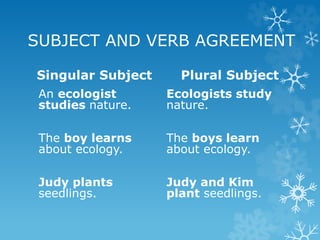
SUBJECT AND VERB AGREEMENT
Singular Subject
An ecologist
studies nature.
The boy learns
about ecology.
Judy plants
seedlings.
Plural Subject
Ecologists study
nature.
The boys learn
about ecology.
Judy and Kim
plant seedlings.
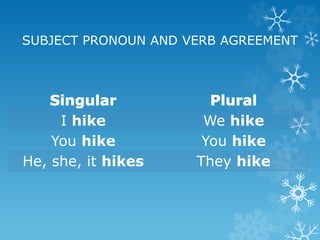
SUBJECT PRONOUN AND VERB AGREEMENT
I hike We hike
You hike You hike
He, she, it hikes They hike
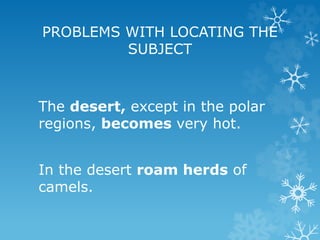
PROBLEMS WITH LOCATING THE
SUBJECT
The desert, except in the polar
regions, becomes very hot.
In the desert roam herds of
camels.
PROBLEMS WITH LOCATING THE
SUBJECT
There is a high mountain near
the desert.
Here at the top are many damp
rocks.
PROBLEMS WITH LOCATING THE
SUBJECT
A high mountain there is near
the desert.
Many damp rocks are here at
the top.
PROBLEMS WITH LOCATING THE
SUBJECT
Do any deserts contain large
animals?
COLLECTIVE NOUNS AND OTHER
SPECIAL SUBJECTS
The team agrees to save
papers. [one unit, singular]
The team agree to store them in
their homes. [individuals, plural]
COLLECTIVE NOUNS AND OTHER
SPECIAL SUBJECTS
Mumps is a disease that is
spread through the air. [singular]
Scissors are not practical for
shredding paper. [plural]
COLLECTIVE NOUNS AND OTHER
SPECIAL SUBJECTS
Ten years seems a long time.
[singular]
Ten years have passed since you
left. [individual units]
Five cents is the deposit on one
bottle. [single unit]
Five cents are in my hand.
[plural]
COLLECTIVE NOUNS AND OTHER
SPECIAL SUBJECTS
Recycling Successes is now a
best-selling book. [one book]
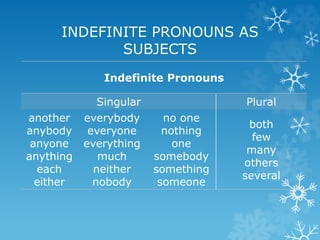
INDEFINITE PRONOUNS AS
SUBJECTS
Indefinite Pronouns
Singular Plural
another
anybody
anyone
anything
each
either
everybody
everyone
everything
much
neither
nobody
no one
nothing
one
somebody
something
someone
both
few
many
others
several
Some, None, All, Any, Most
Most of the forest lies to the east.
[singular]
Most of those scientists study the
process of respiration. [plural]
Some of her lawn is brown. [singular]
Some of the ferns are large. [plural]
INDEFINITE PRONOUNS AS
SUBJECTS
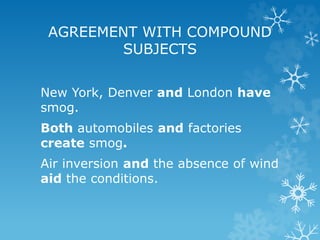
New York, Denver and London have
smog.
Both automobiles and factories
create smog.
Air inversion and the absence of wind
aid the conditions.
AGREEMENT WITH COMPOUND
SUBJECTS
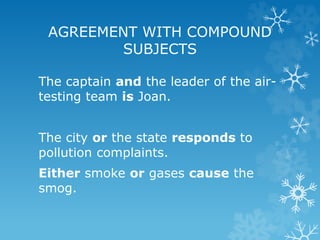
The captain and the leader of the air-
testing team is Joan.
The city or the state responds to
pollution complaints.
Either smoke or gases cause the
smog.
AGREEMENT WITH COMPOUND
SUBJECTS
Glossary of Special Usage
Problems
Using Troublesome Words
Word Meaning Example
a lot “very
much” A lot
is two
words. Its
meaning is
vague;
avoid using
it.
A lot of
stars can’t
be seen.
[vague]
Thousands
of stars
can’t be
seen. [more
precise]
Using Troublesome Words
Word Meaning Example
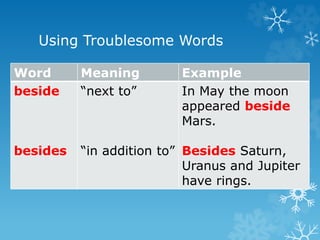
beside
besides
“next to”
“in addition to”
In May the moon
appeared beside
Mars.
Besides Saturn,
Uranus and Jupiter
have rings.
Using Troublesome Words
Word Meaning Example
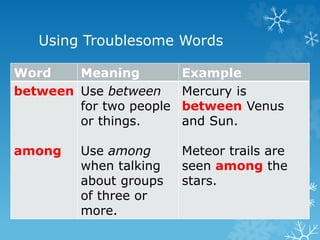
between
among
Use between
for two people
or things.
Use among
when talking
about groups
of three or
more.
Mercury is
between Venus
and Sun.
Meteor trails are
seen among the
stars.
Using Troublesome Words
Word Meaning Example
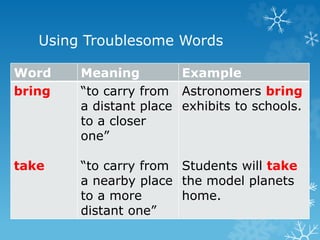
bring
take
“to carry from
a distant place
to a closer
one”
“to carry from
a nearby place
to a more
distant one”
Astronomers bring
exhibits to schools.
Students will take
the model planets
home.
Using Troublesome Words
Word Meaning Example
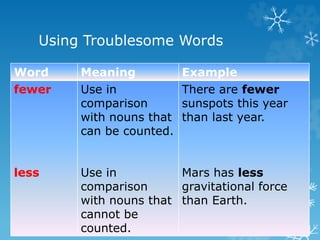
fewer
less
Use in
comparison
with nouns that
can be counted.
Use in
comparison
with nouns that
cannot be
counted.
There are fewer
sunspots this year
than last year.
Mars has less
gravitational force
than Earth.
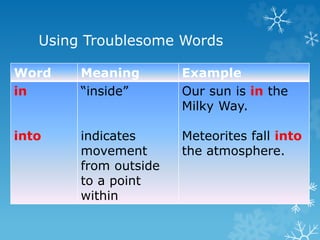
Using Troublesome Words
Word Meaning Example
in
into
“inside”
indicates
movement
from outside
to a point
within
Our sun is in the
Milky Way.
Meteorites fall into
the atmosphere.
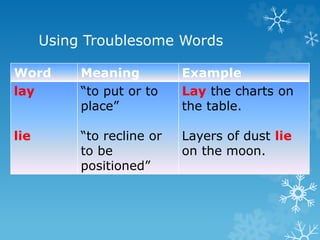
Using Troublesome Words
Word Meaning Example
lay
lie
“to put or to
place”
“to recline or
to be
positioned”
Lay the charts on
the table.
Layers of dust lie
on the moon.
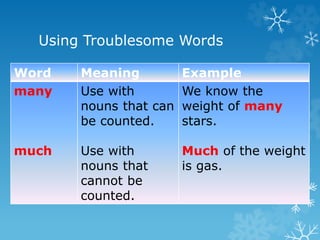
Using Troublesome Words
Word Meaning Example
many
much
Use with
nouns that can
be counted.
Use with
nouns that
cannot be
counted.
We know the
weight of many
stars.
Much of the weight
is gas.
TROUBLESHOOTING
Lack of Subject-Verb Agreement
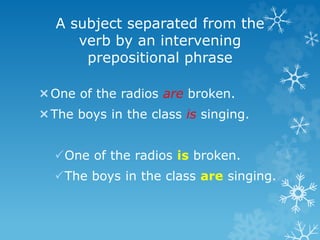
A subject separated from the
verb by an intervening
prepositional phrase
One of the radios are broken.
The boys in the class is singing.
One of the radios is broken.
The boys in the class are singing.
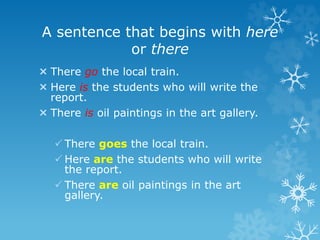
A sentence that begins with here
or there
 There go the local train.
 Here is the students who will write the
report.
 There is oil paintings in the art gallery.
 There goes the local train.
 Here are the students who will write
the report.
 There are oil paintings in the art
gallery.
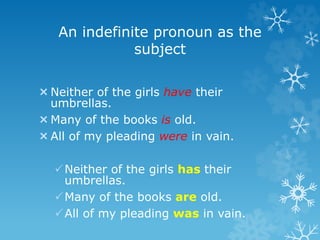
An indefinite pronoun as the
subject
Neither of the girls have their
umbrellas.
Many of the books is old.
All of my pleading were in vain.
Neither of the girls has their
umbrellas.
Many of the books are old.
All of my pleading was in vain.
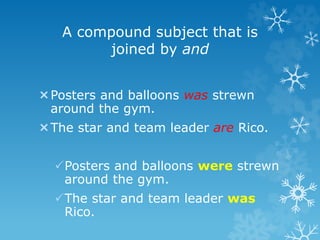
A compound subject that is
joined by and
Posters and balloons was strewn
around the gym.
The star and team leader are Rico.
Posters and balloons were strewn
around the gym.
The star and team leader was
Rico.
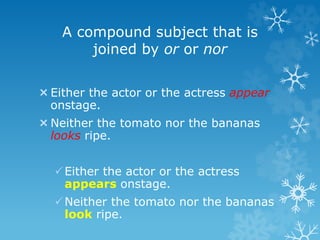
A compound subject that is
joined by or or nor
Either the actor or the actress appear
onstage.
Neither the tomato nor the bananas
looks ripe.
Either the actor or the actress
appears onstage.
Neither the tomato nor the bananas
look ripe.
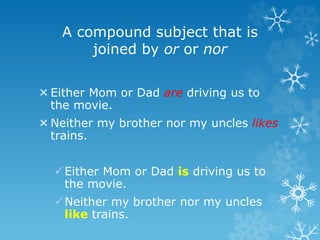
A compound subject that is
joined by or or nor
Either Mom or Dad are driving us to
the movie.
Neither my brother nor my uncles likes
trains.
Either Mom or Dad is driving us to
the movie.
Neither my brother nor my uncles
like trains.
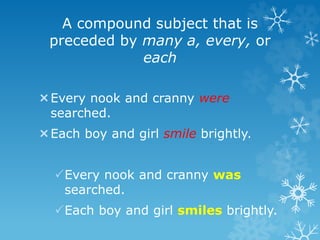
A compound subject that is
preceded by many a, every, or
each
Every nook and cranny were
searched.
Each boy and girl smile brightly.
Every nook and cranny was
searched.
Each boy and girl smiles brightly.
Incorrect Verb Tense or Form
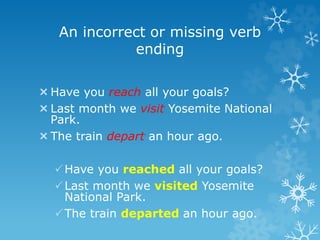
An incorrect or missing verb
ending
Have you reach all your goals?
Last month we visit Yosemite National
Park.
The train depart an hour ago.
Have you reached all your goals?
Last month we visited Yosemite
National Park.
The train departed an hour ago.
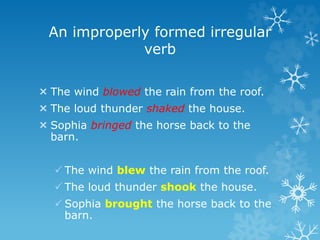
An improperly formed irregular
verb
 The wind blowed the rain from the roof.
 The loud thunder shaked the house.
 Sophia bringed the horse back to the
barn.
 The wind blew the rain from the roof.
 The loud thunder shook the house.
 Sophia brought the horse back to the
barn.
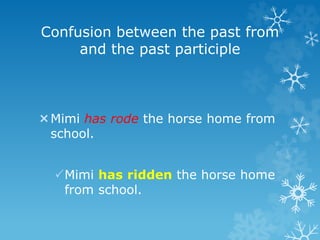
Confusion between the past from
and the past participle
Mimi has rode the horse home from
school.
Mimi has ridden the horse home
from school.
Incorrect Use of Pronouns
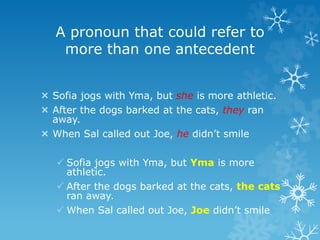
A pronoun that could refer to
more than one antecedent
 Sofia jogs with Yma, but she is more athletic.
 After the dogs barked at the cats, they ran
away.
 When Sal called out Joe, he didn’t smile
 Sofia jogs with Yma, but Yma is more
athletic.
 After the dogs barked at the cats, the cats
ran away.
 When Sal called out Joe, Joe didn’t smile
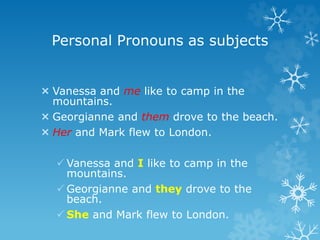
Personal Pronouns as subjects
 Vanessa and me like to camp in the
mountains.
 Georgianne and them drove to the beach.
 Her and Mark flew to London.
 Vanessa and I like to camp in the
mountains.
 Georgianne and they drove to the
beach.
 She and Mark flew to London.
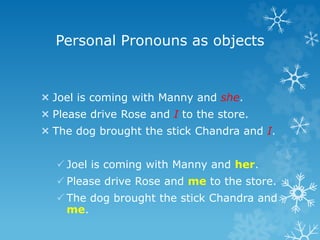
Personal Pronouns as objects
 Joel is coming with Manny and she.
 Please drive Rose and I to the store.
 The dog brought the stick Chandra and I.
 Joel is coming with Manny and her.
 Please drive Rose and me to the store.
 The dog brought the stick Chandra and
me.
Incorrect Use of Adjectives
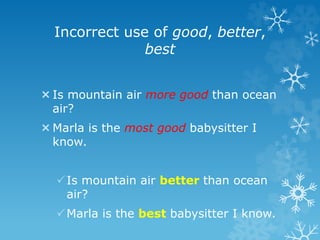
Incorrect use of good, better,
best
Is mountain air more good than ocean
air?
Marla is the most good babysitter I
know.
Is mountain air better than ocean
air?
Marla is the best babysitter I know.
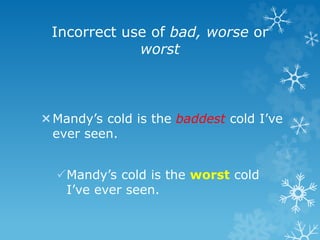
Incorrect use of bad, worse or
worst
Mandy’s cold is the baddest cold I’ve
ever seen.
Mandy’s cold is the worst cold
I’ve ever seen.
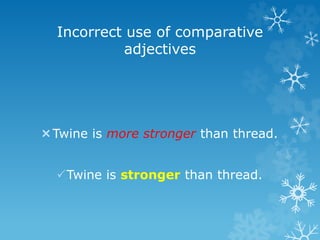
Incorrect use of comparative
adjectives
Twine is more stronger than thread.
Twine is stronger than thread.
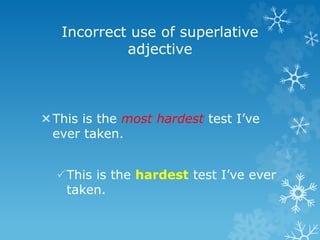
Incorrect use of superlative
adjective
This is the most hardest test I’ve
ever taken.
This is the hardest test I’ve ever
taken.
Incorrect Use of Commas
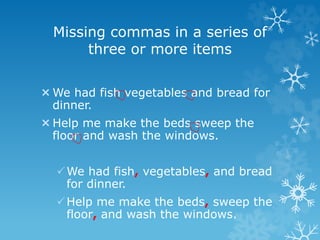
Missing commas in a series of
three or more items
We had fish vegetables and bread for
dinner.
Help me make the beds sweep the
floor and wash the windows.
We had fish, vegetables, and bread
for dinner.
Help me make the beds, sweep the
floor, and wash the windows.
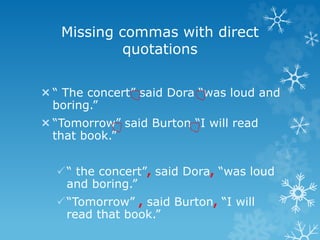
Missing commas with direct
quotations
“ The concert” said Dora “was loud and
boring.”
“Tomorrow” said Burton “I will read
that book.”
“ the concert”, said Dora, “was loud
and boring.”
“Tomorrow” , said Burton, “I will
read that book.”
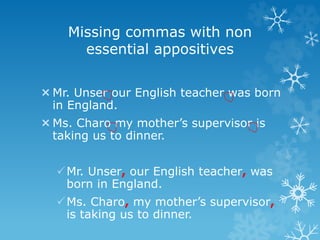
Missing commas with non
essential appositives
Mr. Unser our English teacher was born
in England.
Ms. Charo my mother’s supervisor is
taking us to dinner.
Mr. Unser, our English teacher, was
born in England.
Ms. Charo, my mother’s supervisor,
is taking us to dinner.
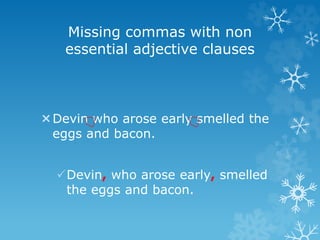
Missing commas with non
essential adjective clauses
Devin who arose early smelled the
eggs and bacon.
Devin, who arose early, smelled
the eggs and bacon.
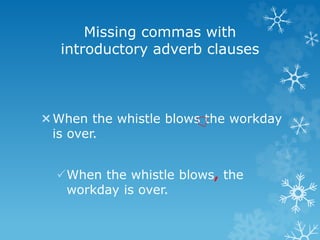
Missing commas with
introductory adverb clauses
When the whistle blows the workday
is over.
When the whistle blows, the
workday is over.

Subject verb agreement

  • 1.
    Subject Verb Agreement MakingSubjects and Verbs Agree
  • 2.
    SUBJECT AND VERBAGREEMENT Singular Subject An ecologist studies nature. The boy learns about ecology. Judy plants seedlings. Plural Subject Ecologists study nature. The boys learn about ecology. Judy and Kim plant seedlings.
  • 3.
    SUBJECT PRONOUN ANDVERB AGREEMENT I hike We hike You hike You hike He, she, it hikes They hike
  • 4.
    PROBLEMS WITH LOCATINGTHE SUBJECT The desert, except in the polar regions, becomes very hot. In the desert roam herds of camels.
  • 5.
    PROBLEMS WITH LOCATINGTHE SUBJECT There is a high mountain near the desert. Here at the top are many damp rocks.
  • 6.
    PROBLEMS WITH LOCATINGTHE SUBJECT A high mountain there is near the desert. Many damp rocks are here at the top.
  • 7.
    PROBLEMS WITH LOCATINGTHE SUBJECT Do any deserts contain large animals?
  • 8.
    COLLECTIVE NOUNS ANDOTHER SPECIAL SUBJECTS The team agrees to save papers. [one unit, singular] The team agree to store them in their homes. [individuals, plural]
  • 9.
    COLLECTIVE NOUNS ANDOTHER SPECIAL SUBJECTS Mumps is a disease that is spread through the air. [singular] Scissors are not practical for shredding paper. [plural]
  • 10.
    COLLECTIVE NOUNS ANDOTHER SPECIAL SUBJECTS Ten years seems a long time. [singular] Ten years have passed since you left. [individual units] Five cents is the deposit on one bottle. [single unit] Five cents are in my hand. [plural]
  • 11.
    COLLECTIVE NOUNS ANDOTHER SPECIAL SUBJECTS Recycling Successes is now a best-selling book. [one book]
  • 12.
    INDEFINITE PRONOUNS AS SUBJECTS IndefinitePronouns Singular Plural another anybody anyone anything each either everybody everyone everything much neither nobody no one nothing one somebody something someone both few many others several
  • 13.
    Some, None, All,Any, Most Most of the forest lies to the east. [singular] Most of those scientists study the process of respiration. [plural] Some of her lawn is brown. [singular] Some of the ferns are large. [plural] INDEFINITE PRONOUNS AS SUBJECTS
  • 14.
    New York, Denverand London have smog. Both automobiles and factories create smog. Air inversion and the absence of wind aid the conditions. AGREEMENT WITH COMPOUND SUBJECTS
  • 15.
    The captain andthe leader of the air- testing team is Joan. The city or the state responds to pollution complaints. Either smoke or gases cause the smog. AGREEMENT WITH COMPOUND SUBJECTS
  • 16.
    Glossary of SpecialUsage Problems Using Troublesome Words
  • 17.
    Using Troublesome Words WordMeaning Example a lot “very much” A lot is two words. Its meaning is vague; avoid using it. A lot of stars can’t be seen. [vague] Thousands of stars can’t be seen. [more precise]
  • 18.
    Using Troublesome Words WordMeaning Example beside besides “next to” “in addition to” In May the moon appeared beside Mars. Besides Saturn, Uranus and Jupiter have rings.
  • 19.
    Using Troublesome Words WordMeaning Example between among Use between for two people or things. Use among when talking about groups of three or more. Mercury is between Venus and Sun. Meteor trails are seen among the stars.
  • 20.
    Using Troublesome Words WordMeaning Example bring take “to carry from a distant place to a closer one” “to carry from a nearby place to a more distant one” Astronomers bring exhibits to schools. Students will take the model planets home.
  • 21.
    Using Troublesome Words WordMeaning Example fewer less Use in comparison with nouns that can be counted. Use in comparison with nouns that cannot be counted. There are fewer sunspots this year than last year. Mars has less gravitational force than Earth.
  • 22.
    Using Troublesome Words WordMeaning Example in into “inside” indicates movement from outside to a point within Our sun is in the Milky Way. Meteorites fall into the atmosphere.
  • 23.
    Using Troublesome Words WordMeaning Example lay lie “to put or to place” “to recline or to be positioned” Lay the charts on the table. Layers of dust lie on the moon.
  • 24.
    Using Troublesome Words WordMeaning Example many much Use with nouns that can be counted. Use with nouns that cannot be counted. We know the weight of many stars. Much of the weight is gas.
  • 25.
  • 26.
  • 27.
    A subject separatedfrom the verb by an intervening prepositional phrase One of the radios are broken. The boys in the class is singing. One of the radios is broken. The boys in the class are singing.
  • 28.
    A sentence thatbegins with here or there  There go the local train.  Here is the students who will write the report.  There is oil paintings in the art gallery.  There goes the local train.  Here are the students who will write the report.  There are oil paintings in the art gallery.
  • 29.
    An indefinite pronounas the subject Neither of the girls have their umbrellas. Many of the books is old. All of my pleading were in vain. Neither of the girls has their umbrellas. Many of the books are old. All of my pleading was in vain.
  • 30.
    A compound subjectthat is joined by and Posters and balloons was strewn around the gym. The star and team leader are Rico. Posters and balloons were strewn around the gym. The star and team leader was Rico.
  • 31.
    A compound subjectthat is joined by or or nor Either the actor or the actress appear onstage. Neither the tomato nor the bananas looks ripe. Either the actor or the actress appears onstage. Neither the tomato nor the bananas look ripe.
  • 32.
    A compound subjectthat is joined by or or nor Either Mom or Dad are driving us to the movie. Neither my brother nor my uncles likes trains. Either Mom or Dad is driving us to the movie. Neither my brother nor my uncles like trains.
  • 33.
    A compound subjectthat is preceded by many a, every, or each Every nook and cranny were searched. Each boy and girl smile brightly. Every nook and cranny was searched. Each boy and girl smiles brightly.
  • 34.
  • 35.
    An incorrect ormissing verb ending Have you reach all your goals? Last month we visit Yosemite National Park. The train depart an hour ago. Have you reached all your goals? Last month we visited Yosemite National Park. The train departed an hour ago.
  • 36.
    An improperly formedirregular verb  The wind blowed the rain from the roof.  The loud thunder shaked the house.  Sophia bringed the horse back to the barn.  The wind blew the rain from the roof.  The loud thunder shook the house.  Sophia brought the horse back to the barn.
  • 37.
    Confusion between thepast from and the past participle Mimi has rode the horse home from school. Mimi has ridden the horse home from school.
  • 38.
  • 39.
    A pronoun thatcould refer to more than one antecedent  Sofia jogs with Yma, but she is more athletic.  After the dogs barked at the cats, they ran away.  When Sal called out Joe, he didn’t smile  Sofia jogs with Yma, but Yma is more athletic.  After the dogs barked at the cats, the cats ran away.  When Sal called out Joe, Joe didn’t smile
  • 40.
    Personal Pronouns assubjects  Vanessa and me like to camp in the mountains.  Georgianne and them drove to the beach.  Her and Mark flew to London.  Vanessa and I like to camp in the mountains.  Georgianne and they drove to the beach.  She and Mark flew to London.
  • 41.
    Personal Pronouns asobjects  Joel is coming with Manny and she.  Please drive Rose and I to the store.  The dog brought the stick Chandra and I.  Joel is coming with Manny and her.  Please drive Rose and me to the store.  The dog brought the stick Chandra and me.
  • 42.
    Incorrect Use ofAdjectives
  • 43.
    Incorrect use ofgood, better, best Is mountain air more good than ocean air? Marla is the most good babysitter I know. Is mountain air better than ocean air? Marla is the best babysitter I know.
  • 44.
    Incorrect use ofbad, worse or worst Mandy’s cold is the baddest cold I’ve ever seen. Mandy’s cold is the worst cold I’ve ever seen.
  • 45.
    Incorrect use ofcomparative adjectives Twine is more stronger than thread. Twine is stronger than thread.
  • 46.
    Incorrect use ofsuperlative adjective This is the most hardest test I’ve ever taken. This is the hardest test I’ve ever taken.
  • 47.
  • 48.
    Missing commas ina series of three or more items We had fish vegetables and bread for dinner. Help me make the beds sweep the floor and wash the windows. We had fish, vegetables, and bread for dinner. Help me make the beds, sweep the floor, and wash the windows.
  • 49.
    Missing commas withdirect quotations “ The concert” said Dora “was loud and boring.” “Tomorrow” said Burton “I will read that book.” “ the concert”, said Dora, “was loud and boring.” “Tomorrow” , said Burton, “I will read that book.”
  • 50.
    Missing commas withnon essential appositives Mr. Unser our English teacher was born in England. Ms. Charo my mother’s supervisor is taking us to dinner. Mr. Unser, our English teacher, was born in England. Ms. Charo, my mother’s supervisor, is taking us to dinner.
  • 51.
    Missing commas withnon essential adjective clauses Devin who arose early smelled the eggs and bacon. Devin, who arose early, smelled the eggs and bacon.
  • 52.
    Missing commas with introductoryadverb clauses When the whistle blows the workday is over. When the whistle blows, the workday is over.

Editor's Notes

  • #13 Plural- few, both, many, others, several
  • #14 Some, none, all, any, most--Depend on the OF PHRASE