Rational FunctionsBy: Katie Thayer
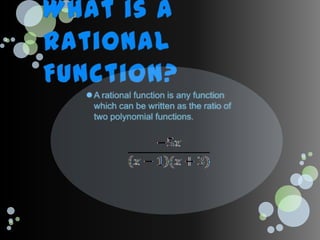
A rational function is any function which can be written as the ratio of two polynomial functions.What is a Rational Function?
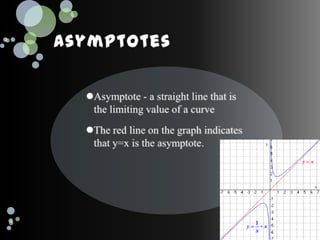
AsymptotesAsymptote - a straight line that is the limiting value of a curveThe red line on the graph indicates that y=x is the asymptote.
2 typesThere are two types of asymptotes. Vertical Asymptote- x=___, ** CAN’T BE CROSSED**.  Can be found be the zeros, or x- intercepts, which are in the denominator.Horizontal Asymptote- y=___, ** Can be crossed*. But there are three different ways you can find a horizontal asymptote.
VA and HAThe Vertical Asymptote of out function would be, x=-3 and x=1The Horizontal Asymptote is  y=0.
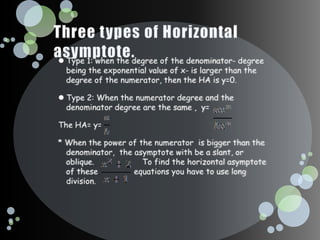
Three types of Horizontal asymptote.Type 1: when the degree of the denominator- degree being the exponential value of x- is larger than the degree of the numerator, then the HA is y=0.Type 2: When the numerator degree and the denominator degree are the same ,  y=The HA= y= * When the power of the numerator  is bigger than the denominator,  the asymptote with be a slant, or oblique.                    To find the horizontal asymptote of these               equations you have to use long division.
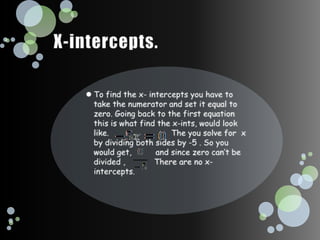
X-intercepts. To find the x- intercepts you have to take the numerator and set it equal to zero. Going back to the first equation this is what find the x-ints, would look like.                          The you solve for  x by dividing both sides by -5 . So you would get,          and since zero can’t be divided ,            There are no x- intercepts.
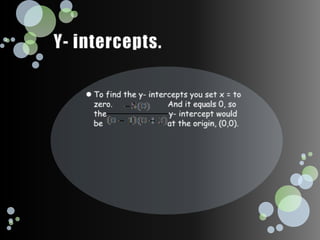
Y- intercepts. To find the y- intercepts you set x = to zero.                       And it equals 0, so the                          y- intercept would be                           at the origin, (0,0).
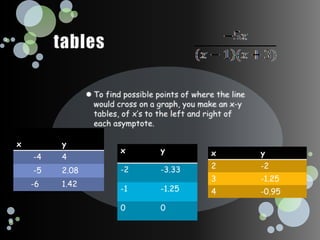
tablesTo find possible points of where the line would cross on a graph, you make an x-y tables, of x’s to the left and right of each asymptote.
Domain and RangeThe domain of a function is the set of all possible x values which will make the function "work" and will output real y-valuesThe range of a function is the possible y values of a function that result when we substitute all the possible x-values into the function.
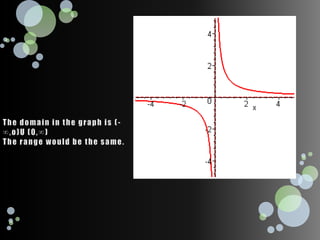
The domain in the graph is (-∞,o)U (0,∞)The range would be the same.
Domain and Range cont.The Domain of this function would beD: (-∞,-3] U [-3,1] U [1,∞)The Range would be (-∞,∞)

Rational functions

  • 1.
  • 2.
    A rational functionis any function which can be written as the ratio of two polynomial functions.What is a Rational Function?
  • 3.
    AsymptotesAsymptote - astraight line that is the limiting value of a curveThe red line on the graph indicates that y=x is the asymptote.
  • 4.
    2 typesThere aretwo types of asymptotes. Vertical Asymptote- x=___, ** CAN’T BE CROSSED**. Can be found be the zeros, or x- intercepts, which are in the denominator.Horizontal Asymptote- y=___, ** Can be crossed*. But there are three different ways you can find a horizontal asymptote.
  • 5.
    VA and HATheVertical Asymptote of out function would be, x=-3 and x=1The Horizontal Asymptote is y=0.
  • 6.
    Three types ofHorizontal asymptote.Type 1: when the degree of the denominator- degree being the exponential value of x- is larger than the degree of the numerator, then the HA is y=0.Type 2: When the numerator degree and the denominator degree are the same , y=The HA= y= * When the power of the numerator is bigger than the denominator, the asymptote with be a slant, or oblique. To find the horizontal asymptote of these equations you have to use long division.
  • 7.
    X-intercepts. To findthe x- intercepts you have to take the numerator and set it equal to zero. Going back to the first equation this is what find the x-ints, would look like. The you solve for x by dividing both sides by -5 . So you would get, and since zero can’t be divided , There are no x- intercepts.
  • 8.
    Y- intercepts. Tofind the y- intercepts you set x = to zero. And it equals 0, so the y- intercept would be at the origin, (0,0).
  • 9.
    tablesTo find possiblepoints of where the line would cross on a graph, you make an x-y tables, of x’s to the left and right of each asymptote.
  • 10.
    Domain and RangeThe domain ofa function is the set of all possible x values which will make the function "work" and will output real y-valuesThe range of a function is the possible y values of a function that result when we substitute all the possible x-values into the function.
  • 11.
    The domain inthe graph is (-∞,o)U (0,∞)The range would be the same.
  • 12.
    Domain and Rangecont.The Domain of this function would beD: (-∞,-3] U [-3,1] U [1,∞)The Range would be (-∞,∞)