Lesson 3.7
Graphs of Rational Functions
A rational function is a quotient of
two polynomial functions.
)(
)(
)(
xh
xg
xf  0)( xh
The parent function is
,
x
xf
1
)(  0x
I
III
a vertical asymptote x = 0
a horizontal
asymptote
y = 0
Example 1.
Determine the asymptotes for the graph
of f(x) = .
1
34


x
x
A vertical asymptote
Solve x +1 = 0
x = -1
Since f(-1) is undefined, there may be a
vertical asymptote at x = -1
A horizontal asymptote
1
34
)(



x
x
xf
1
34



x
x
y
Solve for xy(x + 1) = 4x + 3
xy + y = 4x + 3
xy - 4x = 3 - y
x(y - 4) = 3 - y
4
3



y
y
x
The rational expression is undefined
for y = 4. Thus, the horizontal
asymptote is the line y = 4.
The graph of this function verifies that
the lines of y = 4 and x = -1 are asymptotes.
f(x) =
1
34


x
x
Here’s the cheat sheet!
a) If the degree of the numerator is greater
than the degree of the denominator then
there is no a horizontal asymptote.
63x
2x
y
2



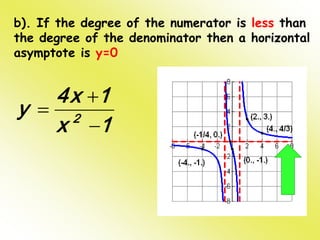
b). If the degree of the numerator is less than
the degree of the denominator then a horizontal
asymptote is y=0
1x
14x
y 2



c). If the degree of the numerator is equal to
the degree of the denominator then a horizontal
asymptote is a quotient.
16x
4x
y 2
2



4
x
4x
y 2
2



a horizontal asymptote
Example 2
Use the parent graph
to graph each function. Describe the transformation(s)
that take place. Identify the new location of each
asymptote.
x
1
f(x) 
a. g(x) =
To graph g(x) translate the parent
graph 2 units to the right. The new
vertical asymptote is x = 2. The
horizontal asymptote, y = 0, remains
unchanged.
2-x
1
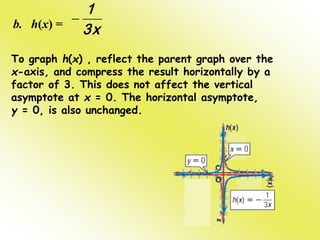
b. h(x) = 3x
1

To graph h(x) , reflect the parent graph over the
x-axis, and compress the result horizontally by a
factor of 3. This does not affect the vertical
asymptote at x = 0. The horizontal asymptote,
y = 0, is also unchanged.
To graph m(x) , stretch the parent function
vertically by a factor of 3, and translate the
result 1 unit to the right and 2 units down. The
new vertical asymptote is x = 1. The horizontal
asymptote changes from y = 0 to
y = -2.
2
1x
3
m(x) 

c.
A slant asymptote occurs when the
degree of the numerator of a rational
function is exactly one degree greater
then the degree of a denominator.
Example 3
Determine the slant asymptote for
 
1x
42x3x
xf
2



a slant asymptote
a vertical asymptote
x = 1

Fun37

  • 1.
    Lesson 3.7 Graphs ofRational Functions
  • 2.
    A rational functionis a quotient of two polynomial functions. )( )( )( xh xg xf  0)( xh The parent function is , x xf 1 )(  0x
  • 3.
    I III a vertical asymptotex = 0 a horizontal asymptote y = 0
  • 4.
    Example 1. Determine theasymptotes for the graph of f(x) = . 1 34   x x A vertical asymptote Solve x +1 = 0 x = -1 Since f(-1) is undefined, there may be a vertical asymptote at x = -1
  • 5.
    A horizontal asymptote 1 34 )(    x x xf 1 34    x x y Solvefor xy(x + 1) = 4x + 3 xy + y = 4x + 3 xy - 4x = 3 - y x(y - 4) = 3 - y 4 3    y y x The rational expression is undefined for y = 4. Thus, the horizontal asymptote is the line y = 4.
  • 6.
    The graph ofthis function verifies that the lines of y = 4 and x = -1 are asymptotes. f(x) = 1 34   x x
  • 7.
    Here’s the cheatsheet! a) If the degree of the numerator is greater than the degree of the denominator then there is no a horizontal asymptote. 63x 2x y 2   
  • 8.
    b). If thedegree of the numerator is less than the degree of the denominator then a horizontal asymptote is y=0 1x 14x y 2   
  • 9.
    c). If thedegree of the numerator is equal to the degree of the denominator then a horizontal asymptote is a quotient. 16x 4x y 2 2    4 x 4x y 2 2    a horizontal asymptote
  • 10.
    Example 2 Use theparent graph to graph each function. Describe the transformation(s) that take place. Identify the new location of each asymptote. x 1 f(x)  a. g(x) = To graph g(x) translate the parent graph 2 units to the right. The new vertical asymptote is x = 2. The horizontal asymptote, y = 0, remains unchanged. 2-x 1
  • 11.
    b. h(x) =3x 1  To graph h(x) , reflect the parent graph over the x-axis, and compress the result horizontally by a factor of 3. This does not affect the vertical asymptote at x = 0. The horizontal asymptote, y = 0, is also unchanged.
  • 12.
    To graph m(x), stretch the parent function vertically by a factor of 3, and translate the result 1 unit to the right and 2 units down. The new vertical asymptote is x = 1. The horizontal asymptote changes from y = 0 to y = -2. 2 1x 3 m(x)   c.
  • 13.
    A slant asymptoteoccurs when the degree of the numerator of a rational function is exactly one degree greater then the degree of a denominator.
  • 14.
    Example 3 Determine theslant asymptote for   1x 42x3x xf 2   
  • 15.
    a slant asymptote avertical asymptote x = 1