Graphing in Biology (pg 6)
Characteristics of a good graph
1. Use a ruler
Characteristics of a good graph
1. Use a ruler
2. Give your graph a title (y vs. x)
Characteristics of a good graph
1. Use a ruler
2. Give your graph a title (y vs. x)
3. Label the axes and give units
Characteristics of a good graph
1. Use a ruler
2. Give your graph a title
3. Label the axes and give units
4. Number the axes such that:
a. The graph takes up at least half the page
b. The numbers increase in “nice” intervals
c. The intervals between numbers are
consistent
Characteristics of a good graph
1. Use a ruler
2. Give your graph a title
3. Label the axes and give units
4. Number the axes such that:
a. The graph takes up at least half the page
b. The numbers increase in “nice” intervals
c. The intervals between numbers are
consistent
5. Don’t connect the dots! Draw a best fit
line
O.K. Now you’re done taking
notes. Lets look at some
examples:
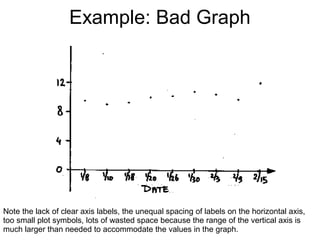
Example: Bad Graph
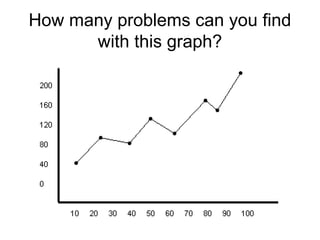
Note the lack of clear axis labels, the unequal spacing of labels on the horizontal axis,
too small plot symbols, lots of wasted space because the range of the vertical axis is
much larger than needed to accommodate the values in the graph.
How many problems can you find
with this graph?
you
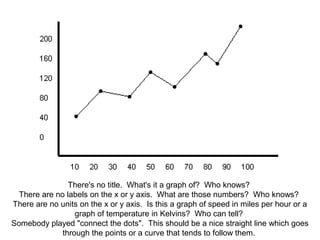
There's no title. What's it a graph of? Who knows?
There are no labels on the x or y axis. What are those numbers? Who knows?
There are no units on the x or y axis. Is this a graph of speed in miles per hour or a
graph of temperature in Kelvins? Who can tell?
Somebody played "connect the dots". This should be a nice straight line which goes
through the points or a curve that tends to follow them.
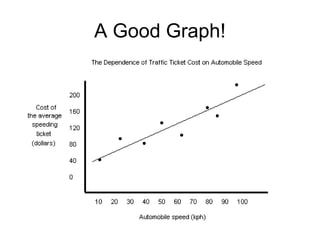
A Good Graph!
Output
• Paste the provided data on the top of
page 7 of your interactive notes
• Below that, graph the data using all the
characteristics of a good graph
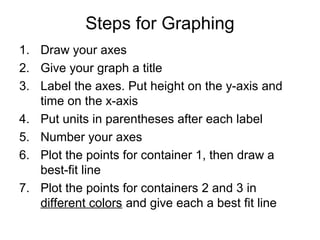
Steps for Graphing
1. Draw your axes
2. Give your graph a title
3. Label the axes. Put height on the y-axis and
time on the x-axis
4. Put units in parentheses after each label
5. Number your axes
6. Plot the points for container 1, then draw a
best-fit line
7. Plot the points for containers 2 and 3 in
different colors and give each a best fit line

Graphing in biology

  • 1.
  • 2.
    Characteristics of agood graph 1. Use a ruler
  • 3.
    Characteristics of agood graph 1. Use a ruler 2. Give your graph a title (y vs. x)
  • 4.
    Characteristics of agood graph 1. Use a ruler 2. Give your graph a title (y vs. x) 3. Label the axes and give units
  • 5.
    Characteristics of agood graph 1. Use a ruler 2. Give your graph a title 3. Label the axes and give units 4. Number the axes such that: a. The graph takes up at least half the page b. The numbers increase in “nice” intervals c. The intervals between numbers are consistent
  • 6.
    Characteristics of agood graph 1. Use a ruler 2. Give your graph a title 3. Label the axes and give units 4. Number the axes such that: a. The graph takes up at least half the page b. The numbers increase in “nice” intervals c. The intervals between numbers are consistent 5. Don’t connect the dots! Draw a best fit line
  • 7.
    O.K. Now you’redone taking notes. Lets look at some examples:
  • 8.
    Example: Bad Graph Notethe lack of clear axis labels, the unequal spacing of labels on the horizontal axis, too small plot symbols, lots of wasted space because the range of the vertical axis is much larger than needed to accommodate the values in the graph.
  • 9.
    How many problemscan you find with this graph?
  • 10.
    you There's no title.What's it a graph of? Who knows? There are no labels on the x or y axis. What are those numbers? Who knows? There are no units on the x or y axis. Is this a graph of speed in miles per hour or a graph of temperature in Kelvins? Who can tell? Somebody played "connect the dots". This should be a nice straight line which goes through the points or a curve that tends to follow them.
  • 11.
  • 12.
    Output • Paste theprovided data on the top of page 7 of your interactive notes • Below that, graph the data using all the characteristics of a good graph
  • 13.
    Steps for Graphing 1.Draw your axes 2. Give your graph a title 3. Label the axes. Put height on the y-axis and time on the x-axis 4. Put units in parentheses after each label 5. Number your axes 6. Plot the points for container 1, then draw a best-fit line 7. Plot the points for containers 2 and 3 in different colors and give each a best fit line