Introduction to Science
What is ”Science”?
Science… is made up of mistakes, but
they are mistakes which it is useful to
make, because they lead little by little to
the truth.” –Jules Vern
What is ”Science”
Science is not a ‘thing’, but a way of thinking.
Focus of science is the natural world
Can be used to understand anything that is Observable
Observable: able to be experienced using the senses
Science changes over time to give the best explanation possible
Observations
The noticing and describing of events or processes.
Observations rely on our senses, or on scientific instruments
which enhance our senses.
Observations can be:
Qualitative: use adjectives and descriptions
Quantitative: use measurements and numbers
Hypothesis
A possible explanation for a set of observations, or a possible
answer to a scientific question. A good hypothesis should
offer predictions that are testable
Model
A representation of an idea, object, system, or process which
is used to explain something that cannot be experienced
directly. Similar to a hypothesis.
Types of model include conceptual (ideas), mathematical,
computer, physical.
Prediction
A guess, based on observations, hypothesis, or theory, which
is observable and testable.
Theory
A well tested explanation that unifies a broad range of
observations and hypotheses, and enables scientists to make
accurate and testable predictions about new situations.
Theories will change to incorporate and explain new
observations, or will be replaced by better theories
Ex: Theory of Gravity, Theory of Relativity, Germ Theory,
Theory of Evolution, Molecular Theory, Theory of Plate
Tectonics
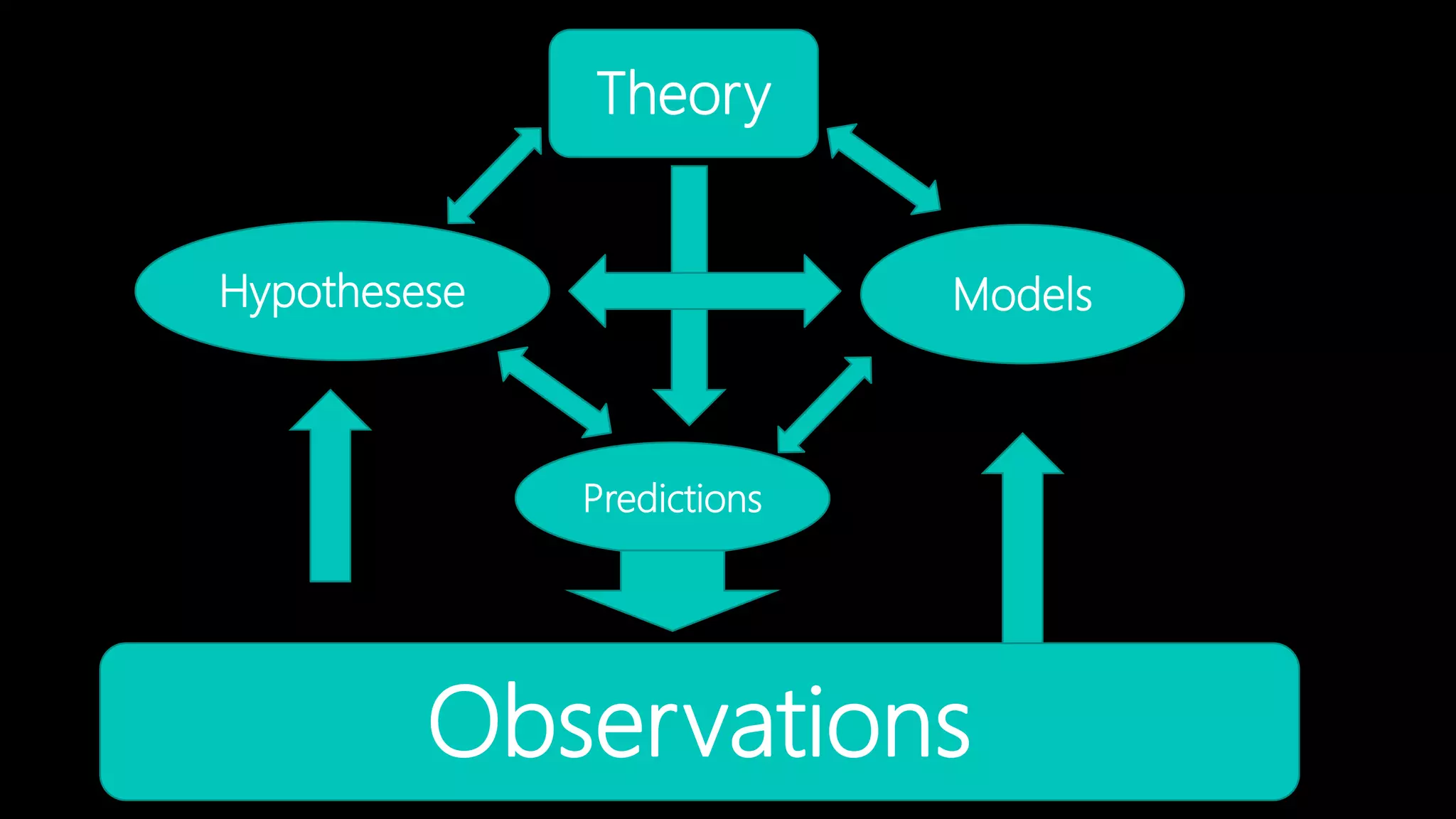
Observations
Hypothesese Models
Predictions
Theory

Science overview

  • 1.
  • 2.
    What is ”Science”? Science…is made up of mistakes, but they are mistakes which it is useful to make, because they lead little by little to the truth.” –Jules Vern
  • 3.
    What is ”Science” Scienceis not a ‘thing’, but a way of thinking. Focus of science is the natural world Can be used to understand anything that is Observable Observable: able to be experienced using the senses Science changes over time to give the best explanation possible
  • 4.
    Observations The noticing anddescribing of events or processes. Observations rely on our senses, or on scientific instruments which enhance our senses. Observations can be: Qualitative: use adjectives and descriptions Quantitative: use measurements and numbers
  • 5.
    Hypothesis A possible explanationfor a set of observations, or a possible answer to a scientific question. A good hypothesis should offer predictions that are testable
  • 6.
    Model A representation ofan idea, object, system, or process which is used to explain something that cannot be experienced directly. Similar to a hypothesis. Types of model include conceptual (ideas), mathematical, computer, physical.
  • 7.
    Prediction A guess, basedon observations, hypothesis, or theory, which is observable and testable.
  • 8.
    Theory A well testedexplanation that unifies a broad range of observations and hypotheses, and enables scientists to make accurate and testable predictions about new situations. Theories will change to incorporate and explain new observations, or will be replaced by better theories Ex: Theory of Gravity, Theory of Relativity, Germ Theory, Theory of Evolution, Molecular Theory, Theory of Plate Tectonics
  • 9.