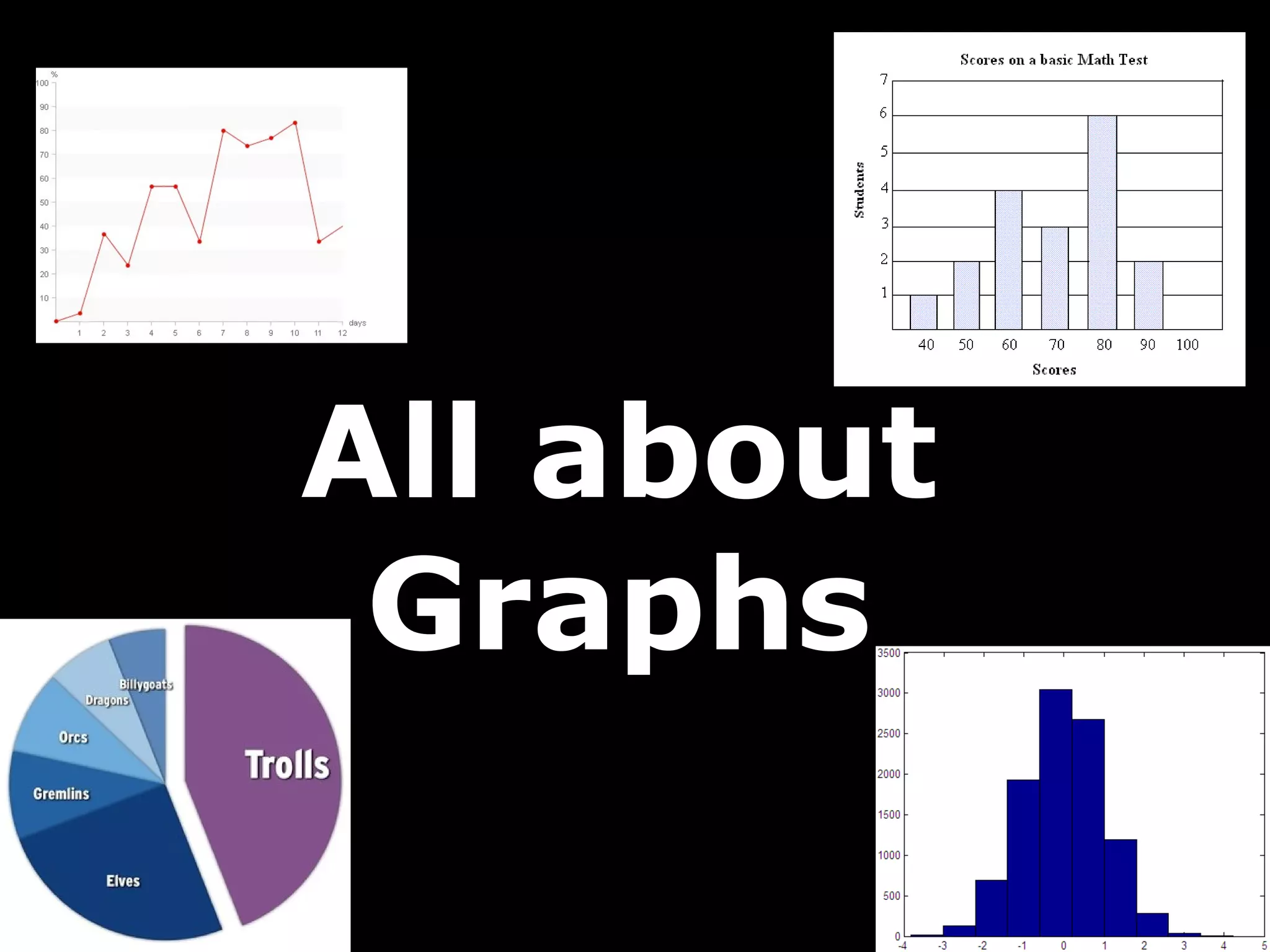
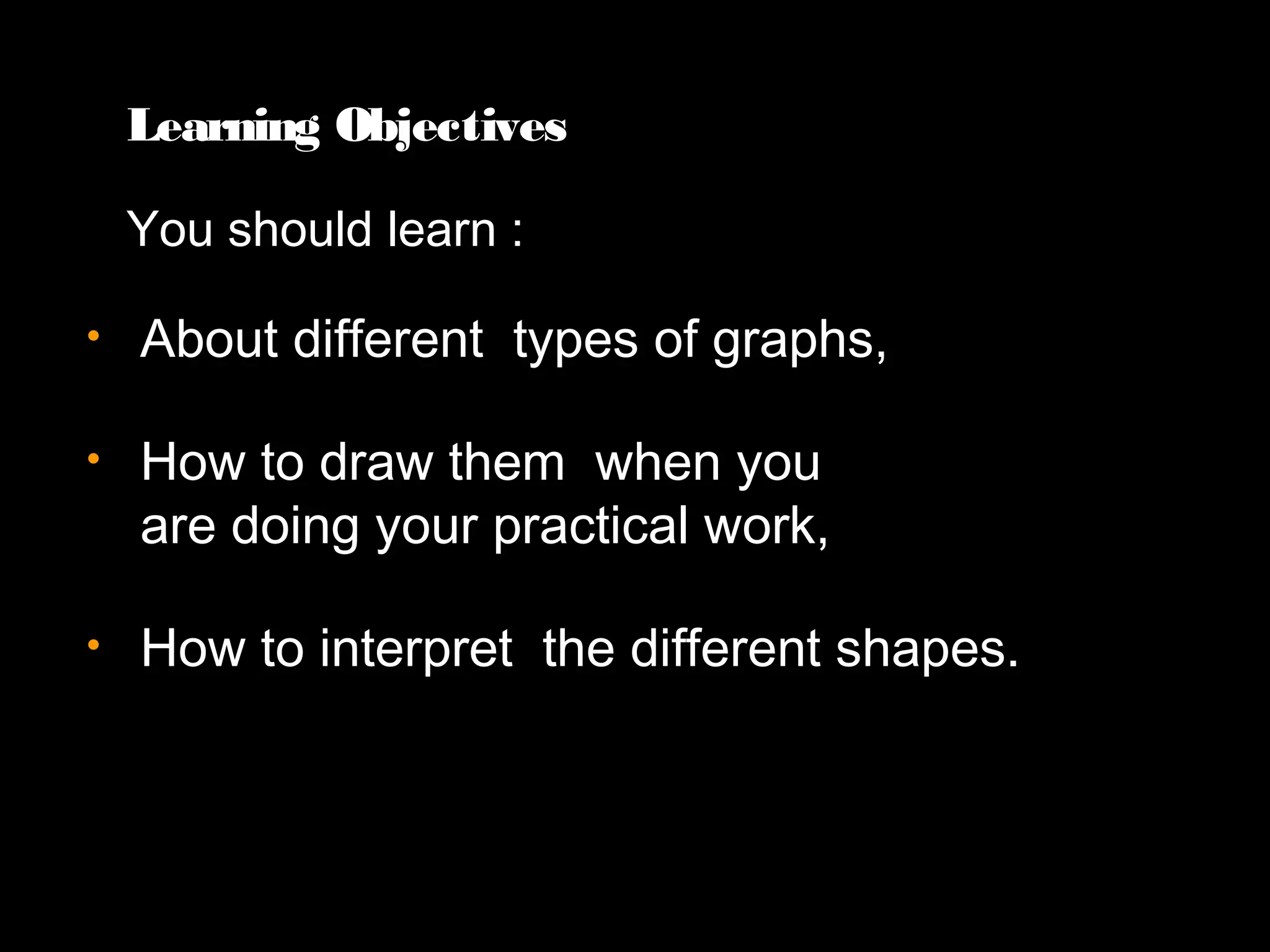
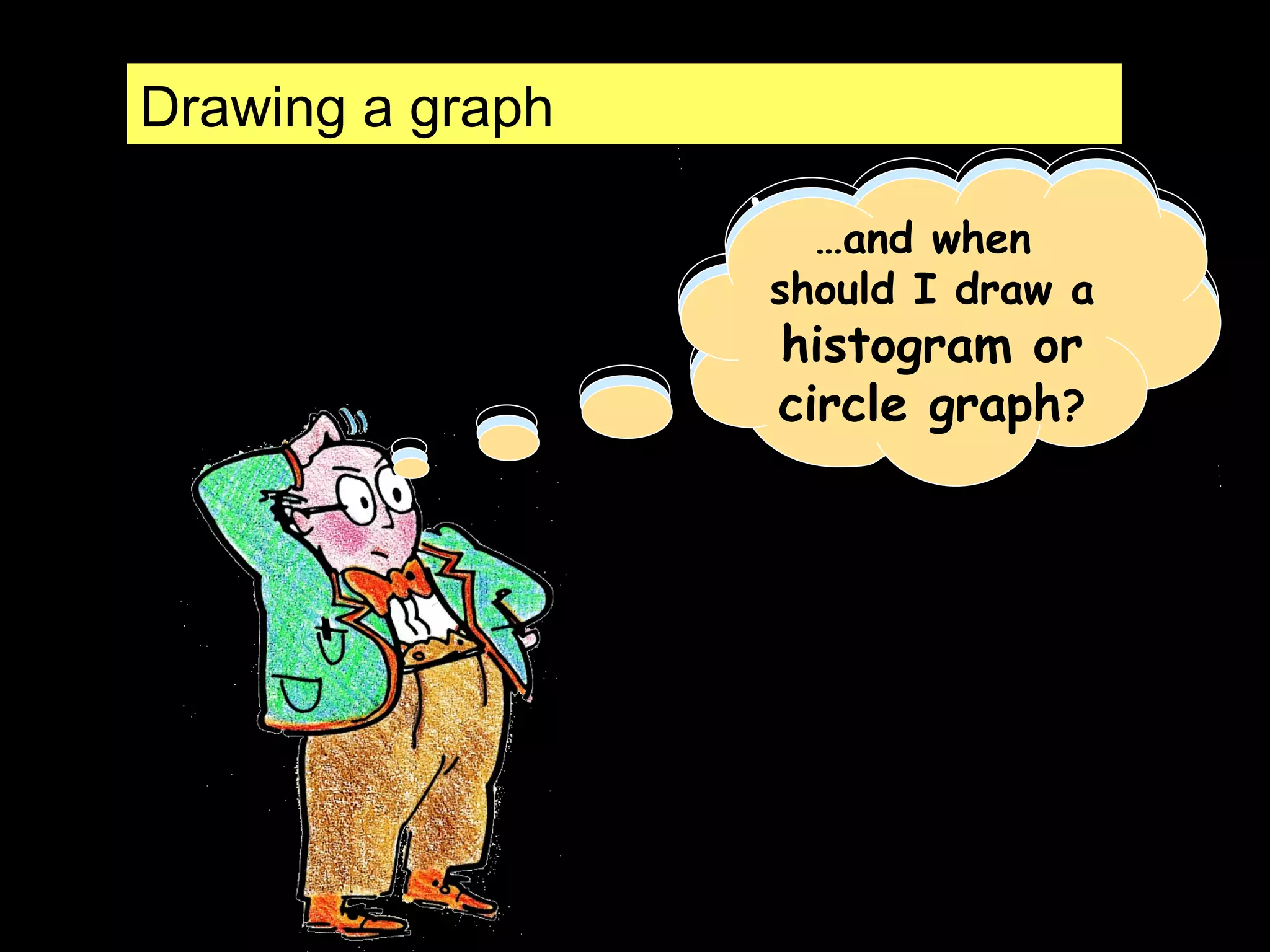
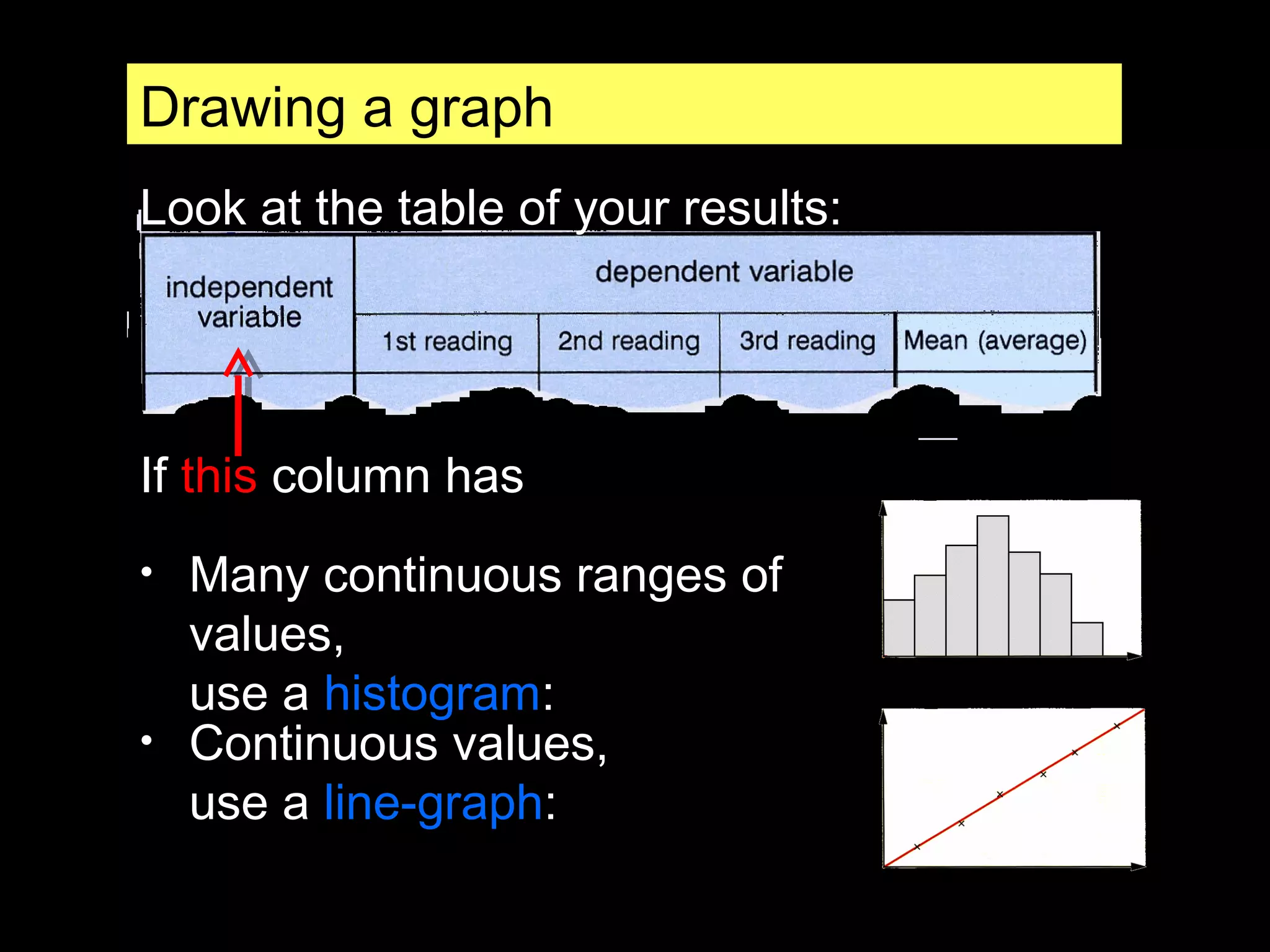
All aboutAll about
GraphsGraphs
• About different types of graphs,
• How to draw them when you
are doing your practical work,
• How to interpret the different shapes.
Learning Objectives
You should learn :
Drawing a graph
When should I
draw a
line-graph…?
…and when should
I draw a
bar-graph…?
…and when
should I draw a
histogram or
circle graph?
Drawing a graph
Look at the table of your results:
If this column has
• Many continuous ranges of
values,
use a histogram:
• Continuous values,
use a line-graph:
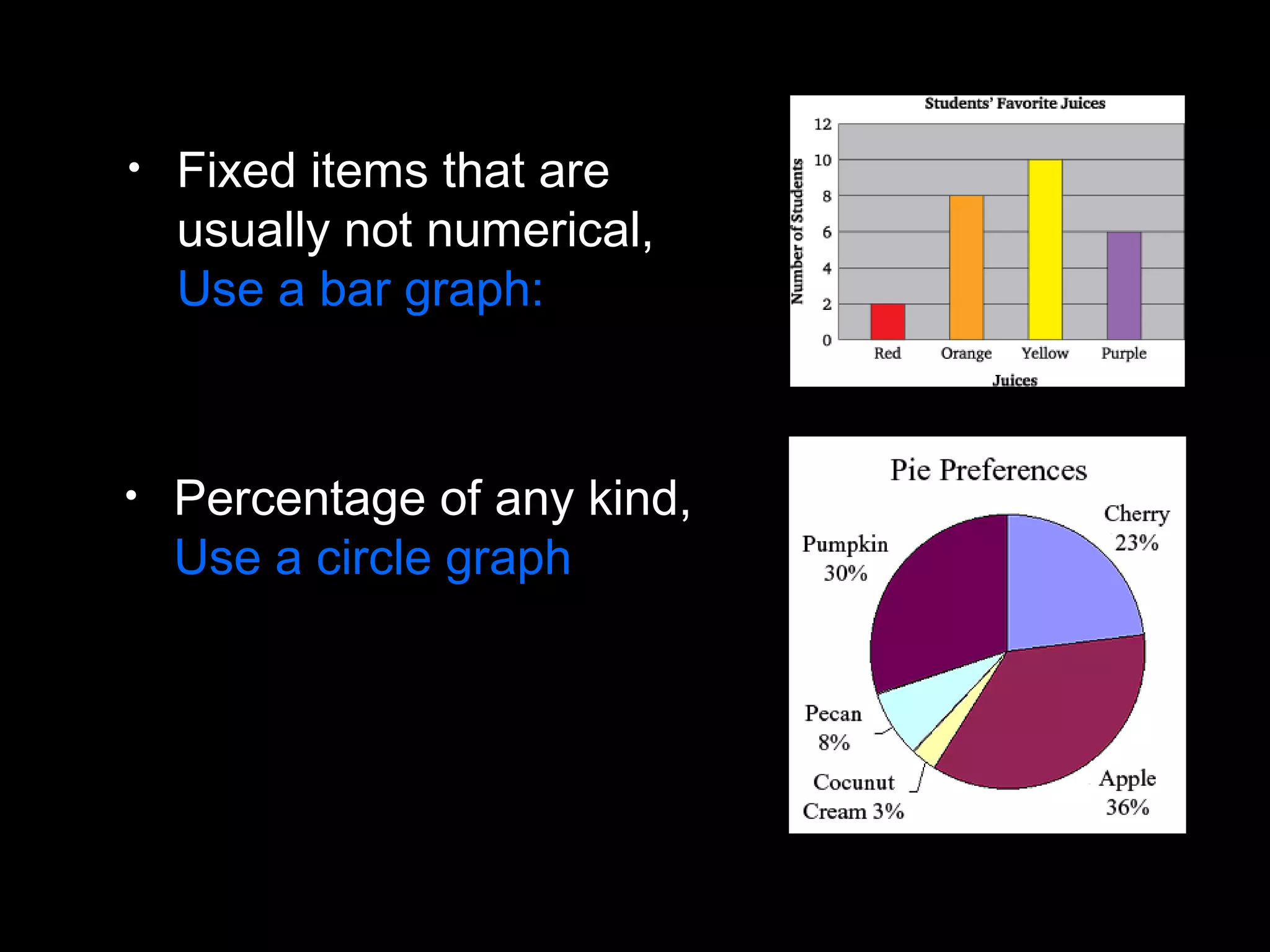
• Fixed items that are
usually not numerical,
Use a bar graph:
• Percentage of any kind,
Use a circle graph
Drawing a graph
What is the best
way to draw a
line-graph?
5 steps in drawing a graph
1. Choose simple scales.
For example:
1 large square = 1 meter (1 m)
or
1 large square = 2 m, or 5 m, or 10 m
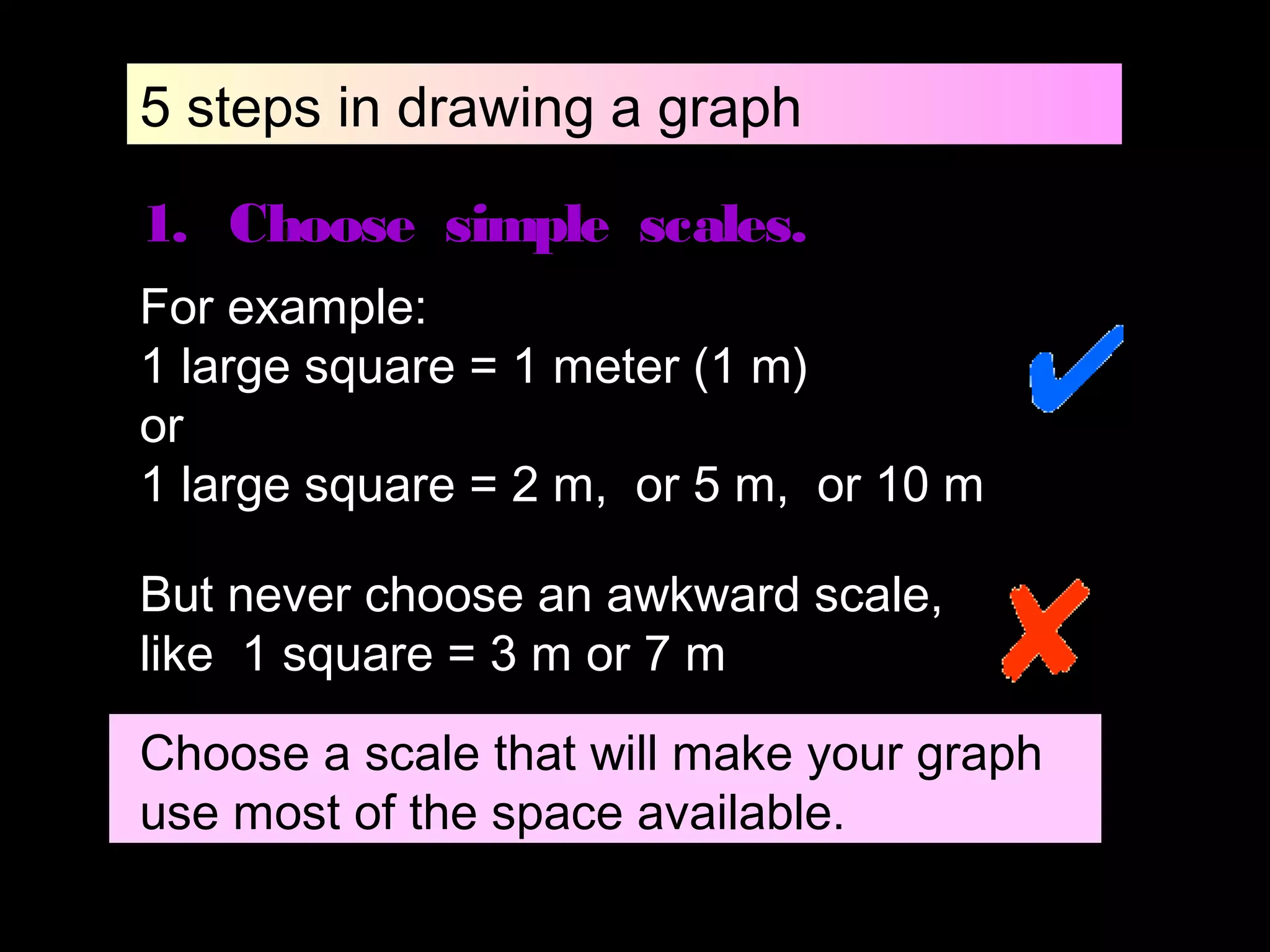
But never choose an awkward scale,
like 1 square = 3 m or 7 m
Choose a scale that will make your graph
use most of the space available.
5 steps in drawing a graph
1. Choose simple scales.
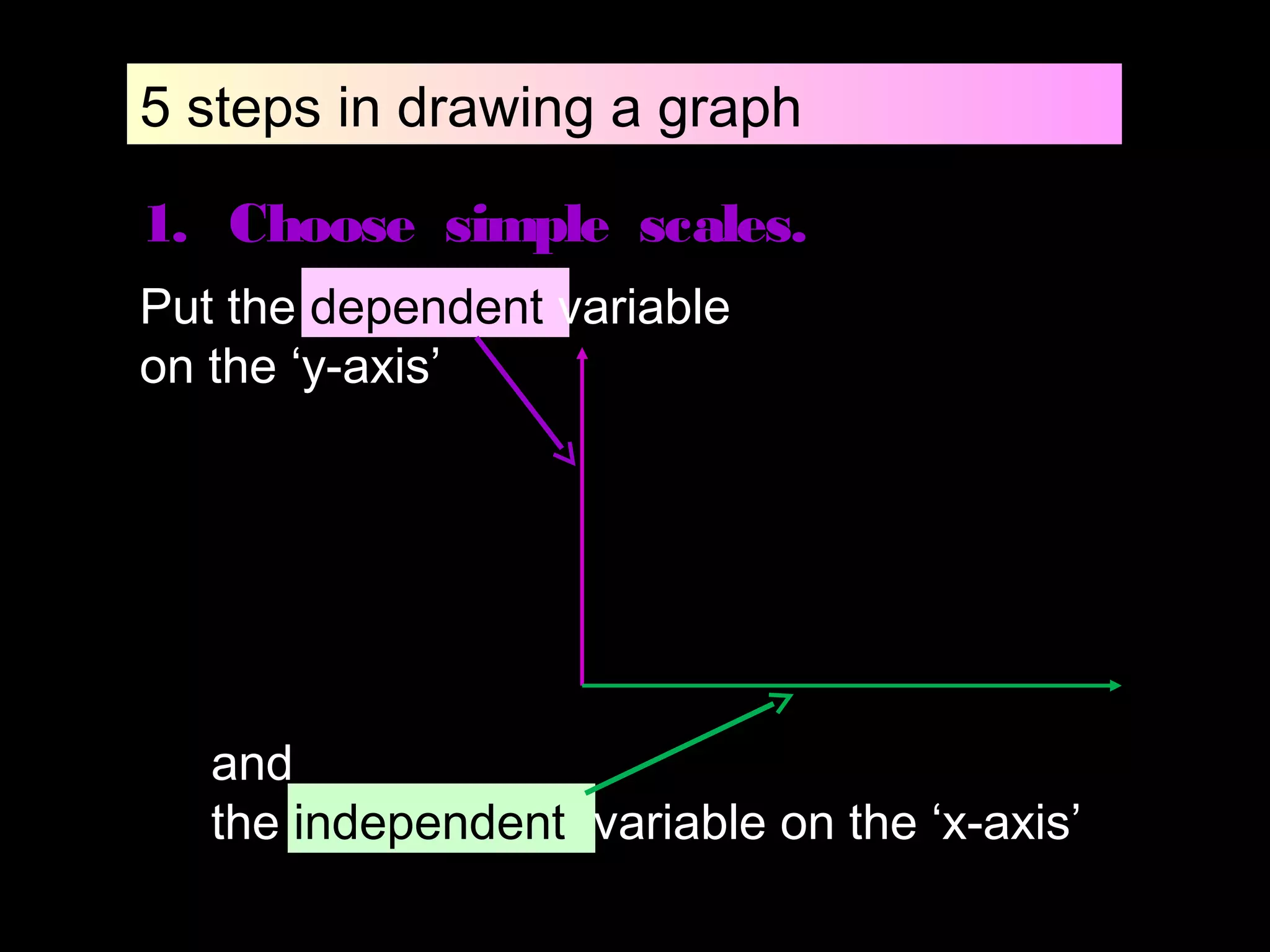
Put the dependent variable
on the ‘y-axis’
and
the independent variable on the ‘x-axis’
5 steps in drawing a graph
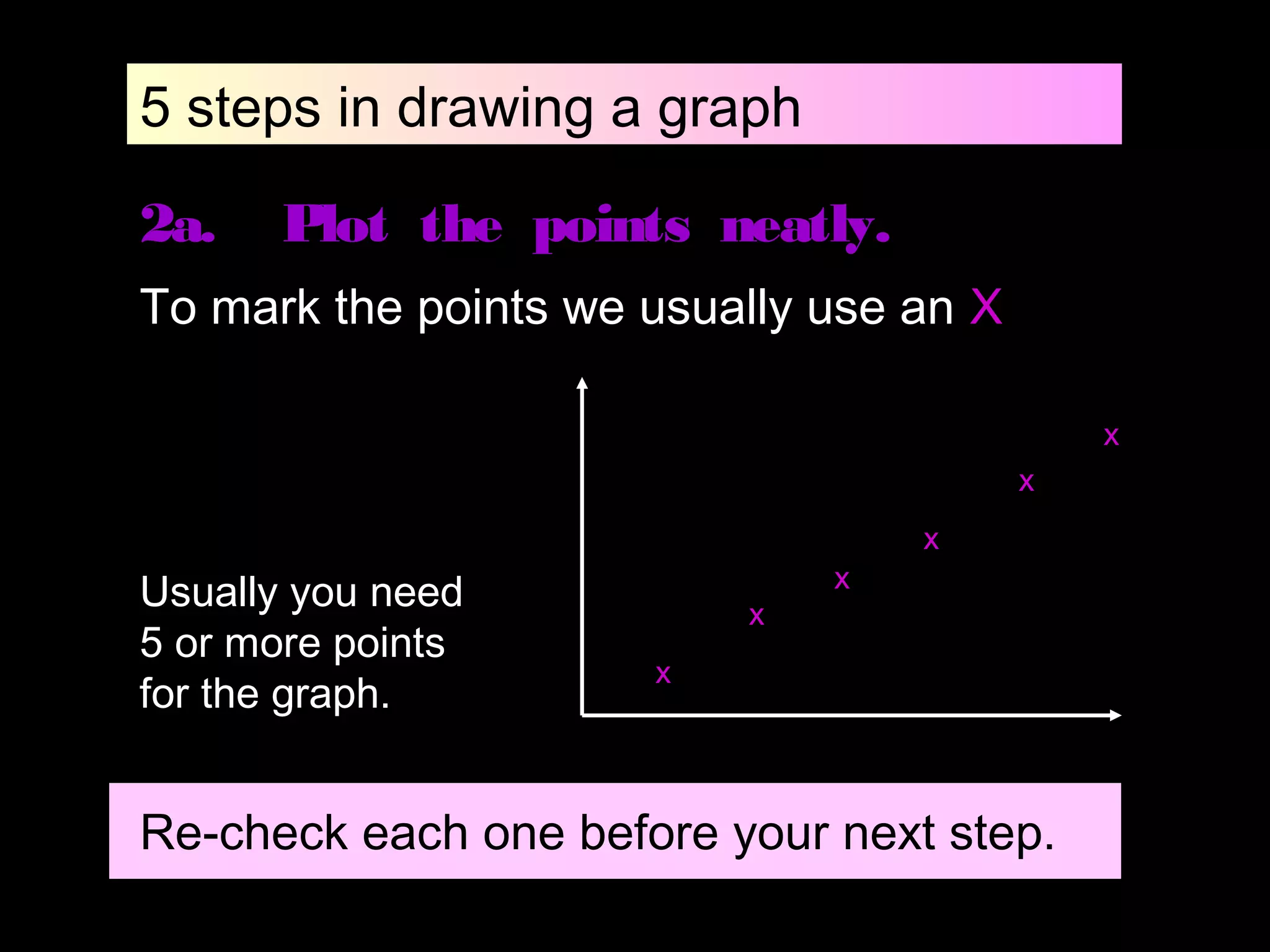
2a. Plot the points neatly.
To mark the points we usually use an X
x
x
x
x
x
x
Re-check each one before your next step.
Usually you need
5 or more points
for the graph.
5 steps in drawing a graph
2b. Alternative plotting.
•To mark the points we can also use a dot in a circle .
Re-check each one before your next step.
•Make sure the dot
is very small and
the circle has a
diameter no
greater than 2mm
5 steps in drawing a graph
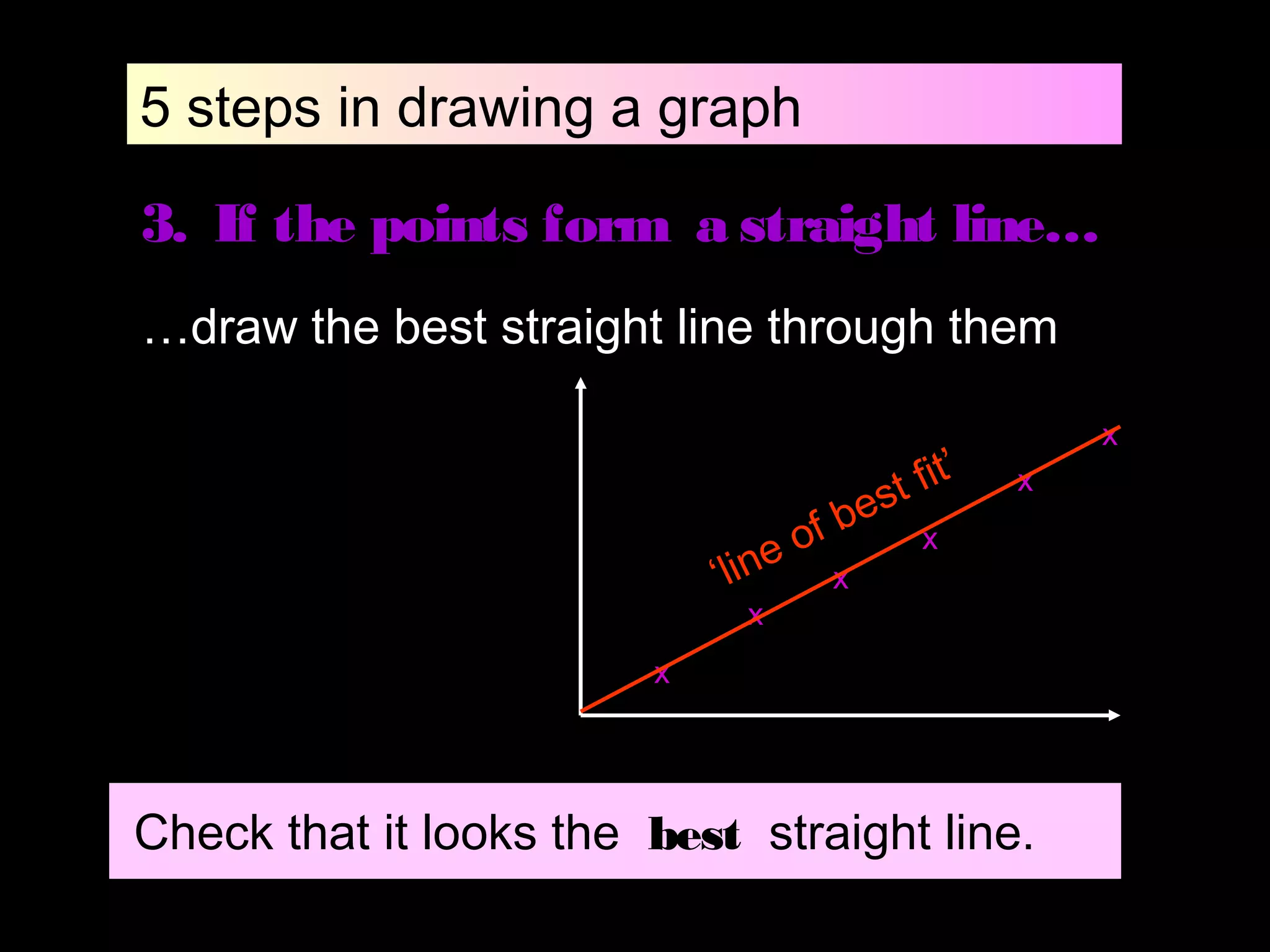
3. If the points form a straight line…
…draw the best straight line through them
x
x
x
x
x
x
Check that it looks the best straight line.
‘line of best fit’
5 steps in drawing a graph
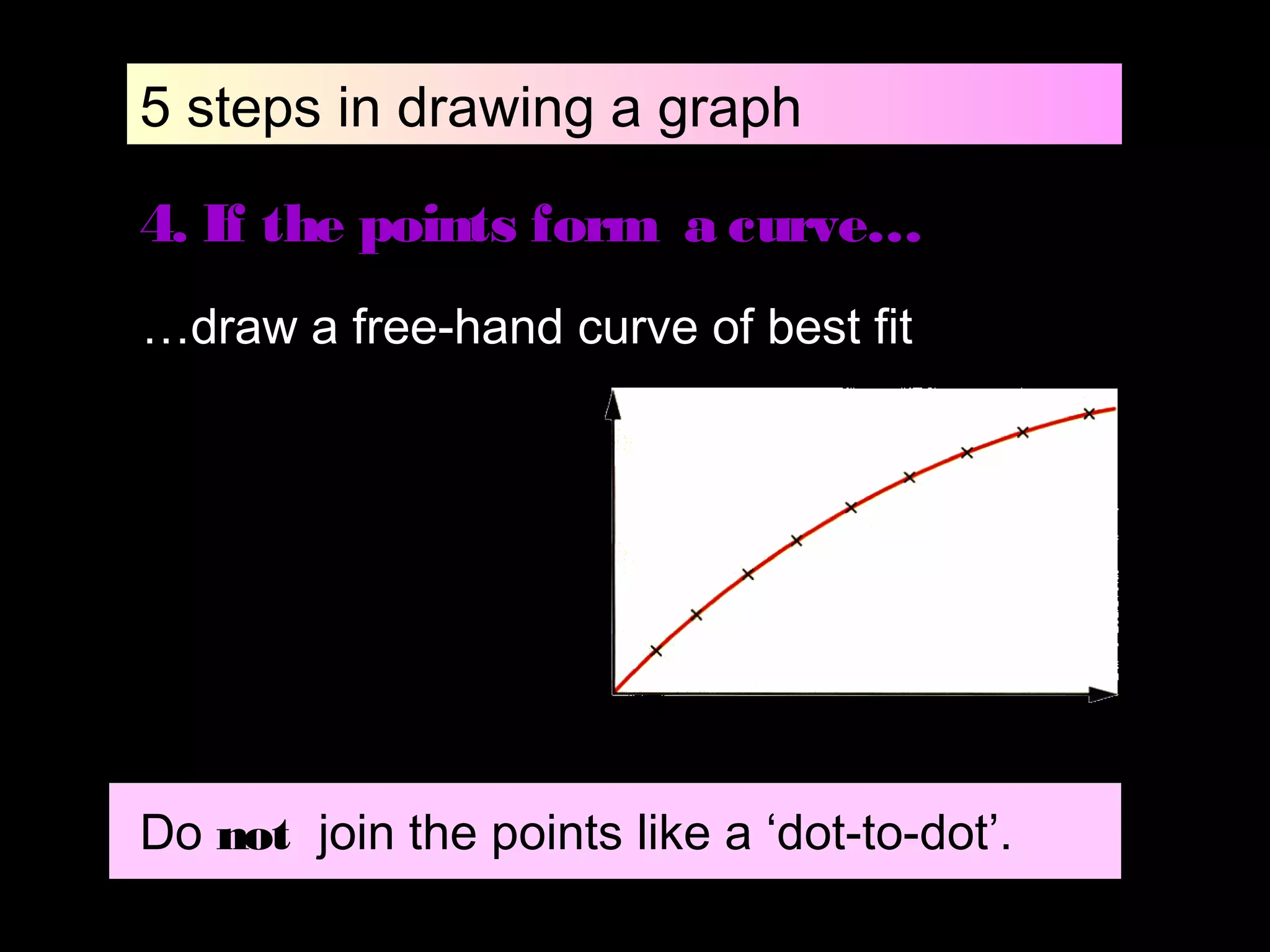
4. If the points form a curve…
…draw a free-hand curve of best fit
Do not join the points like a ‘dot-to-dot’.
5 steps in drawing a graph
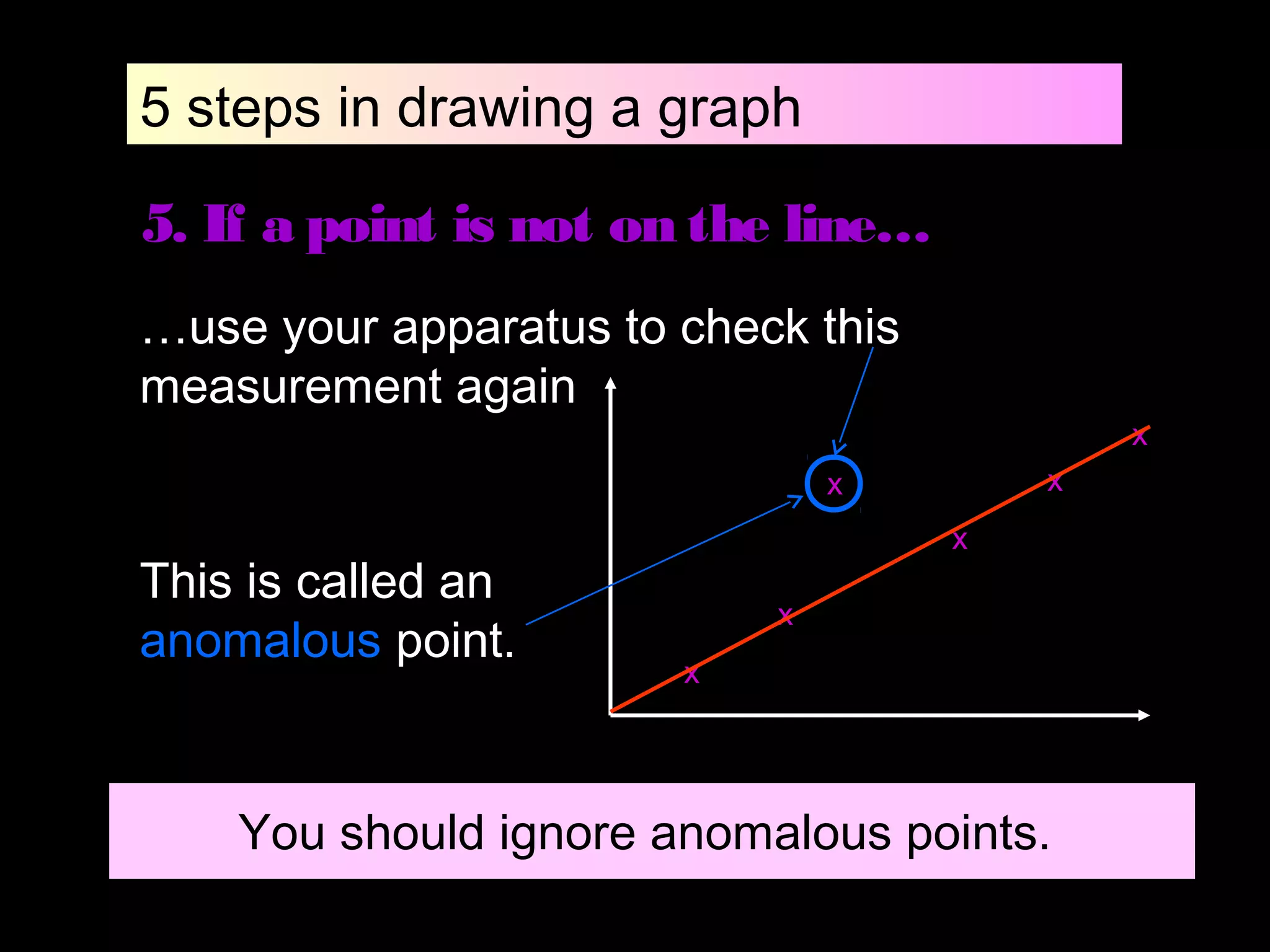
5. If a point is not on the line…
…use your apparatus to check this
measurement again
You should ignore anomalous points.
This is called an
anomalous point.
x
x
x
x
x
x
5 steps in drawing a graph
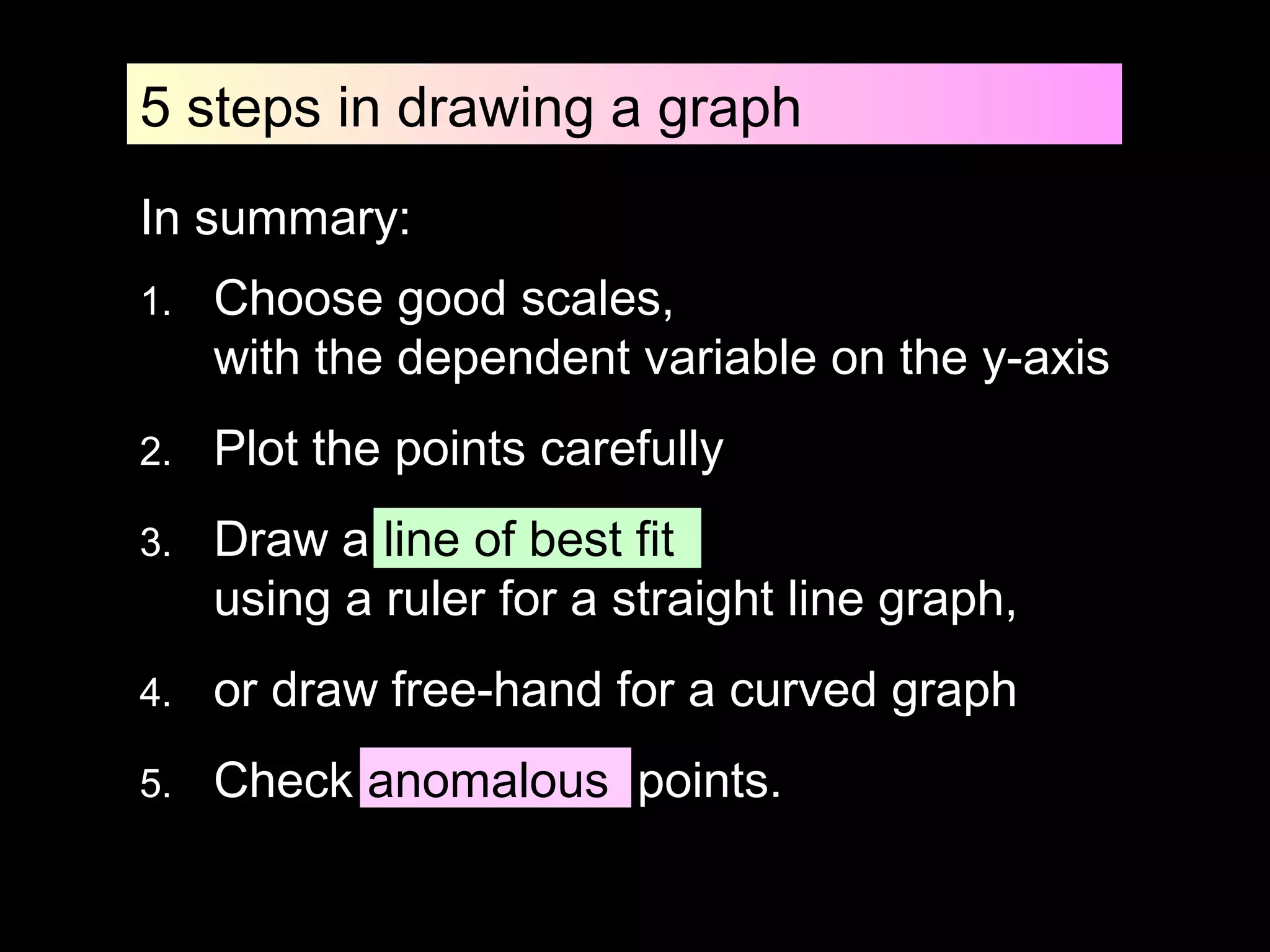
In summary:
1. Choose good scales,
with the dependent variable on the y-axis
2. Plot the points carefully
3. Draw a line of best fit
using a ruler for a straight line graph,
4. or draw free-hand for a curved graph
5. Check anomalous points.
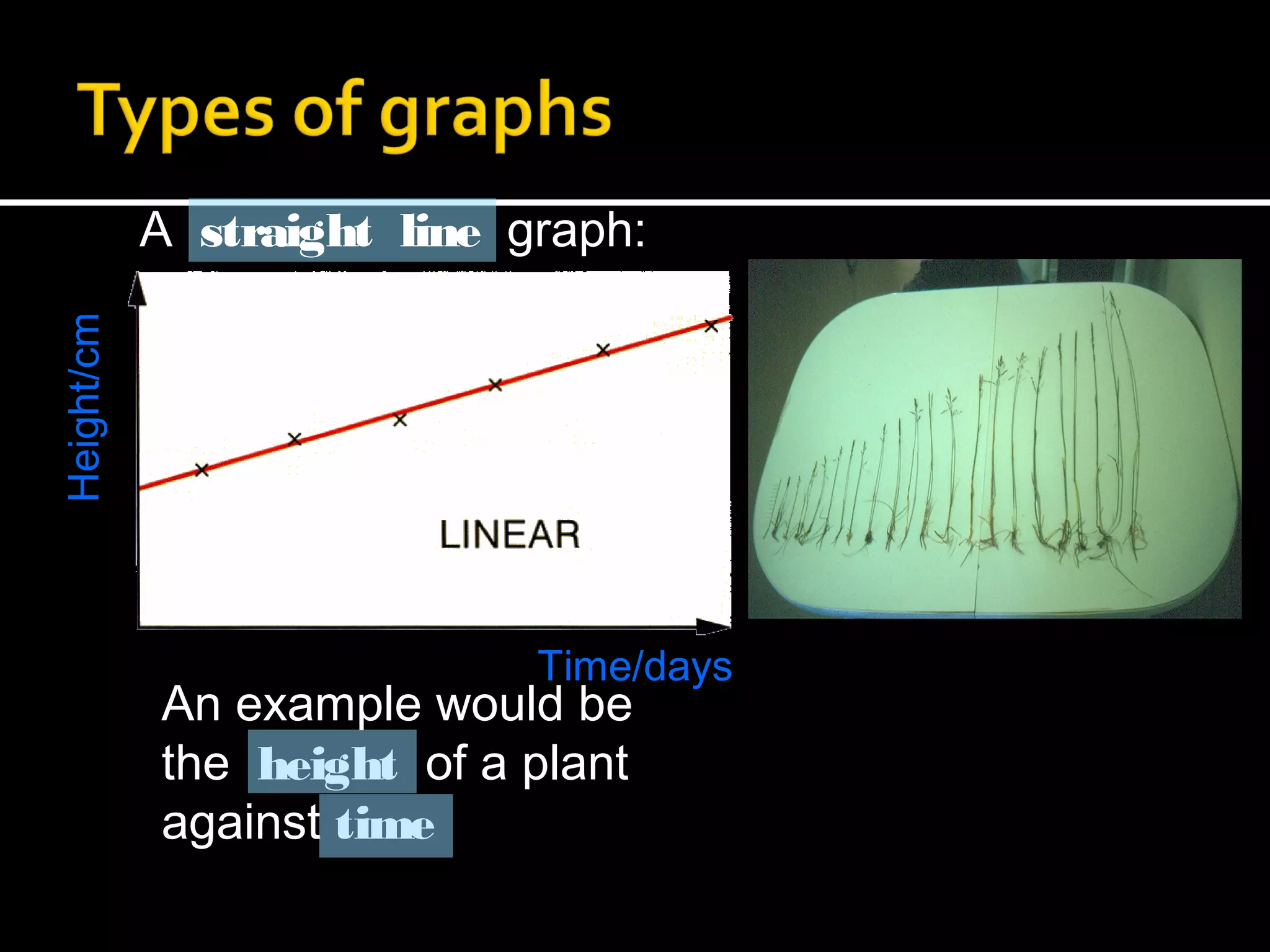
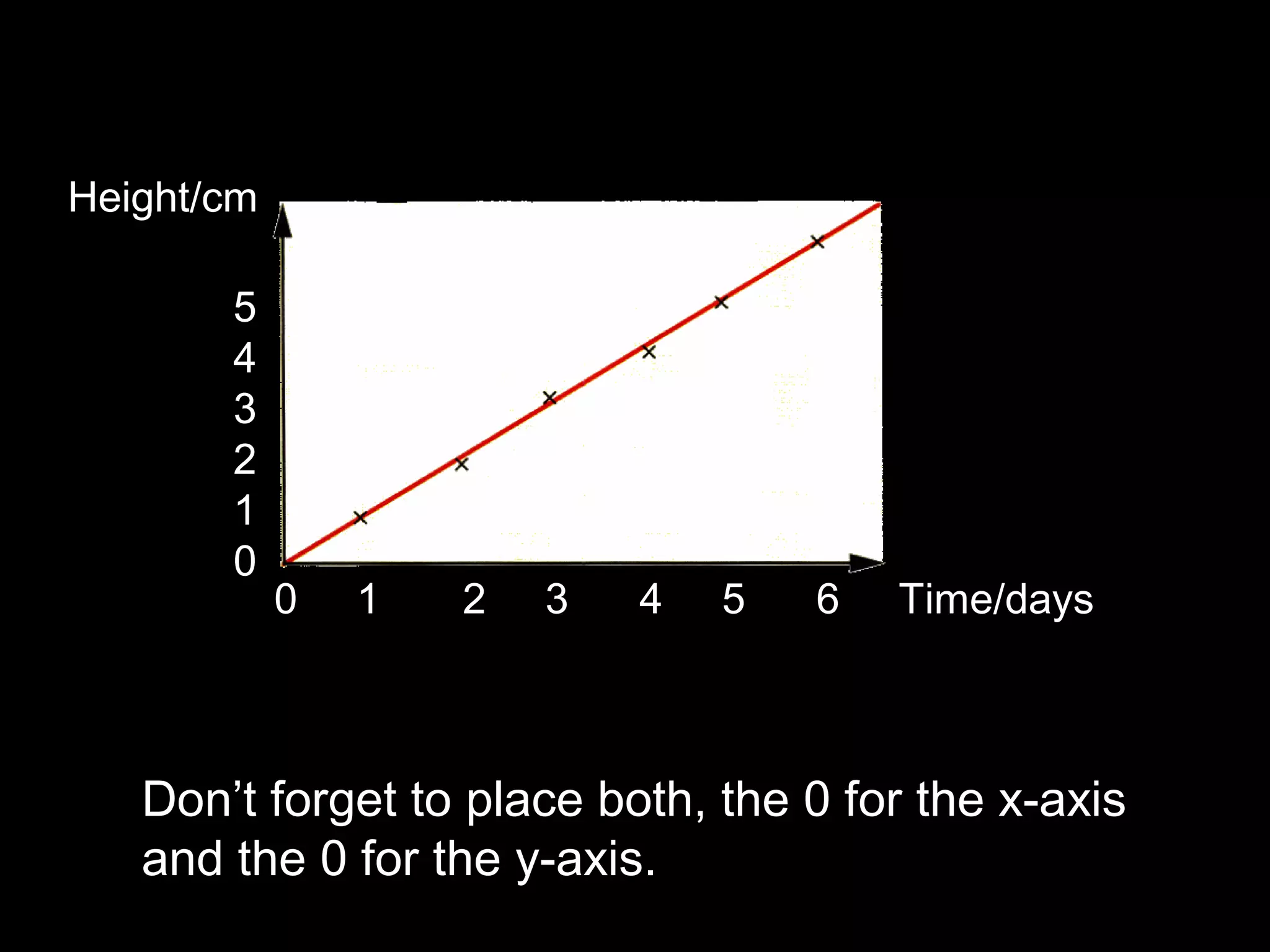
An example would be
the height of a plant
against time
A straight line graph:
Time/days
Height/cm
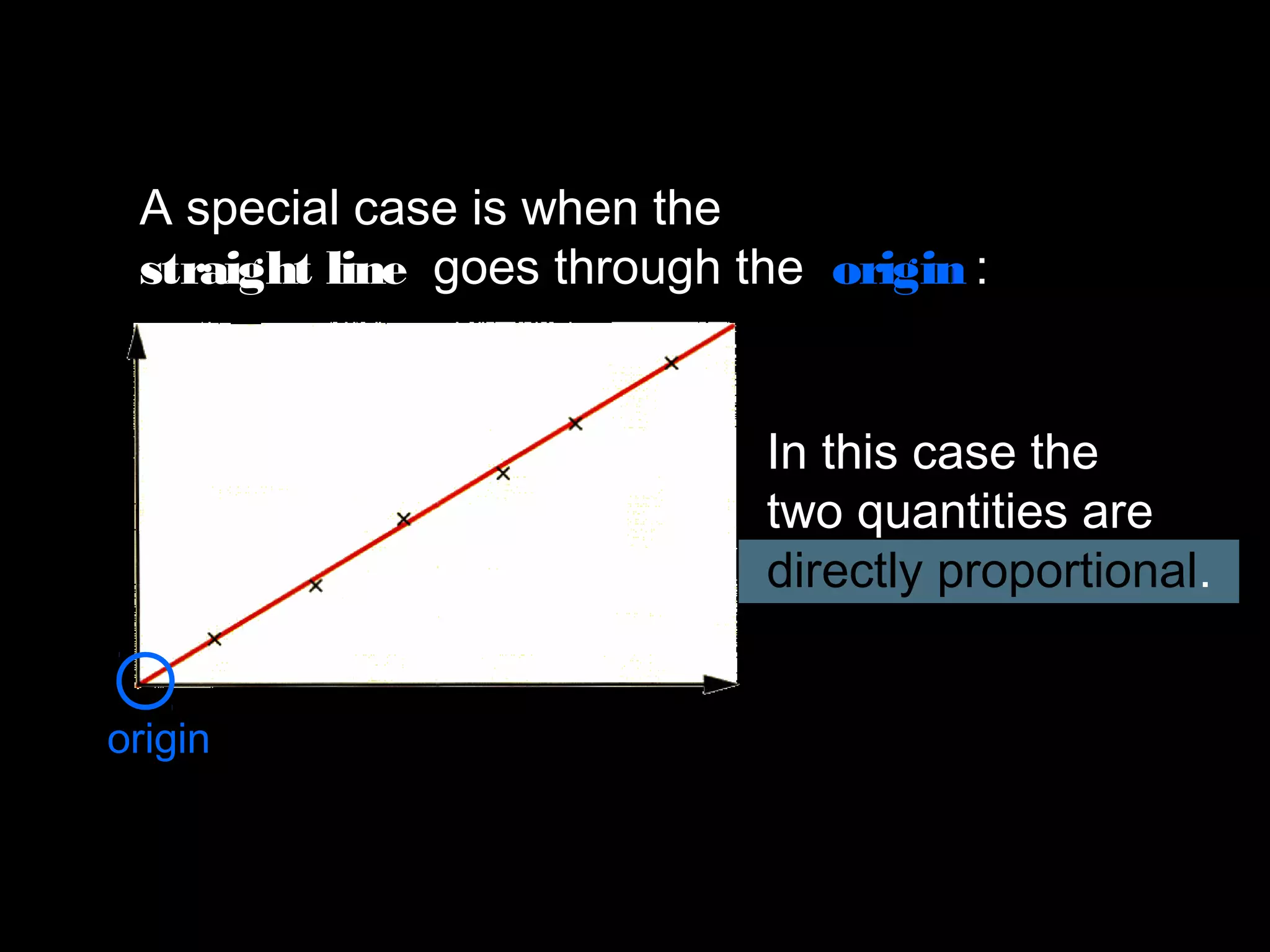
A special case is when the
straight line goes through the origin :
origin
In this case the
two quantities are
directly proportional.
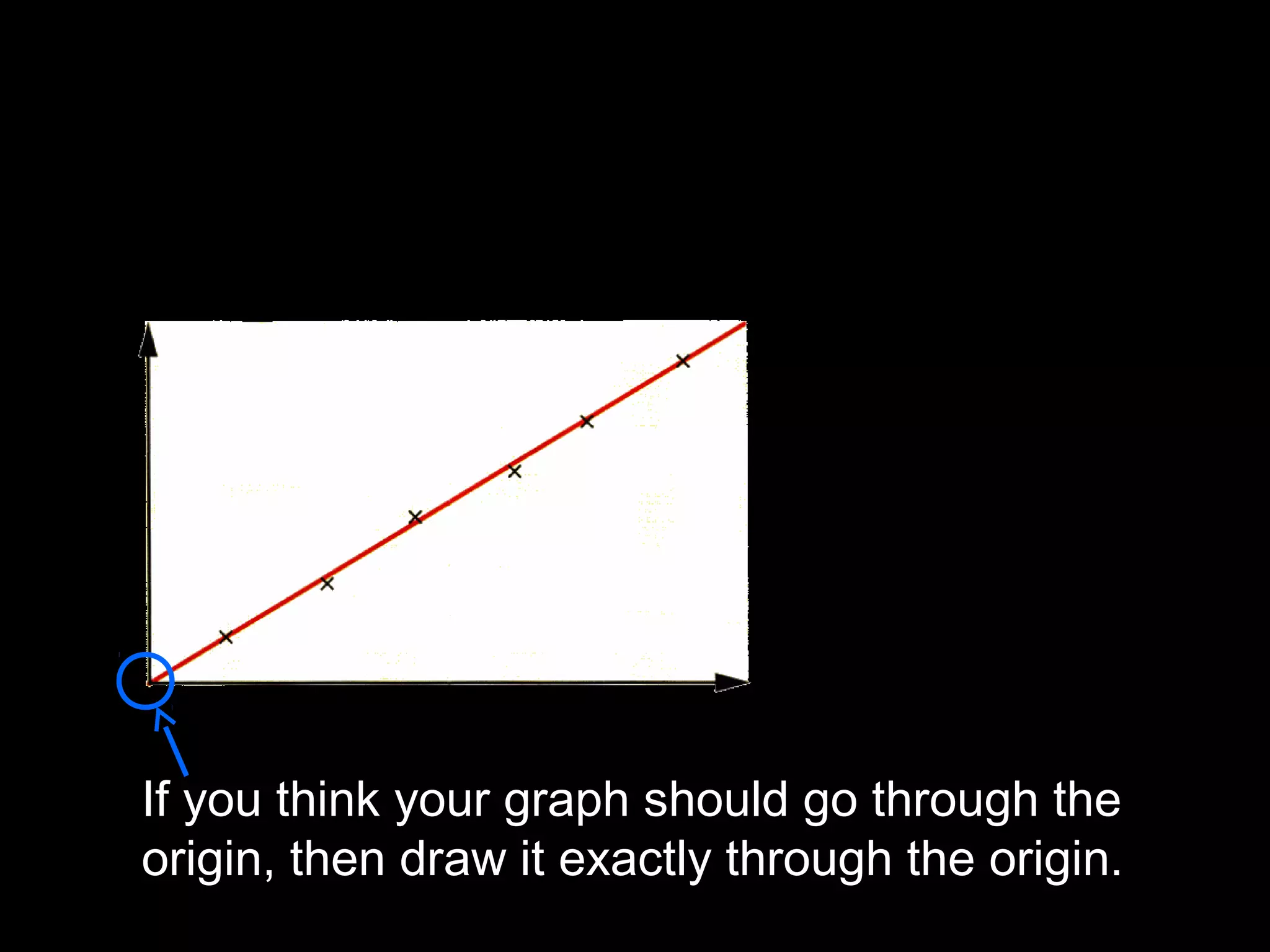
If you think your graph should go through the
origin, then draw it exactly through the origin.
Don’t forget to place both, the 0 for the x-axis
and the 0 for the y-axis.
0 1 2 3 4 5 6 Time/days
Height/cm
5
4
3
2
1
0
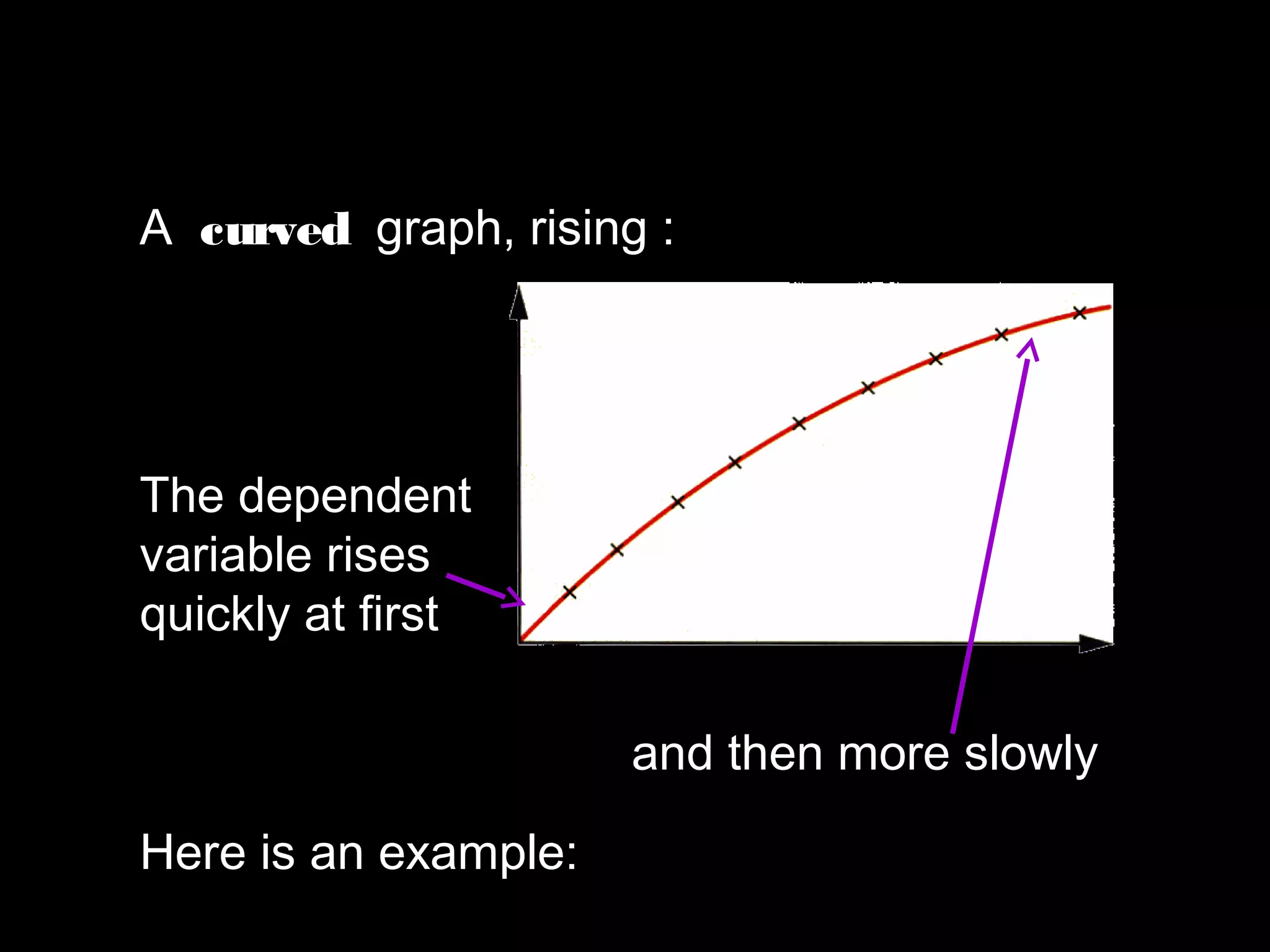
A curved graph, rising :
The dependent
variable rises
quickly at first
and then more slowly
Here is an example:
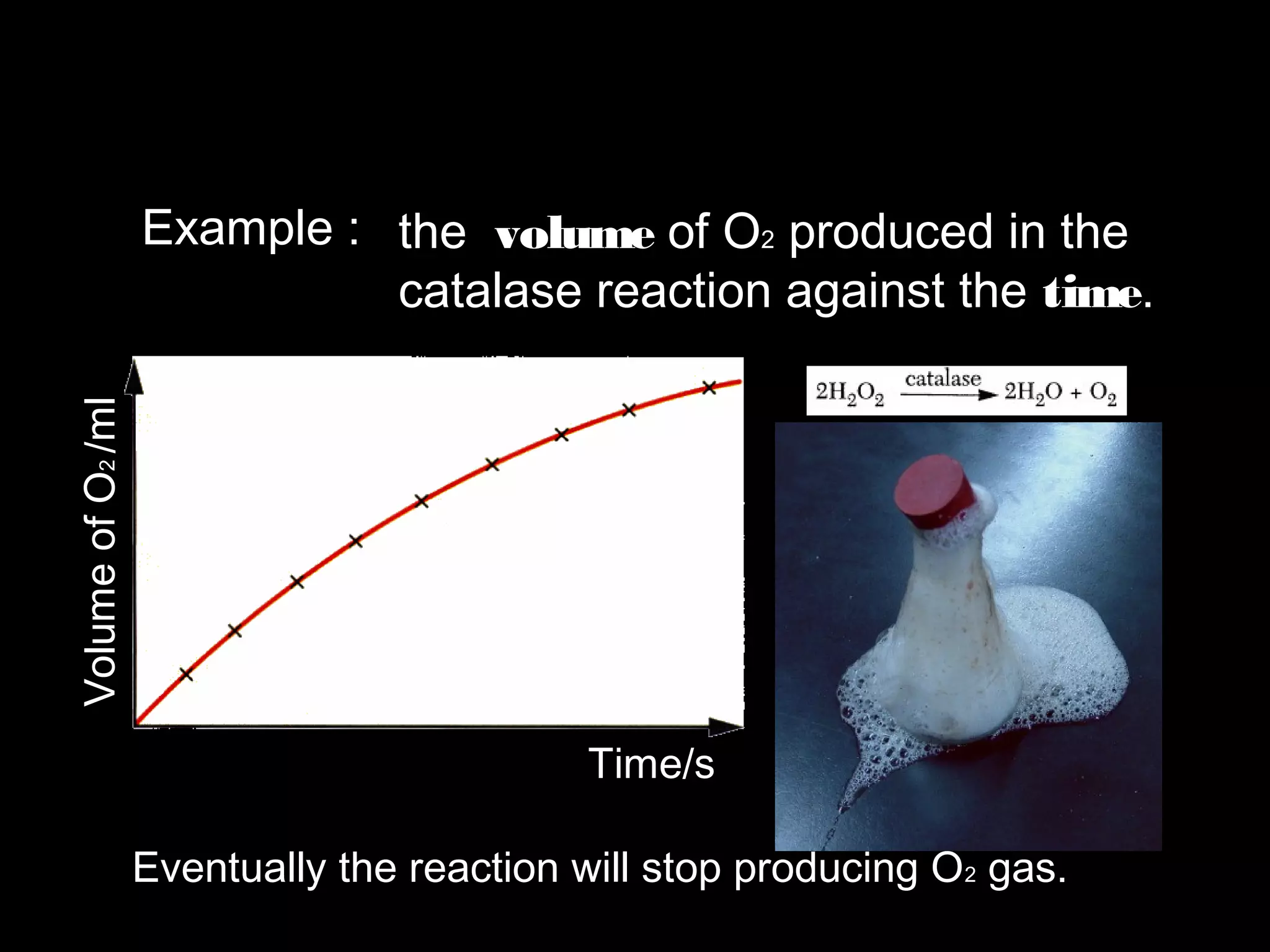
Example : the volume of O2 produced in the
catalase reaction against the time.
VolumeofO2/ml
Time/s
Eventually the reaction will stop producing O2 gas.
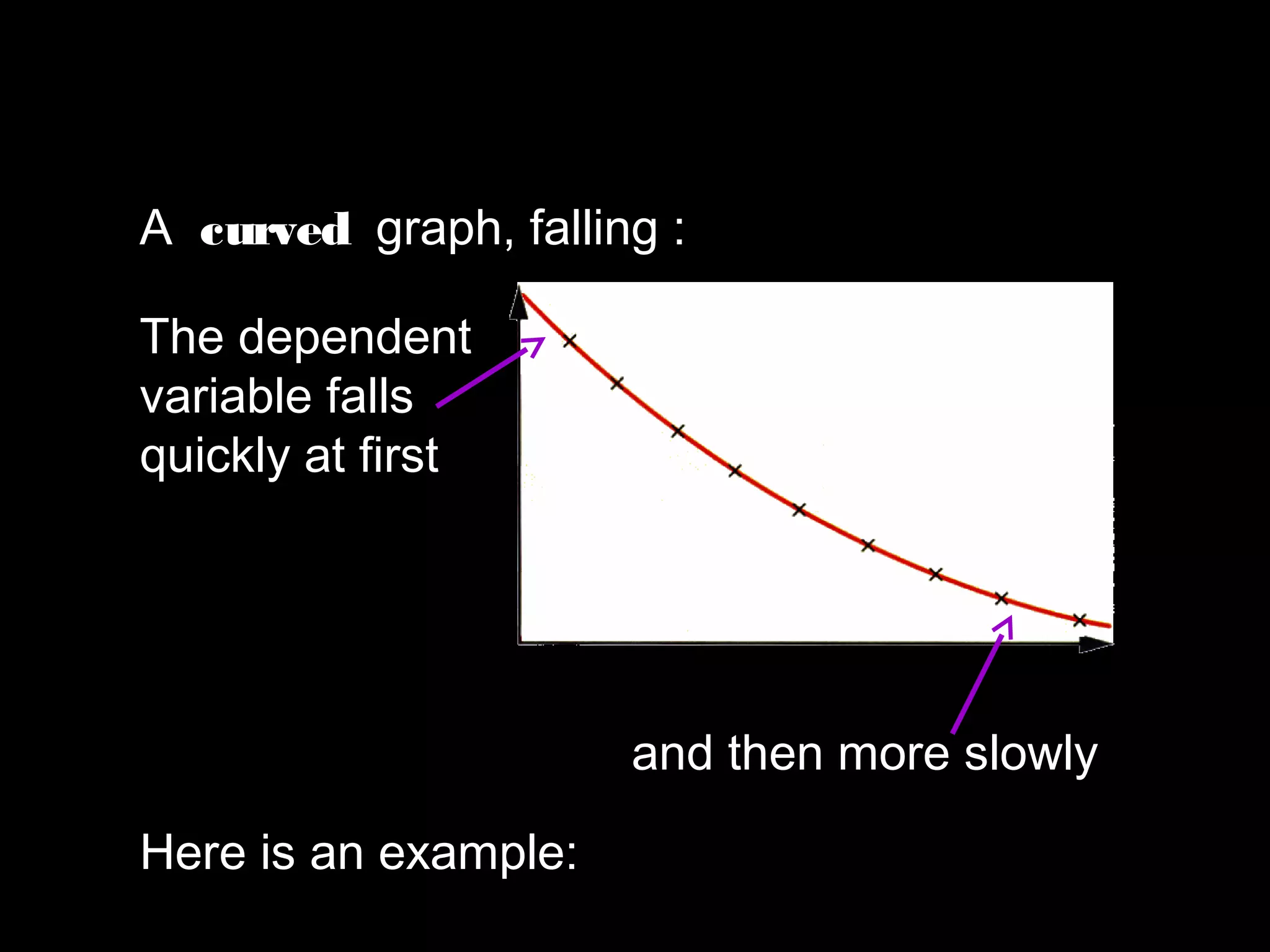
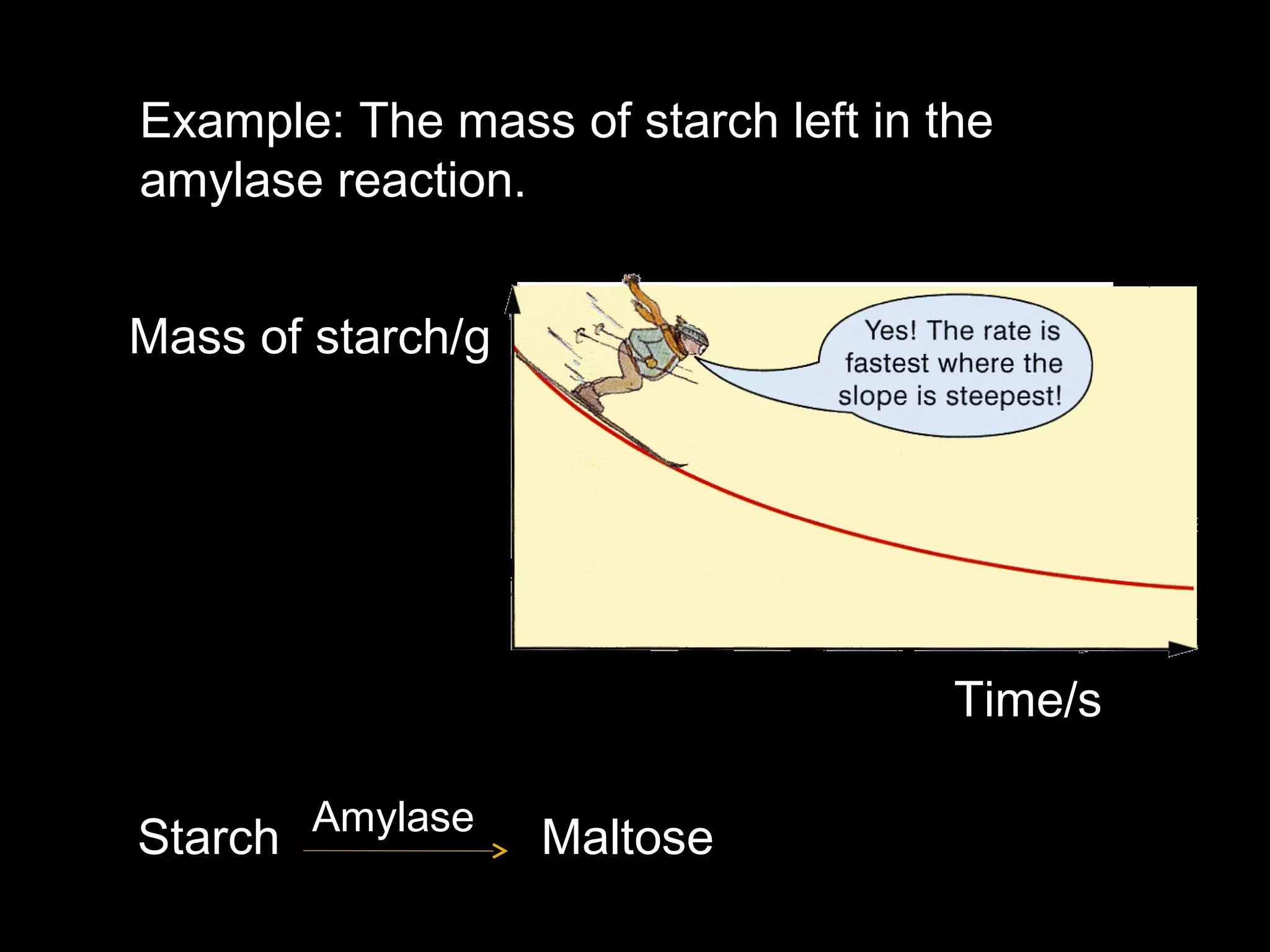
A curved graph, falling :
The dependent
variable falls
quickly at first
and then more slowly
Here is an example:
Example: The mass of starch left in the
amylase reaction.
Mass of starch/g
Time/s
Starch MaltoseAmylase
• Know how to draw a line-graph correctly,
• Be able to give examples of graphs
with different shapes,
• Be able to interpret graphs with
different shapes.
Learning Outcomes
You should now:

All about drawing Graphs

  • 1.
  • 2.
    • About differenttypes of graphs, • How to draw them when you are doing your practical work, • How to interpret the different shapes. Learning Objectives You should learn :
  • 3.
    Drawing a graph Whenshould I draw a line-graph…? …and when should I draw a bar-graph…? …and when should I draw a histogram or circle graph?
  • 4.
    Drawing a graph Lookat the table of your results: If this column has • Many continuous ranges of values, use a histogram: • Continuous values, use a line-graph:
  • 5.
    • Fixed itemsthat are usually not numerical, Use a bar graph: • Percentage of any kind, Use a circle graph
  • 6.
    Drawing a graph Whatis the best way to draw a line-graph?
  • 7.
    5 steps indrawing a graph 1. Choose simple scales. For example: 1 large square = 1 meter (1 m) or 1 large square = 2 m, or 5 m, or 10 m But never choose an awkward scale, like 1 square = 3 m or 7 m Choose a scale that will make your graph use most of the space available.
  • 8.
    5 steps indrawing a graph 1. Choose simple scales. Put the dependent variable on the ‘y-axis’ and the independent variable on the ‘x-axis’
  • 9.
    5 steps indrawing a graph 2a. Plot the points neatly. To mark the points we usually use an X x x x x x x Re-check each one before your next step. Usually you need 5 or more points for the graph.
  • 10.
    5 steps indrawing a graph 2b. Alternative plotting. •To mark the points we can also use a dot in a circle . Re-check each one before your next step. •Make sure the dot is very small and the circle has a diameter no greater than 2mm
  • 11.
    5 steps indrawing a graph 3. If the points form a straight line… …draw the best straight line through them x x x x x x Check that it looks the best straight line. ‘line of best fit’
  • 12.
    5 steps indrawing a graph 4. If the points form a curve… …draw a free-hand curve of best fit Do not join the points like a ‘dot-to-dot’.
  • 13.
    5 steps indrawing a graph 5. If a point is not on the line… …use your apparatus to check this measurement again You should ignore anomalous points. This is called an anomalous point. x x x x x x
  • 14.
    5 steps indrawing a graph In summary: 1. Choose good scales, with the dependent variable on the y-axis 2. Plot the points carefully 3. Draw a line of best fit using a ruler for a straight line graph, 4. or draw free-hand for a curved graph 5. Check anomalous points.
  • 15.
    An example wouldbe the height of a plant against time A straight line graph: Time/days Height/cm
  • 16.
    A special caseis when the straight line goes through the origin : origin In this case the two quantities are directly proportional.
  • 17.
    If you thinkyour graph should go through the origin, then draw it exactly through the origin.
  • 18.
    Don’t forget toplace both, the 0 for the x-axis and the 0 for the y-axis. 0 1 2 3 4 5 6 Time/days Height/cm 5 4 3 2 1 0
  • 19.
    A curved graph,rising : The dependent variable rises quickly at first and then more slowly Here is an example:
  • 20.
    Example : thevolume of O2 produced in the catalase reaction against the time. VolumeofO2/ml Time/s Eventually the reaction will stop producing O2 gas.
  • 21.
    A curved graph,falling : The dependent variable falls quickly at first and then more slowly Here is an example:
  • 22.
    Example: The massof starch left in the amylase reaction. Mass of starch/g Time/s Starch MaltoseAmylase
  • 23.
    • Know howto draw a line-graph correctly, • Be able to give examples of graphs with different shapes, • Be able to interpret graphs with different shapes. Learning Outcomes You should now: