Notes: Evolution of Complex Traits
(pg 8)
Notes: Evolution of Complex Traits
(pg 8)
• Complex Traits include structures or systems
with multiple interacting parts
Notes: Evolution of Complex Traits
(pg 8)
• Complex Traits include structures or systems
with multiple interacting parts
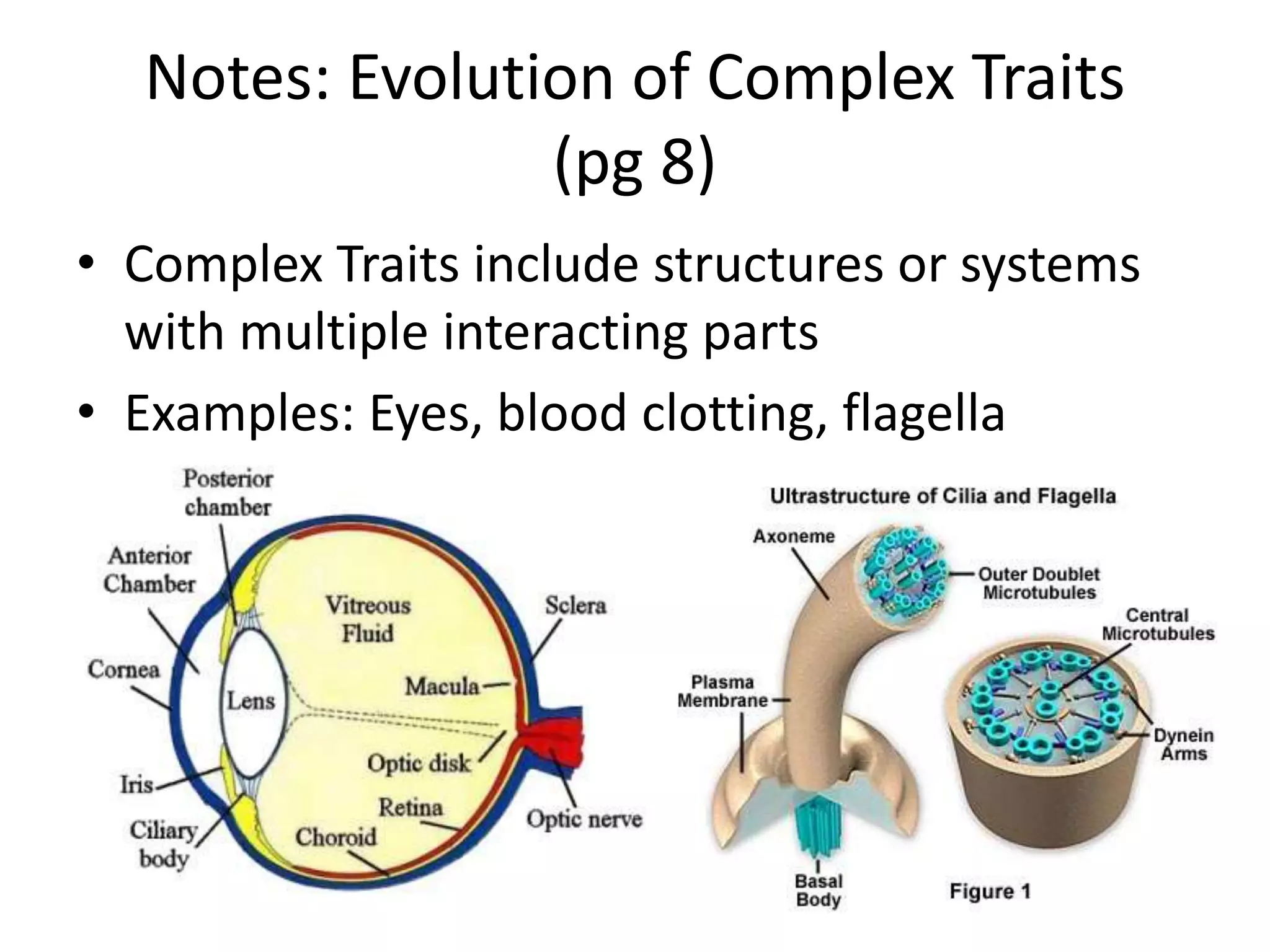
• Examples: Eyes, blood clotting, flagella
Notes: Evolution of Complex Traits
(pg 8)
• Complex Traits include structures or systems
with multiple interacting parts
• Examples: Eyes, blood clotting, flagella
• Opponents of evolution say that some traits
are “irreducibly complex” and could not have
evolved through small changes
• Opponents of evolution say that some traits
are “irreducibly complex” and could not have
evolved through small changes
• However, biologists have shown that this is
not true
Evolution can produce very complex traits
because:
Evolution can produce very complex traits
because:
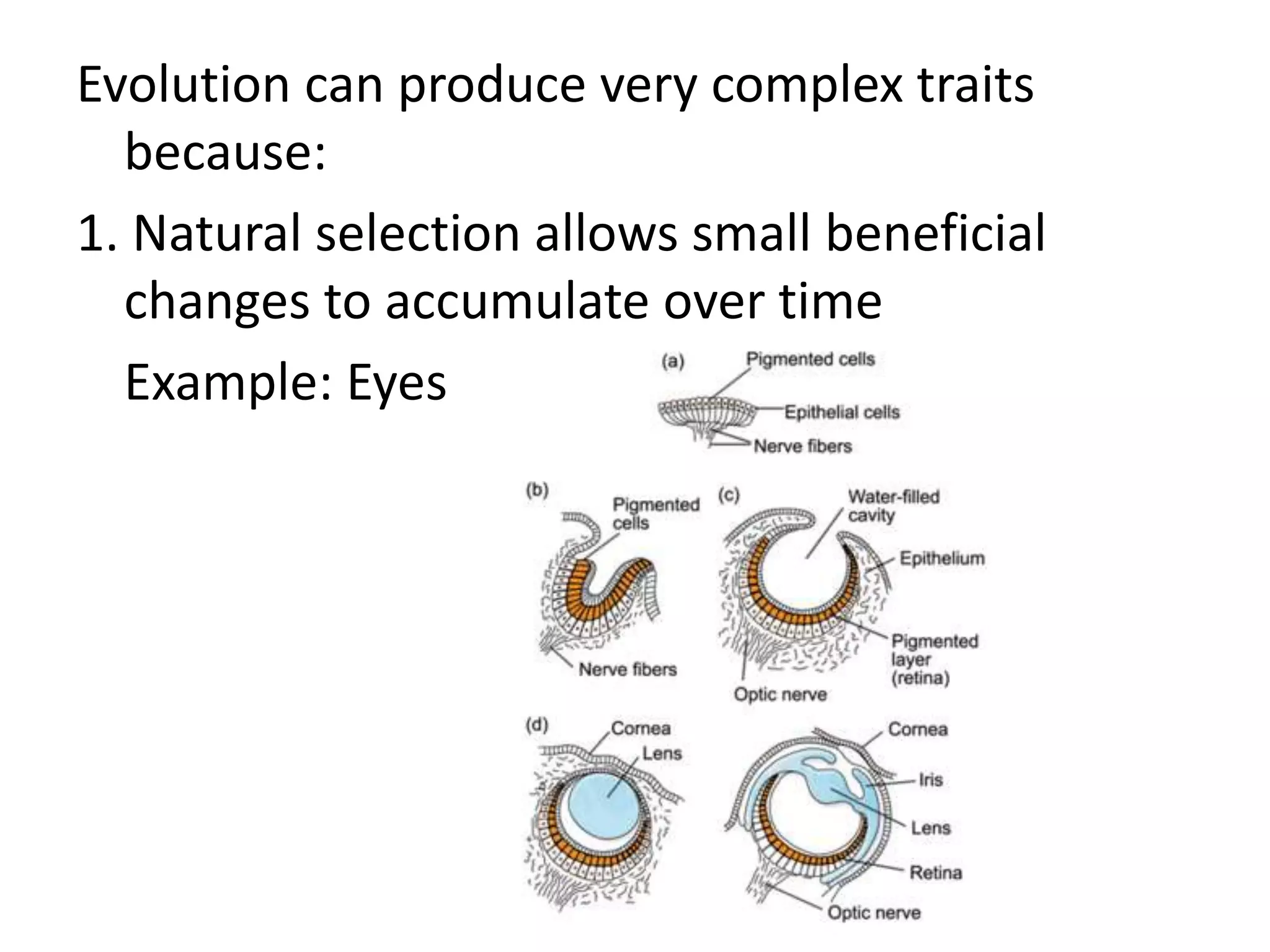
1. Natural selection allows small beneficial
changes to accumulate over time
Evolution can produce very complex traits
because:
1. Natural selection allows small beneficial
changes to accumulate over time
Example: Eyes
Evolution can produce very complex traits
because:
1. Natural selection allows small beneficial
changes to accumulate over time
Example: Eyes
2. Traits may have had a different function in the
past
Evolution can produce very complex traits
because:
1. Natural selection allows small beneficial
changes to accumulate over time
Example: Eyes
2. Traits may have had a different function in the
past
Example: Lungs (for breathing) evolved from
swim bladders (for floatation)

Evolution of complex traits

  • 1.
    Notes: Evolution ofComplex Traits (pg 8)
  • 2.
    Notes: Evolution ofComplex Traits (pg 8) • Complex Traits include structures or systems with multiple interacting parts
  • 3.
    Notes: Evolution ofComplex Traits (pg 8) • Complex Traits include structures or systems with multiple interacting parts • Examples: Eyes, blood clotting, flagella
  • 4.
    Notes: Evolution ofComplex Traits (pg 8) • Complex Traits include structures or systems with multiple interacting parts • Examples: Eyes, blood clotting, flagella
  • 5.
    • Opponents ofevolution say that some traits are “irreducibly complex” and could not have evolved through small changes
  • 6.
    • Opponents ofevolution say that some traits are “irreducibly complex” and could not have evolved through small changes • However, biologists have shown that this is not true
  • 7.
    Evolution can producevery complex traits because:
  • 8.
    Evolution can producevery complex traits because: 1. Natural selection allows small beneficial changes to accumulate over time
  • 9.
    Evolution can producevery complex traits because: 1. Natural selection allows small beneficial changes to accumulate over time Example: Eyes
  • 10.
    Evolution can producevery complex traits because: 1. Natural selection allows small beneficial changes to accumulate over time Example: Eyes 2. Traits may have had a different function in the past
  • 11.
    Evolution can producevery complex traits because: 1. Natural selection allows small beneficial changes to accumulate over time Example: Eyes 2. Traits may have had a different function in the past Example: Lungs (for breathing) evolved from swim bladders (for floatation)