OBJECTIVESOBJECTIVES What is a graph?What is a graph? Different types of graphsDifferent types of graphs Line of best fitLine of best fit QUIZQUIZINTRODUCTIONINTRODUCTION
XX
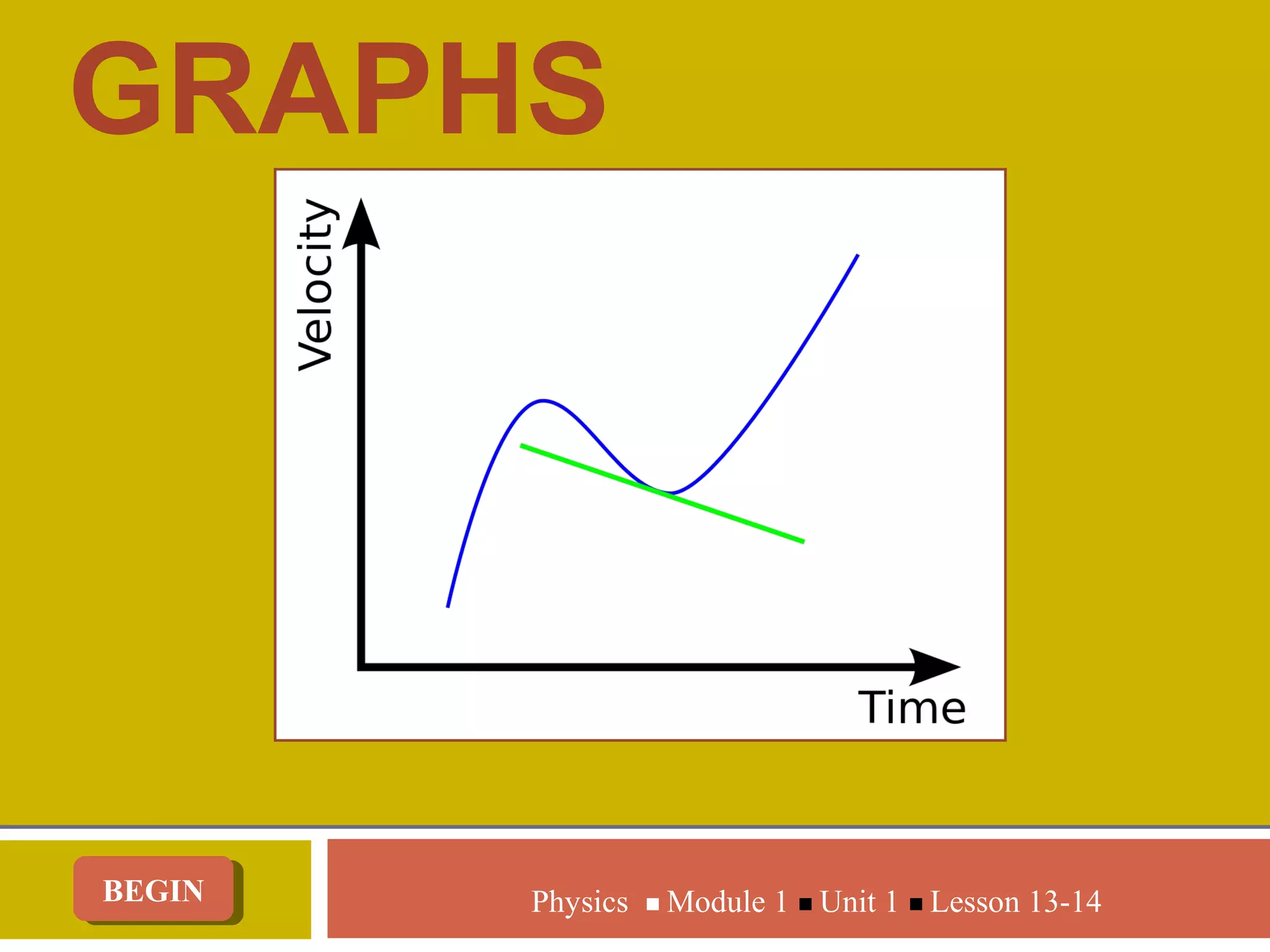
GRAPHS
Physics  Module 1  Unit 1  Lesson 13-14BEGINBEGIN
OBJECTIVESOBJECTIVES What is a graph?What is a graph? Different types of graphsDifferent types of graphs Line of best fitLine of best fit QUIZQUIZINTRODUCTIONINTRODUCTION
XX
Introduction
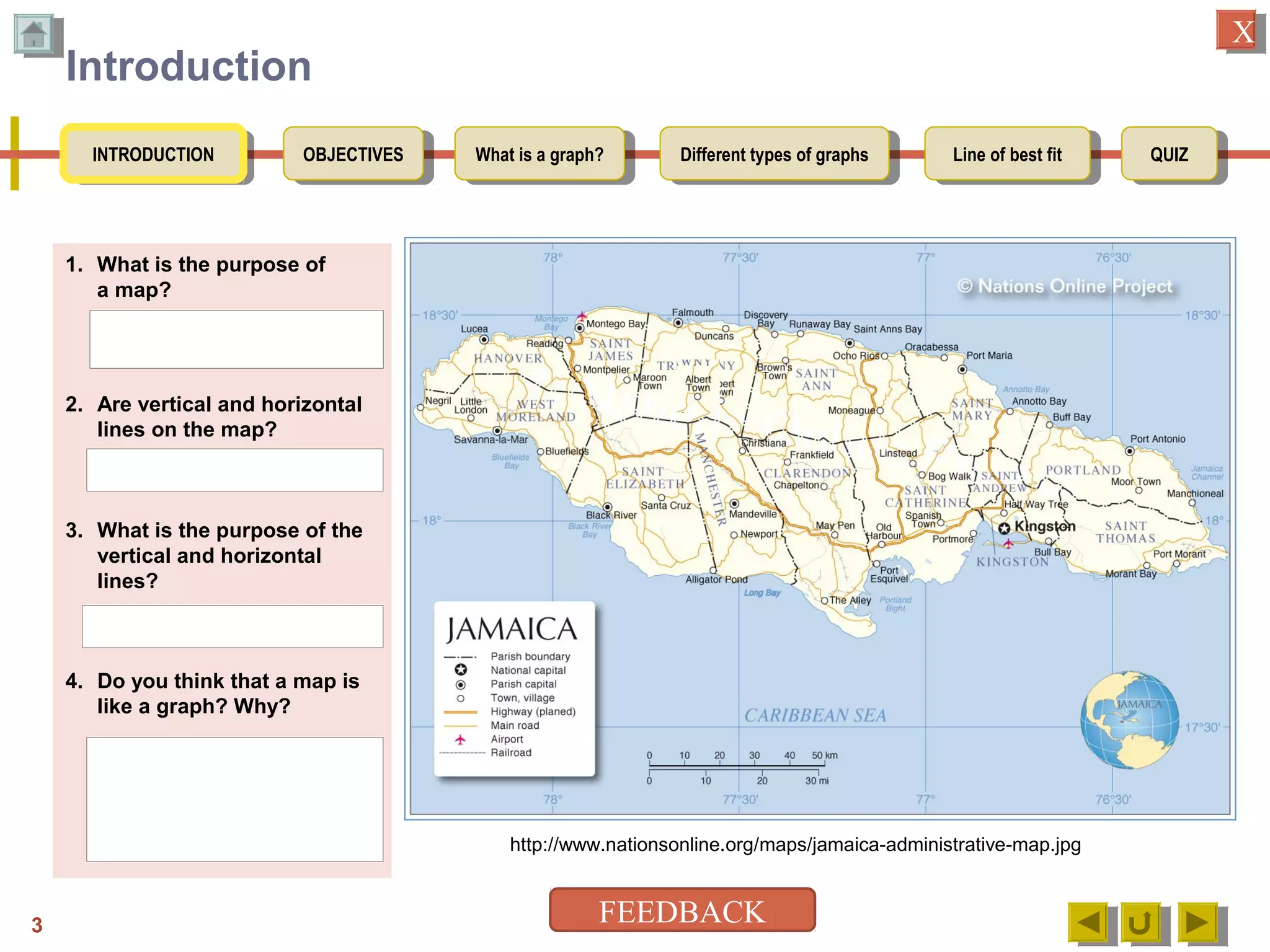
http://www.nationsonline.org/maps/jamaica-administrative-map.jpg
FEEDBACK3
1. What is the purpose of
a map?
2. Are vertical and horizontal
lines on the map?
3. What is the purpose of the
vertical and horizontal
lines?
4. Do you think that a map is
like a graph? Why?
OBJECTIVESOBJECTIVES What is a graph?What is a graph? Different types of graphsDifferent types of graphs Line of best fitLine of best fit QUIZQUIZINTRODUCTIONINTRODUCTION
XX
Introduction
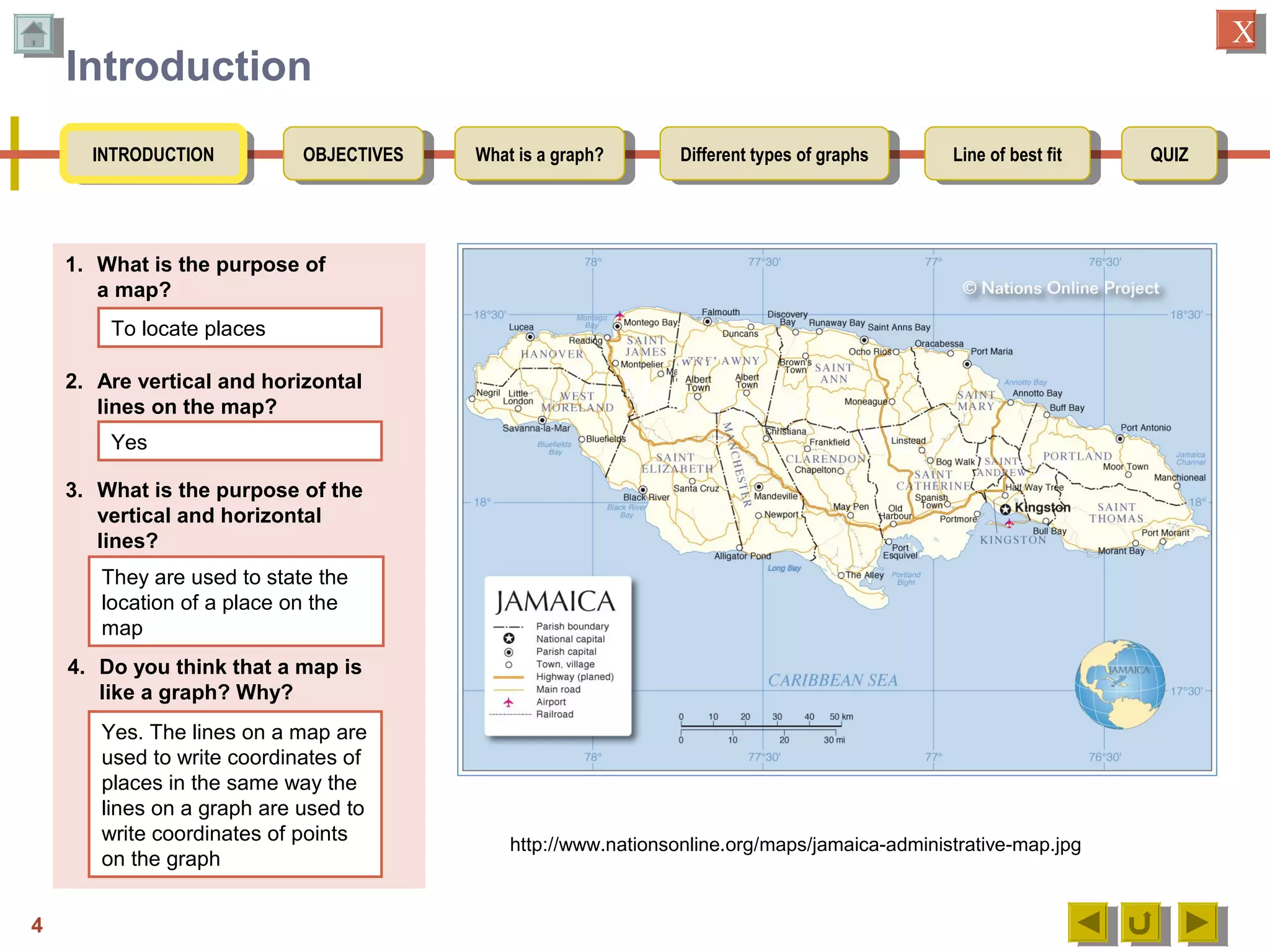
http://www.nationsonline.org/maps/jamaica-administrative-map.jpg
4
1. What is the purpose of
a map?
2. Are vertical and horizontal
lines on the map?
3. What is the purpose of the
vertical and horizontal
lines?
4. Do you think that a map is
like a graph? Why?
To locate places
Yes
They are used to state the
location of a place on the
map
Yes. The lines on a map are
used to write coordinates of
places in the same way the
lines on a graph are used to
write coordinates of points
on the graph
OBJECTIVESOBJECTIVES What is a graph?What is a graph? Different types of graphsDifferent types of graphs Line of best fitLine of best fit QUIZQUIZINTRODUCTIONINTRODUCTION
XX
Objectives
At the end of this lesson, you will be able to the following:
1. State what is a coordinate grid (Cartesian plane) and a graph.
2. Explain what is an experimental graph.
3. Distinguish between independent and dependent variables.
4. Apply the required rules for plotting experimental graphs.
5. Identify different types of experimental graphs that are commonly found in
physics.
5
OBJECTIVESOBJECTIVES What is a graph?What is a graph? Different types of graphsDifferent types of graphs Line of best fitLine of best fit QUIZQUIZINTRODUCTIONINTRODUCTION
XX
1. What is a Cartesian plane? What is a graph?
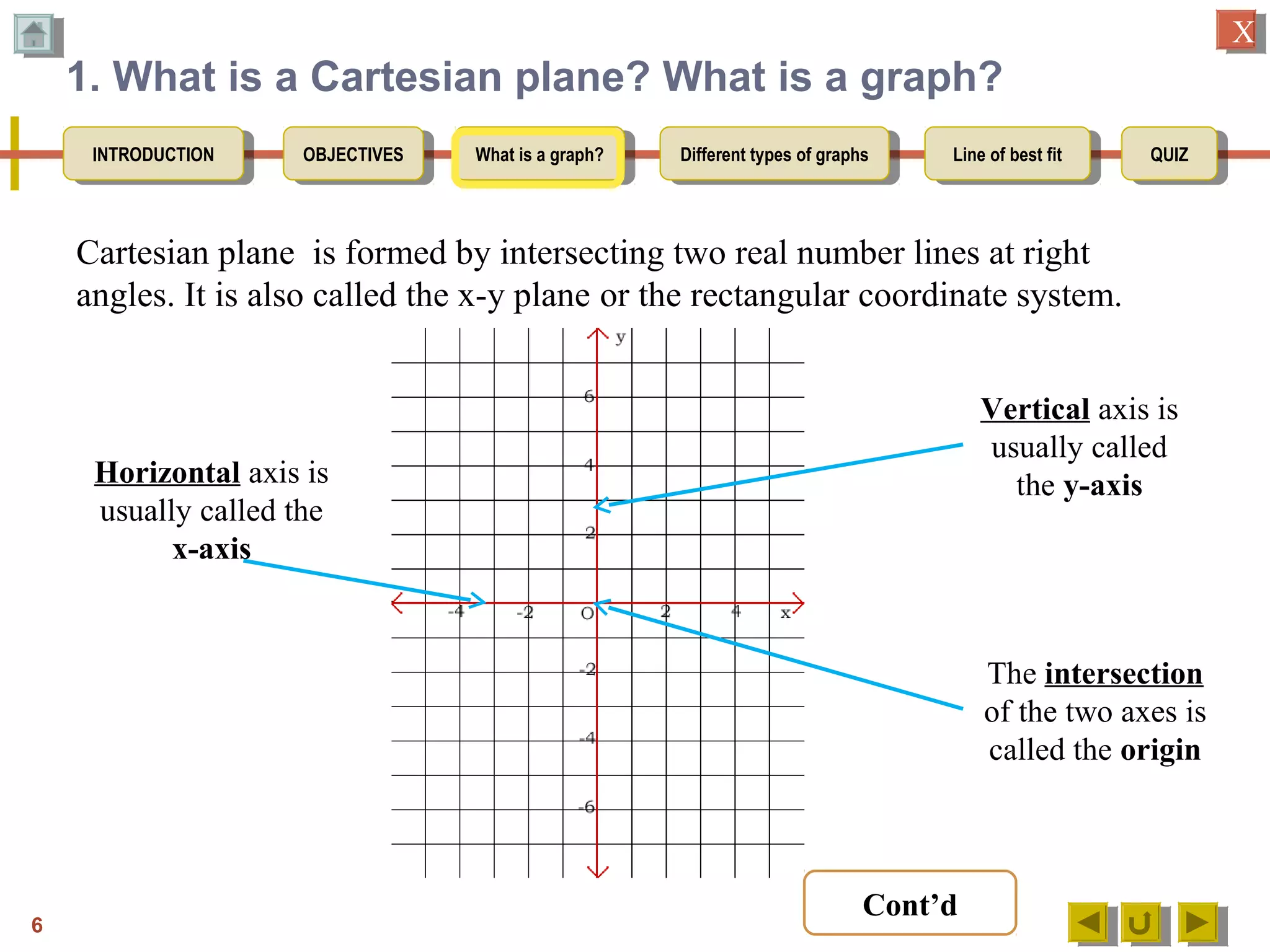
Cartesian plane is formed by intersecting two real number lines at right
angles. It is also called the x-y plane or the rectangular coordinate system.
Horizontal axis is
usually called the
x-axis
Vertical axis is
usually called
the y-axis
The intersection
of the two axes is
called the origin
6
Cont’d
OBJECTIVESOBJECTIVES What is a graph?What is a graph? Different types of graphsDifferent types of graphs Line of best fitLine of best fit QUIZQUIZINTRODUCTIONINTRODUCTION
XX
1. What is a Cartesian plane? What is a graph?
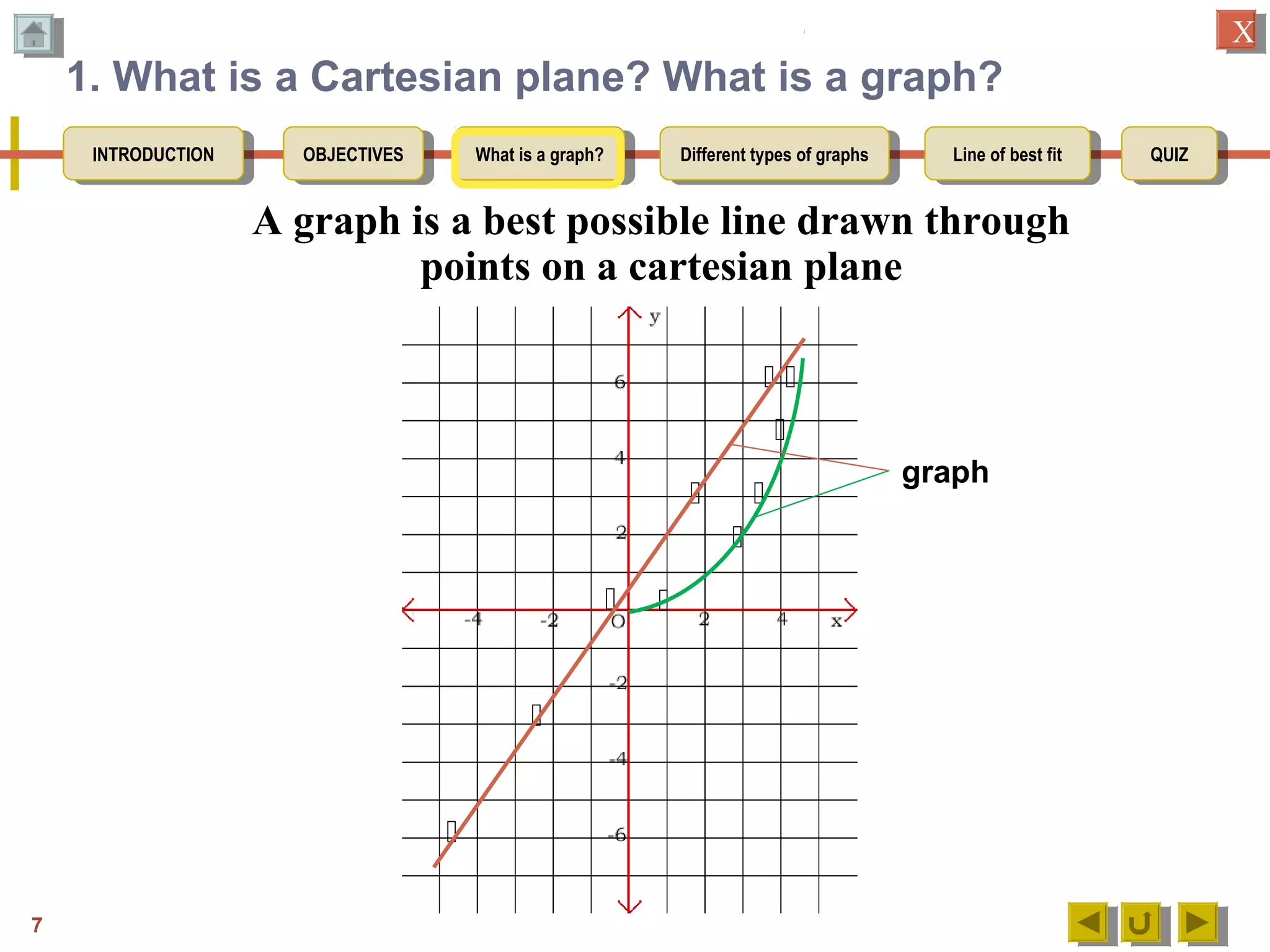
A graph is a best possible line drawn through
points on a cartesian plane
7










graph
OBJECTIVESOBJECTIVES What is a graph?What is a graph? Different types of graphsDifferent types of graphs Line of best fitLine of best fit QUIZQUIZINTRODUCTIONINTRODUCTION
XX
What is an experimental graph?
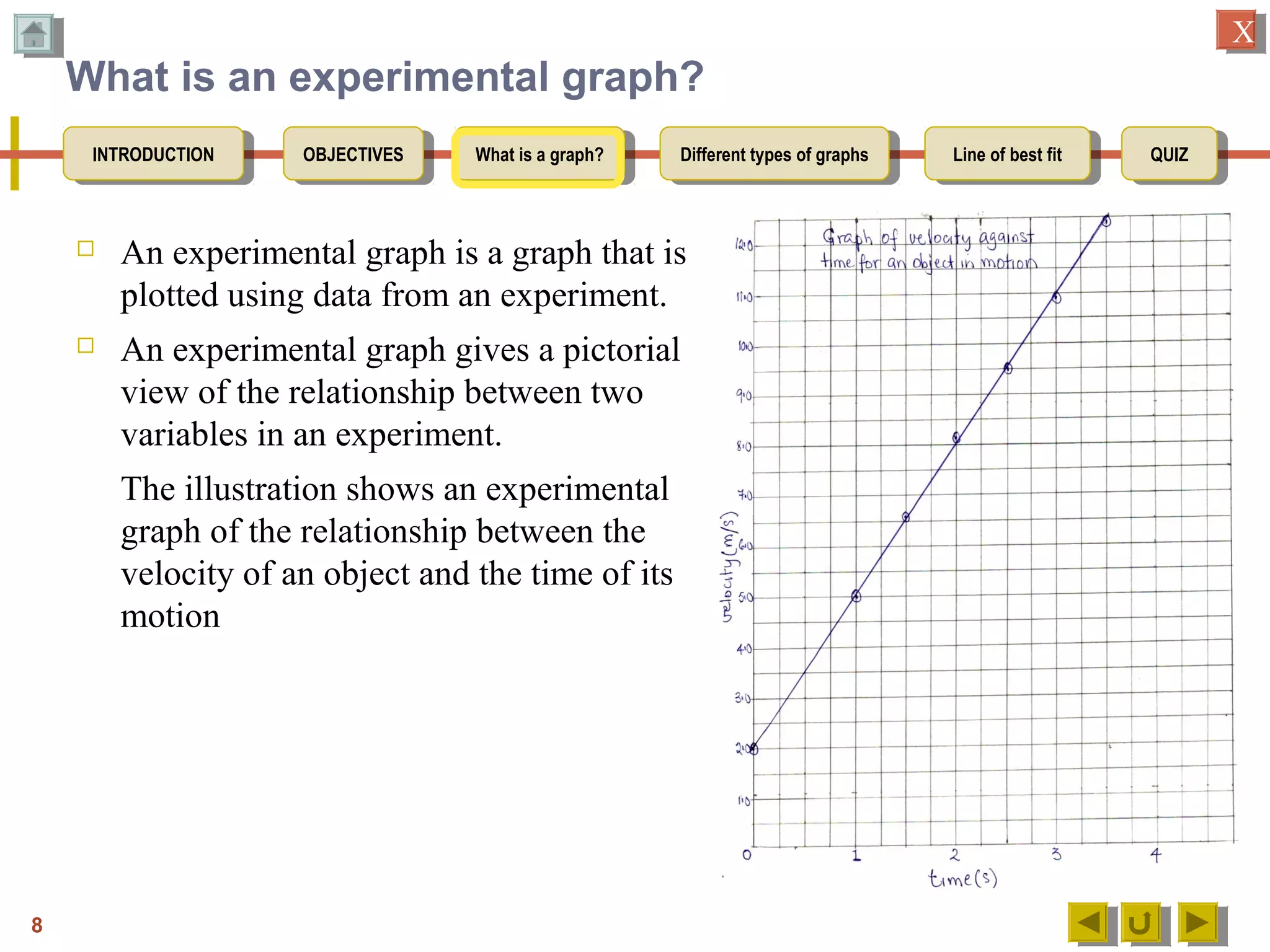
 An experimental graph is a graph that is
plotted using data from an experiment.
 An experimental graph gives a pictorial
view of the relationship between two
variables in an experiment.
The illustration shows an experimental
graph of the relationship between the
velocity of an object and the time of its
motion
8
OBJECTIVESOBJECTIVES What is a graph?What is a graph? Different types of graphsDifferent types of graphs Line of best fitLine of best fit QUIZQUIZINTRODUCTIONINTRODUCTION
XX
1. What is an experimental graph?
Independent and dependent variables
1. An experimental graph shows the relationship between two variables in an
experiment.
2. In an experiment the magnitude of one variable is measured and the
magnitude of another variable that depends on it is measured whenever the
magnitude of the first variable changes. The magnitude of the first variable
is most times varied by the experimenter
3. The variable that is varied by the experimenter in the experiment is called
the independent variable.
4. The variable that depends on the independent variable is called the
dependent variable
9
OBJECTIVESOBJECTIVES What is a graph?What is a graph? Different types of graphsDifferent types of graphs Line of best fitLine of best fit QUIZQUIZINTRODUCTIONINTRODUCTION
XX
1. What is an experimental graph?
Independent and dependent variables
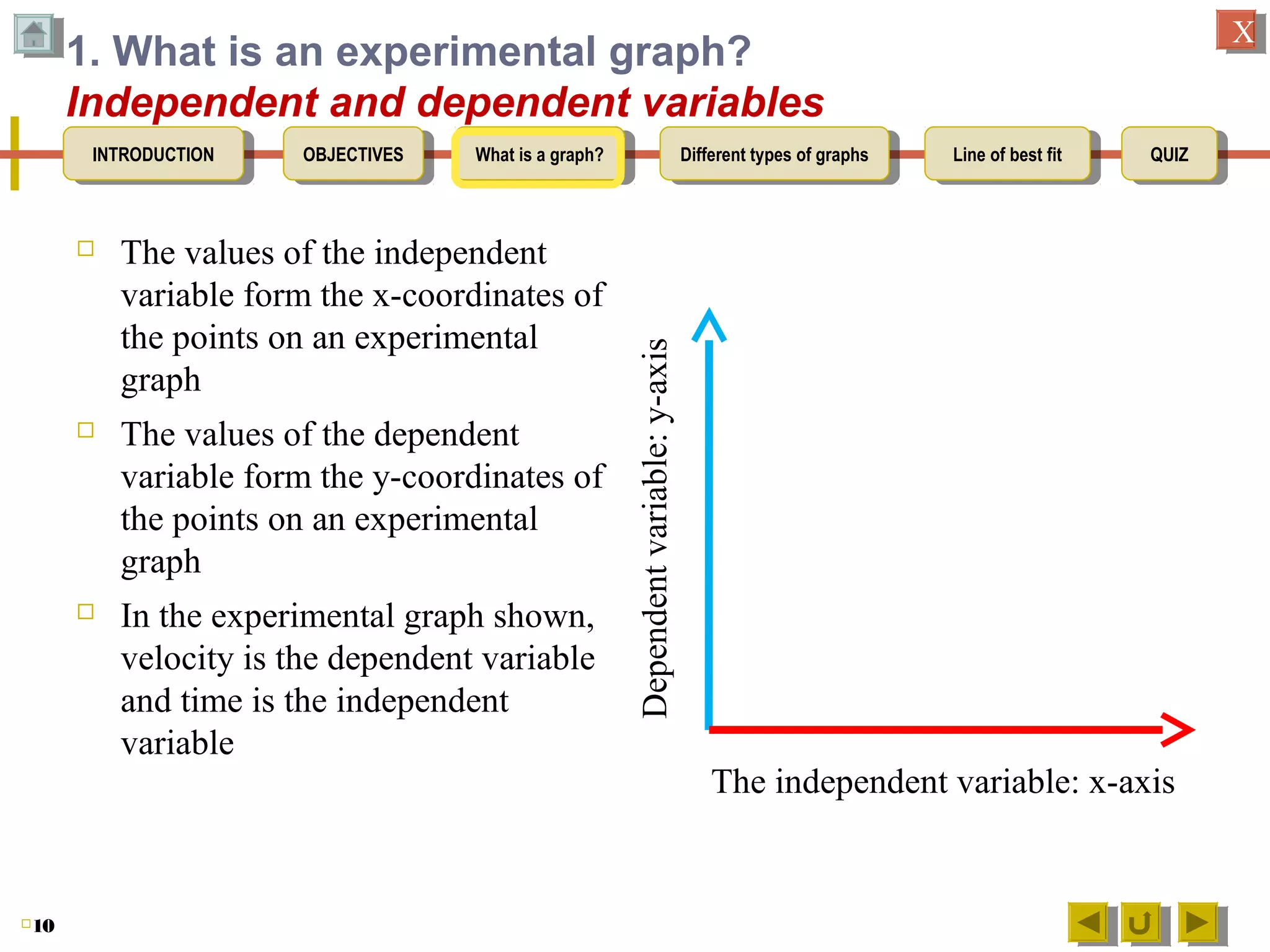
 The values of the independent
variable form the x-coordinates of
the points on an experimental
graph
 The values of the dependent
variable form the y-coordinates of
the points on an experimental
graph
 In the experimental graph shown,
velocity is the dependent variable
and time is the independent
variable
10
Dependentvariable:y-axis
The independent variable: x-axis
OBJECTIVESOBJECTIVES What is a graph?What is a graph? Different types of graphsDifferent types of graphs Line of best fitLine of best fit QUIZQUIZINTRODUCTIONINTRODUCTION
XX
1. What is an experimental graph?
Elements of a Proper Graph
 A proper graph must display the following:
 A title
 The dependent variable on the y-axis and independent variable on the x-
axis.
 Axes labeled with the names of the variable quantities and their units.
 Properly calibrated axes. An axis is calibrated when the numbers
representing the magnitudes of the quantity are written along the axis at
evenly spaced intervals
 Calibrations must be such that the ranges of values on each axis must take
up more than half the length of the axis. Numbering can begin at a non-zero
value to accommodate this requirement , however this cannot be broken if
intercept values are required from the graph.
 DO NOT use 1 cm to represent 3 or 7 units or any multiple or fraction of 3
or 7 units. Similarly DO NOT use 3 or 7 cm to represent 1 unit.
 Use  or × to plot points on the graph.11
OBJECTIVESOBJECTIVES What is a graph?What is a graph? Different types of graphsDifferent types of graphs Line of best fitLine of best fit QUIZQUIZINTRODUCTIONINTRODUCTION
XX
1. What is an experimental graph?
Elements of a Proper Graph
TITLE
 Clearly states the purpose of the graph
 Should be located on a clear space near the top of the graph
 A possible title for a graph would be: Graph showing the variation of the
period of a Simple Pendulum with its length.
 The title should uniquely identify the graph
12
OBJECTIVESOBJECTIVES What is a graph?What is a graph? Different types of graphsDifferent types of graphs Line of best fitLine of best fit QUIZQUIZINTRODUCTIONINTRODUCTION
XX
1. What is an experimental graph?
Elements of a Proper Graph
EXAMPLES OF POOR CHOICES OF TITLES
Example 1. “v vs t"
The title should be in words and should not just repeat the symbols of the
quantities plotted on the axes!
Example 2. “Velocity versus time“
This title is in words, but just repeats the names of the quantities plotted on the
axes.
13
OBJECTIVESOBJECTIVES What is a graph?What is a graph? Different types of graphsDifferent types of graphs Line of best fitLine of best fit QUIZQUIZINTRODUCTIONINTRODUCTION
XX
1. What is an experimental graph?
Elements of a Proper Graph
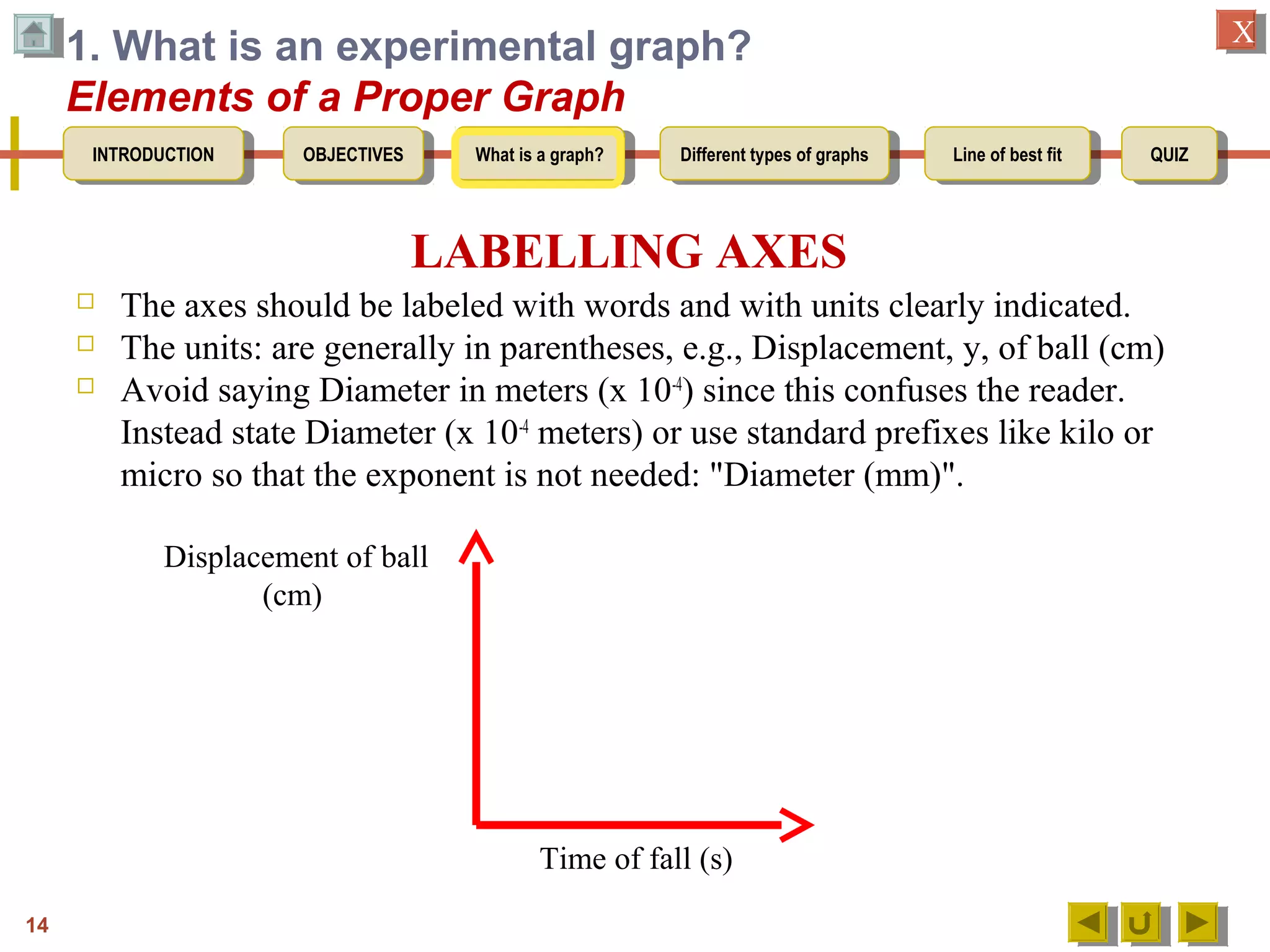
 The axes should be labeled with words and with units clearly indicated.
 The units: are generally in parentheses, e.g., Displacement, y, of ball (cm)
 Avoid saying Diameter in meters (x 10-4
) since this confuses the reader.
Instead state Diameter (x 10-4
meters) or use standard prefixes like kilo or
micro so that the exponent is not needed: "Diameter (mm)".
Time of fall (s)
Displacement of ball
(cm)
LABELLING AXES
14
OBJECTIVESOBJECTIVES What is a graph?What is a graph? Different types of graphsDifferent types of graphs Line of best fitLine of best fit QUIZQUIZINTRODUCTIONINTRODUCTION
XX
1. What is a graph? Elements of a Proper Graph
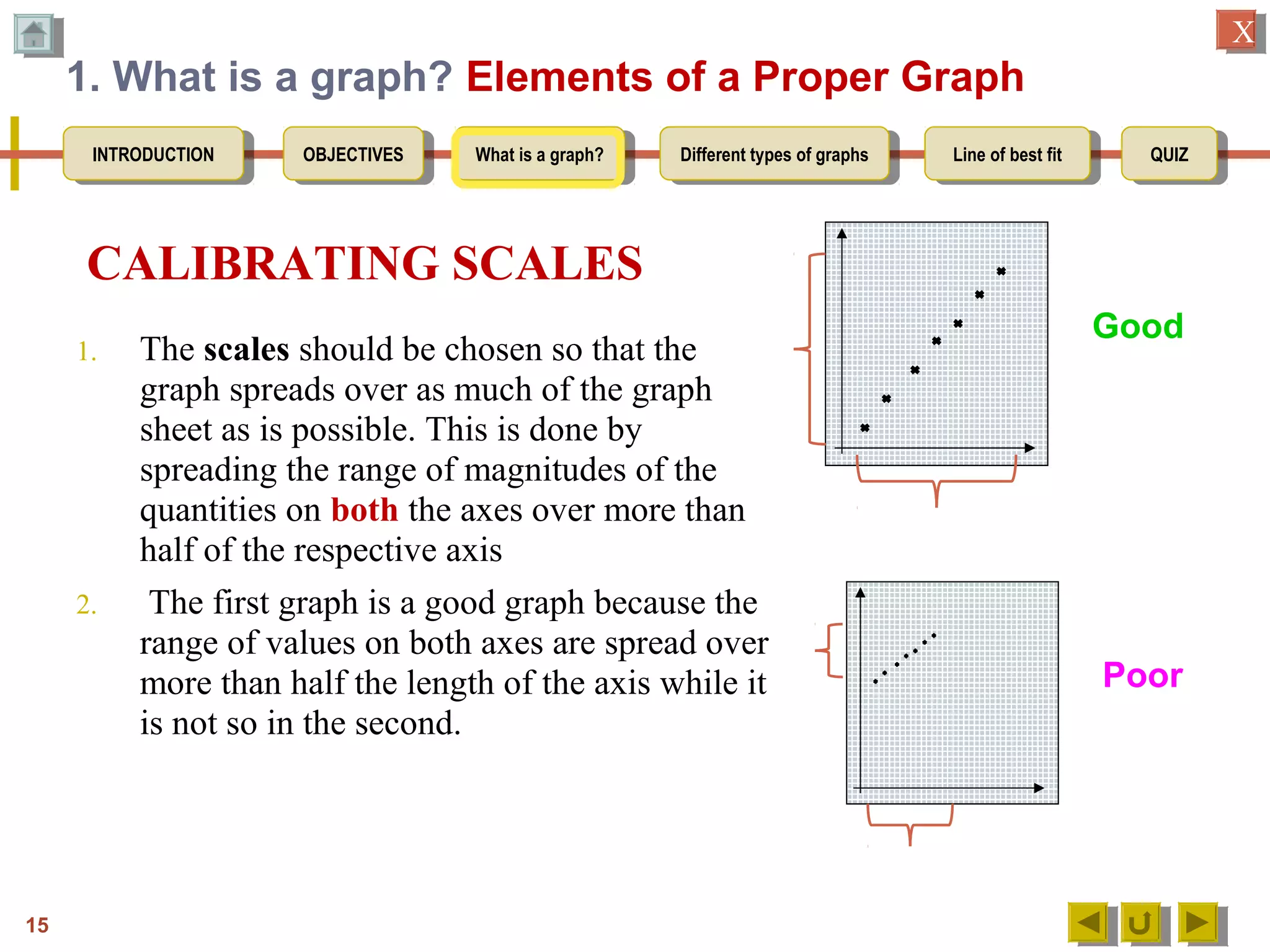
1. The scales should be chosen so that the
graph spreads over as much of the graph
sheet as is possible. This is done by
spreading the range of magnitudes of the
quantities on both the axes over more than
half of the respective axis
2. The first graph is a good graph because the
range of values on both axes are spread over
more than half the length of the axis while it
is not so in the second.
Good
Poor
CALIBRATING SCALES
15
OBJECTIVESOBJECTIVES What is a graph?What is a graph? Different types of graphsDifferent types of graphs Line of best fitLine of best fit QUIZQUIZINTRODUCTIONINTRODUCTION
XX1. What is an experimental graph?
Elements of a proper graph. Summary
16
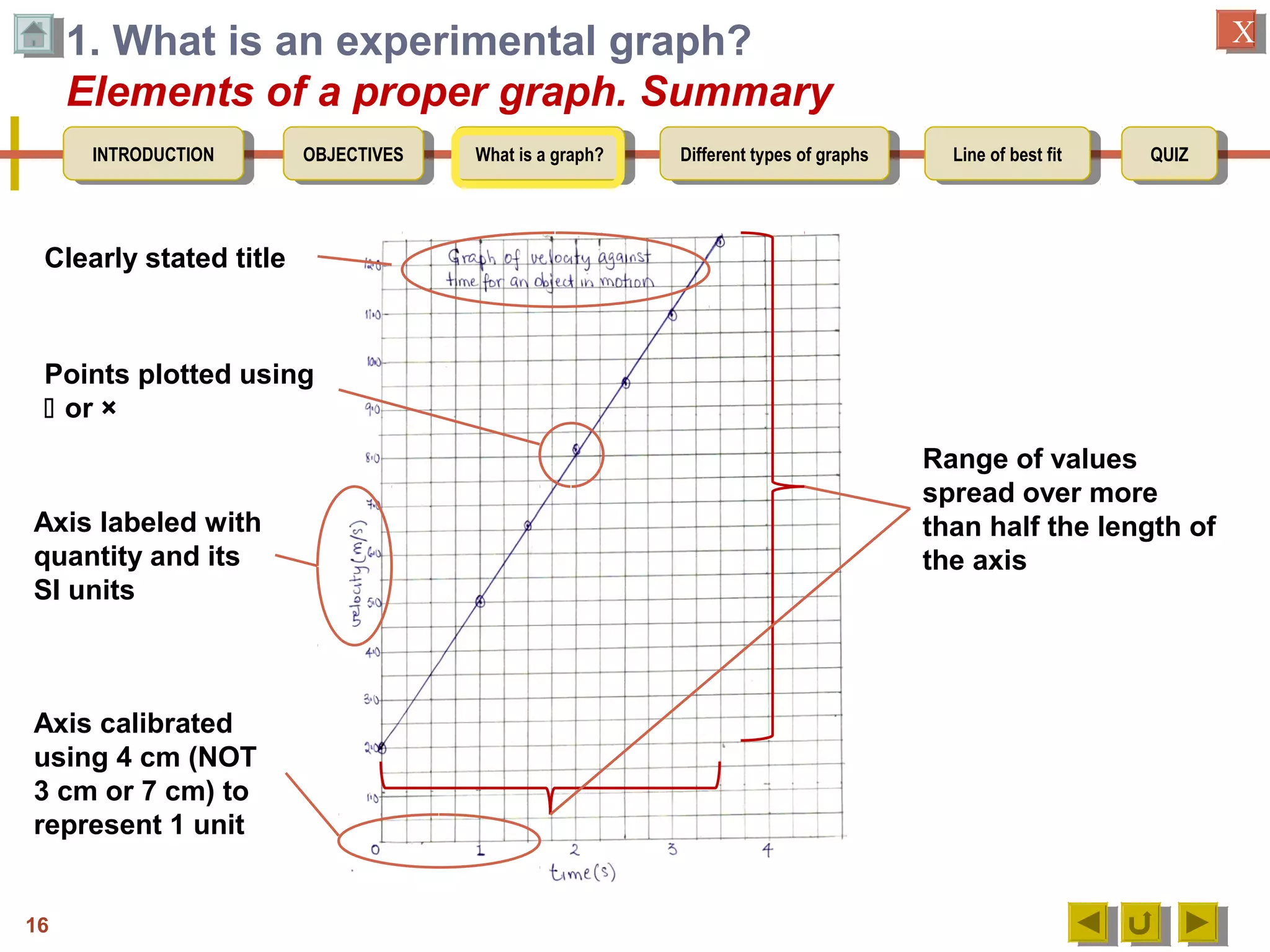
Clearly stated title
Axis labeled with
quantity and its
SI units
Points plotted using
 or ×
Axis calibrated
using 4 cm (NOT
3 cm or 7 cm) to
represent 1 unit
Range of values
spread over more
than half the length of
the axis
OBJECTIVESOBJECTIVES What is a graph?What is a graph? Different types of graphsDifferent types of graphs Line of best fitLine of best fit QUIZQUIZINTRODUCTIONINTRODUCTION
XX
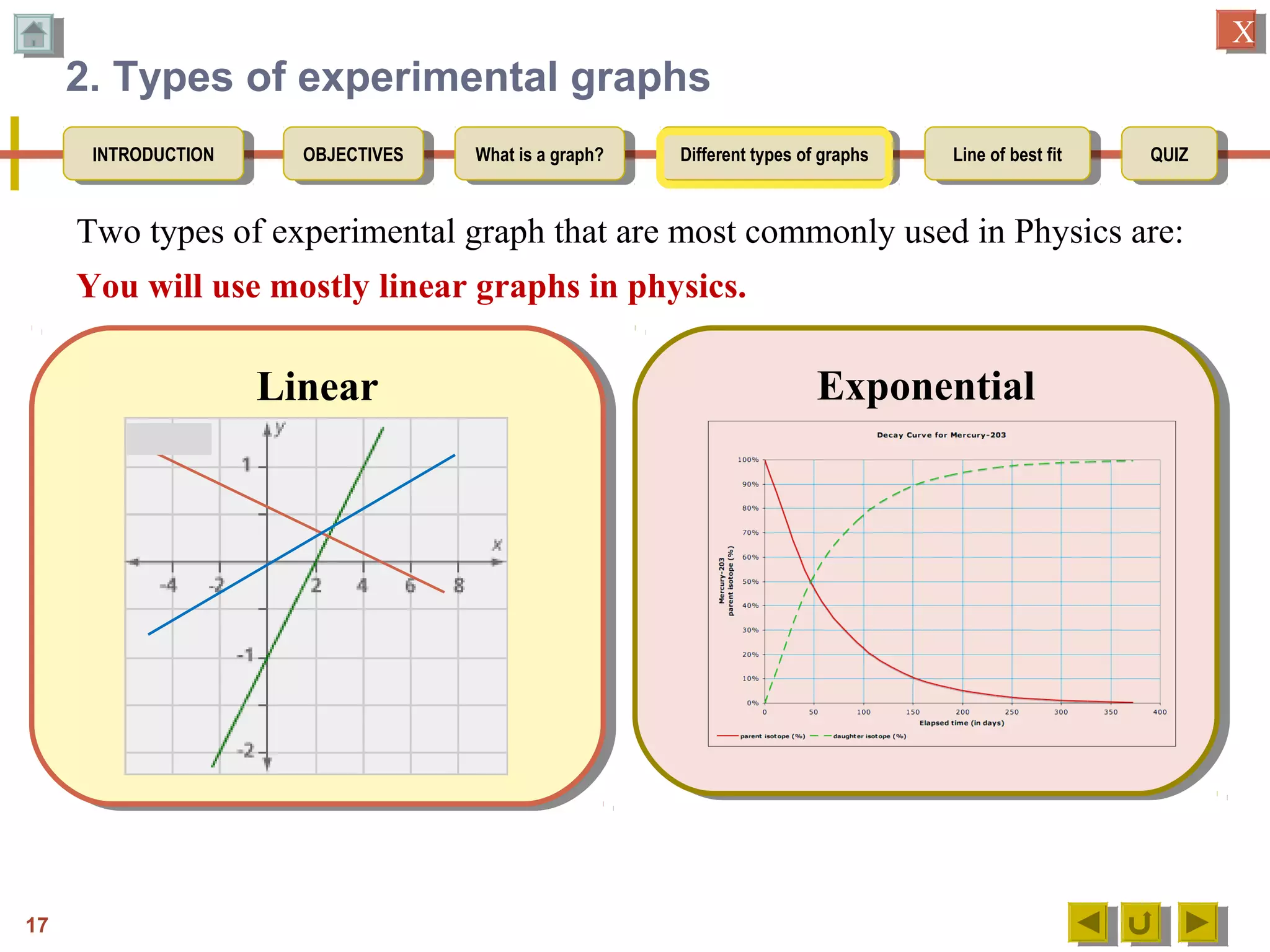
2. Types of experimental graphs
Two types of experimental graph that are most commonly used in Physics are:
You will use mostly linear graphs in physics.
17
LinearLinear ExponentialExponential
OBJECTIVESOBJECTIVES What is a graph?What is a graph? Different types of graphsDifferent types of graphs Line of best fitLine of best fit QUIZQUIZINTRODUCTIONINTRODUCTION
XX
2. Types of experimental graphs: Linear graphs
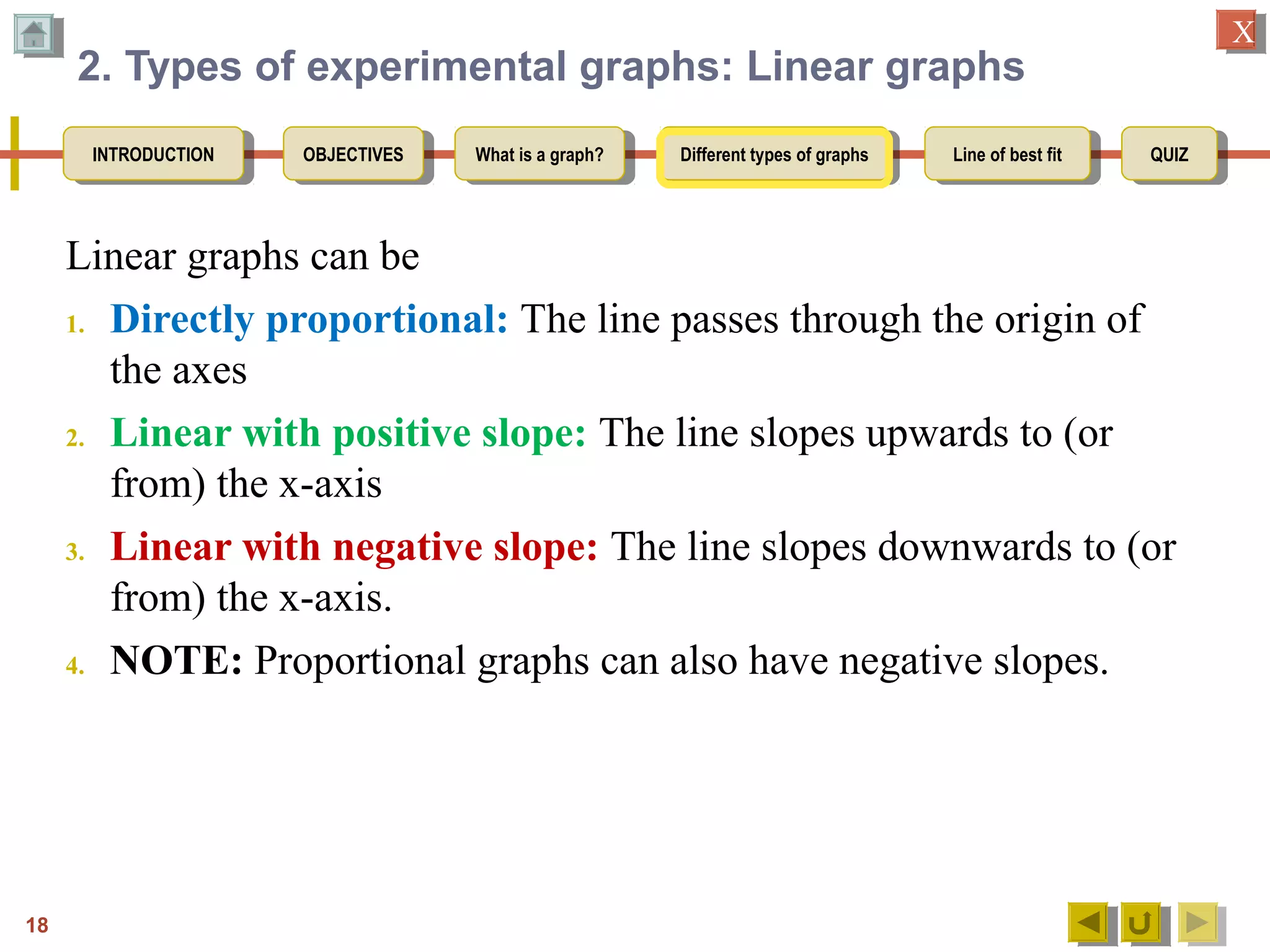
Linear graphs can be
1. Directly proportional: The line passes through the origin of
the axes
2. Linear with positive slope: The line slopes upwards to (or
from) the x-axis
3. Linear with negative slope: The line slopes downwards to (or
from) the x-axis.
4. NOTE: Proportional graphs can also have negative slopes.
18
OBJECTIVESOBJECTIVES What is a graph?What is a graph? Different types of graphsDifferent types of graphs Line of best fitLine of best fit QUIZQUIZINTRODUCTIONINTRODUCTION
XX
2. Making linear graphs
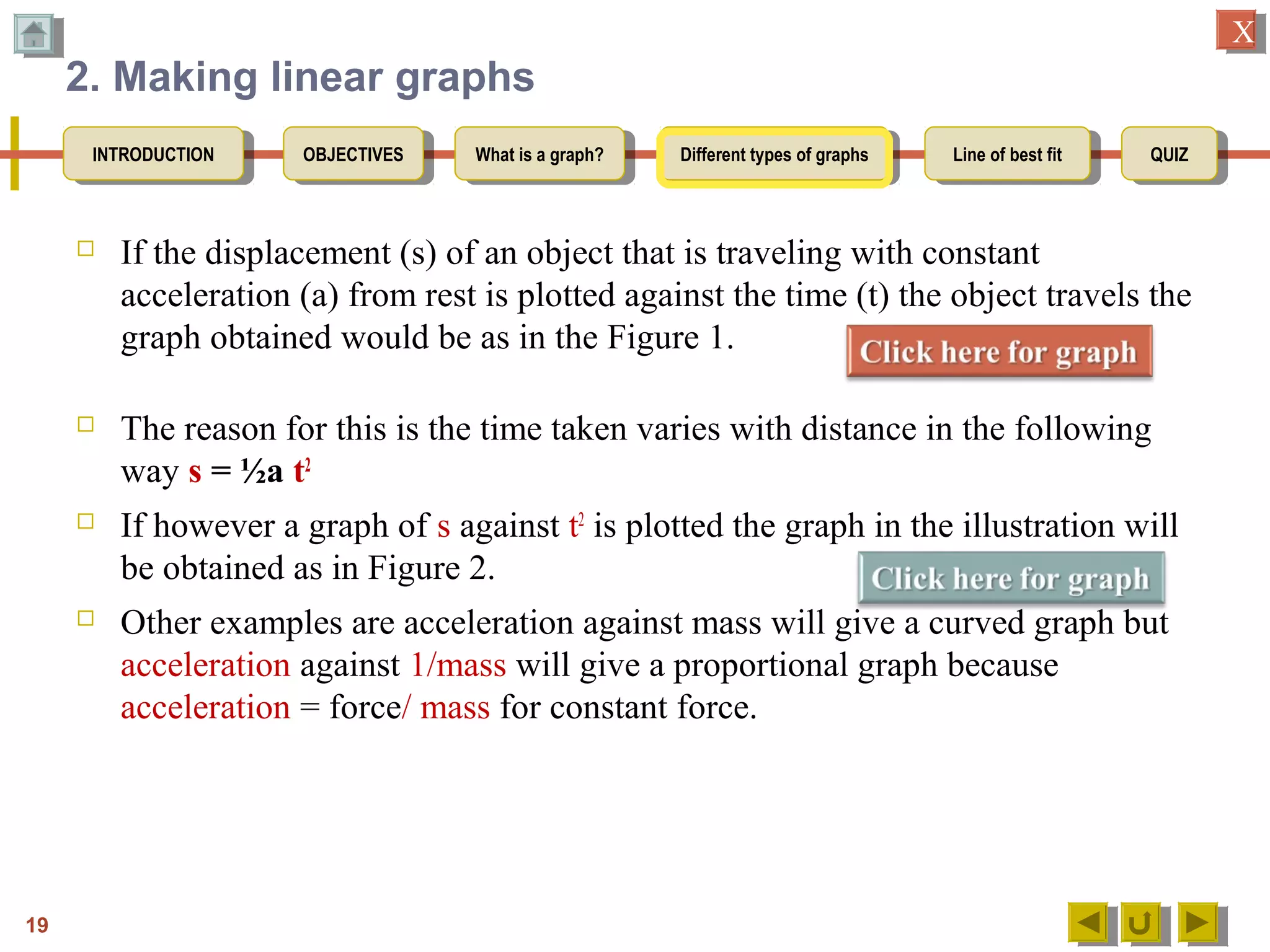
 If the displacement (s) of an object that is traveling with constant
acceleration (a) from rest is plotted against the time (t) the object travels the
graph obtained would be as in the Figure 1.
 The reason for this is the time taken varies with distance in the following
way s = ½a t2
 If however a graph of s against t2
is plotted the graph in the illustration will
be obtained as in Figure 2.
 Other examples are acceleration against mass will give a curved graph but
acceleration against 1/mass will give a proportional graph because
acceleration = force/ mass for constant force.
19
OBJECTIVESOBJECTIVES What is a graph?What is a graph? Different types of graphsDifferent types of graphs Line of best fitLine of best fit QUIZQUIZINTRODUCTIONINTRODUCTION
XX
3. Line of best fit. What is it?
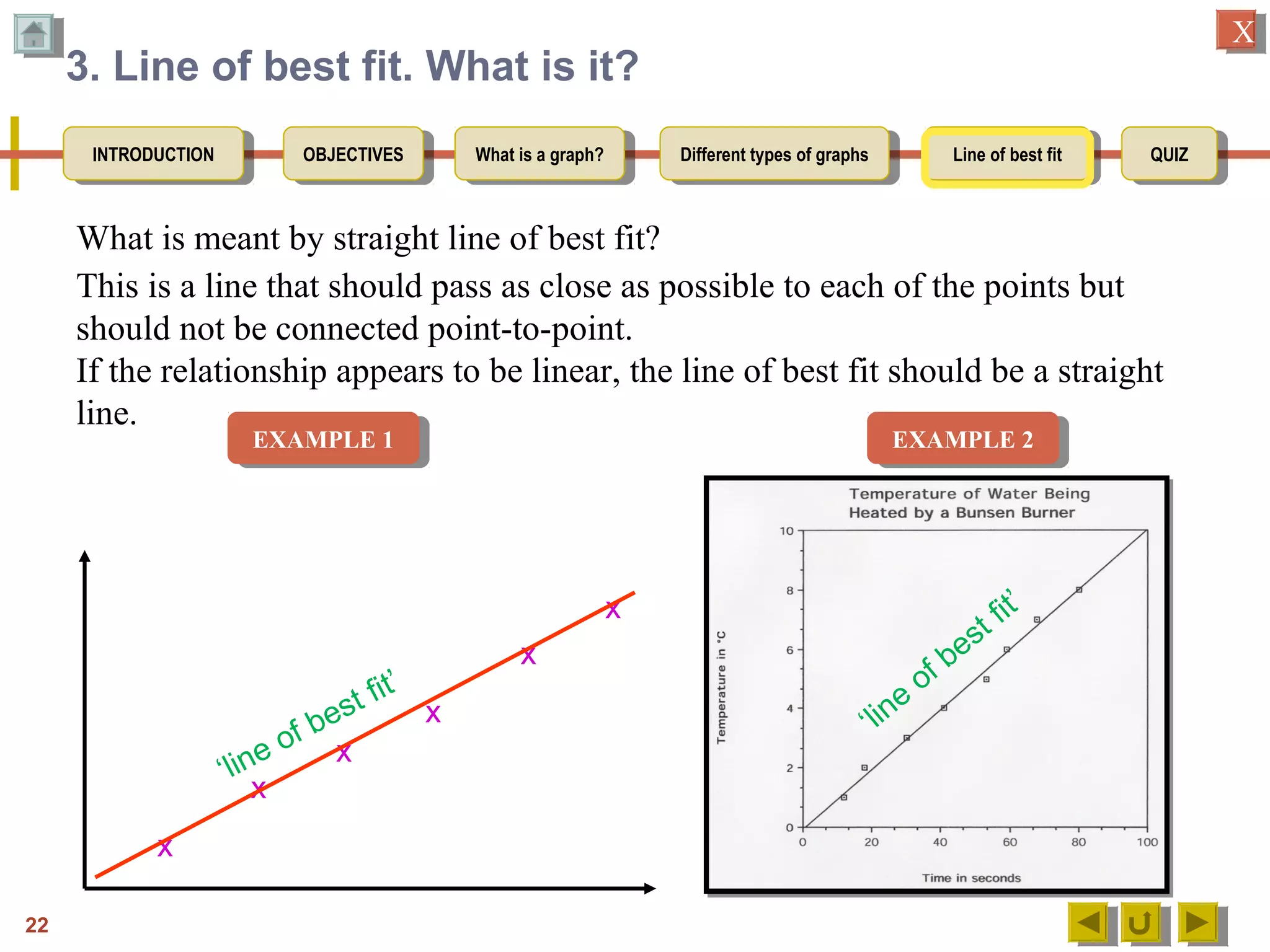
What is meant by straight line of best fit?
x
x
x
x
x
x
‘line of best fit’
‘line
of best fit’
This is a line that should pass as close as possible to each of the points but
should not be connected point-to-point.
If the relationship appears to be linear, the line of best fit should be a straight
line.
EXAMPLE 1EXAMPLE 1 EXAMPLE 2EXAMPLE 2
22
OBJECTIVESOBJECTIVES What is a graph?What is a graph? Different types of graphsDifferent types of graphs Line of best fitLine of best fit QUIZQUIZINTRODUCTIONINTRODUCTION
XX
3. Line of best fit. What is it?
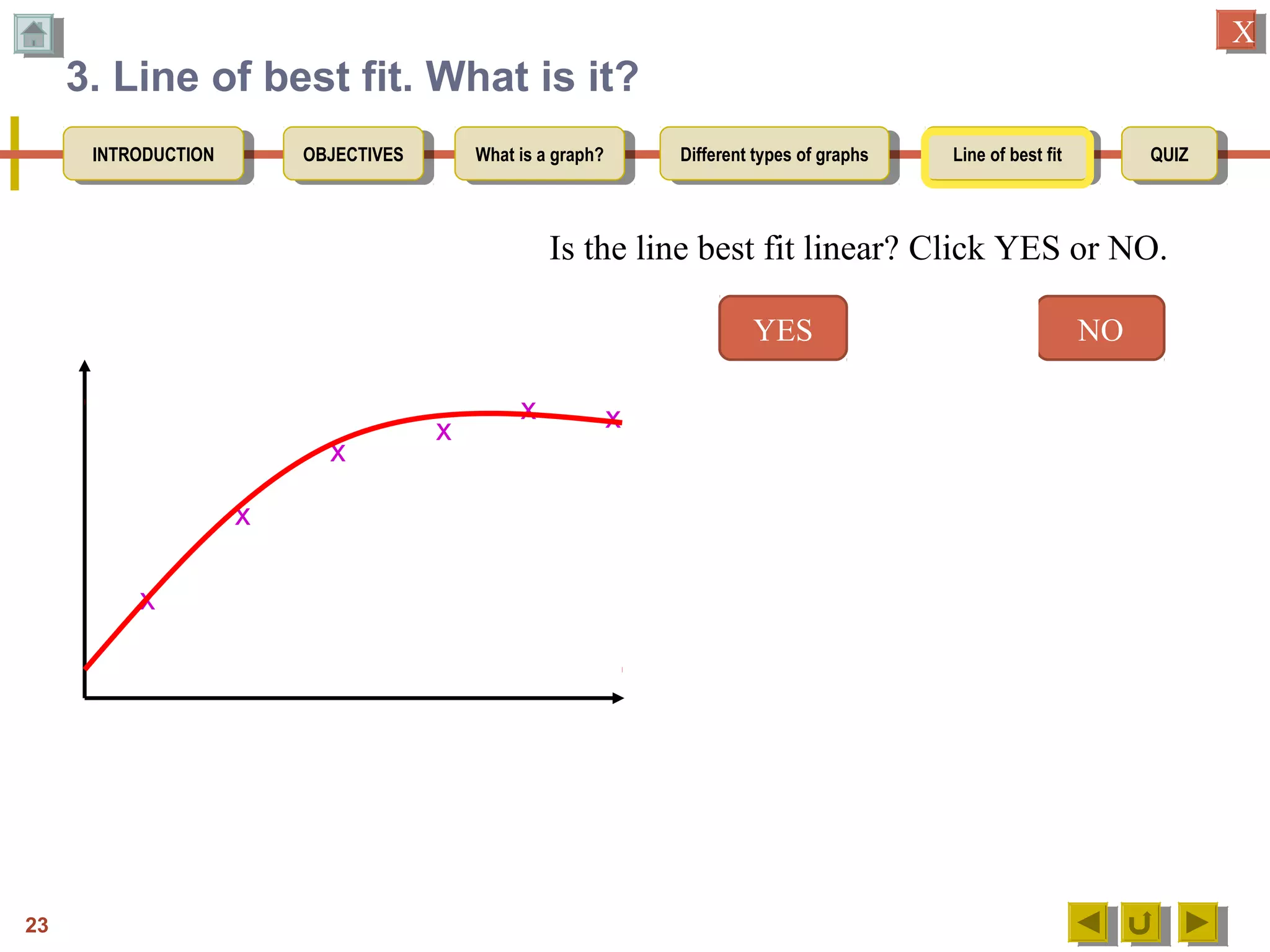
Is the line best fit linear? Click YES or NO.
x
x
x
x
x x
It is not linear.
This is a line that should pass
as close as possible to each
of the points but should not
be connected point-to-point.
But the relationship appears
to be non linear.
NOYES Try again
23
OBJECTIVESOBJECTIVES What is a graph?What is a graph? Different types of graphsDifferent types of graphs Line of best fitLine of best fit QUIZQUIZINTRODUCTIONINTRODUCTION
XX
3. Line of best fit.
Steps to follow to draw a line of best fit
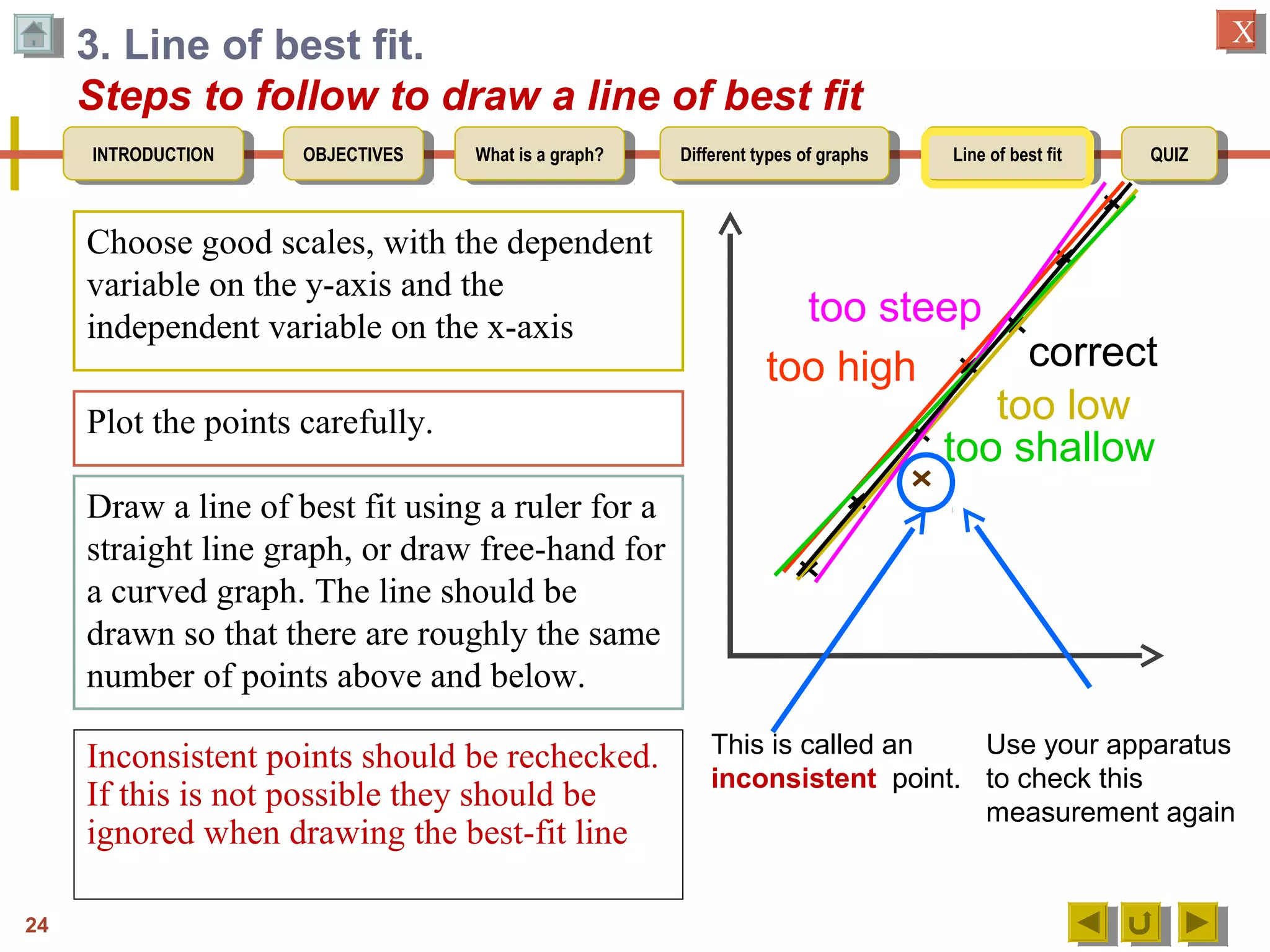
Draw a line of best fit using a ruler for a
straight line graph, or draw free-hand for
a curved graph. The line should be
drawn so that there are roughly the same
number of points above and below.
too high
too low
too steep
too shallow
correct
This is called an
inconsistent point.
Use your apparatus
to check this
measurement again
24
Choose good scales, with the dependent
variable on the y-axis and the
independent variable on the x-axis
Plot the points carefully.
Inconsistent points should be rechecked.
If this is not possible they should be
ignored when drawing the best-fit line
OBJECTIVESOBJECTIVES What is a graph?What is a graph? Different types of graphsDifferent types of graphs Line of best fitLine of best fit QUIZQUIZINTRODUCTIONINTRODUCTION
XX
QUIZ
Are you ready to test yourself?
 There are five multiple choice questions
 For each question, click on the correct response and then click on the
feedback for explanations of the answers being correct or incorrect.
25
BEGIN QUIZ!BEGIN QUIZ!
OBJECTIVESOBJECTIVES What is a graph?What is a graph? Different types of graphsDifferent types of graphs Line of best fitLine of best fit QUIZQUIZINTRODUCTIONINTRODUCTION
XX
QUIZ: Question 1
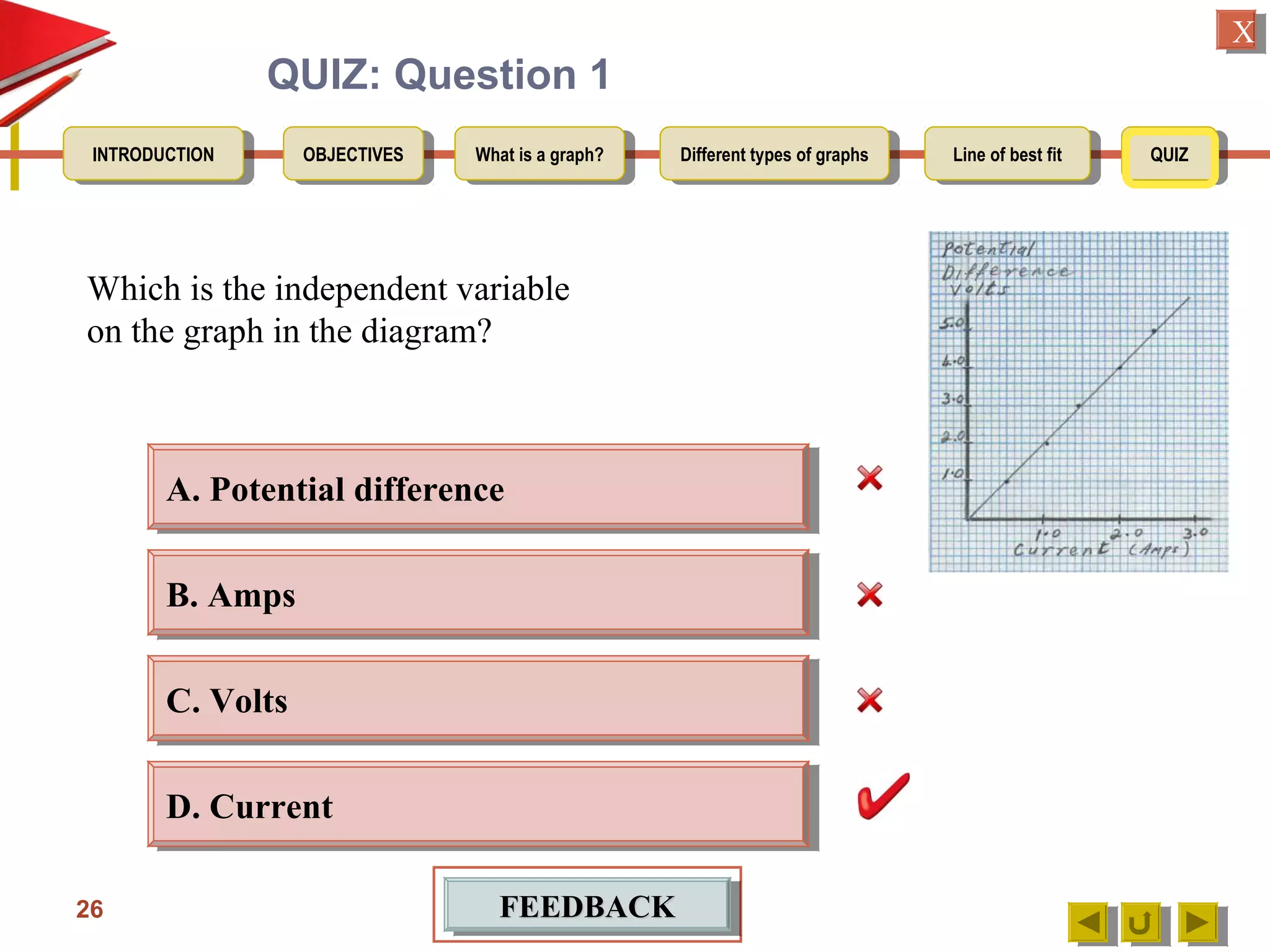
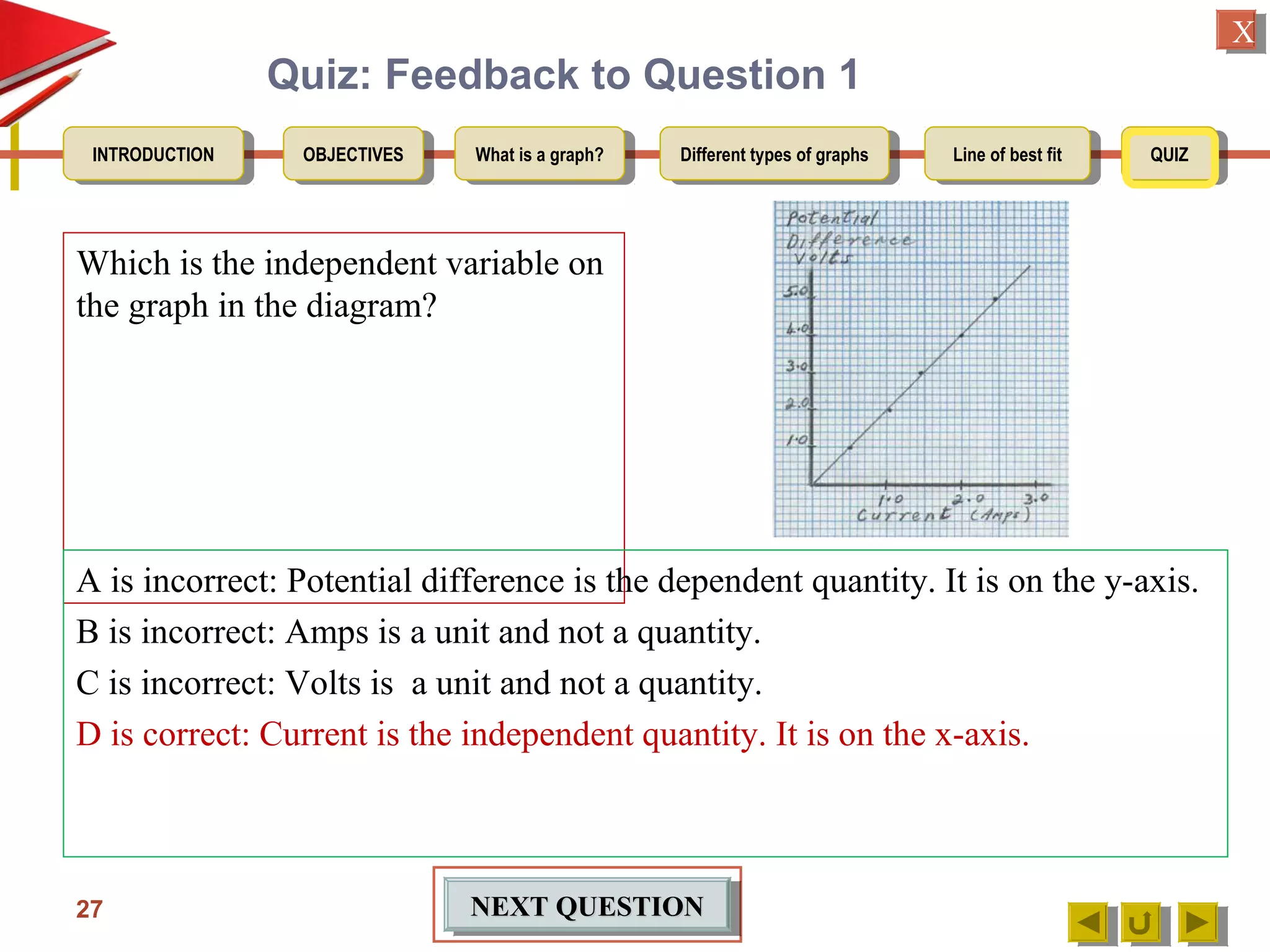
Which is the independent variable
on the graph in the diagram?
26
A. Potential differenceA. Potential difference
B. AmpsB. Amps
C. VoltsC. Volts
D. CurrentD. Current
FEEDBACKFEEDBACKFEEDBACKFEEDBACK
OBJECTIVESOBJECTIVES What is a graph?What is a graph? Different types of graphsDifferent types of graphs Line of best fitLine of best fit QUIZQUIZINTRODUCTIONINTRODUCTION
XX
Quiz: Feedback to Question 1
Which is the independent variable on
the graph in the diagram?
27 NEXT QUESTIONNEXT QUESTIONNEXT QUESTIONNEXT QUESTION
A is incorrect: Potential difference is the dependent quantity. It is on the y-axis.
B is incorrect: Amps is a unit and not a quantity.
C is incorrect: Volts is a unit and not a quantity.
D is correct: Current is the independent quantity. It is on the x-axis.
OBJECTIVESOBJECTIVES What is a graph?What is a graph? Different types of graphsDifferent types of graphs Line of best fitLine of best fit QUIZQUIZINTRODUCTIONINTRODUCTION
XX
QUIZ: Question 2
28
B. I and III onlyB. I and III only
D. I, II and IIID. I, II and III
C. I and II onlyC. I and II only
A. NoneA. None
FEEDBACKFEEDBACKFEEDBACKFEEDBACK
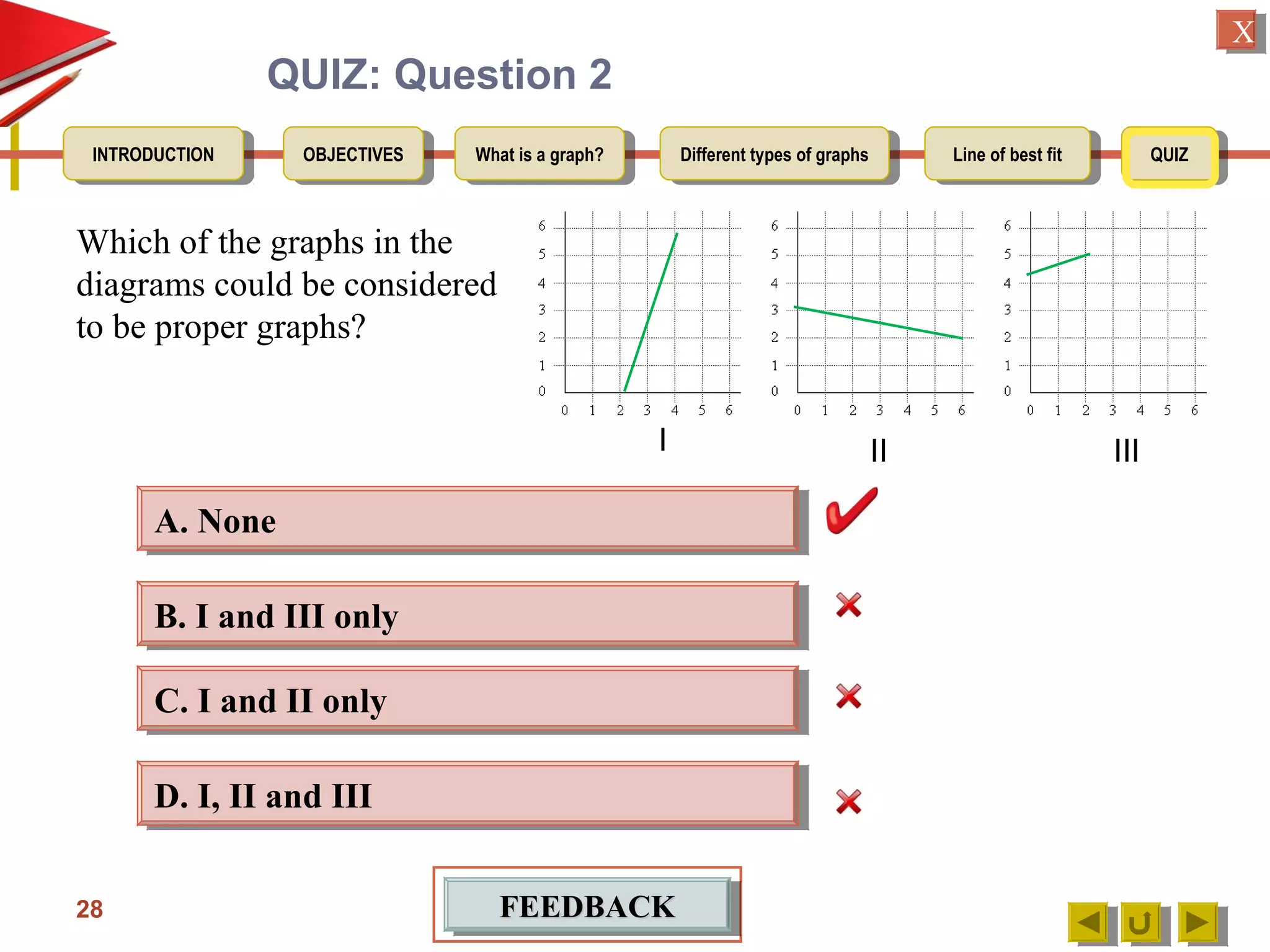
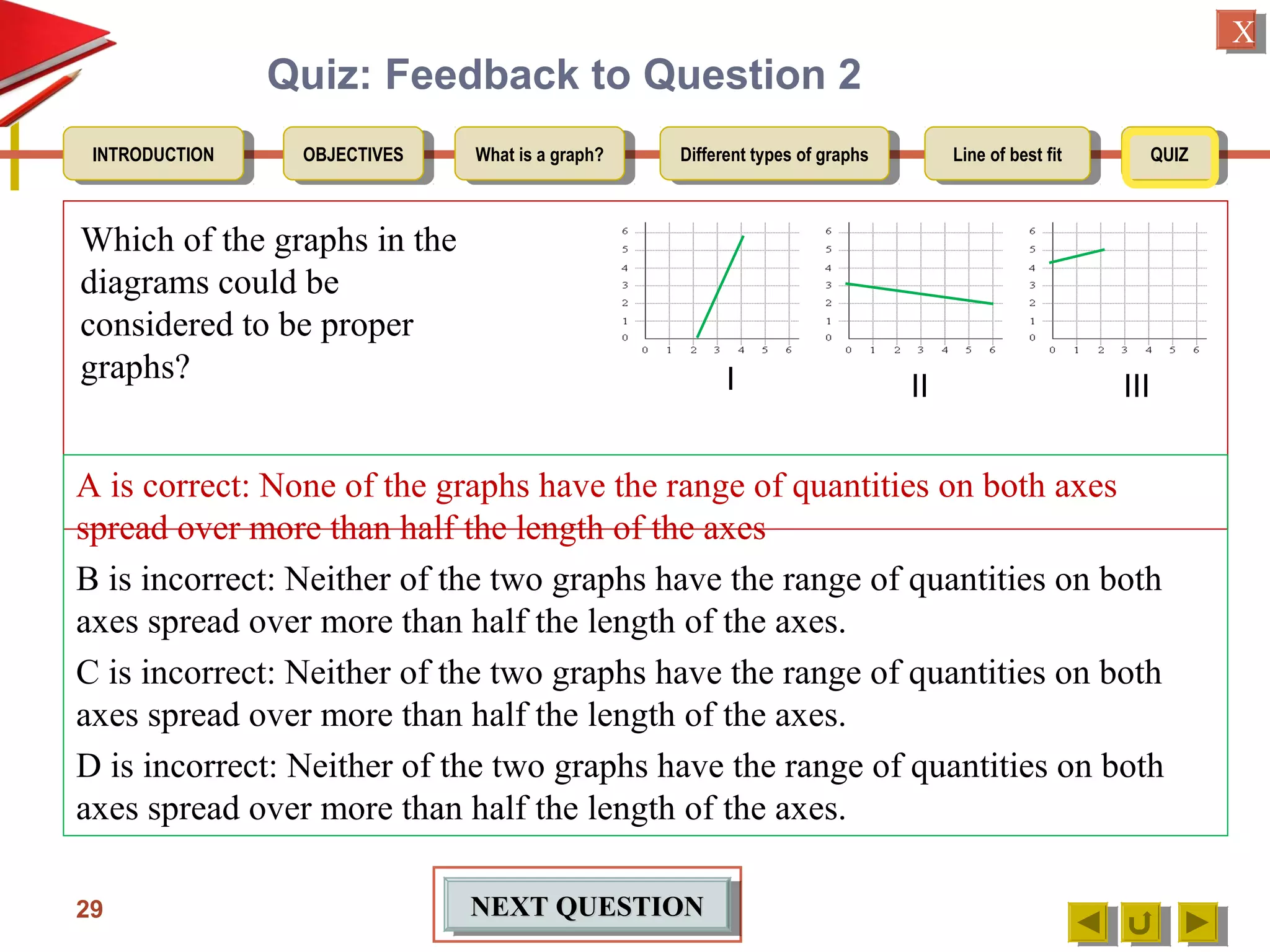
Which of the graphs in the
diagrams could be considered
to be proper graphs?
I II III
OBJECTIVESOBJECTIVES What is a graph?What is a graph? Different types of graphsDifferent types of graphs Line of best fitLine of best fit QUIZQUIZINTRODUCTIONINTRODUCTION
XX
Quiz: Feedback to Question 2
29 NEXT QUESTIONNEXT QUESTIONNEXT QUESTIONNEXT QUESTION
A is correct: None of the graphs have the range of quantities on both axes
spread over more than half the length of the axes
B is incorrect: Neither of the two graphs have the range of quantities on both
axes spread over more than half the length of the axes.
C is incorrect: Neither of the two graphs have the range of quantities on both
axes spread over more than half the length of the axes.
D is incorrect: Neither of the two graphs have the range of quantities on both
axes spread over more than half the length of the axes.
Which of the graphs in the
diagrams could be
considered to be proper
graphs? I II III
OBJECTIVESOBJECTIVES What is a graph?What is a graph? Different types of graphsDifferent types of graphs Line of best fitLine of best fit QUIZQUIZINTRODUCTIONINTRODUCTION
XX
QUIZ: Question 3
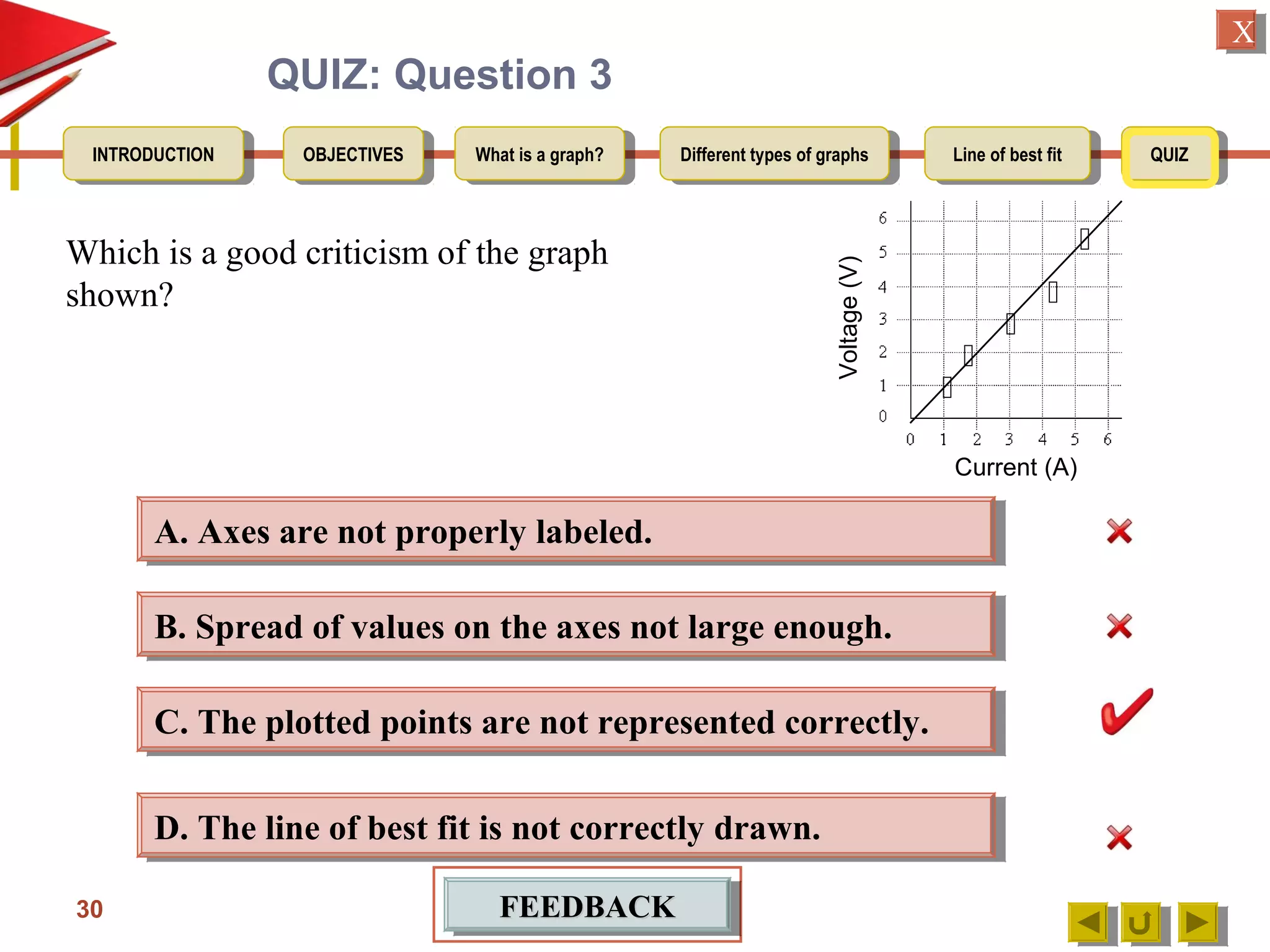
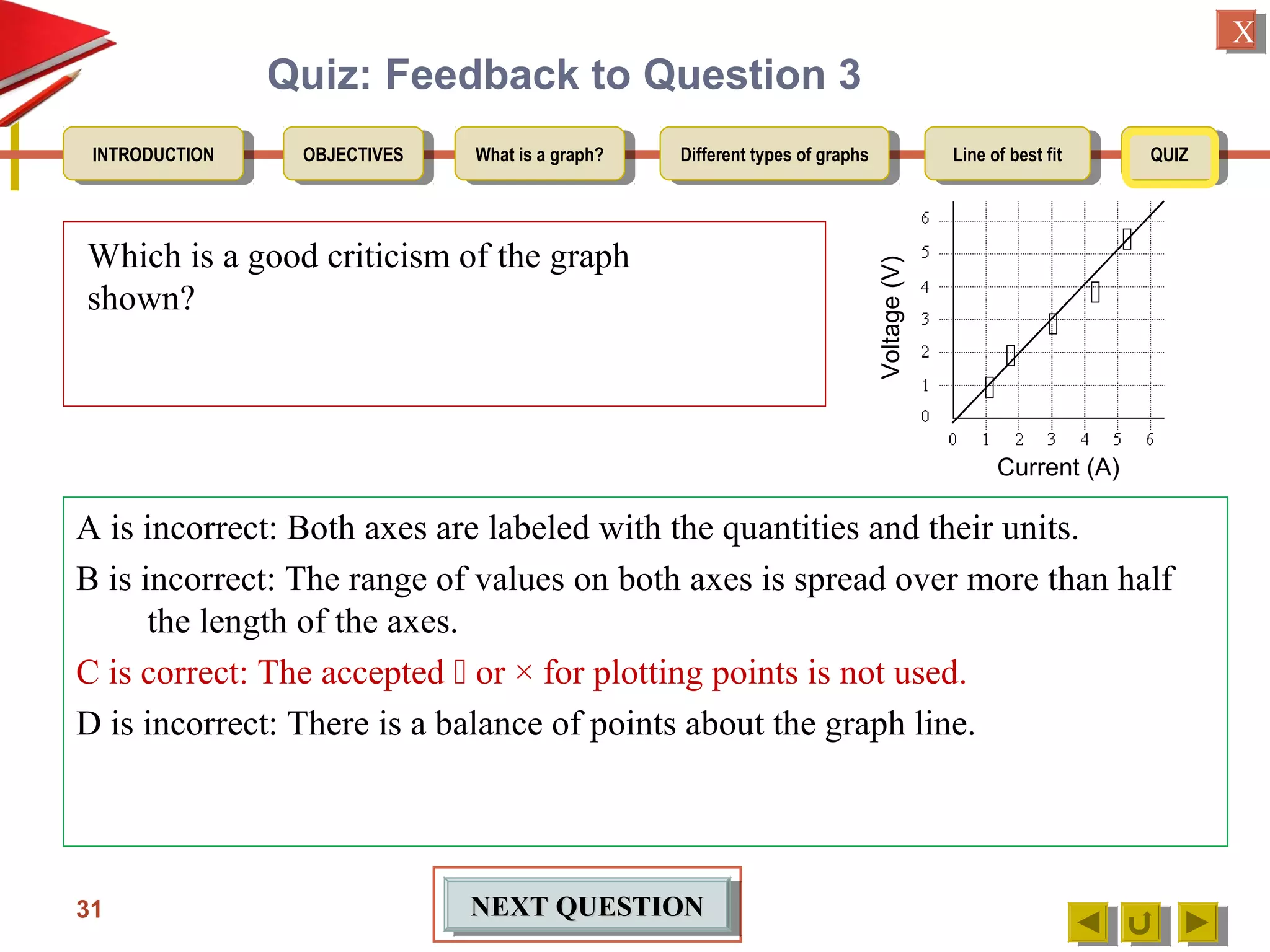
Which is a good criticism of the graph
shown?
30
A. Axes are not properly labeled.A. Axes are not properly labeled.
D. The line of best fit is not correctly drawn.D. The line of best fit is not correctly drawn.
B. Spread of values on the axes not large enough.B. Spread of values on the axes not large enough.
C. The plotted points are not represented correctly.C. The plotted points are not represented correctly.
FEEDBACKFEEDBACKFEEDBACKFEEDBACK





Current (A)
Voltage(V)
OBJECTIVESOBJECTIVES What is a graph?What is a graph? Different types of graphsDifferent types of graphs Line of best fitLine of best fit QUIZQUIZINTRODUCTIONINTRODUCTION
XX
Quiz: Feedback to Question 3
31 NEXT QUESTIONNEXT QUESTIONNEXT QUESTIONNEXT QUESTION
A is incorrect: Both axes are labeled with the quantities and their units.
B is incorrect: The range of values on both axes is spread over more than half
the length of the axes.
C is correct: The accepted  or × for plotting points is not used.
D is incorrect: There is a balance of points about the graph line.
Which is a good criticism of the graph
shown?





Current (A)
Voltage(V)
OBJECTIVESOBJECTIVES What is a graph?What is a graph? Different types of graphsDifferent types of graphs Line of best fitLine of best fit QUIZQUIZINTRODUCTIONINTRODUCTION
XX
32
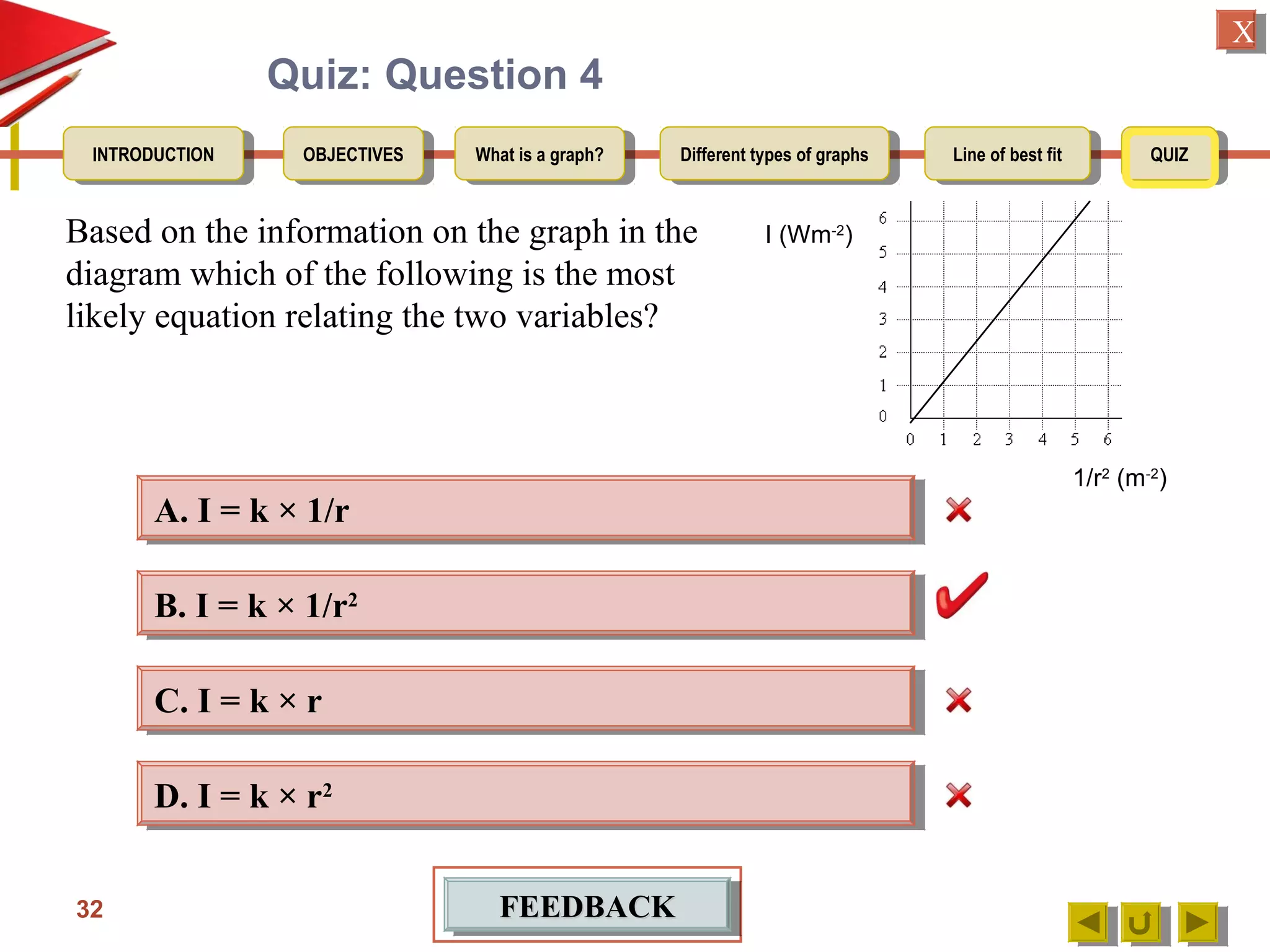
Based on the information on the graph in the
diagram which of the following is the most
likely equation relating the two variables?
Quiz: Question 4
A. I = k × 1/rA. I = k × 1/r
D. I = k × r2D. I = k × r2
C. I = k × rC. I = k × r
B. I = k × 1/r2B. I = k × 1/r2
FEEDBACKFEEDBACKFEEDBACKFEEDBACK
1/r2
(m-2
)
I (Wm-2
)
OBJECTIVESOBJECTIVES What is a graph?What is a graph? Different types of graphsDifferent types of graphs Line of best fitLine of best fit QUIZQUIZINTRODUCTIONINTRODUCTION
XX
Quiz: Feedback to Question 4
33 NEXT QUESTIONNEXT QUESTIONNEXT QUESTIONNEXT QUESTION
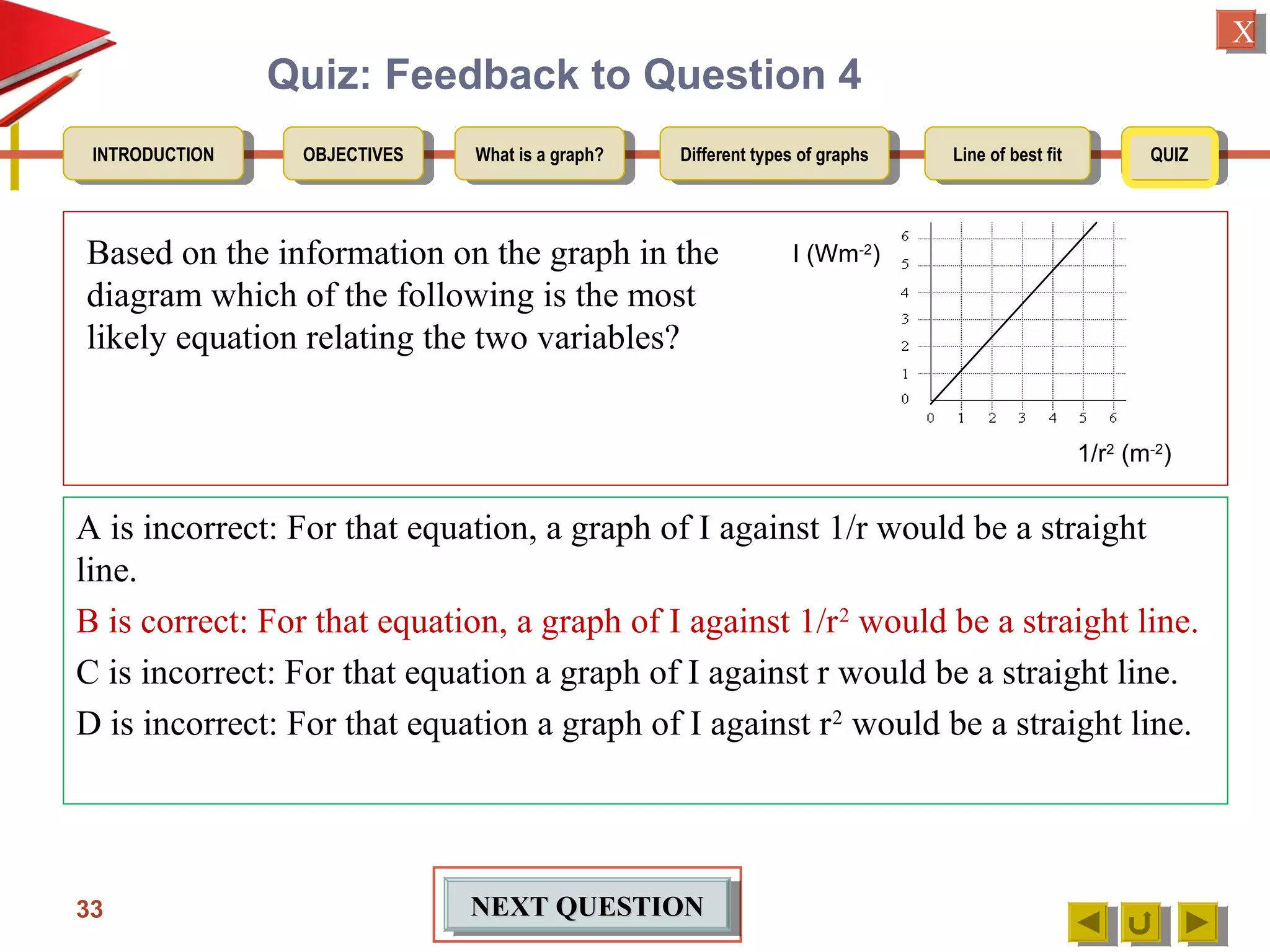
A is incorrect: For that equation, a graph of I against 1/r would be a straight
line.
B is correct: For that equation, a graph of I against 1/r2
would be a straight line.
C is incorrect: For that equation a graph of I against r would be a straight line.
D is incorrect: For that equation a graph of I against r2
would be a straight line.
Based on the information on the graph in the
diagram which of the following is the most
likely equation relating the two variables?
1/r2
(m-2
)
I (Wm-2
)
OBJECTIVESOBJECTIVES What is a graph?What is a graph? Different types of graphsDifferent types of graphs Line of best fitLine of best fit QUIZQUIZINTRODUCTIONINTRODUCTION
XX
QUIZ: Question 5
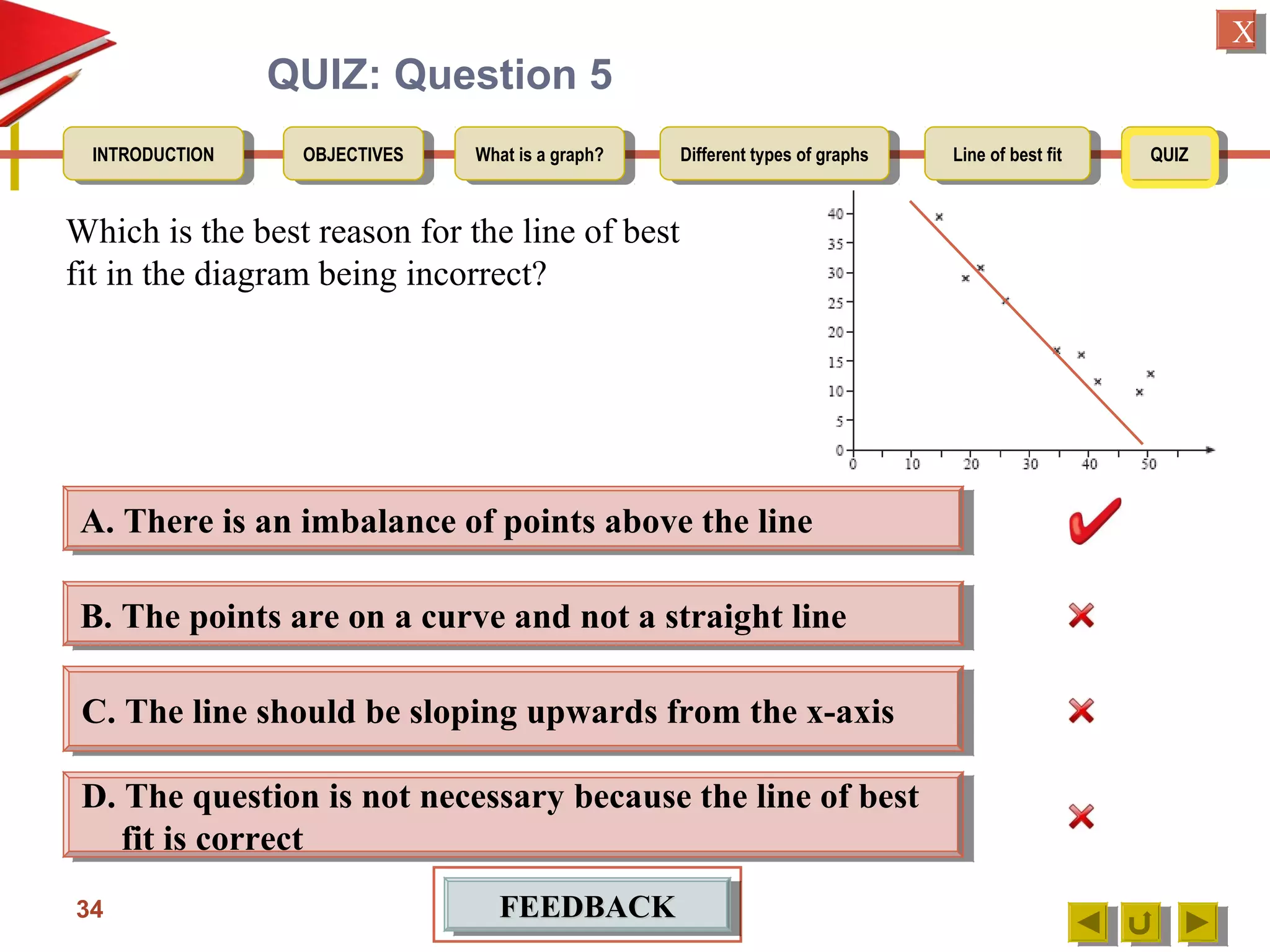
Which is the best reason for the line of best
fit in the diagram being incorrect?
34
B. The points are on a curve and not a straight lineB. The points are on a curve and not a straight line
D. The question is not necessary because the line of best
fit is correct
D. The question is not necessary because the line of best
fit is correct
C. The line should be sloping upwards from the x-axisC. The line should be sloping upwards from the x-axis
A. There is an imbalance of points above the lineA. There is an imbalance of points above the line
FEEDBACKFEEDBACKFEEDBACKFEEDBACK
OBJECTIVESOBJECTIVES What is a graph?What is a graph? Different types of graphsDifferent types of graphs Line of best fitLine of best fit QUIZQUIZINTRODUCTIONINTRODUCTION
XX
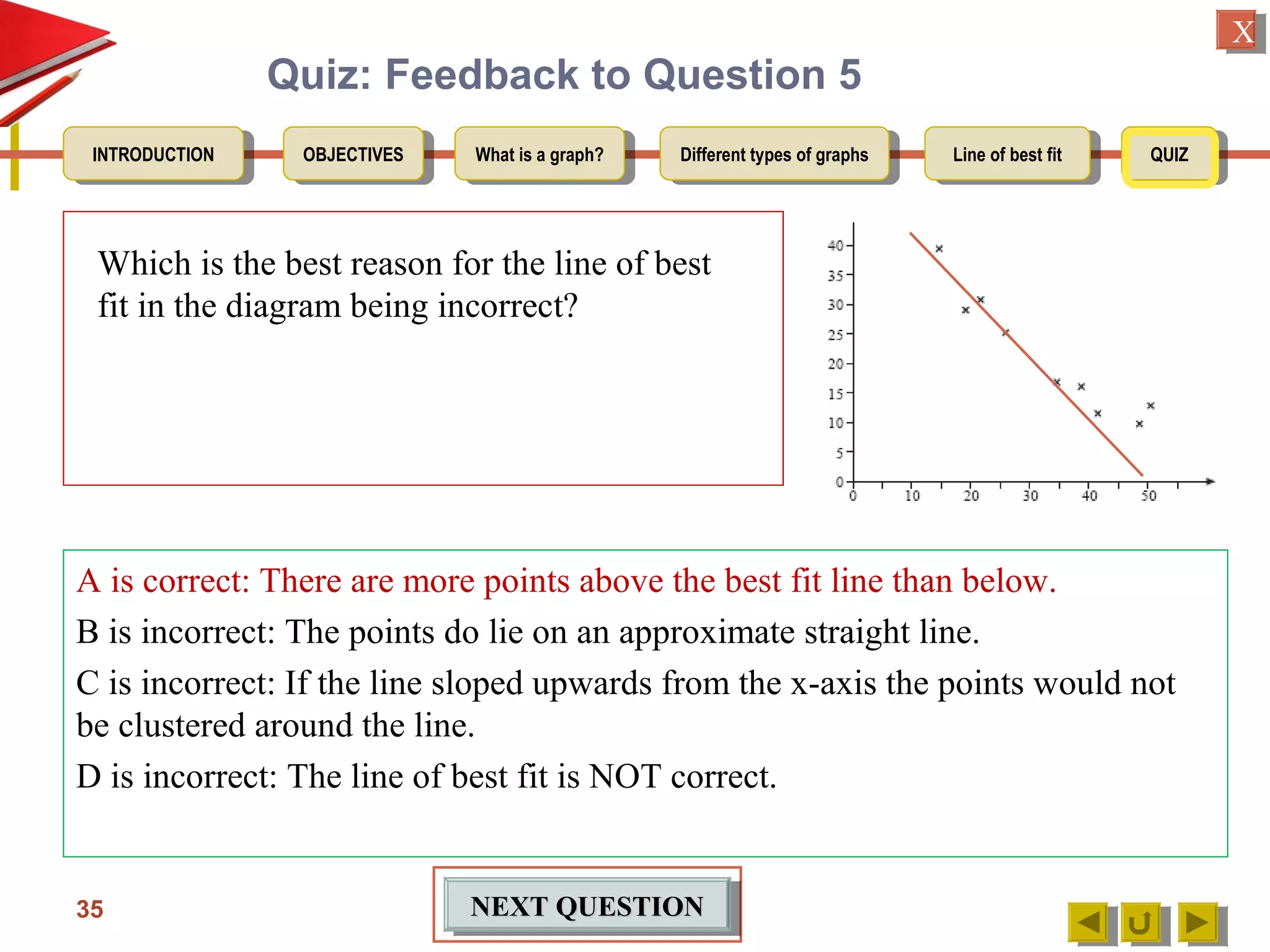
Quiz: Feedback to Question 5
35 NEXT QUESTIONNEXT QUESTIONNEXT QUESTIONNEXT QUESTION
A is correct: There are more points above the best fit line than below.
B is incorrect: The points do lie on an approximate straight line.
C is incorrect: If the line sloped upwards from the x-axis the points would not
be clustered around the line.
D is incorrect: The line of best fit is NOT correct.
Which is the best reason for the line of best
fit in the diagram being incorrect?
OBJECTIVESOBJECTIVES What is a graph?What is a graph? Different types of graphsDifferent types of graphs Line of best fitLine of best fit QUIZQUIZINTRODUCTIONINTRODUCTION
XX
END OF QUIZ
 You have reached the end of the quiz.
 If you wish to review this lesson, click on Introduction to start the review.
 If you have finished viewing the lesson, click the Close (X) button.
36

Physics M1 Graphs I

  • 1.
    OBJECTIVESOBJECTIVES What isa graph?What is a graph? Different types of graphsDifferent types of graphs Line of best fitLine of best fit QUIZQUIZINTRODUCTIONINTRODUCTION XX
  • 2.
    GRAPHS Physics  Module1  Unit 1  Lesson 13-14BEGINBEGIN
  • 3.
    OBJECTIVESOBJECTIVES What isa graph?What is a graph? Different types of graphsDifferent types of graphs Line of best fitLine of best fit QUIZQUIZINTRODUCTIONINTRODUCTION XX Introduction http://www.nationsonline.org/maps/jamaica-administrative-map.jpg FEEDBACK3 1. What is the purpose of a map? 2. Are vertical and horizontal lines on the map? 3. What is the purpose of the vertical and horizontal lines? 4. Do you think that a map is like a graph? Why?
  • 4.
    OBJECTIVESOBJECTIVES What isa graph?What is a graph? Different types of graphsDifferent types of graphs Line of best fitLine of best fit QUIZQUIZINTRODUCTIONINTRODUCTION XX Introduction http://www.nationsonline.org/maps/jamaica-administrative-map.jpg 4 1. What is the purpose of a map? 2. Are vertical and horizontal lines on the map? 3. What is the purpose of the vertical and horizontal lines? 4. Do you think that a map is like a graph? Why? To locate places Yes They are used to state the location of a place on the map Yes. The lines on a map are used to write coordinates of places in the same way the lines on a graph are used to write coordinates of points on the graph
  • 5.
    OBJECTIVESOBJECTIVES What isa graph?What is a graph? Different types of graphsDifferent types of graphs Line of best fitLine of best fit QUIZQUIZINTRODUCTIONINTRODUCTION XX Objectives At the end of this lesson, you will be able to the following: 1. State what is a coordinate grid (Cartesian plane) and a graph. 2. Explain what is an experimental graph. 3. Distinguish between independent and dependent variables. 4. Apply the required rules for plotting experimental graphs. 5. Identify different types of experimental graphs that are commonly found in physics. 5
  • 6.
    OBJECTIVESOBJECTIVES What isa graph?What is a graph? Different types of graphsDifferent types of graphs Line of best fitLine of best fit QUIZQUIZINTRODUCTIONINTRODUCTION XX 1. What is a Cartesian plane? What is a graph? Cartesian plane is formed by intersecting two real number lines at right angles. It is also called the x-y plane or the rectangular coordinate system. Horizontal axis is usually called the x-axis Vertical axis is usually called the y-axis The intersection of the two axes is called the origin 6 Cont’d
  • 7.
    OBJECTIVESOBJECTIVES What isa graph?What is a graph? Different types of graphsDifferent types of graphs Line of best fitLine of best fit QUIZQUIZINTRODUCTIONINTRODUCTION XX 1. What is a Cartesian plane? What is a graph? A graph is a best possible line drawn through points on a cartesian plane 7           graph
  • 8.
    OBJECTIVESOBJECTIVES What isa graph?What is a graph? Different types of graphsDifferent types of graphs Line of best fitLine of best fit QUIZQUIZINTRODUCTIONINTRODUCTION XX What is an experimental graph?  An experimental graph is a graph that is plotted using data from an experiment.  An experimental graph gives a pictorial view of the relationship between two variables in an experiment. The illustration shows an experimental graph of the relationship between the velocity of an object and the time of its motion 8
  • 9.
    OBJECTIVESOBJECTIVES What isa graph?What is a graph? Different types of graphsDifferent types of graphs Line of best fitLine of best fit QUIZQUIZINTRODUCTIONINTRODUCTION XX 1. What is an experimental graph? Independent and dependent variables 1. An experimental graph shows the relationship between two variables in an experiment. 2. In an experiment the magnitude of one variable is measured and the magnitude of another variable that depends on it is measured whenever the magnitude of the first variable changes. The magnitude of the first variable is most times varied by the experimenter 3. The variable that is varied by the experimenter in the experiment is called the independent variable. 4. The variable that depends on the independent variable is called the dependent variable 9
  • 10.
    OBJECTIVESOBJECTIVES What isa graph?What is a graph? Different types of graphsDifferent types of graphs Line of best fitLine of best fit QUIZQUIZINTRODUCTIONINTRODUCTION XX 1. What is an experimental graph? Independent and dependent variables  The values of the independent variable form the x-coordinates of the points on an experimental graph  The values of the dependent variable form the y-coordinates of the points on an experimental graph  In the experimental graph shown, velocity is the dependent variable and time is the independent variable 10 Dependentvariable:y-axis The independent variable: x-axis
  • 11.
    OBJECTIVESOBJECTIVES What isa graph?What is a graph? Different types of graphsDifferent types of graphs Line of best fitLine of best fit QUIZQUIZINTRODUCTIONINTRODUCTION XX 1. What is an experimental graph? Elements of a Proper Graph  A proper graph must display the following:  A title  The dependent variable on the y-axis and independent variable on the x- axis.  Axes labeled with the names of the variable quantities and their units.  Properly calibrated axes. An axis is calibrated when the numbers representing the magnitudes of the quantity are written along the axis at evenly spaced intervals  Calibrations must be such that the ranges of values on each axis must take up more than half the length of the axis. Numbering can begin at a non-zero value to accommodate this requirement , however this cannot be broken if intercept values are required from the graph.  DO NOT use 1 cm to represent 3 or 7 units or any multiple or fraction of 3 or 7 units. Similarly DO NOT use 3 or 7 cm to represent 1 unit.  Use  or × to plot points on the graph.11
  • 12.
    OBJECTIVESOBJECTIVES What isa graph?What is a graph? Different types of graphsDifferent types of graphs Line of best fitLine of best fit QUIZQUIZINTRODUCTIONINTRODUCTION XX 1. What is an experimental graph? Elements of a Proper Graph TITLE  Clearly states the purpose of the graph  Should be located on a clear space near the top of the graph  A possible title for a graph would be: Graph showing the variation of the period of a Simple Pendulum with its length.  The title should uniquely identify the graph 12
  • 13.
    OBJECTIVESOBJECTIVES What isa graph?What is a graph? Different types of graphsDifferent types of graphs Line of best fitLine of best fit QUIZQUIZINTRODUCTIONINTRODUCTION XX 1. What is an experimental graph? Elements of a Proper Graph EXAMPLES OF POOR CHOICES OF TITLES Example 1. “v vs t" The title should be in words and should not just repeat the symbols of the quantities plotted on the axes! Example 2. “Velocity versus time“ This title is in words, but just repeats the names of the quantities plotted on the axes. 13
  • 14.
    OBJECTIVESOBJECTIVES What isa graph?What is a graph? Different types of graphsDifferent types of graphs Line of best fitLine of best fit QUIZQUIZINTRODUCTIONINTRODUCTION XX 1. What is an experimental graph? Elements of a Proper Graph  The axes should be labeled with words and with units clearly indicated.  The units: are generally in parentheses, e.g., Displacement, y, of ball (cm)  Avoid saying Diameter in meters (x 10-4 ) since this confuses the reader. Instead state Diameter (x 10-4 meters) or use standard prefixes like kilo or micro so that the exponent is not needed: "Diameter (mm)". Time of fall (s) Displacement of ball (cm) LABELLING AXES 14
  • 15.
    OBJECTIVESOBJECTIVES What isa graph?What is a graph? Different types of graphsDifferent types of graphs Line of best fitLine of best fit QUIZQUIZINTRODUCTIONINTRODUCTION XX 1. What is a graph? Elements of a Proper Graph 1. The scales should be chosen so that the graph spreads over as much of the graph sheet as is possible. This is done by spreading the range of magnitudes of the quantities on both the axes over more than half of the respective axis 2. The first graph is a good graph because the range of values on both axes are spread over more than half the length of the axis while it is not so in the second. Good Poor CALIBRATING SCALES 15
  • 16.
    OBJECTIVESOBJECTIVES What isa graph?What is a graph? Different types of graphsDifferent types of graphs Line of best fitLine of best fit QUIZQUIZINTRODUCTIONINTRODUCTION XX1. What is an experimental graph? Elements of a proper graph. Summary 16 Clearly stated title Axis labeled with quantity and its SI units Points plotted using  or × Axis calibrated using 4 cm (NOT 3 cm or 7 cm) to represent 1 unit Range of values spread over more than half the length of the axis
  • 17.
    OBJECTIVESOBJECTIVES What isa graph?What is a graph? Different types of graphsDifferent types of graphs Line of best fitLine of best fit QUIZQUIZINTRODUCTIONINTRODUCTION XX 2. Types of experimental graphs Two types of experimental graph that are most commonly used in Physics are: You will use mostly linear graphs in physics. 17 LinearLinear ExponentialExponential
  • 18.
    OBJECTIVESOBJECTIVES What isa graph?What is a graph? Different types of graphsDifferent types of graphs Line of best fitLine of best fit QUIZQUIZINTRODUCTIONINTRODUCTION XX 2. Types of experimental graphs: Linear graphs Linear graphs can be 1. Directly proportional: The line passes through the origin of the axes 2. Linear with positive slope: The line slopes upwards to (or from) the x-axis 3. Linear with negative slope: The line slopes downwards to (or from) the x-axis. 4. NOTE: Proportional graphs can also have negative slopes. 18
  • 19.
    OBJECTIVESOBJECTIVES What isa graph?What is a graph? Different types of graphsDifferent types of graphs Line of best fitLine of best fit QUIZQUIZINTRODUCTIONINTRODUCTION XX 2. Making linear graphs  If the displacement (s) of an object that is traveling with constant acceleration (a) from rest is plotted against the time (t) the object travels the graph obtained would be as in the Figure 1.  The reason for this is the time taken varies with distance in the following way s = ½a t2  If however a graph of s against t2 is plotted the graph in the illustration will be obtained as in Figure 2.  Other examples are acceleration against mass will give a curved graph but acceleration against 1/mass will give a proportional graph because acceleration = force/ mass for constant force. 19
  • 20.
    OBJECTIVESOBJECTIVES What isa graph?What is a graph? Different types of graphsDifferent types of graphs Line of best fitLine of best fit QUIZQUIZINTRODUCTIONINTRODUCTION XX 3. Line of best fit. What is it? What is meant by straight line of best fit? x x x x x x ‘line of best fit’ ‘line of best fit’ This is a line that should pass as close as possible to each of the points but should not be connected point-to-point. If the relationship appears to be linear, the line of best fit should be a straight line. EXAMPLE 1EXAMPLE 1 EXAMPLE 2EXAMPLE 2 22
  • 21.
    OBJECTIVESOBJECTIVES What isa graph?What is a graph? Different types of graphsDifferent types of graphs Line of best fitLine of best fit QUIZQUIZINTRODUCTIONINTRODUCTION XX 3. Line of best fit. What is it? Is the line best fit linear? Click YES or NO. x x x x x x It is not linear. This is a line that should pass as close as possible to each of the points but should not be connected point-to-point. But the relationship appears to be non linear. NOYES Try again 23
  • 22.
    OBJECTIVESOBJECTIVES What isa graph?What is a graph? Different types of graphsDifferent types of graphs Line of best fitLine of best fit QUIZQUIZINTRODUCTIONINTRODUCTION XX 3. Line of best fit. Steps to follow to draw a line of best fit Draw a line of best fit using a ruler for a straight line graph, or draw free-hand for a curved graph. The line should be drawn so that there are roughly the same number of points above and below. too high too low too steep too shallow correct This is called an inconsistent point. Use your apparatus to check this measurement again 24 Choose good scales, with the dependent variable on the y-axis and the independent variable on the x-axis Plot the points carefully. Inconsistent points should be rechecked. If this is not possible they should be ignored when drawing the best-fit line
  • 23.
    OBJECTIVESOBJECTIVES What isa graph?What is a graph? Different types of graphsDifferent types of graphs Line of best fitLine of best fit QUIZQUIZINTRODUCTIONINTRODUCTION XX QUIZ Are you ready to test yourself?  There are five multiple choice questions  For each question, click on the correct response and then click on the feedback for explanations of the answers being correct or incorrect. 25 BEGIN QUIZ!BEGIN QUIZ!
  • 24.
    OBJECTIVESOBJECTIVES What isa graph?What is a graph? Different types of graphsDifferent types of graphs Line of best fitLine of best fit QUIZQUIZINTRODUCTIONINTRODUCTION XX QUIZ: Question 1 Which is the independent variable on the graph in the diagram? 26 A. Potential differenceA. Potential difference B. AmpsB. Amps C. VoltsC. Volts D. CurrentD. Current FEEDBACKFEEDBACKFEEDBACKFEEDBACK
  • 25.
    OBJECTIVESOBJECTIVES What isa graph?What is a graph? Different types of graphsDifferent types of graphs Line of best fitLine of best fit QUIZQUIZINTRODUCTIONINTRODUCTION XX Quiz: Feedback to Question 1 Which is the independent variable on the graph in the diagram? 27 NEXT QUESTIONNEXT QUESTIONNEXT QUESTIONNEXT QUESTION A is incorrect: Potential difference is the dependent quantity. It is on the y-axis. B is incorrect: Amps is a unit and not a quantity. C is incorrect: Volts is a unit and not a quantity. D is correct: Current is the independent quantity. It is on the x-axis.
  • 26.
    OBJECTIVESOBJECTIVES What isa graph?What is a graph? Different types of graphsDifferent types of graphs Line of best fitLine of best fit QUIZQUIZINTRODUCTIONINTRODUCTION XX QUIZ: Question 2 28 B. I and III onlyB. I and III only D. I, II and IIID. I, II and III C. I and II onlyC. I and II only A. NoneA. None FEEDBACKFEEDBACKFEEDBACKFEEDBACK Which of the graphs in the diagrams could be considered to be proper graphs? I II III
  • 27.
    OBJECTIVESOBJECTIVES What isa graph?What is a graph? Different types of graphsDifferent types of graphs Line of best fitLine of best fit QUIZQUIZINTRODUCTIONINTRODUCTION XX Quiz: Feedback to Question 2 29 NEXT QUESTIONNEXT QUESTIONNEXT QUESTIONNEXT QUESTION A is correct: None of the graphs have the range of quantities on both axes spread over more than half the length of the axes B is incorrect: Neither of the two graphs have the range of quantities on both axes spread over more than half the length of the axes. C is incorrect: Neither of the two graphs have the range of quantities on both axes spread over more than half the length of the axes. D is incorrect: Neither of the two graphs have the range of quantities on both axes spread over more than half the length of the axes. Which of the graphs in the diagrams could be considered to be proper graphs? I II III
  • 28.
    OBJECTIVESOBJECTIVES What isa graph?What is a graph? Different types of graphsDifferent types of graphs Line of best fitLine of best fit QUIZQUIZINTRODUCTIONINTRODUCTION XX QUIZ: Question 3 Which is a good criticism of the graph shown? 30 A. Axes are not properly labeled.A. Axes are not properly labeled. D. The line of best fit is not correctly drawn.D. The line of best fit is not correctly drawn. B. Spread of values on the axes not large enough.B. Spread of values on the axes not large enough. C. The plotted points are not represented correctly.C. The plotted points are not represented correctly. FEEDBACKFEEDBACKFEEDBACKFEEDBACK      Current (A) Voltage(V)
  • 29.
    OBJECTIVESOBJECTIVES What isa graph?What is a graph? Different types of graphsDifferent types of graphs Line of best fitLine of best fit QUIZQUIZINTRODUCTIONINTRODUCTION XX Quiz: Feedback to Question 3 31 NEXT QUESTIONNEXT QUESTIONNEXT QUESTIONNEXT QUESTION A is incorrect: Both axes are labeled with the quantities and their units. B is incorrect: The range of values on both axes is spread over more than half the length of the axes. C is correct: The accepted  or × for plotting points is not used. D is incorrect: There is a balance of points about the graph line. Which is a good criticism of the graph shown?      Current (A) Voltage(V)
  • 30.
    OBJECTIVESOBJECTIVES What isa graph?What is a graph? Different types of graphsDifferent types of graphs Line of best fitLine of best fit QUIZQUIZINTRODUCTIONINTRODUCTION XX 32 Based on the information on the graph in the diagram which of the following is the most likely equation relating the two variables? Quiz: Question 4 A. I = k × 1/rA. I = k × 1/r D. I = k × r2D. I = k × r2 C. I = k × rC. I = k × r B. I = k × 1/r2B. I = k × 1/r2 FEEDBACKFEEDBACKFEEDBACKFEEDBACK 1/r2 (m-2 ) I (Wm-2 )
  • 31.
    OBJECTIVESOBJECTIVES What isa graph?What is a graph? Different types of graphsDifferent types of graphs Line of best fitLine of best fit QUIZQUIZINTRODUCTIONINTRODUCTION XX Quiz: Feedback to Question 4 33 NEXT QUESTIONNEXT QUESTIONNEXT QUESTIONNEXT QUESTION A is incorrect: For that equation, a graph of I against 1/r would be a straight line. B is correct: For that equation, a graph of I against 1/r2 would be a straight line. C is incorrect: For that equation a graph of I against r would be a straight line. D is incorrect: For that equation a graph of I against r2 would be a straight line. Based on the information on the graph in the diagram which of the following is the most likely equation relating the two variables? 1/r2 (m-2 ) I (Wm-2 )
  • 32.
    OBJECTIVESOBJECTIVES What isa graph?What is a graph? Different types of graphsDifferent types of graphs Line of best fitLine of best fit QUIZQUIZINTRODUCTIONINTRODUCTION XX QUIZ: Question 5 Which is the best reason for the line of best fit in the diagram being incorrect? 34 B. The points are on a curve and not a straight lineB. The points are on a curve and not a straight line D. The question is not necessary because the line of best fit is correct D. The question is not necessary because the line of best fit is correct C. The line should be sloping upwards from the x-axisC. The line should be sloping upwards from the x-axis A. There is an imbalance of points above the lineA. There is an imbalance of points above the line FEEDBACKFEEDBACKFEEDBACKFEEDBACK
  • 33.
    OBJECTIVESOBJECTIVES What isa graph?What is a graph? Different types of graphsDifferent types of graphs Line of best fitLine of best fit QUIZQUIZINTRODUCTIONINTRODUCTION XX Quiz: Feedback to Question 5 35 NEXT QUESTIONNEXT QUESTIONNEXT QUESTIONNEXT QUESTION A is correct: There are more points above the best fit line than below. B is incorrect: The points do lie on an approximate straight line. C is incorrect: If the line sloped upwards from the x-axis the points would not be clustered around the line. D is incorrect: The line of best fit is NOT correct. Which is the best reason for the line of best fit in the diagram being incorrect?
  • 34.
    OBJECTIVESOBJECTIVES What isa graph?What is a graph? Different types of graphsDifferent types of graphs Line of best fitLine of best fit QUIZQUIZINTRODUCTIONINTRODUCTION XX END OF QUIZ  You have reached the end of the quiz.  If you wish to review this lesson, click on Introduction to start the review.  If you have finished viewing the lesson, click the Close (X) button. 36

Editor's Notes

  • #3 This file is licensed under the Creative Commons Attribution-Share Alike 3.0 Unported license.
  • #18 Proportional curve image source: http://www.learner.org/courses/learningmath/algebra/images/session5/5b7.gif Exponential curve image source: http://i.imgur.com/wdQgUBW.gif
  • #21 Source of image: author with use of Microsoft Excel
  • #22 Source of image: Author using Microsoft Excel