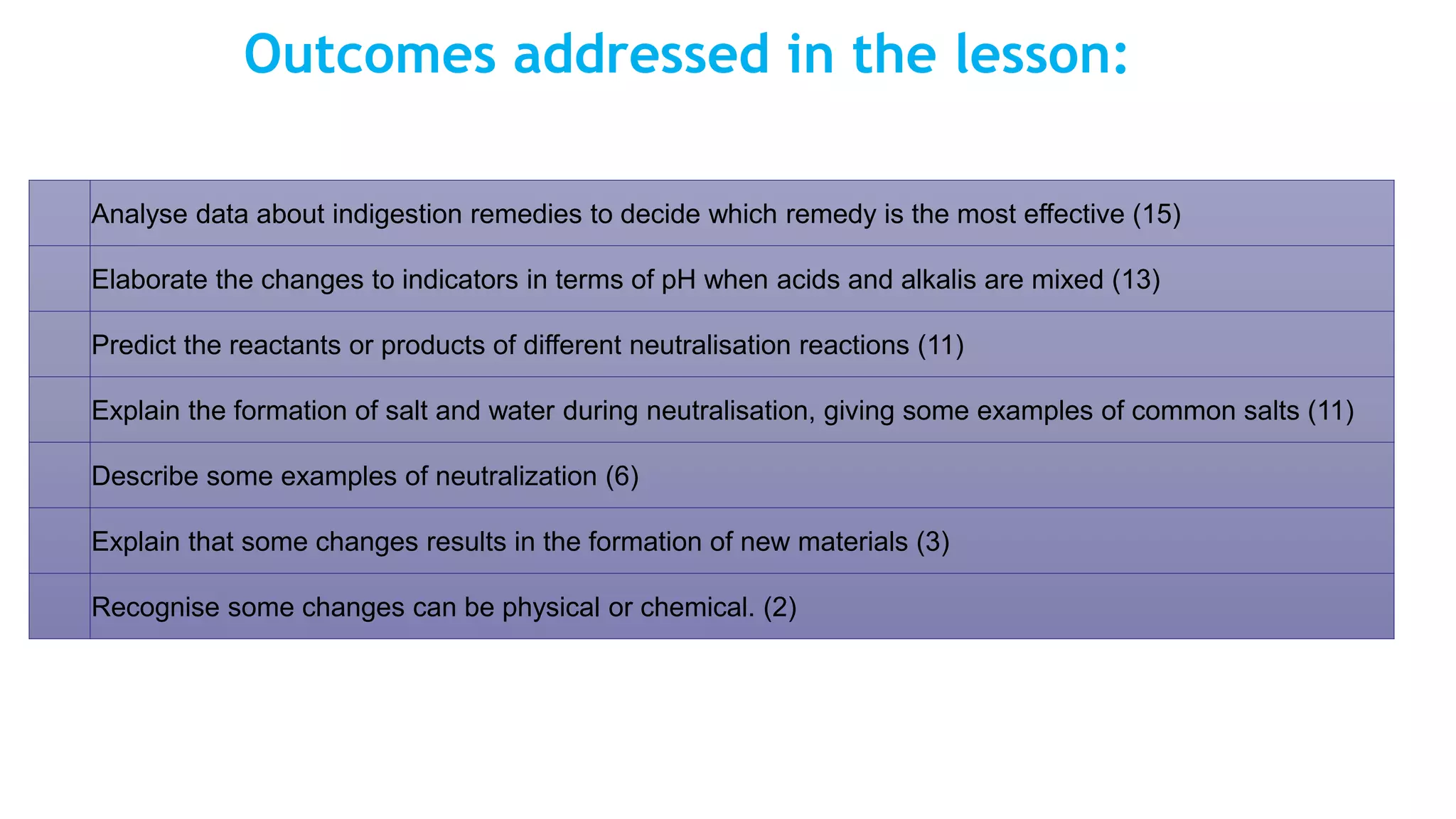
Analyse data about indigestion remedies to decide which remedy is the most effective (15)
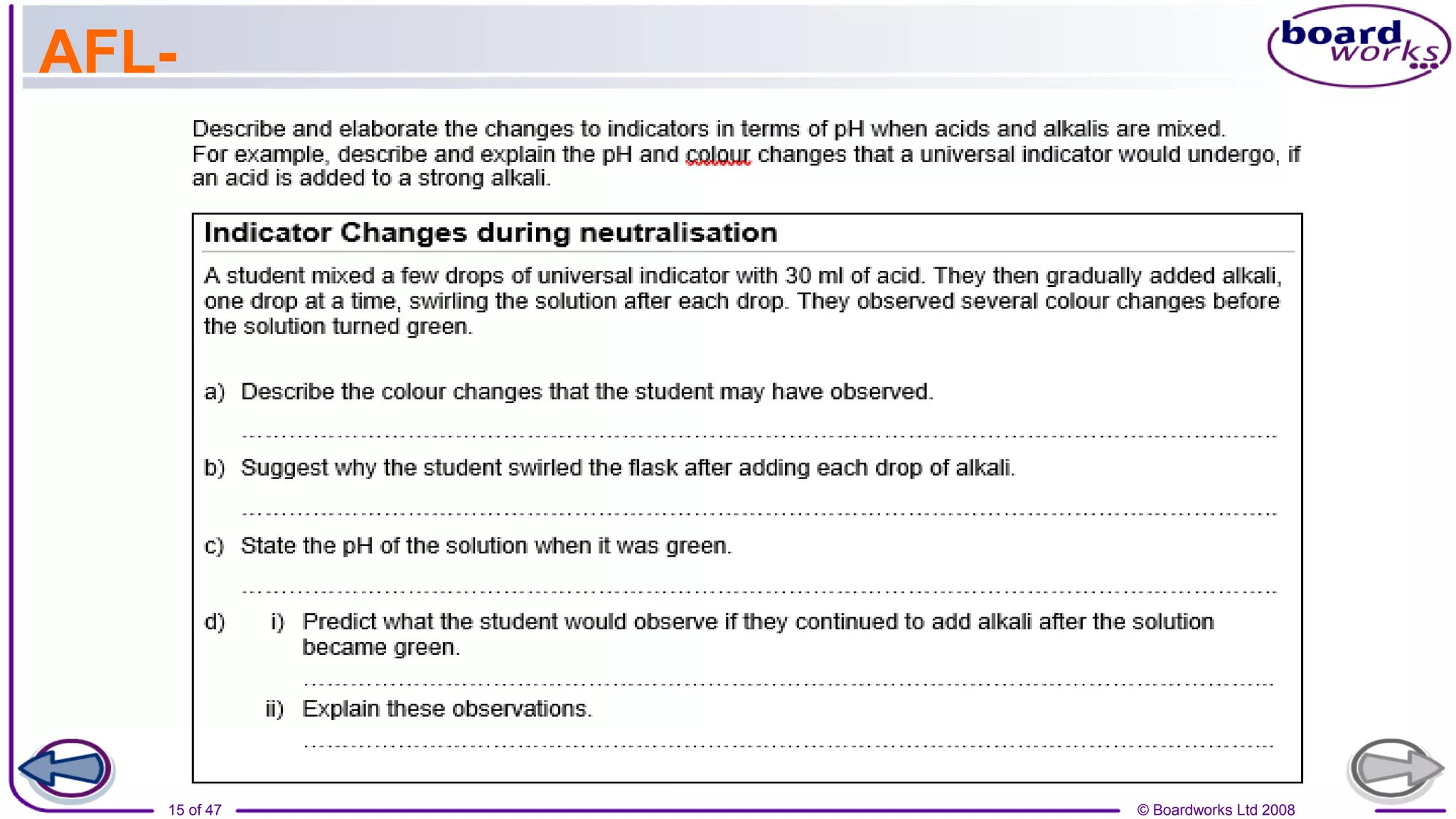
Elaborate the changes to indicators in terms of pH when acids and alkalis are mixed (13)
Predict the reactants or products of different neutralisation reactions (11)
Explain the formation of salt and water during neutralisation, giving some examples of common salts (11)
Describe some examples of neutralization (6)
Explain that some changes results in the formation of new materials (3)
Recognise some changes can be physical or chemical. (2)
Outcomes addressed in the lesson:
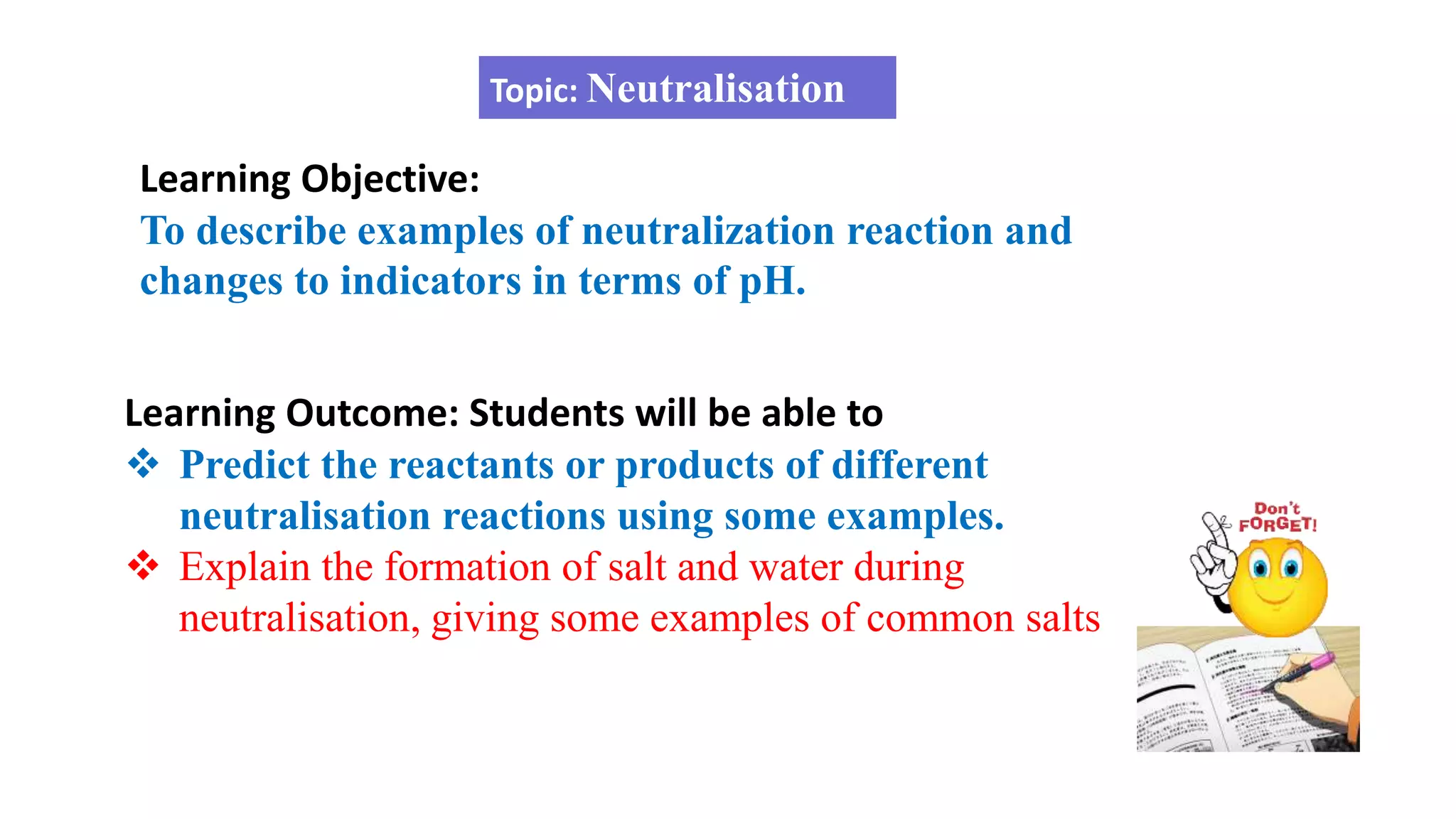
Topic: Neutralisation
Learning Outcome: Students will be able to
 Predict the reactants or products of different
neutralisation reactions using some examples.
 Explain the formation of salt and water during
neutralisation, giving some examples of common salts
Learning Objective:
To describe examples of neutralization reaction and
changes to indicators in terms of pH.
© Boardworks Ltd 2008
3 of 47
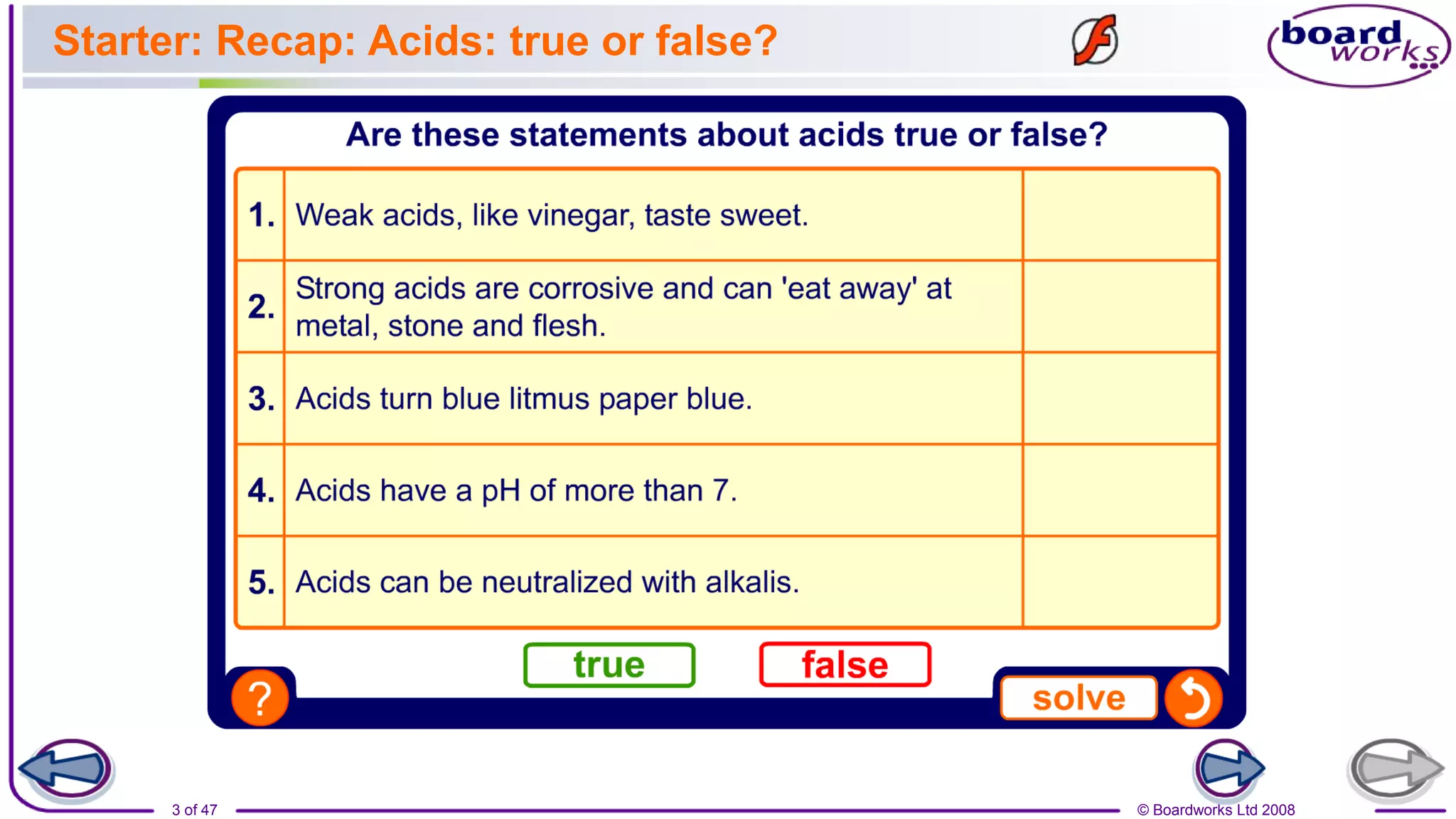
Starter: Recap: Acids: true or false?
© Boardworks Ltd 2008
4 of 47
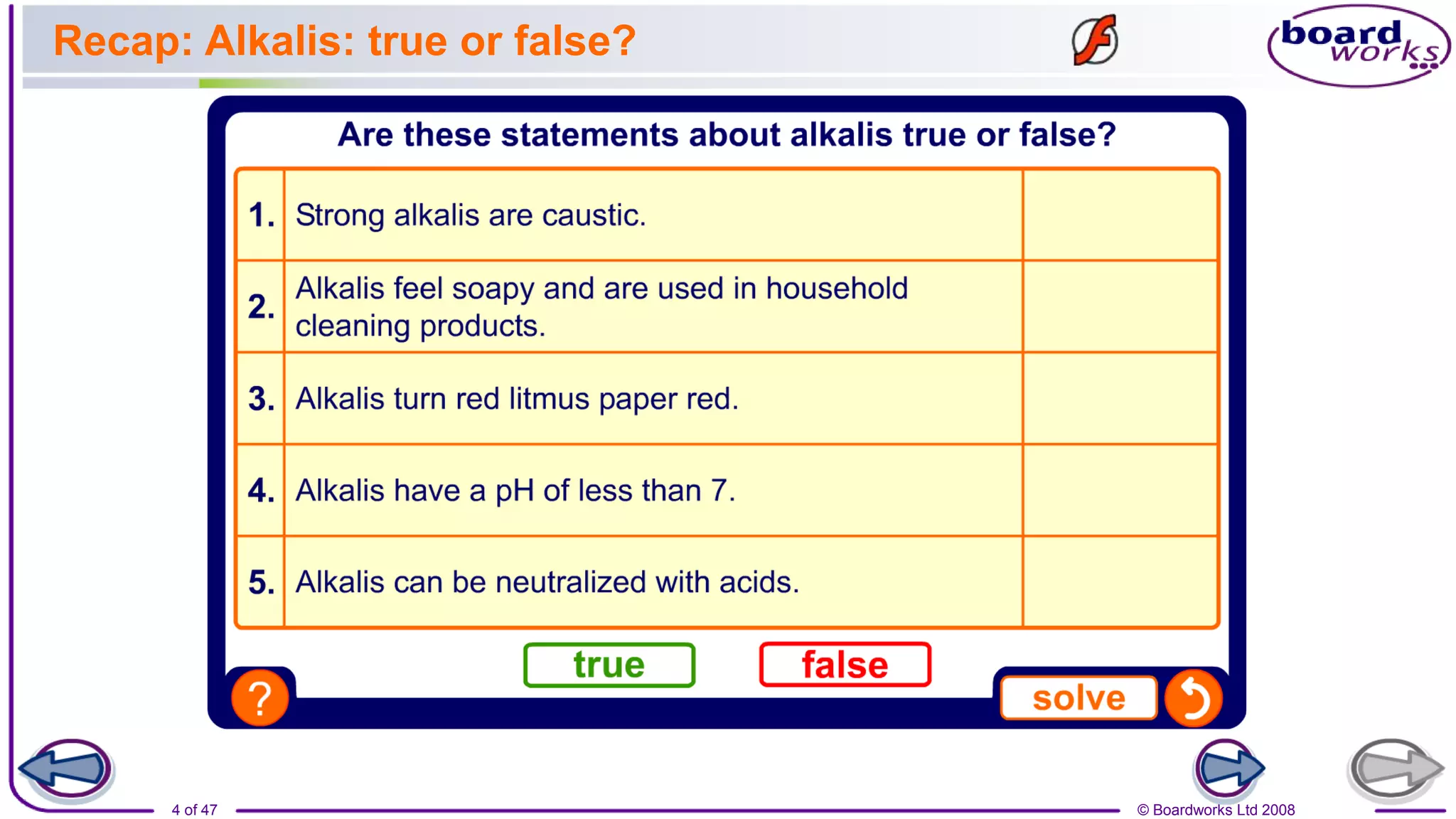
Recap: Alkalis: true or false?
© Boardworks Ltd 2008
5 of 47
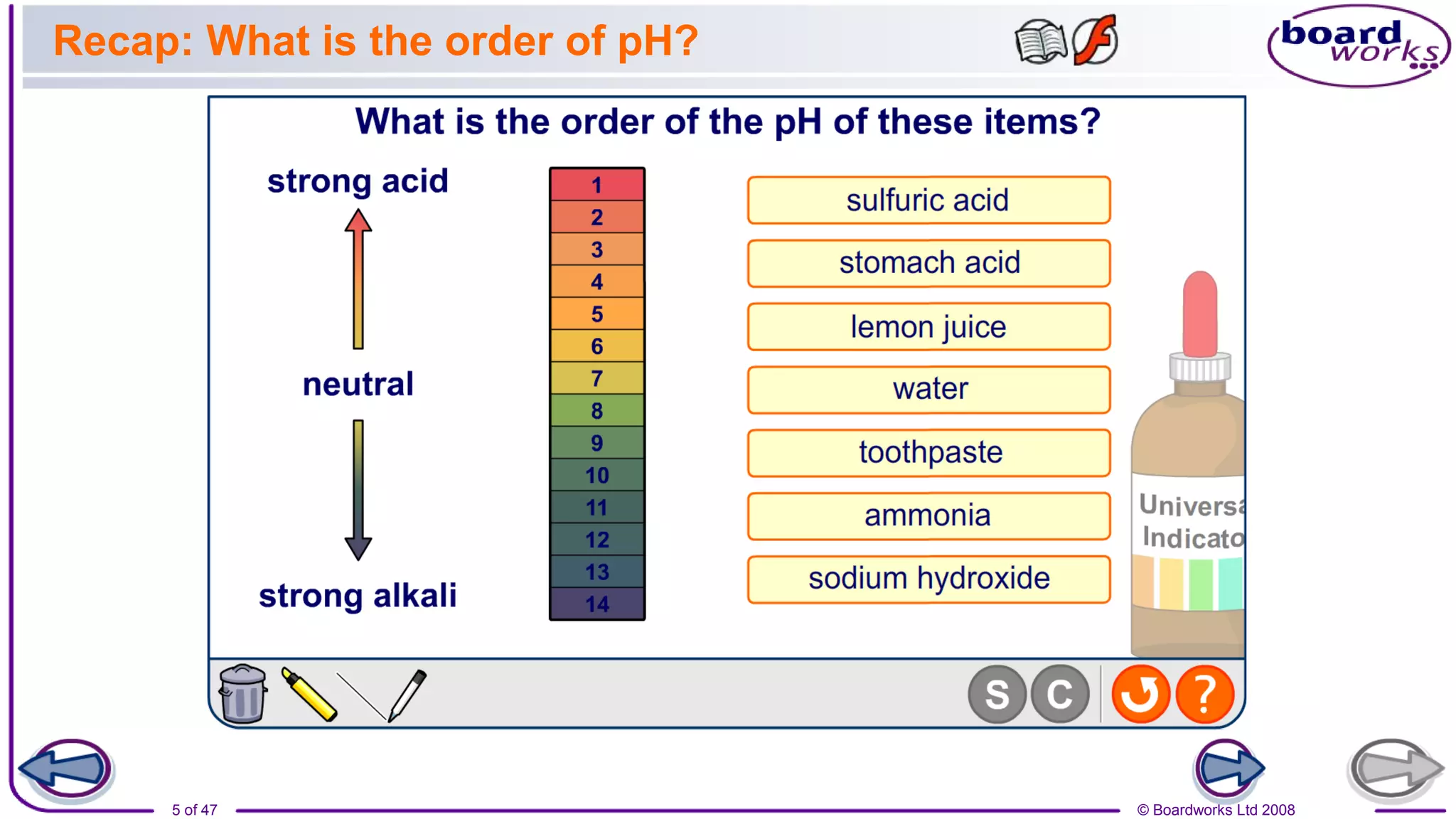
Recap: What is the order of pH?
© Boardworks Ltd 2008
6 of 47
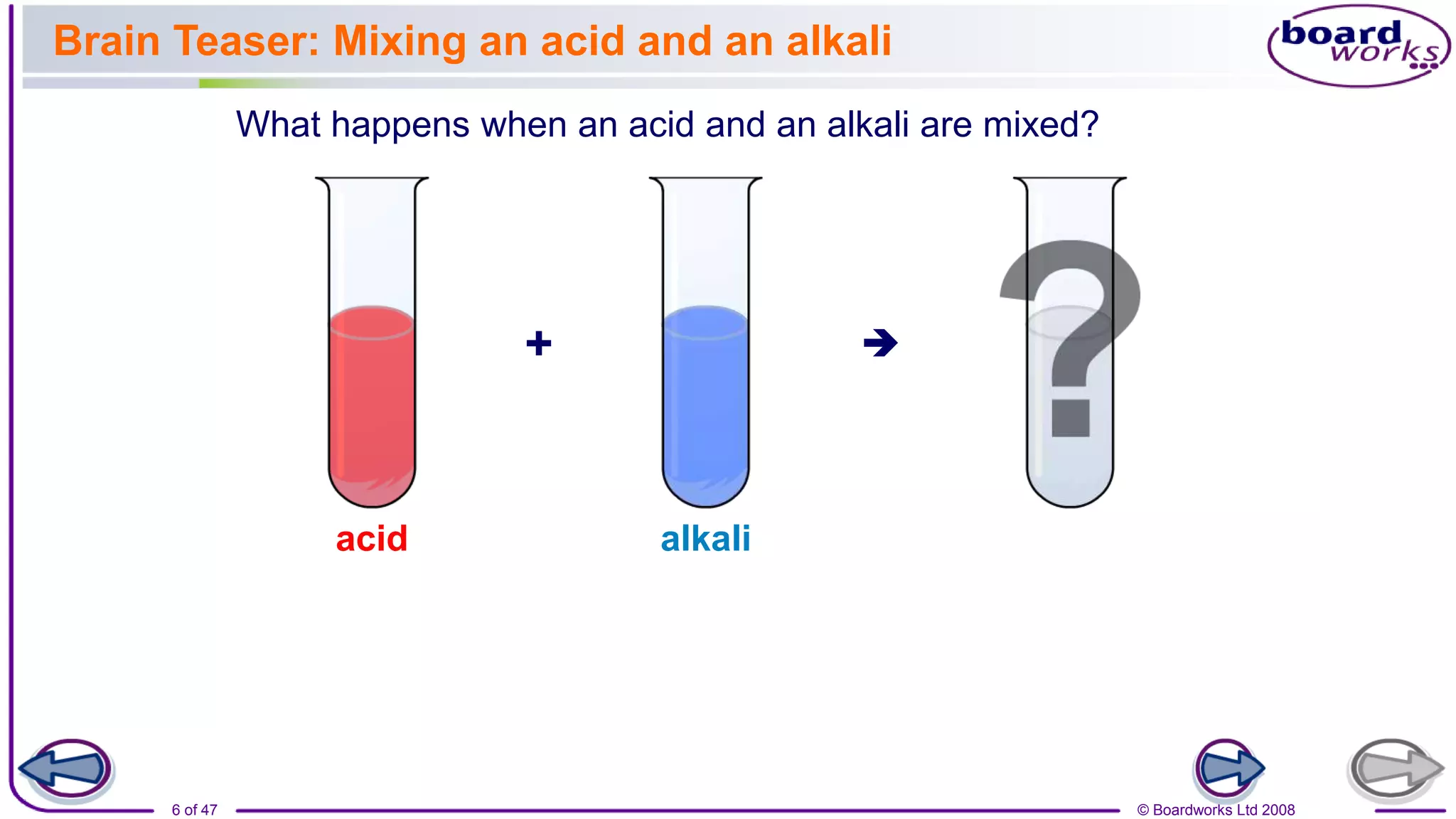
Brain Teaser: Mixing an acid and an alkali
What happens when an acid and an alkali are mixed?
+ 
acid alkali
© Boardworks Ltd 2008
7 of 47
https://www.youtube.com/watch?v=RmnT9jwX4gQ
Watch video
https://www.youtube.com/watch?v=8UiuE7Xx5l8
Explore
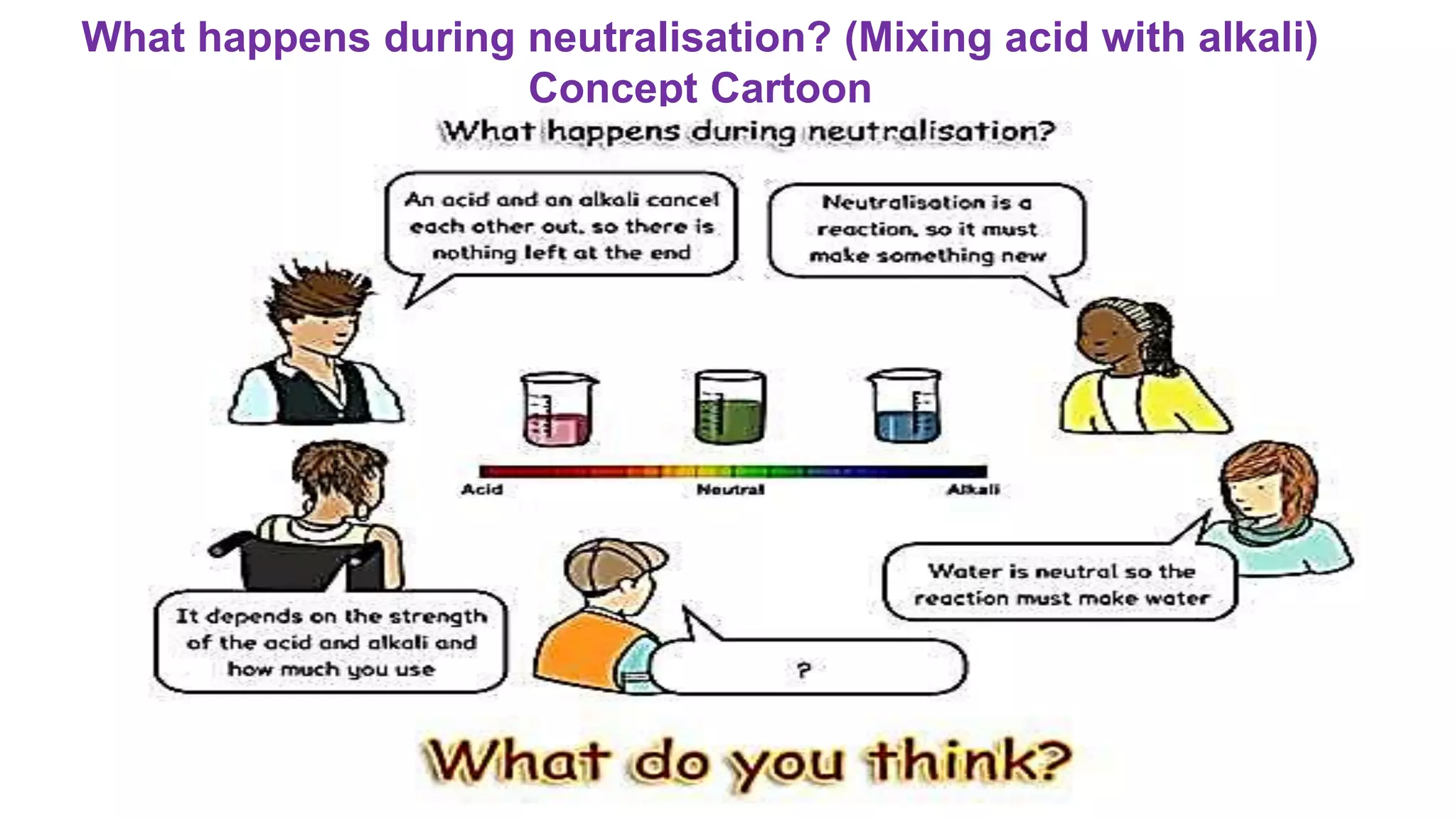
What happens during neutralisation? (Mixing acid with alkali)
Concept Cartoon
9 of 47
Task 1 : Neutralisation
Create an information sheet/ poster/mind map covering the
Highlighting aspects of neutralisation:
1. Changes to pH and indicators
2. Uses and examples of neutralization
3. Chemical reaction of neutralization (reactants, products)
© Boardworks Ltd 2008
10 of 47
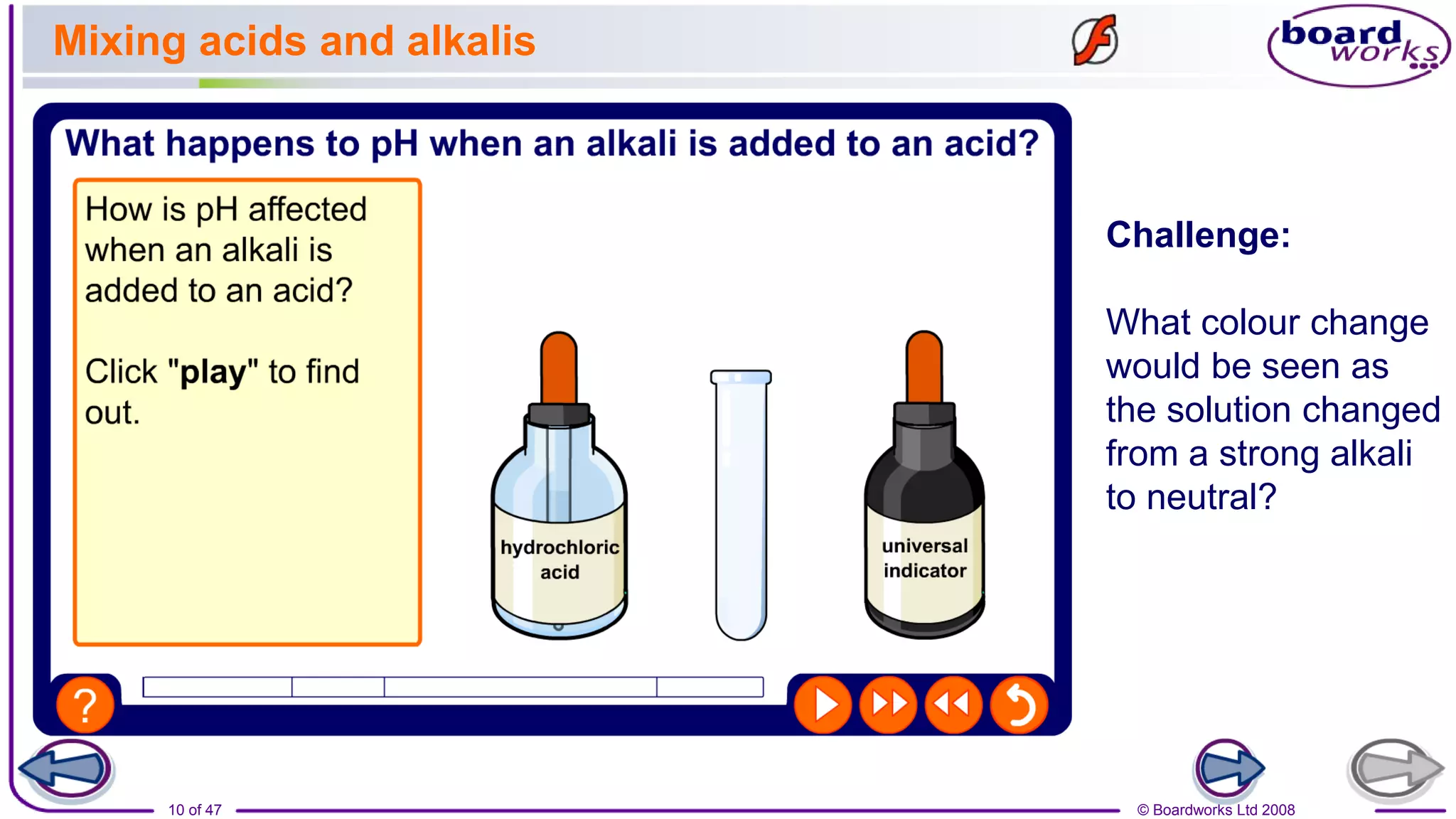
Mixing acids and alkalis
Challenge:
What colour change
would be seen as
the solution changed
from a strong alkali
to neutral?
© Boardworks Ltd 2008
11 of 47
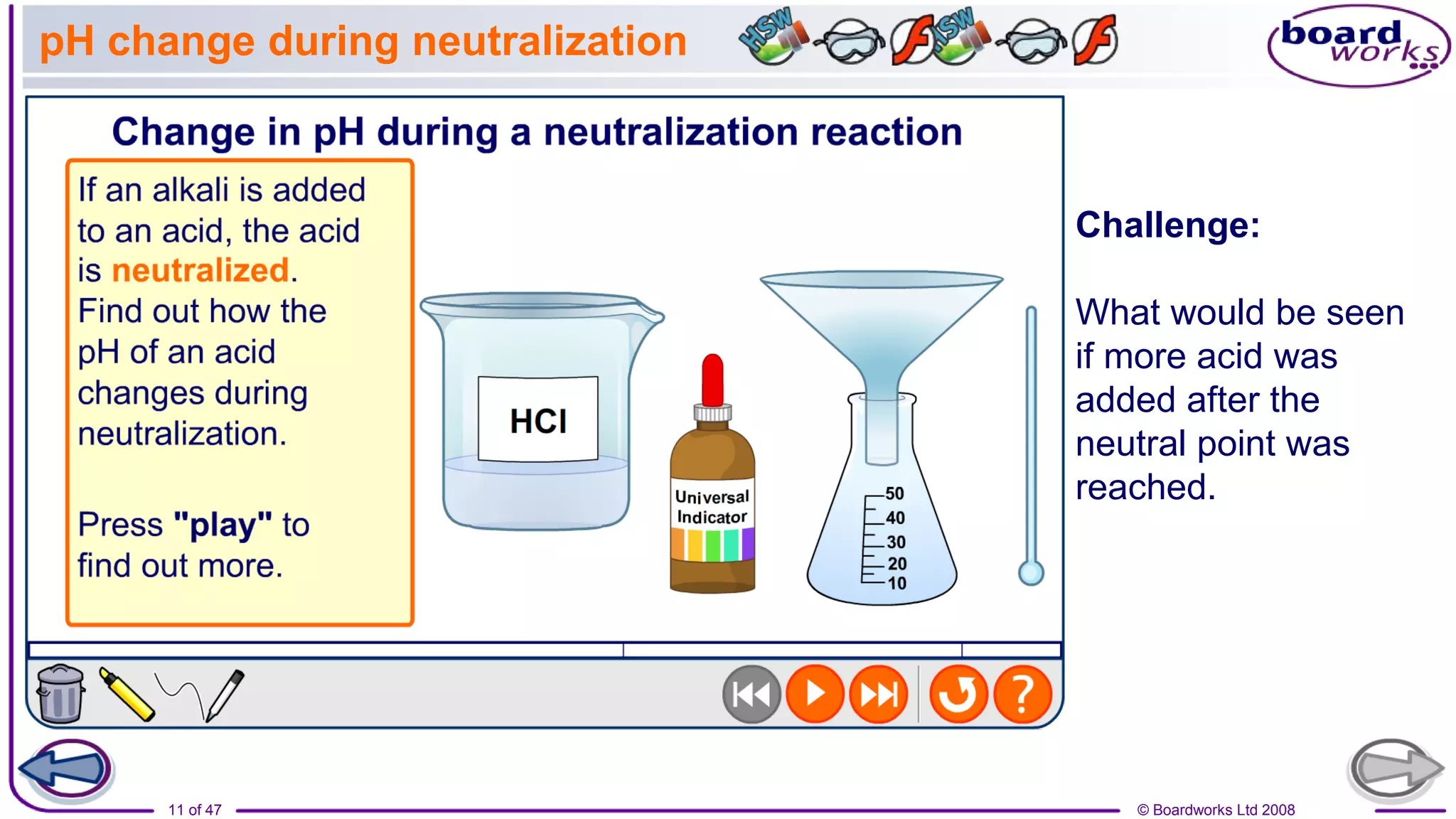
Challenge:
What would be seen
if more acid was
added after the
neutral point was
reached.
pH change during neutralization
© Boardworks Ltd 2008
12 of 47
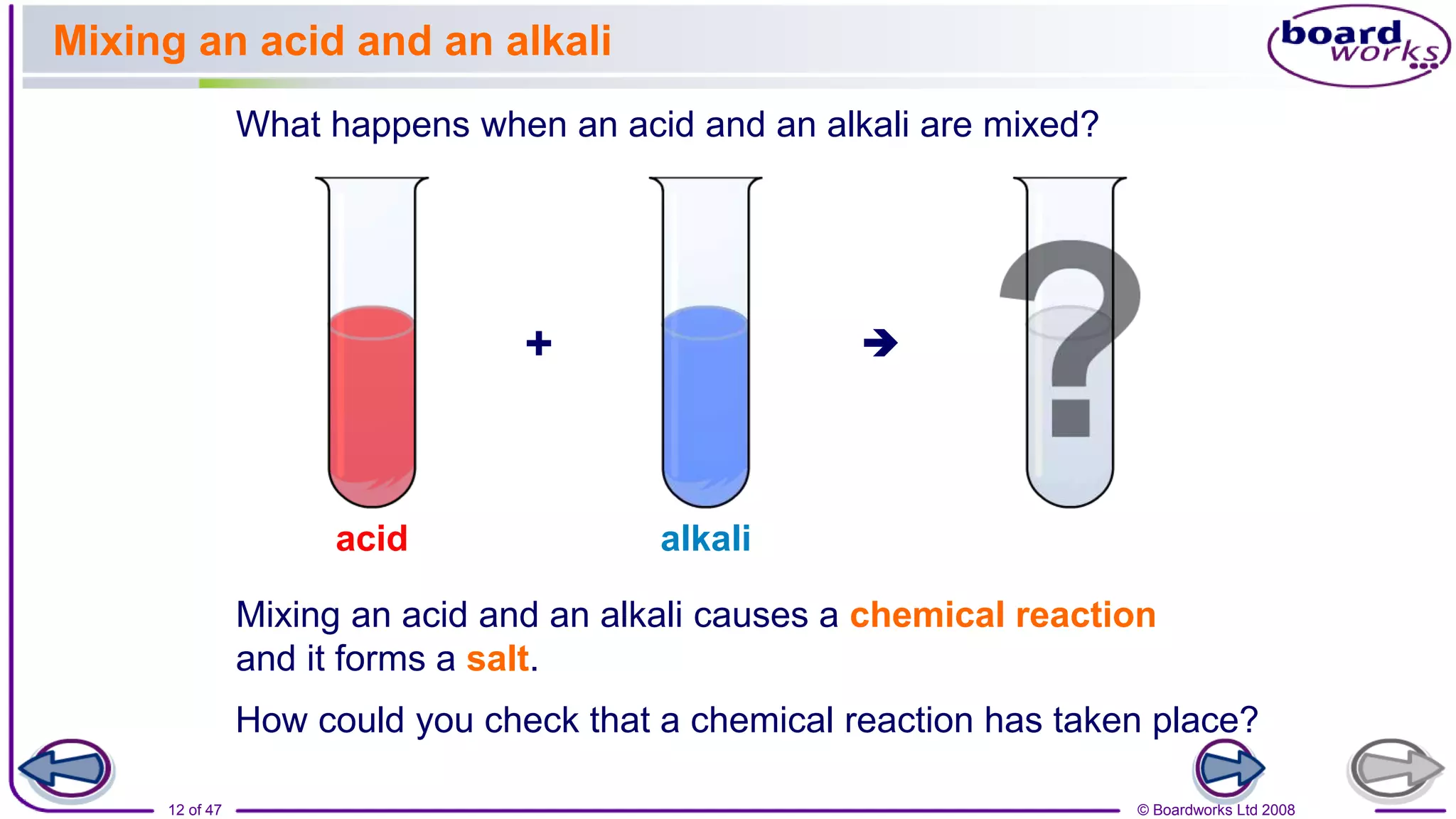
Mixing an acid and an alkali
What happens when an acid and an alkali are mixed?
Mixing an acid and an alkali causes a chemical reaction
and it forms a salt.
How could you check that a chemical reaction has taken place?
+ 
acid alkali
© Boardworks Ltd 2008
13 of 47
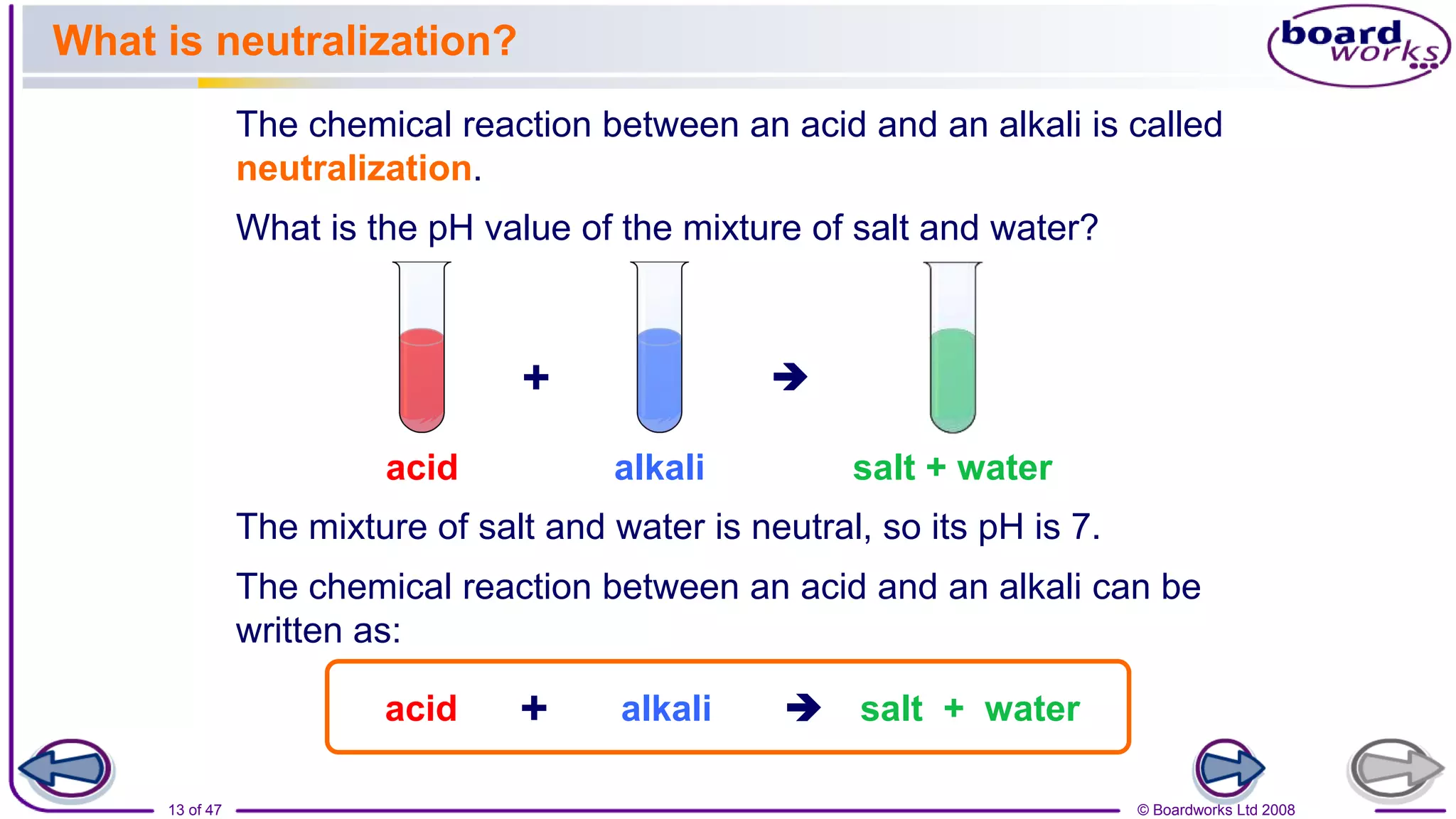
What is neutralization?
The chemical reaction between an acid and an alkali is called
neutralization.
What is the pH value of the mixture of salt and water?
The chemical reaction between an acid and an alkali can be
written as:
+ 
acid alkali salt + water
+ 
acid alkali salt + water
The mixture of salt and water is neutral, so its pH is 7.
© Boardworks Ltd 2008
14 of 47
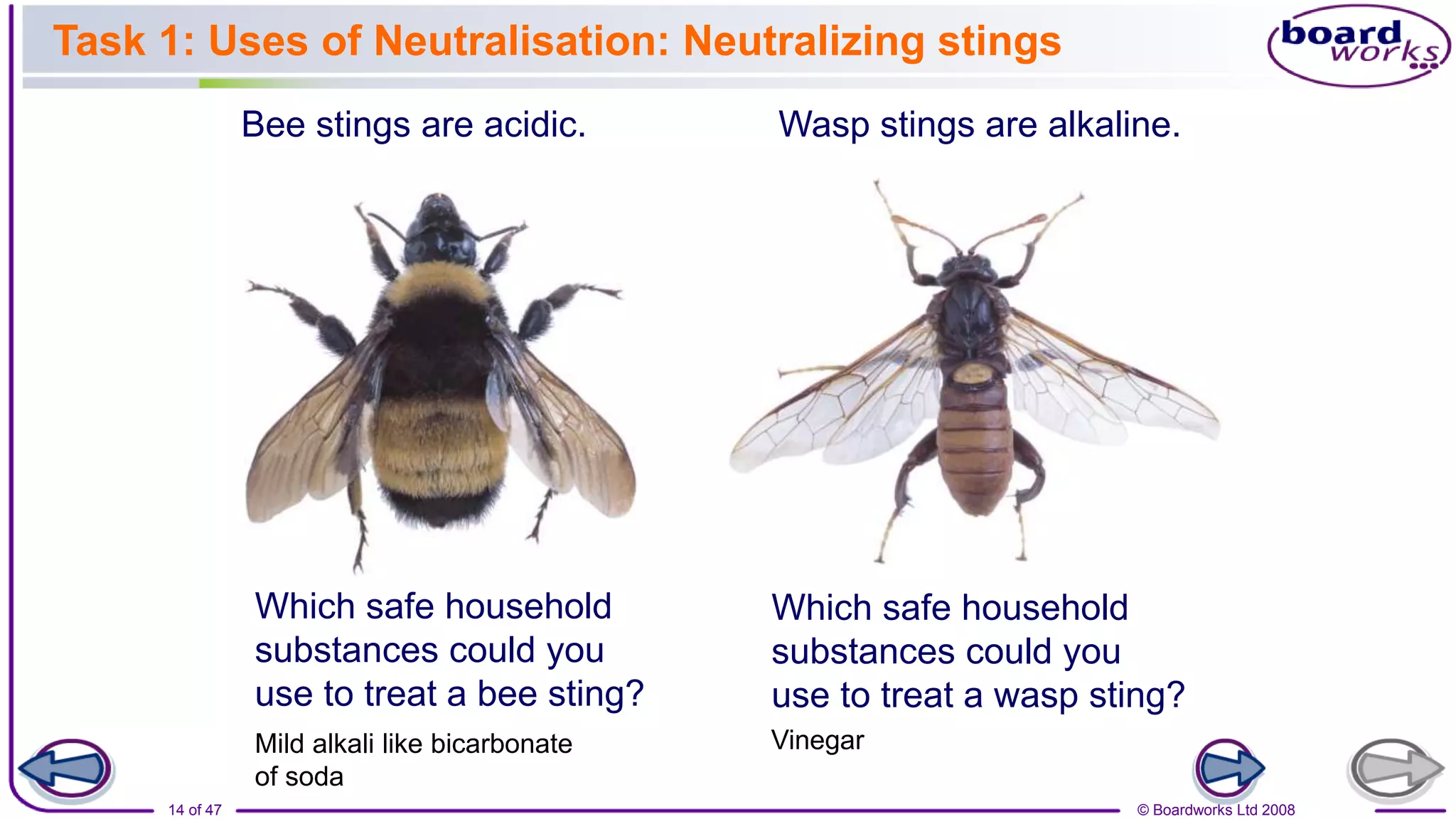
Task 1: Uses of Neutralisation: Neutralizing stings
Bee stings are acidic.
Which safe household
substances could you
use to treat a bee sting?
Wasp stings are alkaline.
Which safe household
substances could you
use to treat a wasp sting?
Mild alkali like bicarbonate
of soda
Vinegar
© Boardworks Ltd 2008
15 of 47
AFL-
© Boardworks Ltd 2008
16 of 47
• Part B
© Boardworks Ltd 2008
17 of 47
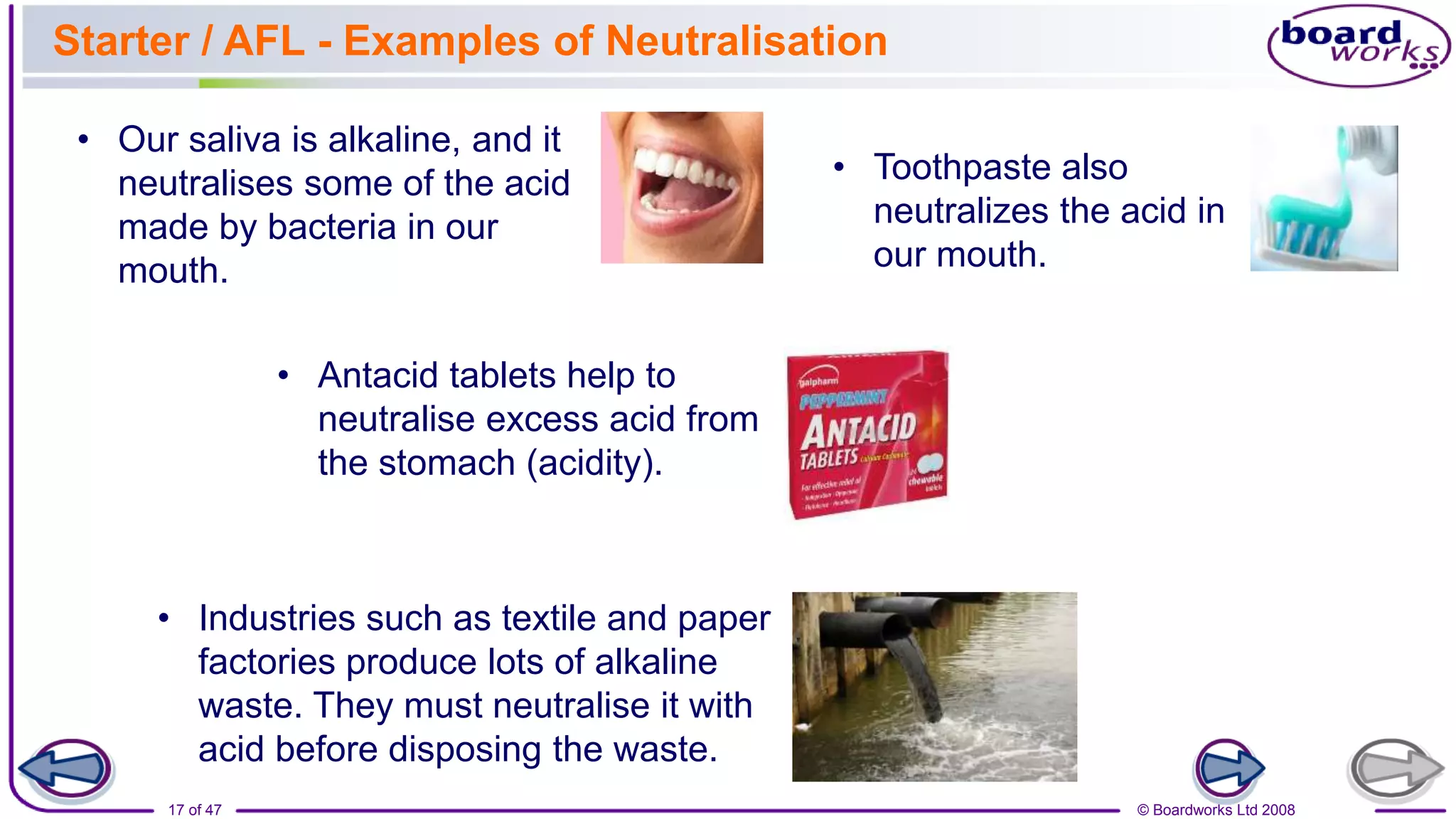
Starter / AFL - Examples of Neutralisation
• Our saliva is alkaline, and it
neutralises some of the acid
made by bacteria in our
mouth.
• Toothpaste also
neutralizes the acid in
our mouth.
• Antacid tablets help to
neutralise excess acid from
the stomach (acidity).
• Industries such as textile and paper
factories produce lots of alkaline
waste. They must neutralise it with
acid before disposing the waste.
© Boardworks Ltd 2008
18 of 47
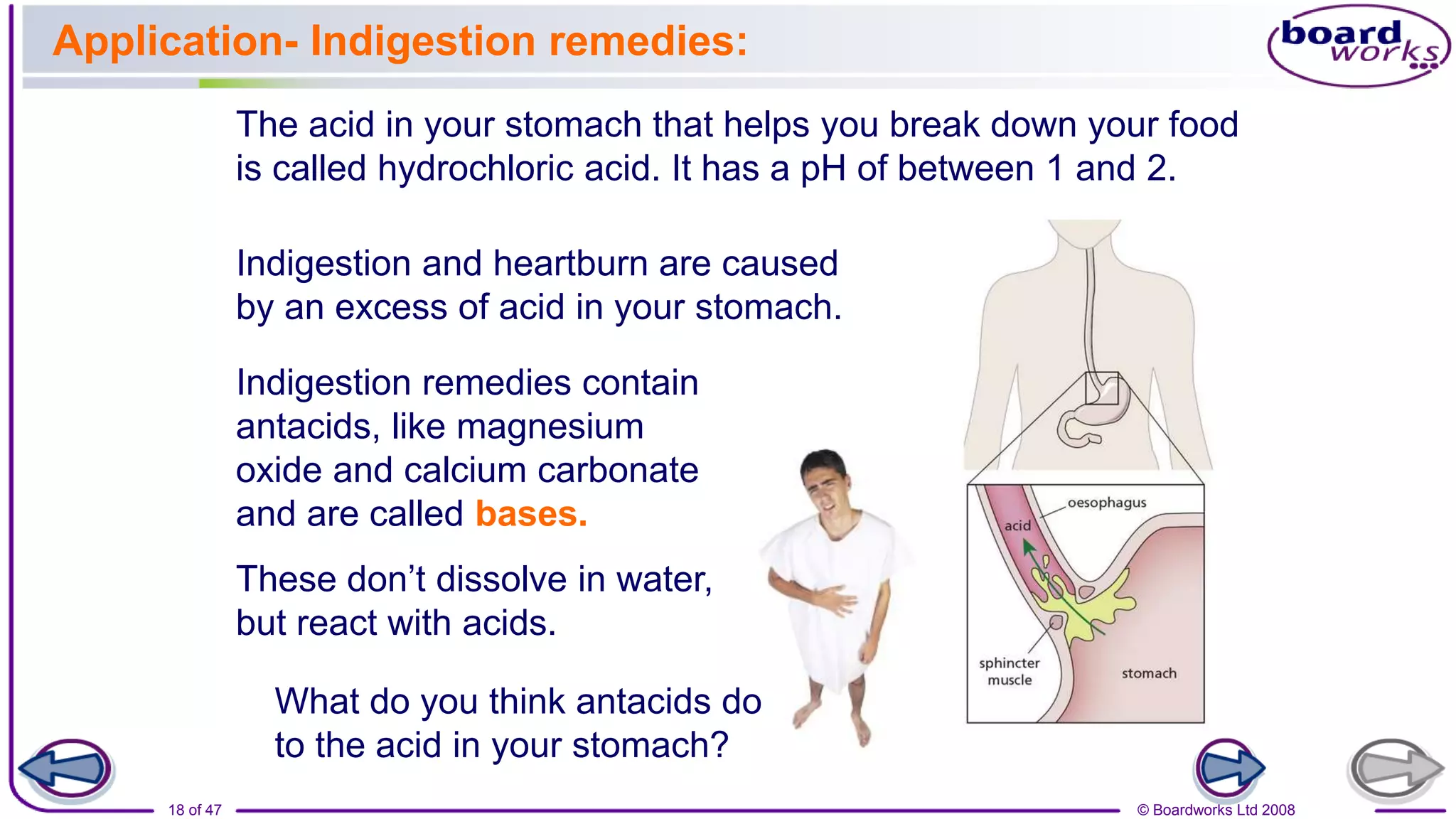
Application- Indigestion remedies:
Indigestion and heartburn are caused
by an excess of acid in your stomach.
Indigestion remedies contain
antacids, like magnesium
oxide and calcium carbonate
and are called bases.
These don’t dissolve in water,
but react with acids.
What do you think antacids do
to the acid in your stomach?
The acid in your stomach that helps you break down your food
is called hydrochloric acid. It has a pH of between 1 and 2.
© Boardworks Ltd 2008
19 of 47
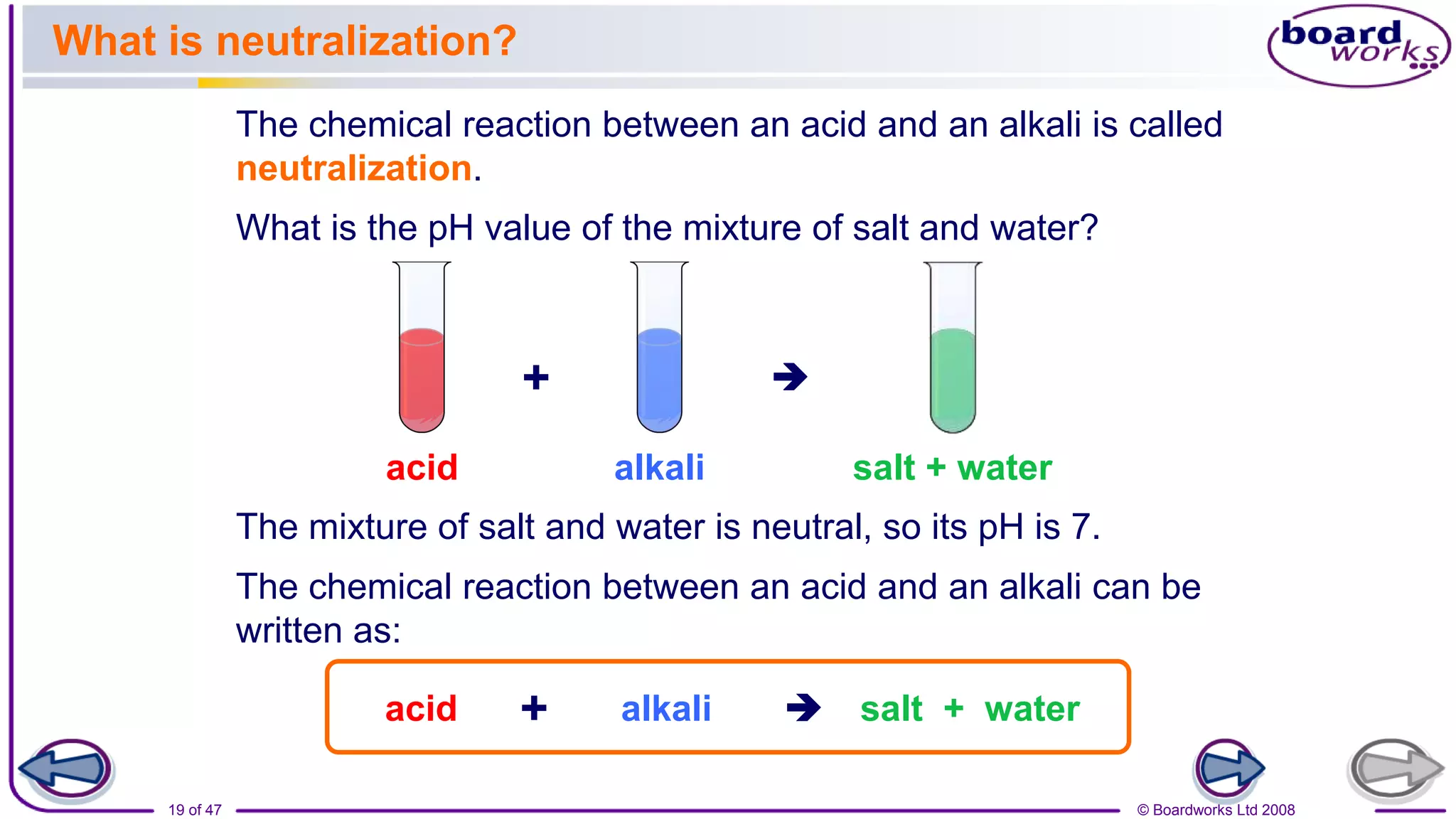
What is neutralization?
The chemical reaction between an acid and an alkali is called
neutralization.
What is the pH value of the mixture of salt and water?
The chemical reaction between an acid and an alkali can be
written as:
+ 
acid alkali salt + water
+ 
acid alkali salt + water
The mixture of salt and water is neutral, so its pH is 7.
© Boardworks Ltd 2008
20 of 47
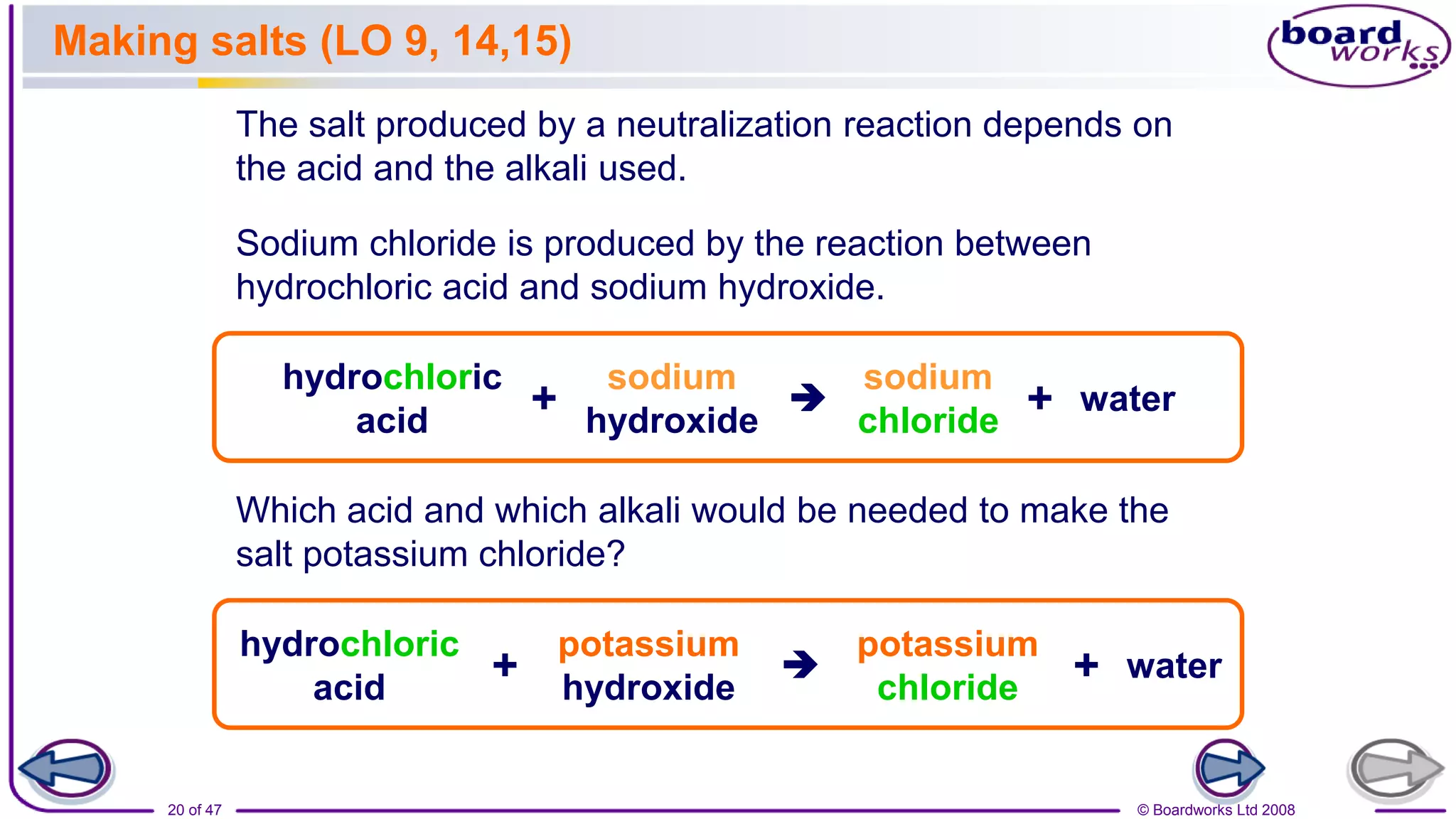
Making salts (LO 9, 14,15)
The salt produced by a neutralization reaction depends on
the acid and the alkali used.
Sodium chloride is produced by the reaction between
hydrochloric acid and sodium hydroxide.
Which acid and which alkali would be needed to make the
salt potassium chloride?
potassium
hydroxide
hydrochloric
acid
+ 
potassium
chloride
water
+
+  +
sodium
hydroxide
sodium
chloride
hydrochloric
acid
water
© Boardworks Ltd 2008
21 of 47
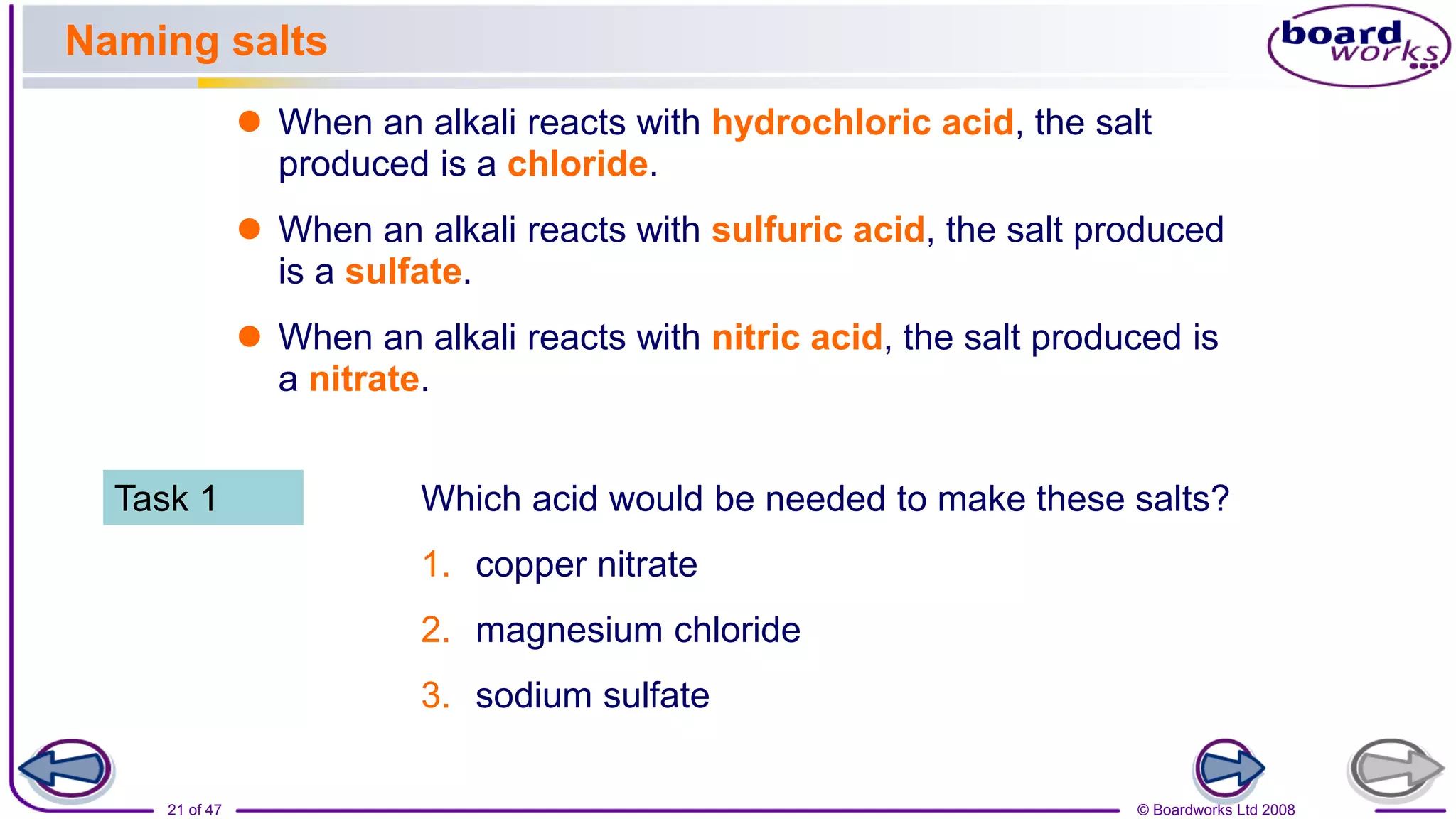
Naming salts
 When an alkali reacts with hydrochloric acid, the salt
produced is a chloride.
 When an alkali reacts with sulfuric acid, the salt produced
is a sulfate.
 When an alkali reacts with nitric acid, the salt produced is
a nitrate.
Which acid would be needed to make these salts?
1. copper nitrate
2. magnesium chloride
3. sodium sulfate
Task 1
© Boardworks Ltd 2008
22 of 47
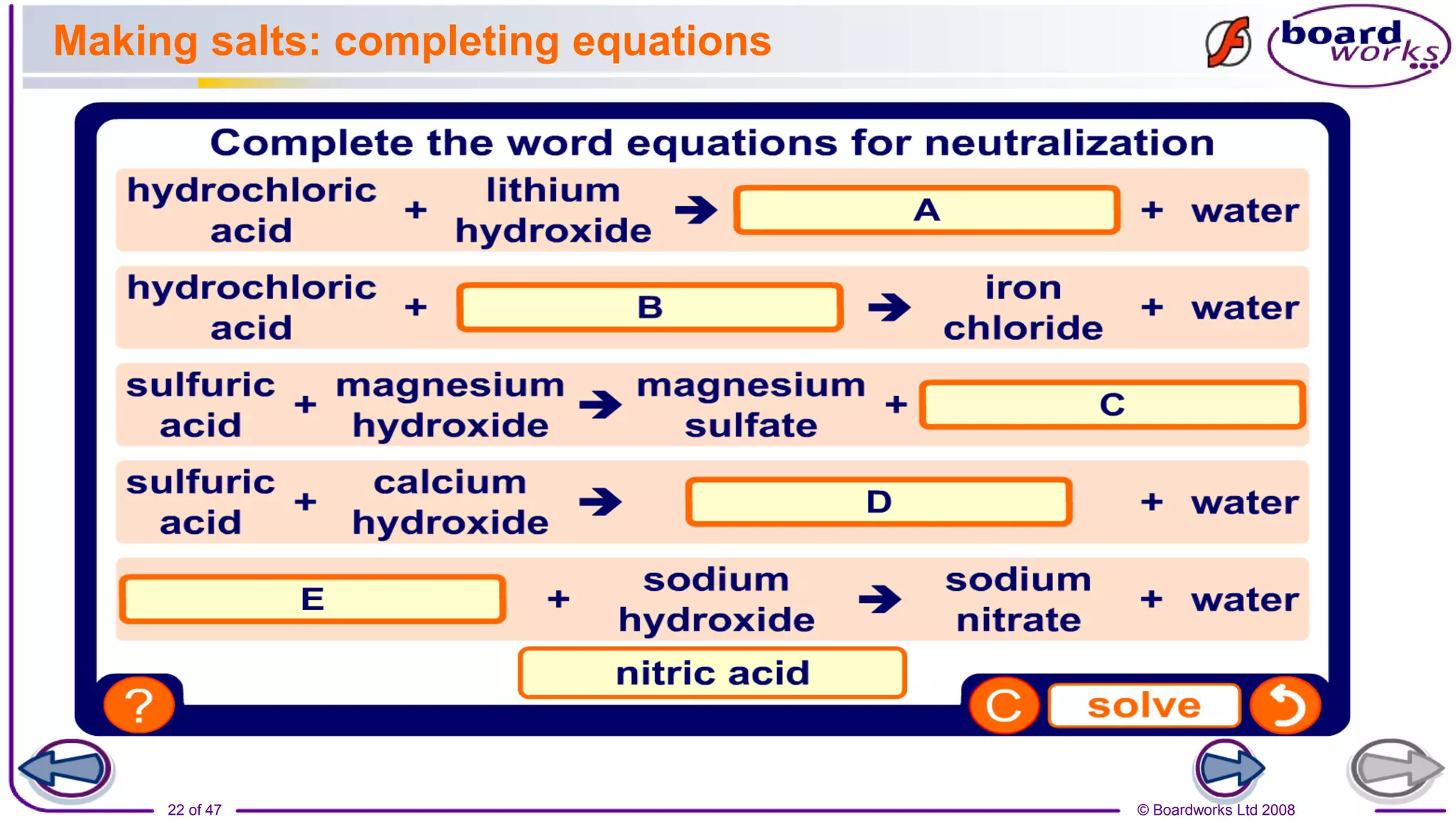
Making salts: completing equations
© Boardworks Ltd 2008
23 of 47
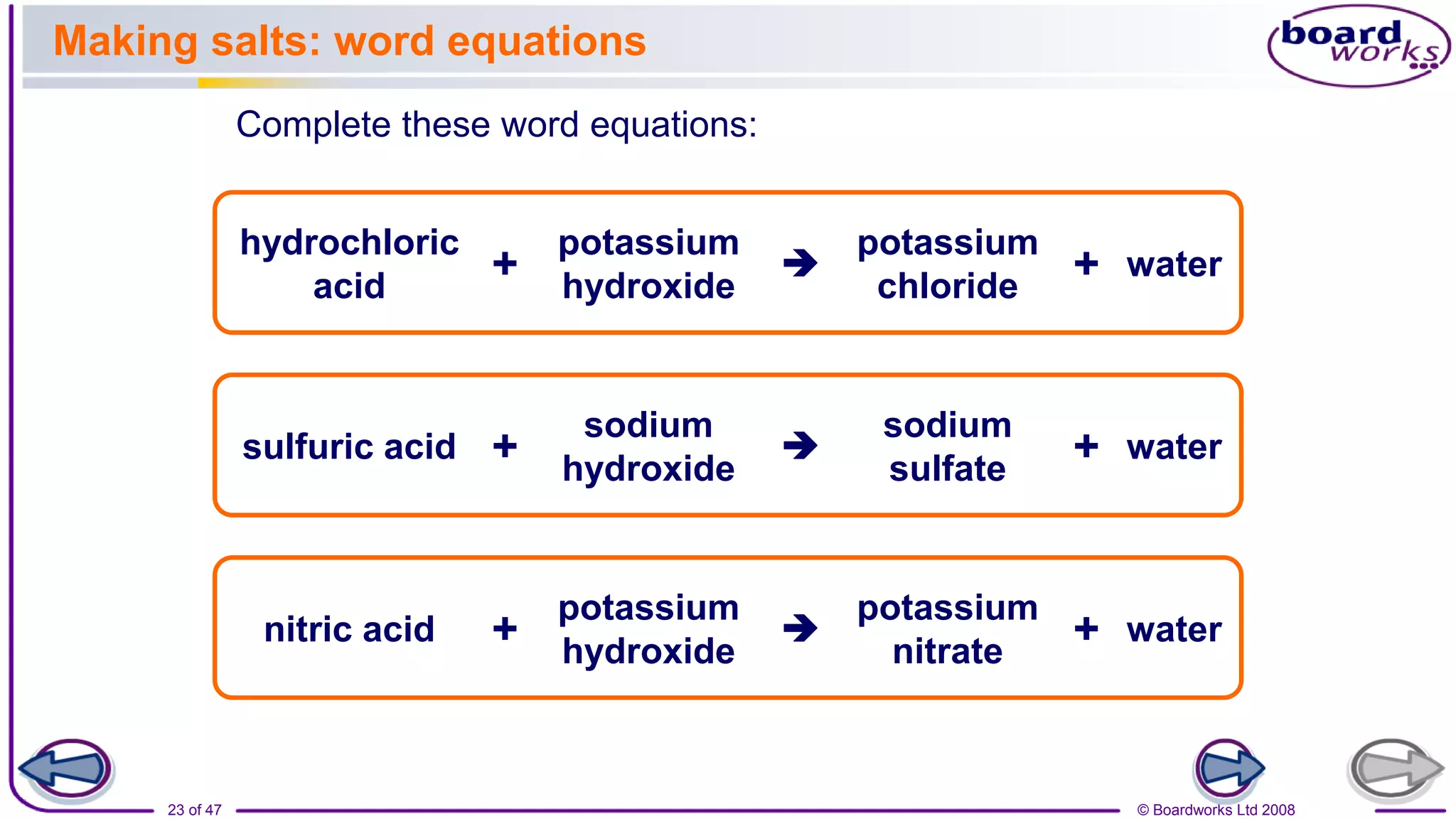
Making salts: word equations
potassium
hydroxide
hydrochloric
acid
+ 
potassium
chloride
water
+
sodium
hydroxide
sulfuric acid + 
sodium
sulfate
water
+
potassium
hydroxide
nitric acid + 
potassium
nitrate
water
+
Complete these word equations:
© Boardworks Ltd 2008
24 of 47
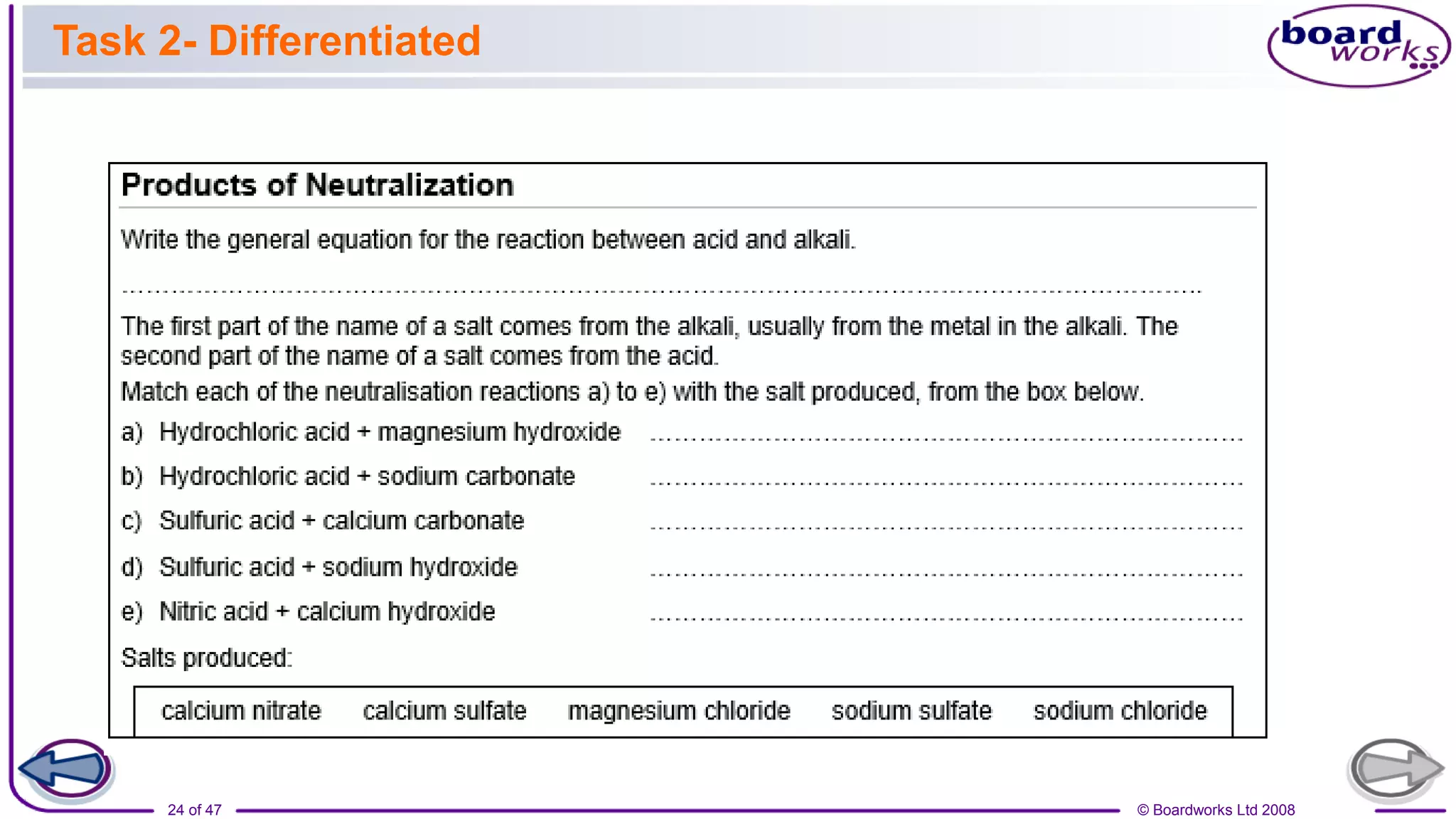
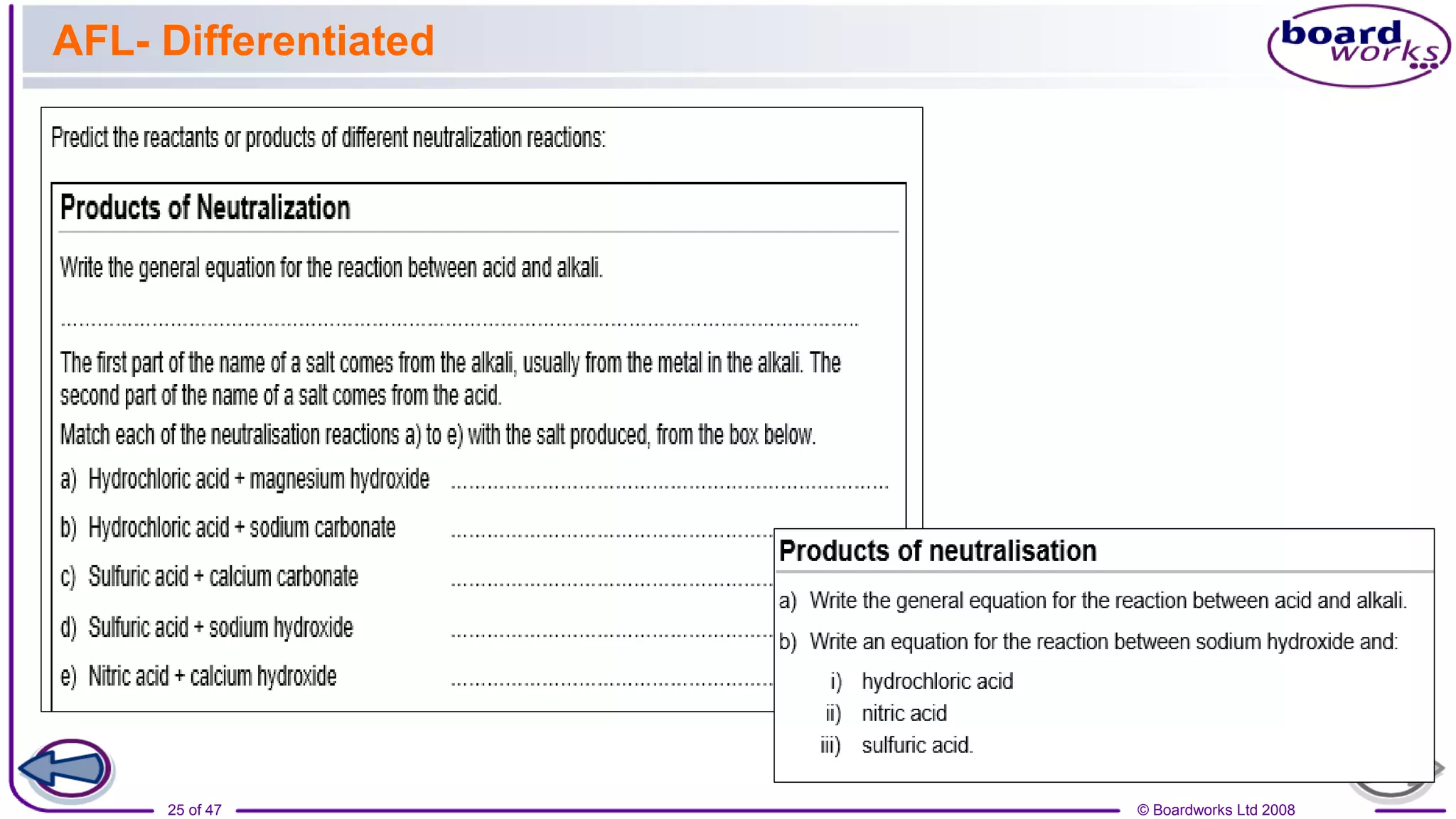
Task 2- Differentiated
© Boardworks Ltd 2008
25 of 47
AFL- Differentiated
© Boardworks Ltd 2008
26 of 47
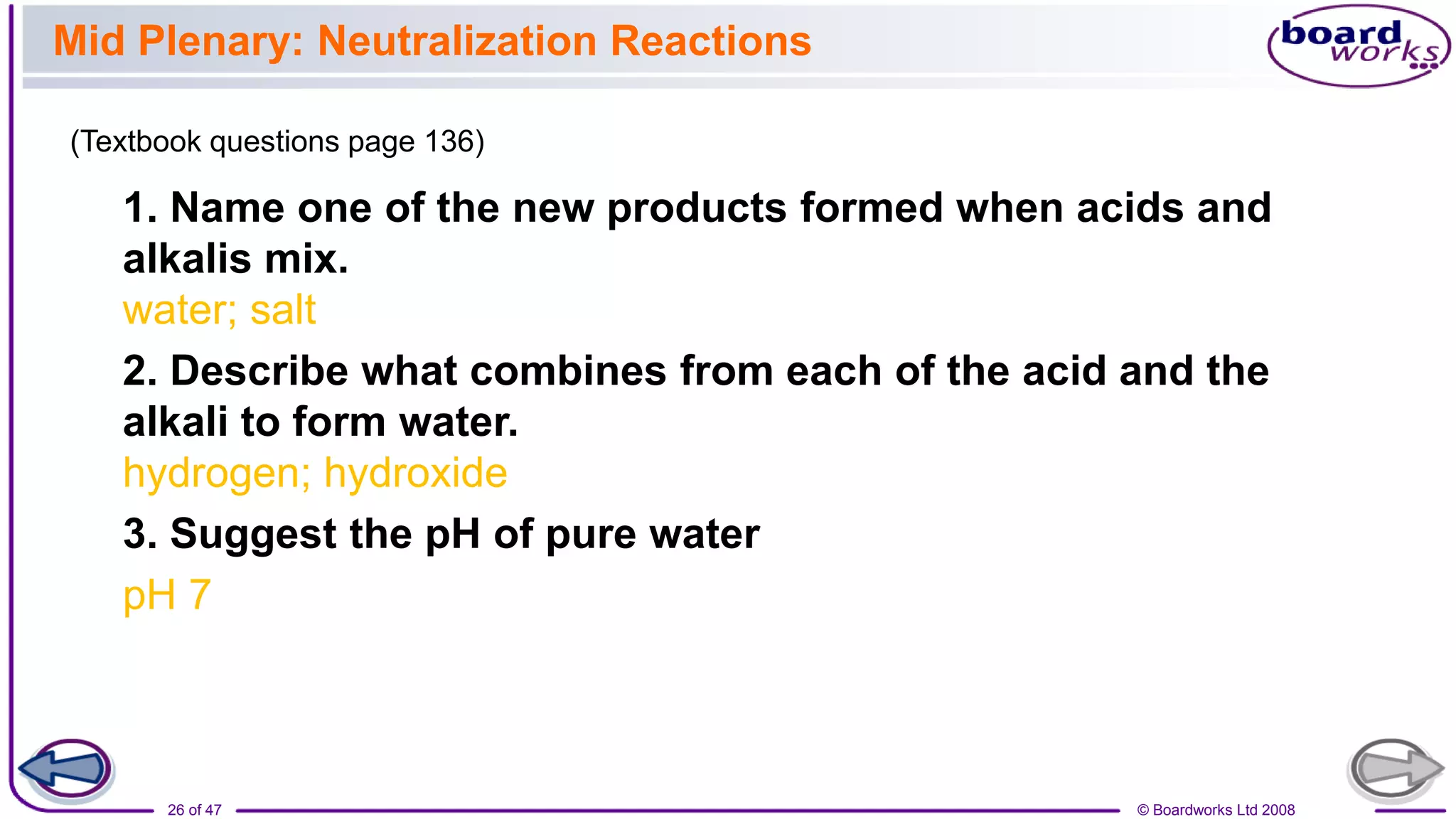
Mid Plenary: Neutralization Reactions
1. Name one of the new products formed when acids and
alkalis mix.
water; salt
2. Describe what combines from each of the acid and the
alkali to form water.
hydrogen; hydroxide
3. Suggest the pH of pure water
pH 7
(Textbook questions page 136)
© Boardworks Ltd 2008
27 of 47
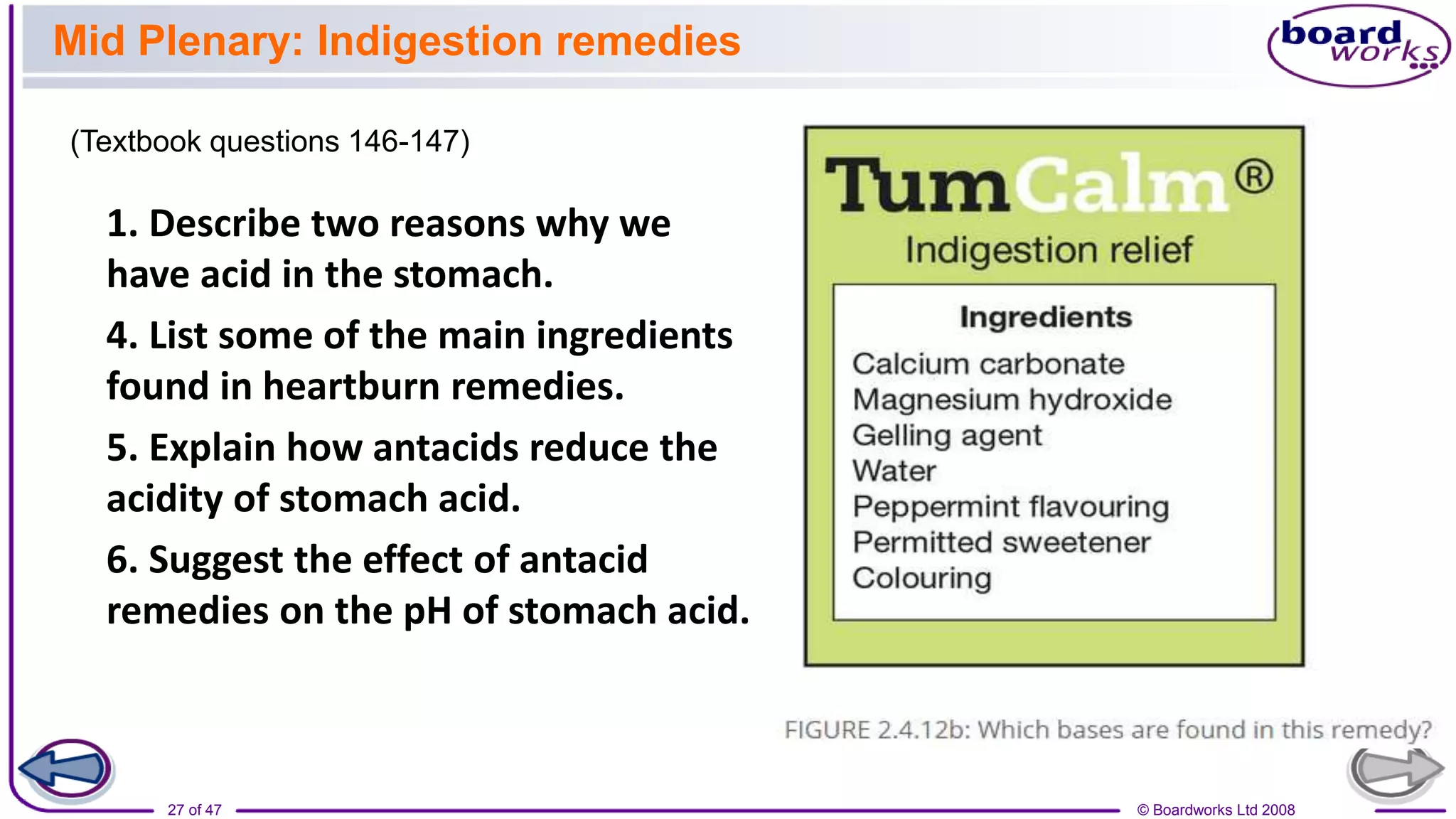
1. Describe two reasons why we
have acid in the stomach.
4. List some of the main ingredients
found in heartburn remedies.
5. Explain how antacids reduce the
acidity of stomach acid.
6. Suggest the effect of antacid
remedies on the pH of stomach acid.
Mid Plenary: Indigestion remedies
(Textbook questions 146-147)
© Boardworks Ltd 2008
28 of 47
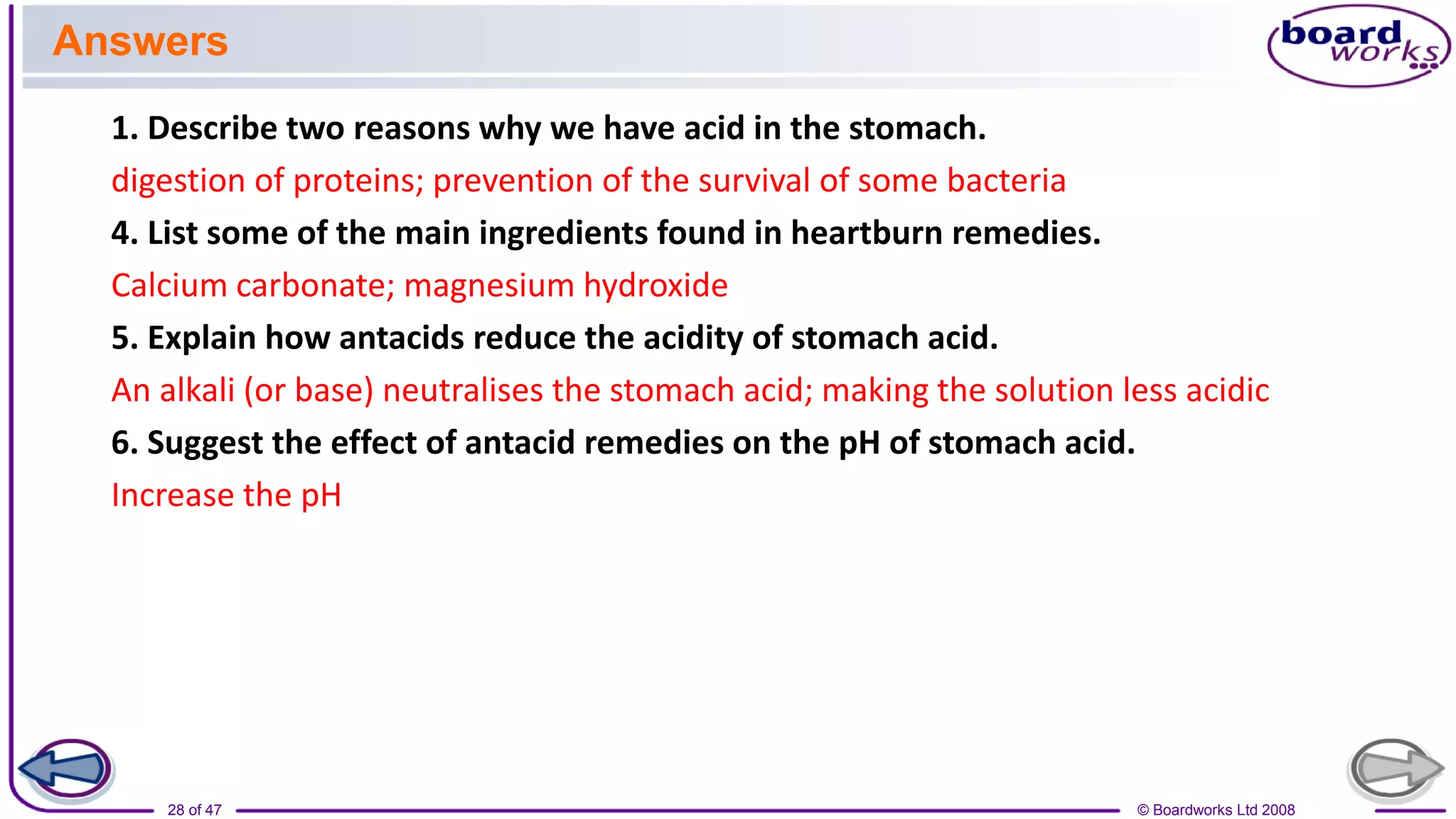
1. Describe two reasons why we have acid in the stomach.
digestion of proteins; prevention of the survival of some bacteria
4. List some of the main ingredients found in heartburn remedies.
Calcium carbonate; magnesium hydroxide
5. Explain how antacids reduce the acidity of stomach acid.
An alkali (or base) neutralises the stomach acid; making the solution less acidic
6. Suggest the effect of antacid remedies on the pH of stomach acid.
Increase the pH
Answers
© Boardworks Ltd 2008
29 of 47
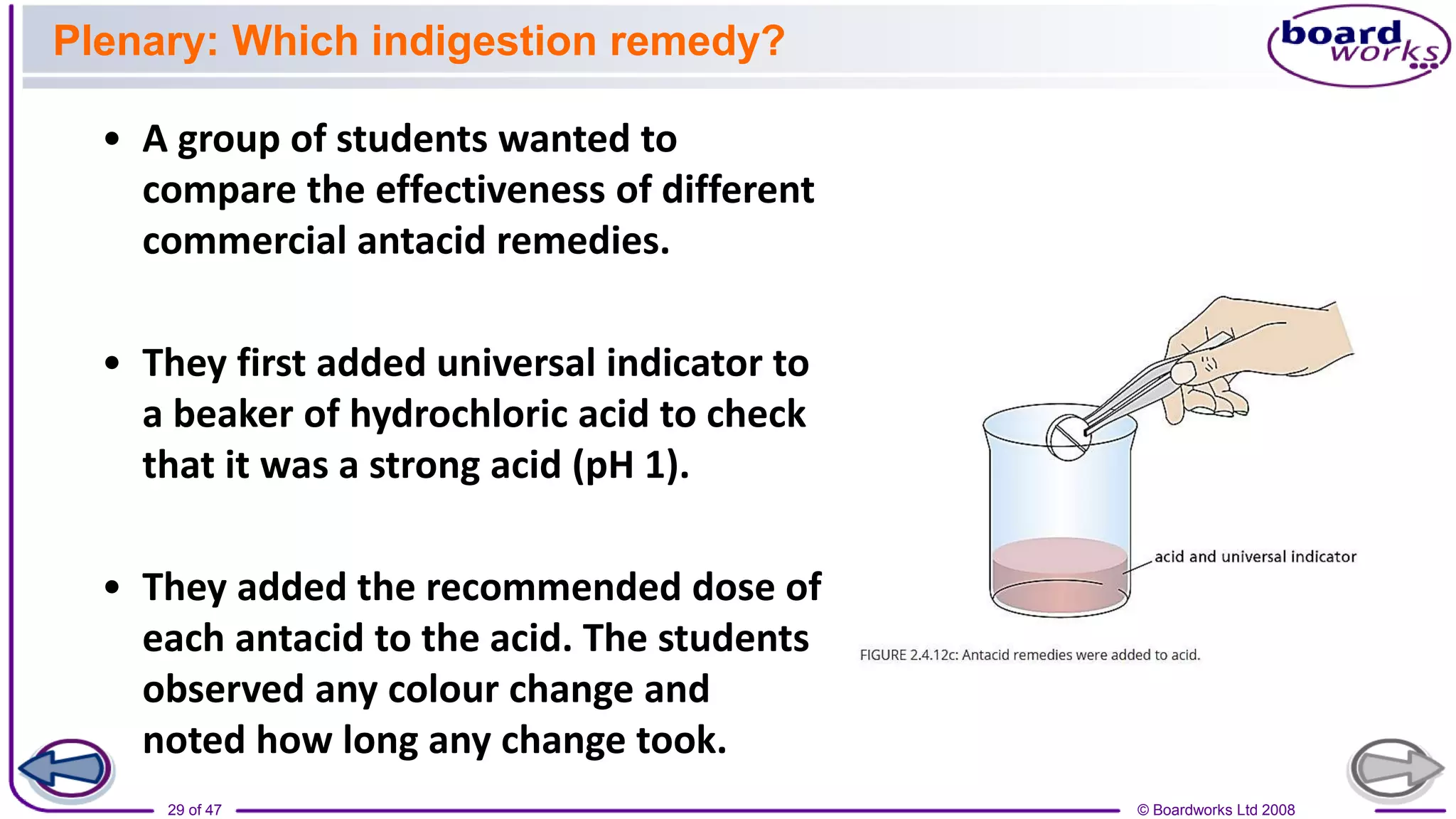
• A group of students wanted to
compare the effectiveness of different
commercial antacid remedies.
• They first added universal indicator to
a beaker of hydrochloric acid to check
that it was a strong acid (pH 1).
• They added the recommended dose of
each antacid to the acid. The students
observed any colour change and
noted how long any change took.
Plenary: Which indigestion remedy?
© Boardworks Ltd 2008
30 of 47
Task 3 Analyzing data about indigestion remedies
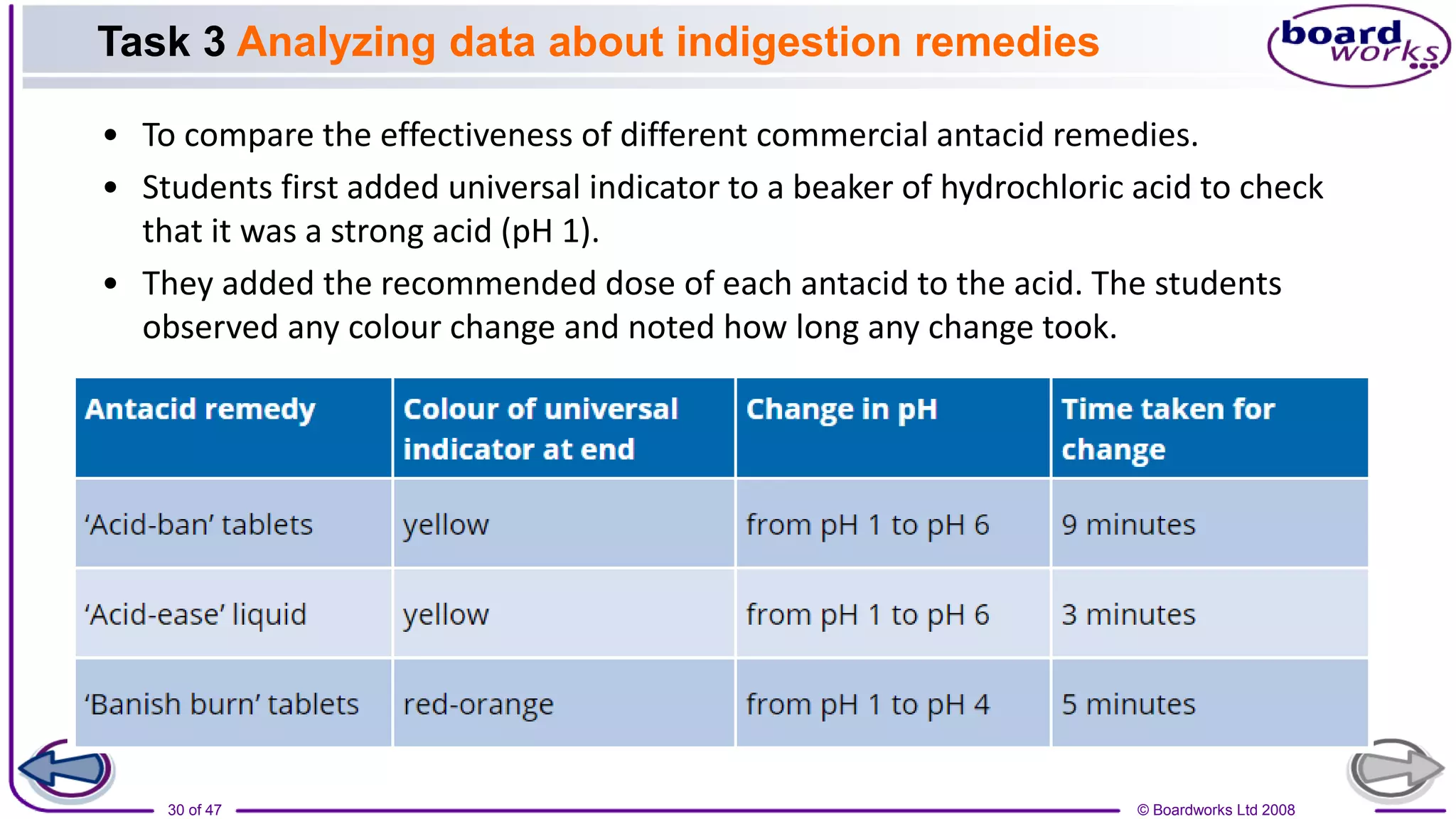
• To compare the effectiveness of different commercial antacid remedies.
• Students first added universal indicator to a beaker of hydrochloric acid to check
that it was a strong acid (pH 1).
• They added the recommended dose of each antacid to the acid. The students
observed any colour change and noted how long any change took.
© Boardworks Ltd 2008
31 of 47
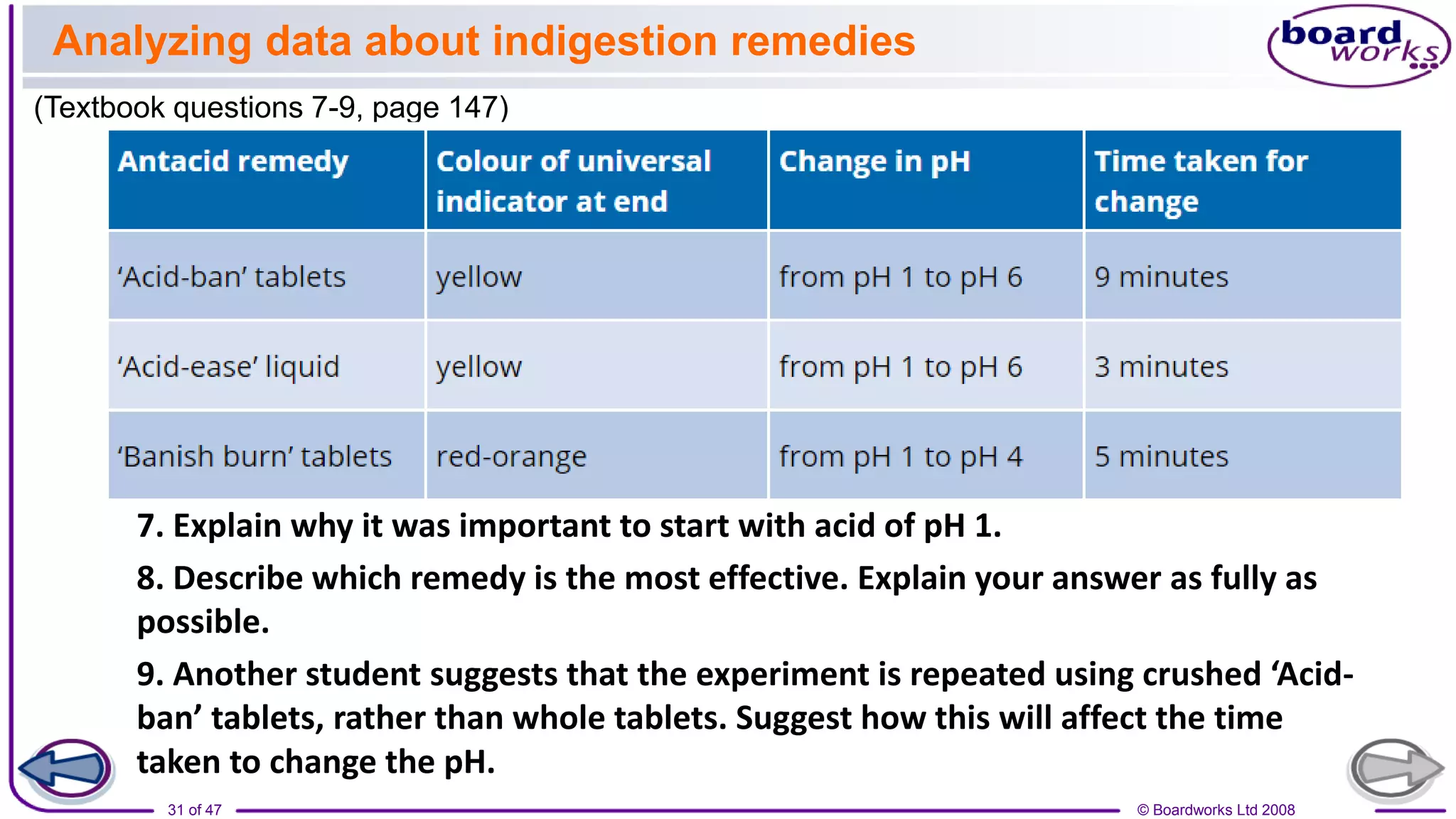
7. Explain why it was important to start with acid of pH 1.
8. Describe which remedy is the most effective. Explain your answer as fully as
possible.
9. Another student suggests that the experiment is repeated using crushed ‘Acid-
ban’ tablets, rather than whole tablets. Suggest how this will affect the time
taken to change the pH.
Analyzing data about indigestion remedies
(Textbook questions 7-9, page 147)
© Boardworks Ltd 2008
32 of 47
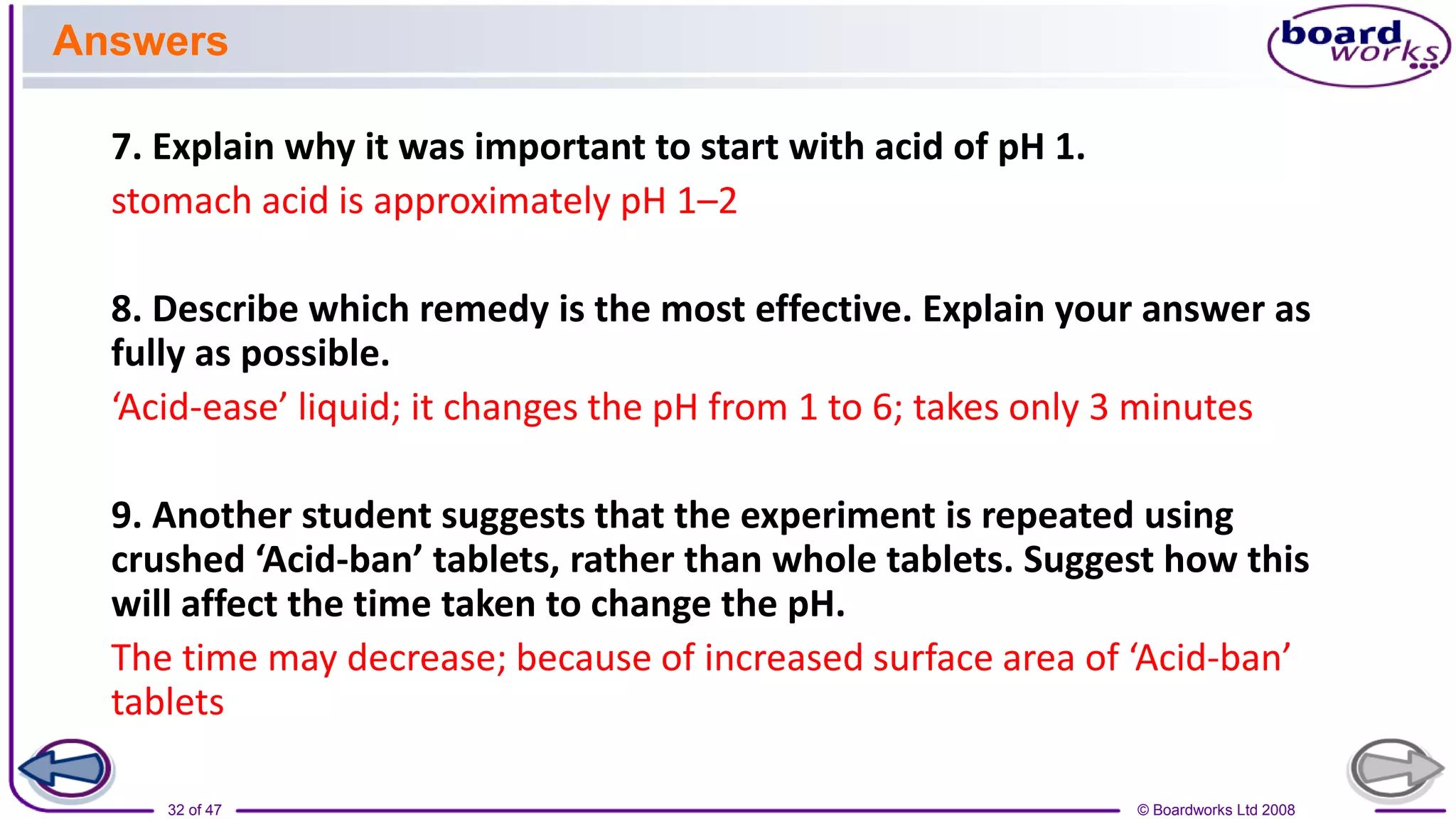
7. Explain why it was important to start with acid of pH 1.
stomach acid is approximately pH 1–2
8. Describe which remedy is the most effective. Explain your answer as
fully as possible.
‘Acid-ease’ liquid; it changes the pH from 1 to 6; takes only 3 minutes
9. Another student suggests that the experiment is repeated using
crushed ‘Acid-ban’ tablets, rather than whole tablets. Suggest how this
will affect the time taken to change the pH.
The time may decrease; because of increased surface area of ‘Acid-ban’
tablets
Answers
© Boardworks Ltd 2008
33 of 47
Extension Task
Try and find out how the fire services deal with a large scale spillage of acid. (Internet research)
Quiz time
https://quizizz.com/admin/quiz/601aa1ed385b47001b57b287

Year 8 -Term 2- Unit 4 - Lesson 3- Neutralization

  • 1.
    Analyse data aboutindigestion remedies to decide which remedy is the most effective (15) Elaborate the changes to indicators in terms of pH when acids and alkalis are mixed (13) Predict the reactants or products of different neutralisation reactions (11) Explain the formation of salt and water during neutralisation, giving some examples of common salts (11) Describe some examples of neutralization (6) Explain that some changes results in the formation of new materials (3) Recognise some changes can be physical or chemical. (2) Outcomes addressed in the lesson:
  • 2.
    Topic: Neutralisation Learning Outcome:Students will be able to  Predict the reactants or products of different neutralisation reactions using some examples.  Explain the formation of salt and water during neutralisation, giving some examples of common salts Learning Objective: To describe examples of neutralization reaction and changes to indicators in terms of pH.
  • 3.
    © Boardworks Ltd2008 3 of 47 Starter: Recap: Acids: true or false?
  • 4.
    © Boardworks Ltd2008 4 of 47 Recap: Alkalis: true or false?
  • 5.
    © Boardworks Ltd2008 5 of 47 Recap: What is the order of pH?
  • 6.
    © Boardworks Ltd2008 6 of 47 Brain Teaser: Mixing an acid and an alkali What happens when an acid and an alkali are mixed? +  acid alkali
  • 7.
    © Boardworks Ltd2008 7 of 47 https://www.youtube.com/watch?v=RmnT9jwX4gQ Watch video https://www.youtube.com/watch?v=8UiuE7Xx5l8 Explore
  • 8.
    What happens duringneutralisation? (Mixing acid with alkali) Concept Cartoon
  • 9.
    9 of 47 Task1 : Neutralisation Create an information sheet/ poster/mind map covering the Highlighting aspects of neutralisation: 1. Changes to pH and indicators 2. Uses and examples of neutralization 3. Chemical reaction of neutralization (reactants, products)
  • 10.
    © Boardworks Ltd2008 10 of 47 Mixing acids and alkalis Challenge: What colour change would be seen as the solution changed from a strong alkali to neutral?
  • 11.
    © Boardworks Ltd2008 11 of 47 Challenge: What would be seen if more acid was added after the neutral point was reached. pH change during neutralization
  • 12.
    © Boardworks Ltd2008 12 of 47 Mixing an acid and an alkali What happens when an acid and an alkali are mixed? Mixing an acid and an alkali causes a chemical reaction and it forms a salt. How could you check that a chemical reaction has taken place? +  acid alkali
  • 13.
    © Boardworks Ltd2008 13 of 47 What is neutralization? The chemical reaction between an acid and an alkali is called neutralization. What is the pH value of the mixture of salt and water? The chemical reaction between an acid and an alkali can be written as: +  acid alkali salt + water +  acid alkali salt + water The mixture of salt and water is neutral, so its pH is 7.
  • 14.
    © Boardworks Ltd2008 14 of 47 Task 1: Uses of Neutralisation: Neutralizing stings Bee stings are acidic. Which safe household substances could you use to treat a bee sting? Wasp stings are alkaline. Which safe household substances could you use to treat a wasp sting? Mild alkali like bicarbonate of soda Vinegar
  • 15.
    © Boardworks Ltd2008 15 of 47 AFL-
  • 16.
    © Boardworks Ltd2008 16 of 47 • Part B
  • 17.
    © Boardworks Ltd2008 17 of 47 Starter / AFL - Examples of Neutralisation • Our saliva is alkaline, and it neutralises some of the acid made by bacteria in our mouth. • Toothpaste also neutralizes the acid in our mouth. • Antacid tablets help to neutralise excess acid from the stomach (acidity). • Industries such as textile and paper factories produce lots of alkaline waste. They must neutralise it with acid before disposing the waste.
  • 18.
    © Boardworks Ltd2008 18 of 47 Application- Indigestion remedies: Indigestion and heartburn are caused by an excess of acid in your stomach. Indigestion remedies contain antacids, like magnesium oxide and calcium carbonate and are called bases. These don’t dissolve in water, but react with acids. What do you think antacids do to the acid in your stomach? The acid in your stomach that helps you break down your food is called hydrochloric acid. It has a pH of between 1 and 2.
  • 19.
    © Boardworks Ltd2008 19 of 47 What is neutralization? The chemical reaction between an acid and an alkali is called neutralization. What is the pH value of the mixture of salt and water? The chemical reaction between an acid and an alkali can be written as: +  acid alkali salt + water +  acid alkali salt + water The mixture of salt and water is neutral, so its pH is 7.
  • 20.
    © Boardworks Ltd2008 20 of 47 Making salts (LO 9, 14,15) The salt produced by a neutralization reaction depends on the acid and the alkali used. Sodium chloride is produced by the reaction between hydrochloric acid and sodium hydroxide. Which acid and which alkali would be needed to make the salt potassium chloride? potassium hydroxide hydrochloric acid +  potassium chloride water + +  + sodium hydroxide sodium chloride hydrochloric acid water
  • 21.
    © Boardworks Ltd2008 21 of 47 Naming salts  When an alkali reacts with hydrochloric acid, the salt produced is a chloride.  When an alkali reacts with sulfuric acid, the salt produced is a sulfate.  When an alkali reacts with nitric acid, the salt produced is a nitrate. Which acid would be needed to make these salts? 1. copper nitrate 2. magnesium chloride 3. sodium sulfate Task 1
  • 22.
    © Boardworks Ltd2008 22 of 47 Making salts: completing equations
  • 23.
    © Boardworks Ltd2008 23 of 47 Making salts: word equations potassium hydroxide hydrochloric acid +  potassium chloride water + sodium hydroxide sulfuric acid +  sodium sulfate water + potassium hydroxide nitric acid +  potassium nitrate water + Complete these word equations:
  • 24.
    © Boardworks Ltd2008 24 of 47 Task 2- Differentiated
  • 25.
    © Boardworks Ltd2008 25 of 47 AFL- Differentiated
  • 26.
    © Boardworks Ltd2008 26 of 47 Mid Plenary: Neutralization Reactions 1. Name one of the new products formed when acids and alkalis mix. water; salt 2. Describe what combines from each of the acid and the alkali to form water. hydrogen; hydroxide 3. Suggest the pH of pure water pH 7 (Textbook questions page 136)
  • 27.
    © Boardworks Ltd2008 27 of 47 1. Describe two reasons why we have acid in the stomach. 4. List some of the main ingredients found in heartburn remedies. 5. Explain how antacids reduce the acidity of stomach acid. 6. Suggest the effect of antacid remedies on the pH of stomach acid. Mid Plenary: Indigestion remedies (Textbook questions 146-147)
  • 28.
    © Boardworks Ltd2008 28 of 47 1. Describe two reasons why we have acid in the stomach. digestion of proteins; prevention of the survival of some bacteria 4. List some of the main ingredients found in heartburn remedies. Calcium carbonate; magnesium hydroxide 5. Explain how antacids reduce the acidity of stomach acid. An alkali (or base) neutralises the stomach acid; making the solution less acidic 6. Suggest the effect of antacid remedies on the pH of stomach acid. Increase the pH Answers
  • 29.
    © Boardworks Ltd2008 29 of 47 • A group of students wanted to compare the effectiveness of different commercial antacid remedies. • They first added universal indicator to a beaker of hydrochloric acid to check that it was a strong acid (pH 1). • They added the recommended dose of each antacid to the acid. The students observed any colour change and noted how long any change took. Plenary: Which indigestion remedy?
  • 30.
    © Boardworks Ltd2008 30 of 47 Task 3 Analyzing data about indigestion remedies • To compare the effectiveness of different commercial antacid remedies. • Students first added universal indicator to a beaker of hydrochloric acid to check that it was a strong acid (pH 1). • They added the recommended dose of each antacid to the acid. The students observed any colour change and noted how long any change took.
  • 31.
    © Boardworks Ltd2008 31 of 47 7. Explain why it was important to start with acid of pH 1. 8. Describe which remedy is the most effective. Explain your answer as fully as possible. 9. Another student suggests that the experiment is repeated using crushed ‘Acid- ban’ tablets, rather than whole tablets. Suggest how this will affect the time taken to change the pH. Analyzing data about indigestion remedies (Textbook questions 7-9, page 147)
  • 32.
    © Boardworks Ltd2008 32 of 47 7. Explain why it was important to start with acid of pH 1. stomach acid is approximately pH 1–2 8. Describe which remedy is the most effective. Explain your answer as fully as possible. ‘Acid-ease’ liquid; it changes the pH from 1 to 6; takes only 3 minutes 9. Another student suggests that the experiment is repeated using crushed ‘Acid-ban’ tablets, rather than whole tablets. Suggest how this will affect the time taken to change the pH. The time may decrease; because of increased surface area of ‘Acid-ban’ tablets Answers
  • 33.
    © Boardworks Ltd2008 33 of 47 Extension Task Try and find out how the fire services deal with a large scale spillage of acid. (Internet research) Quiz time https://quizizz.com/admin/quiz/601aa1ed385b47001b57b287